Humans not so special-- other animals with consciences?

As for war, i dont think being advanced will completely eliminate the need of war. It can be argued that war is a means of advancing societies when interest of opposing sides clash. In the case of ants, wars almost always result in the survival of the colonies. Self preservation and advancement of the pecies 101. And make no mistake, there are some ant species who simply do not fight at all.


Ants go to war with other colonies for two primary reasons. 1)because they want to expand their territory or 2) a rival colony is impeding upon their territory. It's pretty much as simple as that.

The expansion of power is indicative of a militaristic mindset which only serves those at the very top, nobody else. So if the trickling down of power alludes all but a few, true advancement can not occur.


Another thing I neglected to mention is that Ants also have a class system, and seeing as how class systems prohibits free will, has a class reserved only for slave labor (worker ants) and allocates power to only a few.

Do you seriously think this is the road map to an advanced innovative society?
 
Okay, the other thread is up.

I quoted you in that thread and I'll paste that specific part right here since this is where it originated:


We, as "normal humans," have such a sense of superiority. Most look down on other animals and express this sort of belief:
Man is both the most high and the most base of creation...because he can consiously decide to do or not to do a thing on a consistent basis...Freewill!!

These other animals move because their natural hardwiring dictates....that's why when you put them in a enviroment opposed to their natural one...no telling what you will see fro them

We see a cat running in circles chasing its tail and see it as a stupid cat, subject to the dictates of natural hardwiring and so unlike us. But next time you're huddled next to your laptop pulling one of these moves :jackoff: you might stop and ask yourself how advanced you really are.

:D There's more to it than that excerpt, you can check the other thread for that... but that's pretty much my rebuttal to your "natural hardwiring dictates" argument.

Well the most obvious flaw is you saying the next time you are at your laptop during the same thing...stop and think....

The cat ain't gon stop and think....he'll get tired or get distracted by something else.....No meditating why he was running in circles...thought you'd come better than that..
Is the average person more likely to stop and think or to finish and get tired or get distracted by something else?

And was the point of my post to compare the mental capacities of humans and cats or was it in response to your statement about the "dictates of natural hardwiring"?

The most obvious flaw here is your completely ducking the major argument...
 
But how do you know that they arent "fettered by mental and spiritual problems"? Again, our understanding is limited and it is subject o our interpretations of their actions and modes of operation. Also, it can be argued that the species which allows themselves to be "fettered" by what we call spiritual problems is further proof of our not so special ways.

Which species is more special/advanced, the one who operates with the focus and purpose of creation and sustaining and advancing life or the one easily distracted and prone to waste copious amounts of time praying to and worshipping invisible beings and trinkets??

Your point is very valid.......
And I guess this is the point that further argument becomes somewhat redundant in that neither pov can be proven or disproven thru the mutually agreed dialectic

Further we come to a fork in the road as regards subjects such as if there is or is not a Conscience Creator of all things...what ever you might call him or it.

My belief is that there is without a doubt...
You express yourself as a intelligent brother....and so I think we can both agree that if you believe otherwise....Then this will become an argument with NO chance of resolution.

So I will ride with the reality that I have experienced....which leads me to the conclusions I have on this matter.....

Sometimes you cannot agree on a thing...but that does not mean there has to be disrespect......which is usually the case and which I mos def see directed at myself in this thread...
The good I see in our exchange is that it did not have to go there....and I think we have carried this dicussion as far as possible as I said with a level of respect...

So Peace!!
 
Is the average person more likely to stop and think or to finish and get tired or get distracted by something else?

And was the point of my post to compare the mental capacities of humans and cats or was it in response to your statement about the "dictates of natural hardwiring"?

The most obvious flaw here is your completely ducking the major argument...

but whether they did or not...they still have the capability...That is the major point!!
 
DOGS cant READ BIBLES! Thats how we know they have no CONSCIENCE!

Only a person with a Conscience can READ THE BIBLE because if you dont know THE WORD, then you don't know GOD.
 
DOGS cant READ BIBLES! Thats how we know they have no CONSCIENCE!

Only a person with a Conscience can READ THE BIBLE because if you dont know THE WORD, then you don't know GOD.
I wonder if all the billions upon billions of animals go to Hell when they die or if they simply cease to exist?

but whether they did or not...they still have the capability...That is the major point!!

Dude, read what you wrote and my response to it. I re-quoted all the shit for you in the last reply. The higher intellectual capability of humans compared to cats was never the issue.

Hint: "dictates of natural hardwiring"-- Check the bold, if you observe humans and cats, they are both subject to these.

Yes, a SMALL minority of humans seek to overcome these natural inclinations, google "Catholic Church pedophilia" to see how well that has worked out.
 
Last edited:
^^^^dont argue with fools :smh:
It's prep for everyday arguments, you really can't avoid it unless you take a vow of silence. :dunno:

I never believed in that line before anyway; we're all the fool sometimes...And sometimes, rarely, you get through to someone (or they get through to you).
 
I wonder if all the billions upon billions of animals go to Hell when they die or if they simply cease to exist?


Dude, read what you wrote and my response to it. I re-quoted all the shit for you in the last reply. The higher intellectual capability of humans compared to cats was never the issue.

Hint: "dictates of natural hardwiring"-- Check the bold, if you observe humans and cats, they are both subject to these.

Yes, a SMALL minority of humans seek to overcome these natural inclinations, google "Catholic Church pedophilia" to see how well that has worked out.
Well what stuck in my mind was "HARDWIRED"........
Don't mis understand Humans are "HARDWIRED" into a lot of shit...But they have the capacity on so many levels to either overide the wiring or chose a different wiring altogether....and to a certain degree toeven create the wiring that moves and motivates them........Cats and Dogs DO NOT....I for one would not dissmiss that cat running around in circles as being a example of their stupidity...just cause I did not know why they did it....In Humans...Dancing....Playing Music....Sex could all be a kind of wiring.....
Humans can conciously chose to partake or not....The cat doesnot ride that way.....Their reactions and actions if not interupted by external forces are always dictated by their relationship to their primal urges....that is all I'm saying...sorry if I offended you in any way ....seem like you got a attitude.....
Their are a couple of people on this thread I could give less than a fuck about offending cause they stepped wrong from the rip...But I truly am just trying to share what I have observed and learned in your regard...
 
It's prep for everyday arguments, you really can't avoid it unless you take a vow of silence. :dunno:

I never believed in that line before anyway; we're all the fool sometimes...And sometimes, rarely, you get through to someone (or they get through to you).

Now I agree with that statement!!
 
One good example of behaviour of most domesticated animals....is when cats or dogs lick on people...
Some people thought this was a sign of affection...when in reality them animals just wanted to lick the salt off your body...
You thinking they love yo ass so much when in reality they where using you for nutrition...LOL

have you ever had a pet?

my dog cuddles with me when i cry....he seeks me out and he lays his head on my chest...and he has tried to lick my tears...this isnt some search for salt

funny thing about my dog...he will fuss and bark when i play fight with friends and family...

but he wont do that when i have sex...he knows the difference
 
elephant painting self portrait:

[flash]http://www.youtube.com/v/SNogdpHeuiE[/flash]
 
Ants go to war with other colonies for two primary reasons. 1)because they want to expand their territory or 2) a rival colony is impeding upon their territory. It's pretty much as simple as that.

The expansion of power is indicative of a militaristic mindset which only serves those at the very top, nobody else. So if the trickling down of power alludes all but a few, true advancement can not occur.


Another thing I neglected to mention is that Ants also have a class system, and seeing as how class systems prohibits free will, has a class reserved only for slave labor (worker ants) and allocates power to only a few.

Do you seriously think this is the road map to an advanced innovative society?
You seem to have an idealistic viewpoint that an advanced society must be peaceful, without conflict and have all its members equal to one another in rank, and purpose. That is counterproductive to survival of a species. Every one needs to have a defined role, purpose and function. The fact that the species seems to understand and accept this can be seen as further proof of advancement. Their "class system" should not be confused with Human class systems which only exist to further one personal agenda or another while oppressing a class for the purpose of personal gain. It doesnt work that way. There are defined roles which srve the ultimate goal of preserving and advancing the colony.
 
have you ever had a pet?

my dog cuddles with me when i cry....he seeks me out and he lays his head on my chest...and he has tried to lick my tears...this isnt some search for salt

funny thing about my dog...he will fuss and bark when i play fight with friends and family...

but he wont do that when i have sex...he knows the difference
damn how often to do cry?
 
You seem to have an idealistic viewpoint that an advanced society must be peaceful, without conflict and have all its members equal to one another in rank, and purpose. That is counterproductive to survival of a species. Every one needs to have a defined role, purpose and function. The fact that the species seems to understand and accept this can be seen as further proof of advancement. Their "class system" should not be confused with Human class systems which only exist to further one personal agenda or another while oppressing a class for the purpose of personal gain. It doesnt work that way. There are defined roles which srve the ultimate goal of preserving and advancing the colony.

We Humans should have the same system as the ants but due to ego no one wants to play their position. Everyone wants to be the King/Queen even when most are supposed to be Workers by design. Not everyone is fit for leadership...that's just how the cards fall. Ants seem to understand this therefore they live very efficient and productive lives.
 
Your point is very valid.......
And I guess this is the point that further argument becomes somewhat redundant in that neither pov can be proven or disproven thru the mutually agreed dialectic...

So Peace!!
Absolutely. Its all just thoeritical bullshit based largely on our opinions, experiences, views and interpretations. Its good to hear different views though.

Respect.
 
have you ever had a pet?

my dog cuddles with me when i cry....he seeks me out and he lays his head on my chest...and he has tried to lick my tears...this isnt some search for salt

funny thing about my dog...he will fuss and bark when i play fight with friends and family...

but he wont do that when i have sex...he knows the difference

Yes I have had pets....I'm not to much into Dogs ...But I like cats and birds...
Now if you feel that your dog has intelligence on the level with a Human......Then ride wit dat!!....seriously!!

I don't have a clue.....Just ask LW...He'll tell you
 
Yes I have had pets....I'm not to much into Dogs ...But I like cats and birds...
Now if you feel that your dog has intelligence on the level with a Human......Then ride wit dat!!....seriously!!

I don't have a clue.....Just ask LW...He'll tell you

i dunno about the intelligence of a human...

im talking about consciences in regards to the op's article
 

We Humans should have the same system as the ants but due to ego no one wants to play their position. Everyone wants to be the King/Queen even when most are supposed to be Workers by design. Not everyone is fit for leadership...that's just how the cards fall. Ants seem to understand this therefore they live very efficient and productive lives.
Good response. You hit on something i wanted to illicit but didnt want to say outright. Human "EGO". A very limiting and handicapping primitive self-serving emotion that may actually further substantiate theories of human intelectual inferiority (or the lack of human intellectual superiorty). The fact that we seem to be slaves to it is very irrational and illogical behavior. Certainly for such an advanced species as us.
 
Yes I have had pets....I'm not to much into Dogs ...But I like cats and birds...
Now if you feel that your dog has intelligence on the level with a Human......Then ride wit dat!!....seriously!!

I don't have a clue.....Just ask LW...He'll tell you
:lol:
 
"I ain't readin' that shit"

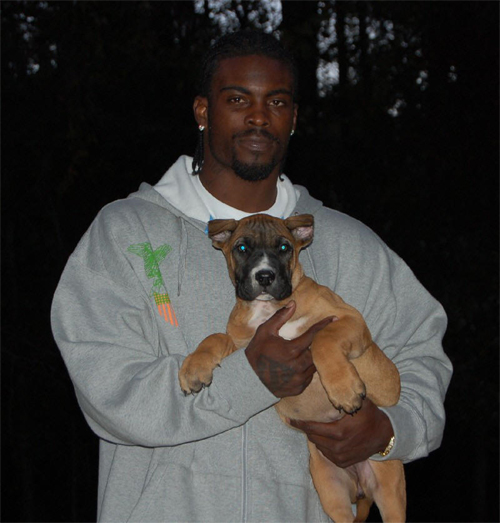
michael_vick_dog.jpg

:lol::lol::lol::lol::lol::lol::lol::lol::lol:


poor dog:smh:


:roflmao2::roflmao2:
 
You seem to have an idealistic viewpoint that an advanced society must be peaceful, without conflict and have all its members equal to one another in rank, and purpose. That is counterproductive to survival of a species. Every one needs to have a defined role, purpose and function. The fact that the species seems to understand and accept this can be seen as further proof of advancement. Their "class system" should not be confused with Human class systems which only exist to further one personal agenda or another while oppressing a class for the purpose of personal gain. It doesnt work that way. There are defined roles which srve the ultimate goal of preserving and advancing the colony.

deuterion said:
We Humans should have the same system as the ants but due to ego no one wants to play their position. Everyone wants to be the King/Queen even when most are supposed to be Workers by design. Not everyone is fit for leadership...that's just how the cards fall. Ants seem to understand this therefore they live very efficient and productive lives.


Their class system would not work with us because they accept their roles without question, it is genetically imprinted into their DNA to be subservient. You two seem to be missing this vital point.

that same information inscribed within their DNA is noticeably absent from ours. Instead many of us have to be conditioned in order to act this way. It has absolutely little to do with being idealistic because it is not in our nature to be innately subservient to a superior caste. Many of us aggressively try to define our own path and ideology, we are not of hive mind.


I find it comical that in a scenario that Deuterion would accept the role as a mere worker for the rest of his life without question, when he in fact has the capability to do much more than the role prescribed to him.
 
Good response. You hit on something i wanted to illicit but didnt want to say outright. Human "EGO". A very limiting and handicapping primitive self-serving emotion that may actually further substantiate theories of human intelectual inferiority (or the lack of human intellectual superiorty). The fact that we seem to be slaves to it is very irrational and illogical behavior. Certainly for such an advanced species as us.

I don't like to look at us as necessarily more advance but I believe that we have different priorities. I think the other forms of life on this planet to be more complacent and appreciate of the fact they are just living. They don't need a car, painting, airplane, or computer because they're happy just living. When you think about it we are actually slaves to our own devices. How do you know Animals haven't created technology because they already know the outcome? How do you know Chimpanzees don't look down on us for what we deem makes us more advance? How can someone be sure that Animals don't feel sorry for us more than anything? A Chimpanzee could look at you on a Computer and be like "look at that weak muhfucka right there on that computer...I'd fuck his ass up! Be on that gotdamn computer all day...aint even as fast or strong as me...cant even smell as good as me."
 
Their class system would not work with us because they accept their roles without question, it is genetically imprinted into their DNA to be subservient. You two seem to be missing this vital point.

that same information inscribed within their DNA is noticeably absent from ours. Instead many of us have to be conditioned in order to act this way. It has absolutely little to do with being idealistic because it is not in our nature to be innately subservient to a superior caste. Many of us aggressively try to define our own path and ideology, we are not of hive mind.


I find it comical that in a scenario that Deuterion would accept the role as a mere worker for the rest of his life without question, when he in fact has the capability to do much more than the role prescribed to him.
Then we are genetically flawed then. If we value individual pursuit over the survival and advancemnt of the whole then that can be interpreted as a primitive self destructive trait can it not? Maybe we havent evolved to the point where nature eliminates that handicap from our DNA???

I also have to disagree that all or most are capable or a higher role than worker. The fact is the we are not. Far too many people are in denial of their limits and roles in life. This too is destructive and counterproductive to the advancement of a society.
 
Then we are genetically flawed then. If we value individual pursuit over the survival and advancemnt of the whole then that can be interpreted as a primitive self destructive trait can it not? Maybe we havent evolved to the point where nature eliminates that handicap from our DNA???

No it is not because we are not genetically flawed :smh::lol:, we are genetically defined to survive in our current environment. Ants need a class system in order for the colony to thrive, We do not, BIG difference.

We are entirely two separate species living in two entirely different circumstances, thus why we function differently for the most part. Basic biology.


Amaj said:
I also have to disagree that all or most are capable or a higher role than worker. The fact is the we are not. Far too many people are in denial of their limits and roles in life. This too is destructive and counterproductive to the advancement of a society.

I said most of us seek to define our own roles/path and ideology

I never said that all or most are capable of a higher role than worker :confused:, where are you getting this from?


it seems you misread
 
Awesome find both for its sheer beauty and irony in regards to the topic at hand.


Which species built this incredible structure and which species destroyed it for the sake of "learning" form it?

/thread.

So i wasnt the only person that noticed this. I thought when they said they were gonna map out the colony they were gonna use lasers or sonar but of coarse they took the lazy route and just poured some cement. I hope there aint no advanced species out there planin on studyin us like that:smh:


But notice the species in question and their skin pigment, and the infatuation with destroying great works not of their own volition will become clear ;)

explains the laziness
 
I don't like to look at us as necessarily more advance but I believe that we have different priorities. I think the other forms of life on this planet to be more complacent and appreciate of the fact they are just living. They don't need a car, painting, airplane, or computer because they're happy just living. When you think about it we are actually slaves to our own devices. How do you know Animals haven't created technology because they already know the outcome? How do you know Chimpanzees don't look down on us for what we deem makes us more advance? How can someone be sure that Animals don't feel sorry for us more than anything? A Chimpanzee could look at you on a Computer and be like "look at that weak muhfucka right there on that computer...I'd fuck his ass up! Be on that gotdamn computer all day...aint even as fast or strong as me...cant even smell as good as me."

C/s
 
Ants go to war with other colonies for two primary reasons. 1)because they want to expand their territory or 2) a rival colony is impeding upon their territory. It's pretty much as simple as that.

The expansion of power is indicative of a militaristic mindset which only serves those at the very top, nobody else. So if the trickling down of power alludes all but a few, true advancement can not occur.


Another thing I neglected to mention is that Ants also have a class system, and seeing as how class systems prohibits free will, has a class reserved only for slave labor (worker ants) and allocates power to only a few.

Do you seriously think this is the road map to an advanced innovative society?

Well - do you consider our society advanced and innovative?
 
No it is not because we are not genetically flawed :smh::lol:, we are genetically defined to survive in our current environment. Ants need a class system in order for the colony to thrive, We do not, BIG difference.

We are entirely two separate species living in two entirely different circumstances, thus why we function differently for the most part. Basic biology.
No. Ants need a class sytem to effectively operate in the system under which they exist. They are far more focused and efficient than human beings. Again, this can be viewed as a flaw in us. Apparently you dont see it that way and thats perfectly fine. Also, you're missing my point. Im saying that the fact that we are wired the way we are may be a hinderance to our progression and function. Its no secret that we have tons of room for improvement (war, greed, poverty, hatre, racism, etc.). Perhaps the next stage of evolution will enable us to ignore the ego which serves to prevent us from acting for the greater good of society on a whole???


I said most of us seek to define our own roles/path and ideology

I never said that all or most are capable of a higher role than worker :confused:, where are you getting this from?

it seems you misread
I dont think i misread. You responded to Deuterion that human workers wouldnt accept a role that they are more capable than. In the context of the exchange i thought it was pretty clear what you were saying. Heres the exact quote:

"I find it comical that in a scenario that Deuterion would accept the role as a mere worker for the rest of his life without question, when he in fact has the capability to do much more than the role prescribed to him."

Maybe you intended it differently but it come across as if you were stating that people would be reluctant to accept roles assigned to them because they are capable of so much more. My point was that on the contrary they are not. Most people are in denial of their limitations and thus refuse to accept their role in life.
 
Can Animals Think?
By EUGENE LINDEN
Monday, Mar. 22, 1993


In a sun-dappled pool not far from the clamor of Waikiki Beach, two female dolphins poke their heads out of the water, waiting for a command. "O.K.," says Louis Herman, founder and director of the Kewalo Basin Marine Mammal Laboratory, "now let's try a tandem creative." Two graduate students, positioned at opposite ends of the 50-ft. tank, throw full body and soul into communicating this message to the animals, Phoenix and Akeakamai. First the humans ask the dolphins to pay attention by holding a finger high in the air. Then they tap the index fingers of each hand together, forming the gesture that has been taught to mean tandem. Next they throw their arms up in an expansive gesture that signifies creative. The dolphins have just been told, "Do something creative together."

The dolphins break away from their trainers and submerge in the 6-ft.-deep water, where they can be seen circling until they begin to swim in tandem. Once they are in synch, the animals leap into the air and simultaneously spit out jets of water before plunging back into the pool. The trainers flash huge smiles at their flippered pupils and applaud wildly. The animals also seem delighted and squeak with pleasure.

What is going on here? Do the dolphins actually understand the command tandem creative as a request to make some joint artistic statement through movement? Did they communicate in some fashion to choose a routine and coordinate their movements? In order to spit, for instance, they both must take water into their mouths before they leap into the air -- a trick that takes some forethought. Other requests for tandem creatives have yielded a variety of results, including a synchronized backward swim culminating in a simultaneous wave of the tails. Or could it be that these routines are nothing more than one dolphin very closely following the lead of another? In the wild, after all, dolphins are extraordinarily skilled at tuning their actions to the movements of others in their group.

In cluttered quarters at the University of Arizona -- half lab, half toy- strewn nursery -- Alex, the voluble African gray parrot, is, as usual, commenting on all he sees. "Hot!" he warns in a sweet, childlike voice, as a visitor picks up a mug of tea. Alex spots a plateful of fruit and announces his choice: "Grape."

Everyone knows parrots can talk, but for the past 15 years, ethologist Irene Pepperberg has been working with Alex, exploring the degree to which the birds understand what they are saying. Pepperberg picks up an object from a crowded tray and inquires, "What toy?" Alex promptly answers, "Block." He then responds to questions about the plaything, describing its color, shape, what it is made of ("wood") and whether it is bigger or smaller than other objects on the tray.

Something less than true creativity may account for the dolphin flights of fancy seen at Kewalo Basin, but something more than simple mimicry seems to be at work in the case of this 1-lb. bird.

Alex also uses English to communicate what appears to be his feelings. After incorrectly answering how many rose-colored pieces of wool are mixed in with other objects on the tray, he says, "I'm sorry." A moment later the obviously frustrated bird says, "I'm gonna go away" and turns his feathered back on the offending tray. Does Alex know what he is saying, or is "I'm gonna go away" merely a collection of sounds he emits when frustrated?

Since antiquity, philosophers have argued that higher mental abilities -- in short, thinking and language -- are the great divide separating humans from other species. The lesser creatures, Rene Descartes contended in 1637, are little more than automatons, sleepwalking through life without a mote of self- awareness. The French thinker found it inconceivable that an animal might have the ability to "use words or signs, putting them together as we do." Charles Darwin delivered an unsettling blow to this doctrine a century ago when he asserted that humans were linked by common ancestry to the rest of the animal kingdom. Darwinism raised a series of tantalizing questions for future generations: If other vertebrates are similar to humans in blood and bone, should they not share other characteristics, including intelligence? More specifically, did the earliest humanlike creatures, who split from the ancestors they shared with apes between 5 million and 7 million years ago, already possess a primitive ability to form plans, manipulate symbols, plot mischief and express sentiments?

Even to raise these questions challenges humanity's belief that it occupies an exalted place in the universe. Moreover, scientists have historic reasons to be skeptical of claims concerning animal intelligence. At the turn of the century, a wonder horse named Clever Hans wowed Europeans with his apparent ability to solve math problems, expressing his answers by tapping a hoof. Dutch psychologist Oskar Pfungst ultimately showed that Hans was merely responding to inadvertent cues from his human handlers, who, for instance, would visibly relax when the horse had tapped the proper number of times. When blindfolded by Pfungst, Hans ceased to be so clever.

Not surprisingly, then, accounts of the first language experiments with apes in the 1970s produced one of the most fractious debates in the history of the behavioral sciences. Washoe the chimp and Koko the gorilla became famous for their linguistic feats using sign language, but scientists argued bitterly over the significance. Did the "speech" of these animals reflect a genuine ability to think symbolically and communicate thought, or was it largely the result of rote conditioning or of cuing -- a la Hans -- by trainers? Skepticism carried the day, and researchers who had dedicated their lives to working with the apes saw their work dismissed as a mere curiosity. So chilly was the climate that many young researchers left the field.

But the skepticism also served as a challenge. A number of scientists launched innovative probes of animal intelligence, while those who remained in language work designed careful experiments to meet the objections of critics. Their aim is to determine, as precisely as possible, what animals know and how well they can communicate it. The result is that animals are once again talking up a storm, as well as demonstrating other intellectual skills. Most scientists now take seriously the flood of new evidence suggesting that other species share with humans some higher mental abilities.

The Lessons of Kanzi​

No animal has done more to renew interest in animal intelligence than a beguiling, bilingual bonobo named Kanzi, who has the grammatical abilities of a 2 1/2-year-old child and a taste for movies about cavemen. The 12-year-old pygmy chimpanzee lives with a colony of other apes in a cage complex on the wooded campus of the Georgia State University Language Research Center, near Atlanta. Under the tutelage of psychologist Sue Savage-Rumbaugh, he makes his desires known either by pointing to symbols printed on a laminated board or by punching the symbols on a special keyboard that then generates the words in English. While Kanzi cannot speak (apes lack the vocal control to form words), he understands spoken language.

In the time-honored fashion of ambitious young interns, Kanzi became involved in language experiments by catching the boss's eye. Savage-Rumbaugh noticed that the young ape was learning words she was struggling to teach his mother Matata. The language was a system of abstract visual symbols developed by Savage-Rumbaugh's husband Duane Rumbaugh during his first language experiments with chimpanzees. "If Kanzi could learn without instruction, I wondered, Why teach?" says Savage-Rumbaugh. From then on, Kanzi learned language much the way human children do: by going through the ordinary activities of his day while humans spoke in English and pointed to the appropriate lexigrams on the portable boards.

Kanzi soon began using the lexigrams as a means of communication, requesting games, treats and activities. Eventually he learned to combine two or more symbols to convey his desires. When, for instance, he wanted to watch a favorite movie, Quest for Fire, he would ask for "Fire TV" (Kanzi also adores Greystoke, a Tarzan movie).

Kanzi's most noteworthy achievement has been to demonstrate a grasp of grammatical concepts such as word order. Savage-Rumbaugh and psychologist Rose Sevcik created an extended experiment to compare the ape with a two-year-old girl named Alia in responding to commands expressed in 660 spoken English sentences. The sentences combined objects in ways that Kanzi and Alia were unlikely to have encountered before: "Put the melon in the potty," or "Go get the carrot that's in the microwave."

Through most of the experiment, Kanzi and Alia were neck and neck. At the end, however, Alia's language skills began to outpace the bonobo's, while Kanzi's grammatical comprehension topped out at the level of a 2 1/2-year-old. Though not impressive by human standards, even that toddler level implies vastly more sophisticated abilities than critics have acknowledged.

In truth, Kanzi's achievements are no greater than those claimed for Koko or other subjects in early language studies. His real significance is that scientists are more willing to accept the results as valid because of the tight controls used during the studies. For instance, a one-way mirror prevented Kanzi and Alia from seeing who gave them commands, while those tracking what the ape and toddler did in response wore earphones to prevent them from hearing the requests. Each sentence was also utterly new to both ape and child. The young bonobo has thus helped break a two-decade deadlock during which language experimentation with animals was paralyzed by concerns that the animals were responding to cues from their trainers rather than demonstrating true abstract abilities.

The Knowledge of Dolphins​

It is not terribly surprising that apes, humanity's closest relatives, might possess some measure of smarts. But is it possible that more distantly related species might also have some capacity for symbolic communication? Herman offers a partial answer through his work with dolphins, animals whose ancestors diverged from other mammals' more than 45 million years ago.

Communication between humans and dolphins at Kewalo Basin occurs mostly through a gestural language that borrows some words from American Sign Language. The trainers make the gestures with big, enthusiastic arm movements, asking Phoenix or Akeakamai to follow such commands as "person left Frisbee fetch," which means "bring the Frisbee on the left to the person in the pool," or "surfboard person fetch," in which Akeakamai gently pushes a human volunteer over to the surfboard.

Such requests probe the dolphin's understanding of word order in ways somewhat analogous to the work with Kanzi. Herman insists that the dolphin's grammatical competence is at least as sophisticated as Kanzi's. Herman's group has also determined that dolphins can form a generalized concept about an object: they respond correctly to commands involving a hoop, no matter whether the hoop is round, octagonal or square. They also seem to retain a mental image of an object whether or not it is present in their environment. Thus they can accurately report whether a ball or hoop is in the pool (by touching their snouts to YES and NO paddles placed in the water).

The dolphins have a better attitude toward their schooling than many children. When correct, they squeak excitedly as they race back to the trainer. When wrong, they sag noticeably and look about as depressed as it is possible for these benign creatures to look. Herman notes that they are not above resorting to tricks familiar to every student, such as rushing over to another object after choosing the wrong one, or positioning themselves at some ambiguous midpoint between two choices with the apparent hope that the trainer will say "Right!" On occasion, when wrong, they will take their chagrin out on the object and beat a hoop or basket as though it were at fault.

But Do the Animals Really Understand?​

Because of their big brains, genial smiles and noble foreheads, dolphins have long attracted human champions quite willing to credit the marine mammals with all sorts of higher mental abilities. To a hard-nosed scientist, however, the noble forehead is a housing for sonar gear, the upturned smile is an adaptation that makes it easier for the animal to scoop up fish, and it is open to question for what purposes the animal uses its large brain. Herman and others working with animals have been criticized for using linguistic terms like word or syntax when some cruder system may describe what is occurring in a dolphin's head.

Unfortunately, it is impossible to know precisely what goes on in another creature's mind and to what degree it understands the languages it uses. Take the case of the gorilla Koko, first taught 20 years ago to use American Sign Language by psychologist Penny Patterson. On one much discussed occasion, the powerful gorilla had inadvertently knocked a sink off its moorings in her living quarters. Koko signed the words "Kate there bad," pointing to the sink. Was the muscular animal trying, rather implausibly, to shift the blame to one of Patterson's slightly built female assistants? Or was she merely making signs vaguely associated with the event? Sixteen years later, there is still no definitive answer.

For his part, Herman admits that his dolphins are a long way from humans in their use of language. But he vehemently insists that they do have a conceptual grasp of the words they learn. "If you accept that semantics and syntax are core attributes of human language," says Herman, "then we have shown that the dolphins also account for these two features within the limits of this language."

Some scientists, particularly those from the behaviorist school of psychology, take a more skeptical view. What looks like language, they say, may be simply mimicry or rote learning. One of Herman's critics, animal behaviorist Ronald Schusterman, insists that before anyone can say an animal is speaking, they had better determine whether the beast is capable of the kind of abstract thinking that forms the basis of speech. "My argument is that the language experiments have moved too fast," says Schusterman. "They have not looked at some fundamental cognitive abilities that give rise to linguistic abilities." At Long Marine Laboratory in Santa Cruz, California, Schusterman has been trying to fill that gap.

Games of Logic with Sea Lions​

Unlike the sunny-dispositioned dolphins, sea lions radiate intensity. Schusterman chose them for his research because they are easily trained. He did not attempt to teach seven-year-old Rio a language. Instead, he wanted to determine if the female sea lion could understand logical relationships between symbols presented on poster boards. For instance, by rewarding the sea lion selectively, trainers taught Rio that a symbol looking like a mug was equivalent to one that looked like a watch. Then she was taught that the watch symbol was equivalent to a third symbol that looked like a bomb. The question was whether she could make the jump to understanding that the mug was therefore equivalent to a bomb.

Schusterman devised an elaborate procedure to ensure against cuing: signals to Rio were delivered by a trainer who did not know the correct answer. Rio would start the test by choosing one of two randomly selected symbols on a scoreboard-like apparatus next to her tank. She would then be presented with two new icons and asked to pick which one was logically equivalent to the symbol she had chosen earlier.

Unlike dolphins, sea lions seem to treat training as if it were a life-or- death matter. At the start of each session Rio rivets her stare on her trainers. When wrong, she barks in frustration. But on one particular day she had little to complain about, answering correctly 24 out of 28 times. Schusterman takes this performance as proof that the animal has at least some of the cognitive skills required for language. Thus, he says, it is now much easier for him to accept that bigger-brained dolphins and apes understand and manipulate their vocabularies symbolically as well.

Words of Love from a Parrot​

If the animal-language experiments had an awards dinner, the prize for best accent would go to the befeathered Alex. The parrot acquired his Midwestern accent from his mentor, Pepperberg. She became intrigued by the language work with great apes in the 1970s and decided to examine the abilities of an animal with an entirely different brain structure. She chose parrots in part because they can actually talk and because studies had established that the birds could perform as well as chimps on some psychological tests, suggesting that brain size is not the only determinant of mental ability.

Like Kanzi, Alex learned his vocabulary in a social setting, though the approach was more contrived. Pepperberg would, for instance, show a student a cork (one of Alex's favorite objects). If the student said the word cork, Pepperberg would give it to her; but when another word was used, the student would be scolded. Alex quickly got the drift of this game, and over the years has acquired more than 71 labels denoting objects, actions, colors, shapes and materials. Apart from answering several different questions about the same object, Alex also seems to understand quantity. Most impressively, he can look at an assortment of objects on a tray and say how many pieces of green wool or how many blue blocks lie amid the clutter.

At some level, Alex apparently understands language as a social interaction and uses it to maintain contact and get attention. "The way Alex uses English does not necessarily have all the aspects of language," says Pepperberg, "but it provides a two-way communication system that allows me to explore the way he thinks." At times his choice of words is touchingly apt, even if he uses phrases to get results rather than express emotion. When the parrot, who lives with Pepperberg, became sick a few years ago, she had to take him to a vet and leave him overnight in a strange place for the first time in his life. As she headed for the door she heard Alex calling in his plaintive child's voice, "Come here. I love you. I'm sorry. Wanna go back."

Why Did Intelligence Evolve, Anyway?​

If animals indeed have the capacity to understand and manipulate symbols, the question then becomes why and when did they develop it. For answers, scientists have turned once again to chimps, who both in the wild and in captivity show the ability to formulate plans and make tools. Kanzi has been most helpful in this regard.

In an experiment supervised by Nicholas Toth of Indiana University, Kanzi watched as a favorite treat was placed inside a box. The box was then locked, and the key was placed inside another box tied up by a cord. It added up to a Houdini-like challenge for the chimp: how to get to the treat.

But inside his cage, Kanzi had the makings of a tool that could solve the riddle: some pieces of flint he had selected during an excursion to the countryside. No sweat! By slamming the flints against the concrete floor, the chimp created knifelike chips, which he used to cut the cord and free the key. He then used the key to open the other box and grab the treat.

Toth notes that in several runs through the experiment, Kanzi always used the chip to cut toward himself, an observation that might help Toth better understand the first tools of Homo habilis some 2 million years ago. "For a Stone Age archaeologist like myself, seeing this is almost like a religious experience," says Toth, whose university awarded Kanzi a prize for providing the most insight into the origins of technology.

Observations of apes in the wild provide further insights. In the Tai forest in the Ivory Coast, Swiss biologist Christophe Boesch points out a flat piece of granite with two small hollows on the top. The rock has marks from heavy use for some purpose. "If an anthropologist came upon this in the forest," says Boesch, "he might think he had found a human artifact." Instead, it is used by chimpanzees for nut cracking. The chimps place a panda nut in one of the depressions and then smash it with a smaller stone. Boesch has watched a mother chimp instruct her young in the art of nut cracking.

Still, toolmaking does not entirely explain why apes, humans and other animals developed big brains. Gorillas, orangutans and bonobos are roughly the intellectual peers of chimps but rarely resort to tool use. Nor does the need to build tools fully account for the enormous expansion of human brainpower during the past million years. As recently as 100,000 B.C., Homo sapiens were using only the crudest tools, even though their brains had already reached the present size -- large enough to put men on the moon, probe the basis of matter and tinker with the genetic code. Because big brains need a lot of high- calorie food and require large craniums, which makes childbirth difficult, scientists have looked for other evolutionary pressures to account for their development.

Machiavellian Chimps​

The answer may be politics, which is hardly confined to human society. Scottish psychologists Richard Byrne and Andrew Whiten believe chimps are positively "Machiavellian" in their efforts to acquire power within a group. In the Mahale Mountains in Tanzania, for instance, Japanese primatologist Toshisada Nishida observed one male chimp shift his support between two more dominant males who needed his allegiance to maintain power. The bigger males curried favor with this artful manipulator by allowing him access to fertile females. When a ruler began to take him for granted, the canny old chimp would shift allegiance to the pretender, thus ensuring himself continual access to mates without fear of attack from his superiors.

In the complex game of social chess played by chimps and other primates, having the intellectual skills to anticipate a rival's moves and engage in deceit is a distinct advantage. Consider the double deception observed at a feeding station in Tanzania's Gombe Stream Reserve. A wild chimp had the luck to be alone next to a feeding box when it was opened by remote control. Noticing that another, more dominant chimp was approaching, the first one closed the box and moved nonchalantly away until the second chimp moved on. Once the interloper was gone, the first chimp opened the box to claim the food. The second chimp, however, had cleverly hidden himself just out of sight and triumphantly returned to snatch the bananas. There are enough examples of such ape trickery to suggest that perhaps Koko really was lying when she made the signs "Kate there bad."

Knowing Whom to Trust​

A crucial question raised by such devious behavior is, To what degree does an animal actually understand what's in its rival's mind? If an animal knows when another creature is misinformed or has valuable knowledge, it gains an enormous advantage. In the late 1980s, a pioneer of animal-language work came up with an ingenious way of probing this question.

David Premack actually devised his simple test to study children. First, a child is shown a tableau in which a little girl named Sally puts a marble in her bag and then leaves the room. Before Sally returns, another girl, Ann, takes the marble from Sally's bag and puts it in a box. The child is then asked where Sally will look for the marble when she returns. Three-year-olds will point to the box, because that is where the marble is; but four-year-olds understand that Sally has the mistaken belief that the marble is still in her bag and that she will look for it there.

Psychologist Daniel Povinelli at the University of Southwestern Louisiana has conducted a number of experiments that adapt Premack's test for primates. In one version, chimpanzees had to choose which of two humans would be better at helping them find some hidden food. While the animals themselves could not see where the food was being hidden, they could observe that only one of the two humans had a full view of the process. When asked to choose a helper, the chimps overwhelmingly chose the human who knew where the food was hidden.

Just as four-year-olds have an insight that three-year-olds lack, chimps have an advantage over lesser primates. When Povinelli tried his experiment with rhesus macaques, the monkeys proved unable to distinguish between the human who knew where the food was and the one who didn't -- even after 600 attempts.

Psychologists concoct some absurd situations to plumb the depths of chimp insight. For instance, one experiment has the apes observe two handlers deliver cups of juice. One accidentally spills juice on the floor; the other overturns the cup deliberately. When asked to choose a handler to deliver their next cup of juice, chimps prefer the clumsy person, suggesting that they are aware they are better off with a klutz than with a helper with evil intent. Again, in analogous experiments capuchin monkeys appear to be less shrewd. The animals will, pitiably, continue to put their trust in a human helper who eats rather than delivers their food, even after he or she has stuffed himself 150 times with the monkeys' treats.

To Andrew Whiten, the striking difference between monkeys and chimps supports the notion that within primates there is a "mental Rubicon -- not the familiar one with humans on one side and everyone else on the other, but with man and at least the apes on the same side."

Even if some other creatures have crossed this mental Rubicon, human analytical abilities remain vastly superior to anything demonstrated elsewhere in the animal kingdom. In virtually all studies of animal intelligence and language skills, performance plummets as more elements are added to a task and as an animal has to remember these elements for long periods. By contrast, humans can call on vast working memory.

Many evolutionary scholars suspect that as ancient human groups became larger, the need to keep track of ever more complex social interactions was what really pushed the human brain toward superiority. Both dolphins and chimps have very complex interactions, but the intricacy of their social world pales beside the lattice of entanglements that characterized human society as early Homo sapiens banded together to gather food and defend themselves. In Somalia today, warring clans identify friend or foe by demanding that those accosted recite their ancestry going back many generations. It is easy to see how similar challenges in antiquity might have driven the development of brainpower.

It does not lessen the grandeur of the human intellect to argue that it evolved partly in response to social pressures or that these pressures also produced similar abilities in "lesser" creatures. Instead, the fact that nature may have broadly sown the seeds of consciousness suggests a world enlivened by many different minds. There may even be practical applications. Studies of animal cognition and language have yielded new approaches to communicating with handicapped and autistic children. Some scientists are pondering ways to turn intelligent animals like sea lions and dolphins into research assistants in marine studies or into lifeguards who can save the drowning upon command.

If the notion that animals might actually think poses a problem, it is an ethical one. The great philosophers, such as Descartes, used their belief that animals cannot think as a justification for arguing that they do not have moral rights. It is one thing to treat animals as mere resources if they are presumed to be little more than living robots, but it is entirely different if they are recognized as fellow sentient beings. Working out the moral implications makes a perfect puzzle for a large-brained, highly social species like our own.

http://www.time.com/time/magazine/article/0,9171,978023,00.html

 
Inside the Minds of Animals
By Jeffrey Kluger
Thursday, Aug. 05, 2010


Not long ago, I spent the morning having coffee with Kanzi. It wasn't my idea; Kanzi invited me, though he did so in his customary clipped way. Kanzi is a fellow of few words — 384 of them by formal count, though he probably knows dozens more. He has a perfectly serviceable voice — very clear, very expressive and very, very loud. But it's not especially good for forming words, which is the way of things when you're a bonobo, the close and more peaceable cousin of the chimpanzee.

But Kanzi is talkative all the same. For much of his day, he keeps a sort of glossary close at hand — three laminated, place mat — like sheets filled with hundreds of colorful symbols that represent all the words he's been taught by his minders or picked up on his own. He can build thoughts and sentences, even conjugate, all by pointing. The sheets include not just easy nouns and verbs like ball and Jell-O and run and tickle but also concept words like from and later and grammatical elements like the -ing and -ed endings signifying tense.

Kanzi knows the value of breaking the ice before getting down to business. So he points to the coffee icon on his glossary and then points to me. He then sweeps his arm wider, taking in primatologist Sue Savage-Rumbaugh, an investigator at the Great Ape Trust — the research center in Des Moines, Iowa, that Kanzi calls home — and lab supervisor Tyler Romine. Romine fetches four coffees — hot, but not too hot — takes one to Kanzi in his patio enclosure on the other side of a Plexiglas window and then rejoins us. Kanzi sips — gulps, actually — and since our voices are picked up by microphones, he listens as we talk.

"We told him that a visitor was coming," Savage-Rumbaugh tells me. "He's been excited, but he was stubborn this morning, and we couldn't get him to come out to the yard. So we had to negotiate a piece of honeydew melon in exchange." Honeydew is not yet on Kanzi's word list; instead, he points to the glyphs for green, yellow and watermelon. When he tried kale, he named it "slow lettuce" because it takes longer to chew than regular lettuce.

The not-for-profit Great Ape Trust is home to seven bonobos, including Kanzi's baby son Teco, born this year on June 1. Kanzi is by no means the first ape to have been taught language. The famous Koko, Washoe and others came before him. But the Trust takes a novel approach, raising apes from birth with spoken and symbolic language as a constant feature of their days. Just as human mothers take babies on walks and chatter to them about what they see even though the child does yet not understand, so too do the scientists at the Trust narrate the lives of their bonobos. With the help of such total immersion, the apes are learning to communicate better, faster and with greater complexity.

All the same, today Kanzi is not interested in saying much, preferring to run and leap and display his physical prowess instead. "Ball," he taps on one of his glossary sheets when he finishes his coffee.

"Tell him you'll get it for him," Savage-Rumbaugh instructs me and then shows me where the necessary symbols are on a sheet I have in hand. "Yes-I-will-chase-the-ball-for-you," I slowly peck out, chase being a word Kanzi uses interchangeably with get.

It takes me a while to find the ball in an office down the hall, and when I finally return, Savage-Rumbaugh verbally asks Kanzi, "Are you ready to play?" He looks at us balefully. "Past ready," he pecks.

Humans have a fraught relationship with beasts. They are our companions and our chattel, our family members and our laborers, our household pets and our household pests. We love them and cage them, admire them and abuse them. And, of course, we cook and eat them.

Our dodge — a not unreasonable one — has always been that animals are ours to do with as we please simply because they don't suffer the way we do. They don't think, not in any meaningful way. They don't worry. They have no sense of the future or their own mortality. They may pair-bond, but they don't love. For all we know, they may not even be conscious. "The reason animals do not speak as we do is not that they lack the organs," René Descartes once said, "but that they have no thoughts." For many people, the Bible offers the most powerful argument of all. Human beings were granted "dominion over the beasts of the field," and there the discussion can more or less stop.

But one by one, the berms we've built between ourselves and the beasts are being washed away. Humans are the only animals that use tools, we used to say. But what about the birds and apes that we now know do as well? Humans are the only ones who are empathic and generous, then. But what about the monkeys that practice charity and the elephants that mourn their dead? Humans are the only ones who experience joy and a knowledge of the future. But what about the U.K. study just last month showing that pigs raised in comfortable environments exhibit optimism, moving expectantly toward a new sound instead of retreating warily from it? And as for humans as the only beasts with language? Kanzi himself could tell you that's not true.

All of that is forcing us to look at animals in a new way. With his 1975 book Animal Liberation, bioethicist Peter Singer of Princeton University launched what became known as the animal-rights movement. The ability to suffer, he argued, is a great cross-species leveler, and we should not inflict pain on or cause fear in an animal that we wouldn't want to experience ourselves. This idea has never met with universal agreement, but new studies are giving it more legitimacy than ever. It's not enough to study an animal's brain, scientists now say; we need to know its mind.

Conscious Critters​
There are a lot of obstacles in the way of our understanding animal intelligence — not the least being that we can't even agree whether nonhuman species are conscious. We accept that chimps and dolphins experience awareness; we like to think dogs and cats do. But what about mice and newts? What about a fly? Is anything going on there at all? A tiny brain in a simple animal has enough to do just controlling basic bodily functions. Why waste synapses on consciousness if the system can run on autopilot?

There's more than species chauvinism in that question. "Below a certain threshold, it's quite possible there's no subjective experience," says cognitive psychologist Dedre Gentner of Northwestern University. "I don't know that you need to ascribe anything more to the behavior of a cockroach than a set of local reflexes that make it run away from bad things and toward good things."

Where that line should be drawn is impossible to say, since our judgment is clouded by our feelings about any given species. A cockroach likely has no less brainpower than a butterfly, but we're quicker to deny it consciousness because it's a species we dislike. Still, most scientists agree that awareness is probably controlled by a sort of cognitive rheostat, with consciousness burning brightest in humans and other high animals and fading to a flicker — and finally blackness — in very low ones.

"It would be perverse to deny consciousness to mammals," says Steven Pinker, a Harvard psychologist and the author of The Stuff of Thought. "Birds and other vertebrates are almost certainly conscious too. When it gets down to oysters and spiders, we're on shakier ground."

Among animals aware of their existence, intellect falls on a sliding scale as well, one often seen as a function of brain size. Here humans like to think they're kings. The human brain is a big one — about 1,400 g (3 lb.). But the dolphin brain weighs up to 1,700 g (3.75 lb.), and the killer whale carries a monster-size 5,600-g (12.3 lb.) brain. But we're smaller than the dolphin and much smaller than the whale, so correcting for body size, we're back in first, right? Nope. The brain of the Etruscan shrew weighs just 0.1 g (0.0035 oz.), yet relative to its tiny body, its brain is bigger than ours.

While the size of the brain certainly has some relation to smarts, much more can be learned from its structure. Higher thinking takes place in the cerebral cortex, the most evolved region of the brain and one many animals lack. Mammals are members of the cerebral-cortex club, and as a rule, the bigger and more complex that brain region is, the more intelligent the animal. But it's not the only route to creative thinking. Consider tool use. Humans are magicians with tools, apes dabble in them, and otters have mastered the task of smashing mollusks with rocks to get the meat inside — which, though primitive, counts. But if creativity lives in the cerebral cortex, why are corvids, the class of birds that includes crows and jays, better tool users than nearly all nonhuman species?

Crows, for example, have proved themselves adept at bending wire to create a hook so they can fish a basket of food from the bottom of a plastic tube. More remarkably, last year a zoologist at the University of Cambridge — the aptly named Christopher Bird — found that the rook, a member of the crow family, could reason through how to drop stones into a pitcher partly filled with water in order to raise the level high enough to drink from it. What's more, the rooks selected the largest stones first, apparently realizing they would raise the level faster. Aesop wrote a tale about a bird that managed just such a task more than 2,500 years ago, but it took 21st century scientists to show that the feat is no fable.

How the birds performed such a stunt without a cerebral cortex probably has something to do with a brain region they do share with mammals: the basal ganglia, more primitive structures involved in learning. Mammalian basal ganglia are made up of a number of structures, while those in birds are streamlined down to one. Earlier this year, a collaborative team at MIT and Hebrew University of Jerusalem found that while the specialized cells in each section of mammalian basal ganglia do equally specialized work, the undifferentiated ones in birds' brains multitask, doing all those jobs at once. The result is the same — information is processed — but birds do it more efficiently.

In the case of corvids and other animals, what may drive intelligence higher still is the structure not of their brains but of their societies. It's easier to be a solitary animal than a social one. When you hunt and eat alone, like the polar bear, you don't have to negotiate power struggles or collaborate in stalking prey. But it's in that behavior — particularly the hunt — that animals behave most cleverly.

Consider the king of the beasts. "Lions do very cool things," says animal biologist Christine Drea of Duke University. "One animal positions itself for the ambush, and another pushes the prey in that direction." More impressive still is the unglamorous hyena. "A hyena by itself can take out a wildebeest, but it takes several to bring down a zebra," she says. "So they plan the size of their party in advance and then go out hunting particular prey. In effect, they say, Let's go get some zebras. They'll even bypass a wildebeest if they see one on the way."

Last year, Drea conducted a study of hyena cooperation, releasing pairs of them into a pen in which a pair of ropes dangled from an overhead platform. If the animals pulled the ropes in unison — and only in unison — the platform would spill out food. "The first pair walked into the pen and figured it out in less than two minutes," Drea says. "My jaw literally dropped."

For these kinds of animals, it's not clear what the cause-and-effect relationship is — whether living cooperatively boosts intelligence or if innate intelligence makes it easier to live cooperatively. It's certainly significant that corvids are the most social of birds, with long lives and stable group bonds, and that they're the ones that have proved so handy. It's also significant that herd animals, like cows and buffalo, exhibit little intelligence. Though they live collectively, there's little shape to their society. "In a buffalo herd, Bob doesn't care who Betty is," Drea says. "But among primates, social carnivores, whales and dolphins, every individual has a particular place."

Self and Other​
It's easy enough to study the brain and behavior of an animal, but subtler cognitive abilities are harder to map. One of the most important skills human children must learn is something called the theory of mind: the idea that not all knowledge is universal knowledge. A toddler who watches a babysitter hide a toy in a room will assume that anyone who walks in afterward knows where the toy is too. It's not until about age 3 that kids realize that just because they know something, it doesn't mean somebody else knows it also.

The theory of mind is central to communication and self-awareness, and it's the rare animal that exhibits it, though some do. Dogs understand innately what pointing means: that someone has information to share and that your attention is being drawn to it so that you can learn too. That seems simple, but only because we're born with the ability and, by the way, have fingers with which to do the pointing.

Great apes, despite their impressive intellect and five-fingered hands, do not seem to come factory-loaded for pointing. But they may just lack the opportunity to practice it. A baby ape rarely lets go of its mother, clinging to her abdomen as she knuckle-walks from place to place. But Kanzi, who was raised in captivity, was often carried in human arms, and that left his hands free for communication.

"By the time Kanzi was 9 months old, he was already pointing at things," says Savage-Rumbaugh. I witnessed him do it in Iowa, not only when he pointed at me to invite me for coffee but also when he swept his hand toward the hallway in a be-quick-about-it gesture as I went to get him his ball. (See pictures from a wildlife forensics lab.)

Pointing isn't the only indicator of a smart species that grasps the theory of mind. Blue jays — another corvid — cache food for later retrieval and are very mindful of whether other animals are around to witness where they've hidden a stash. If the jays have indeed been watched, they'll wait until the other animal leaves and then move the food. They not only understand that another creature has a mind; they also manipulate what's inside it.

The gold standard for demonstrating an understanding of the self-other distinction is the mirror test: whether an animal can see its reflection and recognize what it is. It may be adorable when a kitten sees itself in a full-length mirror and runs around to the other side of the door looking for what it thought was a playmate, but it's not head-of-the-class stuff. Elephants, apes and dolphins are among the few creatures that can pass the mirror test. All three respond appropriately when they look in a mirror after a spot of paint is applied to their forehead or another part of their body. Apes and elephants will reach up to touch the mark with finger or trunk rather than reach out to touch the reflection. Dolphins will position themselves so they can see the reflection of the mark better. (See up-close pictures of sharks.)

"If you put a bracelet on an orangutan and put it in front of a mirror, it doesn't just look at the bracelet," says Bhagavan Antle, director of the Institute of Greatly Endangered and Rare Species in Myrtle Beach, S.C. "It puts the bracelet up to its face and shakes it. It interacts with its reflection."

With or without mirror smarts, some animals are also adept at grasping abstractions, particularly the ideas of sameness and difference. Small children know that a picture of two apples is different from a picture of a pear and a banana; in one case, the objects match, and in the other they don't. It's harder for them to take the next step — correctly matching a picture of two apples to a picture of two bananas instead of to a picture of an orange and a plum.

"It's called relations between relations, and it's a basic scaffold of intelligence," says psychologist Ed Wasserman of the University of Iowa. Last year Wasserman conducted a study that proved some animals have begun building that scaffold. In his research, baboons and — surprisingly — pigeons got the relations-between-relations idea, correctly identifying the proper pairings with a peck or a joystick when images were flashed on a screen. (See the top 10 animal attacks on humans.)

Significantly, just as humans better understand an idea when they have a term to describe it (imagine explaining, say, satisfaction if the word didn't exist), so do animals benefit from such labels. Psychologist David Premack of the University of Pennsylvania found that when chimps were taught symbols for same and different, they later performed better on analogy tests.

Beyond Smarts​
If animals can reason — even if it's in a way we'd consider crude — the unavoidable question becomes, Can they feel? Do they experience empathy or compassion? Can they love or care or hope or grieve? And what does it say about how we treat them? For science, it would be safest simply to walk away from a question so booby-trapped with imponderables. But science can't help itself, and at least some investigators are exploring these ideas too.

It's well established that elephants appear to mourn their dead, lingering over a herd mate's body with what looks like sorrow. They show similar interest — even what appears to be respect — when they encounter elephant bones, gently examining them, paying special attention to the skull and tusks. Apes also remain close to a dead troop mate for days.

Empathy for living members of the same species is not unheard of either. "When rats are in pain and wriggling, other rats that are watching will wriggle in parallel," says Marc Hauser, professor of psychology and anthropological biology at Harvard. "You don't need neurobiology to tell you that suggests awareness." A 2008 study by primatologist Frans de Waal and others at the Yerkes National Primate Research Center in Atlanta showed that when capuchin monkeys were offered a choice between two tokens — one that would buy two slices of apple and one that would buy one slice each for them and a partner monkey — they chose the generous option, provided the partner was a relative or at least familiar. The Yerkes team believes that part of the capuchins' behavior was due to a simple sense of pleasure they experience in giving, an idea consistent with studies of the human brain that reveal activity in the reward centers after subjects give to charity.

Animal-liberationist Singer believes that such evidence of noble impulses among animals is a perfectly fine argument in defense of their right to live dignified lives, but it's not a necessary one. Indeed, one of his central premises is that to the extent that humans and animals can experience their worlds, they are equals. "Similar amounts of pain are equally bad," he says, "whether felt by a human or a mouse." (See pictures of animals in space.)

Hauser takes a more nuanced view, arguing that people are possessed of what he calls humaniqueness, a suite of cognitive skills including the ability to recombine information to gain new understanding, a talent animals simply don't have. All creatures may exist on a developmental continuum, he argues, but the gap between us and the second-place finishers is so big that it shows we truly are something special. "Animals have a myopic intelligence," Hauser says. "But they never experience the aha moment that a 2-year-old child gets."

No matter what any one scientist thinks of animal cognition, nearly all agree that the way we treat domesticated animals is indefensible — though in certain parts of the world, improvements are being made. The European Union's official animal-welfare policies begin with the premise that animals are sentient beings and must be treated accordingly. This includes humane conditions on farms and in vehicles during transport and proper stunning before killing in slaughterhouses. (See illustrations of animals wildly in love.)

In the U.S., food animals are overwhelmingly raised on factory farms, where cattle and pigs are jammed together by the thousands and chickens are confined in cages that barely allow them to stand. But here too, public sentiment is changing. Roughly half of vegetarians list moral concerns as the chief reason for giving up meat. Still, vegetarians as a whole make up only about 3% of the U.S. population, a figure that has barely budged since before the days of Singer's manifesto. And there are three times as many ex-vegetarians as practicing ones.

Even Singer doesn't believe we're likely to wake up in a vegan world anytime soon. For that matter, he doesn't think it's morally necessary. Eating meat to avoid starvation is all right, he believes, and some creatures are fair game all the time, provided they're grown sustainably. "I think there's very little likelihood that oysters, mussels and clams have any consciousness, so it's defensible to eat them," he says. (See "Sit. Stay. Trust. Learn.")

What's more, we're not going to quit using animals in other ways that benefit humans either — testing drugs, for example. But we could surely stop using them to test cosmetics, a practice the E.U. is also moving to ban. We could surely eat less meat and treat animals better before we convert them from creature to dinner. And we could rethink zoos, marine parks and other forms of animal entertainment.

Ultimately, the same biological knob that adjusts animal consciousness up or down ought to govern how we value the way those species experience their lives. A mere ape in our world may be a scholar in its own, and the low life of any beast may be a source of deep satisfaction for the beast itself. Kanzi's glossary is full of words like noodles and sugar and candy and night, but scattered among them are also good and happy and be and tomorrow. If it's true that all those words have meaning to him, then the life he lives — and by extension, those of other animals — may be rich and worthy ones indeed.

http://www.time.com/time/health/article/0,8599,2008759,00.html
 
Back
Top