


White Like Lim
Shocking photo created a hero,
but not to his family
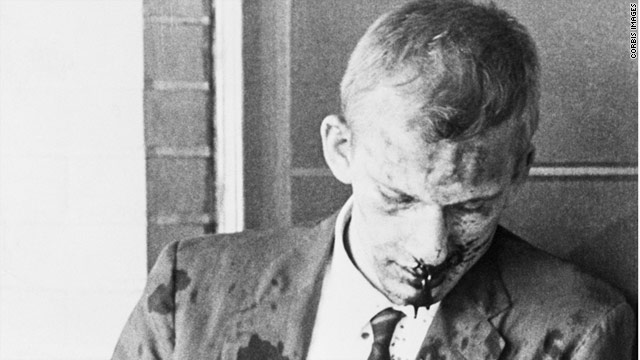
James Zwerg's physical wounds healed after he was attacked by an Alabama mob, but the emotional
wounds festered.
By John Blake, CNN
Editor's note: This is an excerpt from John Blake's 2004 book "Children
of the Movement." The PBS documentary "Freedom Riders," which airs
Monday at 9 p.m. ET, features James Zwerg, now 71. Blake interviewed
him in 2003. This report contains objectionable language.
(CNN) -- The mob was already waiting for James Zwerg by the time the
Greyhound bus eased into the station in Montgomery, Alabama.
Looking out the window, Zwerg could see men gripping baseball bats, chains
and clubs. They had sealed off the streets leading to the bus station and
chased away news photographers. They didn't want anyone to witness what
they were about to do.
Zwerg accepted his worst fear: He was going to die today.
Only the night before, Zwerg had prayed for the strength to not strike back
in anger. He was among the 18 white and black college students from
Nashville who had decided to take the bus trip through the segregated
South in 1961. They called themselves Freedom Riders. Their goal was to
desegregate public transportation.
Zwerg had not planned to go, but the night before, some students had asked
him to join them. To summon his courage, Zwerg stayed up late, reading
Psalm 27, the scripture that the students had picked to read during a group
prayer before their trip.
"The Lord is my light and my salvation, of whom shall I fear?" the Psalm
began. But there was another passage at the end that touched Zwerg in a
place the other students didn't know about: "Though my mother and father
forsake me, the Lord will receive me."
Zwerg's parents had forsaken him for joining the civil rights movement. That
same night, he had written a letter that was to be handed to them in case
he was killed. It explained his decision to join the Freedom Riders.
Zwerg called his mother to tell her where he was going.
"Don't go. Don't go," she said. "You can't do this to your father."
"I have no choice. I have to," he said.
"You killed your father," his mother replied. Then she hung up.
The Greyhound bus doors hissed open. Zwerg had volunteered to go first.
The mob swarmed him as he stepped off the bus, yelling, "****** lover!
****** lover!"
Then, as the mob grabbed him, Zwerg closed his eyes and bowed his head to
pray. "The Lord is my light and salvation, of whom shall I fear ... "
The mob dragged him away.
Zwerg tells the story behind the photo
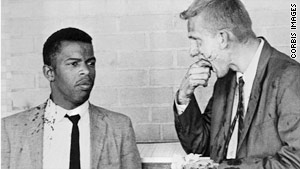
James Zwerg, right, with John Lewis after
the mob attacked them. Zwerg passed out
soon after the photo was taken.
What happened next would furnish the civil rights movement with one of its
most unforgettable images. Photographers eventually broke through and
snapped pictures of what the mob had done to Zwerg and another Freedom
Rider, John Lewis. The pictures were broadcast around the world.
Zwerg looked like a bloody scarecrow. His eyes were blackened and his suit
was splattered with blood. After he was hospitalized, a news crew filmed him
in his hospital bed. Barely able to speak, Zwerg declared that violence
wouldn't stop him or any of his friends. The Freedom Rides would go on.
Zwerg became one of the movement's first heroes. Although his physical
wounds healed, the emotional ones took longer. He was wracked with guilt
and depression after the beating. He drank too much, contemplated suicide,
and finally had to seek therapy.
He was drawn to the Freedom Rides after he was assigned a black roommate
while attending Beloit College in Wisconsin. He grew to admire his roommate
and was shocked to see how the young man was treated by whites when
they went out in public together. So he volunteered to be an exchange
student at Fisk University in Nashville, an all-black college, for one semester.
He wanted to know how it felt to be a minority.
Zwerg had gone to a city that had become a launching pad for the civil rights
movement. He was swept up in the group of Nashville college students who
were initiating sit-ins and Freedom Rides. He was awed by their commitment.
Zwerg's parents were unaware of the changes taking place in their son. They
were enraged when they opened their local newspaper the day after he was
attacked and saw the now-famous picture of their battered son on the front
page.
Zwerg later tried to explain to them that what he did as a Freedom Rider was
an outgrowth of what they had taught him, but they remained angry. "These
are the two people who instilled my Christian beliefs, my ethics," he
says, "and now they were saying, this time when I lived my faith to the
fullest, they didn't accept it."
Zwerg would try to talk to his father about his decision, but they could never
finish the conversation.
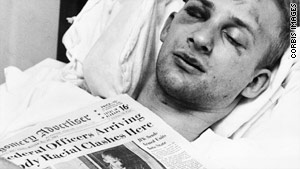
Even after the mob attacked James Zwerg,
they followed him to the hospital. He became
a media sensation.
"He'd blow up. He'd say, 'I don't want to talk about it.' One time, he used the
n-word. He said, 'Those damn ******s used you.' "
Zwerg's anguish was compounded by his father's weak heart. He suffered a
heart attack after he learned his son was attacked by a mob, and his
mother had a nervous breakdown. "I had a tremendous amount of guilt," he
says.
Even as the years passed and he was featured in documentaries and history
books, Zwerg's parents never gave their approval. They simply stopped
discussing that part of his life.
The closest he got to some sort of reconciliation was a conversation with his
mother. She told him that her concern was for his dad. "She said, 'You'll
never know the shock. We knew you were doing something, but we learned
what happened to you from seeing your picture on the front page of the
Milwaukee Journal. Until you have a child of your own, you'll never
understand.' "
The iconic photo eats away at Zwerg's life
His parents' rejection erased the closeness Zwerg once felt with them. "I had
a lot of anger toward them," he says. "How can they treat me this way?
This was the most meaningful period of my life. How could they not
understand that?"
Zwerg took out his anger on himself and on others. After the beating, he
returned to college but had trouble being close to anyone. "The two people I
loved the most hurt me, so, by God, I wasn't going to love anybody," Zwerg
says. "I might meet a girl who I felt was special. One minute, I'd tell her that
I loved her, and the next, I told her I didn't want to see her again."
Zwerg began to drink heavily during his senior year, and at one time he
contemplated suicide. Depressed, he put on his jacket and walked to a pier
near campus.
He still doesn't remember what happened next. "I remember going out to the
pier, but I do not remember coming back," he says. "I awoke the next day in
my room, and when I put on my jacket, a straight-edge razor was in a
pocket. I didn't remember putting it there."
Though the aftermath of the beating caused Zwerg much emotional pain, the
attack also led to one of his most profound religious experiences. He felt
something during the mob attack that he still struggles to describe.
After he stepped off the bus, Zwerg says, the crowd grabbed him.
In "Parting the Waters," Taylor Branch wrote that the mob had swelled to
3,000 people and described what happened to Zwerg: "One of the men
grabbed Zwerg's suitcase and smashed him in the face with it. Others
slugged him to the ground, and when he was dazed beyond resistance, one
man pinned Zwerg's head between his knees so that the others could take
turns hitting him.'"
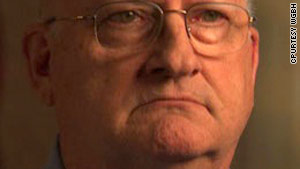
James Zwerg, now 71, says he never felt as
alive as he did when he was a Freedom Rider.
Yet in the midst of that savagery, Zwerg says he had the most beautiful
experience in his life. "I bowed my head," he says. "I asked God to give me
the strength to remain nonviolent and to forgive the people for what they
might do. It was very brief, but in that instant, I felt an overwhelming
presence. I don't know how else to describe it. A peace came over me. I
knew that no matter what happened to me, it was going to be OK. Whether
I lived or whether I died, I felt this incredible calm."
Zwerg blacked out and didn't wake up until he was in a car. The mob had
continued to beat him after he was unconscious. Being unconscious saved
his life, he believes now. His body was relaxed, so it took the punishment
better than if he had stiffened up to protect himself. Incredibly, no Freedom
Riders were killed during the mob attack.
Even after he was taken to a nearby hospital, Zwerg learned later, he was
not safe. "A nurse said she drugged me the first night because there was a
mob coming within a block of the hospital to lynch me," he says. "She didn't
want me to be aware of anything if they got me."
Zwerg was in such shock, he doesn't remember the news crew that did make
it to his hospital room. In a scene that was played in the "Eyes on the Prize"
documentary, a battered Zwerg told the American public that the Freedom
Rides would go on. "We will continue our journey, one way or another. We
are prepared to die."
He doesn't even remember talking to anyone from his hospital bed.
Zwerg's teeth were fractured and several of his vertebrae were cracked, but
he recovered. He also took steps to recover emotionally. He was torn
between rejoining the Freedom Riders and attending seminary.
Then, as he was being honored by the Southern Christian Leadership
Conference for his courage, he talked to the Rev. Martin Luther King Jr.
about his career indecision. "He said, 'Jim, go to seminary. You'll touch a lot
more lives through pastoring,' " Zwerg recalls. "Basically, that made up my
mind for me."
Freedom Riders struggle on a new journey
When he entered seminary, Zwerg decided to go through six months of
therapy to release the anger and guilt he felt toward his parents. He also
thought about a woman he had shunned during his angry college days. "I
worked a lot of this through, which made me feel much better," he
says. "When I finished, I knew I wanted to see my lady again. So, I called
her up that night, asked her out, and asked her to marry me."
That woman, Carolyn, said yes. They live together today in Tucson, Arizona.
Zwerg entered the ministry after the beating. But he left in 1975, dejected
by the politics of his job.
At various times, he was a chamber of commerce lobbyist, an IBM manager,
and a business manager at a hospice. He worked for a ministry that put
people into low-cost housing. He retired in 1999.
He never found the bond he experienced with the other Freedom
Riders. "Each of us was stronger because of those we were with," he
says. "If I was being beaten, I knew I wasn't alone. I could endure more
because I knew everybody there was giving me their strength. Even as
someone else was being beaten, I would give them my strength."
Though he became a pastor, Zwerg says his most profound exposure to faith
came as a Freedom Rider. "I never felt so alive theologically," he says. "My
prayer life was never so meaningful. My whole awareness of the power of
love when I heard King say in his last utterance, 'I've been to the
mountaintop, and I've seen the Promised Land.' I know those of us who were
in the movement can say we were there, too."
But coming down from the mountaintop, after the movement, was deflating,
Zwerg says. He couldn't find that bond again. "It's a tremendous downer.
You look for it everywhere. I've never experienced it since. The closest thing
I've experienced to it is the love of my wife."
Many of his colleagues had the same struggles. Some couldn't keep jobs
because they couldn't handle authority. One stepped in front of a bus and
killed himself. Another drank himself to death. Many experienced some type
of post-traumatic stress.
Zwerg questions his place in history
Zwerg says he still gets choked up about that morning in the Alabama bus
station. When I ask what he feels today when he sees that photo of himself,
he grows quiet.
Then he tells a story.
He says he attended a reunion at the Birmingham Civil Rights Institute and
Museum in Alabama. During a ceremony, Zwerg was walking with a crowd of
Freedom Rider colleagues when he saw the famous pictures of his battered
face in a video and displayed on the museum wall.
"I looked at it, and what it brings back to me more than anything else is that
I got so much notoriety because I was white," he says. "I looked at that
picture and I thought of all the people that never get their names in a book,
never get interviewed but literally had given their lives. Who the hell am I
to have my picture up there?"
He was suddenly flooded with guilt. He started bawling during the ceremony
as startled people looked on. Then another Freedom Rider veteran, a
strapping black man named Jim Davis, walked over to Zwerg.
Zwerg's voice trembles with emotion as he recalls what Davis said. "He
said, 'Jim, you don't realize that it was your words from that hospital bed
that were the call to arms for the rest of us.' "
And then, as Davis wrapped his big arms around Zwerg in front of the
startled crowd, the two men cried together.
http://www.cnn.com/2011/US/05/16/Zwerg.freedom.rides/index.html?hpt=C2
Shocking photo created a hero,
but not to his family
James Zwerg's physical wounds healed after he was attacked by an Alabama mob, but the emotional
wounds festered.
By John Blake, CNN
Editor's note: This is an excerpt from John Blake's 2004 book "Children
of the Movement." The PBS documentary "Freedom Riders," which airs
Monday at 9 p.m. ET, features James Zwerg, now 71. Blake interviewed
him in 2003. This report contains objectionable language.
(CNN) -- The mob was already waiting for James Zwerg by the time the
Greyhound bus eased into the station in Montgomery, Alabama.
Looking out the window, Zwerg could see men gripping baseball bats, chains
and clubs. They had sealed off the streets leading to the bus station and
chased away news photographers. They didn't want anyone to witness what
they were about to do.
Zwerg accepted his worst fear: He was going to die today.
Only the night before, Zwerg had prayed for the strength to not strike back
in anger. He was among the 18 white and black college students from
Nashville who had decided to take the bus trip through the segregated
South in 1961. They called themselves Freedom Riders. Their goal was to
desegregate public transportation.
Zwerg had not planned to go, but the night before, some students had asked
him to join them. To summon his courage, Zwerg stayed up late, reading
Psalm 27, the scripture that the students had picked to read during a group
prayer before their trip.
"The Lord is my light and my salvation, of whom shall I fear?" the Psalm
began. But there was another passage at the end that touched Zwerg in a
place the other students didn't know about: "Though my mother and father
forsake me, the Lord will receive me."
Zwerg's parents had forsaken him for joining the civil rights movement. That
same night, he had written a letter that was to be handed to them in case
he was killed. It explained his decision to join the Freedom Riders.
Zwerg called his mother to tell her where he was going.
"Don't go. Don't go," she said. "You can't do this to your father."
"I have no choice. I have to," he said.
"You killed your father," his mother replied. Then she hung up.
The Greyhound bus doors hissed open. Zwerg had volunteered to go first.
The mob swarmed him as he stepped off the bus, yelling, "****** lover!
****** lover!"
Then, as the mob grabbed him, Zwerg closed his eyes and bowed his head to
pray. "The Lord is my light and salvation, of whom shall I fear ... "
The mob dragged him away.
Zwerg tells the story behind the photo
James Zwerg, right, with John Lewis after
the mob attacked them. Zwerg passed out
soon after the photo was taken.
What happened next would furnish the civil rights movement with one of its
most unforgettable images. Photographers eventually broke through and
snapped pictures of what the mob had done to Zwerg and another Freedom
Rider, John Lewis. The pictures were broadcast around the world.
Zwerg looked like a bloody scarecrow. His eyes were blackened and his suit
was splattered with blood. After he was hospitalized, a news crew filmed him
in his hospital bed. Barely able to speak, Zwerg declared that violence
wouldn't stop him or any of his friends. The Freedom Rides would go on.
Zwerg became one of the movement's first heroes. Although his physical
wounds healed, the emotional ones took longer. He was wracked with guilt
and depression after the beating. He drank too much, contemplated suicide,
and finally had to seek therapy.
He was drawn to the Freedom Rides after he was assigned a black roommate
while attending Beloit College in Wisconsin. He grew to admire his roommate
and was shocked to see how the young man was treated by whites when
they went out in public together. So he volunteered to be an exchange
student at Fisk University in Nashville, an all-black college, for one semester.
He wanted to know how it felt to be a minority.
Zwerg had gone to a city that had become a launching pad for the civil rights
movement. He was swept up in the group of Nashville college students who
were initiating sit-ins and Freedom Rides. He was awed by their commitment.
Zwerg's parents were unaware of the changes taking place in their son. They
were enraged when they opened their local newspaper the day after he was
attacked and saw the now-famous picture of their battered son on the front
page.
Zwerg later tried to explain to them that what he did as a Freedom Rider was
an outgrowth of what they had taught him, but they remained angry. "These
are the two people who instilled my Christian beliefs, my ethics," he
says, "and now they were saying, this time when I lived my faith to the
fullest, they didn't accept it."
Zwerg would try to talk to his father about his decision, but they could never
finish the conversation.
Even after the mob attacked James Zwerg,
they followed him to the hospital. He became
a media sensation.
"He'd blow up. He'd say, 'I don't want to talk about it.' One time, he used the
n-word. He said, 'Those damn ******s used you.' "
Zwerg's anguish was compounded by his father's weak heart. He suffered a
heart attack after he learned his son was attacked by a mob, and his
mother had a nervous breakdown. "I had a tremendous amount of guilt," he
says.
Even as the years passed and he was featured in documentaries and history
books, Zwerg's parents never gave their approval. They simply stopped
discussing that part of his life.
The closest he got to some sort of reconciliation was a conversation with his
mother. She told him that her concern was for his dad. "She said, 'You'll
never know the shock. We knew you were doing something, but we learned
what happened to you from seeing your picture on the front page of the
Milwaukee Journal. Until you have a child of your own, you'll never
understand.' "
The iconic photo eats away at Zwerg's life
His parents' rejection erased the closeness Zwerg once felt with them. "I had
a lot of anger toward them," he says. "How can they treat me this way?
This was the most meaningful period of my life. How could they not
understand that?"
Zwerg took out his anger on himself and on others. After the beating, he
returned to college but had trouble being close to anyone. "The two people I
loved the most hurt me, so, by God, I wasn't going to love anybody," Zwerg
says. "I might meet a girl who I felt was special. One minute, I'd tell her that
I loved her, and the next, I told her I didn't want to see her again."
Zwerg began to drink heavily during his senior year, and at one time he
contemplated suicide. Depressed, he put on his jacket and walked to a pier
near campus.
He still doesn't remember what happened next. "I remember going out to the
pier, but I do not remember coming back," he says. "I awoke the next day in
my room, and when I put on my jacket, a straight-edge razor was in a
pocket. I didn't remember putting it there."
Though the aftermath of the beating caused Zwerg much emotional pain, the
attack also led to one of his most profound religious experiences. He felt
something during the mob attack that he still struggles to describe.
After he stepped off the bus, Zwerg says, the crowd grabbed him.
In "Parting the Waters," Taylor Branch wrote that the mob had swelled to
3,000 people and described what happened to Zwerg: "One of the men
grabbed Zwerg's suitcase and smashed him in the face with it. Others
slugged him to the ground, and when he was dazed beyond resistance, one
man pinned Zwerg's head between his knees so that the others could take
turns hitting him.'"
James Zwerg, now 71, says he never felt as
alive as he did when he was a Freedom Rider.
Yet in the midst of that savagery, Zwerg says he had the most beautiful
experience in his life. "I bowed my head," he says. "I asked God to give me
the strength to remain nonviolent and to forgive the people for what they
might do. It was very brief, but in that instant, I felt an overwhelming
presence. I don't know how else to describe it. A peace came over me. I
knew that no matter what happened to me, it was going to be OK. Whether
I lived or whether I died, I felt this incredible calm."
Zwerg blacked out and didn't wake up until he was in a car. The mob had
continued to beat him after he was unconscious. Being unconscious saved
his life, he believes now. His body was relaxed, so it took the punishment
better than if he had stiffened up to protect himself. Incredibly, no Freedom
Riders were killed during the mob attack.
Even after he was taken to a nearby hospital, Zwerg learned later, he was
not safe. "A nurse said she drugged me the first night because there was a
mob coming within a block of the hospital to lynch me," he says. "She didn't
want me to be aware of anything if they got me."
Zwerg was in such shock, he doesn't remember the news crew that did make
it to his hospital room. In a scene that was played in the "Eyes on the Prize"
documentary, a battered Zwerg told the American public that the Freedom
Rides would go on. "We will continue our journey, one way or another. We
are prepared to die."
He doesn't even remember talking to anyone from his hospital bed.
Zwerg's teeth were fractured and several of his vertebrae were cracked, but
he recovered. He also took steps to recover emotionally. He was torn
between rejoining the Freedom Riders and attending seminary.
Then, as he was being honored by the Southern Christian Leadership
Conference for his courage, he talked to the Rev. Martin Luther King Jr.
about his career indecision. "He said, 'Jim, go to seminary. You'll touch a lot
more lives through pastoring,' " Zwerg recalls. "Basically, that made up my
mind for me."
Freedom Riders struggle on a new journey
When he entered seminary, Zwerg decided to go through six months of
therapy to release the anger and guilt he felt toward his parents. He also
thought about a woman he had shunned during his angry college days. "I
worked a lot of this through, which made me feel much better," he
says. "When I finished, I knew I wanted to see my lady again. So, I called
her up that night, asked her out, and asked her to marry me."
That woman, Carolyn, said yes. They live together today in Tucson, Arizona.
Zwerg entered the ministry after the beating. But he left in 1975, dejected
by the politics of his job.
At various times, he was a chamber of commerce lobbyist, an IBM manager,
and a business manager at a hospice. He worked for a ministry that put
people into low-cost housing. He retired in 1999.
He never found the bond he experienced with the other Freedom
Riders. "Each of us was stronger because of those we were with," he
says. "If I was being beaten, I knew I wasn't alone. I could endure more
because I knew everybody there was giving me their strength. Even as
someone else was being beaten, I would give them my strength."
Though he became a pastor, Zwerg says his most profound exposure to faith
came as a Freedom Rider. "I never felt so alive theologically," he says. "My
prayer life was never so meaningful. My whole awareness of the power of
love when I heard King say in his last utterance, 'I've been to the
mountaintop, and I've seen the Promised Land.' I know those of us who were
in the movement can say we were there, too."
But coming down from the mountaintop, after the movement, was deflating,
Zwerg says. He couldn't find that bond again. "It's a tremendous downer.
You look for it everywhere. I've never experienced it since. The closest thing
I've experienced to it is the love of my wife."
Many of his colleagues had the same struggles. Some couldn't keep jobs
because they couldn't handle authority. One stepped in front of a bus and
killed himself. Another drank himself to death. Many experienced some type
of post-traumatic stress.
Zwerg questions his place in history
Zwerg says he still gets choked up about that morning in the Alabama bus
station. When I ask what he feels today when he sees that photo of himself,
he grows quiet.
Then he tells a story.
He says he attended a reunion at the Birmingham Civil Rights Institute and
Museum in Alabama. During a ceremony, Zwerg was walking with a crowd of
Freedom Rider colleagues when he saw the famous pictures of his battered
face in a video and displayed on the museum wall.
"I looked at it, and what it brings back to me more than anything else is that
I got so much notoriety because I was white," he says. "I looked at that
picture and I thought of all the people that never get their names in a book,
never get interviewed but literally had given their lives. Who the hell am I
to have my picture up there?"
He was suddenly flooded with guilt. He started bawling during the ceremony
as startled people looked on. Then another Freedom Rider veteran, a
strapping black man named Jim Davis, walked over to Zwerg.
Zwerg's voice trembles with emotion as he recalls what Davis said. "He
said, 'Jim, you don't realize that it was your words from that hospital bed
that were the call to arms for the rest of us.' "
And then, as Davis wrapped his big arms around Zwerg in front of the
startled crowd, the two men cried together.
http://www.cnn.com/2011/US/05/16/Zwerg.freedom.rides/index.html?hpt=C2


