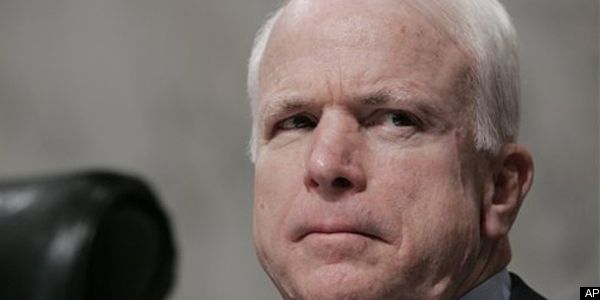
The Official John McCain Thread

thoughtone

Rising Star
Registered
source: Free Republic.com

Transcript of Roberta McCain on C-SPAN (Says son hasn't any support among GOP base)
Time ^ | January 24, 2008 | Mark Halperin|


Posted on 01/24/2008 9:09:37 PM PST by 2ndDivisionVet


Steve Scully: This is a political question in terms of how he gets the nomination, but just from what you have seen, how much support do you think he has among the base of the Republican Party?

Roberta McCain: I don’t think he has any. I don’t know what the base of the Repub–maybe I don’t know enough about it, but I’ve not seen any help whatsoever.

Scully: So can he then go on and become the nominee of this party?

McCain: Yes, I think holding their nose they’re going to have to take him.

Scully: Can you explain?

McCain: Well, everything they’ve done and said. … Now I’m really popping off, but he worked like a dog to get Bush re-elected. …He’s backed Bush in everything except Rumsfeld. Have you heard other senators and congressmen backing Bush over eight years? Find me it–give me a name. I’ve not seen any public recognition of the work that he’s done for the Republican party.
 
GOP Senators Reassess Views On McCain

<img src="http://media.washingtonpost.com/wp-srv/ssi/globalnav/wpdotcom_190x30.gif" alt="washingtonpost.com" border="0" height="30" vspace="2" width="190"></a>
<div style="margin-right: 165px;"></div><font size="+2"><b>GOP Senators Reassess Views About McCain</b></font><br>His Old Foes Still Wary Of His Pugnacious Style<br><p><font size="-1">By Paul Kane<br>Washington Post Staff Writer<br>Monday, February 4, 2008; A01<br></font></p><p></p><p><a linkindex="12" href="http://projects.washingtonpost.com/congress/members/m000303/" target="">John McCain</a> once testified under oath that a Senate colleague inappropriately used tobacco corporation donations to sway votes on legislation. He cursed out another colleague in front of 20 senators and staff members, questioning the senator's grip on immigration legislation. And, on the Senate floor, McCain (R-Ariz.) accused another colleague of "egregious behavior" for helping a defense contractor in a move he said resembled "corporate scandals."</p><p>And those were just the Republicans.</p><p>In a chamber once known for cordiality if not outright gentility, McCain has battled his fellow senators for more than two decades in a fashion that has been forceful and sometimes personal. Now, with the conservative maverick on the brink of securing his party's presidential nomination, McCain's Republican colleagues are grappling with the idea of him at the top of their ticket.</p><p>"There would be a lot of people who would have to recalibrate their attitudes toward John," said <a linkindex="13" href="http://www.washingtonpost.com/ac2/related/topic/Robert+Bennett?tid=informline" target="">Sen. Robert F. Bennett (R-Utah)</a>, a supporter of <a linkindex="14" href="http://www.washingtonpost.com/ac2/related/topic/Mitt+Romney?tid=informline" target="">Mitt Romney</a>'s who has clashed with McCain.</p><p>Many Senate Republicans, even those who have jousted with McCain in the past, say their reassessment is underway. Sensing the increasing likelihood that he will be the nominee, <a linkindex="15" href="http://www.washingtonpost.com/ac2/related/topic/U.S.+Republican+Party?tid=informline" target="">GOP</a> senators who have publicly fought with him are emphasizing his war-hero background and playing down past confrontations.</p><p>"I forgive him for whatever disagreements he has had with me. We can disagree on things, but I have great admiration for him," said <a linkindex="16" href="http://projects.washingtonpost.com/congress/members/s000888/" target="">Sen. Ted Stevens</a> (R-Alaska), a senior member of the Appropriations Committee who has often argued with McCain over government spending.</p><p>But others have outright rejected the idea of a McCain nomination and presidency, warning that his tirades suggest a temperament unfit for the <a linkindex="17" href="http://www.washingtonpost.com/ac2/related/topic/The+White+House?tid=informline" target="">Oval Office</a>.</p><p>"The thought of his being president sends a cold chill down my spine," <a linkindex="18" href="http://projects.washingtonpost.com/congress/members/c000567/" target="">Sen. Thad Cochran</a> (R-Miss.), also a senior member of the Appropriations panel, told the <a linkindex="19" href="http://www.washingtonpost.com/ac2/related/topic/The+Boston+Globe?tid=informline" target="">Boston Globe</a> recently. "He is erratic. He is hotheaded. He loses his temper and he worries me."</p><p>A former colleague says McCain's abrasive nature would, at minimum, make his relations with Republicans on <a linkindex="20" href="http://www.washingtonpost.com/ac2/related/topic/Capitol+Hill?tid=informline" target="">Capitol Hill</a> uneasy if he were to become president. McCain could find himself the victim of Republicans who will not go the extra mile for him on legislative issues because of past grievances.</p><p>"John was very rough in the sandbox," said former senator <a linkindex="21" href="http://www.washingtonpost.com/ac2/related/topic/Rick+Santorum?tid=informline" target="">Rick Santorum</a> (R-Pa.), who is outspoken in his opposition to McCain's candidacy. "Everybody has a McCain story. If you work in the Senate for a while, you have a McCain story. . . . He hasn't built up a lot of goodwill."</p><p>Santorum was a fierce advocate for the GOP's social conservative wing -- a group particularly hostile to McCain because of his apostasy on immigration and same-sex marriage -- while Cochran is considered one of the more genteel senators. Both men back Romney, a former <a linkindex="22" href="http://www.washingtonpost.com/ac2/related/topic/Massachusetts?tid=informline" target="">Massachusetts</a> governor, for president.</p><p>To McCain's allies, his fiery personality is part of the "Straight Talk" lore, and a positive quality in a passionate fighter who will tell you to your face how much he dislikes an idea.</p><p>"When he's arguing about something he believes in, he's arguing about it," said Mark Salter, a top aide to McCain. "It's an admirable trait, the capacity to be outraged."</p><p>Salter scoffed at the idea that McCain is not fit to be president and said most stories about his temper are "wildly exaggerated." He pointed to McCain's success at "across-the-aisle cooperation" with Democrats as an example of how he would deal with Congress if elected president.</p><p>Those legislative wins include a major campaign finance law in his name in 2002 and a deal with 14 Democrats and Republicans in 2005 that broke Democratic filibusters on judicial nominees. "That resulted in a lot of good, solid, conservative jurists being confirmed," Salter said.</p><p>McCain's battles with colleagues have often gone beyond the ins and outs of policy, taking on a fierce personal tone that other senators do not often engage in, at least not in public.</p><p>Stevens, for example, has long stuffed the annual Pentagon spending bill with earmarked provisions for his home state that draw the ire of McCain, who has crusaded against such pet projects. In 2002, Stevens inserted an unusual provision in the defense appropriations bill that allowed <a linkindex="23" href="http://www.washingtonpost.com/ac2/related/topic/Boeing+Company?tid=informline" target="">Boeing Corp.</a> to lease fuel tankers to the Air Force for $21 billion.</p><p>McCain regularly took to the floor to criticize the provision and tried to steal jurisdiction from Stevens's subcommittee so he could kill the deal. "This is the same kind of egregious behavior we often rail against here on the Senate floor when it comes to corporate scandals," he said.</p><p>While he has lost almost every earmark fight with Stevens, McCain won the Boeing battle by using his perch atop the Commerce Committee in 2003 and 2004 to investigate the lease deal, uncovering corruption inside the Air Force procurement office.</p><p>As president, one of McCain's most critical relationships would be with <a set="yes" linkindex="24" href="http://projects.washingtonpost.com/congress/members/m000355/" target="">Senate Minority Leader Mitch McConnell</a> (R-Ky.), a necessary ally in the conflict with a Democratic-led Congress. But their relationship has been gravely tested.</p><p>In 2003, after McConnell challenged the McCain-Feingold campaign finance law in court, McCain gave testimony that almost accused McConnell of breaking federal laws. Under oath, he said that in 1998 McConnell tried to scuttle McCain's legislation to settle lawsuits against the tobacco industry by informing GOP senators that Big Tobacco would spend millions of dollars supporting candidates who opposed McCain's bill.</p><p>McConnell has denied the nature of the allegation, but that deposition culminated a five-year fight between the senators over the tobacco bill and the campaign finance legislation. But McConnell said last week that he would have no trouble with McCain as the nominee or as president.</p><p>"We've had a great relationship since," McConnell said. "All of them [McCain's fights] have been respectable and entirely within the traditions of the Senate."</p><p>McCain's relationship with House Republicans has been strained for years. After stumping for more than 50 GOP candidates during the 2000 campaign, McCain dramatically scaled back his efforts in 2002 out of pique toward House Republicans who opposed his effort to overhaul campaign finance law. In 2004, while McCain was objecting to GOP-backed tax cuts, then-Speaker <a linkindex="25" href="http://projects.washingtonpost.com/congress/members/h000323/" target="">J. Dennis Hastert</a> (R-Ill.) suggested that the senator, a former prisoner of war, should go to <a linkindex="26" href="http://www.washingtonpost.com/ac2/related/topic/Walter+Reed+Health+Care+System?tid=informline" target="">Walter Reed Army Medical Center</a> to see what "sacrifice" meant to the nation.</p><p>Nevertheless, many House Republicans now view McCain as the best possible nominee. Despite the senator's heresies on taxes, immigration and campaign finance, <a linkindex="27" href="http://projects.washingtonpost.com/congress/members/c001053/" target="">Rep. Tom Cole</a> (<a linkindex="28" href="http://www.washingtonpost.com/ac2/related/topic/Oklahoma?tid=informline" target="">Okla.</a>), chairman of the Republican campaign committee, said McCain could appeal to independent voters.</p><p>"You'll have more Democrats running away from <a linkindex="29" href="http://projects.washingtonpost.com/congress/members/c001041/" target="">Hillary Clinton</a> than you'll have Republicans running away from our nominee," he said.</p><p>In his first run for the presidency in 2000, McCain's temperament became an issue as campaign aides to <a set="yes" linkindex="30" href="http://www.washingtonpost.com/ac2/related/topic/George+W.+Bush?tid=informline" target="">George W. Bush</a> questioned whether the senator was a suitable occupant for the Oval Office. Only a few of McCain's Senate colleagues endorsed him then.</p><p>But the past few years have seen fewer McCain outbursts, prompting some senators and aides to suggest privately that he is working to control his temper. This time, 13 senators have endorsed his presidential bid, more than for any other candidate, Democrat or Republican.</p><p>"We all get a little bit mellower," Salter said. "But he doesn't get up every morning saying, 'I must control my temper.' "</p><p>Last spring, however, McCain's confrontational side reappeared during a closed-door meeting of senators from both parties. After spending six weeks away from the Senate, he showed up for final negotiations on a fragile immigration bill, leading <a set="yes" linkindex="31" href="http://projects.washingtonpost.com/congress/members/c001056/" target="">Sen. John Cornyn</a> (R-Tex.) to question where he had been. McCain responded by swearing at Cornyn loudly and repeatedly, according to witnesses.</p><p>Cornyn, who has not endorsed a presidential candidate, doesn't expect to befriend McCain anytime soon but said he will happily stump for him as the nominee.</p><p>"We've had our moments, but we've gotten over that and moved on down the road," Cornyn said. "You're talking about people who are professionals. You don't have to link arms and sing 'Kumbaya' to get things done."</p>
 
Re: GOP Senators Reassess Views On McCain

They already know. Bitch Romney is attacking Hillary out here in Cali instead of POW man. :smh::smh:
 
Re: GOP Senators Reassess Views On McCain

I'm a Democrat, but if Hill gets the nomination, McCain's my boy. We need some serious work (maybe Executive Order) on campaign finance reform, and anybody who pisses republicans off THAT much can't be all bad.
 
CNN: John McCain "wimped out"

<object type="application/x-shockwave-flash" width="450" height="370" wmode="transparent" data="http://www.liveleak.com/player.swf?autostart=false&token=7b4_1202504814"><param name="movie" value="http://www.liveleak.com/player.swf?autostart=false&token=7b4_1202504814"><param name="wmode" value="transparent"><param name="quality" value="high"></object>

It was one of those moments that said quite a bit about somebody’s character,” Cafferty said. “John McCain didn’t have the stomach for the tough decision
:smh:
 
This Is Exactly Why We Do Not John Mccain.......

<object type="application/x-shockwave-flash" width="450" height="370" wmode="transparent" data="http://www.liveleak.com/player.swf?autostart=false&token=70b_1202744610"><param name="movie" value="http://www.liveleak.com/player.swf?autostart=false&token=70b_1202744610"><param name="wmode" value="transparent"><param name="quality" value="high"></object>

His illegal alien policies will jeopordize the soverienty of the United States:eek:
 
Re: This Is Exactly Why We Do Not John Mccain.......

Not Voting:

Boxer (D-CA)
Dodd (D-CT)
Kennedy (D-MA)
McCain (R-AZ)

:hmm::hmm::hmm:
 
Re: This Is Exactly Why We Do Not John Mccain.......

Amen. Fuck John McCain. Motherfucker says "we'll have to stay in Iraq even if it takes 1000 years" THE FUCK????
 
Re: This Is Exactly Why We Do Not John Mccain.......

THEREALMCCAIN.COM

[FLASH]http://www.youtube.com/v/0nqtL-P8kzo&rel=1&border=0[/FLASH]
 
Re: This Is Exactly Why We Do Not John Mccain.......

Yo Muckraker,

Why does that video look a lot like an attempt by someone to encourage people to consider Hillary, if Obama is not the nominee ???

QueEx
 
McCain's vote is an appeal to the hard right

Maverick Fails The Test: McCain Votes Against Waterboarding Ban
r-MCCAIN-TORTURE-large.jpg

Today, the Senate brought the Intelligence Authorization Bill to the floor, which contained a provision from Sen. Dianne Feinstein (D-CA) establishing one interrogation standard across the government. The bill requires the intelligence community to abide by the same standards as articulated in the Army Field Manual and bans waterboarding.

Just hours ago, the Senate voted in favor of the bill, 51-45.

Earlier today, ThinkProgress noted that Sen. John McCain (R-AZ), a former prisoner of war, has spoken strongly in favor of implementing the Army Field Manual standard. When confronted today with the decision of whether to stick with his conscience or cave to the right wing, McCain chose to ditch his principles and instead vote to preserve waterboarding:

Mr. McCain, a former prisoner of war, has consistently voiced opposition to waterboarding and other methods that critics say is a form torture. But the Republicans, confident of a White House veto, did not mount the challenge. Mr. McCain voted “no” on Wednesday afternoon.

The New York Times Times notes that “the White House has long said Mr. Bush will veto the bill, saying it ‘would prevent the president from taking the lawful actions necessary to protect Americans from attack in wartime.’”

After Bush vetoes the bill, McCain will again be confronted with a vote to either stand with President Bush or stand against torture. He indicated with his vote today where he will come down on that issue.

John McCain: He was against waterboarding before he was for it.
http://thinkprogress.org/2008/02/13/mccain-waterboarding-fail/

-VG
 
Re: McCain's vote is an appeal to the hard right

not for nothing i think this could cause him the white house. No way your gonna convince an independant moderate that torture is ok. pandering to the extreme right for a primary victory he already basically won is going to ruin him later.
 
Re: This Is Exactly Why We Do Not John Mccain.......

His illegal alien policies will jeopordize the soverienty of the United States:eek:

OK, after viewing that video, if that amnesty bill went forward, I would immediately get citizenship in Mexico, and illegally come back to America. Shit, pay no taxes, get tax credits, free education, etc!?!? Fuck it 'ese! Viva Mexico!!
 
The Official John McCain Thread - M C C A I N * I S * T O A S T ! ! !

You guys need to read this article. It's titled "Republicans for Obama: An editorial" (2/18/2008 8:17 am), but one of the replies (from someone named "fflambeau") tears McC a new one. If ANY of these facts are right, O will def be the next president.

==========================================

http://www.madison.com/tct/opinion/273021

Indeed, what is a Republican to do? I mean Huckabee, McCain, Romney and Rudy G--these are the best people they have? It doesn't say much for the party.


McCain is pure and simple a war monger: he has called for the US to be in Iraq for the next 100 years and a 'bomb, bomb, bomb' policy against Iran. That's all we need--yet another war in the Middle East. All those tax dollars of yours will go for the 100 year war.


McCain is going to be 72 years old in August. He will be 72 1/2 years old in February, 2009, and would be the oldest president we have ever had if he wins. Fellow Republicans have said he has such a bad temper and is so erratic that the idea of him 'sends shudders up their spine.'


Moreover, McCain has had an easy ride from the collaborationist press. McCain was one of the Keating Five and was charged along with the other 5 of taking $1.3 million from the corrupt Charles Keating so that the feds would stay away from what he was doing in bankrupting several savings and loans. He was sanctioned by the Senate Ethics Committee for this and had to return thousands of dollars.


Far from being a campaign finance reformer, McCain has also been in the pockets of special interests like the Phoenix 40 (the biggest group of special interest corporations, banks and lawyers in Arizona) and huge banks, the military industrial complex, and pharmaceuticals. He has accepted more funds from lobbyists than any other senator. He is owneed currently by J.P. Morgan and Ogilvy, among others. Please see: Jeffrey H. Bimbaum and John Solomon, “McCain’s Unlikely ties to K Street; 32 Lobbyists Aiding Industry’s Longtime Foe”, Washington Post (Dec. 31, 2007), http://www.washingtonpost.com/wp-dyn/content/story/2007/12/30/ST2007123002933.html


McCain has flip-flopped positions on: campaign finance reform (now opposing various proposals he sponsored; immigration reform (now opposing the Dream Act which he sponsored); women's rights and abortions; gay rights; waterboarding as torture; FISA; flying the Confederate flag in South Carolina; the Bush tax cuts; and even on whether Martin Luther King day should be holiday.


McCain has also publicly said he knows next to nothing about economics at a time when our economy is in trouble. McCain graduated 6th from the BOTTOM of his class of almost 900 at the Naval Academy--do we need yet another dummy in high office?


Is this really the record Americans want? What has happened to the once proud Republican party, once the home of Lincoln?


For your readers I present a resume I have put together for McCain. It is based on factual sources like: The Arizona Republic, The New York Times, Boston Globe, Wikipedia, Washington Post etc. Symbols after entries like **$ indicate footnotes at the end of the article.


***************

RESUME


John Sidney McCain III

Senate Office Building

Washington, D.C.


OVERVIEW:

I’m a much older (72 in August), grumpier, meaner, and crankier George W. Bush. Think of me as a Cheney who’s actually served in the military.


Still don’t get the picture? Then think of me as the crotchety old man in the Cowardly Dog cartoons.


My solution to most problems? Bomb, bomb, bomb them.


I took money from convicted criminal, Charles H. Keating, Jr., and I was one of the scandalous “Keating Five.” *#


It’s true I was rebuked (that’s what we Senators call a slap on the wrist) by the Senate Ethics Committee for this but unlike Keating I never served time in the slammer for it. Neither did my wife for her drug addiction. ****#


I’ve been a Washington, D.C. insider for the last 22 years serving as a Congressman and a Senator and took more campaign contributors from lobbyists than any other politician.****#


I know that our country faces grave economic problems, people are losing their homes to bank foreclosures, the stock market is up and down like a yo-yo, unemployment numbers are way up, average workers’ earnings are down and people have to work 2 jobs to make due. But I’ve said publicly: “I know a lot less about economics than military and foreign policy issues. …I still need to be educated.” (McCain to Wall Street Journal, 2005)


I’ve also said, “The issue of economics is not something that I understood as well as I should. I’ve got Greenspan’s book.”*


That’s my kind of “straight talk” and the collaborationist media let’s me get away with it because they don’t understand economics either. They understand Britney Spears and booze.


I’m proud to have George W. Bush’s blessings as a true conservative.


I have such a mean streak and bad temper that a fellow Republican Senator (Thad Cochran, Miss.) told the Boston Globe that the thought of me being the President “sends a cold chill down my spine.” Cochran also called me “erratic,” “hotheaded” and “someone who loses his temper” and “worries me”. ****%


I’ve been married twice; divorced; I’ve had extra marital affairs *%; my wife Cindy is a self-confessed drug addict; ***#; I’ve been reprimanded for my role in the “Keating Five Scandal” by the Senate Ethics Committee ;reprimanded with more than 100 demerits a year while at the Naval Academy; crashed 4 or 5 jets while in the Navy; have a mean temper; but I’m still a “family values” man--especially when elections roll around.


My Motto:

More of the Same

With John McCain


EDUCATION AND MILITARY EXPERIENCE:


I’m almost 72 years old (DOB: August 29, 1936).*# I’ll be 72 ½ years old in February, 2009, if I should become the President—by far the oldest man to ever be even considered for the office.


As a child, I was known to have a quick temper and an aggressive attitude so much so that my nicknames in high school were “Punk” and “McNasty”.*#


Both my father and my grandpa were 4 star admirals so I went to the Naval Academy where--unlike them--I finished 5th from the bottom of my graduating class in 1958 (894th out of 899).*#


I’m very proud of my record of misconduct at the Naval Academy: I was given over 100 demerits every year while there. A fellow midshipman accurately said of me, “being on liberty with John McCain was like being in a train wreck.” (real quotation).*#


I was known as a sub par flier and had little patience to study flight manuals. During a practice run in Texas, I crashed my multimillion dollar aircraft into Corpus Christi Bay but escaped serious injury.*#


I had another close call later when my jet scrapped some power lines because I was flying too low in Spain.*#


I had another close call with death in the Fall of 1965 when another one of my planes crashed over Norfolk, Virginia, but I bailed out.*# The nice thing about the military, especially with the budgets I’ve been getting passed, is you always get a newer, more expensive model to crash the next time.


I’m proud of having crashed 4 fighter jets at great financial cost to the U.S. Treasury and the taxpayers of America. But I’m still a proud Reagan Republican and oppose needless spending.


After yet another crash and rocket accident occurred involving my plane on the USS Forrestal killed132 sailors and injured 62 others and destroyed at least 20 aircraft worth hundred of millions of dollars. After this, I told the New York Times: “But now what I’ve seen what the bombs and the napalm did to the people on our ship, I’m not so sure that I want to drop any more of that stuff on North Vietnam.”*# (Actual quotation).


But I found the courage to continue dropping napalm on the men, women and children of Vietnam. I also had the courage to call them “gooks.” Gooks don’t vote—how’s that for straight talk?


I was shot down over Vietnam in October, 1967 after having flown 23 bombing missions. *#


I supported completely Richard Nixon’s handling of the Vietnam War. In fact, I completely supported Richard Nixon as President.


At a time in 1977 when I was jobless and thinking of being a politician in Florida, I became the Navy’s liaison to the U.S. Senate.*# It helped that my daddy was a 4 star Admiral as was my grandpa.


PERSONAL:


After I was commissioned an Ensign, I earned a reputation as a party animal and dated an exotic dancer named “Marie the Flame of Florida.” *#


On July 3, 1965 I married a model, Carol Shepp, who came from Philadelphia. *#


I’m sorry to say that my marriage began to falter. I have written, “My marriage’s collapse was attributable to my own selfishness and immaturity… .” *# (Actual quotation).


I filed for divorce from Carol on April 2, 1980. Carol attributed our breakup to “John turning 40 and wanting to be 25 again… .” *# (Actual quotation).


I married for the second time on May 17, 1980: my new bride was Cindy Lou Hinsley—17 years younger than me-- whose daddy was a wealthy Anheuser-Busch distributor in Arizona. *#


My wife Cindy is a self-confessed and sentenced drug addict. She also stole drugs from her non profit charity, the American Voluntary Medical Team, and has been investigated by the Drug Enforcement Administration. ***#


Cindy never served any time for her drug addiction (like me with the Keating scandal). Because she was married to me, a U.S. Senator, and because she was wealthy and had connections, she “entered a diversion program”; defense lawyers said if she had been poor, she likely would have been locked up. ***# No matter that I’m always complaining about judges being too liberal; I don’t want a hard-ass judge when it comes to sentencing my wife, do I?


Despite my having been implicated in scandals and being divorced, I’m big on “family values”. That slogan really helped me get elected.


Gary Hart, the future contender for the Democratic Presidency, was my groomsman. My children by my former marriage were upset and did not attend the wedding.*#


I’m proud that a 2006 Washingtonian survey of Capitol Hill staff ranked me as having the 2nd “Hottest Temper” in the Senate.*# Rest assured, I’m shooting for #1.


I accurately said that “I’m older than dirt and have more scars than Frankenstein.”*# (Actual quotation).


POLITICAL CAREER:


Having crashed all those navy jets, I went to work for my new father-in-law’s beer dealership in Arizona. One of my buddies was Charles H. Keating, Jr. (who later bankrupted lots of savings and loan institutions and was put in prison for fraud and racketeering). Keating gave me lots of money and helped my political rise. *#


With the help of a $167,000 loan from my wife, I outspent my opponents to win a Congressional seat from Arizona even though I had spent almost no time there prior to my marriage.*# , **#


In 1986, I ran for Barry Goldwater’s senatorial seat after he retired. I won despite my friendship with Duke Tully, a powerful newspaper publisher who made up his own heroic war record and despite my father-in-law’s brushes with the law (he was convicted of filing false liquor records and conspiracy in the illegal distribution of liquor)**#) and despite my role with Charles Keating Jr. and his fraudulent savings and loan practices. *# , **#


I was Chairman of Veterans for George H. W. Bush in 1988.*#


I courageously supported the hard-drinking and womanizing Senator Tower of Texas in his doomed attempt to be U.S. Secretary of Defense in 1989.*# What’s wrong with having an alcoholic as our Defense Secretary?


“Family values” has to be overlooked for realities sometimes; that’s part of the “vision thing” that my pal George W. Bush had down so well.


I boldly criticized Paul Weyrich, Founder of the Moral Majority in 1989, who opposed John Tower’s nomination as Defense Secretary, for being a “pompous, self-serving son of a bitch.”*# (Actual quotation).


From 1982-1987, I received over $112,000 in political contributions from Charles Keating, Jr., whose savings and loan (and many others) collapsed due to bad loans and mismanagement.*#


In addition, my wife and father-in-law invested almost $400,000 in a shopping center being built by Keating.*#


My wife and father-in-law retained an 8 percent interest in a shopping center project put together by Keating in 1986 until the project was sold in 1998. **#


Profits from the sale of the McCain-Keating shopping center totaled between $100,000 and $1 million. **#


My career benefited from the support of the powerful Phoenix 40 group—the leading big shots of that city—a group started by Dan Quayle’s grandpa. **# But you guessed it, I portray myself as an opponent of special interests in politics and the media eats this up. .


I, my wife and our baby sitter made at least 9 trips at Keating’s expense on his jet.*#


Federal regulators filed a $1 Billion racketeering and fraud case against Keating and me and 4 other senators for siphoning savings and loan assets into our political coffers. None of us senators was convicted.*#


The Keating Five scandal in 1989 implicated me and 4 other senators in strong-arming federal officials to back off their investigation of Charles Keating, former Chairman of the Lincoln Savings and Loan association. In exchange, it is uncontested that we 5 senators reportedly received close to $1.3 million in campaign contributions from Keating.*#


I was rebuked by the Senate Ethics Committee for my dealings with Keating for bad judgment and forced to pay back thousands of dollars.*#


I survived the political scandal surrounding Charles Keating Jr. in part by sucking up to the press big time and becoming “a straight talker”. **%


I’m a good friend of Sen. John Kerry although I hated him at first.


Despite my own dealings with Charles Keating and involvement with the Keating Five Scandal, I have worked with Sen. Feingold, Democrat of Wisconsin on campaign reform: you know, the McCain-Feingold Bill.*#


That is, I used to support major campaign-finance reform measures that bore my name. In June 2006, I flip-flopped and announced my opposition to a major McCain-Feingold provision.**


I sponsored in 2006 legislation to require grassroots lobbying coalitions to reveal their financial donors. In 2007, after receiving 'feedback' on the proposal, I told far-right activist groups that I now oppose the measure I'd backed, another flip-flop.**


I have positioned myself as a champion of campaign finance reform and an opponent of special interests. But the New York Times wrote of me: “Yet a look at his rapid ascension shows that his early career was founded on special-interest money, and that he might never have emerged from the competitive world of Arizona politics without the steadfast backing of this city's (Phoenix) political and business establishment. “


My father’s beer distributorship in Arizona was accused in 1992 by a former lobbyist of making contributions to state legislators in the names of its employees, an illegal tactic known as bundling. **#


Company officials denied the accusation, the former lobbyist withdrew it, and no one from the company was charged with any wrongdoing. **#


I count more than 30 lobbyists among my chief fundraisers, more than any other presidential candidate. ****#


I’ve spent a career decrying “special interests” in politics and attacking politicians who offer special access to them in order to raise money, yet I routinely court lobbyists and their wealthy clients.****#


I took a break from the presidential campaign trail in March 2007 to fly to a posh Utah ski resort (Deer Valley) where I mingled with hundreds of top corporate executives assembled by J.P. Morgan Chase. Shortly after, J.P. Morgan executives donated more than $56,250 to me. ****#


My campaign manager described it like this, “We were very much in the friend-making business.” ****# Isn’t it nice to be a campaign finance reformer and get easy money like this at the same time?


A recent study (2007) by the nonpartisan Campaign Finance Institute and the ladvocacy group Public Citizen found that I have more lobbyists raising funds for my presidential bid than do any of my rivals. I have 32 'bundlers' of donations who are lobbyists. Former New York mayor Rudolph W. Giuliani (R) is the closest to me with 29 lobbyist bundlers, followed by Sen. Hillary Rodham Clinton (D-N.Y.) with 18. ****#


My campaign manager is a former lobbyist who represented major telecommunications companies. My campaign's senior adviser is Charles R. Black Jr., chairman of BKSH & Associates, which represents drug companies, an oil company, an automaker, a telecommunications company, defense contractors and the steel industry, among others.


Some of my other advisors have included former congressman Tom Loeffler (R-Tex.) Chairman of the Loeffler Group, whose clients include oil, auto and telecommunications companies as well as a tobacco firm and an airline client. Others include :

the lobbyists Timothy P. McKone of AT&T, Robert S. Aiken of Phoenix-based Pinnacle West Capital, John W. Timmons of the Cormac Group and John Green of Ogilvy Government Relations. Also at Ogilvy is a major McCain fundraiser, Wayne L. Berman. ****#


Their firms' clients have been a significant source of campaign contributions to me. Executives for the clients of Ogilvy Government Relations gave at least $271,000 for my presidential bid (as through 2007). Loeffler Group client employees donated $118,500, according to a Washington Post analysis. BKSH clients' executives gave $24,000. ****#


But believe me (wink, wink) these guys don’t expect anything from me in return. They just want to see me as the next President, that’s all.


I pushed through a line item veto act for the President in 1996 but this bill was later declared unconstitutional by the U.S. Supreme Court.*#


I was the only Republican Senator to vote against the Freedom to Farm Act in 1996. *#


I nominated Robert Dole for the Republican presidency in 1996.*#


I accepted funds and donations from powerful businesses and corporations being regulated after becoming Chairman of the powerful Senate Commerce Committee in 1997.*#


I explained to the people that this is o.k. because “Literally every business in America falls under the Commerce Committee.” My attitude is that since I was regulating all these business, I could take money from all of them too. How about that for straight talk? And see, I understand economics as long as it benefits me.


In 1999, I wrote a letter as Commerce Committee Chairman on behalf of my longtime political supporter Lowell 'Bud' Paxson, urging the FCC to vote on a long-delayed decision whether to approve the sale of a Pittsburgh television station to Paxson's company. I had flown on Paxson's corporate jet four times to appear at campaign events around that time, and had received $20,000 from campaign donations from Paxson and its law firm, the Boston Globe reported. The FCC chairman at the time, William Kennard, called my intervention 'highly unusual,' but of course I denied doing any favors. ****#


In 2003 and 2004, for example, as Chairman of the Senate Commerce Committee I took two actions favorable to Cablevision, the cable TV company, while Davis, my chief political strategist at the time, solicited the company for a total of $200,000 for the Reform Institute, a tax-exempt group that advocated an end to outsize political donations. ****#


Davis, my strategist, solicited an initial donation from Cablevision chief Charles Dolan a week after Dolan testified before the Senate Commerce Committee in favor of a position backed by me. Davis said there was no connection between the testimony and the solicitation. ****#


During the South Carolina Primary in 2000 when I was running against W, I changed my position on flying the Confederate Flag at the state capital from its being a “very offensive” “symbol of racism” to its being “a symbol of heritage.”*# Hell, otherwise I would have lost. But I lost anyway to W despite yet my Johnny Reb flip-flop.


I later wrote about the “flag incident” that “I chose to compromise my principles.” *# (actual quotation)


I accused W. Bush of being Anti-Catholic for visiting Bob Jones University during the 2000 primaries. *#


I opposed gun legislation sponsored by George W. Bush after Bush was elected president in 2000. *#


I proudly voted against Bush’s tax cut bill in May 2001. *#


In May and June 2001, conservatives in my state of Arizona attempted to recall me from office. *# Imagine that! Something the national press don’t talk about either.


I have strongly supported our country’s invasion of the sovereign state of Iraq. *#


I agreed with George W. Bush’s assertions in 2003 that Americans would be greeted as liberators by the people of Iraq, *# though it sure didn’t turn out that way. Take it from me, the “surge” is working too, it just might not occur in my lifetime or my son’s either.


I unequivocally stated that Iraq had weapons of mass destruction. *#


I was often spoken of as a possible vice-presidential candidate for John Kerry on the Democratic ticket in 2004. *#


I co-sponsored controversial legislation with Senator Ted Kennedy known as the Comprehensive Immigration Reform Act of 2007 which would have allowed tens of millions of illegal immigrants already in the United States a path to citizenship. *#


I have been a lifelong supporter of judges “who strictly interpret the U.S. Constitution” and I supported Robert Bork and Clarence Thomas’s appointments to the U.S. Supreme Court. *#


Even though I voted against tax cuts in 2001 and 2003 saying they were indefensible while we were at war and unfair to the middle class *#, I supported George W. Bush’s tax cut bill in 2006 *# even though we were still at war and the tax cuts still benefited the wealthy. The press still calls me a “straight talker” despite such flip-flops because I buy them a lot of booze when I have the money.


I have worked with Senator Edward Kennedy for immigration reform. *# Now that I am running for the President, I want to convince everyone I will stand for a firm line on closed US borders and oppose amnesty to aliens. Can you say immigration “Flip-flop “?


I co-sponsored the DREAM Act, which would grant legal status to illegal immigrants' kids who graduate from high school. In 2007, to make the far-right base happy, I voted against the bill I had taken the lead on.*** That’s a man-crush of a flip-flop.


I recently visited Baghdad and declared it terrorist free even though I had to wear a flak jacket at the time and was surrounded by hundreds of heavily armed troops and uncounted tanks and helicopters. It made for a nice photo op picture for my friends in the collaborationist media who are always anxious to dress up in combat gear and play along with the military industrial elite.


I gave the commencement address at Jerry Falwell’s Liberty University in May, 2006 (Even though I had called Falwell an “agent of intolerance” in 2000). *# That’s my Christian right-wing Flip-flop!


I have relied as a senator on more lobbyists as fundraisers than any other senator.


As a politician, I have an 82 per rating from the American Conservative Union. *#


My record in the 109th Congress was the second most conservative among senators according to voteview.com.


Rush Limbaugh and Glen Beck have said that if I’m nominated the Republican candidate for president, they will vote for Hillary. Rush even offered to help Hillary raise money.


I said before the war in Iraq, “We will win this conflict. We will win it easily.” Four years later, I said I knew all along that the war in Iraq war was “probably going to be long and hard and tough.”*** How’s that for a flip-flop that the press sells as straight talk?


When President Bush talked about staying in Iraq for 56 years, I said “Make it a hundred. We’ve been in Japan for 60 years, we’ve been in Korea for 50 years or so.”


I favored Roe vs. Wade on women’s rights to abortion in 1999, but changed my position in 2007 when I said, “it should be overturned.” *#, *** A woman crush flip-flop.


I went from saying gay marriage should be allowed, to saying gay marriage shouldn’t be allowed.*** Dare I say “straight talk” for this gay flip-flop?


I decided in 2000 that I didn’t want anything to do with former Secretary of State Henry Kissinger, believing he “would taint the image of the ‘Straight Talk Express.’” Kissinger is now the Honorary Co-Chair for my presidential campaign in New York. Call it my “Dr. Strangelove”flip-flop.***


I opposed a holiday to honor Martin Luther King, Jr., before I supported it.*** A black leader flip-flop.


I have e earned an F- rating for my gun control positions from the Gun Owners of America but I have opposed the federal ban on assault weapons and the Brady Bill.


I’m a big believer in fortune tellers and lucky charms. *# I guess that’s what really makes me a Reagan Republican since Nancy and Ron were superstitious too.


My bad temper has put me atop insiders’ lists of being the most difficult politician in Washington to deal with. I’ve called myself “a wise ass” and have said that, “Occasionally my sense of humor is ill-considered or ill-timed and that can be a problem.” *#


One of my Republican supporters in the 2008 campaign, former Sen. Rick Santorum of Pennsylvania has said I have a bad temper and “I think it is a legitimate cause of concern.”


I was the subject of a 2007 AP story entitled, “ McCain’s WMD is a Mouth that Won’t Quit.” *#


In my 1986 Senatorial campaign, I spoke about a retirement community, named “Leisure World,” and described it as “Seizure World.” (real quote). I also said that 97% of the people there vote and the other 3% are in intensive care. I never apologized for these remarks. *# Who cares? These people are mostly basket cases, and hell, most of them probably died soon after any ways.


I also made this joke in 1998 at a Republican fundraiser: “Why is Chelsea Clinton so ugly? Because her father is Janet Reno.” *# (Actual quotation). Hah! Hah! But I did apologize to the Clintons for this; I feel Bill’s pain!


I have openly used the word “gook” to describe Vietnamese. *# There aren’t many Asians in Arizona you see.


I have also used the racist term “Tar Baby” *# but hey, I apologized later and feel their pain just as much as Bill Clinton does.


I have supported Alabama Lt. Governor candidate George Wallace Jr., a man who has given four speeches to the racist Council of Conservative Citizens (CCC).****


I told Senator John Cornyn of Texas, a Republican, “Fuck You” during a discussion on immigration in 2007. *# (Actual quotation)


My bold plan for keeping the world safe is to “bomb, bomb, bomb Iran…” *# (Actual quotation).


I have admitted that I don’t know much about business or the economy. ****% Do you think George W. Bush does?


I skipped voting on the proposed economic stimulus package of 2008 on whether to make 20 million seniors and 250,000 disabled veterans eligible for rebate checks. I was in D.C. at the time, and originally said I would vote but was just “too busy.” (and didn’t want to go on record too!). (Actual quotation, Source: Yahoo News, 2-07-08). Also, see *****%. How’s that for “straight talk”?


I pledged before the Conservative Political Action Conference in February 2008 to make the Bush tax cuts permanent and cut the corporate tax rate from 35 to 25% (at a time when Exxon Mobil has reported all time profits of $40.6 billion dollars in 2007 and $27.6 Billion in 2007). *****


I’ve also missed all 8 senatorial roll call votes in 2008. ***** Who wants to get pinned down by positions in an election year?


I’ve lavished praise on Karl Rove calling “Turd Flower,” “one of the smartest political minds in America” and saying “I’d be glad to get his advice.” **, ***


I’m proud to have the support of that great American, Senator Joe Lieberman. We stand for war together, forever, and ever and ever.


I flip-flopped my position on torture and voted the GOP party line instead, voting no on the conference report containing the torture ban language in Feb, 2008.******

This is my “water-boarding” flip-flop.*******, *****%, *%


Shortly after calling Mitt Romney a phony, flailing flip-flopper, I proudly accepted his endorsement for the Republican nomination. ****%, *****% That’s just one of my campaign flip-flops.


I’ve accused Democrats critical of the war in Iraq of surrendering. *****


When asked on Meet the Press whether I would have still invaded Iraq based on what we know now, I said, “The invasion was not a mistake.” *&


I’ve supported “free trade” pacts (that undermine jobs of American workers) with overseas governments like Korea, Malaysia, Singapore, Australia and Thailand.***%


REFERENCES (Please contact):


Charles H. Keating, Jr. (who admitted to having committed bankruptcy fraud and served 4 years in prison for it).


The other Keating 5 senators (of course, I was one too):

Sen. Alan Cranston (Ca); Sen. Dennis DeConcini (Az.); Sen. John Glenn (Oh.); Sen. Douglas Riegle (Mi.).


Also: Jerry Falwell; Sen. Joe Lieberman; Karl Rove; my good old friend, George W. Bush; and, Mitt Romney *****% (yes, the champion flip-flopper is now aboard my campaign even though he really thinks I’m a douche bag).


===========================

There's a list of sources if you wanna check, but I didn't wanna scare off the Colin's with more words.

I thought I knew something about McC, and I didn't know ANY of this shit. Anybody McCain supporters know about this long list of bullshit?

 
Re: The Official John McCain Thread - M C C A I N * I S * T O A S T ! ! !

I wonder if that was written by a democrat who, worried that some people will have trouble voting Hillary if Obama doesn't get the nomination, is trying to scare people off McCain if Hillary gets the nomination ???

QueEx
 
All I can picture after skimming thru that article^, is that goofy bear hug picute, someone posted with the shrub and McCain hugging that fool...

People who vote republican, better rush to write in some other candidate and democrats, better make sure you vote...:smh:
 
McCain Focusing On Obama

<font size="3">
Maybe its because Barack is now deemed the Front Runner?

Maybe its because McCain needs something to help him Raise Money?

Whatever, the focus is definitely turning towards, Obama.


<embed src='http://www.washingtonpost.com/wp-srv/mmedia/player/wpniplayer_viral.swf?thisObj=fo764846&vid=021908-10v_title' bgcolor='#FFFFFF' flashVars='allowFullScreen=true&initVideoId=&servicesURL=http://www.brightcove.com&viewerSecureGatewayURL=https://www.brightcove.com&cdnURL=http://admin.brightcove.com&autoStart=false' base='http://admin.brightcove.com' name='fo764846' width='454' height='305' allowFullScreen='false' allowScriptAccess='always' seamlesstabbing='false' type='application/x-shockwave-flash' swLiveConnect='true' pluginspage='http://www.macromedia.com/shockwave/download/index.cgi?P1_Prod_Version=ShockwaveFlash'></embed>


John McCain and his wife Cindy appeared before the crowd barely five minutes later, to the beat of "Takin' Care of Business." McCain wasted no time in declaring that he will soon claim the nomination.

"Thank you, Wisconsin, for bringing us to the point where even a suspicious naval aviator can claim with confidence and humility that I will be our party's nominee for president," McCain said.

In his victory speech, McCain appeared to set his sights on silver-tongued Barack Obama as his competitor in the general election, ignoring the fact that Sen. Hillary Clinton is still running neck and neck with the Illinois senator.

<center>
"I will fight every moment of every day in this campaign
to make sure Americans are not deceived by an eloquent
but empty call for change," which McCain said "promises
no more than a holiday from history."

"Will the next president have the experience? Will we risk
the confused leadership of an inexperienced candidate" who,
he said, threatened to bomb Pakistan and would sit down
with rogue dictators."
</center>

While McCain did not mention Obama, both referenced statements that have caused Obama grief in the primaries.

</font size>

http://blog.washingtonpost.com/the-trail/2008/02/19/mccain_wins_says_hes_the_one_1.html
 
Re: McCain Focusing On Obama

Tell McCain to peep:

Overall Fund raising Leaders


CANDIDATE TOTAL as of 12/31/2007


Hillary Clinton $118,301,659
Barack Obama $103,802,537

Mitt Romney $90,076,402
John McCain $42,094,077
Ron Paul $28,219,301
provided by FEC

and, most important the actual voter turnout:

(taken from a blog)

Democrats Shatter Previous Primary Turnout Records
Posted by Matt Ortega on February 6, 2008 at 10:56 AM


CNN reported late last night on massive Democratic turnout across the country. Some of these figures are based off of incomplete returns, like Arizona for instance, who broke the previous record by 80,000 with 67% percent in at the time.

Though the fate of the Democratic race to the nomination remains uncertain, one thing is for sure: voters are turning out for the Democratic primaries in number that absolutely shatter previous records — which may be a troubling sign for Republicans looking ahead to the general election.

We may not have a nominee yet, but I'll tell you this, when you look at these numbers from the across the country, one thing is for certain: our Democratic nominee will be competitive anywhere.

STATE: MISSOURI
PREVIOUS RECORD: 528,000
VOTES TONIGHT SO FAR: 778,000 (98% reporting)
% CHANGE OVER PREVIOUS RECORD: +47%

STATE: ILLINOIS
PREVIOUS RECORD: 1,504,000
VOTES TONIGHT SO FAR: 1,809,000 (91% reporting)
% CHANGE OVER PREVIOUS RECORD: +20%

STATE: NEW YORK
PREVIOUS RECORD: 1,575,000
VOTES TONIGHT SO FAR: 1,744,000 (99% reporting)
% CHANGE OVER PREVIOUS RECORD: +11%

STATE: NEW JERSEY
PREVIOUS RECORD: 654,000
VOTES TONIGHT SO FAR: 1,104,000 (99% reporting)
% CHANGE OVER PREVIOUS RECORD: +69%

STATE: MASSACHUSETTS
PREVIOUS RECORD: 793,000
VOTES TONIGHT SO FAR: 1,170,000 (98% reporting)
% CHANGE OVER PREVIOUS RECORD: +48%

STATE: ARIZONA
PREVIOUS RECORD: 239,000
VOTES TONIGHT SO FAR: 314,000 (67% reporting)
% CHANGE OVER PREVIOUS RECORD: +31%

(http://www.democrats.org/a/2008/02/democrats_shatt.php)

--------------------------------------------------------------------------

Short of a terrorist attack or death, Obama WILL be the next president - period. I don't care how McCain and the repooplican party spins it.:yes:
 
A Hole in McCain’s Defense?

Looks like the “Straight Talk Express” has some curves.

source: Newsweek.com

An apparent contradiction in his response to lobbyist story.

By Michael Isikoff | Newsweek Web Exclusive
Feb 22, 2008 | Updated: 11:33 a.m. ET Feb 22, 2008

A sworn deposition that Sen. John McCain gave in a lawsuit more than five years ago appears to contradict one part of a sweeping denial that his campaign issued this week to rebut a New York Times story about his ties to a Washington lobbyist.

On Wednesday night the Times published a story suggesting that McCain might have done legislative favors for the clients of the lobbyist, Vicki Iseman, who worked for the firm of Alcalde & Fay. One example it cited were two letters McCain wrote in late 1999 demanding that the Federal Communications Commission act on a long-stalled bid by one of Iseman's clients, Florida-based Paxson Communications, to purchase a Pittsburgh television station.

Just hours after the Times's story was posted, the McCain campaign issued a point-by-point response that depicted the letters as routine correspondence handled by his staff—and insisted that McCain had never even spoken with anybody from Paxson or Alcalde & Fay about the matter. "No representative of Paxson or Alcalde & Fay personally asked Senator McCain to send a letter to the FCC," the campaign said in a statement e-mailed to reporters.

But that flat claim seems to be contradicted by an impeccable source: McCain himself. "I was contacted by Mr. [Lowell] Paxson on this issue," McCain said in the Sept. 25, 2002, deposition obtained by NEWSWEEK. "He wanted their approval very bad for purposes of his business. I believe that Mr. Paxson had a legitimate complaint."

While McCain said "I don't recall" if he ever directly spoke to the firm's lobbyist about the issue—an apparent reference to Iseman, though she is not named—"I'm sure I spoke to [Paxson]." McCain agreed that his letters on behalf of Paxson, a campaign contributor, could "possibly be an appearance of corruption"—even though McCain denied doing anything improper.

McCain's subsequent letters to the FCC—coming around the same time that Paxson's firm was flying the senator to campaign events aboard its corporate jet and contributing $20,000 to his campaign—first surfaced as an issue during his unsuccessful 2000 presidential bid. William Kennard, the FCC chair at the time, described the sharply worded letters from McCain, then chairman of the Senate Commerce Committee, as "highly unusual."

The issue erupted again this week when the New York Times reported that McCain's top campaign strategist at the time, John Weaver, was so concerned about what Iseman (who was representing Paxson) was saying about her access to McCain that he personally confronted her at a Washington restaurant and told her to stay away from the senator.

The McCain campaign has denounced the Times story as a "smear campaign" and harshly criticized the paper for publishing a report saying that anonymous aides worried there might have been an improper relationship between Iseman and McCain. McCain, who called the charges "not true," also told reporters Thursday in a news conference that he was unaware of any confrontation Weaver might have had with Iseman.

The deposition that McCain gave came in the course of a lawsuit challenging the constitutionality of his landmark campaign finance reform law, known as McCain-Feingold. The suit sheds no new light on the nature of the senator's dealings with Iseman, but it does include a lengthy discussion of his dealings with the company that hired her, including some statements by the senator that could raise additional questions for his campaign.

In the deposition, noted First Amendment lawyer Floyd Abrams (who was representing the lawsuit's lead plaintiff, Kentucky Sen. Mitch McConnell) grilled McCain about the four trips he took aboard Paxson's corporate jet to campaign events and the $20,000 in campaign contributions he had received from the company's executives during the period the firm was pressing him to intervene with federal regulators.

Asked at one point if Paxson's lobbyist (Abrams never mentions Iseman's name) had accompanied him on any of the trips he took aboard the Paxson corporate jet, McCain responded, "I do not recall." (McCain's campaign confirmed this week that Iseman did fly on one trip returning to Washington from a campaign fund-raiser in Florida.)

At another point Abrams asked McCain if, "looking back on the events with Mr. Paxson, the contributions, the jets, everything you and I have just talked about, do you believe that it would have been justified for a member of the public to say there is at least an appearance of corruption here?"

"Absolutely," McCain replied. "And when I took a thousand dollars or any other hard-money contribution from anybody who does business before the Congress of the United States, then that allegation is justified as well. Because the taint affects all of us." Elsewhere McCain said about his dealings with Paxson, "As I said before, I believe that there could possibly be an appearance of corruption because this system has tainted all of us."

Abrams's purpose at the time was not especially damaging to McCain. The lawyer's argument, which he later unsuccessfully made to the Supreme Court, was that the "appearance of corruption" was relatively commonplace in Washington and therefore too amorphous a standard to justify the intrusion on free speech that Congress made by passing a law that restricted big-money campaign donations and last-minute campaign advertising by outside groups.

In his deposition McCain got the opportunity to emphasize some of the same points his campaign made in 2000 and again this week about his letters to the FCC at Paxson's behest: that he never pressed the agency to rule in Paxson's favor, only to make a decision one way or another.

"My job as chairman of the committee, Mr. Abrams, is to see that bureaucracies do function," McCain said. "Bureaucracies are notorious for not functioning and not making decisions. I believe that Mr. Paxson had a legitimate complaint. Not about whether the commission acted favorably or unfavorably, but that the commission act."

But despite McCain's own somewhat detailed descriptions of his conversations with Paxson about the matter in the deposition, his campaign Thursday night stuck with its original statement that the senator never discussed the issue at all with the communications executive or his lobbyist.

"We do not think there is a contradiction here," campaign spokeswoman Ann Begeman e-mailed NEWSWEEK after being asked about the senator's sworn testimony five and a half years ago. "We do not have the transcript you excerpted and do not know the exact questions Senator McCain was asked, but it appears that Senator McCain, when speaking of being contacted by Paxson, was speaking in shorthand of his staff being contacted by representatives of Paxson. Senator McCain does not recall being asked directly by Paxson or any representative of him or by Alcalde & Fay to contact the FCC regarding the Pittsburgh license transaction.

"Senator McCain's staff recalls meeting with representatives of Paxson, and staff was asked to contact the FCC on behalf of Senator McCain," Begemen continued. "The staff relayed to Senator McCain the message from Paxson's representatives. But we have checked the records of the Senator's 1999 schedule and it does not appear there were any meetings between Senator McCain and Paxson or any representative of Paxson regarding the issue."

There appears to be no dispute that Paxson lobbyist Iseman did indeed contact McCain's top communications aide at the time about the Pittsburgh license issue. Mark Buse, who then served as McCain's chief of staff at the Commerce Committee and is now chief of staff in his Senate office, recalled to NEWSWEEK that Iseman came by his office, talked to him about the issue before the FCC, and left behind briefing material that he used to draft the letters under McCain's signature. He said there was nothing unusual about this. "That's Lobbying 101," Buse said. "You leave paper behind."

But the campaign's insistence that McCain himself never talked to Paxson about the issue seems hard to square with the contents of his testimony in the McCain-Feingold case.

Abrams, for example, at one point cited the somewhat technical contents of one of his letters to the FCC and then asked the witness, "where did you get information of that sort, Senator McCain?"

McCain replied: "I was briefed by my staff."

Abrams then followed up: "Do you know were they got the information?"

"No," McCain replied. "But I would add, I was contacted by Mr. Paxson on this issue."

"You were?"

"Yes."

Abrams then asked McCain: "Can you tell us what you said and what he said about it?"

McCain: "That he had applied to purchase this station and that he wanted to purchase it. And that there had been a numerous year delay with the FCC reaching a decision. And he wanted their approval very bad for purposes of his business. I said, 'I would be glad to write a letter asking them to act, but I will not write a letter, I cannot write a letter asking them to approve or deny, because then that would be an interference in their activities. I think everybody is entitled to a decision. But I can't ask for a favorable disposition for you'."

Abrams a few moments later asked: "Did you speak to the company's lobbyist about these matters?"

McCain: "I don't recall if it was Mr. Paxson or the company's lobbyist or both."

Abrams: "But you did speak to him?"

McCain: "I'm sure I spoke with him, yes."

© 2008 Newsweek, Inc.
 
John McCain - Then & Now, The Savings and Loans Scandal

More ah, hum, straight talk.

source: Slate.com

Is John McCain a Crook?
Chris Suellentrop
Posted Friday, Feb. 18, 2000, at 2:35 PM ET
The controversial George W. Bush-sponsored poll in South Carolina mentioned John McCain's role in the so-called Keating Five scandal, and McCain says his involvement in the scandal "will probably be on my tombstone." What exactly did McCain do?

In early 1987, at the beginning of his first Senate term, McCain attended two meetings with federal banking regulators to discuss an investigation into Lincoln Savings and Loan, an Irvine, Calif., thrift owned by Arizona developer Charles Keating. Federal auditors were investigating Keating's banking practices, and Keating, fearful that the government would seize his S&L, sought intervention from a number of U.S. senators

At Keating's behest, four senators--McCain and Democrats Dennis DeConcini of Arizona, Alan Cranston of California, and John Glenn of Ohio--met with Ed Gray, chairman of the Federal Home Loan Bank Board, on April 2. Those four senators and Sen. Don Riegle, D-Mich., attended a second meeting at Keating's behest on April 9 with bank regulators in San Francisco.

Regulators did not seize Lincoln Savings and Loan until two years later. The Lincoln bailout cost taxpayers $2.6 billion, making it the biggest of the S&L scandals. In addition, 17,000 Lincoln investors lost $190 million.

In November 1990, the Senate Ethics Committee launched an investigation into the meetings between the senators and the regulators. McCain, Cranston, DeConcini, Glenn, and Riegle became known as the Keating Five.

(Keating himself was convicted in January 1993 of 73 counts of wire and bankruptcy fraud and served more than four years in prison before his conviction was overturned. Last year, he pleaded guilty to four counts of fraud and was sentenced to time served.)

McCain defended his attendance at the meetings by saying Keating was a constituent and that Keating's development company, American Continental Corporation, was a major Arizona employer. McCain said he wanted to know only whether Keating was being treated fairly and that he had not tried to influence the regulators. At the second meeting, McCain told the regulators, "I wouldn't want any special favors for them," and "I don't want any part of our conversation to be improper."

But Keating was more than a constituent to McCain--he was a longtime friend and associate. McCain met Keating in 1981 at a Navy League dinner in Arizona where McCain was the speaker. Keating was a former naval aviator himself, and the two men became friends. Keating raised money for McCain's two congressional campaigns in 1982 and 1984, and for McCain's 1986 Senate bid. By 1987, McCain campaigns had received $112,000 from Keating, his relatives, and his employees--the most received by any of the Keating Five. (Keating raised a total of $300,000 for the five senators.)

After McCain's election to the House in 1982, he and his family made at least nine trips at Keating's expense, three of which were to Keating's Bahamas retreat. McCain did not disclose the trips (as he was required to under House rules) until the scandal broke in 1989. At that point, he paid Keating $13,433 for the flights.

And in April 1986, one year before the meeting with the regulators, McCain's wife, Cindy, and her father invested $359,100 in a Keating strip mall.

The Senate Ethics Committee probe of the Keating Five began in November 1990, and committee Special Counsel Robert Bennett recommended that McCain and Glenn be dropped from the investigation. They were not. McCain believes Democrats on the committee blocked Bennett's recommendation because he was the lone Keating Five Republican.

In February 1991, the Senate Ethics Committee found McCain and Glenn to be the least blameworthy of the five senators. (McCain and Glenn attended the meetings but did nothing else to influence the regulators.) McCain was guilty of nothing more than "poor judgment," the committee said, and declared his actions were not "improper nor attended with gross negligence." McCain considered the committee's judgment to be "full exoneration," and he contributed $112,000 (the amount raised for him by Keating) to the U.S. Treasury.


source: News For Real.com

February 21, 2008

John McCain
Then & Now

Way back in 1988 my co-authors and I were putting the final touches to our book, Inside Job: The Looting of America's Savings and Loans when someone slipped us a plain brown envelop. Inside was a transcript of a meeting between thrift regulators and five US senators who had interceded on behalf of Arizona S&L owner Charles Keating. At the time the regulators were warning that Keating's thrift, Lincoln Savings and Loan, was dangerously insolvent and that Keating and his cohorts -- including then junk bond king, Mike Milken, were robbing the federally-insured thrift blind -- or, more precisely, robbing the US taxpayers blind.

Keating had been generous in sharing his new-found wealth with the five senators, particularly his two Arizona senators, John McCain and Dennis DeConcini. They became known as "The Keating Five."

Alarmed by such high-powered political arm twisting, FHLBB attorney, William Black, decided to document the meeting. He claims to this day that he did not secretly record the five senators. But over the years I've read countless transcripts and I remain certain that the following is a transcription taken off an actual recording.

Of course, once authenticating the transcript we wasted no time including it in the appendix of our book. The disclosure of the meeting and verbatim remarks by each senator caused them no end of misery. One would have thought McCain especially had learned his lesson about messing with the work of federal regulators. And it appeared he had. But then comes the revelation that he once again chummed up to an industry group -- this time telecom -- and inserted himself into the regulatory process in ways that look distressingly similar to the Keating affair.

The Keating affair was about money and influence, not sex. This new revelation may or may not have sex in it -- but fankly, I couldn't care less. I don't lay awake at night worrying if my senator is getting laid by the wrong people, I worry if they are getting paid by the wrong people.

In the case of Charles Keating that money and influence, and the delays caused by political pimping by people like McCain, cost American small shareholders and taxpayers dearly:


Much has been made of the $2 billion that it will cost taxpayers to bail out Charles H. Keating Jr.'s Lincoln Savings and Loan Association. But for the people who were persuaded to invest their life savings in now-worthless securities, the cost is emotional as well as financial. (NYT- 1989)


Anyway, how often have you wished you could be a fly on the wall at one of these closed-door sit downs? Well, here's a rare glimpse at one, up close and personal.


"This meeting is very unusual... to discuss a particular company."

(Chairman, James Cirona, Federal Home Loan Bank, San Francisco, 1987)


Memo


From: William Black, Esq.
To: Chairman, FHLBB, Edwin Gray

April 9, 1987

Meeting of FHLB-SF Personnel with:
Senators Cranston, DeConcini,
Glenn, McCain and Riegle

At your request I am providing you this memorandum, which reflects the substance of yesterday’s meeting with Senators Cranston, DeConcini, Glenn, McCain and Riegle. The Federal Home Loan Bank of San Francisco (FHLB-SF) personnel who attended the meeting were James Cirona (President and Principal Supervisory Agent), Michael Patriarca (Director of Agency Functions), myself (general counsel) and Richard Sanchez (the Supervisory Agent for Lincoln Savings Assoc. of Irvine, Calif.).

The meeting commenced at 6:00 P.M. and ended at approximately 8:15 a.m., with two breaks of approximately 15 and 10 minutes during which time the Senators voted. Senator Cranston was present only very briefly, because of his responsibilities on the Senate floor. The other Senators were present for substantially the entire meeting.

This meeting was the product of an earlier meeting among yourself and Senators Cranston, DeConcini, Glenn and McCain. At that meeting, as related by you (and by these same Senators in yesterday’s meeting) each of the Senators raised their concerns regarding the examination of Lincoln by the FHLB-SF and you noted your unfamiliarity with any specifics of the examination, your confidence in the FHLB-SF and your suggestion that the Senators hear from the FHLB-SF our supervisory concerns regarding Lincoln.

I was the only one at the April 9 meeting who took notes. While not verbatim, my notes are very extensive. At your request, I called you last night and read these notes to you. I have attached a copy of those notes to this memorandum. I have used these notes and my independent recall of the meeting to prepare this memorandum and provide the fullest possible record of the discussions at yesterday’s meeting.

I have circulated this memorandum to Messrs. Cirona, Patriarca and Sanchez for their review to ensure the accuracy of this memorandum. I believe that his memorandum is an accurate and complete record of the substance of yesterday’s meeting.


The Transcript


CIRONA: I am Jim Cirona. I am president of the Federal Home Loan Bank of San Francisco. I have held that position for four years. I am here in my capacity as principal supervisory agent. We have jurisdiction over California, Arizona and Nevada savings and loans. Before becoming president I was in the industry for 20 years.

DECONCINI: Where?

CIRONA: In New York.

DECONCINI: Did you know Bud Bavasi?

CIRONA: Yes. Bud is a good guy.

DECONCINI: Yes. He’s great.

CIRONA: With me is Mike Patriarca, head of our agency function. Mike has joined us recently from the Comptroller of the Currency, where he was in charge of multi-national banks. Before that he was a lawyer for seven years.

McCAIN: We won’t hold that against you.

CIRONA: You were a litigator.

PATRIARCA: No, I was in enforcement seven years.

CIRONA: Also with me is Bill Black, our general counsel. Bill was formerly director of litigation for the Bank Board for three years. Next to bill is Richard Sanchez. He’s been with the San Francisco bank for years. Before that he was an auditor for a commercial bank and before that he was in school.

DECONCINI: Thank you for coming. We wanted to meet with you because we have determined that potential actions of yours could injure a constituent. This is a particular concern to us because Lincoln is willing to take substantial actions to deal with what we understand to be your concerns. Lincoln is prepared to go into a major home loan program – up to 55% of assets. We understand that that’s what the Bank Board wants S&Ls to do. It’s prepared to limit its high risk bond holdings and real estate investments. It’s even willing to phase out of the insurance process if you wish. They need to deal with, one, the effect of your reg... Lincoln is a viable organization. It made $49 million last year, even more the year before. They fear falling below 3 percent (net worth) and becoming subject to your regulatory control of the operations of their association. They have two major disagreements with you. First, with regard to direct investments. Second, on your reappraisal. They’re suing against your direct investment regulation. I can’t make a judgment on the grandfathering issue. We suggest that the lawsuit be accelerated and that you grant them forbearance while the suit is pending. I know something about the appraisal values [Senator Glenn joins the meeting at this point] of the Federal Home Loan Bank Board. They appear to be grossly unfair. I know the particular property here. My family is in real estate. Lincoln is prepared to reach a compromise value with you.

CRANSTON: [He arrives at this point] I’m sorry I can’t join you but I have to be on the floor to deal with the bill. I just want to say that I share the concerns of the other Senators on this subject. [Cranston leaves.]

DECONCINI: I’m not on the Banking Committee and I’m not familiar with how all this works. I asked Don Riegle to explain to me how the Federal Home Loan system works because he’s on Senate Banking. He explained it to me and that’s why he’s here.

McCAlN: Thank you for coming. One of our jobs as elected officials is to help constituents in a proper fashion. ACC is a big employer and important to the local economy. I wouldn’t want any special favors for them. It’s like the Apache helicopter program that Dennis and I are active on. The Army wants to cut back the program. Arizona contractors make major components of the Apache helicopter. We believe that the Apache is important to our national defense. That’s why we met with General Dynamics and tried to keep the program alive.

I don’t want any part of our conversation to be improper. We asked chairman Gray about that and he said it wasn’t improper to discuss Lincoln. I’d like to mention the appraisal issue. It seems to me, from talking to many folks in Arizona, that there’s a problem. Arizona is the second fastest growing state. Land values are skyrocketing. That has to be taken account of in appraisals.

(Sen.John Glenn joins the meeting late,)

GLENN: I apologize for being late. Lincoln is an Ohio chartered corporation, and...

CIRONA: Excuse me. Lincoln is a California chartered S&L.

GLENN: Well, Lincoln is wholly owned by ACC. (Keating's American Continental Corp.)

DECONCINI: You said Lincoln was Ohio chartered. It’s California.

GLENN: Well, in any event, ACC is an Ohio chartered corporation. I’ve known them for a long time but it wouldn’t matter if I didn’t. Ordinary exams take maybe up to 6 months. Even the accounting firm says you’ve taken an unusually adversary view toward Lincoln. To be blunt, you should charge them or get off their backs. If things are bad there, get to them. Their view is that they took a failing business and put it back on its feet. It’s now viable and profitable. They took it off the endangered species list. Why has the exam dragged on and on? I asked Gray about his. Lincoln has been told numerous times that the exam is being directed to continue by Washington. Gray said this wasn’t true.

RIEGLE: I wasn’t present at the earlier meeting. There are things happening that may indicate a pattern that do raise questions [sic]. There is broad concern on the Banking Committee about the American Banker article on the FADA and FSLIC feud. Gray has great confidence in you as a team. He says you are some of the finest people in the system. The appearance from a distance is that this thing is out of control and has become a struggle between Keating and Gray, two people I gather who have never even met. The appearance is that it’s a fight to a death. This discredits everyone if it becomes the perception. If there are fundamental problems at Lincoln, OK. I’ve had a lot of people come through the door feeling that they’ve been put through a meat grinder. I want professionalism, and your backgrounds attest to that professionalism. But I want not just professionalism, but fairness and the appearance of fairness. So I’m very glad to have this opportunity to hear your side of the story.

GLENN: I’m not trying to get anyone off. If there is wrongdoing I’m on your side. But I don’t want any unfairness against a viable entity.

CIRONA : How long do we have to speak to you? A half-hour, an hour?

DECONCINI: As quickly as possible. We have a vote coming up soon.

CIRONA: First, if there’s any fault to be had concerning the length of the examination, it’s on my shoulders. We determine how examinations are conducted. Gray never gave me instructions on how to conduct this exam or any other exam. At this meeting you’ll hear things that Gray doesn’t know.

DECONCINI: Did Gray ever talk to you about the examination of Lincoln?

CIRONA: Gray talked to me when that article ran in the Washington Post. We received no instructions from Gray about the exam of Lincoln. We decide how to do the exam.

CIRONA: This meeting is very unusual... to discuss a particular company.

DECONCINI: It’s very unusual for us to have a company that could be put out of business by its regulators. Richard, you’re on; you have 10-12 minutes.

SANCHEZ: An appraisal is an important part of underwriting. It is very important. If you don’t do it right you expose yourself to loss. Our 1984 exam showed significant appraisal deficiencies. Mr. Keating promised to correct the problem. Our 1986 exam showed that the problems had not been corrected – that there were huge appraisal problems. There was no meaningful underwriting on most loans. We have independent appraisals. Merrill Lynch appraised the Phoenician [Hotel]. It shows a significant loss. Other loans had similar losses.

DECONCINI: Why not get an independent appraisal?

SANCHEZ: We did.

DECONCINI: No, you hired them. Why not get a truly independent one or use arbitration – if you’re trying to bend over backwards to be fair. There’s no appeal from your reappraisal. Whatever it is you take it.

SANCHEZ: If it meets our appraisal standards.

CIRONA : The Phoenician reappraisal process is not complete. We have received Lincoln’s rebuttal and forwarded it to our independent appraisers.

[At this point the senators left to vote. We resumed when Senators DeConcini and Riegle returned.]

SANCHEZ: Lincoln had underwriting problems with all of their investments, equity securities, debt securities, land loans and direct real estate investments. It had no loan underwriting policy manual in elect when we began our 1986 exam. When the examiners requested such a manual they were informed that it was being printed. The examiners looked at 32 real estate loans that Lincoln had made since the 1984 exam. There were no credit reports on the borrowers in all 52 of the loan Files.

DECONCINI: I have trouble with this discussion. Are you saying that their underwriting practices were illegal or just not the best practice?

CIRONA: These underwriting practices violate our regulatory guidelines.

BLACK: They are also an unsafe and unsound practice.

DECONCINI: Those are two very different things.

SANCHEZ: You need credit reports for proper underwriting.

[Senator Glenn returns at this point.]

RIEGLE: To recap what’s been said for Senator Glenn: 52 of the 52 loans they looked at had no credit information. Do we have a history of loans to folks with inadequate credit?

SANCHEZ: $47 million in loans were classified. by examiners due to lack of adequate credit to assure repayment of the loans.

PATRIARCA: They’re flying blind on all of their different loans and investments. That’s what you do when you don’t underwrite.

GLENN: How long had these loans been on the books?

SANCHEZ: A fairly long time.

GLENN: How many loans have gone belly-up?

SANCHEZ: We don’t know at this point how many of the 52 have defaulted. These loans generally have interest reserves.

GLENN: Well, the interest reserves should run out on many of these.

CIRONA: These are longer term investments.

BLACK: I know that Lincoln has refinanced some of these loans.

GLENN: Some people don’t do the kind of underwriting you want. Is their judgment good?

PATRIARCA: That approach might be okay if they were doing it with their own money. They aren’t; they’re using federally insured deposits.

RIEGLE: Where’s the smoking gun? Where are the losses?

DECONCINI: What’s wrong with this if they’re willing to clean up their act?

CIRONA: This is a ticking time bomb.

SANCHEZ: I had another case which reported strong earnings in 198%. It was insolvent in 1985.

RIEGLE: These people saved a failing thrift. ACC is reputed to be highly competent.

BLACK: Lincoln was not a failing thrift when ACC acquired it. It met its net worth requirement. It had returned to profitability before it was acquired. It had one of the lowest rations of scheduled assets in the 11th District, the area under our jurisdiction. Its losses were caused by an interest spread problem from high interest rates. It, as with most other California thrifts, would have become profitable as interest rates fall.

DECONCINI: I don’t know how you can’t consider it a success story. It lost $24 million in 1982 and 1983. After it was acquired by ACC it made $49 million in one year.

McCAIN: I haven’t gotten an answer to my question about why the exam took so long.

SANCHEZ: It was an extremely complex exam because of their various investments. The examiners were actually in the institution from March to October – 8 months. The asset classification procedure is very time consuming.

McCAIN: What’s the longest exam you ever had before?

CIRONA: Some have technically never ended, where we had severe problems with a shop.

McCAIN: Why would Arthur Young say these things about the exam – that it was inordinately long and bordered on harassment?

GLENN: And Arthur Anderson said they withdrew as Lincoln’s prior auditor because of your harassment.

RIEGLE: Have you seen the Arthur Young letter?

CIRONA: No.

RIEGLE: I d like you to see the letter. It’s been sent all over the Senate. [Hands Cirona the letter.]

PATRIARCA: I’m relatively new to the savings and loan industry but I’ve never seen any bank or S&L that’s anything like this. This isn’t even close. You can ask any banker and you know about these practices. They violate the law and regulations and common sense.

GLENN: What violates the law?

PATRIARCA: Their direct investments violate the regulation. Then there’s the file stuffing. They took undated documents purporting to show under writing efforts and put them into the files sometimes more than a year after they made the investment.

GLENN: Have you done anything about these violations of law?

PATRIARCA: We’re sending a criminal referral to the Department of Justice. Not maybe; we’re sending one. This is an extraordinarily serious matter. It involves a whole range of imprudent actions. I can’t tell you strongly enough how serious this is. This is not a profitable institution. Prior year adjustments will reduce that reported $49 million profit. They didn’t earn $49 million. Let me give you one example. Lincoln sold a loan with recourse and booked a $12 million profit. The purchaser rescinded the sale, but Lincoln left the $12 million profit on its books. Now, I don’t care how many accountants they get to say that’s right. It’s wrong. The only thing we have as regulators is our credibility. We have to preserve it.

DECONCINI: Why would Arthur Young say these things? They have to guard their credibility too. They put the firm’s neck out with this letter.

PATRIARCA: They have a client. The $12 million in earnings was not unwound.

DECONCINI: You believe they’d prostitute themselves for a client?

PATRIARCA: Absolutely. It happens all the time.


[The senators left at this point for another vote.]
[We resumed when Senators DeConcini, McCain, and Riegle returned.]


CIRONA I also wanted to note that the Bank Board has had a lot of problems with Arthur Young, and is thinking of taking disciplinary action against it.

BLACK: Not for its actions here. Primarily because of its Texas office, which has never met a direct investment. They think everything is a loan. This has quite an effect on the income you can claim.

PATRIARCA: By regulation we have adopted a regulatory capital standard.

DECONCINI: And you’ll take control of them if they fail your net worth standard – you’ll take operational control of them.

CIRONA: That’s speculative. We’d take steps to reduce their risk exposure.

RIEGLE: What would require them to sell?

CIRONA: We’d probably have them decrease their growth. Time and again we’ve found rapid growth associated with loss. Lincoln has grown rapidly.

BLACK: Are you sure you want to talk about this? We haven’t made any recommendation to the Bank Board yet. The Bank Board decides what action to take. These are very confidential matters.

DECONCINI: No, then we don’t want to go into it. We were just asking very hypothetically and that’s how you [indicating Mr. Cirona] were responding.

CIRONA: That’s right.

DECONCINI: Can we do something other than liquidate them?

CIRONA: I hesitate to tell an association what to do. We’re not in control of Lincoln, and won’t be. We want to work the problem out.

McCAIN: Have they tried to work it out?

CIRONA: We’ve met with them numerous times. I’ve never seen such cantankerous behavior. At one point they said our examiners couldn’t get any association documents unless they made the request through Lincoln’s New York litigation counsel.

RIEGLE: Well, that does disturb me – when you have to go through New York litigation counsel. What could they do? Is it too late?

CIRONA: It’s never too late.

McCAIN: What’s the best approach? Voluntary guidelines instead of a compulsory order?

DECONCINI: How long will it take you to finish the exam?

PATRIARCA: Ten days.

GLENN: Have they been told what you’ve told us?

PATRIARCA: We provided them with our views and gave them every opportunity to have us hear what they had to say. We gave them our classification of asset materials and went through them loan by loan. This is one of the reasons the exam has taken so long.

SANCHEZ: We gave them our classification materials on January . On March 9 we received 52 exhibits, amounting to a stack of paper this high [indicating approximately two feet of material] responding to that. We went through every page of that response.

PATRIARCA: We didn’t use in-house appraisers. We sent the appraisals out to independent appraisers. We sent the reappraisals to Lincoln. We got rebuttals from Lincoln and sent them to the independent appraisers. I don’t think there was any case that Lincoln agreed with the re-appraisal.

SANCHEZ: None where the reappraisal indicated insufficient collateral.

PATRIARCA: In every case, after reviewing the rebuttal, the independent ap-
praiser has stood by his conclusion.

DECONCINI: Of course. They had to.

PATRIARCA: No. The rebuttals claim specific problems with the independent appraisers’ reappraisals: “You didn’t consider this feature or you used the wrong rental rate or approach to value.” The independent appraiser has come back to us and answered those specific claims by saying: “Yes, I did consider that, and here’s why I used the right rate and approach.”

DECONCINI: I’d question those reappraisals. If you want to bend over back-wards to be fair I’d arbitrate the differences. The criminality surprises me. We’re not interested in discussing those issues. Our premise was that we had a viable institution concerned that it was being over-regulated.

GLENN: What can we say to Lincoln?

BLACK: Nothing with regard to the criminal referral. They haven’t, and won’t be told by us that we’re making one.

GLENN: You haven’t told them?

BLACK: No. Justice would skin us alive if we did. Those referrals are very confidential. We can’t prosecute anyone ourselves. All we can do is refer it to Justice.

DECONCINI: They make their own decision whether to prosecute?

BLACK: Yes. I also want to mention that we are already investigating Arthur Anderson because of their role in the file stuffing. We don’t know whether they knew the purpose for which they were preparing the materials. I don’t want to get harassed... no, that’s not the right word; I don’t want to get criticized if we Find out that Arthur Anderson was involved criminally and we have to make a referral on them. We don’t want them to claim retaliation. We’re in a tough spot. With regard to what you can say to Lincoln, you might want to simply have them call us. If you really want to talk to them you can say that it will take us 7 to 10 days to Finish the exam.

RIEGLE: Is this institution so far gone that it can’t be salvaged?

PATRIARCA: I don’t know. They’ve got enough risky assets on their books that a little bad luck could nail them. You can’t remove the risk of what they already have. You can reduce what new risks they would otherwise add on.

BLACK: They have huge holdings in Tucson and Phoenix. The. market there can’t absorb them for many years. You said earlier that ACC was extremely good but ACC has gotten out of its former primary activity, homebuilding. I’m not saying they’re bad businessmen but they had to get out of one homebuilding market after another. They had to get out of Colorado when they had bad models and soil problems. They also had to get out of their second leading activity, mortgage banking. They’re now down to Arizona. That’s not a bad market but no one knows how well it will do over the many years that it would take to absorb such huge holdings in Tucson and Phoenix.

DECONCINI: So you don’t know what you’d do with the property even if you took them over?

BLACK: Bill Black doesn’t. Bill Black is a lawyer. We hire experts to do this work. Our study of their Arizona holdings was done by top experts. Our study of below investment grade corporate debt securities – what folks usually call junk bonds, but I avoid it because I don’t know where you stand on such bonds – was done by top outside experts. I see in this Arthur Young letter that they criticize us for having an accountant with “only” eight years of experience. Well, I think... I don’t see how you can claim eight years as inexperienced. But we didn’t simply rely on him. We had... wasn’t it Kenneth...

SANCHEZ: Yes. Kenneth Laventhol.

BLACK: We had Kenneth Laventhol, outside accountants, work on this. These are also some of the reasons the exam took time.

PATRIARCA: I think my colleague Mr. Black put it right when he said that it’s like these guys put it all on 16-black in roulette. Maybe, they’ll win, but I can guarantee you that if an institution continues such behavior it will eventually go bankrupt.

RIEGLE: Well, I guess that’s pretty definitive.

DECONCINI: I’m sorry, but I really do have to leave now.


[The meeting broke up at this point, approximately at 8:20 P.M.]


( Editor's note: Now with the sub-prime, credit crunch, foreclosure crisis gutting both consumer and investment banking one can wonder how many meetings like this are going on today. I don't know. No one has sent me a transcript -- yet. )
 
More Lobbyists On McCain Staff Than Any Other 08 Candidate

source: The Huffington Post.com

June 23, 2007 11:54 AM

John McCain, who made his name attacking special interests, has more lobbyists working on his staff or as advisers than any of his competitors, Republican or Democrat.

A Huffington Post examination of the campaigns of the top three presidential candidates in each party shows that lobbyists are playing key roles in both Democratic and Republican bids --although they are far more prevalent on the GOP side. But, all the campaigns pale in comparison to McCain's, whose rhetoric stands in sharp contrast to his conduct.

"Too often the special interest lobbyists with the fattest wallets and best access carry the day when issues of public policy are being decided," McCain asserts on his web site, declaring that he "has fought the 'revolving door' by which lawmakers and other influential officials leave their posts and become lobbyists for the special interests they have aided."

In actual practice, at least two of McCain's top advisers fit precisely the class of former elected officials he criticizes so sharply. On March 7, 2007, McCain named ex-Texas Representative Tom Loeffler, who has one of the most lucrative and influential practices in the nation's capital, as his campaign co-chair. In the same month, McCain named former Washington Sen. Slade Gorton, now a heavyweight lobbyist, as his honorary chairman for Washington state.

Loeffler's client list includes PhRMA, the drug industry association; Southwest Airlines; Toyota; and Martin Marietta. Gorton represents, among others, Burlington Northern Santa Fe Corp., Weyerhaeuser and Fidelity National Financial.

In addition, David Crane, now the campaign's senior policy advisor, was a senior executive at The Washington Group, a firm with 2006 billings of $10.4 million and 52 clients, including Delta Airlines, the Association of American Railroads, and the governments of Panama and Bangladesh. And Charlie Black, who is now a campaign spokesman appearing on McCain's behalf on radio, television, and as a "spin-doctor" after debates, is chairman of BKSH & Associates, with lobbying billings of $7.6 million in 2006, representing J.P. Morgan, Occidental and General Motors.

All told, there are 11 current or former lobbyists working for or advising McCain, at least double the number in any other campaign. Among the current and former lobbyists working for McCain are: Campaign CEO Rick Davis, a partner at Davis Manafort, where his clients have included SBC Communications and Verizon; and former Davis Manafort associate, National eCampaign Director Christian Ferry. At the end of 2006, Mike Dennehy, who founded The Dennehy Group, a New Hampshire lobbying firm, was appointed McCain's national political director. He gave up that post in May to become a senior campaign advisor

McCain's deputy communications director Danny Diaz did not reply to questions about the campaign's policies governing the activities of lobbyists.

McCain is not the only Republican to depend substantially on the help of lobbyists. In January, 2007, former Massachusetts Governor Mitt Romney picked Vin Weber, a member of Congress from Minnesota until 1992, to be his policy chairman. "As I continue building a national organization, he [Weber] will be an important voice in advancing my agenda to move the country forward," Romney said.

Considered one of Washington's "super lobbyists," Weber counts among his clients such drug industry powerhouses as PhRMA and Pfizer; accounting firms Ernst & Young, KPMG and Deloitte Touche, along with such companies as Microsoft and Ebay.

Senior Romney adviser Ron Kaufman is a managing partner at the lobbying firm Dutko Worldwide. Romney also hired lobbyist Tony Feather, whose close ties to the Bush administration have given his clients exceptional access to power, as a top political consultant.

Rudy Giuliani is less reliant on big league lobbyists. The chair of his Justice Advisory Committee, Theodore Olson, was a registered lobbyist last year for Hoffmann-LaRouche. Senior communications advisor Michael McKeon is a partner at Mercury Public Affairs a federal and state lobbying firm which "specializes in high-value public affairs at the intersection of business, government, politics, and media." But Giuliani himself is a partner in the firm Bracewell & Giuliani, and in the most recent filing period, the second half of 2006, the firm represented 90 clients before the federal government. Bracewell & Giuliani, which is headquartered in Texas, specializes in advancing the interests of energy companies, along with such businesses as CSX Transportation and the Power Tool Institute. Bracewell & Giuliani's managing partner, Patrick Oxford, is the chairman of the Giuliani campaign. Although the firm and many of its lawyers are registered lobbyists, neither Giuliani nor
Oxford are personally registered.

On the other side of the aisle, Democratic campaigns have fewer ties with lobbyists.

Of the leading Democratic candidates, Barack Obama is the least entangled with K Street. His campaign has no lobbyists on the payroll or serving as key advisers.

Obama is followed by John Edwards. Nick Baldick, a senior Edwards adviser, is not a registered lobbyist, but he is the founder of Hilltop Public Solutions. Hilltop "manages its national network of state affiliates to build support for our clients' public policy goals," boasting of victories for "the nation's largest financial services firm, one of the nation's largest airlines, a major fast food retailer, the world's largest healthcare provider, and numerous additional industry leaders."

The Edwards campaign political director, David Medina, was a lobbyist for the AFL-CIO from 1998 to 2003.

While falling short of McCain's ties to lobbying networks, Hillary Clinton has made the most use, among Democrats, of the special interest community.

Chief Clinton consigliere Harold Ickes represents the International Dairy Food Association, Equitas, and TransCanada Pipelines. Finance Director Jonathan Mantz came to the campaign from the PodestaMatoon lobbying firm where his clients included Sigma Tau Pharmaceuticals, General Dynamics, and United Airlines.

Clinton's chief strategist, Mark Penn, is president and CEO of Burson-Marsteller, a public relations behemoth in the nation's capital. Although Penn is not a registered lobbyist, his company is part of the WWP Group conglomerate, a "family of companies" including such heavy hitting lobbying firms as BKSH (Alcoa, Kaiser Aluminum, AT&T) and Quinn & Gillespie (Bristol Myers Squibb, Qualcomm, and Microsoft).

Penn's controversial role has been written up by Ari Berman in The Nation and in the Washington Post .

The growing role of lobbyists reflects a major change in their status in campaigns. Once consigned to conducting their work in secret, lobbyists now thrive on publicity, routinely appearing on television as political commentators. Even running for office is no longer out of the question: a stint as a lobbyist did not prevent Jim Talent from winning a seat from Missouri in the U.S. Senate nor did one of the most powerful lobbying careers in history hamper Haley Barbour's successful 2003 bid to become governor of Mississippi.
 
Re: A Hole in McCain’s Defense?

<font size="5"><center>McCain's Smoking Blonde</font size><font size="4">
In defense of the New York Times' takedown.</font size></center>

SLATE
By Jack Shafer
Thursday, Feb. 21, 2008,

The New York Times served onto the Web last night a meaty sandwich wrapped in slices of thin white—make that blond—bread that's giving indigestion to critics of the Times. Both Republicans and press observers regard the piece as a low-calorie meal assembled from moldy ingredients and sullied by unethical preparation.

The Times entrée, "For McCain, Self-Confidence on Ethics Poses Its Own Risk," which runs on Page One in today's edition, presents a withering historical review of Sen. John McCain's ethical conduct and examines his close relationship to a skinny blond lobbyist named Vicki Iseman.

So far, I've yet to encounter a single critique that faults the article for its portrayal of McCain's eccentric and self-serving ideas about political ethics. McCain thoroughly soiled himself in the "Keating Five" savings and loan scandal in the 1980s, which the article accurately condenses. Although McCain has devoted much of his post-Keating career to the policing of political ethics, the article notes, he's often strayed from the path of righteousness. When accused of skirting ethical standards, he usually pleads guilty in an embarrassed, hangdog fashion, as the Times anecdote about a political fundraiser held for his 2000 presidential campaign points out. Scores of lobbyists were invited to the Willard Hotel to feed his campaign treasury, but, as the paper reports, "McCain himself skipped the event, an act he later called 'cowardly.' " Here, McCain has it three ways: He throws the event, he skips it, he criticizes himself for not attending it. Will the real John McCain please stand up?

And so on. The Times reports that the enemy of special interests, money in politics, earmarks, and lobbyists has staffed his presidential campaign with lobbyists and recently hired a lobbyist to run his Senate office. That particular lobbyist, Mark Buse, the paper reports, came to McCain's staff through the revolving door. Before he was a telecommunication industry lobbyist, Buse was the director of McCain's commerce committee staff.

When critics question McCain's integrity, his allies, such as McCain adviser and lobbyist Charles Black, say the man is beyond reproach. "Unless he gives you special treatment or takes legislative action against his own views, I don't think his personal and social relationships matter," Black told the Times.

This, of course, is hooey. What the lobbyist craves above all is access, and anything that provides that edge is coveted. In many cases, both lobbyists and their clients know the mission to change the mind of a member of Congress is hopeless. Often the point of the exercise is to be seen and heard by the member. If the lobbyist does not carry the day with the member, the client counts on the "relationship" to pay off in the next visit or the visit after that or the visit after that.

Getting inside the "red zone," to steal a metaphor from Washington Post reporter Jeffrey H. Birnbaum's feature about the tourism industry's recent lobbying efforts, is almost as good as a touchdown. Corruption, if that's the right word for it, arrives on the installment plan as a lobbyist moves closer and closer to a member.

Few Times critics quarrel with the historical part of the article, of course. What gets their dander up are the piece's thinly sourced beginning and conclusion. The story portrays McCain as way too close to lobbyist Iseman and cites unnamed advisers who believe that the relationship was "romantic," although McCain and Iseman deny that specific allegation.

The piece fails for these critics because the newspaper does not produce sheets from McCain and Iseman's enseamed bed to prove their intimacy. My friend Anne Applebaum denounces the Times article as "an extended piece of insinuation" in a brief Slate "XX Factor" blog item today.

Applebaum argues that if the Times has "evidence that he showed improper favoritism toward a lobbyist, they should come out with that, too. The fact that they do neither—most of the article rehashes old stories—must mean they don't have anything at all; perhaps they are hoping the blogosphere will produce it."

What Applebaum and others miss is that the Times doesn't have to produce photographic evidence of the hot dog meeting the bun to cast suspicion upon the McCain-Iseman intimacies. If McCain were as close to a male lobbyist as he is Iseman, I'd want the Times to report it. That McCain may have voted against the interests of Iseman's clients is no vindication. Her extreme proximity to a self-styled political ethicist is.

Consider these undisputed points reported by the Times:

McCain flew on the corporate jet of an Iseman client who was seeking the senator's support. Iseman, who is a partner at the firm Alcalde & Fay, "represented telecommunications companies for whom Mr. McCain's commerce committee was pivotal. Her clients contributed tens of thousands of dollars to his campaigns." The paper also reports that "Mr. McCain and Ms. Iseman attended a small fund-raising dinner with several clients at the Miami-area home of a cruise-line executive and then flew back to Washington along with a campaign aide on the corporate jet of one of her clients, Paxson Communications." Two former McCain associates anonymously tell the paper that they confronted McCain over his relationship with Iseman because they thought it was putting his career and campaign at risk. Former top McCain strategist John Weaver sent an e-mail about his Iseman worries.

Where there's smoke, there's sometimes fire. That the imperfect Times article doesn't expose a raging blaze isn't sufficient cause for condemning it. The evidence the paper provides more than adequately establishes that McCain remains a better preacher about ethics, standards, appearances, and special interest conflicts than he is a practitioner, something voters should consider before punching the ballot for him.

http://slate.com/id/2184893/
 
Re: A Hole in McCain’s Defense?

<font size="4"><center>
Do voters believe McCain? Watch this video to find out:
</font size></center>


<IFRAME SRC="http://www.mediacurves.com/Politics/J6720/" WIDTH=690 HEIGHT=1500>
<A HREF="http://www.mediacurves.com/Politics/J6720/">link</A>

</IFRAME>
 
Re: A Hole in McCain’s Defense?

How about an official McCain thread. onethought always get obsessed.
 
Back
Top