THE CANNABIS THREAD 101!!

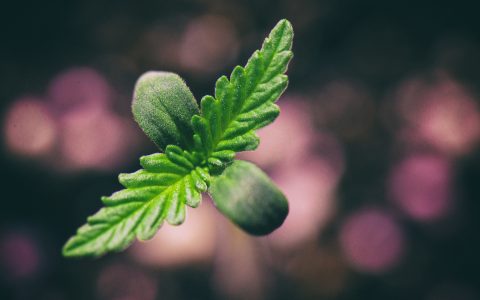
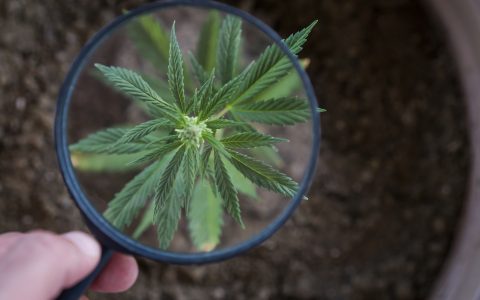
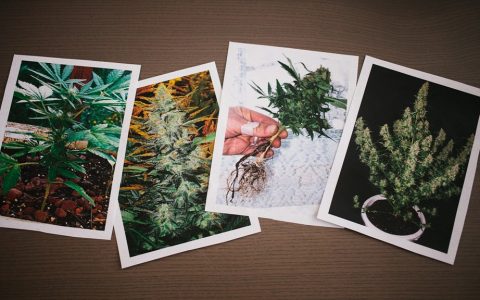
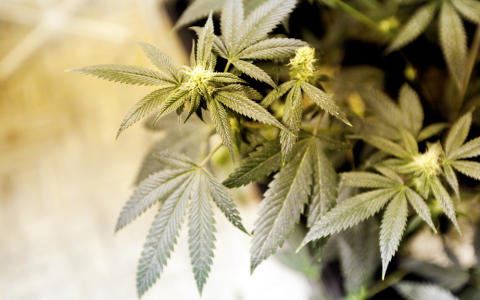
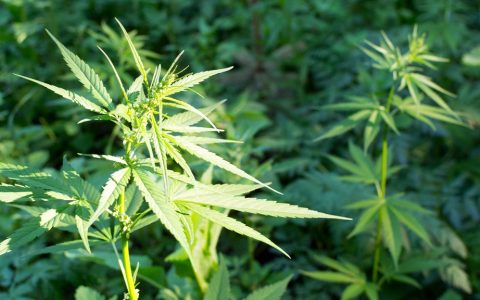
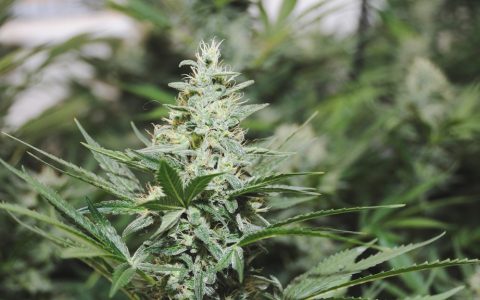
Why is he growing a male plant?? Those arent good for anything but mating..

I tried to tell him. Even let him read my Hightimes. But he a country bumpkin ass cat. So he insists on doing it. Idk. He said he was gonna make a butter.
Idk how long he gonna keep letting grow. I guess he forgot that shit is still illegal. Hate to see him lose his crib over a doo-doo plant.
 
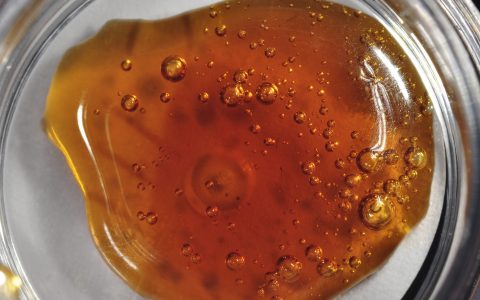
In Photos: Pouring Liquid Gold Cannabis Oil at Xtracted Labs

In a state-regulated industry like cannabis, every market functions a little differently. Expanding a cannabis brand beyond the borders of your home state is daunting from a geographical standpoint. It’s also challenging to keep up with the moving target of compliance under different state cannabis laws.


For brands with long-standing legacies in medical cannabis, expanding into new markets is the next great challenge. Recently, Xtracted Labs has taken their Refine brand into Alaska and Maine. But before growers or extractors can open up shop in new markets, they have to make sure their processes and products are dialed in and fit within the regulatory framework of that new area.

We visited Xtracted’s flagship lab in Seattle to get a better look at their formula for success—and the cannabinoid-rich oil resulting from it.

xtracted-labs-grant-hindsley-3-1024x640.jpg

The complete lineup of products from Xtracted Labs including their Refine and Northwest Concentrates brands. (Grant Hindsley for Leafly)


xtracted-labs-grant-hindsley-8-1024x640.jpg

Like any good extract, it all starts with the material you are refining. Refine’s signature Loud Resin uses only expertly grown, dried, and cured material to capture the dried flower experience. (Grant Hindsley for Leafly)


xtracted-labs-grant-hindsley-9-1024x640.jpg

Preloaded “socks” of raw material from local farms prepped in the freezer for future extraction. (Grant Hindsley for Leafly)


xtracted-labs-grant-hindsley-5-1024x640.jpg

Hydrocarbon gasses running through a closed-loop extractor. (Grant Hindsley for Leafly)


xtracted-labs-grant-hindsley-4-1024x640.jpg

Crude extract straight from the extractor. (Grant Hindsley for Leafly)


xtracted-labs-grant-hindsley-1-768x1024.jpg

Various types of finished cannabis extract stored in an inventory safe until they’re prepared for delivery. (Grant Hindsley for Leafly)


xtracted-labs-grant-hindsley-12-1024x640.jpg

A big scoop of Gelato #33 Loud Resin extracted from Aurum Farms flower. (Grant Hindsley for Leafly)


xtracted-labs-grant-hindsley-6-1024x640.jpg

Vinnie Trichanh packages grams of Refine’s LSD Loud Resin extracted from Royal Tree Gardens flower. (Grant Hindsley for Leafly)


xtracted-labs-grant-hindsley-11-768x1024.jpg

A variety of THCA diamonds extracted, refined, and formed at Xtracted Labs. (Grant Hindsley for Leafly)


xtracted-labs-grant-hindsley-14-768x1024.jpg

A giant beaker of Peach Ringz distillate destined to become RAD! – Refine Activated Distillate. (Grant Hindsley for Leafly)


xtracted-labs-grant-hindsley-10-768x1024.jpg

Peach Ringz distillate being poured out of a beaker. (Grant Hindsley for Leafly)


xtracted-labs-grant-hindsley-7-1024x640.jpg

Vape pen cartridges being loaded with freshly distilled cannabis oil. (Grant Hindsley for Leafly)
 
What Is Hydroponics? An Overview of Soilless Growing

Hydroponics is a method of growing plants without the use of soil. The plant roots are suspended in sand, gravel, water, coco peat, rockwool, or clay pellets (just to name a few), and nutrients are applied directly to the roots using a solution. Any water that is not absorbed by the roots is recycled through the system to be absorbed later.

In Part 1 of this two-part series, we’ll explore everything those interested in hydroponics should know, from the different growing systems to what nutrients one should use. For Part 2, we’ll go into how to grow cannabis using hydroponic growing methods.

A Hydroponics History Lesson
This method has a futuristic quality about it, but you might be surprised to learn the practice stretches back centuries. Some theorize that around 600 BC, the Hanging Gardens of Babylon were established with hydroponic methods. Historians can conclude with more certainty that the Aztecs used a style of hydroponic farming in the 10th and 11th centuries when they began to farm on Lake Tenochtitlan.


Today, hydroponic cultivation has given rise to some of the world’s best cannabis. The increasing popularity of cannabis cultivation has massively contributed to advancements in hydroponic systems and nutrient formulation, and it continues to help write the modern history of hydroponics. But what more is there to know about this age-old technique embraced by farmers worldwide?

The Different Hydroponic Systems for Your Garden
Hydroponics is a loosely defined term; there are many different unique systems that can be classified as hydroponics. The common denominator all hydroponic systems share is that they are soilless systems that provide three main ingredients: nutrients, oxygen, and water. Below are six of the most common styles of hydroponic techniques.

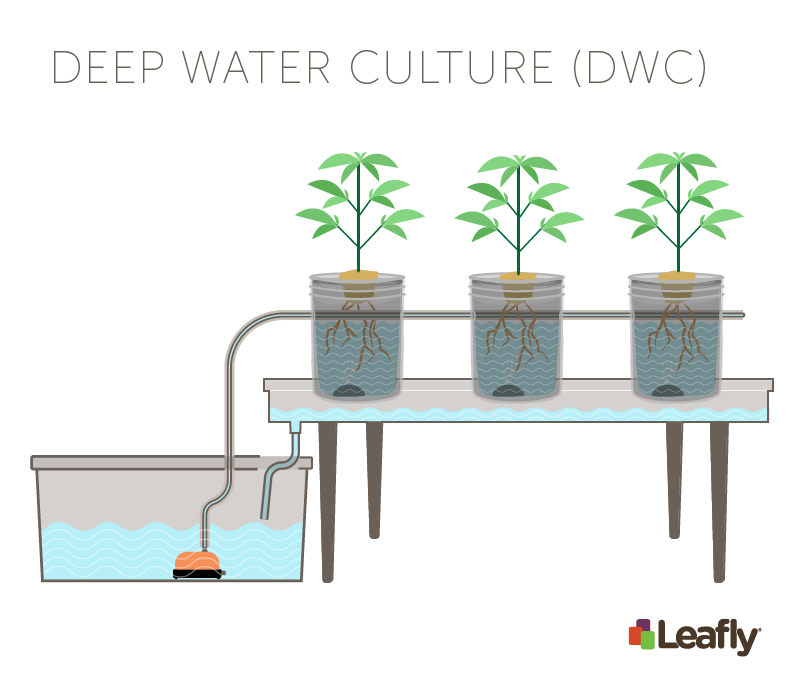
Deep Water Culture (DWC)

Hydro1.png

(Amy Phung/Leafly)
Deep water culture (DWC) is the most basic of all hydroponic systems. This system is good for beginners as it’s very cost effective and easy to run.

The idea is simple. Plants are put in separate containers and each is placed in a grow tray that is suspended in water. Alternatively, companies such as Current Culture or Root Spa have created pots that can hold water individually, removing the need for trays.

In this setup, the water tank has an air pump to keep the water oxygenated, and nutrients are then added to the water to feed the plant via the roots. The roots can stay submerged and still receive oxygen thanks to oxygenating air pumps.


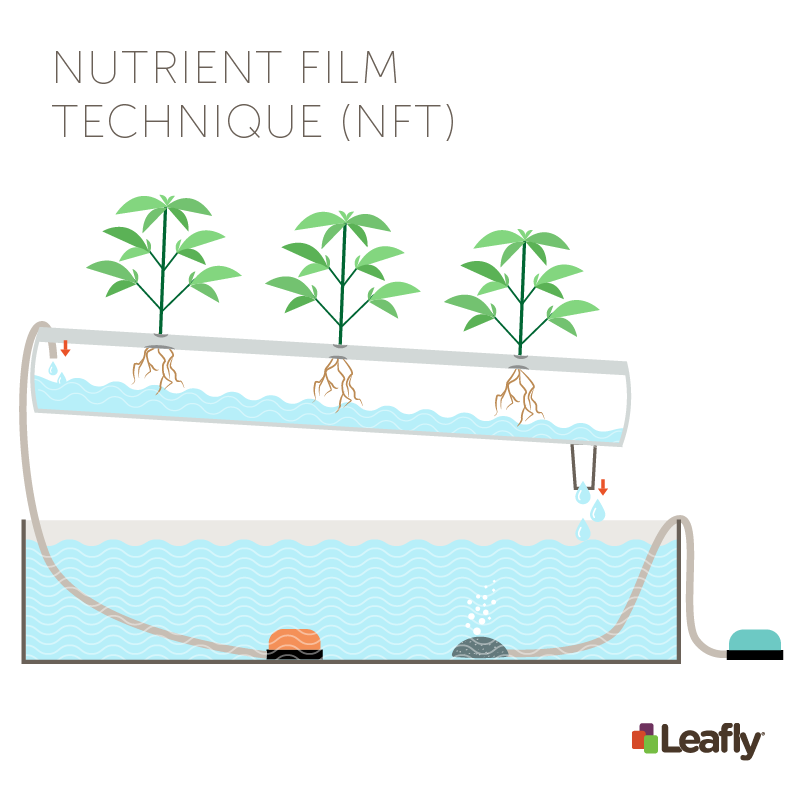
Nutrient Film Technique (NFT)

Hydro2.png

(Amy Phung/Leafly)
Unlike the simple DWC system, the nutrient film technique (NFT) is a bit more complex. For this method, you are taking your oxygenated water nutrient solution and pumping it from the reservoir to your planting tube. Growers commonly use large-circumference PVC tubing that is angled at a slight decline so that the pumped water solution drains down the planting tube, passing by the roots of all the plants before being recycled into the holding tank.

One common issues with the NFT system is the water solution failing to exit the planting tube. If water sits stagnant in the channel, bacteria can grow and kill your plants. To prevent this issue, the angle of the planting tube needs to be steep enough to allow the solution to pass through entirely. Keep in mind that root density may also cause chamber clogging, as they grow fast and thick in such an ideal environment.

On the other hand, one benefit of NFT is the ability to expand the system easily. Adding more holes in your planting tube to hold more plants, or simply adding more planting tubes, will allow you to easily expand your grow as long as your holding tank and pump can handle the extra work.


Ebb and Flow

Hydro3.png

(Amy Phung/Leafly)
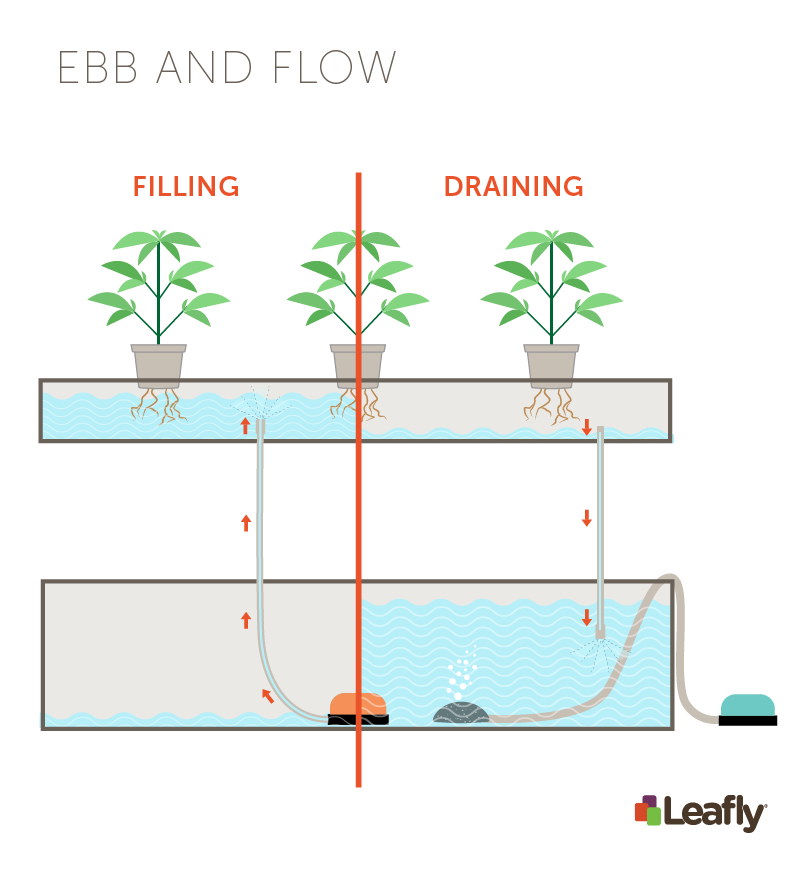
Unlike NFT or DWC systems, an ebb and flow system does not continuously cover the roots in water. Like an ocean tide coming in and out of mangroves, the ebb and flow system will fill a tray with the oxygenated water nutrient solution, treating the growing medium and the plants. Once full, the pump will turn off and solution will drain back down into the reservoir, where it will stay until the garden is ready to be flooded again at the desired interval.

This is a great system in that the roots receive massive doses of oxygen in between tray flooding. It also allows you to harvest plants easily while adding or taking away plants.


Drip System

Hydro4.png

(Amy Phung/Leafly)
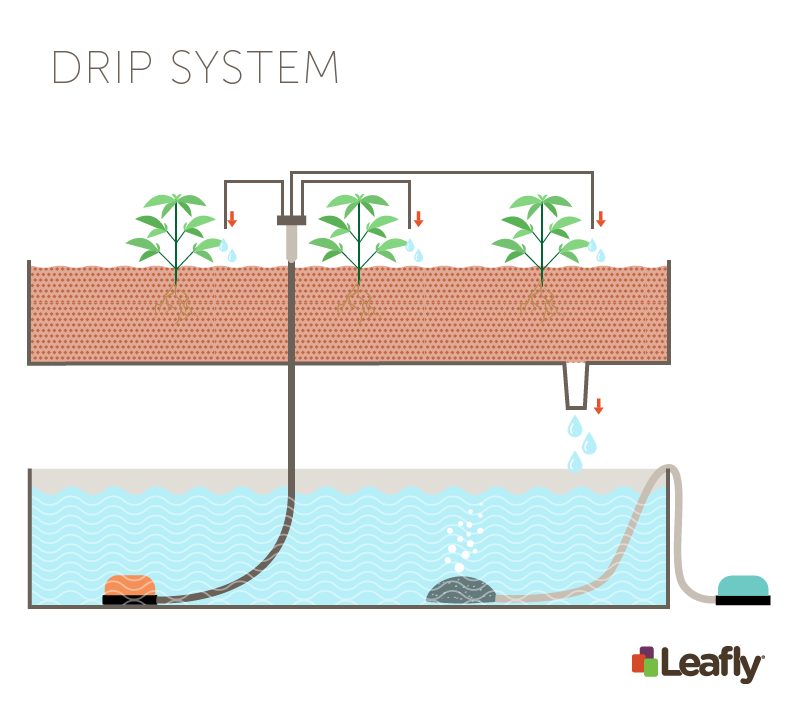
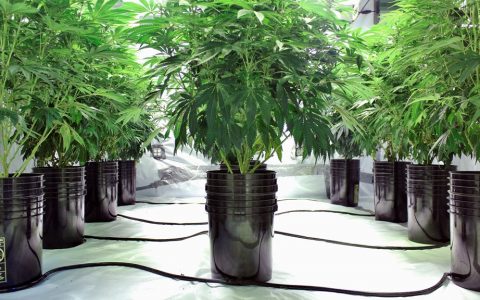
A drip system is one of the more popular systems for growing on a commercial scale, and it offers the greatest array of media choices. Using individual drippers that are placed in each plant’s growing medium, you deliver equal amounts of the oxygenated water nutrient solution to every plant. Excess solution that is not absorbed by the plants is drained back into the reservoir to be pumped back through the dripper system as necessary.

This system allows for the quick harvest and swapping out of plants by simply removing the dripper from the growing medium. By using dripper systems with customizable flows, you can control how much solution each plant is receiving. Also, with a drip system you have more control over the watering schedule in your garden and can easily change the frequency of waterings based on what the plants need at that given time.


Aeroponics

Hydro5.png

(Amy Phung/Leafly)
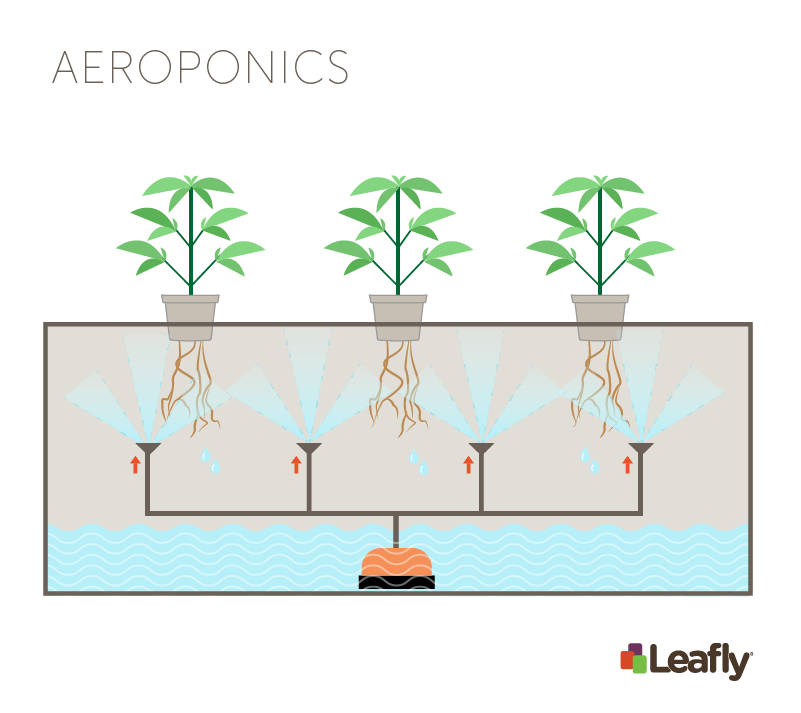
Aeroponics is the most unique hydroponic system. With an aeroponic system, the oxygenated water nutrient solution is being taken from the reservoir and then pumped into misting valves that spray a fine mist into chambers where the roots are exposed. By growing aeroponically, you are introducing the highest percentage of oxygen to the roots by not continually soaking the roots in water. Aeroponic systems can be costly to set up, but they’re also very effective for large-scale grows as they allow for successful vertical growing, thus maximizing your growing space.

The biggest concern for growing aeroponically is clogged misting valves. Without any moisture on the roots, your plants will die rapidly.


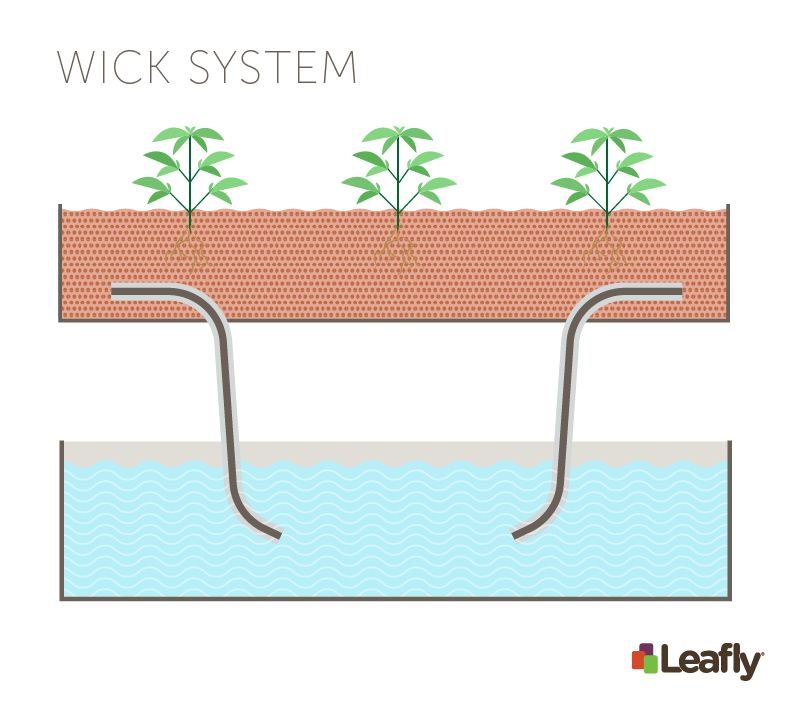
Wick System

Hydro6.png

(Amy Phung/Leafly)
The wick system is the most basic system of hydroponics. Similar to DWC, a wick system uses a material such as a piece of rope through a PVC tube. The oxygenated water nutrient solution is pulled up the rope and dispersed in the growing tray. Using this method, you do not need a water pump to bring the solution to the plants, which means one less piece of machinery that can break down. This is a very basic system that can be used to explore how hydroponics work before investing in more complex setups.

Hydroponic Growing Mediums
The list of growing mediums that can be used for hydroponics is virtually endless, but we’ll review three of the most common. These mediums vary in their ability to allow oxygen in and retain water, and they can be used in different ways to support and contain the plants. As you practice hydroponics, you’ll discover what medium best suits your system and your plants.


Rockwool

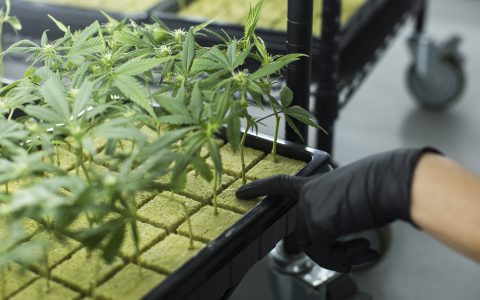
Rockwool is made of thin rock fibers that were created by heating rocks to extremely high temperatures and then spinning them into small threads. Rockwool has been a longtime favorite for hydroponic growing because of its ability to breathe and retain moisture.

When using rockwool, it needs to be soaked in a pH solution before being used. To do this, prepare a pH solution that has a reading of 5.5, then soak the rockwool in the solution for 8-12 hours. Once you have soaked the rockwool, check the pH level of the solution—if it is between 5.5 and 6.0, the rockwool is ready for use.

Clay Pellets

A common reusable medium, clay pellets are heavy enough to support your plants but light enough to work with easily. Clay pellets wick up moisture towards the roots while their size allows for enough oxygen to flow through.

Coconut Fiber

Similar to rockwool but sustainable, coconut fibers once were a waste product that are now being used as a grow medium for hydroponics. They allow in more oxygen and retain more moisture than rockwool, making them a very popular hydroponic medium. Furthermore, coconut fibers have plant-stimulating hormones that help protect roots from infection and disease.


Hydroponic Nutrients
When gardening with hydroponics, you can completely control the nutrients supplied to the root system as well as the pH level. A benefit of growing hydroponically is that the roots can easily access nutrients without having to search for them. Complete control of the pH level also allows for maximum nutrient uptake by the plant. The energy saved by bringing the nutrients directly to the roots and keeping a stable pH level results in bigger and stronger plants.

The most notable difference between growing in soil and hydroponically is that soil on its own has nutrients and microorganisms that benefit the plant. When you are feeding a plant in soil, you are supplementing the nutrients while also feeding the microorganisms. If you do not feed a plant in soil, it will still grow but will not reach its full potential.

With hydroponics, you are responsible for providing all the nutrients the plant needs to survive. If you neglect nutrients the plant needs, it will die. Consequently, quality nutrients are essential when growing with hydroponics as there is no room for error.


Looking into the different systems, mediums, and nutrients for hydroponics can be overwhelming. However, hydroponic systems allow you to produce robust, healthy, and large plants that mature quickly by providing an ideal environment. What cannot be stressed enough is that when growing hydroponically, you can’t cut corners with the quality of your system. Your equipment must run, your mediums must be supportive and clean, and your nutrients must be accurate. When you meet these requirements, gardening with hydroponics will yield incredible results.

Now that you have an understanding of hydroponic growing, next we’re going to explore how to best use systems and techniques for your cannabis crop.
 
How to Grow Hydroponic Cannabis


In the previous post, we gave an overview of hydroponic gardening including its origins, the various systems and techniques, and medium options for a hydroponic grow. In this next article, we will focus how to use hydroponic systems specifically for growing cannabis.

What Is Hydroponic Cannabis?
The common nickname for cannabis—“weed” —comes from its ability to grow almost anywhere, under varying conditions and different climates. “Hydroponic cannabis” simply refers to plants grown using a nutrient-water solution and an inert growing medium rather than nutrient-rich soil. This method could be something as basic as hand-watering pots of inert medium with a nutrient solution. As discussed in the first part of this series, sophisticated systems with multiple pumps, timers, and reservoirs can take some of the daily labor out of growing, but they require more maintenance and setup time as well as a greater initial investment.


Cannabis growers have been using different hydroponic methods for many years as a way to maximize yields and speed up growth, the two main advantages of soilless growing. Working with soils indoors can be inefficient and difficult for a number of reasons:

  • You may not be able to recycle soil
  • Susceptibility to pest problems
  • Difficult to determine proper amount of nutrients
  • Need to carefully monitor soil pH
  • Soil quality significantly influences the final product
With some hydroponic methods, you get to use small amounts of grow media that can often be reused while also precisely controlling what nutrients the plants are receiving and pH levels. With such levels of control, growers find that their buds are bigger, healthier and more potent.

Whether you have grown cannabis before or have no experience growing cannabis whatsoever, hydroponics can be a great way to produce cannabis in any size space. At first it can be confusing and slightly overwhelming, but by learning the basics you will come to understand it’s not as difficult as you imagined.

Set Up Your Hydroponic Cannabis Growing System
There are numerous setups for growing hydroponically with varying benefits that were discussed previously here. And while there are several types of hydroponic setups that don’t use any type of growing medium at all, many of them still use some sort of substrate to support root growth.

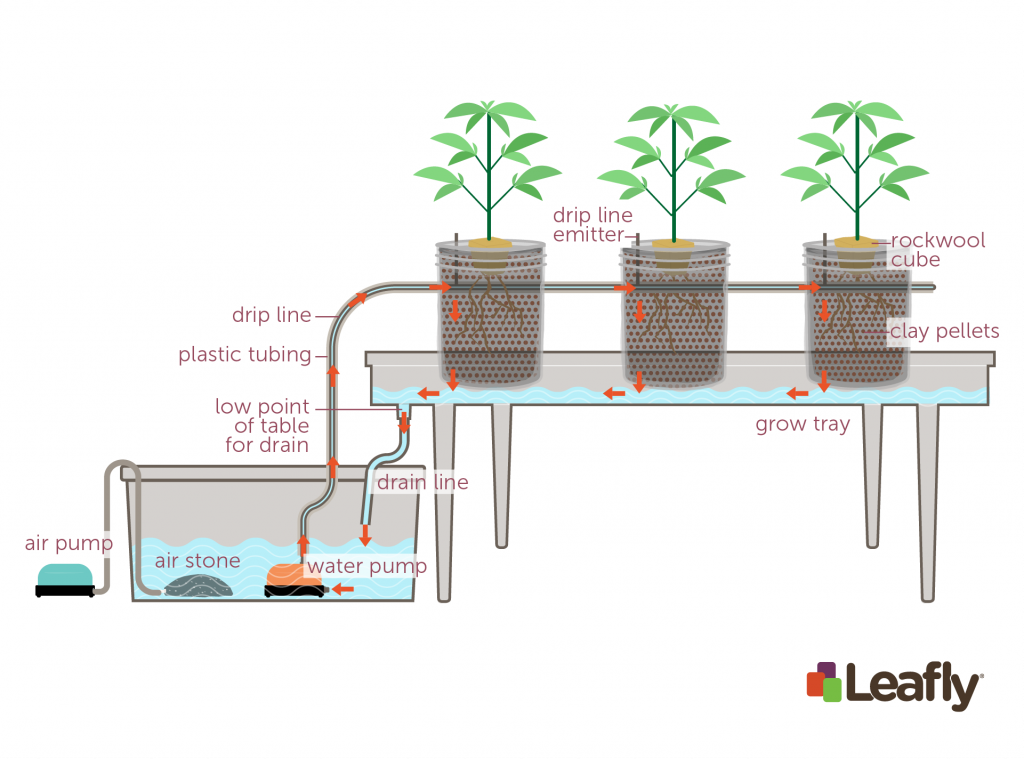
Various materials all provide slightly different benefits and drawbacks, so some thought should be put into choosing the right medium for your cannabis plants. In this article, we are going to be utilizing the drip line hydroponics technique.


While this system is built from the ground up, it should be noted that there are plenty of plug and play systems available for those looking for something that is easy to set up. Plug and play systems come with everything you need in a streamlined package to allow growers to get started on the right foot.

First we will start with the supplies needed. Keep in mind this is just an example, and depending on your space and desired results, many things can be tweaked in a hydroponic system to make it most beneficial to you. This list specifically outlines equipment needed to install your hydroponic system and does not include lights, fans, filters, and other basic needs for any grow room.

Hydroponic Cannabis Supplies:

  • 3 or 5 gallon bucket (one for each plant)
  • Grow table
  • Clay pellets (enough to fill each bucket)
  • Rockwool cubes (one 1.5-inch starter plug per plant)
  • Reservoir tank (depending on the size of garden)
  • Water pump (the bigger the better)
  • Air pump
  • Air stone
  • Plastic tubing
  • Drip line
  • Drip line emitters (one or two per plant)
Browse Hydroponic Growing Supplies
Once you have gathered your materials you can begin to construct your hydroponic setup.

Growing-cannabis-hydroponically-1024x759.png

(Amy Phung/Leafly)
  1. First, set up your reservoir. Your reservoir is where your nutrient solution is held. A reservoir can come in all shapes and sizes depending on your grow space and size, and it holds the water pump and the air stone. It will have a line in from the air pump to the air stone and a drainage line in from the grow table. The reservoir will have a line out from the water pump to the drip line and the power cord for the water pump.
  2. Next you will create your grow table. The purpose of the table is to contain and return the excess water from the plants to the reservoir. To do this successfully, the table needs to have a low point where all the excess water will travel to. This low point is where you install the drain that will take the water back to the reservoir via plastic tubing.
  3. You can then add your 5 gallon buckets filled with clay pellets on the table. Before using clay pellets, you should soak the pellets overnight to allow them to become fully saturated with water for your plants to drink. Also, the buckets need to have holes drilled in the bottom to allow them to drain excess water onto the grow table. It is important that the holes are about half the diameter of the clay pellets to prevent the pellets from passing through or clogging the holes.
  4. Take the plastic tubing coming off of the water pump and run the line to the grow table. From here you can use drip line equipment to puncture holes in the plastic tubing and extend drip line to each bucket. Finally, attach drip line emitters to the end of the drip lines.
  5. From here you can run your system without plants to see if everything is functioning properly. The system should not have standing water anywhere. The air pump should always be running to keep the water in the reservoir oxygenated and moving, while the 5 gallon buckets and grow table drains any excess water back into the reservoir.
  6. At this point you are setup and ready to create your nutrient water solution in your reservoir. Below we will introduce information about nutrients and how to use them to grow your cannabis plants.
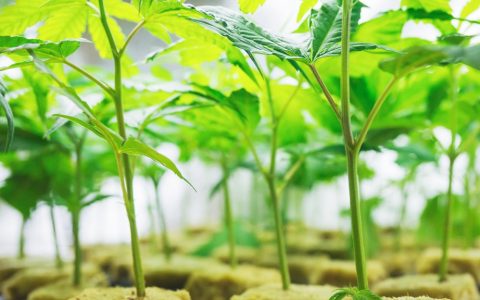
  7. Once your solution is ready, can introduce your plants. Take the starts or clones that have begun growing in rockwool and place them into the clay pellets. Insert the drip line so that moisture is reaching the rockwool and roots of your starts.


A benefit this setup offers is that it can easily be expanded as you want to grow more plants as long as your reservoir has enough capacity to provide all the plants with enough water. To expand a drip line setup, all you need to do is add additional lines to the new pots.

Nutrients for Hydroponic Cannabis
When growing hydroponically, you are responsible for providing all of the nutrients necessary for plants to survive. Nitrogen (N), Phosphorus (P), and Potassium (K) are the three essential nutrients for plant growth known as macronutrients. Additionally, there are secondary and micronutrients that will help the plant develop as well. These include Boron, Calcium, Copper, Iron, Magnesium, Sulfur, and Zinc.

Many companies sell hydroponic nutrient solutions that are specifically designed for certain stages of growth. Nitrogen-rich nutrient solutions will be used in the vegetative stage while phosphorus-rich nutrients become more necessary in the flowering phase.

Nutrients will come either pre-mixed in a solution or in powder form. While powder form might be cheaper and less bulky, it is best to stick with liquid pre-mixed nutrients if you are a small-time grower as they mix with water easily and are more forgiving.

Explore Nutrients for Your Hydroponic Cannabis
When mixing in nutrients, take a few measurements to make sure your solution is safe for the plants. First, make sure you have the right EC (electrical conductivity) reading, and secondly, ensure your pH reading is correct.

The EC reading is how growers can tell how strong their solution is, and how mineral-rich the water is. The more minerals, the higher the EC rating will be. Generally speaking, a reading between 0.8 to 2.0 is appropriate for growing cannabis. When a plant is young, it will need a lower amount of nutrients as opposed to when it is flowering and growing quite big.


Another common measurement used is ppm (parts per million) which is another way of looking at how nutrient-dense your solution is. There are two different scales for ppm used in the cannabis industry: the 500 and the 700 scale. The most efficient way to determine ppm is to take an EC reading, multiply it by either 500 or 700 depending on the scale you are using. An EC reading of 2.0 would equal either 1,000 ppm (500 scale) or 1,400 ppm (700 scale). Many readers used to measure EC or ppm will do this conversion for you.

The lower the ppm, the less nutrient-dense a solution is. As a general rule, aim for the following densities based on your plant’s age:

  • Seedlings/early sprouts – 100 to 250 ppm
  • Early vegetative stage – 300 to 400 ppm
  • Full vegetative stage – 450 to 700 ppm
  • Early blooming stage – 750 to 950 ppm
  • Full mature bloom/ripening stage – 1,000 to 1,600 ppm
Note what scale the nutrients you are using are based upon before making any nutrient solutions.

Next, you’ll need to balance the pH level. Between 5.5 and 6 is ideal for cannabis to absorb the nutrients. If levels are off significantly, the plants will fail to uptake the nutrients and will suffer deficiencies.

You should continue to monitor your solution by taking readings two times a day to make sure everything is at the correct levels. Regardless, it is good practice to switch out your solutions every week or two to keep the solution as optimal as possible.


Caring for Cannabis Grown With Hydroponics vs. Soil
Raising a plant with hydroponics is different in many ways from growing in a soil garden. One thing to consider is the support the plant is receiving. Unlike a plant growing in soil, plants in hydro mediums might be vulnerable to tipping or breaking. Trellising your garden will help to prevent this from happening and will also allow you to train your plants to grow in specific directions.

Another thing to consider is pruning. With hydroponics, your plants can grow extremely fast. This means you need to be diligent about pruning. Removing all the bottom foliage and topping your plant before switching to its flowering cycle will allow your top colas (the large, topmost buds) to receive all the energy they need.


Growing hydroponically does require that you invest a good amount of time and money into developing your system prior to actually starting your garden. Additionally, you’ll want to make sure your system works effectively and your nutrients are high quality so that your plants will flourish. Once you gain a knack for hydroponics, you’ll be on your way to producing world-class cannabis that is well worth the effort.

Have you ever tried hydroponic growing techniques before, either for cannabis plants or other grows? Share your advice, tips, and questions in the comments section below!
 
I Found a Seed in My Bag of Cannabis. Can I Grow It?

bagseed-1024x640.jpg

(brazzo/iStock)
You just picked up a new strain that you’ve been waiting to try. The moment you get home, you rip into the package and take in its smell. When you dive in deeper, you spot something buried within the bud. It’s small, round, and has an outer casing.


Congratulations, you’ve found a seed. More specifically a bagseed, as the seeds found in packaged or bagged flower are commonly called.

Maybe congratulations aren’t quite in order. Depending on where it came from, who you ask, and if the seed is viable or not will affect your level of excitement.

While finding a seed in your stash is not ideal for truly exceptional flower and much less common than it once was, it is a pretty ordinary occurrence. Anyone who has been smoking cannabis for some time has undoubtedly come across a bagseed. Sometimes you’ll notice one when grinding down some flower or you’ll see it pop, spark, and crackle as the heat of your lit bowl pops the precious kernel within.

Ok, so you found a bagseed. Now what?


Is a Bagseed Good or Bad?
Seeds found in finished cannabis flower can develop for a number of reasons. A nearby male plant can accidentally pollinate a flowering female. More commonly, though, they’re a sign of stress and can be attributed to high temperatures during the final stages of flowering or an exaggerated spike in climate or environment.

Seeds can also form in plants with genetic disorders or instability, like hermaphrodites—plants that develop both male and female reproductive parts. Generally these conditions are viewed as negatives, and for that reason alone, temper your expectations with any plants you start from a bagseed.

If found before lighting it on fire, the first thought from excited smokers is: “Let’s grow some weed!” But before you jump in headfirst, ask yourself a few questions to help decide if it’s worth the time and energy to grow the seed.


Was the Seed Found in Good Cannabis?
The first and most apparent question you should ask yourself is whether you enjoy the cannabis that the seed turned up in. If you don’t like the flavor, effects, or even the looks of the bud, then it’s probably not worth growing.

Strains like the legendary Chemdog wouldn’t be possible without adventurous smokers planting and proliferating the seeds they found in a bag.
Sometimes you’ll get lucky and find a mature seed in some really nice herb. Strains like the legendary Chemdog wouldn’t be possible without adventurous smokers planting and proliferating the seeds they found in a bag of kind bud.

So don’t discount your bud just because there’s a seed or two in it. While not ideal, it could be the origins of the next great cannabis strain.

Are You Ready to Grow?
Growing cannabis takes a certain level of commitment. Plants need nurturing for months in the right environment with a close eye for detail. All this takes investment. Whether it’s time, energy, or financial resources, you’ll have to commit to the whole process if you want to produce something you’re proud of.

Fear not! If you’re simply curious to learn how cannabis grows and less concerned with the overall outcome, you can plant a couple of bagseeds outside and see what the result are.

If you’re ready for a more serious approach, make sure you have the space for a proper garden and pop the seeds to see what fruit they bear. That is, if the seeds you found are viable.


Is the Seed Viable?
If you like the strain and you’re ready to grow, then it comes down to whether or not the seed is viable, or able to successfully germinate. For a seed to be viable, it must be mature enough to have a completely formed genetic blueprint and it must be strong enough to “pop” through its hard casing and sprout its crucial tap root.

Immature seeds tend to be light in color and have a soft outer shell.
Stress on a plant and unstable environments can produce bagseeds, and often, a bagseed’s viability is questionable at best.

There are a few indicators that will give you a sense of whether the seed is worth germinating. Immature seeds tend to be light in color and have a soft outer shell.

Visual signs like tiger stripes—dark stripes that resemble tiny roots or veins on a leaf—are generally good. A seed with a solid shell will withstand a little pressure when pinched between your fingers. If it crumbles or cracks, the seed will be effectively destroyed, but don’t agonize over your loss.


In some cases, even if a seed isn’t completely mature, there’s still a chance it could be viable. But often these are extremely weak, take long to develop, and express other unfavorable characteristics. Growers usually discard weak plants to free up space in their limited gardens.

However, I’ve watched seeds that I had zero faith in their ability to germinate turn into strong, healthy plants—but that isn’t common.

You might also find a mature seed that has been physically damaged through poor handling, like rough trimming. In those cases, it probably isn’t worth the effort to try and germinate the seed.

But if the seeds you found look decent or even questionable, you might as well germinate them and see what sprouts.

Time to Germinate
Viable or not, there’s only one sure way to find out. Once you’ve decided you’re going to see what those beans can do, it’s time to germinate. Germination is the incubation period that encourages seeds to sprout and develop into a new plant.


There are a number of different ways you can germinate cannabis seeds, but they all require the same things to be successful: water, heat, and air. For a complete, step-by-step guide, check out our article How to Germinate Cannabis Seeds.

Even if your seed sprouts fast and grows vigorously, it has roughly a 50/50 chance of being female and producing seedless, cannabinoid-rich flowers.

Remember, once a seed germinates, the real work begins. Sexing, selecting, vegetative growth, flowering, and the eventual harvest all lie ahead.
 
Why Growing Your Own Cannabis Is the Best Resolution for 2019

new-years-grow-resolutions-1024x640.png

(Leafly)


Who grows the greatest cannabis on earth?

You do, or at least you can, and it’s not as hard as you might think. But if 2019 is going to be the year you pop your first seeds or root your first cuttings, now’s the time to start planning and preparing for a spring planting. You can get started by reading Leafly’s two primers—one for those growing indoors and one for those growing outdoors.


If, like most of us, you’re a hobbyist hoping to simply cover your yearly head stash, with plenty leftover to gift to friends, I’d definitely recommend starting outdoors, assuming you’ve got a suitable space to do so. Because depending on the climate where you live (including the legal climate), it’s pretty likely you can cultivate a few plants right next to your heirloom tomatoes or summer squash. Setting up indoors means figuring out everything from high-intensity lights to advanced hydroponics.

If you haven’t heard, you can buy this stuff at a store now. But there’s still five good reasons you should take the means of cannabis production into your own hands this year.
Remember, we only started growing cannabis in basements and attics to avoid the cops. So let’s leave all that high-tech equipment to the professionals (and those still living under oppressive laws), and nurture your first-ever cannabis garden in your backyard—or side yard, or up on the roof, or wherever you’ve got a little space to work. Immediately, that takes an awful lot of the effort and expense out of the equation. And more importantly, small-batch sun-grown cannabis—cultivated in soil with organic nutrients—truly is the plant’s highest expression.

But before we fully dig into how you will grow the greatest cannabis on earth in 2019, we need to start by asking why bother?

I mean, if you haven’t heard, you can buy this stuff at a store now. But there’s still five good reasons you should take the means of cannabis production into your own hands this year.

Value
The most obvious reason to grow your own cannabis is that you can produce high-quality herb at a small fraction of what you’d pay at a dispensary, particularly once you factor in all of the taxes. For a rough estimate of return-on-investment, I asked my good friend and cannabis colleague Danny Danko, longtime cultivation editor at High Times magazine and author of the book Cannabis: A Beginner’s Guide to Growing Marijuana, for a run-down on the expected annual harvest for a six plant backyard garden, grown in soil with some basic organic fertilizer and plenty of sunshine.

“Six small outdoor plants should yield 8-10 ounces of dried buds, so you’re looking at approximately 3 pounds total at the end of the season, and if you grow large outdoor plants, they could yield a pound or more each,” he says.


Quality
Okay, it may be a bit of hyperbole to say you will grow the best cannabis on earth, particularly your first year trying, but here’s a little secret: they call it weed for a reason. Cannabis is an incredibly hardy plant, and one that’s adaptable to a wide range of environments, so minus some kind of catastrophic event (spider mites, mold, thieving neighbors), you’ll almost certainly succeed in harvesting some truly lovely buds.

Your dispensary may have the hottest new strains and the stankiest top-shelf brands on the market, but nobody else on earth can roll up a joint of your Backyard Kush.
How much and how lovely depends on your skill, your starting materials, and your diligence, but with just a few inexpensive inputs and some careful tending, you’ll most definitely be proud of what you produce. Because unlike large, bustling commercial operations, growing just a handful of plants per year allows you to give them the kind of individual tender-loving-care that will help them flourish from start to finish. And you can harvest at the absolute peak of potency and then treat your buds like the delicate, resin-coated flowers they are throughout the vital drying and curing process. You’d be surprised how much this improves the quality and potency of the finished product.


Also, like a meal that you prepare yourself or children you raise from birth, some measure of the beauty of your buds will be in the eye of the beholder. Embrace that. Your dispensary (or dealer) may have the hottest new strains and the stankiest top-shelf brands on the market, but nobody else on earth can roll up a joint of your Backyard Kush or Basement Haze.

Variety
One of the biggest decisions you’ll get to make as a cannabis cultivator will be deciding which strain(s) to grow. Some people like to plant a uniform garden, so all the plants will mature at roughly the same rate and have roughly the same needs, while others want to try out as many different varietals as possible and see what works best.

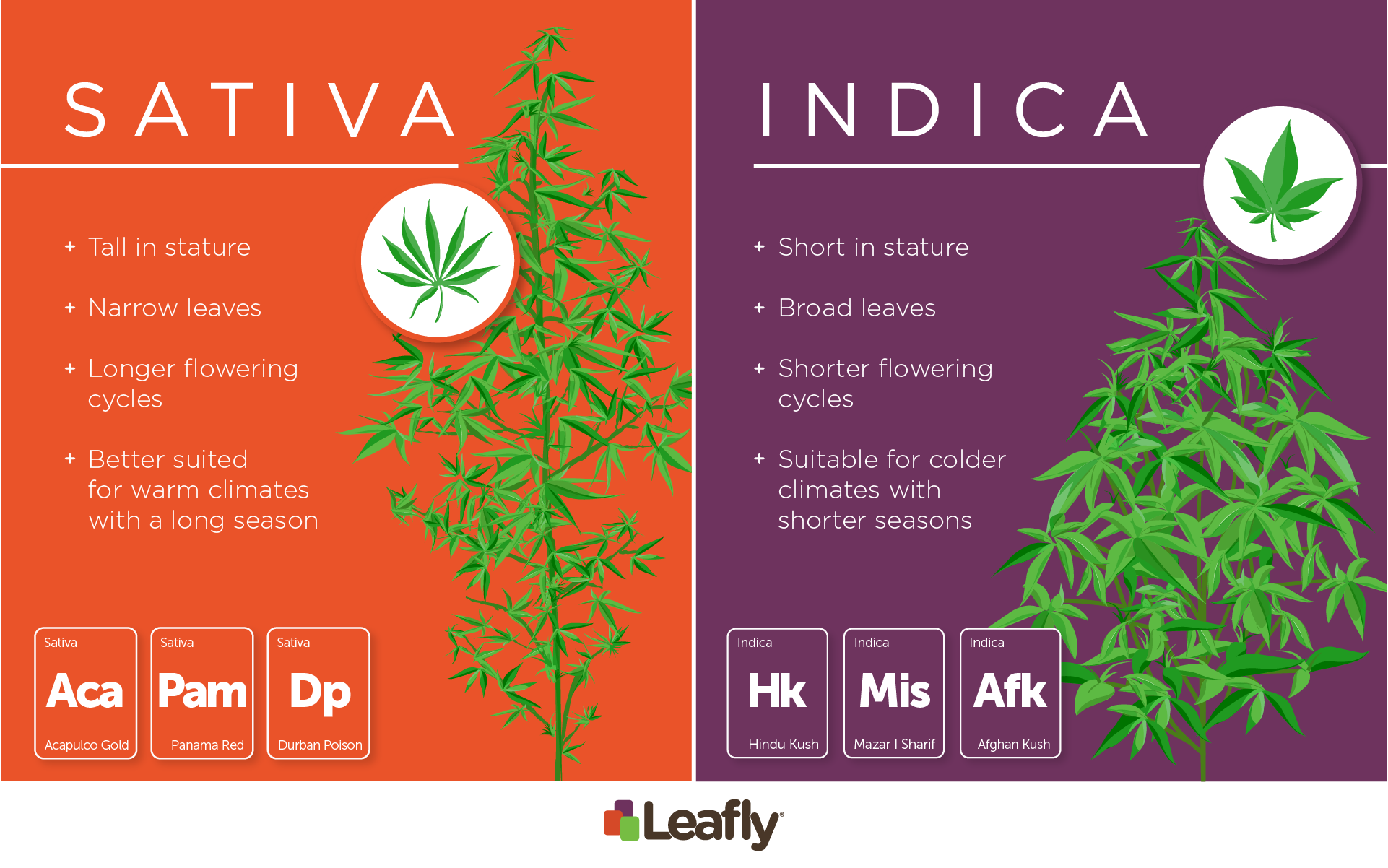
There’s no wrong answers, really, just keep in mind that your favorite strain to smoke may not be the best one to grow in your particular circumstances. Some cannabis strains grow short and stout and mature quickly (indicas), and some grow tall and wispy and take a long time to reach their peak (sativas). Certain strains have been bred to flourish outdoors and others are optimized for indoor growing. Some are highly resistant to wet weather and others mold easily.


The quality of seeds and cuttings on the market also varies widely, so source only from reputable suppliers who stand behind their products and offer informed recommendations based on your detailed input. And then double check everything via Leafy’s comprehensive strain database.

Connection
If you truly love cannabis, what could be better than starting your day by watering a small collection of luscious herb plants while marveling at how quickly they grow?

Gardening time is almost always quality time. And over time, you’ll become increasingly attuned to the life force of your plants and the heady milieu that envelopes your garden. Particularly as your cannabis becomes ever more fragrant towards the end of the season.

Last year, six plants in 50-gallon containers sat right outside the door to my home office, and from mid-July until the day I cut them down, I didn’t walk past those plants once without taking in their fragrance. And let me tell you, that’s a unique and highly effective form of aromatherapy in a world gone mad.


Decentralization
Legalization is a many splendored thing. And obviously no adult, anywhere, should face criminal charges for growing, possessing, smoking, sharing, or selling this most wonderful plant. But legalization has also led to two troubling forms of consolidation.

The first is a severe winnowing of genetic diversity in the cannabis gene pool caused by industrial agriculture sized cultivation facilities that focus on only a handful of strains that grow quickly and easily and have the most commercial appeal. The second form of consolidation happens when these hyper-capitalized companies begin to gobble up market share by either buying up their competition or pushing them to the margins through economy of scale.

Both forms of consolidation represent existential threats to the cannabis plant and the cannabis movement as we’ve come to understand them.


Rest assured, left to its own devices, “Big Marijuana” will do an excellent job of producing “mids”-quality Blue Dream in massive amounts at a low price point, but will do little to nothing to protect and preserve the incredible genetic diversity of strains that’s been created and curated by crafty cannabis breeders over the last half century. And meanwhile they’ll do everything they can to eliminate unwanted competition from the kind of small-scale Mom and Pop growers who’ve kept the plant alive and flourishing during the long dark days of prohibition.

One way to push back on both forms of consolidation is to seek out cannabis from small scale traditional growers, particularly those specializing in rare and heirloom strains. But the best and most satisfying way is to become a small scale traditional grower who specializes in rare and heirloom strains—even if it’s just six plants per year.
 
Cannabis Seeds 101: All You Need to Know and More

cannabis-seeds-101-all-you-need-to-know-and-more.jpg


What Are Cannabis Seeds?
DINnIjkRwyJvNJ8kyBxg_Seeds-in-Spoon-2.jpg

Cannabis is a dioecious plant, meaning its female and male reproductive organs are found on separate individuals. Female cannabis plants are grown in an environment without males to produce what we find in medical and recreational stores: seedless, high potency marijuana flowers, traditionally known as “sinsemilla.”

In order to reproduce, the flower of a female plant must be pollinated by a male plant after which the female flower produces seeds. However, many varieties of cannabis can produce some male flowers alongside female flowers on the same plant, especially if exposed to environmental stressors or left to flower for a longer than normal period. This is known as the hermaphrodite condition, and sometimes these male flowers will produce viable pollen and self-pollinate the surrounding female flowers to create seeds.

Once the seeds are mature, the female plant begins to die, and seeds are either dropped to the ground where they germinate and grow into new cannabis plants the next spring, or they are harvested for processing into hemp seed oil, food products, or to be sown to become the next generation of plants.


What Are Feminized Cannabis Seeds?
U1wJKTTTUKwzrq0WJbMe_Seeds-White-Background.jpg

Feminized cannabis seeds are seeds that are produced by causing the monoecious, or hermaphrodite condition in a female cannabis plant. This is achieved through several methods:


Feminized seeds produce plants that are nearly identical to this self-pollinated (or “selfed”) female parent plant, as only one set of genes is present. This is sometimes referred to as “cloning by seed” and will not produce any male plants. However, most producers of feminized seeds do not go through the lengthy (and costly) process of identifying a completely stable mother plant for seed production. Many, if not most feminized seeds end up being hermaphrodites, which can result in flowers with seeds in them and reduced yields. Most experienced growers will not use feminized seed, and they should never be used for breeding purposes.

What Are Auto-Flowering Cannabis Seeds?
zAkfPxMER2exCkkKnFPm_Seeds-Table-Spoon.jpg

Most cannabis plants begin their flowering cycle when the photoperiod, or length of time they are exposed to light each day, is reduced to somewhere between 12 and 14 hours, regardless of the size or age of the plant. The species Cannabis ruderalis, however, will begin flowering once the plant reaches a certain age and does not depend on a change in photoperiod.

Some breeders have crossed the low-THC ruderalis with other more potent varieties to create auto-flowering strains. These strains will produce indica, sativa, or hybrid-like cannabis flowers that start blooming as soon as they reach maturity. This is desirable especially in northern climates where summers are short and cold, and wet weather comes early in the fall. Auto-flowering strains can be started in early spring and will flower during the longest days of summer to take advantage of the highest quality light available. Unlike clone mothers, auto-flowering strains cannot be kept in a vegetative state.


What Is the Difference Between Cannabis Seeds and Cannabis Clones?
3Xidf6e0QtqeyvvuEjVy_Clone.jpg

A clone is a cutting taken from a plant and then placed in some sort of grow medium to induce root production. Once it has rooted, it can be grown into a mature plant that is genetically identical to the one it was cut from.

Seeds carry genetic information from two parent plants that can be expressed in numerous different combinations, some like the mother, some like the father, and many presenting various traits from both. Creating identical cannabis plants using seeds is a very difficult and lengthy process. Generally, cannabis producers will plant many seeds and choose the best plant, and then take clones from that individual to grow their cannabis flowers, or simply start with a proven clone acquired from another grower as their mother plant.

Where Can I Buy Cannabis Seeds?
Yli15XNbSfujEz2BL55p_Seeds-in-Jar.jpg

Cannabis seeds can be found on numerous online seed banks, many of which are located in the UK, the Netherlands, Spain, and Canada, where the laws on selling cannabis seeds are much more lax than in other countries. It is illegal to bring seeds into the US and Customs will seize any cannabis seeds that they find in packages or on a person. In states that have home-grow provisions in their medical marijuana laws, you may purchase seeds at dispensaries. Seed banks are popping up in many of these states.


What Is the Legality of Cannabis Seeds?
mfCXf1FhQ1W36DMNiMk1_Large-Pile-of-Seeds.jpg

Depending on what state you live in, it may or may not be legal to sell, purchase, or possess cannabis seeds. In the United States, all cannabis seeds are considered illegal at the federal level.

Seed banks exist outside of the US and can sell them for “souvenir purposes,” but it is illegal to bring seeds into the US and Customs will seize any cannabis seeds that they find in packages or on a person.

What Makes a Cannabis Seed High Quality?
G85TAbCQT7aL2rMVsjFJ_Seeds-in-Spoon-Near-Bowl-2.jpg

There are several factors that go into determining whether cannabis seeds are high quality or not. First of all, they must be allowed to fully mature before harvest. Next, they must be properly stored as to not acquire mold or other pathogens that can spoil them. Seeds should be stored in a dark, cool place and used within 16 months, or frozen for future use.

The most important factor in seed quality is genetics. To grow quality cannabis, you need good genetics. Some less scrupulous breeders will simply cross a nice female with a random male and sell the resulting seeds. Other breeders will take their time crossing and backcrossing plants to stabilize the most desirable traits, while still producing an array of different phenotypes. This group represents most of the seeds on the market.

Really dedicated breeders have worked for years to create “inbred lines”, or IBLs, that will produce plants with very little noticeable difference. IBLs represent only a small fraction of the cannabis seed market, as they are generally used by breeders and not by cannabis producers.


How Do Cannabis Seeds Germinate?
Qrp4LHddQUupKNphqvPf_Germinate.jpg

In the wild, female cannabis plants drop their seeds as they die in the fall, then when the warmer, wetter weather of spring comes around, these seeds sprout and become new plants. Traditional outdoor methods used for centuries involve simply broadcasting seeds by hand onto cultivated fields.

There are many methods used by modern growers to germinate seeds. The easiest is to put the seed in a light potting soil mix covered by ⅛ to ¼ of an inch of soil. Keep the soil moist and relatively warm (50-70 degrees Fahrenheit) until the seed has sprouted into a seedling. Other techniques involve lightly scuffing the seed coat to ensure the seed is able to crack open, pre-soaking the seeds, and even germinating them in a wet paper towel until the epicotyl emerges and then gently planting them in the grow medium with tweezers. There are also popular products called starter plugs that consist of a small block of growing medium, often compressed peat or coco coir, with a small hole in the middle into which the seed is placed.


What Is There to Know About High-CBD Seeds?
DmHervMFTOmPEgzL6QIf_Seeds-in-Spoon.jpg

Cannabidiol, or CBD, is one of the chemical components (known collectively as cannabinoids) found in the cannabis plant. Lately much has been made of the potential benefits of CBD for treating the symptoms of many diseases and conditions. Through millennia of human selection for high THC content, cannabis with high levels of CBD has become exceedingly rare, as the genetic pathways through which THC is synthesized by the plant are different than those for CBD production.

Cannabis used for hemp production has been selected for other traits, including very low THC content, so as to comply with various drug laws. Consequently, many varieties of hemp plant produce significant quantities of CBD. As interest in CBD as a medicine has grown, many breeders have been breeding cannabis that has high levels of CBD by crossing drug species with hemp species; some of these hybrids have little or no THC, some have 1:1 ratios, and some that still have high THC contents along with significant amounts of CBD (3% or more).


Seeds for these varieties are now widely available online and through medical dispensaries. It should be noted, however, that any plant that is grown from these seeds is not guaranteed to produce high levels of CBD, as it takes many years to create a seed line that produces consistent results. There are breeders who are currently working on making seed strains with consistent CBD levels, but until these seeds are widely available, a grower who wants to produce cannabis with a certain THC to CBD ratio will need to grow from a tested and proven clone or grow many seeds out to maturity and have samples tested at a lab to determine the cannabinoid levels of each.

Why Are Cannabis Seeds So Expensive?
YTmmudQNRxCIS6c9bZIP_Expensive.jpg

Cannabis seeds generally sell for about $10-$12 each, a far cry from the $3 pack of tomato seeds you can buy at the local nursery. People are often quite taken aback when they find that a pack of 10 cannabis seeds can cost well over $100. It’s not hard to pinpoint the reason for this: prohibition.

The breeding of commercial crop seeds can be done in a relatively short time because of the enormous scale and abundant resources of commercial breeding programs. The general rule is that if you can grow more plants at once, it’s easier to locate and stabilize desired traits and is less expensive to produce massive quantities of seeds. Add to this new scientific methods of testing for desired traits using tissue cultures and lab analyses, and you have a great advantage over your average cannabis breeder.


Even larger scale cannabis grows are miniscule when compared to your average commercial agricultural seed production facilities. Cannabis breeders working under prohibition or strictly regulated legal environments are simply not able to work on this scale, and must take much longer, sometimes as long as decades, to produce a quality seed line. When you combine this restriction with the threat of potential legal consequences for breeders (many have spent time in jail), it becomes easy to see why cannabis seeds are so expensive. It should be noted that high cost does not always equal high quality, as the industry is unregulated.

GENETICS
 
Cannabis Anatomy: The Parts of the Plant


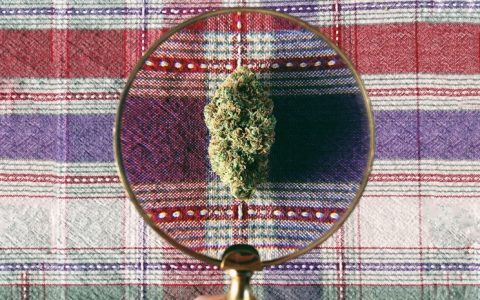
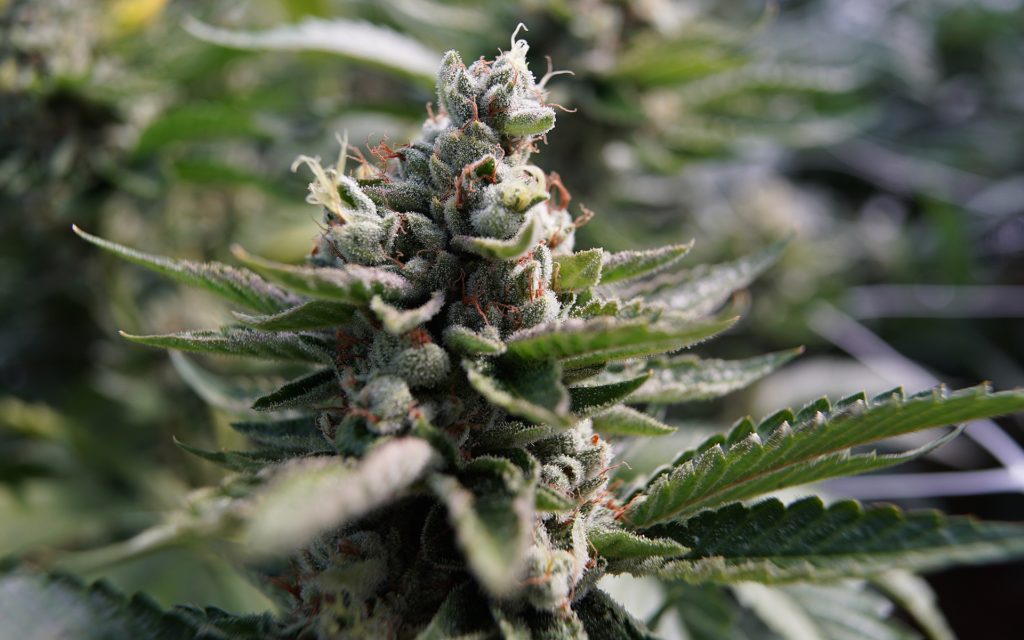
When examining a cannabis bud, you’ll notice a complex knotting of different parts: the fiery orange hairs, the sugary crystals, chunky knobs enveloped by tiny leaves. But what exactly are these formations and what functions do they serve?

This brief guide to cannabis anatomy is meant to familiarize you with the plant in its full form. Unfortunately, the sight of real, living cannabis is made rare for many by restrictive laws, but we hope we can bring you just a little closer to your favorite strain’s source.

Male & Female Plants
Cannabis plants can be male, female, or both (hermaphrodite), but what’s in your stash jar now are the flowers of a female.

Female plants produce the large resin-secreting flowers that are trimmed down to round or pointed buds while males produce smaller pollen sacs near the base of the leaves. The male plants pollinate the females to initiate seed production, but the potent flowers we consume come from the seedless female plants, called sinsemilla, which grow large cannabinoid-rich buds while without seed.

The rare hermaphroditic plants contain both female and male sex organs that allow the plant to pollinate itself during flowering. This self-pollination is typically deemed a nuisance among growers as it spoils the seedless sinsemilla plants and passes on hermaphroditic genes.

Growers can ensure the sex of their plants by growing clones or the genetically identical clippings from a parent strain. Feminized seeds are also made available through a special breeding process.

Cannabis Plant Anatomy
cannabis-parts.png

Deborah Ro/Leafly
The cannabis plant is comprised of several structures, many of which we can find on any ordinary flowering species. Cannabis grows on long skinny stems with its large, iconic fan leaves extending out from areas called nodes. Cannabis really starts to stand out in her flowers where unique and intricate formations occur.

Cola

A cola refers to a cluster of buds that grow tightly together. While smaller colas occur along the budding sites of lower branches, the main cola (sometimes called the apical bud) forms at the very top of the plant.

Stigma and Pistil

The pistil contains the reproductive parts of a flower, and the vibrant, hairlike strands of the pistil are called stigmas. Stigmas serve to collect pollen from males. The stigmas of the pistil begin with a white coloration and progressively darken to yellow, orange, red, and brown over the course of the plant’s maturation. They play an important role in reproduction, but stigmas bring very little to the flower’s potency and taste.

Bract and Calyx

A bract is what encapsulates the female’s reproductive parts. They appear as green tear-shaped “leaves,” and are heavily covered in resin glands which produce the highest concentration of cannabinoids of all plant parts. Enclosed by these bracts and imperceptible to the naked eye, the calyx refers to a translucent layer over the ovule at a flower’s base.

Trichome

Despite their minute size, it’s hard to miss the blanket of crystal resin on a cannabis bud. This resin (or “kief” when dry) is secreted through translucent, mushroom-shaped glands on the leaves, stems, and calyxes. Trichomes were originally developed to protect the plant against predators and the elements. These clear bulbous globes ooze aromatic oils called terpenes as well as therapeutic cannabinoids like THC and CBD. The basis of hash production depends on these trichomes and their potent sugar-like resin.


10 Fast-Growing Cannabis Flowers for Impatient Gardeners

fastest-growing-cannabis-flowers-1024x640.jpg

Growing cannabis can be an arduous process. Beyond the space, materials, and nutrients needed, time and light are the most essential ingredients in the cannabis cultivation equation. But what if you’re impatient or short on time? Is there a way to speed up the growing process?


Historically, black market growers would seek out or hybridize strains to harness attributes that catered to their surreptitious needs. These plants would usually be short and stalky with larger-than-average yields, and in some instances they would be autoflowering (such as a ruderalis hybrid). They were designed to be fast-flowering for both a quick turnover and so they could be easily relocated from time to time.


The fast-flowering cannabis strains listed below are now emerging for professional and hobby growers to utilize. They’re perfect for novice growers as well as set-it-and-forget-it growers who want to squeeze out a harvest with little time to spare. The list includes a mixture of both photoperiod and autoflowering varieties so you can find the perfect plants for your setup.

Wondering if you can legally grow in your state? Check our state-by-state guide to home cultivation laws to find out.


Photoperiod Strains That Grow Quickly (7-9 Weeks)
Lowryder
Lowryder is a hybrid strain that was inbred for nine generations by Joint Doctor Seeds to give it a dwarfed size. Growing no more than 16 inches tall, it’s the cannabis equivalent of a bonsai for the discrete grower’s windowsill or balcony. Lowryder’s small size comes from a species of cannabis ruderalis crossed with Northern Lights #2 and then William’s Wonder. Consumers, be patient with this strain: its medicinal and cerebrally stimulating effects have a slow but powerful onset. A mild earthy aroma radiates from the small, conic buds which autoflower in a short 40 to 45 days. Lowryder is a stalwart plant that can survive in harsh, colder climates, making it a popular strain in northern regions like Finland and Canada.

Critical Kush
Critical Kush from Barney’s Farm is a mostly indica strain that blends together two famed cannabis staples, Critical Mass and OG Kush. Aromatic notes of earthiness and spice usher in a calming sensation that relaxes the mind and body. Critical Kush pairs a staggeringly high THC content with a moderate dose of CBD, making this strain a perfect nighttime medication for pain, stress, insomnia, and muscle spasms. Growers cultivating this strain indoors will wait 50 to 60 days for Critical Kush to complete its flowering cycle.


Early Girl
Early Girl is the wallflower of cannabis strains since its introduction in the 1980s. Lovingly preserved by the breeders at Sensi Seeds, this strain is lazy and relaxed, nothing over the top. A 75/25 indica-dominant hybrid, Early Girl is a good one for those new to cannabis who would like relief from stress. Also a great strain for novice growers, it’s compact, resilient, and has a particularly short flowering time of 7 to 8 weeks. Early Girl grows especially well outdoors, but won’t put up a fuss if she’s stuck inside.

OG Kush
OG Kush makes up the genetic backbone of West Coast cannabis varieties, but in spite of its ubiquity, its genetic origins remain a mystery. Popular myth maintains that Chemdawg and Hindu Kush parented OG Kush, passing on the distinct “kush” bud structure we see in many strains today. However, we can’t be sure because OG Kush first came from bag seed in the early 90s. The earliest propagators (now known as Imperial Genetics) are said to have brought the seeds out of Florida to Colorado and southern California, where it now flourishes. There are many different phenotypes of OG Kush, some of which include Tahoe OG, SFV OG, and Alpha OG.

OG Kush is cherished for its ability to crush stress under the weight of its heavy euphoria. It carries an earthy pine and sour lemon scent with woody undertones, an aroma that has become the signature of OG Kush varieties and descendants. With OG Kush, patients most commonly cite improvements in migraines, ADD/ADHD, and stress disorders.


Superglue
Superglue is a hybrid strain bred by Seedism Seeds. A cross between Afghani and Northern Lights, Superglue inherits indica growth patterns along with a sweet caramel and pine aroma. Superglue brings calming relaxation to the mind and body, but leaves you functional and energetic enough for social activities or a productive afternoon.

Autoflowering Strains That Grow Quickly (7-12 Weeks)
Red Dwarf
Red Dwarf is a rarer strain of cannabis that is an autoflowering plant. This trait comes from its cannabis ruderalis genetics, which is a third variety of the plant that’s usually not bred due to its lower THC content. The wonders of selective breeding from Buddha Seeds have resulted in seeds that grow to adulthood in an incredibly short six weeks. This strain’s squat, small plants are easy to grow in smaller spaces, making it a popular choice for growers who want something simple and fast. Indica-dominant, Red Dwarf will eventually make you sleepy, but not without some relaxed euphoria first.

Hobbit
Hobbit by Kannabia Seeds is a resilient autoflowering variety with sweetness and strong elemental resistance. This strain has a sweet aroma that has been described as “strawberry candy” and an equally sweet smoke with latent earthy notes. Hobbit deftly combines stimulating Haze elements with a pervasive body buzz that is lightly weighted while remaining pleasant and functional. Many growers covet this autoflowering wonder for its quick 65-day flowering time and above-average yield.


White Ryder
White Ryder is Riot Seeds’ attempt to create a ruderalis version of White Widow by crossing Buddha Seeds’ White Dwarf against Lowryder. By blending two stout, autoflowering plants, Riot Seeds created a potent indica-dominant hybrid that finishes in under 80 days and can easily be hidden from view. Enjoy this flower for anti-anxiety and sleep-inducing effects.

Purple Cheese
Purple Cheese is an indica-dominant autoflowering hybrid that combines Purple #1, Blue Cheese, and Lowryder. Bred by Auto Seeds, Purple Cheese was designed to have a sweeter, less cheesy flavor than its Blue Cheese parent. It does, however, inherit a tight bud structure and a high CBD profile. With a palatable fruit aroma, Purple Cheese delivers powerful full-body effects best suited for night owls or patients treating pain. Colder climates will bring out this hybrid’s purple hues, and for best results, growers should keep this autoflowering variety between 50-80 cm in height.


Royal Haze
Royal Haze (or Royale Haze) by Dinafem Seeds is a mostly sativa strain bred from Skunk, Haze, and Northern Lights genetics. Taking after her Haze parent, this sativa inherits a spicy citrus flavor and buzzing, energetic effects that keep you alert and productive throughout the day. Outdoor growers will appreciate her flexibility and resilience even when the temperature drops, although her 10-11 week flowering cycle demands a bit of patience.

An autoflowering rendition of Royal Haze was bred by Royal Queen Seeds, who mixed Amnesia Haze, Skunk, and a ruderalis strain. Its effects are similarly energizing and cerebral.
 
Tips for Growing Industrial Hemp

tips-for-growing-industrial-hemp-1024x640.jpg

Hemp is an industrial form of cannabis that produces seeds and stalks that can then be used to make a long list of products. But unlike consumable cannabis which is harvested for its resinous, cannabinoid-packed flowers, the target yield for industrial hemp is seeds and straw (plant stalks/leaves). As such, these two types of cannabis are grown using completely different methods.


The Benefits of Hemp as an Industrial Crop
Industrial hemp plants grow vigorously, with long, lanky stalks and deep tap roots. Different varieties of hemp may produce a varying quantity seeds or fiber, and they may also differ in oil composition. Hemp is typically ready to harvest in four months, and per acre it produces four times as much paper as trees, which take many years to reach maturity for harvest.


The list of benefits associated with hemp production is extensive. Some examples include:

  • Dense growth leaves little room for competing weeds
  • Highly pest-resistant
  • Deep tap roots help to protect soil
  • Easier to farm organically than most other fibrous crops
How to Grow Industrial Hemp
Select the Proper Genetics
Industrial hemp is a valuable agricultural crop that can be harvested for both its seeds and its stalks. Depending on which of these parts you’re harvesting, you’ll want to take genetics into consideration. Are you hoping to use the oils, seeds, or the stalks? When buying hemp seeds, look for those that have been bred to maximize the plant part that interests you most.


Grow in the Right Climate
Industrial hemp is an agricultural crop that can thrive in many environments. Its deep tap roots can find water sequestered in the ground, but for a healthy hemp crop, it will need additional water via rainfall or watering.

The soil quality should lean on the alkaline side. A pH level above 6 is necessary, but a reading between 7 to 7.5 is ideal. Even if healthy soil is impossible to provide, hemp plants often find a way to manage regardless. Season after season, hemp roots will aerate the soil to improve its quality.

Finally, industrial hemp should not be grown indoors. This plant is meant to be grown on a large scale for low costs, and by growing inside, your costs will far exceed the monetary value of your yield.


Grow Dense
Because the end game is different from regular cannabis, prepare to change the way you go about growing the plant. Grow dense by planting seeds close to each other. A healthy hemp field should consist of hundreds to thousands of hemp plants that are each comprised of one single stalk. While a cannabis farm might look like an apple orchard, an industrial hemp field will look like a corn or wheat field.

Common Uses for Industrial Hemp
One of the most compelling arguments for industrial hemp is the laundry list of products it can provide. Between the stalks and the seeds, you will find there are dozens of directions you can take industrial hemp.


Hemp Stalks
Hemp stalks are harvested for their fiber, which is used to produce a wide range of textile materials such as newspapers and packing materials. The woodier portions of hemp stalks can produce a building material known as hempcrete. Hempcrete is a carbon-negative product that can be used to replace insulation, drywall, and cement in building projects. It is a nontoxic, lightweight, durable, mold/fire-resistant, sustainable, high-quality insulator composed of hemp hurds (the center of the hemp stalk), ground limestone, and water.


Seeds
The seeds are commonly used for nutrient-dense hemp nut and hemp oil. Foods like bread, granola, milk, ice cream, and protein powder can be produced for consumption using the hemp nut. Hemp oil can help produce cooking oils, salad dressings, essential fatty acid supplements, cosmetic products, and industrial oil-based products. It’s also been explored as a biofuel diesel alternative.


For thousands of years, hemp was used around the world, and when cannabis became illegal, hemp suffered heavily as a result. We can only hope that as cannabis laws loosen, so will those around this sustainable crop.
 
Differences in Growing Sativa, Indica and Hybrid Cannabis
growing-different-strains-1024x641.jpg


A primary joy that comes from growing cannabis yourself is that you get to pick the genetics that interest you. However, not all strains are created equal and depending on the genetics, the plant you want to grow could be a poor choice for your garden. Indicas, sativas, and the many hybrid strains in between all grow differently, take varying times to flower, and produce a different end product.

We’ve already covered the main differences in cannabis types, so what’s there to know about growing each?

Growing Indica Cannabis Strains
iStock_94164859_LARGE-1024x526.jpg


Traits of a typical indica cannabis plant:

  • Shorter flowering time
  • High yields
  • Effects: Sedating, relaxing
  • Symptom Relief: Anxiety, insomnia, pain, muscle spasms
  • Morphology: Short, bushy, broader leaves
Because of indica’s shorter flowering periods and higher yields, they have always been popular amongst growers. Shorter flowering periods mean plants mature and finish growing sooner than sativa strains. This allows outdoor gardens to exist in climates where fall turns to winter quickly. For indoor gardeners, this means more cycles annually. The higher yields also incentivize growers to work with indicas to increase profit margins. Additionally, a benefit of growing indicas is their short stature which is ideal for most gardens indoors and out where space is limited and direct sunlight is a top priority.


Growing Sativa Cannabis Strains
iStock_34149860_LARGE-1024x683.jpg

Closeup of Marijuana plant
Traits of a typical sativa cannabis plant:

  • Longer flowering time
  • Low yields
  • Effects: Uplifting, creative, cerebral
  • Symptom Relief: Depression, ADD/ADHD, fatigue, mood disorders
  • Morphology: Tall, lanky, thin leaves
Sativa genetics come from near the equator, where the summers are long and the winters are mild. Sativas grow long, lanky, and take their time to finish. Generally, they are not a first pick for gardeners as their height is difficult indoors while their lower yields make for a reduced profit. However, if you are more interested growing as a connoisseur you might take great pleasure from exploring the sativa strains and the varying effects.


Sativas do offer some good qualities when it comes to growing. The period of time it takes for a sativa to complete its flower cycle can be offset by faster vegetative growth. Additionally, some purebred sativas have been developed to have faster flowering times and increased yields. Coming from the equator, sativa strains handle heat better than most indicas, which is good for indoor gardens where temperature control is difficult or costly in the summer months.

Growing Hybrid Cannabis Strains
hybrid-leaves-1024x641.jpg


Traits of hybrid cannabis plants:

  • Flowering time varies
  • Many are high-yielding
  • Effects: Blend of sativa and indica traits
  • Symptom Relief: Varies based on genetics
  • Morphology: wide range of growth patterns
Hybrids blend the best of both worlds of the cannabis plant. Most cannabis these days tends to be a hybrid mix of different indica and sativa strains. More often than not, they lean toward one side of the spectrum with either indica- or sativa-dominant traits.


Hybrids may inherit the shorter flowering time of indicas while retaining the cerebral high offered by sativas. They can also have the quality yields of indicas while taking on the fast vegetative growth of a sativa. Because hybrids can blend attributes of each, it’s no wonder they make up most of the market.
 
I tried to tell him. Even let him read my Hightimes. But he a country bumpkin ass cat. So he insists on doing it. Idk. He said he was gonna make a butter.
Idk how long he gonna keep letting grow. I guess he forgot that shit is still illegal. Hate to see him lose his crib over a doo-doo plant.

That butter is going to be green and no thc!! He might as well go buy sum country crock and put green food coloring in it!! Oh well, sum kats just have to learn the hard way I guess..
 
That butter is going to be green and no thc!! He might as well go buy sum country crock and put green food coloring in it!! Oh well, sum kats just have to learn the hard way I guess..

I literally just asked him what is his plans for the plant....he said "Shiiiit, imma let it grow till it do something." I said fam it's too big, if it was gonna do something it would've done something by now. He said I be leaving my night light on back there that's why it's not flowering. I just shook my head and walked off.
Gotta let a fool bump his head.
 
7 Factors That Affect Your Cannabis High


Factors_Cannabis_High_2-1024x640.jpg

(CSA Images/iStock)
Ask a dozen smokers what their favorite strain is, and you may receive a dozen different answers. Some prefer their high to be mellow, others like it buzzy, some want to feel it in their body, and others yet, in their head. There are a lot of factors that go into personal preferences when it comes to enjoying cannabis, but there are also many factors outside of simple likes that can affect your high.


By understanding the circumstances that can affect your high, you can empower yourself to have better experiences with a variety of strains and narrow down what works best for you.

Here are seven factors that affect your cannabis high.

Set & Setting
Your environment plays a crucial role in the effect of your cannabis high and should not be taken lightly. Sometimes, if you smoke the same strain on two different days, you can have very different experiences.

Next time this happens, ask yourself—what was your mood and environment like before you smoked? Were you relaxed, happy, comfortable? Tense, anxious, or uneasy? At ease with the people in your company? Out in nature, or in a crowd?


Different scenarios can wildly affect your high. It’s important to consider your comfort level before indulging. Perhaps you know that getting high before you have to enter a stuffy waiting room will make you feel anxious, or maybe you know the best time for you to indulge is right before bed.

By being aware of your surroundings, you can figure out what set and setting work best for you, and better prepare yourself for enjoying the best possible cannabis high.

Delivery Method
Smoking, vaping, and eating edibles may all be ways to ingest cannabis, but every delivery method comes with its own variables. Eating a pot brownie and hitting a vape will, generally speaking, affect you differently. Your body processes cannabis from each method differently, and the amount you consume usually differs between methods. On top of that, the duration of a high with edibles can be much longer, and the effects are often reported as stronger.


It’s also easier to control your dose with some methods more than others—vaping for example, as opposed to eating an edible. Additionally, you can get a more potent hit from dabbing oil than from puffing on a joint, and it’s easier to visualize how much you’re consuming with a joint than with a vape. All of these factors can play a role, affecting the quality and length of your cannabis high.

As a result, it’s important to know your own limits with each individual method. Just because you can smoke a blunt every evening doesn’t necessarily mean you’ll enjoy half a pot brownie.

Dose
Dosing can be tricky, especially when indulging in edibles or a new strain. Starting low and going slow is essential.

Dosing may in fact be the most important factor to take into account when considering what will affect your high. Too little and you may feel like you shouldn’t have even bothered; too much and you may wind up sunk in the couch waiting for the high to wear off while the sound of the neighbor’s lawn mower freaks you out (I’ve been there too).


Hitting that sweet spot, and knowing what your sweet spot is, can make a world of a difference when enjoying cannabis.

Cannabinoid Profile
Currently, the cannabinoid profile of a strain is one of the best and most accessible ways to determine how a high will affect you. For example, some people really enjoy the effects of cannabis’ most famous cannabinoid, THC, while others find its effects too stimulating or may have bad reactions from it, like anxiety.

There are other cannabinoids to consider as well, such as CBD and more. Cannabinoid profiles can be diverse and vary widely from strain to strain, but they can also be a powerful tool in assessing how a strain will affect your high.


But it’s necessary to first know how each cannabinoid makes you feel, and this usually requires some experimenting. Once you know which ones work best for you, knowing the composition of a strain will put the power in your hands and will allow you to have the type of high you want.

However, the buck doesn’t quite stop there—other factors can come into play, such as the CBD:THC ratio of the strain, as THC can enhance CBD. Therefore, it is possible to have an unpleasant experience with one strain that is high in THC, but an enjoyable experience with another, simply because the ratio of the two compounds is different.

Terpenes
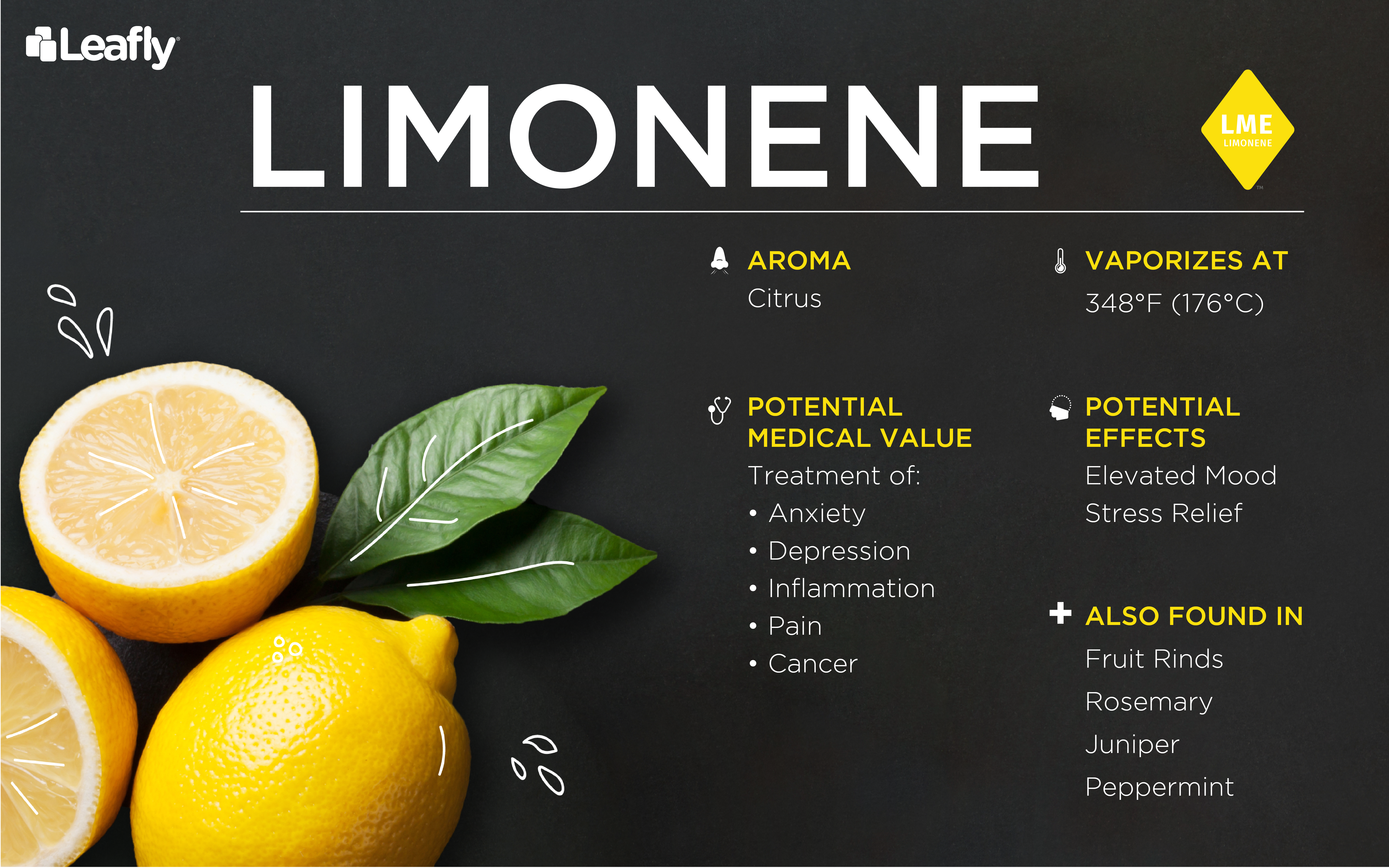
You’re familiar with terpenes even if you’ve never heard the word before. They are the lemon in your Lemon Haze, the berry in your Blueberry Kush, the fuel in your Sour Diesel. Terpenes give our strains the scents and tastes we love, but can they also play a role in the high? The topic is in need of further research, and it is a fascinating question, but some anecdotal evidence seems to suggest that it can, in fact, make a difference.



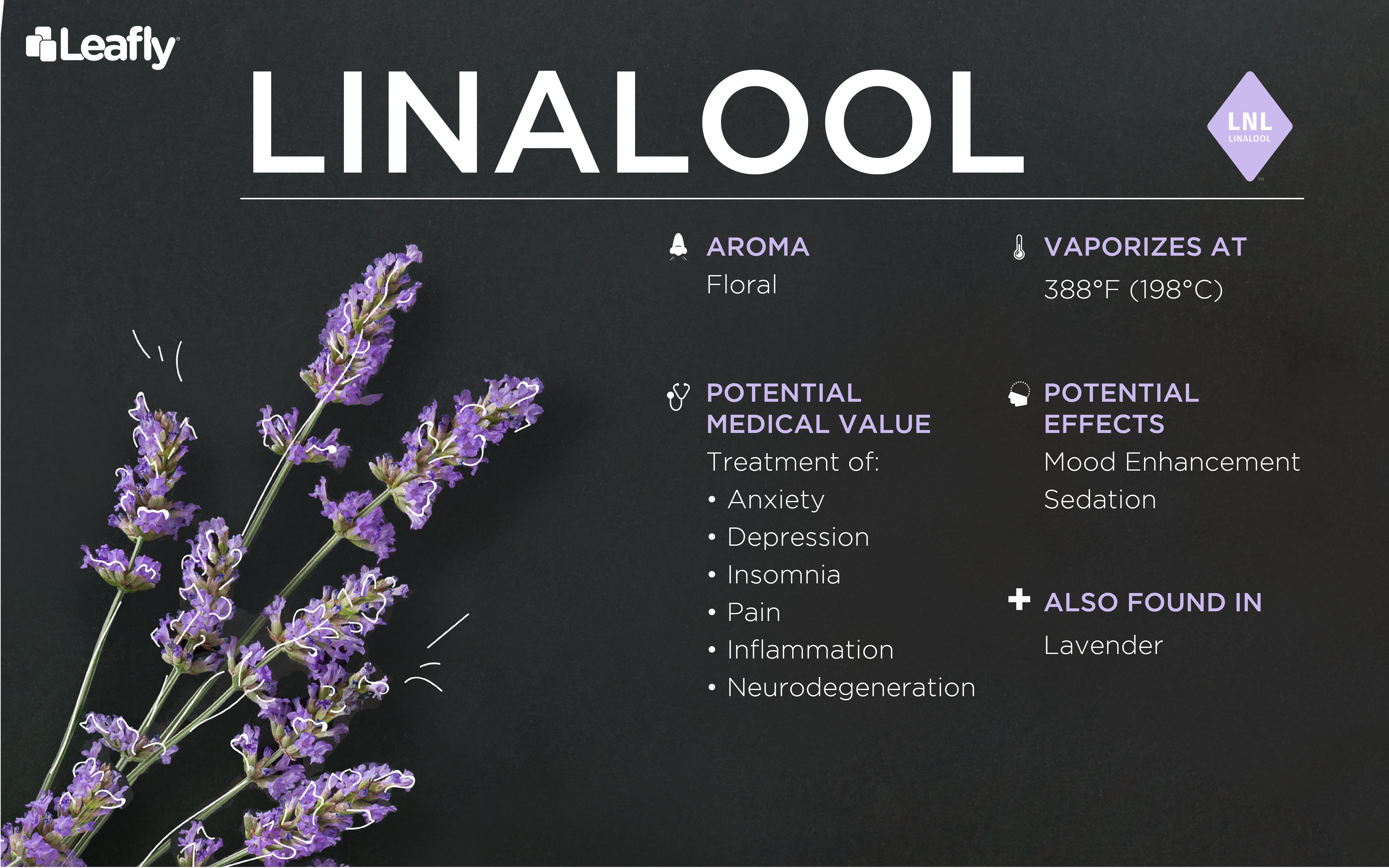
For example, a potential effect of limonene is said to be stress relief, and linalool may provide relaxed mood enhancement. It makes a kind of intuitive sense—linalool, for example, is also what gives lavender its signature scent, and no one questions the relaxing effects of lavender oil.

In the future, research will undoubtedly emerge to confirm the beneficial effects of terpenes, and cannabis consumers will be able to say with confidence which terpenes they prefer most.

Age
If you’ve ever asked your folks if they smoked when they were young, you might have heard that they enjoyed it back in the day but can’t tolerate it now. While you may have assumed they simply became uncool once they had kids, the truth is that age may have a surprising role to play in enjoying a cannabis high.


A 2007 study on rats found a link between age and the effects of cannabis. Adolescent rats were reported to tolerate the effects of weed much better than their adult counterparts, who showed more signs of stress, anxiety, and suppressed movement.

More research on age still needs to be done, but it may be wise to reevaluate how much and what kind of cannabis you’re consuming if the last time you smoked was in your teens.

Tolerance
No two people are exactly alike, and the same can be said for a person’s cannabis tolerance. The aforementioned age affects tolerance, as well as other factors, including frequency of consumption, body chemistry, and how long you’ve been smoking. It’s important to know your own personal tolerance, so you know how much or how little to consume, especially when consuming with others who may have different tolerances.


At the end of the day, only you can ascertain what your tolerance is, and by doing so, you will be empowered to have the type of cannabis high you want—whether that be relief, medical benefits, enjoyment, creativity, or whatever other effects you seek.
 
What Are Cannabis Terpenes and What Do They Do?

There’s something about the aroma of cannabis that soothes the mind and body. Whether it’s the sweet fruity taste of Pineapple Trainwreck or that skunky smell that bursts from a cracked bud of Sour Diesel, we know there’s something going on under their complex and flavorful bouquets.

Terpenes are what you smell, and knowing what they are will deepen your appreciation of cannabis whether you’re a medical patient or recreational consumer.

What Are Cannabis Terpenes?
Secreted in the same glands that produce cannabinoids like THC and CBD, terpenes are aromatic oils that color cannabis varieties with distinctive flavors like citrus, berry, mint, and pine.

Terpenes play a key role in differentiating the effects of various cannabis strains. Some terpenes promote relaxation and stress-relief, while others promote focus and acuity.
Not unlike other strong-smelling plants and flowers, the development of terpenes in cannabis began for adaptive purposes: to repel predators and lure pollinators. There are many factors that influence a plant’s development of terpenes, including climate, weather, age and maturation, fertilizers, soil type, and even the time of day.

Over 100 different terpenes have been identified in the cannabis plant, and every strain tends toward a unique terpene type and composition. In other words, a strain like Cheese and its descendants will likely have a discernible cheese-like smell, and Blueberry offspring often inherit the smell of berries.

The diverse palate of cannabis flavors is impressive enough, but arguably the most fascinating characteristic of terpenes is their ability to interact synergistically with other compounds in the plant, like cannabinoids. In the past few decades, most cannabis varieties have been bred to contain high levels of THC, and as a result, other cannabinoids like CBD have fallen to just trace amounts. This has led many to believe that terpenes play a key role in differentiating the effects of various cannabis strains.


Each individual terpene is associated with unique effects. Some promote relaxation and stress-relief, while others promote focus and acuity. Linalool, for example, is believed to be relaxing whereas limonene elevates mood.

The effect profile of any given terpene may change in the presence of other compounds in a phenomenon known as the entourage effect. More research is needed to understand each terpene’s effect when used in harmony with others.

Their differences can be subtle, but terpenes can add great depth to the horticultural art and connoisseurship of cannabis. Most importantly, terpenes may offer additional medical value as they mediate our body’s interaction with therapeutic cannabinoids.

Many cannabis analysis labs now test terpene content, so you may have a better idea of what effects a strain might produce. With their unlimited combinations of synergistic effects, terpenes will certainly open up new scientific and medical terrains for cannabis research.


Most Common Cannabis Terpenes

Click to enlarge. (Elysse Feigenblatt/Leafly)
Alpha-Pinene

Click to enlarge. (Elysse Feigenblatt)
Aroma: Pine

Vaporizes At: 311ºF (155ºC)

Potential Effects: Alertness, memory retention, counteracts some THC effects

Potential Medical Value: Treatment of asthma, pain, inflammation, ulcers, anxiety, cancer

Also Found in: Pine needles, rosemary, basil, parsley, dill


Myrcene

Click to enlarge. (Elysse Feigenblatt)
Aroma: Cardamom, cloves, musky, earthy, herbal

Vaporizes At: 332ºF (167ºC)

Potential Effects: Sedating “couchlock” effect, relaxing

Potential Medical Value: Antioxidant; treatment of insomnia, pain, and inflammation

Also Found in: Mango, lemongrass, thyme, hops


Limonene

Click to enlarge. (Elysse Feigenblatt/Leafly)
Aroma: Citrus

Vaporizes At: 348ºF (176ºC)

Potential Effects: Elevated mood, stress relief

Potential Medical Value: Treatment of anxiety, depression, inflammation, pain, and cancer

Also Found in: Fruit rinds, rosemary, juniper, peppermint


Beta-Caryophyllene

Click to enlarge. (Elysse Feigenblatt)
Aroma: Pepper, spicy, woody, cloves

Vaporizes At: 266ºF (130ºC)

Potential Effects: Stress relief

Potential Medical Value: Treatment of pain, anxiety/depression, ulcers

Also Found in: Black pepper, cloves, cinnamon


Linalool

Click to enlarge. (Elysse Feigenblatt)
Aroma: Floral

Vaporizes At: 388ºF (198ºC)

Potential Effects: Mood enhancement, sedation

Potential Medical Value: Treatment of anxiety, depression, insomnia, pain, inflammation, and neurodegenerative disease

Also Found in: Lavender


Humulene

Click to enlarge. (Elysse Feigenblatt)
Aroma: Hops, woody, earthy

Vaporizes At: 222ºF (106ºC)

Potential Medical Value: Anti-inflammatory

Also Found in: Hops, coriander, cloves, basil


Ocimene

Click to enlarge. (Elysse Feigenblatt)
Aroma: Sweet, herbal, and woody

Vaporizes At: 122ºF (50ºC)

Potential Medical Value: Antiviral, anti-fungal, antiseptic, decongestant, antibacterial

Also Found in: Mint, parsley, pepper, basil, mangoes, orchids, and kumquats


Terpinolene

Click to enlarge. (Elysse Feigenblatt)
Aroma: Piney, floral, and herbal

Vaporizes At: 366ºF (186ºC)

Potential Effects: Relaxing

Potential Medical Value: Antioxidant, sedative, antibacterial, anti-fungal, anti-cancer

Also Found in: Nutmeg, tea tree, conifers, apples, cumin, and lilacs


What Types of Pain Can Cannabidiol (CBD) Treat?

vee-cbd--1024x640.jpg

Photo by @fallforvee
Pain, when used as an umbrella term, is more vast than the Pacific Ocean. Using CBD to treat pain can be effective only under the pretense that the type of pain is well-understood and properly diagnosed.


Most of us have crossed paths with the loud, piercing, cuss-worthy persona of acute pain: an elbow dings the edge of the table or a pinky toe that has found the bed frame yet again at 3 a.m. Other types of pain produce less shock value but are no less odious in nature.


For the sake of this article, I’ll simply go into the types of pain that CBD has shown to treat effectively: neuropathic and inflammatory pain.

Types of Pain
CBD treats neuropathic pain like Cinderella’s foot fit the magic shoe—a blissful, but unexpected, union. Neuropathic pain is largely created and sustained due to the glutamenergic system, which is a major excitatory neuronal pathway. Glutamate is the neurotransmitter that is responsible for turning neurons on, which is great, sometimes.

Inflammatory pain is related to neuropathic pain, except it is not limited to neurons. Examples of inflammatory pain include all types of arthritis, a few autoimmune diseases such as Crohn’s and ulcerative colitis, and simple conditions like headaches, cramps, muscle aches, and pains.


For humans, communication is key, not only interpersonally but also molecularly. Problems arise in paradise when cells become damaged due to injury or chronic illness. When the body senses this damage, it cranks inflammation to HIGH and begins pumping inflammatory agents on its cells.

The point is to promote death of the damaged cell, otherwise called apoptosis. Our bodies don’t enjoy malfunctioning cells and would prefer that they throw in the towel—this is important in ridding ourselves of possible cancer and maintaining optimal functioning. However, when this becomes a chronic condition, it is named inflammatory pain.

How CBD Works for Pain
CBD inhibits glutamate release and other inflammatory agents, which makes it ‘neuroprotective’ and excellent at dulling the prickling, tingling and burning sensations that neuropathic pain is characterized for. CBD can be used as a supplement to help manage neuropathic pain, alongside other natural supplements such as magnesium glycinate.


Pain due to inflammation is not as easily characterized as other types of pain, mostly because its origins of pain vary and so does the experience. On the bright side, CBD is good at calming inflammation, no matter what the root cause.

The anti-inflammatory mechanism of cannabidiol is unique to cannabis. It doesn’t work like other anti-inflammatory drugs by inhibiting COX-1 and COX-2 receptors, which means you don’t run the risk of developing gastrointestinal ulcers or heart attacks, hooray! Some studies have shown that cannabinoids (CBD and THC) are up to twenty times more potent anti-inflammatory agents when compared to NSAIDs (eg. ibuprofen).


When taken regularly alongside other natural anti-inflammatory supplements (eg. curcumin, Omega-3), CBD can provide systemic relief of inflammation. Usually taken three times per day, dosing at each interval depends on your unique needs. Typically patients start with 0.5 mg per dose and increase until maximum relief.

Cannabidiol can be an effective, non-psychotropic alternative to THC when used correctly. However, we are still in the infancy stage of incorporating CBD into health and medicine, so it is important to consult your physician when contemplating the use of CBD to treat pain.


It’s important to remember that CBD, like other nutraceuticals, can interact with medications.

The takeaway? CBD isn’t effective in treating all types of pain—for that reason, it’s important to understand your pain: does it worsen with the weather, cause swelling, or is it persistent and stabbing? If you feel that you experience inflammatory or neuropathic pain, talk to your doctor. CBD supplementation could be right for you.
 
Indica vs. Sativa Strains: Which Has More THC & CBD?

Raise your hand if you’ve heard someone say, “Indica strains produce more CBD and sativas have more THC.” Or maybe you’ve heard that claim in reverse. But which is true?


According to cannabis lab testing data, neither is. At least not in any significant way that could explain the perceived difference between these two cannabis types.

In other words, that indica isn’t sleepy because it has more CBD, and that sativa isn’t more energizing because it produced more THC.

But before we get too deep into the numbers, it’s important to first flip a popular notion on its head.


Indica & Sativa Designation Isn’t a Reliable Predictor of Effects
It’s possible you’ve noticed that indica and sativa strains look a bit different. One forms chunky, dense buds while the other often grows into airy, fluffy spears. The physical differences between indica and sativa plants allowed each to thrive in different climates, from rugged and cold highlands to tropical regions along the equator.


Click to enlarge. (Amy Phung/Leafly)
Cool, but what does that have to do with how indicas and sativas affect you? Nothing. Exactly.

Ethan Russo, prominent cannabis researcher and neurologist, put it this way:

“The way that the sativa and indica labels are utilized in commerce is nonsense. The clinical effects of the cannabis chemovar have nothing to do with whether the plant is tall and sparse vs. short and bushy, or whether the leaflets are narrow or broad.”

One way we know that this perceived correlation between plant type and effect is flawed is by looking at the chemical profiles—the compounds cannabis produces that contribute to the mood or experience of that strain.

Here, we’ll take a look at the average cannabinoid content of each strain type. Terpenes also play an important role in a strain’s effect, but don’t worry—we’ll get to that in the next installment.


CBD vs. THC in Indicas and Sativas
Using data from Confidence Analytics, a state-certified testing lab in Washington, we were able to see how much THC or CBD is produced, on average, by each strain type.

First, let’s take a look at the average abundance of THC in strain samples grouped by their sativa, indica, and hybrid designation on Leafly, for THC-dominant samples only:


Click to enlarge. (Elysse Feigenblatt/Leafly)
As shown in the graphic above, THC-dominant sativa strains on average produced 0.4% more THC than their indica counterparts. So, yes, you could look at that graph and say that sativas produce more THC, but the difference is fairly negligible in terms of statistical significance.

What the graphic does contradict is any claim that THC abundance accounts for the perceived “opposite” effects of indicas and sativas. If that were true, we’d expect hybrids—which are typically seen as a balance of indica and sativa effects, would fall somewhere in between, around 17.5%.

Now let’s see if there are any notable differences in CBD abundance for CBD-containing strains:


Click to enlarge. (Elysse Feigenblatt/Leafly)
Once again, the graph above shows small differences in the average amount of CBD among the three plant types, but not so much that we’d expect to see polar opposite experiences delivered. Indicas, on average, produce 0.4% more CBD than sativas. Again, hybrid strains produced slightly more.

While the bird’s eye view we get with larger sample sizes is helpful in seeing the big picture, you don’t need huge amounts of data to realize that THC and CBD profiles are specific to plant types. Peruse the lab-tested flower on dispensary menus and you’ll see that THC and CBD contents can vary widely, no matter its sativa or indica designation.

How to Shop for Cannabis Without Saying ‘Indica’ or ‘Sativa’
What’s important to you as a consumer shopping for a specific mood is not the shape of the bud or the climate it was grown in. Instead, it has everything to do with potency, dose, and chemical profile (i.e., cannabinoids and terpenes).

For example, if you’re prone to anxiety and looking to avoid an uncomfortable, racy experience, look for a strain with more CBD and less THC. Then dose modestly. If you tell a budtender you hate sativas because they make your thoughts race, they may still hand you a THC powerhouse like White Fire OG simply because it’s not a sativa.

Although it isn’t as simple as grouping strains into the indica-sativa-hybrid triumvirate that has long been our compass while navigating menus, try using potency to guide you. You may find that a strain packing 25% THC isn’t as enjoyable as that very fragrant strain tapping in at 16%, or the balanced THC/CBD variety that provides 10% of each cannabinoid.


Shopping by strain name is also a more reliable way of achieving desirable effects. For example, if you loved the dreamy, blissful euphoria of Granddaddy Purple, you’ll likely have a comparable experience with the next GDP you come across.

Cannabis is a personal experience, and how you select it is, too. This data is meant to give you an alternative perspective on what qualities one should look for in a strain. For many consumers, this level of precision in strain selection is paramount to having a good experience.

Others, well, we’d be happy to sit down with a strain of any variety, any time.
 
The 10 Terp Commandments: How to Preserve the Aroma of Your Cannabis

10-commandments-of-terpenes--1024x640.jpg

(rez-art/iStock)
We’re living in heady times. Cannabis products are rapidly advancing. Connoisseur-level appreciation for them is flourishing.


But look around you and you’ll still see people unknowingly wasting their precious time and hard-earned money, throwing perfectly good cannabis terpenes to the wind. Don’t make the mistake of sullying divine flavors with cheap plastic bags and resiny old pipes.

It’s time to emancipate yourself from mental slavery. Here are ten terpene preservation commandments—guidelines to help you identify, preserve, and appreciate your bud’s flavorful potential.


Thou Shalt Smell Your Cannabis Before You Buy It (If Possible)
The nose is the seat of memory and an evolutionary marvel. Let it lead you to the cannabis you’ll instantly know as “home.” The hippies turned out to be right: aromatherapy has empirical effects and it starts with the retail smelling experience.

Thou Shalt Leave No Terp Behind
Plastic degrades terpenes and cannabinoids. Get it out of cheap supply chain packaging and into some glass promptly. Seal your terps up tightly at all times. Smell loud in the air? That’s your hard-earned money, and someone else’s time, resources, and energy off-gassing in a room. Don’t let them escape, except into your nose and lungs.


Thou Shalt Store Strains Separately
Different types of cannabis are called strains, and they’re as real as different breeds of dog. “What breed is it?” “Dog. It’s a dog-type dog.” See how silly that sounds? Showcase your intelligence and preserve them separately.

Explore cannabis by flavor with Leafly’s strain filters.
Thou Shalt Keep Your Pieces Clean of Foul-Smelling Resin
Do you drink wine out of an old glass that’s been sitting outside on your sun deck for few days? No. Look—we get it. Keeping glass clean is hard. Just try, will you? Do it for the terps. The important thing is striving toward goals, not completing them all the time.

Thou Shalt Burn No Terp Before Its Time
Heat and light breaks the delicate chemical bonds of terpenes, burning them. You’re wasting nature’s gift. Don’t cook terps in your hot car. Preserve flowers in a cool and dark place until it’s time to shine.

Also, dab at low temperatures.


Thou Shalt Use a Grinder
Herb grinders unlock the aroma in the dense, resinous cannabis bud. Mashing an unbroken nug into a bowl and firing it with a Bic Lighter takes 80% of the enjoyment out of smoking.

Thou Shalt Use a Hemp Wick
Just as you light a cigar with a wooden match, you can light cannabis with a tiny bit of hemp wick. The butane in a Bic lighter seemingly masks the terpenes and gives all bud the same dull sweet taste.

Thou Shalt Not Hoard Terps
Time is the thief that steals all. So enjoy your terps fresh and share liberally in cannabis’ long-held tradition. To be miserly or withhold is unbecoming.

Thou Shalt Spread the Terp Gospel with Humility and Grace
Because no one likes a snob.
 
What Is Cannabis and What Is a Cannabis Strain?
PATRICK BENNETT
June 14, 2018
what-is-cannabis-and-what-are-strains-21-1024x640.jpg

(iStock/Leafly)
Cannabis is a fascinating plant genus best known for its mind-altering and medicinal properties. Its use and cultivation date back as far as written language itself, and its therapeutic and spiritual utility spans many cultures around the world throughout history.


But despite its ubiquity, you may not fully understand what cannabis is or why there are thousands of different named strains flooding markets worldwide. Here, we’ll take a dive into how the plant is defined, how cannabis has been used, and why it’s taken on so many forms since its earliest uses in human society.


What Is Cannabis Used For?
Today, cannabis consumption is generally divided into two primary uses: recreational and medical. Recreational cannabis consumers may use cannabis for a variety of purposes, such as enjoyment, stress relief, and creative stimulation. Medical consumers use cannabis to alleviate symptoms such as pain, anxiety, insomnia, appetite loss, and more.

Cannabis contains hundreds of active compounds (e.g., cannabinoids, terpenes, and flavonoids) that provide a range of medical benefits. THC and CBD are two of cannabis’ most well-known compounds, although there are many more that offer a unique range of effects.

The cannabis plant is also an important agricultural resource. The strong fibers of hemp have been used to make ropes, clothing, textiles, building materials, and more. It also produces nutritious consumable seeds filled with essential amino acids, protein, and other valuable minerals. Cannabis byproducts can also be manufactured into cooking oils, and can even function as a sustainable biofuel.

Getting to Know the Cannabis Plant
Cannabis is an annually flowering plant that displays either male and female reproductive organs, meaning a male must pollenate a female to create seeds (unless the plant expresses rare hermaphroditic features).

A female plant that does not receive pollen within its reproductive cycle is often referred to as sinsemilla, a Spanish term that means “without seed.” These seedless females produce the large, resinous buds that are commonly smoked, vaporized, or processed into oils.


Hemp refers to a different subspecies of cannabis most commonly cultivated for its fiber and seeds. It also produces a modest amount of CBD that can be rendered into cosmetics, oils, and other consumables.

What Is a Cannabis Strain?
Cannabis is believed to have originated in Central Asia, but over the course of millennia, conquest and exploration would carry the plant to virtually every continent. Cultivators selectively bred their plants to suit the needs of their communities.

Over many generations, variations within cultivars began to develop in each pocket of the world where cannabis had taken root. These variations became known as landrace strains.

Many of these landrace strains were collected from their native habitats and brought to the West, where they were crossbred with one another by horticulturists seeking to explore the plant’s potential. This process of hybridization—breeding different males with different females—has given rise to the thousands of named varieties we consume today.

You’ve probably also heard the terms “indica,” “sativa,” and “hybrid” when discussing cannabis strains. These three types primarily refer to the various plant shapes and structures, features that are important for growers. Consumers have long thought that indicas have sedating effects, sativas promote energy, and hybrid effects fall somewhere in between. However, research has largely debunked this effects-based classification.


Today, cannabis classification more or less operates in the following categories:

  • High-THC, low-CBD (more euphoric)
  • High-CBD, low-THC (more clear-headed)
  • Balanced CBD and THC (mildly euphoric)
Each of these three “chemotypes” offer unique medical benefits and effect profiles. Learn more about how CBD and THC strains differ here, and try experimenting with different strains and potencies to find what works best for you.
 
What Is Medical vs. Recreational Cannabis?


What Makes Medical and Recreational Cannabis Different?
In 2012, Colorado and Washington became the first states to legalize recreational cannabis. Before that, cannabis was legal in certain states only to those with qualifying medical conditions. As more states follow in Washington and Colorado’s footsteps, “recreational” or “adult-use” have become the commonly used terms for personal cannabis consumption that isn’t exclusively for medical purposes.

But beyond the distinction of consumer intention, what other differences exist between medical and recreational cannabis?

The Medical vs. Recreational Cannabis Shopping Experience
When it comes to the shopping experience itself, medical and recreational shops tend to offer similar experiences. Qualified medical marijuana patients present both their ID to prove they’re legally old enough to purchase cannabis, as well as their valid medical cannabis card. Some medical shops will have a waiting room where patients are called in one at a time to ensure privacy.


Oftentimes, recreational stores are not permitted to provide medical advice to customers, although you can still shop at them as a medical patient. Some shops are also “dual-licensed,” meaning they can cater to the needs of both recreational and medical consumers. They may also offer discounts and tax breaks to medical patients.

Medical dispensaries and dual-licensed shops are best equipped to answer patient questions, especially those that provide education opportunities for their budtenders, such as seminars and certifications. Don’t be afraid to explore multiple dispensaries until you find one with a well-trained staff that you connect with.

Browse Dispensaries Nearby
As for product selection, there tends to be very little difference between medical and recreational menus. At either store type, you’re bound to find the shelves full of various edibles, drinkables, vaporizers, topicals, strains, and concentrates.

Different States, Different Perks
Medical patients may receive certain perks not available to recreational consumers. These generally include:

  • Lower costs and taxes
  • Higher THC potency limits
  • Higher quantity restrictions
  • Legal access for minors in approved medical cases (e.g., cancer or epilepsy)
  • Medical patients may be allowed to grow their own cannabis (or are permitted a higher plant count than recreational consumers)
Find out more about the benefits of having a medical cannabis card in a legal state by consulting this resource.


How Are Medical and Recreational Cannabis Perceived Differently?
Social stigma and perception further bolden the dividing line between medical and recreational cannabis, as a greater percentage of Americans support medical cannabis than recreational adult use.

Using cannabis for enjoyment is still somewhat taboo in the public eye, although you don’t need to be suffering a severe disease to find wellness benefits in casual use. For example, when a state legalizes recreational cannabis, a consumer might first fall in love with the easy access to a variety of high-quality strains, only to discover an infused topical that works wonders on a chronic condition. Or, a healthy adult may find that a low-dose tincture helps alleviate daily stress and anxiety.

As new products and medicines with a wide range of benefits come to market, it’s easy to become fan of both recreational and medical cannabis. And it’s only a matter of time before state laws come to reflect that.
 
7 Signs You May Want a Cannabis Tolerance Break
There are a lot of reasons to take a break from getting high, and you might currently be considering stepping away for a bit but feel weird because cannabis has been your best friend since Day 1. You’re not alone; it’s perfectly normal for cannabis consumers to give up their favorite product for a stretch. If you’re wondering whether you should bench your bud, take a look at some of these reasons why you may want to abstain.


You’re Spending Too Much Money on Cannabis
A one-time-buy isn’t that expensive, but those one-times turn into 12-times and then your ATM card’s looking at you like this isn’t the relationship that y’all agreed to. It’s very easy to spend hundreds on a few grams and a few edibles or concentrates, then look up at the end of the month and see that you could’ve bought a plane ticket to Hawaii or, even better, a delicious amount of mozzarella sticks.


It’s Taking Priority Over Your Responsibilities
You said after work was Day 1 of Operation Back in the Gym, but instead you go home, smoke, and pass out for the night. You said tonight was the night that you’d write out that business plan, but that one hit for a little inspiration turned into 87 hits for procrastination and now you’re watching the basketball episode of The Office for the 832nd time. You were going to pay off that credit card, but you’ll get it next month because you got the munchies and ordered a delicious amount of mozzarella sticks delivered straight to your mouth.

While cannabis may not be entirely responsible for your laziness, you may want to cut back on it for a while so you eliminate the temptation and can focus on establishing good habits and being more productive.


All Your Free Time Is Spent Inside
You need a social life to stay sane. Your friends are important, and seeing other humans in the wild matters. Spending all your time with your dab rig is cool, but so is fresh air and some time with your loved ones. If your motivation to go out and do things with others is being zapped, try tucking away your stash box for a bit so you can get out of your comfort zone and reestablish some social connections.


You Rely on It Too Much for Creativity
You’re either creative or you’re not. If you are, it’s not because you smoke, it’s because you’re talented and special. I think the connection between cannabis and art is so strong that some creatives believe they can’t create the latter without the former. If you’ve become so reliant on it that you can’t create without it, you should chill on it for a while so you can see what you’re truly capable of with a clear head.


Either You’re Getting Too High…
There was a period in college where I couldn’t even smell a blunt without passing out for the next six hours. Imagine being that friend: every time you get high, you pass out on the couch, and now the sitting area is closed for the next 360 minutes.

If you’re getting way too high and it’s leaving you feeling stuck too consistently, you may need a less-potent strain or product, or at least admit that your body isn’t built for war and you need to retreat for a bit to get your soldiers in order.

…Or Your Cannabis Tolerance Has Gotten Too High
Sometimes you smoke so much that you feel like you’re not feeling the effects as strongly as you used to. The only way to power through is to take a little break to reset your tolerance a bit. Even just 24 hours will help, but a full month? Oooohweee, that will make a big difference.


You Feel Guilty About It
You’ve been wanting to take a break, or even quit, for so long that getting high makes you feel extremely guilty because it feels like you’re running from a challenge. Anyone who has felt like they needed to stop smoking and rearrange their priorities knows all about that feeling.

There’s no shame in walking away from a bit. You can still support the mission of normalizing the use of cannabis and advancing the legalization of medical marijuana without actually indulging in the product. Do whatever’s best for you, my friend.
 
5 Facts About The Marihuana Tax Act of 1937

marihuana-tax-act-1937-1024x640.jpg

The Marihuana Tax Act of 1937 was drafted by infamous anti-cannabis prohibitionist Harry Anslinger, and signed into law on August 2, 1937. Up until this law was passed, cannabis products were legal to sell in pharmacies and drug stores, so long as they were properly labeled and regulated, but it was during the 1930s that the mainstream attitudes towards cannabis began to sway greatly towards negative opinion.


In honor of the 80th anniversary of the first official federal prohibitory measure on cannabis in the United States, we explore some of the reasons why the Marihuana Tax Act of 1937 changed the history of cannabis.


1. The Origins of ‘Marihuana’
This was one of the first acknowledgements by the US government of the new and notorious drug known as “marihuana.” The name itself, marihuana, was derived from Mexican Spanish, although the linguistic origins have been widely debated. From the Aztec language Nahuatl to the Chinese word ma ren hua, meaning “hemp seed flower,” marijuana truly has many roots, but the word was popularized by Harry Anslinger as part of his campaign to instill fear of the drug. Before this, it was commonly referred to as “hemp” or “cannabis sativa,” and was considered “a fashionable narcotic,” often found in over-the-counter pharmaceutical products like cough syrups.


2. The Opposition of the AMA
The Marihuana Tax Act of 1937 was originally passed to levy taxes on hemp products and on the commercial sales of cannabis products. Farmers could acquire tax stamps for the cultivation of fiber hemp, physicians would be charged a tax for prescribing cannabis, and pharmacists would be required to pay a tax for selling cannabis. The American Medical Association was strongly opposed to the act, arguing against the measure in court and proposing instead that cannabis be added to the Harrison Narcotics Tax Act.


3. Reefer Madness Is Born
The law was enacted a year after the production of the notorious anti-cannabis film, Reefer Madness, originally titled Tell Your Children, but also known as The Burning Question, Doped Youth, and Love Madness. Reefer Madness was financed by a church group before being widely released as an exploitation film to warn the public about the dangers of cannabis use. It was just one in a long line of education-exploitation films of the era, including Marihuana (1936), Assassin of Youth (1937), and Devil’s Harvest (1942).


4. The Power of the Paper Industry
Over the years, many have speculated that the reason for the campaign against cannabis boiled down to demonizing the hemp industry because it was a low-cost substitute for paper pulp. The paper industry, and more specifically, the newspaper industry, led the charge against cannabis with Anslinger. William Randolph Hearst, Andrew Mellon, and the DuPont family all had major investments in the timber and newspaper industries, and a rise of hemp would have seemingly undercut their profits. Curiously, years later, manufacturing paper with hemp as the raw material proved that hemp lacks the qualities needed to become a major competitor of the traditional paper industry, as it does not contain a high enough concentration of cellulose to be an effective substitute.


5. The First Victim of the Drug War
The first person to be arrested under the Marihuana Tax Act of 1937 was precisely the person Anslinger and his cohorts sought to target with their cannabis crusade: a young, Mexican-American named Moses Baca, who had a quarter-ounce of cannabis tucked into his drawer in his third-floor rooming house in Denver’s Five Points neighborhood. Judge John Foster Symes sentenced Baca and made his disgust for cannabis well-known: “I consider marijuana the worst of all narcotics, far worse than the use of morphine or cocaine. Under its influence, men become beasts. Marijuana destroys life itself. I have no sympathy with those who sell this weed.”
 
Advice for First-Time Cannabis Smokers: 10 Tips to Keep in Mind

first-time-cannabis-smoker-1024x640.jpg

Congratulations, you’ve decided that you’re finally ready to take that leap towards trying cannabis. Perfect. Beautiful. Let me be the first to welcome you to the family. But before you take that first toke, I’d like to offer you a few pieces of advice so you know what you’re getting into.


Be Prepared to Not Get High
first-time-cannabis-smoker-2-1024x640.jpg

(franckreporter/iStock)
The first time I smoked, I didn’t get high. Maybe I didn’t do it right. Maybe I was all wrong. But I didn’t. And I’ve heard this as the case for so many people, so just know it’s a possibility. But don’t let it deter you from getting to where you’re going. If at first you don’t succeed, dust yourself off and try again. Yes, I did just quote Aaliyah.


Inhale
You can’t get high if you aren’t inhaling. I still remember the first time I properly did it. Ooooohweeee. My eyes got low, lights got bright, and my soul left my body. It was epic—no, scratch that—it was euphoric. Everything and everyone made me soooo happy and my body felt soooo good.

If you don’t feel like you’re getting high, maybe you just aren’t inhaling properly. Let that smoke fill your lungs and carry you to infinity and beyond.


Hydrate Like an Athlete
first-time0cannabis-smoking-5-1024x640.jpg

(ljubaphoto/iStock)
If I had a nickel for every morning I woke up completely dehydrated from getting stoned out of my mind the night before, well, I’d have a lot of nickels. Probably enough to buy 17 gallons of water, which is the exact amount you’ll need after a solid smoke sesh unless you want to end up looking like Spongebob when he visited Sandy’s house for the first time. If you’re going to indulge in the arts of cannabis, make sure to chug a bunch of water before the occasion like you’re about to play in a high school state championship game.


Choose Your Piece Wisely
I’ve been smoking blunts since Day One so that’s just how I get down. But if it’s your first time, I suggest easing into it. You don’t run a marathon without first doing a one mile test, and the same principle applies to smoking. Don’t jump into heavy bong rips, dabs, and things of that nature until you take a few baby steps.

I suggest starting with a little bowl and working your way up that ladder until you’re ready to take on more advanced consumption methods like the dab rip, also known as the M. Bison of the cannabis world. Also: beware of the gravity bong. They’re little, but boyyyy do they pack a punch. My first time hitting one resulted in hours of paranoia and discomfort. Don’t do that. You’ve been warned.


Download a Food Courier App
cannabis-first-timesmoking-3-1024x640.jpg

(BalkansCat/iStock)
The worst thing possible when high is having to go somewhere and do something, even if the task is just getting food. When I delivered food for Postmates, 95% of the houses I delivered to reeked of cannabis. Coincidence? I think not. It’s because those people were smart enough to make the experience convenient for them. You are, too. Make sure to download your preferred courier app (Postmates, DoorDash, Favor, etc.) beforehand so you won’t entertain the possibility of going out and driving under the influence (or wandering around outside when you’re not feeling particularly social or comfortable).


Clear Your Schedule
If you’re about to get high for the first time, you’ll probably pass out at some point. Don’t even say “No I won’t,” because you’ll be forced to come apologize to me once you wake up eight hours after taking your first bong hit. It’s like a rollercoaster: you go alllll the way to the top just to drop alllll the way to the bottom.

Even if you don’t fall asleep (which you probably will), you may end up feeling heavy-bodied, so if you’re about to smoke for the first time, make sure you’re in a comfortable environment that encourages absolute relaxation. I suggest a living room with a 65” flat screen and a sectional couch (the crease of the L is the sweet spot).


Never Smoke With Sketchy People
first-cannabis-smoking-4-1024x640.jpg

(pixelfit/iStock)
This pretty much applies to anything in life, but especially when it comes to cannabis consumption. If you’re smoking for the first time, it should be with some friends you trust. But on the off chance that it’s with some sketchy-ass strangers, make sure to abide by Rule #1 of the Bruh, I’m Just Tryna Get High code of conduct: If you didn’t see it rolled or packed, don’t smoke it. You do not want to get hit with a case of the shenanigans around people you don’t know in an unfamiliar environment.


Know (or Learn) Your Limits
If you’re stoned out of your mind after one hit, feel free to pass on the joint in rotation. Your mission was to get high for the first time, not melt your entire face off. Know your limits and act accordingly.


Develop a Tribe
first-time-cannabis-smoking-3-1024x640.jpg

(Rawpixel/iStock)
Once you start smoking, you’ll want to have a group of friends that you can smoke with. I like to call this my tribe. These are the people that you hit up for a group sesh. You also want to have a tribe because, if I can keep it funky, smoking solo can get extremely boring. But when you have friends, who knows what type of adventures y’all might get high enough to go on? Or even if it’s not an adventure, you might end up having a dope/deep-ass conversation, which may turn out to be a therapeutic experience. So make sure to find friends who enjoy the same activity then build with them.


Be Prepared to Fall in Love
For me, cannabis was love at first pipe. When I took that first hit and felt that buzz in my eyelids I instantly knew that I was smitten. You might be, too. Prepare to embark on a new, groundbreaking relationship. (But much like any relationship, things can get expensive. So before you go into this, just know this love may leave your pockets taxed.)
 
List of Major Cannabinoids in Cannabis and Their Effects

cannabinoids-and-their-effects-1024x640.jpg

Cannabis produces a variety compounds known as cannabinoids, many of which have not been detected in any other plant. How many, exactly? It’s hard to say. You’ll often see people report that there are dozens, or even 100+ plant cannabinoids produced by cannabis. But it’s difficult to know the precise number. Most of them are present at very low levels, especially in commercial cannabis products, making it difficult for scientists to accurately detect them. The important point is that there are many. Let’s take a closer look at some of the major cannabinoids that can be found in cannabis products.


8 Major Cannabinoid Acids Produced by Cannabis
Cannabis doesn’t directly make the most famous cannabinoids associated with the plant, THC and CBD. Instead, it synthesizes several cannabinoid acids (Figure 1). These cannabinoid acids must be “activated” (decarboxylated), usually by heat, to yield the compounds that most consumers are after (THC or CBD). But in addition to THCA and CBDA, there are number of related cannabinoid acids that can be produced by Cannabis. These are:

  • CBGA (Cannabigerolic acid)
  • THCA (Δ9-tetrahydrocannabinolic acid)
  • CBDA (Cannabidiolic acid)
  • CBCA (Cannabichromenenic acid)
  • CBGVA (Cannabigerovarinic acid)
  • THCVA (Tetrahydrocanabivarinic acid)
  • CBDVA (Cannabidivarinic acid)
  • CBCVA (Cannabichromevarinic acid)
PRECURSORS.png

Figure 1: Biosynthetic pathway resulting in production of cannabinoid acids. Each cannabinoid acid can be subsequently decarboxylated into a corresponding cannabinoid, such as THC, CBD, or THCV.


THCA and CBDA are usually the most abundant cannabinoids in strains. The others shown in Figure 1 are normally present at much lower levels. The major cannabinoid acids include CBGA, THCA, CBDA, and CBCA. CBGA is the starting compound that enzymes in the plant use to make the other three. In addition to these, there are an equal number of corresponding “V” compounds with slightly shorter chemical structures: CBGVA, THCVA, CBDVA, and CBCVA.


Cannabinoid acids are not known to produce intoxicating effects like THC. But they do have a variety of interesting properties. For example, many cannabinoid acids have antibiotic or insecticidal properties. This is likely related to the reason Cannabis produces these compounds in the first place: to defend itself.

Plant Cannabinoids Are Made From Cannabinoid Acids
When cannabinoid acids are exposed to heat energy, they lose the “A” part and turn into neutral, rather than acidic, plant cannabinoids (Figure 2).


Figure 2: Decarboxylation examples, with THCA being converted to THC. The other cannabinoid acids can also be decarboxylated into their cannabinoid counterparts. (Amy Phung/Leafly)


Following decarboxylation, each of the cannabinoid acids yields a corresponding cannabinoid compound:


Most Cannabinoids Will Not Get You High
THC is the only plant cannabinoid that you know for sure has clear intoxicating effects on its own. There is some evidence to suggest that THCV may also have intoxicating effects, although whether it does may depend on dose. However, like most other plant cannabinoids, THCV is usually not present in significant quantities in commercial strains and cannabis products.

While most plant cannabinoids are not intoxicating themselves, their presence can influence how THC affects you. The best example of this comes from CBD. Even though it wouldn’t get you high by itself, it influences the way that THC interacts with the CB1 receptors in your endocannabinoid system, and can therefore influence exactly how a cannabis product will affect you.


THCV may also influence THC’s effects. At relatively low doses, THCV appears to diminish THC’s ability to activate CB1 receptors, like CBD. However, at relatively high doses, THCV may start to activate CB1 receptors, like THC. The exact dose that you consume can greatly influence how a compound affects you. But because THCV and the other, lesser-known cannabinoids are generally less abundant in cannabis, they have also been studied much less. There’s a lot more for us to learn about their effects in humans.

THC Can Turn Into CBN
Another plant cannabinoid you may have heard about is cannabinol (CBN). This is another example of a plant cannabinoid that is not directly synthesized by cannabis. Instead, CBN is a breakdown product of THC. This is why older flower products will tend to have more CBN, especially when not properly stored. With time and exposure to oxygen, THC gradually breaks down into CBN.


CBN has been observed to result in greater sedation when combined with THC, and may also have anticonvulsant (anti-seizure), anti-inflammatory, and antibiotic properties. However, this is another example of understudied plant cannabinoid, and more work needs to be done before we can be confident in its precise effects.
 
What Are the Best Ways to Get Rid of Cannabis Smell Inside Your House?
cannabis-odors-1024x640.jpg

Cannabis, as we’re well aware, is a flower. One of the primary functions of flowers is to create terpenes, odoriferous chemicals designed by nature to attract pollinators and ward off predators. These pungent compounds can be one of the best and worst parts of enjoying cannabis. The rich smell of fresh, sticky bud can be as intoxicating as the perfume of a long-lost lover.


Unfortunately, this odor can also be a dead giveaway that alerts others to your preferably private ritual. And while cannabis may be consumed for medicinal and adult-use purposes throughout the country, federal prohibition continues to govern public perception, which can still trend negative. If you want to be mindful of your neighbors or simply want your cannabis habits to stay under the radar, respect and privacy can be preserved with a few handy tricks to mask the smell of cannabis on your person or inside your home.

The Classic Approach: Sai Baba, Satya, Nag Champa, Agarbatti Incense
Nag Champa is an incense commonly burnt in ashrams. The scent is neither masculine or feminine and usually contains a mixture of the following ingredients:

  • Champa flower
  • Benzoin resinoid (Styrax tonkinensis)
  • Henna (Lawsonia inermis)
  • Geranium (Pelargonium graveolens)
  • Indian sandalwood (Santalum album)
  • Vanilla
  • Honey
The classic aroma was transplanted in the west at the end of the hippie trail and has remained a welcome scent for practitioners of yoga, meditation, and cannabis consumption. This is a great way to get rid to not only get rid the smell of cannabis, but the incense smoke will also visually mask the cannabis smoke if it’s still lingering.


The Hippie Approach: Patchouli Oil
This aromatic oil is a hippie hallmark. Made from the small pink and white flowers of the patchouli plant, this oil is known for its pleasant, lasting scent and supposed antidepressant and aphrodisiac qualities. Certainly makes sense to me: enjoy a doobie, dab some patchouli behind the ears, smell nice, and make love, not war.

The Homemaker Approach: Febreeze
A household staple for many Americans living with gassy pets and gassier spouses or roommates, Febreeze is a trigger-action odor eliminator. This is not the end-all, be-all of cannabis smell reduction, but for a fresh scent in a pinch, it’s a solid option.

The Toilet Bowl Approach: Matches With the Bathroom Fan On
One of the sneakier moves on the list, the toilet bowl is an act of desperation at its core. You can’t go outside but you can’t consume inside; it’s a risky move no matter how you slice it. But if you must, bring along stick matches (preferably) and flip the switch on the fan. The combusting sulfur and wood smoke of the stick matches should cover a hit or two and the fan should take care of the rest.

Smoking in the Shower
Another bathroom consumption method is to smoke your cannabis while the shower is running. Turn the shower to maximum hotness; creating steam is the primary goal here because the smoke smell will dissipate along with the steam being sucked into your bathroom fan. This is traditionally called a “Hawaiian Hotbox.” For some added odor-masking, place a towel at the bottom of the door or even use a small spritz of your smell-good shower toiletries to replace the smell.

The Last Resort: Burnt Popcorn
The smell of burning popcorn could make a house fire just smell like another movie night gone wrong. In my experience, few smells mask other odors better and linger in the air longer than an accidentally burnt bag of microwavable popcorn.


But beware! Respect the very delicate balance between burnt for effect and just burning the hell out of it. While the room may no longer smell of cannabis, the fire alarm is literally the loudest signal of domestic failure known to man, and that’s not the perception cannabis needs, either.

Other Suggestions
Air-tight containers are not hard to come by. A good Tupperware, Mason jar, or, if you’re in a pinch, a Ziploc bag inside another Ziploc bag, can really go the distance. There are also other vacuum-sealed containers on the market, like OXO food storage containers, that will work extremely well for storing your pungent cannabis. If you can, get a UV protective airtight container and/or keep all cannabis plant matter out of direct/indirect sunlight to preserve quality over time.


Paper towel/toilet paper roll + rubber band + dryer sheet. It’s that simple—get a toilet paper or paper towel roll, place a fabric softener sheet at the end, and strap it to the roll with a rubber band. The idea is to fill the volume of the roll, so exhale slowly as not to shoot the smoke directly out the other end. Know that smoke will escape either way, but if done correctly, much of the odor will be diffused.

Buy a smoke filter. Manufactured smoke filters are starting to hit the market. You can try Sploofy—this portable carbon filter is an excellent choice for travelers and cannabis consumers that need to conceal their presence. The Sploofy’s replaceable filter system and nearly magical ability to swallow up enormous clouds of smoke make for potent camouflage on the go or in the home.
 
What Is ‘Kush’ Cannabis?

kush-1024x640.jpg

Cannabis can be classified in many different ways. Typically, this resinous flower is categorized as sativa, hybrid, or indica, based on the morphology of the plant. But cannabis can be further categorized through a vernacular defined by the popular culture, such as Kush, Haze, and Purple. These terms refer to types of cannabis characterized by distinct smells, flavors, effects, and/or geographic regions.


What Characterizes ‘Kush’ Cannabis?
kush-21-960x600.jpg


Kush is a particular variety of cannabis that descends from the Hindu Kush mountains. This mountain range spans the Afghanistan-Pakistan border and is one of the few geographic regions where the cannabis plant grows natively.

Having strong Kush genetics usually means a strain will have a few of the following attributes:

  • Appearance: Your strain may exhibit deep green colas and leaves with hints of purple. Pistils (hairs) can look orange, bronze, or rust colored. Buds are dense, chunky, and knotted, coming from squat, thick plants.
  • Smell: Aroma can vary between earthy, floral, pungent, pine, incense, sweet fruit, hash spice, pepper, citrus, gas, and herbs.
  • Flavor: Smoke or vapor should be smooth and herbaceous, tasting of flowers, grape, diesel, citrus, and earth.
  • Effects: The effects are typically heavy and sedative. OG Kush crosses are usually coupled with a bright euphoria that puts a smile on the couch-locked consumer. Introspection or internal reflection is a common effect of Kush as well. These cerebral effects make a strong case for Kush as a meditative variety of cannabis.
Keep in mind that these attributes can vary from Kush strain to Kush strain. How a strain is grown and its unique genetic expression (referred to as a “phenotype”) naturally affect a strain’s attributes.


Among strain breeders, Kush varieties are popular candidates for backcrossing and in turn, stabilizing hybrid genetics. As with many landrace strains, Kush genetics present natural resistance to certain elements native to their land of origin. This includes hardy stocks and vegetation that can survive colder, harsher climates and moderate water consumption, allowing the plant to endure somewhat parched terrain. In addition to their natural resilience, many growers choose to grow Kush strains for their heavy yields and manageable height.

What Are the Most Popular Kush Cannabis Strains?
A simple search of “Kush” will yield hundreds of strains with an Afghani ancestor, but let’s start with the five most popular:

1. OG Kush


The most famous of all Kush varieties, OG Kush hits the sweet spot on the indica-dominant hybrid scale. This strain’s comfortable yet potent sedation coupled with an uplifting euphoria make it the perfect strain to just feel good with.

2. Bubba Kush


Bubba Kush is what usually comes to mind when people think of indica-dominant effects. This strain is stoney and sedative, weighing the consumer to couch as though they were wearing cement boots with a matching cement tracksuit and stately cement trench coat. Bubba Kush may also ignite your appetite; just try not to fall asleep in front of the fridge while spooning a box of Eggo waffles.

3. Purple Kush


Purple Kush is an excellent example of indica-dominant attributes. This strain has purple foliage and will generally have an earthy, grapey flavor, as well as sleepy effects.

4. Skywalker OG


Skywalker OG takes the classic hybrid effects of OG Kush and deepens its sedating effects with the addition of Skywalker. This Kush develops a fruit-rich, diesel-driven flavor and aroma while mimicking the happy, uplifted mental characteristics of its paternal genetics. The creeping, sedative effects melt over the body, taking the consumer from the light side of day into the dark side of night (and sleep.)

5. Master Kush


Master Kush is another Kush classic that inherits attributes directly from Hindu Kush. With a mixture of sleepy, happy, and relaxing effects, Master Kush earns its title. This strain is an excellent alternative to Bubba Kush.

Which Kush varieties are your favorite? Share them in the comments section below!
 
4 Lessons Alcohol Prohibition Should Teach Us About Cannabis

prohibition-header-1024x640.jpg

It’s difficult to predict what the next four years will look like for cannabis users. While President-elect Trump has made a number of contradictory statements on the subject of legalization, his pick for Attorney General, Sen. Jeff Sessions, holds some radical viewpoints, once claiming, “Good people don’t smoke marijuana.”


This isn’t the first event of this nature in U.S. history. Producing insurmountable suffering and hardship, the so-called ‘Prohibition Period’ between 1920-1933 – referring to the 13-year ban on alcohol – was largely regarded as a large-scale political failure. Cannabis prohibition has yielded similar consequences, with both events leading to an influx in organized crime, attacks on minorities, and ironically, a rise in drug use.

Recognizing the parallels between these two time periods can help us make informed decisions about the future, no matter what our political alignments may happen to be. So what lessons can we take from America’s first prohibition?

1. Crime Increases
prohibition-31-1024x640.jpg

Women turn out in large numbers, some carrying placards reading “We want beer,” for the anti-prohibition parade and demonstration in Newark, N.J., Oct. 28, 1932. More than 20,000 people took part in the mass demand for the repeal of the 18th Amendment. (AP Photo)
Despite its negative reputation, alcohol prohibition was by some measures a success. The 18th amendment was popular for the majority of its duration, and Americans consumed significantly less alcohol. The benefits, however, were not without serious drawbacks. Organized crime groups thrived in territory that legitimate businesses were no longer allowed to inhabit. Prices of liquor spiked, the federal prisoner population multiplied, and the nation lost out on valuable tax dollars.

Because cannabis only became popular after it was made illegal, it’s a lot more difficult to determine exactly how much of an impact its prohibition has on crime rates. According to the American Civil Liberties Union, over 8 million Americans were arrested for cannabis-related crimes between 2001 and 2010. To this day, half of all drug arrests are marijuana-related, with enforcement costing taxpayers around $3.6 billion a year.


The crime doesn’t stop at the border, though. Cannabis trafficking has historically been the bread and butter of Mexican gangs. According to the Washington Post, cartels reaped in a total of about $8.6 billion from the plant in 2006 alone. Mexico’s Drug War has resulted in staggering tragedy; some experts estimate that by 2013, 120,000 people had died as a direct result of it. A few years ago, illegal cannabis sales made up 20-30% of overall cartel revenue. Thanks to legalization efforts, however, these numbers have dropped significantly. A change in government policy has real potential to destroy a financial cornerstone of violent criminal organizations.

2. Racial Inequality
prohibition-7-1024x640.jpg

Authorities unload cases of whiskey crates labeled as green tomatoes from a refrigerator car in the Washington yards on May 15, 1929. The grower’s express cargo train was en route from Holandale, Fla., to Newark, N.J. (AP Photo)
The passage of the 18th Amendment was largely thanks to an activist group called the Anti-Saloon League. Though certainly not the first prohibitionist group in America, the ASL stood out by way of its single-minded approach to policy. Taking no stance on issues unrelated to alcohol, the ASL garnered support from a range of organizations with conflicting values: African labor unions, women’s rights groups, and most notably, the Ku Klux Klan.

When alcohol was banned, the KKK flourished. Overwhelmed with gang-related crime, a number of southern counties appealed to the hate group to act as additional police support, transforming them into vigilante enforcers of the law. The Klan was known to raid the homes of immigrants, illegally collect evidence, and occasionally burn down buildings in the name of abstinence. Unfortunately, their strict anti-alcohol stance and ruthless methods attracted a positive image for the hate group during the mid-1920’s. The Klan reached peak popularity during this time, with an estimated total of between 4 and 5 million members.


The enforcement of cannabis has caused significantly disproportionate damage on minority communities. In fact, John Ehrlichman, Nixon’s Chief Domestic Advisor, allegedly once claimed that the introduction of harsher drug penalties was a method of further targeting the administration’s two political enemies: the “antiwar left and black people.” Ehrlichman passed away nearly two decades before the interview was published, leaving no witnesses to verify the validity of these admissions. Federal crime statistics, however, speak volumes in corroboration with this story. Though blacks and whites use roughly the same amount of cannabis, blacks are nearly four times more likely to be arrested for possession.

3. Harm Reduction
prohibition-4-1024x640.jpg

Five members of the alcohol Prohibition Research Committee depart on the bus Diogenes, named after the man who sought in vain for an honest man, in New York City, June 1, 1932. The membership is seeking one drunk who has been reformed by the 18th amendment in their campaign against the liquor ban. From left are Stephen Duggan Jr., assistant investigator; Russell Salmon, chief investigator; Ernest Boorland Jr., member of the executive committee; Robert Nicholson, assistant director; and Paul Morris, director. (AP Photo)
Research suggests that drug choices are heavily influenced by availability – the more readily a person can access a drug, the more likely they are to use it. Applying a blanket ban on a substance, however, can produce harmful consequences. A modern look into Kentucky’s ‘dry’ counties – which still practice prohibition – suggest that while these areas experience a reduction in alcohol usage, they also experience a terrifying rise in the prevalence of meth labs.

Unfortunately, a ban on cannabis also seems to signal a rise in use of more harmful drugs. There is indication that, in areas where cannabis supply is limited, some users will begin to smoke synthetic cannabinoids – unsafe, unregulated, artificial drugs which can often be purchased legally.


Conversely, it seems as if legalizing cannabis leads to lowered rates of drug abuse. A nationwide study recently concluded that MMJ states experienced a reduction in opioid deaths by nearly a quarter. Another study found that doctors allowed to prescribe medical cannabis wrote an average of 1,826 fewer opiate prescriptions per year.

4. Economic Impact
prohibition-8-1024x640.jpg

At a desk in the cabinet room President Franklin D. Roosevelt signs the Cullen-Harrison Act, or “Beer Bill,” the first relaxation of the Volstead Act in all the years of prohibition, March 22, 1933, in Washington. With its signature, the new law will permit the sale of beer and wine containing 3.2% alcohol from midnight of April 6. (AP Photo)
Bringing back booze was ultimately an economic decision. In the midst of the Great Depression, the prospect of an entirely new, booming industry was simply too good to pass up. In 1933, the newly elected Franklin D. Roosevelt signed the legislation repealing the amendment, famously remarking, “I think this would be a good time for a beer.”

The United States is still recovering from a global economic crisis, and the revenue and career opportunities of a legal cannabis industry spell out hope for many. Legal states reported record high earnings in 2016, with Colorado selling more than $1 billion worth of cannabis, and some figures estimating that the plant would generate $18 billion in the U.S. by 2020.


Over the next four years, citizens must demand that future policy be based on informed judgment, rather than impartial bias. We have the capacity to generate a larger job market, prevent drug-related deaths, and come to the aid of medical patients, but first we must make the decision to stop repeating the mistakes of our past.

 
What Is THC (Tetrahydrocannabinol)?

what-is-thc-header-1024x640.jpg

Isolated on white with clipping path. 3D render
Most people know that THC, or tetrahydrocannabinol, is the chemical compound in cannabis responsible for a euphoric high. But what more is there to know about cannabis’ primary psychoactive component? Whether the question comes as a newbie to the cannabis world or an experienced consumer who would like to know a bit more about the most famous of cannabinoids, THC has likely been synonymous with cannabis in your mind for as long as you’ve known about the plant.


Let’s dig a little deeper into what THC is and how it works.

THC is a Cannabinoid, but What’s a Cannabinoid?
what-is-thc-3-1024x640.jpg


The first step to understanding THC is to understand cannabinoids. Cannabinoids are chemical compounds found in the cannabis plant that interact with receptors in the brain and body to create various effects. There exist dozens, and potentially more than 100, cannabinoids in the cannabis plant, but THC is most widely known among these due to its abundance and euphoric attributes.

The isolation of THC came from an Israeli chemist by the name of Raphael Mechoulam. In 1964, Mechoulam isolated and synthesized THC from Lebanese hashish, marking the beginning of cannabis research that would lead to the discovery of many other cannabinoids, cannabinoid receptors throughout the body, and “endocannabinoids” – the THC-like compounds our body naturally produces to maintain stability and health.


Why does cannabis produce cannabinoids? Cannabinoids are known as secondary metabolites, which means they are chemicals the plant produces that have no primary role on the plant’s development. However, the leading hypothesis is that secondary metabolites act as an immune system for the plant, fending off predators, parasites, and pests.

Because humans (and many other animals) have receptor systems that THC binds to, we can also reap the benefits of cannabinoids for both health and enjoyment. This system, called the endocannabinoid system (or ECS), is a group of specialized signaling chemicals (think “keys”), their receptors (think “locks”), and the metabolic enzymes that produce and break them down. These endocannabinoid chemical signals act on some of the same brain and immune cell receptors (CB1 and CB2) that plant cannabinoids like cannabidiol (CBD) and Δ9-tetrahydrocannabinol (THC) act on.


How Does THC Produce Its Effects and Get Us High?
what-is-thc-7-1024x640.jpg


Simply put, THC works by binding to cannabinoid receptors concentrated in the brain and central nervous system to produce intoxicating effects. But does that mean our bodies evolved for cannabis?

Well, not quite. Before envisioning a symbiotic relationship between cannabis and humans, it’s important to be introduced to “endogenous cannabinoids” such as anandamide and 2AG – the human body’s naturally occurring cannabinoids. You may be familiar with anandamide if you’re, say, a runner and have experienced the wave of euphoria after a successful jog, commonly known as “runner’s high.”


The bottom line? Our bodies evolved to interact with natural cannabinoids such as anandamide, but this same system is responsible for the effects experienced from THC and other cannabinoids.

What to Expect from a THC High
what-is-thc-1024x640.jpg


THC has a wide range of short-term effects which may or may not be experienced depending on the individual. For example, while some may find that THC elicits strong feelings of calm and peace, others may notice an increase in their anxiety levels. The difference can be as simple as one’s own body chemistry, but certain strains and varying concentrations of THC can also create different outcomes in how one feels.


If one cannabis strain elicits unpleasant feelings, another may be just the right medley to induce a very enjoyable sensation. Consider consulting a thorough strain database to find what’s right for you, and as always, it’s wise to “start low and go slow” – consume a little at a time and then wait to see how you feel. Remember, a cannabis high can last for a few hours, but it will wear off.

Some short-term effects of THC include:

  • Elation
  • Relaxation
  • Sedation
  • Pain relief
  • Memory impairment
  • Energy
  • Hunger
  • Drowsiness
  • Increased heart rate
  • Dry mouth
  • Red eyes
  • Slowed perception of time
  • Laughter
  • Dizziness
  • “Couch-lock,” or feeling heavy
  • Anxiety/paranoia

RELATED STORY
8 Ways to Counteract a Too-Intense Cannabis High

What are the Risks and Long-Term Effects of THC?
what-is-thc-4-1024x640.jpg


There is very little concrete evidence to support theories about the long-term effects of THC. Research is ongoing and inconclusive, and with time, some of the prevailing theories may be confirmed or ruled out entirely. That said, research into the long-term effects of THC currently includes the following potential effects.

Anatomical Brain Changes: In a recent study, researchers found a link between frequent high-THC consumption and anatomical alterations in a region of the brain called the corpus callosum, which connects the two cerebral hemispheres. Using data from participants who self-reported their cannabis use, researchers found that daily consumers of high-potency THC strains showed differences in corpus callosum microstructure compared to occasional consumers and those who had never consumed cannabis. However, the anatomical differences between frequent consumers of high-THC cannabis and the other groups could not be linked with psychosis, which was another key variable that researchers in this study considered. In addition, it’s important to note that due to the self-reported nature of this study, there is no independent verification of the accuracy of these results.


Bronchitis: A result of smoking in general, these symptoms can be thwarted by choosing alternative consumption methods, such as vaporization.

Memory: A study from March 2016 suggested a decrease in verbal cognitive function over an extended period of consistent cannabis consumption. For every five years of cannabis use, participants were found to lose memory of one word from a 15-word list. However, this study had a very small sample size of long-term cannabis users, so it’s difficult to know how conclusive their findings really are. In addition, once again, cannabis use was self-reported, so there’s no independent verification of the accuracy of how frequently subjects consumed cannabis.


RELATED STORY
How Does Cannabis Affect Your Memory?

Psychosis: Only truly a concern for those predisposed to certain psychotic conditions such as schizophrenia and other such disorders, research has found the onset of symptoms may develop an average of three years earlier with regular cannabis use.

Tolerance: The body naturally builds up a tolerance for THC with extended, long-term use. The downside to this is that increased levels of consumption will be required to achieve the desired effects. A simple solution? Tolerance breaks.


RELATED STORY
Can a Tolerance Break Rejuvenate the Effects of Cannabis?

Beyond these studies, there is little known long-term risk to THC/cannabis use. The following are some things you do not have to worry about, based on research.

Cancer: There is no consistent evidence to support an increase in cancer risk (lung or otherwise) with THC consumption. However, smoking should be avoided as inhaling smoke does carry health risks.


RELATED STORY
Cannabis and Cancer

Overdose: There has never been a documented cannabis overdose or risk of death. It would be virtually impossible to fatally overdose.

What are the Medicinal Effects of THC?
what-is-thc-6-1024x640.jpg


THC has many medicinal benefits. There are a variety of conditions for which THC may offers benefits:

Cannabis research remains in the early stages, and it is very likely that as this research continues to gain traction and grow with the advancement of legalization, our understanding of how THC and other cannabinoids can be utilized for the treatment of these and other conditions will expand. New research continues to emerge consistently.


RELATED STORY
Qualifying Conditions for Medical Marijuana by State

THC vs. CBD: What’s the Difference?
thc-1024x640.jpg


The main difference between THC and CBD, both of which are very popular cannabinoids, is in their perceived effects. THC elicits strong cerebral euphoria, while CBD lacks intoxicating effects altogether. This basically comes down to the fact that THC activates CB1 receptors in our brain while CBD does not. CBD’s subtle effects are primarily felt in pain, inflammation, and anxiety relief, as well as other medicinal benefits.


RELATED STORY
CBD (Cannabidiol): What Does It Do & How Does It Affect the Brain & Body?

What are the Different Ways to Consume THC?
what-is-thc-5-1024x640.jpg


There are myriad ways to consume THC, the most common and obvious being smoking. Decarboxylation (which occurs with heating) is the key to enjoying THC, and this holds true whether one intends to smoke it or eat it. In its raw form, cannabis is non-intoxicating, with its primary cannabinoid being THCA. However, by applying heat, either when lighting it in a pipe or cooking it into oil, the THCA is converted to THC, and then the magic can begin.

There are plenty of different ways to enjoy THC. Consider your options and choose the method that is right for you and/or any conditions you may be treating.


RELATED STORY
The Different Ways to Smoke and Consume Cannabis

With so much to be said about THC, the above information may act as a good jumping off point for the inquiring mind, and in time, as research continues to grow and expand, there will surely be much more to learn and understand.
 
7 DIY Tips for How to Make a Homemade Pipe or Bong

homemade-smoking-device-hacks-3-1024x640.jpg

If you’re a frequent cannabis consumer, odds are you’ve found yourself fiending for some flower but sans a smoking device. Cue the homemade pipes or bongs.


The most famous of this breed include the apple pipe and water bottle gravity bong, but the scope of what’s possible is limited only by imagination – and luckily, cannabis consumers are creative folks. Some devices are artistic masterworks and can rival marijuana pipes on the market, while others barely get the job done, but in the sage words of one Leafly follower on Facebook, “If it works, it ain’t stupid.”


Below, we’ve gathered a few tips and hacks from the Leafly community – let them guide you in your homemade smoking device endeavors.

homemade-smoking-device-hacks-1-1024x640.jpg


  1. Sturdy produce and plastic containers are good bets. Hall-of-famers include apples, carrots, bell peppers, and water bottles. They work well because they hold their shape during the construction and consumption processes; carrots, for example, are sturdy enough to carve a bowl into to create a steamroller. And a bonus of an apple pipe is that you can eat the outside of the apple afterward to cure cottonmouth.
  1. Gather as many supplies as possible. Constructing a homemade smoking device can take a few tries (particularly if you’ve already indulged). Lacking inspiration? Get seasonal! Think pumpkin bongs in the fall, watermelon bongs in the summer – the sky’s the limit.
  1. Certain materials are always handy. A pen with the ink removed is great for making holes in fruit pieces and/or to use as a downstem. Aluminum foil is convenient for connecting disparate elements of your homemade device; just don’t use it as the bowl piece, since heat from your lighter can cause oxidation and the release of harmful chemicals. Toothpicks can create a makeshift screen on a fruit pipe.
  1. Steer clear of juicy or mushy produce. What bananas, oranges and the like offer in flavor, they lack in cleanliness, particularly if you’re passing the piece around a smoke circle. Keep in mind how things like bananas will react to the heat from your lighter, too (spoiler alert: they’re gonna get brown). That said, small fruits such as strawberries work well as bowl pieces or as personal one-hitters.
homemade-smoking-device-hacks-2-1024x640.jpg


  1. If you’re going to cheat, use a pre-fabricated bowl. This piece is the handiest if you’re going to include a pre-made element in your smoking device. When inserting a bowl piece (pre-fabricated or not) into a plastic bottle, melt the bottle with your lighter before poking the hole – this can help create an airtight seal with the downstem.
  1. Things might get messy. If you’re in a real pinch, gum (with all the sugar chewed out of it) can be a godsend. Sticky peanut butter can also work as a temporary seal in pieces that aren’t airtight; same goes for soft, sticky candy, like Airheads or Starbursts. Steer clear of using unnatural adhesives like tape near the bowl piece; some varieties can release chemicals when heated.
  1. Don’t forget the air filter. Wrap a dryer sheet over the end of a toilet paper tube and secure with a rubber band, then exhale smoke through it to mask any odors and keep your sesh discreet.
 
A People’s History of Cannabis Consumption
history-of-cannabis-consumption-2-1024x641.jpg

This article is sponsored by VaporNation – Your Online Vaporizer Superstore. Save 15% off your entire order at VaporNation with coupon code LEAFLY at checkout.


Vaporizers, edibles, and biologically engineered cannabis strains are the norm today. But according to scholars, the journey toward the perfection of cannabis consumption has lasted millennia. From bundles of incense and clay pipes to hand-blown glass pieces and the first ever vaporizer, humankind embarked on a long journey to get to today’s golden age of getting high.

The First Cannabis Toke in History
old-cannabis-plant-1024x641.jpg

(Wikimedia Commons)
Ancient peoples likely discovered the psychoactive effects of cannabis by accident after casting the herb onto their campfires. From there, the natural progression was to burn it in incense form. The first documented indication of early marijuana use dates back 5,000 years to an ancient burial site in Romania, where a “smoking cup” containing burnt hemp seeds was discovered. Around the same time, cannabis was also recommended in China for maladies from malaria to menstrual cramps.


The transition from incense to pipe is relatively recent: it wasn’t until the late 15th century, when Europeans journeyed to the New World and witnessed Native Americans smoking tobacco, that pipe smoking became popular. Eventually, pipe smokers began imitating the practice of smoking tobacco using cannabis instead. The habit quickly spread through Asia, Africa, and Europe.

Smoking Marijuana in the Prohibition Era


As we move further through the annals of history, you’ll notice that the concept of marijuana as an evil drug is a fairly recent invention. The historic anomaly of marijuana prohibition began with the Marihuana Tax Act of 1937 and reached its pinnacle with the Controlled Substances Act of 1970, which classified cannabis as a Schedule One substance.


The Marihuana Tax Act had a huge impact on the way Americans consumed cannabis. Suddenly, smokers had to keep the practice under wraps or risk arrest for possession. This is when the spliff, a mixture of cannabis and tobacco wrapped in rolling paper, began to rise in popularity. Spliffs could easily pass for tobacco cigarettes, and they were easy to discard on the spot. Cannabis consumers continue to be conscientious today – even on the cusp of legalization – which fuels a market for vaporizers disguised as everything from car key fobs to asthma inhalers.

Glass Pipes and the 1960s Counterculture


The dawn of the 1960s brought about a cultural shift that echoed worldwide. This revolution of ideals led to widespread disregard for the moral and societal values of previous generations. The use of cannabis spread within this counterculture as individuals began to question the reasons behind the plant’s prohibition. Smoking cannabis became more than recreation: soon, it was seen as an assertion of liberty. Before long, artists, laborers and skilled craftsmen were creating better tools for indulging in this new freedom.

Enter the era of the water pipe, a modern take on an ancient device which moisture-conditioned and purified smoke via water filtration. The “godfather of glasswork,” Bob Snodgrass, began handcrafting glass pipes while tagging along on a Grateful Dead tour. Snodgrass and other glassblowers and artisans crafted these devices expressly for use with cannabis, a first since prohibition had begun. The next stage in the evolution of cannabis consumption had arrived.

Medical Use of Cannabis After Prohibition

Magic Flight Muad-Dib
Even as the flower power era was coming to an end, the counterculture movement had made headway on changing society’s perception of cannabis. In the 1970s, the first synthetic cannabis alternative, Marinol, was produced. A few decades later, medical and independent research on cannabis had begun to make major advancements. For the first time, growers began experimenting with the plants’ potency.

Out of this exploration, the use of concentrates such as butane hash oil (BHO) and bubble hash also grew more popular. Meanwhile, as cannabis use was refined, smokers sought a healthier alternative to the combustion methods by which cannabis was at that point most commonly consumed. The popularity of vaporizers, which heat cannabis below the point of combustion to release their cannabinoids and terpenoids for inhalation, thus began to rise.


The Era of Vaporizers for Cannabis

KandyPens MINI
Today, cannabis consumption has been honed to a science. Edibles, which date back to 10th century India, have reached gourmet level, with an ever-growing array of beverages, baked goods, and even gummy bears in varying potencies. Expansive menus of lab-bred strains and extracts are available in many states. To enjoy products like cannabis flower and concentrates in a healthy way, the electronic vaporizer extracts nearly every flavor note, aroma, and cannabinoid from dry herb and wax without the harmful by-products of combustion.

The evolution of the vaporizer has been a centuries-long process, beginning with ancient hookahs, moving through such advancements as “Eagle” Bill Amato’s 1993 Shake and Bake glass-on-glass pipe all the way to the 2000 launch of the Volcano desktop vaporizer, and beyond. One of the latest, greatest devices for medical and recreational cannabis enthusiasts alike is the portable vaporizer, which has quickly become one of the most popular methods of consumption thanks to its health benefits, convenience, cost-effectiveness, and discreet nature.

Best Portable Vaporizers on the Market

Source Nail
Among other things, portable vapes simplify the popular practice of dabbing, which usually requires a stationary dab rig and butane torch to vaporize wax at high temperatures. Vaporizers like the Source Nail are designed specifically for vaping oily wax at high heats like a dab rig does, but unlike a standard dab rig, they can be used nearly anywhere. The Source Nail utilizes a 40W TC mod battery with a glass bubbler and globe attachments to deliver the intensity of a dab rig session in a unit that fits in your pocket. It also features precision temperature control, so users can zero in on a thermal sweet spot. The portability of vaporizers like the Source Nail is ideal for dab rig users with busy lifestyles – which accounts for the growing popularity of handheld vaporizers.


Portable wax vaporizers like the Magic Flight Muad-Dib (pronounced maw-deeb) do a lot with a little, saving money for those who use them. Miniature yet mighty, the Muad-Dib vaporizer is capable of vaporizing concentrates at an infernal 900˚F, much hotter than the majority of vaporizers out there. For such a compact unit, the Muad-Dib vape can produce intensely flavorful, lung-expanding vapor from a single drop of wax. Vaporizers like the Magic Flight Muad-Dib enable users to enjoy intense draws while conserving the contents of their wax jar. The cost-effectiveness of portable vapes like the Muad-Dib is another reason why handheld devices have exploded in popularity lately.

Smokers who want to keep their concentrate use low-key turn to wax pens. The KandyPens MINI is an example of how discreetly compact but powerful a wax pen can be. It features a 950 mAh lithium-ion battery, a deep dish chamber for larger bowls, and a ceramic coilless atomizer that heats concentrates “slow and low” to prevent combustion. The KandyPens MINI wax pen is exceptionally small, fitting in the palm of your hand.

Each of these vaporizers exemplifies the qualities that attract cannabis users to vaporization today. But how will the public consume cannabis tomorrow?

The Future of Cannabis Consumption

Firefly 2
The future of cannabis consumption may well lie with vaporization. It is healthier, more cost-effective, and more convenient than combustion-based methods of enjoying cannabis.

Portable vapes like the Firefly 2, widely marketed as the “iPhone of vaporizers,” offer a glimpse of what’s to come on the vaporizer market. With a sleek, minimalist design, intuitive usability (featuring touch-sensor control buttons and a magnetic lid for easy loading), and advanced technology like Bluetooth compatibility for mobile app control, the Firefly 2 really does look and feel like something Steve Jobs dreamed up.

What will vaporizers look like five years from now? Based on vapes like the Firefly 2, KandyPens Mini, Muad-Dib, and Source Nail, the market is trending toward much smaller, more powerful wax pens and portable vaporizers than we’ve ever seen before.
 
The Racist Roots of Marijuana Prohibition
The war on marijuana was a product of American's growing prejudice towards the influx of Mexican immigrants after the Mexican Revolution.
Tuesday, April 11, 2017
greens_mini.jpg

The focus was on its healing powers, primarily how it healed diseases such as malaria and even "absent-mindlessness." The plant was used recreationally by Indians and Muslims as well.


Marijuana in America

The drug was introduced into America by the Spanish in 1545, where it became a major commercial force and was grown alongside tobacco. Farmers mostly grew hemp instead of cannabis (a form of the plant that is very low in THC), and by 1890 it had replaced cotton as the major cash crop in southern states.

Hemp continued to flourish in the States until the 1910s when Mexicans began popularizing the recreational use of cannabis.

At the time, cannabis was not primarily used for its psychoactive effects. However, and quite frankly, many "white" Americans did not like the fact that Mexicans were smoking the plant, and they soon demonized the drug.

Around 1910, the Mexican Revolution was starting to boil over, and many Mexicans immigrated to the U.S. to escape the conflict. This Mexican population had its own uses for cannabis, and they referred to it as "marihuana." Not only did they use it for medicinal purposes, but they smoked it recreationally – a new concept for white Americans. U.S. politicians quickly jumped on the opportunity to label cannabis “marihuana” in order to give it a bad rep by making it sound more authentically Mexican at a time of extreme prejudice.

It worked. Southern states became worried about the dangers this drug would bring, and newspapers began calling Mexican cannabis use a “marijuana menace.”

During the 1920s, many anti-marijuana campaigns were conducted to raise awareness about the many harmful effects the drug caused. These campaigns included radical claims stating that marijuana turned users into killers and drug addicts. They were all obviously fake, made up in an attempt to get rid of Mexican immigrants.

"A widow and her four children have been driven insane by eating the Marihuana plant, according to doctors, who say that there is no hope of saving the children's lives and that the mother will be insane for the rest of her life," read a New York Times story from 1927. It was clear the newspapers and tabloids were building a campaign against the plant, and much of it has been said to be based on racist ideologies against Mexican immigrants.

The "war against marijuana" arguably began in 1930, where a new division in the Treasury Department was established — the Federal Bureau of Narcotics — and Harry J. Anslinger was named director. This, if anything, marked the beginning of the all-out war against marijuana.

Anslinger realized that opiates and cocaine would not be enough to build his new agency, so he turned towards marijuana and worked relentlessly to make it illegal on a federal level. Some anti-marijuana quotes from Anslinger’s agency read:

“There are 100,000 total marijuana smokers in the US, and most are Negroes, Hispanics, Filipinos, and entertainers. Their Satanic music, jazz, and swing, result from marijuana use. This marijuana causes white women to seek sexual relations with Negroes, entertainers, and any others.”“…the primary reason to outlaw marijuana is its effect on the degenerate races.”“Marijuana is an addictive drug which produces in its users insanity, criminality, and death.”“Reefer makes darkies think they’re as good as white men.”“Marihuana leads to pacifism and communist brainwashing”“You smoke a joint and you’re likely to kill your brother.”“Marijuana is the most violence-causing drug in the history of mankind.”

Yes, every single one of these claims is outrageous, but the strategy worked.

(Harry Anslinger got some additional help from William Randolph Hearst, owner of a huge chain of newspapers. Hearst had lots of reasons to help. First, he hated Mexicans. Second, he had invested heavily in the timber industry to support his newspaper chain and didn’t want to see the development of hemp paper in competition. Third, he had lost 800,000 acres of timberland to Pancho Villa and blamed Mexicans. Fourth, telling lurid lies about Mexicans [and the devil marijuana weed causing violence] sold newspapers, making him rich.)

The war on marijuana intensified in 1970, when the Controlled Substances Act was passed.

The two were then supported by the Dupont chemical company and various pharmaceutical companies in the effort to outlaw cannabis. Pharmaceutical companies were on board with the idea because they could not standardize cannabis dosages, and people could grow it themselves. They knew how versatile the plant was in treating a wide range of medical conditions and that meant a potentially massive loss of profits.

So, these U.S. economic and political powerhouses teamed up to form a great little act called The Marijuana Tax Act of 1937.

This act testified to the many harmful effects of marijuana and was obviously opposed by many. But it was ultimately the committee chairman who got this act passed in congress.

The chairman decided that

“high school boys and girls buy the destructive weed without knowledge of its capacity of harm, and conscienceless dealers sell it with impunity. This is a national problem, and it must have national attention. The fatal marihuana cigarette must be recognized as a deadly drug, and American children must be protected against it.”

And there you have it: 1937 marks the year where marijuana became illegal in the United States of America.

Epilogue

A man by the name of Harry Anslinger became the director of the newly established department — the Federal Bureau of Narcotics.

Anslinger teamed up with William Randolph Hearst (a newspaper company owner) and some big-time pharmaceutical companies, and together they launched an anti-marijuana campaign to profit off of manufactured medicine and deport thousands of Mexicans.

Marijuana was not made illegal because of its negative health impacts. It was these men who manipulated the public into believing the herb was deadly, and their impacts are still felt even today.

The war against marijuana intensified in 1970, when the Controlled Substances Act was passed.
The future for marijuana is looking very bright.

During this time, marijuana, heroin, and LSD were listed as "schedule 1" drugs (having the highest abuse potential and no accepted medical use). Obviously, this goes against thousands of years of human knowledge where it was widely known that cannabis was one of the most beneficial herbs on the face of the planet.

Congress has repeatedly decided to ignore history to the benefit of big pharmaceutical companies, which bring in billions of dollars annually from selling cheaply manufactured medicine.

The “zero tolerance” climate of the Reagan and Bush years resulted in the passage of stricter laws, mandatory minimum sentencing for possession of marijuana, and heightened vigilance against smuggling at the southern borders. The “war on drugs” brought with it a shift from reliance on imported supplies to domestic cultivation.

It wasn’t until 1996 when California legalized marijuana for medical use. Alaska, Oregon, and Washington eventually followed suit. However, it has taken well over a decade for marijuana to reach recreational legalization in these states.

With all this being said, the future for marijuana is looking very bright. Marijuana advocates believe there is a chance for at least 11 more states to legalize recreational marijuana in the near future, which would be a huge leap forward in the grand scheme of things.

It has taken far too long to break the stigma attached to marijuana. Yes, like any drug, it can be abused. But to ignore its obvious health benefits in order to maintain large scale pharmaceutical operations and a monopoly on the health industry is ludicrous.
 
What Is ‘Synthetic Marijuana’ and How Is It Made?

what-is-synthetic-marijuana-and-why-is-it-dangerous.jpg


Rumors spread that it was legal and that it would mimic the effects of real cannabis. But when more and more people began suffering side effects (which in some cases led to death), concerns arose over synthetic cannabis, a designer drug made for those who prefer health risks to legal risks – or for those blind to the risks altogether.

What is Synthetic Cannabis?
fl3rL0BQT9CX0gIf9hYq_synthetic-cannabinoids-what-is-it.jpg

Not to be confused with legal synthetic THC like Marinol, this cannabis doppelganger is anything but FDA-approved. Synthetic cannabis (also called synthetic cannabinds, SCs, or synncanns) hides under many monikers like K2 and Spice, as well as a label which reads “Not for human consumption.” New varieties are introduced with shuffled ingredients as a way of maintaining their legality. These products would sit inconspicuously on the shelves of smoke shops and gas stations, and of course the internet offered an even broader selection of products.


A synthetic cannabinoid is not a cannabis product, but a chemical analog that binds to the same system of receptors. THC, the primary psychoactive chemical in herbal cannabis, latches to CB1 receptors in the brain to produce a euphoric high, and synthetic cannabinoids also bind here, but with a much higher affinity.

Synthetic cannabinoids can be 2 to 100 times more potent than THC and induce severe side effects like vomiting, chest pain, increased heart rate, vision blackouts, headaches, kidney damage, agitation, high blood pressure, and psychosis. Significant withdrawal symptoms have also been reported.

John William Huffman, a Harvard graduate and organic chemistry professor at Clemson University, began synthesizing hundreds of novel cannabinoids in the mid-1980s for medical research purposes using funding from the National Institute of Drug Abuse (NIDA). They were intended as tools for understanding cannabinoid mechanisms, but in 2008 following the publication of his work, one cannabinoid called JWH-018 appeared thousands of miles away in a German forensic lab. They named it “Spice” and disseminated it to curious, experimentally-inclined customers.

Simple to manufacture with a remarkably short turnaround time, it didn’t take long for clandestine drug manufacturers to jump on the opportunity and open the market floodgates. Huffman’s response: “Someone opened Pandora’s box.”

How to Make Synthetic Cannabinoid Blends
Uo29QnixTWaPBZrxWbsf_synthetic-cannabinoids-how-are-they-made.jpg

Synthetic cannabinoids are typically shipped overseas from China to manufacturers who prepare the blends using high-proof alcohol or acetone solvents. It’s basically a reverse-extraction: the synthetic molecules are dissolved in a solvent and introduced to its plantlike host material through a soaking or spraying process.

Much can go wrong in the production process. A poorly mixed solution or an uneven spray job can result in chemical “hot spots,” or dangerously potent areas of the batch. The unlucky customer who happens to buy a bag with this concentrated chemical hot spot is likely to experience some pretty terrible side effects.


You can use your imagination to come up with tons of other production errors, especially in the hands of unexperienced or careless manufacturers. Is your novel cannabinoid source reliable? Is your potency analysis accurate? Is it actually the cannabinoid you think it is?

While the DEA chases down large-scale operations, small operations sell their questionable products under established “brand” names. Without a system of regulation, it’s anyone’s guess how a product was made, what ingredients went into it, and what potency each batch exhibits.

All of these uncertainties are contributors to the dangerous side effects and even deaths from synthetic cannabis. So why are people turning to it despite its dangers?

Simple. People typically choose synthetic cannabis over real cannabis for the following reasons:

  • Cannabis is illegal in their state
  • Synthetic cannabinoids don’t turn up on a urine analysis
Unfortunately, these short-sighted “advantages” aren’t worth the risk of death or serious side effects that can compromise your health. The success of these life-threatening products rides the wave of cannabis prohibition. It’s yet another reason to keep fighting the good fight for legalization.
 
Five star thread. Excellent information. Our people need to get in on this industry. We’ve basically popularized cannabis culture for the last 60 years.
 
What Is Kief and How Can You Use It?

Ever wonder what to call all those tiny, sticky crystals that cover cannabis flower? They’re called kief, also known as dry sift or pollen.


Kief refers to the resin glands which contain the terpenes and cannabinoids that make cannabis so unique. While marijuana sans kief still contains cannabinoids, the resin glands that develop on flower buds pack the biggest punch.

Kief and Trichomes: Built-In Protection for Cannabis Plants
shNeCSOUROOrufLREWfc_trichomes.jpg

The white hairs covering this cannabis flower are trichomes, or resin glands.
While kief specifically refers to the bulbous, crystal formation on the tip of a gland, the substance itself is just one part of what is called a trichome, or a “hair.”

Many different plants and algae have external trichomes for specific evolutionary purposes. For example, some carnivorous plants rely on sticky trichomes to trap their prey. Other plants, like cannabis, use them as a deterrent to herbivores.


Trichomes on the marijuana plant keep away hungry herbivores by producing an intense psychoactive experience, theoretically disorienting the animal and preventing it from eating the rest of the plant. The resin’s strong, distinct odor also attracts pollinating insects and predators, which might keep herbivore populations at bay.

How to Separate Kief From the Cannabis Plant
vleo0ZioRm2xwvbKm2op_kief.jpg

Without a three-chamber herb grinder to sift and collect kief, the kief is wasted because it just sticks to the grinder itself.
If you like the experience of concentrates but don’t want to break the bank buying expensive wax or extraction equipment, sifting kief might be a great alternative. Due to the high concentration of terpenes and cannabinoids in resin glands, separating kief crystals from plant matter is a great way to consume cannabis while reducing the amount of charred material you take into your body.

Extracting kief is simple. Using a three-chamber herb grinder will help you finely grind your cannabis while letting kief crystals fall through a screen and collect into a small compartment. While two chamber grinders are nice, they often let potent kief go to waste since crystals fall off of the dried herb and just stick to the inside of the grinder.


For extracting larger quantities of kief, using simple silk screening materials will allow you to separate kief from plant matter with the ease of sifting flower.


Framed Speedball screen printing screens.
Many people create makeshift sifters using layered screens similar to the ones pictured above. Because kief tends to measure between 75 and 125 microns, it can be difficult to separate all of the resin from the plant materials. To make sure you’re collecting the cleanest kief without unwanted plant matter, stack three to four layers of fine mesh screen one on top of another.

For the best results, home extractors use consecutive sizes of screen and stack them in order from largest to smallest. When buying screens, the number of wires or threads per inch, or the LPI (lines per inch) number is an important thing to remember. The larger the screen, the smaller the LPI number. When it comes to sifting kief, mesh between 80 and 270 LPI tends to work best.


RELATED STORY
Explore the Diverse World of Cannabis Oil and Concentrates


When buying extracted kief at a dispensary or retail store, keep in mind that the purer the kief, the lighter the color will be. Kief that still looks fairly green means that there is still quite a bit of plant matter mixed in, whereas kief that has been cleaned well tends to be more of an off-white color.
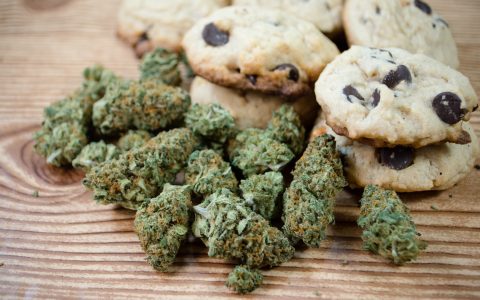
What to Do With Kief
pJxsMQjCTcOGoBKiBnHt_hash.jpg

A compressed hash brick. This hash has a dark color because it has been heavily pressurized.
Now that you know what kief is and how to collect it, what should you do with it? There are many ways to make good use of your stockpile of unrefined cannabis concentrate. Here are a few suggestions that can amplify potency and refine consistency.

Sprinkle It Onto Your Packed Bowl of Cannabis
Also known as “crowning a bowl,” this is the first and most obvious use for kief. Overall potency can increase dramatically with a generous dusting of kief on top of your bowl. Corner your hits to get the most out of a kief-crowned bowl, corner your hits, which entails burning a quadrant of the bowl at a time so that you can enjoy multiple hits.


RELATED STORY
How to Pack and Smoke a Bowl of Cannabis


Sprinkle Kief Into a Joint or Roll a Twax Joint
Freshly ground cannabis is just sticky enough to make rolling a joint fairly easy. Pepper your ground cannabis with a healthy pinch of kief and mix well. The extra trichomes should more or less stick to the ground leaves, adding potency to the interior of your joint.

For those of you who want a more advanced experience, dampen the outside of your joint with a lick or your preferred wax and then roll the top 1/3 of the joint in kief. This kief-coated joint is often call a “twaxed” joint.


RELATED STORY
How to Roll a Joint


Make Hash
Hash is one of the oldest forms of refined cannabis. One of the first steps of making hash is extracting kief, as hash is basically just kief that has been heated and pressurized to form a soft, green ball. Applying heat and pressure to kief changes its composition by rupturing the resin glands. Once the kief ruptured, the overall taste and effects of the product are slightly different. Pressurizing kief also darkens its color; the more pressure you apply, the darker the hash becomes.


Make Moonrocks
Moonrocks are top-quality nugs covered in oil and rolled in kief. These glorious glitter cannabis specimens are very high potency and can be considered a quick DIY concentrate. Moonrocks are relatively easy to make if you have the materials. Gently heat your oil of choice and liberally coat your buds. Sprinkle kief over still-warm buds, or dredge buds in a kief bath using tongs. Let harden, then enjoy them by breaking them up by hand and sprinkling them into your bowl (avoid using a grinder if possible, as a grinder will break them up too finely and defeat the purpose of creating your lovely moonrock).


Press Rosin
Rosin is a rising star in the world of cannabis concentrates for its solventless extraction methods and preservation of cannabinoids. This process is usually done with flower, but higher yields and potency can be achieved by pressing kief. The at-home method involves a hair straightener and a vice, while professional methods incorporate high-pressure presses.


Add Potency to Cannabutter
Cannabutter has so many great applications, and kief is an easy way to boost potency that doesn’t add any extra steps to the cannabutter creating process. Just remember, no matter if you decarboxylate your cannabis in the oven or in your crockpot, make sure your kief is intermixed with your flower for best results.


Try These Kief-Heavy Strains


A cross between a Brazilian sativa landrace and a resin-heavy South Indian indica, White Widow has blessed every Dutch coffee shop menu since its birth in the 1990s. Its buds are white with crystal resin, warning you of the potent effects to come. A powerful burst of euphoria and energy breaks through immediately, stimulating both conversation and creativity.


Hash Plant’s tight, resin-drenched flower clusters develop a brittle surface when dried and give off a deep, rich Afghani aroma that’s undercut with a hint of hashish. When consumed, her dominant flavor is the spicy-sharp bite of smouldering resin glands. The instant vaporization of those layers of sparkling trichomes accelerates Hash Plant’s rapid, blissful and breathtakingly powerful body-stone.


Between its mysterious origin, ambiguous genetics, and the plethora of successful crosses the strain has produced, Chemdawg has practically secured itself a permanent place in the cannabis hall of fame. The original source of powerhouse strains like Sour Diesel and OG Kush, Chemdawg is known for its distinct, diesel-like aroma. Pungent and sharp, you’ll be able to smell this hybrid from a mile away.

 
Back
Top