
You are using an out of date browser. It may not display this or other websites correctly.
You should upgrade or use an alternative browser.
You should upgrade or use an alternative browser.
Other than MSNBC, is there any mainstream coverage of the WI protests?
- Thread starter Upgrade Dave
- Start date


<font size="5"><center>
Why employee pensions
aren't bankrupting states</font size><font size="4">
From state legislatures to Congress to tea party rallies, a vocal backlash
is rising against what are perceived as too-generous retirement
benefits for state and local government workers. However,
that widespread perception doesn't match reality</font size></center>
McClatchy Newspapers
By Kevin G. Hall
Sunday, March 6, 2011
WASHINGTON — From state legislatures to Congress to tea party rallies, a vocal backlash is rising against what are perceived as too-generous retirement benefits for state and local government workers. However, that widespread perception doesn't match reality.
A close look at state and local pension plans across the nation, and a comparison of them to those in the private sector, reveals a more complicated story. However, the short answer is that <SPAN style="BACKGROUND-COLOR: #ffff00">there's simply no evidence that state pensions are the current burden to public finances that their critics claim</span>.
Pension contributions from state and local employers aren't blowing up budgets. They amount to just 2.9 percent of state spending, on average, according to the National Association of State Retirement Administrators. The Center for Retirement Research at Boston College puts the figure a bit higher at 3.8 percent.
Though there's no direct comparison, state and local pension contributions approximate the burden shouldered by private companies. The nonpartisan Employee Benefit Research Institute estimates that retirement funding for private employers amounts to about 3.5 percent of employee
compensation.
Nor are state and local government pension funds broke. They're underfunded, in large measure because — like the investments held in 401(k) plans by American private-sector employees — they sunk along with the entire stock market during the Great Recession of 2007-2009. And like 401(k) plans, the investments made by public-sector pension plans are increasingly on firmer footing as the rising tide on Wall Street lifts all boats.
Boston College researchers project that if the assets in state and local pension plans were frozen tomorrow and there was no more growth in investment returns, there'd still be enough money in most state plans to pay benefits for years to come.
"On average, with the assets on hand today, plans are able to pay annual benefits at their current level for another 13 years. This assumes, pessimistically, that plans make no future pension contributions and there is no growth in assets," said Jean-Pierre Aubry, a researcher specializing in state and local pensions for the nonpartisan Center for Retirement Research at Boston College.
In 2006, when the economy was humming before the financial crisis began, the value of assets in state and local pension funds covered promised benefits for a period of just over 19 years.
At the bottom of Aubry's list is Kentucky, which would have enough assets to cover 4.7 years. Other states do much better: North Carolina local government pensions are funded to cover 19 years of promised benefits; Florida's state plan could cover 17 years; and California's plans about 15 years.
"On the whole, the pension system isn't bankrupting every state in the country," Aubry said.
States having the biggest problems with pension obligations tend to be struggling with overall fiscal woes — New Jersey and Illinois in particular. Many states are now wrestling with underfunding because they didn't contribute enough during boom years.
Most state and local employees government across the nation have defined-benefit plans that promise employees either a percentage of their final salary during retirement or some fixed amount. The Bureau of Labor Statistics estimates that 91 percent of full-time state and local government workers have access to defined-benefit plans.
Several states_ including Florida, Georgia, Ohio, Colorado and Washington_ have adopted competing defined-contribution plans, or a hybrid plan that provides government employees both a partial defined benefit in retirement and a supplementary defined-contribution plan.
Defined-contribution 401(k) plans divert on a tax-deferred basis a portion of pay, generally partially matched by the employer, into an account that invests in stocks and bonds. In 1980, 84 percent of workers at medium and large companies in the U.S. had a defined-benefit plan like those still predominate in the public sector. By last year, just 30 percent of workers in these larger companies were covered under such plans.
Defenders of the public pension system say anti-government, anti-union elected officials and interest groups have exaggerated the problem to score political points, and that as the economy heals, public pension plans will gain value and prove critics wrong.
"There's a window that's closing as market conditions improve and interest rates rise, the funding of these plans is going to look better than depicted by some," insisted Keith Brainard, the director of research for the National Association of State Retirement Administrators in Georgetown, Texas.
Critics of public sector pensions paint the problem with a broad brush.
"Unionized government workers have tremendous leverage to negotiate their own wages and benefits. They funnel tens of millions of dollars to elect candidates who will sit across from them at the negotiating table," said Thomas Donohue, the chief executive of the U.S. Chamber of Commerce, in a Feb. 24 blog post. "This self-dealing has resulted in ever-increasing wage and benefit packages for unionized government workers that often far outstrip those for comparable private-sector workers."
In a Feb. 23 radio interview, Rep. Devin Nunes, R-Calif., called federal stimulus efforts to rescue the economy "essentially a federal bailout of public employee unions." Nunes described money owed to state pensioners as a crisis "about ready to happen."
Except that two out of every three public-sector workers aren't union members.
The Bureau of Labor Statistics reported in January that 31.1 percent of state public-sector workers were unionized in 2010, compared with 26.8 percent of federal government employees. The highest percentage of unionization, 43.3 percent, was found in local government, where police officers and firefighters work. Teachers can fall into either state systems or local government.
Ironically, in Wisconsin, where Republican Gov. Scott Walker is trying to weaken public-sector unions and reduce pension benefits, he's exempted police and firefighters, who are among the most unionized public employees. And Wisconsin's public-sector pension plan still has enough assets today to cover more than 18 years of benefits.
The most recent Public Fund Survey by the National Association of State Retirement Administrators showed that, on average, state and local pensions were 78.9 percent funded, with about $688 billion in unfunded promises to pensioners. Critics suggest that the real number is at least $1 trillion or higher, using less-optimistic market assumptions.
The unfunded liabilities would be a problem if all state and local retirees went into retirement at once, but they won't. Nor will state governments go out of business and hand underfunded pension plans over to a federal regulator, as happens in the private sector. State and local governments are ongoing enterprises.
The flow of employees into retirement matches up with population trends in states, with Northeastern states with declining populations, particularly Rhode Island, seeing more stress on their pension systems than Southern and Western states, where there's been vibrant population growth.
Another misperception tied to the pension debate is that while the private sector has shed jobs during the economic crisis, state and local government employment has grown — and pensions along with it.
Since September 2008_ when state and local government employees numbered 19,385,000 and the economic crisis turned severe — the governments' payrolls shrunk by 407,000, to 18,978,000 this January, according to Bureau of Labor Statistics data.
When calculating from December 2007_ the month that the National Bureau of Economic Research determined was the start of the Great Recession_ state and local government employment has fallen by 703,000 jobs amid a downturn that cost the nation more than 8 million jobs overall.
"The down economy has had an effect, and the loss of employment outside the public sector has created a contrast" said Brainard, of the National Association of State Retirement Administrators.
Also fueling backlash is the perception that state and local workers don't contribute to their own retirement funds the way private sector workers do.
Four states have non-contribution public pension plans_ Florida, Utah, Oregon and Connecticut. Missouri until recently had a non-contribution policy for state workers, as did Michigan until 1997. Michigan workers hired before 1997 still don't pay toward their pensions, and some teachers in Arkansas don't have to contribute toward theirs. Tennessee doesn't require contributions from most workers and employees in the state higher education system.
Those notable exceptions aside, most states require employee contributions. The midpoint for these contributions for all states and the District of Columbia is 5 percent of pay, according to academic and state-level research. That contribution rate climbs to 8 percent for the handful of states whose workers or teachers are prohibited from paying into the federal Social Security program.
By comparison, private-sector workers shoulder a bit more of the burden.
In its data for 2010, Fidelity Investments, the largest administrator of private-sector 401(k) retirement plans, showed employee contribution rates in its plans averaged 8.2 percent of pre-tax pay.
Separately, the Employee Benefits Research Institution estimates that most private-sector employers match up to 50 percent of employee contributions up to the first 6 percent of salary.
The utility or burden of either type of retirement plan depends on whether the plan is measured by what it delivers to an individual, or by how much it delivers to all workers receiving retirement benefits from their employer.
"It really comes down to what you are attempting to do," said Dallas Salisbury, the president of the nonpartisan Employee Benefit Research Institute.
Viewed through the lens of an employee, defined-benefit plans are more cost-effective at providing a pre-determined level of benefits to an employee. But the shortcoming of these plans is that they reward seniority. For workers with a shorter tenure, they're far less generous in retirement.
This fairness issue is one reason why 401(k) plans have grown steadily in prominence since the mid-1980s. From the payroll perspective of an employer, these defined-contribution plans produce at least some retirement income for the greatest number of employees, and the plans can move with employees who change jobs.
http://www.mcclatchydc.com/2011/03/06/109649/why-employee-pensions-arent-bankrupting.html

In other words
Stop letting pro-corporate forces tell you what to think and do your own research.
Instead of blaming teachers and police officers, actually show some ire at the people who caused this whole thing: Wall Street and DC shysters who created and abetted the housing fraud.

<font size="6">
Recall</font size>
<font size="4">Both Sides Begin Efforts for Recalls in Wisconsin</font size>
New York Times, March 5, 2011
The New American, March 7, 2011
Politico, March 2, 22011
The Wisconsin Democratic Party has decided to throw its weight behind a nascent grassroots drive to recall a number of GOP state senators, a move that will considerably increase the pressure on them to break with Governor Scott Walker, the Dem party chair confirms to me.
"The proposals and the policies that Republicans are pushing right now are not what they campaigned on, and they're extreme," the party chair, Mike Tate, said in an interview. "Something needs to be done about it now. We're happy to stand with citizens who are filling papers to recall these senators."
Previously, Wisconsin Dems had not publicly supported talk about recalling GOP Senators, in hopes of privately reaching a negotiated solution to the crisis. The Wisconsin Democratic Party's decision to support the recall drives represents a significant ratcheting up of hostilities and in essence signals that all bets are off.
Recall</font size>
<font size="4">Both Sides Begin Efforts for Recalls in Wisconsin</font size>
New York Times, March 5, 2011
CHICAGO — The fight over collective bargaining rights for public sector workers in Wisconsin remained at an impasse this weekend, even as its political fallout — in recall efforts of state legislators and dueling television commercials — grew larger.
Fourteen Senate Democrats, who left the state on Feb. 17 to prevent a vote on Gov. Scott Walker’s plan to curtail bargaining and benefits for public workers, were said to have taken part in recent days in discussions with Republicans, but no progress was announced Saturday.
Even as they remained in Illinois (in order to avoid being returned by Wisconsin law enforcement officials to the Capitol), some of the Senate Democrats, who make up a minority in Madison, found themselves the focus of recall efforts, as did some Senate Republicans by forces opposed to Mr. Walker’s bill.
All told, more than a dozen senators were being singled out, chosen in part because of Wisconsin’s rules for recalls, which require selected lawmakers to have been in office for at least a year and call for thousands of voters’ signatures to be gathered in a matter of 60 days — a process that was under way with canvassing all weekend.
If enough signatures are gathered, a senator must run for election sooner than the end of his or her term.
Fourteen Senate Democrats, who left the state on Feb. 17 to prevent a vote on Gov. Scott Walker’s plan to curtail bargaining and benefits for public workers, were said to have taken part in recent days in discussions with Republicans, but no progress was announced Saturday.
Even as they remained in Illinois (in order to avoid being returned by Wisconsin law enforcement officials to the Capitol), some of the Senate Democrats, who make up a minority in Madison, found themselves the focus of recall efforts, as did some Senate Republicans by forces opposed to Mr. Walker’s bill.
All told, more than a dozen senators were being singled out, chosen in part because of Wisconsin’s rules for recalls, which require selected lawmakers to have been in office for at least a year and call for thousands of voters’ signatures to be gathered in a matter of 60 days — a process that was under way with canvassing all weekend.
If enough signatures are gathered, a senator must run for election sooner than the end of his or her term.
The New American, March 7, 2011
Some out-of-state groups have been involved in the recall campaigns against state Senators from both parties. The Utah-based American Recall Coalition, for example, has started the process to help unseat a number of Democratic lawmakers in Wisconsin.
The Republican State Leadership Committee also vowed to spend "whatever it takes to protect our incumbents," The Hill quoted the group’s president as saying. Meanwhile, the Democratic Legislative Campaign Committee said it would support the targeted Democrats.
Prominent labor unions such as the Service Employees International Union (SEIU) are already assembling their troops to canvass the state against Republicans, too. The labor group said in a statement seeking petition signatures that its coalition wanted to recall the eight eligible GOP lawmakers who were supposedly “leading the charge to take away the rights and voices of working families in Wisconsin” — despite the fact that no rights or voices of working families were actually being threatened. The group has also been bussing in protesters from other states for weeks.
The leftist group People for the American Way is another one of the national organizations working to recall Republicans backing the reforms — especially the most vulnerable ones. In an e-mail to supporters, the organization suggested signing a petition in favor of recalling eligible Republican state Senators, sharing the petition with friends, and more. It also urged those who live “in or near” Wisconsin to volunteer to gather signatures. For people farther away, the e-mail suggested contacting anyone they may know in the state and encouraging them to support the effort.
The Republican State Leadership Committee also vowed to spend "whatever it takes to protect our incumbents," The Hill quoted the group’s president as saying. Meanwhile, the Democratic Legislative Campaign Committee said it would support the targeted Democrats.
Prominent labor unions such as the Service Employees International Union (SEIU) are already assembling their troops to canvass the state against Republicans, too. The labor group said in a statement seeking petition signatures that its coalition wanted to recall the eight eligible GOP lawmakers who were supposedly “leading the charge to take away the rights and voices of working families in Wisconsin” — despite the fact that no rights or voices of working families were actually being threatened. The group has also been bussing in protesters from other states for weeks.
The leftist group People for the American Way is another one of the national organizations working to recall Republicans backing the reforms — especially the most vulnerable ones. In an e-mail to supporters, the organization suggested signing a petition in favor of recalling eligible Republican state Senators, sharing the petition with friends, and more. It also urged those who live “in or near” Wisconsin to volunteer to gather signatures. For people farther away, the e-mail suggested contacting anyone they may know in the state and encouraging them to support the effort.
Politico, March 2, 22011
The Wisconsin Democratic Party has decided to throw its weight behind a nascent grassroots drive to recall a number of GOP state senators, a move that will considerably increase the pressure on them to break with Governor Scott Walker, the Dem party chair confirms to me.
"The proposals and the policies that Republicans are pushing right now are not what they campaigned on, and they're extreme," the party chair, Mike Tate, said in an interview. "Something needs to be done about it now. We're happy to stand with citizens who are filling papers to recall these senators."
Previously, Wisconsin Dems had not publicly supported talk about recalling GOP Senators, in hopes of privately reaching a negotiated solution to the crisis. The Wisconsin Democratic Party's decision to support the recall drives represents a significant ratcheting up of hostilities and in essence signals that all bets are off.
FINALLY, Democrats willing to fight as hard as Republicans.
What happened in Wisconsin tonight
Washington Post
By Ezra Klein
March 9, 2011
Here's what just happened in Wisconsin: the rules of the state's Senate require a quorum for any measures that spend money. That's how the absence of the Senate's Democrats could stymie Gov. Scott Walker's proposed budget law -- it spent money, and thus it needed a quorum.
But in a surprise move earlier today, Wisconsin's Senate Republicans rewrote the bill and left out all the parts that spent money. Then they quickly convened and passed the new law, which included the provisions stripping most public-employee unions of their collective bargaining rights but excluding everything in the law that spent money.
What happens next? Expect the protests over the next few days to be ferocious. But unless a judge rules the move illegal -- and I don't know how to judge the likelihood of that -- Walker's proposed law will go forward. The question is whether Walker and the Republicans who voted for it will do the same.
Polls in Wisconsin clearly showed that Republicans had failed to persuade the public of their cause. Walker's numbers dropped, while Democrats and unions found themselves suddenly flush with volunteers, money, and favorable media coverage. And they plan to take advantage of it:
- Eight Wisconsin Republicans have served for long enough to be vulnerable to a recall election next year, and
- Democrats have already begun gathering signatures. Now their efforts will accelerate. "We now put our total focus on recalling the eligible Republican senators who voted for this heinous bill," said Mike Tate, chairman of the Wisconsin Democratic Party. "And we also begin counting the days remaining before Scott Walker is himself eligible for recall."
http://voices.washingtonpost.com/ezra-klein/2011/03/what_happened_in_wisconsin_ton.html

Mar 9, 8:20 PM EST
Wis. GOP strips public workers' bargaining rights
By SCOTT BAUER
Associated Press
MADISON, Wis. (AP) -- Republicans in the Wisconsin Senate voted Wednesday night to strip nearly all collective bargaining rights from public workers after discovering a way to bypass the chamber's missing Democrats.
All 14 Senate Democrats fled to Illinois nearly three weeks ago, preventing the chamber from having enough members present to consider Gov. Scott Walker's so-called "budget repair bill" - a proposal introduced to plug a $137 million budget shortfall.
The Senate requires a quorum to take up any measures that spend money. But Republicans on Wednesday split from the legislation the proposal to curtail union rights, which spends no money, and a special conference committee of state lawmakers approved the bill a short time later.
The lone Democrat present on the conference committee, Rep. Peter Barca, shouted that the surprise meeting was a violation of the state's open meetings law but Republicans voted over his objections. The Senate convened within minutes and passed the measure without discussion or debate.
Before the sudden votes, Democratic Sen. Bob Jauch said if Republicans "chose to ram this bill through in this fashion, it will be to their political peril. They're changing the rules. They will inflame a very frustrated public."
Walker said after the votes that Senate Democrats had plenty of opportunities to come home.
"I applaud the Legislature's action today to stand up to the status quo and take a step in the right direction to balance the budget and reform government," the governor said in a statement.
Walker's proposal has touched off a national debate over union rights and prompted tens of thousands of demonstrators to converge on Wisconsin's capital for weeks of protests. Spectators in the gallery Wednesday night screamed "You are cowards" as the Senate voted.
"In 30 minutes, 18 state Senators undid 50 years of civil rights in Wisconsin. Their disrespect for the people of Wisconsin and their rights is an outrage that will never be forgotten," said Democratic Senate Minority Leader Mark Miller. "Tonight, 18 Senate Republicans conspired to take government away from the people. Tomorrow we will join the people of Wisconsin in taking back their government."
The drama unfolded less than four hours after Walker met with GOP senators in a closed-door meeting. He emerged from the meeting saying senators were "firm" in their support of the bill.
Democrats had been calling all day Wednesday for Walker and Republicans to compromise.
Senate Majority Leader Scott Fitzgerald said earlier that Republicans had been discussing concessions Walker's office had offered, including allowing public workers to bargain over their salaries without a wage limit. Several GOP senators facing recall efforts had publicly called for compromise.
Union leaders weren't happy with the concessions, and Democrats had not signed off on them.
While talks had been going on sporadically behind the scenes, Republicans in the Senate also had publicly tried to ratchet the pressure on Democrats to return. They had agreed earlier Wednesday to start fining Democrats $100 for each day legislative session day they miss.
Walker's stalled bill was introduced to help plug a $137 million budget shortfall projected by the end of June. He has said that without the collective bargaining bill, he may have to lay off 1,500 state workers and make other cuts to balance the budget.
On Wednesday, the nonpartisan Legislative Fiscal Bureau offered a way to salvage $165 million in debt by refinancing savings. It had said the bill could pass as late as early April if other accounting moves were done by Walker's administration to extend the debt refinancing deadline by a month.
Mar 9, 8:20 PM EST
Wis. GOP strips public workers' bargaining rights
By SCOTT BAUER
Associated Press
MADISON, Wis. (AP) -- Republicans in the Wisconsin Senate voted Wednesday night to strip nearly all collective bargaining rights from public workers after discovering a way to bypass the chamber's missing Democrats.
All 14 Senate Democrats fled to Illinois nearly three weeks ago, preventing the chamber from having enough members present to consider Gov. Scott Walker's so-called "budget repair bill" - a proposal introduced to plug a $137 million budget shortfall.
The Senate requires a quorum to take up any measures that spend money. But Republicans on Wednesday split from the legislation the proposal to curtail union rights, which spends no money, and a special conference committee of state lawmakers approved the bill a short time later.
The lone Democrat present on the conference committee, Rep. Peter Barca, shouted that the surprise meeting was a violation of the state's open meetings law but Republicans voted over his objections. The Senate convened within minutes and passed the measure without discussion or debate.
Before the sudden votes, Democratic Sen. Bob Jauch said if Republicans "chose to ram this bill through in this fashion, it will be to their political peril. They're changing the rules. They will inflame a very frustrated public."
Walker said after the votes that Senate Democrats had plenty of opportunities to come home.
"I applaud the Legislature's action today to stand up to the status quo and take a step in the right direction to balance the budget and reform government," the governor said in a statement.
Walker's proposal has touched off a national debate over union rights and prompted tens of thousands of demonstrators to converge on Wisconsin's capital for weeks of protests. Spectators in the gallery Wednesday night screamed "You are cowards" as the Senate voted.
"In 30 minutes, 18 state Senators undid 50 years of civil rights in Wisconsin. Their disrespect for the people of Wisconsin and their rights is an outrage that will never be forgotten," said Democratic Senate Minority Leader Mark Miller. "Tonight, 18 Senate Republicans conspired to take government away from the people. Tomorrow we will join the people of Wisconsin in taking back their government."
The drama unfolded less than four hours after Walker met with GOP senators in a closed-door meeting. He emerged from the meeting saying senators were "firm" in their support of the bill.
Democrats had been calling all day Wednesday for Walker and Republicans to compromise.
Senate Majority Leader Scott Fitzgerald said earlier that Republicans had been discussing concessions Walker's office had offered, including allowing public workers to bargain over their salaries without a wage limit. Several GOP senators facing recall efforts had publicly called for compromise.
Union leaders weren't happy with the concessions, and Democrats had not signed off on them.
While talks had been going on sporadically behind the scenes, Republicans in the Senate also had publicly tried to ratchet the pressure on Democrats to return. They had agreed earlier Wednesday to start fining Democrats $100 for each day legislative session day they miss.
Walker's stalled bill was introduced to help plug a $137 million budget shortfall projected by the end of June. He has said that without the collective bargaining bill, he may have to lay off 1,500 state workers and make other cuts to balance the budget.
On Wednesday, the nonpartisan Legislative Fiscal Bureau offered a way to salvage $165 million in debt by refinancing savings. It had said the bill could pass as late as early April if other accounting moves were done by Walker's administration to extend the debt refinancing deadline by a month.
In what way is this a good thing?

In what way is this a good thing?
Absolutely the right question.
It is NOT a good thing.
Since the 1980’s most US citizens have become non-critical thinkers. Not only do they not know the short-lived 237 year history of the country they live in, the United States of America, they don’t care!
“Don’t worry be happy” a Grammy winning song by musician Bobby McFerrin released in the 1980’s is the perfect metaphor for the rapid intellectual laziness that has afflicted US citizens in dramatically increasing numbers since the 1980’s. In 1996 <s>FOX</s> FAKE News channel was launched, financed by Rupert Murdoch and led by Roger Ailes, political consultant for Nixon, Reagan, & Papa Bush, providing 24/7 bold-face lies, and becoming the official dissembler for the RepubliKlan party.
By the 1990’s in the Black community when the Spike Lee movie Malcolm X was released, Black teenagers looked at the movie posters and asked “Who was Malcolm Ten” ; they had no idea who El-Hajj Malik El-Shabazz was.
The history of Labor Unions (collective bargaining) in US history has also been lost. Non-critical thinking US citizens never stop to think where the 5 day work week came from, or the minimum wage, or child labor laws, or overtime pay, or paid vacations, or employer-based healthcare, and much more.
Non-critical thinking US citizens who have willfully decided not to learn the brief 237 year history of the US have forgotten that prior to unions some employers DID NOT EVEN PAY THEIR WORKERS MONEY (US currency)
What mining companies used to do before unions was to “pay” their workers in something called “scrip” . The “scrip” could only be used in the company owned store to buy food, clothing etc. In other words workers were neo-slaves. If workers demanded collective bargaining (a union) , the company would bring in armed guards, Pinkertons and others to kill any worker who dared demand collective bargaining (a union).
Fast forward to today. Unions built the middle class in America. Did you have a package delivered today by United Parcel Service (UPS)? If you did the people who work at competitor Federal Express thank you; because UPS is a union shop with excellent benefits, ESOP (employee stock ownership plan) etc. and existed prior to Federal Express. When Federal Express started (it is non-union) they had to pay wages and benefits equivalent to UPS in order to attract workers. The UPS union wages set the floor for FedEx pay.
The RepubliKlan party represents the Über Capitalist class.
They don’t give a shit about the declining US middle class. Lower wages for the peons, equals - higher stock prices, equals – more Ho’s, more private jets, more houses, more $$$$$$$$$$$$$$$$$$$$$$$$$$$$$$$$$$$$$$$$$$$$$$$,
MORE POWER.
RepubliKlans in 2010 blocked an anti-outsourcing bill.
US Senate Republicans blocked a bill from coming to the US Senate floor that would of outlawed tax breaks for firms that outsource jobs overseas. The bill would of given new tax incentives to businesses to bring jobs back to the US.
The RepubliKlans said fuck the American worker, let’s send more jobs to China where $310. a month is considered middle class. That’s right Three Hundred Ten Dollars per month!!!!!!
Look at the charts and play the videos below.
It will explain to you if you are ignorant why the Über Capitalist are opposed to collective bargaining (Unions).
In one a <s>FOX</s> FAKE News commentator explains to their brain addled viewers what collective bargining represents, proving that even a broken clock is right at least twice every 24 hours.
<iframe src="http://videos.mediaite.com/embed/player/?layout=&playlist_cid=&media_type=video&content=S23QBR28NHQHCHBS&read_more=1&widget_type_cid=svp" width="420" height="421" frameborder="0" marginheight="0" marginwidth="0" scrolling="no" allowtransparency="true"></iframe>


As union membership declines, WAGES DECLINE FOR THE MAJORITY OF ALL WORKERS, corporate profits increase and corporate taxes decrease as jobs and profits are outsourced overseas.
The largest employer in the state of Texas is??????? Can’t figure it out????? The answer is??? WALMART. Yes WALMART. Non-Union poverty wages WALMART.
That is the business model that the Über Capitalist have in mind for the entire United States. How dare a teacher with a Masters Degree earn $51,000 a year and have health care and a pension after 25 years of service. $36,000 with no benefits and a 401k should be enough for a teacher, after all teachers are just part-time workers.
Will the majority of non-critical thinking Americans wake-up as they are being boiled alive and having their lifestyle dramatically downsized by the Über Capitalist?? I’m not optimistic. The digital brownshirts are winning.
<div style="background-color:#000000;width:520px;"><div style="padding:4px;"><embed src="http://media.mtvnservices.com/mgid:cms:item:comedycentral.com:375911" width="512" height="288" type="application/x-shockwave-flash" allowFullScreen="true" allowScriptAccess="always" base="." flashVars=""></embed><p style="text-align:left;background-color:#FFFFFF;padding:4px;margin-top:4px;margin-bottom:0px;font-family:Arial, Helvetica, sans-serif;font-size:12px;"><b><a href="http://www.colbertnation.com/the-colbert-report-videos/375911/march-01-2011/the-word---new-country-for-old-men">The Colbert Report</a></b><br/>Tags: <a href='http://www.colbertnation.com/full-episodes/'>Colbert Report Full Episodes</a>,<a href='http://www.indecisionforever.com/'>Political Humor & Satire Blog</a>,<a href='http://www.colbertnation.com/video'>Video Archive</a></p></div></div>

Most New Jobs (86%) Created Last 12 Months Pay Less Than $13.00 A Hour, No Benefits
http://www.mainstreet.com/article/career/survey-most-new-jobs-pay-low-wages
http://chicagobreakingbusiness.com/2011/01/low-wage-job-growth-seen-as-hurdle-to-recovery.html
<hr noshade color="#0000FF" size="8"></hr>
<div id="kadoo_video_container_14427871-ab6"><object height="340" width="560" id="video_detector_14427871-ab6"><param value="http://divshare.com/flash/video_flash_detector.php?data=YTo2OntzOjU6ImFwaUlkIjtzOjE6IjQiO3M6NjoiZmlsZUlkIjtpOjE0NDI3ODcxO3M6NDoiY29kZSI7czoxMjoiMTQ0Mjc4NzEtYWI2IjtzOjY6InVzZXJJZCI7czo3OiIxMzE0NjMzIjtzOjQ6InRpbWUiO2k6MTMwMTMwMDk4MTtzOjEyOiJleHRlcm5hbENhbGwiO2k6MTt9&autoplay=default&id=14427871-ab6" name="movie"></param><param name="allowFullScreen" value="true"></param><param name="allowscriptaccess" value="always"></param><param name="wmode" value="opaque"></param><embed wmode="opaque" height="340" width="560" type="application/x-shockwave-flash" allowscriptaccess="always" allowfullscreen="true" src="http://divshare.com/flash/video_flash_detector.php?data=YTo2OntzOjU6ImFwaUlkIjtzOjE6IjQiO3M6NjoiZmlsZUlkIjtpOjE0NDI3ODcxO3M6NDoiY29kZSI7czoxMjoiMTQ0Mjc4NzEtYWI2IjtzOjY6InVzZXJJZCI7czo3OiIxMzE0NjMzIjtzOjQ6InRpbWUiO2k6MTMwMTMwMDk4MTtzOjEyOiJleHRlcm5hbENhbGwiO2k6MTt9&autoplay=default&autoplay=default&id=14427871-ab6"></embed></object></div>
Last edited:
Mar 9, 8:20 PM EST
Wis. GOP strips public workers' bargaining rights
Yep, its crystal clear now: this was always a political matter; and never a budgetary one.
QueEx

Yep, its crystal clear now: this was always a political matter; and never a budgetary one.
QueEx
Sometimes I feel like Mr. Douglas and this board is Hooterville!
The damn governor is telling you we don't have the money and the promises made by others are not sustainable. The only way you guys understand is when the people who were promised these goodies take to the streets. WTF I mean, stop relying on others for your future.
Gunner, you know this is not about school teachers, it' about breaking the unions. Karl Rove, when asked if he had mapped out the campaign (for GW Bush), he said, 'Don't expect me to answer this question' -- he is too ambitious to want only that. The real prize is creating a Republican majority that would be as solid as, say, the Democratic coalition that Franklin Roosevelt created -- a majority that would last for a generation and that, as it played itself out over time, would wind up profoundly changing the relationship between citizen and state in this country." (The New Yorker, May 12, 2003)"
The public unions in Wisconsin have made concessions and are will to make more, but they will not allow corporatist politicians to further transfer income from the middle class to the wealthy.
Yep, its crystal clear now: this was always a political matter; and never a budgetary one.
QueEx
As we assumed from the beginning.
I'm questioning the
by Gunner. How is this a good thing? How is this a thing to celebrate and will you still be when Wisconsin voters, who have turned strongly against Walker and the Republicans, start removing them from office, either through recall or through regular elections? Short term victory is meaningless if it facilitates longer term catastrophic defeat.
Yep, its crystal clear now: this was always a political matter; and never a budgetary one.
QueEx
Brilliant deduction.
I see why they pay you the big bucks.
What else could it possibly be when one political party fights another?
Brilliant deduction.
I see why they pay you the big bucks.
What else could it possibly be when one political party fights another?
Gee, why didn't you just say so sooner, when you were pretending it was about
money/budgets . . .
With extensive experience with schools in my city, it is easy to see that whites use the inner city schools as a steady paycheck. They do not give a flying crap about the education black children get, which is why the schools are so terrible.
Yet, <SPAN style="BACKGROUND-COLOR: #ffff00">they want high salaries, extensive pensions, full health care, and more</span> WITHOUT ANY ACCOUNTABILITY!
<SPAN style="BACKGROUND-COLOR: #ffff00">Teachers and police are wildly overcompensated</span> because of their unions. <SPAN style="BACKGROUND-COLOR: #ffff00">Local and state budgets are collapsing because of it, and yet they refuse to be reasonable</span>.
This is just going to get worse.

Gee, why didn't you just say so sooner, when you were pretending it was about
money/budgets . . .
I forgot he said that nonsense.
The "wildly overcompensated" teachers and police. Damn. I guess that's why so many people flock to those jobs.
I forgot he said that nonsense.
The "wildly overcompensated" teachers and police. Damn. I guess that's why so many people flock to those jobs.
This year's list broke records in size (1,210 billionaires) and total net worth ($4.5 trillion). China doubled its number of 10-figure fortunes, and Moscow now has more billionaires than any other city. Mexico's Carlos Slim widened his lead at No. 1.
source: The World's Billionaires
Trickle down, where are the jobs?
Last edited:
<iframe title="YouTube video player" width="640" height="390" src="http://www.youtube.com/embed/eLJdijPEBJE" frameborder="0" allowfullscreen></iframe>
<iframe title="YouTube video player" width="640" height="390" src="http://www.youtube.com/embed/eLJdijPEBJE" frameborder="0" allowfullscreen></iframe>
Gee, why didn't you just say so sooner, when you were pretending it was about
money/budgets . . .
A government budget is just a part of politics.
When one group forcibly decides how another group's resources is used, it is politics.
The public sector unions force you to pay their salaries and pensions through taxes.
If that is not politics, what is?
In what way is this a good thing?
Public unions use YOUR money to fund political parties. BOTH. You have to pay for their demands. If you're working at a job that has no insurance or if you're paying out your ass for yours, is it fair that you fully fund theirs???? The same as with retirement. Why should you fund a full retirement for someone else.
In the private sector owners can't give out such goodies to unions or it could be the end of the company. For example Detroit!!!!!
In the public sector who cares its other peoples money!!! When the shit hits the fan like in Wisconsin the politician moves on to the next job. Politicians are Negotiating with your money. Without your say. Are they smarter than you? Do they know the needs of your family better than you???

Last edited:
As we assumed from the beginning.
I'm questioning the
Read my reply to the previous response.
The people elected Walker to clean it up. Wisconsin is known as a democratic state. Dave you can only tax the rich so much until that burden has to roll over to the middle class. Dude why do you support entitlements so much??? Granted, I want to help people but not to the point of forever looking at them as a permanent underclass.
If that is the case, given the financial problems of California why would they continue to elect the same people? Why because as a whole many in California is hooked on getting something for nothing?
Research the history of Labor Unions. Where were these fucking unions when our forefathers couldn't get a damn job or protection because of the pigment of their skin Dave?
Why Did FDR's New Deal Harm Blacks?
by Jim Powell
Good intentions are over-rated. Franklin Delano Roosevelt's New Deal, for instance, has been hailed for its lofty goals of reforming the American economy and helping the under-privileged. Yet mounting evidence, developed by dozens of economists across the country, shows that the New Deal prolonged joblessness for millions, and black people were especially hard hit.
The flagship of the New Deal was the National Industrial Recovery Act, passed in June 1933. It authorized the president to issue executive orders establishing some 700 industrial cartels, which restricted output and forced wages and prices above market levels. The minimum wage regulations made it illegal for employers to hire people who weren't worth the minimum because they lacked skills. As a result, some 500,000 blacks, particularly in the South, were estimated to have lost their jobs.
Marginal workers, like unskilled blacks, desperately needed an expanding economy to create more jobs. Yet New Deal policies made it harder for employers to hire people. FDR tripled federal taxes between 1933 and 1940. Social Security excise taxes on payrolls discouraged employers from hiring. New Deal securities laws made it harder for employers to raise capital. New Deal antitrust lawsuits harassed some 150 employers and whole industries. Whatever the merits of such policies might have been, it was bizarre to disrupt private sector employment when the median unemployment rate was 17 percent.
Jim Powell, a senior fellow at the Cato Institute, is author of FDR's Folly, How Roosevelt and His New Deal Prolonged the Great Depression (Crown Forum, 2003).
More by Jim Powell
The Agricultural Adjustment Act (1933) aimed to help farmers by cutting farm production and forcing up food prices. Less production meant less work for thousands of poor black sharecroppers. In addition, blacks were among the 100 million consumers forced to pay higher food prices because of the AAA.
The Wagner Act (1935) harmed blacks by making labor union monopolies legal. Economists Thomas E. Hall and J. David Ferguson explained: "By encouraging unionization, the Wagner Act raised the number of insiders (those with jobs) who had the incentive and ability to exclude outsiders (those without jobs). Once high wages have been negotiated, employers are less likely to hire outsiders, and thus the insiders could protect their own interest."
By giving labor unions the monopoly power to exclusively represent employees in a workplace, the Wagner Act had the effect of excluding blacks, since the dominant unions discriminated against blacks. The Wagner Act had originally been drafted with a provision prohibiting racial discrimination. But the American Federation of Labor successfully lobbied against it, and it was dropped. AFL unions used their new power, granted by the Wagner Act, to exclude blacks on a large scale. Booker T. Washington, W.E.B. DuBois, and Marcus Garvey were all critical of compulsory unionism.
The Tennessee Valley Authority -- FDR's government-power-generating monopoly funded by the 98 percent of American taxpayers who didn't live in the Tennessee Valley -- was touted as a bold social experiment. But, among other things, the TVA flooded an estimated 730,000 acres of land behind its dams, and 15,654 people were forced out of their homes. Farm owners received cash settlements for their condemned property. But tenant farmers -- a substantial number of whom were black -- got nothing. After chronicling victims of the TVA "population removal program," historians Michael J. McDonald and John Muldowny reported: "TVA's social experiment was a failure."
What about New Deal spending programs? They were channeled away from the poorest people, including millions of blacks, who lived in the South. These people were already on FDR's side, so, from a political standpoint, there wasn't anything for FDR, as an incumbent, to gain by giving them money. The bulk of New Deal spending went to western states and eastern states where previous election returns had been relatively close, because FDR was focused on winning the next election. Moreover, getting congressional funding required giving states the power to administer programs like the Works Progress Administration (WPA). Indiana Democratic county chairman V.G. Coplen told FDR's 1932 and 1936 campaign manager James Farley, "use these Democratic projects to make votes for the Democratic party."
If FDR's New Deal policies weren't conceived with racist intent, they certainly had racist consequences. Hopefully in the future, more people will try to better understand the often startling, unexpected consequences of government interference with the economy.
How can any person of color support these bastards???

A government budget is just a part of politics.
When one group forcibly decides how another group's resources is used, it is politics.
The public sector unions force you to pay their salaries and pensions through taxes.
If that is not politics, what is?
It's all part of living in a sociality with high living standards. Of course you can move to Mexico of Somalia and pay nothing.
http://www.nytimes.com/
F.D.R. Warned Us
Updated February 19, 2011, 09:38 PM
James Sherk is the Bradley fellow in labor policy at the Center for Data Analysis at the Heritage Foundation.
“It is impossible to bargain collectively with the government.”
That wasn’t Newt Gingrich, or Ron Paul, or Ronald Reagan talking. That was George Meany -- the former president of the A.F.L.-C.I.O -- in 1955. Government unions are unremarkable today, but the labor movement once thought the idea absurd.
Public sector unions insist on laws that serve their interests -- at the expense of the common good.
The founders of the labor movement viewed unions as a vehicle to get workers more of the profits they help create. Government workers, however, don’t generate profits. They merely negotiate for more tax money. When government unions strike, they strike against taxpayers. F.D.R. considered this “unthinkable and intolerable.”
Government collective bargaining means voters do not have the final say on public policy. Instead their elected representatives must negotiate spending and policy decisions with unions. That is not exactly democratic – a fact that unions once recognized.
George Meany was not alone. Up through the 1950s, unions widely agreed that collective bargaining had no place in government. But starting with Wisconsin in 1959, states began to allow collective bargaining in government. The influx of dues and members quickly changed the union movement’s tune, and collective bargaining in government is now widespread. As a result unions can now insist on laws that serve their interests – at the expense of the common good.
Union contracts make it next to impossible to reward excellent teachers or fire failing ones. Union contracts give government employees gold-plated benefits – at the cost of higher taxes and less spending on other priorities. The alternative to Walker's budget was kicking 200,000 children off Medicaid.
Governor Walker’s plan reasserts voter control over government policy. Voters’ elected representatives should decide how the government spends their taxes. More states should heed the A.F.L.-C.I.O. Executive Council’s 1959 advice: “In terms of accepted collective bargaining procedures, government workers have no right beyond the authority to petition Congress — a right available to every citizen.”
This is why Reagan fired the air traffic controllers. A government can't hold the people hostage Dave. This is America not China.
I want to have a say where my tax dollars go. All he is asking those selfish people to do is bear some of the burden that everyone else is feeling. How is this wrong?
The alternative was kicking 200,000 children off medicaid!!!!!!
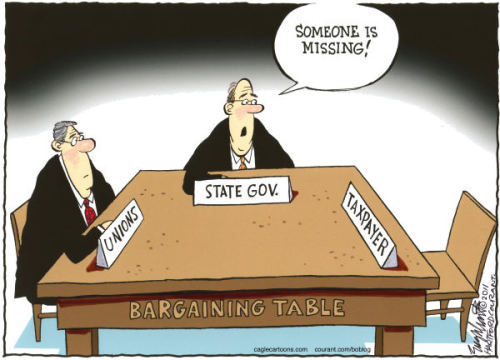
F.D.R. Warned Us
Updated February 19, 2011, 09:38 PM
James Sherk is the Bradley fellow in labor policy at the Center for Data Analysis at the Heritage Foundation.
“It is impossible to bargain collectively with the government.”
That wasn’t Newt Gingrich, or Ron Paul, or Ronald Reagan talking. That was George Meany -- the former president of the A.F.L.-C.I.O -- in 1955. Government unions are unremarkable today, but the labor movement once thought the idea absurd.
Public sector unions insist on laws that serve their interests -- at the expense of the common good.
The founders of the labor movement viewed unions as a vehicle to get workers more of the profits they help create. Government workers, however, don’t generate profits. They merely negotiate for more tax money. When government unions strike, they strike against taxpayers. F.D.R. considered this “unthinkable and intolerable.”
Government collective bargaining means voters do not have the final say on public policy. Instead their elected representatives must negotiate spending and policy decisions with unions. That is not exactly democratic – a fact that unions once recognized.
George Meany was not alone. Up through the 1950s, unions widely agreed that collective bargaining had no place in government. But starting with Wisconsin in 1959, states began to allow collective bargaining in government. The influx of dues and members quickly changed the union movement’s tune, and collective bargaining in government is now widespread. As a result unions can now insist on laws that serve their interests – at the expense of the common good.
Union contracts make it next to impossible to reward excellent teachers or fire failing ones. Union contracts give government employees gold-plated benefits – at the cost of higher taxes and less spending on other priorities. The alternative to Walker's budget was kicking 200,000 children off Medicaid.
Governor Walker’s plan reasserts voter control over government policy. Voters’ elected representatives should decide how the government spends their taxes. More states should heed the A.F.L.-C.I.O. Executive Council’s 1959 advice: “In terms of accepted collective bargaining procedures, government workers have no right beyond the authority to petition Congress — a right available to every citizen.”
This is why Reagan fired the air traffic controllers. A government can't hold the people hostage Dave. This is America not China.
I want to have a say where my tax dollars go. All he is asking those selfish people to do is bear some of the burden that everyone else is feeling. How is this wrong?
The alternative was kicking 200,000 children off medicaid!!!!!!
Last edited:
It's all part of living in a sociality with high living standards. Of course you can move to Mexico of Somalia and pay nothing.
If that's the case why don't use that same argument against every pro entitlement legislation you champion. Coming from you that means you're moving to the center!!!

Here you go Dave!!!
<iframe title="YouTube video player" width="640" height="390" src="http://www.youtube.com/embed/su4PwZCWUdg" frameborder="0" allowfullscreen></iframe>
How unions operate.
.
Collective Bargaining in Action: $10K a Year for Not Working, $6K to Carry a Pager, Two Pensions…
And it gets worse…
Madison — Today Governor Walker’s office released more specific examples and new details to show how collective bargaining fiscally impacts government and how reforming collective bargaining can improve government.
A Year’s Worth of Pay for 30 Days of Work
Under the Green Bay School District’s collectively bargained Emeritus Program, teaches can retire and receive a year’s worth of salary for working only 30 days over a three year period. This is paid in addition to their already guaranteed pension and health care payouts.
At the average annual salary for a Green Bay teacher of $51,355, this amounts to a daily rate of pay of $1,711.83, or an hourly rate of $213.98. Since most retiring teachers receive higher than average salary, these amounts are, in practice, much higher.
Source: WLUK-TV, 3/3/11
Teachers Receiving Two Pensions
Due to a 1982 provision of their collective bargaining agreement,Milwaukee Public School teachers actually receive two pensionsupon retirement instead of one. The contribution to the second pension is equal to 4.2% of a teacher’s salary, with the school district making 100% of the contribution, just like they do for the first pension. This extra benefit costs taxpayers more than $16 million per year.
Source: February 17, 2010 Press Release, Process of developing FY11 budget begins Milwaukee Public Schools
Almost $10,000 Per Year for Doing Nothing
While the Green Bay Emeritus Program actually requires teachers to at least show up for work, the Madison Emeritus Program doesn’t even require that. In addition to their pension payouts, retired Madison public school teachers receive annual payments of at least $9,884.18 per year for enrolling in the Emeritus Program, which requires ZERO days of work.
When this program began, 20 days of work per year were required. Through collective bargaining, the union successfully negotiated this down to zero days.
Source: Madison Teachers Inc. Website
Yesterday the Governor’s office released these examples of the fiscal impact of collective bargaining.
No Volunteer Crossing Guards Allowed
A Wausau public employee union filed a grievance to prohibit a local volunteer from serving as a school crossing guard. The 86-year-old lives just two blocks away and serves everyday free of charge.
Principal Steve Miller says, “He said, you know, this gives me a reason to get up in the morning to come and help these kids in the neighborhood.”
But for a local union that represents crossing guards, it isn’t that simple. Representatives didn’t want to go on camera but say if a crossing guard is needed, then one should be officially hired by the city.
Source: WAOW-TV, 1/27/10
$6,000 Extra for Carrying a Pager
Some state employees, due to the nature of their positions, are required to carry pagers during off-duty hours in order to respond to emergency situations. Due to the collective bargaining agreements, these employees are compensated an extra five hours of pay each week, whether they are paged or not.
For an employee earning an average salary of $50,000 per year, this requirement can cost more than $6,000 in additional compensation.
Source: 2008-09 Agreement between the State of Wisconsin and AFSCME Council 24
$150,000 Correctional Officers
Correctional Officer collective bargaining agreements allow officers a practice known as “sick leave stacking.” Officers can call in sick for a shift, receiving 8 hours of sick pay, and then are allowed to work the very next shift, earning time-and-a-half for overtime. This results in the officer receiving 2.5 times his or her rate of pay, while still only working 8 hours.
In part because of these practices, 13 correctional officers made more than $100,000 in 2009, despite earning base wages of less than $60,000 per year. The officers received an average of $66,000 in overtime pay for an average annual salary of more than $123,000 with the highest paid receiving $151,181.
Source: Department of Corrections
The $150,000 Bus Driver
In 2009, the City of Madison’s highest paid employee was a bus driver who earned $159,258, including $109,892 in overtime, guaranteed by a collective bargaining agreement. In total, seven City of Madison bus drivers made more than $100,000 per year in 2009.
“That’s the (drivers’) contract,” said Transit and Parking Commission Chairman Gary Poulson.
Source: Wisconsin State Journal, 2/7/10
<iframe title="YouTube video player" width="640" height="390" src="http://www.youtube.com/embed/su4PwZCWUdg" frameborder="0" allowfullscreen></iframe>
How unions operate.
.
Collective Bargaining in Action: $10K a Year for Not Working, $6K to Carry a Pager, Two Pensions…
And it gets worse…
Madison — Today Governor Walker’s office released more specific examples and new details to show how collective bargaining fiscally impacts government and how reforming collective bargaining can improve government.
A Year’s Worth of Pay for 30 Days of Work
Under the Green Bay School District’s collectively bargained Emeritus Program, teaches can retire and receive a year’s worth of salary for working only 30 days over a three year period. This is paid in addition to their already guaranteed pension and health care payouts.
At the average annual salary for a Green Bay teacher of $51,355, this amounts to a daily rate of pay of $1,711.83, or an hourly rate of $213.98. Since most retiring teachers receive higher than average salary, these amounts are, in practice, much higher.
Source: WLUK-TV, 3/3/11
Teachers Receiving Two Pensions
Due to a 1982 provision of their collective bargaining agreement,Milwaukee Public School teachers actually receive two pensionsupon retirement instead of one. The contribution to the second pension is equal to 4.2% of a teacher’s salary, with the school district making 100% of the contribution, just like they do for the first pension. This extra benefit costs taxpayers more than $16 million per year.
Source: February 17, 2010 Press Release, Process of developing FY11 budget begins Milwaukee Public Schools
Almost $10,000 Per Year for Doing Nothing
While the Green Bay Emeritus Program actually requires teachers to at least show up for work, the Madison Emeritus Program doesn’t even require that. In addition to their pension payouts, retired Madison public school teachers receive annual payments of at least $9,884.18 per year for enrolling in the Emeritus Program, which requires ZERO days of work.
When this program began, 20 days of work per year were required. Through collective bargaining, the union successfully negotiated this down to zero days.
Source: Madison Teachers Inc. Website
Yesterday the Governor’s office released these examples of the fiscal impact of collective bargaining.
No Volunteer Crossing Guards Allowed
A Wausau public employee union filed a grievance to prohibit a local volunteer from serving as a school crossing guard. The 86-year-old lives just two blocks away and serves everyday free of charge.
Principal Steve Miller says, “He said, you know, this gives me a reason to get up in the morning to come and help these kids in the neighborhood.”
But for a local union that represents crossing guards, it isn’t that simple. Representatives didn’t want to go on camera but say if a crossing guard is needed, then one should be officially hired by the city.
Source: WAOW-TV, 1/27/10
$6,000 Extra for Carrying a Pager
Some state employees, due to the nature of their positions, are required to carry pagers during off-duty hours in order to respond to emergency situations. Due to the collective bargaining agreements, these employees are compensated an extra five hours of pay each week, whether they are paged or not.
For an employee earning an average salary of $50,000 per year, this requirement can cost more than $6,000 in additional compensation.
Source: 2008-09 Agreement between the State of Wisconsin and AFSCME Council 24
$150,000 Correctional Officers
Correctional Officer collective bargaining agreements allow officers a practice known as “sick leave stacking.” Officers can call in sick for a shift, receiving 8 hours of sick pay, and then are allowed to work the very next shift, earning time-and-a-half for overtime. This results in the officer receiving 2.5 times his or her rate of pay, while still only working 8 hours.
In part because of these practices, 13 correctional officers made more than $100,000 in 2009, despite earning base wages of less than $60,000 per year. The officers received an average of $66,000 in overtime pay for an average annual salary of more than $123,000 with the highest paid receiving $151,181.
Source: Department of Corrections
The $150,000 Bus Driver
In 2009, the City of Madison’s highest paid employee was a bus driver who earned $159,258, including $109,892 in overtime, guaranteed by a collective bargaining agreement. In total, seven City of Madison bus drivers made more than $100,000 per year in 2009.
“That’s the (drivers’) contract,” said Transit and Parking Commission Chairman Gary Poulson.
Source: Wisconsin State Journal, 2/7/10
Last edited:
If that's the case why don't use that same argument against every pro entitlement legislation you champion. Coming from you that means you're moving to the center!!!
So this means you want every state to be like Louisiana?

Protesters flood the streets of Madison around the Capitol to welcome the 14 Democratic
senators and protest the passage of the budget-repair bill. Full Storyhttp://www.jsonline.com/news/statepolitics/117862214.html
`
Read my reply to the previous response.
The people elected Walker to clean it up. Wisconsin is known as a democratic state. Dave you can only tax the rich so much until that burden has to roll over to the middle class. Dude why do you support entitlements so much??? Granted, I want to help people but not to the point of forever looking at them as a permanent underclass.
Walker did not run on nor was he elected to break unions. Giving workers the right to collectively bargain, a right they've had in Wisconsin for 50 years, is not an "entitlement".
If that is the case, given the financial problems of California why would they continue to elect the same people? Why because as a whole many in California is hooked on getting something for nothing?
Research the history of Labor Unions. Where were these fucking unions when our forefathers couldn't get a damn job or protection because of the pigment of their skin Dave?
So because unions were run by racist Whites before, Black people should be against them today? I thought "we" didn't view people as victims?
Were Black folks in states/municipalities where there weren't many unions better off?
http://www.nytimes.com/
F.D.R. Warned Us
Updated February 19, 2011, 09:38 PM
James Sherk is the Bradley fellow in labor policy at the Center for Data Analysis at the Heritage Foundation.
“It is impossible to bargain collectively with the government.”
That wasn’t Newt Gingrich, or Ron Paul, or Ronald Reagan talking. That was George Meany -- the former president of the A.F.L.-C.I.O -- in 1955. Government unions are unremarkable today, but the labor movement once thought the idea absurd.
I know it wasn't Ronald Reagan, Reagan was for collective bargaining.
Union contracts make it next to impossible to reward excellent teachers or fire failing ones. Union contracts give government employees gold-plated benefits – at the cost of higher taxes and less spending on other priorities. The alternative to Walker's budget was kicking 200,000 children off Medicaid.
/QUOTE]
That's not true at all. At all. The alternative was to not give the millions of dollars in tax breaks to businesses right after he was sworn in. How can he afford that spending with his state in crisis? And since when have Republicans cared about kicking people off Medicaid? That's new.
This is why Reagan fired the air traffic controllers. A government can't hold the people hostage Dave. This is America not China.
Reagan fired the air traffic controllers because they had a no-strike rule and they broke it.
I want to have a say where my tax dollars go. All he is asking those selfish people to do is bear some of the burden that everyone else is feeling. How is this wrong?
The alternative was kicking 200,000 children off medicaid!!!!!!
They gave in on all of his demands, every single one. The point was NEVER the budget but union-busting.
You have as much say over your tax dollars whether there's collective bargaining or not, unless suddenly Wisconsin is going to referendums on every bill.
He wasn't asking top wage earners or big business to bear some of that burden, how is that right?
Stop with the medicaid story, it's not true.
http://www.nytimes.com/
F.D.R. Warned Us
Updated February 19, 2011, 09:38 PM
James Sherk is the Bradley fellow in labor policy at the Center for Data Analysis at the Heritage Foundation.
When I began reading this story I came across a number of grammatical errors so I clicked on the link to read the story from the website. Unfortunately, the link did not point to the story.
Could you please fix that; and, could you please separate for us your comment, if any, from what James Sherk wrote -- so that there is no confusion between the two.
Thanks.
QueEx
source: Politicususa<O </O
</O
Media Blackout: CNN Fox News and MSNBC Ignore 100,000 WI Protesters
February 26, 2011
By Jason Easley

Over 100,000 people in Madison, Wisconsin were joined by thousands of other Americans around the country in protest of Gov. Scott Walker’s attempt to strip collective bargaining rights from the state’s unionized workers, but you would not have known any of this if you watched cable news on Saturday as the coverage of the protests ranged from disappointing (MSNBC) to scant (CNN) to non-existent (Fox News).
AFL-CIO spokesman Eddie Vale estimated that the crowd was over 100,000 people before the rally began at 3 PM. According to the Wisconsin State Journal, police estimated the crowd size at around 70,000 three hours before the rally began, “Madison police spokesman Joel DeSpain said the number of protesters around the Capitol is on the scale of last Saturday’s peak crowd of an estimated 68,000 and could swell even more for a 3 p.m. rally.”
Here are some highlights from the protests around the country from Moveon.org:
<IFRAME style="BORDER-BOTTOM: 0px; BORDER-LEFT: 0px; OUTLINE-STYLE: none; OUTLINE-COLOR: invert; OUTLINE-WIDTH: 0px; BORDER-TOP: 0px; BORDER-RIGHT: 0px" id=iframeplayer height=340 src="http://cdn.livestream.com/embed/moveonorg?layout=4&autoplay=false" frameBorder=0 width=560 scrolling=no></IFRAME>
Hundreds of thousands of Americans around the country march on their governments in an event that would be a perfect fit for the 24 hour cable news cycle. Even better, the protests were occurring during the news cycle dead zone of Saturday afternoon. The coverage should have been everywhere in the media, but if you turned on your television in hopes of watching the rally from Wisconsin live, you were disappointed.
As the official state run television of the Republican Party, Fox News has been openly and loudly supporting Gov. Walker. It is no surprise that the right wing network would ignore the events in Madison and around the country today. A propaganda outlet never spends much time relaying information that is detrimental to their message.
CNN, which is supposed to be the moderate network in the cable news ideological spectrum, sort of thought they should cover the story, so they did a few minute and half live cut ins here and there. No wall to wall coverage of course, but they at least managed to pull themselves away from celebrating the Tea Party long enough to take a quick glance at Madison.
Now we come to MSNBC. Sigh, the so called liberal news network. MSNBC couldn’t be bothered to break away from their Lock Up and Dateline reruns documentary bloc to cover a landmark event that has reunified the left, and is likely to have an impact on the 2012 presidential election.
If there is one network that progressives/liberals thought understood this, it was MSNBC. However MSNBC has never really been overly interested in covering the news, much less live news events on a weekend. If I had a dollar for every time MSNBC has disappointed their viewership by being AWOL when news happens, I’d be a very wealthy man.
All three cable networks share something else in common besides their decision to ignore today’s rallies. CNN, MSNBC, and Fox News along with most other forms of media have decided that liberal protests aren’t newsworthy. They believe that the ratings and the money are in the right, not the left. The three cable networks are corporate owned and only for the purpose of profit. They don’t care about journalism or their obligation to inform the public.
This is all about dollars, and the outdated notion that the most profitable way to run a cable news outlet is to be like Fox News, which is why CNN keeps hiring more and more right wingers and has hopped into bed with the Tea Party Express.
There is a deeper bias evident in the case of the Wisconsin rallies. The corporate ownership of these networks, like most businesses, is anti-union. They assume that all of America is also anti-union, and they have conveniently ignored all the polling that shows the American people are behind the protesters in order to rationalize ignoring the protests.
The networks assume that since there is no money to be made by covering the left, America isn’t interested in events like the protests in Madison. At least this is what they tell themselves in order to justify their own biases in filtering out the news. The problem is that when the cable networks stay stuck in their old model and ignore these stories, new media steps up to fill the void, today’s generation of Internet news viewers and tweeters are tomorrow’s would be cable news viewers. If cable news insists on imposing their myopic definition of news, those viewers may not be tuning in.
By focusing on a misguided cash grab, corporate cable news is sowing the seeds of its own stagnation. A protest was held today that was bigger than anything that the Tea Party has ever done, but you wouldn’t know it if you were watching TV. There is something seriously wrong with a news gathering and reporting apparatus that devotes more live coverage to the protests in Egypt than protests in Wisconsin. Egypt was a big story, but the a fight for the very survival of the middle class should not be ignored.
Cable news, your bias is showing.
___
source: Huffington Post
<!--ASKCRAWL--><!-- Entries --><!-- Reporter --><!-- Entry -->Wisconsin Protesters Refuse To Quit
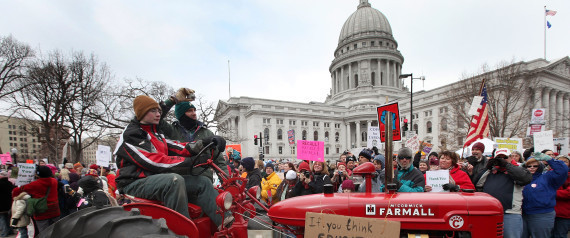
MADISON, Wis. — Clogging the Wisconsin Capitol grounds and screaming angry chants, tens of thousands of undaunted pro-labor protesters descended on Madison again Saturday and vowed to focus on future elections now that contentious cuts to public worker union rights have become law.
Protests have rocked the Capitol almost every day since Gov. Scott Walker proposed taking nearly all collective bargaining rights away from public workers, but the largest came a day after the governor signed the measure into law. Madison Police estimated the crowd at 85,000 to 100,000 people – along with 50 tractors and one donkey – by late afternoon. No one was arrested.
Speakers delivered angry diatribes while the crowd carried signs comparing Walker to dictators and yelled thunderous chants of "this is what democracy looks like."
"This is so not the end," said protester Judy Gump, a 45-year-old English teacher at Madison Memorial High School. "This is what makes people more determined and makes them dig in."
Walker's signature on the measure capped a week of political maneuvering to end a bitter, month-long standoff that began when the state's 14 Democratic senators fled to Illinois in an ultimately futile attempt to block the legislation.
Throngs of protesters gathered Saturday outside a convention center where senators made their first public appearances in Madison since ending their self-imposed exile. Demonstrators treated the lawmakers like rock stars, yelling "Fab 14, our heroes!" and giddily snapping pictures.
All 14 Democrats later marched around the Capitol, trading chants of "thank you" with protesters who ringed the sidewalks. When the senators made their way to a stage, they promised to shift their energies toward recall drives already under way against eight of their GOP colleagues.
"Now ... we trade in our rally signs for clipboards and we take to the streets to recall the Republicans," Sen. Chris Larson of Milwaukee told the cheering crowd, "and in one year we recall the governor that refuses to listen."
Walker is not eligible to be recalled until he completes his first year in office in January 2012.
Eight of the Democrats also face recall efforts. Senate Majority Leader Scott Fitzgerald issued a statement Saturday calling them the most shameful 14 people in the state.
"(Fleeing to Illinois) is an absolute insult to the hundreds of thousands of Wisconsinites who are struggling to find a job, much less one they can run away from and go down to Illinois – with pay," Fitzgerald said.
Walker's plan has spurred a national debate over labor rights. Its passage is a key victory for Republicans who have targeted unions in efforts to cut government spending across the country. Democrats see it as a blatant attempt to weaken organized labor, one of their strongest campaign allies.
Labor leaders have promised to use the setback to fire up members and mount a major counterattack against Republicans at the ballot box in 2012.
"We're never going to give up," said Marilyn Rolfsmeyer, 56, who serves as the 300-student Argyle School District's only art teacher. "What part of it don't they understand? There's hope here. I feel it. You feel the energy, the intensity. Somebody's got to be out there feeling it, too."
Dozens of fist-pumping farmers drew cheers as they chugged around the Capitol square in tractors bearing signs with messages such as "planting the seeds for a big season of recalls."
Tod Pulvermacher, 33, of Bear Valley, towed a manure spreader carrying a sign that read, "Walker's bill belongs here."
"Farmers are working-class Americans," he said as the crowd cheered. "We work for a living as hard as anybody, and this is about all of us."
Walker has repeatedly argued that ending collective bargaining gives local governments much-needed flexibility to confront cuts in state aid necessary to fix Wisconsin's deficit, which is expected to grow to $3.6 billion deficit over two years.
The new law erases public workers' ability to collectively bargain anything except wages up to the rate of inflation. It also requires them to contribute more to their pensions and health care, changes that amount to an 8 percent pay cut. Police and firefighters are exempt.
The Senate Democrats had fled to deny Republicans, who hold a 19-14 Senate majority, the 20-member quorum needed to vote on measures that spend money. But GOP leaders worked around them Wednesday, calling a special committee to take spending items out of Walker's proposal.
The Senate passed it 18-1 minutes later. Assembly Republicans approved it the next day.
Democratic Dane County Executive Kathleen Falk has filed a lawsuit seeking to block the secretary of state from publishing the law, the last step before it takes effect. She argues the bill still contained fiscal items and that the committee meeting violated Wisconsin's open meeting law.<SCRIPT>window.google_render_ad();</SCRIPT><SCRIPT src="http://googleads.g.doubleclick.net/pagead/test_domain.js"></SCRIPT><SCRIPT src="http://pagead2.googlesyndication.com/pagead/render_ads.js"></SCRIPT><SCRIPT>google_protectAndRun("render_ads.js::google_render_ad", google_handleError, google_render_ad);</SCRIPT><SCRIPT>google_protectAndRun("render_ads.js::google_render_ad", google_handleError, google_render_ad);</SCRIPT><SCRIPT>google_protectAndRun("render_ads.js::google_render_ad", google_handleError, google_render_ad);</SCRIPT><SCRIPT>google_protectAndRun("render_ads.js::google_render_ad", google_handleError, google_render_ad);</SCRIPT>
<SCRIPT src="http://googleads.g.doubleclick.net/pagead/test_domain.js"></SCRIPT><SCRIPT src="http://pagead2.googlesyndication.com/pagead/render_ads.js"></SCRIPT><SCRIPT>google_protectAndRun("render_ads.js::google_render_ad", google_handleError, google_render_ad);</SCRIPT><SCRIPT>google_protectAndRun("render_ads.js::google_render_ad", google_handleError, google_render_ad);</SCRIPT><SCRIPT>google_protectAndRun("render_ads.js::google_render_ad", google_handleError, google_render_ad);</SCRIPT><SCRIPT>google_protectAndRun("render_ads.js::google_render_ad", google_handleError, google_render_ad);</SCRIPT><SCRIPT>google_protectAndRun("render_ads.js::google_render_ad", google_handleError, google_render_ad);</SCRIPT>
</OMedia Blackout: CNN Fox News and MSNBC Ignore 100,000 WI Protesters
February 26, 2011
By Jason Easley
Over 100,000 people in Madison, Wisconsin were joined by thousands of other Americans around the country in protest of Gov. Scott Walker’s attempt to strip collective bargaining rights from the state’s unionized workers, but you would not have known any of this if you watched cable news on Saturday as the coverage of the protests ranged from disappointing (MSNBC) to scant (CNN) to non-existent (Fox News).
AFL-CIO spokesman Eddie Vale estimated that the crowd was over 100,000 people before the rally began at 3 PM. According to the Wisconsin State Journal, police estimated the crowd size at around 70,000 three hours before the rally began, “Madison police spokesman Joel DeSpain said the number of protesters around the Capitol is on the scale of last Saturday’s peak crowd of an estimated 68,000 and could swell even more for a 3 p.m. rally.”
Here are some highlights from the protests around the country from Moveon.org:
<IFRAME style="BORDER-BOTTOM: 0px; BORDER-LEFT: 0px; OUTLINE-STYLE: none; OUTLINE-COLOR: invert; OUTLINE-WIDTH: 0px; BORDER-TOP: 0px; BORDER-RIGHT: 0px" id=iframeplayer height=340 src="http://cdn.livestream.com/embed/moveonorg?layout=4&autoplay=false" frameBorder=0 width=560 scrolling=no></IFRAME>
Watch live streaming video from moveonorg at livestream.com
Hundreds of thousands of Americans around the country march on their governments in an event that would be a perfect fit for the 24 hour cable news cycle. Even better, the protests were occurring during the news cycle dead zone of Saturday afternoon. The coverage should have been everywhere in the media, but if you turned on your television in hopes of watching the rally from Wisconsin live, you were disappointed.
As the official state run television of the Republican Party, Fox News has been openly and loudly supporting Gov. Walker. It is no surprise that the right wing network would ignore the events in Madison and around the country today. A propaganda outlet never spends much time relaying information that is detrimental to their message.
CNN, which is supposed to be the moderate network in the cable news ideological spectrum, sort of thought they should cover the story, so they did a few minute and half live cut ins here and there. No wall to wall coverage of course, but they at least managed to pull themselves away from celebrating the Tea Party long enough to take a quick glance at Madison.
Now we come to MSNBC. Sigh, the so called liberal news network. MSNBC couldn’t be bothered to break away from their Lock Up and Dateline reruns documentary bloc to cover a landmark event that has reunified the left, and is likely to have an impact on the 2012 presidential election.
If there is one network that progressives/liberals thought understood this, it was MSNBC. However MSNBC has never really been overly interested in covering the news, much less live news events on a weekend. If I had a dollar for every time MSNBC has disappointed their viewership by being AWOL when news happens, I’d be a very wealthy man.
All three cable networks share something else in common besides their decision to ignore today’s rallies. CNN, MSNBC, and Fox News along with most other forms of media have decided that liberal protests aren’t newsworthy. They believe that the ratings and the money are in the right, not the left. The three cable networks are corporate owned and only for the purpose of profit. They don’t care about journalism or their obligation to inform the public.
This is all about dollars, and the outdated notion that the most profitable way to run a cable news outlet is to be like Fox News, which is why CNN keeps hiring more and more right wingers and has hopped into bed with the Tea Party Express.
There is a deeper bias evident in the case of the Wisconsin rallies. The corporate ownership of these networks, like most businesses, is anti-union. They assume that all of America is also anti-union, and they have conveniently ignored all the polling that shows the American people are behind the protesters in order to rationalize ignoring the protests.
The networks assume that since there is no money to be made by covering the left, America isn’t interested in events like the protests in Madison. At least this is what they tell themselves in order to justify their own biases in filtering out the news. The problem is that when the cable networks stay stuck in their old model and ignore these stories, new media steps up to fill the void, today’s generation of Internet news viewers and tweeters are tomorrow’s would be cable news viewers. If cable news insists on imposing their myopic definition of news, those viewers may not be tuning in.
By focusing on a misguided cash grab, corporate cable news is sowing the seeds of its own stagnation. A protest was held today that was bigger than anything that the Tea Party has ever done, but you wouldn’t know it if you were watching TV. There is something seriously wrong with a news gathering and reporting apparatus that devotes more live coverage to the protests in Egypt than protests in Wisconsin. Egypt was a big story, but the a fight for the very survival of the middle class should not be ignored.
Cable news, your bias is showing.
___
source: Huffington Post
<!--ASKCRAWL--><!-- Entries --><!-- Reporter --><!-- Entry -->Wisconsin Protesters Refuse To Quit
MADISON, Wis. — Clogging the Wisconsin Capitol grounds and screaming angry chants, tens of thousands of undaunted pro-labor protesters descended on Madison again Saturday and vowed to focus on future elections now that contentious cuts to public worker union rights have become law.
Protests have rocked the Capitol almost every day since Gov. Scott Walker proposed taking nearly all collective bargaining rights away from public workers, but the largest came a day after the governor signed the measure into law. Madison Police estimated the crowd at 85,000 to 100,000 people – along with 50 tractors and one donkey – by late afternoon. No one was arrested.
Speakers delivered angry diatribes while the crowd carried signs comparing Walker to dictators and yelled thunderous chants of "this is what democracy looks like."
"This is so not the end," said protester Judy Gump, a 45-year-old English teacher at Madison Memorial High School. "This is what makes people more determined and makes them dig in."
Walker's signature on the measure capped a week of political maneuvering to end a bitter, month-long standoff that began when the state's 14 Democratic senators fled to Illinois in an ultimately futile attempt to block the legislation.
Throngs of protesters gathered Saturday outside a convention center where senators made their first public appearances in Madison since ending their self-imposed exile. Demonstrators treated the lawmakers like rock stars, yelling "Fab 14, our heroes!" and giddily snapping pictures.
All 14 Democrats later marched around the Capitol, trading chants of "thank you" with protesters who ringed the sidewalks. When the senators made their way to a stage, they promised to shift their energies toward recall drives already under way against eight of their GOP colleagues.
"Now ... we trade in our rally signs for clipboards and we take to the streets to recall the Republicans," Sen. Chris Larson of Milwaukee told the cheering crowd, "and in one year we recall the governor that refuses to listen."
Walker is not eligible to be recalled until he completes his first year in office in January 2012.
Eight of the Democrats also face recall efforts. Senate Majority Leader Scott Fitzgerald issued a statement Saturday calling them the most shameful 14 people in the state.
"(Fleeing to Illinois) is an absolute insult to the hundreds of thousands of Wisconsinites who are struggling to find a job, much less one they can run away from and go down to Illinois – with pay," Fitzgerald said.
Walker's plan has spurred a national debate over labor rights. Its passage is a key victory for Republicans who have targeted unions in efforts to cut government spending across the country. Democrats see it as a blatant attempt to weaken organized labor, one of their strongest campaign allies.
Labor leaders have promised to use the setback to fire up members and mount a major counterattack against Republicans at the ballot box in 2012.
"We're never going to give up," said Marilyn Rolfsmeyer, 56, who serves as the 300-student Argyle School District's only art teacher. "What part of it don't they understand? There's hope here. I feel it. You feel the energy, the intensity. Somebody's got to be out there feeling it, too."
Dozens of fist-pumping farmers drew cheers as they chugged around the Capitol square in tractors bearing signs with messages such as "planting the seeds for a big season of recalls."
Tod Pulvermacher, 33, of Bear Valley, towed a manure spreader carrying a sign that read, "Walker's bill belongs here."
"Farmers are working-class Americans," he said as the crowd cheered. "We work for a living as hard as anybody, and this is about all of us."
Walker has repeatedly argued that ending collective bargaining gives local governments much-needed flexibility to confront cuts in state aid necessary to fix Wisconsin's deficit, which is expected to grow to $3.6 billion deficit over two years.
The new law erases public workers' ability to collectively bargain anything except wages up to the rate of inflation. It also requires them to contribute more to their pensions and health care, changes that amount to an 8 percent pay cut. Police and firefighters are exempt.
The Senate Democrats had fled to deny Republicans, who hold a 19-14 Senate majority, the 20-member quorum needed to vote on measures that spend money. But GOP leaders worked around them Wednesday, calling a special committee to take spending items out of Walker's proposal.
The Senate passed it 18-1 minutes later. Assembly Republicans approved it the next day.
Democratic Dane County Executive Kathleen Falk has filed a lawsuit seeking to block the secretary of state from publishing the law, the last step before it takes effect. She argues the bill still contained fiscal items and that the committee meeting violated Wisconsin's open meeting law.<SCRIPT>window.google_render_ad();</SCRIPT><SCRIPT src="http://googleads.g.doubleclick.net/pagead/test_domain.js"></SCRIPT><SCRIPT src="http://pagead2.googlesyndication.com/pagead/render_ads.js"></SCRIPT><SCRIPT>google_protectAndRun("render_ads.js::google_render_ad", google_handleError, google_render_ad);</SCRIPT><SCRIPT>google_protectAndRun("render_ads.js::google_render_ad", google_handleError, google_render_ad);</SCRIPT><SCRIPT>google_protectAndRun("render_ads.js::google_render_ad", google_handleError, google_render_ad);</SCRIPT><SCRIPT>google_protectAndRun("render_ads.js::google_render_ad", google_handleError, google_render_ad);</SCRIPT>
<SCRIPT src="http://googleads.g.doubleclick.net/pagead/test_domain.js"></SCRIPT><SCRIPT src="http://pagead2.googlesyndication.com/pagead/render_ads.js"></SCRIPT><SCRIPT>google_protectAndRun("render_ads.js::google_render_ad", google_handleError, google_render_ad);</SCRIPT><SCRIPT>google_protectAndRun("render_ads.js::google_render_ad", google_handleError, google_render_ad);</SCRIPT><SCRIPT>google_protectAndRun("render_ads.js::google_render_ad", google_handleError, google_render_ad);</SCRIPT><SCRIPT>google_protectAndRun("render_ads.js::google_render_ad", google_handleError, google_render_ad);</SCRIPT><SCRIPT>google_protectAndRun("render_ads.js::google_render_ad", google_handleError, google_render_ad);</SCRIPT>
<IFRAME title="YouTube video player" height=390 src="http://www.youtube.com/embed/AJMwWtqYODU" frameBorder=0 width=640 allowfullscreen></IFRAME>
source: Duluth News Tribune
Wis. governor greeted at Washburn fundraiser by thousands of protesters
Wisconsin’s protracted family fight over the budget and public employee unions moved to this Bayfield County town Saturday evening, as embattled Gov. Scott Walker spoke at an invitation-only event and was greeted by at least 2,000 angry protesters outside.
WASHBURN — Wisconsin’s protracted family fight over the budget and public employee unions moved to this Bayfield County town Saturday evening, as embattled Gov. Scott Walker spoke at an invitation-only event and was greeted by at least 2,000 angry protesters outside.
Walker arrived in a convoy of six unmarked police cars that pulled up at
5:45 p.m. to the Steak Pit for a Republican Lincoln Day fundraiser. The large, boisterous crowd, which had been lining the streets leading to the restaurant since 4:30, quickly recognized him and erupted in boos and shouts of “Recall Walker.”
The convoy moved through quickly and without incident, and most of the protesters began to follow a circuitous route on public pathways to a spot behind the restaurant where they continued the protest within earshot of the Republican Party faithful inside.
Bayfield County Sheriff Paul Susienka said Saturday evening that he didn’t have a crowd estimate, but various people had estimated the size at between 2,000 and 5,000. So the protest
probably at least doubled the size of Washburn, which has a population of 2,271.
Susienka said there had been no incidents and no arrests.
“We wanted to be able to let people say their piece,” Susienka said. “Our primary focus was for the safety of the governor and the congressman.”
He referred to Rep. Sean Duffy, who arrived at the event well before Walker.
People were definitely saying their piece, greeting each vehicle that arrived for the dinner with shouts of “Shame!” while waving protest signs and shaking their fists. One person videotaped the license plates of at least some of the vehicles that entered.
Protesters banged pots, shook tambourines at car windows and sounded horns. Most of the drivers and their passengers stared straight ahead. They had to navigate through a narrow tunnel formed by protesters on both sides, held back by Bayfield County sheriff’s deputies and rally organizers.
Signs included “Gov. Walker, you probably can’t remember me, but ... I can recall you” and “At least my Grandma’s Walker helps her.”
Ron Borchers, a substitute teacher in Washburn, said he was among 24 people who organized the rally, which began Friday afternoon behind Stage North, a community theater and entertainment venue.
Borchers praised Washburn police, whom he said worked closely with the organizers to agree on ground rules.
Scott Griffiths, a freelance artist in Washburn, also was among the organizers.
“The thing that really got me here is the disparity of wealth that has grown way too out of hand,” Griffiths said. “This is not a Wisconsin thing. This is a global pandemic of wealth buying power.”
Richard Bergsrud, 26, of Duluth agreed that it wasn’t just a Wisconsin thing. The way Walker’s proposal to strip public employee unions of most collective bargaining rights was passed into law was wrong, Bergsrud said.
“It should be a dialogue, not a monologue,” he said.
Bergsrud acknowledged he felt a little bit sorry for people arriving to the event. But he said they were wrong for supporting actions that deprived public employees of long-fought-for rights.
Not everyone who disagreed with the protesters was in the Steak Pit.
Mark Goodrich, a building contractor in Ashland, stood at the corner where protesters passed between Stage North and the entrance to the Steak Pit with a large sign bearing the words, “God Bless Gov. Walker.”
Goodrich said he had heard a few taunts from protesters.
“I know some of the people,” he said. “I have friends on both sides.”
But he added: “Collective bargaining is not a right. It’s never been a right.”
Susienka said about 50 law enforcement officers from agencies across Northwestern Wisconsin were involved in efforts to maintain peace. He said they’d known for several weeks that Walker planned to speak at the event, but began to ratchet up their efforts when the conflict over Walker’s proposal became apparent.
“The organizers of the protest have been pretty cooperative,” Susienka said.
Now we come to MSNBC. Sigh, the so called liberal news network. MSNBC couldn’t be bothered to break away from their Lock Up and Dateline reruns documentary bloc to cover a landmark event that has reunified the left, and is likely to have an impact on the 2012 presidential election.
If there is one network that progressives/liberals thought understood this, it was MSNBC. However MSNBC has never really been overly interested in covering the news, much less live news events on a weekend. If I had a dollar for every time MSNBC has disappointed their viewership by being AWOL when news happens, I’d be a very wealthy man.
I'm really surprised that MSNBC is still on that nonsense on the weekends. They don't even have to run the normal crew but a weekend crew with some of the lesser lights to give them some shine. And you can't tell me Ed Schultz wouldn't go to whereever to cover an event like this. To FNC's credit, they push their bullshit 24/7 and never take days off. FNC is part of a right wing machine while MSNBC is just another way for GE/Comcast/whoever to make some money and the difference is stark.
All three cable networks share something else in common besides their decision to ignore today’s rallies. CNN, MSNBC, and Fox News along with most other forms of media have decided that liberal protests aren’t newsworthy. They believe that the ratings and the money are in the right, not the left. The three cable networks are corporate owned and only for the purpose of profit. They don’t care about journalism or their obligation to inform the public.
They showed this strongly during the Bush Administration when they gave scant coverage to anti-war demonstrations that numbered in the hundreds of thousands.
This is all about dollars, and the outdated notion that the most profitable way to run a cable news outlet is to be like Fox News, which is why CNN keeps hiring more and more right wingers and has hopped into bed with the Tea Party Express.
They're even hiring Breitbart agents. Are they that desperate to appear "non-partisan"?
Eight of the Democrats also face recall efforts. Senate Majority Leader Scott Fitzgerald issued a statement Saturday calling them the most shameful 14 people in the state.
It's rarely noted that the recall measures on the Democrats are being pushed by outside interests while the recall efforts on the Republicans are being led by the same people marching in Wisconsin.
Judge blocks contentious Wisconsin union law
Detriot Free Press
Mar. 18, 2011
MADISON, Wis. — A Wisconsin judge issued a <SPAN style="BACKGROUND-COLOR: #ffff00">temporary restraining order today blocking the state’s new and contentious collective bargaining law from taking effect, raising the possibility that the Legislature may have to vote again to pass the bill</span>.
Lawmakers had passed Gov. Scott Walker’s measure last week, breaking a three-week stalemate caused by 14 Senate Democrats fleeing to Illinois. Demonstrations against the measure grew as large as 85,000 people.
Dane County District Judge Maryann Sumi granted the order in response to a lawsuit filed by the district attorney alleging that Republican lawmakers violated the state’s open meetings law by hastily convening a special committee before the Senate passed the bill.
Sumi said her ruling would not prevent the Legislature from reconvening the committee with proper notice and passing the bill again.
Walker spokesman Cullen Werwie would not comment on whether the governor would push to call the Legislature back to pass the bill again, either in its current form or with any changes. Werwie said Walker was confident the bill would become law in the near future.
"This legislation is still working through the legal process," Werwie said.
A spokesman for Republican Senate Majority Leader Scott Fitzgerald declined to comment, citing the ongoing legal fight. A spokesman for Assembly Speaker Jeff Fitzgerald did not immediately respond to a message seeking comment.
Opponents of the law were hopeful the judge’s ruling would lead to concessions.
"I would hope the Republicans would take this as an opportunity to sit down with Democrats and negotiate a proposal we could all get behind," said Democratic Sen. Jon Erpenbach, one of the 14 senators who stayed in Illinois for three weeks in an attempt to stop the bill from passing.
The head of the state’s largest teachers union said the Legislature should use this as a chance to listen to opponents of the measure, not vote to pass the same bill again.
"Wisconsin’s educators call upon the Legislature to take this as a clear signal that Wisconsinites will not tolerate backroom deals and political power plays when it comes to our public schools and other valued services,” said Mary Bell, president of the Wisconsin Education Association Council.
Marty Beil, director of the state’s largest public employee union, said in a statement, “We are gratified to see some of our so-called ‘leaders’ finally held accountable for their illegal actions."
Assistant Attorney General Steve Means said the Justice Department planned to appeal the ruling. Since Sumi’s order isn’t final, the agency must secure permission from the state court of appeals before it can bring a case, Means said. Agency attorneys planned to make the request later today or perhaps early next week, Means said.
If the agency wins permission, it can pursue an appeal with the state appeals court or try to get the state Supreme Court to hear the case.
Dane County District Attorney Ismael Ozanne filed the lawsuit this week alleging the open meetings law was violated because 24 hours’ notice wasn’t given for a meeting of the special legislative committee convened to amend the bill.
Justice Department attorneys argued that notice on a bulletin board posted about two hours before the committee meeting was to start last Wednesday was sufficient under rules of the Senate.
The judge said DOJ couldn’t show the committee was exempt from the 24-hour notice requirement. She said Ozanne could ultimately win the case and ordered Secretary of State Doug La Follette to hold off on publishing the law — the last step before it can take effect. La Follette had planned to publish the law on March 25.
Assembly Minority Leader Peter Barca of Kenosha said the ruling was a move in the right direction.
"I’m very pleased," Barca said. "As you know, I felt from the moment they called this that this would be a violation of open meetings law. This is an important first step in this regard."
The bill was part of Walker’s solution for plugging a $137-million state budget shortfall. A part of the measure would require state workers to increase their health insurance and pension contributions to save the state $30 million by July 1. Other parts of Walker’s original proposal to address the budget shortfall were removed before the bill passed last week. The Legislature planned to take those up later.
Associated Press writers Scott Bauer and Todd Richmond contributed to this report.
http://www.freep.com/article/201103...tentious-Wisconsin-union-law?odyssey=nav|head
The Walker/Luntz timeline very suspicious, possibly illegal!!
<iframe title="YouTube video player" width="480" height="390" src="http://www.youtube.com/embed/v6DhaYCVvwA" frameborder="0" allowfullscreen></iframe>
National Day in Solidarity
with Wisconsin Workers on April 4

SEIU Local 99 What would Dr. King have done about Wisconsin? Let's keep turning the Wisconsin "moment" into a movement. April 4 is a National Day in Solidarity with Wisconsin workers, chosen specifically because it is the anniversary of Dr. King's assassination in Memphis. His last act was standing with striking sanitation workers. On April 4, two of the leaders of that strike, Rev. James Lawson and Bill Lucy from AFSCME will join L.A. workers.


On April 4, 1968, Dr. Martin Luther King Jr. was assassinated in Memphis, where he had gone to stand with sanitation workers demanding their dream: The right to bargain collectively for a voice at work and a better life.
Today, that same demand is electrifying people across America. It’s the demand of all people—black, white, Latino and Asian American: The right to join together for our common dreams.
Join us to make April 4, 2011, a day to stand in solidarity with working people in Wisconsin, Ohio, Indiana and dozens of other states where well-funded, right-wing corporate politicians are trying to take away the rights Dr. King gave his life for. It’s a day to show movement. Teach-ins. Vigils. Faith events. A day to be creative, but clear: We are one. Videos, info, more
<font size="5"><center>
Marchers Remember: MLK Was Pro-Union</font size><font size="4">
Today's national Day of Solidarity with Wisconsin's union
workers comes on the anniversary of Dr. Martin Luther
King Jr.'s slaying. It's a fitting tribute.</font size></center>

The Root
By: Lynette Holloway
March 31, 2011
In what is being hailed as a national Day of Solidarity, hundred of thousands of teachers, nurses, students, clergy, firefighters and other workers from across the nation will hold "We Are One" demonstrations to show support for Wisconsin union employees to demand a stop to overreaching policies by Republican lawmakers trying to balance budgets on the backs of public workers.
The observance comes on the 43rd anniversary of the murder of slain civil rights leader Rev. Dr. Martin King Jr., who was unceremoniously gunned down outside of a Memphis hotel. He was in town planning a demonstration in support of sanitation workers seeking collective bargaining rights.
"Dr. King went to Memphis to stand with sanitation workers demanding their dream, the right to bargain collectively, for a voice at work and a better life," Richard Trumka, president of the AFL-CIO, said during a conference call with reporters last week.
"Today, that fight goes on," he continued. "Remember the simple placards they wore: 'I am a man,' to signify that they deserved respect for the work that they did and the way they helped this country. [Today,] it's for fair pay. It's a fight for dignity in retirement. And it's a fight for respect on the job. And quite frankly, this is a fight to preserve the middle-class way of life. And we want to commemorate his life and legacy while calling on working people to continue to stand together."
The period of solidarity began over the weekend (April 1) with worship services and culminates today with the Day of Solidarity. The events come on the heels of a measure signed into law last month by Wisconsin Gov. Scott Walker that significantly reduces collective bargaining rights for public employees and requires workers, except police officers and firefighters, to pay more for pension plans and health care premiums.
The Wisconsin law sent waves of shock across the nation and mobilized pro-labor forces in ways that have not been seen since the civil rights era. Protestors stormed the capital to protest the bill; Democratic lawmakers fled the state to stave off the passage of the measure that ultimately was signed into law without them. Now, it is held up in an interminable court battle over its legality.
But Wisconsin is not alone. To reduce their budgets, Republican lawmakers are seeking to make changes to collective bargaining rights in Ohio, Indiana and other states.
"In Ohio, 20,000 workers came together to fight back against a bill to take away collective bargaining rights," Trumpka said. "In Indiana, working people held the largest rally in the state's history, and in events across the country, people stood up to say we're all in this together. There is an engagement and enthusiasm that has been absent for a very long time."
African Americans stand to lose the most from dwindling collective bargaining rights. As of last year, African-American employees were more likely to be public union members than whites, Asians and Hispanics, making up 15 percent of the membership, according to the U.S. Bureau of Labor Statistics. And unionized African-American workers earn 12 percent more than their nonunion counterparts, according to the AFL-CIO.
This is a critical time for working families, on the 43rd anniversary of the assassination of King, said Arlene Holt Baker, executive vice president of the AFL-CIO.
"His fight for economic justice and the American dream for all resonates now more than ever," Baker said.
Not everyone agrees. Charles Butler, a Republican black Tea Party member who hosts the radio show "The Other Side" on Chicago's WVON, balked at the demonstration. "The AFL-CIO's fight is to keep from being labeled irrelevant,'' he told The Root. "But let's be real. The labor and suffrage movements were about white people. So, for these people to hold a mass demonstration on the anniversary of King's death is hypocritical.
"My father was a union man," Butler continued. "He couldn't get certain jobs, even in a union shop. Blacks were excluded from the higher paying jobs. I used to hear stories at the dinner table about how a white man would walk in off the street with no education from Tennessee, Kentucky and Appalachia and get a job as an electrician, or a tool and die man. But my father had to struggle to get into one of those skilled trade jobs, which paid a lot of money. Today, things are a lot worse and [the unions] need to be dismantled."
Unfair treatment of black workers was very much on King's mind 43 years ago, in Memphis in the midst of organizing the demonstration to stand in solidarity with striking sanitation workers. The protest was the culmination of months of mistreatment. In February 1968, two black sanitation workers were crushed to death when a trash truck malfunctioned.
In a separate incident on the same day, 22 black workers were sent home without pay because of the brutal weather, while their white supervisors remained on the job with pay. Two weeks later, thousands of workers joined forces to fight for job safety, better pay, benefits and union support. They also fought against then-Memphis Mayor Henry Loeb's indifference to their plight.
The effort unified blacks and whites and brought King and his Southern Christian Leadership Conference to the front lines. But violent protestors on the side of the sanitation workers interrupted King's first demonstration in March, and he was forced to go to court to reschedule the event. After working out an agreement with the courts on April 4, a peaceful march was planned for April 8.
As lawyers prepared to inform King of the court agreement over dinner on that fateful April 4 evening, he was assassinated as he stepped out of his hotel room, changing history and uniting the civil rights and the labor movements like never before.
"We know that Dr. King spent the last day of his life speaking out against those who would deny workers the right to collectively bargain," Baker said. "During the last year of his life, Dr. King put justice for the poor and working-class people at the center of his agenda. He challenged the country to create an economy of full employment or lacking that, a tax system that ensured a decent level of income for every American."
In that spirit, Trumpka said unions would not bow to political pressure today.
"On April 4, we are going to continue this fight," he said. "We are going to declare that we truly are one. I've had enough."
Lynette Holloway is a Chicago-based writer. She is a former New York Times reporter and associate editor for Ebony magazine.
http://www.theroot.com/views/marchers-remember-mlk-was-pro-union
Marchers Remember: MLK Was Pro-Union</font size><font size="4">
Today's national Day of Solidarity with Wisconsin's union
workers comes on the anniversary of Dr. Martin Luther
King Jr.'s slaying. It's a fitting tribute.</font size></center>
The Root
By: Lynette Holloway
March 31, 2011
In what is being hailed as a national Day of Solidarity, hundred of thousands of teachers, nurses, students, clergy, firefighters and other workers from across the nation will hold "We Are One" demonstrations to show support for Wisconsin union employees to demand a stop to overreaching policies by Republican lawmakers trying to balance budgets on the backs of public workers.
The observance comes on the 43rd anniversary of the murder of slain civil rights leader Rev. Dr. Martin King Jr., who was unceremoniously gunned down outside of a Memphis hotel. He was in town planning a demonstration in support of sanitation workers seeking collective bargaining rights.
"Dr. King went to Memphis to stand with sanitation workers demanding their dream, the right to bargain collectively, for a voice at work and a better life," Richard Trumka, president of the AFL-CIO, said during a conference call with reporters last week.
"Today, that fight goes on," he continued. "Remember the simple placards they wore: 'I am a man,' to signify that they deserved respect for the work that they did and the way they helped this country. [Today,] it's for fair pay. It's a fight for dignity in retirement. And it's a fight for respect on the job. And quite frankly, this is a fight to preserve the middle-class way of life. And we want to commemorate his life and legacy while calling on working people to continue to stand together."
The period of solidarity began over the weekend (April 1) with worship services and culminates today with the Day of Solidarity. The events come on the heels of a measure signed into law last month by Wisconsin Gov. Scott Walker that significantly reduces collective bargaining rights for public employees and requires workers, except police officers and firefighters, to pay more for pension plans and health care premiums.
The Wisconsin law sent waves of shock across the nation and mobilized pro-labor forces in ways that have not been seen since the civil rights era. Protestors stormed the capital to protest the bill; Democratic lawmakers fled the state to stave off the passage of the measure that ultimately was signed into law without them. Now, it is held up in an interminable court battle over its legality.
But Wisconsin is not alone. To reduce their budgets, Republican lawmakers are seeking to make changes to collective bargaining rights in Ohio, Indiana and other states.
"In Ohio, 20,000 workers came together to fight back against a bill to take away collective bargaining rights," Trumpka said. "In Indiana, working people held the largest rally in the state's history, and in events across the country, people stood up to say we're all in this together. There is an engagement and enthusiasm that has been absent for a very long time."
African Americans stand to lose the most from dwindling collective bargaining rights. As of last year, African-American employees were more likely to be public union members than whites, Asians and Hispanics, making up 15 percent of the membership, according to the U.S. Bureau of Labor Statistics. And unionized African-American workers earn 12 percent more than their nonunion counterparts, according to the AFL-CIO.
This is a critical time for working families, on the 43rd anniversary of the assassination of King, said Arlene Holt Baker, executive vice president of the AFL-CIO.
"His fight for economic justice and the American dream for all resonates now more than ever," Baker said.
Not everyone agrees. Charles Butler, a Republican black Tea Party member who hosts the radio show "The Other Side" on Chicago's WVON, balked at the demonstration. "The AFL-CIO's fight is to keep from being labeled irrelevant,'' he told The Root. "But let's be real. The labor and suffrage movements were about white people. So, for these people to hold a mass demonstration on the anniversary of King's death is hypocritical.
"My father was a union man," Butler continued. "He couldn't get certain jobs, even in a union shop. Blacks were excluded from the higher paying jobs. I used to hear stories at the dinner table about how a white man would walk in off the street with no education from Tennessee, Kentucky and Appalachia and get a job as an electrician, or a tool and die man. But my father had to struggle to get into one of those skilled trade jobs, which paid a lot of money. Today, things are a lot worse and [the unions] need to be dismantled."
Unfair treatment of black workers was very much on King's mind 43 years ago, in Memphis in the midst of organizing the demonstration to stand in solidarity with striking sanitation workers. The protest was the culmination of months of mistreatment. In February 1968, two black sanitation workers were crushed to death when a trash truck malfunctioned.
In a separate incident on the same day, 22 black workers were sent home without pay because of the brutal weather, while their white supervisors remained on the job with pay. Two weeks later, thousands of workers joined forces to fight for job safety, better pay, benefits and union support. They also fought against then-Memphis Mayor Henry Loeb's indifference to their plight.
The effort unified blacks and whites and brought King and his Southern Christian Leadership Conference to the front lines. But violent protestors on the side of the sanitation workers interrupted King's first demonstration in March, and he was forced to go to court to reschedule the event. After working out an agreement with the courts on April 4, a peaceful march was planned for April 8.
As lawyers prepared to inform King of the court agreement over dinner on that fateful April 4 evening, he was assassinated as he stepped out of his hotel room, changing history and uniting the civil rights and the labor movements like never before.
"We know that Dr. King spent the last day of his life speaking out against those who would deny workers the right to collectively bargain," Baker said. "During the last year of his life, Dr. King put justice for the poor and working-class people at the center of his agenda. He challenged the country to create an economy of full employment or lacking that, a tax system that ensured a decent level of income for every American."
In that spirit, Trumpka said unions would not bow to political pressure today.
"On April 4, we are going to continue this fight," he said. "We are going to declare that we truly are one. I've had enough."
Lynette Holloway is a Chicago-based writer. She is a former New York Times reporter and associate editor for Ebony magazine.
http://www.theroot.com/views/marchers-remember-mlk-was-pro-union
Similar threads

- Replies
- 1
- Views
- 447

- Replies
- 0
- Views
- 315

- Replies
- 0
- Views
- 474

- Replies
- 18
- Views
- 1K
