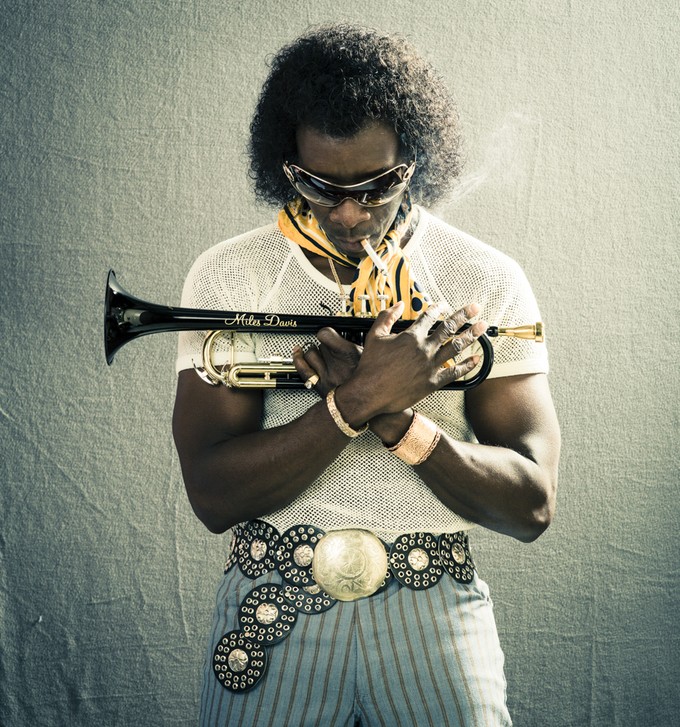
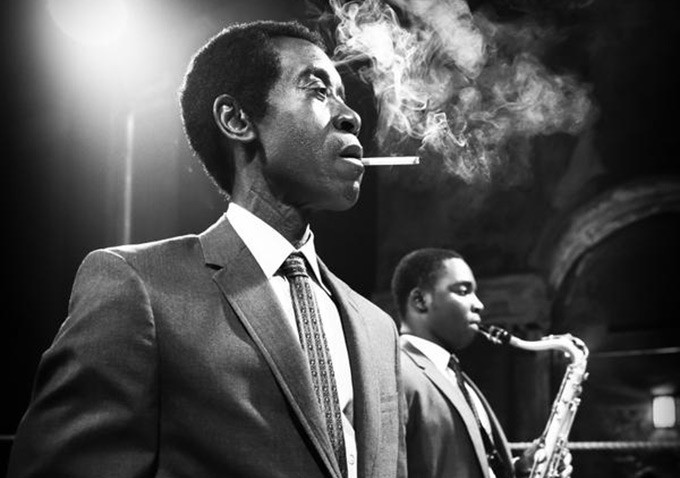
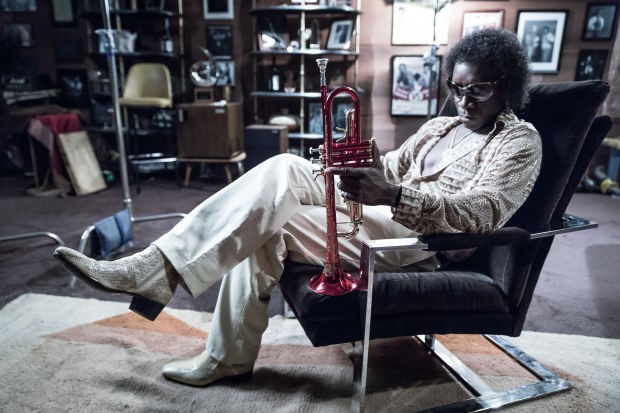
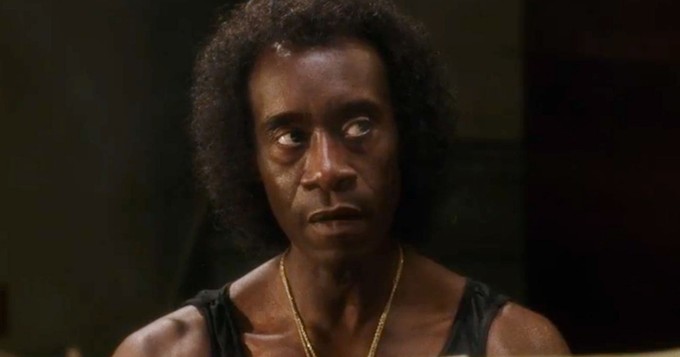
Miles Ahead - Don Cheadles Miles Davis biopic teaser

geechiedan

Rising Star
BGOL Investor
milesahead-1600x900-c-default.jpg


CLICK HERE FOR THE MOVIE TRAILER
 
Last edited:
Will be in the theater the day it drops.

I have the privilege of owning a few art pieces. He did paintings as well google it.
 
Last edited:
patiently waiting... I know he killed this role
 
Don Cheadle won the role of Miles Davis before he even knew he was being considered. In 2006, when Davis was posthumously being inducted into the Rock and Roll Hall of Fame, Davis’s nephew, Vince Wilburn, told reporters that Cheadle was the guy to play the jazz genius. ”I had not been reaching out for this role in any way, shape or form,” says Cheadle. “There was a pronouncement made, I guess — a proclamation — that I was going to play his uncle in a movie.”

Ten years later, Miles Ahead is ready to open in theaters, and Cheadle not only stars as the raspy-voiced trumpet master, he also made his directorial debut. The film premiered at the 2015 New York Film Festival and will open in theaters on April 1. Rather than a conventional cradle-to-grave music biopic, Cheadle built the narrative around Davis in 1979, a period of artistic paralysis. Ewan McGregor plays a persistent journalist who intrudes on Davis’s privacy, but becomes his reluctant partner in crime when they have to retrieve a missing tape of valuable session music. Like Davis’s music, their adventure knows no boundaries, and the film flirts with the surreal. In flashbacks, Davis courts and obsesses over dancer Frances Taylor (Emayatzy Corinealdi), and their romance has a major impact on his music.

In the exclusive trailer, Davis is a loose cannon: fighting, shooting guns, and behaving like a less than perfect husband. But this isn’t Walk the Line. As Davis says in the clip, “If you’re going to tell the story, come with some attitude, man.” This is a Miles Davis joint.

ENTERTAINMENT WEEKLY: When did you discover Miles Davis?
DON CHEADLE:
He was someone that my parents listened to. The music was in the house since I can remember, but I think at 10, when I started actually playing music, playing sax, is probably when I started paying more close attention to the kind of music and the construction of the music and the composition and all of those aspects of it.

What was he doing differently than anyone else?
It was more what he wasn’t doing. It was more about the space that he created. It was more about the way he allowed things to finish in the listener’s head, as opposed to trying to define every moment. Miles was a lot about space, and that’s something that was unique. People usually wanted to show everything that they know, and Miles seemed to intimate and insinuate and let you finish things off in your head.

For a directorial debut, this is pretty tall order. Did you always see this story as one you wanted to direct?
No, and when it first came to me, it was just something for me to act in. When I met with [Miles’] family, I told them I wanted to do something that wasn’t like I had seen before, and I had a take on the movie, that if I was going to play him, that it had to be as creative and different, that if it wasn’t as aspirational as he was, then I wasn’t really that interested. And before I got to my house after that meeting, it kind of came to me that that would be hard for anyone else possibly to see it the same way that I was seeing it, so if I was going to do it, I’d probably have to direct it. And as I was calling them, they were kind of calling me to say the same thing.

WANT MORE EW? Subscribe now to keep up with the latest in movies, television and music.

Miles had this huge life, this huge career, this huge personality. How did you decide to frame his life and focus on what you did? Because so many music biopics fall victim to familiar tropes.
I had seen other films that have done it — because I’ve been a part of several of them, by the way. Biopics, where I guess you could say tropes; I would say they’re also just signposts you have to hit along the way. When you set out to make a biopic, the purpose, whether stated or not, is usually to hit the highlights or lowlights of someone’s life in order to crescendo at the end. It is trope, I guess that’s the word. But I thought, especially with someone like Miles Davis, whose life seemed to very antithetical to that, and whose art was so mercurial and spontaneous and not dedicated to any sort of form that he had done before. He went on to the next thing and he kind of never looked back. I thought it would really be totally anathema to him to do something that felt standard, so to speak.

The film jumps around, but the main thread of the plot is set around 1979. Why did you chose to focus on that time period?
Just the fact that he wasn’t playing. The fact that he hadn’t played for five years, up to that point, and in a way, was either chomping at the bit to figure out what to say again, if to say again, or he was going down towards death very quickly. He was standing on that knife’s edge at that point, and I don’t think he even know which way it was gonna go. So for us, when we got to the period in all the research about how Miles didn’t play for five years, we were like, “What?” [Laughs] That was the part that was the most interesting from a human being standpoint to me. Musically and what he did with his art form was amazing to me all the time, for the most part. But for me, as a human and an artist and someone who’s a creative person, what happens when you just stop for five years? That’s why we picked that moment to sort of be the departure point: him on the verge of talking again, basically.


miles-ahead-01.jpg


There’s a great line in the movie where Miles says, “It takes a long time to be able to play like yourself?” I imagine that’s not a foreign sentiment for any actor, no matter how accomplished. Looking back at your career, was there a moment where you figured out who you were? Because I imagine when you started out, you’re justacting as an actor. But at some point, does something click?
I can’t say that I think I’ve ever arrived at a moment where I feel like, “Now, this is it.” And I don’t know many actors that actually feel like that. Some bad ones, probably. [Laughs] But I think most actors and most people who are still curious and trying to get better and figure stuff out don’t feel like they really ever have it.

So is that an element of fear?
Well, I don’t know about fear. You’re out there in front of everybody while you’re trying to figure it out. You’re not doing it in your garage. You’re doing it in front of people, so I guess there’s a vulnerability, definitely. But I think that’s when you’re supposed to know, or recognize, “Oh, that’s what I’m supposed to be.” Because I’m not in my comfort zone. I’m reaching for something, and when you reach for something, you stumble. You don’t actually get to get there cleanly, which is another thing I loved about Miles. The story goes that if he heard you rehearsing something, if you were guys doing a date and you were in your hotel, and he heard you rehearsing your solo or whatever, and you came down on stage and performed that same solo, you were out, you were done with the band. Because, as Herbie [Hancock] said, “Miles paid us to rehearse in front of people.” That, to me, is like the most respectful thing you can do. It’s like, I’m going to show you all of the bumps and bruises along the way, and how we get to something. I’m not going to come out here and make sure that we’re totally polished and everything’s slick and perfect. That’s not what he wanted to do. I feel like, when it’s the best, that’s how you’re supposed to feel. Like, you’re reaching, that you’re always trying to figure it out. And if you’re always reaching, then yeah, you’re always going to feel vulnerable. I don’t know, fear may be another way to say it, but you’re always going to feel you’re exposed.

Is that something you tried to channel when you were playing Miles. You obviously weren’t winging it, because that’s not how this works, but were you acting a form of jazz on screen?
I was trying to do both things at the same time, which is have a form and allow yourself to be somewhat formless inside the form. If it’s just totally formless, then it’s just kind of, to me, bullshit. But you have to, inside of the form, be able to at some point, have stuff just be where you don’t know, and be out there. That’s the feeling, of having all the conditions set and then not knowing what’s going to happen. You have to know what the chords are, but then anything inside those chords is allowed.

The conversation around this year’s Oscars has been more about the films that weren’t nominated instead of the films that were, in part because no minority actors were honored. Will you be attending this year’s ceremony?
Oh, I don’t go to the Oscars unless I’m nominated usually. I might want to be there this year just to watch Chris Rock, but I have yet to make plans.

The first 15 minutes of the show are going to be electric.
Oh, it’s got to be. This could be a career-defining moment for him. I hope he just goes in and gets everybody. [Laughs]
 
I heard Don really learned how to play trumpet for the role. Can't wait.
 
Don Cheadle is up there with Denzel and Forrest Whitaker in acting talent.

He originally from the Show Me State, too.


Full trailer


All In.... Dude if Don Cheadle doesn't get his Oscar for this shit... It's riot time.

I'm still pissed off that he didn't get an Oscar for Hotel Rwanda. He is easily one of the most underrated Black Actors of our generation.
 
IMO, I believe he is a better actor that Denzel. But that's just my opinion.

I can't compare body of work because that isn't fair on Cheadle's part.

I actually agree with you. I think Cheadle has far more range then Denzel. But don't get twisted, Denzel is amazing. It's just that Don has this ability to blend seamlessly into any role to such a point that you don't even see his Character as Don Cheadle playing a role..... you just see the character.
 
I actually agree with you. I think Cheadle has far more range then Denzel. But don't get twisted, Denzel is amazing. It's just that Don has this ability to blend seamlessly into any role to such a point that you don't even see his Character as Don Cheadle playing a role..... you just see the character.

I concur. Denzel is usually just Denzel in his movies. He doesn't have to jump too far out of himself to make his role stick. Very similar to Sidney P. But Cheadle on the other hand is exactly as you stated: "Don has this ability to blend seamlessly into any role to such a point that you don't even see his Character as Don Cheadle playing a role."

That aspect is why I have always appreciated him as an actor. His versatility is not limited by no means. He is naturally a funny person, but he can play serious as well when called upon. I was a little disappointed that his role in "Rosewood" was limited. Mouse was my dude in "Devil in a Blue Dress." He has always been a supporting actor, but I think "Miles Ahead" may be his first lead? Please correct me if I am wrong. My memory is clouded.

Edit: I forgot about "Rebound" :yes: and "Hotel Rawanda"
 
I concur. Denzel is usually just Denzel in his movies. He doesn't have to jump too far out of himself to make his role stick. Very similar to Sidney P. But Cheadle on the other hand is exactly as you stated: "Don has this ability to blend seamlessly into any role to such a point that you don't even see his Character as Don Cheadle playing a role."

That aspect is why I have always appreciated him as an actor. His versatility is not limited by no means. He is naturally a funny person, but he can play serious as well when called upon. I was a little disappointed that his role in "Rosewood" was limited. Mouse was my dude in "Devil in a Blue Dress." He has always been a supporting actor, but I think "Miles Ahead" may be his first lead? Please correct me if I am wrong. My memory is clouded.

Edit: I forgot about "Rebound" :yes: and "Hotel Rawanda"

Yeah I was looking for a trailer for Rebound. He was great in that movie.
 
I actually agree with you. I think Cheadle has far more range then Denzel. But don't get twisted, Denzel is amazing. It's just that Don has this ability to blend seamlessly into any role to such a point that you don't even see his Character as Don Cheadle playing a role..... you just see the character.

Denzel used to be amazing...now he just turns up as himself

forrest and don will never let you down
 
cant wait for this, im shocked its gonna be in theater as it was crowdfunded. Either way Im seeing it!
 
yeah this is going to be good. Wonder how they will portray Coltrane if at all? With Miles he is one of my favorites.
 
Capone talks making a biopic feel like a musical composition with MILES AHEAD star/director Don Cheadle!!!


It’s almost impossible for me to wrap my brain around the fact that Don Cheadle has been working in movies and television for more than 30 years. Although he’s done plenty of smaller supporting roles in both for 10 years leading up to it, I first recall taking note of him in 1995 with the double shot of THINGS TO DO IN DENVER WHEN YOU’RE DEAD and more importantly, DEVIL IN A BLUE DRESS (although to be fair, his two years as a part of the cast of “Picket Fences” from 1993-95 was his true breakthrough).

It seems almost impossible not to love Cheadle. He’s an exercise in harnessing energy. Sometimes he’s allowed to let it all out (as he currently does in his Showtime show “House of Lies,” which begins its fifth season this Sunday, April 10) or as James Rhodes/War Machine in the Marvel films IRON MAN 2 & 3, as well as AVENGERS: AGE OF ULTRON and the upcoming CAPTAIN AMERICA: CIVIL WAR (May 6). Cheadle has created a host of mannered, unique characters in everything from Steven Soderbergh’s OCEAN’S films (11, 12 & 13), OUT OF SIGHT, and TRAFFIC, as well as BOOGIE NIGHTS, BULWORTH, MANIC, TALK TO ME, FLIGHT, THE GUARD, and his Oscar-nominated turn in HOTEL RWANDA.

For about the last 10 years, Cheadle has been trying to get a Miles Davis biopic off the ground, and ever since he signed up for the job (with a little unexpected prompting from the Davis family), he knew the task of capturing the trumpeting legend who changed music several times over would not be take a conventional route, so he picked up the directing reigns for the first time and stepped into the writing process (with co-writer Steven Baigelman) and has sketched a portrait of Davis that actually covers to eras of his life—one during which he was highly innovative and production and another when he was in the midst of a five-year break from playing at all. Cheadle wanted to create a film that was as free-form and loose as the subject himself, and the result is MILES AHEAD, which is unlike just about any film about a famous artist as you’re likely to see.

I sat down with Cheadle in Chicago recently, and we had a great deal of ground to cover. With that, please enjoy my conversation with the always fascinating and supremely talented Don Cheadle…


miles_1_large.jpg


Capone: How are you? Great to meet you.

Don Cheadle: Great to meet you too.

Capone: There’s a quote in the movie—and you use it in the trailer as well—“If you’re going to tell a story, come with some attitude.” That’s pretty much what you’ve done here. That’s pretty much what you do most of the time, even when you’re just acting. Tell me why specifically for this film that seemed like the best approach? It was more than just about facts and getting everything in the right order. It’s about like attitude.

DC: Yeah, because haven’t we seen that? And how many times do we wanto to approach it like that? For me, especially with a figure like Miles Davis, to do something that felt conventional to me seemed like it would have just been an affront. We always wanted to approach the movie in a way that felt like a composition that was freeform and felt improvisational, and timelines intersect and interweave. I wanted it to feel like you’re waling around Miles Davis’s creative brain.

Capone: Even some of the music cues are in the wrong decade. “Maybe this piece from the ’70s or ’80s will work better in the ’50s.” There’s some filmmakers that would never dream of doing that.

miles_7_large.jpg


DC: Yeah, that’s right. I think everything that Miles did, most people would have never dreamed of doing. And we wanted to be meta. I wanted to do what Miles did, as opposed to, in this movie, give you a Cliff’s Notes version of his life. I said what I wanted to do with this film—and thankfully the family was on board and got it, because they know him better than anybody—was to make a movie Miles would want to star in.

Capone: So an action film?

DC: [laughs] I wanted to make a movie that can also service all aspects of his music and not have us locked into anything. So if I do want to use a piece of music from 1975 in 1950, I can do that, or vice versa. That’s, to me, the best thing about Miles Davis’s music is that it was expansive and went everywhere and anyone can plug into it. He was hip-hop, bebop, rock, soul, all of it. He touched it all.

Capone: I love that the movie you think he would want to be in has shootouts and car chases and is like caper film at some times.

DC: It’s gangster. And it wasn’t just all whipped up out of complete fantasy. Miles was shot in a drive-by. There were these secret recordings produced during this period of time that no one has heard, and everyone was trying to get. Dave [played by Ewan McGregor], is an amalgam of many reporters who were trying to get into his life during a period and seeing if they were going to be writing an obituary or a comeback story. It’s all based in factual events.

Capone: Structurally, although the energy is completely different, having just seen LOVE AND MERCY last year, the Brian Wilson film, you did something similar in that you picked a time in his life when he was very productive and a time in his life when he was absolutely not productive, musically at least. Do you think that shows the two sides of him the best?

DC: For us, it was more about the nature of an artist who had been this prolific for that many years. When we bump into this period of life when he’s silent…in a very meta way for Miles who was always talking about “Play what’s not there” and would leave solos unfinished and leave a lot of space. Wow, here’s an artist that finds himself in the playing. What’s not there in that moment in his life, and is he going to come out of it? How did he get into it? What is he going to say when he does come out of it? What’s it going to sound like? What’s that going to be?

miles_2_large.jpg


So for a storyteller, that is just rife with possibilities and really fertile ground, and to focus on a time when an artist is going to be coming back into the light and how that works for us is just very interesting. When you talk about the counterpoint, it’s going to be musical and speak about his period of time with Frances Taylor [played by Emayatzy Corinealdi], which was, as you noted, the most productive time of his life. She says it in the movie, “You’ve never sounded better. You’ve never played better in your life.” And that this would be what he would harken back to, and these would be the things he would look back on when he was trying to figure out how to find his voice again and get out of his writer’s block.

Capone: It makes perfect sense, for this man who reinvented music several times over, that you would feel the need to reinvent the music biopic to tell his story.

DC: I wanted it to all be meta. That was the whole goal and to have the ability to bring all these different musical genres he touched and have people go, “Wait a minute. That’s Miles? That rock shit is Miles?” “Yeah, that’s Miles.”

Capone: What was it about Frances that was different and perhaps more inspirational to him than other relationships in his life?

DC: Well, he and she both described that relationship as the one that got away. She’s the one that figuratively and literally got away. It’s the one that he was the most regretful about not being able to work out. That period of time, that ten-year period of time, was what most people think was his seminal most iconographic time of his musical life—“Kind of Blue”—and over the next ten years with that second supergroup, took those things that he was playing then and played them super uptempo and way out and solos went everywhere in just the most expansive, expressive way he could deal with that music. And then he never dealt with it again. So their relationship actually mirrors that same amount of time, so there was something structurally that made sense to have that be the relationship we looked at.

Capone: I know that the character that Ewan McGregor plays is a composite character, in the best biopic tradition. Is the reason that character is there at all because you needed someone like Ewan McGregor—some big-name, white actor—to get the money you needed?

miles_4_large.jpg


DC: From the beginning, that part existed. We didn’t reboot the whole movie to go “Let’s jam a character in there.” No, it was always constructed like that. These are all parts of Miles’s brain. We see in the framing device, he picks up his horn and he plays the movie. That character always existed, this person that was going to come in there and chase after Miles for his story.

Capone: And he’s us. He’s our entry into that world.

DC: Absolutely. That was always there. Now the casting of Ewan McGregor and the casting of a big white actor ultimately was important for us to get our financing. We could have cast a big Japanese actor if we were going to get money from Japan, or if we were going to try to get money from Mexico or Latin America, we could have maybe cast a big Mexican actor. These are just the components that go into trying to cobble together the money to try and make a film of this size. You’re outside the studio system. We shot in Cincinnati because there’s a rebate. We crowd-funded. There were a lot of things we had to do to put all these pieces together so we could get a green light.

Capone: Speaking of elements that were there from the beginning, was there ever a time when there were other periods in his life that you thought at one point you would try to dig into, and then just said “No, let’s just do these two.”?

DC: There is definitely just from an aficionado standpoint, as someone who loves Miles, I wanted tell all of it. I wanted figure out ways to investigate when he was still in Alton, Illinois, and when he moved from Alton to St. Louis. What was that about? Or going from Juilliard to the street. All of that. But ultimately, it felt like those things would have come off as being didactic and just giving pieces of information and un-cinematic, if that’s even a word. And there are documentaries, books, magazine articles, radio plays—there are so many places if you need to check all those boxes off and get all those pieces of information. We wanted to create a piece of cinema that felt like it was a composition and felt like an experience of Miles Davis. I wanted to do Miles Davis. I wanted to do Don Cheadle is Miles Davis as Miles Davis is. That’s what I wanted [laughs].

Capone: At SXSW this year, there was a biopic of Chet Baker that Ethan Hawke has done [BORN TO BE BLUE], where Miles Davis is a small character in the film. Not a very nice guy, but it made me realize there actually is a very good chance that some people might leave this film not liking Miles Davis very much, as a person.

DC: You don’t have to like him.

Capone: Is it more important to like him or to understand him?

miles_6_large.jpg


DC: I just hope that people are entertained and engaged by the film. Miles wasn’t that concerned with you liking him or not [laughs]. He was concerned about going after what he wanted to go after musically. Maybe even a better word than “understanding” would be “relatable.”

If we’re going to be honest, there are parts of ourselves that we are often at cross purposes with, and it’s not about being this or that, or this but that. It’s this AND that. When you’re a big personality like that, and he’s not dissimilar to a lot of artists that we see, they live at the extremities of their personalities often. That’s not to excuse anything that he’s done, but it’s also not to count him out or count out what he has done because of who he was. I think that’s often the question we’re faced with: “Can I just look at the person’s works? Do I judge them differently if I know about them? And if I don’t like them as a person, do I now listen to “Kind of Blue” and go, ‘I can’t listen to that album.’” For some, the answer is yes.

Capone: Some people have a hard time separating the art from the artist.

DC: Absolutely. Once you know. But if you don’t know, you’re just enjoying the art.

Capone: There’s this big physical brawl that you have between him and Frances, but almost more startling in this film is that moment when he asks her to quit dancing.

DC: Well, it’s one thing to ask for someone to do that, and it’s another thing for that person to agree to do it. To me, that was the bigger gut punch, that she said yes.

Capone: True enough. How much of the playing that we hear is actually you? How deep did you get in terms of the preparation. I know you’ve played sax growing up.

miles_5_large.jpg


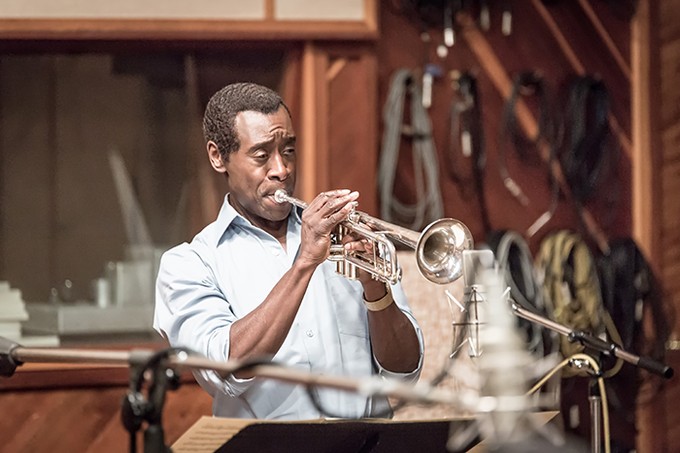
DC: Yeah, and I’ve played trumpet. We only hear my sound a little bit in this movie. We’re going to use professionals. I play the trumpet, but I’m not a trumpet player, and we’re never going to use my sound when we have Miles Davis’s sound to use. Keyon Harrold overdubbed a lot of stuff I did in the film. But for me, you see movies where actors are playing musicians sometimes, and you can tell they don’t have a real facility for what they’re doing. You see their hand going down on the guitar fret cord when the sound notes are going up. You don’t see their hands on the keyboard. For me, it was important to learn how to play the trumpet so that some point in the development process, I am where Miles was. Maybe I only got as far as he was when he was 9 or 10-years-old, but I wanted to have that facility under my hand.

Capone: “House of Lies” is starting up again. I love that show. I never miss an episode.

DC: Thank you.

Capone: Speaking of attitude, what can we expect this season? I know we’ve got some new people as always.

DC: Yeah, and we had a baby. Marty and Jeannie had a baby, which is terrifying. The thought of those two people parenting—it’s crazy.

Capone: Well, Marty has parented before.

DC: Yeah, but doing that as a team? Should that baby just be put up for adoption? And Skip Galweather comes back and makes this Faustian proposal to Marty at the beginning about the season, and we’re going to see over the course of the season how that plays out. Does he sell his business? What is he going to do to get ready to sell it to his enemy, by all accounts? And what does that look like?

Capone: I can’t wait. Don, thank you so much. It was great to meet you.

DC: Appreciate it.

miles_3_large.jpg


Back
Top