Conspiracy Theories - Official Thread!

US Customs And Border Patrol CBP Releases Videos Of Unidentified Aerial Phenomena
September 2023


Customs and Border Patrol released ten videos along with 387 pages of reports including news clippings and firsthand accounts from sightings of unidentified aerial phenomena. Chris Mellon, a former Secretary of Defense for Intelligence official, said the videos will help the public better understand why this is a national security issue.

 
China Ghost Cities


The official narrative is that these were built because of China’s massive investment/predictions on relocating its massive population core from rural areas into these structures. Along with China just going buckwild crazy in building.

For whatever reason, it never happened.

It’s believed that there are at least 50 Ghost City municipalities spread around China.

The current conspiracy is that there never were plans on relocating Chinese citizens. There are those who believe these cities are part of the Global Initiative to relocate millions of people from around the world to these China Ghost Cities (including people from the United States).

Basically, relocating the “Undesirables”. The people who are not productive in their native countries of origin. They would be moved here and spend their remaining years in servitude thru-out China’s factories and farms.

What do you think?….

Eerie photos of enormous Chinese cities completely empty of people

Throughout China, there are hundreds of cities that have almost everything one needs for a modern, urban lifestyle: high-rise apartment complexes, developed waterfronts, skyscrapers, and even public art. Everything, that is, except one major factor: people.

These mysterious — and almost completely empty — cities are a part of China's larger plan to move up to 300 million citizens currently living in rural areas into urban locations. Places like the Kangbashi District of Ordos are already prepped and ready to be occupied.

Photographer Kai Caemmerer became fascinated with these urban plans, and in 2015 he traveled to China to explore and document them. His series, "Unborn Cities," depicts a completely new type of urban development. "Unlike in the US, where cities often begin as small developments and grow in accordance to the local industries, these new Chinese cities are built to the point of near completion before introducing people," he told Business Insider.

88aa81a5da11defc0ff6a799a437342b


060169d18023cbbfceb477744a2e3a10


428189a7-64d3-4b5b-9dd8-0af462a3f24f-5%20Aerial%20drone%20shot%20of%20residential%20apartments%20in%20Shanghai%20Pudong.jpg


A_Halted-Construction_2.jpg


61601cedd62be70019c008ce


20210422121534828859558.jpg


SCHMIDT-ANGOLA-AIF41.jpg


BbimMs2IgAAaUoS.jpg:large


4ff313a16bb3f7da0d00000f


10168_1.gif


thumbnail.jpeg


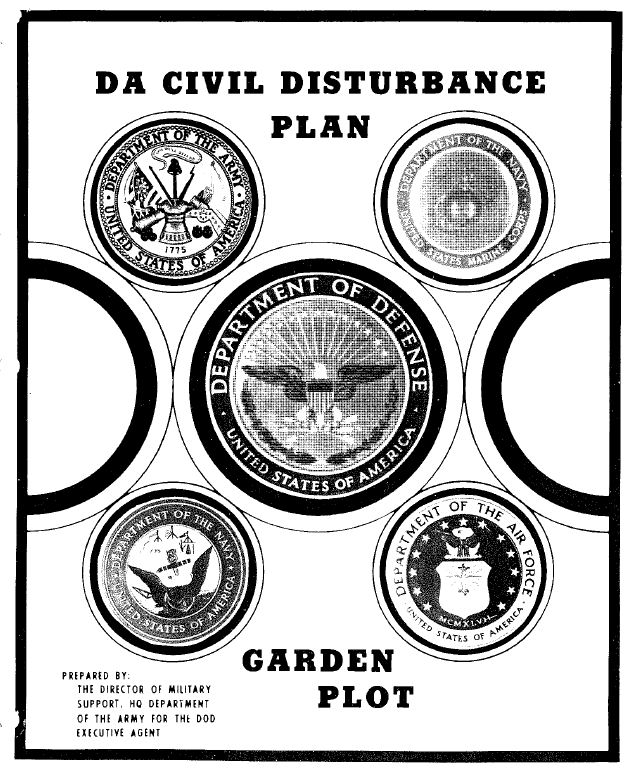
Operation “Garden Plot:” The Army’s Emergency Plan to Restore “Law and Order” to America


Here’s one that might make you dust off your tinfoil hat. It’s the US Army’s 1968 “Civil Disturbance Plan,” codenamed Garden Plot. The plan –first posted by governmentattic.org— explains how the Army planned to “employ Federal forces to assist local authorities in the restoration and maintenance of law and order in the 50 states [and all other districts and territories].”

Of course, for the “restoration of law and order” to be legal, the president must decree it. Planning ahead, the Army drafted Annex Five (pg. 59): a five-section executive order that authorized the Secretary of Defense to “take all appropriate steps” to quell the restive population… All the president needed to do to allow the military to operate domestically was sign the dotted line.

The Garden Plot plan –drafted after the Watts, Newark, and Detroit riots– captures the acrimonious times when the document was drawn up. The section outlining the Army’s perception of the “situation” in America certainly insinuates an establishment that was afraid the disenfranchised. The Plot warns against “racial unrest,” as well as “anti-draft” and “anti-Vietnam” elements. It deserves a read in full (pgs. 36-37)

What the Army considered “indicators of potential violence (pg. 37)” are also telling (if jarring)

Garden Plot is a much larger and more broadly orchestrated operation than a governor “merely” calling in the Federal Guard (which happened 92 times from 1 July 1969-30 June 1970). And because historic Garden Plot activity was classified and current activity likely remains so, it is difficult to discern exactly how many times Garden Plot was evoked.

The Los Angeles Times reported that until 1971, there were two brigades (4,800 troops) on permanent standby to quell unrest. The Times also reported that Governor Ronald Reagan once addressed 500 soldiers drilling for Garden Plot; he joked that if his political enemies saw him they would accuse him of “planning a military takeover.”

Globalsecurity.org reports that Garden Plot deployments “were commonplace” in the late 1960s and early 1970s. Among other instances, deployments occurred after Martin Luther King Jr.’s assassination, in response to the US invasion of Cambodia in 1970, and the Republican and Democratic conventions of 1972. There is speculation that Garden Plot was evoked after the 1992 Rodney King Riots and the 1999 Seattle WTO riots. The 1968 plan lists 25 “high priority” cities (pg. 177).

Establishing a contingency plan for civil unrest may have been a prudent and constitutional action by the US military. But by cloaking Garden Plot in unnecessarily secrecy, the executive branch contributed to the erosion of the US public’s trust of its government.

USArmy-GardenPlot-1978.png
 
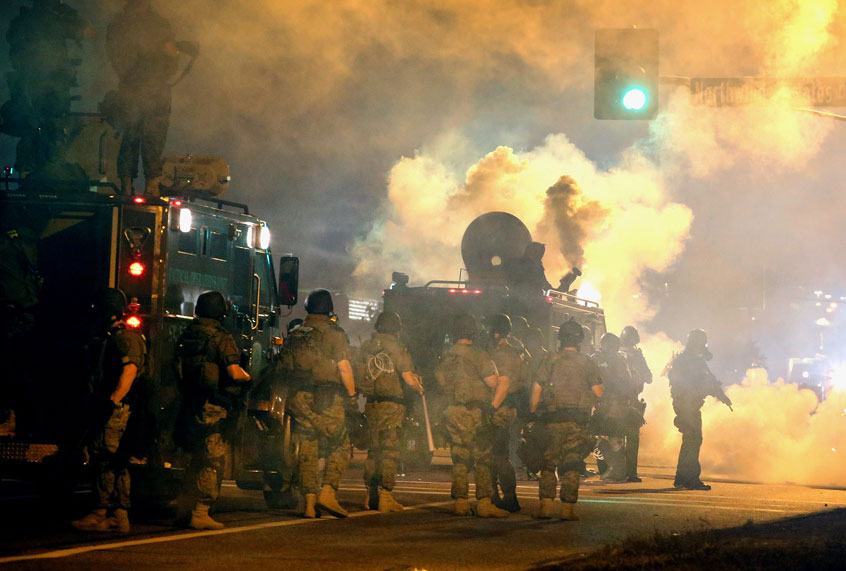
Leaked documents show FBI targeted post-Ferguson "black identity extremists" over white supremacists

FBI planned undercover operation aimed at infiltrating black "extremist" groups after 2014 Ferguson violence

By IGOR DERYSH
Senior News Editor
AUGUST 14, 2019


The FBI ranked black nationalists and animal rights activists as bigger threats than white supremacists and terror groups like al-Qaida among their official counterterrorism priorities, according to leaked FBI documents obtained by The Young Turks.

The documents show that the FBI’s official Consolidated Strategy Guide, which lists the bureau’s counterterrorism priorities, continues to focus on “black identity extremists,” well after the bureau assured Democrats in Congress that it would stop using the term after a 2017 internal FBI report that included the phrase was published by Foreign Policy.

In a 2018 strategy guide obtained by The Young Turks’ Ken Klippenstein, the FBI not only used the term but referred to “black identity extremists” as a “priority domestic terrorism target.” The documents did not mention any specific attacks, though it did list examples of high-profile white supremacist attacks, which were ranked a lower priority.

In 2019, the FBI did replace the term “black identity extremists” with the term “Racially Motivated Extremism,” according to the fiscal year 2018-20 counterterrorism strategy guides obtained by The Young Turks. Despite the new term, the threat guidance still included “Black Racially Motivated Extremism” in the definition.

“Racially Motivated Extremism … generally includes White Racially Motivated Extremism, previously referred to as White Supremacy Extremism, and Black Racially Motivated Extremism, previously referred to as Black Identity Extremism,” the document said.

In 2020, the FBI changed the term again to “Racial Motivated Violent Extremism” but still included most of the previous definition for “Black Identity Extremist.”

“RMVEs [Racially Motivated Violent Extremists] use force or violence in violation of criminal law in response to perceived racism and injustice in American society, or in an effort to establish a separate black homeland or autonomous black social institutions, communities, or governing organizations within the United States,” the 2020 guide said.

According to previous guides, the FBI believes that the threat originated from the Black Lives Matter movement in response to the 2014 shooting of Michael Brown in Ferguson, Missouri.

“The FBI judges BIE perceptions of police brutality against African Americans have likely motivated acts of pre-meditated, retaliatory lethal violence against law enforcement,” the 2018 guide said. “The FBI first observed this activity following the August 2014 shooting of Michael Brown in Ferguson, Missouri, and the subsequent acquittal of police officers involved in that incident.”

The 2018 guide also revealed that the FBI intended to counter the threat of black identity extremists with an operation called IRON FIST, which included undercover operatives:

It is challenging to get sources into BIE groups, due to security measures these groups employ. The vetting process and time investment to gain access to leadership in BIE groups is very lengthy. The use of undercover employees and online covert employees in BIE investigations would provide valuable intelligence to assist in mitigating the threat. IRON FIST will accomplish this by identifying actionable intelligence to directly support the initiation of FBI investigations and augment current efforts directed against BIEs. … In addition, FBIHQ works to develop potential CHS [Confidential Human Sources] and conduct assessments on the current BIE CHS base. … Many BIEs are convicted felons who are prohibited possessors, therefore the FBI will continue to use their prohibited possessor status as a tactic to assist in mitigating the threat for potential violence.

While the FBI designated black identity extremists as a “priority” threat, the same documents referred to “White Supremacy Extremists” as a “medium threat.” The term was later rolled into the “Racially Motivated Extremism” term in 2019.

Though the Racially Motivated Extremism term was used to label black identity extremists, all the incidents of violence cited as examples in the guide referred to attacks carried out by white supremacists, such as the synagogue shootings in Pittsburgh and Poway, California, and the mosque attacks in Christchurch, New Zealand. Last month, FBI Director Christopher Wray said the majority of domestic terror cases the agency has investigated “are motivated by some version of what you might call white supremacist violence.”

Despite the rise in white supremacist violence, the FBI predicted in its 2018 guide that the threat posed by white supremacists would only decline.

“The FBI further judges ongoing attrition of national organized white supremacy extremist groups will continue over the next year, yielding a white supremacy extremist movement primarily characterized by locally organized groups, small cells, and lone offenders,” the guide said. “Infighting and lack of leadership have made it difficult for groups to organize nationally and to sustain their memberships and influence. The internet and the emergence of social media have also enabled individuals to engage the WSE movement without joining organized groups.”

The American Civil Liberties Union warned in a statement that there is “no indication that IRON FIST or any other programs used to target Black people for surveillance has been dismantled.”

“The Black Identity Extremist label is baseless, and earlier this year, bureau director Wray testified that the label is no longer in use. But, based on these documents, it appears that the FBI simply renamed the label,” said Nusrat Choudhury, deputy director of the ACLU’s racial justice program. “These documents suggest that the FBI under Trump continues to prioritize criminalizing Black dissent while minimizing the threat of white supremacy.”

ELNk11jXsAYg37l
 
The Mysterious Betz Sphere of Fort George Island


Getting the ball rolling

Sometime in March or April 1974 - fittingly, the accounts aren’t consistent - three members of the Betz family, parents Gerri and Antoine and their oldest son Terry, were walking in the woods around their property on Jacksonville’s Fort George Island when Terry found something that would impact their lives for years: a strange metallic sphere, about the size of a bowling ball. Thinking it odd enough to make a good souvenir, Terry, then a 21-year old pre-med student, took the ball home.

OddBall_Episode_1_Extras_12-e1570030292286%20Terry%20Betz%20Akron%20Beacon%20Journal-X3.jpg

Terry Betz with the “Betz sphere” from the Acron Beacon-Journal.

The Betzes didn’t think much about the orb until one day when Terry started strumming his guitar near it. According to Gerri, who became the family spokesman on sphere-related matters, something strange happened: the ball started humming back. Soon it started displaying other unusual properties - it would roll around seemingly on its own volition, changing directions and halting abruptly. It even vibrated and emitted a high-pitched sound that would send dogs whining and covering their ears.

Theories, studies and tall tales

Shortly, the “Betz sphere,” also called the “mystery sphere” or simply the “Odd Ball,” started attracting attention. Ron Kivett, the host of local radio show on paranormal phenomena, was one of the first to inspect it. Kivett, who also has a place in local lore as one of the writers of the locally produced cult monster movie Zaat, confirmed the Betz family’s claims that the sphere moved and behaved strangely. He, like many others after him, was convinced that the orb was of extraterrestrial origin, a device created by some cosmic intelligence for an opaque purpose.

By mid-April the Betz sphere had also drawn the attention of the news. It’s not clear whether the Betzes contacted the media or if reporters caught wind of it around town, but Jacksonville’s local papers, the Jacksonville Journal and the Florida Times-Union, began covering the sphere and interviewing Gerri about it. According to Lindsey Kilbride, a reporter for The Jaxson’s partner WJCT and host of a podcast about the sphere - more on that in a bit - the sphere captured people’s curiosity. “Around that time, UFOs were really popular,” said Kilbride. The story only got bigger from there.

OddBall_Episode_1_Extras_2%20-%20Wayne%20Betz%2012-X3.jpg

12-year-old Wayne Betz with the sphere, from the Jacksonville Journal.

“Within one or two weeks of it making headlines locally, it was a national story, and there were even international publications that picked it up as well,” said Kilbride. In the spring of 1974, reporters from around the world were asking, what is this crazy thing down in Jacksonville, and where did it come from?

OddBall_Episode_1_Extras_13-X3.jpg

Some of the many news stories on the sphere from the Florida Times-Union archives.

With curiosity at a fever pitch, even the U.S. Navy wanted a look at the Betz sphere. A shrewd businesswoman, Gerri wrote up a contract that gave the Navy two weeks to inspect the orb at Naval Station Mayport, and committed them to returning it if it turned out not to be government property. In contemporary news reports, the Navy spokesman stated that they’d found only that the ball was stainless steel, was not their property, and that while they couldn’t determine what it was for, it was certainly constructed on Earth. The Navy suggested that its tendency to move around was due to a small triangular chip in the surface that threw off its otherwise perfect balance, and the fact that the Betz’s floors were uneven. But of course they’d say that.

“Within one or two weeks of it making headlines locally, it was a national story, and there were even international publications that picked it up as well,” said Kilbride. In the spring of 1974, reporters from around the world were asking, what is this crazy thing down in Jacksonville, and where did it come from?

With curiosity at a fever pitch, even the U.S. Navy wanted a look at the Betz sphere. A shrewd businesswoman, Gerri wrote up a contract that gave the Navy two weeks to inspect the orb at Naval Station Mayport, and committed them to returning it if it turned out not to be government property. In contemporary news reports, the Navy spokesman stated that they’d found only that the ball was stainless steel, was not their property, and that while they couldn’t determine what it was for, it was certainly constructed on Earth. The Navy suggested that its tendency to move around was due to a small triangular chip in the surface that threw off its otherwise perfect balance, and the fact that the Betz’s floors were uneven. But of course they’d say that.

Scientists were the next to take a crack at the mystery. As it happened, shortly after the Betz sphere story had broken, the National Enquirer was convening a panel of five UFO investigators in New Orleans. Despite the disreputable sponsor and subject, each of the members was a scientist or engineer in their own right. Among them was J. Allen Hynek, a Northwestern University astronomy professor and the best known ufologist of the time. The Enquirer flew Terry Betz and the sphere out so it could be investigated by the panel. Evidently, Hynek and his colleagues were unimpressed with the ball and agreed with the Navy that it was man-made.

These conclusions did nothing to tamp down interest in the sphere, and eventually, the Betz family had had enough. A year and half or so after the orb became national news, the family simply stopped talking about the sphere. “I have recorded interviews with her at the time, and this is just extremely overwhelming for her family,” said Kilbride. “[Gerri Betz] was getting calls 24 hours a day, the phone was just constantly ringing. People were just showing up at her house. It drastically changed their lives. This is kind of what they became known for.” With the Betzes no longer taking sphere-related inquiries, it was never definitively proven what the thing was or how it had gotten on Fort George Island.
 
Has the mystery of the Mars 'Monolith' been solved?

By Daily Mail Reporter
04 Aug 2009
updated 06 Aug 2009


An image of what appears to be a mysterious rocky monument on Mars has excited space junkies around the world.

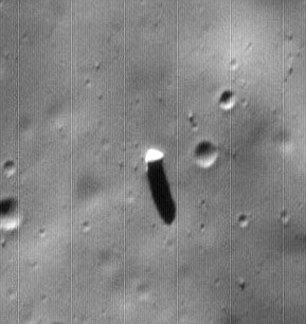
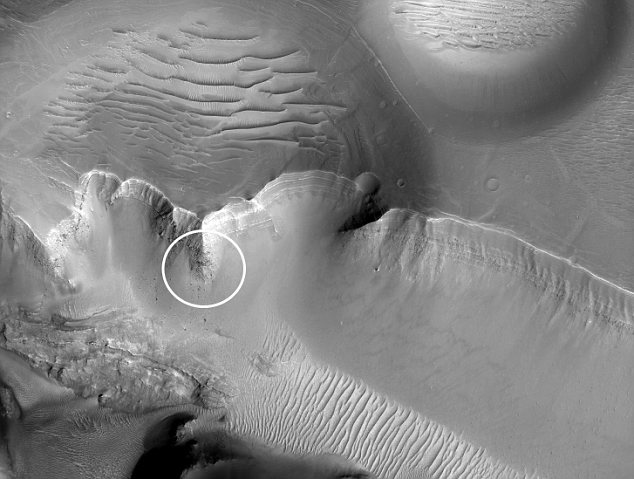
The 'monolith', was snapped from 165miles away using a special high resolution camera on board the Mars Reconnaissance Orbiter.

After being published on the website Lunar Explorer Italia, it set tongues wagging with space buffs questioning whether there was once life on the Red Planet.

But scientists at the University of Arizona, who captured the original image, reckon it's just an unremarkable boulder, which could measure up to five metres across.

Yisrael Spinoza, a spokesman for the HiRISE department of the university's Lunar and Planetary Laboratory, gave Mail Online the original image so readers can make up their own minds.

He said: 'It would be unwise to refer to it as a "monolith" or "structure" because that implies something artificial, like it was put there by someone for example.

'In reality it's more likely that this boulder has been created by breaking away from the bedrock to create a rectangular-shaped feature.'

The image seems to resemble the black monolith that appears during key moments of man's evolution in the Stanley Kubrick film 2001: A Space Odyssey.

The original image, taken last July, was published again this week on the University of Arizona's HiRISE website on the 'spotlight' page which seems to have led to the renewed interest.

'Is it possible that there used to be an ancient civilization on Mars?' former Montreal radio presenter David Tyler asked on his blog.

'Is it possible that NASA already knows the answer? Could this be the final straw for disclosure?'

But speaking about the satellite picture scientist Alfred McEwen, the principal investigator from the University of Arizona's HiRISE department, said: 'There are lots of rectangular boulders on Earth and Mars and other planets.

'Layering from rock deposition combined with tectonic fractures creates right-angle planes of weakness such that rectangular blocks tend to weather out and separate from the bedrock.'

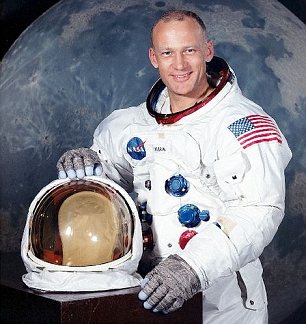
Fuel was added to the flames after Buzz Aldrin, the second man to walk on the Moon, alluded to a similar monolith detected on Mars' moon Phobos.

Speaking on a U.S. cable television channel last week he said: 'We should visit the moons of Mars.

'There's a monolith there - a very unusual structure on this little potato shaped object that goes around Mars once every seven hours.

'When people find out about that they are going to say, "Who put that there? Who put that there?" Well the universe put it there, or if you choose God put it there.'

In 2007 the Canadian Space Agency funded a study for an unmanned mission to Phobos known as PRIME (Phobos Reconnaissance and International Mars Exploration).

The building-sized monolith is the main proposed landing site but not because scientists suspect UFO activity. They believe the object is a boulder exposed relatively recently in an otherwise featureless area of the asteroid-like moon.

PRIME investigator Dr Alan Hildebrand said it could answer questions about the moon's composition and history.

'If we can get to that object, we likely don’t need to go anywhere else,' he told his science team.

The fact it seems to resemble a rectangular monument could be due to simulacra. This is where humans see familar images in random surroundings such as the famous 'Face of Mars', which is actually just a hilly and cratered area.

article-1204254-05F2FFFF000005DC-66_306x324.jpg


article-1204254-05F2E104000005DC-903_634x264.jpg

Close, closer, closest: The Mars 'monolith' was recently spotted (above) in a satellite HiRISE image
Phobos monolith


article-1204254-05F30086000005DC-189_634x479.jpg

From further away: The circled area show where the rectangular feature, described by scientists as a boulder, was discovered

article-1204254-05B8479E000005DC-800_306x324.jpg

Buzz Aldrin, pictured here in his Apollo space suit

article-1204254-000B8CF400000258-232_634x310.jpg

An image sent by the Viking spacecraft in 1976 seemed to show a human-like face on the surface of Mars

 
The UFO Reporter
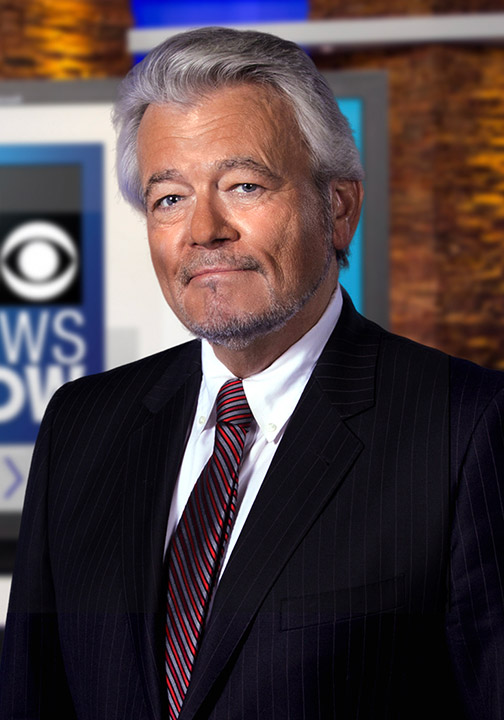
The Files of George Knapp


For the first time, NewsNation is bringing you unprecedented access to the files of legendary television reporter George Knapp.

For over thirty years, investigative journalist George Knapp has fearlessly taken on the biggest mysteries, crimes and scandals.

From mob activity in Las Vegas to strange phenomena in the sky.

Now, NewsNation is bringing you unprecedented access to his archives that date back decades. And how his life’s work still influences the conversation on UFOs today.

George-Knapp_web.jpg


Mount Pony

The Federal Reserve’s Communications and Records Center (Culpeper, Virginia)


Until recently the Federal Reserve Board operated a 140,000 square-foot (13,020 square-meter) radiation hardened facility inside Mount Pony just east of Culpeper, Virginia (near the intersection of State Routes 658 and 3). Dedicated on December 10, 1969, the 400 foot long (122 meter) bunker was built of steel-reinforced concrete one foot (30.5 centimeters) thick. Lead-lined shutters could be dropped to shield the windows of the semi-recessed facility, which is covered by 2-4 feet (0.6-1.2 meters) of dirt and surrounded by barbed-wire fences and a guard post. The seven computers at the facility, operated by the Federal Reserve Bank of Richmond, were the central node for all American electronic funds transfer activities.

Until 1988, Mount Pony stored several billion dollars worth of U.S. currency, including a large number of $2 bills shrink-wrapped and stacked on pallets 9 feet (2.7 meters) high. Following a nuclear attack, this money was to be used to replenish currency supplies east of the Mississippi.

Prior to July 1992, the bunker, about 70 miles (113 kilometers) southwest of Washington, D.C., also served as a continuity of government facility. With a peacetime staff of 100, the site was designed to support an emergency staff of 540 for 30 days, but only 200 beds were provided in the men’s and women’s dormitories (to be shared on a “hot-bunk” basis by the staff working around the clock). A pre-planned menu of freeze-dried foods for the first 30 days of occupation was stored on site; private wells would provide uncontaminated water following an attack. Other noteworthy features of the facility were a cold storage area for maintaining bodies unable to be promptly buried (due to high radiation levels outside), an incinerator, indoor pistol range, and a helicopter landing pad.

In November 1997, Congress authorized the transfer of the facility from the Federal Reserve to the Library of Congress which, using funds from a private foundation, will purchase and renovate the site to house its extensive motion picture, television, and recorded sound collections.

pony4.jpg

An aerial view of Mount Pony, showing how the facility is built into the hillside. A single guard station at the entrance controlled access to the site. There are 119 parking spaces.

pony1.jpg

The main entrance to the facility.

pony2.jpg

The entrance to Mount Pony’s ground-floor high security vault.

Screenshot-88-800x369.jpg


image-asset.jpeg


Screenshot-84-800x453.jpg


bunkerfilmhistoryfeat.jpg

 
Ever wondered why these billionaires like Elon Musk, Jeff Bezos and Richard Branson are spending billions to go up into space?

Maybe so when we go into SHTF status on Earth, they can make a run for it to their secret space station, while the rest of us fight and scavenge to survive.

That movie “Elysium” was onto something…

Private Space Stations

A crypto billionaire is joining the race for private space stations

By Tim Fernholz
September 12, 2022


A pioneer of cryptocurrency is turning to a different frontier: Jed McCaleb, the original founder of Mt. Gox and an early developer of Ripple, has founded a new company called Vast that aims to build space stations with artificial gravity.

It’s a high-risk business plan, but because the International Space Station is aiming at retirement in 2030, and NASA is shifting its focus to the Moon and beyond, a handful of companies are raising money and mocking-up plans for private habitats in low-earth orbit.

“We’re at the beginning of this explosion of activity in orbit and in space generally,” McCaleb tells Quartz. “A lot of that will require people in the loop to bring down the prices for things we really can’t do remotely or robotically at this point. There will be demand for multiple stations. We will be one of the first, if not the first.”

Building a machine shop in space, where astronauts could perform scientific experiments, manufacture special goods, or even build other spacecraft is a tall order for a software entrepreneur who has never run an aerospace business before. Vast will vie with firms like Axiom Space, which has its own module on the ISS and is flying private astronaut missions; Nanoracks, a longtime NASA contractor with its own space station plans; and Blue Origin, Jeff Bezos’ space company, which is developing a habitat called Orbital Reef.

The first obstacle for any mission like this is cost: While rockets built by Elon Musk’s SpaceX are driving down the price of access to orbit, launching substantial infrastructure still isn’t cheap. The ISS cost more than $100 billion, and while McCaleb thinks his station will be an order of magnitude cheaper, it’s still likely to cost a billion dollars or more, once development, testing, launch, construction, and operations are all factored in.

What sets Vast apart thus far is its dedication to creating a space station with artificial gravity. Existing plans for private space stations envision habitats like the ISS, where astronauts float about in microgravity. However, that environment can cause significant health problems for humans, including declining vision and loss of bone density, particularly over long-term stays. Creating artificial gravity, such as by rotating a habitat as in the movie 2001: A Space Odyssey, will be a significant engineering challenge. Vast isn’t yet ready to share the details on its concept for such a space station.

To get Vast’s station in orbit, McCaleb is betting on SpaceX’s Starship, the next-generation rocket the company is currently developing. While it has yet to make its first orbital flight, the vehicle is also at the center of NASA’s plans to put humans back on the Moon.

Like the other space station aspirants, Vast hopes to attract a variety of customers: Government astronauts from NASA and other space agencies, private astronauts on tourist trips, or from companies attempting to develop space-based businesses. While business models exist that take advantage of the unique properties of microgravity, from making drugs with microscopic crystals that can’t form in Earth’s gravity to creating goods like ultra-efficient fiberoptic cable, it’s not clear how much demand there will ultimately be for time spent 500 miles above the surface of the Earth.

Vast is mainly in recruiting mode right now, scooping up former employees of companies like SpaceX and Blue Origin. One key adviser is Hans Koenigsmann, formerly the top engineer at Musk’s firm.

Silicon Valley turns its eyes to orbit

McCaleb, whose net worth is estimated in the billions of dollars, wouldn’t say how much he has invested in Vast. He plans to self-fund the business through the launch of its first habitat, but wants it to ultimately be a sustainable enterprise. Vast’s future is not dependent on the crypto markets, according to McCaleb, who says “I still own a bunch of crypto, but I know that it’s volatile.”

McCaleb’s professional history began with developing peer-to-peer networks and creating Mt. Gox, initially a trading platform for Magic: The Gathering cards that became one of the most prominent early crypto exchanges. After he sold it in 2011, it collapsed dramatically in 2014. McCaleb was also one of the lead developers of Ripple, an early crypto alternative to bitcoin, and today is involved with Stellar, a digital currency trading protocol.

Now, he is turning a longtime personal interest in space exploration into a business. McCaleb, like Bezos and Musk, believes that the future of human civilization is beyond the Earth. “As a civilization, we need a frontier, otherwise things get very zero sum, and that’s very bad for society,” he told Quartz. “This is something that has higher [return on investment] for humanity. For me personally, I want to do the biggest ambitious thing, given the resources I have.”

Billionaire_space_race.png


960x0.jpg


220428100630-11-orbital-assembly-space-hotel.jpg


6044c0b944d8e300117b978a


180220-bigelow-630x412.jpg


axiom-station-iss-world-square.jpg


ghows-LK-696bddf4-8c24-2a78-e053-0100007f21cc-a0b379f2.jpeg


106965511-16352063421635206340-19407636315-1080pnbcnews.jpg


If you are a Conspiracy Fanatic, then you are familiar with Linda.

She is well respected in the Conspiracy World.

The Mystery Of The Dark Pyramid In Alaska
Linda Moulton Howe

A top-secret government facility beneath the Alaskan wilderness may be hiding an extraterrestrial pyramid. Strange forces within the Alaska Triangle are making wildlife more aggressive towards humans.


Shutterstock_10315635dl.jpg

Linda Moulton Howe

cropped-817c47f6-3e8a-46b2-bccd-7f5cc895d517-ThaAlaskaTriangle_S002_Ep001-740x416.jpg
 
The John Birch Society

In small-town Wisconsin, looking for the roots of the modern American conspiracy theory

BY TIM SULLIVAN
January 21, 2024


APPLETON, Wis. (AP) — The decades fall away as you open the front doors.

It’s the late 1950s in the cramped little offices — or maybe the pre-hippie 1960s. It’s a place where army-style buzz cuts are still in fashion, communism remains the primary enemy and the decor is dominated by American flags and portraits of once-famous Cold Warriors.

At the John Birch Society, they’ve been waging war for more than 60 years against what they’re sure is a vast, diabolical conspiracy. As they tell it, it’s a plot with tentacles that reach from 19th-century railroad magnates to the Biden White House, from the Federal Reserve to COVID vaccines.

Long before QAnon, Pizzagate and the modern crop of politicians who will happily repeat apocalyptic talking points, there was Birch. And outside these cramped small-town offices is a national political landscape that the Society helped shape.

“We have a bad reputation. You know: ‘You guys are insane,’” says Wayne Morrow, a Society vice president. He is standing in the group’s warehouse amid 10-foot (3-meter) shelves of Birch literature waiting to be distributed.

“But all the things that we wrote about are coming to pass.”

GetLogoFileById

Back when the Cold War loomed and TV was still mostly in black and white, the John Birch Society mattered. There were dinners at the Waldorf-Astoria in New York and meetings with powerful politicians. There was a headquarters on each coast, a chain of bookstores, hundreds of local chapters, radio shows, summer camps for members’ children.

90

A chair sits at the end of a row of file cabinets at a library in the John Birch Society headquarters in Appleton, Wis., Thursday, Nov. 17, 2022.

Well-funded and well-organized, they sent forth fevered warnings about a secret communist plot to take over America. It made them heroes to broad swaths of conservatives, even as they became a punchline to a generation of comedians.

“They created this alternative political tradition,” says Matthew Dallek, a historian at George Washington University and author of “Birchers: How the John Birch Society Radicalized the American Right.” He says it forged a right-wing culture that fell, at first, well outside mainstream Republican politics.

Conspiracy theories have a long history in the United States, going back at least to 1800, when secret forces were said to be backing Thomas Jefferson’s presidential bid. It was a time when such talk moved slowly, spread through sermons, letters and tavern visits.

No more. Fueled by social media and the rise of celebrity conspiracists, the last two decades have seen ever-increasing numbers of Americans lose faith in everything from government institutions to journalism. And year after year, ideas once relegated to fringe newsletters, little-known websites and the occasional AM radio station pushed their way into the mainstream.

90

CEO Bill Hahn points to articles of the Constitution in his office during an interview at the headquarters of the John Birch Society in Appleton, Wis., Thursday, Nov. 17, 2022.

Today, outlandish conspiracy theories are quoted by more than a few U.S. senators, and millions of Americans believe the COVID pandemic was orchestrated by powerful elites. Prominent cable news commentators speak darkly of government agents seizing citizens off the streets.

But the John Birch Society itself is largely forgotten, relegated to a pair of squat buildings along a busy commercial street in small-town Wisconsin.

So why even take note of it today? Because many of its ideas — from anger at a mysterious, powerful elite to fears that America’s main enemy was hidden within the country, biding its time — percolated into pockets of American culture over the last half-century. Those who came later simply out-Birched the Birchers. Says Dallek: “Their successors were politically savvier and took Birch ideas and updated them for contemporary politics.”

The result has been a new political terrain. What was once at the edges had worked its way toward the heart of the discourse.

To some, the fringe has gone all the way to the White House. In the Society’s offices, they’ll tell you that Donald Trump would never have been elected if they hadn’t paved the way.

90

Boxes of John Birch Society literature waiting to be distributed pamphlets and reports on a range of issues from COVID to inflation are stored in a warehouse at the headquarters of the John Birch Society in Appleton, Wis., Thursday, Nov. 17, 2022.

“The bulk of Trump’s campaign was Birch,” Art Thompson, a retired Society CEO who remains one of its most prominent voices, says proudly. “All he did was bring it out into the open.”

There’s some truth in that, even if Thompson is overstating things.

The Society had spent decades calling for a populist president who would preach patriotism, oppose immigration, pull out of international treaties and root out the forces trying to undermine America. Trump may not have realized it, but when he warned about a “Deep State” — a supposed cabal of bureaucrats that secretly controls U.S. policy — he was repeating a longtime Birch talking point.

A savvy reality TV star, Trump capitalized on a conservative political landscape that had been shaped by decades of right-wing talk radio, fears about America’s seismic cultural shifts and the explosive online spread of misinformation.

While the Birch Society echoes in that mix, tracing those echoes is impossible. It’s hard to draw neat historical lines in American politics. Was the Society a prime mover, or a bit player? In a nation fragmented by social media and offshoot groups by the dozens, there’s just no way to be sure. What is certain, though, is this:

“The conspiratorial fringe is now the conspiratorial mainstream,” says Paul Matzko, a historian and research fellow at the libertarian-leaning Cato Institute. “Right-wing conspiracism has simply outgrown the John Birch Society.”

Their beliefs skip along the surface of the truth, with facts and rumors and outright fantasies banging together into a complex mythology. “The great conspiracy” is what Birch Society founder Robert Welch called it in “The Blue Book,” the collection of his writings and speeches still treated as near-mystical scripture in the Society’s corridors.

90

Wayne Morrow, vice president of the John Society, walks past a world map hanging in a warehouse storing the organization’s literature, stickers and buttons at its headquarters in Appleton, Wis., Thursday, Nov. 17, 2022.

Welch, a wealthy candy company executive, formed the Society in the late 1950s, naming it for an American missionary and U.S. Army intelligence officer killed in 1945 by communist Chinese forces. Welch viewed Birch as the first casualty of the Cold War. Communist agents, he said, were everywhere in America.

Welch shot to prominence, and infamy, when he claimed that President Dwight D. Eisenhower, the hero general of World War II, was a “dedicated, conscious agent of the Communist conspiracy.” Also under Kremlin control, Welch asserted: the secretary of state, the head of the CIA, and Eisenhower’s younger brother Milton.

Subtlety has never been a strong Birch tradition. Over the decades, the Birch conspiracy grew to encompass the assassination of President John F. Kennedy, public education, the United Nations, the civil rights movement, The Rockefeller Foundation, the space program, the COVID pandemic, the 2020 presidential election and climate-change activism. In short, things the Birchers don’t like.

The plot’s leaders — “insiders,” in Society lexicon — range from railroad baron Cornelius Vanderbilt to former President George H.W. Bush and Bill Gates, whose vaccine advocacy is, they say, part of a plan to control the global population. While his main focus was always communism, Welch eventually came to believe that the conspiracy’s roots twisted far back into history, to the Illuminati, an 18th-century Bavarian secret society.

By the 1980s, the Society was well into its decline. Welch died in 1985 and the society’s reins passed to a series of successors. There were internal revolts. While its aura has waned, it is still a force among some conservatives — its videos are popular in parts of right-wing America, and its offices include a sophisticated basement TV studio for internet news reports. Its members speak at right-wing conferences and work booths at the occasional county fair.

Scholars say its ranks are far reduced from the 1960s and early 1970s, when membership estimates ranged from 50,000 to 100,000. “Membership is something that has been closely guarded since day one,” says Bill Hahn, who became CEO in 2020. He will only say the organization “continues to be a growing operation.”

Today, the Society frames itself as almost conventional. Almost.

“We have succeeded in attracting mainstream people,” says Steve Bonta, a top editor for the Society’s New American magazine. The group has toned down the rhetoric and is a little more careful these days about throwing around accusations of conspiracies. But members still believe in them fiercely.

“As Mr. Welch came out with on Day One: There is a conspiracy,” Hahn says. “It’s no different today than it was back in December 1958.”

It can feel that way. Ask about the conspiracy’s goal, and things swerve into unexpected territory. The sharp rhetoric re-emerges and, once again, the decades seem to fall away.

“They really want to cut back on the population of the Earth. That is their intent,” Thompson says.

But why?

“Well, that’s a good question, isn’t it?” he responds. “It makes no sense. But that’s the way they think.”

jsa1zr5gj1ls2wsib6a7jkrmvyn5-ebc706b12a61448789da6760ef8e2fce.jpg

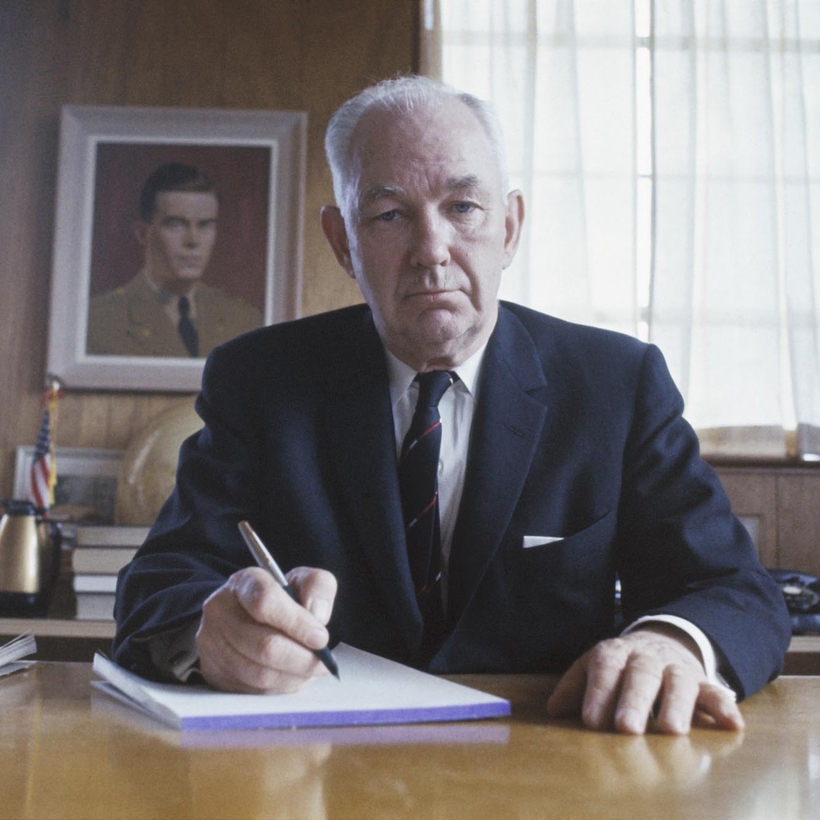
Robert Welch, Founder of The John Birch Society
12>
 
Dugway Proving Ground

Aliens at Dugway Proving Ground: Spaceships taking off from “the new Area 51”?

Richard Markosian
April 18, 2018


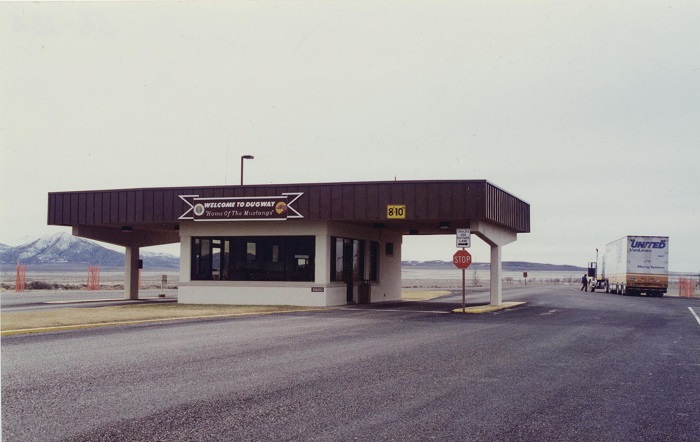
dugway.jpg

As home to 1,400 residents, you might call Dugway Proving Ground the ultimate gated community. There are an estimated 300 miles of roads around Dugway, but residents have clearance to only a fraction of the secret areas surrounding this mysterious place in Utah’s west desert.

Conspiracy theorists claim that Dugway is the “New Area 51”, and that US Government secret programs are hiding extraterrestrial technology that could liberate us from our fossil fuel-based dependency for energy. A friend and I thought we would stop in and see what we could find out.

The inhospitable, wind-swept Pony Express road leading to Dugway lies in the middle of nowhere. We entered the gates by showing my Utah State Legislature press credentials, but we were told we still must check in with security to gain permission for a tour. While we were waiting to speak to Dugway’s PR director, we watched a group of men wearing bulletproof vests with side arms enter Dugway’s main gate in black Ford Excursions. They appeared to be Army Special Forces. One man told me he was there for anti-terrorist training. After a 30-minute wait, I was denied access because I had an unpaid ticket on my driving record. My colleague was denied because he wasn’t an American citizen. After being escorted out by police, I began to wonder what was really going on here.

The main mission of Dugway is to test biological and chemical weapons for the Army. Doing so requires using a chunk of Utah the size of Rhode Island. There are so many civilian contractors and military personnel stationed at Dugway, that it has its own elementary school, high school, and Subway and Popeyes restaurants. They are currently hiring for all sorts of positions. On the surface it doesn’t appear suspicious.

649d165e695968001925d262

A technician in a gas mask takes a reading from a dummy in Dugway Proving Ground in 2017.

However, Dugway is divided into two parts. The Army operates the northern portion which houses most of the residents. The southeast portion is operated by the Air Force, with a runway large enough to land an aircraft the size of the space shuttle. This portion isn’t mentioned on Dugway’s website. It has been developed and expanded since 2004, with an increased security buildup. The additional infrastructure has led ufologists to conclude that this is a new site where the government is testing secret military and UFO technology.

649d043a695968001925d219

A truck approaches Dugway Proving Ground in 2017.

While researching the claims of the conspiracy theorists, my natural skepticism remains intact. But for the purposes of understanding Dugway, I felt inclined to listen to what the ET believers and conspiracists have to say.

Dr. Steven M. Greer is a leading ufologist. He says he gave up a $400,000 per year career in medicine to make contact with extraterrestrials and expose what he found, which was a giant cover-up by the US government dating back to the late 1940s. Greer, along with his followers, believe that a UFO indeed crash landed in Roswell, New Mexico, in 1947. Federal officers confiscated the remains of the ETs, who were still alive, as well as their flying saucer and medical scanning technology. According to Greer, the US secret “black box” program has been working in conjunction with Lockheed Martin to reverse-engineer the alien technology.

649d051f695968001925d226

Satellite image shows Dugway Proving Ground in 2016.

Greer says the U.S. secret program possesses technology to travel deep into outer space. These aircraft are so powerful and able to produce so much energy and thrust that they make our Space Shuttle Program appear like a Cub Scout project. It sounds like a nice story to sell books, but what evidence exists to support these wild claims?

The most convincing evidence Greer points at is that Lockheed Martin’s (one of the largest defense contractors in the world) former CEO, Dr. Ben Rich, admitted on his deathbed that for years he had been working with a secret military operation by developing anti-gravity technology and flying saucers powerful enough to “take ET home.”

According to Rich,“We already have the means to travel among the stars, but these technologies are locked up in black projects, and it would take an act of God to ever get them out to benefit humanity. Anything you can imagine, we already know how to do.”
Dr. Rich admitted that earlier in his career he agreed that the public should not know about these secret programs. Late in his life, he concluded that the “multinational, corporate board of directors who were over this secret program posed more of a potential threat to the US than ETs or the technology they were developing.”

As I opened this Pandora’s Box, what I initially believed to be completely absurd, suddenly sounded plausible. More key witnesses have come forward and backed Dr. Greer’s and Dr. Rich’s claims.

Don Phillips, another Lockheed Engineer, corroborates that they have developed flying saucer technology. Phillips adds, “These UFOs were huge and they would just come to a stop and do a 60-degree, 45-degree, 10-degree turn, and then immediately reverse this action.” Phillips also says that earlier scientists had indeed confiscated an aircraft that crash landed in Roswell, New Mexico, and reverse-engineered the technology.

649d169f695968001925d26a

A satellite image showing the housing area inside Dugway Proving Grounds in 2016.

Another account which adds credibility to the cover up these scientists’ claims is substantiated by one of the highest ranking military officials in the country. When Edgar Mitchell, former chief of intelligence for the Joint Chiefs of Staff, requested a briefing on the secret UFO programs that were in place, he was denied this briefing based on a “need-to-know basis.” Furious after this rejection, Mitchell went on the record for a CNN interview in 2008, stating that indeed he was told, “Sorry Admiral, but you don’t have the need to know. Goodbye.”

How is this all connected with Dugway Proving Ground? If the army was still developing this technology and testing it, they would need a massive amount of security to keep these operations private.

Dugway’s airfield is surrounded on three sides by mountains. Anyone caught attempting to climb these mountains with a vehicle and approach Dugway’s southern border will be stopped by ground patrol or Apache helicopters.
The History Channel recently produced a program called UFO Hunters, that made attempts to better understand what is happening at Dugway. The program interviewed some local Utahns.

649d21ceca7880001970867e

Col. William King, then the commander of Dugway Proving Ground, talks to the media near the main gate in 2011.

A Utah man known as Alien Dave says he has seen a jet vanish into thin air. And he says he has watched a convoy of Humvees that were traveling along a road disappear into a massive subterranean fortress built into the side of a mountain. He also personally witnessed a laser beam directed high into outer space. This beam was so powerful that its electromagnetic discharge left the air smelling of ozone and his hair standing on end.

In addition to Dave’s claims, a former police officer on the Goshute Reservation has seen more than his share of oddities. While traveling a desolate road in the west desert, he watched a flying saucer in the night sky. After flashing a light beam onto the UFO, it reacted by speeding up and disappearing over a mountain range. It was out of sight in seconds—moving faster than any known plane could travel. A short time later, two fighter jets followed the flying saucer’s flight path.
This technology is allegedly in the hands of our government, which doesn’t want to release it because of the disruptive effects it would have on our current economy because it would ostensibly eliminate all need for fossil fuel-based energy and transportation.

news_feature1-1-2a113c9d7ed64c55.jpg

A cylindrical tunnel in the Active Standoff Chamber at Dugway Proving Ground.

According to Dr. Greer, “elimination” is the problem. Anti-gravity technology can harness the power of the fabric of space. There is enough power in each square millimeter of space to solve all of the world’s energy needs. We have this technology, but if it were disseminated to the public, corporate empires would topple. The internal combustion engine would become a museum piece, and fossil fuel use would become obsolete. “The powers that be don’t want to see this happen, which is why even the President of the United States doesn’t have authority to make any decisions on these programs and technology,” Greer tells me.

Greer has partnered on a documentary film called The Sirus Project, which outlines his case: that a shadow government exists in the United States, where trillions of dollars have been funneled over the years, which falls outside the influence of the DOD, or any branch of the US military. Sounds like a plot from the X-Files.
Greer’s case is compelling. Just prior to the 9/11 attack on the US, Secretary of Defense, Donald Rumsfeld, said in a press conference that he had found a $2.3 trillion gap in funding, amounting to 25% of the military’s budget. These funds were never accounted for in the military’s defense budget.

According to Greer, untracked, unaccountable military funding like this has been going on for years. This became acceptable during WWII and the Cold War era, when secret funding was funneled to projects such as the Manhattan Project. But when the military chose to use their technology to end World War II, they chose to keep other elements secret and remain private—even out of the jurisdiction of the President.

President Carter attempted to gain clearance to understand this project and was told that his security clearance wasn’t high enough to be allowed a briefing on US extraterrestrial history and secret programs.

What, if anything, can we do if this is true? According to Greer, recent events are bringing things to a head. Greer believes that extraterrestrials are making contact with humans and have been doing so for years. But contrary to popular conception, all ETs so far have been friendly and peaceful. “They could completely wipe our entire planet; out game, set, match point in a heartbeat … but they choose to communicate with us peacefully.”

Greer continues, “If there is a battle, it will be initiated by the secret military industrial complex. We will be the aggressors.” Greer’s Disclosure Project has now surpassed $250 K from Kickstarter funding and aims to make the public aware of this massive coverup.

Should we accept all of this? I’m not ready to accept all of it. Greer charges $650 to have fellow ufologists come to his farm and communicate with ETs. And he stands to greatly benefit from book sales and the potential film. But the testimony from several former Lockheed Martin employees and scientists leads me to believe that large portions of this conspiracy are highly plausible.

I have watched interviews with retired military personnel who have experienced UFO incidents both through close encounters and radar anomalies, and they all speak to the high degree of coverup that is standard operating procedure after such incidents occur. Other countries have opened their UFO files completely, while the majority of US files have remained X-Files, with a high degree of restricted access.

In recent years, there has been an increase in the displays of incredible extraterrestrial light shows and spacecraft, including incidents in China, Russia, Norway and Arizona. Although these events have been covered by the mainstream media, few questions have been asked regarding the secret programs and huge funding gaps in military spending. It’s time that at least non-mainstream media and the public begin demanding answers.

There is currently no cold war (unless you count strained relations with Russia), and the war on terror has calmed down. The military needs to be held accountable for our tax dollars and prove to us that there isn’t an enemy from within, by releasing what they have been hiding for so many years. Greer might be a bit of an opportunist, but his mission to disclose this information is a mission we support.

For more information on the current state of Skunk Works, Lockheed Martin, and what is going on in with the Deep State secret programs, we recommend reading Sekret Machines by Tom DeLonge.

28592973.jpeg
 
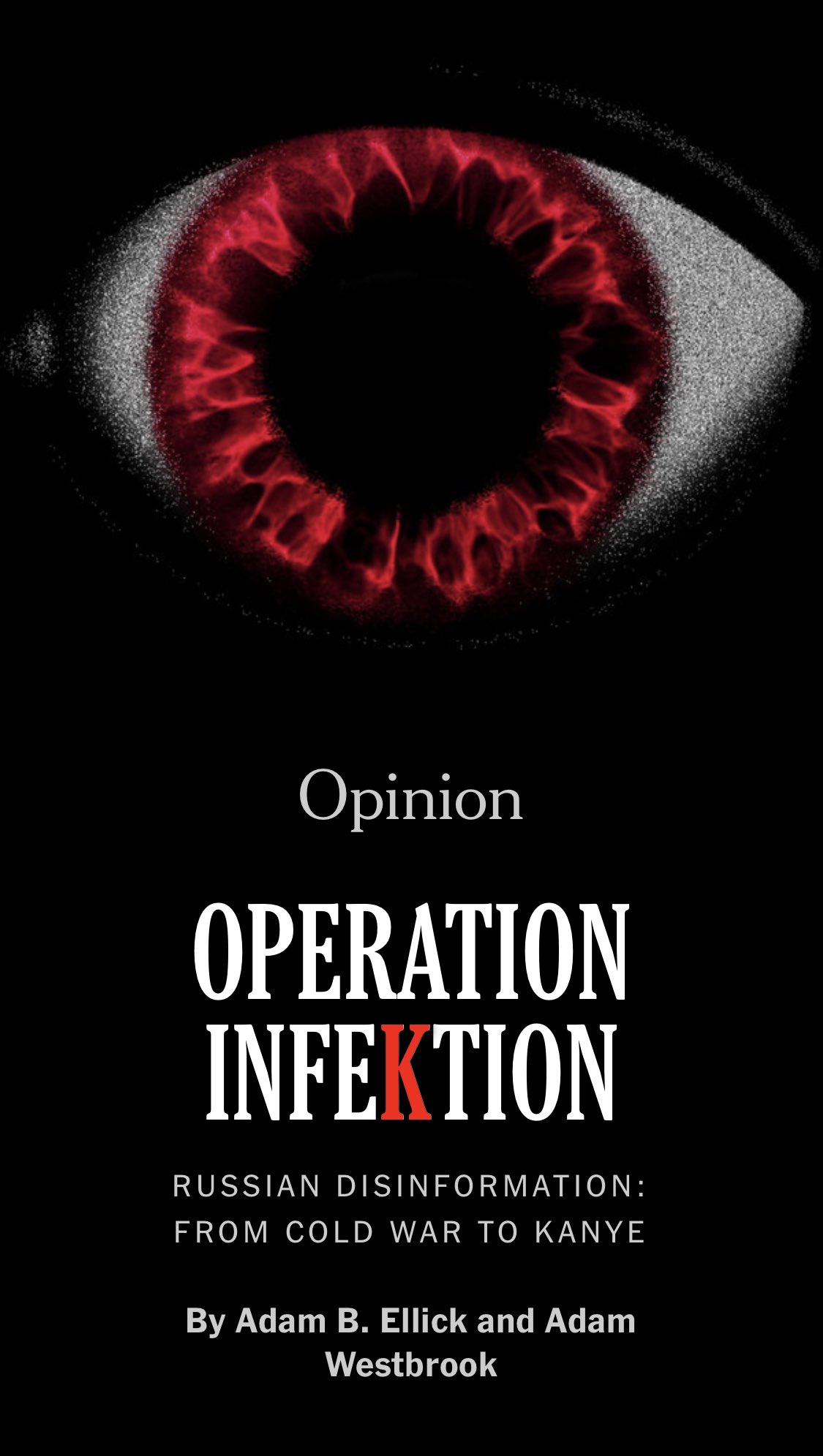
Operation Infektion

OPERATION INFEKTION: A THREE-PART VIDEO SERIES ON RUSSIAN DISINFORMATION
RUSSIAN DISINFORMATION: FROM COLD WAR TO KANYE
2019

Operation Infektion is a New York Times Opinion documentary that begins in the Soviet Union in 1959, when one of the world’s greatest disinformation engines was born. By way of animation and riveting interviews with Soviet disinformation agents, the series reverse-engineers the KGB playbook that concocted viral lies in a pre-Internet era.

The film pulls back the curtain on Moscow’s disinformation campaign, revealing it to be a highly organized, well-funded, concerted effort by Russian military intelligence operating since the 1960s — its purpose, then and now, to destabilize the West so Russia can more easily bully countries one by one. This playbook of deceit is now being mimicked worldwide, from India to Myanmar to Washington, D.C. Today’s fake news crisis is an old story, not a new story, and Operation Infektion will forever change how you consume news.

DuOa4skUUAAZ11b.jpg:large


The Secret History of Fort Detrick, MD, the CIA’s Base for Mind Control Experiments

Today, it’s a cutting-edge lab. In the 1950s and 1960s, it was the center of the U.S. government’s darkest experiments.

By STEPHEN KINZER
September 15, 2019


37232eab-4eba-418f-a536-c23b38e08926.jpeg
In 1954, a prison doctor in Kentucky isolated seven black inmates and fed them “double, triple and quadruple” doses of LSD for 77 days straight. No one knows what became of the victims. They may have died without knowing they were part of the CIA’s highly secretive program to develop ways to control minds—a program based out of a little-known Army base with a dark past, Fort Detrick.

Suburban sprawl has engulfed Fort Detrick, an Army base 50 miles from Washington in the Maryland town of Frederick. Seventy-six years ago, however, when the Army selected Detrick as the place to develop its super-secret plans to wage germ warfare, the area around the base looked much different. In fact, it was chosen for its isolation. That’s because Detrick, still thriving today as the Army’s principal base for biological research and now encompassing nearly 600 buildings on 13,000 acres, was for years the nerve center of the CIA’s hidden chemical and mind control empire.

90

Building 470 on the campus of Fort Detrick in Frederick, Md.

Detrick is today one of the world’s cutting-edge laboratories for research into toxins and antitoxins, the place where defenses are developed against every plague, from crop fungus to Ebola. Its leading role in the field is widely recognized. For decades, though, much of what went on at the base was a closely held secret. Directors of the CIA mind control program MK-ULTRA, which used Detrick as a key base, destroyed most of their records in 1973. Some of its secrets have been revealed in declassified documents, through interviews and as a result of congressional investigations. Together, those sources reveal Detrick’s central role in MK-ULTRA and in the manufacture of poisons intended to kill foreign leaders.

In 1942, alarmed by reports that Japanese forces were waging germ warfare in China, the Army decided to launch a secret program to develop biological weapons. It hired a University of Wisconsin biochemist, Ira Baldwin, to run the program and asked him to find a site for a new bio-research complex. Baldwin chose a mostly abandoned National Guard base below Catoctin Mountain called Detrick Field. On March 9, 1943, the Army announced that it had renamed the field Camp Detrick, designated it as headquarters of the Army Biological Warfare Laboratories and purchased several adjacent farms to provide extra room and privacy.

After World War II, Detrick faded in importance. The reason was simple: The United States had nuclear weapons, so developing biological ones no longer seemed urgent. As the Cold War began, however, two seemingly unrelated developments on opposite sides of the world stunned the newly created Central Intelligence Agency and gave Detrick a new mission.

The first was the show trial of the Roman Catholic Primate of Hungary Joseph Cardinal Mindszenty for treason in 1949. At the trial, the cardinal appeared disoriented, spoke in a monotone and confessed to crimes he had evidently not committed. Then, after the Korean War ended, it was revealed many American prisoners had signed statements criticizing the United States and, in some cases, confessing to war crimes. The CIA came up with the same explanation for both: brainwashing. Communists, the CIA concluded, must have developed a drug or technique that enabled them to control human minds. No evidence of this ever emerged, but the CIA fell hard for the fantasy.

In the spring of 1949 the Army created a small, super-secret team of chemists at Camp Detrick called the Special Operations Division. Its assignment was to find military uses for toxic bacteria. The coercive use of toxins was a new field, and chemists at the Special Operations Division had to decide how to begin their research.

At the same time, CIA had just established its own corps of chemical magicians. CIA officers in Europe and Asia were regularly capturing suspected enemy agents and wanted to develop new ways to draw prisoners in interrogation away from their identities, induce them to reveal secrets and perhaps even program them to commit acts against their will. Allen Dulles, who ran the CIA’s covert-operations directorate and would soon be promoted to direct the agency, considered his mind control project—first named Bluebird, then Artichoke, then MK-ULTRA—to be of supreme importance, the difference between the survival and extinction of the United States.

GettyImages-72556017.jpg

The exterior of the U.S. Army Medical Research Institute of Infectious Diseases, which has maintained stores of weapons-grade anthrax at Fort Detrick in Frederick, Maryland, is shown in this undated photo.

In 1951, Dulles hired a chemist to design and oversee a systematic search for the key to mind control. The man he chose, Sidney Gottlieb, was not part of the silver-spoon aristocracy from which most officers of the early CIA were recruited, but a 33-year-old Jew from an immigrant family who limped and stuttered. He also meditated, lived in a remote cabin without running water and rose before dawn to milk his goats.

Gottlieb wanted to use Detrick’s assets to propel his mind control project to new heights. He asked Dulles to negotiate an accord that would formalize the connection between the military and the CIA in this pursuit. Under the arrangement’s provisions, according to a later report, “CIA acquired the knowledge, skill, and facilities of the Army to develop biological weapons suited for CIA use.”

Taking advantage of this arrangement, Gottlieb created a hidden CIA enclave inside Camp Detrick. His handful of CIA chemists worked so closely with their comrades in the Special Operations Division that they became a single unit.

7a-portrait_custom-d36fee1f7b5c28af674188807e0a98ed51d0652b.jpg

CIA chemist Sidney Gottlieb headed up the agency's secret MK-ULTRA program, which was charged with developing a mind control drug that could be weaponized against enemies.

Some scientists outside the tight-knit group suspected what was happening. “Do you know what a ‘self-contained, off-the-shelf operation’ means?” one of them asked years later. “The CIA was running one in my lab. They were testing psychochemicals and running experiments in my labs and weren’t telling me.”

Gottlieb searched relentlessly for a way to blast away human minds so new ones could be implanted in their place. He tested an astonishing variety of drug combinations, often in conjunction with other torments like electroshock or sensory deprivation. In the United States, his victims were unwitting subjects at jails and hospitals, including a federal prison in Atlanta and an addiction research center in Lexington, Kentucky.

In Europe and East Asia, Gottlieb’s victims were prisoners in secret detention centers. One of those centers, built in the basement of a former villa in the German town of Kronberg, might have been the first secret CIA prison. While CIA scientists and their former Nazi comrades sat before a stone fireplace discussing the techniques of mind control, prisoners in basement cells were being prepared as subjects in brutal and sometimes fatal experiments.

These were the most gruesome experiments the U.S. government ever conducted on human beings. In one of the them, seven prisoners in Lexington, Kentucky, were given multiple doses of LSD for 77 days straight. In another, captured North Koreans were given depressant drugs, then dosed with potent stimulants and exposed to intense heat and electroshock while they were in the weakened state of transition. These experiments destroyed many minds and caused an unknown number of deaths. Many of the potions, pills and aerosols administered to victims were created at Detrick.

One of the most well-known victims of the MK-ULTRA experiments was Frank Olson. Olson was a CIA officer who had spent his entire career at Detrick and knew its deepest secrets. When he began musing about quitting the CIA, his comrades saw a security threat. Gottlieb summoned the team to a retreat and arranged for Olson to be drugged with LSD. A week later, Olson died in a plunge from a hotel window in New York. The CIA called it suicide. Olson’s family believes he was thrown from the window to prevent him from revealing what was brewing inside Camp Detrick.

A decade of intense experiments taught Gottlieb that there are indeed ways to destroy a human mind. He never, however, found a way to implant a new mind in the resulting void. The grail he sought eluded him. MK-ULTRA ended in failure in the early 1960s. “The conclusion from all these activities,” he admitted afterward, “was that it was very difficult to manipulate human behavior in this way.”

Nonetheless Fort Detrick, as it was renamed in 1956, remained Gottlieb’s chemical base. After the end of MK-ULTRA, he used it to develop and store the CIA’s arsenal of poisons. In his freezers, he kept biological agents that could cause diseases including smallpox, tuberculosis and anthrax as well as a number of organic toxins, including snake venom and paralytic shellfish poison. He developed poisons intended to kill Cuban leader Fidel Castro and Congolese leader Patrice Lumumba.

During this period, Fort Detrick’s public profile rose uncomfortably. No one knew the CIA was making poisons there, but its role as the country’s principal center for research into biological and anti-crop warfare became clear. From mid-1959 to mid-1960, protesters convened once a week at the gate. “No rationalization of ‘defense’ can justify the evil of mass destruction and disease,” they wrote in a statement.

In 1970, President Richard Nixon ordered all government agencies to destroy their supplies of biological toxins. Army scientists complied. Gottlieb hesitated. He had spent years assembling this deadly pharmacopeia and did not want to destroy it. After meeting with CIA Director Richard Helms, he reluctantly agreed that he had no choice.

d9a05b41acc04333ac1946f21da9dbe1.jpg

Former U.S. President Gerald Ford apologizing in 1975 to the family of Frank Olson, who died in 1953 after the CIA gave him a dose of LSD.

One batch, a supremely potent shellfish poison known as saxitoxin, escaped destruction, though. Two canisters containing nearly 11 grams of saxitoxin—enough to kill 55,000 people—were in Gottlieb’s depot at Fort Detrick. Before Army technicians could remove them, two officers from the Special Operations Division packed them into the trunk of a car and drove them to the Navy Bureau of Medicine and Surgery in Washington, where the CIA maintained a small chemical warehouse. One of Gottlieb’s aides later testified that he had ordered this operation without informing his boss. By the time the saxitoxin was discovered and destroyed in 1975, Gottlieb had retired.

Gottlieb was the most powerful unknown American of the 20th century—unless there was someone else who conducted brutal experiments across three continents and had a license to kill issued by the U.S. government. Detrick, his indispensable base, still contains untold stories of the cruelty that began there—just 50 miles from the center of the government that has kept them sealed for decades.

lsn.itc_htmldb.display_image
 
The Fine Structure Constant

Life as we know it would not exist without this highly unusual number

By Paul Sutter
March 24, 2022


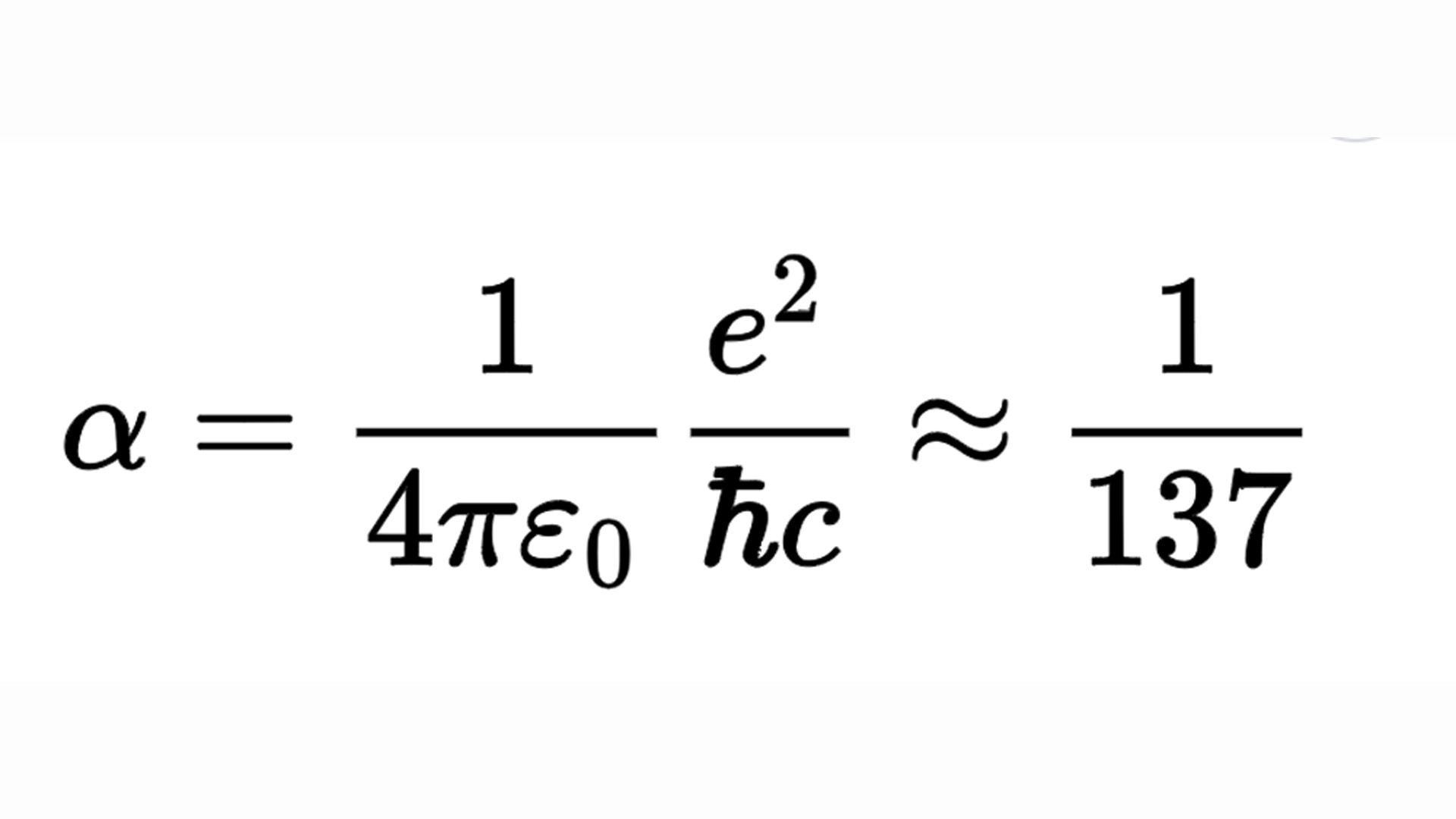
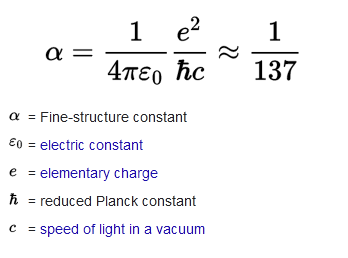
The fine-structure constant is a seemingly random number with no units or dimensions, which has cropped up in so many places in physics, and seems to control one of the most fundamental interactions in the universe.

A seemingly harmless, random number with no units or dimensions has cropped up in so many places in physics and seems to control one of the most fundamental interactions in the universe.

Its name is the fine-structure constant, and it's a measure of the strength of the interaction between charged particles and the electromagnetic force. The current estimate of the fine-structure constant is 0.007 297 352 5693, with an uncertainty of 11 on the last two digits. The number is easier to remember by its inverse, approximately 1/137.

SRwM6Jt-asset-mezzanine-16x9-HhaCISu.jpg

If it had any other value, life as we know it would be impossible. And yet we have no idea where it comes from.

A fine discovery

Atoms have a curious property: They can emit or absorb radiation of very specific wavelengths, called spectral lines. Those wavelengths are so specific because of quantum mechanics. An electron orbiting around a nucleus in an atom can't have just any energy; it's restricted to specific energy levels.

When electrons change levels, they can emit or absorb radiation, but that radiation will have exactly the energy difference between those two levels, and nothing else — hence the specific wavelengths and the spectral lines.

But in the early 20th century, physicists began to notice that some spectral lines were split, or had a "fine structure" (and now you can see where I'm going with this). Instead of just a single line, there were sometimes two very narrowly separated lines.

quote-there-are-considerable-mysteries-surrounding-the-strange-values-that-nature-s-actual-roger-penrose-71-69-07.jpg

The full explanation for the "fine structure" of the spectral line rests in quantum field theory, a marriage of quantum mechanics and special relativity. And one of the first people to take a crack at understanding this was physicist Arnold Sommerfeld. He found that to develop the physics to explain the splitting of spectral lines, he had to introduce a new constant into his equations — a fine-structure constant.

The introduction of a constant wasn't all that new or exciting at the time. After all, physics equations throughout history have involved random constants that express the strengths of various relationships. Isaac Newton’s formula for universal gravitation had a constant, called G, that represents the fundamental strength of the gravitational interaction. The speed of light, c, tells us about the relationship between electric and magnetic fields. The spring constant, k, tells us how stiff a particular spring is. And so on.

But there was something different in Sommerfeld's little constant: It didn't have units. There are no dimensions or unit system that the value of the number depends on. The other constants in physics aren't like this. The actual value of the speed of light, for example, doesn't really matter, because that number depends on other numbers. Your choice of units (meters per second, miles per hour or leagues per fortnight?) and the definitions of those units (exactly how long is a "meter" going to be?) matter; if you change any of those, the value of the constant changes along with it.

But that's not true for the fine-structure constant. You can have whatever unit system you want and whatever method of organizing the universe as you wish, and that number will be precisely the same.

If you were to meet an alien from a distant star system, you'd have a pretty hard time communicating the value of the speed of light. Once you nailed down how we express our numbers, you would then have to define things like meters and seconds.

But the fine structure constant? You could just spit it out, and they would understand it (as long as they count numbers the same way as we do).

The limit of knowledge

Sommerfeld originally didn't put much thought into the constant, but as our understanding of the quantum world grew, the fine-structure constant started appearing in more and more places. It seemed to crop up anytime charged particles interacted with light. In time, we came to recognize it as the fundamental measure for the strength of how charged particles interact with electromagnetic radiation.

Change that number, change the universe. If the fine-structure constant had a different value, then atoms would have different sizes, chemistry would completely change and nuclear reactions would be altered. Life as we know it would be outright impossible if the fine-structure constant had even a slightly different value.

So why does it have the value it does? Remember, that value itself is important and might even have meaning, because it exists outside any unit system we have. It simply … is.

In the early 20th century, it was thought that the constant had a value of precisely 1/137. What was so important about 137? Why that number? Why not literally any other number? Some physicists even went so far as to attempt numerology to explain the constant's origins; for example, famed astronomer Sir Arthur Eddington "calculated" that the universe had 137 * 2^256 protons in it, so "of course" 1/137 was also special.

Today, we have no explanation for the origins of this constant. Indeed, we have no theoretical explanation for its existence at all. We simply measure it in experiments and then plug the measured value into our equations to make other predictions.

Someday, a theory of everything — a complete and unified theory of physics — might explain the existence of the fine-structure constant and other constants like it. Unfortunately, we don't have a theory of everything, so we're stuck shrugging our shoulders.

But at least we know what to write on our greeting cards to the aliens.

E1tr1HyWEAkwmZN.png

The Fine Structure Constant
 
George Knapp
KLAS 8 News Now - Las Vegas, NV.

Breakdown Of The History Of Alleged UFO Crashes
January 29, 2024


Who Recovers Unidentified Objects That Fall Out Of The Sky
January 31, 2024

 
If there are advanced spacecraft why would they crash?

George Knapp
Jan 30, 2024


LAS VEGAS (KLAS) – Members of Congress have heard testimony about alleged UFO crashes and retrievals. The stories sound much like the plot of a sci-fi movie but are now being taken seriously in Washington.

The question is, if there are advanced spacecraft from beyond, why would they crash?

April 18, 1962, an unknown object entered Earth’s atmosphere over Cuba, traveled up the East Coast, and then made an abrupt 45-degree left turn at New York. It blazed across the heart of the U.S., and was pursued by military jets that could not keep up, and then landed in a small town in Utah where it knocked out electricity, locals said, before taking off again. Somewhere over east-central Nevada, it exploded in a massive fireball seen all over the west.

“It’s a fantastic case involving, not only a few hundred witnesses, thousands of witnesses saw this thing as it traveled across the United States.” UFO Investigator and author Preston Dennett said.

According to an Air Force intelligence report, one military pilot who chased the object thought it was structured, not just a fireball, and that it was gasping and sputtering as it flew. The Air Force’s infamous Project Blue Book explained it away as a meteor, despite its highly unusual maneuvers.

In the early 2000s, Las Vegas was the annual host to a UFO crash conference, where the best-known investigators shared information about dozens of similar incidents. Ryan Wood was the conference organizer and wrote a book listing more than 70 possible UFO crashes.

“The best cases are the ones where we have multiple witnesses, some physical evidence, and multiple investigations by a variety of people over a long period of time,” Wood said.

Wood admits some of the tales might be disinformation or made up. Former Army Intelligence Col. John Alexander, himself a UFO investigator, expressed glaring doubt.

“It seems inconceivable to me that this hyper-advanced technology came a trillion miles to crash in our backyard once, let alone that this stuff keeps falling down,” Alexander said.

If these are advanced craft from another galaxy or dimension or century, why would they crash here?

In Arizona, residents of Kingman reported seeing a bizarre aerial ballet involving multiple UFOs, almost as if they were in a dogfight. Three of the objects reportedly fell from the sky and were then scooped up by military units. Investigator Harry Drew thinks the craft was disrupted by an unusual and highly powerful radar array that was activated in Kingman.

“The retrieval team arrived just in time on May 22 when the red light craft was flying down the flyway from north to south ran through a corridor where high output high energy short bolts of microwave radiation was installed and operating. There were complaints locally about birds being killed and all kinds of things that happened,” Drew said.

Former government scientist Bob Lazar, who claimed in 1989 that he saw an array of nine bizarre E.T. craft in an underground facility near Area 51, said nearly all of them looked intact, not like anything that had crashed. He later speculated that some might have been acquired from archeological digs as if left behind long ago.

Lazar’s claims remain highly controversial, but our news reports about him and UFOs caught the attention of two men who would later have a profound influence on the hunt for UFO secrets and crash retrievals. One was a freshman U.S. senator named Harry Reid.

The other was Las Vegas billionaire Robert Bigelow, who subsequently created his research organization, NIDS, the National Institute for Discovery Science, advised by former intelligence officials, astronauts, and scientists.

After Reid was invited to a NIDS meeting, he was quietly hooked on the UFO subject. In 2007 Reid sponsored a secretive UFO investigation dubbed AAWSAP, overseen by the Defense Intelligence Agency and based within Bigelow Aerospace.

It became the largest acknowledged UFO program ever funded by the federal government. The DIA contract specified that Bigelow Aerospace needed to make special accommodations so it could receive unspecified special materials. AAWSAP personnel were informed that UFO crashes were real and that exotic technologies had been recovered, though those materials were never delivered.

At least two of the key players in AAWSAP were directly informed about crashed UFOs and where they might be stashed. When they tried to press the issue and asked to see the goods, alarm bells were set off and the program was shut down for good.

Harry Reid wasn’t the first Nevada senator to have an interest in UFOs and UFO crashes. One of his predecessors, four-term senator Howard Cannon, made his own inquiries years earlier.

There has never been definitive evidence put forward that proves there are aliens on Earth.

56a535a258c3231a008b4bb8
 
Stone Age megastructure found submerged in the Baltic Sea wasn’t formed by nature, scientists say

By Ashley Strickland, CNN
February 12, 2024


A megastructure found in the Baltic Sea may represent one of the oldest known hunting structures used in the Stone Age — and could change what’s known about how hunter-gatherers lived around 11,000 years ago.

Researchers and students from Kiel University in Germany first came across the surprising row of stones located about 69 feet (21 meters) underwater during a marine geophysical survey along the seafloor of the Bay of Mecklenburg, about 6 miles (9.7 kilometers) off the coast of Rerik, Germany.

The discovery, made in the fall of 2021 while aboard the research vessel RV Alkor, revealed a wall made of 1,670 stones that stretched for more than half a mile (1 kilometer). The stones, which connected several large boulders, were almost perfectly aligned, making it seem unlikely that nature had shaped the structure.

After the researchers alerted the Mecklenburg-Vorpommern State Office for Culture and Monument Preservation to their find, an investigation began to determine what the structure might be and how it ended up at the bottom of the Baltic Sea. Diving teams and an autonomous underwater vehicle were used to study the site.

The team determined that the wall was likely built by Stone Age communities to hunt reindeer more than 10,000 years ago.

A study describing the structure was published Monday in the journal Proceedings of the National Academy of Sciences.

“Our investigations indicate that a natural origin of the underwater stonewall as well as a construction in modern times, for instance in connection with submarine cable laying or stone harvesting are not very likely. The methodical arrangement of the many small stones that connect the large, non-moveable boulders, speaks against this,” said lead study author Dr. Jacob Geersen, senior scientist at the Leibniz Institute for Baltic Sea Research in Germany, in a statement.

Turning back time

The wall was likely built more than 10,000 years ago along the shoreline of a lake or a bog, according to the study. Rocks were plentiful in the area at the time, left behind by glaciers that had moved across the landscape.

But studying and dating submerged structures is incredibly difficult, so the research team had to analyze how the region has evolved to determine the approximate age of the wall. They collected sediment samples, created a 3D model of the wall and virtually reconstructed the landscape where it was originally built.

Sea levels rose significantly after the end of the last ice age about 8,500 years ago, which would have led to the wall and large parts of the landscape being flooded, according to the study authors.

But things were different nearly 11,000 years ago.

“At this time, the entire population across northern Europe was likely below 5,000 people. One of their main food sources were herds of reindeer, which migrated seasonally through the sparsely vegetated post-glacial landscape,” said study coauthor Dr. Marcel Bradtmöller, research assistant in prehistory and early history at the University of Rostock in Germany, in a statement. “The wall was probably used to guide the reindeer into a bottleneck between the adjacent lakeshore and the wall, or even into the lake, where the Stone Age hunters could kill them more easily with their weapons.”

pnas-presse-abb-03.jpg

P. Hoy, University of Rostock, model created using Agisoft Metashape by J. Auer, LAKD

The hunter-gatherers used spears, bows and arrows to catch their prey, Bradtmöller said.

A secondary structure may have been used to create the bottleneck, but the research team hasn’t found any evidence of it yet, Geersen said. However, it’s likely that the hunters guided the reindeer into the lake because the animals were slow swimmers, he said.

And the hunter-gatherer community seemed to recognize that the deer would follow the path created by the wall, the researchers said.

“It seems that the animals are attracted by such linear structures and that they would rather follow the structure instead of trying to cross it, even if it is only 0.5 meters (1.6 feet) high,” Geersen said.

The discovery changes the way researchers think about highly mobile groups like hunter-gatherers, Bradtmöller said. Building a massive permanent structure like the wall implies that these regional groups may have been more location-focused and territorial than previously believed, he said.

Hunting sites around the world

The discovery marks the first Stone Age hunting structure in the Baltic Sea region. But other comparable prehistoric hunting structures have been found elsewhere around the globe, including the United States and Greenland, as well as Saudi Arabia and Jordan, where researchers have discovered traps known as “desert kites.”

Stonewalls and hunting blinds built for hunting caribou were previously found at the bottom of Lake Huron in Michigan and discovered at a depth of 98 feet (30 meters). The Lake Huron wall’s construction and location, which includes a lakeshore to one side, is most similar to the Baltic Sea wall’s, the study authors said.

Meanwhile, the scientists continue their investigation in the Baltic using sonar and sounding devices, as well as planning future dives to search for archaeological finds. Only by combining the expertise from those in fields like marine geology, geophysics and archaeology are such discoveries possible, Geersen said.

Understanding the location of lost structures and artifacts on the seafloor is key as demand for offshore areas increases due to tourism and fishing and the construction of pipelines and wind farms, he said. And other undiscovered treasures at the bottom of the Baltic could potentially shed more light on ancient hunter-gatherer communities.

“We have evidence for the existence of comparable stonewalls at other locations in the (Bay of Mecklenburg). These will be systematically investigated as well,” said study coauthor Dr. Jens Schneider von Deimling, researcher in the Marine Geophysics and Hydroacoustics group at Kiel University, in a statement.

pnas-presse-abb-01.jpg

P. Hoy, University of Rostock, model created using Agisoft Metashape by J. Auer, LAKD
 
Operation Mockingbird


sofrep_black_and_white_graphic_novel_style_image_of_the_CIAs_Op_d9e578c0-ef1b-4d90-9b98-79469bc5afda.png

What was Operation Mockingbird?

James Slate
Aug 20, 2018


0*LkYOkQG-B9I7shFa.jpg

With regards to Conspiracy Theorists on both sides of the Political Spectrum lies a common conspiracy that the CIA controls the Mainstream Media in the United States. The evidence they cite for this is Operation Mockingbird, an alleged large-scale program of the United States Central Intelligence Agency (CIA) that began in the early 1950s and attempted to manipulate news media for propaganda purposes. So what was Project Mockingbird? Does this program indicate CIA control of the Press now? Did it then?

What was Project Mockingbird?

0*0oDUczJSpFlWchQ4.jpg

A more notorious CIA electronic surveillance operation was Project Mockingbird, which involved tapping the Washington, D.C. telephones of two U.S. newspaper reporters in 1963.The operation was done with the support of the telephone company, and with the apparent knowledge and consent of the Attorney General. The reporters had published extensive news articles that contained highly classified CIA information. The CIA tapped the reporters’ phones to identify the sources of that classified information, in order to prevent such leaks from continuing. The operation culminated in the identification of dozens and dozens of the reporters’ sources, including a White House staffer, an Assistant Attorney General, twenty-one congressional staffers, six Members of Congress, and twelve Senators.

Project Mockingbird-the CIA’s warrantless telephone tap of the phones of U.S. reporters to determine their sources of information does not appear to have been legal in 1973. Though the Agency had Attorney General approval to conduct the taps, the surveillance does not appear to have been done to collect foreign intelligence, but rather to assess the source of leaks, and therefore would not comply with the basic requirements of the foreign intelligence exception. It is possible that the project could have complied with that exception, and been legal, if the CIA originally believed that the leaks were being made by or to agents of a foreign power, or that the reporters were acting as agents of a foreign power. However, there is no indication that the CIA ever held such a belief or acted for such a purpose, and therefore the project would appear to have been illegal.

The Rockefeller Commission agreed, noting that the Agency has authority to conduct investigations of present or former employees, but “has no authority to investigate newsmen simply because they have published leaked classified information.” Thus you can conclude that Project Mockingbird was an illegal program, though not a program which indicated Agency control of the Press.

Does Project Mockingbird Indicate current day CIA Control of the Mainstream Media?

0*UYLcMuPoTyBN2yu5.jpg

After the Watergate scandal in 1972–1974, Congress became concerned over possible presidential abuse of the CIA. This concern reached its height when reporter Seymour Hersh published an expose of CIA domestic surveillance in 1975.Congress authorized a series of Congressional investigations into Agency activities from 1975 to 1976. A wide range of CIA operations were examined in these investigations, including CIA ties with journalists and numerous private voluntary organizations. None of the resulting reports, however, refer to an Operation Mockingbird.

The most extensive discussion of CIA relations with news media from these investigations is in the Church Committee’s final report, published in April 1976. The report covered CIA ties with both foreign and domestic news media.
For foreign news media, the report concluded that:

The CIA currently maintains a network of several hundred foreign individuals around the world who provide intelligence for the CIA and at times attempt to influence opinion through the use of covert propaganda. These individuals provide the CIA with direct access to a large number of newspapers and periodicals, scores of press services and news agencies, radio and television stations, commercial book publishers, and other foreign media outlets
For domestic media, the report states:

Approximately 50 of the [Agency] assets are individual American journalists or employees of U.S. media organizations. Of these, fewer than half are “accredited” by U.S. media organizations … The remaining individuals are non-accredited freelance contributors and media representatives abroad … More than a dozen United States news organizations and commercial publishing houses formerly provided cover for CIA agents abroad. A few of these organizations were unaware that they provided this cover.


The CIA was sensitive to the charge that CIA covert relationships with the American media jeopardize the credibility of the American press and risk the possibility of propagandizing the U.S. public. Former Director William Colby expressed this concern in recent testimony before the House Select Committee on Intelligence:

We have taken particular caution to ensure that our operations are focused abroad and not at the United States in order to influence the opinion of the American people about things from a CIA point of view.

As early as 1967, the CIA, in the wake of the National Student Association disclosure, moved to flatly prohibit the publication of books, magazines, or newspapers in the United States. More recently, George Bush, the new Director, undertook as one of his first actions to recognize the “special status afforded the American media under our Constitution” and therefore pledged that “CIA will not enter into any paid or contractual relationship with any full-time or part-time news correspondent accredited by any ‘United States news service, newspaper, periodical, radio or television network or station.”

Prior to the release of the Church report, the CIA had already begun restricting its use of journalists.The first major step to impose restrictions on the use of U.S. journalists was taken by former Director Colby in the fall of 1973. According to Mr. Colby’s letter to the Committee:

CIA will undertake no activity in which there is a risk of influencing domestic public opinion, either directly or indirectly. The Agency will continue its prohibition against placement of material in the American media. In certain instances, usually where the initiative is on the part of the media, CIA will occasionally provide factual non-attributable briefings to various elements of the media, but only in cases where we are sure that the senior editorial staff is aware of the source of the information provided.


As a general policy, the Agency will not make any clandestine use of staff employees of U.S. publications which have a substantial impact or influence on public opinion. This limitation includes cover use and any other activities which might be directed by CIA.

Mr. Colby’s letter specified that operational use of staff-that is, fulltime correspondents and other employees of major U.S. news magazines, newspapers, wire services, or television networks — was to be avoided. Use would be less restricted for “stringers” or occasional correspondents for these news organizations, as well as for correspondents working for smaller, technical, or specialized publications.

On February 11, 1976, the CIA announced new guidelines governing its relationship with U.S. media organizations. The public statement that the CIA issued expressed a policy of even greater restraint:

Effective immediately, CIA will not enter into any paid or contractual relationship with any full-time or part-time news correspondent accredited by any U.S. news service, newspaper, periodical, radio or television network or station.As soon as feasible, the Agency will bring existing relationships with individuals in these groups into conformity with this new policy.


From CIA testimony later that month, the Committee learned that this prohibition extends to non-Americans accredited to U.S. media organizations.
By the time the Church Committee Report was completed, all CIA contacts with accredited journalists had been dropped. According to the CIA, “accredited” applies to individuals who are “formally authorized by contract or issuance of press credentials to represent themselves as correspondents.” Furthermore on December 4, 1981 President Reagan issued Executive Order 12333 which specifically prohibits CIA relationships with the Media:

Limitation on Covert Action. No covert action may be conducted which is intended to influence United States political processes, public opinion, policies, or media.

The recently declassified CIA Internal Guidelines also reiterate the same prohibitions here:

E.O. 12333 prohibits CIA from engaging in special activities to influence U.S. political processes, public opinion, policies, or media.

and here:

In accordance with the authorities and responsibilities described in Section 2, the CIA is not authorized to and shall not engage in any intelligence activity, including dissemination of information to the Executive Office of the President, for the purpose of affecting the political process in the United States. Questions
about whether a particular activity falls within this prohibition will be resolved in consultation with the Office of General Counsel (OGC).


The older CIA Attorney General Guidelines also make mention of this policy in greater depth in the section Relations with Journalists and Staff of U.S. News Media Organizations.

No full-time or part-time journalists (including so called stringers) accredited by a U.S. news service, newspaper, periodical, radio, or television network or station will be used for the purpose of conducting any intelligence activities. The term accredited means any full-time or part-time employee of U.S. or foreign nationality who is formally authorized by contract or by the issuance of press credentials to represent himself either in the United States or abroad as a correspondent for a U.S. news media organization (including professional and trade journal publications) or who,is officially recognized by a foreign government to represent a U.S. news media organization.

Nonjournalist staff employees of any U.S. news media will not be used for the purpose of conducting intelligence activities without the approval of senior management of the news organization.

Open relationships with journalists or non journalist staff employees (for example, contracts to perform translating services or to lecture at training courses) will continue to be permitted. Open relationships are characterized by a willingness on both sides to acknowledge the fact and nature of the relationship to senior management officials of the organizations involved.

The name or facilities of any U.S. news media organization shall not be used to provide cover for any Agency employees or activities.
Nothing in this regulation prohibits the Public Affairs Office from maintaining regular liaison with representatives of the news media.


As per the Church Committee's recommendation (page 456), this ban is also now law with 50 U.S. Code § 3093. The National Security Act of 1947 has also been amended (page 111) to include these prohibitions .A finding may not authorize any action intended to influence United States political processes, public opinion, policies, or media. These bans are designed to protect the integrity of government and civil rights.

Conclusion

0*TFE2cq5kmvzKz2TH.jpg

Former CIA Director George H.W. Bush, January 30, 1976 – January 20, 1977

The CIA did have extensive paid and contractual relationships with journalists. But that policy ended 45–48 years ago. And is prohibited by Executive Order as well as National Security Law today. Internal safeguards and the congressional oversight process assure compliance. The Senate Select Committee on Intelligence (SSCI) and the House Permanent Select Committee on Intelligence (HPSCI), as well as other committees, closely monitor the Agency’s reporting and programs. Thus we can conclude that the CIA doesn’t “control” the Media in the United States. And one can conclude from a Reading of the Final Report from the Church Committee that it never did.

61-tEGOJjUL._AC_UF1000,1000_QL80_.jpg
 
UFOs: Past, Present, and Future
UFOs: It Has Begun
1974

The film is narrated by Rod Serling, Burgess Meredith, and José Ferrer. Serling and Meredith had previously worked together on The Twilight Zone. The 1979 re-release features commentary by noted UFOlogist and astronomer Jacques Vallée. The film uses dramatizations, interviews with government officials and scientists, and selected footage to provide context for UFO sightings, both ancient and contemporary.

MV5BMTI4MjcyMzUxMl5BMl5BanBnXkFtZTcwMzQ5MzcxMQ@@._V1_FMjpg_UX1000_.jpg


New Steven Spielberg Movie Coming.....


What are they preparing us for ??? :oops:
Here is a good reaction video
That describes what the movie might be about.....


side-eye-dog.gif
 
What in the world was going on in Egypt ??? :oops:

So the powers that be, want us to believe.....
Egyptians supposedly built not one, not two, but three big ass pyramids?
Plus they supposedly built the *possible* gigantic vertical columns & structure under the pyramids?
Plus they supposedly built the Sphinx?
Plus they supposedly built the tunnels, underground structure beneath the Sphinx?

And now I'm just hearing about a *possible* massive Labyrinth near the Pyramids too? :oops:


Back
Top