Conspiracy Theories - Official Thread!

What is Kona Blue? The proposed Las Vegas UFO technology program unveiled

George Knapp
May 9, 2024


Information has recently surfaced shedding light on an ambitious program that would have researched UFO technology in southern Nevada, aiming to exploit the tech, interview witnesses to extraterrestrial activities, and study the physical and psychological effects of the encounters.

Code-named “Kona Blue,” Las Vegas would have been in the eye of the storm when it came to UFO technology investigations if the program had come to fruition. But why the transparency now? Dr. James Lacatski, formerly a Defense Intelligence Agency (DIA) analyst and missile expert, has some insight.

“It was completely UFO-related,” Lacatski said regarding Kona Blue. In 2007, Lacatski became interested in reports of UFO activity at certain hotspots, including a property in northeast Utah known by its nickname Skinwalker Ranch.

Lacatski designed and championed a highly secretive program called the Advanced Aerospace Weapons System Application Program (AAWSAP), an acronym that purposefully omits terms regarding UFOs. He met with Nevada Senator Harry Reid, who, along with two Senate colleagues, secured $22 million in funds. With the contract awarded to a subsidiary of Bigelow Aerospace, AAWSAP became the largest acknowledged UFO investigation in history.

AAWSAP boasted 50 full-time employees, most based in southern Nevada, and created the world’s largest UFO data warehouse. It spawned more than 100 technical papers on different aspects of UFO technology and related phenomena. DIA has not released any of those papers.

However, Lacatski, the overall project manager, and his colleague Dr. Colm Kelleher, the onsite manager in Las Vegas, have co-authored two books about AAWSAP, reporting as much as government officials would allow.

In his 2023 book, Lacatski casually revealed that in 2011, he informed a U.S. senator and a high-ranking official that “the United States was in possession of a craft of unknown origin and had successfully gained access to its interior. This craft had…. no intakes, exhaust, wings, or control surfaces …(no) engine, fuel tanks, or fuel.”

In other words, the U.S. had a flying saucer.

Since that revelation, Lacatski has declined to say anything unauthorized by the Pentagon.

“There was more to it, considerably more to that discussion about what the situation was,” Lacatski said. “We can’t go into that.”

However, thanks to a surprise release from the All-domain Anomaly Resolution Office (AARO), the Pentagon’s current UFO program, the public is more able to read between the lines. The formerly top-secret document, declassified in February by Homeland Security, describes Kona Blue, a program designed by Lacatski, Kelleher, and other AAWSAP colleagues, as an ambitious plan to study and exploit UFO technology.

KONA BLUE

The papers describing Kona Blue, which would function as a successor to AAWSAP, did not mention UFOs or UAPs by name, but there are clues. For one, the documented purpose of Kona Blue was to “identify potentially disruptive technologies” by analyzing “material of unique origin and engineering.” Success in doing so would depend on gaining access to said materials.

Kona Blue would establish a system to collect sightings of such technology, including at locations of frequent reports. The papers reference advanced technology that has already been recovered and a plan to interview those familiar with those recoveries and how they might recover more. One section notes this recovered technology exists only within special access programs.

The program would have created a medical division to study the physical and psychological effects of encounters with advanced aerial vehicles on humans, including deaths and injuries. Notably, Kona Blue experts would be tasked with handling and examining “unusual and unique biological specimens.” It is not explicitly stated what the specimens were, but it is not difficult to infer.

Meant to be based in Las Vegas, the document notes that buildings already cleared to handle top secret materials were standing by. Businessman Robert Bigelow reportedly spent more than $1 million to bring his facilities into compliance with security requirements in preparation for the AAWSAP effort. His team had expected to receive unspecified but highly sensitive materials.

In 2009, Senator Harry Reid wrote to the Department of Defense to ask for special classification for the DIA program. Officials in Washington were alerted, opposition mounted, and the program’s budget disappeared. As a result, in 2011, Lacatski, Kelleher, and others tried to find another home for Kona Blue.

Documents show the Department of Homeland Security was briefed about what AAWSAP had learned. Dr. Tara O’Toole, deputy secretary for science and technology and noted scientist, was impressed enough to sign off on Kona Blue. However, as with AAWSAP, when top officials began knocking on doors to ask for access to the special materials, opposition to Kona Blue quickly mobilized and the proposed program was stopped dead.

Lacatski was measured when he spoke of the special materials officials wanted to access.

“There’s material, and there’s material,” he said. “Are you talking about material to be investigated? In other words, pieces falling off flying saucers? Or are you talking about full-blown craft? You know, there’s a big difference.”

BLUE LEGACY

Kona Blue was declassified by AARO to discredit evidence and testimony provided by witnesses and whistleblowers. Dr. Sean Kirpatrick, former head of AARO, said the people who tell of crashed saucers were all referring to Kona Blue.

However, as the program never existed and only a handful of people even knew it was proposed, it seems unlikely that witnesses who reported crashed saucers were seeing the results of Kona Blue.

 
The Grand Canyon Conspiracy

Jacob Garcia, Ben Brock Johnson, Paul Vaitkus, Matthew Reed
November 10, 2023


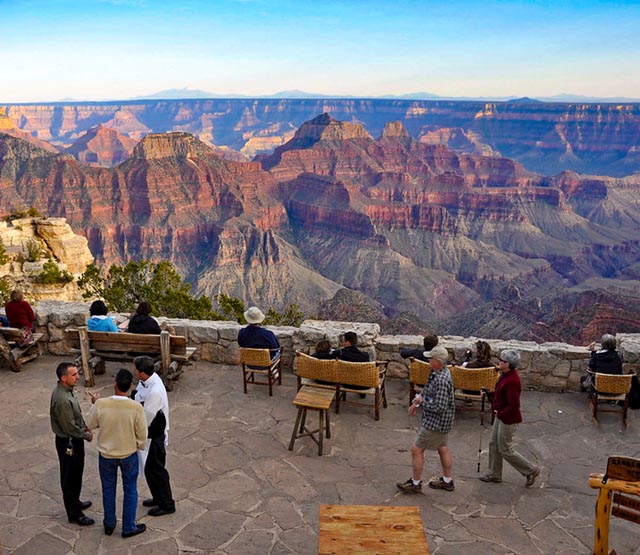
In 1909, the Arizona Gazette ran an article titled "Exploration in Grand Canyon." It said that an explorer by the name of G.E. Kincaid went into the National Park for the Smithsonian and found caves full of mummies and ancient Egyptian treasures that put everything we thought we knew about civilization on its head.

Well, the Smithsonian called the articles bunk reporting that Kincaid never worked for the institution. And it turns out he never existed! So how can a conspiracy that has been repeatedly debunked for decades, survive for so long?

ARIZONA GAZETTE

MONDAY EVENING
APRIL 5, 1909
EXPLORATIONS IN GRAND CANYON

https://www.bibliotecapleyades.net/egipto/grandcanyon/ArizonaGazette5April1909.htm

tuweep_mainpg.jpg

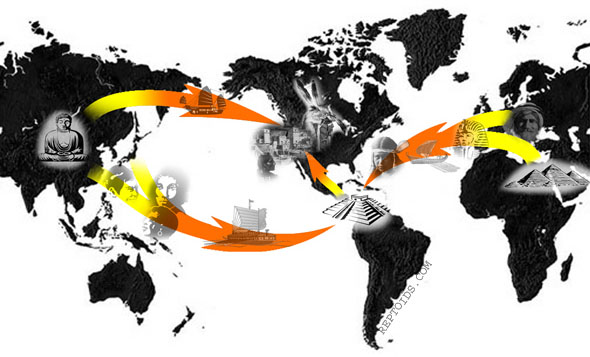
Remarkable Finds Indicate Ancient People Migrated From Orient

The latest news of the progress of the explorations of what is now regarded by scientists as not only the oldest archaeological discovery in the United States, but one of the most valuable in the world, which was mentioned some time ago in the Gazette, was brought to the city yesterday by G.E. Kinkaid, the explorer who found the great underground citadel of the Grand Canyon during a trip from Green River, Wyoming, down the Colorado in a wooden boat, to Yuma, several months ago.

According to the story yesterday to the Gazette by Mr. Kinkaid, the archaeologist of the Smithsonian Institute, which is financing the explorations, have made discoveries which almost conclusively prove that the race which inhabited this mysterious cavern, hewn in solid rock by human hands, was of Oriental origin or possibly from Egypt tracing back to Ramses.

If their theories are borne out of the translation of the tablets engraved with hieroglyphics, the mystery of the prehistoric peoples of North America, their ancient arts, who they were and whence they came, will be solved.

Egypt and the Nile and Arizona and the Colorado will be linked by a historical chain running back to ages which staggers the wildest fancy of the fictionist.

New-Globe.jpg

A Thorough Investigation

Under the direction of professor S.A. Jordan, the Smithsonian Institute is now prosecuting the most thorough explorations, which will be continued until the last link in the chain has been forged.

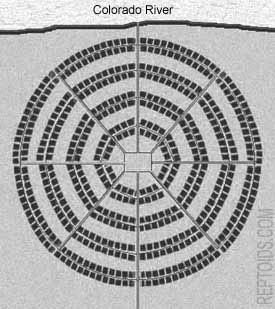
Nearly a mile underground, about 1480 feet below the surface, the long main passage has been delved into, to find another mammoth chamber from which radiates scores of passageways, like the spokes of a wheel. Several hundred rooms have been discovered, reached by passageways running from the main passage, one of them having been explored for 854 feet and another 634 feet.

The recent finds include articles which have never been known as native to this country and doubtless they had their origin in the Orient. War weapons, copper instruments sharp edged and hard as steel, indicate the high state of civilization reached by these strange people. So interested have the scientists become that preparations are being made to equip the camp for extensive studies and the force will be increased to thirty or forty persons.

Before going further into the cavern, better facilities for lighting have to be installed, for the darkness is dense and impenetrable for the average flash light.

In order to avoid being lost, wires are being strung from the entrance to all passageways leading directly to large chambers.

How far this cavern extends no one can guess, but it is now the belief of many that what has already been explored is merely the "Barracks", to use an American term, for the soldiers, and that far into the underworld will be found the main communal dwellings of the families and possibly other shrines.

The perfect ventilation of the cavern, the steady drought that blows through, indicates that it has another outlet to the surface.

Mr. Kinkaids Report


Mr. Kinkaid was the first white child born in Idaho and has been an explorer and hunter all his life.

Thirty years having been in the service of the Smithsonian Institute. Even briefly recounted, his history sounds fabulous, almost grotesque.

"First, I would impress that the cavern is almost inaccessible. The entrance is almost 1486 feet down a shear canyon wall. It is located on government land and no visitor will be allowed there under penalty of trespass. The scientists wish to work unmolested, without fear of the archaeological discoveries being disturbed by curio or relic hunters. A trip there would be fruitless and the visitor would be sent on his way.

The story of how I found the cavern has already been recounted, but in a paragraph: I was journeying down the Colorado river in a boat, alone, looking for mineral.

Some forty two miles up the river from El Tovar Crystal canyon, I saw on the east wall, stains in the sedimentary formation about 2000 feet above the river bed.

There was no trail to this point, but I finally reached it with great difficulty. Above a shelf, which hid it from view of the river, was the mouth of the cave.

There are steps leading from this entrance some thirty yards from what was at the time the cavern was inhabited, the level of the river. When I saw the chisel marks on the wall inside the entrance, I became interested, secured my gun and went in.

During that trip I went back several hundred feet along the main passage, till I came to the main crypt in which I discovered the mummies. One of these I stood up and photographed by flashlight. I gathered a number of relics, which I carried down the Colorado to Yuma, from whence I shipped them to Washington with details of the discovery.

Following this, the explorations were undertaken".

The Passages


CircularFloorPlan2_bw4web.jpg

"The main passageway is about 12 feet wide, narrowing to 9 feet toward the farther end.

About 57 feet from the entrance, the first passages branch off to the right and left, along which, on both sides, are a number of rooms about the size of ordinary living rooms of today, though some are 30 to 40 feet square.

These are entered by oval shaped doors and are ventilated by round air spaces through the walls into the passages.

The walls are about 3 feet 6 inches in thickness. The passages are chiseled or hewn as straight as could be laid out by any engineer.

The ceilings of many of the rooms converge to a center.

The side passages near the entrance run at a sharp angle from the main hall, but toward the rear they gradually reach a right angle in direction".

The Shrine


shrine1.jpg

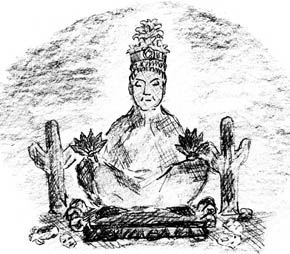
"Over a hundred feet from the entrance is a cross-hall, several hundred feet long, in which was found the idol, or image, of the peoples god, sitting cross-legged, with a Lotus flower or Lily in each hand. The cast of the face is Oriental, and the carving shows a skillful hand, and the entire is remarkably well preserved, as is everything in this cavern.

The idol most resembles Buddha, though the scientists are not certain as to what religious worship it represents. Taking into consideration everything found thus far, it is possible that the worship most resembles the ancient people of Thibet.

Surrounding this idol are smaller images, some beautiful in form, other crooked necked and distorted shapes, symbolical, probably, of good and evil. There are two large cacti with protruding arms, one on each side of the dais on which the god squats. All this is carved out of hard rock resembling marble.

In the opposite corner of this cross-hall were found tools of all descriptions, made of copper. This people undoubtedly knew the lost art of hardening this metal, which has been sought by chemists for centuries without result. On a bench running around the workroom was some charcoal and other material probably used in the process.

faces.jpg

There is also slag and stuff similar to matte, showing that these ancient peoples smelted ores, but so far, no trace of where of how this was done has been discovered, nor the origin of the ore. Among other finds are vases or urns and cups of copper and gold made very artistic in design. The pottery work includes enameled ware and glazed vessels.

Another passageway leads to granaries such as are found in the Oriental temples. They contain seeds of various kinds. One very large storehouse has not been entered, as it is twelve feet high and can be reached only from above. Two copper hooks extend on the edge, (continued on page 7) which indicates that some sort of ladder was attached. These granaries are rounded and the materials of which they are constructed, I think, is a very hard cement.

A grey metal is also found in this cavern which puzzles the scientists, for its identity has not been established. It resembles platinum. Strewn promiscuously over the floor everywhere are what people call "Cats eyes" or "Tiger eyes", a yellow stone of no great value. Each one is engraved with a head of a Malay type."

The Hieroglyphics


tools.jpg

"On all the urns, on the walls over the doorways and tablets of stone which were found by the image are mysterious hieroglyphics, the key to which the Smithsonian Institution hopes yet to discover. These writings resemble those found on the rocks about this valley.

The engraving on the tablets probably has something to do with the religion of the people.

Similar hieroglyphics have been found in the peninsula of Yucatan, but these are not found in the Orient. Some believe that these cave dwellers built the old canals in the Salt River valley. Among the pictorial writings only two animals are found. One is of prehistoric type".

The Crypt


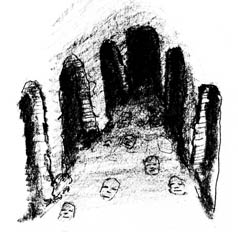
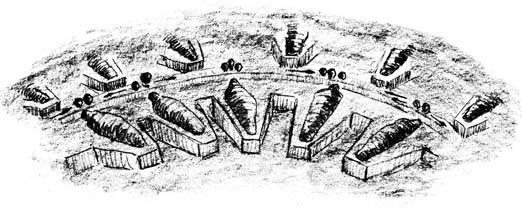
"The tomb or crypt in which the mummies are found is one of the largest of the chambers, the walls slanting back at an angle of about 35 degrees. One these are tiers of mummies, each one occupying a separate hewn shelf.

At the head of each is a small bench on which is found copper cups and pieces of broken swords. Some of the mummies are covered with clay and all are wrapped in a bark fabric. The urns or cups on the lower tiers are crude, while as the higher shelves are reached, the urns are finer in design showing a interstage of civilization. It is worthy of note that all the mummies examined so far have proved to be male, no children or females being buried here.
This leads to the belief that this interior section was the warriors barracks.

mummies.jpg

Among the discoveries no bones of animals have been found, no skins, no clothing nor bedding.

Many of the rooms are bare but for the water vessels. One room, about 400 by 700 feet, was probably the main dining hall for cooking utensils are found here. What these people lived on is a problem, though it is presumed that they came south for the winter and farmed in the valleys, going back north in the summer. Upwards of 50,000 people could have lived in the cavern comfortably.

One theory is that the present Indian tribe found in Arizona are descendants of the serfs or slaves of the people which inhabited the cave. Undoubtedly a good many thousands of years before the Christian era a people lived here which reached a high state of civilization.

The chronology of human history is full of gaps. Prof. Jordan is much enthused over the discoveries and believes that the find will prove of incalculable value in archaeological work.

One thing I have spoken of may be of interest.

There is one chamber the passageways to which is not ventilated and when we approach it a deadly, snaky smell struck us.

Our lights would not penetrate the gloom and until stronger ones are available, we will not know what the chamber contains.

Some say snakes, but others boo-hoo this idea and think that it may contain a deadly gas or chemicals used by the ancients.

No sounds are heard, but it smells snaky just the same.

The whole underground institution gives one of shaky nerves the creeps. The gloom is like a weight on ones shoulders and our flashlights and candles only make the darkness blacker.

Imagination can revel in conjectures and ungodly day-dreams back through the ages that have elapsed till the mind reels dizzily in space".

An Indian Legend


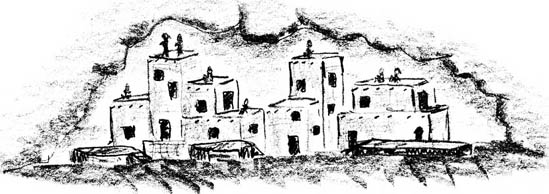
In connection with this story, it is notable that among the Hopis the tradition is told that their ancestors once lived in an underworld in the Grand Canyon till dissension arose between the good and the bad, the people of one heart, the people of two hearts.

(Manchoto) who was their chief, counselled them to leave the underworld, but there was no way out. The chief then caused a tree to grow up and pierce the roof of the underworld and then the people of one heart climbed out.

They tarried by Palsiaval (Red River), which is the Colorado, and grew grain and corn. They sent out a message to the temple of the sun, asking the blessing of peace, good will and rain for the people of one heart. That messenger never returned but, today at the Hopi village, at sundown can be seen the old men of the tribe out on the housetops gazing towards the sun, looking for the messenger.

When he returns, their land and ancient dwelling place will be restored to them. That is the tradition.

pueblo.jpg

Among the engravings of animals in the cave is seen a image of a heart over the spot where it is located.

The legend was learned by W.E. Rollins, the artist, during a year spent with the Hopi Indians. There are two theories of the origin of the Egyptians. One is that they came from Asia: another is that the racial cradle was in the upper Nile region.

Heeren, an Egyptologist, believed in the Indian origin of the Egyptians. The discoveries in the Grand Canyon may throw further light on human evolution and prehistoric ages."

T016_2.jpg
 
As supernatural claims flourish online, the Vatican revamps apparition rules for 1st time since 1978

Approved last month by Pope Francis, the rules officially take effect Sunday and offer instructions to bishops on how to conduct investigations.

Eric Lagatta
USA TODAY
May 17, 2024


It's about to become very rare for the Vatican to gives its stamp of approval to supernatural claims of weeping statues of the Virgin Mary and divine apparitions.

Under new guidelines revealed Friday, the Vatican has radically reformed its process for evaluating seemingly supernatural phenomena. The document, compiled by the Vatican’s Dicastery for the Doctrine of the Faith, is a bid for the Catholic Church to exert more control over unverified claims of faith-based events – including anything from stigmata wounds mirroring those of Jesus Christ, to holy visions.

050420_chicago_mary_bcol_7a.jpg

Candles, flowers and other gifts sit at a highway underpass where some believe is an apparition of the Virgin Mary on the wall April 19, 2005 in Chicago, Illinois. Police were posted in the area to keep traffic flowing as hundreds of people have been drawn to the site under I90 near downtown Chicago.

Approved last month by Pope Francis, the rules officially take effect Sunday and offer instructions to bishops, who have long been responsible for evaluating reported claims.

In the document, church leaders make clear that the intention of the guidelines' revisions is not to deny all new claims that emerge.

“The Church needs clear procedures,” the document states. The norms "are not intended to control or (even less) stifle the Spirit."

73729475007-vatican.jpg

What to know about the new rules

The reforms strengthen the criteria that bishops will use to investigate and possibly reject reports of alleged miraculous events.

However, Vatican approval will be required before ruling on the validity of those reports. The Dicastery of Congregation of the Faith, which is in charge of religious discipline within the Catholic church, will also weigh in on each case.

The new guidance outlines six possible conclusions that church leaders investigating events can reach, the most direct of which is outright rejection.

Significantly, the church will no longer endorse or verify any event as supernatural in origin. In that case, labeled as nihil obstat, the church will be determining that, while the event is not confirmed as supernatural, nothing about it is contrary to the faith.

While bishops may promote it, Catholics will no longer be compelled to believe it, the document makes clear.

jesus-toast1_fe.jpg

Image of Jesus Christ seen on Toast

New norms replace 1978 guidelines

The last time the Vatican issued rulings on supernatural phenomena was in 1978, but those guidelines were kept secret until 2011.

While the document does not reference specific fraudulent cases that made it necessary to replace those rules, the Vatican did acknowledge that the 1978 norms “are no longer adequate” – especially in the internet age.

Social media has allowed wild claims and obvious hoaxes to proliferate online, spreading like wildfire and capturing the imaginations of faithful Catholics eager to believe in the supposed divine phenomena. In the document, church leaders expressed concern about charlatans attempting to make money or gain power by manipulating people's beliefs.

“The use of purported supernatural experiences or recognized mystical elements as a means of or a pretext for exerting control over people or carrying out abuses is to be considered of particular moral gravity,” the document states.

Pilgrims flock to Lourdes, France, Fatima, Portugal after verified apparitions

Reported visions of the Virgin Mary and other divine apparitions, as well as stigmata appearing on hands and feet, have rippled through the Catholic Church for as long as it's existed.

Those recognized by the Vatican have inspired mass pilgrimages to the sights where they are said to have occurred.

Millions of faithful have for decades been drawn to Lourdes, France, where the Virgin Mary is said to have appeared in the 19th century, as well as in Fátima, Portugal, where she was alleged to have appeared again in 1917 to a group of children.

The church may have no desire to detract from such significant events, which have become a touchstone of the Catholic faith for many. But as Cardinal Victor Manuel Fernandez wrote in the document, "there are serious critical issues that are detrimental to the faithful."

"I am thinking of the use of such phenomenon to gain 'profit, power, fame, social recognition, or other personal interest," wrote Fernandez, head of the Vatican's doctrinal office.

x-files.jpg
 
Archaeologists found a secret chamber at the base of the Great Pyramid of Giza, and they have no idea what it is

Archaeologists discovered secret structures in Giza, Egypt with ground-penetrating high-tech methods. The methods revealed an L-shaped structure and a deeper, larger anomaly hidden beneath bare sand. The findings could explain why a large section of the densely packed Western Cemetery is empty.

Jenny McGrath
edited by Jessica Orwig
May 30, 2024


Egypt holds many secrets to its ancient past, and archaeologists may have discovered a new one hidden beneath the sands of the Western Cemetery in Giza.

The Western Cemetery holds hundreds of rectangular tombs called mastabas that line the base of Giza's Great Pyramid. These mastabas belong to elite citizens and relatives of the Ancient Egyptian king Khufu, who ruled around 4,500 years ago.

However, in stark contrast to the many rows of tombs, one area of the cemetery is bare, with no structures. Below the sand, it's a different story, archaeologists recently discovered.

What appears to be a flat, sandy surface might hide long-forgotten structures built thousands of years ago. Only a couple of feet below the surface lies what appears to be an L-shaped structure. Even deeper, there's another, larger structure connected to the first.

The L-shaped structure's corners are "too sharp" to be naturally occurring, researcher Motoyuki Sato, who helped find the anomaly, told Live Science.

That suggests humans constructed it and might explain why such a large swatch of the crowded necropolis remains empty above the sand, the researchers reported in a paper they recently published in the peer-reviewed journal Archaeological Prospection.

Both features could be remnants of an ancient tomb, according to the researchers. However, the discovery still leaves many unanswered questions.

High-tech archaeology uses radar and other tools to find buried secrets

66562cbd239fda2da6cc418a

The approximate location of the Egyptian and Japanese researchers' first survey of the Western Cemetery in Giza, Egypt.

In the early days of archaeology, it took years of careful digging to uncover the shape and size of a structure. Now, newer technologies can help scientists map previously unknown buildings without removing even a shovelful of dirt.

That's how researchers from Higashi Nippon International University, Tohoku University, and the National Research Institute of Astronomy and Geophysics in Egypt uncovered this latest hidden piece of history.

Between 2021 and 2023, the team studied the location using not one but two high-tech methods: ground-penetrating radar (GPR) and electrical resistivity tomography (ERT). GPR uses electromagnetic waves to map shallow underground features in high resolution. For deeper structures, ERT can locate walls, shafts, and similar anomalies but without as much detail.

Combining GPR, ERT, and satellite data, the researchers discovered an L-shaped structure measuring roughly 32 by 50 feet buried 1.6 feet to 6.5 feet under the sand. They also found evidence of a 1,000-square-foot structure about 11.5 feet to 33 feet below ground, deeper than the L-shaped anomaly.

The next step is excavation

66562df920abc1efe8fe306a

Some mastabas in the Giza Necropolis were elaborately decorated

At some point, the shallower L-shaped structure was filled with sand, which could be a clue to its purpose. It may have served as a kind of passageway to a lower tomb, according to the researchers. Ancient Egyptians often filled up such shafts to keep out the living.

While GPR and ERT can offer a more complete picture of sub-surface archaeological finds, these techniques can only take archaeologists so far. The researchers noted that the two methods' data didn't precisely match, and the techniques can sometimes make anomalies appear larger than they are.

Other mysteries remain, too. They don't know what, if anything, is in the deeper structure. It could be filled with sand or totally empty.

To answer some of these questions, the archaeologists needed to start digging, literally. They're currently excavating the site, Live Science reported.

6656276a239fda2da6cc3ce6

Archaeologists used radar and other methods to find an underground structure near the pyramids and cemeteries in Giza, Egypt.
 
Trump says there 'could be' alien life forms, but it's 'not my thing'

Former President Trump recalled speaking with elite pilots who reported encountering aircraft traveling at inexplicable speeds

By Timothy H.J. Nerozzi Fox News
June 14, 2024


GettyImages-836325346-scaled-e1718360349794.jpg

President Donald Trump
 
Possible alien megastructure may have been found by researchers

Researchers have identified at least seven stars that might be surrounded by advanced megastructures known as “Dyson spheres.” The theory is that potential superior intelligent life might be creating buildings or devices to harness the energy around their home stars or planets, creating so-called “alien megastructures.”

Newsnation
Jun 17, 2024


How Otto Skorzeny Went From Hitler’s Favorite Commando To An Israeli Hitman

From rescuing Mussolini for Hitler to becoming a hitman for Mossad, Otto Skorzeny's life was full of twists.

By Daniel Rennie
Edited By John Kuroski
Published March 27, 2018
Updated January 27, 2020


otto-nazi-uniform.jpg

SS Lieutenant Colonel Otto Skorzeny.

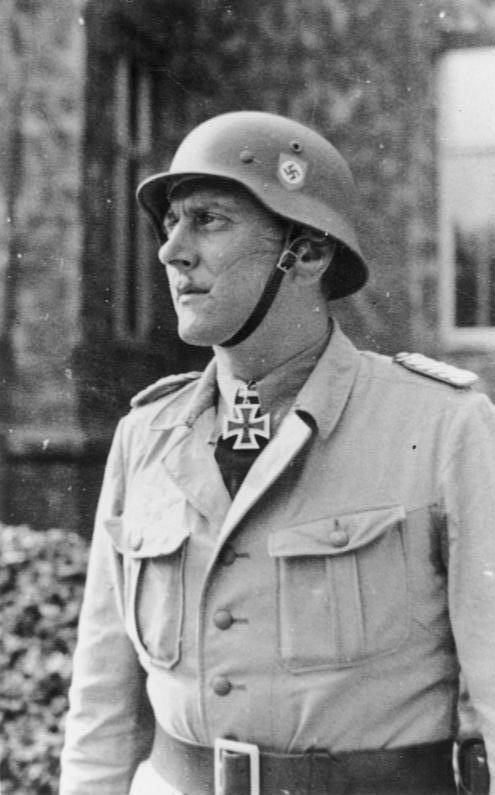
SS Lieutenant Colonel Otto Skorzeny was an extraordinary military man who specialized in guerrilla warfare and commando-style raids during World War II. He mounted numerous operations with varying degrees of success that involved either the rescue, kidnapping, assassination, or defense of numerous wartime leaders in Europe.

As a result, he became Hitler’s favorite commando and dubbed “the most dangerous man in Europe” by the Allies.
Skorzeny certainly looked the part. He was an imposing figure at 6′ 4″ that sported a deep scar on his left cheek from a fencing duel.
Though loyal to Hitler and a staunch Austrian Nazi, Skorzeny would ultimately turn on his former compatriots and become a hitman for Israel at the end of the war.

Skorzeny was born in 1908 into a middle-class Austrian family. He became a Nazi early on joining the Austrian branch in 1931. When World War II broke out in 1939, Skorzeny’s military career got off to a bumpy start when his application to join the Luftwaffe was denied. He was told he was too tall and too old at the age of 31.

Instead, he joined the SS and became an officer-cadet in the Liebstandarte, Hitler’s bodyguard regiment. From 1940 to 1942, he fought on the battlefield in Holland, France, and the Eastern Front.

But in December 1942, Skorzeny nearly lost his life on the Eastern Front after shrapnel struck him in the head. He carried on fighting until his wounds incapacitated him and he was hospitalized. For his bravery, he was awarded his first Iron Cross.

While recovering in Berlin he became interested in commando operations, reading everything he could on unconventional warfare and guerrilla tactics. He soon formulated his own ideas which gained the attention of SS-Brigadeführer Walter Schellenberg, head of the SD (the SS foreign intelligence service).

Schellenberg made Skorzeny the head of the newly formed Waffen Sonderverband z.b.V. Friedenthal. Now with a team of commandos, he got to test out his ideas of unconventional warfare. His first mission, Operation Francois, did not go according to plan, but his next would be his greatest success.

In July 1943, the Italian government toppled Benito Mussolini. Outraged, Hitler vowed to rescue him and initiated Operation Eiche (Oak). He assembled a line-up of Germany’s best operatives that included Skorzeny. They had never met before, but it soon became apparent Skorzeny was the best man for the job.

First Skorzeny had to find Mussolini. The Italians were moving him from one secret location to the next, and a game of cat ‘n’ mouse ensued. Finally, after weeks of searching, Skorzeny tracked him down to the Campo Imperatore Hotel, some 6,500 feet above sea level on Gran Sasso mountain in the Abruzzo region of Italy.

The hotel was accessible only by funicular. So on Sept. 12, 1943, Skorzeny led a daring airborne raid on the hotel by gliders, but not without incident.

As the gliders approached the hotel, Skorzeny relied on a level patch of grass in front of the hotel as a landing strip. But as it came into view, he realized that what he had seen in reconnaissance photographs was not grass but a rock-laden incline.

skorzeny-and-mussolini.jpg

Deposed Italian dictator Benito Mussolini and Otto Skorzeny outside the Campo Imperatore Hotel. 12 September 1943.

Orders were given to abort, but Skorzeny ignored them and ordered his pilot to land. The pilot managed to awkwardly land 30 feet from the hotel. Within minutes Skorzeny found Mussolini. Not one person had been killed.

Not to be overshadowed by Mussolini, Skorzeny barged onto a waiting flimsy Fieseler Scorch aircraft designed to only carry a pilot and one passenger. With three on board, the craft strained to take off but somehow made it safely to its destination.

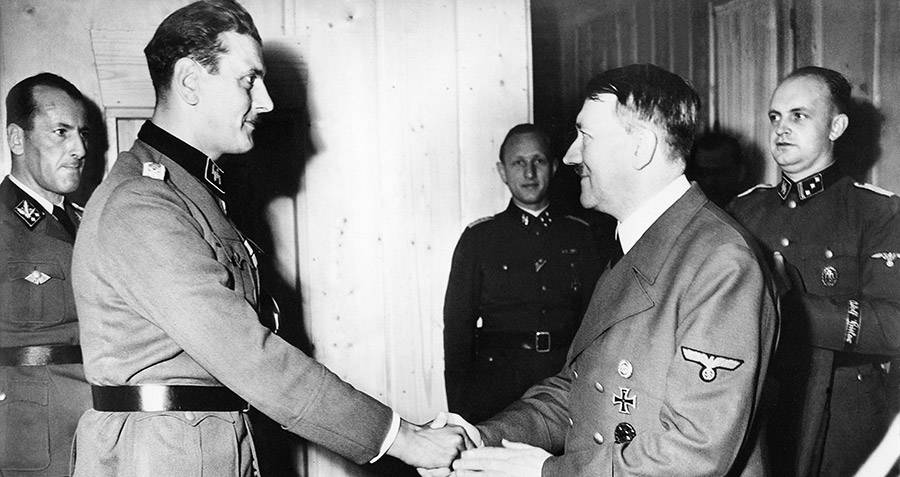
Skorzeny’s audacious plan had paid off. The Fuhrer, delighted with Skorzeny, awarded him the Knights Cross. The plan even impressed Winston Churchill. And so Skorzeny’s legend began.

otto-hitler.jpg

Adolf Hitler awarding Otto Skorzeny his Knight’s Cross after the liberation of Mussolini.

A few months later, Hitler required Skorzeny to carry out a mission that, at least in planning, was even more audacious. This time Hitler planned to kill his major enemies in one location. Called Operation Long Jump, Skorzeny and his commandos were required to infiltrate the Tehran Conference and assassinate the ‘Big Three’: Franklin Roosevelt, Winston Churchill, and Joseph Stalin.

According to the Soviets, their own legendary agent, Nikolai Kuznetsov, infiltrated the Wehrmacht in the Ukraine, where he learned all the details on Long Jump after plying a German SS major with alcohol.

With this knowledge, the Soviets allowed the first phase of the German operation to unfold. A team of German radio operators had gone ahead to Tehran to prepare for the arrival of German commandos. There, Soviet spies intercepted messages sent by the Germans stating that Skorzeny and his men would parachute into Iran a few weeks before the conference started.

The Soviets now with irrefutable proof of the planned assassination, arrested the Germans and thus thwarted the plan. Skorzeny and his team never made it to Iran.

Historians have debated whether this operation existed, claiming it was just Soviet propaganda. The Soviets state it was real and high-ranking Soviet officers involved at the time have written books about it.

tehran-conference-1943.jpg

In Operation Long Jump, Otto Skorzeny and his team allegedly planned to assassinate the “Big Three” at the Tehran Conference.

Skorzeny’s next success was not strictly an operation but a response to a threat to Nazi leadership.

In his memoir, he claimed he played an integral part in restoring order to Berlin — and the war effort in the aftermath of Hitler’s assassination attempt on July 20, 1944. The conspirators had modified the Wehrmacht “Valkyrie” codeword normally used to suppress a revolt into instigating an uprising instead.

While Major Otto Remer spearheaded an attack against the plotters, Skorzeny got inside the conspirators’ base of operations and had the “Valkyrie” order rescinded. He then restored communications to Fuhrer Headquarters, thus preventing a possible civil war between German troops.
Skorzeny took charge of Wehrmacht administration until normalcy returned, and he was relieved.

Hitler now knew he could completely trust Skorzeny and in October 1944, sent him to kidnap the son of Hungarian leader Admiral Horthy. The successful mission kept Hungary on Germany’s side and involved in the war.

However, Skorzeny’s most infamous mission was Operation Greif (Griffin), which was part of Hitler’s last-ditch attempt at turning the tables on the Allies. His key objective required the capture of key bridges over the Meuse river during the Battle of the Bulge. Skorzeny devised a trojan horse operation which required his men to go behind enemy lines in the Belgian Ardennes dressed as American soldiers and cause maximum panic and confusion.

But there were major hurdles. Only a handful of men spoke adequate English and there was a lack of appropriate American uniforms and equipment, which made the charade risky at best.

german-tank-disguised-american.jpg

A German tank disguised as an American tank during Operation Greif during the Battle of the Bulge. Belgian Ardennes. December 1944.

Still, on Dec. 16, 1944, Operation Greif launched into action. Skorzeny’s men cut communication wires, issued fake orders, and turned around road signs.
Paranoia set in amongst American forces as word of the German impostors spread. Some Americans fired on each other and soon GIs grilled each other on American popular culture to flush out German agents.

Many American soldiers and even Allied generals were detained at checkpoints for answering questions wrong. For instance, Field Marshall Bernard Montgomery refused to show his ID and had his car tires shot out. He was then dragged into a barn and restrained until his identity could be confirmed.

But the biggest confusion — and the masterstroke of the operation — came from Skorzeny himself when he let a rumor run wild within his own ranks that the real target was General Eisenhower, who was still in Paris.

Convinced of the “real” mission, two jeeps full of German agents confirmed the assassination plot to kill Eisenhower when interrogated by Americans. Back in Paris, Eisenhower spent time in protective custody while his body-double did his daily rounds.

In the end, the impostors’ inability to correctly mimic “Americanisms” and U.S. Army protocol proved their underdoing. Many were shot as spies for impersonating the opposing side.

By war’s end, Skorzeny had received oak leaves for his Iron Cross, the highest honor awarded by the Nazis. However, his directive for his men to wear American uniforms got him in hot water in 1947 at the Allied Dachau War Crimes trials.

Luckily for him, he escaped execution when British SOE operatives confirmed they wore German uniforms during the war.

Other charges loomed — and Skorzeny sidestepped those too when former SS men, donning American military police uniforms, helped him escape. He later claimed the OSS (the CIA’s forebear) had aided his escape in return for his services.

prison-nuremberg-trial.jpg

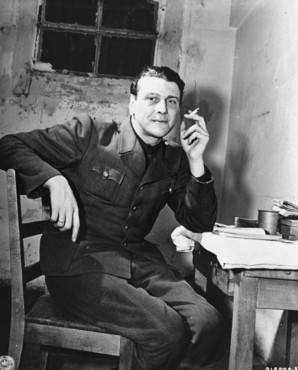
At Nuremberg, Otto Skorzeny sits in a prison cell. November, 1945.

In 1950, he moved to Spain, where Nazi refugees received asylum. To all appearances, his new life with his wife and their small engineering business appeared relatively normal. But his business may have been a front to help numerous Nazis escape to Spain or Latin America.

Which makes it even more interesting that Skorzeny became a hitman for Israel over ten years later.

One evening in 1962, two Mossad agents posing as a couple befriended Skorzeny and his wife in a Spanish bar. But Skorzeny was no fool and he lured them back to his house, where he pulled a gun on them.

He said, “I know who you are, and I know why you’re here. You’re Mossad and you’ve come to kill me.”

otto-skorzeny-iron-cross.jpg
 
4th Psychological Operations Group (Airborne)


Who We Are

PSYOP Forces are Masters of Influence – the core of information warfare. We conduct influence activities to target psychological vulnerabilities and create or intensify fissures, confusion, and doubt in adversary organizations. We use all available means of dissemination – from sensitive and high tech, to low-tech, to no-tech, and methods from overt, to clandestine, to deception.


4th Psychological Operations Group (Airborne) consists of a headquarters company and five regional PSYOP battalions (POB). Each POB is regionally aligned and supports a geographic combatant command (GCC) in the planning and execution of MISO series.

The five regional battalions support the following GCCs:

• 1st POB (A) supports operations in Central and South America, as well as the Caribbean conducted by United States Southern Command (SOUTHCOM)

• 5th POB (A) supports operations in the Indo-Pacific region conducted by United States Indo-Pacific Command (INDOPACOM)

• 6th POB (A) supports operations in Europe conducted by United States European Command (EUCOM)

• 7th POB (A) supports operations in Africa conducted by United States Africa Command (AFRICOM)

• 8th POB (A) supports operations in the Middle East and Central Asia conducted by United States Central Command (CENTCOM)

Outreach and Recruiting

Join the PSYOP Regiment: If you are a Soldier or civilian interested in learning more about PSYOP, or how to be selected, give us a call at the number below. Text “4POG” to 462769 to get started. PSYOP is a difficult branch to research so don’t hesitate to reach out for help. We also highly recommend you check us out on our social media.

Newcomers: If you have been assigned to 4th PSYOP Group (A) and are looking for information please give us a call or email at the addresses below. We also recommend you follow our Facebook page to stay up-to-date with new information and other announcements.

Families: We’re happy you’re here. If you are looking for ways to stay in touch please follow the social media pages below. If you have specific questions send us an email so we can connect you with the appropriate section.

Media Inquiries: Give us a call at the number below and we will connect you with the 1st Special Forces Command (Airborne) Public Affairs Office to respond to your request.

Phone: 910-908-4456

Our History

Psychological warfare was established as a sub-section of the War Department during World War I. Over 50 million leaflets were delivered in modified artillery shells and leaflet bombs dropped from airplanes on enemy units on the Western Front. So effective was the Allied PSYWAR, German Generals stated that the Allied PSYWAR effort had played a large part in devastating their troops' morale. Psychological warfare expanded during World War II with the creation of the Psychological Warfare Branch, Allied Force Headquarters; the Psychological Warfare Division, Supreme Headquarters, Allied Expeditionary Force; and PSYWAR Sections at the Army, Group and Field Army levels. These commands consolidated the efforts of the American Office of Strategic Services (OSS), Office of War Information, British Political Warfare Office and Ministry of Information. These commands further directed the formation of tactical PSYWAR units such as mobile broadcasting companies and broadcasting stations operating detachments.

These World War II PSYWAR efforts dwarfed anything attempted before in history. In September of 1950, BG Robert A. McClure was named Chief, Psychological Warfare Division. Recognizing the need for the Army to retain her PSYWAR units and capabilities, he and his staff established the PSYWAR Center at Fort Bragg in 1952. That center still stands today as the United States Army John F. Kennedy Special Warfare Center and School. The fundamental mission of the Psychological Operations Branch has remained the same since World War I: to "convey selected information and indicators to foreign audiences to influence their emotions, motives, objective reasoning, and ultimately the behavior of foreign governments, organizations, groups and individuals." However, the means and methods for accomplishing our mission continue to evolve with the increasing demand for PSYOP capabilities across the full spectrum of conflict.

The 4th Psychological Operations Group (Airborne) (POG(A)) is one of the United States Army's active military information support operations units and has responsibility for the 1st, 5th, 6th, 7th and 8th PSYOP Battalions (Airborne) (POB(A)). 4th POG (A) was activated on 01 DEC 1967 during the Vietnam War and originally consisted of the 7th, 8th, and 10th POBs. It was deactivated in 1971 in Fort Lewis, Washington, before being reactivated in 1972 at Fort Bragg, North Carolina. On 15 OCT 1987 4th POG (A) was brought into USSOCOM and on 03 MAR 1993, PSYOP was officially designated as a Special Operations Force. During this time 4th POG(A) participated in operations in Vietnam, the Dominican Republic, Panama, Iraq, Somalia, Haiti, Liberia, Rwanda, Bosnia, Balkans, and Afghanistan.

On 01 OCT 2006, PSYOP became an official branch within the United States Army. Today, both 4th POG (A) and 8th POG (A) fall under 1st Special Forces Command (Airborne) (1st SFC (A)).

Today, the POBs under 4th POG (A) comprise the bulk of the DODs information warfare forces. They conduct operations in support of multiple Geographic Combatant Commands and seek to influence allies and adversaries in all forms of media. As the way populations communicate continues to change, 4th POG(A) continues to evolve to support the American way of life in an era of global competition.


images
 
AECOM


social.png

This is probably one of the most clandestine U.S. Government contractors operating today.

It has expanded over the decades swallowing up a number of infamous, clandestine government contractors like EG&G, URS and McNeil Technologies.

This multinational conglomerate has its hands in pretty much anything and everything you can think of dealing with U.S. Government Covert Operations.

It’s the company you never heard of….and there is a reason why…

2b4b75bd-2d6b-48df-a66f-9888b42ea339.png

About Us

At AECOM, we believe infrastructure creates opportunity for everyone – uplifting communities, improving access and sustaining our planet.

We’re committed to managing our business with the upmost responsibility and to always strive for better — be that reducing emissions, creating social value or diversifying our senior leadership and workforce.

We understand both the urgency of the challenges facing our society and our responsibility to act in an impactful and enduring way. We’re leading the change towards a more sustainable and equitable future, partnering with those who want to make a positive difference in the world.

We’re listening to clients and the communities we serve in order to improve lives and livelihoods, and to create sustainable legacies for generations to come.

Thinking without limits is what keeps us at the vanguard. Ideas have no borders, and this ethos is embedded in our culture. The full scope of our global expertise is available to anyone who needs it, wherever they are based.

We’re trusted advisors — planners, designers, engineers, consultants and program and construction managers — delivering professional services spanning cities, transportation, buildings, water, new energy, and the environment. Working throughout the project lifecycle, we’re one team driven by a common purpose to deliver a better world.

Aecom-high-vis1-e1579175045668.jpeg

Our history

AECOM launched when a handful of employees from design and engineering companies shared a dream of creating an industry-leading firm dedicated to delivering a better world.

We became an independent company formed by the merger of five entities. While our official founding was in 1990, many of our predecessor firms had distinguished histories dating back more than 120 years.

Since then, more than 50 companies have joined us and, in 2007, we became a publicly traded company on the New York Stock Exchange.

AECOM-structuralengineer-455915.jpg

Fast facts

• 14.4 billion of revenue during fiscal year 2023.

• Ranked #1 in water, transportation, general building, and international markets by Engineering News-Record in 2024.

• Named one of Fortune magazine’s “World’s Most Admired Companies” for the tenth consecutive year

• Named one of 2024 World’s Most Ethical Companies for its commitment to integrity and making a positive impact by Ethisphere.

• Listed at #310 on the Fortune 500 as one of America’s largest companies

1c92f243-1990-433f-9e92-17b84b4e8a5c.png

16>
 
Back
Top