
You are using an out of date browser. It may not display this or other websites correctly.
You should upgrade or use an alternative browser.
You should upgrade or use an alternative browser.
Recored Corporate Profits! Where Are The Jobs?
- Thread starter thoughtone
- Start date



In your world, it is either / or.
It is rich / poor, good / bad, left / right, Democrat / Republican, capitalist / socialist.
I guess to you, every issue only has 2 possibilities.
That's original.
As Warren Buffer stated, “There's class warfare, all right, but it's my class, the rich class, that's making war, and we're winning.”
Generally, the 'rich' advocate for their best interests. What I don't understand is how those who have little economic in common with the rich argue for the rich's best interests. FDR was labeled a traitor to his class, because of his policies. It's not me with the black and white thinking, I don't set policy!
As Warren Buffer stated, “There's class warfare, all right, but it's my class, the rich class, that's making war, and we're winning.”
Generally, the 'rich' advocate for their best interests. What I don't understand is how those who have little economic in common with the rich argue for the rich's best interests. FDR was labeled a traitor to his class, because of his policies. It's not me with the black and white thinking, I don't set policy!
And winning big. And when you have people who aren't even in that class standing up and fighting for them at their own expense, it's easy to see why.
Sometimes, smart people overlook the things that are simple and basic.
Acme Widgets is a widget maker.
Acme Widgets had 10 employees that made 100/week.
Demand for widget has recently dropped to 50/week due to a breakdown in the economy.
Mr A Widgets has responded by cutting staff.
Acme Widgets currently has 5 employees that only make 50 widgets a week.
New orders come in.
Now there is an increased consumer demand for 55 widgets a weeks.
Should Acme Widgets pursue the satisfaction of the new consumer demand?
If so, how should Acme Widgets meet the demand?
Hire a 6th employee which would result in extra cost/lower profits?
or
Increase the workload of the current workforce at cost/increased profit?
This simple scenario is being played out in every industry. Every worker has seen an increase in their workload/job responsibility. Workers don't complain as much as they would have in the past because they are glad/shook to still have a job.
Corporations are getting greater productivity without any or little added cost which results in higher profits.
Why would corporation want to do anything to alter this trend?
Corporations won't hire additional employees until there is enough profitability.
Acme Widgets is a widget maker.
Acme Widgets had 10 employees that made 100/week.
Demand for widget has recently dropped to 50/week due to a breakdown in the economy.
Mr A Widgets has responded by cutting staff.
Acme Widgets currently has 5 employees that only make 50 widgets a week.
New orders come in.
Now there is an increased consumer demand for 55 widgets a weeks.
Should Acme Widgets pursue the satisfaction of the new consumer demand?
If so, how should Acme Widgets meet the demand?
Hire a 6th employee which would result in extra cost/lower profits?
or
Increase the workload of the current workforce at cost/increased profit?
This simple scenario is being played out in every industry. Every worker has seen an increase in their workload/job responsibility. Workers don't complain as much as they would have in the past because they are glad/shook to still have a job.
Corporations are getting greater productivity without any or little added cost which results in higher profits.
Why would corporation want to do anything to alter this trend?
Corporations won't hire additional employees until there is enough profitability.
Sometimes, smart people overlook the things that are simple and basic.
Acme Widgets is a widget maker.
Acme Widgets had 10 employees that made 100/week.
Demand for widget has recently dropped to 50/week due to a breakdown in the economy.
Mr A Widgets has responded by cutting staff.
Acme Widgets currently has 5 employees that only make 50 widgets a week.
New orders come in.
Now there is an increased consumer demand for 55 widgets a weeks.
Should Acme Widgets pursue the satisfaction of the new consumer demand?
If so, how should Acme Widgets meet the demand?
Hire a 6th employee which would result in extra cost/lower profits?
or
Increase the workload of the current workforce at cost/increased profit?
This simple scenario is being played out in every industry. Every worker has seen an increase in their workload/job responsibility. Workers don't complain as much as they would have in the past because they are glad/shook to still have a job.
Corporations are getting greater productivity without any or little added cost which results in higher profits.
Why would corporation want to do anything to alter this trend?
Corporations won't hire additional employees until there is enough profitability.
End of Thread!! Finally
It amazes me that some people think wealth falls out of the air.
Sometimes, smart people overlook the things that are simple and basic.
Acme Widgets is a widget maker.
Acme Widgets had 10 employees that made 100/week.
Demand for widget has recently dropped to 50/week due to a breakdown in the economy.
Mr A Widgets has responded by cutting staff.
Acme Widgets currently has 5 employees that only make 50 widgets a week.
New orders come in.
Now there is an increased consumer demand for 55 widgets a weeks.
Should Acme Widgets pursue the satisfaction of the new consumer demand?
If so, how should Acme Widgets meet the demand?
Hire a 6th employee which would result in extra cost/lower profits?
or
Increase the workload of the current workforce at cost/increased profit?
This simple scenario is being played out in every industry. Every worker has seen an increase in their workload/job responsibility. Workers don't complain as much as they would have in the past because they are glad/shook to still have a job.
Corporations are getting greater productivity without any or little added cost which results in higher profits.
Why would corporation want to do anything to alter this trend?
Corporations won't hire additional employees until there is enough profitability.
Workers don't complain as much as they would have in the past because they are glad/shook to still have a job.
Which is another factor not taken into account. The threat of out sourcing and due to the high unemployment levels, workers know that their are 5 more out their that will take the job for less, compounds the situation. A stark example of how capitalism is parasitics.
Since demand can only be spurred by those with the money to spend, it is less likely that significant numbers of customers would be created in the short term, since without jobs, few will have the extra money.
So, extending tax cuts to those that acquire their income from capital gains, does little to increase job growth. They already have increased expendable funds garnered over the last the years from the current tax cuts and would, most likely continue to save or invest the additional money rather than put it in to circulation.
What sustained the employment growth in the past was the fact that labor pool was somewhat finite. American workers could expect a decent wage when recessions recovered. Now the the completion of workers in other markets willing to work for wages below the American standard, their is, as you so eloquently stated above no incentive for the employer to increase the labor pool, at least in the US market.
<object width="640" height="385"><param name="movie" value="http://www.youtube.com/v/EHSnXFEzE4E?fs=1&hl=en_US"></param><param name="allowFullScreen" value="true"></param><param name="allowscriptaccess" value="always"></param><embed src="http://www.youtube.com/v/EHSnXFEzE4E?fs=1&hl=en_US" type="application/x-shockwave-flash" allowscriptaccess="always" allowfullscreen="true" width="640" height="385"></embed></object>
http://mercatus.org/
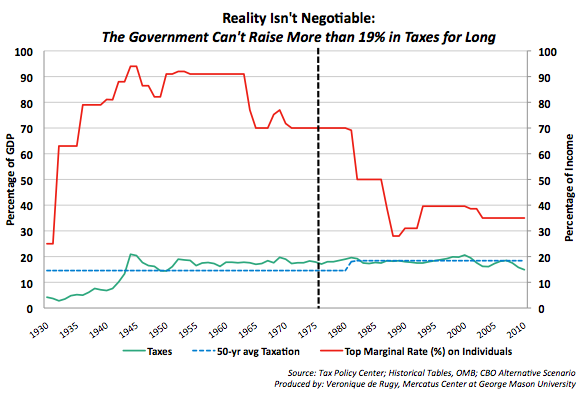
Reality Isn't Negotiable: The Government Can't Raise More than 19% in Taxes for Long
Veronique de Rugy | Nov 29, 2010
This chart by Mercatus Center Senior Research Fellow Veronique de Rugy shows the historical path of federal taxation as a percentage of GDP using the earliest records available from the Office of Management and Budget and top marginal tax rate data from the Tax Policy Center. From 1930 to 2010, tax revenue collection in the United States has never topped 20.9%, averaging 16.5% of GDP over these 80 years. This comes despite the drastic historical fluctuation in the rate of taxes on the wealthiest Americans. As we move toward debt reduction, it is critical to keep the long-term path of the United States in mind.
In recent years, spending, not revenues, has deviated from its historical path; spending must be addressed to rectify the budget.
Veronique de Rugy explains why we can’t tax our way out of the debt on Bloomberg TV. Republican hands are bloody as well.
<object width="480" height="385"><param name="movie" value="http://www.youtube.com/v/uJheKXv2Qro?fs=1&hl=en_US"></param><param name="allowFullScreen" value="true"></param><param name="allowscriptaccess" value="always"></param><embed src="http://www.youtube.com/v/uJheKXv2Qro?fs=1&hl=en_US" type="application/x-shockwave-flash" allowscriptaccess="always" allowfullscreen="true" width="480" height="385"></embed></object>
Reality Isn't Negotiable: The Government Can't Raise More than 19% in Taxes for Long
Veronique de Rugy | Nov 29, 2010
This chart by Mercatus Center Senior Research Fellow Veronique de Rugy shows the historical path of federal taxation as a percentage of GDP using the earliest records available from the Office of Management and Budget and top marginal tax rate data from the Tax Policy Center. From 1930 to 2010, tax revenue collection in the United States has never topped 20.9%, averaging 16.5% of GDP over these 80 years. This comes despite the drastic historical fluctuation in the rate of taxes on the wealthiest Americans. As we move toward debt reduction, it is critical to keep the long-term path of the United States in mind.
In recent years, spending, not revenues, has deviated from its historical path; spending must be addressed to rectify the budget.
Veronique de Rugy explains why we can’t tax our way out of the debt on Bloomberg TV. Republican hands are bloody as well.
<object width="480" height="385"><param name="movie" value="http://www.youtube.com/v/uJheKXv2Qro?fs=1&hl=en_US"></param><param name="allowFullScreen" value="true"></param><param name="allowscriptaccess" value="always"></param><embed src="http://www.youtube.com/v/uJheKXv2Qro?fs=1&hl=en_US" type="application/x-shockwave-flash" allowscriptaccess="always" allowfullscreen="true" width="480" height="385"></embed></object>
^^^^^
http://mercatus.org/
Reality Isn't Negotiable: The Government Can't Raise More than 19% in Taxes for Long
Veronique de Rugy | Nov 29, 2010
This chart by Mercatus Center Senior Research Fellow Veronique de Rugy shows the historical path of federal taxation as a percentage of GDP using the earliest records available from the Office of Management and Budget and top marginal tax rate data from the Tax Policy Center. From 1930 to 2010, tax revenue collection in the United States has never topped 20.9%, averaging 16.5% of GDP over these 80 years. This comes despite the drastic historical fluctuation in the rate of taxes on the wealthiest Americans. As we move toward debt reduction, it is critical to keep the long-term path of the United States in mind.
In recent years, spending, not revenues, has deviated from its historical path; spending must be addressed to rectify the budget.
Veronique de Rugy explains why we can’t tax our way out of the debt on Bloomberg TV. Republican hands are bloody as well.
<EMBED height=385 type=application/x-shockwave-flash width=480 src=http://www.youtube.com/v/uJheKXv2Qro?fs=1&hl=en_US allowfullscreen="true" allowscriptaccess="always"></EMBED>
Gunner, let me ask again, Record Corporate Profits! Where Are The Jobs?
Last edited:
Where are the jobs?
source: Huffington Post
Big Oil Companies Post Huge Profits On High Gas Prices
WASHINGTON -- The sputtering economy, high unemployment rate and punishing gas prices are taking a huge toll on average Americans, but at least somebody is doing well: The Big Five oil companies this week announced they had made a whopping $36 billion in profits in the second quarter of 2011.
According to second-quarter earnings reports, ExxonMobil alone made $10.7 billion in the most recent three months. That's a 41 percent increase over the same period last year and a 161 percent increase over 2009.
Shell nearly doubled its profits year over year, taking in $8.7 billion in the second quarter. Chevron's profits were $7.7 billion, up 43 percent. BP earned $5.6 billion, a far cry from its $17.2 billion loss a year ago. Only Conoco Philips, with $3.4 billion in earnings, posted smaller profits than a year ago, dropping 18 percent due to the jettisoning of some Russian assets.
A good chunk of these profits is coming right out the pockets of the American public, thanks in part to astronomical gas prices and to $4 billion to $8 billion a year in deficit-increasing tax subsidies that oil companies continues to get, long after the incentives those subsidies were designed to create ceased to make economic sense.
Rather than invest their profits in such things as product development, new facilities, hot talent or research -- things that could create jobs, improve consumer offerings and accelerate alternative energy production -- three of the five big oil companies are spending large amounts of that money buying back shares of their own stock.
Exxon spent $5.5 billion -- or more than half of its total profits -- to buy back its own stock in the second quarter; Chevron spent $1 billion, or 13 percent of its profits; and Conoco spent $3.1 billion -- or 91 percent of its profits. The numbers were similar last quarter.
"What this means is these companies see their profits as a way of managing their stock price, rather than investing money in the future of their own companies and the future of the economy," said William Lazonick, a professor of economics at the University of Massachusetts, Lowell.
Executives say stock buybacks reflect confidence in the future of their companies, sending a signal they think their stock is undervalued. Indeed, buybacks are almost guaranteed to send stock prices up by boosting earnings per outstanding share and increasing the demand.
But buybacks are also a self-serving way for management to spend the company's earnings, Lazonick said. Top executives reap benefits from the exercise of stock options -- and if stock prices don't go up, those options are worthless.
"Buybacks and stock options are the yin and yang of corporate executives," Lazonick said. "They spend the company's money to buy back stock and send up stock prices -- and they're one of the biggest beneficiaries of it. But everyone else loses."
The companies are only halfway through what could be a record year for oil profits. At this rate ExxonMobil, for example, will clear almost $43 billion in profits in 2011, just shy of its 2008 record of $45 billion -- the last time there was a huge spike in oil prices.
Democrats have tried, with only limited success, to make political hay of the fact that oil companies are doing so well, while consumers are doing poorly and policymakers are feverishly looking for ways to cut the deficit.
"America is swimming in debt, and oil companies are swimming in profits, yet Republicans continue to defend giving these companies special tax breaks that could help reduce the deficit if they were repealed," said Rep. Ed Markey (D-Mass.) in a statement Thursday. "Instead of asking seniors for a cut in Medicare or Social Security, it's time for the oil companies to do their part and contribute to solving our debt crisis."
But one reason Markey and others have made so little headway is that the oil and gas industry is enormously powerful on Capitol Hill, spending over $1 billion in lobbying since 1998, according to opensecrets.org.
And the Big Five oil companies have already spent $75 million in lobbying just through first half of this year. That seems like a lot, until one considers that it amounts to about one-tenth of 1 percent of their profits.
As profits go up, employment goes down.

source: Huffington Post
Big Oil Companies Post Huge Profits On High Gas Prices
WASHINGTON -- The sputtering economy, high unemployment rate and punishing gas prices are taking a huge toll on average Americans, but at least somebody is doing well: The Big Five oil companies this week announced they had made a whopping $36 billion in profits in the second quarter of 2011.
According to second-quarter earnings reports, ExxonMobil alone made $10.7 billion in the most recent three months. That's a 41 percent increase over the same period last year and a 161 percent increase over 2009.
Shell nearly doubled its profits year over year, taking in $8.7 billion in the second quarter. Chevron's profits were $7.7 billion, up 43 percent. BP earned $5.6 billion, a far cry from its $17.2 billion loss a year ago. Only Conoco Philips, with $3.4 billion in earnings, posted smaller profits than a year ago, dropping 18 percent due to the jettisoning of some Russian assets.
A good chunk of these profits is coming right out the pockets of the American public, thanks in part to astronomical gas prices and to $4 billion to $8 billion a year in deficit-increasing tax subsidies that oil companies continues to get, long after the incentives those subsidies were designed to create ceased to make economic sense.
Rather than invest their profits in such things as product development, new facilities, hot talent or research -- things that could create jobs, improve consumer offerings and accelerate alternative energy production -- three of the five big oil companies are spending large amounts of that money buying back shares of their own stock.
Exxon spent $5.5 billion -- or more than half of its total profits -- to buy back its own stock in the second quarter; Chevron spent $1 billion, or 13 percent of its profits; and Conoco spent $3.1 billion -- or 91 percent of its profits. The numbers were similar last quarter.
"What this means is these companies see their profits as a way of managing their stock price, rather than investing money in the future of their own companies and the future of the economy," said William Lazonick, a professor of economics at the University of Massachusetts, Lowell.
Executives say stock buybacks reflect confidence in the future of their companies, sending a signal they think their stock is undervalued. Indeed, buybacks are almost guaranteed to send stock prices up by boosting earnings per outstanding share and increasing the demand.
But buybacks are also a self-serving way for management to spend the company's earnings, Lazonick said. Top executives reap benefits from the exercise of stock options -- and if stock prices don't go up, those options are worthless.
"Buybacks and stock options are the yin and yang of corporate executives," Lazonick said. "They spend the company's money to buy back stock and send up stock prices -- and they're one of the biggest beneficiaries of it. But everyone else loses."
The companies are only halfway through what could be a record year for oil profits. At this rate ExxonMobil, for example, will clear almost $43 billion in profits in 2011, just shy of its 2008 record of $45 billion -- the last time there was a huge spike in oil prices.
Democrats have tried, with only limited success, to make political hay of the fact that oil companies are doing so well, while consumers are doing poorly and policymakers are feverishly looking for ways to cut the deficit.
"America is swimming in debt, and oil companies are swimming in profits, yet Republicans continue to defend giving these companies special tax breaks that could help reduce the deficit if they were repealed," said Rep. Ed Markey (D-Mass.) in a statement Thursday. "Instead of asking seniors for a cut in Medicare or Social Security, it's time for the oil companies to do their part and contribute to solving our debt crisis."
But one reason Markey and others have made so little headway is that the oil and gas industry is enormously powerful on Capitol Hill, spending over $1 billion in lobbying since 1998, according to opensecrets.org.
And the Big Five oil companies have already spent $75 million in lobbying just through first half of this year. That seems like a lot, until one considers that it amounts to about one-tenth of 1 percent of their profits.
As profits go up, employment goes down.
^^^^

Tax cuts for the rich, Obama is anti-business. Why do these people keep getting elected?
source: Huffington Post
Corporate Profits Hit New Record, U.S. Workers Still Struggling
Happy days are back! During the summer months, corporations logged their biggest profits since the government started counting way back in the age of Elvis, and the economy expanded at a slightly faster pace than previously thought. Surely, when Caterpillar and Morgan Stanley are swimming in lucre, life must be getting more wonderful for everyone.
Alas, no. Word that American businesses sucked in profits at an annualized pace of $1.66 trillion between July and September is certainly better than the alternative. Ditto, the wholly expected news that the economy grew faster than an initially reported 2 percent annual rate, reaching a still modest 2.5 percent. But none of this has translated into the sort of job growth that will be required to cut into an unemployment rate stuck at 9.6 percent. Worse, there is little reason to suspect it will anytime soon.
We have been hearing for so long now that, once companies start making real money, they will feel the urge to expand. Then, they will hire lots of people, and we can stop worrying and resume shopping. Yet so far--this most recent quarter included--all we have gotten is an extended lesson in the modern workings of a stubbornly lean job market and a display of what now stands as American management's core competency: How to rack up profits and reward shareholders while keeping the cubicles empty.
At the corporate level, the Great Recession is a memory. After plunging during the last three months of 2008, when the world was recoiling at the prospect of a full-blown financial meltdown, profits have expanded snappily every quarter since, according to data compiled by Moody's Analytics. But at the household level -- the realm of mortgages, credit card balances, doctor bills and soon-to-expire unemployment benefits -- the worst economic downturn since the Depression remains a defining force.
We taxpayers have handed hundreds of billions of dollars to the same mortgage and insurance industry that started all the trouble with its reckless gambling. We have bailed out General Motors. We have distributed tax cuts to businesses that were supposed to use this lubrication to expand and hire.
For our dollars, we have been rewarded with the staving off of potential financial Armageddon and the stabilizing of a real economy that was teetering dangerously toward the abyss. That certainly is something, but it falls far short of the only thing that can end this disaster on a meaningful scale: large numbers of quality paychecks.
Success for large companies has yet to trickle down. Since the end of 2008, when corporate America began enjoying the resumption of growth, profits have swelled from an annualized pace of $995 billion to the current $1.66 trillion as of the end of September. Over the same period, the number of non-farm jobs counted by the Labor Department has slipped from 13.4 million to 13 million.
The mega-banks have been emboldened to resume the dispensing of handsome bonus checks. Publicly traded companies have rewarded shareholders with dividends. But working people -- or would-be working people -- are still waiting for a slice of the spoils, confronting a bleak job market. Hiring remains scarce.
"Businesses remain very nervous," says Mark Zandi, chief economist at Moody's Analytics. "Many are having a hard time shaking the nightmare of the past several years. Other are very anxious over all of the economic and policy decisions that have been and will be made."
Yet amid the anxiety, corporate America has evinced an impressive ability to make money. Economists celebrate this as an increase in productivity -- making more stuff with less labor. Such is traditionally a harbinger of fresh economic growth and hiring. As bad times give way to better, businesses secure fresh sales by squeezing more production out of existing workers. When they run out of potential squeezes, they add more labor, and the lucky new hires scatter their paychecks at other businesses that themselves must add workers to exploit the potential of suddenly bounteous days.
That story currently seems relegated to your college economics textbook. Business has become extraordinarily sophisticated at finding ways to boost production and sales without adding to payrolls.
Manufacturing and white-collar work alike can be shifted to Asia, Latin America and Eastern Europe, where costs are lower, enabling businesses to rack up extra sales without having to bother themselves with hiring American workers. Companies can add machinery instead of bodies and achieve the same result. When pressed, they can take on temporary workers --something now happening -- and still retain the flexibility to cut people loose should happy times fail to emerge.
We are stuck in an unfortunate feedback loop: The lack of hiring is crimping spending power and economic growth, making the people running businesses even less inclined to hire.
As American business leaders understand, they can only sell product if people are walking around with money, and that is dependent upon people having secure, decent-paying jobs.
For too many years, spending was enabled by borrowing against the value of homes that are currently worth less than the raw materials used in their construction. Consumers availed themselves of credit cards that landed in the mail more frequently than come-ons from Ed McMahon. For many a battered household, those days are over. Meaningful recovery is dependent upon the only factor worth repeating ad nauseum: quality paychecks.
We have long since reached the point at which the economy needs a serious jolt from the government, a concentrated focus on long-term job creation that will embolden private money to start moving again, launching new businesses that can yield lasting growth. Yet, distressingly, little appears on the way to spur this process.
The $800 billion stimulus bill unleashed at the beginning of the Obama presidency -- a mish-mash of unfortunate political compromise and real economic strategy -- has largely run its course. Our political leaders, who ought to be engaged in a crusade to get people back to work, are instead hunkered down on the sidelines, with both major parties staking out positions for a Presidential race still two years off.
Congress cannot even manage to extend unemployment benefits for formerly working people now acquainting themselves with the culinary offerings of trash dumpsters, let alone pursue an ambitious jobs program focused on more promising areas of the economy, such as renewable energy.
The Republicans who are about to control the House have placed their bets on perpetuating economic misery as the clearest path back to the White House. The Democrats who are still in charge are mostly engaged in figuring out how to make it seem like they can cut the federal budget deficit, as if it were possible to save our way back to prosperity.
Another quarter of meager economic growth has changed nothing. Another surge of corporate profits merely underscores how easily high finance can prosper even as most of the country suffers.
Your college econ professor would have pointed to today's data and told you that it reaffirms the recovery. The economy works like the seasons. The spring may be unseasonably cool and summer long in coming, but it must be on the way, because that is how the economy works.
Yet the times keep straining that faith, while the people who are supposed to be leading the pursuit a fix engage in the only industry that has never been in recession: going on cable television and blaming the other guys.
The rich will get richer because they have no incentives to create jobs. Also, they know that the tornado known as tax hikes could/will hit them in the near future.
However, to my understanding, liberals/progressives/wtf you wanna call yourself, do not have an understanding of math. In fact, lack of math + extraordinary emotional unbalance = the liberal mindset. Sadly, there's too many people that believes in the way you do...
The rich will get richer because they have no incentives to create jobs.
So much for the trickle down theory!

So much for the trickle down theory!
It's sad that someone twice my age, still don't understand how economics work...
It's sad that someone twice my age, still don't understand how economics work...
With tax cuts during GW's reign, where are the jobs? Clinton had lower unemployment with higher taxes. Explain expert.
Similar threads

- Replies
- 6
- Views
- 334

- Replies
- 1
- Views
- 280

- Replies
- 34
- Views
- 1K

- Replies
- 1
- Views
- 360

- Replies
- 8
- Views
- 474
