6 Unique Religions Virtually Unknown To The West

divine

Superstar
BGOL Investor
6 Unique Religions Virtually Unknown To The West
05/6/09 Print This Post Print This Post 26 Comments Popular Written by Chris Wary


Bahá’í House of Worship in Delhi, India / Photo: macsurak / Feature photo: Christine K
Think you know most of the world’s religions? Here’s a few that probably flew under your radar.

Encountering different and unique religions worlds apart from your own is part of the travelling experience.

However, no matter how many countries you have under your belt or hostels you’ve slept in, you still might not encounter some of these extremely private, seldom heard-of religions.

1. Jainism

20090506-jain.jpg


Praying at a Jain temple, India / Photo: mattlogelin

Jainism is one of the world’s oldest religions, dating itself prior to tenth century BCE India. There are approximately four million Jains today, almost entirely in India.

The religion revolves around five central beliefs of non-violence, truth, non-stealing, celibacy, and non-possession. The principle of non-violence is particularly important to Jains, as they believe that every living thing, even microscopic organisms, has a soul that can attain enlightenment.

Because of this, most Jains eat something resembling a very strict vegan diet and monks and nuns walk around barefoot sweeping the ground in front of them to avoid killing innocent insects.

2. Zoroastrianism


20090506-zoro.jpg

Zoroastrian carvings / Photo: wallyg

Zoroastrianism is based on the teachings of the first millennium BCE Iranian prophet Zoroaster. There are estimated to be between 150,000 and 210,000 Zoroastrians in the world today, mostly in India and the United States.

These small numbers mask the historical importance of this religion. Both Eastern and Western religions can trace ties back to Zoroastrianism, meaning the religion has most likely had more impact on the world than any other belief system.

Zoroastrians believe in one universal God, Ahura Mazda, who is in conflict with the forces of chaos, led by Angra Mainyu. Humans need to take an active role in the conflict by performing good deeds and having good thoughts and words.

The conflict will ultimately be brought to an end when Soashyant, a savior, comes to Earth and reanimates the dead.


3. Baha’i faith

20090506-bahai.jpg


Baha’i Master looks on / Photo: blakeread

Baha’i was founded in the 1800s in Persia by the prophet Baha’u’llah. It emphasizes the spiritual unity of all humankind and sees religious history as unfolding through a series of divine messengers, each suited for what the people of the time could handle.

The prophets of the world’s major world religions are all accepted as valid, including Krishna, Abraham, Buddha, Jesus, and Muhammad. The social teachings of each religion, such as which direction to pray, may be revoked or changed, but some fundamental principles, including charity and neighborliness, are always unchanged.

The largest center of the Baha’i faith is India, where 2.2 million followers reside, followed by Iran and the United States. Baha’i was classified at the world’s second fastest growing religion by percentage in 2007, when it grew by 1.7 percent.


4. Yoruba

20090506-yoruba.jpg


A girl in prayer / Photo: carf

The Yoruba religion is the beliefs and practices of the people located in the areas that are now Benin and Nigeria before they encountered other outside religions.

There are no specific numbers documenting the number of followers, but many believe that Yoruba is the largest African-born religion in the world. It has also heavily influenced several Afro-American religions such as Lucumi in Cuba.

The main belief of the Yoruba peoples is that all humans have a manifest destiny, referred to as ayanmo, to become one with the divine creator, known as Olodumare.

Our destinies are determined through our thoughts and actions in the physical world. The Yoruba see life and death as cycles in the physical and spiritual realms while the spirit moves towards union with Olodumare.

5. Mami Wata

20090506-mami.jpg


Mami Wata, water spirit

Mami Wata is another African-born religion that venerates a water spirit known as Mami Wata. She is depicted as being incredibly beautiful with long hair and is frequently accompanied by an incredibly large snake.

The religion holds that Mami will sometimes assume human form in bars or busy markets and also will abduct people while they are swimming or boating on the water. These captives are then released in dry clothes and better health, but only after agreeing to an oath of sexual fidelity to the spirit.

From its beginnings in Africa, the worship of Mami Wata has spread to many Caribbean islands and parts of North and South America.


6. Mandaeism

20090506-mandaeism.jpg


Prep for Mandaeism baptism / Photo: credit

Mandaeism is an extremely secretive Gnostic Christian religion. Prior to the 2003 war, the religion’s sixty to seventy thousand followers were almost entirely located in Iraq.

There are now estimated to be only five to seven thousand left in Iraq, the rest having been either displaced or killed in the sectarian violence that followed the US occupation.

Mandaens believe that Jesus was a false messiah who corrupted the teachings given to him by John the Baptist. For this reason, John has a special place in their religion along with Adam, Abel, Seth, Enosh, Noah, Shem, and Aram. Abraham, Moses, and Muhammad, on the other hand, are all seen as false prophets alongside Jesus.

Any personal experience with these religions? Or how about a few we missed? Share your thoughts in the comments!
 
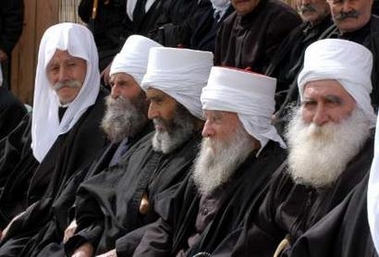
7. Druze

golan-heights-druze3.jpg


(Arabic: درزي, derzī or durzī‎, plural دروز, durūz, Hebrew: דרוזים‎ druzim) are a religious community found primarily in Syria, Lebanon, Israel, and Jordan, whose traditional religion is said to have begun as an offshoot of Islam, but is unique in its incorporation of Gnostic, neo-Platonic and other philosophies, similar to other followers of Ismaili Shi'a Islam.

Theologically, Druze consider themselves "an Islamic Unist, reformatory sect". The Druze call themselves Ahl al-Tawhid "People of Unitarianism or Monotheism" or al-Muwaḥḥidūn "Unitarians, Monotheists."
 
6 Unique Religions Virtually Unknown To The West
05/6/09
5. Mami Wata

20090506-mami.jpg


Mami Wata, water spirit

Mami Wata is another African-born religion that venerates a water spirit known as Mami Wata. She is depicted as being incredibly beautiful with long hair and is frequently accompanied by an incredibly large snake.

The religion holds that Mami will sometimes assume human form in bars or busy markets and also will abduct people while they are swimming or boating on the water. These captives are then released in dry clothes and better health, but only after agreeing to an oath of sexual fidelity to the spirit.

From its beginnings in Africa, the worship of Mami Wata has spread to many Caribbean islands and parts of North and South America.

:hmm:

I knew three out of the 6, Jainism, Yoruba, Zoraster
 
Mami Wata is not really a religion, she is a diety that exists among religions such as Voodun etc...

Anyway playing along:

225px-Sri_Sathya_Sai_Baba.jpg

Sai Baba


Sathya Sai Baba (pronounced /sæt jæ saɪ bæ bæ/) (Telugu: సత్య సాయిబాబా), (born Sathyanarayana Raju on 23 November 1926 [1]) is a South Indian[2] guru, religious figure and educator. He is described by his devotees as an avatar, godman,[3] spiritual teacher and miracle worker.[1][4][5][6][7] He has claimed to be the reincarnation of the great Maharashtrian saint, Sai Baba of Shirdi whose teachings were an eclectic blend of Hindu and Muslim beliefs.[8] He is described as "an extraordinarily compelling orator, gifted with wit."[9]
The Sathya Sai Organization reports that there are an estimated 1,200 Sathya Sai Baba Centers in 114 countries worldwide.[10][11] The number of active Sathya Sai Baba adherents was estimated in 1999 to be around 6 million, although followers' estimations are far higher.[12] Since there are no formal ties of membership, the actual figure may never be known.[8] In India itself, Sai Baba attracts followers from predominantly upper-middle-class, urban sections of society who have the "most wealth, education and exposure to Western ideas."[13] Sri Sathya Sai Baba, draws presidents, prime ministers and other leaders not only from India but also from outside it; altogether he claims followers in 178 countries.
 
religion is a helluva drug


That is the European view that has allowed them to oppress the original peoples of the world without feeling remorse

Look at the objectives of this religion:

"Jainism is one of the world’s oldest religions, dating itself prior to tenth century BCE India. There are approximately four million Jains today, almost entirely in India.

The religion revolves around five central beliefs of non-violence, truth, non-stealing, celibacy, and non-possession.
The principle of non-violence is particularly important to Jains, as they believe that every living thing, even microscopic organisms, has a soul that can attain enlightenment."


Tell me which European country could have prospered with this doctrine?

Western culture is devoted to materialism and violence, that is their religion i.e. way of life


:cool:
 
I know a whole helluva a lot about ALL but the last two.

Mami Wata is no joke...they initiate members all along the East Coast...based in Georgia somewhere.

This post is not for the unenlightened.
 

3. Baha’i faith

20090506-bahai.jpg


Baha’i Master looks on / Photo: blakeread

Baha’i was founded in the 1800s in Persia by the prophet Baha’u’llah. It emphasizes the spiritual unity of all humankind and sees religious history as unfolding through a series of divine messengers, each suited for what the people of the time could handle.

The prophets of the world’s major world religions are all accepted as valid, including Krishna, Abraham, Buddha, Jesus, and Muhammad. The social teachings of each religion, such as which direction to pray, may be revoked or changed, but some fundamental principles, including charity and neighborliness, are always unchanged.

The largest center of the Baha’i faith is India, where 2.2 million followers reside, followed by Iran and the United States. Baha’i was classified at the world’s second fastest growing religion by percentage in 2007, when it grew by 1.7 percent.


I fucked a broad who was Baha'i... She was cool until she came at me with "You People" bullshit about Christians..... Had to cut her off
 
I know a whole helluva a lot about ALL but the last two.

Mami Wata is no joke...they initiate members all along the East Coast...based in Georgia somewhere.

This post is not for the unenlightened.


:lol::lol::lol:
 
Heard of all of them. Esoteric studies does that for ya.:yes::D

Here is another clan form the middle east.


The Yezidi

CAEIPDS0.jpg


In the Yazidi belief system, God created the world and it is now in the care of a Heptad of seven Holy Beings, often known as Angels or heft sirr (the Seven Mysteries). Preeminent among these is Tawûsê Melek (frequently known as "Melek Tawus" in English publications), the Peacock Angel. According to the Encyclopedia of the Orient,

The reason for the Yazidis reputation of being devil worshipers is connected to the other name of Melek Taus, Shaytan, the same name the Koran has for Satan.[9]

Furthermore, the Yazidi story regarding Tawûsê Melek's rise to favor with God is almost identical to the story of the jinn Iblis in Islam, except that Yazidis revere Tawûsê Melek for refusing to submit to Adam, while Muslims believe that Iblis' refusal to submit caused him to fall out of Grace with God, and to later become Satan himself.[10]

Tawûsê Melek is often identified by Muslims and Christians with Shaitan (Satan). Yazidis, however, believe Tawûsê Melek is not a source of evil or wickedness. They consider him to be the leader of the archangels, not a fallen angel. They also hold that the source of evil is in the heart and spirit of humans themselves, not in Tawûsê Melek. The active forces in their religion are Tawûsê Melek and Sheik Adî.

The Kitêba Cilwe "Book of Illumination," which claims to be the words of Tawûsê Melek, and which presumably represents Yazidi belief, states that he allocates responsibilities, blessings and misfortunes as he sees fit and that it is not for the race of Adam to question him. Sheikh Adî believed that the spirit of Tawûsê Melek is the same as his own, perhaps as a reincarnation. He is believed to have said:

I was present when Adam was living in Paradise, and also when Nemrud threw Abraham in fire. I was present when God said to me: 'You are the ruler and Lord on the Earth'. God, the compassionate, gave me seven earths and throne of the heaven.

Yazidi accounts of creation differ from that of Judaism, Christianity and Islam. They believe that God first created Tawûsê Melek from his own illumination (Ronahî ) and the other six archangels were created later. God ordered Tawûsê Melek not to bow to other beings. Then God created the other archangels and ordered them to bring him dust (Ax) from the Earth (Erd) and build the body of Adam. Then God gave life to Adam from his own breath and instructed all archangels to bow to Adam. The archangels obeyed except for Tawûsê Melek. In answer to God, Tawûsê Melek replied, "How can I submit to another being! I am from your illumination while Adam is made of dust." Then God praised him and made him the leader of all angels and his deputy on the Earth. (This likely furthers what some see as a connection to the Islamic Shaytan, as according to the Quran he too refused to bow to Adam at God's command, though in this case it is seen as being a sign of Shaytan's sinful pride.) Hence the Yazidis believe that Tawûsê Melek is the representative of God on the face of the Earth, and comes down to the Earth on the first Wednesday of Nisan (April). Yazidis hold that God created Tawûsê Melek on this day, and celebrate it as New Year's Day. Yazidis argue that the order to bow to Adam was only a test for Tawûsê Melek, since if God commands anything then it must happen. (Bibe, dibe). In other words, God could have made him submit to Adam, but gave Tawûsê Melek the choice as a test. They believe that their respect and praise for Tawûsê Melek is a way to acknowledge his majestic and sublime nature. This idea is called "Knowledge of the Sublime" (Zanista Ciwaniyê). Şêx Adî has observed the story of Tawûsê Melek and believed in him.[11]

One of the key creation beliefs of Yazidism is that all Yazidis are descendants of Adam rather than Eve.[9] Yazidis believe that good and evil both exist in the mind and spirit of human beings. It depends on the humans, themselves, as to which they choose. In this process, their devotion to Tawûsê Melek is essential, since it was he who was given the same choice between good and evil by God, and chose the good.

Yazidis, who have much in common with the followers of Ahl-e Haqq (in western Iran), state that the world created by God was at first a pearl. It remained in this very small and enclosed state for some time (often a magic number such as forty or forty thousand years) before being remade in its current state. During this period the Heptad were called into existence, God made a covenant with them and entrusted the world to them. Besides Tawûsê Melek, members of the Heptad (the Seven), who were called into existence by God at the beginning of all things, include Şêx Adî, his companion Şêx Hasan and a group known as the Four Mysteries: Shamsadin, Fakhradin, Sajadin and Naserdin.

The Yazidi holy books are the Kitêba Cilwe (Book of Revelation) and the Mishefa Reş (Black Book).

Two key and interrelated features of Yazidism are: a) a preoccupation with religious purity and b) a belief in metempsychosis. The first of these is expressed in the system of caste, the food laws, the traditional preferences for living in Yazidi communities, and the variety of taboos governing many aspects of life. The second is crucial; Yazidis traditionally believe that the Seven Holy Beings are periodically reincarnated in human form, called a koasasa.

A belief in the reincarnation of lesser Yazidi souls also exists. Like the Ahl-e Haqq, the Yazidis use the metaphor of a change of garment to describe the process, which they call kiras guhorîn in Kurdish (changing the garment). Alongside this, Yazidi mythology also includes descriptions of heaven and hell, with hell extinguished, and other traditions incorporating these ideas into a belief system that includes reincarnation.
 
Last edited:
From the Humanities point of view, this is new to me. But the Humanities usually study religions from the Western culture.
 
Mami Wata is not really a religion, she is a diety that exists among religions such as Voodun etc...

Anyway playing along:

225px-Sri_Sathya_Sai_Baba.jpg

Sai Baba


Sathya Sai Baba (pronounced /sæt jæ saɪ bæ bæ/) (Telugu: సత్య సాయిబాబా), (born Sathyanarayana Raju on 23 November 1926 [1]) is a South Indian[2] guru, religious figure and educator. He is described by his devotees as an avatar, godman,[3] spiritual teacher and miracle worker.[1][4][5][6][7] He has claimed to be the reincarnation of the great Maharashtrian saint, Sai Baba of Shirdi whose teachings were an eclectic blend of Hindu and Muslim beliefs.[8] He is described as "an extraordinarily compelling orator, gifted with wit."[9]
The Sathya Sai Organization reports that there are an estimated 1,200 Sathya Sai Baba Centers in 114 countries worldwide.[10][11] The number of active Sathya Sai Baba adherents was estimated in 1999 to be around 6 million, although followers' estimations are far higher.[12] Since there are no formal ties of membership, the actual figure may never be known.[8] In India itself, Sai Baba attracts followers from predominantly upper-middle-class, urban sections of society who have the "most wealth, education and exposure to Western ideas."[13] Sri Sathya Sai Baba, draws presidents, prime ministers and other leaders not only from India but also from outside it; altogether he claims followers in 178 countries.

i was messing with a Indian Londoner who prayed to this dude in the morning, in front of his manufactured license sticks. She said to me he performs miracles and whatnot.
 
Last edited:
What do you know about it?

I've been to Ouidad, Benin. A witch doctor in the village told me I came to this world by way of a mermaid. (could indirectly be her) Which is queer to me because I ship out on occasion.

He was trying to get me to become celibate despite any number of woman running up on me in my future. Sounds vaguely similar to this although he was in fact a voodoun priest.
 
Last edited:
we should be encouraging people to think independantly/logically/critically/objectively.

not join another group/cult/clique/posse.
 
we should be encouraging people to think independantly/logically/critically/objectively.

not join another group/cult/clique/posse.

Sorry bruh not even that is frame of thought comes from the west. and should we conclude the west is best?
 
Wrong to state that these religions are unknown in the west.

I previously have heard of Jainism, baha'i and Yoruba being practised here in the UK.
 
i was messing with a Indian Londoner who prayed to this dude in the morning, in front of his manufactured license sticks. She said to me he performs miracles and whatnot.

David Icke stays shitting on this dude, he called him a trickster and rapist.
 
Yazidis - I was working in northern Iraq in 2007 when Al Qaida in Iraq drove into a Yazidi village and killed a few hundred people.

The Mandeans are friendly to Christians. I had a conversation with an elder in which he explained what John The Baptist was doing. Stuff that the Bible leaves out. He was very friendly - but then, it might have been the G36 and M1911 I had.

Mahatma Ghandi talked often about the piety of the Jains
 
Yazidis - I was working in northern Iraq in 2007 when Al Qaida in Iraq drove into a Yazidi village and killed a few hundred people.

The Mandeans are friendly to Christians. I had a conversation with an elder in which he explained what John The Baptist was doing. Stuff that the Bible leaves out. He was very friendly - but then, it might have been the G36 and M1911 I had.

Mahatma Ghandi talked often about the piety of the Jains

Interesting post.
 
Sorry bruh not even that is frame of thought comes from the west. and should we conclude the west is best?

Who is talking about best etc..this is not some regional beef issue.

am merely saying people need to think constructively,objectively as individuals instead of joining,groups/clans/cliques and posse.
but then again maybe its just me,as i don't have the need to join specific sheepish fraternities to give my life meaning.

nothing to do with best or worst.
 
Who is talking about best etc..this is not some regional beef issue.

am merely saying people need to think constructively,objectively as individuals instead of joining,groups/clans/cliques and posse.
but then again maybe its just me,as i don't have the need to join specific sheepish fraternities to give my life meaning.

nothing to do with best or worst.

okay. exclude my second statement for a second. The east works with a team mentality. The individual way of thinking at times also leaves us at a loss. Of course, this social science isn't exact. and we drown each other with circular arguments and case by case situations so that's pointless.

I agree with that folks shouldn't join cliques etc for the mere sake of being accepted but why can't cliques/posse/groups join to think constructively and objectively?

Trust: as an observant tourist visiting the East, Asian Big Brother is watching. And that shit is like industrial strength neighborhood watch. :smh:
 
I knew about a lot of these religions growing up... except for Mami Wata and Mandaeism.

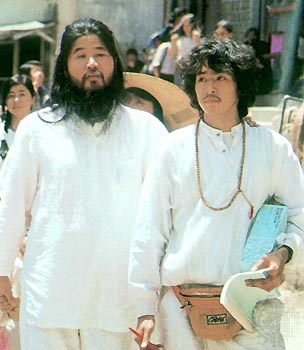
Here's another one, Aum Shinrikyo.:

aum.jpg


http://www.cfr.org/publication/9238/

Aum Shinrikyo, which is also known as Aum and Aleph, is a Japanese cult that combines tenets from Buddhism, Hinduism, and is obsessed with the apocalypse. The group made headlines around the world in 1995 when members carried out a chemical attack on the Tokyo subway system. A nerve agent, sarin, was released onto train cars, killing twelve and causing an estimated six thousand people to seek medical attention, according to the U.S. State Department 2007 Country Report. Aum Shinrikyo is listed as a terrorist organization because of the 1995 attack and for previous attempts to carry out biological and chemical attacks. The group split into two factions in 2007 due to internal friction over attempts to moderate the cults' religious beliefs and improve its public image. Despite thirteen years of inactivity, both groups remain under surveillance by Japanese authorities. Most of Aum's current 1,500 members live in Japan while about three hundred reside in Russia, says the State Department.
 
Learned about all, with the exception of 5 & 6, when I was in high school. Knew/know a few adherents of 1 - 4 as well. 100s of religions (or sects) in the world. Most people never research their own so you know they could care less about someone else's religion. Great thing about L.A., as opposed to my hometown, is that we have some of everybody out here. Baha'i temple right there on La Cienega and...I think Rodeo or just south of it. Been to events there. Been to Ishmaeli events, Hindu events, Hari Krishna events, dated a Buddhist, kick with my peeps (followers of MAAT), and so forth. Great post.
 
Back
Top