Continuing..........
Candomblé
Candomblé (Portuguese pronunciation:
[kɐ̃dõˈblɛ]) is an African-originated or
Afro-Brazilian religion, practiced chiefly in
Brazil by the "povo de santo" (people of saint). It originated in the cities of
Salvador, the capital of
Bahia and Cachoeira, at the time one of the main commercial crossroads for the distribution of products and slave trade to other parts of Bahia state in Brazil. Although Candomblé is practiced primarily in Brazil, it is also practiced in other countries in the Americas, including Uruguay, Argentina, Venezuela, Colombia, Panama and Mexico, and in Europe in Germany, Italy, Portugal and Spain. The religion is based in the anima (soul) of Nature, and is also known as Animism. It was developed in Brazil with the knowledge of African Priests that were enslaved and brought to Brazil, together with their mythology, their culture and language, between 1549 and 1888.
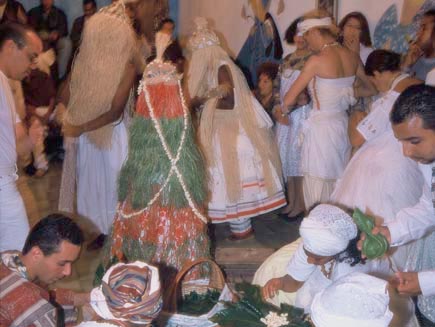
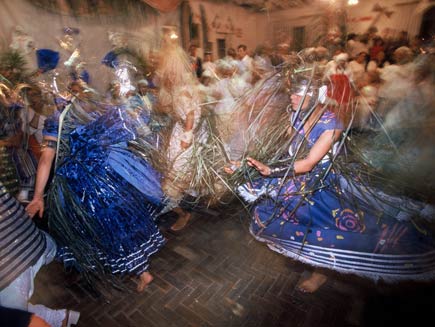
The rituals involve the possession of the initiated by Orishas, offerings and sacrifices of the mineral, vegetable and animal kingdom, healing, dancing/trance and percussion. Candomblé draws inspiration from a variety of people of the African Diaspora, but it mainly features aspects of
Yoruba orisha veneration.
In the
Yoruba language, God, the Supreme Being, has various names such as
Olodumare and
Olorun. God is worshipped along with the veneration of the orishas. The Orishas are said to "mount", or possess the participant during rituals. The religion that came to Brazil is derived of certain practices in the Yorubaland in West Africa. Today, this is in the area of the countries of
Nigeria,
Republic of Benin and
Togo. This was not a single group, but several, united by a common language and culture. Their indigenous spiritual practices were mostly brought over during the Atlantic slave trade by those dedicated to the veneration of the
orishas.
The Yoruba slaves were referred by various names in the Americas such as Anago, O Lukumi and Nago. In many parts of the Latin America, Orishás are now conflated with
Roman Catholic saints. This religion, like many African religions, is an oral tradition and therefore has not been put into text throughout the years. Only recently have scholars and people of this religion begun to write down their practices. The name
Batuque is also used, especially before the 19th century when
Candomblé became more common. Both words are believed to derive from a
Bantu-family language, mainly that of
Kongo Kingdom.
Although originally confined to the
slave population, banned by the
Catholic church, and even criminalized by some governments, Candomblé thrived for over four centuries, and expanded considerably after the end of slavery in the late 1800s. The idea that the Candomblé church is a unit is incorrect, however. The original Candomble temple,
terreiro, was established in early 19th century
Bahia. It developed from three freed African women, Iya Deta, Iya Kala, and Iya Nasso, and many call it a true matrilineal society. They first established the Candomble headquarters in Bahia called Engenho Velho. However, this was not meant to last, and after dispute after dispute candombles split from one another; therefore, this established hundreds of different candombles. These different candombles mixed ideas and practices with local Afro-Brazilians and created distinct attributes for certain candombles. The different candomblés, today, are known as nações, or nations, including Candomblé de Ketu, Candomblé de Angola, Candomblé de Jejé, Candomblé de Congo, Candomblé de Ijexa, and Candomblé de Caboclo. It is now a major, established religion, with followers from all
social classes and tens of thousands of temples. In recent surveys, about 2 million Brazilians (1.5% of the total population) have declared Candomblé as their religion. However, in Brazilian culture, religions are not seen as mutually exclusive, and thus many people of other faiths participate in Candomblé rituals regularly or occasionally. Candomblé deities, rituals, and holidays are now an integral part of Brazilian
folklore.
Candomblé may be called
Macumba in some regions, notably
Rio de Janeiro and
São Paulo, although
Macumba has a distinct set of practices more akin to European
witchcraft. Candomblé can also be distinguished from
Umbanda, a religion founded in the early 20th century by combining African elements with
Kardecism; and from similar African-derived religions such as
Quimbanda,
Haitian Vodou,
Cuban Santería, and
Obeah, which developed independently of Candomblé and are virtually unknown in Brazil.
There are 2 million Candombles worldwide
Brazilian slaves came from a number of African
ethnic groups, including
Igbo,
Yoruba,
Ewe,
Fon, and
Bantu. Slave handlers classified them by the shore of embarkment, so the relation to their actual ethnicity may be accurate or not. As the religion developed semi-independently in different regions of the country, among different ethnic groups, it evolved into several "sects" or
nations (
nações), distinguished chiefly by the set of worshiped deities, as well as the
music and
language used in the rituals.
The division into nations was also influenced by the religious and beneficent
brotherhoods (
irmandades) of Brazilian slaves organized by the Catholic Church in the 18th and 19th centuries. These fraternities, organized along ethnic lines to allow preaching in the slaves' native languages, provided a legitimate cover for slave reunions, and ultimately may have aided the establishment of Candomblé.
The following list is a rough classification of the major nations and sub-nations, and their sacred languages:
Candomblé is a polytheistic religion and worships a number of
gods, derived from African deities:
These deities were created by a supreme God:
Olodumare,
Olorun etc of the Yoruba,
Zambi or
Zambiapongo of the Bantu, and
Nana Buluku of the
Fon.
Candomblé deities have individual personalities, skills, and ritual preferences. Following the African belief systems from which Candomble is derived, every person is born with a "patron" deity. Usually after a reading with cowry shells by a priest such as a
Babalawo (father or master of the mysteries), skilled in divination, or from having been possessed by the deity, the person undergoes initiation into the mysteries of that deity. The deities (except God, the Supreme Deity) manifest themselves by possession trance on the priests during Candomblé rites, when the initiate's body is used by the god to dance and communicate with the humans in attendance.
Altogether, the various nations of Candomblé retain a number of the deities still venerated in Africa. There are many similarities between some deities of different nations: e.g. Bantu
Kabila, Ketu
Oxósse and Jejé
Otulu are all hunters and have the same symbolic colors. In Candomblé, however, they are considered different deities.
On the other hand, deities from one nation may be acculturated as "guests" in houses and ceremonies of another nation, besides those of the latter. Some nations assign new names to guest spirits, while some retain the names used in the nation of origin.
http://en.wikipedia.org/wiki/Candomblé