
You are using an out of date browser. It may not display this or other websites correctly.
You should upgrade or use an alternative browser.
You should upgrade or use an alternative browser.
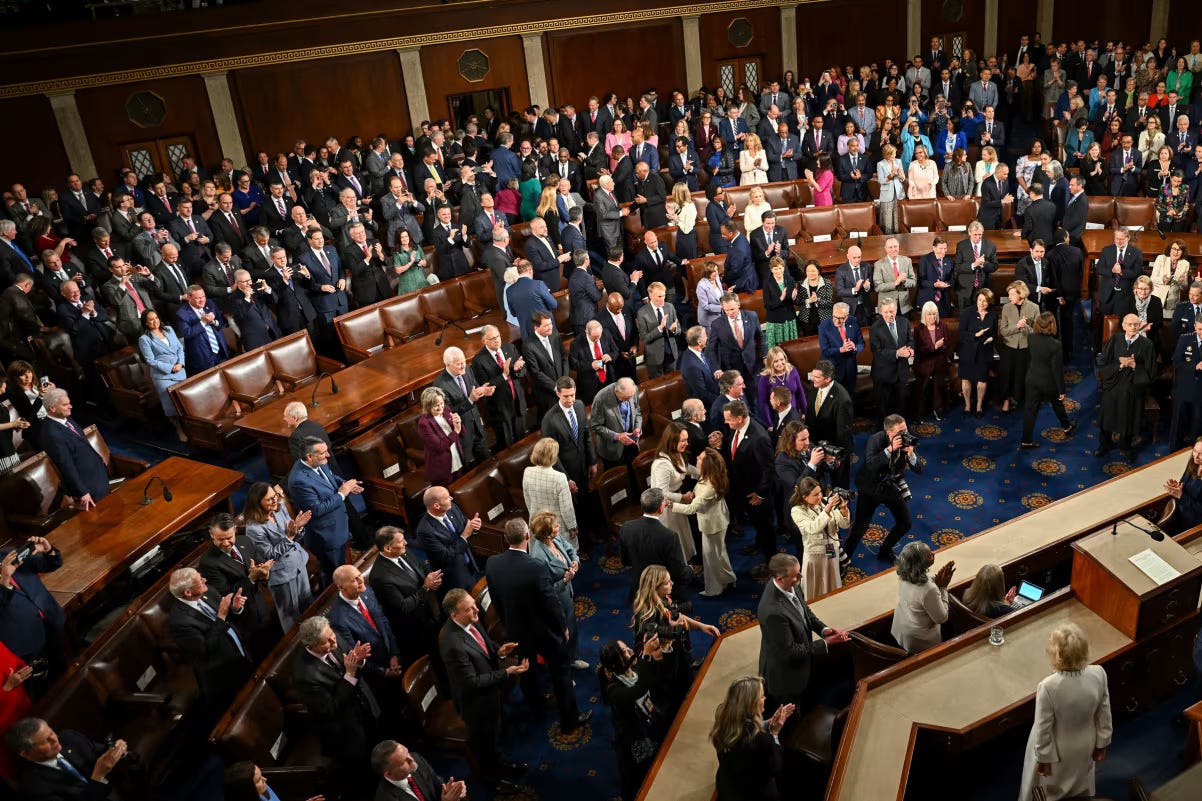
UPDATE: Donald Trump Takes Office as the 47th US President
- Thread starter DC_Dude
- Start date


Yeah but unfortunately there will never be true unity or Real Peace on Earth!!!Black and white working together is something positive we can get from that.
Jackson, Mississippi

Tasia Fortune Identified as Woman Found Hanging in Tree Behind Vacant Jackson Home
The woman whose body was found hanging from a tree behind a vacant Jackson, Mississippi, home is 29-year-old Tasia Fortune, the Hinds County Coroner’s Office said.
 www.mississippifreepress.org
Last edited:
Good for him.
Are we going to start with his wife? That's a tricky question. Which one, am I rite?

The “Establishment” vs. DSA Fight Is Overblown
But They Can Both Learn from Each Other
Bakari SellersAug 06, 2026
I know I’m in the minority of Democrats here, but I think that the media narrative regarding the intra-party fight between “Establishment” Democrats and the DSA wing of the Progressive wing of the Democratic Party is overblown. While a good story to tell and likely to generate clicks, what I see more of in this “fight” is a generational fight that also comes with a few unique wrinkles that generally happen within parties going through the kind of generational, demographic and ideological shifts we see happening across the Democratic Party.
A few points I want to make clear upfront as we think about what’s happening and how Democrats can emerge from this cycle ready to govern while Trump is still in the White House while also looking to win in 2028 –
- Primary fights are healthy, so long as we leave them in the primary. What we’re seeing a lot of Democratic elite hand-wringing about in the emergence of the DSA and more progressive statewide candidates is healthy. Progressives want – and deserve – to see their candidates in primaries where they can make their case to the entire Democratic electorate. Democrats lose voters’ trust when candidates look like they’re hand-picked by party elites. And there’s value to all wings of the Party in seeing where voters land when there’s an election where we have the real polls of whose view of the world prevails with our voters. Primaries tell us where we are as a party, and we only know where we are if we have real choices. When we have choices, people will disagree, but voters will (and should) ultimately make that call. We should all welcome everyone to run in our Democratic primaries, including Democratic Socialists who don’t want to be Democrats at all. Because ultimately, voters will reject them if their views are too extreme or if voters don’t think they can win general elections. I trust our voters to make the right call (most times). The key, though, is that once the primary is over, we focus our attention on the people who deserve to lose: Republicans.
- Establishment Democrats needed a wakeup call. I think we can all agree that the Democratic Party is a gerontocracy that needs to be broken, and the Party’s failing brand has as much to do with old candidates that are out of touch as it does a message that is stale and needs new messengers and new messages. If we learned nothing else from 2024, we were reminded that the couch is always on the ballot when people don’t think they have something to vote for. A party whose message was largely focused on what it was against and who could only be associated with deeply unpopular social issues was one that needed to be beaten. What I think the emergence of the Far Left and DSA has done for many Democrats is wake them up to an electorate that is growing tired of the Party’s leadership. That’s a good thing – for everybody.
- This isn’t about being “centrist.” The easy mistake a lot of commentators make about this issue is that the solution to the DSA and Progressive is being a “moderate” or “centrist.” That’s not only the wrong read; that’s also bad politics. Most voters are going to have positions that span the ideological spectrum, and good candidates and campaigns can, too. Some issues like universal healthcare and more government control on things like data centers and artificial intelligence are good politics and good policy and don’t come with clean ideological tags. So, ignore the “we need more Democratic centrists” talk because that’s not a winner, either.
- While the DSA wing of the Progressive wing of the Democratic Party is real, it’s only concentrated, largely White, only in a few places but over indexes online and in terms of media attention. I also think we need to be clear about the nature and scale of the “threat” that the DSA poses. New York City Mayor Zohran Mamdani’s ascendance – along with a handful of Congressional races in deeply Democratic districts – has muddied the reality that this is a “movement” that is only in a handful of pockets across the country. They tend to be highly urbanized areas with lots of college educated people, so think New York City and Seattle not Birmingham and Indianapolis. That’s important because Democrats have to win and compete everywhere, and in the places where we’re the weakest (rural and suburban areas), we aren’t faced with much DSA/Establishment primary battles. And the non-DSA parts of the country are the vast majority of America. So, while the largely New York City and D.C.-centric media types like to focus on this (in part, because the DSA activity is hot in their backyards), the ink spilled on this isn’t close to the political reality on the ground for most Americans and most Democrats.
What that looks like is candidates that are clear on the Middle East and the U.S.’ relationship with Israel but also understanding that affordability on healthcare, housing, and childcare still wins the day. Universal healthcare is increasingly popular, but you have to have an option for people who like the insurance they have and a role for private insurers. That also looks like candidates with modern, easy-to-understand communications like Mayor Mamdani’s “man on the street” interviews and straight-to-camera appeals instead of wordy IG posts that no one reads or kneeling in Kente cloth.
I think my friends on the DSA left would benefit from learning from the “political gravity” that will come with deeply unpopular positions like abolishing the police, prisons, and borders and gender reassignment surgeries for prisoners – or they’ll continue to lose in bigger races outside of Congressional districts and cities like New York City and Denver and most Democratic primaries. Political gravity will also come into play on race, because a class-only critique of our politics is both wrong *and* bad politics, as Black voters – particularly in the South – will continue to give the Far Left the cold shoulder. As you can see, Mayor Mamdani isn’t abolishing the police, he kept Mayor Adams’ police chief, he can’t arrest Netanyahu when he comes to New York (even though he campaigned on this and no one asked for it), and he is meeting with President Trump. So, even their patron saint has done what everyone does when they win elections: they moderate to govern. He’s also – at least rhetorically – said the right things about race and the outcomes of Black New Yorkers, so the Far Left’s blind spots on race could improve in time. I hope more of his allies take note and follow suit.
Political gravity is also finding my Establishment friends. The Democratic Party’s traditional relationship with Israel is no longer sustainable, and I think in 2028 we’ll see the first Democratic nominee for President with a non-traditional orientation towards Israel and the Middle East that is closer to Jesse Jackson than Barack Obama or Joe Biden. Our relationship with Corporate America post-Trump also has to change when we saw so many companies bend the knee to the Trump White House. I can’t say this enough, but Washington Democrats are also too old, and every time they remind us that they’re out of touch, it gives life to people who want to burn it all down. Political gravity will bring younger challengers from the Establishment wing like a Christian Menefee in Houston such that the race becomes young versus old and not electable versus unelectable in general elections, and the Establishment is going to lose that one more and more as time goes on.
I won’t hold my breath that the groups will learn from one another. But I know when I see Senator Ossoff or Governor Moore, for example, I see young Democrats that are getting smarter on communications, taking tougher stances, while also doing what’s shown to work. Political gravity will do that to you, and I hope everyone uses our primaries to learn to win and be responsive to an electorate that is expecting more of all of us.

Have a debate out in the streets owned by the Tesla Guy. Stop posting Twitter links.

(NewsNation) — The Trump administration has paid about $100 billion in tariff refunds since the U.S. Supreme Court struck down the president’s sweeping import taxes, but don’t expect a windfall as a consumer.
Those refunds could eventually reach as much as $166 billion and are going to the importers that paid the tariffs directly, even though shoppers shared the burden.
Companies like Apple, Nike and Walmart are now deciding whether to pass any of the refunds on to customers, offset costs or put the money toward other business priorities.
More than 440K people became millionaires in the US last year
NewsNation reviewed earnings calls and contacted major companies for additional details on how they plan to use the money. Most did not respond, and those that did largely referred to public statements.
Those statements suggest there is no standard playbook, and few companies have explicitly said the refunds will flow back to customers. Amazon, FedEx and UPS are among the exceptions.
It’s difficult to determine how much the now-illegal IEEPA tariffs ultimately cost consumers because some companies absorbed more of the cost, while others passed it on through higher prices.
Mortgage rates rise for 5th straight week, hitting levels not seen since 2025
The Tax Foundation estimated President Donald Trump’s tariffs amounted to an average tax increase of about $1,000 per U.S. household in 2025, driven primarily by the IEEPA tariffs.
At one point, Trump even floated the idea of sending Americans a $2,000 tariff “dividend,” but that hasn’t happened.
What Amazon, Walmart and others are doing with tariff refunds
Amazon received about $600 million in tariff-related refunds in the second quarter, CFO Brian Olsavsky said on an earnings call last month. He said the company largely absorbed tariff-related costs rather than passing them on to customers.
In the “limited set of circumstances” where it passed specific import charges on to customers, the company plans to contact them and “automatically issue refunds,” Olsavsky said.
Beyond those refunds, Amazon plans to use the money to “invest in low prices” for customers.
Amazon planning to cut number of packages sent through USPS
Walmart is also pursuing tariff refunds, which could total more than $2 billion — less than half of one percent of its annual U.S. sales.
On a May earnings call, CFO John David Rainey said the company’s priority is to “invest in the customer” and “invest in price.”
Walmart referred NewsNation to executives’ public comments and did not provide additional details when contacted by email.
Best Buy has said its goal is to use any recovered duties to “deliver value” back to customers. The company did not respond to an email seeking details.
Meanwhile, UPS and FedEx have both created online portals where customers can check whether they qualify for tariff refunds. Simply receiving a package through UPS or FedEx does not make someone eligible.
Apple, Nike have different plans
Apple has received an estimated $2.2 billion in refunds. On its latest earnings call, CEO Tim Cook reiterated plans to reinvest the money “into the U.S.,” echoing earlier comments that it would go toward domestic innovation and manufacturing.
Apple hiked prices on several popular products in June, though it attributed the increases to an AI-driven memory chip shortage rather than tariffs. The iPhone maker did not respond to a request for comment on its tariff refunds.
Nike expects to recover $986 million in IEEPA tariff refunds but has said little about how the money will be used. It also did not respond to an email seeking additional details.
Apple launches new iPhone lease program: Here’s how it works
Last year, the shoe giant implemented what executives described as a “surgical” price increase in the U.S., and it’s now one of several companies facing consumer lawsuits from shoppers seeking refunds for higher prices they say were driven by tariffs.
Nintendo is also being sued over similar claims.
In a July court filing, the video game company’s lawyers argued that consumers aren’t entitled to refunds and were “free to abstain from purchasing the product or seek out competing products” if they disagreed with the price.
As of July 31, the federal government had received more than 250,000 tariff refund declarations through its Consolidated Administration and Processing of Entries system, according to court filings.
Trump’s IEEPA tariffs were only one piece of a broader tariff agenda that he says is aimed at negotiating better trade deals and bringing jobs back to America. Other levies, including those targeting steel and aluminum imports, remain in place.
Didn't they just buy some weapons at the beginning of this administration? They should go test out their expensive toys.
Or they go reincarnate Saddam. Is he still in Tikrit?

Shit doesn’t that disqualify him

and Barron and IvankaShit doesn’t that disqualify him
His white queen about to be the next female billionaire on the forbes list

Matt Geatz got venmo receipt showing payment to fuck a 17 yr old.
Last edited:


You, unlike Boosie, know who to pay to get your way.
Y'all do know you will have to arrest a couple soup ream court justices indefinitely, right?
Costco overcharged its customers in the tariff wars. But Americans are dumb.
Similar threads

- Replies
- 22
- Views
- 273


- Replies
- 4
- Views
- 392


- Replies
- 55
- Views
- 2K
