
You are using an out of date browser. It may not display this or other websites correctly.
You should upgrade or use an alternative browser.
Coco Gauff Wins Her First U.S. Open Championship!
- Thread starter jawnswoop
- Start date













Raw... 








slim fit lil'thang thang wit deem sweet lil'tits...


The Jessica Pegula hot mic moment should never have happened. Tennis still needs more of it

Jessica Pegula's comments about Mirra Andreeva and Coco Gauff were caught on a hot mic at the WTA Finals. Sarah Stier / Getty Images

By Matthew Futterman
Nov. 6, 2026
Before anyone fries U.S. tennis star Jessica Pegula for calling French Open champion Mirra Andreeva a “diva” who “needs to be humbled” in a conversation that she thought was private, and before Pegula and Andreeva feel pressured to clear the air with one of those forced-friendship TikToks, tennis might want to remember that it needs more of what it got from its WTA Finals hot mic moment Wednesday, not less.
Just not like that.
A representative for Pegula, the world No. 5 who sits on the player council for the governing body of women’s tennis, said that she had no idea that her practice session with Andreeva at Indian Wells, Calif. — the venue for the WTA’s flagship, season-ending event — was being livestreamed, let alone with microphones.
She had no idea that her conversation with coach Mark Knowles, in which Pegula said she had “lost a little respect” for Andreeva’s coach, 1994 Wimbledon champion Conchita Martínez, because she “pokes (Andreeva) and eggs on her behavior,” could be clipped up and broadcast to the internet.
She had no idea that when she brought her friend and former doubles partner Coco Gauff into the conversation, speculating that Andreeva would be a better player than two-time major champion Gauff if she had her mentality, that would go around the world too.
On Thursday, the WTA Tour took responsibility, saying it had neglected to inform players that the practices were being livestreamed and that on-court microphones, intended to capture the sound of ball on racket, might also pick up the kind of candid workplace snark that everyone reading this has likely engaged in at least once.
“We sincerely apologize for failing to meet our responsibility to ensure players and coaches were properly informed,” the WTA said in a statement.
Player privacy was already a vexed question this year, after Gauff smashed a racket at the Australian Open in an area she believed had no cameras and Iga Świątek, the six-time major champion, backed up Gauff’s call for a privacy review by asking whether or not players were like “animals in a zoo.” Tennis Australia, and then the other Grand Slam organizers, said they would balance the ever-growing desire for unfiltered access to athletes with privacy.
The tennis rule that's unevenly enforced
Ava Wallace
The way this spicy chatter about an on-court rival came out was wrong. Pegula has reached out to those involved to apologize. But lost in all the chatter about whether Pegula was right or wrong about Andreeva, or if she had any right to criticize a 19-year-old with a Grand Slam title, which Pegula lacks, or if Pegula’s words were unsporting, was something else: the pearl-clutching over the chatter itself.
Advertisement
It spreads every time something like this happens in tennis, a sport that craves cultural cut through and the attention that controversy can bring, while simultaneously appearing scared of something so woven into the fabric of just about every other high-profile sport in the world. In just about any other league, a conversation like Pegula’s would make the rounds and vanish into the aether, rather than making “People” — albeit with a photo of an in-this-case-innocent Jelena Ostapenko on the story.
Call it the politeness problem. Who isn’t here for drama? Who isn’t now desperate for Andreeva and Pegula to meet at this tournament, which gets underway on Sunday at the Indian Wells Tennis Garden, or at the Australian Open in January? Who doesn’t like players having beef with each other and voicing it publicly?
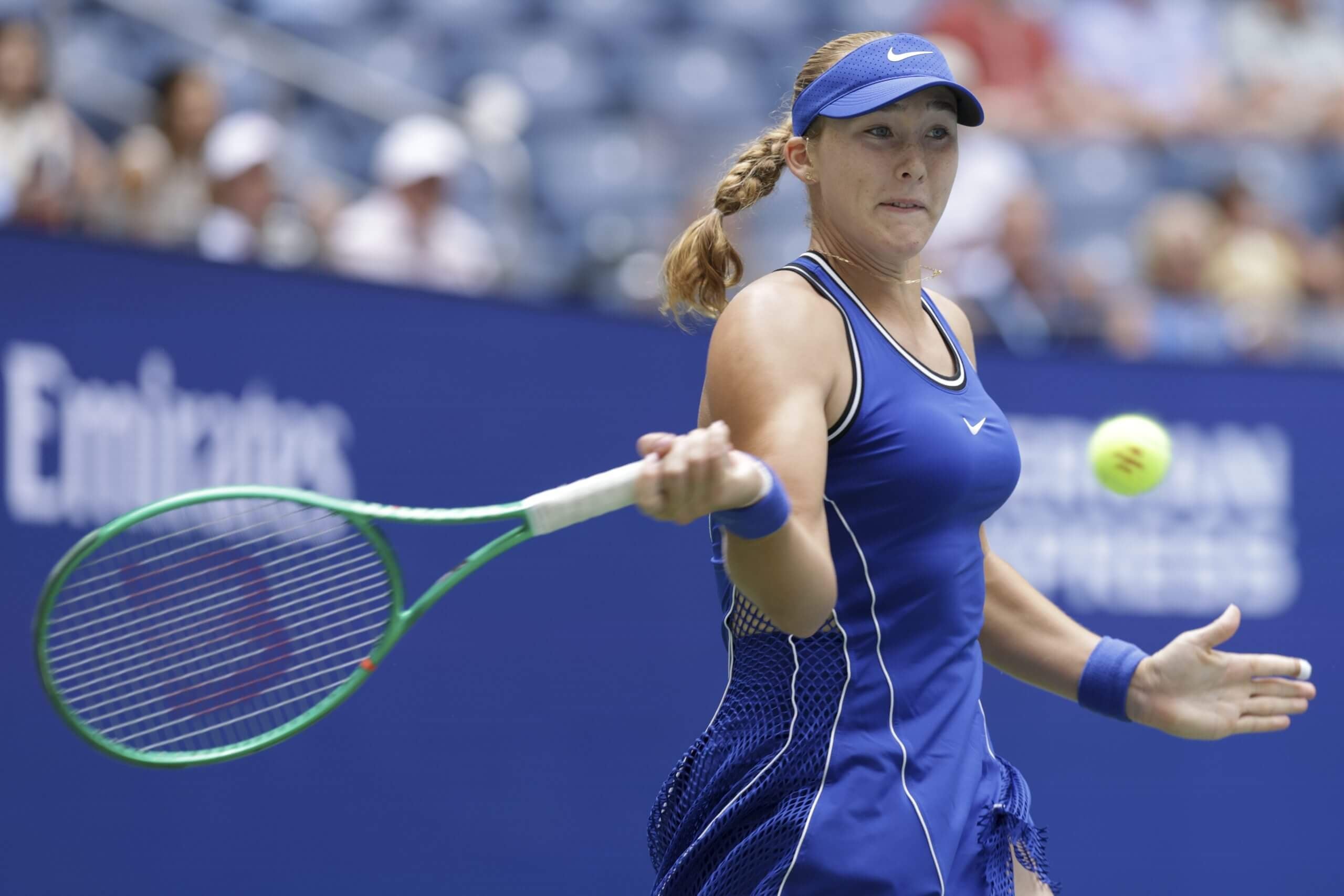
Mirra Andreeva during the U.S. Open in September.Simon Bruty / USTA via Getty Images
Athletes in other sports say the sort of stuff that Pegula said on the practice court Wednesday on the field of play all the time. They say it in the locker room after games with microphones in their faces and tape recorders running. No one suffers irreparable harm. Tension builds and drives the story.
In last year’s can’t-turn-away NBA Finals, Victor Wembanyama of the San Antonio Spurs trash-talked Mitchell Robinson of the New York Knicks, yelling, “I’m in your head,” after scoring with the Spurs leading 37-20 early in Game 4.
Robinson delivered a forearm to Wembanyama’s jaw a play later. Then the Knicks came back from the dead to win. Who was in whose head?
“If somebody says something to me, I’ll probably go back,” WNBA star Caitlin Clark said on “Not Gonna Lie With Kylie Kelce,” just two days ago. Lewis Hamilton and Sebastian Vettel’s rivalry of turns and words in Formula 1. The Seahawks’ Richard Sherman’s iconic “ice up son” to the 49ers’ Michael Crabtree. There are so many examples from so many games in so many sports, and that is the point.
Advertisement
Tennis is still figuring out how to harness this, despite having plenty of examples of its own. Daniil Medvedev’s “man you better shut your f––– up OK” line to Stefanos Tsitsipas from the 2018 Miami Open is embroidered on hats.
The era of the Williams sisters, Maria Sharapova et al had plenty of barbs and retorts that got settled on the court. Roger Federer, now the statesman of decorum, openly called Novak Djokovic’s death-or-glory forehand return down two match points in their 2011 U.S. Open semifinal a “lucky shot.”
Sometimes beefs or disputes feel awkwardly one-sided (Danielle Collins accusing Świątek of insincerity over an injury at the 2024 Paris Olympics) or so out of nowhere that confusion overtakes conflict (Emma Navarro telling Zheng Qinwen she did not respect her as a competitor at the 2024 Paris Olympics).
Sometimes athletes should own up to a furious tirade in the heat of a loss, as Aryna Sabalenka did after crediting everything and anything but Gauff for the American’s 2024 French Open title, in both her on-court speech and her news conference.
What You Should Read Next

Aryna Sabalenka’s ‘terrible’ French Open final and the intangibles of tennis
World No. 1 Sabalenka bemoaned the conditions and her own “terrible” play after losing the French Open final to Coco Gauff.
But once Sabalenka had made those comments, Gauff had her right of reply. “I’m the one sitting here,” she said, the Coupe Suzanne-Lenglen at her side, after Sabalenka had also suggested that Świątek would have beaten her.
That brings us back to the WTA Finals, which start Sunday but had their media days Friday. Pegula, Andreeva and Gauff all spoke, but neither of them addressed the incident in news conferences. WTA chair Valerie Camillo apologized to Pegula in her news conference, while in an interview with ESPN, Pegula said that players could “unfortunately use this incident to keep pushing for more player privacy.”
Next, the players will meet on the court. Gauff and Pegula play Sunday; Pegula and Andreeva, who have never played a competitive match, can only meet in the semifinals, but there’s a whole season of tennis to come.
Advertisement
Head-to-head records and wins or losses in big matches are seen as opportunities for revenge. Controversy adds tension, and tension makes sports narratives more exciting. The privacy debate at the center of this issue is clear: the WTA made a mistake to which it has owned up and a private conversation should not be public. That doesn’t mean that tennis stars should stop talking their talk.
Tennis needs more of this — and Gauff and Pegula are more aware of it than most.
“It would add more types of fans and not make it so traditional,” Pegula said on the WTA Insider podcast in 2023, alongside Gauff.
“I wouldn’t take it personally. I played other sports growing up, I played basketball and ran track. In those sports, we trash talk a lot, and I was the only girl on the boys’ team. I got some dishes and you had to dish some back.” Gauff said.
“It’s also the culture of tennis. If I did that, Twitter would go insane.”






Similar threads

- Replies
- 1
- Views
- 121

- Replies
- 21
- Views
- 908


- Replies
- 0
- Views
- 277
- Replies
- 0
- Views
- 43

