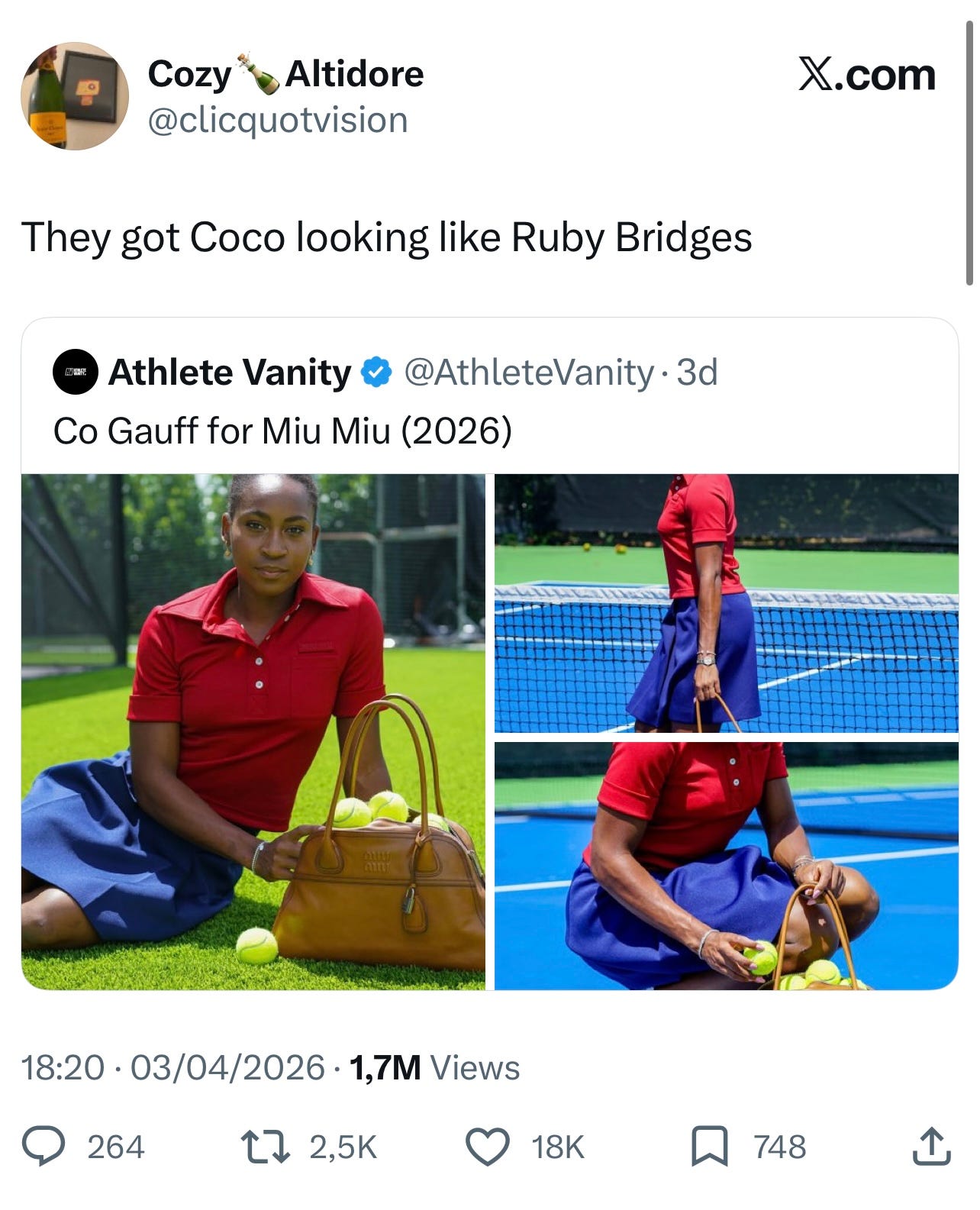
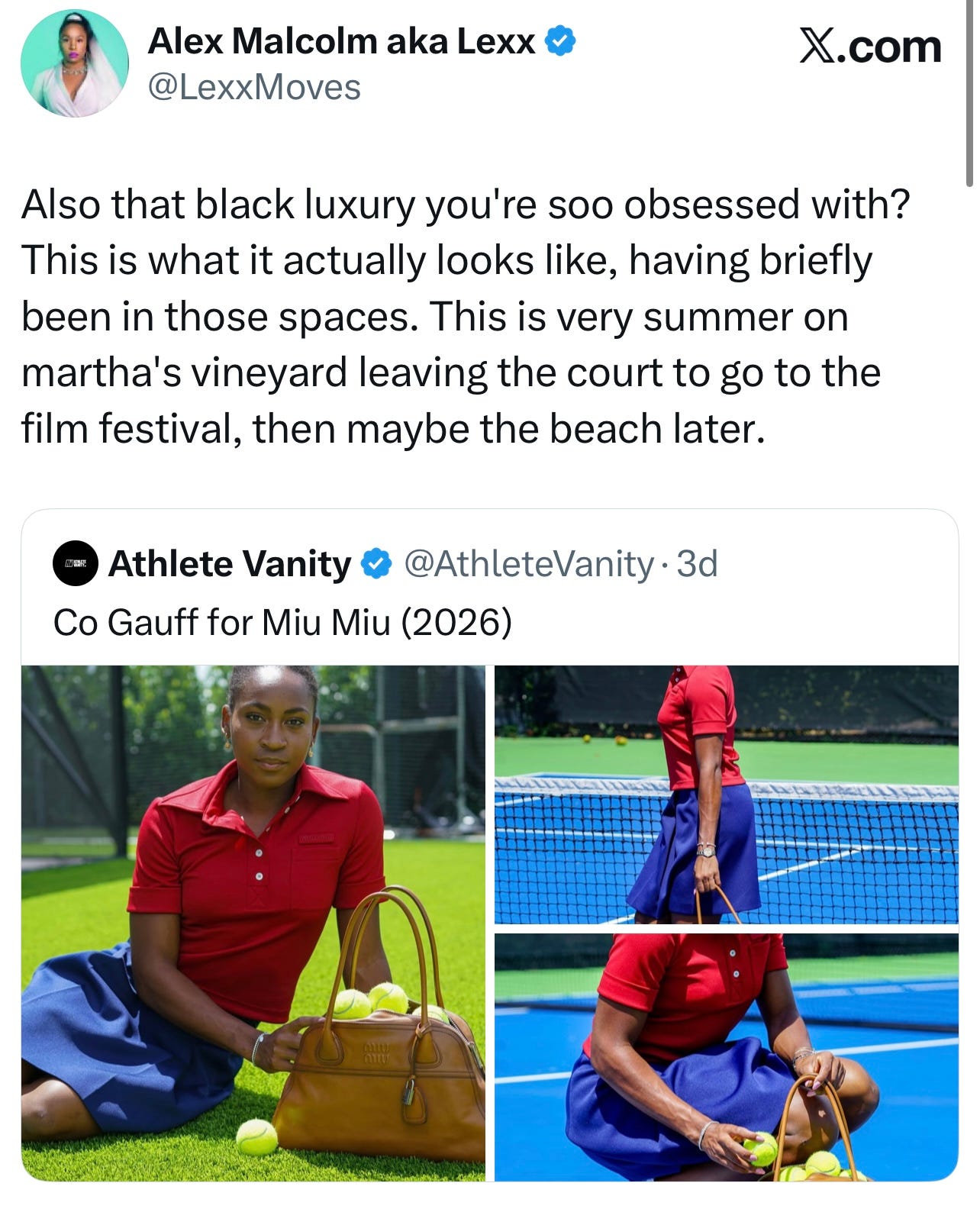
CoCo Gauf catching hell on Social Media for a Miu Miu ad campaign

0utsyder

Rising Star
BGOL Investor
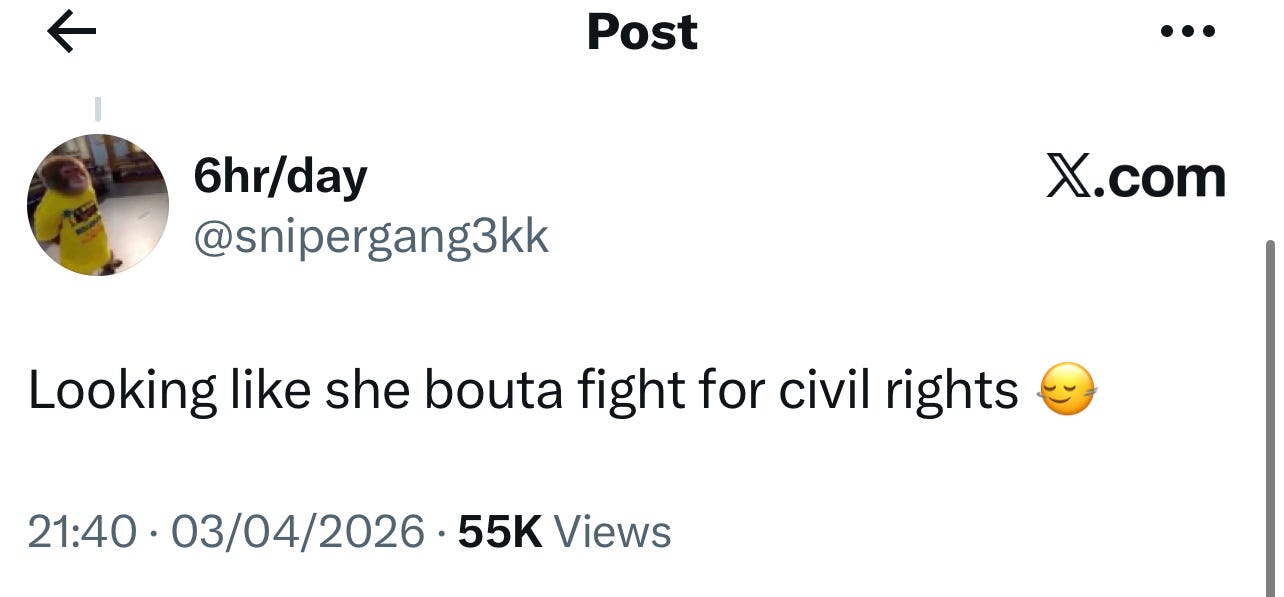
Some on Twitter compared her to Ruby Ridges which tells me someone in a 3rd world country updated their AI bots to the latest version

Coco Gauff responds to backlash over Miu Miu campaign​

Tennis star’s latest fashion campaign stirs discussion about beauty, social media and representation
Coco Gauff


Coco Gauff (Photo by Derrel Jazz Johnson for rolling out)
Coco Gauff, the 22-year-old tennis star, has drawn attention not only for her achievements on the court but also for her presence in the fashion world. Her latest campaign with Miu Miu features her on a tennis court, wearing a bold red top and a stylish blue skirt while embracing her natural hair. The campaign images highlight her authenticity and personal style, resonating strongly with fans who admire her confidence and individuality.

Many social media users praised Gauff’s appearance and the natural way she presented herself, marking a growing appreciation for authenticity and natural beauty in luxury fashion. Her choice to maintain her natural hair in the campaign aligns with broader cultural conversations about representation and self-expression.


Challenges on social media​

While Instagram followers offered positive feedback, Gauff experienced a wave of criticism on X, previously known as Twitter. Comments targeted her appearance and questioned aspects of the campaign, reflecting a stark contrast to the praise she received elsewhere. The athlete’s brief return to the platform after taking a social media break highlighted the challenges that public figures face in navigating spaces that can quickly amplify negative opinions.


Gauff’s experience illustrates a common dilemma for celebrities: balancing engagement with fans against the emotional toll of criticism. Many public figures have temporarily stepped back from platforms like X to protect their mental health, demonstrating the intense pressures associated with constant online visibility.


Representation and visibility​

Despite the backlash, the significance of Gauff’s campaign cannot be understated. As a young Black woman in industries that have historically lacked diversity, her presence challenges conventional beauty standards and promotes representation. Embracing her natural hair in a high-profile fashion campaign sends a powerful message about self-acceptance and encourages audiences, particularly within the African American community, to celebrate authentic beauty.

Her visibility in both sports and fashion underscores the importance of role models who defy stereotypes and embrace individuality. Gauff’s participation in the Miu Miu campaign serves as a reminder of how representation can influence broader conversations about inclusivity and confidence in self-expression.

The weight of public scrutiny​

The scrutiny Gauff faced is part of a larger pattern in which public figures must contend with polarized reactions online. Social media platforms can amplify criticism, making even brief interactions emotionally taxing. For Gauff, the experience highlights the ongoing tension between sharing personal achievements and managing public perception in real time.

Her decision to continue embracing authentic self-expression despite the criticism reflects resilience and a commitment to being a visible example for younger audiences. By navigating the highs and lows of online reactions, Gauff demonstrates the complex reality of modern fame.

Embracing authenticity in the spotlight​

Coco Gauff’s experience with the Miu Miu campaign emphasizes the value of authenticity amid the pressures of social media. While she encountered negative reactions, her presence and confidence offer an empowering model for fans who look to her as a source of inspiration. The campaign reinforces the importance of supporting celebrities for their accomplishments while recognizing the human challenges behind public personas.

As Gauff continues to excel on the tennis court and in fashion, her efforts highlight the intersection of sport, style, and cultural impact. The conversation surrounding her campaign encourages reflection on the ways audiences engage online and the significance of celebrating individuality in all forms.
 

The Discourse Around Coco Gauff's Miu Miu Campaign is a Class Conversation Being Disguised as a Cultural One​

if I hear one more Ruby Bridges comparison......​

Louis Pisano
Apr 06, 2026


Happy Monday to everyone except the people who have spent the better part of this weekend auditing Coco Gauff’s hairline on Twitter, which, based on the volume of discourse, appears to be a significant portion of the population. I was planning to stay out of this one, and to watch it unfold from a safe distance despite having my feelings. Then I woke up this Monday morning still thinking about it and decided that apparently I was going to write about it whether I wanted to or not.

https%3A%2F%2Fsubstack-post-media.s3.amazonaws.com%2Fpublic%2Fimages%2F0eb12da6-add6-44a5-a848-21b41fd2e4a8_1080x1439.jpeg
https%3A%2F%2Fsubstack-post-media.s3.amazonaws.com%2Fpublic%2Fimages%2F66439dd5-2029-46cc-8196-4e8f9c5d054a_1080x1439.jpeg
https%3A%2F%2Fsubstack-post-media.s3.amazonaws.com%2Fpublic%2Fimages%2F92593655-a865-4fed-872f-32639c902898_1080x1439.jpeg


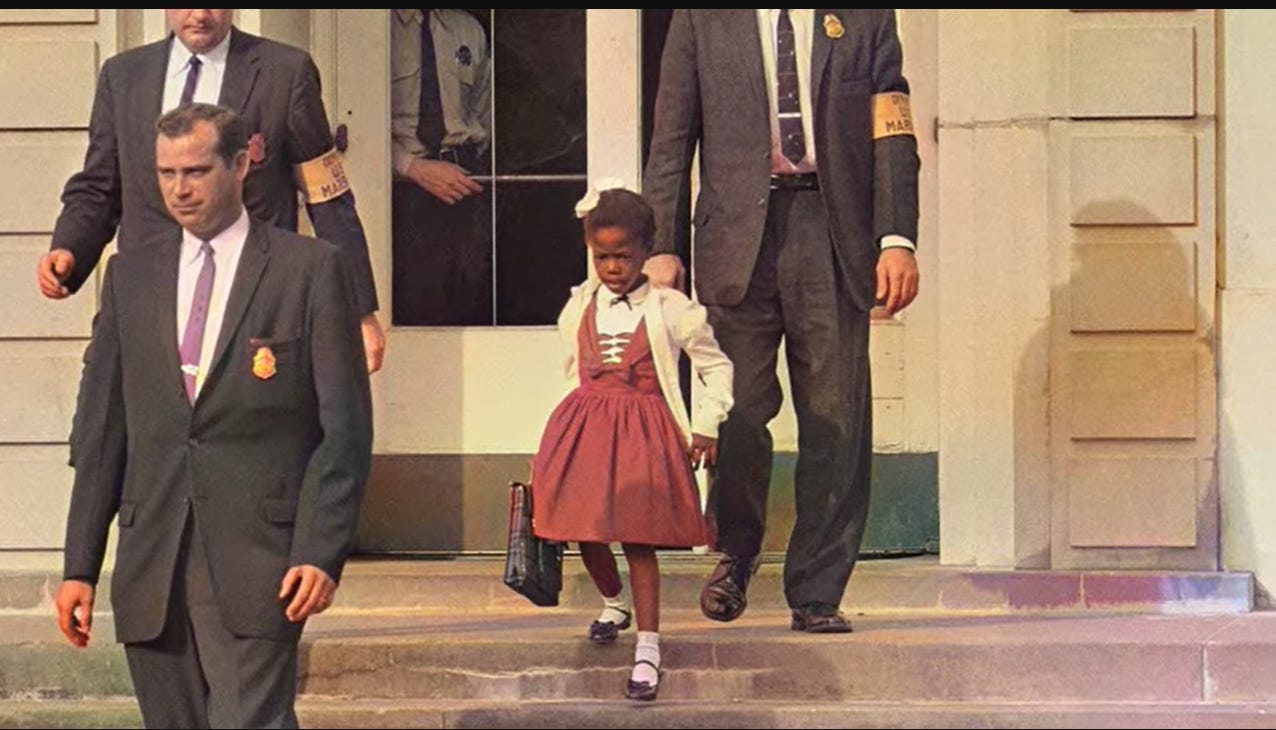
Over the weekend tennis superstar Coco Gauff’s Miu Miu Spring Summer 2026 campaign went viral on the hellscape that used to be Twitter. Now to me the campaign is fab, it captures something specific and true about Coco, the athleticism, the ease, the preppy quality that has always been part of how she moves through the world, and it feels like someone actually looked at her rather than just dropping her into a set. I liked it, I moved on, and then I went back and made the catastrophic mistake of reading the comments, where I found people calling her hair “undone” and “embarrassing” and, in one comparison that has probably already given me multiple aneurysms, likening her to Ruby Bridges. Ruby fucking Bridges. The six-year-old who was escorted into a New Orleans elementary school by federal marshals in 1960 while white parents rioted outside. That photograph of a small Black child in her school clothes walking alone through a mob of adults who wanted her dead, people reached for that image to describe Coco Gauff’s hair in a luxury fashion editorial, and they meant it as a criticism.


Ruby Bridges


I feel like the people making that comparison don’t seem to understand what they’ve actually said about themselves, because the reason Ruby Bridges looks the way she does in that photograph is that she was a working-class child in the Jim Crow South, and the texture of her hair and the simplicity of her clothes are inseparable from that reality, which is part of what makes the image so shattering. So when someone looks at a world-ranked tennis champion in a Miu Miu campaign and the first thing their brain reaches for is that photograph, what that reveals is that natural Black hair, to them, reads as poverty. As unfinished. As something that needed to be fixed before she showed up. Guess what? That’s not a read on Coco Gauff, that is an admission and they are telling on THEMSELVES.


The thing underneath all of this, which I don’t think is getting said clearly enough, is that this is a class conversation being disguised as a cultural one but to understand why it’s so explosive, you have to understand that it landed inside a war that was already in progress. For the better part of fifteen years, Black women’s hair has been one of the most contested terrains in intra-community identity politics, and I mean that with no exaggeration. The natural hair movement that took off in the early 2010s started as something very radical which was a collective decision by Black women to stop chemically straightening their hair and reclaim the textures they’d been taught since childhood to see as unprofessional, unattractive, and unmanageable. It was a real cultural shift, it produced real community, and it also, pretty quickly, produced its own rigid hierarchy. Certain textures got coded as more authentically natural than others. Protective styles were acceptable, but the acceptable ones kept changing. Women with looser curl patterns got accused of dominating spaces that were supposed to center 4C hair and the movement that began as liberation calcified, as these things tend to do, into its own set of rules about what counted and what didn’t.

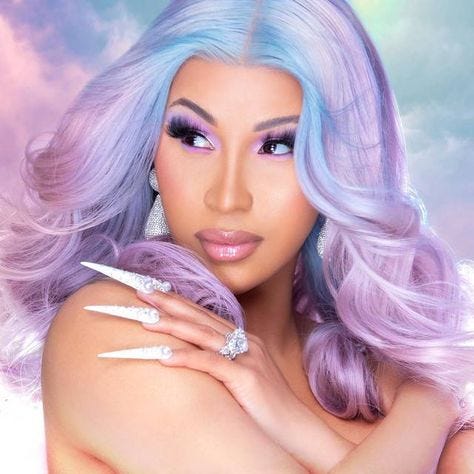
On the other side of that you have a completely different aesthetic world, the one of wigs, weaves, lace fronts, elaborate protective styles, long acrylic nails, full glam (commonly referred to as the Baddies aesthetic) and the contempt that flows between these two camps is extremely vicious in both directions.


Cardi B as an example of the “Baddies aesthetic”
The natural hair community has a whole vocabulary for dismissing the other side: women who wear wigs get accused of self-hatred, of chasing Eurocentric beauty standards, of being unable to love what actually grows out of their heads. And the women on the receiving end of that give it right back, calling the natural hair crowd self-righteous, calling their aesthetic dusty or unkempt, arguing that a woman who spends four hundred dollars on a lace front is expressing just as much pride and creativity as someone who does a wash-and-go. Both sides have a point and both sides are also being completely exhausting about it, and what neither side tends to interrogate is how much class is entangled in the whole argument from the very beginning. But also i’m not a Black woman so maybe my opinion isn’t required.

ANYWAYS!

Writer Alex Malcolm posted during the discourse that this aesthetic is “very ‘summer on Martha’s Vineyard’, leaving the court to go to the film festival, then maybe the beach later,” and what was fascinating was watching how completely differently people received that framing. For some it was immediately obvious and true, and for others it landed as either incomprehensible or as an accusation, like Coco was being charged with performing whiteness. Malcolm’s point is about what the visual language of a certain kind of Black upper-class life actually looks like rather than about racial performance, which is apparently so unfamiliar to a lot of people that they can’t recognize it when they see it and instead read it as a failure.


I’ve spoken about it a lot, I grew up in private school, mostly around white kids, and the Black kids including myself who were there came from a world that looked a lot like what Coco looks like in that shoot, and crucially it didn’t look like anything to them/us because it was just their/our life. When your weekends involve boats and tennis courts and beaches, an elaborate hair situation isn’t a priority you’re avoiding so much as a practical impossibility you’ve never really oriented around, because a silk press doesn’t survive a match and a wig at the beach creates more problems than it solves and the whole logic of your active outdoor life runs counter to a presentation style that requires you to stay relatively still and dry. The privilege isn’t in the hair. The privilege is in the activity, and the appearance is just what the activity produces. When I got to public high school for the first time I encountered a totally different calculus, and I want to be precise about what I mean here because I’m not describing a hierarchy. Someone told me my hair was dusty, asked where my lineup was, told me I dressed like a white boy, and what I was actually bumping up against was a completely coherent alternative system of signals where the appearance had to carry the weight that the context wasn’t carrying. Long nails, expensive hair, the right lashes, these are legible, visible markers of care and income in a world where you can’t just gesture at your sailboat. That logic makes complete sense, and the problem has never been the logic itself, it’s the insistence that it’s the only logic, that it functions as a universal standard rather than one class-specific framework among several, and that anyone operating outside of it is somehow failing or being made to fail by the white institutions around them. A lot of the criticism of the Miu Miu campaign was ultimately dressed up as concern. The idea that Coco was being done dirty, that a white fashion house had somehow gotten her to show up looking like less than she is. But the fashion house didn’t do anything to her. She looks like herself, and the self she looks like is one that a specific segment of Black Twitter has decided doesn’t count, or doesn’t represent, or needs to be corrected and that correction is being framed as solidarity when it is pretty much the fucking opposite of that.

I’ve tried to have versions of this conversation online before and it usually ends with someone finding a photo of my white partner or surfacing an interview where I talked about growing up with a white father and using that as evidence that I’m not qualified to be here, as though the price of entry for talking about intra-community policing is first proving that you perform Blackness according to the approved aesthetic. Which is, if you sit with it for a second, something people online are not prone to doing, is the exact same mechanism I’m describing.
 
Back
Top