
You are using an out of date browser. It may not display this or other websites correctly.
You should upgrade or use an alternative browser.
You should upgrade or use an alternative browser.
Above The Fold with Jemele Hill
- Thread starter Costanza
- Start date



It seems Jemele Hill is the white man of female sports journalism.
Are you just using words or can you actually say why?
Everyone who wants to hate on her for that comment better be going at Obama ten times harder.
Great, now I know when and where to not tune in.
She’s certainly got a committed group of sensitive haters.
She’s certainly got a committed group of sensitive haters.
I don't like egg salad. I won't eat it at the barbecue.
That make me a sensitive hater of egg salad?
I don't like egg salad. I won't eat it at the barbecue.
That make me a sensitive hater of egg salad?
If you see a flyer advertising a BBQ and respond to it having egg salad listed as an option by saying "Great, now I know when and where to not to be around that egg salad," yes, I would say that is a weird response that suggests you are a hater.
If you see a flyer advertising a BBQ and respond to it having egg salad listed as an option by saying "Great, now I know when and where to not to be around that egg salad," yes, I would say that is a weird response that suggests you are a hater.
I'd say it expressed my desire not to watch. She's an entertainer. I'm not a fan of her brand of entertainment. I don't watch the rodeo, wrestling, synchronized swimming and any number of other entertainment options.
I can easily label you a disturbed stalker fanboy for caring enough to defend her like this. But that would be a severe overreach, which is what you have done.
I'd say it expressed my desire not to watch. She's an entertainer. I'm not a fan of her brand of entertainment. I don't watch the rodeo, wrestling, synchronized swimming and any number of other entertainment options.
I can easily label you a disturbed stalker fanboy for caring enough to defend her like this. But that would be a severe overreach, which is what you have done.
Your analogy fails because I know what a hater is but you don't know what a stalker is.

I don't watch the rodeo, wrestling or synchronized swimming, either... And you won't see me in any threads on those subjects displaying a need to let people who do enjoy them know that I won't be watching and actually thank them for details so I know what channels or areas to avoid. That's weird.

She's got a committed group of sensitive haters who follow her just to hate her.She’s certainly got a committed group of sensitive haters.
I don't follow Trump. I hate that son of a fucking bitch and hope he dies as soon as fucking possible. I don't follow him. I can't wait for the day that he loses and I can laugh at him and all his followers.
Jemele Hill seems like that really cool down to earth chick. I root for her and wish her all the best.
Here's why. She shits on black men in general in the name of gay/girl power all while black men held her down when she went at Trump. What her and Obama have in common is they both believe it is safe to go after black men (in front of their whyte benefactors) as a group but want to whine about toxic masculinity when black men clap back. How's that for using words?Are you just using words or can you actually say why?
Everyone who wants to hate on her for that comment better be going at Obama ten times harder.
Here's why. She shits on black men in general in the name of gay/girl power all while black men held her down when she went at Trump. What her and Obama have in common is they both believe it is safe to go after black men (in front of their whyte benefactors) as a group but want to whine about toxic masculinity when black men clap back. How's that for using words?
I don't think you are very familiar with her work. She is very supportive of all black people, including black men. You're judging her based on one critical statement she made (which was a fair one IMO) about gender dynamics within the black community. But her track record is consistent advocacy for all black people.
I bet you there is NOTHING that comes from this show that can be described as shitting on black men. It's not gonna happen. Because that's the opposite of what she does.
It is you my good man who is unfamiliar with her work. Check her Unbothered podcast, her Atlantic column and her various appearances. She is a habitual line stepper when it comes to black men. It must be that patriarchy that we are so fond of that makes us a target. She is no Sage Steel but she like many people in the media run with the big black brut narrative all to quickly while ignoring similar or worst behavior on the part of the whytes.I don't think you are very familiar with her work. She is very supportive of all black people, including black men. You're judging her based on one critical statement she made (which was a fair one IMO) about gender dynamics within the black community. But her track record is consistent advocacy for all black people.
I bet you there is NOTHING that comes from this show that can be described as shitting on black men. It's not gonna happen. Because that's the opposite of what she does.

She’s certainly got a committed group of sensitive haters.
Fuck Jemele Hill. That chick hates black men. I bet she makes her husband sleep in a kennel next to the bed.

I'm cool with Jemele, especially when I see who some of her haters are

It is you my good man who is unfamiliar with her work. Check her Unbothered podcast, her Atlantic column and her various appearances. She is a habitual line stepper when it comes to black men. It must be that patriarchy that we are so fond of that makes us a target. She is no Sage Steel but she like many people in the media run with the big black brut narrative all to quickly while ignoring similar or worst behavior on the part of the whytes.
It’s been a while, care to highlight a single example now that her show has been on the air for a few months?
Seems like you watch the show why don't you highlight examples. I don't watch the show and no I don't care to waste my valuable time on this nonsense. Enjoy your night.It’s been a while, care to highlight a single example now that her show has been on the air for a few months?

Watch the video and then read the caption
@ “negro disapproval”
Obviously I know who she is but honestly I was stumped too.
I'd be like "Berry Washington" and in my wrongness I'd say "I thought it was Marion Berry and he was the mayor of Washington DC, oh my bad. I got confused."
I'd be like "Berry Washington" and in my wrongness I'd say "I thought it was Marion Berry and he was the mayor of Washington DC, oh my bad. I got confused."
Wow...that Berry Washington story was a deep cut.....thanks.
article:
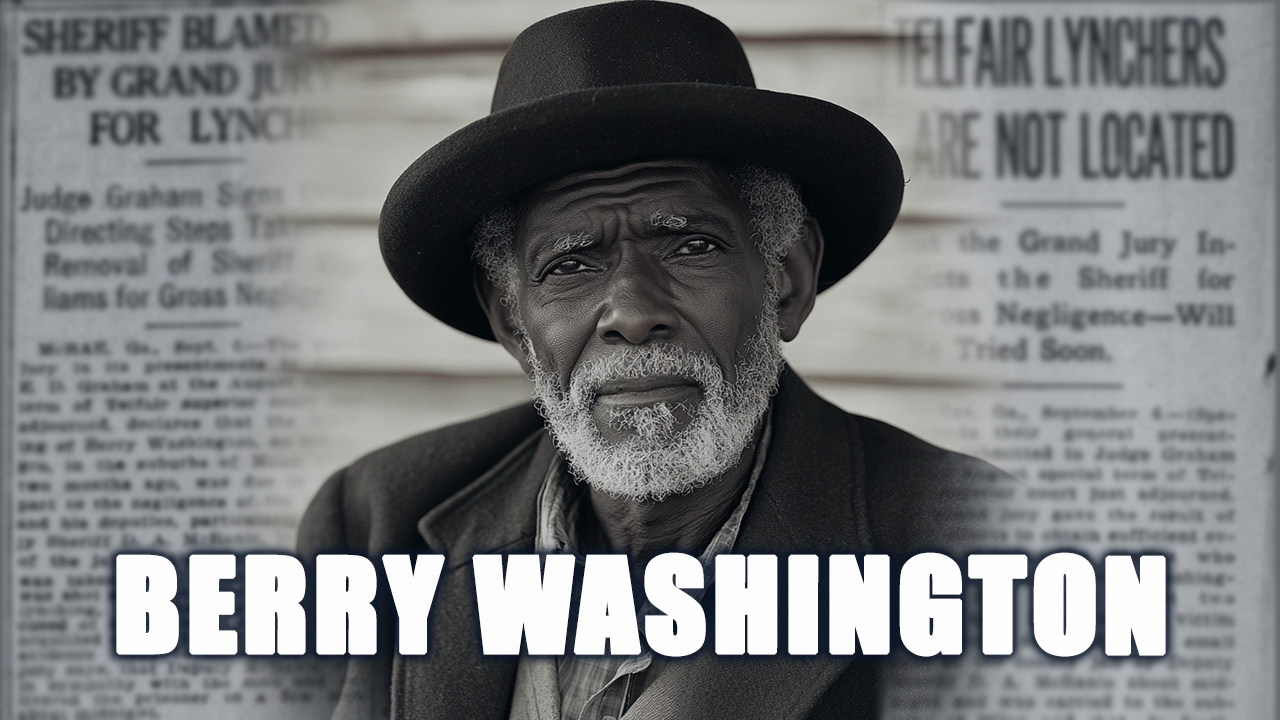
January 24, 2025 / January 23, 2025
From Slavery to a Lynching: The Untold Story of Berry Washington
History often records the milestones of freedom and democracy, but equally important are the stories of those who endured the harsh reality of discrimination and violence in pursuit of these ideals. Among these stories is the heartbreaking account of Berry Washington, a Black man who lived through slavery, Reconstruction, and Jim Crow, only to lose his life to the brutality of racial violence in 1919.This article not only recounts Berry Washington’s story but also provides the historical context necessary to understand the time in which he lived. While Berry Washington’s name may not be widely known, his story is a crucial reminder of the systemic injustices that shaped the United States in the early 20th century.
A Life Shaped by Injustice
Berry Washington was born in 1847 in Georgia, a slave state where Black lives were defined by forced labor and brutal control. Berry likely spent his childhood picking cotton, subject to the whip if he failed to meet daily quotas. When emancipation came in 1865, Berry, like other newly freed people, witnessed the hope of Reconstruction—a time promising freedom, citizenship, and political participation for Black Americans.However, that hope was short-lived. By the time Berry entered his twenties, federal troops were withdrawn from the South, signaling the end of Reconstruction and the rise of Jim Crow laws. He lived through the terror of the Ku Klux Klan, the enforcement of Black Codes, and the re-enslavement of Black people through convict leasing and peonage.
Despite these challenges, Berry survived. He married Annie, another formerly enslaved person, and by 1910, they were sharecroppers in Milan, Georgia. Like many Black families, Berry and Annie worked under a system designed to perpetuate Black labor exploitation. Sharecropping kept Black farmers in a cycle of debt and poverty, a new form of slavery in all but name.
The Attack on the McCollers Family
On May 24, 1919, Berry Washington was 72 years old. That night, in Milan’s Black neighborhood, Emma McCollers and her two daughters were asleep when two white men, John Dowdy and Levi Evans, arrived at their door. John Dowdy was the son of Milan’s mayor, Reverend William Dowdy, and his presence in the Black part of town at 1 a.m. was menacing. When the McCollers family refused to open the door, Dowdy fired his gun into the home.The McCollers daughters fled to a nearby neighbor, Emma Tishler, and hid under her floorboards. Dowdy and Evans followed, attempting to tear up the floor to reach the girls. Tishler, terrified, jumped into a nearby well to escape. The chaos drew the attention of Berry Washington, who lived nearby.
Hearing the commotion, Berry grabbed his firearm and confronted Dowdy and Evans. When Dowdy fired at Berry and missed, Berry defended himself, fatally shooting Dowdy. Evans fled, leaving Berry and the McCollers family safe—for the moment.
A Predictable Outcome: Arrest and Lynching
Berry knew the danger of what had occurred. Despite acting in self-defense to protect two young girls, the racial dynamics of 1919 Georgia were clear: a Black man killing a white man, even in self-defense, was a death sentence. Encouraged by a neighbor, Berry went to the authorities in Milan to explain what had happened.Instead of being treated fairly, Berry was arrested and transferred to a jail in McRae for “his protection.” However, word of Dowdy’s death spread quickly, and a lynch mob began forming. On the night of May 25, 1919, Deputy Sheriff Dave McRanie, a known sympathizer with the mob, handed Berry over to them.
The mob took Berry back to the site of the shooting. There, in front of his community, they lynched him. Berry was hanged from a post, and his body was riddled with bullets in an act of terror meant to send a message to the Black residents of Milan: resistance, even in self-defense, would not be tolerated.
The Aftermath and Cover-Up
After the lynching, the town of Milan silenced any discussion of the event. The local papers were instructed not to report on the lynching. The first public account came from a Macon newspaper, which distorted the story, omitting the attempted assault on the McCollers daughters and portraying Berry as an unprovoked aggressor.
However, Reverend Judson Dinkins, a Black pastor from nearby Cordele, courageously documented the truth. He sent an affidavit to Monroe Work at the Tuskegee Institute, detailing the events leading to Berry’s lynching. This affidavit eventually reached the NAACP, which publicized the lynching nationally. Walter White, a young investigator for the NAACP, worked tirelessly to uncover more details and expose the systemic injustice behind Berry’s death.
The NAACP’s efforts brought national attention to Berry Washington’s story, but justice remained elusive. A grand jury in Telfair County found no one accountable for the lynching, despite clear evidence of involvement by law enforcement and local officials. Sheriff John Williams was criticized for leaving the jail unguarded, but no legal action was taken against him. Deputy McRanie, the mob’s ringleader, died shortly after the lynching, ensuring he faced no consequences.
A Legacy of Courage and Injustice
Berry Washington’s life and death exemplify the horrors of racial violence in America. His story also highlights the bravery of those who resisted injustice, like Reverend Dinkins and Monroe Work, who risked their lives to expose the truth.Berry’s tragic end is a stark reminder of the systemic racism that shaped the United States during the Jim Crow era. It is also a call to honor the lives of those like Berry who, despite enduring unimaginable hardships, stood up for themselves and others in the face of overwhelming injustice.
Why This Story Matters
As one of the few detailed accounts of Berry Washington’s life and lynching, this article seeks to preserve his legacy and educate future generations about the systemic oppression faced by Black Americans. By understanding stories like Berry’s, we can better comprehend the enduring impact of racial violence and the importance of continuing the fight for justice and equality.Let Berry Washington’s story be a reminder of the work still needed to ensure that freedom and democracy truly belong to all.

From Slavery to a Lynching: The Untold Story of Berry Washington
History often records the milestones of freedom and democracy, but equally important are the stories of those who endured the harsh reality of discrimination and violence in pursuit of these ideals.
 julianjohnsonlaw.com

Only thing I want to see "Above the Fold" is her tig ole bitties.... release the twinsGreat, now I know when and where to not tune in.



This shit canceled yet?
Similar threads

- Replies
- 0
- Views
- 14

- Replies
- 5
- Views
- 51

- Replies
- 0
- Views
- 41

- Replies
- 3
- Views
- 49

