
You are using an out of date browser. It may not display this or other websites correctly.
You should upgrade or use an alternative browser.
You should upgrade or use an alternative browser.
Should Democrats build on the Affordable Care Act or push toward Medicare for All?
- Thread starter Rembrandt Brown
- Start date


Two terrible options. Double down on a bad idea or start anew. No. The only option is to expand Medicare.
And any mothafucka who opines about the cost should be placed on ignore.
And any mothafucka who opines about the cost should be placed on ignore.

Nobody commented on what a fucking clown Biden sounds like here.

they can use the same cash they print to bail out airline, auto makers, banks and the rich, cut military spendin, legalize and tax cannabis across the country, and actually tax the rich and eliminate the loopholes that billionaires use to pay nothing. The question isn’t who will pay for it; it’s who will continue to fill these criminal politicians pockets with all that Health care business green.who will pay for it?

There only ever should have been Medicare for all. Romneycare was just another disappointment from Obama, delivered with a smile. I supported this kneegrow and all I wanted him to do was bring the troops home, get healthcare for everyone and be black. He was only able to do one of those. If he had done all three, he literally could have spent the rest of his presidency golfing and I wouldn't have cared. I guess the gays are happy, though.

I hope you realize that no one person can pass medicare 4 all.M4A is the only path forward, imo. Too bad Biden is next up, and he won't do shit to expand affordable medical coverage for every American.

Came in here to say the exact same thing.America is based on an adversarial system of business and law. Better advocates, and privileged advocates, expect more money and better health care than the less fortunate. The idea of universal health care threatens that order.
As long as America remains a capitalistic and adversarial nation Democrats should not focus on universal healthcare. It's a losing battle. Instead, Democrats should focus on the redistribution of wealth--i.e., narrowing the gap between rich and poor. Universal healthcare won't happen until the gap between rich and poor is better equalized.
Could you imagine a poor and sick Republican, whose covered by a Democratic Medicare for all program?
The Conservative party would lose their following overnight and that can’t happen.

True, but the GOP wants the shit gone period! One step at a time bro.Right on, bruh!!! I dont ever see the dems cutting that check for copper color people.. Bruh, getting our people to view the democrats thru new eyes, is damn near impossible!! Until people start demanding and questioning these politicians and democrat party, the nightmare will continue!!
As long as you have 45% of the white population under GOP control, you will never get Medicare for all.
All they need to say is socialist and the poorest white people will flock to the polls to vote down their own health care.
Negrus is getting free health insurance? Hell naw Cletus! Grab your sister wife and them twin cousins kids of yours and vote dis sheet down. #MAGA
All they need to say is socialist and the poorest white people will flock to the polls to vote down their own health care.
Negrus is getting free health insurance? Hell naw Cletus! Grab your sister wife and them twin cousins kids of yours and vote dis sheet down. #MAGA

You can never get a straight answer from these dudes, just an endless stream of nothing.

Fixed— may be what you meant but important to be specific!You can never get a straight answer from the establishment, just an endless stream of nothing.
You can never get a straight answer from these dudes, just an endless stream of nothing.
Fixed— may be what you meant but important to be specific!You can never get a straight answer from the establishment, just an endless stream of nothing.
Same interview:
This is an extremely long, non-direct way of saying “No.”
Last edited:
America is based on an adversarial system of business and law. Better advocates, and privileged advocates, expect more money and better health care than the less fortunate. The idea of universal health care threatens that order.
As long as America remains a capitalistic and adversarial nation Democrats should not focus on universal healthcare.
Democrats should be pushing to make sure America doesn’t remain a capitalistic and adversarial nation.
And a key tactic in that push has to be a focus on universal healthcare.
As long as you have 45% of the white population under GOP control, you will never get Medicare for all.
All they need to say is socialist and the poorest white people will flock to the polls to vote down their own health care.
Negrus is getting free health insurance? Hell naw Cletus! Grab your sister wife and them twin cousins kids of yours and vote dis sheet down. #MAGA
Republicans still try to use it as a boogeyman but socialism has become a lot more popular since this post was made!

Push for Medicare for all.
The main reason this country doesn’t have Universal Healthcare is cuz the Conservatives don’t want to see Black people benefit it.
The original plan when President LBJ did The Great Society with the creation of MediCaid/MediCare was making it accessible for everyone.
The Confederate States didn’t want Black folks to have access to White hospitals. The compromise was making it difficult for Blacks to be eligible and limited access to medical care.

A system this large would depend heavily on Congress and federal agencies.
Future administrations could change reimbursement rates, covered services, eligibility rules, or other aspects of the program.
Healthcare would become even more politically connected to federal budgeting.
The next republican administration could start dismantling it in 4/8 years. (you know they will try).

Future administrations could change reimbursement rates, covered services, eligibility rules, or other aspects of the program.
Healthcare would become even more politically connected to federal budgeting.
The next republican administration could start dismantling it in 4/8 years. (you know they will try).

Same interview:
This is an extremely long, non-direct way of saying “No.”
I can tell yall ain’t never been played by hoe on her period for 4 months. Some of us have been on 9 dates and ain’t never got the draws, dog.
You can’t have healthcare for all and the constitution. The people currently elected swore to protect the constitution.
if a corporation’s only mission to make a profit, we should demand that 95% of its profit returns to employees. You can only do a stock buy back once a generation.
The basketball guy from Philadelphia is releasing a shoe. He should say, “if you buy 2 sneakers, you will a share in the company. If you buy 3 shoes you get the stock and a fractional share of its competitors.
You have to bring civics and music back into schools .A system this large would depend heavily on Congress and federal agencies.
Future administrations could change reimbursement rates, covered services, eligibility rules, or other aspects of the program.
Healthcare would become even more politically connected to federal budgeting.
The next republican administration could start dismantling it in 4/8 years. (you know they will try).
A system this large would depend heavily on Congress and federal agencies.
Future administrations could change reimbursement rates, covered services, eligibility rules, or other aspects of the program.
Healthcare would become even more politically connected to federal budgeting.
The next republican administration could start dismantling it in 4/8 years. (you know they will try).
They couldn’t fully repeal the ACA because the provisions were so popular.
They did scale it back and make it a lot less effective.
If Medicare for All is fully implemented, Republican plans to fuck with it will be extremely unpopular and an obstacle to them getting elected.
Maybe they will run a great anti-trans ad and use immigrants to scare people and regain power in 2032. We’ll be in a better place than we’re in now, it’ll be harder for them to fuck with and, most importantly, it’ll still be better than the free market profit-based alternative.
He ain’t ever reading that. He wants to make healthcare affordable. We don’t know what that means because that’s the point. The reason why democrats suck at messaging is because they’re only interesting in sucking off corporations. Not small businesses. Massive corporations and their big ole wallets.
It was about a month ago when a black guy said George Washington was a genius.
Republicans fuck with social security now. The minute you sign it into law, some poor, sniveling bastard will pick up the fight for them. We as black people don’t know of our role to play in making America great.They couldn’t fully repeal the ACA because the provisions were so popular.
They did scale it back and make it a lot less effective.
If Medicare for All is fully implemented, Republican plans to fuck with it will be extremely unpopular and an obstacle to them getting elected.
Maybe they will run a great anti-trans ad and use immigrants to scare people and regain power in 2032. We’ll be in a better place than we’re in now, it’ll be harder for them to fuck with and, most importantly, it’ll still be better than the free market profit-based alternative.
Republicans fuck with social security now.
Good point.
Passing M4A will not make Republicans go away. It will not be the end of the struggle on health care.
It is still the right thing to do and people will be a lot better off, even with setbacks.
Not moving forward makes it easier for them to take us even further backwards.
The meme of the rich white man pointing to the black as he grabs all the cookies apply to us. Politicians eat all the cookies and blame non voters as to why they can’t seem to overpower the system they’re in place to control.Good point.
Passing M4A will not make Republicans go away. It will not be the end of the struggle on health care.
It is still the right thing to do and people will be a lot better off, even with setbacks.
Not moving forward makes it easier for them to take us even further backwards.
“I have a question for Hakeem in regards to Medicare for all. What changed? In 2019, you became a cosponsor to Medicare for All Act. In 2021, you were an original cosponsor for Medicare for All Act. Now in 2026, he says Medicare for all is not a legislation he cosponsors or supports. What changed? You appear to be with corporate America not the people."
NEW FROM POLITICO: "94 percent support for Medicare for All among Democrats — up from 90 percent support the same survey documented last year — 60 percent support among independents, 55 percent support in conservative-leaning congressional battleground districts, and 19 percent support among voters who backed Trump in 2024."
Medicare for All has the momentum. It's our job to run with it to finally deliver health care as a human right when we take back power in November.
THE PROGRESSIVE PLAN — Progressives on Capitol Hill are circulating a new poll, shared first with POLITICO, as they lobby Democratic leaders to back a renewed push for Medicare for All should the party flip control of either chamber of Congress in November, Alice reports.
The survey, commissioned by Rep. Pramila Jayapal’s (D-Wash.) Medicare for All political action committee and conducted in August by Democratic pollster Greenberg Quinlan Rosner Research, shows strong support for a universal, government-run health system among Democrats at 94% — up from 90% last year. The poll also found that 60% of independents, 55% of conservative-leaning battleground districts and 19% of 2024 Trump voters backed the idea.
That favorability also proved more resilient than in previous polls. When presented with common arguments against a government-run health system — such as its potential to raise taxes and lead to long wait times for care — support fell by only a few percentage points.
GQR surveyed 1,200 likely 2026 voters nationwide and oversampled voters in battleground districts, with a margin of error of plus or minus 2.83 percentage points.
What’s next: Jayapal and her allies in the House and Senate plan to capitalize on the proposal’s popularity. When Congress returns in October, she intends to buttonhole her colleagues, especially party leaders who’ve been skeptical of the idea in the past, to push for the first-ever markup of a Medicare for All bill.
But with President Donald Trump still in power, she said, the next few years will be more about laying the groundwork for 2029 — even if Democrats flip the House or Senate in November.
“I’m very clear-eyed that you can’t pass a big bill like universal health care without a trifecta,” Jayapal told Alice. “So what I want to do is use the next two years to move the discussion forward and prepare the world for a trifecta in 2029. If there are disagreements within the [Democratic] caucus, this is our time to be able to start to [work those out] so that we can get the entire caucus on board.”
‘One Job Away’ Campaign Highlights SAG-AFTRA Actors’ Struggle to Qualify for Health Insurance: “This Is Systemic”
BY CAITLIN HUSTON
OCTOBER 26, 2026

‘One Job Away’ Campaign Highlights SAG-AFTRA Actors’ Struggle to Qualify for Health Insurance: “This Is Systemic”
Cheyenne Jackson launched the social media effort, which has had a massive influx of requests as actors face a tough jobs environment in Hollywood.
 www.hollywoodreporter.com
Amid the industry consolidation and lack of work in Hollywood, actors are speaking up about needing help to qualify for SAG-AFTRA’s health insurance plan this year.
Cheyenne Jackson, known for his onscreen roles in several seasons of American Horror Story, 30 Rock and Glee, launched the movement Monday morning on his Instagram to highlight actors in need of one more or a few more gigs to meet the SAG-AFTRA minimum of $28,000 in annual earnings to get health insurance. Within 24 hours, he said he “received hundreds and hundreds” of DMs from actors asking to be featured, with some highlighting only being a few hundred dollars short or a few thousand, and others pointing to an almost barren job landscape.
“This is systematic. This is like across the whole swath of SAG actors working right now,” Jackson told The Hollywood Reporter. “This is what’s happening. People that have been leads of television shows have worked for years and years and years, and you know their faces, and you know their work. This year, they’re like, ‘What am I gonna do?'”
Jackson said he was inspired to launch the project, One Job Away, after reflecting on his experience in 2025. That year, for the first time in more than 20 years in the industry, he found himself $6,000 short of meeting the eligibility criteria for the insurance that covers himself, his husband and their twins. Facing the deadline, he called Kathy Bates, who he had previously worked with, and she arranged for him to get four speaking lines on her show, Matlock, to meet the eligibility criteria.
Jackson also pointed to Angela Lansbury, who also helped hire older actors who were short on their insurance to be guest stars on Murder She Wrote, as inspiration for the project. His goal, in posting the headshots and bios of the actors, is to have casting directors or other famous names give them the same leg-up he received.
While many actors have struggled to qualify for health insurance in the past, the sharp drop-off of scripted television series orders and the rise of runaway production amid industry consolidation and cost-cutting in recent years is cumulatively weighing on performers. Actors on the SAG-AFTRA plan have four different quarterly deadlines to qualify for the $28,000 in earnings, depending on the point at which they joined the union.
And amid rampant healthcare inflation, qualifying isn’t about to get any easier. Starting Jan. 1, quarterly eligibility premiums will rise, as will the earnings threshold by one percent, with more one percent bumps coming in the years after. That’s the result of terms negotiated in the union’s latest contract with studios and streamers.
This year, Jackson, who also has a stage career, said he “squeaked by” himself and was able to meet the minimum thanks to a couple of gigs, including acting in a microdrama for the first time and doing a commercial.
“What’s baffling is I’ve been on over 40 TV shows, and so I make OK money on residuals. Not great, but OK. But that money doesn’t go necessarily towards your insurance. So it’s tough,” he said. “You can have a really good year. You can make $350,000 a year acting, and then the next year it’s lean, but sadly that that money from before doesn’t necessarily carry over and help you to the next year. So I don’t know. I just think some conversations need to be had, and I think probably now is the time because there’s a lot of discussion right now around SAG and everything that’s going on.”
Bayne Gibby was one of the actors highlighted on Instagram Monday. Gibby, who describes herself as a middle-class actor has been in the industry for 30 years, including appearances as Gigi in The Comeback and recently in the final season of Hacks, where she gifts Deborah Vance’s character seed art. Despite the latter appearance, and what had been a steady stream of work, Gibby said she has only been able to work one day this year, making it her “worst financial year ever.”
“I’ve been on a couple HBO series that have been Emmy winning, and I’ve done a lot of commercials, and I’ve done a couple features. To then sort of go to a place where you’re not sure you’re going to be able to pay your bills, and you could possibly use your health insurance is like a real kick in the crotch, and it’s very scary,” she continued.
In addition to the industry consolidation, Gibby also points to the traumatic events of the last several years, all of which have put a damper on work. Among these, was the SAG-AFTRA strike, which Gibby said she and others are currently questioning the efficacy of, given the lack of opportunities that are currently in the industry and the sacrifice they made with not working several months in 2023.
“There was a saying in the industry: ‘Stay alive til ’25,’ and that everybody felt like in January of 2025 we were going to kind of come back from the strikes in ‘23, and then in January of 2025 we had the fires and that set everything back,” Gibby said. “That felt like almost the final blow after the pandemic, and then the strikes, and then the fires. It just felt like every time we thought we might get onto smoother waters, the hits just kept coming.”
“When we went on strike in 2023, I think people were all in because they really thought we’re going to make this sacrifice in the short term for some greater benefit in the longer term, and I think the way a lot of my peers are feeling now is why did we strike? Why did we do that huge sacrifice? Because things have not gotten better,” she added.
She still has several months to qualify for insurance, and does not plan to leave the industry, but said it’s a conversation that has increasingly crept up amongst fellow actors.
Both Jackson and Gibby noted that there has been somewhat of a stigma around admitting the need to get more work in order to qualify for health insurance, even as Gibby says it had been previously talked about “in hushed tones” while waiting for auditions. The project is also meant to combat that.
Since launching on Instagram, Jackson said he has received support from friends Sarah Paulson and Jamie Lee Curtis, who are reposting actors’ bios and photos. He also notes that he’s since heard from others on Instagram asking for a similar campaign for directors and for hair and makeup artists.
“There’s definitely a need to highlight each other, and what I really want to do is kind of just take the stigma out of it because I don’t think there’s any shame in talking about that you’re short,” Jackson said. “And I do feel that from folks, ‘They’re just like, “Oh God, I don’t want to seem like I’m desolate and can’t get it together. But it’s just what’s happening. So be vulnerable. Put yourself out there.”

Cheyenne Jackson
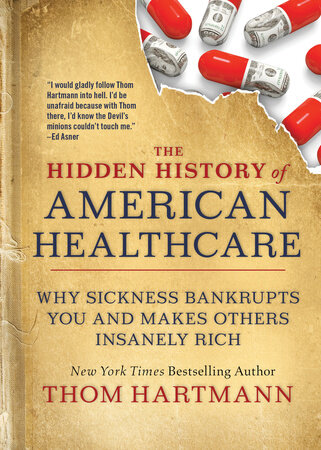
Thom Hartmann Presents The Hidden History Of American Healthcare
Powell Books
September 10, 2021
In his new book, The Hidden History of American Healthcare (Berrett-Koehler), popular progressive radio host Thom Hartmann reveals how and why attempts to implement affordable universal healthcare in the United States have been thwarted and what we can do to finally make it a reality.
For-profit health insurance is the largest con job ever perpetrated on the American people — one that has cost trillions of dollars and millions of lives since the 1940s.
Other countries have shown us that affordable universal healthcare is not only possible but also effective and efficient.
Taiwan's single-payer system saved the country a fortune as well as saving lives during the coronavirus pandemic, enabling the country to implement a nationwide coronavirus test-and-contact-trace program without shutting down the economy.
This resulted in just 10 deaths, while more than 500,000 people have died in the United States.
Hartmann offers a deep dive into the shameful history of American healthcare, showing how greed, racism, and oligarchic corruption led to the current "sickness for profit" system.
Modern attempts to create versions of government healthcare have been hobbled at every turn, including Obamacare.
There is a simple solution: Medicare for all.
Hartmann outlines the extraordinary benefits this system would provide the American people and economy and the steps we need to take to make it a reality.
It's time for America to join every industrialized country in the world and make health a right, not a privilege.
Powell Books
September 10, 2021
In his new book, The Hidden History of American Healthcare (Berrett-Koehler), popular progressive radio host Thom Hartmann reveals how and why attempts to implement affordable universal healthcare in the United States have been thwarted and what we can do to finally make it a reality.
For-profit health insurance is the largest con job ever perpetrated on the American people — one that has cost trillions of dollars and millions of lives since the 1940s.
Other countries have shown us that affordable universal healthcare is not only possible but also effective and efficient.
Taiwan's single-payer system saved the country a fortune as well as saving lives during the coronavirus pandemic, enabling the country to implement a nationwide coronavirus test-and-contact-trace program without shutting down the economy.
This resulted in just 10 deaths, while more than 500,000 people have died in the United States.
Hartmann offers a deep dive into the shameful history of American healthcare, showing how greed, racism, and oligarchic corruption led to the current "sickness for profit" system.
Modern attempts to create versions of government healthcare have been hobbled at every turn, including Obamacare.
There is a simple solution: Medicare for all.
Hartmann outlines the extraordinary benefits this system would provide the American people and economy and the steps we need to take to make it a reality.
It's time for America to join every industrialized country in the world and make health a right, not a privilege.
Albertsons won't insure employees' spouses if they're eligible for their own health coverage
By Dominick Reuter
October 28, 2026
Albertsons won't insure employees' spouses if they're eligible for their own health coverage
Grocery giant Albertsons says it will not provide health coverage for spouses or partners who can get insurance elsewhere.
 www.businessinsider.com
Starting next year, the grocery giant will no longer offer medical insurance plans to employees' spouses and domestic partners who have jobs that provide such coverage. The grocery giant detailed the change in an open enrollment guide posted to its website.
Albertsons said it expects its healthcare costs to increase 9.5% next year due to inflation, higher prescription drug costs, provider consolidation, and shortages in the healthcare workforce...
Albertsons won't insure employees' spouses if they're eligible for their own health coverage
By Dominick Reuter
October 28, 2026

Albertsons won't insure employees' spouses if they're eligible for their own health coverage
Grocery giant Albertsons says it will not provide health coverage for spouses or partners who can get insurance elsewhere.
Starting next year, the grocery giant will no longer offer medical insurance plans to employees' spouses and domestic partners who have jobs that provide such coverage. The grocery giant detailed the change in an open enrollment guide posted to its website.
Albertsons said it expects its healthcare costs to increase 9.5% next year due to inflation, higher prescription drug costs, provider consolidation, and shortages in the healthcare workforce...

The need to get the middle man out of the Health care system. It just doesn't make sense to make health care a for profit Business
From The A.I. Machine:
How Care and Coverage Were Administered
- Non-Profit Prepayment Plans: Early systems like the Baylor University Hospital plan in 1929 and subsequent Blue Cross (hospital care) and Blue Shield (physician services) plans operated as non-profit entities. Patients paid a flat, affordable monthly rate to pool risk across the community rather than paying out-of-pocket for every emergency. [1, 2, 3]
- Community Rating: Non-profit insurers used community rating, meaning everyone in a given plan paid the same rate regardless of their age, gender, or medical history. Plans were designed to protect family savings rather than extract shareholder value. [1, 2, 3]
- Charitable and Public Hospitals: In the 19th and early-20th centuries, many hospitals operated as charitable institutions, religious missions, or local public facilities. Care for low-income or indigent patients was frequently handled through charity care, philanthropic donations, and direct municipal funding. [1]
- Direct Physician-Patient Relationships: Doctors largely operated as independent practitioners or small local partnerships. They often set flexible fees, used sliding scales based on a patient's ability to pay, or traded services for goods.
- Post-WWII Government and Employer Expansion: Following World War II, wage freezes led employers to offer health benefits as tax-exempt compensation. Later, government programs like the Hill-Burton Act (1946) built community hospitals nationwide, and Medicare and Medicaid (1965) stepped in to cover seniors and low-income individuals. [1, 2, 3]
The Turning Point Toward Profit:
The structural shift began with the Health Maintenance Organization (HMO) Act of 1973 signed by President Richard Nixon, which authorized federal funds to promote for-profit HMOs and private corporate management. By the 1980s and 1990s—including the conversion of major Blue Cross/Blue Shield plans into for-profit corporations by 1994—community-focused protection was largely replaced by investor-owned insurance and hospital networks. [1, 2, 3, 4]
More details on how this transition unfolded can be reviewed via Stanford Medicine and PubMed Central. [1, 2]
Obamacare continues to shrink as enrollment opens for 2027
By Tami Luhby
November 1, 2026
Holly Hendricks, who is battling an autoimmune disease that leaves her with open wounds down to the muscle, did everything she could to maintain her Affordable Care Act coverage after the enhanced premium subsidies lapsed at the start of this year.
But after a few months, the 49-year-old couldn’t handle paying the monthly premiums, which had more than tripled to nearly $1,100. Hendricks, who also has lupus and rheumatoid arthritis, became uninsured for the first time in April.
While she scrapes together enough money to afford her 12 daily medications, Hendricks can no longer see her four specialists, get blood work, receive infusions or have a wound care nurse tend to her condition. In September, she developed sepsis and ended up in the hospital for a month, which she expects could saddle her with more than $500,000 in medical bills.
“Being uninsured is catastrophic to my health, but when you have to choose between rent, utilities, food and insurance – the more basic needs have to come first,” said Hendricks, a Sarasota, Florida, resident who works full-time as a caretaker for a veteran...
…Some folks are hoping to resume their coverage in January if they can find a less expensive Obamacare plan. Open enrollment begins Sunday in most states, but premiums are expected to jump once again.
The ongoing enrollment decline comes as healthcare has been a key affordability issue in the midterm elections. Many Democratic candidates are highlighting that their Republican rivals allowed the enhanced premium subsidies to lapse, as well as voted to slash federal Medicaid funding by roughly $1 trillion as part of the One Big Beautiful Bill Act.
Republican-held congressional districts suffered disproportionately greater drops in enrollment between 2025 and 2026, KFF found. These districts account for 55% of enrollees but 67% of the declines. They tend to have higher shares of lower-income residents, who would have a tougher time affording any premium increases, Cox said...

Holly Hendricks had to drop her Affordable Care Act coverage after her monthly 2026 premiums jumped.
Similar threads

- Replies
- 0
- Views
- 64

- Replies
- 9
- Views
- 285

- Replies
- 1
- Views
- 83


