25% of the World's Prison Population

<iframe src="http://www.politifact.com/punditfact/statements/2014/dec/16/matthew-cooke/us-prison-population-big-russia-china-and-north-ko/" width=800 height=1000></iframe>
 
2d1n2n7.gif


v3d6kj.jpg


This is probably a true statement rather than false considering that it has increased 8 times with the population increasing 1.5 times. This increase has come on the backs of African Americans as a genocidal program.

 
source: VOX

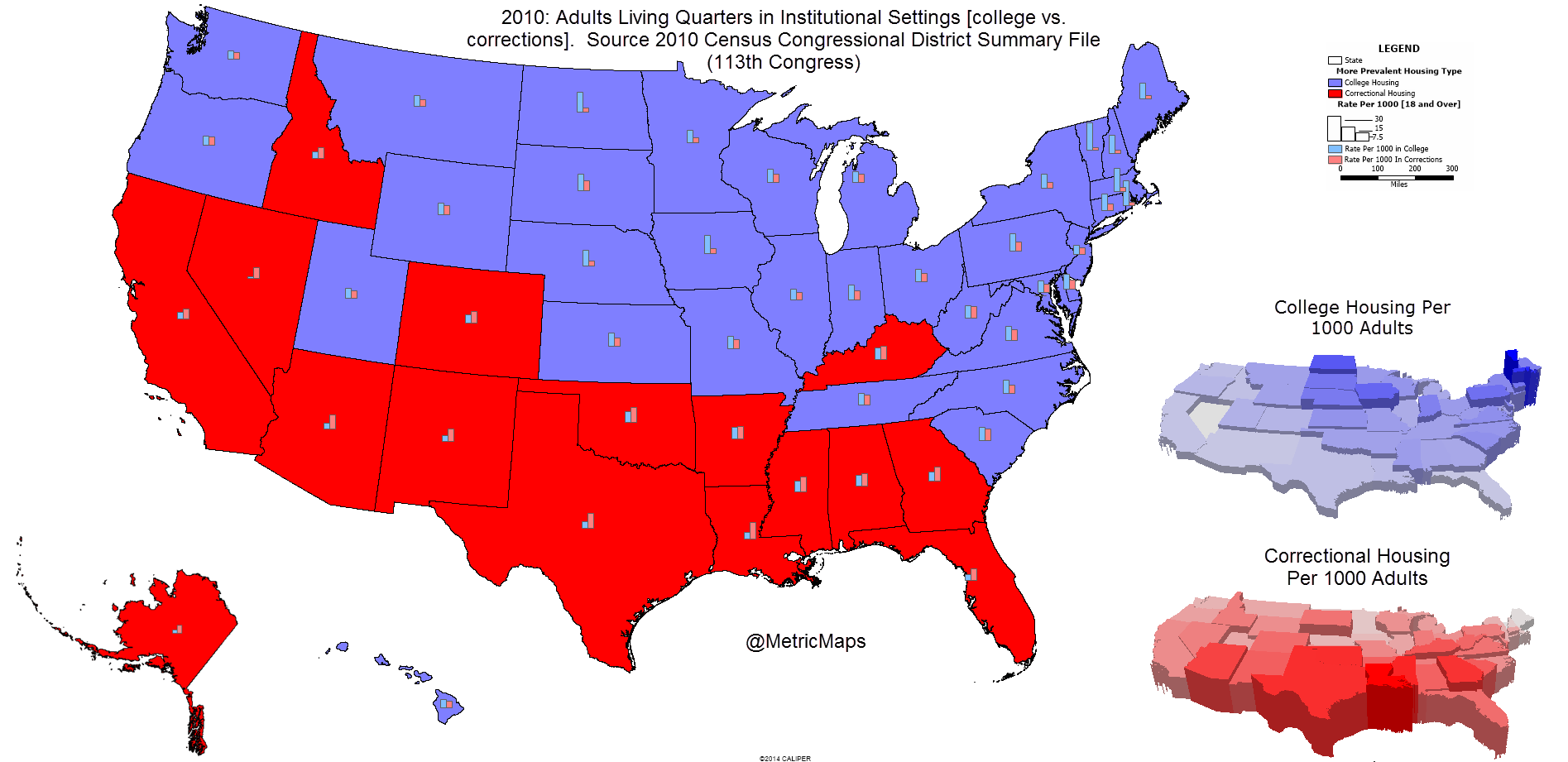
Map: 16 states have more people in prisons and jails than college housing


In 16 states, there are more people in prisons and jails than college housing.

This map by MetricMaps shows which states (blue) have more people in college housing and which states (red) have more people in correctional facilities:

Corrections_vs._College.0.png


One possible takeaway is that states keeping more inmates in prisons and jails than people in college housing arguably have poor priorities. College is still a great investment, with multiple studies showing higher education significantly increases people's wages and economic output. Mass incarceration in the US long ago hit diminishing returns that make it an ineffective crime-fighting tool; an analysis by the PewPublic Safety Performance Project found that the 10 states that shrunk incarceration rates the most over the past five years saw bigger drops in crime than the 10 states where incarceration rates most grew.

But the map doesn't show that there are fewer people in college than jail and prison. The entire US corrections population, which includes people in jail, prison, parole, and probation, totaled 6.9 million in 2013. In comparison, about 19.5 million people were enrolled for college that same year — but most students live off-campus.

So while criminal justice experts generally agree it's long past time to reduce the number of Americans in jails and prisons, the map isn't a perfect comparison. But it at least shows the US has a lot of jail and prison inmates.
 
Unlikely bedfellows unite on criminal justice reform

Unlikely bedfellows unite on criminal justice reform
From the Koch brothers to Al Franken, momentum builds to reduce prison population
By Liz Goodwin
January 28, 2015 6:07 PM Yahoo News

Only one issue in Washington right now could bring together the Koch brothers’ top lawyer, an environmental activist, the former head of the NRA and Sen. Al Franken.

Criminal justice reform.

In a city best known for dysfunction and discord, the issue has stood out as a rare area of common ground between Democrats and Republicans.

And at a panel on reforming the criminal justice system hosted by the Constitution Project advocacy group on Capitol Hill on Wednesday, the bipartisan array of speakers seemed genuinely nonplussed by the harmony across an otherwise gaping political divide.

Van Jones, the former Obama administration official and liberal commentator, was seated next to Mark Holden, Koch Industries’ general counsel and the face of the conservative mega-donors’ efforts to lower incarceration rates in the country. (The Koch brothers are planning to spend a reported $889 million during the 2016 election cycle, a figure that puts their operation in the same financial ballpark as the two political parties themselves.)

“That should be a headline in itself,” Jones said of he and Holden sitting at the same table.

“Cats and dogs sleeping together,” Holden chimed in.

“I don’t know about sleeping together,” Jones quipped.

Jones said he hoped politicians would seize on this moment — when crime is down and interest is high — to reform the U.S. penal system so that the country no longer imprisons a higher percentage of its citizens than any other nation.

“This is a time for real comprehensive change,” Jones said. “It’s very, very rare that we have a moment where the stars are aligned in this way.” He later warmly embraced the Kochs' lawyer.

Lawmakers lined up to promote their criminal justice reform bills at the event, which also included remarks from Piper Kerman, the author whose memoir about her experience in federal prison inspired the Netflix series “Orange Is the New Black.”

Sens. Rob Portman, a Republican, and Al Franken, a Democrat, spoke about a bill they’re reintroducing this year to provide more mental health services to prisoners and to fund special mental health courts that emphasize treatment over doing time. Rep. Jim Sensenbrenner (R-Wis.) said he believes lawmakers should review every federal regulation or law that carries prison time to decide if it’s merited or not. Sen. Cory Booker (D-N.J.), who introduced a bill to expunge nonviolent criminal records of juvenile offenders that he’s co-sponsored with Sen. Rand Paul (R-Ky.), sat with audience members, saying he wanted to listen and learn.

Holden told the crowd that the Koch brothers have been involved in criminal justice reform for more than 10 years, after a few of their employees were prosecuted for violating environmental regulations in Texas in the 1990s. (The charges against the employees were later dropped, and Koch Industries settled with the government.) The Kochs have since invested in providing defense lawyers for poor people and other reform efforts, and have signaled it will be a major policy priority this year. Their support could lend momentum to the bipartisan reform bills that have already been introduced.

“What we should be using the prison system for is people we’re afraid of,” Holden said, not for nonviolent offenders.

After his remarks, Franken took to the podium. At one point, the liberal Minnesota senator was trying to recall the name of a documentary series he liked about the prison system.

“You know when you watch MSNBC on the weekends,” he began, alluding to the staunchly liberal cable channel and looking at his fellow panelists, which included Holden, conservative activist Pat Nolan and Constitution Project board member David Keene, who used to lead the National Rifle Association. “I don’t know if you guys ever watch MSNBC,” Franken said, to laughs. He then described the documentary show.

“‘Lockup,’” Holden offered. “It’s one of my favorite shows, actually.”

http://news.yahoo.com/unlikely-bedfellows-unite-on-criminal-justice-reform-230726294.html
 
Re: Unlikely bedfellows unite on criminal justice reform


Last year, "we saw the first reduction in the federal prison population in 32 years."


- -
politifact%2Fmugs%2Feric_holder.jpg
- - Eric Holder on Tuesday, February 17th, 2015 in remarks at the National Press Club - -
rulings%2Ftom-true.gif
- -


<iframe width="780" height="1500" src="http://www.politifact.com/truth-o-meter/statements/2015/feb/23/eric-holder/federal-prison-population-drops-first-time-3-decad/" frameborder="0" allowfullscreen></iframe>

 
Last edited:
How the Koch brothers became criminal justice reformers

How the Koch brothers became criminal justice reformers
When Koch employees were charged with environmental crimes, the brothers teamed up with defense lawyers
Liz Goodwin
By Liz Goodwin
November 12, 2014 4:57 AM Yahoo News

Billionaire brothers Charles and David Koch have used their fortune to back Republican candidates who support rolling back corporate regulations, slashing taxes and shrinking government.

But the tea party benefactors have another cause close to their heart, one that’s shared with many tree-hugging liberals who vilify the brothers’ politics and business practices. They want to reform the U.S. criminal justice system, which locks away a higher percentage of citizens than any other country in the world at a staggering cost.

Since 2004, the Kochs have quietly made substantial six-figure donations every year to a group representing criminal defense lawyers. The money has gone to training programs for court-appointed defenders, who predominantly represent poor and minority people who can’t afford their own lawyer, campaigns to reform the grand jury system and other causes. The Kochs haven’t attached strings to how the money must be used or sought recognition for the donations.

“They have been very, very supportive of our efforts to reform the criminal justice system,” said Norman Reimer, the executive director of the National Association of Criminal Defense Lawyers (NACDL). Reimer says he’s been able to put whatever political disagreements he may have with the Kochs aside in order to work to fix the country’s broken justice system.

The issue is one of the few in the nation’s hyperpolarized political environment that’s attracted bipartisan support, from President Barack Obama to libertarian-leaning Republican Sen. Rand Paul. (The “tough on crime” political ethos that helped triple the prison population since 1980 was also bipartisan.)

“Everybody across the ideological spectrum recognizes that the ... system is a tragedy,” Reimer said.

The Kochs’ “come to Jesus” moment on criminal justice reform came back in the 1990s, when a handful of their employees at a Corpus Christi, Texas, refinery were indicted for violating the Clean Air Act and other crimes. The charges against the employees were eventually dropped in 2001, but Koch, as a corporate entity, settled with the federal government, pleading guilty to one count of the original 97 and paying millions of dollars in fines.

While the Kochs’ critics see this incident as an example of a company rightly being punished for polluting the environment, for Charles Koch and other company officials, it was a wake-up call that the government was over-criminalizing legitimate conduct and over-prosecuting its citizens. Mark Holden, Koch Industries’ top lawyer, said he worried that such scrutiny from the government would have an insidious effect on the company’s culture.

“It took a toll on our company,” says Holden. “We saw that laws can be used to go after people and put pressure on them to turn against people.”

The powerful and wealthy Kochs realized that if they were being hit with overzealous prosecution, average citizens must have it even worse, according to Holden. “That made us look at the whole situation,” he said. “If they’re doing this to us, what’s happening elsewhere?”

The Kochs’ money has helped the NACDL to lobby Congress to change federal laws so that prosecutors have to prove intent — meaning that defendants knew they were violating the law.

Reimer says the partnership with Koch, which began in 2004, has been led by the NACDL from the beginning.

“The commitment, as far as I can see, is deep and sincere and unconditional,” Reimer said.

For now, the Kochs have no intention of turning their financial support for the NACDL into a political effort. The American Civil Liberties Union, backed with money from liberal tycoon George Soros, plans to spend at least $50 million to make criminal justice reform an issue in elections around the country, the New York Times reported last week. In theory, the Kochs could use some of their considerable political spending to back pro-reform candidates, as well.

“That’s not what’s driving what we’re doing,” Holden said of the politics of criminal justice reform. “We are focused more on the society well-being side of it here. We should all put the politics aside because that can muddle things.”

http://news.yahoo.com/how-the-koch-brothers-became-criminal-justice-reformers-235243801.html
 
Re: How the Koch brothers became criminal justice reformers

How the Koch brothers became criminal justice reformers
When Koch employees were charged with environmental crimes, the brothers teamed up with defense lawyers


<div style='text-align:center'><script type='text/javascript' src='http://pshared.5min.com/Scripts/PlayerSeed.js?sid=281&width=480&height=401&playList=517859264'></script><br/></div>
 
source: The Guardian


UN torture expert refused access to Guantánamo Bay and US federal prisons

Juan Méndez says he has been waiting more than two years for access to a range of state and federal prisons and asks: ‘Is the United States hiding something?’

1000.jpg

Juan Méndez, the UN’s top investigator on torture, also said the US state department has yet to be able to visit federal prisons despite two years of discussions.

The United Nations’ top investigator on the use of torture has accused Washington of dragging its feet over his requested visits to prisons and refusing to give him access to inmates at Guantánamo.

Juan Méndez said he had been waiting for more than two years for the United States to provide him access to a range of state and federal prisons, where he wants to probe the use of solitary confinement.

Méndez told reporters in Geneva he wanted to visit federal prisons in New York and Colorado and state prisons in New York, California and Louisiana, among others.

He said the US state department had been working to help him gain access to the state prisons, but after two years of discussions he had yet to receive a positive answer.

“And in one of my last conversations they said that federal prisons were unavailable,” he said.

“I fully expect the United States to secure invitations from state prisons for me, but also to be able to visit federal prisons as well,” he said.

According to Méndez, “it is not rare” for prisoners in the United States to spend 25-30 years in solitary confinement, locked up in a cell with no human contact for 22-23 hours a day.

“It’s simply outrageous that it’s taking such a long time to provide access to American detention facilities,” said Jamil Dakwar, head of human rights at the American Civil Liberties Union.

“This begs the question: is the United States hiding something?” he wrote to AFP in an email.

According to the ACLU, more than 80,000 people are held in solitary confinement in the United States on any given day.

Méndez said he was particularly concerned about the use of solitary confinement for underage offenders.

Solitary confinement for children “should never happen, even for a single day”, he said, pointing out that the punishment, widely considered cruel even for adults, was “particularly harmful for children because of their state of development and their special needs”.

Méndez also harshly criticised Washington for not providing him with “acceptable” access to the US military prison at Guantánamo Bay in Cuba, and to the 122 detainees still being held there.

Washington, he said, had invited him to visit the prison camp in 2012, but under “unacceptable” conditions.

He would be allowed to only visit parts of the prison, and “I am not allowed to have any unmonitored or even monitored conversations with any inmate in Guantánamo Bay,” he said.

Méndez said he had declined the invitation and asked the United States to replace it with one he can accept, to no avail.
 
Good question. Say we close it by morning, what do we do with its inhabitants ???


Good question.

Thats tough. IDK, do you think we can just send them back into society without any real cause for caution and suspicion? It's sad that a lot shit went on in that human storage cell that can't only be described as an understatement of atrocities of human rights.

I'm sure the mental trauma that occurred would cause any suspected terrorist to become a full fledged terrorist to fight the evils of the American government.

QueEx, I don't know lol. So bouncing of your question, if we decide not to release them home, then what do we do with them?
 
Last edited:

Frankly, I don't know that it would be safe to just release them all, some for reasons you mentioned and some, perhaps, for reasons that they are everything that they (our government's agents) say they are. But if you want to close Gitmo, I think you have to answer the question. Didn't the President propose to shut it down and house those who we don't know what to do with in federal prisons in various parts of the country? But didn't the NIMBY's (Not In My Back Yard) and some of those He-Must-Fail Republicans promptly shut that down?


I honestly have no answer. But to give you an answer, I wouldn't have created a Guantanamo nor entered into America's biggest mistake of a 12 year war. America once again bit more than it can chew now dealing with ISIS. Now we the citizens are dealing with the vomit of patriotism of catching the bad guys. It frustrates me that my country didn't have an honest initiative, execution, or exit plan.

I have no answer. It's like me raping a young girl and then asking how I can bring her back to normal. It sucks, I guess we have let the chips fall where they may and we must reap what we sow by letting them return home and potentially cause more terror.

We're no different than the Babylonians, Roman Empire, or the British Empire. We all have a rise and fall. This war on terror will be America's downfall. There's no end in sight. Guantanamo Bay is just one of the reasons.
 
Last edited:

Frankly, I don't know that it would be safe to just release them all, some for reasons you mentioned and some, perhaps, for reasons that they are everything that they (our government's agents) say they are. But if you want to close Gitmo, I think you have to answer the question. Didn't the President propose to shut it down and house those who we don't know what to do with in federal prisons in various parts of the country? But didn't the NIMBY's (Not In My Back Yard) and some of those He-Must-Fail Republicans promptly shut that down?


But didn't the NIMBY's (Not In My Back Yard) and some of those He-Must-Fail Republicans promptly shut that down?
But nobody wants to vote and blame President Obama for the banks.
 
The U.S. needs to quit being an asshole and leave Gitmo; turn this land back to the government. Let the Cuban people live in peace without some hostile foreign military a few miles away

This lease was made under some corrupt regime that the U.S. installed that is not in power.


This type of fucked up mentality is the reason we have terrorism.
 
The U.S. needs to quit being an asshole and leave Gitmo; turn this land back to the government. Let the Cuban people live in peace without some hostile foreign military a few miles away

This lease was made under some corrupt regime that the U.S. installed that is not in power.


This type of fucked up mentality is the reason we have terrorism.

Agreed
 
Ruling clears way for marijuana convictions to be erased

Ruling clears way for marijuana convictions to be erased
By DAVE COLLINS
March 16, 2015 3:15 PM

HARTFORD, Conn. (AP) — Thousands of people busted in Connecticut for marijuana possession now have the right to get their convictions erased after the state Supreme Court ruled Monday that the violation had been downgraded to the same legal level as a parking ticket.


The 7-0 ruling came in the case of former Manchester and Bolton resident Nicholas Menditto, who had asked for his convictions to be overturned after the Legislature decriminalized possession of small amounts of pot in 2011.

"It's a topic multiple states will have to be facing," said Aaron Romano, Menditto's attorney. "Because marijuana is being decriminalized across the United States, this issue needs to be addressed."

Colorado, Washington state, Washington, D.C., and Alaska have legalized the recreational use of pot. Oregon's law legalizing it takes effect in July. Connecticut and 22 other states allow marijuana for medicinal purposes, and 18 states have decriminalized possession of varying amounts.

Last year, Colorado's second-highest court ruled that some people convicted of possessing small amounts of marijuana can ask for those convictions to be thrown out under the state law that legalized recreational marijuana. Officials in the other states are grappling with the issue.

In 2011, Connecticut Gov. Dannel P. Malloy and legislators changed possession of less than a half ounce of marijuana from a misdemeanor with potential jail time to a violation with a $150 fine for a first offense and fines of $200 to $500 for subsequent offenses.

Menditto, 31, wanted the state to erase his two convictions for marijuana possession in 2009 and a pending possession case. The Supreme Court ruled he could apply to have the two convictions erased, but declined to address the pending case. Romano said he may take the pending case to the U.S. Supreme Court.

The appeal involved the 2011 decriminalization and another state law that allows erasure of convictions of offenses that have been decriminalized.

A three-judge panel of the Appellate Court, the state's second-highest court, agreed with prosecutors when it ruled in 2013 that convictions before the 2011 law took effect should stand.

The judges said the term "decriminalization," as used in the state law allowing erasure of convictions for offenses that are decriminalized, means legalization. They concluded the state has not legalized possession of less than a half ounce of marijuana.

The Supreme Court disagreed.

"The legislature has determined that such violations are to be handled in the same manner as civil infractions, such as parking violations," Justice Carmen Espinosa wrote in the ruling. "The state has failed to suggest any plausible reason why erasure should be denied in such cases."

Senior Assistant State's Attorney Harry Weller said the state argued what it believed was the correct analysis. He said the issue was one the Supreme Court needed to decide.

Romano said Menditto is now an activist for the use of medical marijuana. He said when Menditto was arrested, he was using pot to medicate himself. Romano declined to elaborate.

http://news.yahoo.com/ruling-clears-way-marijuana-convictions-erased-184500612.html
 
Report: Racial disparities in arrests persist with legal pot

Report: Racial disparities in arrests persist with legal pot
By KRISTEN WYATT
Associated Press
March 25, 2015

DENVER — The legalization of marijuana in Colorado hasn't solved the racial disparities in enforcement that drug-policy reformers had hoped to end, with blacks still far more likely than whites to be charged with pot-related crimes, a new report says.

The report, issued Wednesday by the pro-legalization Drug Policy Alliance, showed that marijuana arrests in Colorado all but stopped after voters made the drug legal in small amounts for those 21 and older.

But the report noted continuing racial disparities involving the marijuana crimes that remain, including public use and possession in excess of the one-ounce limit.

The study examined drug arrests in all 64 Colorado counties for two years before and two years after legalization in 2012.

The total number of charges for pot possession, distribution and cultivation plummeted almost 95 percent, from about 39,000 in 2010 to just over 2,000 last year.

Even after legalization, blacks were more than twice as likely as whites to be charged with public use of marijuana. Blacks were also much more likely to be charged with illegal cultivation of pot or possession of more than an ounce.

"Legalization is no panacea for the longtime issues that law enforcement had with the black and brown community," said Art Way, Colorado director for the Drug Policy Alliance.

Still, the overall drop-off in arrests is good news for minorities, said Tony Newman, also of the Drug Policy Alliance.

"Despite the unsurprising racial disparities, these massive drops in arrests have been enormously beneficial to people of color," Newman said.

The analysis did not break out data for Colorado's largest ethnic minority, Latinos. That's because data comes from the National Incident-Based Reporting System, which does not tally numbers for Latinos.

One of the region's top officials for coordinating drug enforcement, Tom Gorman of the Rocky Mountain High Intensity Drug Trafficking Area program, insisted that officers are not racially profiling pot users.

"Racial disparities exist in other laws. What does that mean, that homicide law, rape laws, weapon laws are racist? There are other factors going on here that we need to address," Gorman said.

After legalization, racial disparities did ease somewhat for marijuana distribution charges. Blacks accounted for about 22 percent of such arrests in 2010 and around 18 percent in 2014.

The arrest data got a mixed response from the regional head of the NAACP.

"The overall decrease in arrests, charges and cases is enormously beneficial to communities of color who bore the brunt of marijuana prohibition," Rosemary Harris Lytle said in a statement.

"However, we are concerned with the rise in disparity for the charge of public consumption and challenge law enforcement to ensure this reality is not discriminatory in any manner."

In 2014, the year Colorado's recreational marijuana stores opened, blacks were 3.9 percent of the population but accounted for 9.2 percent of pot possession arrests.

For illegal marijuana cultivation, the disparities didn't just persist. They got much worse.

In 2010, whites in Colorado were slightly more likely than blacks to be arrested for growing pot. After legalization, the arrest rate for whites dropped dramatically but ticked up for blacks. In 2014, the arrest rate for blacks was roughly 2.5 times higher.

The Drug Policy Alliance did not conduct a similar analysis in Washington state, which also legalized pot in 2012. But racial disparities appear to have persisted there, too.

Last September, Seattle's elected prosecutor dropped all tickets issued for the public use of marijuana through the first seven months of 2014 because most of them were written by a single police officer who disagreed with the legal pot law.

About one-third of those tickets were issued to blacks, who make up about 8 percent of Seattle's population.

A researcher who did not work on the Drug Policy Alliance report, sociologist Pamela E. Oliver of the University of Wisconsin, said the numbers reflect greater law enforcement attention paid to blacks.

"Black communities, and black people in predominantly white communities, tend to be generally under higher levels of surveillance than whites and white communities," she said in an email, "and this is probably why these disparities are arising."

http://www.kentucky.com/2015/03/25/3767055/report-racial-disparities-in-arrests.html
 
See This Barbaric Georgia Prison Cell Photo

See This Barbaric Georgia Prison Cell Photo
A cell phone photograph showing cellblock brutality has raised new awareness of problems in America’s prison system.
By Patrik Jonsson
April 02, 2015

A shocking photo of inmates taken at a Georgia correctional facility could intensify a halting effort in the United States to alleviate poor prison conditions that can lead to unchecked barbarism likened to an American Abu Ghraib.

The picture from Burruss Correctional Training Center in Forsyth, Georgia, shows three young and shirtless African American male prisoners. One of them is pointing at the camera as though holding a gun, another is holding a makeshift leash, and the third, an 18-year-old, is on his knees, his left eye swollen shut from a beating and the leash lashed around his neck.

The image is shocking on several levels, including its similarity to the Abu Ghraib torture pictures, that a contraband cell phone was used to capture the degradation, and that prison officials didn’t witness the mass beating and subsequent humiliation of a young man serving an eight-year sentence for aggravated assault after first being arrested for armed robbery as a 14-year-old.

Prison-system critics say the image offers poignant insight into a broader problem of prisoner-on-prisoner violence in many U.S. correctional facilities, not just in Georgia, and the extent to which those experiences influence “young men who will be back among us one day,” as Sarah Geraghty, an Atlanta human rights lawyer, put it.

Wide-ranging reaction to the degrading photo also illustrates America’s evolving views about the confluence of punishment and humanity, and the extent to which society tolerates prison violence as a form of deterrence.

“I think this picture can go a long way toward galvanizing a discussion about what prisons are for—particularly, does anybody believe that these men are deterred by prison?” said Jonathan Simon, a law professor at the University of California, Berkeley.

“You have to ask yourself: If the basic story that we tell ourselves is that it’s all about laws and sending people to prison because they violated laws and harmed other people, how can we possibly justify sending them to a place where that is happening to them?” Simon said. “If that’s our idea of punishment, then we have conceded the point that there’s a difference between crime and law.”

In Georgia, reaction among prison officials to the picture was immediate and strong. The beaten inmate was moved into protective custody, and the state Department of Corrections moved to find and punish the torturers. More broadly, new policies and detection technology have led to mass confiscation of cell phones, which have been tied to violent extortion schemes involving inmates and their family on the outside.

“First and foremost, the Department does not tolerate contraband and takes very seriously its mission of protecting the public and running safe and secure facilities,” spokeswoman Gwendolyn Hogan told The Atlanta Journal-Constitution. “The problem plaguing the corrections system nationwide is one that the [Georgia DOC] is aware of and continuously works to utilize extensive resources to combat this issue.”

Yet critics say the Abu Ghraib–like photo is emblematic of the kind of violence that regularly occurs in Georgia’s prisons. In a 2014 report called The Crisis of Violence in Georgia’s Prisons, the Southern Center for Human Rights in Atlanta documented dozens of similar ordeals and argued that Georgia has seen an increase in the “number of really brutal incidents.”

Those include a prisoner who was airlifted to a burn center after fellow inmates poured bleach in his eyes and boiling water on his privates. In another case, a prisoner had three fingers severed by an inmate wielding a 19-inch prison-made machete. In another, a prisoner was tied to his bed and beaten, remaining a hostage until guards found him—two days later.

Root causes of such violence include failure of basic security, inadequate supervision, and accessibility to lethal weapons and cell phones, the report concluded.

But while Georgia’s problems with violent prisons are significant, it’s far from the only state where life inside sometimes devolves into outright blood-sport degradation.

Indeed, it was California that became the poster child for “horrendous” prison conditions, in the words of Supreme Court Justice Stephen Breyer.

In a 2011 decision, the Supreme Court ruled that California prisons overcrowded by long-term incarceration policies violated the Eighth Amendment’s guarantee against cruel and unusual punishment. In 2006, there was one preventable inmate death a week inside California’s sprawling prison complex. The opinion referenced several photos of prison conditions, including a picture of a suicidal prisoner who was “held in...a cage for nearly 24 hours, standing in a pool of his own urine, unresponsive and nearly catatonic.”

Aside from mandates to slim down California’s prison population, the ruling’s most lasting contribution came from Justice Anthony Kennedy. “Prisoners retain the essence of human dignity inherent in all persons,” he wrote.

Kennedy’s stance represented a rejection of what University of Pennsylvania law student Sara Mayeux, in an article for Reason.com, called “a deeper cultural pathology: the tendency to imagine prisoners as an undifferentiated mass of uncontrollable criminality, not as human beings with organs that fail and extremities that break.”

Still, problems remain deep and endemic in states like Georgia. It’s a system, the human rights report argues, “in which prison officials have lost control.”

Aware of such problems, political leaders in Georgia and other Southern states have begun to recognize that overreliance on incarceration and mass imprisonment has itself become a problem that affects society.

Former House Speaker Newt Gingrich said in 2011 that his get-tough-on-crime views had been tempered over time. “There is an urgent need to address the astronomical growth in the prison population, with its huge costs in dollars and lost human potential,” Gingrich pointed out. “The criminal-justice system is broken, and conservatives must lead the way in fixing it.”

Fighting off tears, Georgia’s Republican Gov. Nathan Deal in 2012 signed a law to help keep nonviolent offenders out of prison.

http://www.takepart.com/article/201...american-abu-ghraib?cmpid=tp-internal-taboola
 
A look at the problem of rape in US prisons

A look at the problem of rape in US prisons
Associated Press
By REBECCA BOONE
January 4, 2015 3:27 PM

Inmate advocates worry that a proposal to reduce the financial penalties for states that don't comply with a 2003 federal law aimed at eliminating rape behind bars will severely damage it.

The measure failed this fall. Its sponsor, Sen. John Cornyn, R-Texas, vows to re-introduce it in the new GOP-controlled Congress.

Cornyn said the funds include grants for worthy programs — such as ones that support rape and domestic violence victims — and that the law should be more narrowly tailored to affect money that goes to prison construction, operations and administration.

Supporters of the measure acknowledge the change would essentially eliminate the financial penalties, since little — if any — federal grant money is used for prison construction, daily operations and administration.

Those costs are typically handled by local government budgets.

A LONG-IGNORED PROBLEM: PRISON RAPE

Inmate advocates had lobbied for years for policymakers and lawmakers to address the problem of prison rape. Federal statistics show about 216,000 adult and juvenile inmates are sexually assaulted each year, compared to 238,000 in the overall U.S.

More than half of all sexual assaults behind bars are committed by prison staffers, according to the U.S. Department of Justice, and more than half of those employee-on-inmate assaults are committed by women.

Among the most vulnerable populations are the mentally ill, juveniles and lesbian, gay, bisexual and transgender inmates.

ATTITUDES BEGIN TO CHANGE IN THE 1990s

By the mid-1990s, more than half of the states passed laws defining staff-on-inmate sexual misconduct as a criminal offense.

And in 1994, the U.S. Supreme Court ruled that federal prison officials in Terre Haute, Indiana, failed to take reasonable measures to protect a transgender woman who was repeatedly raped after she was sent to live with the general male population.

A UNANIMOUS VICTORY

Prison rape survivors, inmate advocacy groups and evangelical organizations lobbied Congress to pass a law that aimed to end sexual assault behind bars. In 2003, Congress unanimously passed it.

The law's requirements ranged from increased training of staff about sex abuse policies to screening new inmates to determine if they're likely to commit sexual assault or to be assaulted.

If states opt out of the law or don't comply, they stand to lose 5 percent of federal funds they get for prison operations.

$110 MILLION, AND CHANGE

In all, states have spent more than $110 million in state and federal funds to implement the law. By last fall, every state was supposed to certify that it had instituted dozens of the standards.

So far, New Jersey and New Hampshire say they are compliant with the law's requirements, and 43 states and the District of Columbia are working toward that goal. All states have made some improvements to follow the law.

Pennsylvania developed a web-based incident reporting program, and is working to improve prosecution strategies to ensure that rapists are brought to justice. Colorado and Oregon, for example, are using software to help track sexual assault reports.

SOME STATES OPT OUT, CITING COST, AUTONOMY

Texas, Arizona, Florida, Indiana, Nebraska, Utah and Idaho have opted out, arguing that it's too costly to implement requirements that they say don't give them the flexibility to administer their facilities the way they see fit.

Texas, for example, says a requirement to prevent guards from seeing inmates of the opposite sex naked in the showers or during strip searches wouldn't work because 40 percent of the correctional officer workforce is female.

TOO EARLY TO SAY IF LAW IS WORKING

Federal surveys show the nation's rate of sexual victimization behind bars has remained steady for at least 7 years, with nearly 1 in 10 adult inmates reporting attacks. The rate is the same for juveniles, although that has improved slightly since 2008.

http://news.yahoo.com/look-problem-rape-us-prisons-174002032.html
 
source: Huffington Post

3 Educators Sentenced To 7 Years In Prison In Atlanta Teaching Scandal


<script data-readbyplayerseed="true" type="text/javascript" src="http://pshared.5min.com/Scripts/PlayerSeed.js?sid=281&width=480&height=401&playList=518754235"></script>
<object data="http://cfiles.5min.com/FlexPlayers/SmartPlayer_310.swf" type="application/x-shockwave-flash" name="FiveMinPlayer520893184761602" id="FiveMinPlayer520893184761602" height="401" width="480">


</object>


A judge disregarded prosecutors' recommendations and sentenced three Atlanta educators to 20 years, seven of them to be served in prison.

The state sought five year sentences, with three served in prison, but Fulton County Superior Court Judge Jerry Baxter threw out those recommendations in favor of the much stiffer penalties, according to the Associated Press.

Sharon Davis-Williams, Tamara Cotman and Michael Pitts will serve the rest of their 20-year sentences on probation. Each was a regional director in Atlanta's school system.

The sentences come as a result of a massive cheating scandal in which educators manipulated students' high-stakes test scores.

"I think there were hundreds, thousands of children who were harmed," Baxter said, according to WXIA. "That's what gets lost in all of this."

But Brittney Cooper, a professor of African-American studies at Rutgers University, told HuffPost Live this month that the educators were being unfairly blamed for a wider problem of high-stakes tests.

"These teachers are scapegoats for what's a national problem and a strategy pioneered by the right-wing to ruin America’s public education system," Cooper said.
 
source: The Telegraph


Barack Obama becomes first president to visit US prison

Barack Obama says that the US criminal justice system needs to distinguish between young people who make mistakes and those who are truly dangerous

<script height="349px" width="620px" src="http://player.ooyala.com/iframe.js#ec=MyOXg4djqzHJB-4pDQV4zxm-SdDS8nMc&pbid=ZTIxYmJjZDM2NWYzZDViZGRiOWJjYzc5"></script><iframe webkitallowfullscreen="true" src="http://player.ooyala.com/iframe.html#ec=MyOXg4djqzHJB-4pDQV4zxm-SdDS8nMc&pbid=ZTIxYmJjZDM2NWYzZDViZGRiOWJjYzc5&docUrl=http%3A%2F%2Fwww.bgol.us%2Fboard%2Fnewreply.php%3Fdo%3Dpostreply%26t%3D627862" frameborder="0" height="349px" width="620px"></iframe>

Barack Obama became the first sitting US president to visit a federal prison on Thursday, amid a push to reform America's overcrowded and expensive correctional system.

Obama toured the "B" block of El Reno Federal Correctional Institution in Oklahoma, where he met six inmates convicted of drug offenses.

Nearly a quarter of the world's prison population is concentrated in American jails. However, the United States accounts for less than five percent of the world's population.

Obama wants to cut the number of people incarcerated, curb use of solitary confinement and end mandatory minimum sentences.

"We have to consider whether this is the smartest way for us to both control crime and rehabilitate individuals," he said during his visit.

President_Barack_O_3378474b.jpg


"We have to reconsider whether 20 year, 30 year, life sentences for nonviolent crimes is the best way for us to solve these problems."

After viewing a small cell that can hold up to three inmates, Obama said: "This is an outstanding institution within the system, and yet they've got enormous overcrowding issues."

The United States jails as many people as the top 35 European nations combined.

Black and Latino Americans represent 60 percent of the prison population while around 30 percent of prisoners are white.

Around 71,000 minors are also incarcerated in the United States.

"I think we have a tendency sometimes to almost take for granted, or think it's normal, that so many young people end up in our criminal justice system," Obama said. "It's not normal. It's not what happens in other countries."

"What is normal is teenagers doing stupid things," Obama said.

Recounting his discussion with inmates, he added: "When they describe their youth, these are young people who made mistakes that aren't that different from the mistakes I made, and the mistakes that a lot of you guys made."

"The difference is that they did not have the kind of support structures, the second chances, the resources that would allow them to survive those mistakes."

President_Barack_O_3378478b.jpg


Obama has said he will try to pass "meaningful criminal justice reform" this year.

"This is a cause that's bringing people in both houses of Congress together. It's created some unlikely bedfellows," Obama said earlier this week.

He has tried to show Republicans angry at federal spending that prison costs are also hurting the budget.

At $80 billion, the budget for prisons represents a third of the Department of Justice's annual spending.

But all that money doesn't mean prisons are in good condition.

A report by the Columbia Journalism Review on Illinois state prisons revealed vermin, flooded basements, a general lack of sanitation and crowding, with "some serving time for nothing more than driving on a revoked license."
 
I would love to know the psychology behind the effortless pacification that's achieved when white people admit they've hurt black people.
 
<iframe width="640" height="360" src="https://www.youtube.com/embed/3hGZ7AMk39Q" frameborder="0" allowfullscreen></iframe>
 
Back
Top