Zoning Laws; Culture & Bedroom Police ?

QueEx

Rising Star
Super Moderator
<font size="5"><center>Manassas Changes Definition Of Family</font size>
<font size="4">Activists Criticize New Housing Limits As Anti-Immigrant</font size></center>


By Stephanie McCrummen
Washington Post Staff Writer
Wednesday, December 28, 2005; Page A01

The inspector slid into his Crown Victoria, a police radio on his belt, addresses in hand. It was after 5 p.m., and he and his interpreter rolled into Manassas, down a street of benign ranch houses strung with lights. They parked, walked to a door and knocked.

"Mrs. Chavez?" Victor Purchase asked in the quiet evening.

There had been a complaint, he said. The city needed to know not just how many people lived there but how they were related. He handed Leyla Chavez a form and explained that she could be prosecuted for lying.

"Okay," she said and, in a mild state of shock, began filling it out.

There was Chavez and her husband. Their two sons. A nephew. The man who rented downstairs. His girlfriend.

"Your nephew, under our law, is considered unrelated," Purchase said, then delivered the verdict: Two people had to go.

That is because a zoning ordinance adopted this month by the city of Manassas redefines family, essentially restricting households to immediate relatives, even when the total is below the occupancy limit.

The rule, which has alarmed civil libertarians and housing activists, is among a series of attempts by municipalities across the nation to use zoning powers to deal with problems they associate with immigrants, often illegal, who have settled in suburbs, typically in shared housing to help with the rent or mortgage.

"It is not only unfair; it's racism," said Edgar Rivera, an organizer with Tenants and Workers United, a Northern Virginia group that advocates affordable housing as a solution to overcrowding. "It's basically a way to just go after certain communities."

Kent Willis, executive director of the American Civil Liberties Union of Virginia, said the new rule is "constitutionally questionable" and pointed to a 1977 Supreme Court ruling that struck down a similar law defining family passed by the city of East Cleveland, Ohio.

Even so, other municipalities have passed similar ordinances or are considering them.

Reacting to a swell of pressure from residents, the town of Herndon restricted its definition of family last year. Prince William County and Richmond are studying the Manassas ordinance. And Fairfax County is seeking authority from the state to impose criminal fines and jail time on landlords who rent houses to more than four unrelated people, typically immigrants.

Manassas, the ordinance is one of several steps the city has taken. In October, Mayor Douglas S. Waldron (R) asked Gov. Mark R. Warner (D) to declare a state of emergency in Virginia regarding illegal immigration, as have governors in New Mexico and Arizona. The declaration, which would make localities eligible for federal homeland security dollars, was not made. Waldron also asked for expanded police powers to identify and arrest illegal immigrants.

Waldron and two city lawyers did not return several calls.

"It isn't just too many people in the house," said Manassas Vice Mayor Harry J. "Hal" Parrish II. "It's impacting parking on the streets. It's impacting the hospital and its costs, our emergency services, our schools to a great extent."

Parrish said he understands why some people might think the ordinance is racist, but he disagrees. "In my heart, I believe that is not the issue," he said. "The issue is the impact of overcrowding in our community. It looks as though that issue is a direct result of illegal immigration."

But Chavez and her husband, Juan, are U.S. citizens. They came from Honduras in the 1980s, worked more than one job -- she at two laundromats, he as a cook -- and eventually saved enough to buy the house on Liberia Avenue in 2003 for $270,000.

Now, faced with the loss of rental income and with a $3,500 monthly mortgage to pay, Chavez said, they are going to sell. The family will never buy a house again, she said.

Chavez, who has two nephews in the military who served in Iraq, said she could understand having some kind of rule against overcrowding.

"When it's 20 or 30 people, when there are drinkers, drugs, I say yes," she said.

Considering, though, that every house on her block more or less resembles hers, and considering that she has only seven people living in a five-bedroom house, she was suspicious about why she was singled out. As far as she knew, she and her husband were just doing what any normal family would do to make it.

"Americans live that way, too," Chavez said. "They have roommates."

In Manassas, a city of about 40,000 with a rapidly growing Latino population -- it is 72 percent white, 15 percent Latino and 13 percent black -- some residents see the rule as a bizarre form of social engineering. Others are indifferent, thinking they will not be subjected to the "bedroom police." The ordinance is enforced by complaint, and so far, complaints have overwhelmingly been against Latinos, Purchase said.

A vocal number of locals have welcomed the ordinance, saying they hope it will help alleviate complaints about trash, parking problems and tight school budgets as well as more general feelings of unease that somehow, the city is not theirs anymore.

The Dec. 5 town hall meeting at Round Elementary School was advertised in the usual way, without any special outreach to the Latino community. About 30 residents attended, no one objected to the ordinance, and the City Council easily adopted it. Then Brian Smith, chief building official, stood up to explain the new concept in town: consanguinity.

Under the city's old, broad definition of family, just about any group of relatives, however distantly related, was allowed to share a single-family house, along with one unrelated person.

The problem with that, Smith explained, was that when inspectors responded to a complaint, they often found houses full of aunts, uncles, cousins and extended relatives but no violations, because the total number was below the occupancy limit.

"We were stymied by families who met the existing definition," Smith said. And so the city changed the rules to break up more households.

Under the city's old zoning ordinance, there were three definitions of who could share a house: three unrelated people; two unrelated people and their children; or any combination of relatives, however extended, plus one unrelated person. It is the third definition that was changed under the new law.

"What we tried to do is define it in a way that was traditional, to make sure these peripheral people start to be winnowed out," Smith said.

According to the new definition, one unrelated person is still allowed. But everyone else must fall within the "second degree of consanguinity" from the person declared to be the head of household. Significantly, relationships are traced through the parents.

Thus, in Chavez's case, her nephew is three degrees: He is her parents' son's son and thus is considered unrelated. Under the old rule, Chavez had two unrelated people living with her -- the tenant and his girlfriend -- and one would have had to go. Under the new rule, though, she has three unrelated people under her roof.

The Chavezes have 30 days to comply. If they don't, they face escalating fines and, ultimately, court.

Smith said he has been surprised at how many people readily allow inspectors into their homes and how many families have complied with the rules.

From Leyla Chavez's point of view, however, the compliance stemmed more from fear than a happy sense of cooperation.

"It's like the police were here searching for murderers," she said.

http://www.washingtonpost.com/wp-dyn/content/article/2005/12/27/AR2005122701216.html
 
<font size="5">Manassas Changes Definition Of Family
Part Two</font size>


If she fixed a few expensive fire code violations, and if she could find close relatives to move in, the family could perhaps stay, she realized. But it would be a hassle, she said, and one that might never end. She is hoping that things are easier in North Carolina.

"The living is cheaper there," she said. "We'll rent a little house, and we'll be comfortable."
Although safety violations often turn up during inspections, Smith said that the complaints that prompt inspection rarely have to do with safety. Typically, they are about parking or a more general suspicion that a large number of people are living next door.

Purchase, who is an assistant fire marshal, said that occasionally he will find what amounts to a rooming house full of unrelated people. More often he will find, say, eight people who were living lawfully under the old definition of family but who might now be broken up. Mostly, he said, people are living as one unit, and mostly, the houses he inspects are neat and orderly.

A Changing Area

In general, the city of Manassas is neat and orderly, too.

Crime is down again this year. The historic downtown area is doing well, with wine shops and spas and restaurants. And the city is planning more development -- townhouses and single-family homes that will bring more people.

The area is also quietly changing: Se habla espanol signs are hung at car dealerships. Strip malls might have a Starbucks alongside a mercado . Travel agencies advertise flights to Honduras.

Along with those changes, the city has received a rising number of complaints about crowding. To help field them, an "overcrowding hotline" was established, and in October, the mayor sent two letters to Warner asking him to declare a state of emergency.

"One of the largest impacts is being felt on our once-quaint neighborhood streets, which now in many cases are littered with trash and lined with far too many vehicles due to overcrowded boarding houses and multi-family dwellings," the mayor wrote. "The situation is eroding the strong spirit of our city. . . . We must stress that we are not anti-immigration, rather illegal immigration is our concern."

Along the residential streets of Manassas, however, the sense of panic and urgency that many residents and politicians feel is not shared by everyone.

"It's definitely more diverse," said Mike Donick, a retired government worker who has lived 11 years on Abbott Road, where neighbors have complained about some houses with Latino families. "The only thing I notice is more cars around than there used to be. It hasn't really affected me."

Over on Gloxinia Way, however, Marta Horlick, a substitute teacher and translator originally from Puerto Rico, said she has had parking problems and garbage issues and has witnessed some odd scenes: In the garage of a neighbor's house one weekend, a line of men was waiting for a woman to give haircuts, for instance.

She is concerned that the city is missing out on tax dollars. She is worried about school budgets being consumed by English language programs. Really, she said, the problem is bigger than the city has the wherewithal to handle.

"I don't think it's a perfect solution," she said of the new ordinance. "But it beats doing nothing."

But Willis, of the ACLU, questioned whether the city can implement the rule without discriminating on the basis of race or national origin. "In a nation that prides itself on diversity," he said, "these kinds of ordinances are becoming part of a shameful episode in our history."

After he left Leyla Chavez's place, Purchase and his interpreter, Adriana Vallenas, got back into the Crown Victoria and headed off for the next address, a re-inspection.

They joined the streams of cars and trucks full of people coming home from work, passed Iglesia Pentecostal church, then the old white-columned houses of Grant Avenue, then Valdemar Travel Agencia de Viajes.

They pulled up to the townhouse of Oscar Cortez, a construction worker from El Salvador. A few weeks ago, he had a house full of seven tenants, all unrelated.

"We have a form for you to fill out," Purchase said to Cortez. "If you lie to me, we're going to prosecute you."

Cortez filled out the form as Vallenas explained who could live in the house he owns.

"Your brother, mother, father," she said. "No uncles, no aunts, no cousins, no nieces, no nephews."

Purchase headed upstairs to check two bedrooms that had been full before.

He pushed open the doors. This time, they were empty.

Staff writer Karin Brulliard contributed to this report.
 
A new Manassas ordinance narrows, for zoning, what the city considers a family:

A. An individual;

B. Two or more persons related to the second degree of collateral consanguinity by
blood, marriage, adoption or guardianship, or otherwise duly authorized custodial
relationship, as verified by official public records such as driver's licenses, birth or
marriage certificates, court orders or notarized affidavits, living and cooking together
as a single housekeeping unit, exclusive of not more than one additional unrelated person;

C. A number of persons, not exceeding three, living and cooking together as a single
housekeeping unit though not related by blood, marriage, adoption or guardianship; or

D. Not more than two unrelated persons and their dependent children living and
cooking together as a single housekeeping unit.

SOURCE: City of Manassas
GRAPHIC: The Washington Post​
 
Once again, Government denies people thier ability to live lives as they see fit. Those regulations probably violate the First amendment right to peacefully assemble. They may also violate statutes that deny the ability to discriminate in housing according to marital status (something the gay lobby had passed). But in the real, it's racism and economics.
 
Fuckallyall said:
Once again, Government denies people thier ability to live lives as they see fit. Those regulations probably violate the First amendment right to peacefully assemble. They may also violate statutes that deny the ability to discriminate in housing according to marital status (something the gay lobby had passed). But in the real, it's racism and economics.
Looks a lot like the 1960's all over again doesn't it. Mostly white communities trying to prevent outside elements. In the 1960's the exclusions worked against Blacks - while those like the City of Manassas are meant to work against Mexican immigrants, supposedly illegal immigrants. The strange thing is the Manassas regulations will apply to Black and White households as well and go a long way towards the death of the extended family, if there is still such a thing.

These regulations do point out, however, that the government needs desperately to solve its broken borders.

QueEx
 
Here Come The Thought Police - THE END OF AMERICA


The information below is not new. However it is not widely disseminated.
Free “reality based" speech still exist in the United States of America - As long as not too many people are listening !!!!!!!

Legislation H.R. 1955 - The Homegrown Terrorism Prevention Act of 2007 already has passed in the US House (404 – 6) is now being sent to the US Senate -S. 1959- which would allow the arbitrary ‘criminalization’ of individuals and groups as “terrorist" who circulate inconvenient facts, such as those contained below via the internet.

I bet you didn’t hear about H.R. 1955/ S. 1959. No surprise that you didn’t hear about it since the “Media of Mass Distraction" – CBS, NBC, FAKE, ABC, CNN – didn’t mention the legislation AT ALL!!!

In fact, just like the mislabeled ‘Patriot Act’ the overwhelming majority of the 404 members who voted for H.R. 1955 didn’t even bother to read it. The few who did read it, and understood its implications, voted against it.


………… H.R. 1955 includes an absurd attack on the Internet, criticizing it for providing Americans with "access to broad and constant streams of terrorist-related propaganda," and legalizes an insidious infiltration of targeted organizations. The misnamed "Center of Excellence," which would function after the commission is disbanded in 18 months, gives the semblance of intellectual research to what is otherwise the suppression of dissent."…………..


The quotation below is actual verbatim language from the bill:

“(3) The Internet has aided in facilitating violent radicalization, ideologically based violence, and the homegrown terrorism process in the United States by providing access to broad and constant streams of terrorist-related propaganda to United States citizens."

???? Who determines what internet posted information is “terrorist- related propaganda" ?????

READ : Here come the thought police

READ : POWERGRAB: HR1955 & the End of Liberty

READ the actual bill - http://www.govtrack.us/congress/bill.xpd?bill=s110-1959

Peeps, those of you who are unwittingly unacquainted with America’s rapid move toward an authoritarian corporatist state; Wake Up!!!!

"Fascism should more properly be called corporatism because it is the merger of state and corporate power." - Benito Mussolini


...more to come....


Republiklan.jpg


America's Fascist Coup Owes to Bush's Nazi Grandfather

Naomi Wolf: Author of "10 steps" speaks publicly for the first time about legacy of modern-day tyranny


Read - Ten Steps To Close Down an Open Society by Naomi Wolf

November 29, 2007 |

by Paul Joseph Watson


Author Naomi Wolf, who made headlines earlier this year after she identified the ten steps to fascism that were being followed to a tee by the Bush administration, spoke publicly for the first time yesterday about the origins of what we see unfolding today, Prescott Bush's attempt to launch a Nazi coup in 1930's America.

Speaking on the Alex Jones Show, Wolf said that she was first alerted to begin researching America's slide into fascism when her friend, the daughter of a Holocaust survivor, warned her that the same events that laid the foundations for the rise of the Third Reich in early 1930's Germany, when it was still a Parliamentary democracy, were being mirrored in modern-day America.

"A small group of people began very systematically to use the law and dismantle the Constitution and put pressure on citizens to subvert the law - and that opened the door for everything that followed," said Wolf.

"When I started reading, not only are tactics and strategy being reproduced exactly right now by the Bush administration - but actual sound bytes and language and images and scenarios are being reproduced," she added.

Wolf's essay, Fascist America, In 10 Easy Steps , has received plaudits for how it succinctly describes the ways in which dictatorships the world over thro ughout the 20th century have evolved by following the exact same blueprint for tyranny that we see unfolding in America today.

"Everybody that wants to close down a Democracy does the exact same ten things, the same classic steps and unfortunately we're starting to see these ten steps being put in place in the United States," said Wolf.

For the first time publicly, Wolf traced the origins of contemporary developments back to President Bush's Nazi grandfather, Prescott Bush, and his plan to launch a fascist coup in the 1930's.

"There was a scheme in the 30's and Prescott Bush was one of the leaders of this scheme, an industrialist who admired fascism and thought that was a good idea - to have a coup in the United States along the lines of the coup they saw taking place in Italy and Germany," said Wolf, referring to the testimony of Marine Corps Maj.-Gen. Smedley Butler, who was approached by a wealthy and secretive group of industrialists and bankers, including Prescott Bush - the current President's grandfather, who asked him to command a 500,000 strong rogue army of veterans that would help stage a coup to topple then President Franklin Delano Roosevelt.

240707bushes.jpg

Prescott Bush and George Herbert Walker Bush.

A recent BBC radio report confirmed that there was an attempted coup against FDR led by Prescott Bush.

Click link below to listen to the BBC Radio 4 investigation of the attempted coup against Franklin Delano Roosevelt (FDR)

BBC Radio 4 Coup Investigation mp3 audio file

Go to - WHITEHOUSE COUP

"Smedley Butler had been involved with violent regime change throughout his career, but he was approached by these conspirators, including Prescott Bush, and he outed them and he testified to Congress that they were planning a coup in the United States - it's in the Congressional record," said Wolf, adding that the coup was being bankrolled by German industrialist and one of Hitler's chief financiers Fritz Thyssen.

Read - How Bush's grandfather helped Hitler's rise to power
http://www.guardian.co.uk/usa/story/0,12271,1312540,00.html

"What is amazing to me and resonant to me is that when the Nuremberg trials were finally put in place, these Nazi industrialists, some of whom had colluded with Americans including IBM, were about to be brought to trial and sent to prison - there was a moment at which they were going to look into turning the spotlight on their American partners," said Wolf.

The author added that laws such as the Military Commissions Act of 2006 were consciously designed to protect current President Bush and his co-conspirators from being indicted for war crimes, harking back to Prescott Bush's history.

"The family history is that you can make so much money uniting corporate interests with a fascist state that violently represses people, that's why when I saw the recycling of so much Nazi language, Nazi tactics, Nazi strategies, Nazi imagery in the Bush White House and then finally belatedly people brought to me this history of Prescott Bush's attempted coup and Smedley Butler's revelations - it gives me absolute chills," said Wolf.

The fact that Bush's grandfather was a Nazi cannot be presented alone as proof that President Bush is carrying on the legacy, but his policies and rhetoric, which in her essay Wolf clearly documents are borrowed from the Nazi playbook, and in particular the recent move to smear administration critics as potential terrorists, are evidence that George W. Bush is the figurehead for a modern-day fascist coup in America led by the Neo-Cons.

Wolf concluded that history shows the only safe course for preserving freedom in such a climate is to prosecute and jail the protagonists of the coup as early as possible, a process many would argue should have been enacted several years ago.

Click link below to listen to the MP3 interview with Naomi Wolf.


Naomi Wolf Interview


http://www.infowars.com/articles/bush/fascist_coup_owes_to_bush_nazi_grandfather_wolf.htm

http://www.prisonplanet.com/articles/july2007/240707fascistcoup.htm


11-21-Homeland-Insecutiry.jpg
 
Last edited:
Re: Here Come The Thought Police - THE END OF AMERICA

Here it comes... NWO is here people...!!!:angry::angry::angry:

Looks/ Sounds a lot like this.....:yes::smh::eek:

[FLASH]http://www.youtube.com/v/J7Kznmrc3o4&rel=1[/FLASH]
 
Re: Here Come The Thought Police - THE END OF AMERICA

And everyone who looked to Government to save us is fully responsible for such actions.
 
Re: Here Come The Thought Police - THE END OF AMERICA

IMPORTANT ARTICLE!!!
Don't Sleep.
6 months from now when Rupert Murdoch fully implements "his changes" at the Wall Street Journal you will have to go to the FT.com to read this type of article in a major 'corporate media' broadsheet.


http://mywebpage.netscape.com/camarilla10025/NSA_Domestic_Spying.pdf

[PDF]http://mywebpage.netscape.com/camarilla10025/NSA_Domestic_Spying.pdf[/PDF]
 
Re: Here Come The Thought Police - THE END OF AMERICA


The technical & physical apparatus needed to implement a fascist police state is being built.

The implementation of this nefarious neo-slave system has been the dream of the Reich-Wing since the 1950’s – beginning with RepubliKlan senator Joe McCarthy.

Read the article below for the details of how the Cheney-bush junta, violating the US Constitution, with the cowardly collusion of democratic party leadership (Pelosi-Reid), have put the march to a fascist police state, on steroids.


<hr noshade color="#0000FF" size="14"></hr>

background_top_logo_area.gif


The Last Roundup
Is the government compiling a secret list of citizens to detain under martial law?

01_last_roundup.jpg

ARE YOU ON THE LIST? The federal government has been developing a highly classified plan that will override the Constitution in the event of a major terrorist attack


by Christopher Ketcham

June 2008


http://radaronline.com/from-the-mag...rveillance_homeland_security_main_core_01.php

In the spring of 2007, a retired senior official in the U.S. Justice Department sat before Congress and told a story so odd and ominous, it could have sprung from the pages of a pulp political thriller. It was about a principled bureaucrat struggling to protect his country from a highly classified program with sinister implications. Rife with high drama, it included a car chase through the streets of Washington, D.C., and a tense meeting at the White House, where the president's henchmen made the bureaucrat so nervous that he demanded a neutral witness be present.

The bureaucrat was James Comey, John Ashcroft's second-in-command at the Department of Justice during Bush's first term. Comey had been a loyal political foot soldier of the Republican Party for many years. Yet in his testimony before the Senate Judiciary Committee, he described how he had grown increasingly uneasy reviewing the Bush administration's various domestic surveillance and spying programs. Much of his testimony centered on an operation so clandestine he wasn't allowed to name it or even describe what it did. He did say, however, that he and Ashcroft had discussed the program in March 2004, trying to decide whether it was legal under federal statutes. Shortly before the certification deadline, Ashcroft fell ill with pancreatitis, making Comey acting attorney general, and Comey opted not to certify the program. When he communicated his decision to the White House, Bush's men told him, in so many words, to take his concerns and stuff them in an undisclosed location.

The Continuity of Governance program encompasses national emergency plans that would trigger the takeover of the country by extra-constitutional forces. In short, it's a road map for martial law

Comey refused to knuckle under, and the dispute came to a head on the cold night of March 10, 2004, hours before the program's authorization was to expire. At the time, Ashcroft was in intensive care at George Washington Hospital following emergency surgery. Apparently, at the behest of President Bush himself, the White House tried, in Comey's words, "to take advantage of a very sick man," sending Chief of Staff Andrew Card and then–White House counsel Alberto Gonzales on a mission to Ashcroft's sickroom to persuade the heavily doped attorney general to override his deputy. Apprised of their mission, Comey, accompanied by a full security detail, jumped in his car, raced through the streets of the capital, lights blazing, and "literally ran" up the hospital stairs to beat them there.

Minutes later, Gonzales and Card arrived with an envelope filled with the requisite forms. Ashcroft, even in his stupor, did not fall for their heavy-handed ploy. "I'm not the attorney general," Ashcroft told Bush's men. "There"—he pointed weakly to Comey—"is the attorney general." Gonzales and Card were furious, departing without even acknowledging Comey's presence in the room. The following day, the classified domestic spying program that Comey found so disturbing went forward at the demand of the White House—"without a signature from the Department of Justice attesting as to its legality," he testified.

What was the mysterious program that had so alarmed Comey? Political blogs buzzed for weeks with speculation. Though Comey testified that the program was subsequently readjusted to satisfy his concerns, one can't help wondering whether the unspecified alteration would satisfy constitutional experts, or even average citizens. Faced with push-back from his bosses at the White House, did he simply relent and accept a token concession? Two months after Comey's testimony to Congress, the New York Times reported a tantalizing detail: The program that prompted him "to threaten resignation involved computer searches through massive electronic databases." The larger mystery remained intact, however. "It is not known precisely why searching the databases, or data mining, raised such a furious legal debate," the article conceded.

02_53038140_10.jpg

ONE NATION, UNDER SURVEILLANCE James Comey testifies before the Senate Judiciary Committee (Photo: Getty Images)

Another clue came from a rather unexpected source: President Bush himself. Addressing the nation from the Oval Office in 2005 after the first disclosures of the NSA's warrantless electronic surveillance became public, Bush insisted that the spying program in question was reviewed "every 45 days" as part of planning to assess threats to "the continuity of our government."
Few Americans—professional journalists included—know anything about so-called Continuity of Government (COG) programs, so it's no surprise that the president's passing reference received almost no attention. COG resides in a nebulous legal realm, encompassing national emergency plans that would trigger the takeover of the country by extra-constitutional forces—and effectively suspend the republic. In short, it's a road map for martial law.

While Comey, who left the Department of Justice in 2005, has steadfastly refused to comment further on the matter, a number of former government employees and intelligence sources with independent knowledge of domestic surveillance operations claim the program that caused the flap between Comey and the White House was related to a database of Americans who might be considered potential threats in the event of a national emergency. Sources familiar with the program say that the government's data gathering has been overzealous and probably conducted in violation of federal law and the protection from unreasonable search and seizure guaranteed by the Fourth Amendment.

According to a senior government official who served with high-level security clearances in five administrations, "There exists a database of Americans, who, often for the slightest and most trivial reason, are considered unfriendly, and who, in a time of panic, might be incarcerated. The database can identify and locate perceived 'enemies of the state' almost instantaneously." He and other sources tell Radar that the database is sometimes referred to by the code name Main Core. One knowledgeable source claims that 8 million Americans are now listed in Main Core as potentially suspect. In the event of a national emergency, these people could be subject to everything from heightened surveillance and tracking to direct questioning and possibly even detention.

Of course, federal law is somewhat vague as to what might constitute a "national emergency." Executive orders issued over the past three decades define it as a "natural disaster, military attack, [or] technological or other emergency," while Department of Defense documents include eventualities like "riots, acts of violence, insurrections, unlawful obstructions or assemblages, [and] disorder prejudicial to public law and order." According to one news report, even "national opposition to U.S. military invasion abroad" could be a trigger.

Let's imagine a harrowing scenario: coordinated bombings in several American cities culminating in a major blast—say, a suitcase nuke—in New York City. Thousands of civilians are dead. Commerce is paralyzed. A state of emergency is declared by the president. Continuity of Governance plans that were developed during the Cold War and aggressively revised since 9/11 go into effect. Surviving government officials are shuttled to protected underground complexes carved into the hills of Maryland, Virginia, and Pennsylvania. Power shifts to a "parallel government" that consists of scores of secretly preselected officials. (As far back as the 1980s, Donald Rumsfeld, then CEO of a pharmaceutical company, and Dick Cheney, then a congressman from Wyoming, were slated to step into key positions during a declared emergency.) The executive branch is the sole and absolute seat of authority, with Congress and the judiciary relegated to advisory roles at best. The country becomes, within a matter of hours, a police state.

In case of a wide-scale attack, the executive branch becomes the sole and absolute seat of authority. The country becomes, within a matter of hours, a police state.

Interestingly, plans drawn up during the Reagan administration suggest this parallel government would be ruling under authority given by law to the Federal Emergency Management Agency, home of the same hapless bunch that recently proved themselves unable to distribute water to desperate hurricane victims. The agency's incompetence in tackling natural disasters is less surprising when one considers that, since its inception in the 1970s, much of its focus has been on planning for the survival of the federal government in the wake of a decapitating nuclear strike.

Under law, during a national emergency, FEMA and its parent organization, the Department of Homeland Security, would be empowered to seize private and public property, all forms of transport, and all food supplies. The agency could dispatch military commanders to run state and local governments, and it could order the arrest of citizens without a warrant, holding them without trial for as long as the acting government deems necessary. From the comfortable perspective of peaceful times, such behavior by the government may seem far-fetched. But it was not so very long ago that FDR ordered 120,000 Japanese Americans—everyone from infants to the elderly—be held in detention camps for the duration of World War II. This is widely regarded as a shameful moment in U.S. history, a lesson learned. But a long trail of federal documents indicates that the possibility of large-scale detention has never quite been abandoned by federal authorities. Around the time of the 1968 race riots, for instance, a paper drawn up at the U.S. Army War College detailed plans for rounding up millions of "militants" and "American negroes," who were to be held at "assembly centers or relocation camps." In the late 1980s, the Austin American-Statesman and other publications reported the existence of 10 detention camp sites on military facilities nationwide, where hundreds of thousands of people could be held in the event of domestic political upheaval. More such facilities were commissioned in 2006, when Kellogg Brown & Root—then a subsidiary of Halliburton—was handed a $385 million contract to establish "temporary detention and processing capabilities" for the Department of Homeland Security. The contract is short on details, stating only that the facilities would be used for "an emergency influx of immigrants, or to support the rapid development of new programs." Just what those "new programs" might be is not specified.

In the days after our hypothetical terror attack, events might play out like this: With the population gripped by fear and anger, authorities undertake unprecedented actions in the name of public safety. Officials at the Department of Homeland Security begin actively scrutinizing people who—for a tremendously broad set of reasons—have been flagged in Main Core as potential domestic threats. Some of these individuals might receive a letter or a phone call, others a request to register with local authorities. Still others might hear a knock on the door and find police or armed soldiers outside. In some instances, the authorities might just ask a few questions. Other suspects might be arrested and escorted to federal holding facilities, where they could be detained without counsel until the state of emergency is no longer in effect.

It is, of course, appropriate for any government to plan for the worst. But when COG plans are shrouded in extreme secrecy, effectively unregulated by Congress or the courts, and married to an overreaching surveillance state—as seems to be the case with Main Core—even sober observers must weigh whether the protections put in place by the federal government are becoming more dangerous to America than any outside threat.

Another well-informed source—a former military operative regularly briefed by members of the intelligence community—says this particular program has roots going back at least to the 1980s and was set up with help from the Defense Intelligence Agency. He has been told that the program utilizes software that makes predictive judgments of targets' behavior and tracks their circle of associations with "social network analysis" and artificial intelligence modeling tools.

"The more data you have on a particular target, the better [the software] can predict what the target will do, where the target will go, who it will turn to for help," he says. "Main Core is the table of contents for all the illegal information that the U.S. government has [compiled] on specific targets." An intelligence expert who has been briefed by high-level contacts in the Department of Homeland Security confirms that a database of this sort exists, but adds that "it is less a mega-database than a way to search numerous other agency databases at the same time."

04_51719845_10_225px.jpg

CROWD CONTROL New Yorkers walk home on the afternoon of the September 11 attacks (Photo: Getty Images)

A host of publicly disclosed programs, sources say, now supply data to Main Core. Most notable are the NSA domestic surveillance programs, initiated in the wake of 9/11, typically referred to in press reports as "warrantless wiretapping."

In March, a front-page article in the Wall Street Journal shed further light onto the extraordinarily invasive scope of the NSA efforts: According to the Journal, the government can now electronically monitor "huge volumes of records of domestic e-mails and Internet searches, as well as bank transfers, credit card transactions, travel, and telephone records." Authorities employ "sophisticated software programs" to sift through the data, searching for "suspicious patterns." In effect, the program is a mass catalog of the private lives of Americans. And it's notable that the article hints at the possibility of programs like Main Core. "The [NSA] effort also ties into data from an ad-hoc collection of so-called black programs whose existence is undisclosed," the Journal reported, quoting unnamed officials. "Many of the programs in various agencies began years before the 9/11 attacks but have since been given greater reach."

"We're at the edge of a cliff," says Bruce Fein, a top justice official in the Reagan administration. "To a national emergency planner, everybody looks like a danger to stability"

The following information seems to be fair game for collection without a warrant: the e-mail addresses you send to and receive from, and the subject lines of those messages; the phone numbers you dial, the numbers that dial in to your line, and the durations of the calls; the Internet sites you visit and the keywords in your Web searches; the destinations of the airline tickets you buy; the amounts and locations of your ATM withdrawals; and the goods and services you purchase on credit cards. All of this information is archived on government supercomputers and, according to sources, also fed into the Main Core database.

Main Core also allegedly draws on four smaller databases that, in turn, cull from federal, state, and local "intelligence" reports; print and broadcast media; financial records; "commercial databases"; and unidentified "private sector entities." Additional information comes from a database known as the Terrorist Identities Datamart Environment, which generates watch lists from the Office of the Director of National Intelligence for use by airlines, law enforcement, and border posts. According to the Washington Post, the Terrorist Identities list has quadrupled in size between 2003 and 2007 to include about 435,000 names. The FBI's Terrorist Screening Center border crossing list, which listed 755,000 persons as of fall 2007, grows by 200,000 names a year. A former NSA officer tells Radar that the Treasury Department's Financial Crimes Enforcement Network, using an electronic-funds transfer surveillance program, also contributes data to Main Core, as does a Pentagon program that was created in 2002 to monitor antiwar protesters and environmental activists such as Greenpeace.

HERE'S LOOKING AT YOU From your late-night e-mails and travel plans to phone records and financial transactions, the government finds you fascinating—and may consider you a potential enemy of the state

If previous FEMA and FBI lists are any indication, the Main Core database includes dissidents and activists of various stripes, political and tax protesters, lawyers and professors, publishers and journalists, gun owners, illegal aliens, foreign nationals, and a great many other harmless, average people.

A veteran CIA intelligence analyst who maintains active high-level clearances and serves as an advisor to the Department of Defense in the field of emerging technology tells Radar that during the 2004 hospital room drama, James Comey expressed concern over how this secret database was being used "to accumulate otherwise private data on non-targeted U.S. citizens for use at a future time." Though not specifically familiar with the name Main Core, he adds, "What was being requested of Comey for legal approval was exactly what a Main Core story would be." A source regularly briefed by people inside the intelligence community adds: "Comey had discovered that President Bush had authorized NSA to use a highly classified and compartmentalized Continuity of Government database on Americans in computerized searches of its domestic intercepts. [Comey] had concluded that the use of that 'Main Core' database compromised the legality of the overall NSA domestic surveillance project."

If Main Core does exist, says Philip Giraldi, a former CIA counterterrorism officer and an outspoken critic of the agency, the Department of Homeland Security (DHS) is its likely home. "If a master list is being compiled, it would have to be in a place where there are no legal issues"—the CIA and FBI would be restricted by oversight and accountability laws—"so I suspect it is at DHS, which as far as I know operates with no such restraints." Giraldi notes that DHS already maintains a central list of suspected terrorists and has been freely adding people who pose no reasonable threat to domestic security. "It's clear that DHS has the mandate for controlling and owning master lists. The process is not transparent, and the criteria for getting on the list are not clear." Giraldi continues, "I am certain that the content of such a master list [as Main Core] would not be carefully vetted, and there would be many names on it for many reasons—quite likely including the two of us."

Would Main Core in fact be legal? According to constitutional scholar Bruce Fein, who served as associate deputy attorney general under Ronald Reagan, the question of legality is murky: "In the event of a national emergency, the executive branch simply assumes these powers"—the powers to collect domestic intelligence and draw up detention lists, for example—"if Congress doesn't explicitly prohibit it. It's really up to Congress to put these things to rest, and Congress has not done so." Fein adds that it is virtually impossible to contest the legality of these kinds of data collection and spy programs in court "when there are no criminal prosecutions and [there is] no notice to persons on the president's 'enemies list.' That means if Congress remains invertebrate, the law will be whatever the president says it is—even in secret. He will be the judge on his own powers and invariably rule in his own favor."

Compared to PROMIS, Richard Nixon's enemies list or Senator Joe McCarthy's blacklist look downright crude.

The veteran CIA intelligence analyst notes that Comey's suggestion that the offending elements of the program were dropped could be misleading: "Bush [may have gone ahead and] signed it as a National Intelligence Finding anyway."

But even if we never face a national emergency, the mere existence of the database is a matter of concern. "The capacity for future use of this information against the American people is so great as to be virtually unfathomable," the senior government official says.

In any case, mass watch lists of domestic citizens may do nothing to make us safer from terrorism. Jeff Jonas, chief scientist at IBM, a world-renowned expert in data mining, contends that such efforts won't prevent terrorist conspiracies. "Because there is so little historical terrorist event data," Jonas tells Radar, "there is not enough volume to create precise predictions."

The overzealous compilation of a domestic watch list is not unique in postwar American history. In 1950, the FBI, under the notoriously paranoid J. Edgar Hoover, began to "accumulate the names, identities, and activities" of suspect American citizens in a rapidly expanding "security index," according to declassified documents. In a letter to the Truman White House, Hoover stated that in the event of certain emergency situations, suspect individuals would be held in detention camps overseen by "the National Military Establishment." By 1960, a congressional investigation later revealed, the FBI list of suspicious persons included "professors, teachers, and educators; labor-union organizers and leaders; writers, lecturers, newsmen, and others in the mass-media field; lawyers, doctors, and scientists; other potentially influential persons on a local or national level; [and] individuals who could potentially furnish financial or material aid" to unnamed "subversive elements." This same FBI "security index" was allegedly maintained and updated into the 1980s, when it was reportedly transferred to the control of none other than FEMA (though the FBI denied this at the time).

FEMA, however—then known as the Federal Preparedness Agency—already had its own domestic surveillance system in place, according to a 1975 investigation by Senator John V. Tunney of California. Tunney, the son of heavyweight boxing champion Gene Tunney and the inspiration for Robert Redford's character in the film The Candidate, found that the agency maintained electronic dossiers on at least 100,000 Americans that contained information gleaned from wide-ranging computerized surveillance. The database was located in the agency's secret underground city at Mount Weather, near the town of Bluemont, Virginia. The senator's findings were confirmed in a 1976 investigation by the Progressive magazine, which found that the Mount Weather computers "can obtain millions of pieces [of] information on the personal lives of American citizens by tapping the data stored at any of the 96 Federal Relocation Centers"—a reference to other classified facilities. According to the Progressive, Mount Weather's databases were run "without any set of stated rules or regulations. Its surveillance program remains secret even from the leaders of the House and the Senate."

08_51547622_10.jpg

JUST IN CASE The Miami Herald contended that Reagan loyalist Oliver North had spearheaded the development of a "secret contingency plan" (Photo: Getty Images)

Ten years later, a new round of government martial law plans came to light. A report in the Miami Herald contended that Reagan loyalist and Iran-Contra conspirator Colonel Oliver North had spearheaded the development of a "secret contingency plan,"—code-named REX 84—which called "for suspension of the Constitution, turning control of the United States over to FEMA, [and the] appointment of military commanders to run state and local governments." The North plan also reportedly called for the detention of upwards of 400,000 illegal aliens and an undisclosed number of American citizens in at least 10 military facilities maintained as potential holding camps.

North's program was so sensitive in nature that when Texas congressman Jack Brooks attempted to question North about it during the 1987 Iran-Contra hearings, he was rebuffed even by his fellow legislators. "I read in Miami papers and several others that there had been a plan by that same agency [FEMA] that would suspend the American Constitution," Brooks said. "I was deeply concerned about that and wondered if that was the area in which he [North] had worked." Senator Daniel Inouye, chairman of the Senate Select Committee on Iran, immediately cut off his colleague, saying, "That question touches upon a highly sensitive and classified area, so may I request that you not touch upon that, sir." Though Brooks pushed for an answer, the line of questioning was not allowed to proceed.

Wired magazine turned up additional damaging information, revealing in 1993 that North, operating from a secure White House site, allegedly employed a software database program called PROMIS (ostensibly as part of the REX 84 plan). PROMIS, which has a strange and controversial history, was designed to track individuals—prisoners, for example—by pulling together information from disparate databases into a single record. According to Wired, "Using the computers in his command center, North tracked dissidents and potential troublemakers within the United States. Compared to PROMIS, Richard Nixon's enemies list or Senator Joe McCarthy's blacklist look downright crude." Sources have suggested to Radar that government databases tracking Americans today, including Main Core, could still have PROMIS-based legacy code from the days when North was running his programs.

In the wake of 9/11, domestic surveillance programs of all sorts expanded dramatically. As one well-placed source in the intelligence community puts it, "The gloves seemed to come off." What is not yet clear is what sort of still-undisclosed programs may have been authorized by the Bush White House. Marty Lederman, a high-level official at the Department of Justice under Clinton, writing on a law blog last year, wondered, "How extreme were the programs they implemented [after 9/11]? How egregious was the lawbreaking?" Congress has tried, and mostly failed, to find out.

09_detention_camp.jpg

HISTORY'S LESSONS Japanese Americans moved to internment camps in World War II

In July 2007 and again last August, Representative Peter DeFazio, a Democrat from Oregon and a senior member of the House Homeland Security Committee, sought access to the "classified annexes" of the Bush administration's Continuity of Government program. DeFazio's interest was prompted by Homeland Security Presidential Directive 20 (also known as NSPD-51), issued in May 2007, which reserves for the executive branch the sole authority to decide what constitutes a national emergency and to determine when the emergency is over. DeFazio found this unnerving.

But he and other leaders of the Homeland Security Committee, including Chairman Bennie Thompson, a Mississippi Democrat, were denied a review of the Continuity of Government classified annexes. To this day, their calls for disclosure have been ignored by the White House. In a press release issued last August, DeFazio went public with his concerns that the NSPD-51 Continuity of Government plans are "extra-constitutional or unconstitutional." Around the same time, he told the Oregonian: "Maybe the people who think there's a conspiracy out there are right."

None of the leading presidential candidates have been asked the question, "As president, will you continue aggressive domestic surveillance programs in the vein of the Bush administration?"

Congress itself has recently widened the path for both extra-constitutional detentions by the White House and the domestic use of military force during a national emergency. The Military Commissions Act of 2006 effectively suspended habeas corpus and freed up the executive branch to designate any American citizen an "enemy combatant" forfeiting all privileges accorded under the Bill of Rights. The John Warner National Defense Authorization Act, also passed in 2006, included a last-minute rider titled "Use of the Armed Forces in Major Public Emergencies," which allowed the deployment of U.S. military units not just to put down domestic insurrections—as permitted under posse comitatus and the Insurrection Act of 1807—but also to deal with a wide range of calamities, including "natural disaster, epidemic, or other serious public health emergency, terrorist attack, or incident."

More troubling, in 2002, Congress authorized funding for the U.S. Northern Command, or NORTHCOM, which, according to Washington Post military intelligence expert William Arkin, "allows for emergency military operations in the United States without civilian supervision or control."

"We are at the edge of a cliff and we're about to fall off," says constitutional lawyer and former Reagan administration official Bruce Fein. "To a national emergency planner, everybody looks like a danger to stability. There's no doubt that Congress would have the authority to denounce all this—for example, to refuse to appropriate money for the preparation of a list of U.S. citizens to be detained in the event of martial law. But Congress is the invertebrate branch. They say, 'We have to be cautious.' The same old crap you associate with cowards. None of this will change under a Democratic administration, unless you have exceptional statesmanship and the courage to stand up and say, 'You know, democracies accept certain risks that tyrannies do not.'"

As of this writing, DeFazio, Thompson, and the other 433 members of the House are debating the so-called Protect America Act, after a similar bill passed in the Senate. Despite its name, the act offers no protection for U.S. citizens; instead, it would immunize from litigation U.S. telecom giants for colluding with the government in the surveillance of Americans to feed the hungry maw of databases like Main Core. The Protect America Act would legalize programs that appear to be unconstitutional.

Meanwhile, the mystery of James Comey's testimony has disappeared in the morass of election year coverage. None of the leading presidential candidates have been asked the questions that are so profoundly pertinent to the future of the country: As president, will you continue aggressive domestic surveillance programs in the vein of the Bush administration? Will you release the COG blueprints that Representatives DeFazio and Thompson were not allowed to read? What does it suggest about the state of the nation that the U.S. is now ranked by worldwide civil liberties groups as an "endemic surveillance society," alongside repressive regimes such as China and Russia? How can a democracy thrive with a massive apparatus of spying technology deployed against every act of political expression, private or public? (Radar put these questions to spokespeople for the McCain, Obama, and Clinton campaigns, but at press time had yet to receive any responses.)

These days, it's rare to hear a voice like that of Senator Frank Church, who in the 1970s led the explosive investigations into U.S. domestic intelligence crimes that prompted the very reforms now being eroded. "The technological capacity that the intelligence community has given the government could enable it to impose total tyranny," Church pointed out in 1975. "And there would be no way to fight back, because the most careful effort to combine together in resistance to the government, no matter how privately it was done, is within the reach of the government to know."

UPDATE: Since this article went to press, several documents have emerged to suggest the story has longer legs than we thought. Most troubling among these is an October 2001 Justice Department memo that detailed the extra-constitutional powers the U.S. military might invoke during domestic operations following a terrorist attack. In the memo, John Yoo, then deputy assistant attorney general, "concluded that the Fourth Amendment had no application to domestic military operations." (Yoo, as most readers know, is author of the infamous Torture Memo that, in bizarro fashion, rejiggers the definition of "legal" torture to allow pretty much anything short of murder.)

In the October 2001 memo, Yoo refers to a classified DOJ document titled "Authority for Use of Military Force to Combat Terrorist Activities Within the United States." According to the Associated Press, "Exactly what domestic military action was covered by the October memo is unclear. But federal documents indicate that the memo relates to the National Security Agency's Terrorist Surveillance Program." Attorney General John Mukasey last month refused to clarify before Congress whether the Yoo memo was still in force.

Meanwhile, congressional sources tell Radar that Congressman Peter DeFazio has apparently abandoned his effort to get to the bottom of the White House COG classified annexes. Penny Dodge, DeFazio's chief of staff, says otherwise. "We will be sending a letter requesting a classified briefing soon," she told Radar this week.

 
Re: Here Come The Thought Police - THE END OF AMERICA

The Last Roundup
Is the government compiling a secret list of citizens to detain under martial law?


ARE YOU ON THE LIST? The federal government has been developing a highly classified plan that will override the Constitution in the event of a major terrorist attack


by Christopher Ketcham

June 2008


http://radaronline.com/from-the-mag...rveillance_homeland_security_main_core_01.php

<SPAN style="BACKGROUND-COLOR: #ffff00">In the spring of 2007, a retired senior official in the U.S. Justice Department sat before Congress and told a story so odd and ominous, it could have sprung from the pages of a pulp political thriller.</span> It was about a principled bureaucrat struggling to protect his country from a highly classified program with sinister implications. Rife with high drama, it included a car chase through the streets of Washington, D.C., and a tense meeting at the White House, where the president's henchmen made the bureaucrat so nervous that he demanded a neutral witness be present.

<SPAN style="BACKGROUND-COLOR: #ffff00">The bureaucrat was James Comey, John Ashcroft's second-in-command at the Department of Justice during Bush's first term.</span> Comey had been a loyal political foot soldier of the Republican Party for many years. Yet in his testimony before the Senate Judiciary Committee, he described how he had grown increasingly uneasy reviewing the Bush administration's various domestic surveillance and spying programs. Much of his testimony centered on an operation so clandestine he wasn't allowed to name it or even describe what it did. He did say, however, that he and Ashcroft had discussed the program in March 2004, trying to decide whether it was legal under federal statutes. Shortly before the certification deadline, Ashcroft fell ill with pancreatitis, making Comey acting attorney general, and Comey opted not to certify the program. When he communicated his decision to the White House, Bush's men told him, in so many words, to take his concerns and stuff them in an undisclosed location.

The Continuity of Governance program encompasses national emergency plans that would trigger the takeover of the country by extra-constitutional forces. In short, it's a road map for martial law

Comey refused to knuckle under, and the dispute came to a head on the cold night of March 10, 2004, hours before the program's authorization was to expire. At the time, Ashcroft was in intensive care at George Washington Hospital following emergency surgery.


James Comey
Former Bush Aide Said to Be Obama's
Choice to Be Chief of F.B.I.​


30COMEY-web1-articleLarge.jpg

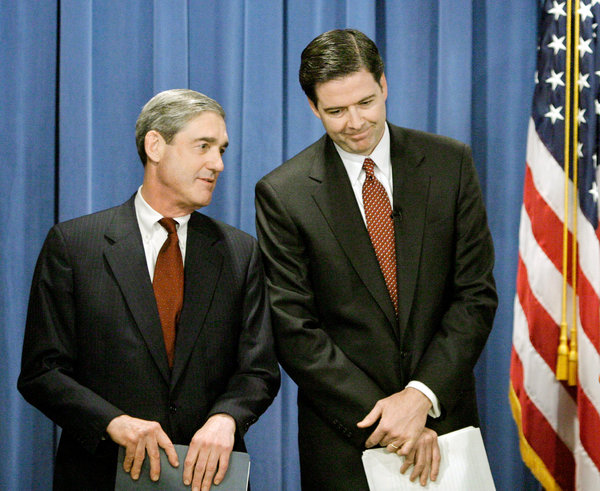
James B. Comey, right, with Robert S. Mueller III, whom he would replace as the director of the
Federal Bureau of Investigation if confirmed, in 2004


WASHINGTON — President Obama plans to nominate James B. Comey, a former hedge fund executive who served as a senior Justice Department official under President George W. Bush, to replace Robert S. Mueller III as the director of the Federal Bureau of Investigation, according to two people with knowledge of the selection.

By choosing Mr. Comey, a Republican, Mr. Obama made a strong statement about bipartisanship at a time when he faces renewed criticism from Republicans in Congress and has had difficulty winning confirmation of some important nominees. At the same time, Mr. Comey’s role in one of the most dramatic episodes of the Bush administration — in which he refused to acquiesce to White House aides and reauthorize a program for eavesdropping without warrants when he was serving as acting attorney general — should make him an acceptable choice to Democrats.


FULL STORY


Back
Top