Will Evacuees/New Residents Affect 2008 Election?

bensisco

Star
Registered
Here's an interesting political question about evacuees. The news media is saying that many of the evacuees will settle wherever they have been taken. So, for the 200,000+ poor Blacks taken to Texas, will that affect the 2008 election for President (given all of Texas’ Electoral College votes) or other political offices? If so, how long will the evacuees truly be welcome there?
 
Evacuees changing residency happened in south Florida, but I don't think the number not returning to New Orleans will be anywhere near that. N.O. is, in my opinion, rather unique and so is its people. N.O. isn't just home to its residents, its a way of life. Besides, life is difficult (especially job-wise) as it is for Black people and I find it difficult to believe that any of the host cities, especially those in Texas, will make it easy for Black evacuees to take root in election affecting numbers.

QueEx
 
I live here in Houston, TX.

I'll give you an update. Right now the Astrodome, the Astrohall and the AstroArena have been opened to evacuees.

We are now getting local news reports that 100,000 to 150,000 evacuees say they are not going back. They are now looking for jobs and residency here around Houston. Also This would probably put a strain on the job market. We already have an illegal-alien problem. Now you have a wierd situation in which illegal-aliens and evacuees from Louisiana will now be fighting it out for low paying jobs in a job market that's already strained.

The political angle is one that I don't even think any of us have taken into account yet. You're ahead of the curve on this one!
 
supply of labor will be good for companies but not for labor. it might have a net-zero impact on the economy. from a political p.o.v., it might make for some interesting demographic changes. LA is a blue state, and TX is a red state. Could this influx of new residents change the political leanings of TX? That remains to be seen I guess...
 
The 2008 election has already been decided. It will be stolen like the previous two.

Things are about to seriously change in Houston. There has been a massive influx of people who have nothing. The place is exploding with feelings of brotherhood and community, but how long will it last? Houston and the rest of the country will be very different in the coming years.
 
African Herbsman said:
The 2008 election has already been decided. It will be stolen like the previous two.
unless a democrat wwins it then it will be the will off the people.

i know i know, you're not a democrat.
 
Katrina could prompt new black "great migration"

Katrina could prompt new black "great migration"
By Adam Tanner
Mon Sep 5, 3:21 PM ET

HOUSTON (Reuters) - If refugees end up building new lives away from New Orleans, Hurricane Katrina may prompt the largest U.S. black resettlement since the 20th century's Great Migration lured southern blacks to the North in a search for jobs and better lives.

Interviews with refugees in Houston, which is expecting many thousands of evacuees to remain, suggest that thousands of blacks who lost everything and had no insurance will end up living in Texas or other U.S. states.

Officials say it will take many months and maybe even years before the birthplace of jazz is rebuilt.

"We advise people that this city has been destroyed," New Orleans Deputy Police Chief Warren Riley told reporters on Monday. "We are simply asking people not to come back to this city right now."

Many evacuees like Percy Molere, 26, who worked in a hotel in New Orleans' famed French quarter, say they cannot keep their lives on hold for very long.

"If it took a month, I'd go back, but a year, I don't want to wait that long," said Molere. "Hopefully we're going to stay in Houston just to stay out of New Orleans" for the time being.

Experts caution that it is too soon to clearly predict the long-term impact of the devastation of New Orleans, a city of less than half a million people more than two-thirds of whom are black. But one scenario would be massive resettlement elsewhere.

"You've got 300,000, 400,000 people, many of them low income without a lot of means, who are not going to have the ability to wait out a year or two or three years for the region to rebuild," said Barack Obama, the only black member of the U.S. Senate.

"They are going to have to find immediate work, immediate housing, immediately get their kids into school and that probably will change the demographics of the region," he told Reuters on Monday during a visit to Houston, the largest single gathering point for the refugees.

Because of the legacy of slavery, southern states including Louisiana, Arkansas, Mississippi, Alabama, Georgia and South Carolina have historically been home to the greatest concentration of U.S. blacks. In 1900, 85 percent of U.S. blacks lived in the South and as early as 1830, more than 58 percent of Louisiana's population was black.

Between 1940 and 1970 economic changes prompted 5 million blacks to quit the south for cities across the North including Chicago, Detroit and New York, marking one of the nation's largest internal migrations.

"It could have potentially that kind of effect," said Obama, whose father immigrated from Kenya.

MIGRATION TRENDS

New Orleans did not always follow the trend. Historically, far fewer residents have moved from New Orleans than from most American cities, despite its high poverty and crime rates.

Nicholas Lemann, author of "The Promised Land: The Great Black Migration and How it Changed America," was wary of predicting that Katrina would prompt major resettlement.

"It is kind of early to tell," he said.

But he said as officials elsewhere accommodate large numbers of blacks, they should avoid putting them in confined areas as Chicago did in the past, which created new urban woes. "They should think carefully on how to avoid the sort of ghetto phenomenon," he said.

Part of the migration trend will be set by what federal, state and local agencies do to help refugees rebuild their lives.

"What I do think should be focused on now is what is the Congress is going to do when they get back," former President Bill Clinton said in Houston on Monday. "How are we going to find jobs for these people, where are they really going to live, do they need some cash right away?"

"They feel lost."

http://news.yahoo.com/s/nm/20050905/ts_nm/migration_dc
 
Black refugees ask if Utah will really accept them

Black refugees ask if Utah will really accept them
By Adam Tanner
44 minutes ago

CAMP WILLIAMS, Utah (Reuters) - Asked whether he would relocate permanently to Utah after being brought here as a refugee from Hurricane Katrina, Larry Andrew rattled off a series of questions on Friday on the delicate issue of race.

"How do the adults really feel about us moving in?" he asked at Camp Williams, a military base 21 miles south of Salt Lake City housing about 400 refugees from last weeks disaster. "What if I find a Caucasian girl and decide to date her?

"Will I have to deal with whispering behind me and eyeballing me?" asked the 36-year-old black man.

For the mostly poor, black refugees evacuated from New Orleans, few places are as geographically remote and culturally alien as this corner of Utah, where 0.2 percent of the population in the nearest town is black.

Still, some refugees, especially younger adults, say they are ready to make a new start in the region even though they did not know they were coming until the doors shut on the airplane evacuating them from New Orleans.

"I'm planning a whole new life," said Phillip Johnson II, 23, who has already arranged an apartment in Salt Lake City. "It's an opportunity knocking for me out here."

He said even though the population of New Orleans was two-thirds black, his appearance with dreadlocks and a goatee still worked against him. "In New Orleans, being a young black man, you get harassed a lot, stereotyped a lot," he said.

One of the volunteers at the base, Newton Gborway, who moved to Utah from Liberia in West Africa five years ago, shared his first-hand impression of life in an economically prosperous state with a less than one percent black population.

"Don't be shocked and surprised if you meet someone who is mean to you or doesn't want to associate with you because you are black," he told Darisn Evans. "You don't worry about the negative stuff."

"Everything is going to be okay, but it is just a matter of time."

Evans said he would remain in Utah, and would like to work either as a handyman or as a highway patrolman.

His ex-wife Tanya Andrews, 44, said race played a part in their escape from flooded New Orleans, an adventure which she said included looting food, a television and a boat to get to higher land. She said rescuers picked them up only after a lighter-skinned black woman waved down a helicopter.

UTAH OPEN ARMS

So far the local community has welcomed the refugees with open arms, although they say they face an adjustment to life in Utah, stronghold of the socially conservative Mormon Church.

"Any time you go in where you are in the minority -- and I'm experienced in this -- it's going to be more difficult," said Wayne Mortimer, mayor of Bluffdale next to Camp Williams.

He cited his past missionary work in Canada when he was a relatively rare Mormon. Mortimer said his town of 6,500, a well-to-do bedroom community of Salt Lake City, had 20 low-income housing units available for the refugees.

"When you are an affluent community like we have, the greatest blessing we can have is to lift someone else," he said in an interview.

Larry Andrew's brother Adrian and sister Tanya, despite initial shock about being sent to Utah, say they will remain in Utah. Even Larry, despite his doubts, says the state is offering him a unique chance.

"According to what I see, it will be beneficial to me economically, even socially," he said. "But how would they adapt to me?"

http://news.yahoo.com/s/nm/20050909...g5Z.3QA;_ylu=X3oDMTBiMW04NW9mBHNlYwMlJVRPUCUl
 
Re: Black refugees ask if Utah will really accept them

<font size="5"><center>Katrina Darkens the Outlook for Incumbents</font size></center>
Public Dismay Could Shape 2006 Elections

By Jim VandeHei
Washington Post Staff Writer
Sunday, September 11, 2005; Page A02

Hurricane Katrina has the potential to foment change in Washington like the terrorist strikes did four years ago, altering the government's priorities for the foreseeable future and darkening the mood of an electorate that was already anxious before the storm hit shore, according to lawmakers, pollsters and strategists from both parties.

The dispute over Washington's role in saving lives in New Orleans and in the future threatens to make incumbents from both parties among Katrina's casualties, several officials said. With the popularity of Congress and President Bush sagging before the crisis, many officials said Bush and lawmakers made their situation worse by pointing fingers and digressing into political warfare with rescue operations still underway.

The aftermath of the past two weeks is almost certain to have a long echo. The billions of dollars already committed -- with many predicting the sum will eventually reach into the hundreds of billions -- is enough to make the New Orleans catastrophe a dominant factor in Washington's ritual battles over spending priorities for the balance of Bush's term. And the question of accountability -- fixing responsibility for what went wrong in the troubled early days of the rescue effort -- promises to color congressional debate for the next year or more.

Beyond these concrete impacts, some strategists expect Katrina to reshape the ideological premises of Washington debate in more subtle, but potentially more consequential, ways. Former House speaker Newt Gingrich (R-Ga.), in memos circulated among Republicans last week and in conversations with White House officials, argued that the party that offers bold ideas to modernize how government responds to crisis will be rewarded in future elections.

"Both parties have a great opportunity -- and a great risk," Gingrich said in an interview. "One of the two parties is going to be the party that brings the country into the 21st century . . . and you can't say today which party will win that battle."

John D. Podesta, former chief of staff to President Bill Clinton and head of a leading Democratic think tank, says Democrats must start by casting Bush's brand of conservatism -- emphasizing an "ownership society" elevating individualism and private enterprise -- as fundamentally flawed and hostile to society's collective responsibility to help citizens, especially the neediest.

In its place, Podesta says, Democrats must offer an activist, reform-minded government agenda that includes new energy, infrastructure and homeland defense policies.

Katrina "changed the future," said Senate Minority Leader Harry M. Reid (D-Nev.). "Enough is enough: No more Bush-business-as-usual."

The emerging Democratic plan calls for a shift of resources away from Bush priorities, including lower taxes, to disaster preparedness, an approach that might gain traction with images of Katrina fresh in the minds of voters.

Although Democrats see opportunity, some of them acknowledge that Katrina's initial impact did not show anyone in Washington in the best light.

"When you get down to it, [voters] hate everyone right now," said Rep. Rahm Emanuel (D-Ill.), chairman of the Democratic Congressional Campaign Committee. "Do you blame them? They feel let down."

This is potentially bad news for incumbents of all stripes, but Emanuel asserts the sour mood is more detrimental to the ruling Republican Party, in part because it scuffs what had been a core asset: a widespread belief that Bush was steady in crisis. Even some GOP strategists privately said they worry about Bush's political erosion. Bush's job- approval rating fell to the lowest of his presidency in two different polls released yesterday: 38 percent in the latest Newsweek Poll and to 42 percent in the Time Poll. "Incumbents in both parties are dancing perilously close to the edge right now: Gas prices are out of control, we are bogged down in Iraq and now politicians seem to be doing more talking than acting," said David Gergen, a presidential scholar who has served in GOP and Democratic administrations. "We may be heading toward an election in which the attitude is to throw the bums out, and if that happens, Republicans will pay the bigger prices because they are in control."

In such an atmosphere, neither side sees a benefit in compromise or rhetorical restraint -- as last week's rush of Katrina-inspired partisan invective made plain.

"As the middle dissipates in American politics, there is a tendency to see the other side as even more dangerous because there is such a radical shift if they are in power," Gergen said.

It is too early to determine whether the public's gloomy mood spells trouble for elected officials next year, but Frank Newport of the nonpartisan Gallup Organization said his surveys have shown a strong majority of Americans unhappy with Bush and Congress even before Katrina. Only about 35 percent of Americans have said they approve of Congress's performance throughout the summer, citing the war and gas prices as their chief gripes.

"In 2006, if there isn't some turn of events, Iraq combined with Katrina and the large budget deficits to follow will create an opportunity for non-incumbents to move in," said James A. Thurber, a political scientist professor at American University.

Democratic pollster Stan Greenberg briefed a group of Capitol Hill Democrats last week on the political fallout of Katrina, telling them Bush is losing support and that Democrats stand to benefit from the public's discontent next November if they manage the Katrina aftermath shrewdly, participants said.

Rep. Thomas M. Reynolds (R-N.Y), the top strategist for House Republicans, said the GOP has two factors working in its favor: The public may dislike Congress, but voters generally like their own representative and, unlike a decade ago, there are only 30 or so House seats that are truly competitive.

The one thing Republicans and Democrats agree on is voters will reward or punish them based on how they respond to the devastating natural disaster in the weeks and months ahead.

GOP congressional leaders, concerned about a backlash to the massive spending ahead and the president's performance over the past 10 days, are lobbying Bush to lay out a long-term vision that would be announced in an address to the nation, several leadership aides said. One issue being debated inside the White House is whether to offer victims "portable benefits" such as education assistance they can carry with them if they decide to relocate outside of the Gulf Coast region.

One new issue that will be addressed is assistance to minorities living in big cities, often the forgotten demographic in political wars focused on the middle-class Americans who vote in higher numbers and live in competitive regions. Republicans are laying preliminary plans for tax-friendly business zones in low-income areas, an idea that was popular among conservatives in the late 1990s, and expanding education programs targeted at the neediest.

Democrats see Katrina uprooting the entire budget debate, making it virtually impossible for Republicans to reduce the size of programs such as Medicaid or any other funding aimed at the poor for months to come. A senior House GOP leadership aide said Democrats are probably right.

Yet much remains unresolved about the Democratic alternative. Will they drop their campaign for smaller deficits to fund an activist government? Will they raises taxes? Will they call for a pullout from Iraq to shift funds to homeland protection?

As Sept. 11, 2001, led to the creation of committees, probes and even a new federal agency, the natural disaster is likely to lead to a broad rethinking of governmental priorities in a time of turmoil and change. Issues such as mass evacuations, domestic deployment of troops and the restoration of wetlands will assume the prominence of anthrax vaccinations and subway alert systems held in the fall of 2001. Many predict a natural-disaster czar will emerge with power similar to homeland security chief.

Ultimately, some strategists believe the details of individual debates will matter less than a cumulative judgment about effectiveness. "The public is going to look in coming months and year and say how have leaders responded to this . . . and what have they done" to protect the nation, said Republican National Committee Chairman Ken Mehlman.

http://www.washingtonpost.com/wp-dy...5091001016.html?referrer=email&referrer=email
 
Hurricane may end up costing La. a House seat

Hurricane may end up costing La. a House seat
By Peter Savodnik

The mass evacuation of coastal Louisiana triggered by Hurricane Katrina will likely cost the state one of its House seats, according to election officials.

Even before the devastating storm ripped through the Gulf Coast, Louisiana officials said their representation in Congress was in doubt.

“We were concerned about that anyway because of outmigration,” said Jennifer Marusak, a spokeswoman for Louisiana’s secretary of state.

With Katrina having emptied out New Orleans and much of the surrounding parishes, hundreds of thousands of people who once voted in Louisiana’s 1st, 2nd and 3rd Districts are no longer there. And many who never heard of Reps. Jim McCrery, Rodney Alexander and Richard Baker — Louisiana Republicans who represent the 4th, 5th and 6th Districts, respectively — are now camped out in those districts.

House members, their staffers and government officials in Baton Rouge and Washington say they’re loathe to talk about politics when there are still bodies to be recovered, children to be reunited with their parents and schools and hospitals to be reopened.

But the reality is that less than 14 months before voters are scheduled to head to the polls, it’s unclear which polls they’ll be heading to — and how this will affect Louisiana’s congressional balance of power as well as that of neighboring Alabama or Texas.

“Our delegation met last week, talked about the fact that Mobile is, for the moment, the largest the city along the central Gulf Coast,” said Rep. Jo Bonner (R-Ala.), whose 1st District encompasses the thoroughly thrashed port city.

“Clearly, we’ll do redistricting in 2010,” Bonner continued, saying that he and his “band of brothers” — Reps. Gene Taylor (D-Miss.) and Bobby Jindal (R-La.) and other Gulf Coast members — had been bound together by the storm. He added: “I don’t see a groundswell of interest in making any adjustments between now and 2010.”

Tricia Lowrey, a senior legislative analyst at the Louisiana House Governmental Affairs Committee, agreed with Bonner, noting that the government does not have the data to know where to redraw district lines. But, she quickly added, “It certainly will be a redistricting issue after the 2010 census.”

The plight of displaced Louisiana residents could make it politically difficult to strip the state of a House seat. It is unclear what how many residents will return to the New Orleans area after the city is rebuilt.

Still, there is a realization at the state Legislature in Baton Rouge that Louisiana may have to take action before the end of the decade. Marusak and Lowrey said state lawmakers have discussed holding a special session before they are scheduled to convene again in March 2006.

That recognition may stem from growing pressure in central and northern Louisiana congressional districts that have become a temporary home for thousands of newcomers renting houses, filling public schools and clogging local highways.

Baker spokesman Michael DiResto estimated that the 6th, which is northwest of New Orleans and encompasses Baton Rouge, may have twice as many people in it as most every other district in the nation.

Baker said that motels, hotels and public-housing and rental units are filled in Baton Rouge and surrounding communities. He added that some business owners had bought 20 or 30 houses to relocate their entire operations to the state capital.

The “ideal” district, Lowrey said, has 638,425 people. Officials in Baton Rouge said the 4th, 5th and 6th districts are each housing more than 1 million people. Bonner said Alabama had picked up 20,000 residents, including as many as 5,000 in his district.

For now, no one wants to speculate about what a reconfigured congressional map in Louisiana might look like for fear of sounding crass or because most simply don’t know who will be living where come 2006 or 2008, let alone 2010 or 2012.

But strong emotions are swirling around the interrelated questions of future congressional districts, the fate of New Orleans and who, exactly, will represent those former city residents if and when they come back.

“The congressman’s main goal right now is rebuilding and moving forward with New Orleans,” said Melane Roussell, spokeswoman for Rep. William Jefferson (D-La.), whose 2nd District encompasses the ghost town that the Big Easy has become. “To assume that his district wouldn’t exist when his election comes up would be to assume that New Orleans doesn’t exist, and that’s not a consideration — at all.”

Said Baker: “New Orleans will come back. Will it be the million-person metro center it was before the storm is very difficult to predict.”

For some members, any discussion of congressional boundaries or politics is too much to bear.

Aides to Rep. Charlie Melancon (D-La.), whose 3rd District south and west of New Orleans was savaged by Katrina, refused to answer questions about the future of the district, forwarding all calls to spokeswomen for House Minority Leader Nancy Pelosi (D-Calif.) and the Democratic Congressional Campaign Committee (DCCC).

“What they’re focused on right now is, they’re not even focused on this,” Sarah Feinberg of the DCCC said. Sounding Democrats’ rallying cry from the 2000 presidential recount, Feinberg said: “Congressman Melancon and the DCCC are … making sure that no one is disenfranchised.”

Rep. Artur Davis (D-Ala.) is crafting a bill to ensure that evacuees, like military personnel and students, retain their voting rights, said his communications director, Corey Ealons.

Some officials and congressional aides privately acknowledged that Republicans may ultimately benefit from the hurricane, with Jindal holding onto or gaining population and Democrats Jefferson and Melancon being fused into a single seat.

Bonner was reluctant to speculate. “I think it’s way too early to predict any fallout politically,” he said. “It’s hard to say because it’s changing everyday.”

http://www.hillnews.com/thehill/export/TheHill/News/Frontpage/091205/seat.html
 
Re: Hurricane may end up costing La. a House seat

Its hard to vote when you cant even read the ballot
 
Re: Hurricane may end up costing La. a House seat

<font size="5"><center>Population Loss Altering Louisiana Political Landscape</font size></center>

The New York Times
By JEREMY ALFORD
Published: October 4, 2005

BATON ROUGE, La., Oct. 3 - The two recent gulf hurricanes may result in a significant loss of population for Louisiana, and state officials are now virtually certain that Louisiana will lose a Congressional seat - along with federal financing and national influence - after the 2010 census.

Having dislodged more than a million people in southern Louisiana alone, Hurricane Katrina and Hurricane Rita are also likely to alter the state's political landscape, demographers and political experts say, reducing the domination of New Orleans over the State Legislature and increasing the influence of suburban and rural areas.

With a low-wage economy and consistently poor educational performance, Louisiana was losing population even before the hurricanes. The state had a net loss of more than 75,000 people from 1995 to 2000, according to census figures. But the physical and psychological damage inflicted by the hurricanes could push tens of thousands, and possibly hundreds of thousands, of people out of the state for good, state officials say, comparable only to the Dust Bowl during the Great Depression and possibly the 1927 floods.

"I'm not sure if history is going to help us with this because we've never had anything like it," said Karen Paterson, the state demographer. "But we have not shown a positive net migration in many years. I would expect that we would experience a significant loss of population statewide."

With evacuees now making decisions on whether to plant roots elsewhere, and the geographical future of New Orleans in question, it is impossible to say with any precision how many people will be in Louisiana at the end of the decade. A dependable number will have to wait until the 2010 census.

The numbers available now, however, are staggering. About 1.5 million people were initially evacuated from the damaged regions, roughly 1 million have applied for hurricane-related federal aid, 30,000 are in out-of-state shelters, 46,400 are in in-state shelters and 932 people have perished in the storms. Officials are unsure how many people are staying in hotels or with family and friends.

Many here were already expecting Louisiana to lose one of its seven Congressional seats because of existing out-migration and high growth rates in other states, but the impact of the hurricanes has solidified fears.

Glenn Koepp, secretary of the Louisiana State Senate and one of the main officials in the state's redistricting office, said Louisiana had fallen so far behind other states that even if it managed to increase by 7,000 people in the next five years, it would still lose a Congressional seat.

Elliott Stonecipher, a political analyst and demographer based in Shreveport, said the state faced a long-term reduction in federal aid as its population diminishes.

"The result is direct," said Mr. Stonecipher, who was formerly an assistant superintendent with the state Department of Education. "With the loss of population there will be a matching loss of revenue. You pick it. Look at education, whether it be Title IX or special education. This will be devastating."

Many politicians are also keeping a close eye on population movement within the state.

Within 48 hours after Hurricane Katrina made landfall, Baton Rouge became Louisiana's largest city, doubling to about 800,000 residents. Local officials are now trying to get a population survey up and running to seek federal aid.

Mr. Koepp said this population shift could actually be the early stages of the deterioration of New Orleans' long-term hold over the State Legislature. "If this holds true, there will be a significant political change," he said.

There are now 21 seats in the House and Senate that encompass or touch on Orleans Parish, of 144 total seats statewide.

But if the population fails to return to the parish in coming years, New Orleans may be confined to just a few seats in each chamber through redistricting, Mr. Koepp added. That could change the state's racial and partisan balance.

If evacuees from the Ninth Ward in New Orleans - a reliable bloc of 30,000 black voters that is traditionally easy to mobilize - choose suburban or rural areas over their urban roots in coming years, it could be a political blow to Democrats, said Roy Fletcher, a political consultant from Shreveport who helped elect former Gov. Mike Foster, a Republican.

"It would give a whole lot of a stronger foothold to Republicans in the Legislature and statewide," Mr. Fletcher said. "Louisiana has always been a swing state, a purple state that's both blue and red. You take the Ninth Ward out of that equation and you get a real shot of Republicans winning statewide office."

Barry Erwin, president of a Council for a Better Louisiana, a nonpartisan nonprofit group that monitors the activities of state government, said such a change could forever alter the political landscape.

"These things are symbolic of a divide that we've always had," he said. "There's an us versus them thing. In New Orleans, it's like us, and then there's the rest of the state. Around the rest of the state, it's like us, and then there's New Orleans. This could change all of that."

http://www.nytimes.com/2005/10/04/national/nationalspecial/04census.html
 
Quiet life of Utah is fine by evacuee

i'm fascinated by black people in utah stories.

Quiet life of Utah is fine by evacuee
Settled in Midvale: 'It's time to act my age,' says retired welder, 68

The Salt Lake Tribune
Salt Lake Tribune

New Orleans transplant William Payton can't shake nightmares about Hurricane Katrina, a hardship he regrets anyone had to endure. He misses his hometown and his children and grandchildren who live in Texas and Louisiana.

But the 68-year-old retired welder is grateful to have landed where he did: a senior housing complex in Midvale.

"I had to give all that up. It's time to act my age," Payton said of his old lifestyle. "New Orleans is what you call a fun-loving place. You can party all day and all night. This is conservative living. Peace and quiet, that's what I need."

Payton has little contact with other Katrina survivors; he doesn't attend Calvary Baptist Church's support group, though he was invited.

He gets lonely sometimes, but in less than six months, he has struck up friendships with welcoming neighbors who filled his new home with furnishings and household goods. The built-in social supports at Valley Fair Village - shuttle service, bingo nights and continental breakfast on Saturdays - also help.

"Going back home," he said, "would be taking the easy way out." Payton doesn't describe his childhood as rough, though his dad earned little as a Baptist minister and he says his mom "worked herself to death."

He admits making poor decisions growing up; he graduated from high school but never went to college.

"I was the oldest son and supposed to be a role model," Payton said. "But most of the time I was the mess-up."

Divorced from his wife for 30 years, he has two adult sons and two daughters. He worked all his life, until he lost his right eye and suffered other disabling injuries in an armed robbery outside the shipyard where he worked. He was stabbed 30 times.

But Payton is angered and offended when asked whether post-Katrina charity helped him turn his life around.

"I'm black. I make my opportunities. Life shows us many bad things and many good things," he said. "But it's taught me that it takes determination."

http://www.sltrib.com/utah/ci_3557142
 
When the spotlight fades: Katrina a powerful lens for seeing response to poverty

When the spotlight fades: Katrina a powerful lens for seeing response to poverty: Battling poverty: For some, the hurricane just compounded problems, such as lack of job skills, that already existed
03/01/2006
By Carey Hamilton,
Kirsten Stewart
and Brian R. Friedman

NEW ORLEANS - Wearing surgical masks to avoid contamination, Edwa and Louis Towns took unsteady steps last week through their rented house in New Orleans, treasure-hunting in the aftermath of Hurricane Katrina.

Inside the small, shotgun home in Orleans Parrish, the couple retrieved a few heirlooms that weren't destroyed - a punch bowl, a green church hat and matching dress that had belonged to Edwa's late mother. Edwa rescued two favorite drinking mugs that depict New Orleans and other great American cities, and her "angel of protection," a doll with wings and a halo.

Losing new living room furniture and a washer and dryer, purchased just before the deadly storm, "was hurtful, hurtful, hurtful," she said.

The Townses were among roughly 600 evacuees flown to Utah in September in the nation's hurricane relief effort. They were met with a charitable outpouring of support and an economy flush with jobs.

But evacuees, and those who came on their own, faced adapting to a starkly different culture and climate. As the six-month mark approaches, with a hint of spring, many are returning home or relocating; half a dozen families shipped out Tuesday morning.

Some are thriving and plan to stay in Utah. Others are still jobless, homesick and isolated in their apartments, according to outreach workers. News reports document a handful turning to drugs or crime.

The Townses looked like an immediate success story, with new friends, a Salt Lake City apartment and a donated car. But they have since struggled, losing their jobs and temporarily separating. Louis, 50, returned to New Orleans, where Edwa, 39, met him in mid-February when she flew back to bury her grandfather.

The stories of Hurricane Katrina survivors provide a powerful lens for viewing this country's response to poverty. Whether former Gulf Coast residents were impoverished before the storm, many fit the criteria now. "Katrina victims are what we've termed in social work circles the undeserving poor. The hurricane hits and they become the symbol for how we focus our resources. They were in the headlines, and we could see their poverty and their need," said Mary Jane Taylor, a University of Utah social work professor.

"The question then becomes how soon are they going to become invisible, sent to the back of the line and become the deserving poor again?"

Poverty's problems run deep: The solutions to poverty are as varied as the people who live in its shadows, Taylor believes, after spending years tracking more than 3,000 Utahns in the wake of welfare reform. Clothing and food drives are helpful but superficial fixes, Taylor said.

For Katrina survivors, "A lack of job skills, education and those kinds of problems are not systemic to living in New Orleans," she said. "They need to be addressed no matter where they live."

Utah's relief effort got early high marks from evacuees at Camp Williams. State officials and charities worked to quickly move people into more stable, government-subsidized apartments scattered along the Wasatch Front.

But soon after the leases were signed, communication faltered. Evacuees complained of never receiving furniture, household goods and the federal emergency aid they were promised. Traumatized and living in a strange place with no reliable transportation, some evacuees had no idea who to turn to for help in navigating federal and local aid programs.

Even keeping tabs on survivors has proved difficult. The Federal Emergency Management Agency reports 517 Katrina survivors registered in Utah. Utah housing officials have records of only 383 living in state-leased apartments.
Red Cross chapters throughout the state report hundreds more who came to Utah on their own, including dozens in Ogden and Provo, to live with family or pursue job opportunities.

State officials say they have done their best to reach out, mailing survivors information and setting up a support group at Calvary Baptist Church in Salt Lake City.

"Utah has done a great job helping, as far as I can tell," said Ernest Timmons, an evacuee hired by Calvary for outreach work. "We've mailed, phoned or personally visited everyone we know about. . . . Help is there for the taking."

What helps after a disaster? To oversee the long-term recovery of Utah's Katrina survivors, charities and faith-based groups have created a committee that will "ensure that people don't fall through the cracks," said Chairman Josh Pederson, director of Utah's 211 referral hot line for public assistance.

"Some [evacuees,] we've been able to help. For others, the hurricane just compounded problems that already existed," Pederson said.

"Our challenge is to help them navigate the system. Sometimes there are waiting lists for help. They will encounter the same frustrations as anyone."
Why, then, are some evacuees thriving?

It's a question that researchers at Harvard Medical School are trying to answer.

Last month, Harvard began recruiting hurricane victims to serve in a 2,000-person advisory group. Researchers will track the group for two years, interviewing members every three months about their health, mental outlook and pace of recovery.

The interviews will be used to create an oral history to "help policymakers monitor the unmet needs of people whose lives were, and may continue to be, severely impacted by this unprecedented disaster," said Ronald Kessler, the project's director.

No such study is under way in Utah.

"A sociological study would be fascinating," said Pederson. "But we need to tread with caution. They're Utahns now, and we need to respect them as such. In the news it was reported that eight people were busted for drugs and three were Katrina evacuees. Well, where were the other five born? Were they from San Diego or Sandy?"

"I'd like to stay." Edwa Towns returned to Louisiana last week to bury her grandfather. The United Way, through a roundabout process, paid for her airfare. "I was so upset," she said. "I thought I wouldn't be able to make it to his funeral because I couldn't afford a ticket."

After the hurricane, the Townses were stuck for days in New Orleans' chaotic Convention Center. On arrival in Utah, both were briefly hospitalized at Salt Lake Regional Medical Center. The hospital temporarily hired Edwa and paid for her education as a certified nursing assistant.

Louis got a job as a custodian at Pioneer Valley Hospital in West Valley City that paid $10.50 an hour, double his wages operating a forklift in New Orleans. The spiritual couple found a welcoming church and befriended the pastor and his wife.

But in December, things began to unravel.

Edwa traces their troubles to a Dec. 10 car accident that left them both with minor injuries.

Their donated car was slammed; the driver of the other vehicle was cited for failure to yield and having no proof of insurance. Louis took time off work and was eventually let go. Edwa didn't take her final nursing test, and couldn't return to her hospital job without passing it.

"He was drinking and depressed after he got laid off," Edwa said. "He told me he was unhappy in Utah. He felt like he couldn't provide for us anymore."

Louis took a Greyhound bus back to Louisiana in January.

Now, the couple plan to reunite in Utah. Edwa, who was scheduled to fly back to Salt Lake City on Tuesday evening, said Louis has promised not to drink and he wants to get back into a church routine. He plans to hop a bus this week.

But many challenges lie ahead, such as how to pay rent. Edwa said she is not receiving her federal rental assistance.

"We have to find some full-time jobs so we can keep a roof over our heads," said Edwa, now working part time at Salt Lake City's Main Library. "I'd like to stay in Utah."

chamilton@sltrib.com
kstewart@sltrib.com


Katrina evacuee help by the numbers

* 517 Utah evacuees registered with FEMA
* 383 Evacuees in apartments leased by state of Utah
* 159 Self-evacuees helped by Salt Lake Red Cross
* 102 Self-evacuees helped by Provo Red Cross
* 63 Self-evacuees helped by the Northern Utah Red Cross
* 10 Self-evacuees helped by Logan Red Cross

http://www.sltrib.com/nationworld/ci_3557146

 
After Katrina, black family warily adjusts to Utah

After Katrina, black family warily adjusts to Utah
By Adam Tanner
Fri Aug 25, 8:05 AM ET

Nearly a year ago, the three Andrews bothers and their sister were shocked to learn the jet evacuating them from flooded New Orleans was flying to Utah, a Western state with very few black residents.

Fast forward a year, and their bewilderment has eased but not disappeared. All four are still adjusting to life in a conservative state settled by white Mormon pioneers in the 19th century. They say economic opportunity and lower crime rates there are offset by subtle racism the black family encounters.

Clifford Andrews, 40, is perhaps the most upbeat of his siblings about life in Utah and sees the hand of God bringing them there after Hurricane Katrina.

"People in Utah don't know how to act toward black people," he said in his suburban rental home surrounded by lawn. "I personally believe that is my reason, to teach these people how to get along with people of color."

A year after Katrina struck, its far-flung victims are still contending with the upheaval and disorientation.

The evacuation of New Orleans was chaotic. Some people escaped in their own vehicles to destinations of their own choosing. Others were sent in buses or planes to distant cities, sometimes without knowing where they were headed.

Invited by states or private groups, former New Orleans residents are now scattered across the country and most U.S. states have at least some evacuees.

In this diaspora, Utah took in 679 mostly black Louisiana residents including the Andrews siblings.

Before their flight to safety a year ago, the Andrews family, which lived in a few households on New Orleans' Hope Street, survived some harrowing days.

After Hurricane Katrina struck, they looted food to survive during several days in which they camped out at a supermarket parking lot above the flood waters. Sister Tanya, 45, and brother Larry, 37, both took boats in an effort to find help, although they said they were rescued only after a white woman waved down a helicopter.

When the Andrews arrived at a displacement camp outside Salt Lake City in September 2005, they expressed cautious optimism about Utah but concern about how the largely white population would respond to the new blacks moving there.

A year later, Larry Andrews is still filled with doubts.

"We (blacks) used to live in Africa and we were moved to New Orleans and we had to adapt there," he said. "Now we are in Utah and we have to adapt here. We're tired of adapting."

Asked if his apartment living room with two computers, a television, a stereo and a boom box indicated a better life materially, he said: "What's in here, in my heart, I'm not. I'm confused. We were living better where we was."

SUCCESSES AND FAILURES

Richard Walker, who oversaw last year's resettlement process for Utah, says despite wide cultural differences, more than half of those sent to Utah have started a new life here.

"Some of them have done pretty well and others of them have not had that good of an experience," he said. "There were some law enforcement issues with some of them, some of them were dealing drugs, some people were involved in other kinds of crime. One person tried to burn his apartment complex down because they evicted him."

But, he adds, "There are some really good stories about people who have just flourished here."

The U.S. Census Bureau estimates that less than 1 percent of Utah's population of 2.5 million is black, far below the U.S. average of nearly 13 percent. For those from New Orleans, the birthplace of jazz which had a two-thirds black population, the cultural and geographic contrast was especially stark.

"It was tough. I had to make attitude adjustments for myself," said Tanya Andrews who found a job driving a truck, work she did in New Orleans. "I'm one of the only black women driving a truck in Utah; you're in a man's world. It was tough for me to go into an all-white waiting room."

Like her two unmarried brothers in Utah, Tanya was initially concerned about romantic prospects. The divorced woman then met a man from New Orleans at the Utah relocation camp last September and they have since been dating.

CHANGING CULTURES

Larry Andrews, who is studying electronics at community college, struck up a relationship with someone evacuated from New Orleans, Lynn Lawrence, 42. As she hugged an oversized stuffed bear and dog, she complained about discrimination and said rebuilding a new life was hard.

"Sometimes I'm so depressed, I cry a lot," she said.

Walker, who works for the Utah Division of Housing and Community Development, said many of the former New Orleans residents faced "huge cultural issues," including a higher rate of illiteracy or poor education.

"A lot of that has been resolved by the people who came here, you know, changing. They were willing to become part of this culture rather than their culture," he said.

Clifford Andrews, who is married with two young children and is studying to be a chef, said he hoped to stay in Utah through their school years. "Most look at the glass as half empty; I look at it as half full," he said.

Tanya Andrews is marking the anniversary of Hurricane Katrina with a trip back to Louisiana where she hopes to persuade her mother to move to Utah. One brother also still lives in Louisiana; he heeded warnings and left New Orleans before the floods.

"Life is better now (in Utah). It's not as oppressed. You feel better, the air's cleaner, it's safer. In New Orleans, they hold you back. You can't get a job," Tanya Andrews said.

Walker, who oversaw the resettlement, said many echo such sentiments. "I'm surprised that as many people did stay here actually survived and did want to remain here because of the cultural differences and because of the climactic difference."

The final word in any family story belongs to the mother, in this case Jacquelyn Andrews, who has lived in a Louisiana trailer since her home was destroyed.

"The Lord put them there. There is a reason why they are there," she said by telephone. "They have to follow God's needs. I tell them they need to stay."

http://news.yahoo.com/s/nm/20060825/ts_nm/weather_hurricanes_evacuees_dc
 
Re: After Katrina, black family warily adjusts to Utah

CUT/PASTE battle!

Anyway I can't see why anyone would willingly put themselves in a situation where they could all be washed out to sea and lose what few belongings they have. It just doesn't make any sense. That area is BELOW SEA LEVEL. Storms whip in there every year and every storm is a potential Katrina. How confused do you have to be to want to go back to that?

I can't say what the trigger is for how people will vote in these upcoming election of how Katrina will fit into the equation but most people who stayed did so willingly. Ray Nagin himself said it would pass. The majority will probably vote based on existing habits. Dems vote for dems and Republicans for Republican. But a few will vote because they believe white people blew up the levees and delayed help to kill them. That few won't be much to change the dynamics of who will ultimately get into office. But you can bet the politicians will find a way to use our race and our condition to get in.

-VG
 
Here's an interesting political question about evacuees. The news media is saying that many of the evacuees will settle wherever they have been taken. So, for the 200,000+ poor Blacks taken to Texas, will that affect the 2008 election for President (given all of Texas’ Electoral College votes) or other political offices? If so, how long will the evacuees truly be welcome there?

<font size="4">Apparently not . . .

</font size>

<IFRAME SRC="http://www.realclearpolitics.com/epolls/2008/president/tx/texas_mccain_vs_obama-628.html" WIDTH=780 HEIGHT=1500>
<A HREF="http://www.realclearpolitics.com/epolls/2008/president/tx/texas_mccain_vs_obama-628.html">link</A>

</IFRAME>
 
Louisiana Politicians Already Talking Redistricting

http://www.rollcall.com/issues/54_142/politics/35644-1.html?type=printer_friendly

[FONT=verdana,arial, helvetica, geneva]There’s still one round of Congressional elections to go before the post-2010 redistricting battle takes center stage, but in some states, including Louisiana, hypothetical lines are already being drawn. [/FONT][FONT=verdana,arial, helvetica, geneva]Earlier this year, the Louisiana Family Forum, a conservative interest group affiliated with Family Research Council President Tony Perkins, released a redistricting plan based on the widely held belief that Louisiana will lose a seat in the Congressional reapportionment process following next year’s Census. [/FONT]
[FONT=verdana,arial, helvetica, geneva]That map combines most of the majority-black 2nd district based in New Orleans with most of the south-central 3rd district, which is currently represented by Louisiana’s lone House Democrat, Rep. Charlie Melancon. [/FONT]
[FONT=verdana,arial, helvetica, geneva]The seat would still be a majority-minority seat so as to comply with certain requirements of the Voting Rights Act of 1965. [/FONT]
[FONT=verdana,arial, helvetica, geneva]Freshman Rep. Anh “Joseph” Cao (R) currently holds the 2nd district seat, but Democrats and most unbiased political observers believe the 64 percent black district will revert to Democratic control next cycle. [/FONT]
[FONT=verdana,arial, helvetica, geneva]Since the Louisiana Family Forum released its six-district map, Democrats have assailed it as a blatant attempt to gerrymander as many Democratic voters as possible into one district while drawing the other five seats to heavily favor Republicans for the coming decade. [/FONT]
[FONT=verdana,arial, helvetica, geneva]Louisiana Democratic Party Chairman Chris Whittington dismissed the Family Forum plan for being based on two-year-old data. [/FONT]
[FONT=verdana,arial, helvetica, geneva]“We will support a fair and equitable redistricting plan based on updated census numbers,” he said Monday. [/FONT]
[FONT=verdana,arial, helvetica, geneva]Independent political analyst and demographer Elliot Stonecipher, who has been crisscrossing the state lobbying for a less political redistricting process, was skeptical of the Family Forum map. [/FONT]
[FONT=verdana,arial, helvetica, geneva]“That of course is useful in the sense that it’s nice to have on the table the extreme right’s view of this issue,” Stonecipher said. [/FONT]
[FONT=verdana,arial, helvetica, geneva]Meanwhile, counter maps are already being created to push back against the Family Forum map. One of those maps made its way onto a Louisiana political blog on Monday. That map sought to retain both the 2nd and 3rd districts by combining most of Melancon’s district with nearly all of Republican Rep. Charles Boustany’s 7th district seat to form a new 3rd district. [/FONT]
[FONT=verdana,arial, helvetica, geneva]Another early idea being tossed around by some Democrats involves creating a six- district map by combining a portion of northern Louisiana’s 4th and 5th districts and dividing the southern parts of those districts among the four remaining districts. [/FONT]
[FONT=verdana,arial, helvetica, geneva]But one Louisiana Republican on Capitol Hill argued that such a plan would be unlikely considering the fact that Louisiana has not lost population equally across each of its seven districts. In fact, some districts have seen growth as large numbers of people have moved around the state in the wake of the major hurricanes that have hit Louisiana in recent years. [/FONT]
[FONT=verdana,arial, helvetica, geneva]Following Hurricane Katrina in 2005, New Orleans was hit hardest in population loss. But parts of southern Louisiana and Baton Rouge have also been negatively affected. [/FONT]
[FONT=verdana,arial, helvetica, geneva]Meanwhile, some statistics have shown that parts of Rep. Steve Scalise’s (R) 1st district near New Orleans and the Shreveport-based 4th district of Rep. John Fleming (R) have actually experienced growth. [/FONT]
[FONT=verdana,arial, helvetica, geneva]As such, the Louisiana Republican operative argued that any map redraw will likely center on Melancon’s 3nd district and the Baton Rouge-based 6th district of freshman Rep. Bill Cassidy (R). The eastern part of Boustany’s 7th district and southeast part of Rep. Rodney Alexander’s (R) 5th district could also be affected to a lesser extent. [/FONT]
[FONT=verdana,arial, helvetica, geneva]Stonecipher — who continues to believe that there’s an argument to be made for Louisiana to keep seven seats — said that a six-district map would likely see the dismantling of the current 6th district seat with pieces being divided out to the 1st, 2nd, 3rd and 5th districts. [/FONT]
[FONT=verdana,arial, helvetica, geneva]Stonecipher also predicted that with a Democratically controlled Congress, White House and Justice Department, Melancon will be the key player in the next round of the redistricting process, despite being the lone Democrat in the state delegation. [/FONT]
[FONT=verdana,arial, helvetica, geneva]“I would say he also has the strongest ability to influence the process. I think his relationship with the White House ought to be plenty enough to make sure that those interests — whether they be the Democratic Party interests, the African-American interests — will be heard.” [/FONT]
[FONT=verdana,arial, helvetica, geneva]Bernie Pinsonat, an independent pollster in Louisiana, noted that any new map will have to be approved by the Justice Department under terms of the Voting Rights Act. “If I were a Democrat, I wouldn’t be that concerned,” he said. [/FONT]
[FONT=verdana,arial, helvetica, geneva]Despite the increasing chatter in state political circles, national officials say it’s a bit premature to start drawing maps. [/FONT]
[FONT=verdana,arial, helvetica, geneva]Rep. Lynn Westmoreland (R-Ga.), who is heading up the National Republican Congressional Committee’s redistricting task force, said that new technology is certainly making it easier for the average political junkie to get into the redistricting process. [/FONT]
[FONT=verdana,arial, helvetica, geneva]“Everybody’s getting in the game,” Westmoreland said. “I’ve had several Members from several different states say there’s this Web site or there’s that Web site that has maps drawn.” [/FONT]
[FONT=verdana,arial, helvetica, geneva]But he said that there’s little point getting into the mapmaking business before the 2010 data are available. “Until you get those census numbers back broken down by voting blocks, it’s very hard to draw them.” [/FONT]
[FONT=verdana,arial, helvetica, geneva]Pinsonat agreed, saying the Louisiana Family Forum proposal “is probably the first of a hundred” maps. [/FONT]
 
Re: Louisiana Politicians Already Talking Redistricting

Excellent post. We need to watch out for these tactics. This is one way the right has governed from the minority, splitting up districts in such away to dilute certain demographics. Keep us informed.
 
Re: Louisiana Politicians Already Talking Redistricting

<!--has the bg_content img--> <!-- marketplace bottom --> <!--googleon: index--> <!-- how many comments/recommendations --> <nobr>Comments
comment_icon.gif
9 | Recommend
thumb_up.gif
3
</nobr> <!-- how many comments/recommendations --> <!-- VELOCIT CONTENT STARTS HERE! --> <!-- vstory begin --> [SIZE=+2]La. GOP opposes counting immigrants in 2010 census

[/SIZE] [SIZE=-1]02:52 PM CDT on Sunday, August 30, 2009

[/SIZE] [SIZE=-1]Associated Press[/SIZE] BATON ROUGE, La. -- The chairman of the Louisiana Republican Party says the GOP is considering legal action to oppose federal plans to count illegal immigrants in the 2010 census.
M_IMAGE.11fd101b4ff.93.88.fa.d0.d0c5c4f9.jpg
WWLTV

GOP Chairman Roger Villere said if illegal immigrants are counted, Louisiana would lose one of its seven congressional seats.
"We are considering doing something legally to see if we can stand up. We feel like we need to protect our sovereignty," Villere said Saturday during a Republican State Central Committee meeting.


U.S. census information is used to determine the level of federal aid states get for numerous programs. The census numbers are also used for redrawing election districts to reflect population shifts. Louisiana has been projected by some demographers to lose a congressional seat because of a population decline.


However, Shreveport political analyst Elliott Stonecipher and LSU constitutional law professor John Baker have suggested recently that the loss of a seat can be averted if noncitizens, inflating the count in such states as California and Texas, are taken out.
They said counting the people who lack citizenship would give those states and some others with high numbers of undocumented immigrants more congressional seats, while states such as Louisiana lose them.


"It's not a Republican problem. It's a problem for the state of Louisiana," Villere said in an interview after the meeting. "Everybody has a vested interest that our Louisiana voting strength is not diluted."
Villere said options include working through Congress and the Obama administration to change census plans and going to court, he said.
 
~ Update ~
<font size="5"><center>
Smaller New Orleans
After Katrina, Census Shows</font size>

<font size="4">City is 29 percent smaller than a decade ago</center></font size>


Y-jp-census-1-articleLarge.jpg

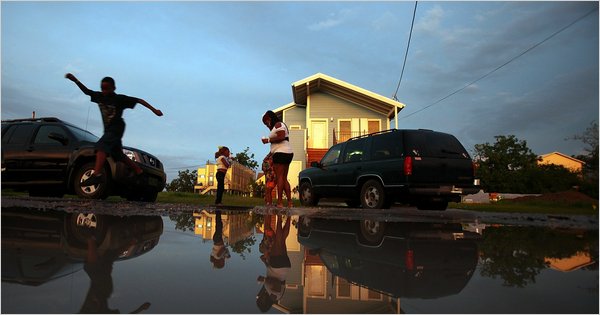
The aftermath of a rain storm, not a hurricane, in front of a new home in the Lower Ninth
Ward last summer.


The New York Times
By CAMPBELL ROBERTSON
Published: February 3, 2011


NEW ORLEANS — When Hurricane Katrina hit and the murky waters rushed through levee breaches, even the facts were drowned.

Official documents were destroyed, years of photographs were ruined, and a city’s ability to know itself was lost. Answers to basic questions like how many people lived here, where they lived and who they were could not be easily answered.

Now there finally are some numbers, and they show that the city is 29 percent smaller than a decade ago.

The Census Bureau reported on Thursday that 343,829 people were living in the city of New Orleans on April 1, 2010, four years and seven months after it was virtually emptied by the floodwaters that followed the hurricane.

The numbers portray a significantly smaller city than in the previous census, in 2000, though it should be said that New Orleans had been steadily shrinking even then. In 1990, it was the 24th-biggest city in the country, in 2000, the 31st, and now it has surely dropped from the top 50.

The latest figure is lower than estimates cited widely by many here in recent months. It is lower, by roughly 10,000, than the official census estimate in the summer of 2009.

“It’s not an unqualified good thing to have big numbers,” said Mark VanLandingham, a professor at Tulane University who has expressed frustration with frequent calls from local officials, sometimes successful, for the Census Bureau to raise the city’s population estimate. “It made it very difficult to figure out what was actually going on.”

The census findings reveal some other changes in the population, as well.

According to Andrew A. Beveridge, a Queens College sociologist who analyzed the census results for The New York Times, the city has roughly 24,000 fewer white residents than it did 10 years ago, though the proportion of the white population has grown to 30 percent.

The city has 118,000 fewer black residents. New Orleans, once more than two-thirds black, is now less than 60 percent black.

There are 56,193 fewer children, a drop of nearly 44 percent.


The movements in the region can be seen with some clarity as well. St. Tammany Parish, a suburban refuge for many New Orleanians after the storm, grew by nearly a quarter. St. Bernard Parish, which is downriver from the city and was almost completely overwhelmed by the floodwaters, shrank by nearly half.

The Hispanic population of neighboring Jefferson Parish, home to many of those who came to fill the city’s ravenous appetite for construction labor, jumped by 65 percent.

Some may yet challenge these figures, arguing that the count overlooked people living in abandoned houses or moving in with one relative after another as they wait for rents to come down or houses to be rebuilt. There is no question such people exist in New Orleans; whether they were all counted is another matter.

Emily Arata, the deputy mayor for external affairs , said the city was not planning to challenge the numbers, in part because such challenges do not traditionally succeed but also because it was satisfied that the figure fell within 3 percent of the 2009 estimate.

The numbers have consequences, of course. Many of them will play out in the heated political battle to come in March when the State Legislature meets to discuss redistricting.

Louisiana has lost a Congressional seat, something that was possible even without the storm, given the state’s anemic population growth in the first five years of the decade. But while the loss itself may not be a result of the floodwaters, its effect will be.

With such a significant drop in New Orleans’s black population, will the state’s majority-minority Congressional district remain centered in the city? Will it snake upward from New Orleans, along the Mississippi to East Baton Rouge, now the largest parish in the state?

“The one thing that people need to realize about these numbers is that everything is on the table,” said Norby Chabert, a Democratic state senator from Houma, south of New Orleans. “The political assumptions that have been bedrock for however many years now are out the window.”

Far more is at stake than political representation.

Certain to be a contentious topic at the legislative session in March are the scores, if not hundreds, of laws on the Louisiana books that exempt New Orleans from a variety of state rules. These exemptions, which go back decades, coyly apply to any city in the state of more than 400,000 people, a description that no longer applies to New Orleans.

“There will be weeping and wailing and gnashing of teeth,” predicted Emile Bruneau, a former legislator who represented a district in New Orleans.

In an e-mail, James Perry, a former mayoral candidate and the executive director of the Greater New Orleans Fair Housing Action Center, called the city’s population figure “likely devastating,” and raised concerns that it could lead to drops in federal financing for housing, infrastructure and public health efforts, as the city is still steadily pushing forward in recovery.

Mayor Mitch Landrieu acknowledged the issue in a statement, saying that “accurate census estimates in future years will ensure that city government and local nonprofit organizations will have the federal funds necessary to provide our growing population with important services.”

But he and officials like Ms. Arata emphasized that the city’s recovery should not be judged by census data but by the reforms under way now, many of which are addressing problems that have plagued the city for years. The mayor, in his statement, mentioned the overhaul of the city’s schools and the broad and ongoing redesign of its troubled criminal justice system. Indeed, as the census numbers were trickling out, the City Council was voting to build a new, and smaller, jail.

There are some who say it is premature, even wrong, to focus only on the 343,829 people who are here (compared with 484,674 in 2000). “I think it does point to that we have a problem with a large percentage of displaced people,” said Lance Hill, the executive director of the Southern Institute for Education and Research, which is based at Tulane.

Dr. Hill described shortcomings in housing programs, particularly in initiatives meant to restore the city’s rentals, that disproportionately affected black residents. Such failings may have been a reason why so many former residents have not returned.

The 2010 census tracked people’s current locations, not their past homes nor future intentions. And indeed, it is difficult if not impossible to know how many of the New Orleanians of 2000 who are not here still want to return. It is not even known where they are. But nonprofit rebuilding groups say their waiting lists are long.


http://www.nytimes.com/2011/02/04/us/04census.html?ref=us
 
<font size="3">
Mapping the Recovery of New Orleans While New Orleans has not fully recovered from the effects of Hurricane Katrina, a local research group, GCR & Associates, estimates that up to 80 percent of the city’s population before the storm has returned. The group analyzed utility, sanitation, mail and voter activity statistics to track the number of people resettling in the city. Click below or on the map to get more details on resettlement patterns in New Orleans or one of four key neighborhoods.</font size>
 
Back
Top