


Why Personal Websites Are Replacing Social Media
The 30-Year Pattern & Why Web 1.0 is Coming Back
Angela BentonJan 28, 2026
Last year, like many people, I fell out of love with posting on my social media. And, if I’m honest, it happened way before then. The break that I took 4 years ago after my Mother passed away was an inflection point in many ways. A reminder that life is lived in the moment with the people you love and not chronically online. Through the grief process I discovered much about myself, and in reflection I also tapped into a scary truth about how we live and interact with technology.
It became very clear that, without posting, it’s far too easy to loose touch with friends, associates, people you may have connected with online for well over a decade. Not just that, when I did decide to start posting again the feed changed from chronological to networked based to what we know now as an algorithmic feed. When I did post I wasn’t being connected to my online community who I’ve communed and shared thoughts and ideas with for nearly 2 decades.
Naturally, this got me thinking.
My first thoughts were the nostalgia of my early 20’s when I was building websites. It was fun, creative, and free (aside from the hosting). And, if you were really technical, having your own server to host your websites on was par for the course.
This got me thinking about cycles and how they repeat themselves.
Which got me thinking about cycle lengths and how I’ve been noticing a resurgence of early internet technologies.
And then I thought: What if the solution to being buried by the algorithm isn’t a new platform; it’s a 30-year-old idea we abandoned?
The Visible Pattern
Every 30 years or so, culture swings back on itself. Bell bottoms dominated the ‘70s, disappeared in the ‘80s, and came roaring back in the ‘90s. I remember this moment distinctly because I desperately wanted a pair and my mom thought it was hilarious that they were making a comeback. It’s core memory of mine.And now, we’re seeing the 90’s and early 2000’s swing back through Gen Z. From “dumb” phones, to fashion, to behavior of opting for offline connection instead of online connection. I don’t think they’re being nostalgic.
I think they’re responding to something deeper.
When the current moment feels structurally wrong, we instinctively reach back to the last time things felt right, even if we never lived it ourselves.
This isn’t sentimentality. It’s pattern recognition dressed up as culture.
It’s not just clothes. It’s music, design, aesthetics, even the way people are starting to communicate online. The kids carrying flip phones as status symbols and using walkie-talkie voice messaging apps aren’t doing retro cosplay they’re opting out of a system that feels broken and rebuilding something that feels human-scaled.
The Invisible Pattern: Kondratiev Waves
What most people don’t realize is that this 30-year rhythm isn’t just cultural—it’s economic and technological. Economists call them Kondratiev waves: long economic cycles, roughly 40-60 years, driven by major technological revolutions that build up, saturate, mature, and eventually collapse before the next wave begins.Each wave follows a predictable pattern. A new technology arrives—steam power, electricity, automobiles, information technology—and triggers an expansion phase. Investment surges, productivity explodes, new industries form. Then comes maturity and saturation. Returns diminish. The infrastructure built around that technology becomes oversaturated and inefficient. Finally, there’s a collapse or restructuring phase where weak players get cleared out, and something new begins to emerge from the wreckage.
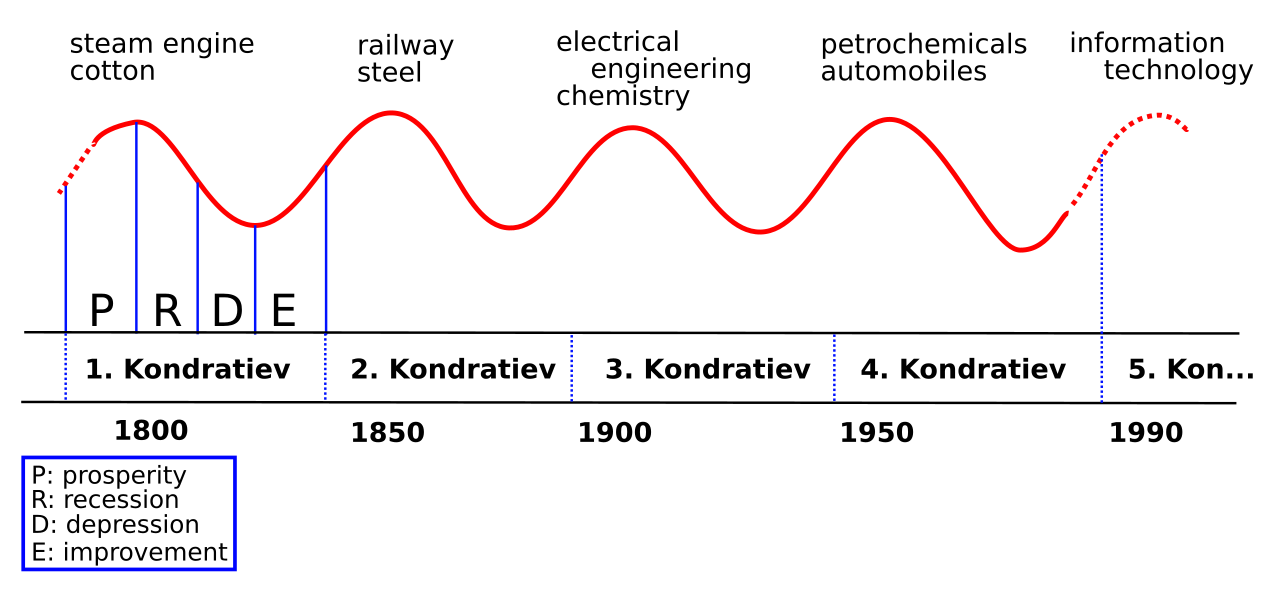
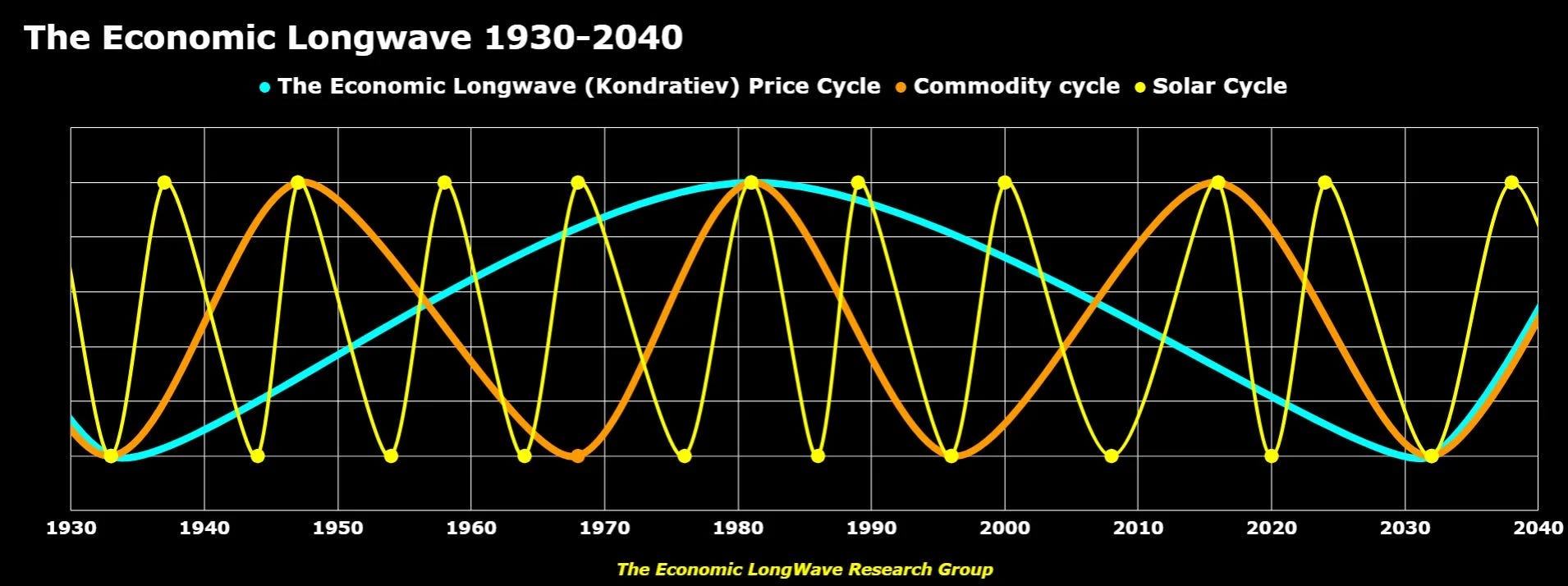
We’ve seen this pattern repeat for centuries. The industrial revolution. The age of railways and steel. The oil and automobile era. The information and telecommunications boom of the late 20th century.
And right now, we’re living through not just the collapse phase of the social media wave, but the replacement with an algorithmic internet.
The Internet’s 30-Year Swing
The early internet—Web 1.0—was radically decentralized. You built a personal website on Geocities or Angelfire. You hand-coded your HTML. You had a blogroll of sites you trusted. You used RSS feeds to follow people directly, without an algorithm deciding what you saw.If someone wanted to find your work, they came to your corner of the internet.
You owned it completely.
Then Web 2.0 arrived and promised us something seductive: convenience and reach without effort. You didn’t need to know code. You didn’t need to maintain your own infrastructure. Just post on the platform, build your following, and the people who followed you could easily keep up with your world. Facebook, Twitter, and Instagram seemingly made connection and distribution co-mingled and effortless.
So we made a trade. We gave up ownership for convenience. We gave up control for connection and scale. We built our entire online presence on basically on rented land.
Ahhh, there’s that smell of millennial optimism.
And for a while, it worked. Platforms were desperate for content and creators, so they made the deal attractive. They showed your posts to your followers. They rewarded authenticity and early adoption.
But then the platforms matured. They went public. They needed to monetize. The algorithm changed. Suddenly, your followers didn’t see your posts unless you paid for reach. Engagement became a shell game. The whole system started optimizing for the platform’s revenue and reach, not your relationship with your community.
Which brings us to now.
The Collapse Phase
Right now, we’re watching the social media paradigm collapse under its own weight. Not spectacularly—not all at once—but in the slow, grinding way that Kondratiev waves always collapse. Engagement is increasingly artificial. Followers don’t convert to anything real. The metrics that mattered five years ago are now essentially meaningless. People are realizing they’ve spent a decade building on someone else’s infrastructure, and they own none of it.So, when life happens as it always does; you end up penalized for not posting, disconnected from your community, and stuck holding rules of engagement that you never signed up for.
But, I noticed something interesting is happening.
Platforms like Digg are being relaunched by their original founders, explicitly trying to recapture the community-first, niche-driven internet of the 2000s. Personal websites are having a full renaissance. Substacks, Ghost blogs, and email lists are exploding. People are building RSS feeds and blogrolls again.
The tools are modern and polished but the philosophy is pure Web 1.0: own your space, control your distribution, build direct relationships.
This isn’t just nostalgia for the “good old days.” This is a structural correction. The 30-year cycle doing exactly what it always does: identifying an imbalance and swinging back toward equilibrium.
Here’s What I Think Comes Next
Web 1.0 gave us ownership but didn’t scale. You had complete control over your corner of the internet, but discovery was hard and growth was manual.Web 2.0 gave us scale but stole our sovereignty. You could reach millions, but you owned nothing and had no say in how the system worked.
What’s emerging now—let’s call it the real Web 3, not the crypto-bro version—is the synthesis. It’s the personality, control, and direct relationships of Web 1.0, rebuilt with the tools, polish, and distribution possibilities of Web 2.0.
You can have a beautiful, fast, easy-to-build personal website. You can have an email list that reaches people directly. You can have RSS feeds and discovery mechanisms that don’t require surveillance capitalism. You can build community spaces that you control, where the algorithm can’t reach.
And here’s the key insight that most people are missing: in a world where AI can generate anything, provenance becomes the premium.
It feels like we’re entering an era of a human generated internet.
One with authenticity.
This is not to say that I’m anti-AI and that there is no place for it.
It’s actually the opposite.
What gets people pissed about AI is the way that it’s currently being done. That it’s core is based off of exploitation and leveraging things like Creative Commons Licenses to scrape, remix, and train future AI’s without contribution or attribution.
We need to name the issue plainly instead of lumping our dissent into one big “I hate AI” bucket.
Because the truth is it can accelerate the creative process particularly for software development. My point of view comes from spending years in Silicon Valley, having some success there and within it’s structures, and seeing close up the power structures that decide what winning is and who gets to win.
This is why I think AI can be powerful if the right tools are used to create your own corner of the internet; be it a website, app, or tool.
The broader issue is attribution and authenticity.
Provenance in an AI World
Your website isn’t a digital business card. It’s proof of existence. It’s how people verify that you’re real, that your work is actually yours, that your ideas have a history, a context, and an origin source.When everything can be generated, remixed, and regurgitated by machines, the “who made this and why” becomes the only thing that matters. Your personal website becomes the source of truth that generative engines crawl. It’s your authentication infrastructure in an increasingly synthetic information environment.
And platforms? They don’t disappear. They just get relegated to their proper role: amplifiers and discovery channels that point back to something you actually own. Instagram, TikTok, LinkedIn—they become the spokes, not the hub. They drive attention, but your website is where the actual relationship happens, where the depth lives, where people come when they want the real thing.
The early internet is coming back as necessary infrastructure for an AI-saturated world.
What This Means for You
Much of the sour taste we have in our mouth for what these platforms have become lead to asking yourself “Should I leave the platform?”But I don’t think that’s the answer.
We should start asking: “What would I create if I knew this platform had one year left?”
That question changes everything because it’s not about abandoning reach or connection; it’s about building a real foundation underneath it. A personal site that’s actually yours. An email list that no algorithm can throttle. A space where you set the rules and own the relationship.
The people who built Myspace pages, LiveJournals, and personal blogs in the early 2000s looked inefficient at the time. They looked like they were doing too much work for too little reach. But they were the only ones who still had their archives, their audiences, and their autonomy when the platforms changed the rules or shut down entirely.
History doesn’t repeat itself, but it does rhymes.
And right now, it’s rhyming so hard it’s basically rapping.
The 30-year pendulum is swinging back. Some people will see it early and build accordingly. Most won’t. At least not until the platform they spent a decade building on changes the algorithm overnight or disappears entirely.
We’re watching this pattern unfold in real time. The question isn’t whether the cycle will complete because frankly it always does.
The question is: are you building the hub, or are you still renting the spoke?
If you like what I’m doing here check out my new series called Thinking in Public
on YouTube and consider giving me a subscribe!


