
You are using an out of date browser. It may not display this or other websites correctly.
You should upgrade or use an alternative browser.
You should upgrade or use an alternative browser.
Weatherman Claims Japanese Mafia Behind Hurricane Katrina. WTF?
- Thread starter domex
- Start date


This is bullshit. Most truly enlightened black people know it was the American government that manipulated Katrina to once again disenfranchise blacks. :d
domex said:Ok i know whats the deal with American Goverment, but is this type of technology real or not?
Bruh, I was was being sarcastic. Many have tried several means to control the weather, with no sucess. We cannot even track a storm the size of texas with any long term accuracy. If you could control the weather, wouldn't you use it to control yours first? The Japanese have just as many problems with tropical storms as the US does.

Man I think the technology to manipulate wheater is readily available. Shit when I was in the 10th grade we created a cloud in chemistry class. I know they can seed clouds to create rain. Just because the majority of Americans have no idea how the weather works doesn't mean that the powers that be don't.
Underwater explosion = Tsunami
Underground Explosion = Earthquake
Saying that Its possible doesn't mean I necessarily believed thats the way it happened. I am just saying we should not be so quick to label something impossible when in reality we have no idea if its possible or not.
Underwater explosion = Tsunami
Underground Explosion = Earthquake
Saying that Its possible doesn't mean I necessarily believed thats the way it happened. I am just saying we should not be so quick to label something impossible when in reality we have no idea if its possible or not.

there is no hurricane machine... I swear, people need to pay more attention in science class instead of avioding being called a "nerd". There would be a 2000% decrease in the number of conspiracy theories right now, cause most of them are based on misunderstanding of science and technology.
vitrifier said:there is no hurricane machine... I swear, people need to pay more attention in science class instead of avioding being called a "nerd". There would be a 2000% decrease in the number of conspiracy theories right now, cause most of them are based on misunderstanding of science and technology.
Please enlighten me and I am sure many others on the scientific reason why a huricane can not be created by man.
Temujin said:Please enlighten me and I am sure many others on the scientific reason why a huricane can not be created by man.
You should prove that is can. Your comment is very typical of conspiricy theorists. Make a fantastic claim, then expect others to disprove the negative.
Fuckallyall said:You should prove that is can. Your comment is very typical of conspiricy theorists. Make a fantastic claim, then expect others to disprove the negative.
Come on all ya'll are saying its impossible to create a hurricane. Given our level of technology to me that is an outragous claim. I say that it is possible. I have no idea if someone has a weather manipulation machine or not. I just say it is possible. If you can't prove its impossible how can you eliminate the possibility from your mind. Thats illogical. Why.
1. HAARP
http://www.haarp.alaska.edu/
HAARP stands for The High Frequency Active Auroral Research Program. The goal of this program is to further advance our knowledge of the physical and electrical properties of the Earth's ionosphere which can affect our military and civilian communication and navigation systems. The HAARP ionospheric research observatory in Gakona will be used for these studies.
HAARP is a joint venture with the U.S. Airforce and Navy. HAARP actively conducts experiments on the Ionosphere including manipulation of the ionosphere.
For those who don't know what the ionosphere is it is the part of our atmosphere that is ionized by the electromagnetic rays of the sun. The ionization of our atmosphere provides the catalyst for electric storms.
Without explicitly referring to the HAARP program, a US Air Force study points to the use of "induced ionospheric modifications" as a means of altering weather patterns as well as disrupting enemy communications and radar.
Dr. Rosalie Bertell depicts HAARP as "a gigantic heater that can cause major disruption in the ionosphere, creating not just holes, but long incisions in the protective layer that keeps deadly radiation from bombarding the planet."
2. Former Secretary of defense Cohen said it.
Others are engaging even in an eco-type of terrorism whereby they can alter the climate, set off earthquakes, volcanoes remotely through the use of electromagnetic waves. So there are plenty of ingenious minds out there that are at work finding ways in which they can wreak terror upon other nations.It's real, and that's the reason why we have to intensify our efforts, and that's why this is so important."
[Secretary of Defense William Cohen at an April 1997 counterterrorism conference sponsored by former Senator Sam Nunn. Quoted from DoD News Briefing, Secretary of Defense William S. Cohen, Q&A at the Conference on Terrorism, Weapons of Mass Destruction, and U.S. Strategy, University of Georgia , Athens , Apr. 28, 1997].
3.
http://www.indiadaily.com/editorial/2070.asp
Another article written in march describing the move to climate manipulation.
It is clear that man affects weather. Global warming is well documented. If we know how we affect weather over a long period of time then we can figure out how to affect it over a short period of time. I don't believe anything is scientifically impossible given time and the human mind we have proved on several occaisions that the impossible is very possible.
Also I am not a conspiracy theorist. I have no idea if Katrina was man made and honestly I strongly believe that it wasn't. I however recognize that it is possible that it was man-made and unless we open that up as a possibility we will never truly know.
Not true. While has been an increase in CO2, no theory regarding global warming has yet been proven accurate. For example, New York city has warmed up, but Albany has cooled. Many glaciers have shrunk, but the Polar icecaps are thickening. None of the predicted calamities, such as a greater frequency in storms, drought or disruption of the thermo-haline conduction (the salt water flow that was mentioned in the movie The Day After Tomorrow) has occured. There have been no unexpected large weather systems, period. Even the damage from Katrina that we will remember the longest had very little to do with the storm itself, but the failure of the Levees which displaced all of those people.It is clear that man affects weather. Global warming is well documented.
Also, the articles you mentioned talked about all the thigs they wanterd to do, not what actually was occuring. The one thing which has been developed, the particle beam, is very small, and is used on electrical systems, not atmospheres, which have quantum differences.
B
BahMegaBro
Guest
I'm just constantly amazed at the amount of eloquent bullshit supposedly intelligent people spend time and money thinking about and documenting.....
maybe its true...for argument sake.......but if it is......
1. Where did Russia go...since it had/has this "SUPER WEAPON".....or did the US develop an Anti-weather Machine.
2. Why did they not use it stop the US from orchestrating their demise....can't imagine what I would use to fight wind and rain.
3. What can we now expect Bush to do?... send a killer tornado guided by some joystick?
4. Why doesn't someone create a storm cloud over Ethiopia and some of the other Sub Saharan countries in Africa?...
5. Anyway....before I piss them off...... to the muthafukka that's controlling that joystick over on the other side of the globe..... keep ya hand steady patna.... 'cause we een do you nuttin....
maybe its true...for argument sake.......but if it is......
1. Where did Russia go...since it had/has this "SUPER WEAPON".....or did the US develop an Anti-weather Machine.
2. Why did they not use it stop the US from orchestrating their demise....can't imagine what I would use to fight wind and rain.
3. What can we now expect Bush to do?... send a killer tornado guided by some joystick?
4. Why doesn't someone create a storm cloud over Ethiopia and some of the other Sub Saharan countries in Africa?...
5. Anyway....before I piss them off...... to the muthafukka that's controlling that joystick over on the other side of the globe..... keep ya hand steady patna.... 'cause we een do you nuttin....
vitrifier said:I am not convinced that there is any possiblity that a hurricane could be man made, or even man-seeded (to make it more powerful).
Researchers have been seeding clouds to increase rainfall since 1942.
http://abcnews.go.com/Technology/story?id=98859&page=1
http://www.nawcinc.com/wmfaq.html
http://water.utah.gov/cloudseeding/
http://www.dar.csiro.au/publications/holper_2001c.htm
Even though you don't want to believe it weather manipulation has been studied for centuries. Not to cause disasters but to prevent them. You guys got to look at the flip side if we can create a hurricane we can stop it. If we can increase its intensity we can lessen its intensity. If researches did not think this was scientifically possible they would not be researching.
People didn't believe in the atomic bomb until hiroshima.

Okay even if they werent able to make the hurricane stronger... Someone in Stuart, Florida invented a foam which can be dropped on top storm clouds and weaken the system. the result is a rain foam that is biodegradable. This was tested to be proven effective against a major hurricane. he demonstated many times on telivision news in flarida to publicise it and developed the product...Do you know the gubment & their contrators bought the license or rights or pending patent and said it is unsafe to use. Basic b.s.
So to say they're making the wheather worst and not trying to fix is very accurate.
How many ever seen Avengers? The one on HBO and the old school TV show from the 60's staring roger moore? In the lobby of his house on the show was there not a large painting of a strange character riding a pale white horse? behold on the HBO ep was not Sean connery's characters name Sir August de Winter and was not he intend on controlling the wheather.
Many in our case it is not immediate global dominition, but just for the purpose of gentrification around the coast. All coastal states have this Community Redevelopment Agency- and there job is 'CRA director who would oversee coastal development'
Its not about conspiracies, its about the fact republicans have always been linked to the luminaty and always hell bent on making life for normal people harder. And since Assimiliating with the masons many, many years ago.. we might as well ignore this in the future and just think God controls everything and everything is in his hands. get the fuck outa here with that ugbllshit...There are predators and those who are preyed upon. Maybe some of you are a part of those and those secrets handshakes have enabled you to think you are doin good for some ultimate goal- wrong. Ya'll just keep on killing our saviors and wonder why history kep repeating.
May the highest Blessings be all yours.
So to say they're making the wheather worst and not trying to fix is very accurate.
How many ever seen Avengers? The one on HBO and the old school TV show from the 60's staring roger moore? In the lobby of his house on the show was there not a large painting of a strange character riding a pale white horse? behold on the HBO ep was not Sean connery's characters name Sir August de Winter and was not he intend on controlling the wheather.
Many in our case it is not immediate global dominition, but just for the purpose of gentrification around the coast. All coastal states have this Community Redevelopment Agency- and there job is 'CRA director who would oversee coastal development'
Its not about conspiracies, its about the fact republicans have always been linked to the luminaty and always hell bent on making life for normal people harder. And since Assimiliating with the masons many, many years ago.. we might as well ignore this in the future and just think God controls everything and everything is in his hands. get the fuck outa here with that ugbllshit...There are predators and those who are preyed upon. Maybe some of you are a part of those and those secrets handshakes have enabled you to think you are doin good for some ultimate goal- wrong. Ya'll just keep on killing our saviors and wonder why history kep repeating.
May the highest Blessings be all yours.
Noodlez said:Okay even if they werent able to make the hurricane stronger... Someone in Stuart, Florida invented a foam which can be dropped on top storm clouds and weaken the system. the result is a rain foam that is biodegradable. This was tested to be proven effective against a major hurricane. he demonstated many times on telivision news in flarida to publicise it and developed the product...Do you know the gubment & their contrators bought the license or rights or pending patent and said it is unsafe to use. Basic b.s.
So to say they're making the wheather worst and not trying to fix is very accurate.
How many ever seen Avengers? The one on HBO and the old school TV show from the 60's staring roger moore? In the lobby of his house on the show was there not a large painting of a strange character riding a pale white horse? behold on the HBO ep was not Sean connery's characters name Sir August de Winter and was not he intend on controlling the wheather.
Many in our case it is not immediate global dominition, but just for the purpose of gentrification around the coast. All coastal states have this Community Redevelopment Agency- and there job is 'CRA director who would oversee coastal development'
Its not about conspiracies, its about the fact republicans have always been linked to the luminaty and always hell bent on making life for normal people harder. And since Assimiliating with the masons many, many years ago.. we might as well ignore this in the future and just think God controls everything and everything is in his hands. get the fuck outa here with that ugbllshit...There are predators and those who are preyed upon. Maybe some of you are a part of those and those secrets handshakes have enabled you to think you are doin good for some ultimate goal- wrong. Ya'll just keep on killing our saviors and wonder why history kep repeating.
May the highest Blessings be all yours.
I disagree, It is all about conspiracies with folks with your thought pattern who only use part of a transaction and then base an entire theory on it.
Here goes:
1. The guy who was developing foam did not prove that he could drain a hurricane with his foam because he could not make enough of it to test. Also, the accepted philosophy dictates that the LAST thing you would want to do is weaken a hurricane, as hurricanes dissipates the heat that builds up in the tropics.
2. The Avengers was fiction, man. We do not have warp drives or transporter beams yet either.
3. As i said before, if they wanted to gentrify, they would do so. They have done it in several metropolitan areas already, such as parts of NY, NJ, MD & Il.
4. Also, the "Illuminati" do not really exist any more, and when they did, they were just a bunch of rich guys trying to get richer. And domination does not have a party. John Kerry is much richer than George Bush.
It's always good to embellish things to make them seem more mysterious and interesting, but I've found out that the drugery that constitutes reality is far more engaging.
And it's a good touch to demonize those who don't agree with you, becasue they don't agree with you.
Peace.
Last edited:
Hate to be a dick QueEx, but that website is full of shit, lol. Basically they're saying fish oil has been used to calm the waters, so why not use it to calm hurricanes. Good idea, but not scientifically sound enough to try it. Plus, notice that there are no real details, and the references section is left out??
There is some truth to fish oil calming waves. Certain oils are amphiphilic (each molecule has an oily and a polar part) and act as surfactants (or surface actants). An example, soap, has an oily part that catches grime, while the polar part keeps it suspended in water so it rinses off. Sailors since the ancient days used fish oil to control waves near the boat, the fish oil reduces the surface tension of the ocean, and basically acts kinda like a lubricant between the wind and the ocean surface. So, the wind drags the water surface less, and the waves at the surface are smaller. This also makes it so the wind speed near the surface of the water is nearly unchanged (no drag), so the surface wind speed is near that of the high altitude wind speed. The change in wind speed per unit height is called wind shear, so when there is a large change in wind speed with height, there's high wind shear, and when there's no change in wind speed with height, there's no wind shear.
However, that being said, the change in wind shear as a result of putting surfactant on the ocean surface is probably not enough to cause a hurricane, but it won't stop one or even slow it down.
Hurricanes form when there is a low shear condition. So reducing the wind drag at the surface won't help keep hurricanes from forming.
http://ww2010.atmos.uiuc.edu/(Gh)/guides/mtr/hurr/grow/home.rxml
Ultimately, its the wind speed and direction, and the formation of a low pressure area with circulating winds that is the cause. The warm water from the ocean loses energy by evaporating water, which rises, making thunderclouds, which eventually return the water via precipication when the humid air has cooled. You can probably think of it as a circular low to high then high to low recirculation.
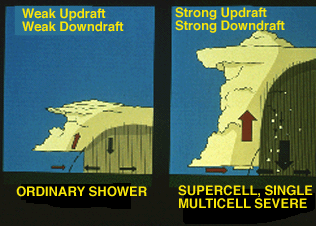
Basically, when a few thunderclouds come near each other, and the low pressure regions come into contact, the storm gets bigger. When there's a situation where the uplifting hot humid air is rising, and it's surrounded by the downfalling precipitation, that's a tropical depression. As the tropical depression gets stronger, the winds from the outer (down) regions to the inner (up) region at the water surface, instead of going directly to the center, they start twisting (it's related to what is called a Coriolis effect, which is related to the earth's rotation, but my professor says that it has not been established that the Coriolis effect is strong enough to do anything).
So now, there is a storm, with winds that are rotating, a core that has rising warm humid air, surrounded by rotating thunderstorm, and feeds on warm ocean water, gaining energy with the heat energy from the water and changing it into mechanical energy in wind. The stronger it gets, the bigger the hurricane. It slows down when it hits cooler water.
So, to create a Hurricane, you basically have to be able to heat the ocean several degrees (the energy to do so would be extraordinary) and then get some thunderstorms to come together to form a depression. Steering a hurricane, you would need to be able to control the atmospheric winds on the ocean, and it will take more than some fans to do that. Again, you would have to find a way to heat one area several degrees more than another area, big areas, too.
To stop a hurricane, someone came up with the idea of cooling down the eye to reduce the energy going into the storm. It has been inconclusive whether this works or not. Plus, since that energy is still there, and has not been dissipated, a future storm will form. I guess the aim is to keep hurricanes from forming, but allow tropical storms and thunderstorms.
http://hurricaneville.com/project_stormfury.html
Additionally, in order to seed a storm, that storm has to already be forming. You can't create a thundercloud, but (they say) you can seed a cloud to make it rain more, or earlier.
http://www.nawcinc.com/wmfaq.html
http://www.usatoday.com/weather/resources/askjack/wfaqhurm.htm
FAQ: Attempts to weaken, destroy hurricanes
Answers by Jack Williams, USATODAY.com weather editor.
Q: Why don't they destroy or weaken hurricanes when they threaten land?
A: The basic problem is the size and intensity of hurricanes. They cover tens of thousands of square miles even when they are just beginning. They draw their energy from air over hundreds of thousands of square miles of ocean. Cooling the water over this large area or finding a way to prevent evaporation of water would reduce hurricanes' strength. But, all of the dry ice in the world would be quickly absorbed in a small part of the ocean near a hurricane. Also, the hurricane would quickly move away from the cooled water or water covered with something to prevent evaporation.
The National Hurricane Center notes that a hurricane releases heat energy at a rate of 50 trillion to 200 trillion watts. (trillion here is used in the U.S. and French sense: a number followed by 12 zeros) This is the equivalent of a 10-megaton nuclear bomb exploding about every 20 minutes.
Q: I saw a report on television about someone who had a substance that could be dropped into clouds and absorb water. They did an experiment where they dropped some on clouds off Florida and the clouds dissipated. The television reporter said this could be used to weaken hurricanes. Why isn't this done?
A: I've seen this report a couple of times, and both times I've been tempted to call the TV reporters and producers involved and offer them a good deal on a bridge in Brooklyn, N.Y. All reporters can't be expected to know a lot about everything they report, but they do owe it to their readers and viewers to find out what they don't know. A phone call to someone who knows about hurricanes, could have shown the problems with this idea.
The best discussion I've seen on this is in the FAQ on hurricanes on the NOAA Hurricane Research division Web site. If you go to the HRD's answer to this question, you'll see the idea has several problems, beginning with the claim that it caused clouds to dissipate. When I saw this I recalled something that a scientist who studies clouds told me several years ago, "You can make clouds go away by watching them." In other words, small cumulus clouds like those used in the "experiment' normally don't last very long. On a day when some of them will grow into thunderstorms, it's impossible to select the one that will grow since most of the clouds will quickly go away.
Q: Wouldn't a huge bomb weaken a hurricane? If they are worried about radioactivity, they could use powerful fuel-oil bombs.
A: A bomb or bombs would be a dead end since the amount of energy a hurricane is releasing and the size of its circulation would make any bomb, including the largest nuclear bomb, seem more futile than trying to stop a charging elephant by throwing a ping-pong ball at it. As noted above, hurricanes release tremendous amounts of heat energy. In fact, since hurricanes are "heat engines" that depend on the temperature contrast between warmth at the ocean surface and cold air aloft, we could wonder whether the heat from any kind of bomb would actually add to the storm's natural heat supply, making the storm stronger. Trying to heat the upper atmosphere with bombs, to lessen the heat contrast, would be like trying to heat the city of Minneapolis in January by opening the windows of a house.
Until recent years, many people suggested using nuclear bombs. But, doing that would create a hurricane with the danger of radioactivity as well as wind and storm surge.
Q: What happened to the idea of seeding hurricanes to weaken them?
A: During the 1960s the U.S. Navy and the National Oceanic and Atmospheric Administration (NOAA) tried a more sophisticated way of making hurricanes weaker. This research was known as Project Stormfurry. The basic idea was to seed clouds just outside the eye wall with silver iodide. The silver iodide, which is widely used in cloud seeding, encourages supercooled water - water that's colder than 32 degrees F but is liquid, not ice - to freeze. This releases latent heat, which would make the clouds grow, stealing some of the humid air that's helping the eye wall clouds grow and create strong winds.
This seemed to work with Hurricane Beulah in 1963 and Hurricane Debbie in 1969. But, scientists had no way of knowing whether these two storms would have weakened any way at that time. Hurricanes often weaken and then regain strength naturally. Also, since the 1980s researchers have found that most hurricanes don't have enough supercooled water for seeding to work.
Concerns were also raised that the experiments could make a storm change course, hitting some place that it otherwise wouldn't. The experiments did increase hurricane knowledge and also led to the purchase of the two WP-3 airplanes that NOAA still uses for hurricane research and tracking.
Bob Sheets, the retired director of the National Hurricane Center, and I have an entire chapter on Project Stormfury in our book, Hurricane Watch: Forecasting the Deadliest Storms on Earth. Bob was the last director of Stormfury.
There is some truth to fish oil calming waves. Certain oils are amphiphilic (each molecule has an oily and a polar part) and act as surfactants (or surface actants). An example, soap, has an oily part that catches grime, while the polar part keeps it suspended in water so it rinses off. Sailors since the ancient days used fish oil to control waves near the boat, the fish oil reduces the surface tension of the ocean, and basically acts kinda like a lubricant between the wind and the ocean surface. So, the wind drags the water surface less, and the waves at the surface are smaller. This also makes it so the wind speed near the surface of the water is nearly unchanged (no drag), so the surface wind speed is near that of the high altitude wind speed. The change in wind speed per unit height is called wind shear, so when there is a large change in wind speed with height, there's high wind shear, and when there's no change in wind speed with height, there's no wind shear.
However, that being said, the change in wind shear as a result of putting surfactant on the ocean surface is probably not enough to cause a hurricane, but it won't stop one or even slow it down.
Hurricanes form when there is a low shear condition. So reducing the wind drag at the surface won't help keep hurricanes from forming.
http://ww2010.atmos.uiuc.edu/(Gh)/guides/mtr/hurr/grow/home.rxml
Ultimately, its the wind speed and direction, and the formation of a low pressure area with circulating winds that is the cause. The warm water from the ocean loses energy by evaporating water, which rises, making thunderclouds, which eventually return the water via precipication when the humid air has cooled. You can probably think of it as a circular low to high then high to low recirculation.
Basically, when a few thunderclouds come near each other, and the low pressure regions come into contact, the storm gets bigger. When there's a situation where the uplifting hot humid air is rising, and it's surrounded by the downfalling precipitation, that's a tropical depression. As the tropical depression gets stronger, the winds from the outer (down) regions to the inner (up) region at the water surface, instead of going directly to the center, they start twisting (it's related to what is called a Coriolis effect, which is related to the earth's rotation, but my professor says that it has not been established that the Coriolis effect is strong enough to do anything).
So now, there is a storm, with winds that are rotating, a core that has rising warm humid air, surrounded by rotating thunderstorm, and feeds on warm ocean water, gaining energy with the heat energy from the water and changing it into mechanical energy in wind. The stronger it gets, the bigger the hurricane. It slows down when it hits cooler water.
So, to create a Hurricane, you basically have to be able to heat the ocean several degrees (the energy to do so would be extraordinary) and then get some thunderstorms to come together to form a depression. Steering a hurricane, you would need to be able to control the atmospheric winds on the ocean, and it will take more than some fans to do that. Again, you would have to find a way to heat one area several degrees more than another area, big areas, too.
To stop a hurricane, someone came up with the idea of cooling down the eye to reduce the energy going into the storm. It has been inconclusive whether this works or not. Plus, since that energy is still there, and has not been dissipated, a future storm will form. I guess the aim is to keep hurricanes from forming, but allow tropical storms and thunderstorms.
http://hurricaneville.com/project_stormfury.html
Additionally, in order to seed a storm, that storm has to already be forming. You can't create a thundercloud, but (they say) you can seed a cloud to make it rain more, or earlier.
http://www.nawcinc.com/wmfaq.html
http://www.usatoday.com/weather/resources/askjack/wfaqhurm.htm
FAQ: Attempts to weaken, destroy hurricanes
Answers by Jack Williams, USATODAY.com weather editor.
Q: Why don't they destroy or weaken hurricanes when they threaten land?
A: The basic problem is the size and intensity of hurricanes. They cover tens of thousands of square miles even when they are just beginning. They draw their energy from air over hundreds of thousands of square miles of ocean. Cooling the water over this large area or finding a way to prevent evaporation of water would reduce hurricanes' strength. But, all of the dry ice in the world would be quickly absorbed in a small part of the ocean near a hurricane. Also, the hurricane would quickly move away from the cooled water or water covered with something to prevent evaporation.
The National Hurricane Center notes that a hurricane releases heat energy at a rate of 50 trillion to 200 trillion watts. (trillion here is used in the U.S. and French sense: a number followed by 12 zeros) This is the equivalent of a 10-megaton nuclear bomb exploding about every 20 minutes.
Q: I saw a report on television about someone who had a substance that could be dropped into clouds and absorb water. They did an experiment where they dropped some on clouds off Florida and the clouds dissipated. The television reporter said this could be used to weaken hurricanes. Why isn't this done?
A: I've seen this report a couple of times, and both times I've been tempted to call the TV reporters and producers involved and offer them a good deal on a bridge in Brooklyn, N.Y. All reporters can't be expected to know a lot about everything they report, but they do owe it to their readers and viewers to find out what they don't know. A phone call to someone who knows about hurricanes, could have shown the problems with this idea.
The best discussion I've seen on this is in the FAQ on hurricanes on the NOAA Hurricane Research division Web site. If you go to the HRD's answer to this question, you'll see the idea has several problems, beginning with the claim that it caused clouds to dissipate. When I saw this I recalled something that a scientist who studies clouds told me several years ago, "You can make clouds go away by watching them." In other words, small cumulus clouds like those used in the "experiment' normally don't last very long. On a day when some of them will grow into thunderstorms, it's impossible to select the one that will grow since most of the clouds will quickly go away.
Q: Wouldn't a huge bomb weaken a hurricane? If they are worried about radioactivity, they could use powerful fuel-oil bombs.
A: A bomb or bombs would be a dead end since the amount of energy a hurricane is releasing and the size of its circulation would make any bomb, including the largest nuclear bomb, seem more futile than trying to stop a charging elephant by throwing a ping-pong ball at it. As noted above, hurricanes release tremendous amounts of heat energy. In fact, since hurricanes are "heat engines" that depend on the temperature contrast between warmth at the ocean surface and cold air aloft, we could wonder whether the heat from any kind of bomb would actually add to the storm's natural heat supply, making the storm stronger. Trying to heat the upper atmosphere with bombs, to lessen the heat contrast, would be like trying to heat the city of Minneapolis in January by opening the windows of a house.
Until recent years, many people suggested using nuclear bombs. But, doing that would create a hurricane with the danger of radioactivity as well as wind and storm surge.
Q: What happened to the idea of seeding hurricanes to weaken them?
A: During the 1960s the U.S. Navy and the National Oceanic and Atmospheric Administration (NOAA) tried a more sophisticated way of making hurricanes weaker. This research was known as Project Stormfurry. The basic idea was to seed clouds just outside the eye wall with silver iodide. The silver iodide, which is widely used in cloud seeding, encourages supercooled water - water that's colder than 32 degrees F but is liquid, not ice - to freeze. This releases latent heat, which would make the clouds grow, stealing some of the humid air that's helping the eye wall clouds grow and create strong winds.
This seemed to work with Hurricane Beulah in 1963 and Hurricane Debbie in 1969. But, scientists had no way of knowing whether these two storms would have weakened any way at that time. Hurricanes often weaken and then regain strength naturally. Also, since the 1980s researchers have found that most hurricanes don't have enough supercooled water for seeding to work.
Concerns were also raised that the experiments could make a storm change course, hitting some place that it otherwise wouldn't. The experiments did increase hurricane knowledge and also led to the purchase of the two WP-3 airplanes that NOAA still uses for hurricane research and tracking.
Bob Sheets, the retired director of the National Hurricane Center, and I have an entire chapter on Project Stormfury in our book, Hurricane Watch: Forecasting the Deadliest Storms on Earth. Bob was the last director of Stormfury.

This theory was completely debunked by myself and another poster. This isn't even remotely possible. Please read this thread:
http://64.255.174.200/board/showthread.php?t=57017
http://64.255.174.200/board/showthread.php?t=57017

LOL. I didn't post it for the truth of the matters asserted; however, it seemed to fit well with the rest of discussion. lmaoVitrifier said:Hate to be a dick QueEx, but that website is full of shit, lol.
QueEx
vitrifier said:there is no hurricane machine... I swear, people need to pay more attention in science class instead of avioding being called a "nerd". There would be a 2000% decrease in the number of conspiracy theories right now, cause most of them are based on misunderstanding of science and technology.
Seriously man. I debunked the theory here:http://64.255.174.200/board/showthread.php?t=57017
We are closer to putting a man on Mars than creating hurricanes. Putting a man on the moon is linear evolutionary progress based on appliable knowledge and science. Creating a disaster level catostrophic weather event is revolutionary and an impossible based on available knowledge and all scientific theory involving weather. We don't even understand hurricanes that well. That will be the equivalent of doing full cloning with no outside cells with NO working knowledge of DNA..with no genome sequence. It's not possible. It's really a ridiculous claim
Man can not comntrol the weather,we do not have the technolgy to make them or break them up,only god can ,end of story.SSHHHHHHHHHHHiiiishhhhh Some of the shit people post on this board is absurd.
Umm HAARP has been used to alter the atmosphere many times and its a PUBLICLY known research facility.
Then people have the nerve to say man doesn't have the technology to do this or that, only god can etc.Temujin posted links to PUBLICLY known US government research on this topic.Please get familiar with it before saying what man can't do.
Then people have the nerve to say man doesn't have the technology to do this or that, only god can etc.Temujin posted links to PUBLICLY known US government research on this topic.Please get familiar with it before saying what man can't do.
Turri said:Umm HAARP has been used to alter the atmosphere many times and its a PUBLICLY known research facility.
Then people have the nerve to say man doesn't have the technology to do this or that, only god can etc.Temujin posted links to PUBLICLY known US government research on this topic.Please get familiar with it before saying what man can't do.
Please read the thread that I posted in the previous post. It explained the weak evidence of the "government research" and explained exactly what were working on.
I searched for haarp through a thread 4 pages deep.But the signal to noise ratio is low so I might have missed some insightful comments.But those I did read didn't address what haarp's head director said or Dr. Bernard Eastlund said.
Eastland said haarp was a defensive military research facility but now is also used for offensive "research".Haarp's director agreed but didn't elaborate on offensive tests but said basically, we do as we're told it's not up to us to make policy we do what the military says.
Those interviews are in "Haarp Holes in Heaven" documentary.
I have a highly compressed version of it.If folks want it i'll post the video.
I don't have the time to check now.Could someone post a link that has a chart showing all countries that have radio antenna arrays similar to harrp.
Thanks
eewwll I didn't say Haarp caused katrina or any other hurricane.I'm basically saying the public doesn't know what the government is up to and they never will if they think some technology is beyond or means.Or think governments research is always altruistic.
Eastland said haarp was a defensive military research facility but now is also used for offensive "research".Haarp's director agreed but didn't elaborate on offensive tests but said basically, we do as we're told it's not up to us to make policy we do what the military says.
Those interviews are in "Haarp Holes in Heaven" documentary.
I have a highly compressed version of it.If folks want it i'll post the video.
I don't have the time to check now.Could someone post a link that has a chart showing all countries that have radio antenna arrays similar to harrp.
Thanks
eewwll I didn't say Haarp caused katrina or any other hurricane.I'm basically saying the public doesn't know what the government is up to and they never will if they think some technology is beyond or means.Or think governments research is always altruistic.
Never said government research is ever altruistic. My point was that with all available scientific data it isn't possible. Until some scientest(and if you think the best scientists in the world work in the public sector you are wrong) produces a theory or working scientific evidence that is heavily scrutinized by his peers, It is all hearsay...and not even a plausible one.
But I agree that government agencies are known to be manipulative, etc...some of the documentation that comes into the public realm after being declassified is alarming at times. However, if you want to see real innovation, go the private sector. That's were goverment agencies do most of their puchasing anyway. For instance, do you think our best spy and anti spy equipment comes from the U.S. government? No, there are often bought from private firms and then modified..or especially from Israeli firms that specialize in the sector. Government research rarely produces remarkable innovation. Look at all the billions thrown at NASA which is an acknowledged failure given the amount of resources provided to it. Ironically, even this sector is now beginning to be populated by private companies: private space exploration is beginning to be commercialized. But that is another argument altogether.
My point is that. I just want to see some solid evidence and the proponents have yet to provide it. I haven't fallen in love with position, but I'm not going to leave it until someone provides some substantical evidence.
Post that video though or send me the link. Thanks man
But I agree that government agencies are known to be manipulative, etc...some of the documentation that comes into the public realm after being declassified is alarming at times. However, if you want to see real innovation, go the private sector. That's were goverment agencies do most of their puchasing anyway. For instance, do you think our best spy and anti spy equipment comes from the U.S. government? No, there are often bought from private firms and then modified..or especially from Israeli firms that specialize in the sector. Government research rarely produces remarkable innovation. Look at all the billions thrown at NASA which is an acknowledged failure given the amount of resources provided to it. Ironically, even this sector is now beginning to be populated by private companies: private space exploration is beginning to be commercialized. But that is another argument altogether.
My point is that. I just want to see some solid evidence and the proponents have yet to provide it. I haven't fallen in love with position, but I'm not going to leave it until someone provides some substantical evidence.
Post that video though or send me the link. Thanks man
Last edited:
Turri said:Umm HAARP has been used to alter the atmosphere many times and its a PUBLICLY known research facility.
Then people have the nerve to say man doesn't have the technology to do this or that, only god can etc.Temujin posted links to PUBLICLY known US government research on this topic.Please get familiar with it before saying what man can't do.
You been watching to much si-fi and reading to many conspiracy theroies,man can not control the weather.scientests have explored all the shit and have come to the conclusion it cant be done.Get out side and enjoy life.
Ok here is the link for Haarp Holes in heaven.
If some one has a better quality version please post it.
http://s52.yousendit.com/d.aspx?id=0ULT0GROX45524EGY69EDCAOT
I plan on watching it again when I get some free time this week.
If some one has a better quality version please post it.
http://s52.yousendit.com/d.aspx?id=0ULT0GROX45524EGY69EDCAOT
I plan on watching it again when I get some free time this week.
Turri said:Ok here is the link for Haarp Holes in heaven.
If some one has a better quality version please post it.
http://s52.yousendit.com/d.aspx?id=0ULT0GROX45524EGY69EDCAOT
I plan on watching it again when I get some free time this week.
Thanks I will check this out this weekend too. Good drop.
thanksTurri said:Ok here is the link for Haarp Holes in heaven.
If some one has a better quality version please post it.
http://s52.yousendit.com/d.aspx?id=0ULT0GROX45524EGY69EDCAOT
I plan on watching it again when I get some free time this week.
I was going to post some more videos via yousendit but it's too slow.So I put up a little page http://www.turrican2.com/ that has 2 videos so far. A episode of horizon from january of this year about Global Dimming & The Fluoride Deception,which is about the government/corporations paying off top scientists to convince the public that fluoride is good for you.
I would like to post the Great War series for the military buffs out there if bandwith allows it.http://www.bbcfactual.co.uk/the_great_war.htm
The best place I know of to find science,international news,documentaries,lectures etc. is.
alt.binaries.documentaries/
alt.binaries.multimedia.documentaries/
If you find the usenet daunting sign up with newzbin.com almost the whole usenet indexed and easy to search.
I would like to post the Great War series for the military buffs out there if bandwith allows it.http://www.bbcfactual.co.uk/the_great_war.htm
The best place I know of to find science,international news,documentaries,lectures etc. is.
alt.binaries.documentaries/
alt.binaries.multimedia.documentaries/
If you find the usenet daunting sign up with newzbin.com almost the whole usenet indexed and easy to search.
Turri said:I was going to post some more videos via yousendit but it's too slow.So I put up a little page http://www.turrican2.com/ that has 2 videos so far. A episode of horizon from january of this year about Global Dimming & The Fluoride Deception,which is about the government/corporations paying off top scientists to convince the public that fluoride is good for you.
I would like to post the Great War series for the military buffs out there if bandwith allows it.http://www.bbcfactual.co.uk/the_great_war.htm
The best place I know of to find science,international news,documentaries,lectures etc. is.
alt.binaries.documentaries/
alt.binaries.multimedia.documentaries/
If you find the usenet daunting sign up with newzbin.com almost the whole usenet indexed and easy to search.
I'll admit that I haven't read up on the flouride debate as much as I would like to, but what I have read was really damn alarming. Thanks for the posts.
The fluoride debacle is quite alarming but so was DDT,asbestos heck even cigarettes,by big money using scientists to confuse the public.
I don't want to threadcrap, but your credit post eewwll reminded me of the frontline episode called the secret history of credit cards http://www.pbs.org/wgbh/pages/frontline/shows/credit/
I'll post the video later tonight.
I don't want to threadcrap, but your credit post eewwll reminded me of the frontline episode called the secret history of credit cards http://www.pbs.org/wgbh/pages/frontline/shows/credit/
I'll post the video later tonight.
Similar threads

- Replies
- 5
- Views
- 192

- Replies
- 0
- Views
- 265
- Replies
- 4
- Views
- 171

