WEALTH INEQUALITY IN AMERICA- {Great Documentary by Al Jazeera English}

muckraker10021

Superstar *****
BGOL Investor
Wealth Inequality In America, How We Got Here


ilRsSc.jpg

President Barack Obama meets with the Emir of Qatar Sheikh Hamad bin Khalifa Al Thani who funded Al Jazeera


Al Jazeera English, presents this documentary today about wealth inequality in America.

The corporate television media in the US (CNN, <s>FOX</s> FAKE, NBC/MSNBC, CBS, ABC) would NEVER show the factual information contained in this video produced by Al Jazeera English. This is why Al Jazeera English has been relegated to the internet and deliberately kept off US cable & satellite dish networks. This exclusion is slowly beginning to change; you can get Al Jazeera English in Washington DC and some parts of the greater New York City area. 25 years ago CBS news would allow Bill Moyers to produce this type of film, but that's all gone now. Today the corporate television media of mass deception (CNN, FOX FAKE, NBC/MSNBC, CBS, ABC) for the most part is nothing more than a huge concerted PSYOPS operation designed to befuddle, persistently frighten,and then anesthetize the American people into a fetal position of helplessness.


ilR1y8.PNG


ij5Bbg.jpg
 
Last edited:

Tea Partiers Refuse To End Tax Breaks For The Wealthy?

Let 'em all eat dog food


ijlTYy.jpg


ijidrW.jpg

by Michael Daly

August 4th 2011


http://www.nydailynews.com/news/pol...let_em_all_eat_dog_food.html?print=1&page=all


"Beef, some chicken and pork, apple and sweet potato," said the extremely pleasant man behind the counter at Dickson's Farmstand Meats on Wednesday.

I saw a large number of packages maybe 8- by-6-inches wrapped in unmarked white plastic in a glass-fronted refrigerator behind him.

"That's them?" I asked.

"That's them," he said.

He suggested that a $10 package is enough to feed a medium-sized dog for the day, bringing the weekly tab to $70.

A full-sized dog might need two portions, bringing the cost to $20 a day, $140 a week, or more than three times the average weekly benefit for a human on food stamps.

Neither the dog food's cost nor the present shape of the economy have kept business from being brisk.

After all, we live in a city where there is a wider gap than ever before between the haves and the have-nots.

Unemployment is over 8%, the poverty rate is near 19% and one in five New Yorkers are on food stamps.

On the other hand, the top 1% of New Yorkers earn an average of $3.7 million a year, pocketing 45% per of the total, while paying just 34% in property, income and sales taxes.

The national numbers reflect a similar divide. Millions are jobless while private plane brokers say business is up as much as 30% flying kids to summer camps that already cost $10,000 or more. One rural airfield in Maine was jammed with 50 winged limos in a single day.

Such excess amidst joblessness has not stopped the Tea Party from threatening to wreck the whole economy rather than raise taxes even for just the wealthiest among us.

The words "Tea Party" conjure images of the Sons of Liberty protesting an unjust levy by tossing crates from a British ship into Boston Harbor.

In fact, the Tea Party is more like a tea party in a British sense, a gathering of the genteel being waited upon by appropriately servile servants of the lower classes.

"Another watercress sandwich, ma'am?"

Nobody could be more servile to the interests of the wealthy than the Tea Party Republicans who insist they are championing everyday Americans.

Vice President Biden was wrong to call them terrorists. They are servants, toadies of the most reckless and grasping of the rich.

Even the socially responsible rich think the Tea Party stance is nuts. Mayor Bloomberg has noted that there was simply "no way" to bring the deficit into line without raising revenue.

In their blind resistance to simple reality, the nuttier Republicans caused such a mess in Washington that investors the world over felt added cause to doubt the soundness of the American economy. The eventual result could hurt even the rich.

Meanwhile, the Tea Partiers continue pushing for cuts in programs benefiting the less fortunate while refusing to end tax breaks for the wealthy. If the likes of the Tea Party had held sway during Marie Antoinette's time, there would have been no French Revolution or guillotine.

She would have continued to live in luxurious excess, perhaps even feeding her little terrier dog food as fine as can be had at Dickson's.

That should not be taken as an aspersion on the shop. The folks behind the counter are as nice as anybody you could encounter.

And the dog food is said to be what God would have provided for all pooches everywhere, if only He had the money.
 
It starts off...

"It's been 2 years since the great recession ended."

I didn't need to hear any more.

I get enough of that bullshit on regular TV.
 
It starts off...

"It's been 2 years since the great recession ended."

I didn't need to hear any more.

I get enough of that bullshit on regular TV.


Don't let that spook you. The official economic defintion of a recession is -A period of general economic decline; typically defined as a decline (negative growth) in GDP for two or more consecutive quarters.

2011-01-14-chart.jpg


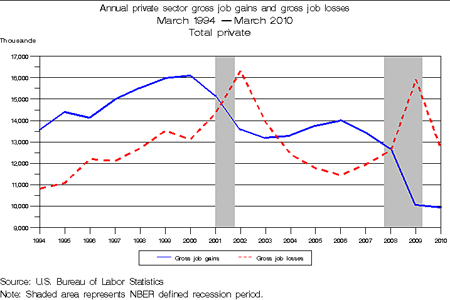
Look at the chart above, the gray shaded areas are textbook defined recessions. Using that textbook definition the BuShit recession ended 2 years ago, so the commentator is correct.

Now 97% of Americans don't see it that way because their money and jobs have NOT recovered. Understood. The top 3% have recovered $$$$$ in fact they have recovered in a spectacular fashion.

READ - Jet Sales Soar as Wealthy Fliers Avoid Airlines

READ - Even Marked Up, Luxury Goods Fly Off Shelves

So what you're looking at is a tale of two cities. How and why this is happening is what the film is about.
 
It is difficult to make self made men and women feel guilty about their success when they didn't get it handed to them on a silver platter. Both sides only point to the extremes (Rich people pointing to the laziest of the poor and poor people point to the the most absurdly rich and both sides say the same phrase...."Why should I help HIM"? The main reason why the economy hasn't recoved the way it has in the past is because America is now a service/investment economy. You can't fix it by using the same thinking we used when America was a manufacturing/export economy. Washington and most economists thinking is outdated.

Most of the jobs that were plentiful before the financial crisis were there because of the easy access to credit and ephemeral profits created by the glut of sub-prime loans in the housing market. Those jobs are NEVER coming back and you have a whole population of people who can't afford to retrain themselves, have to start from the bottom again, AND simply can't get hired because they aren't employed. Not only that, but they can't sell their now worthless home so they can move to where the jobs are. Cutting taxes won't fix that. Keeping interest rates low, in the past, would have spurred economic growth because the cost of borrowing money by businesses would be cheap so manufacturers would borrow and expand, creating jobs. We don't build shit anymore so all their doing mostly is keeping even more people from defaulting their mortgages because of another variable rate hike. I don't have the answers but a fundamental shift in thinking about the way we manage our economy has to change. The thought process now in my opinion is the equivalent of trying to steal a 2011 Lexus with keyless entry by using a lock pick. The old rules no longer apply and we need leaders that recognize that and can adapt.
 
It is difficult to make self made men and women feel guilty about their success when they didn't get it handed to them on a silver platter. Both sides only point to the extremes (Rich people pointing to the laziest of the poor and poor people point to the the most absurdly rich and both sides say the same phrase...."Why should I help HIM"? The main reason why the economy hasn't recoved the way it has in the past is because America is now a service/investment economy. You can't fix it by using the same thinking we used when America was a manufacturing/export economy. Washington and most economists thinking is outdated.

Most of the jobs that were plentiful before the financial crisis were there because of the easy access to credit and ephemeral profits created by the glut of sub-prime loans in the housing market. Those jobs are NEVER coming back and you have a whole population of people who can't afford to retrain themselves, have to start from the bottom again, AND simply can't get hired because they aren't employed. Not only that, but they can't sell their now worthless home so they can move to where the jobs are. Cutting taxes won't fix that. Keeping interest rates low, in the past, would have spurred economic growth because the cost of borrowing money by businesses would be cheap so manufacturers would borrow and expand, creating jobs. We don't build shit anymore so all their doing mostly is keeping even more people from defaulting their mortgages because of another variable rate hike. I don't have the answers but a fundamental shift in thinking about the way we manage our economy has to change. The thought process now in my opinion is the equivalent of trying to steal a 2011 Lexus with keyless entry by using a lock pick. The old rules no longer apply and we need leaders that recognize that and can adapt.
 
icvNixRY2.jpg


icQokWX1j.png


iexArvybx.jpg


Food Stamps usage at ALL TIME HIGH as US jobs disappear overseas (outsourcing)

<div style="background-color:#000000;width:520px;"><div style="padding:4px;"><embed src="http://media.mtvnservices.com/mgid:cms:video:thedailyshow.com:382932" width="512" height="288" type="application/x-shockwave-flash" allowFullScreen="true" allowScriptAccess="always" base="." flashVars=""></embed><p style="text-align:left;background-color:#FFFFFF;padding:4px;margin-top:4px;margin-bottom:0px;font-family:Arial, Helvetica, sans-serif;font-size:12px;"><b><a href="http://www.thedailyshow.com/watch/wed-april-27-2011/exclusive---bernie-sanders-extended-interview-pt--1">The Daily Show - Exclusive - Bernie Sanders Extended Interview Pt. 1</a></b><br/>Get More: <a href='http://www.thedailyshow.com/full-episodes/'>Daily Show Full Episodes</a>,<a href='http://www.indecisionforever.com/'>Political Humor & Satire Blog</a>,<a href='http://www.facebook.com/thedailyshow'>The Daily Show on Facebook</a></p></div></div>

Part 1


<div style="background-color:#000000;width:520px;"><div style="padding:4px;"><embed src="http://media.mtvnservices.com/mgid:cms:video:thedailyshow.com:382933" width="512" height="288" type="application/x-shockwave-flash" allowFullScreen="true" allowScriptAccess="always" base="." flashVars=""></embed><p style="text-align:left;background-color:#FFFFFF;padding:4px;margin-top:4px;margin-bottom:0px;font-family:Arial, Helvetica, sans-serif;font-size:12px;"><b><a href="http://www.thedailyshow.com/watch/wed-april-27-2011/exclusive---bernie-sanders-extended-interview-pt--2">The Daily Show - Exclusive - Bernie Sanders Extended Interview Pt. 2</a></b><br/>Get More: <a href='http://www.thedailyshow.com/full-episodes/'>Daily Show Full Episodes</a>,<a href='http://www.indecisionforever.com/'>Political Humor & Satire Blog</a>,<a href='http://www.facebook.com/thedailyshow'>The Daily Show on Facebook</a></p></div></div>

Part 2

<hr noshade color="#0000FF" size="4"></hr>

The oligarchs plan for America is to have as many people
as possible scrambling for survival as you see in the video below.


Rising riches: 1 in 5 in US reaches affluence

Rising riches: 1 in 5 in US reaches affluence
By HOPE YEN | Associated Press
19 hrs ago

WASHINGTON (AP) — Fully 20 percent of U.S. adults become rich for parts of their lives, wielding extensive influence over America's economy and politics, according to new survey data.

These "new rich," made up largely of older professionals, working married couples and more educated singles, are becoming politically influential, and economists say their capacity to spend is key to the U.S. economic recovery. But their rise is also a sign of the nation's continuing economic polarization.

They extend well beyond the wealthiest 1 percent, a traditional group of super-rich millionaires and billionaires with long-held family assets. The new rich have household income of $250,000 or more at some point during their working lives, putting them — if sometimes temporarily — in the top 2 percent of earners.

The new survey data on the affluent are being published in an upcoming book, and an analysis by The AP-NORC Center for Public Affairs Research provided additional information on the views of the group.

In a country where poverty is at a record high, today's new rich are notable for their sense of economic fragility. They rely on income from their work to maintain their social position and pay for things such as private tutoring for their children. That makes them much more fiscally conservative than other Americans, polling suggests, and less likely to support public programs, such as food stamps or early public education, to help the disadvantaged.

Last week, President Barack Obama asserted that growing inequality is "the defining challenge of our time," signaling that it will be a major theme for Democrats in next year's elections.

"In this country, you don't get anywhere without working hard," said James Lott, 28, a pharmacist in Renton, Wash., who adds to his six-figure salary by day-trading stocks. The son of Nigerian immigrants, Lott says he was able to get ahead by earning an advanced pharmacy degree. He makes nearly $200,000 a year.

After growing up on food stamps, Lott now splurges occasionally on nicer restaurants, Hugo Boss shoes and extended vacations to New Orleans, Atlanta and parts of Latin America. He believes government should play a role in helping the disadvantaged. But he says the poor should be encouraged to support themselves, explaining that his single mother rose out of hardship by starting a day-care business in their home.

The new research suggests that affluent Americans are more numerous than government data depict, encompassing 21 percent of working-age adults for at least a year by the time they turn 60. That proportion has more than doubled since 1979.

Even outside periods of unusual wealth, members of this group generally hover in the $100,000-plus income range, keeping them in the top 20 percent of earners.

At the same time, an increasing polarization of low-wage work and high-skill jobs has left middle-income careers depleted.

"For many in this group, the American dream is not dead. They have reached affluence for parts of their lives and see it as very attainable, even if the dream has become more elusive for everyone else," says Mark Rank, a professor at Washington University in St. Louis, who calculated numbers on the affluent for a forthcoming book, "Chasing the American Dream," to be published by the Oxford University Press.

As the fastest-growing group based on take-home pay, the new rich tend to enjoy better schools, employment and gated communities, making it easier to pass on their privilege to their children.

Because their rising status comes at a time when upward mobility in the U.S. ranks lowest among wealthy industrialized counties, the spending attitudes of the new rich have implications for politics and policy. It's now become even harder for people at the bottom to move up.

The group is more liberal than lower-income groups on issues such as abortion and gay marriage, according to an analysis of General Social Survey data by the AP-NORC Center for Public Affairs Research. But when it comes to money, their views aren't so open. They're wary of any government role in closing the income gap.

In Gallup polling in October, 60 percent of people making $90,000 or more said average Americans already had "plenty of opportunity" to get ahead. Among those making less than $48,000, the share was 48 percent

___

Sometimes referred to by marketers as the "mass affluent," the new rich make up roughly 25 million U.S. households and account for nearly 40 percent of total U.S. consumer spending.

While paychecks shrank for most Americans after the 2007-2009 recession, theirs held steady or edged higher. In 2012, the top 20 percent of U.S. households took home a record 51 percent of the nation's income. The median income of this group is more than $150,000.

Once concentrated in the old-money enclaves of the Northeast, the new rich are now spread across the U.S., mostly in bigger cities and their suburbs. They include Washington, D.C.; Boston, Los Angeles, New York, San Francisco and Seattle. By race, whites are three times more likely to reach affluence than nonwhites.

Paul F. Nunes, managing director at Accenture's Institute for High Performance and Research, calls this group "the new power brokers of consumption." Because they spend just 60 percent of their before-tax income, often setting the rest aside for retirement or investing, he says their capacity to spend more will be important to a U.S. economic recovery.

In Miami, developers are betting on a growing luxury market, building higher-end malls featuring Cartier, Armani and Louis Vuitton and hoping to expand on South Florida's Bal Harbour, a favored hideaway of the rich.

"It's not that I don't have money. It's more like I don't have time," said Deborah Sponder, 57, walking her dog Ava recently along Miami's blossoming Design District. She was headed to one of her two art galleries — this one between the Emilio Pucci and Cartier stores and close to the Louis Vuitton and Hermes storefronts.

But Sponder says she doesn't consider her income of $250,000 as upper class, noting that she is paying college tuition for her three children. "Between rent, schooling and everything — it comes in and goes out."

The new rich's influence will only grow as middle-class families below them struggle. The Federal Reserve said Monday that the nation's wealth rose 2.6 percent from July through September to $77.3 trillion, a record high, boosted in part by a surging stock market. But the gains haven't been equally distributed; the wealthiest 10 percent of U.S. households own about 80 percent of stocks.

___

Both Democrats and Republicans are awakening to the political realities presented by this new demographic bubble.

Traditionally Republican, the group makes up more than 1 in 4 voters and is now more politically divided, better educated and less white and male than in the past, according to Election Day exit polls dating to the 1970s.

Sixty-nine percent of upper-income voters backed Republican Ronald Reagan and his supply-side economics of tax cuts in 1984. By 2008, Democrat Barack Obama had split their vote evenly, 49-49.

In 2012, Obama lost the group, with 54 percent backing Republican Mitt Romney.

"For the Democrats' part, traditional economic populism is poorly suited for affluent professionals," says Alan Abramowitz, an Emory University professor who specializes in political polarization.

The new rich includes Robert Kane, 39, of Colorado Springs, Colo.

A former stockbroker who once owned three houses and voted steadfastly Republican, Kane says he was humbled after the 2008 financial meltdown, which he says exposed Wall Street's excesses. Now a senior vice president for a private equity firm specializing in the marijuana business, Kane says he's concerned about upward mobility for the poor and calls wealthy politicians such as Romney "out of touch."

But Kane, now a registered independent, draws the line when it comes to higher taxes. "A dollar is best in your hand rather than the government's," he says.

http://news.yahoo.com/rising-riches-1-5-us-reaches-affluence-080433232.html

 
How One Family Paid Off $118,000 in Debt

How One Family Paid Off $118,000 in Debt
By Kimberly Palmer | U.S.News & World Report LP
Thu, Jan 2, 2014

When Amy Kroezen, 29, graduated from the Art Institute of Atlanta in 2008, she couldn't find a job that took advantage of her interior design degree. "I was turned down for job after job, and even advised to go wait tables by a design firm until the economy got better," she says.

To make matters worse, she soon had to start payments on her student loan debt. She and her husband, a dance instructor, owed about $116,000 in student loans and $2,000 in car payments. "I had no idea how we were going to spend the next 10-plus years paying $990 a month in debt. How would we ever own a house, have a child and have any quality of life?" Kroezen recalls asking herself. She felt physically ill, just as she had as a child when she heard her parents talking about money.

So Kroezen and her husband, a native of Australia, decided to do something about it. In April 2009, they committed to paying off their debt within four years by dedicating one of their incomes entirely to paying off debt and then living off the other income. At the time, Kroezen and her husband were each earning between $32,000 and $35,000. Now a growing family with a 2 and a half-year-old daughter and another baby on the way, they are very close to achieving their goal - and they say their strategy could work well for other families, too.

According to a December survey of more than 2,000 adults from Think Finance, an online financial products company, about three-quarters of Americans will carry debt into the new year, including credit card debt (36 percent) and car loans (28 percent). Here are six strategies that can help those Americans - and you - climb out of debt in 2014:

1. Downsize. Not only did Kroezen and her family start living off only one income, but they moved into a cheaper apartment that was minutes from each of their jobs, which meant they could also save money on gas. That also made it easier for them to live off just one income.

2. Use the envelope system. Whenever Kroezen got her paycheck, she turned it into cash and then distributed those bills into envelopes dedicated to different costs, including food, rent and other essentials.

3. Get ready to work and get support. "It's not easy," Kroezen acknowledges. "You need a good support system whether it's family, your spouse or a friend." She adds that aiming to get out of debt, not become rich, will help keep you from feeling overwhelmed.

4. Be super frugal. Kroezen and her family cut out all spending that wasn't absolutely necessary. That meant repairing broken items instead of buying new ones, skipping restaurants and making her own coffee. "There will be times you feel depressed over it, but remember the end result is going to outshine all that," she says.

Her family still lives on about $19,000 a year, so they can save the rest. She even built her own furniture when her family moved into a new house, and asked family members for power tools as gifts for Christmas. She's since built a king-size bed, dining table and toy box. She also makes her own cleaning supplies and grows some of her family's food, too.

5. Pay off the most expensive debt first. Not everyone abides by this approach, and instead prefers to pay off the smallest debts first to build momentum and a sense of accomplishment, but many financial advisors recommend paying off the most expensive debt first. That helps reduce interest and fee payments. Credit card debt is often the most expensive debt that people carry, followed by auto loans and student loans. Any debt with a variable rate can go up quickly when interest rates start to rise.

6. Stay inspired. Certified financial planner Jude Boudreaux learned how to stop overspending with the help of a vision book - a collection of images of financial goals, which helped keep him and his wife focused and on budget. Boudreaux's vision book includes images of where they want to vacation and their condo, which they want to pay off. He flips through it when he needs to remind himself to avoid spending on unnecessary items.

Now, Kroezen and her family live in Nashville, where Kroezen is a stay-at-home mom and her husband works in the insurance industry. Kroezen has paid off $103,168 of her student loan, and she says she would have completely paid it off were it not for the birth of her daughter. She and her husband also bought a home and put down a $20,000 down payment on it. They pay off their credit card bills in full each month.

"We will attack the mortgage in the same way as the student loan, although we may take a month off and buy some clothing, which we haven't done in years," Kroezen says. Her family is also growing, with another baby on the way.
If going debt-free is one of your goals for 2014, these strategies might help you get there.

http://news.yahoo.com/one-family-paid-off-118-000-debt-145930656.html
 
Tiger Mom's New Book Stirs Up Culture Wars

Tiger Mom's New Book Stirs Up Culture Wars
By Beth Greenfield, Shine Staff | Parenting
13 hours ago

Remember "Tiger Mom," the Yale professor who brought us the most buzzy and controversial child-rearing philosophy since helicoptering and attachment parenting? Well, now the ire-raising author of "The Battle Hymn of the Tiger Mother," Amy Chua, who argued that strict, Chinese-style moms are best, is back — and likely to raise even more hackles this time around. Her latest book, "The Triple Package: How Three Unlikely Traits Explain the Rise and Fall of Cultural Groups in America," deems eight cultural groups here superior to others. And, though the book is not due out until February, Twitter criticisms are already flying, with many calling Chua "racist" and a self-promoter.

But the reality, notes the book, co-written by Chua's husband and fellow Yale professor Jed Rubenfeld, is that "uncomfortable as it may be to talk about," some "religious, ethnic, and national-origin groups are starkly more successful than others." Those groups, according to the authors, are Mormons, Cuban exiles, Nigerian Americans, Indian Americans, Chinese Americans, American Jews, Iranian Americans and Lebanese Americans. And the reasons they excel, the book declares, is because of a basic "triple package" formula: a superiority complex, insecurity, and impulse control.

A Publishers Weekly review calls the book a "comprehensive, lucid psychological study," which balances its findings with the downsides of the "triple package." And the authors address cultural stereotyping early on in the book, explaining, "Throughout this book, we will never make a statement about any group's economic performance or predominant cultural attitudes unless it is backed up by solid evidence, whether empirical, historical, or sociological. But when there are differences between groups, we will come out and say so." They add, "Group generalizations turn into invidious stereotypes when they're false, hateful, or assumed to be true of every group member. No group and no culture is monolithic."

But that hasn't quieted a slew of critics. Peter Kiang, director of the Asian American Studies Program at University of Massachusetts Boston, tells Yahoo Shine in an email, "I don't see any credible cultural superiority argument that can be made in this way…and assume that the authors' intentions are primarily meant to enhance marketing and publicity for their book." He adds, "The self-serving nature of the argument does seem to reveal the authors' own senses of superiority and insecurity, but not so much their impulse control."

And Ed Liebow, executive director of the American Anthropological Association, tells Yahoo Shine, "To generalize about some common characteristics is not a very productive way to talk about culture." Though he has not yet read the book, he adds, "I find it very troubling. As anthropologists, we have always avoided value judgments, or the idea that one cultural group is more exceptional than another."

Many on Twitter, meanwhile, have responded angrily to early coverage of the book.

Some choice phrases on Twitter: "racist," "awful," "racist psychopath," "idiot," "nonsense," "race baiting clap trap" and, finally, from the political organization MOMocrats, "Amy Chua trolls us all for college tuition for child number two/book number two. YAWN."

Bloggers are also mad. "It's rife with American exceptionalism and model minority thinking — the notion that anyone can succeed in America if they just act right, and those who don't will get what they deserve," notes Race Files blogger Soya Jung about the book's subtitle and marketing. Jung says she hasn't read the book and doesn't intend to, explaining, "My main problem with this is that it ignores the history of race in America," particularly when it comes to that of black Americans.

Prachi Gupta of Salon calls the new book Chua's "personal rant about her cultural superiority." Kenton Ngo, meanwhile, blogs, "It's too simplistic to read Chua's thesis as a form of racism. In fact, it's more sinister than that. Chua, her husband, and many other members of the 1% genuinely believe they got to where they were because they were somehow inherently better people…The worst part about this sordid saga is that both of them are tenured law professors at Yale. If anything exposes the dark, seedy underbelly of the elite views of their own superiority, it's that the people teaching future white-shoe lawyers and M&A sharks genuinely believe that some ethnic groups are simply not cut out for life. No wonder our social safety net is under attack."

Chua and Rubenfeld have not yet responded to the wave of criticism. But if the book's narrative is any indication, it won't be taken to heart. "Scorn," the duo writes in Chapter 4, "is a legendary motivator."

http://shine.yahoo.com/parenting/tiger-mom-39-book-stirs-culture-wars-195300564.html
 
Gen Xers are poorer than their parents

Gen Xers are poorer than their parents
By Tami Luhby
September 22, 2014: 7:05 AM ET

Gen Xers may be taking home bigger paychecks than their parents did at the same age, but they haven't been able to accumulate nearly as much wealth.

The typical Gen Xer has only $29,100 in wealth, compared to the $65,200 that their parents had socked away at the same age, according to a new report from the Pew financial security and mobility project. Wealth includes savings, retirement funds, homes and other investments.

"They are on track to be the first in recent history to fall behind previous generations in terms of wealth accumulation, a key indicator of economic security and particularly retirement preparedness," Diana Elliott, research manager at Pew, said of this generation, born between 1965 and 1980. Researchers compared Gen Xers with their own parents.

Only 36% of Gen Xers have exceeded their parents' net worth. That's especially telling since three-quarters of Gen Xers are taking home bigger paychecks than their parents did.

Why are Gen Xers so much poorer? Debt, particularly student loans.

The Molly Ringwald/Kurt Cobain generation have nearly six times the debt levels of their parents, primarily from college. And this debt hampered Gen X's ability to accumulate wealth even two decades after they graduated.

That's not to say college isn't worth it. Degree-holding Gen Xers make $25,000 a year more than their non-educated peers. They also have $26,000 more in home equity and $9,000 more in other wealth, Pew found.

When it comes to mobility, Gen Xers are also a lot less likely to move up the economic ladder ... or fall from their perch. Nearly three-quarters of those raised at the bottom of the income ladder never reach the middle, while nearly 70% of those raised at the top never fall to the middle. That's linked to sharp demographic differences between the ends of income spectrum: Those at the bottom are often single and not college-educated, while those at the top are married with a degree.

Gen Xers are also less prepared for retirement, according to an earlier Pew study. They lost 45% of their savings between 2007 and 2010, and only have enough to replace about half of their pre-retirement income.

This lack of savings and wealth have the Pew researchers concerned.

"The findings show that Gen X has bigger hurdles to overcome than previous generations did to achieve financial security," Elliott said.

http://money.cnn.com/2014/09/22/new...r-than-parents-pew-study/index.html?iid=HP_LN
 
Back
Top