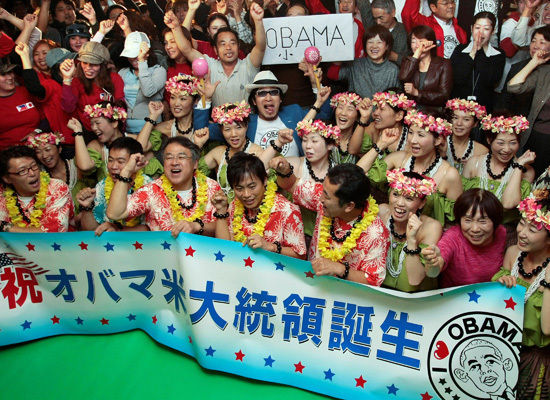
Around the world, Obama triumph gives battered U.S. image a lift
<font size="5"><center>
Around the world, Obama triumph
gives battered U.S. image a lift</font size></center>
McClatchy Newspapers
By Tim Johnson, Tyler Bridges
and Dion Nissenbaum
Wednesday, November 5, 2008
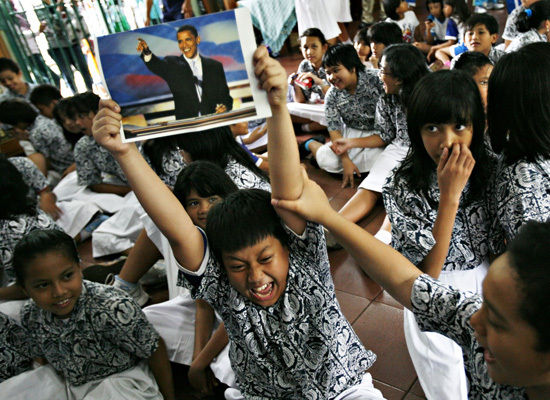
BEIJING — From the cafes of Beirut to the villages of Kenya and on to the streets of Asian metropolises, much of the world looked on with vivid hope Wednesday at Barack Obama’s electoral triumph.
Some saw the rise of an African American to the U.S. presidency as a transformative event that may repair the battered reputation of the United States, lift the aspirations of global minorities, and renew chances for diplomacy rather than war.
Dozens of people interviewed by McClatchy reporters voiced anticipation that Obama would take a more cooperative approach to global problems than President George Bush.
In the Middle East, some viewed a glimmer of hope out of intractable conflict. In Latin America, others took heart in the meteoric rise of an African-American politician. In Asia, concern lingered over Obama’s ability to calm global financial turmoil, but many welcomed the fresh new face of U.S. leadership.
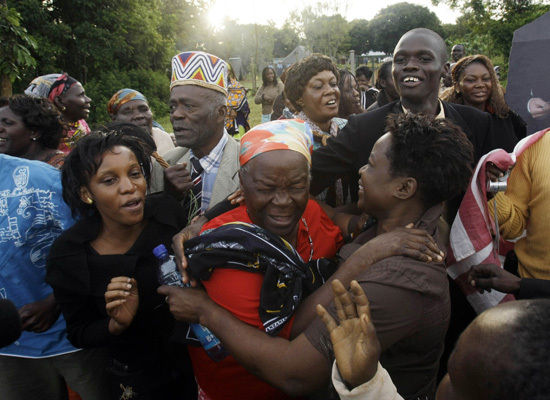
Special pride burst forth in Kenya, the country of origin of Obama’s late father, where citizens voiced joy that a descendant of one of their own would occupy the White House. Kenyan President Mwai Kibaki declared Thursday a national holiday.
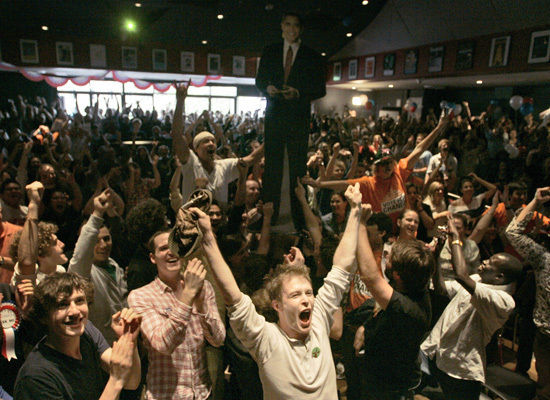
Huge numbers of foreigners and U.S. citizens living overseas jammed into venues for live broadcasts of the election results, a sign of the intense interest in the change pending in U.S. leadership.
In Rio de Janeiro, Ryan Steers, a 23-year-old Brazilian documentary film-maker, said Obama can improve the United States’ image abroad.
“Obama is someone the world can trust,” Steers said. “That is the most important thing for American right now – regaining its trust in the world community.”
With U.S.-led wars grinding away in Iraq and Afghanistan, and a financial meltdown shaking the pillars of economies worldwide, many foreigners seemed to associate the Bush presidency with a spate of ill fortune and global uncertainty linked to a never-ending war on terrorism. They are eager for more reassuring signs.
“I’m just really, really happy,” said Shane Inwood, an English teacher watching U.S. election returns in an Irish pub in Osaka, Japan. “It is more to do with, ‘Goodbye Bush,’ then ‘Hello Obama.’”
Some foreigners could barely believe the news. In London’s Trafalgar Square, Hannah Capella, a 20-year-old student, was told of the election result by a correspondent. "That's amazing," said Capella. "I really didn't think it could happen, . . . I always thought he was too good to be true," she said of Obama. "We'll see.”
Some foreigners said Obama’s victory was a clarion call to re-examine racial issues in their own countries.
“It’s a fantastic moment for the world to see how a country with widely known racial issues can progress this far,” said Mark Tjhung(cq), 27, an Australian writer living in Hong Kong.
As shouts of “Obama! Obama!” nearly drowned out his voice from a restaurant in Auckland, New Zealand, Calum McKenzie echoed that sentiment.
“The Maoris and the Pacific Islanders are going to take inspiration from him,” the 34-year-old McKenzie said from the Mustang Saloon & Grill.
U.S. executives working overseas said Obama’s triumph heartens foreigners distressed by Washington’s tendency toward a go-it-alone approach following the Sept. 11, 2001, terror attacks.
“They are just so unhappy with the current administration,” said Chris Kimble, a U.S. executive based in Bangkok, Thailand, who headed a campaign drive for John McCain among U.S. citizens living there. “The U.S. is not looked on as it used to be. People are expecting that to change to a little more ‘open to discussion’ type of approach rather than a unilateral style.”
In resurgent Russia, where tensions with the West have risen, some people dismissed the pending change of U.S. leadership.
“Both Obama and McCain criticize Russia, blame it for international conflicts. Their hostility offends me and I don’t expect any improvement in our relations,” said Andrey Grigoriev, a 61-year-old entrepreneur.
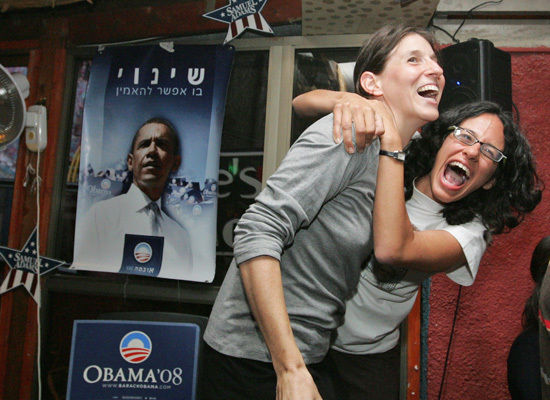
The election drew intense interest in the Middle East, where residents gathered before dawn in cafes, bars and army bases to watch the historic election unfold.
Even if they disagreed with his politics, Israelis and Palestinians, Sunni and Shiite Muslims, Arabs and Jews all saw Obama’s victory as a transformative event for the United States and the world. Across the Middle East, there was broad recognition that Americans were embracing a new strategy for the region – one that relies on diplomacy. Many saw that as a change for the better.
In a Beirut restaurant, Miriam, a 28-year-old from southern Lebanon said her two brothers, both members of Hezbollah, see Obama as an American leader who is willing to take diplomatic risks to avoid military confrontations.
“They think Obama will not damage the Middle East the way Bush did, and they were afraid if McCain made it, the whole region would be in danger,” she said.
The daunting challenge facing Obama in trying to bring new stability to the Middle East was made clear Tuesday when Israel broke a relatively-stable, four-month-old cease fire with Hamas by staging a deadly air strike in the Gaza Strip and sending a small number of troops into the Hamas-controlled region. At least five Palestinians were killed in the attacks.
Perhaps the most serious reservations in the region about Obama can be found in Israel, where some worry that his pledge to engage America’s adversaries is politically naïve.
Those concerns were reflected in a poll in Israel’s Yedioth Ahronoth newspaper that showed Israelis favor McCain over Obama, 46 percent to 34 percent.
“Obama as president, it seems that our hands would be tied and we would be pressed to do things that we don’t want to do,” said Yona Mishane, a Jerusalem plumber who expressed hope that the president-elect would eventually recognize that supporting Israel “is the right thing to do.”
But Danny Ayalon, a former Israeli ambassador to the United States who is now part of the hawkish Yisrael Beitenu party, said that the fears about Obama’s approach might be unfounded.
“Obama is more patient than McCain,” Ayalon told Israel Radio on Wednesday morning. “He will give more chance for diplomatic solutions and he has a better chance to seal off Iran with sanctions and maybe this will be better for everyone.”
The following are snapshots from other parts of the world over the Obama victory.
///
In Iraq, some U.S. soldiers stayed up all night to await the announcement of their new commander in chief and when Barack Obama gave his acceptance speech he spoke to them.
“Even as we stand here tonight, we know there are brave Americans waking up in the deserts of Iraq and the mountains of Afghanistan to risk their lives for us,” Obama said.
About 15 miles north of Baghdad at Camp Taji, Kevin Brooks, a 38-year-old staff sergeant from South Carolina, saw that Obama was the president elect just after 7 a.m.
"I'm really proud to be an American today," Brooks said. "Our country has come such a long way. It's incredible."
Brooks, an African American, woke up at 3 a.m. to watch the news at a recreation hall on the base in Taji.
"I just wish my own grandmother was here to see this," he said.
For some this meant change and a possible end in sight.
"I knew he'd win, but I'm still shocked," said Staff Sgt. Errol Watson, 34, of Georgetown, Del. "It's pretty huge, especially for people here … Obviously an Obama win means we could be going home sooner, and I think everybody here wants a (withdrawal) timeline."
///
In Baghdad, shop owners in the busy marketplace of Bab al Sharji tuned their televisions to the Arabic Satellite News stations monopolized by election coverage. The market is encased by towering concrete walls to protect shoppers from car bombs.
In one shop that specialized in the whole sale of two-way radios, Jassim al Saadi read the newspaper at 8:30 a.m. and gazed at the television where newscasters analyzed Obama’s win.
“We will be liberated as Iraqis, we will get rid of this concrete, we will be capable of going to our jobs at normal times and not in darkness,” al Saadi said. “I believe Obama is a man of politics not a man that desires wars, not like McCain or George Bush, the father and son.”
As he spoke, Malek Fadel a young Iraqi soldier walked into the shop to buy batteries.
“Our future is connected to America not by our will and despite this connection this vote will not affect us,” Fadel said. “No one hears us or cares for us as Iraqis.”
As another customer walked in an employee called out to him.
“Congratulations the black man wins!” he said.
“He deserves it. He is one of our uncles,” Sadiq al Dulaimy said, joking that next time a member of his tribe, the Dulaim could run for president.
Another patron joined in and his words dripped with sarcasm.
“Yes he’s our president,” said Mohammed Khalaf a bodyguard for a senior Iraqi official. “He’s the man who can make a decision in Iraq. He’s the man with the first and last word in this country.”
///
In western Kenya, the birthplace of Obama’s father, small crowds gathered at fairgrounds and in bars to watch the election returns trickle in. In Kisumu, the main town in the region, a few dozen young men watching on a small screen at the fairgrounds erupted in cheers and hoots shortly after 7 a.m. local time, when television networks called the election for Obama.
Kenyans wearing Obama pins, Obama stickers and Obama T-shirts expressed joy not only that a man they see as one of their own would occupy the White House, but also at the idea that American voters could see beyond a person’s skin color.
“Kenyans have learned a lot about America,” Lamek Onyango, a jobless 25-year-old. “It depends on the person, on how he is and the knowledge that somebody has, not if he is black or white.”
Sensing a victory even before the polls had closed, The Standard, a national Kenyan daily, ran a one-word front-page headline: “Obama.”
In Nyangoma-Kogelo, the bucolic village where Obama’s step-grandmother, Sarah, still lives, dozens of neighbors danced in celebration under a searing morning sun. The extended Obama clan made plans for an afternoon feast to include chapati, a fried flatbread that Sarah Obama said was the president-elect’s favorite dish.
Obama’s victory felt like redemption in western Kenya, where many in the predominant Luo tribe _ the ethnic group to which Obama’s late father belonged _ is still smarting from Kenya’s disputed presidential election last December. A loss by the Luo candidate, Raila Odinga, unleashed weeks of violence that killed more than 1,000 people and reignited tensions between Kenya’s many diverse ethnicities.
“In this country politics is too much about ethnicity. America is showing that leadership has no color,” said Samuel Otieno, an unemployed 23-year-old wearing an Obama pin. “Kenya can learn a lot.”
Most Kenyans have come to grips with the fact that Obama isn’t going to personally fix all of their country’s problems. But some hoped that Democratic policies could enhance economic development in Africa.
“What is important to me is that an Obama victory will bring down the racial divide that the world has been suffering,” said Mary Opere, 22, a tour company employee who was watching the returns early Wednesday morning at a bar in Nairobi, the Kenyan capital. “I think Obama will also give us trade and not aid.”
///
In Brazil a cheer went up among Obama supporters at a gathering of Americans and Brazilians in Rio de Janeiro every time CNN called another state for the Democratic candidate.
“I adore the United States, it’s a spectacular country,” said Italo Mazzoni, president of the Rio-based Brazilian-United States Institute. “But the United States’ reputation has been sullied because of President Bush. Obama is capable of improving that image. He is young and has modern ideas. He can transmit a more positive image of the United States.”
In recent days, ordinary Brazilians, unprompted, had been expressing their hopes in Obama.
“I think it will be good for the United States to have a black man as president,” said Jorge Silva, who sells fruit from a cart in Rio. “The United States needs change, and Obama represents that.”
Hugo Chavez
Even Venezuelan President Hugo Chavez has been expressing hope in Obama.
Obama “has said interesting things, and I hope he’ll follow through on them,” Chavez said, citing Obama’s promise to close Guantanamo as a center to detain terrorist suspects and to pull out U.S. troops from Iraq.
Chavez proposed that Obama work with the Venezuelan leader “against the ills of the world: hunger, AIDS, poverty and malnutrition.”
Chavez has been the United States’ biggest headache in Latin America. He regularly rails against Bush, free-trade and capitalism.
///
Chinese and U.S. business executives gathered at a Beijing hotel to watch U.S. election returns voiced hope that an Obama administration would consult closely with China on economic matters.
“The United States and China more than ever need to have a positive partnership,” said James M. Zimmerman, chairman of the American Chamber of Commerce in China, referring to the economic links between the countries.
Already, global financial turmoil is throwing Chinese out of work, and businessmen want the new U.S. administration to take strong action to stabilize markets and investments.
“The election was decided by the financial crisis,” said Thomas Yin, executive director of United China Consultants, adding that Obama’s lack of major management experience makes him nervous.
“He has to do something to save the economy, to save the (American) middle class,” Yin said. “Some small factories here, such as toy manufacturers, have already gone bankrupt because they don’t get any more orders from America.”
Zhang Nan, a journalist from Beijing Today newspaper, said she has one major hope for an Obama administration: “Not so many wars. A more peaceful environment.”
///
Election-night parties were held in homes, bars and pubs across Europe. Given the time difference with America (Britain is five hours ahead of the US East Coast, and continental Europe is six hours ahead), the election result wasn't known until the early morning hours, but that didn't stop crowds of American expatriates and Europeans alike from staying up all night.
In London, home to the largest American community outside North America, hundreds of Obama fans held parties across the city. A mob crowded into The Hoop and Toy, a pub in South Kensington, to watch the night unfold on big-screen televisions. Cheers went up from the crowd each time key state victories were announced, and there was a champagne toast to victory. The event didn't break up until 6 a.m. when many had to start thinking about going to work.
Duane Mitchell, 45, was one of the American expats who stayed up all night in his London home watching the results roll in.
"I'm surprised and I'm really pleased by the result," said Mitchell, who is chief information officer of a law firm in London, originally hails from Philadelphia. "It was an amazing, amazing event." He voted by absentee ballot, as did many Americans abroad.
Britons, too, stayed up to see the conclusion of a campaign that has been closely followed for months.
"The scenes I saw on the telly last night from America were extraordinary," said Simon Haymer, 45, who is managing director of an advertising agency in London and looked rather glassy-eyed as he waited for a bus near Trafalgar Square this morning. "It was like someone had won a war." The only similar displays of emotion he could recall in Britain were royal weddings or "when we do half decent at the Olympics." Haymer, who said he follows American politics closely, said "the best man won." He added "but the best thing is Bush won't be there."
Somit Prasad, a 31-year-old dentist, was snatching a cigarette outside London's Paddington train station during the morning rush hour. "I'm very pleased," he said with typical British understatement. "I've followed the race quite closely, and this is quite historic." He referred to Martin Luther King and Rosa Parks. "Barack Obama is eloquent and very sincere, and I expect world relations will be much better with America."
Even passengers flying across the Atlantic were anxious to hear the news. When a British Airways flight from Boston to London landed at Heathrow, Europe's busiest airport, shortly after 5 a.m. British time, the pilot announced that Obama was the winner and applause broke out among the passengers. "Sweet," said Ramatsu Sowe, a 66-year-old grandmother with several missing teeth and a gold cap in the middle of her crooked smile, who was on the flight to visit her children in Britain. "I can't believe it." Originally from Sierra Leone, she moved to Massachusetts in 1996. This was the first time she was eligible to vote in a U.S. election, and she did so before boarding the flight. "Obama will be great," she said. Although she is looking forward to her visit in Britain she added that "I'm going back for the inauguration in America."
Despite polls across Europe in recent months showing Obama as the heavy favorite, there was some caution this morning, too. "I think the world's still going to be pretty skeptical about America, especially the fear that it might become isolationist," Haymer said. "There's going to be a huge anticlimax" for Obama, Prasad predicted. "He's inheriting so many problems."
Britain's prime minister, Gordon Brown, and the opposition Conservative leader David Cameron both met Obama during his European tour in July and issued statements on the election result. Brown said Obama ran "an inspirational campaign, energizing politics with his progressive values and his vision for the future." Cameron called Obama "the first of a new generation of world leaders."
Perhaps the most surprising praise came from France, long a thorn in America's side. President Nicolas Sarkozy, who met Obama when he visited Paris a few months ago, called the result "brilliant."
(Reporting from Tim Johnson in Beijing; Shashank Bengali in Kisumu, Kenya, and Munene Kilongi in Nairobi; Alla Burakovskaya in Moscow; Dion Nissembaum and Cliff Churgin in Jerusalem; Mohammed Ali in Beirut; Julie Sell in London; Tyler Bridges in Rio de Janeiro, Leila Fadel, Corinne Reilly and Mohammed al Dulaimy in Baghdad.)
http://www.mcclatchydc.com/homepage/story/55339.html
<font size="5"><center>
Around the world, Obama triumph
gives battered U.S. image a lift</font size></center>
McClatchy Newspapers
By Tim Johnson, Tyler Bridges
and Dion Nissenbaum
Wednesday, November 5, 2008
BEIJING — From the cafes of Beirut to the villages of Kenya and on to the streets of Asian metropolises, much of the world looked on with vivid hope Wednesday at Barack Obama’s electoral triumph.
Some saw the rise of an African American to the U.S. presidency as a transformative event that may repair the battered reputation of the United States, lift the aspirations of global minorities, and renew chances for diplomacy rather than war.
Dozens of people interviewed by McClatchy reporters voiced anticipation that Obama would take a more cooperative approach to global problems than President George Bush.
In the Middle East, some viewed a glimmer of hope out of intractable conflict. In Latin America, others took heart in the meteoric rise of an African-American politician. In Asia, concern lingered over Obama’s ability to calm global financial turmoil, but many welcomed the fresh new face of U.S. leadership.
Special pride burst forth in Kenya, the country of origin of Obama’s late father, where citizens voiced joy that a descendant of one of their own would occupy the White House. Kenyan President Mwai Kibaki declared Thursday a national holiday.
Huge numbers of foreigners and U.S. citizens living overseas jammed into venues for live broadcasts of the election results, a sign of the intense interest in the change pending in U.S. leadership.
In Rio de Janeiro, Ryan Steers, a 23-year-old Brazilian documentary film-maker, said Obama can improve the United States’ image abroad.
“Obama is someone the world can trust,” Steers said. “That is the most important thing for American right now – regaining its trust in the world community.”
With U.S.-led wars grinding away in Iraq and Afghanistan, and a financial meltdown shaking the pillars of economies worldwide, many foreigners seemed to associate the Bush presidency with a spate of ill fortune and global uncertainty linked to a never-ending war on terrorism. They are eager for more reassuring signs.
“I’m just really, really happy,” said Shane Inwood, an English teacher watching U.S. election returns in an Irish pub in Osaka, Japan. “It is more to do with, ‘Goodbye Bush,’ then ‘Hello Obama.’”
Some foreigners could barely believe the news. In London’s Trafalgar Square, Hannah Capella, a 20-year-old student, was told of the election result by a correspondent. "That's amazing," said Capella. "I really didn't think it could happen, . . . I always thought he was too good to be true," she said of Obama. "We'll see.”
Some foreigners said Obama’s victory was a clarion call to re-examine racial issues in their own countries.
“It’s a fantastic moment for the world to see how a country with widely known racial issues can progress this far,” said Mark Tjhung(cq), 27, an Australian writer living in Hong Kong.
As shouts of “Obama! Obama!” nearly drowned out his voice from a restaurant in Auckland, New Zealand, Calum McKenzie echoed that sentiment.
“The Maoris and the Pacific Islanders are going to take inspiration from him,” the 34-year-old McKenzie said from the Mustang Saloon & Grill.
U.S. executives working overseas said Obama’s triumph heartens foreigners distressed by Washington’s tendency toward a go-it-alone approach following the Sept. 11, 2001, terror attacks.
“They are just so unhappy with the current administration,” said Chris Kimble, a U.S. executive based in Bangkok, Thailand, who headed a campaign drive for John McCain among U.S. citizens living there. “The U.S. is not looked on as it used to be. People are expecting that to change to a little more ‘open to discussion’ type of approach rather than a unilateral style.”
In resurgent Russia, where tensions with the West have risen, some people dismissed the pending change of U.S. leadership.
“Both Obama and McCain criticize Russia, blame it for international conflicts. Their hostility offends me and I don’t expect any improvement in our relations,” said Andrey Grigoriev, a 61-year-old entrepreneur.
The election drew intense interest in the Middle East, where residents gathered before dawn in cafes, bars and army bases to watch the historic election unfold.
Even if they disagreed with his politics, Israelis and Palestinians, Sunni and Shiite Muslims, Arabs and Jews all saw Obama’s victory as a transformative event for the United States and the world. Across the Middle East, there was broad recognition that Americans were embracing a new strategy for the region – one that relies on diplomacy. Many saw that as a change for the better.
In a Beirut restaurant, Miriam, a 28-year-old from southern Lebanon said her two brothers, both members of Hezbollah, see Obama as an American leader who is willing to take diplomatic risks to avoid military confrontations.
“They think Obama will not damage the Middle East the way Bush did, and they were afraid if McCain made it, the whole region would be in danger,” she said.
The daunting challenge facing Obama in trying to bring new stability to the Middle East was made clear Tuesday when Israel broke a relatively-stable, four-month-old cease fire with Hamas by staging a deadly air strike in the Gaza Strip and sending a small number of troops into the Hamas-controlled region. At least five Palestinians were killed in the attacks.
Perhaps the most serious reservations in the region about Obama can be found in Israel, where some worry that his pledge to engage America’s adversaries is politically naïve.
Those concerns were reflected in a poll in Israel’s Yedioth Ahronoth newspaper that showed Israelis favor McCain over Obama, 46 percent to 34 percent.
“Obama as president, it seems that our hands would be tied and we would be pressed to do things that we don’t want to do,” said Yona Mishane, a Jerusalem plumber who expressed hope that the president-elect would eventually recognize that supporting Israel “is the right thing to do.”
But Danny Ayalon, a former Israeli ambassador to the United States who is now part of the hawkish Yisrael Beitenu party, said that the fears about Obama’s approach might be unfounded.
“Obama is more patient than McCain,” Ayalon told Israel Radio on Wednesday morning. “He will give more chance for diplomatic solutions and he has a better chance to seal off Iran with sanctions and maybe this will be better for everyone.”
The following are snapshots from other parts of the world over the Obama victory.
///
In Iraq, some U.S. soldiers stayed up all night to await the announcement of their new commander in chief and when Barack Obama gave his acceptance speech he spoke to them.
“Even as we stand here tonight, we know there are brave Americans waking up in the deserts of Iraq and the mountains of Afghanistan to risk their lives for us,” Obama said.
About 15 miles north of Baghdad at Camp Taji, Kevin Brooks, a 38-year-old staff sergeant from South Carolina, saw that Obama was the president elect just after 7 a.m.
"I'm really proud to be an American today," Brooks said. "Our country has come such a long way. It's incredible."
Brooks, an African American, woke up at 3 a.m. to watch the news at a recreation hall on the base in Taji.
"I just wish my own grandmother was here to see this," he said.
For some this meant change and a possible end in sight.
"I knew he'd win, but I'm still shocked," said Staff Sgt. Errol Watson, 34, of Georgetown, Del. "It's pretty huge, especially for people here … Obviously an Obama win means we could be going home sooner, and I think everybody here wants a (withdrawal) timeline."
///
In Baghdad, shop owners in the busy marketplace of Bab al Sharji tuned their televisions to the Arabic Satellite News stations monopolized by election coverage. The market is encased by towering concrete walls to protect shoppers from car bombs.
In one shop that specialized in the whole sale of two-way radios, Jassim al Saadi read the newspaper at 8:30 a.m. and gazed at the television where newscasters analyzed Obama’s win.
“We will be liberated as Iraqis, we will get rid of this concrete, we will be capable of going to our jobs at normal times and not in darkness,” al Saadi said. “I believe Obama is a man of politics not a man that desires wars, not like McCain or George Bush, the father and son.”
As he spoke, Malek Fadel a young Iraqi soldier walked into the shop to buy batteries.
“Our future is connected to America not by our will and despite this connection this vote will not affect us,” Fadel said. “No one hears us or cares for us as Iraqis.”
As another customer walked in an employee called out to him.
“Congratulations the black man wins!” he said.
“He deserves it. He is one of our uncles,” Sadiq al Dulaimy said, joking that next time a member of his tribe, the Dulaim could run for president.
Another patron joined in and his words dripped with sarcasm.
“Yes he’s our president,” said Mohammed Khalaf a bodyguard for a senior Iraqi official. “He’s the man who can make a decision in Iraq. He’s the man with the first and last word in this country.”
///
In western Kenya, the birthplace of Obama’s father, small crowds gathered at fairgrounds and in bars to watch the election returns trickle in. In Kisumu, the main town in the region, a few dozen young men watching on a small screen at the fairgrounds erupted in cheers and hoots shortly after 7 a.m. local time, when television networks called the election for Obama.
Kenyans wearing Obama pins, Obama stickers and Obama T-shirts expressed joy not only that a man they see as one of their own would occupy the White House, but also at the idea that American voters could see beyond a person’s skin color.
“Kenyans have learned a lot about America,” Lamek Onyango, a jobless 25-year-old. “It depends on the person, on how he is and the knowledge that somebody has, not if he is black or white.”
Sensing a victory even before the polls had closed, The Standard, a national Kenyan daily, ran a one-word front-page headline: “Obama.”
In Nyangoma-Kogelo, the bucolic village where Obama’s step-grandmother, Sarah, still lives, dozens of neighbors danced in celebration under a searing morning sun. The extended Obama clan made plans for an afternoon feast to include chapati, a fried flatbread that Sarah Obama said was the president-elect’s favorite dish.
Obama’s victory felt like redemption in western Kenya, where many in the predominant Luo tribe _ the ethnic group to which Obama’s late father belonged _ is still smarting from Kenya’s disputed presidential election last December. A loss by the Luo candidate, Raila Odinga, unleashed weeks of violence that killed more than 1,000 people and reignited tensions between Kenya’s many diverse ethnicities.
“In this country politics is too much about ethnicity. America is showing that leadership has no color,” said Samuel Otieno, an unemployed 23-year-old wearing an Obama pin. “Kenya can learn a lot.”
Most Kenyans have come to grips with the fact that Obama isn’t going to personally fix all of their country’s problems. But some hoped that Democratic policies could enhance economic development in Africa.
“What is important to me is that an Obama victory will bring down the racial divide that the world has been suffering,” said Mary Opere, 22, a tour company employee who was watching the returns early Wednesday morning at a bar in Nairobi, the Kenyan capital. “I think Obama will also give us trade and not aid.”
///
In Brazil a cheer went up among Obama supporters at a gathering of Americans and Brazilians in Rio de Janeiro every time CNN called another state for the Democratic candidate.
“I adore the United States, it’s a spectacular country,” said Italo Mazzoni, president of the Rio-based Brazilian-United States Institute. “But the United States’ reputation has been sullied because of President Bush. Obama is capable of improving that image. He is young and has modern ideas. He can transmit a more positive image of the United States.”
In recent days, ordinary Brazilians, unprompted, had been expressing their hopes in Obama.
“I think it will be good for the United States to have a black man as president,” said Jorge Silva, who sells fruit from a cart in Rio. “The United States needs change, and Obama represents that.”
Hugo Chavez
Even Venezuelan President Hugo Chavez has been expressing hope in Obama.
Obama “has said interesting things, and I hope he’ll follow through on them,” Chavez said, citing Obama’s promise to close Guantanamo as a center to detain terrorist suspects and to pull out U.S. troops from Iraq.
Chavez proposed that Obama work with the Venezuelan leader “against the ills of the world: hunger, AIDS, poverty and malnutrition.”
Chavez has been the United States’ biggest headache in Latin America. He regularly rails against Bush, free-trade and capitalism.
///
Chinese and U.S. business executives gathered at a Beijing hotel to watch U.S. election returns voiced hope that an Obama administration would consult closely with China on economic matters.
“The United States and China more than ever need to have a positive partnership,” said James M. Zimmerman, chairman of the American Chamber of Commerce in China, referring to the economic links between the countries.
Already, global financial turmoil is throwing Chinese out of work, and businessmen want the new U.S. administration to take strong action to stabilize markets and investments.
“The election was decided by the financial crisis,” said Thomas Yin, executive director of United China Consultants, adding that Obama’s lack of major management experience makes him nervous.
“He has to do something to save the economy, to save the (American) middle class,” Yin said. “Some small factories here, such as toy manufacturers, have already gone bankrupt because they don’t get any more orders from America.”
Zhang Nan, a journalist from Beijing Today newspaper, said she has one major hope for an Obama administration: “Not so many wars. A more peaceful environment.”
///
Election-night parties were held in homes, bars and pubs across Europe. Given the time difference with America (Britain is five hours ahead of the US East Coast, and continental Europe is six hours ahead), the election result wasn't known until the early morning hours, but that didn't stop crowds of American expatriates and Europeans alike from staying up all night.
In London, home to the largest American community outside North America, hundreds of Obama fans held parties across the city. A mob crowded into The Hoop and Toy, a pub in South Kensington, to watch the night unfold on big-screen televisions. Cheers went up from the crowd each time key state victories were announced, and there was a champagne toast to victory. The event didn't break up until 6 a.m. when many had to start thinking about going to work.
Duane Mitchell, 45, was one of the American expats who stayed up all night in his London home watching the results roll in.
"I'm surprised and I'm really pleased by the result," said Mitchell, who is chief information officer of a law firm in London, originally hails from Philadelphia. "It was an amazing, amazing event." He voted by absentee ballot, as did many Americans abroad.
Britons, too, stayed up to see the conclusion of a campaign that has been closely followed for months.
"The scenes I saw on the telly last night from America were extraordinary," said Simon Haymer, 45, who is managing director of an advertising agency in London and looked rather glassy-eyed as he waited for a bus near Trafalgar Square this morning. "It was like someone had won a war." The only similar displays of emotion he could recall in Britain were royal weddings or "when we do half decent at the Olympics." Haymer, who said he follows American politics closely, said "the best man won." He added "but the best thing is Bush won't be there."
Somit Prasad, a 31-year-old dentist, was snatching a cigarette outside London's Paddington train station during the morning rush hour. "I'm very pleased," he said with typical British understatement. "I've followed the race quite closely, and this is quite historic." He referred to Martin Luther King and Rosa Parks. "Barack Obama is eloquent and very sincere, and I expect world relations will be much better with America."
Even passengers flying across the Atlantic were anxious to hear the news. When a British Airways flight from Boston to London landed at Heathrow, Europe's busiest airport, shortly after 5 a.m. British time, the pilot announced that Obama was the winner and applause broke out among the passengers. "Sweet," said Ramatsu Sowe, a 66-year-old grandmother with several missing teeth and a gold cap in the middle of her crooked smile, who was on the flight to visit her children in Britain. "I can't believe it." Originally from Sierra Leone, she moved to Massachusetts in 1996. This was the first time she was eligible to vote in a U.S. election, and she did so before boarding the flight. "Obama will be great," she said. Although she is looking forward to her visit in Britain she added that "I'm going back for the inauguration in America."
Despite polls across Europe in recent months showing Obama as the heavy favorite, there was some caution this morning, too. "I think the world's still going to be pretty skeptical about America, especially the fear that it might become isolationist," Haymer said. "There's going to be a huge anticlimax" for Obama, Prasad predicted. "He's inheriting so many problems."
Britain's prime minister, Gordon Brown, and the opposition Conservative leader David Cameron both met Obama during his European tour in July and issued statements on the election result. Brown said Obama ran "an inspirational campaign, energizing politics with his progressive values and his vision for the future." Cameron called Obama "the first of a new generation of world leaders."
Perhaps the most surprising praise came from France, long a thorn in America's side. President Nicolas Sarkozy, who met Obama when he visited Paris a few months ago, called the result "brilliant."
(Reporting from Tim Johnson in Beijing; Shashank Bengali in Kisumu, Kenya, and Munene Kilongi in Nairobi; Alla Burakovskaya in Moscow; Dion Nissembaum and Cliff Churgin in Jerusalem; Mohammed Ali in Beirut; Julie Sell in London; Tyler Bridges in Rio de Janeiro, Leila Fadel, Corinne Reilly and Mohammed al Dulaimy in Baghdad.)
http://www.mcclatchydc.com/homepage/story/55339.html