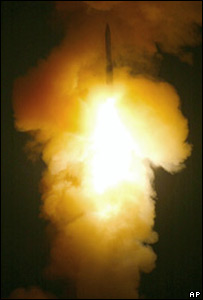
U.S. Missile Plan Worries Russians

QueEx

Rising Star
Super Moderator
<font size="5"><center>U.S. Missile Defense Plan Worries Russia</font size></center>

The Associated Press
Jan 26, 2007 5:25 AM (6 hrs ago)

MOSCOW - Russia on Friday harshly criticized U.S. plans to build missile defense sites in central Europe, shrugging off U.S. assurances that the installations would be meant to deal with a potential threat from Iran.


A statement from Foreign Ministry spokesman Mikhail Kamynin provided a detailed account of Russia's opposition to U.S. proposals to establish elements of its missile defense system in Poland and the Czech Republic - former Soviet satellites that are now NATO members.

"We believe that plans for the creation of a U.S. missile defense in Europe are a mistaken step with negative consequences for international security," Kamynin said.

He suggested Russia could seek to prevent it from happening through talks, saying it would be "a subject of serious analysis and discussion with the United States and its partners."

Kamynin echoed warnings by military officials that Moscow could take unspecified steps in response, saying that "such a base near our borders" would be a factor for Russia in plotting its military development and military ties with other nations.

A senior U.S. Defense official said Thursday that the proposed sites in Poland and the Czech Republic would not affect Russian security but will be designed to intercept missiles planned by Iran that would be capable of reaching Eastern Europe.

Lt. Gen. Henry A. Obering rejected Russian claims that the U.S. plan would upset the security balance, saying their scope would be insignificant compared with Russian capabilities.

Obering, speaking to reporters in a telephone briefing, said that while Iran poses no long-range threat to Eastern Europe today, "we have to stay ahead of what we think that threat is."

Russian opposition to the U.S. plans reflects persistent wariness about growing U.S. clout - both military and political - in former Warsaw Pact nations that have joined Cold War foe NATO and the European Union and ex-Soviet republics that are turning westward.

While Russia and the United States say they are working together to fight terrorism and weapons proliferation, Kamynin's statement also underscored the rift between the approaches of the two nations on the issue, specifically when it comes to Iran.

He said Russia believes that there are "more optimal" ways of dealing with the threat of the spread of weapons of mass destruction and the missiles or other means of their conveyance, "primarily based on working out multilateral political approaches."

http://www.examiner.com/a-530232~U_S__Missile_Defense_Plan_Worries_Russia.html
 
<font size="5"><center>Putin says U.S. wants to dominate world</font size></center>

Washington Post
By Louis Charbonneau
Reuters
Saturday, February 10, 2007; 6:02 PM

MUNICH, Germany (Reuters) - Russian President Vladimir Putin, in one of his harshest attacks on the United States in seven years in power, accused Washington on Saturday of attempting to force its will on the world.

The White House said it was "surprised and disappointed" by Putin's accusations but added Washington expected to continue to work with Moscow in areas such as counter-terrorism and reducing the spread and threat of weapons of mass destruction.

In a speech in Germany, which one U.S. senator said smacked of Cold War rhetoric, Putin accused the United States of making the world a more dangerous place by pursuing policies aimed at making it "one single master."

Attacking the concept of a "unipolar" world in which the United States was the sole superpower, he said: "What is a unipolar world? No matter how we beautify this term it means one single center of power, one single center of force and one single master."

"It has nothing in common with democracy because that is the opinion of the majority taking into account the minority opinion," he told the gathering of top security and defense officials.

"People are always teaching us democracy but the people who teach us democracy don't want to learn it themselves."

Gordon Johndroe, press secretary for the White House National Security Council, rejected Putin's comments.

"We are surprised and disappointed with President Putin's comments. His accusations are wrong," Johndroe said.

"We expect to continue cooperation with Russia in areas important to the international community such as counter-terrorism and reducing the spread and threat of weapons of mass destruction," he added.

INCREASING TENSIONS

The Kremlin has for several weeks been dropping hints that Putin, who steps down next year after two terms in power, was preparing a major foreign policy speech that would point the way for his successor.

Its delivery at the prestigious annual Munich meeting on security was clearly aimed at attracting maximum attention.

"The message I got from his speech was that Putin wants Russia to have the same position in the world as the former Soviet Union," a senior European official told Reuters.

Putin spoke against a background of increasing Russian agitation over U.S. policy on Iraq, and on the Iran and North Korea nuclear issues, as well as growing self-confidence as an emerging energy superpower.

U.S. plans to deploy parts of an anti-missile defense system in Poland and the Czech Republic have become a fresh irritant in U.S.-Russian relations. Washington says the system is needed for defense against rockets launched by Iran and North Korea -- an argument rejected by Moscow.

Russian Defense Minister Sergei Ivanov, who has been extremely critical of the U.S. anti-missile system, will address the conference on Sunday.

Putin said the United States had repeatedly overstepped its national borders in questions of international security, a policy that he said had made the world less, not more, safe.

"Unilateral actions have not resolved conflicts but have made them worse," Putin said, adding that force should only be used when backed by the UN Security Council.

"This is very dangerous. Nobody feels secure any more because nobody can hide behind international law," he said.

"ARMS RACE"

Putin also said the increased use of force was "causing an arms race with the desire of countries to get nuclear weapons." He did not name the countries.

Putin mentioned no specific conflicts. But he has been very critical of the U.S.-led invasion of Iraq in 2003, where U.S. soldiers are still struggling to crush an insurgency.

New Defense Secretary Robert Gates, the top American official at the conference, said Putin's comments were "interesting, very forthright."

U.S. Senator Joseph Lieberman said the speech was provocative and marked by "rhetoric that sounded more like the Cold War."

NATO Secretary-General Jaap de Hoop Scheffer said he was disappointed by Putin's statement that alliance enlargement was "a serious factor provoking reduced mutual trust."

"I see a disconnection between NATO's partnership with Russia as it has developed and Putin's speech," he said.

Kremlin spokesman Dmitry Peskov, however, denied the Russian president was trying to provoke Washington. "This is not about confrontation. It's an invitation to think," he told reporters.

(Additional reporting by Madeline Chambers, Mark John, Kristin Roberts in Munich and Caren Bohan in Washington)


http://www.washingtonpost.com/wp-dyn/content/article/2007/02/10/AR2007021000447.html
 
<font size="5"><center>Putin Accuses U.S. of Sparking Arms Race</font size></center>

Washington Post
By SLOBODAN LEKIC
The Associated Press
Sunday, February 11, 2007; 2:45 AM

MUNICH, Germany -- Russian President Vladimir Putin on Saturday blamed U.S. policy for inciting other countries to seek nuclear weapons to defend themselves from an "almost uncontained use of military force" _ a stinging attack that underscored growing tensions between Washington and Moscow.

"Unilateral, illegitimate actions have not solved a single problem, they have become a hotbed of further conflicts," Putin said at a security forum attracting senior officials from around the world.

"One state, the United States, has overstepped its national borders in every way."

The Bush administration said it was "surprised and disappointed" by Putin's remarks. "His accusations are wrong," said Gordon Johndroe, Bush's national security spokesman.

In what the Russian leader's spokesman acknowledged was his harshest criticism of the United States, Putin attacked Bush's administration for stoking a new arms race by planning to deploy a missile defense system in eastern Europe and for backing a U.N. plan that would grant virtual independence to Serbia's breakaway province of Kosovo.

Sen. John McCain, R-Ariz., who was also attending the conference, described Putin's remarks as "the most aggressive speech from a Russian leader since the end of the Cold War."

The United States and an increasingly assertive Russia repeatedly have butted heads during the past year, with Vice President Dick Cheney accusing Moscow of using its energy resources as "tools of intimidation or blackmail." Washington also has been angered by Russia's reluctance to impose meaningful sanctions against Iran, which is accused of seeking to develop nuclear weapons under the cover of a civilian atomic energy program.

But Putin said it was "the almost uncontained hyper use of force in international relations" that was forcing countries opposed to Washington to seek to build up nuclear arsenals.

"It is a world of one master, one sovereign ... it has nothing to do with democracy," he said. "This is nourishing the wish of countries to get nuclear weapons."

"This is very dangerous, nobody feels secure anymore because nobody can hide behind international law," Putin told the gathering.

Putin did not mention the wars in Iraq or Afghanistan, but he voiced concern about NATO's expansion plans as possible challenges to Russia.

"The process of NATO expansion has nothing to do with modernization of the alliance or with ensuring security in Europe," Putin said. "On the contrary, it is a serious factor provoking reduction of mutual trust."


http://www.washingtonpost.com/wp-dyn/content/article/2007/02/10/AR2007021000363.html
 
<font size="5"><center>Russia's Great-Power Strategy</font size></center>

STRATFOR
By George Friedman
February 13, 2007

Most speeches at diplomatic gatherings aren't worth the time it takes to listen to them. On rare occasion, a speech is delivered that needs to be listened to carefully. Russian President Vladimir Putin gave such a speech over the weekend in Munich, at a meeting on international security. The speech did not break new ground; it repeated things that the Russians have been saying for quite a while. But the venue in which it was given and the confidence with which it was asserted signify a new point in Russian history. The Cold War has not returned, but Russia is now officially asserting itself as a great power, and behaving accordingly.

At Munich, Putin launched a systematic attack on the role the United States is playing in the world. He said: "One state, the United States, has overstepped its national borders in every way ... This is nourishing an arms race with the desire of countries to get nuclear weapons." In other words, the United States has gone beyond its legitimate reach and is therefore responsible for attempts by other countries -- an obvious reference to Iran -- to acquire nuclear weapons.

Russia for some time has been in confrontation with the United States over U.S. actions in the former Soviet Union (FSU). What the Russians perceive as an American attempt to create a pro-U.S. regime in Ukraine triggered the confrontation. But now, the issue goes beyond U.S. actions in the FSU. The Russians are arguing that the unipolar world -- meaning that the United States is the only global power and is surrounded by lesser, regional powers -- is itself unacceptable. In other words, the United States sees itself as the solution when it is, actually, the problem.

In his speech, Putin reached out to European states -- particularly Germany, pointing out that it has close, but blunt, relations with Russia. The Central Europeans showed themselves to be extremely wary about Putin's speech, recognizing it for what it was -- a new level of assertiveness from an historical enemy. Some German leaders appeared more understanding, however: Foreign Minister Frank-Walter Steinmeier made no mention of Putin's speech in his own presentation to the conference, while Ruprecht Polenz, chairman of the Bundestag Foreign Affairs Committee, praised Putin's stance on Iran. He also noted that the U.S. plans to deploy an anti-missile shield in Poland and the Czech Republic was cause for concern -- and not only to Russia.

Putin now clearly wants to escalate the confrontations with the United States and likely wants to build a coalition to limit American power. The gross imbalance of global power in the current system makes such coalition-building inevitable -- and it makes sense that the Russians should be taking the lead. The Europeans are risk-averse, and the Chinese do not have much at risk in their dealings with the United States at the moment. The Russians, however, have everything at risk. The United States is intruding in the FSU, and an ideological success for the Americans in Ukraine would leave the Russians permanently on the defensive.

The Russians need allies but are not likely to find them among other great-power states. Fortunately for Moscow, the U.S. obsession with Iraq creates alternative opportunities. First, the focus on Iraq prevents the Americans from countering Russia elsewhere. Second, it gives the Russians serious leverage against the United States -- for example, by shipping weapons to key players in the region. Finally, there are Middle Eastern states that seek great-power patronage. It is therefore no accident that Putin's next stop, following the Munich conference, was in Saudi Arabia. Having stabilized the situation in the former Soviet region, the Russians now are constructing their follow-on strategy, and that concerns the Middle East.

The Russian Interests

The Middle East is the pressure point to which the United States is most sensitive. Its military commitment in Iraq, the confrontation with Iran, the Israeli-Palestinian conflict and oil in the Arabian Peninsula create a situation such that pain in the region affects the United States intensely. Therefore, it makes sense for the Russians to use all available means of pressure in the Middle East in efforts to control U.S. behavior elsewhere, particularly in the former Soviet Union.

Like the Americans, the Russians also have direct interests in the Middle East. Energy is a primary one: Russia is not only a major exporter of energy supplies, it is currently the world's top oil producer. The Russians have a need to maintain robust energy prices, and working with the Iranians and Saudis in some way to achieve this is directly in line with Moscow's interest. To be more specific, the Russians do not want the Saudis increasing oil production.

There are strategic interests in the Middle East as well. For example, the Russians are still bogged down in Chechnya. It is Moscow's belief that if Chechnya were to secede from the Russian Federation, a precedent would be set that could lead to the dissolution of the Federation. Moscow will not allow this. The Russians consistently have claimed that the Chechen rebellion has been funded by "Wahhabis," by which they mean Saudis. Reaching an accommodation with the Saudis, therefore, would have not only economic, but also strategic, implications for the Russians.

On a broader level, the Russians retain important interests in the Caucasus and in Central Asia. In both cases, their needs intersect with forces originating in the Muslim world and trace, to some extent, back to the Middle East. If the Russian strategy is to reassert a sphere of influence in the former Soviet region, it follows that these regions must be secured. That, in turn, inevitably involves the Russians in the Middle East.

Therefore, even if Russia is not in a position to pursue some of the strategic goals that date back to the Soviet era and before -- such as control of the Bosporus and projection of naval power into the Mediterranean -- it nevertheless has a basic, ongoing interest in the region. Russia has a need both to limit American power and to achieve direct goals of its own. So it makes perfect sense for Putin to leave Munich and embark on a tour of Saudi Arabia and other Persian Gulf countries.

The Complexities

But the Russians also have a problem. The strategic interests of Middle Eastern states diverge, to say the least. The two main Islamic powers between the Levant and the Hindu Kush are Saudi Arabia and Iran. The Russians have things they want from each, but the Saudis and Iranians have dramatically different interests. Saudi Arabia -- an Arab and primarily Sunni kingdom -- is rich but militarily weak. The government's reliance on outside help for national defense generates intense opposition within the kingdom. Desert Storm, which established a basing arrangement for Western troops within Saudi Arabia, was one of the driving forces behind the creation of al Qaeda. Iran -- a predominantly Persian and Shiite power -- is not nearly as rich as Saudi Arabia but militarily much more powerful. Iran seeks to become the dominant power in the Persian Gulf -- out of both its need to defend itself against aggression, and for controlling and exploiting the oil wealth of the region.

Putting the split between Sunni and Shiite aside for the moment, there is tremendous geopolitical asymmetry between Saudi Arabia and Iran. Saudi Arabia wants to limit Iranian power, while keeping its own dependence on foreign powers at a minimum. That means that, though keeping energy prices high might make financial sense for the kingdom, the fact that high energy prices also strengthen the Iranians actually can be a more important consideration, depending on circumstances. There is some evidence that recent declines in oil prices are linked to decisions in Riyadh that are aimed at increasing production, reducing prices and hurting the Iranians.

This creates a problem for Russia. While Moscow has substantial room for maneuver, the fact is that lowered oil prices impact energy prices overall, and therefore hurt the Russians. The Saudis, moreover, need the Iranians blocked -- but without going so far as to permit foreign troops to be based in Saudi Arabia itself. In other words, they want to see the United States remain in Iraq, since the Americans serve as the perfect shield against the Iranians so long as they remain there. Putin's criticisms of the United States, as delivered in Munich, would have been applauded by Saudi Arabia prior to the 2003 invasion of Iraq. But in 2007, the results of that invasion are exactly what the Saudis feared -- a collapsed Iraq and a relatively powerful Iran. The Saudis now need the Americans to stay put in the region.

The interests of Russia and Iran align more closely, but there are points of divergence there as well. Both benefit from having the United States tied up, militarily and politically, in wars, but Tehran would be delighted to see a U.S. withdrawal from Iraq that leaves a power vacuum for Iran to fill. The Russians would rather not see this outcome. First, they are quite happy to have the United States bogged down in Iraq and would prefer that to having the U.S. military freed for operations elsewhere. Second, they are interested in a relationship with Iran but are not eager to drive the United States and Saudi Arabia into closer relations. Third, the Russians do not want to see Iran become the dominant power in the region. They want to use Iran, but within certain manageable limits.

Russia has been supplying Iran with weapons. Of particular significance is the supply of surface-to-air missiles that would raise the cost of U.S. air operations against Iran. It is not clear whether the advanced S300PMU surface-to-air missile has yet been delivered, although there has been some discussion of this lately. If it were delivered, this would present significant challenges for U.S. air operation over Iran. The Russians would find this particularly advantageous, as the Iranians would absorb U.S. attentions and, as in Vietnam, the Russians would benefit from extended, fruitless commitments of U.S. military forces in regions not vital to Russia.

Meanwhile, there are energy matters: The Russians, as we have said, are interested in working with Iran to manage world oil prices. But at the same time, they would not be averse to a U.S. attack that takes Iran's oil off the market, spikes prices and enriches Russia.

Finally, it must be remembered that behind this complex relationship with Iran, there historically has been animosity and rivalry between the two countries. The Caucasus has been their battleground. For the moment, with the collapse of the Soviet Union, there is a buffer there, but it is a buffer in which Russians and Iranians are already dueling. So long as both states are relatively weak, the buffer will maintain itself. But as they get stronger, the Caucasus will become a battleground again. When Russian and Iranian territories border each other, the two powers are rarely at peace. Indeed, Iran frequently needs outside help to contain the Russians.

A Complicated Strategy

In sum, the Russian position in the Middle East is at least as complex as the American one. Or perhaps even more so, since the Americans can leave and the Russians always will live on the doorstep of the Middle East. Historically, once the Russians start fishing in Middle Eastern waters, they find themselves in a greater trap than the Americans. The opening moves are easy. The duel between Saudi Arabia and Iran seems manageable. But as time goes on, Putin's Soviet predecessors learned, the Middle East is a graveyard of ambitions -- and not just American ambitions.

Russia wants to contain U.S. power, and manipulating the situation in the Middle East certainly will cause the Americans substantial pain. But whatever short-term advantages the Russians may be able to find and exploit in the region, there is an order of complexity in Putin's maneuver that might transcend any advantage they gain from boxing the Americans in.

In returning to "great power" status, Russia is using an obvious opening gambit. But being obvious does not make it optimal.

Contact Us
Analysis Comments - analysis@stratfor.com


 
<font size="5"><center>Giants Meet to Counter US Power</font size>
<font size="4">India, China and Russia forming a partnership
to challenge the US-dominated world order </font size></center>

The Times (London
February 15, 2007

India, China and Russia account for 40 per cent of the world’s population, a fifth of its economy and more than half of its nuclear warheads. Now they appear to be forming a partnership to challenge the US-dominated world order that has prevailed since the end of the Cold War.

Foreign ministers from the three emerging giants met in Delhi yesterday to discuss ways to build a more democratic “multipolar world”.

It was the second such meeting in the past two years and came after an unprecedented meeting between their respective leaders, Manmohan Singh, Hu Jintao and Vladimir Putin, during the G8 summit in St Petersburg in July.

It also came only four days after Mr Putin stunned Western officials by railing against American foreign policy at a security conference in Munich.

The foreign ministers, Pranab Mukherjee, Li Zhao Xing and Sergei Lavrov, emphasised that theirs was not an alliance against the United States. It was, “on the contrary, intended to promote international harmony and understanding”, a joint communiqué stated.

Their formal agenda covered issues ranging from Iran, Iraq, Afghanistan, the Middle East and North Korea to energy security, nuclear non-proliferation and trade. The subtext, however, was clear: how to use their growing economic and political muscle to prevent Washington from tackling such issues alone.

“In the long term, they feel that the whole structure of international relations has to shift in their direction,” said Vinod C. Khanna, of the Institute of Chinese Studies, Delhi. “What has happened is that quite independently they’ve reacted very similarly to recent international events.”

Mr Mukherjee said: “We agreed that cooperation rather than confrontation should govern approaches to regional and global affairs. We also agreed on the importance of the UN.”

Diplomats say that it is premature to talk of a strategic axis between the world’s largest and two most populous nations because they still have more in common with the West than with each other.

Delhi was close to Moscow in Soviet times, but has forged a new friendship with Washington. Chinese relations were soured by its border wars with India in 1962 and the Soviet Union in 1969, and by its arms sales to Pakistan. Russia appears keener than China or India to challenge American hegemony. But there has been a convergence of interests as each struggles to make the transition from a command economy to free markets. Since 2003 they have found further common ground in opposing the US-led invasion of Iraq.

One area of agreement is opposition to outside interference in separatist conflicts in Chechnya, the northeast of India and the northwestern Chinese region of Xinjiang.

Another is energy. India and China are desperate for Russian oil and gas, and Moscow is worried about its dependence on Western markets. But their most significant common ground is opposition to US military intervention in Iran. The joint statement did not mention Iran, but the three countries have taken a common stance in calling for a negotiated solution through the International Atomic Energy Agency. None of them wants a nuclear-armed Iran, but Russia sells Tehran nuclear technology and India and China need Iranian gas.

http://www.timesonline.co.uk/tol/news/world/us_and_americas/article1386812.ece
 
<font size="4"><center>Russian ministry urges strategic security,
air defense agreements with U.S.</font size></center>


MOSCOW, March 27 (RIA Novosti) - Russia is seeking to secure agreements with the United States on controversial issues of strategic security, including plans to deploy air defense missiles in Central Europe, the Russian Foreign Ministry said Tuesday.

Russia, which has long been anxious about the opening of NATO bases in former Communist-bloc countries and ex-Soviet republics, strongly criticized recent U.S. plans to deploy an anti-ballistic missile system in Central Europe as a national security threat and a destabilizing factor for Europe.

"The appearance of a U.S. missile defense base in Europe would represent a reconfiguration of America's military presence in Europe and the formation of a strategic component that could negatively affect Russia's nuclear deterrent potential," the ministry said in its foreign policy overview, posted on its Web site.

Washington continues to insist that the proposed deployment of missile defense elements in Poland and the Czech Republic are intended to counter possible strikes from North Korea and Iran, which are involved in long-running disputes with the international community over their nuclear programs.

"The Americans are inducing some of their European NATO partners to unfold a multilayered air defense system in Europe as an integral part of their global air shield," the ministry said.

The ministry said the U.S. military build-up - opening anti-ballistic missile bases in Alaska and California and plans to establish another in Central Europe - represented consequences of the country's withdrawal from the restrictive Anti-Ballistic Missile Treaty in 2002.

The U.S. aroused further security concerns in Russia in early March when a senior Pentagon official said Washington would like to station a radar base in the Caucasus.

The document recommends that agreements be secured with the U.S. on further effective limitations of strategic offensive arms and strategic security issues that Moscow and Washington have substantial differences on.

http://en.rian.ru/russia/20070327/62693533.html
 
Aren't the three countries (USA, Russia & China) always
gearing up for war or the prevention of war between
them by being militarily prepared, for either ???

QueEx
 
U know what gets me about russia.

They have a terrorism problem also. Hell the major countries "india, russia, china, and the US* have/will deal with terrorism in the near future. Its in a matter of time before the jihad comes on China's door. So why are we having this debate about Iran *a known terrorism supporting country*?

I honestly believe that Putin *former KGB member* is out to get us because of Afghanistan during the 80's. If so, this will be a long conflict...
 
QueEx said:
Aren't the three countries (USA, Russia & China) always
gearing up for war or the prevention of war between
them by being militarily prepared, for either ???

QueEx


I really can't see why the USA would be steeping on any toes in China seeing as how they need us for economic growth and we need them for slave labor and the fact that they own a lot of us debt.

And Russia I can't see how we view them as a threat right now due to them trying to rebuild their economy through oil.

This missle shield indicates that something major is about to happen that might trigger icbms being involved which I really didn't think what happen due to the fact that everyone will be destroyed if it comes down to icbms.
 
<font size="5"><center>Russia threatening new cold war
over missile defence</font size>

<font size="4">Kremlin accuses US of deception on east European interceptor bases </font size></center>

The Guardian
Luke Harding in Moscow
Wednesday April 11, 2007


Russia is preparing its own military response to the US's controversial plans to build a new missile defence system in eastern Europe, according to Kremlin officials, in a move likely to increase fears of a cold war-style arms race.
The Kremlin is considering active counter-measures in response to Washington's decision to base interceptor missiles and radar installations in Poland and the Czech Republic, a move Russia says will change "the world's strategic stability".

The Kremlin has not publicly spelt out its plans. But defence experts said its response is likely to include upgrading its nuclear missile arsenal so that it is harder to shoot down, putting more missiles on mobile launchers, and moving its fleet of nuclear submarines to the north pole, where they are virtually undetectable.
Russia could also bring the new US silos within the range of its Iskander missiles launched potentially from the nearby Russian enclave of Kaliningrad, they add.

In an interview with the Guardian, the Kremlin's chief spokesman, Dmitry Peskov, said Moscow felt betrayed by the Pentagon's move. "We were extremely concerned and disappointed. We were never informed in advance about these plans. It brings tremendous change to the strategic balance in Europe, and to the world's strategic stability."

He added: "We feel ourselves deceived. Potentially we will have to create alternatives to this but with low cost and higher efficiency." Any response would be within "existing technologies", he said. As well as military counter-measures, Russia's president, Vladimir Putin, also wanted "dialogue" and "negotiations", he added.

The Bush administration says the bases are designed to shoot down rogue missiles fired by Iran or North Korea. Its proposed system would be helpless against Russia's vast nuclear arsenal, it says.

But this claim has been greeted with widespread incredulity, not just in Russia but also among some of the US's nervous Nato allies. They include Germany, where the Social Democrat leader, Kurt Beck, warned last month that the US and Russia were on the brink of another arms race "on European soil".

Defence experts say there is little doubt that the real target of the shield is Russia. "The geography of the deployment doesn't give any doubt the main targets are Russian and Chinese nuclear forces," General Vladimir Belous, Russia's leading expert on anti-ballistic weaponry, told the Guardian. "The US bases represent a real threat to our strategic nuclear forces."

The threat of a new arms race comes at a time when relations between Russia and the US are at their worst for a decade. In February Mr Putin accused the Bush administration during a speech in Munich of seeking a "world of one master, one sovereign". On Friday Russia's duma, or lower house or parliament, warned that the US's plans could ignite a second cold war. "Such decisions, which are useless in terms of preventing potential or imaginary threats from countries of the middle and far-east, are already bringing about a new split in Europe and unleashing another arms race," the declaration - passed unanimously by Russian MPs - said.

The same day Russia ruled out cooperating with the US over the shield. "Despite certain signals received in recent days from the US side ... I see no political foundation for it," said Sergei Ryabkov, a foreign ministry spokesman. Moscow now had little choice but to take the bases "into account in our strategic planning", he said.

Analysts said there was a common feeling in Russia that the US had reneged on an agreement after the collapse of the Soviet Union to abandon cold war politics. "Cold war thinking has prevailed, especially on the western side," Yevgeny Myasnikov, a senior research scientist at Moscow's Centre for Arms Control, told the Guardian. "Russia has been deeply disappointed by what has happened after 1991. Nato started to expand, and the US started to think it had won the cold war. We had hoped for a partnership. But it didn't happen."


http://www.guardian.co.uk/russia/article/0,,2054142,00.html
 
US conciliatory over missile plan

_42634003_usmissile203x300ap.jpg

The US wants to place missile
defence bases in eastern Europe

BBC News
By Jonathan Beale
BBC News, Washington
October 6, 2007

The United States has proposed working with Nato and Russia in an attempt to allay Moscow's objections to its missile defence shield.

US Secretary of State Condoleezza Rice and Defence Secretary Robert Gates will travel to Moscow next week to discuss America's controversial defence system.

The US wants to place missile defence bases in eastern Europe to intercept any threat from so-called rogue states.

Russia opposes the move, saying it could threaten its own defences.

Before Condoleezza Rice and Robert Gates set out for Moscow, Washington has adopted a conciliatory tone.

Assistant Secretary of State Daniel Fried said the solution was that the US worked with Nato and Russia to produce a common system of missile defence that would benefit everyone's security while addressing Russia's concerns.

He added that if Russia cooperated, then they would be more confident that missiles were not directed against them.

However, Mr Fried repeated that Poland and the Czech Republic were ideal sites for the missile defence shield, making it difficult to see how Moscow's objections will be addressed.

Strains between Moscow and Washington are not confined to the missile defence shield.

Russian President Vladimir Putin has said Russia will pull out of an arms treaty that limits the deployment of conventional forces by Nato and Warsaw Pact countries.

Nor has Moscow lifted its objections to Kosovo's independence.

The US says Kosovo's unresolved status must be decided by the end of the year.

http://news.bbc.co.uk/1/hi/world/europe/7031155.stm
 
U.S. might delay missile defense in Europe

Associated Press
Oct 23, 2007

PRAGUE, Czech Republic - The United States might delay activating its proposed missile defense sites in Europe until it has “definitive proof” of a missile threat from Iran, Defense Secretary Robert Gates said Tuesday.

FULL ARTICLE: http://www.msnbc.msn.com/id/21433494/

`
 

The Russians have adamantly opposed the U.S. plan for European missle sites.


  • Is Gates statement above a sign that the U.S. is beginning to blink ???

  • Or, is this the beginning of a confession by the Bush administration that the
    Iranians are not building or trying to acquire nuclear weapons ???

QueEx
 

The Russians have adamantly opposed the U.S. plan for European missle sites.


  • Is Gates statement above a sign that the U.S. is beginning to blink ???

  • Or, is this the beginning of a confession by the Bush administration that the
    Iranians are not building or trying to acquire nuclear weapons ???

QueEx
Condi Rice, and all her expertise, is worth about 36 cents. She advised Gates and Bush wrong. But that is not fair because they were moving ahead with the missiles without her. Russia is not down with missiles in their back yard nor should they have ever expected to be. F*** that "I looked into his soul" BS Bush said. Russia does not want our weapons close to them like we did not want theirs in Cuba in the 60's. It's not rocket science. Gates is easing up - a bit - becasue Putin is talking big smack in the press and to Iran. They are not enemies. The US and Iran are.

2. I think you need a nap my friend. To even suggest that this administration would "confess" anything - especially a fault - is a clear sign that you are not feeling well.:D 4real though, EVERYONE, internationally, knows that Iran is not close to making a weapon.

Follow the deception. We must deal with Iran because:

a. They are providing IED's to Iraq/killing soldiersFact: Sunni fighers, backed by SAUDI ARABIA, killed most of our troops.

b. They are close to getting a nuke.
FAct: They are at the begining stages of stabilizing nuclear material. The program is not operational and won't be for YEARS.

c. They are sponsoring terror
FACT: Who isn't according to Bush. The kyl-Lieberman Amendment isolated a faction of the Iranian GOVERNMENT as a terrorist group. WE are in a war agains TERROR so Congress gave him a back door.

d. NOW THE NEW ONE:

If Iran is seeking to "gain the knowledge" of how to build a nuke then they are in trouble.
Seeking the KNOWLEDGE - WTF?!?!?!?!?!?!?!?

Bush, backed by Cheney and PNAC are going to ruin the US.


WHERE THE F*** IS CONGRESS WITH ALL THIS WARMONGERING GOING ON?!?!?!?!? :confused: I DON'T HEAR ANYONE ON THE DEM SIDE BLASTING BUSH ON THIS. :angry: THIS MEANS OBAMA TOO! THIS IS FOREIGN POLICY SUICIDE. :smh:
 
when has bush's awful diplomat squad ever NOT blinked? only when up against a non-nuclear opponent - aka iraq and iran

You think people didnt see that North Korea thing? They blew up one nuke and how long afterward was there a deal on the table from the US? :hmm:
pure bitch shit from Bush

Bush would fuck around and surrender the whole nation under the right circumstances. He's 99% bluff.
 
nyyyyce said:
. . . EVERYONE, internationally, knows that Iran is not close to making a weapon.
Not everyone, internationally, knows what the fuck, if anything, Iran is up to. We could trade articles and sources all day that will differ on what Iran is trying to do. In the end, I doubt anyone knows for sure. I note too, that while playing the shit out of the situation, the Russians appear to have some concern, as well.

QueEx
 
U.S. Looks for Way to End Missile Plan,
Russian Lawmaker Says​

By Michael Heath

Oct. 24 (Bloomberg) -- A U.S. offer to delay activating its proposed missile defense system in eastern Europe may be the start of an effort to back out of the program, Russian lawmaker Konstantin Kosachyov said.

``White House strategists are starting to understand the widespread international aversion to U.S. plans and are looking for a way out,'' state television channel Vesti cited Kosachyov, the head of the International Affairs Committee in the Russian Parliament, as saying yesterday.

Defense Secretary Robert Gates said earlier yesterday in Prague the U.S. will build its missile shield, adding it may delay its operations until there is ``concrete proof'' of a threat from Iran, such as a missile test.

Russia sees U.S. plans to deploy 10 interceptor missiles in Poland and a radar base in the Czech Republic as an effort to neutralize its nuclear deterrent. It proposed that the U.S. use a Soviet-era radar base in Azerbaijan, which borders Iran. The U.S. said the station isn't technologically advanced enough.

Gates said that during a visit with Secretary of State Condoleezza Rice to Moscow on Oct. 12 they suggested the U.S. may allow ``a Russian presence'' at the Czech base to increase the ``transparency'' of the project.

``We continue to encourage the Russians to partner with us in the missile defense and continue our efforts to reassure them that these facilities are not aimed at Russia,'' Gates said yesterday.

Gates's statement is ``only a first step in the right direction, because the call on Russia for cooperation is unclear and impractical,'' Vesti cited Kosachyov as saying on its Web site. ``We don't understand it, bearing in mind that our country has repeatedly put forth its plans for cooperation.''

The Russian government hasn't responded to Gates's comments.


To contact the reporter on this story: Michael Heath in Sydney at mheath1@bloomberg.net .

http://www.bloomberg.com/apps/news?pid=20601103&sid=aFxKfT8WxNrA&refer=us
 
Not everyone, internationally, knows what the fuck, if anything, Iran is up to. We could trade articles and sources all day that will differ on what Iran is trying to do. In the end, I doubt anyone knows for sure. I note too, that while playing the shit out of the situation, the Russians appear to have some concern, as well.

QueEx
Everyone that matters: Germany, Russia, China, France (even though the newly elected guy there is kissing Bush's @$$), the UK. All the industrialized countries know because there has to be a certain amount of resources, technology, scientist and nuclear material available to create the weapons. Former weapons inspectors know about Iran's current nuclear capabilities:


[FLASH]http://youtube.com/watch/v/XctgkYj5aVk[/FLASH]


So there is not need to article swap.

Iran is too far behind to be considered a threat. Did you see the article posted on this board aabout the banks in Iran getting rid of all their US cuurency? It's not about nukes. It's the PNAC doctrine - new imperialism.

Back in 1953, when the world was a lot larger - infowise - the US lead a coup in Iran. That was small. Now we are telling countries we will invade. It has and always will be, under this administration, regime change for "America's best interest".
 
Last edited:
Not everyone, internationally, knows what the fuck, if anything, Iran is up to. We could trade articles and sources all day that will differ on what Iran is trying to do. In the end, I doubt anyone knows for sure. I note too, that while playing the shit out of the situation, the Russians appear to have some concern, as well.

QueEx
:hmm: sounds like some argument from about 4 years ago
 
So, you're telling me that the 'one's that matter' are Germany, Russia, China and backtracking France ??? Maybe I have misread, but Germany seems not to agree with you:
German govt calls for united international stance on Iran nuclear file
Submitted by Mudassir Rizwan on Fri, 10/19/2007 - 06:56. International
By NNN-KUNA

Berlin, Germany : Germany stressed anew on Thursday that a united international stance must be taken towards the Iranian nuclear file.

Spokesman for the German government Ulrich Wilhelm said that Germany expected that Russia and China would continue supporting western countries in the quest to find suitable solutions to the Iranian program' controversies.

Wilhelm also said that Germany was disappointed with China's absence from the Berlin meeting last Monday of UNSC veto powers and Germany regarding the Iranian dossier.

Germany's Chancellor Angela Merkel warned Iran last Monday that strict sanctions would be imposed on the country if Tehran continued to defy the International community and fail to stop its erichment activities.http://www.indianmuslims.info/news/...d_international_stance_iran_nuclear_file.html
Doesn't seem to me Germany is so certain.

That leaves Russia and China. Now, I'm certainly not saying the Bush Administration is right but, are you telling me we should cede the whole "things that matter" to Russia and China, both of which have their own respective interests to protect (which interests are hardly the same as ours) ???

Is that what you're telling me ???

QueEx
 
So, you're telling me that the 'one's that matter' are Germany, Russia, China and backtracking France ??? Maybe I have misread, but Germany seems not to agree with you:
German govt calls for united international stance on Iran nuclear file
Submitted by Mudassir Rizwan on Fri, 10/19/2007 - 06:56. International
By NNN-KUNA

Berlin, Germany : Germany stressed anew on Thursday that a united international stance must be taken towards the Iranian nuclear file.

Spokesman for the German government Ulrich Wilhelm said that Germany expected that Russia and China would continue supporting western countries in the quest to find suitable solutions to the Iranian program' controversies.

Wilhelm also said that Germany was disappointed with China's absence from the Berlin meeting last Monday of UNSC veto powers and Germany regarding the Iranian dossier.

Germany's Chancellor Angela Merkel warned Iran last Monday that strict sanctions would be imposed on the country if Tehran continued to defy the International community and fail to stop its erichment activities.http://www.indianmuslims.info/news/...d_international_stance_iran_nuclear_file.html
Doesn't seem to me Germany is so certain.

That leaves Russia and China. Now, I'm certainly not saying the Bush Administration is right but, are you telling me we should cede the whole "things that matter" to Russia and China, both of which have their own respective interests to protect (which interests are hardly the same as ours) ???

Is that what you're telling me ???

QueEx


I am a little confused about your stance on this. Why is it that you make NO mention in your retort about the accredited and authoritive weapons inspector in the video I posted. :hmm: You don't ask who he is, why does he know so much, if what he is sayiing is true the... - NOTHING. Didn't you write: "Not everyone, internationally, knows what the fuck, if anything, Iran is up to". I show you that someone DOES KNOW WTF IRAN IS DOING and you shift the debate... Typical. The world has youtube. If I know this info then there are others. Unlike the sorry Dem's - that S*** does not fly with me. :smh:

You pick Germany, one of the coalition NON-willing, to refute me?!?!? C'mon man. :smh: What Germany is saying now is the standard rhetoric.

Man, I gave you a lot of credit before reading this post. You are quick to point out China and Russia's interests, but what about OURS?!?!?!?!? What was our purpose for the coup in Iran in 1953 - OIL! Why, with no nukes, no WMD's, not being greeted as liberators, not having the oil fund the war did we invade Irag - OIL!!!!! Why is Chavez an enemy of the US - OIL (rumored to have more reserves than Saudi Arabia).

Until somebody can tell me what PNAC's view of the America's role is in foreign policy/their vision, it will be impossible to have a real conversation with anyone on our current foreign policy stance.

You all think that these events are deveoping spontaneously - THEY ARE NOT!!!!! If the mission of PNAC is regime change abroad to secure America as the lone superpower, and anything less is not acceptable, lies will be said (WMD's), information twisted (Saddam and al Qaeda were responsible for the 911 attacks), and legislation passed (Kyl-Liberman Amendment) to achieve the goal!


Damn wake up!!!
 
Last edited:
I will read all that you've written and I will view the video that you edited in after I had completed my reply. In the meantime, please drop all the damn caps and emotionalism. If you make a point that I agree or disagree with, I'll let you know. The large fonts add absolutely nothing to the truth or veracity of your points. I surmise that you are passionate about your thoughts and these issues, nevertheless, there's just no need to get overly emotional.

I'll read and view as I said. Thank you very much.

QueEx
 
I will read all that you've written and I will view the video that you edited in after I had completed my reply. In the meantime, please drop all the damn caps and emotionalism. If you make a point that I agree or disagree with, I'll let you know. The large fonts add absolutely nothing to the truth or veracity of your points. I surmise that you are passionate about your thoughts and these issues, nevertheless, there's just no need to get overly emotional.

I'll read and view as I said. Thank you very much.

QueEx
I do appologize for the written theatrics. But when I write my responses in normal font, people, like you did in this case, totally ignore my response to their question and then shift into a side debate. Never stopping to at least to acknowledge the point I am making so that an actual discussion or change in perspective can occur.

More over, when I saw that you used profanity in your respnse to my non-capped retorts I felt the need to escalate in turn ("Not everyone, internationally, knows what the fuck, if anything, Iran is up to. We could trade articles and sources all day..."). You got my attention I got yours. We're even. :D

Now that that is out of the way, please do read up on PNAC and then you can get a better grasp of how foreign poicy is being molded to a script. Nothing is accidental or spontaneous.


Peace
 
Brother, I know all about PNAC. I just don't have time to pen a response, at this time. Its late and I'm putting the final touches on a brief that I am filing with the state supreme court in the morning. I've only stuck my head in to take a break, but not to write a reasoned response.

QueEx
 
I am a little confused about your stance on this.
Did I give you my stance, on this? I questioned and rebutted your "everyone that matters" theory. Except for Russia and China, the other entities you named have not conclusively decided the issue in Iran's favor.

nyyyyce said:
Why is it that you make NO mention in your retort about the accredited and authoritive weapons inspector in the video I posted. :hmm: You don't ask who he is, why does he know so much, if what he is sayiing is true the... -
First, you edited your post and added that video AFTER I had posted a reply. Secondly, I didn't need to ask you any questons about who the guy in the video clip was -- I know who Scott Ritter is and I can appreciate Scotts "arguments" on the ineptness of the Bush Administration. In fact, I agree with Ritter, especially when he says, don't make the same mistake with Iran that was made with Iraq: listen to the Inspectors. I have lots of respect for Ritter's opinions but I also know that Ritter has not been on the ground in Iran nor has he personally conducted any inspections in Iran relating to the current controversy.

Next time, how about sticking to what I said and don't try cheap tricks like posting something you believe to be dispositive, AFTER someone replies, and then ask nefarious questions as if other people lack your insight.


nyyyyce said:
I show you that someone DOES KNOW WTF IRAN IS DOING and you shift the debate... Typical. The world has youtube. If I know this info then there are others. Unlike the sorry Dem's - that S*** does not fly with me. :smh:
(1) I've already said that I know and respect Scott Ritter; BUT, Scott Ritter is not and has not been in Iran. Again, I appreciate his insight, but it is mere OPINION unsubstantiated by his personal knowledge of the subject.

(2) I didn't shift the debate. You said certain countries who were "in the know" held opinions that all is well in Iran. I simply offered counter evidence to that and asked: do you want to rely upon Russia and China. You have yet to respond, in kind.

nyyyyce said:
Man, I gave you a lot of credit before reading this post. You are quick to point out China and Russia's interests, but what about OURS?!?!?!?!?
Every nation has interests. Every. Every nation looks out for its own self interest. Some nations join with other nations in pursuit of its national interest. Every nation has as one of its goals the notion of peace. Nevertheless, every nation competes for scarce resources, including OIL. No nation is WILLING to allow any other nation to control those resources, especially to its exclusion; but, that WILL is only as strong as it is capable of enforcing, hence, the ever present possibility of war.

I don't live in those other nations. I am concern with the interests and well being of me and mine in these United States. I don't want my government, acting by and through the sane, insane or the incredulously stupid, to do things that unnecessarily causes harm or hardship upon others. At the same time, I do expect my government to act prudently to protect OUR INTERESTS.


You all think that these events are deveoping spontaneously - THEY ARE NOT!!!!! If the mission of PNAC is regime change abroad to secure America as the lone superpower, and anything less is not acceptable, lies will be said (WMD's), information twisted (Saddam and al Qaeda were responsible for the 911 attacks), and legislation passed (Kyl-Liberman Amendment) to achieve the goal!
Stop ASSUMING we are ignorant. STOP. Your statement above comes off just that way - - as if we know nothing about the PNAC, its missions, its cronies, etc. I think if you read other threads/posts on this board you might discover that we're not as ignant (lol) as you would have us to be.

QueEx
 
Did I give you my stance, on this? I questioned and rebutted your "everyone that matters" theory. Except for Russia and China, the other entities you named have not conclusively decided the issue in Iran's favor.


First, you edited your post and added that video AFTER I had posted a reply. Secondly, I didn't need to ask you any questons about who the guy in the video clip was -- I know who Scott Ritter is and I can appreciate Scotts "arguments" on the ineptness of the Bush Administration. In fact, I agree with Ritter, especially when he says, don't make the same mistake with Iran that was made with Iraq: listen to the Inspectors. I have lots of respect for Ritter's opinions but I also know that Ritter has not been on the ground in Iran nor has he personally conducted any inspections in Iran relating to the current controversy.

Next time, how about sticking to what I said and don't try cheap tricks like posting something you believe to be dispositive, AFTER someone replies, and then ask nefarious questions as if other people lack your insight.


(1) I've already said that I know and respect Scott Ritter; BUT, Scott Ritter is not and has not been in Iran. Again, I appreciate his insight, but it is mere OPINION unsubstantiated by his personal knowledge of the subject.

(2) I didn't shift the debate. You said certain countries who were "in the know" held opinions that all is well in Iran. I simply offered counter evidence to that and asked: do you want to rely upon Russia and China. You have yet to respond, in kind.


Every nation has interests. Every. Every nation looks out for its own self interest. Some nations join with other nations in pursuit of its national interest. Every nation has as one of its goals the notion of peace. Nevertheless, every nation competes for scarce resources, including OIL. No nation is WILLING to allow any other nation to control those resources, especially to its exclusion; but, that WILL is only as strong as it is capable of enforcing, hence, the ever present possibility of war.

I don't live in those other nations. I am concern with the interests and well being of me and mine in these United States. I don't want my government, acting by and through the sane, insane or the incredulously stupid, to do things that unnecessarily causes harm or hardship upon others. At the same time, I do expect my government to act prudently to protect OUR INTERESTS.


Stop ASSUMING we are ignorant. STOP. Your statement above comes off just that way - - as if we know nothing about the PNAC, its missions, its cronies, etc. I think if you read other threads/posts on this board you might discover that we're not as ignant (lol) as you would have us to be.

QueEx


First off my friend, Professor Moriarty is “nefarious”. :hmm: I just happened to have an additional comment to make so I edited it when it struck me. It was not intended to trap you or be an indictment of anyone’s lack of insight. Now to the post...


"Every nation has interests. Every. Every nation looks out for its own self interest. Some nations join with other nations in pursuit of its national interest. Every nation has as one of its goals the notion of peace. Nevertheless, every nation competes for scarce resources, including OIL. No nation is WILLING to allow any other nation to control those resources, especially to its exclusion; but, that WILL is only as strong as it is capable of enforcing, hence, the ever present possibility of war.

I don't live in those other nations. I am concern with the interests and well being of me and mine in these United States. I don't want my government, acting by and through the sane, insane or the incredulously stupid, to do things that unnecessarily causes harm or hardship upon others. At the same time, I do expect my government to act prudently to protect OUR INTERESTS".[/
COLOR]


From Wiki regarding Irans early nuclear exploits


"President Gerald Ford signed a directive in 1976 offering Tehran the chance to buy and operate a U.S.-built reprocessing facility for extracting plutonium from nuclear reactor fuel. The deal was for a complete 'nuclear fuel cycle'."[14] At the time, Richard Cheney was the White House Chief of Staff, and Donald Rumsfeld was the Secretary of Defense. The Ford strategy paper said the "introduction of nuclear power will both provide for the growing needs of Iran's economy and free remaining oil reserves for export or conversion to petrochemicals."

Iran, a U.S. ally then, had deep pockets and close ties to Washington. U.S. and European companies scrambled to do business there.[15]


http://en.wikipedia.org/wiki/Nuclear_program_of_Iran


In 70’s under Dick’s watch it was OK for Iran to gain the knowledge about nuclear because it was in "our interest". I define “interest” as we installed a puppet leader and he had enough loot to pay us for our technology. What would you define interest as given this fact Que? :hmm:


Now 2007, it’s NOT in "our interest" to have Iran have nuclear knowledge to the point that we threaten a conflict that “could” be the spark that ignites WWIII? The same man who led the charge for it then is now telling the public that Iran gaining nuclear knowledge is the most catastrophic event that could ever happen. :smh: Does anyone see the conflict and absurdity of this but me?

I would argue no. Or rather, not many people do. This fact is not on the news nightly. It’s not reported on in any of the major news papers. It will not get any traction until AFTER we take military action like with Cheney’s long-delayed “invading Iraq would be a ‘quagmire’” video footage. I am not an elitist. I do not think everyone here is ignorant either. I can look the number of times a porn post is view vs. a politics post and see where the interest is.

There is a difference between being a patriot and blind patronage. I talk to too many people, like you and others who are very idealistic and want to have faith that the government is working for us. There are too many intellectuals that somehow rationalize this administration is 1. Creating an “Evolving” foreign policy. 2. Interaction globally in the “best” interest of the US. Nothing could be further from the truth. They roll out story after story and they are given the benefit of the doubt - instead of being doubted first. They have ZERO credibility. The Iraqi oil is NOT funding this war. There is going to be a projected debt of 2.4 trillion dollars over this war?!?!? We are already in the hole $9 trillion dollars.


"Stop ASSUMING we are ignorant. STOP. Your statement above comes off just that way - - as if we know nothing about the PNAC, its missions, its cronies, etc. I think if you read other threads/posts on this board you might discover that we're not as ignant (lol) as you would have us to be."

OK, if people DO know about PNAC, it’s cronies, it’s missions etc then help me with this. In PNAC’s Rebuilding America's Defenses: Strategies, Forces, and Resources For a New Century, after its title page, the report features a page entitled "About the Project for the New American Century", there is a "Statement of Principles":

“[What we require is] a military that is strong and ready to meet both present and future challenges; a foreign policy that boldly and purposefully promotes American principles abroad; and national leadership that accepts the United States’ global responsibilities.

Of course, the United States must be prudent in how it exercises its power. But we cannot safely avoid the responsibilities of global leadership of the costs that are associated with its exercise. America has a vital role in maintaining peace and security in Europe, Asia, and the Middle East. If we shirk our responsibilities, we invite challenges to our fundamental interests.”

The PNAC Four core Missions of the military are to:

• defend the American homeland;
• fight and decisively win multiple, simultaneous major theater wars;
• perform the “constabulary” duties associated with shaping the security environment in critical regions;
• transform U.S. forces to exploit the “revolution in military affairs”;


The goals are to:


* MODERNIZE CURRENT U.S. FORCES SELECTIVELY, proceeding with the F-22 program while increasing purchases of lift, electronic support and other aircraft; expanding submarine and surface combatant fleets; purchasing Comanche helicopters and medium-weight ground vehicles for the Army, and the V-22 Osprey “tilt-rotor” aircraft for the Marine Corps.
* CANCEL “ROADBLOCK” PROGRAMS such as the Joint Strike Fighter, CVX aircraft carrier,[24] and Crusader howitzer system that would absorb exorbitant amounts of Pentagon funding while providing limited improvements to current capabilities. Savings from these canceled programs should be used to spur the process of military transformation.

*DEVELOP AND DEPLOY GLOBAL MISSILE DEFENSES to defend the American homeland and American allies, and to provide a secure basis for U.S. power projection around the world.[25]
CONTROL THE NEW “INTERNATIONAL COMMONS” OF SPACE AND “CYBERSPACE,” and pave the way for the creation of a new military service – U.S. Space Forces – with the mission of space control.
*EXPLOIT THE “REVOLUTION IN MILITARY AFFAIRS” to insure the long-term superiority of U.S. conventional forces...."


So if they already have a mission statement/agenda that states that a global missle defense system IS A PRIORITY where does the deplomacy part come in? It doesn't. We tell the world what we want- they cave in. Is that in our "best interest" Que? :confused:

The people who are behind PNAC are running our foreign policy then does it matter if we piss Russia off? Does it matter that we invade Iraq? Does it matter that we pick a fight with Iran? No. By doing ANY of those things, does it make us stronger? I would argue that se look less credible, we incite international hostilities towards us, we stretch our military to the breaking point and our global position as a leader gets destroyed. Is any of the consequences we have heaped upon us thus far been in our best interest – no.

Like I’ve been saying, if it our mission, according to PNAC, to get these bases done then we have already assumed that no matter how Russia feels we have silo’s to build. Is Gates softening his stance on the missiles? He has to publicly, but he is not surprised nor is Condi. It’s all a show. That is the part that pisses me off because it was scripted to transpire like this 10 years ago when they concocted this manifesto. They knew the repercussions and ramifications, but news reports come out now to present information like these tensions and hostilities were unexpected?!?

If people ACTUALLY knew this about PNAC would we really be having this particular debate? Nope. There would be more rage and angst than speculation and contemplation.

I will hit you on the other stuff later. I know Colin Powell is about to appear….

:D
 
Last edited:
<font size="5"><center>U.S. missile defense cannot
affect Russia nuclear capability-Rice</font size></center>


65428357.jpg


RIA Novosti
Russian News and Information Agency
02/ 02/ 2008

WASHINGTON, February 2 (RIA Novosti) - The U.S. missile defense system in Europe is meant to deal with limited threats and cannot degrade the thousands of nuclear warheads Russia has, the U.S. secretary of state said.

Condoleezza Rice said the missile defense plan has nothing to do the strategic defense initiative (SDI) that "the United States once had."

"This is not that program. This is not the son of that program. This is not the grandson of that program. This is a very different program that is meant to deal with limited threats," she said at a press conference after a meeting with Polish Foreign Minister Radoslaw Sikorski.

"There is no way that a few interceptors in Poland and radars in the Czech Republic can degrade the thousands of nuclear warheads that the Russians have and there is no intent to do so," she said.

Rice said Russia and the United States are faced with the same threats, and cooperation in missile defense is vital for both "in a completely different environment."

"We are having discussions with the Russians that President Putin and President Bush have wanted to go ahead about how we can cooperate in missile defense because the Russians face some of the same threats; how can we talk about joint threat assessment, how can we talk about a system that would take advantage of the full geography so that we could have a way to counter these 21st century threats," she said.

Sikorski said Friday Warsaw and Washington had agreed in principle on the deployment of a U.S. missile defense base on Polish territory.

Poland is demanding security guarantees from the United States as part of a deal to install 10 interceptors in Poland at talks in the U.S. this week.

The U.S. plans to deploy elements of its missile defense shield in Poland and the Czech Republic citing a threat from Iran. Russia has fiercely opposed the plans threatening to retarget nuclear missiles at the two countries.


http://en.rian.ru/world/20080202/98230611.html
 
<font size="5"><center>Putin accuses U.S. of setting off 'new arms race' </font size><font size="4">
Says Russia will field new weapons in response to missile defense system</font size></center>


080208-putin-vmed-711p.widec.jpg

Russian President Vladimir Putin speaks during
the State Council session in Moscow's Kremlin,
Feb. 8.


Washington Post
By Peter Finn
Feb. 8, 2008

MOSCOW, Feb. 8 - President Vladimir Putin said Friday that "a new arms race has been unleashed in the world" as the United States moves forward with a missile defense system in Eastern Europe. Russia will field new weapons in response, he said, dismissing American assurances that the missile system is not directed against Russia as nothing more than "diplomatic cover."

"It's not our fault. We didn't start it ... funneling multibillions of dollars into developing weapons systems," Putin declared in what may be his final major address before he leaves the Kremlin after presidential elections March 2, to become prime minister.

"Russia has and always will have a response to these new challenges," Putin declared. "Over the next few years, Russia will start production of new types of arms, with the same or even superior specifications compared to those available to other nations."

He said, however, that military spending should not come at the cost of the country's economic and social development.

Putin was addressing Russia's State Council, a gathering of ministers, regional governors and members of parliaments. Among those watching in the chandeliered St. George's Hall was Dmitry Medvedev, Putin's chosen successor, who is projected to coast to easy victory in next month's vote. His most vocal opponent, former prime minister Mikhail Kasyanov, has been barred from running.

Medvedev has struck a milder tone than his boss in recent speeches and has avoided any rhetorical assaults on the West. He cut some anti-Western flourishes from a recent speech prepared by his staff, according to a report in Newsweek's Russian edition.

But Putin's swan song was in keeping with the president's increasingly harsh tone over the last couple of years as Russia and the West have clashed over a host of issues, including the future status of Kosovo and Russia's democratic development.

Friday's uncompromising words struck the now familiar theme that the West, resentful of Russia's resurgence under Putin's stewardship, is encircling the country by bringing neighbors into the NATO alliance and attempting to subvert it internally by funding opponents of the Kremlin. And although the West speaks of freedom and democracy, Putin said, its real agenda is to gain access to the natural resources that "God has graced us with."

"Thus, many conflicts, foreign policy actions and diplomatic protests reek of oil and gas," he said.

Among Russia's neighbors, Ukraine and Georgia are seeking membership in NATO. The three Baltic republics that were part of the Soviet Union are already in the alliance, as are many formerly communist countries in Eastern Europe.

"We drew down our bases in Cuba and in Vietnam. What did we get?" Putin asked. "New American bases in Romania, Bulgaria. A new third missile defense region in Poland.

"We are categorically being told these actions aren't directed at Russia and therefore our concerns are completely unfounded," he continued. "That's not a constructive response."

Putin said that "irresponsible demagogy, attempts to split society and to use foreign assistance and interference in the course of political struggle in Russia are not only immoral, but also illegal."

The speech, which was punctuated by frequent applause, also enumerated what Putin saw as his achievements.

"We have returned to the world arena as a state which is taken account of, and which can stand up for itself," he said.

Turning to the country's domestic development, he contrasted Russia's current stability and economic growth with what the Kremlin frequently describes as the chaos of the 1990s under President Boris Yeltsin.

"We have managed to rid the country of the vicious practice of government decisions made under pressure from raw materials and financial monopolies, media moguls, foreign political circles and brazen populists that cynically ignored not only national interests but the basic needs of millions of people," Putin said. "First of all, we started restoring the constitutional order, reviving basic social guarantees to individuals and strengthening government institutions."

Putin noted proudly that Russia has joined "the ranks of the seven biggest economies in the world." But he said the country needs to diversify and no longer depend on sales of oil and other natural resources to fuel its growth.

http://www.msnbc.msn.com/id/23077188
 
<font size="5"><center>
U.S. and Poland Set Missile Deal </font size></center>


_44924721_-1.jpg

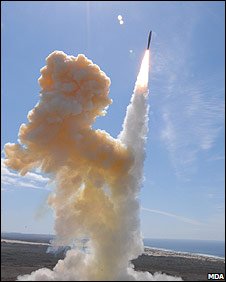
The missiles would be similar to
those based in Alaska and California

The New York Times
By THOM SHANKER and NICHOLAS KULISH
Published: August 14, 2008

WASHINGTON — The United States and Poland reached a long-stalled deal on Thursday to place an American missile defense base on Polish territory, in the strongest reaction so far to Russia’s military operation in Georgia.

Russia reacted angrily, saying that the move would worsen relations with the United States that have already been strained severely in the week since Russian troops entered separatist enclaves in Georgia, a close American ally.

But the deal reflected growing alarm in countries like Poland, once a conquered Soviet client state, about a newly rich and powerful Russia’s intentions in its former cold war sphere of power. In fact, negotiations dragged on for 18 months — but were completed only as old memories and new fears surfaced in recent days.

Those fears were codified to some degree in what Polish and American officials characterized as unusual aspects of the final deal: that at least temporarily American soldiers would staff air defense sites in Poland oriented toward Russia, and that the United States would be obliged to defend Poland in case of an attack with greater speed than required under NATO, of which Poland is a member.

Polish officials said the agreement would strengthen the mutual commitment of the United States to defend Poland, and vice versa. “Poland and the Poles do not want to be in alliances in which assistance comes at some point later — it is no good when assistance comes to dead people,” the Polish prime minister, Donald Tusk, said on Polish television. “Poland wants to be in alliances where assistance comes in the very first hours of — knock on wood — any possible conflict.”

A sense of deepened suspicions — and the more darkly drawn lines between countries in the region — were also apparent in the emotional reaction from Russia.

“It is this kind of agreement, not the split between Russia and United States over the problem of South Ossetia, that may have a greater impact on the growth in tensions in Russian-American relations,” Konstantin Kosachyov, chairman of the foreign affairs committee in the Russian Parliament, told the Interfax news agency on Thursday in Moscow.

South Ossetia is the pro-Russian enclave inside Georgia where Russia sent troops last week, following a military crackdown by the pro-Western government in Georgia.

The missile defense deal was announced by Polish officials and confirmed by the White House. Under it, Poland would host an American base with 10 interceptors designed to shoot down a limited number of ballistic missiles, in theory launched by a future adversary such as Iran. A tracking radar system would be based in the Czech Republic. The system is expected to be in place by 2012.

In exchange for providing the base, Poland would get what the two sides called “enhanced security cooperation,” notably a top-of-the-line Patriot air defense system that can shoot down shorter-range missiles or attacking fighters or bombers.

A senior Pentagon official described an unusual part of this quid pro quo: an American Patriot battery would be moved from Germany to Poland, where it would be operated by a crew of about 100 American military personnel members. The expenses would be shared by both nations. American troops would join the Polish military, at least temporarily, at the front lines — facing east toward Russia.

Russia has long opposed the deal, saying the United States was violating post-cold-war agreements not to base its troops in former Soviet bloc states and devising a Trojan Horse system designed to counter Russia’s nuclear arsenal, not an attack by Iran or another adversary.

Stop-and-start negotiations over the arrangement that was sealed Thursday had been under way for almost two years, with the Polish government reluctant to press the deal in the face of strong opposition — and retaliatory threats — from Moscow.

For its part, Washington had balked at some of Poland’s demands, in particular the sale of advanced air defense systems that were unrelated to shooting down ballistic missiles.

But in a sign of the widening repercussions of the conflict in Georgia, those concerns were cast aside, as the offensive by Russia’s military across its borders was viewed around the world as a sign of Moscow’s determination to reimpose its influence across the old Soviet bloc.

Polish officials, in announcing the agreement, said it would be presented to the National Legislature, although it remained unclear whether the American base would require a vote of approval.

The other half of the American missile defense system in Europe would be an advanced radar in the Czech Republic for tracking specific targets and then precisely guiding an interceptor to destroy a warhead. Likewise, that deal has been signed by the country’s leaders, and is awaiting debate in the Czech Parliament.

At the White House, the press secretary, Dana M. Perino, confirmed that senior officials had initialed the agreement. “In no way is the president’s plan for missile defense aimed at Russia,” she said. “In fact, it’s just not even logically possible for it to be aimed at Russia, given how Russia could overwhelm it. The purpose of missile defense is to protect our European allies from any rogue threats, such as a missile from Iran.”

The Bush administration, in an attempt to prove its sincerity and transparency, had invited Moscow to join as a partner in a continentwide missile defense system, sharing information and technology with NATO allies.

While Russian and American experts have discussed cooperation, senior officials in Moscow have kept up a nonstop stream of complaints about the system.

The agreement also poses potential political problems for Democratic critics of missile defense who would be fighting to cut financing for the program in the face of the specific request from Poland and in light of the Russian offensive into Georgia.

There is no such ambivalence on Russia’s periphery, where Moscow’s attack signaled danger, and offered logic for closer ties with Washington and NATO.

In Poland, the war in Georgia has dominated the front pages of newspapers, where it has been starkly characterized as Russian invaders attacking Georgia. For Poles, Russia’s actions also come as a vindication of Poland’s distrust of its former conqueror and was a warning about issues like energy security, one of the primary areas in which a resurgent Russia first began to exert itself.

“We are worried that we are facing, under the strong arm of Russia, a situation where some kind of understanding would be reached that Russia would be given a free hand in the region,” said Eugeniusz Smolar, director of the Center for International Relations, a nonprofit, nonpartisan research group in Warsaw.


Thom Shanker reported from Washington, and Nicholas Kulish from Tbilisi, Georgia. Clifford J. Levy contributed reporting from Moscow.


http://www.nytimes.com/2008/08/15/world/europe/15poland.html?ref=world
 
<font size="5"><center>Russia:
Poland risks attack because of US missiles</font size></center>


Associated Press
By JIM HEINTZ
August 15, 2008

MOSCOW (AP) — A top Russian general said Friday that Poland's agreement to accept a U.S. missile interceptor base exposes the ex-communist nation to attack, possibly by nuclear weapons, the Interfax news agency reported.

The statement by Gen. Anatoly Nogovitsyn is the strongest threat that Russia has issued against the plans to put missile defense elements in former Soviet satellite nations.

Poland and the United States on Thursday signed a deal for Poland to accept a missile interceptor base as part of a system the United States says is aimed at blocking attacks by rogue nations. Moscow, however, feels it is aimed at Russia's missile force.

"Poland, by deploying (the system) is exposing itself to a strike — 100 percent," Nogovitsyn, the deputy chief of staff, was quoted as saying.

He added, in clear reference to the agreement, that Russia's military doctrine sanctions the use of nuclear weapons "against the allies of countries having nuclear weapons if they in some way help them." Nogovitsyn that would include elements of strategic deterrence systems, he said, according to Interfax.

At a news conference earlier Friday, Nogovitsyn had reiterated Russia's frequently stated warning that placing missile-defense elements in Poland and the Czech Republic would bring an unspecified military response. But his subsequent reported statement substantially stepped up a war of words.

Polish Foreign Minister Radek Sikorski was quoted Friday by the Polish news agency PAP as saying that Poland is open to Russian inspections because it wants to give Moscow "tangible proof" that the planned base is not directed against Russia.

U.S. officials have said the timing of the deal was not meant to antagonize Russian leaders at a time when relations already are strained over the recent fighting between Russia and Georgia over the separatist Georgian region of South Ossetia.

Russian forces went deep into Georgia in the fighting, raising wide concerns that Russia could be seeking to occupy parts of its small, pro-U.S. neighbor, which has vigorously lobbied to join NATO, or even to force its government to collapse.

"I think the Russian behavior over the last several days is generally concerning not only to the United States but to all of our European allies," said Pentagon spokesman Bryan Whitman, when asked about Russian threats against Poland as a result of the missile defense agreement.

He also suggested that earlier U.S. offers for broad cooperation with Moscow on the missile defense program may be reevaluated considering the latest developments.

Under the agreement that Warsaw and Washington reached Thursday, Poland will accept an American missile interceptor base.

Washington says the planned system, which is not yet operational, is needed to protect the U.S. and Europe from possible attacks by missile-armed "rogue states" like Iran. The Kremlin, however, feels it is aimed at Russia's missile force and warns it will worsen tensions.

In an interview on Poland's news channel TVN24, Polish Prime Minister Donald Tusk said the United States agreed to help augment Poland's defenses with Patriot missiles in exchange for placing 10 missile defense interceptors in the Eastern European country.

He said the deal also includes a "mutual commitment" between the two nations to come to each other's assistance "in case of trouble."


That clause appeared to be a direct reference to Russia.

Poland has all along been guided by fears of a newly resurgent Russia, an anxiety that has intensified with Russia's offensive in Georgia. In past days, Polish leaders said that fighting justified Poland's demands that it get additional security guarantees from Washington in exchange for allowing the anti-missile base on its soil.

"Simply the existence of this installation increases Poland's security," Polish President Lech Kaczynski said Friday.

Associated Press writers Lolita C. Baldor in Washington and Vanessa Gera in Warsaw, Poland contributed to this report.

http://ap.google.com/article/ALeqM5ie3N_5xk8Z20qcSJG0MilftDpsLwD92ISLK00
 
<font size="4"><center> Step-by-step guide
How the prototype US missile
defence system is designed to work

</font size></center>


<IFRAME SRC="http://news.bbc.co.uk/1/hi/world/americas/5106762.stm" WIDTH=780 HEIGHT=1500>
<A HREF="http://news.bbc.co.uk/1/hi/world/americas/5106762.stm">link</A>

</IFRAME>
 
US missile defence test 'a success'

<IFRAME SRC="http://news.bbc.co.uk/1/hi/world/americas/7769108.stm" WIDTH=780 HEIGHT=1500>
<A HREF="http://news.bbc.co.uk/1/hi/world/americas/7769108.stm">link</A>

</IFRAME>
 
Re: US missile defence test 'a success'

<font size="5"><center>
Russia scraps plan to deploy nuclear-
capable missiles in Kaliningrad</font size>
<font size="4">

Move comes after Barack Obama administration says it will
review Pentagon's proposed defence shield in central Europe</font size></center>


The Guardian
guardian.co.uk
Luke Harding in Moscow
Wednesday 28 January 2009

Russia today announced it was abandoning plans to deploy nuclear-capable Iskander missiles in its European Kaliningrad outpost – a sign that Moscow wants improved relations with the new US administration.

Defence officials said the Kremlin's proposals to station short-range missiles in the small Baltic territory next to Poland had been "suspended".

The move followed Barack Obama's decision to review the Pentagon's controversial missile defence shield in central Europe.

The Kremlin has been incensed by the Bush administration's plans to site missile interceptors and radar bases in Poland and the Czech Republic.

Moscow believes the plan upsets Europe's strategic nuclear balance and targets Russia, but the Bush administration insisted it was intended to defend against a threat from Iran.

Obama has not yet decided whether to press ahead with the scheme or to abandon it, although indications suggest he is sceptical about its value.

Today's Russian move can be interpreted as a Kremlin olive branch to the new US team and a tactic to put pressure on Obama to scrap the shield.

"These plans have been suspended because the new US administration is not pushing ahead with the plans to deploy the US missile defence system in Poland and the Czech Republic," an official told the Russian state news agency, Interfax.

"Russia does not need to deploy Iskanders in the Kaliningrad region if the US does not install its missile defence facilities in eastern Europe."

In November, the Russian president, Dmitry Medvedev, said Russia would station Iskanders in Kaliningrad – the former German city of Königsberg, which was seized by the Soviet Union after the second world war.

He warned that they would be directly pointed at the US nearby defence and radar bases in Poland and the Czech Republic, and said Russia would use radio-jamming equipment to wreck the Pentagon's new missile defence system.

Today's apparently conciliatory move appears to have been timed to coincide with a major speech by Vladimir Putin at Davos, Switzerland, later today.

The Russian prime minister is attending the world economic summit instead of Medvedev – a clear sign that he remains in charge.

He is expected to put forward his ideas for a change in the world economic order and deliver his assessment of what caused the global economic crisis.

He is also likely to put the boot into Ukraine, blaming the chaotic government in Kiev for this month's gas crisis, which left much of Europe without Russian gas.


http://www.guardian.co.uk/world/2009/jan/28/russia-missiles-kaliningrad-obama
 
Re: US missile defence test 'a success'

Russian POV

<font size="5"><center>Too soon to implement Iskander plans
Russian defense source</font size></center>


118249716.jpg


Russian News & Information Agency
RIA Novosti

January 28, 2009


MOSCOW, January 28 (RIA Novosti) - Russia's Defense Ministry considers it premature to announce plans on the deployment of Iskander missile systems in the country's Baltic exclave, a high ranking ministry source said on Wednesday.

"The Russian Defense Ministry has taken no practical measures to deploy Iskander systems in the west of the country," the source said.

"Naturally, the General Staff is working out a response to the possible deployment of [U.S.] missile defense components in Europe, but it is inappropriate and premature to talk about practical steps to implement or suspend these plans," he added.

Moscow has strongly opposed U.S. plans to deploy 10 interceptor missiles in Poland and a radar in the Czech Republic as a threat to its security and nuclear deterrence. Washington says the defenses are needed to deter possible strikes from "rogue states."

Last November, President Dmitry Medvedev said Moscow would deploy Iskander missile systems in its Baltic exclave of Kaliningrad, sandwiched between NATO members Lithuania and Poland, in response to any deployment by Washington of elements of a missile defense shield in Europe.

However, Moscow has recently expressed hope that the new U.S. administration led by President Barack Obama would "take a break on the issue of missile defense ... and to evaluate its effectiveness and cost efficiency."

The U.S. Congressional Budget Office released in January a report, which proposes an alternative scenario of future budget expenditures on defense, and envisions defense budget cuts of about $40 billion, or 7% annually, through 2026.

Some of the cuts could be implemented by reductions in various missile defense programs, including the deployment of a U.S. missile shield in central Europe. The current budget estimates expenses on missile defense at $9.6 billion annually.

"The evolutionary alternative would refocus Department of Defense's missile defense programs to test, support, and upgrade existing ground-based defenses at two sites in Alaska and California but defer plans to deploy a third missile defense site in Europe," the Long-Term Implications of the Fiscal Year 2009 Future Years Defense Program report said.

"Deployment of future missile defense systems, such as the airborne laser and a constellation of the infrared Space Tracking and Surveillance System satellites, also would be deferred indefinitely," the document said.

http://en.rian.ru/russia/20090128/119841521.html
 
Back
Top