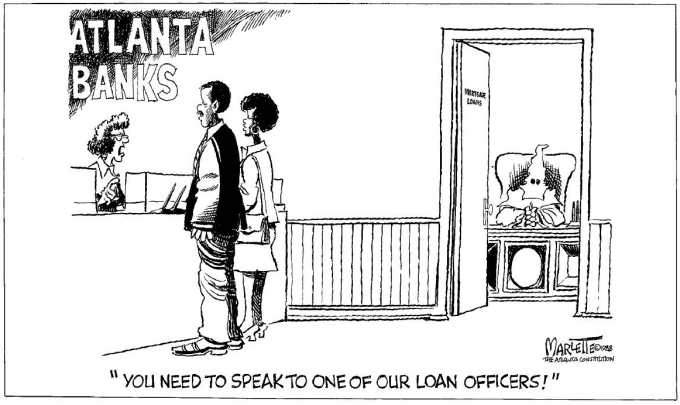
Trump Ends Fed Enforcement Against Banks Who Screw Black & Brown People
During the financial meltdown of 2007-2008 the world found out that the banksters were willfully & deliberately ripping off 'people of color' with sub-prime "shitty" loans 200% to 600% higher rates than white Americans regardless of their credit scores. As one white woman banker testified in an affidavit she “rode the stagecoach from hell” for a decade, systematically singling out blacks in Baltimore and suburban Maryland for high-interest subprime mortgages. She said They referred to blacks as “mud people” and to subprime lending as “ghetto loans.”We just went right after them (Blacks) she said.
http://www.nytimes.com/2009/06/07/us/07baltimore.html
This racist lending practice was widespread among the banksters. The auto companies also engaged in racist lending practices.
Elizabeth Warren now the U.S. Senator from Massachusetts under Obama set up the Consumer Financial Protection Bureau which policed the banksters and has recovered over $12,000,0000,0000 in financial settlements since its inception from corrupt avaricious banksters who had ripped off unsuspecting intimidated customers. Trump wants this policing enforcement to end! Fuck 'people of color' let them get ripped off and pay usury.
https://theintercept.com/2018/02/01/cfpb-mick-mulvaney-lending-housing-discrimination/
https://alliedprogress.org/news/donors-rejoice-mulvaney-intensifies-effort-gut-cfpbs-fight-discriminatory-lending-practices/
The Consumer Financial Protection Bureau and its Office of Fair Lending and Equal Opportunity, as previously structured, compiled a strong track record of working on behalf of communities of color. Trump wants to kill the entire agency:
Saving Consumers $16 Billion in Undisclosed Credit Card Fees


During the financial meltdown of 2007-2008 the world found out that the banksters were willfully & deliberately ripping off 'people of color' with sub-prime "shitty" loans 200% to 600% higher rates than white Americans regardless of their credit scores. As one white woman banker testified in an affidavit she “rode the stagecoach from hell” for a decade, systematically singling out blacks in Baltimore and suburban Maryland for high-interest subprime mortgages. She said They referred to blacks as “mud people” and to subprime lending as “ghetto loans.”We just went right after them (Blacks) she said.
http://www.nytimes.com/2009/06/07/us/07baltimore.html
This racist lending practice was widespread among the banksters. The auto companies also engaged in racist lending practices.
Elizabeth Warren now the U.S. Senator from Massachusetts under Obama set up the Consumer Financial Protection Bureau which policed the banksters and has recovered over $12,000,0000,0000 in financial settlements since its inception from corrupt avaricious banksters who had ripped off unsuspecting intimidated customers. Trump wants this policing enforcement to end! Fuck 'people of color' let them get ripped off and pay usury.
https://theintercept.com/2018/02/01/cfpb-mick-mulvaney-lending-housing-discrimination/
https://alliedprogress.org/news/donors-rejoice-mulvaney-intensifies-effort-gut-cfpbs-fight-discriminatory-lending-practices/
The Consumer Financial Protection Bureau and its Office of Fair Lending and Equal Opportunity, as previously structured, compiled a strong track record of working on behalf of communities of color. Trump wants to kill the entire agency:
- It developed a strategy for fighting discrimination in auto lending, resulting in settlements that returned $80 million in damages to people ripped off by Ally Financial, along with $18 million from Fifth Third bank.
- It helped resolve, with the Department of Justice, the largest redlining case in history against Hudson City Savings, which paid $33 million for lending assistance and community programs on behalf of majority-Black-and-Hispanic neighborhoods in New York, New Jersey, Connecticut and Pennsylvania.
- It assists in the day-to-day work of supervising the nation’s largest banks, and select other service providers, for compliance with fair lending laws.
- The CFPB helped over 29 million individual consumers receive $11.8 billion dollars in due relief, while responding to over 1 million consumer complaints since openings its doors.[2]
- Through enforcement action alone, the CFPB reduced $7.7 billion in consumer debts while winning $3.7 billion in compensation for consumers.[3]
- Nearly 50 million households have benefited from new CFPB mortgage servicing protections that protect consumers from surprise costs and terms when repaying their mortgage, and offer additional protection if a borrower falls behind on their mortgage payment.[4]
- More recently, the CFPB, partnering with the Los Angeles City Attorney’s Office and the Office of the Comptroller of the Currency, uncovered deceptive banking practices at Wells Fargo Bank defrauding millions of customers.[5] Enforcement action by the CFPB forced Wells Fargo to pay full refunds to consumers harmed by illegal practices and to pay a $100 million penalty for their wanton behavior.
- The CFPB’s enforcement actions provided $130 million in due compensation to service members, veterans, and their families that were harmed by illegal private sector predatory practices.[6]
- In collaboration with the Department of Defense (DOD), the Office of Servicemember Affairs at the CFPB visited more than 145 military installations, handling over 71,000 consumer complaints from service members and their families,[7] and advised DOD on better rules to protect service members from financial exploitation.[8]
Saving Consumers $16 Billion in Undisclosed Credit Card Fees
- The Credit Card Accountability, Responsibility and Disclosure (CARD) Act, now under CFPB jurisdiction, reined in the usurious late fees charged on credit cards, limited predatory practices targeting young consumers on college campuses, curtailed sharp interest rate hikes, increased access to consumer credit, and made credit card costs more transparent, saving consumers more than $16 billion in undisclosed fees.[9]
- The number of new consumer credit cards increased steadily since implementation and enforcement of the CARD Act to 6.5 million new credit cards and $37.5 billion in available credit in July of 2016.[10]
- In collaboration with private industry, the CFPB made it easier for stay-at-home spouses to gain access to credit cards by allowing them to use total household income in their applications for new accounts or higher credit limits. This has helped more than 16 million married individuals who do not work outside the home access necessary credit.