The First Black Woman Candidate for Vice President (not who you think!)

QueEx

Rising Star
Super Moderator
THIS MIGHT SURPRISE YOU . . .

Charlotta Bass
More than half a century before Kamala Harris ran for Vice President, this Black woman did

1597623546242.png
Charlotta Bass​


(CNN) Charlotta Bass strode onto a stage in Chicago and gave a speech as the first Black female candidate for Vice President.

As a candidate for the nation's second highest office under the Progressive Party ticket in 1952, she addressed convention attendees on March 30 that year.


"I stand before you with great pride," she said. "This is a historic moment in American political life. Historic for myself, for my people, for all women. For the first time in the history of this nation a political party has chosen a Negro woman for the second highest office in the land."

While Kamala Harris became the first Indian-Americanand first Black woman this week to run for Vice President on a major party ticket, Bass came before her decades ago in that long-shot bid.

In a nod to her minimal chances of winning, Bass' campaign slogan was, "Win or lose, we win by raising the issues." Her party lost to Republican Dwight D. Eisenhower, but her campaign decades ago helped open doors for minority candidates today, according to experts.

"Bass certainly paved the way for the Kamalas of today, in terms of both her identity and her politics of coalition-building," said Keisha N. Blain, associate professor of history at the University of Pittsburgh and author of "Set the World on Fire: Black Nationalist Women and the Global Struggle for Freedom."

"But it is equally important to talk about the countless Black women whose labor has formed the backbone of the Democratic Party. Too often, we only notice the names at the top of the ticket."

Bass made history before she ran for VP
Bass started making history long before she ran for office. The activist turned politician was born in South Carolina in 1874. She later moved to the West Coast, where she became one of the first African American women to own and operate a newspaper — the California Eagle.

Her fight against injustice started decades before her political bid. She used her newspaper as a platform to highlight issues such as police brutality, restrictive housing, the Ku Klax Klan and civil liberties.

She was such a major advocate for civil liberties, women's rights and immigration, she received death threats. The FBI also placed her under surveillance after she was labeled a communist, government records show.

When Bass' husband died in 1934, she ramped up her activism by joining groups fighting against injustices. She was also the founder of the National Sojourner for Truth and Justice Club, which worked to improve working conditions for Black women.

"Throughout her career, Bass evolved and worked with various political groups, capturing the richness and complexity of Black politics," Blain said.

She served as president of a chapter of the Universal Negro Improvement Association, engaged with the more moderate NAACP, and was a leader among leftists and communists in the Sojourners for Truth and Justice, she added.

"Bass's ability to move within radical and more mainstream circles — and her ability to draw significant insight from each — is an important lesson for Harris as she strives to craft a successful political coalition with Biden," Blain said.

While Bass was a key figure in politics, Blain said, equally important are Charlene Mitchell, Shirley Chisholm and countless of other Black women who've worked — oftentimes behind the scenes — to make minorities in politics mainstream.
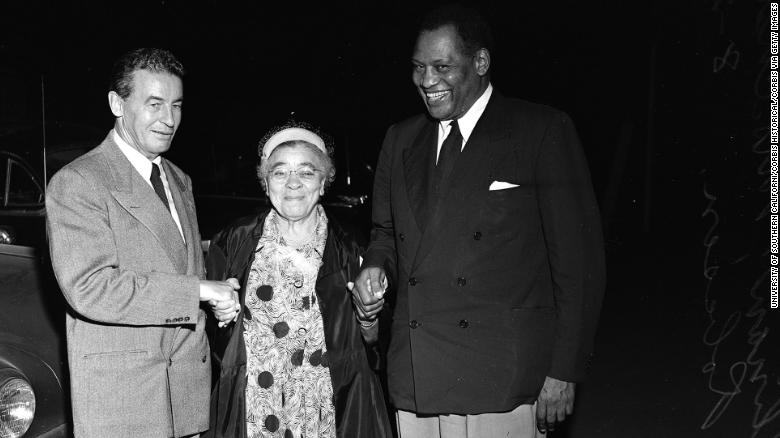
Vincent Hallinan (left)  Progressive candidate for President, Charlotta Bass and Paul Robeson.

Vincent Hallinan (left) Progressive candidate for President, Charlotta Bass and Paul Robeson.


"Mitchell ran for President on the Communist Party ticket in 1968, and Chisholm campaigned in the 1972 Democratic presidential primary. These women paved the way for Harris and other Black women in presidential politics," she said.

The Progressive Party candidate for President was Vincent Hallinan, an attorney who ran for office from behind bars after he was jailed on contempt charges.
Denise Lynn, a history professor at University of Southern Indiana, said that the Progressive Party was opposed to the United States serving as a global police force, especially in countries where the majority of people were not White.

"The Progressive Party ran ... on a platform that opposed militarism, war, and political contest with the Soviet Union in favor of social justice, economic equality and peace. Bass was instrumental in getting the Progressive Party on the ballot in California," Lynn wrote in a piece published this year.
Hallinan got about 140,000 votes.


.
 
  • Like
Reactions: MCP
From Wikipedia: https://en.wikipedia.org/wiki/Charlotta_Bass

BornCharlotta Amanda Spears
February 14, 1874
Sumter, South Carolina, U.S.
DiedApril 12, 1969 (aged 95)
Los Angeles, California, U.S.
Resting placeEvergreen Cemetery, East Los Angeles, California
NationalityAmerican
Occupationeducator, newspaper publisher/editor, and civil rights activist
Known for
  • first African-American woman to own and operate a newspaper in the United States
  • first African-American woman nominated for Vice President
Spouse(s)Joseph Bass

Due to her activities, Bass was repeatedly accused of being part of the Communist Party, for which there was no evidence and which Bass herself repeatedly denied. She was monitored by the FBI, who continued to view her as a potential security threat up until she was in her nineties.


Charlotta Amanda Spears Bass (February 14, 1874[1] – April 12, 1969) was an American educator, newspaper publisher-editor, and civil rights activist. She also focused on various other issues such as housing rights, voting rights, and labor rights, as well as police brutality and harassment.[2] Bass is believed to be the first African-American woman to own and operate a newspaper in the United States; she published the California Eagle from 1912 until 1951.[3] In 1952, Bass became the first African-American woman nominated for Vice President, as a candidate of the Progressive Party.

Due to her activities, Bass was repeatedly accused of being part of the Communist Party, for which there was no evidence and which Bass herself repeatedly denied. She was monitored by the FBI, who continued to view her as a potential security threat up until she was in her nineties.

Background
Charlotta Amanda Spears was born in Sumter, South Carolina, on February 14, 1874, to Hiram and Kate Spears. She was the sixth child of eleven. She received an education from public schools and one semester at Pembroke State College.[4] When she was twenty years old, she moved to live with her brother in Providence, Rhode Island, where she worked for the Providence Watchman. Spears worked for the Providence Watchman for about ten years.

She moved to California for her health and ended up working at the California Eagle. Her first job at the California Eagle consisted of selling subscriptions.[4] When its founder John Neimore died, she assumed the role of editor for the paper.[4] She later became the owner of the California Eagle after purchasing it in auction for fifty dollars.[4] At this time she took courses at Columbia University and University of California. In 1912, a new editor Joseph Bass joined the Eagle. Bass had been one of the founders of the Topeka Plaindealer. He shared his concern with Spears about the injustice and racial discrimination in society.[5]

Marriage and family
Charlotta Spears married Joseph Bass, and they ran the Eagle together. She had no children.


California Eagle
he Eagle developed a large black readership. By 1925, the Eagle employed a staff of twelve and published twenty pages a week. The Eagle's circulation of 60,000 made it the largest African-American newspaper on the West Coast.[6] It is credited as pioneering multiethnic politics, advocating Asian-American and Mexican-American civil rights in the 1940s, during which time the California Eagle, along with other African-American presses, were under investigation by the Office of the Secretary of War, who viewed it as a threat to national security.[7][4]:102 The Department of Justice interrogated Bass in 1942 over claims that the paper was funded by Japan and Germany.[4]:102

When the editor John J. Neimore became ill, he turned the operations of the Eagle over to Spears. After Neimore's death, the paper's new owner put Spears in charge. She renamed the newspaper company to the California Eagle due to increasing social and political issues. Her purpose for the California Eagle was to write about the wrongs of society. The newspaper served as a source of both information and inspiration for the black community, which was often ignored or negatively portrayed by the predominant white press.[8] As publisher, Bass was committed to producing a quality periodical. In her weekly column "On the Sidewalk", begun in 1927, she drew attention to unjust social and political conditions for all Los Angeles minority communities and campaigned vigorously for reform.

Bass published the California Eagle from 1912 until 1951. Bass and her husband combated such issues as the derogatory images in D. W. Griffith's film, The Birth of a Nation; Los Angeles' discriminatory hiring practices; the revival of the Ku Klux Klan; police brutality; and restrictive housing covenants.[5] In her pursuit against the Ku Klux Klan Bass received threatening phone calls and at one point was confronted by eight men robed in white, who she scared off after displaying a firearm.[9] She was also unsuccessfully sued for libel by Klan leader G.W. Price after Bass published a letter from the clan which detailed plans to exterminate black leaders.[4]:98

The Basses championed the black soldiers of the Twenty-Fourth Infantry who were unjustly sentenced in the 1917 Houston race riot. They also covered the case and supported the "Scottsboro Boys," nine young men who were framed and convicted of rape in Scottsboro, Alabama, in 1931.[citation needed]

In 1934, Joseph Bass died and Charlotta Bass assumed control of the paper. The paper's coverage and focus during the 1940s has caused it to been credited as pioneering multi-ethnic politics, advocating Asian-American and Mexican-American civil rights. During this time period the California Eagle, along with other African-American presses, were under investigation by the Office of the Secretary of War, who viewed it as a threat to national security.[7][4]:102 The Department of Justice interrogated Bass in 1942 over claims that the paper was funded by Japan and Germany.[4]:102 The FBI continued to monitor Bass, as they deemed her actions as advocating the Communist Party despite a lack of evidence and Bass herself denying any assertions of the kind.[4]:102–103, 104 In 1943, the Department of Justice was asked by the Post Office Department to revoke her mailing permit. The Post Office Department argued that the newspaper could not be mailed due to sensitive and illegal material within the paper. Bass again won the case, and the Department of Justice said her mailing permit would not be revoked.[4]:103

Bass continued to use the paper as a way of raising awareness of various issues facing African-Americans and other minorities such as restrictive covenants in housing, which the United States Supreme Court found to be unconstitutional in 1948.[4]

Bass continued to run the California Eagle on her own until selling it in 1951 and moving to New York City, where she focused on politics.[4]:105 Her activism and political activities would result in continued belief that she was a communist, which she continued to deny.[4][9]

Political activities
During the 1920s, Bass became co-president of the Los Angeles chapter of the Universal Negro Improvement Association, founded by Marcus Garvey.[10] Bass formed the Home Protective Association to defeat housing covenants in all-white neighborhoods. She helped found the Industrial Business Council, which fought discrimination in employment practices and encouraged black people to go into business. As editor and publisher of the California Eagle, the oldest black newspaper on the West Coast, Charlotta Bass fought against restrictive covenants in housing[11] and segregated schools in Los Angeles. She campaigned to end job discrimination at the Los Angeles General Hospital, the Los Angeles Rapid Transit Company, the Southern Telephone Company, and the Boulder Canyon Project.

During the Great Depression of the 1930s, she continued to encourage black businesses with the campaign known as "Don't Buy Where You Can't Work".[12]

As a leader of both the NAACP and the UNIA, Bass spanned the divide between integrationist and separatist black politics. She was the director of the Youth Movement of the NAACP. It had 200 members, including some actors and actresses, such as Lena Horne, Hattie McDaniel, and Louise Beavers.[13]

In the 1940s, the Republican Party chose Bass as western regional director for Wendell Willkie's presidential campaign. Three years later, she became the first African-American grand jury member for the Los Angeles County Court. Also in 1943, Bass led a group of black leaders to the office of the Mayor of Los Angeles, Fletcher Bowron's office. They demanded an expansion of the Mayor's Committee on American Unity, more public mass meetings to promote interracial unity, and an end to the discriminatory hiring practices of the privately owned Los Angeles Railway Company. The mayor listened, but agreed to do no more than to expand his committee.[14] Then later in the 1940s, Bass left the Republican Party and joined the Progressive Party because she believed neither of the major parties was committed to civil rights.

Bass served in 1952 as the National Chairman of the Sojourners for Truth and Justice, an organization of black women set up to protest racial violence in the South.[15] That year, she was nominated for vice president of the United States by the Progressive Party. She was the running mate of lawyer Vincent Hallinan.[16] Bass became the first African-American woman to run for vice president of the United States. Her platform called for civil rights, women's rights, an end to the Korean War, and peace with the Soviet Union. Bass's slogan during the vice presidential campaign was, "Win or lose, we win by raising the issues."[17]

Bass worked on issues that also attracted Luisa Moreno, who was active in Afro-Chicano politics in Los Angeles during the 1930s-1950. No record shows that the two women ever met, but in 1943 both served on the Sleepy Lagoon Defense Committee, a multiracial group that fought for the release of several Chicanos convicted of murder by an all-white jury making Bass and Moreno part of the same "constellation" of struggle.[18]

Bass wrote her last column for the California Eagle on April 26, 1951, and sold the paper soon after. Considering the sum of her career as she was completing her autobiography, Forty Years (1960), Bass wrote:

It has been a good life that I have had, through a very hard one, but I know the future will be even better, And as I think back I know that is the only kind of life: In serving one's fellow man one serves himself best ... [19]
In 1966, Bass had a stroke and afterwards retired to a Los Angeles nursing home.[4] In 1967, at age ninety-one the FBI still classified Charlotta Bass as a potential security threat.[4]

During her years of retirement, she maintained a library in her garage for the young people in her neighborhood. It was a continuation of her long fight to give all people opportunities and education. She died in Los Angeles on April 12, 1969 from a cerebral hemorrhage. She is buried alongside her husband in Evergreen Cemetery, East Los Angeles, California.

Inter-racial political activities
Gaye Johnson's essay, Constellations of Struggle (2008) examines Charlotta Bass and Luisa Moreno's significance on political activism and how it relates to the history of struggle communities of color have faced.[20] Both Charlotta Bass and Luisa Moreno shared a "mutual struggle" and were active in fighting for civil rights through organizations together and through their own pursuits.[20] Charlotta Bass primarily focused on the African American community and Luisa Moreno on the Chicano community but both supported a variety of civil rights.[20] Both women were active in the Sleepy Lagoon Defense Committee, labor rights, and civil rights throughout their lives.[20] Both women also used a technique of influencing one community at a time, employing antiracist activism, and bringing awareness.[20]

Through the California Eagle Charlotta Bass was able to have readers recognize the struggles of communities of color.[20] Even when Charlotta Bass was faced with her own struggles with United States officials she used it as opportunities to further the influence of her paper.[20] This can be seen after her detainment by United States officials caused her to miss her flight to China for a conference, where afterwards she continued to work on the next issue of the paper.[20] Charlotta Bass was able to strengthen the community by pointing out the issues in Los Angeles, bringing the African American community together.[20] With the strategy of one community at a time she was able to publicize the unequal treatment in a majority of issues from housing to police brutality.[20] Through the newspaper she was able reverse the long used tactic of blaming people of color to shift the blame onto white officials who were responsible for the unequal treatment continued to be perpetuated in various areas such as housing and police brutality.[20]

Gaye Johnson's book, Spaces of Conflict, Sounds of Solidarity (2013) furthers this concept of "constellations of struggle" by looking at the "history of resistance" where communities have fought back and how they have reclaimed space.[21] The work of Charlotta Bass and Luisa Moreno represents an interracial struggle and moments of solidarity.[21] These moments of solidarity between African Americans and Mexicans was a way of reclaiming space through not only political means but through leisure spaces like music.[21] When communities of color were violently attacked by whites it brought these communities together to further resist by unifying their forces together.[21]

The California Eagle was utilized as a tool to change the communities ideology by challenging the police even comparing their tactics to Hitler's tactics, challenging the assumption criminal behavior was biological in people of color, and linked fascism to racism.[21] The California Eagle was a way of reaching global attention to the issues of people of color.[21] Charlotta Bass was able to promote the creation of "spatial entitlement" by bringing communities together through her work with organizations and the newspaper.[21]

Legacy
Charlotta Bass is known for her work as owner and editor of the California Eagle from the 1912 to 1951.[22] The California Eagle was used as a platform for publicizing the issues of the African American community and later included the issues of a variety of civil rights.[20] She worked to improve the conditions of people of color through a multitude of civil rights such as housing rights, labor rights, voting rights, and police brutality.[23] She was the first African American woman to be a jury member in the Los Angeles County Court and to run for Vice President of the United States.[24]

 
(1952) CHARLOTTA BASS, “ACCEPTANCE SPEECH FOR VICE PRESIDENTIAL CANDIDATE OF THE PROGRESSIVE PARTY”

POSTED ONSEPTEMBER 21, 2008
BY: BLACKPAST


Progressive Party VP candidate Charlotta Bass (right) and PP presidential candidate Vincent Hallinan, 1952
Fair use image


Los Angeles newspaper owner and political activist Charlotta Bass began her career as a conservative Republican. By the 1940s, however, she moved to the political left. In 1948 she supported Progressive Party candidate Henry Wallace in his failed bid for the Presidency. Four years later she was nominated for Vice President on the Progressive Party ticket. She was the first African American woman to carry a political party’s nomination for the second highest office in the land. Bass’s acceptance speech given at the Chicago convention of the Progressive Party on Sunday, March 30, 1952, appears below.

I stand before you with great pride.

This is a historic moment in American political life.
Historic for myself, for my people, for all women.

For the first time in the history of this nation a political party has chosen a Negro woman for the second highest office in the land.

It is a great honor to be chosen as a pioneer. And a great responsibility. But I am strengthened by thousands on thousands of pioneers who stand by my side and look over my shoulder—those who have led the fight for freedom—those who led the fight for women’s rights—those who have been in the front line fighting for peace and justice and equality everywhere. How they must rejoice in this great understanding which here joins the cause of peace and freedom.

These pioneers, the living and the dead, men and women, black and white, give me strength and a new sense of dedication.

I shall tell you how I come to stand here. I am a Negro woman. My people came before the Mayflower. I am more concerned with what is happening to my people in my country than in pouring out money to rebuild a decadent Europe for a new war.

We have lived through two wars and seen their promises turn to bitter ashes.

Two Negroes were the first Americans to be decorated for bravery in France in World War I, that war that was fought to make the world safe for democracy.

But when it ended, we discovered we were making Africa safe for exploitation by the very European powers whose freedom and soil we had defended.
And that war was barely over when a Negro soldier, returning to his home in Georgia, was lynched almost before he could take off his uniform. That war was scarcely over before my people were stoned and shot and beaten in a dozen northern cities. The guns were hardly silenced before a reign of terror was unloosed against every minority that fought for a better life.

And then we fought another war.

You know Dorie Miller, the spud peeler who came out of his galley to fight while white officers slept at Pearl Harbor.

And I think of Robert Brooks, another “first Negro”, and of my own nephew. We fought a war to end fascism whose germ is German race superiority and the oppression of other peoples.

A Negro soldier returned from that war—he was not even allowed to take off his uniform before he was lynched for daring to exercise his constitutional right to vote in a Democratic primary.

Yes, we fought to end Hitlerism. But less than 7 years after the end of that war, I find men who lead my government paying out my money and your money to support the rebirth of Hitlerism in Germany to make it a willing partner in another war.

We thought to destroy Hitlerism—but its germ took root right here. I look about me, at my own people—at all colored peoples all over the world. I see the men who lead my government supporting oppression of the colored peoples of the earth who today reach out for the independence this nation achieved in 1776.

Yes, it is my government that supports the segregation by violence practiced by a Malan in South Africa, sends guns to maintain a bloody French rule in Indo-China, gives money to help the Dutch repress Indonesia, props up Churchill’s rule in the Middle East and over the colored peoples of Africa and Malaya.

This week Churchill’s general in Malaya terrorized a whole village for refusing to act as spies for the British, charging these Malyan and Chinese villagers who enjoyed no rights and no privileges—and I quote him literally—“for failing to shoulder the responsibility of citizenship.” But neither the Malayan people—nor the African people who demonstrate on April 6—will take this terror lying down. They are fighting back.

Shall my people support a new war to create new oppressions?

We want peace and we shall have freedom.

We support the movement for freedom of all peoples everywhere—in Africa, in Asia, in the Middle East, and above all, here in our own country.

And we will not be silenced by the rope, the gun, the lynch mob or the lynch judge. We will not be stopped by the reign of terror let loose against all who speak for peace and freedom and share of the world’s goods, a reign of terror the like of which this nation has never seen.

For 40 years I have been a working editor and publisher of the oldest Negro newspaper in the least. During those 40 years I stood on a watch tower, watching the tide of racial hatred and biogotry rising against my people and against all people who believe the Constitution is something more than a piece of yellowed paper to be shut off in a glass case in the archives, but living document, a working instrument for freedom.

Yes, during those 40 years, the Eagle stirred her nest, led the struggles of my people, taught them to work with labor as the one group that could help break down racial differences and open the door for Negro people. I have stood watch over a home to protect a Negro family against the outrages of the Ku Klux Klan. And I have fought the brazen attempts to drive Negroes from their homes under restrictive covenants. I have challenged the great corporations which Negroes in their plants. I have stormed city councils and state legislatures and the halls of Congress demanding real representation for my people.

I have fought not only for my people.

I have fought and will continue to fight unceasingly for the rights and privileges of all people who are oppressed and who are denied their just share of the world’s goods their labor produces.

I have walked and will continue to walk in picket lines for the right of all men and women, of all races, to organize for their own protection and advancement. I will continue to cry out against police brutality against any people, as I did in the infamous zoot suit riots in Los Angeles in 1944, when I went into dark alleys and reached scared and badly beaten Negro and Mexican American boys, some of them children, from the clubs and knives of city police. Nor have I hesitated in the face of that most unAmerican Un-American Activities Committee—and I am willing to face it again. And so help me God, I shall continue to tell the truth as I know it and believe it as a progressive citizen and a good American.
As I stand here on this platform presenting the cause of the Progressive Party, I cannot help but hark back to the 30 years I spent in the Republican Party as an active member. Often as a member of the Republican Party I was as bewildered and as hopeless for the future as the children of Israel when they marched through the Jordan and failed to envision on the other side. I remember 1940, when I was chosen as Western Regional Director for Wendell Wilkie’s campaign for the pre-Republican headquarters right here in Chicago, I found two worlds—upstairs was a world for white Republicans and down below was the world for Negro Republicans.
Yes, I could not see the future clear in the Republican Party, as the children of Israel did not see their future. But if you remember, when the liberation came to these victims of Pharoah’s hate, as they crossed over, they dragged from the bed of the stream 12 stones and built a monument to commemorate the rolling away of the burdens of their bondage. As a member of the great elephant party, I could not see the light of hope shining in the distance, until one day the news flashed across the nation that a new party was born. In 1948, in the Progressive Party, I found that one political world that could provide a home big enough for Negro and white, for native and foreign born, to live and work together for the same ends—as equals.
Here in this party was the political home for me and for my people. Here no one handed me a ready made program from the back door. Here I could sit at the head of the table as a founding member, write my own program, a program for me and my people, that came from us. In that great founding convention in Philadelphia in 1948 we had crossed the Jordan. There we shared in the labor of building a platform stone by stone, choosing candidates, creating a new political party—as equals.
Now perhaps I could retire. I had helped to found a home for my people. I looked forward to a rest after forty years of struggle.
But how could I retire and where could I retire as long as I saw what Frederick Douglass saw and felt what he did, the need to stand up for the downtrodden, to open my mouth for the dumb, to remember those in bonds as bound with me.”
Could I retire when I saw that slavery had been abolished but not destroyed, that democracy had been won in World War I, World War II, only to take roots in my own country where it blossomed and bloomed and sent forth its fruits to poison the land my people had fought to preserve! Could I retire without thinking of Dorie Miller, of Robert Brooks, of my own nephew John Kinloch who gave up a brilliant career, helped set up the first mixed regiment of white and Negro troops, and then went ahead of them to die in the Battle of the Bulge? I think often of John who was to take over my beloved paper, of John who died that those for whom he fought might enjoy the freedom and liberty for which he lay down his life.
I could not retire and step aside when Rose Lee Ingram and her two boys were railroaded to jail for defending themselves. Could I turn a deaf ear to Rosalie McGee? Where was that Shangri-La in these United States where I could live and breathe in dignity? Where my people enjoyed the rights for which their sons and nephews died? In the North there were the Trenton Six demanding justice; in the Middle West was Cicero. In the South there stood Amy Mallard, the Wartinsville Seven, and unnamed hundreds of unavenged deaths that cried out. There was no rest in Florida—there a cross was burning and a bomb killed Harriet Moore and her husband; and white justice sniffed out the life of Samuel Shepherd, threatened Lee Irvin.
No, this new uprising of Terror was not confirmed to the South. It spread throughout the country, goaded and inflammed by persons in high places who created hysteria every time they opened their mouths. In, New York, just a few miles from where I live, they stoned my people at Peekskill—and a governor of a great state defended them. Only last week a Yonkers policeman shot and killed Wyatt and James Blackhall in cold blood—and was held on a minor charge.
Where were the leaders of my nation—yes, my nation, for God knows my whole ambition is to see and make my nation the nest in the world—where were these great leaders when these things happened? Why was my President silent when Harriet Moore died? And why did he not call on the Governor of Florida, a fellow Democrat, on his visits to Key West? What did General Eisenhower say or do about mob lynchers and legal lynchers of my people? General MacArthur rode through Georgia in triumph, like another general 85 years ago, but this general drew the applause of the Klan, the Moore dynamiters the lynchers.
Where were these great leaders who talked so grandly about freedom and spent even more grandly to crush it—what were they doing about my people losing jobs in Detroit while profits were piling up.
To retire meant to leave this world to these people who carried oppression to Africa, to Asia, who made profits from oppression in my own land. To retire meant to leave the field to evil. For there is an evil that stalks in our land, evil that strikes at my people, that would enslave all people, that would send up the world in flames, rob us of our earnings to waste on arms, destroy out living standards, corrupt our youth, silence and enslave us with Smith Acts, McCarran Acts, passed by concentration camp Congressmen.
I believe in a world of good and not of evil. A month ago in New York City, doctors announced the discovery of a new drug that promised a real cure for tuberculosis, that dread killer. Only last week I looked at the pictures of the patients who had offered themselves to try out this new drug. I looked closely at these pictures. I counted the faces. There were ten patients shown. Eight of these ten were Negroes. And seven of these eight were Negro women. Who was it that named tuberculosis the “great white plague”—when three times as many Negroes as whites died from it?
Those pictures symbolize the plight of our people today—yes, and the promise of tomorrow. Tuberculosis is not a disease of race—it is a disease of poverty. It strikes my people hardest because North and South Negro workers earn less than half of what white workers earn. It strikes my people here in Chicago who live 90,000 to the square mile. It strikes my people who live in Harlem 4,000 to the square block, so crowded that all of America could be put into half of New York.
This is what we fight against. We fight to live. We want the $65 billion that goes for death to go to build a new life. Those billions could lift the wages of my people, give them jobs, give education and training and new hope to our youth, free our sharecroppers, build new hospitals and medical centers. The $8 billion being spent to rearm Europe and crush Asia could rehouse all my people living in the ghettos of Chicago and New York and every large city in the nation.
We fight that all people shall live. We fight to send our money to end colonialism for the colored peoples of the world, not to perpetuate it in Malan’s South Africa, Churchill’s’ Malaya, French Indo-China and Middle East.
You have called me to lead the fight against evil, the fight for human life and human dignity. I am indeed proud to answer the call of this party of progress. Can you conceive of the party of Taft and Eisenhower and MacArthur and McCarthy and the big corporations, calling a Negro woman to lead the good fight in 1952? Can you see the party Truman, of Russell of Georgia, of Rankin of Mississippi, of Byrnes of South Carolina, of Acheson, naming a Negro woman to lead the fight against enslavement?
I am stirred by the responsibility that you have put upon me. I am proud that I am the choice of the leaders of my own people and leaders of all those who understand how deeply the fight for peace is one and indivisible with the fight for Negro equality.
And I am impelled to accept this call, for it is the call of all my people and call to my people. Frederick Douglass would rejoice, for he fought not only slavery but the oppression of women. Above all, Douglass would counsel us not to falter, to “continue the struggle while a bondsman in his chains remains to weep.” For Douglass had that calm resolution which led fast while others waivered, that steadfastness which helped to shape the party of Abraham Lincoln and held it fast to the fight for abolition.
I make this pledge to my people, the dead and the living—to all Americans, black and white. I will not retire nor will I retreat, not one inch, so long as God gives me vision to see what is happening and strength to fight for the things I know are right. For I know that my kingdom, my peoples of all the world, is not beyond the skies, the moon and the stars, but right here at our feet—acres of diamonds—freedom—peace and justice—for all the peoples if we will but stoop down and get them.
I accept this great honor. I give you as my slogan in this campaign—“Let my people go.”


Back
Top