Thanks to Liberals, We All Have to Live with High Oil Prices

MASTERBAKER

DEMOTED MOD
BGOL Investor
<object width="450" height="370"><param name="movie" value="http://www.liveleak.com/e/810_1330552046"></param><param name="wmode" value="transparent"></param><param name="allowscriptaccess" value="always"></param><embed src="http://www.liveleak.com/e/810_1330552046" type="application/x-shockwave-flash" wmode="transparent" allowscriptaccess="always" width="450" height="370"></embed></object>
:hmm:
[PyneOil]

This is one ignorant dude. Seriously, work on doing some accurate research before you open your mouth and blame Liberals for your problems (I am not a Liberal by the way). The US supplies over 10 million barrels of oil a day. The only countries that produce more oil are Saudi Arabia and Russia, and both of these countries export more oil than they use. The US exports almost none of the oil we drill for. If you want to point your finger at someone, point it up your own ass. The reason fuel is so expensive and the reason we have to import it is because we use so much of it; about 18 - 22 million barrels a day, more than any other country in the world. China is the number two oil consumer in the would at 6 - 8 million barrels a day (less than half of what the US uses) and they have 1.4 billion people living there (compared to the US's 315 million).

For the record:

-Fact: Less than 1% of the power produced in the US is from petroleum fueled power plants.
-Fact: Oil and gas prices are directly influenced by the amount of gas consumption. (like at bottom)
-Fact: The offshore drilling sites are estimated to increase oil production in the US by 1.6%. YEAH! 1.6% MEASLY FUCKIN PERCENT!!! Oh yeah, we are getting "raped" by those environmentalists banning offshore drilling.
-Fact: The US has about 5% of the worlds population but consumes about 25% of the worlds oil. Want to know more, read the Hirsch report (link at bottom)
-Fact: President H.W. Bush is responsible for the offshore drilling ban. Is he a Liberal? No, he is a Neocon. Obama passed laws allowing for select offshore drilling sites, is he a Liberal? Yes, as a matter of fact he is.
-Fact: With the decrease in the worth of the US dollar comes an increase in oil prices. (link at bottom)

If anybody would like to do some research on the matter that might yield accurate results check out FAS.org (Federation of American Scientist). Don't rely on want-to-be elitist like this guy for your information.

Hirsch Report:
http://www.netl.doe.gov/energy-analyses/pubs/Oil_Peaking_NETL.pdf
Oil demand and prices:
http://www.fas.org/sgp/crs/misc/RL32530.pdf
Energy Security Exchange Report:
http://www.fas.org/sgp/crs/row/RL33636.pdf
US trade Deficit:
http://www.fas.org/sgp/crs/misc/RL34686.pdf
Etc, etc, etc, etc...


Google “Operation Hilarity”.

The Democrats are pulling a “Vote for the Worst” stunt (a’la American Idol) with the open primaries. Do not fall for the gains in the polls for Santorum or any wins for Santorum in open primaries. They are suckering us into nominating the weaker candidate. They fear an Obama re-election fight against Romney.

Santorum knows about “Operation Hilarity”. Out of pure narcissism he is playing along.

Go to SantorumExposed (dot) com.

Republican Field Head to Head Polling VS Obama
*data from Real Clear Politics (dot) com

Un-named Republican: 24 months worth of polling (71 polls total)
42 wins, 6 ties, 23 losses = 59.15% winning percentage
Averages losing to Obama by 1.2%

Romney: 34 months worth of polling (154 polls total)
29 wins, 18 ties, 107 losses = 18.83% winning percentage
Averages losing to Obama by 5.0%

Gingrich: 22 months worth of polling (86 polls total)
2 wins, 1 ties, 83 losses = 2.33% winning percentage
Averages losing to Obama by 13.1%

Paul: 15 months worth of polling (43 polls total)
1 wins, 0 ties, 42 losses = 2.33% winning percentage
Averages losing to Obama by 7.1%

Santorum: 7 months worth of polling (29 polls total)
2 wins, 0 ties, 23 losses = 6.90% winning percentage
Averages losing to Obama by 5.9%

Any candidate other than Romney is an easy win for Obama.
 
:smh:

Supply is greater and demand is lower so the issue is speculators.
Unfortunately, the GOP in Congress are trying to stop the rule limiting speculators in Dodd-Frank from going into effect in October.

Yeah, that's the "liberals'" fault.

No more videos from random jackoffs on YouTube.
 
:smh:

Supply is greater and demand is lower so the issue is speculators.

Unfortunately, the GOP in Congress are trying to stop the rule limiting speculators in Dodd-Frank from going into effect in October.

Yeah, that's the "liberals'" fault.

No more videos from random jackoffs on YouTube.

BUT, but, aren't the Free-Marketeers right? The markets should be left alone; regulation is not needed; regulation interferes with free markets; . . blah, blah, blah . . .


We need some clarity:

Gunner, ran out of talking points;

Actinanass, makes up his own talking points; but, surely

Lamar, can explain why the free market does not require rule making . . .


Gunner

Actinanass

Lamar


cricket-insect-silhouette-thumb7660377.jpg
 
Now, all of y'all are just wrong! I'm typing on my phone but to make this short, speculation comes about because of low interest rates. U know this! It doesn't represent a free market when u have a governing body setting 0% rates.

If you want to stop the speculation, allow the free market to set the rates! We already went through this!

Gas prices are up simply due to inflation (the rise in money supply) Damn, I want to expound but I'm not near a keyboard.
 
Now, all of y'all are just wrong! I'm typing on my phone but to make this short, speculation comes about because of low interest rates. U know this! It doesn't represent a free market when u have a governing body setting 0% rates.

If you want to stop the speculation, allow the free market to set the rates! We already went through this!

Gas prices are up simply due to inflation (the rise in money supply) Damn, I want to expound but I'm not near a keyboard.


They're already setting the price. The major oil companies choose to not compete with each other and the government, a co-conspirator, allows them to do so.
 
He knows that. The greed is pure capitalism!

That is simply not true. I hate typing on this phone but when a barrel of oil is measured in gold or silver, you will find the price is actually going down. However, when measured in Federal Reserve Notes, the price is increasing. That is because the money supply is expanding due to the money-printing in DC.

We had stable prices before the US delinked our currency to the gold standard. Bernanke's stated goal is inflation. Now that the inflation is rearing its ugly head, you wanna blame Capitalism?

And Bernanke stated not too long ago that interest rates will stay low through 2014, the inflation will not stop y'all. It's crazy how this cat tells people what his goal is, and we fail to connect the dots.
 
They're already setting the price. The major oil companies choose to not compete with each other and the government, a co-conspirator, allows them to do so.

That is simply not true. I hate typing on this phone but when a barrel of oil is measured in gold or silver, you will find the price is actually going down. However, when measured in Federal Reserve Notes, the price is increasing. That is because the money supply is expanding due to the money-printing in DC.

We had stable prices before the US delinked our currency to the gold standard. Bernanke's stated goal is inflation. Now that the inflation is rearing its ugly head, you wanna blame Capitalism?

And Bernanke stated not too long ago that interest rates will stay low through 2014, the inflation will not stop y'all. It's crazy how this cat tells people what his goal is, and we fail to connect the dots.

I think quoting yourself can be an egotistical move sometimes but I am curious to your thoughts on how oil companies not competing with each other isn't a major contributor to raising gas/fuel prices.

And is rising inflation driving up gas or is gas driving up inflation?

http://useconomy.about.com/od/monetarypolicy/tp/Current_Inflation_Rate.htm


Inflation is an important economic indicator. It tells you how fast prices are changing in the economy. Moderate inflation is actually good for economic growth. When consumers expect prices to rise, they are more likely to buy now, rather than wait. This increases demand. Therefore, a healthy rate of inflation is 2%, once the volatile effects of gas, food and oil prices are stripped out. This is known as the core inflation rate.Watching the inflation rate from month to month will help you determine where the economy is in the business cycle.
Inflation returned in January, driven by high gas and oil prices. However, inflation only rose .2% during the month, according to the Consumer Price Index report. Year-over-year, prices were up 2.9%, again driven by gas prices that were 9.7% higher than last year.
 
The truth about rising gas prices, the stock market, Warren Buffetts taxes
<object width="450" height="370"><param name="movie" value="http://www.liveleak.com/e/0a4_1330613952"></param><param name="wmode" value="transparent"></param><param name="allowscriptaccess" value="always"></param><embed src="http://www.liveleak.com/e/0a4_1330613952" type="application/x-shockwave-flash" wmode="transparent" allowscriptaccess="always" width="450" height="370"></embed></object>
 
BUT, but, aren't the Free-Marketeers right? The markets should be left alone; regulation is not needed; regulation interferes with free markets; . . blah, blah, blah . . .


We need some clarity:

Gunner, ran out of talking points;

Actinanass, makes up his own talking points; but, surely

Lamar, can explain why the free market does not require rule making . . .


If the market was left alone, there would likely be far fewer speculation based contracts, as much (if not most) of the funding used for the short term flips that the speculation contracts is leveraged by money from the big banks. When banks are short of cash, they tend to be more conservative about lending practices. Also, the artificially low interest money coming out of the Fed discout window provides a double whammy.
 
If the market was left alone, there would likely be far fewer speculation based contracts, as much (if not most) of the funding used for the short term flips that the speculation contracts is leveraged by money from the big banks. When banks are short of cash, they tend to be more conservative about lending practices. Also, the artificially low interest money coming out of the Fed discout window provides a double whammy.

If the market was left alone, there would likely be far fewer speculation based contracts...

The world before the markets were left alone. Whoa to the ignorant.

Sherman Antitrust Act
 
Last edited:
If the market was left alone, there would likely be far fewer speculation based contracts...{/QUOTE]

The world before the markets were left alone. Whoa to the ignorant.

Sherman Antitrust Act

Ignorant many are. Your ilk act as if these Acts were pur in thier intent and genesis. Just like the current bailouts very convieniently ignore governmental involvement in the creation of problem, so do older government intrusions. There were plenty of politicians on the take then which steered the ship toward ruin, like those who created subsidies and land use laws to get for example the railroad guys cheap and/or free land. That should have never taken place either. But I don't expect many elitists, I mean progressives to actually display any long term thought or practical reasoning.
 
And is rising inflation driving up gas or is gas driving up inflation? [/I]

It's all in how you define "inflation". Inflation should be seen as an increase in the money supply but we've been trained to think inflation is rising prices. In reality, rising prices are the result of inflation. It just takes a little time all the money to run through the system, and BAM, prices rise because of QE, QE2, stimulus and all other Keynesian remedies for a suffering economy.

Yes, inflation is driving up the price of gas, cotton, food, sugar, the stock market etc. The fundamentals don't support $4 gas or a DOW JONES at13,000! The demand is just not there, as indicated earlier in this thread.

This economy is based on over-valued assets and we have to allow the markets to work.
 

Ignorant many are. Your ilk act as if these Acts were pur in thier intent and genesis. Just like the current bailouts very convieniently ignore governmental involvement in the creation of problem, so do older government intrusions. There were plenty of politicians on the take then which steered the ship toward ruin, like those who created subsidies and land use laws to get for example the railroad guys cheap and/or free land. That should have never taken place either. But I don't expect many elitists, I mean progressives to actually display any long term thought or practical reasoning.

like those who created subsidies and land use laws to get for example the railroad guys cheap and/or free land.

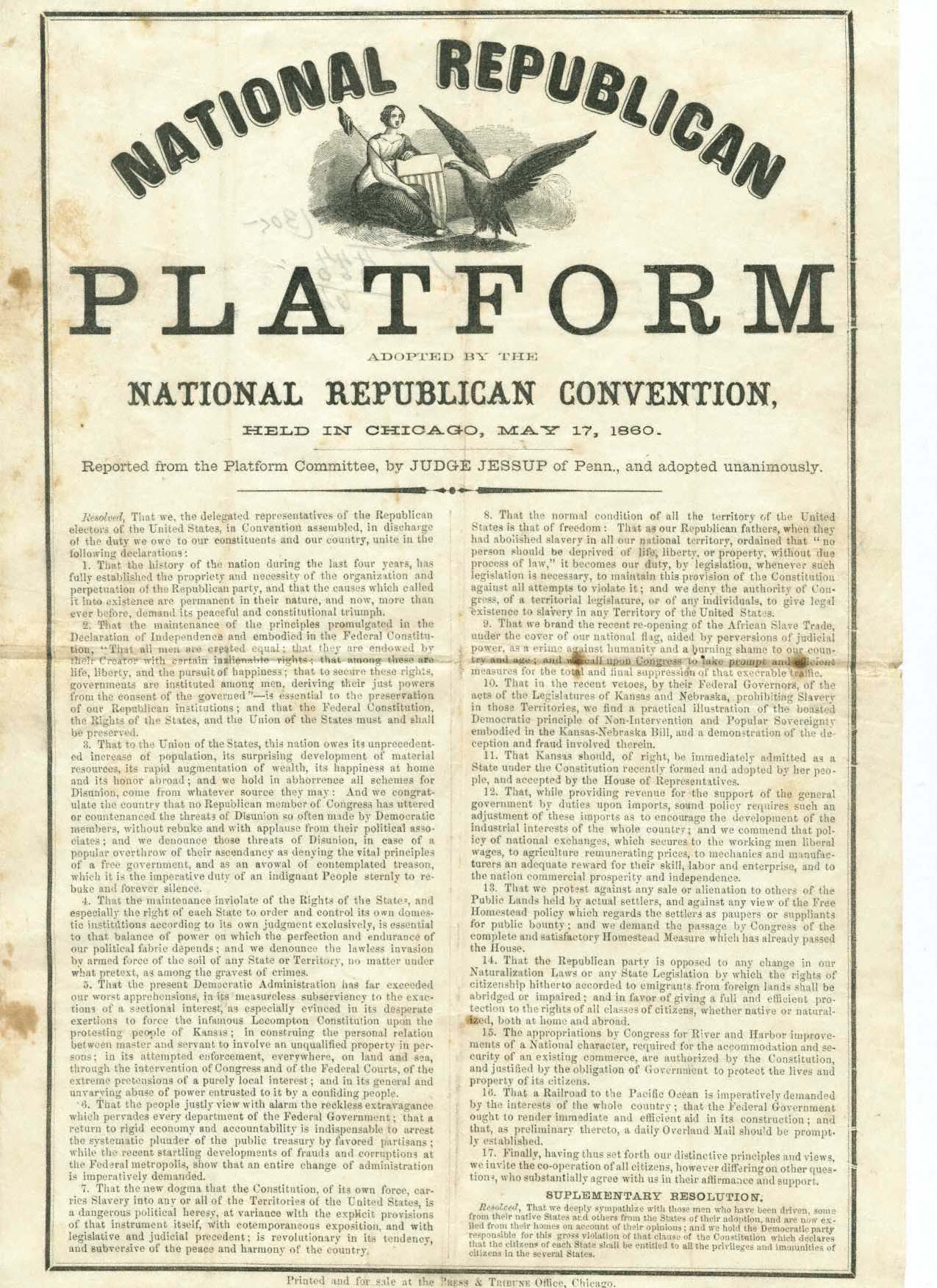
Talk about pining for the "good ol' days!" Someone arguing against the creation of the railroad system. BTW, the Republican Party was responsible for those subsidies you mentioned. Check out the first republican platform:

16. That a railroad to the Pacific ocean is imperatively demanded by the interests of the whole country; that the Federal Government ought to render immediate and efficient aid in its construction; and that, as preliminary thereto, a daily overland mail should be promptly established.


Republican_Platform_1860.jpg
 
Ignorant many are. Your ilk act as if these Acts were pur in thier intent and genesis. Just like the current bailouts very convieniently ignore governmental involvement in the creation of problem, so do older government intrusions. There were plenty of politicians on the take then which steered the ship toward ruin, like those who created subsidies and land use laws to get for example the railroad guys cheap and/or free land. That should have never taken place either. But I don't expect many elitists, I mean progressives to actually display any long term thought or practical reasoning.

Bro, would it not be proper to admit that the truth of the matter is long term thought or practical reasoning dictates that no economic system exists in a vacumm; that the human element is THE element which breathes life/existence into the system; that humans are endowed with the notion of individual self preservation; that the very nature of self preservation means that one persons interest may and often does conflict with the next person's idea of his self preservation and interests; and that, if left alone and unchecked by some rule of law/regulation, these competing interest will simply devour one or the other ???

Seriously?
 
Bro, would it not be proper to admit that the truth of the matter is long term thought or practical reasoning dictates that no economic system exists in a vacumm; that the human element is THE element which breathes life/existence into the system; that humans are endowed with the notion of individual self preservation; that the very nature of self preservation means that one persons interest may and often does conflict with the next person's idea of his self preservation and interests; and that, if left alone and unchecked by some rule of law/regulation, these competing interest will simply devour one or the other ???

Seriously?


Very good.

I had to read that when you quoted it because he lost me when he used the term "elitist" like the oil companies and Conservatives are somehow "common folks".
 
Re: The Contango Game: How Koch Industries Manipulates The Oil Market For Profit


The price of gasoline which is of course a derivative of crude oil (gasoline is refined from crude) is at a minimum 35% to as high as 50% higher than it should be If it were not for oil & gasoline futures speculation. So this means that the current price of unleaded gasoline which here in New York City is about $4.00 dollars should at a minimum be $2.60.

The percent of price inflation caused by commodity futures oil trading speculation was addressed at a US senate hearing several months ago. The Chairman and CEO of the largest oil company in the world Exxon/ Mobil testified under oath that at-a-minimum 35% of the price of oil is is pumped up commodity futures speculation. You can watch the videos below to watch his testimony. The current futures markets form crude oil and gasoline are both in backwardation. This means that the current 2012 futures contracts are trading at a higher price than 2013 contracts.

Whose responsible for adding at least $1.40 to the price US consumers pay for gasoline? The Banksters and the hundreds of black-box hedge funds who dominate the oil complex futures markets. The names most Americans would recognize are the same players that caused the financial meltdown of 2008 —Goldman Sachs, Citibank, Morgan Stanley, Well Fargo, Bank of America’s Merril Lynch, JP Morgan Chase, etc. As bank holding companies all of these companies can and are borrowing money from the Federal Reserve at 0% interest — and then using this cheap money to speculate on oil futures and push the price of gasoline to $4.00 and beyond. Is there a gasoline shortage in the United States right now? Hell no! The US currently has so much gasoline right now that the oil companies are exporting gasoline to Brazil and Mexico. The American Sheeple conned again by the oligarchs.


<object classid="clsid:d27cdb6e-ae6d-11cf-96b8-444553540000" codebase="http://download.macromedia.com/pub/shockwave/cabs/flash/swflash.cab#version=6,0,40,0" width="460" height="278"><param name="width" value="460"/><param name="height" value="278"/><param name="allowfullscreen" value="true"/><param name="src" value="http://www.youtube.com/v/furSTUKwfOw&fs=1&rel=1&showsearch=0" /><embed type="application/x-shockwave-flash" src="http://www.youtube.com/v/furSTUKwfOw&fs=1&hl=en&showsearch=0" width="460" height="278" allowfullscreen="true"> <br><a href="http://therealnews.com/">More at The Real News</a><br> </embed></object>
 
Re: The Contango Game: How Koch Industries Manipulates The Oil Market For Profit

Whose responsible for adding at least $1.40 to the price US consumers pay for gasoline? The Banksters and the hundreds of black-box hedge funds who dominate the oil complex futures markets. The names most Americans would recognize are the same players that caused the financial meltdown of 2008 —Goldman Sachs, Citibank, Morgan Stanley, Well Fargo, Bank of America’s Merril Lynch, JP Morgan Chase, etc. As bank holding companies all of these companies can and are borrowing money from the Federal Reserve at 0% interest — and then using this cheap money to speculate on oil futures and push the price of gasoline to $4.00 and beyond. Is there a gasoline shortage in the United States right now? Hell no! The US currently has so much gasoline right now that the oil companies are exporting gasoline to Brazil and Mexico. The American Sheeple conned again by the oligarchs.


Hey QueEx, I didn't write this. Is the message beginning to resonate, that 0% interest rates are undermining the economy?

Thought1, under Capitalism, the "Greed" for profit is counter-balanced with the risk of loss. 0% interest rates erase the risk, hence what you are experiencing, is NOT capitalism.
 
Last edited:
Re: The Contango Game: How Koch Industries Manipulates The Oil Market For Profit

Hey QueEx, I didn't write this. Is the message beginning to resonate, that 0% interest rates are undermining the economy?

Thought1, under Capitalism, the "Greed" for profit is counter-balanced with the risk of loss. 0% interest rates erase the risk, hence what you are experiencing, is NOT capitalism.


I don't think anyone disputed that when you said it but I maintain that interest rates alone are not the sole culprit in this (though what were interest rates a year ago? 6 months ago?) and gas prices are artificially high under normal circumstances due to other factors, including collusion among oil companies.
 
Re: The Contango Game: How Koch Industries Manipulates The Oil Market For Profit

Hey QueEx, I didn't write this. Is the message beginning to resonate, that 0% interest rates are undermining the economy?

Thought1, under Capitalism, the "Greed" for profit is counter-balanced with the risk of loss. 0% interest rates erase the risk, hence what you are experiencing, is NOT capitalism.

Lamar,

(1) Muckraker didn't post the article in this thread, I did - I copied it to this thread.

(2) Don't get caught up on "Sides" as your sometimes partner-in-ideology, actinanass does. I never said you were right or wrong; rarely is the root of a problem single-sourced, i.e., the FedRes being the source of all evil.

I don't have a problem acknowledging that interest rates are/may be influencing the price of gasoline. Likewise, I don't have a problem seeing that an unregulated market place will consume its subjects, if left to its own devices.
 
Re: The Contango Game: How Koch Industries Manipulates The Oil Market For Profit

I don't think anyone disputed that when you said it but I maintain that interest rates alone are not the sole culprit in this (though what were interest rates a year ago? 6 months ago?) and gas prices are artificially high under normal circumstances due to other factors, including collusion among oil companies.

It's just the first time someone has echoed my 0% interest rate argument, I was :eek:

I'd include the war propaganda and the inflating of the overall money supply as "significant factors" to the price increase.
 
In terms of real money, gas is ridiculously cheap.

In 1960...

a 1960 quarter (90% silver) bought 1 gallon of gas.

In 2012...

that 1960 quarter (90% silver) is worth $6.00 and buys 1 1/2 gallons of gas.

Actually, gas prices, in terms of money are EXTREMELY CHEAP!

In terms of dollars, gas prices went from 25 cents, in 1960, to almost $4 today. The reason why $4 seems so high, is because the United States is vastly POORER than it was 50 years ago.

Incomes are stagnant. Unemployment is sky-high. Debt is even higher. And wars abound.

That is why gas prices FEEL so high, despite all the evidence to the contrary.

Of course, these low gas prices cannot last, and it is just a matter of time before we are all looking at $6 gas.

Obama is going to lose in 2012 because of it.
 
In terms of real money, gas is ridiculously cheap.

In 1960...

a 1960 quarter (90% silver) bought 1 gallon of gas.

In 2012...

that 1960 quarter (90% silver) is worth $6.00 and buys 1 1/2 gallons of gas.

Actually, gas prices, in terms of money are EXTREMELY CHEAP!

In terms of dollars, gas prices went from 25 cents, in 1960, to almost $4 today. The reason why $4 seems so high, is because the United States is vastly POORER than it was 50 years ago.

Incomes are stagnant. Unemployment is sky-high. Debt is even higher. And wars abound.

That is why gas prices FEEL so high, despite all the evidence to the contrary.

Of course, these low gas prices cannot last, and it is just a matter of time before we are all looking at $6 gas.

Obama is going to lose in 2012 because of it.


You were having the best post in your history until the last unrelated sentence that goes back to your own psychosis.
Not that I agreed but it was well stated and came off intelligently.
 
Last edited:
Source

March 3, 2012 - 12:45 Pacific Standard Time

6-dollar-gas.jpg


I guess $6 gas has already been seen in Los Angeles.

You were having the best post in your history until the last unrelated sentence that goes by your own psychosis.
Not that I agreed but it was well stated and came off intelligently.

What difference does it make? You have two scumbag, Baby Boomers wanting to be President in 2013.

Both idiots want to keep this crumbling, stumbling, United States empire going for just a little while longer so they can live the good life... all the while destroying any chance that their children will have any resources left to use on which to live.

The United States is finished. We will all be farmers in the next 20 years, trying to eke out an existence any way we can.

We will look back at this period as one of the great lost opportunities of history. There will be no one to blame but ourselves for what is coming.
 
Bro, would it not be proper to admit that the truth of the matter is long term thought or practical reasoning dictates that no economic system exists in a vacumm; that the human element is THE element which breathes life/existence into the system; that humans are endowed with the notion of individual self preservation; that the very nature of self preservation means that one persons interest may and often does conflict with the next person's idea of his self preservation and interests; and that, if left alone and unchecked by some rule of law/regulation, these competing interest will simply devour one or the other ???

Seriously?

Seriously. The "rule of law" is more often than used used as a tool to implement the "simply devour one or the other" that you allude to (See "Slavery by Another Name") for just a recent example. Who the fuck is who to judge. Now we just have races between different groups of well
 
ibfSAVInUgy3vw.JPG


Once Again, Speculators Behind Sharply Rising Oil & Gasoline Prices

by Kevin G. Hall | McClatchy Newspapers

February 21, 2012


http://www.mcclatchydc.com/2012/02/21/v-print/139521/once-again-speculators-behind.html

WASHINGTON — U.S. demand for oil and refined products — including gasoline — is down sharply from last year, so much that United States has actually become a net exporter of gasoline, unable to consume all that it makes.

Yet oil and gasoline prices are surging.

On Tuesday, oil rose past $106 a barrel and gasoline averaged $3.57 a gallon — thanks again in no small part to rampant financial speculation on top of fears of supply disruptions.

The ostensible reason for the climb of crude prices on the New York Mercantile Exchange, where contracts for future delivery of oil are traded, is growing fear of a military confrontation with Iran in the Persian Gulf's Strait of Hormuz, through which 20 percent of the world's oil passes.

Other factors driving up prices include last month's bankruptcy of Petroplus, a big European refiner, and a recent BP refinery fire in Washington state that's temporarily crimped gasoline supply along the West Coast; gas now costs an average of $4.04 a gallon in California.

While tension over Iran has ratcheted up over the last few months, the price of oil and gasoline has leaped far beyond conventional supply and demand variables. Financial speculators are piling into the market, torquing the Iranian fear factor into ever-higher prices.

"Speculation is now part of the DNA of oil prices. You cannot separate the two anymore. There is no demarcation," said Fadel Gheit, a 30-year veteran of energy markets and an analyst at Oppenheimer & Co. "I still remain convinced oil prices are inflated."

Consider that light, sweet crude trading on the NYMEX changed hands at $79.20 a barrel just four months ago, but soared past $106 a barrel Tuesday afternoon, partly on news that Iran would halt shipment of oil to Britain and France. But those countries already had stopped buying Iranian oil. And Didier Houssin, the International Energy Agency's director for energy markets and security, said that "there are alternative supplies that can make up for any loss of Iranian exports," The Wall Street Journal reported.

Still, oil's price shot up because it trades in financial markets, where Wall Street firms and other big financial players dominate the trading of oil, even though they have no intention of ever taking possession of the oil whose contracts they are trading.

Since oil prices are the biggest component in the price of gasoline, pump prices are soaring. AAA said Tuesday that the nationwide average price for a gallon of gasoline stood at $3.57, compared with $3.38 a month ago and $3.17 a year ago. It takes about $6 more to fill up the tank than it did this time last year — and last year's gasoline-price surge helped take the steam out of the economic recovery.

Defining what percentage of today's high oil and gasoline prices is due to excessive speculation, driven by Iran fears, is something of a guessing game.

"I put the Iran security premium at about $8 to $10 (a barrel) at this point, which still puts crude at about $90 or $95," said John Kilduff, a veteran energy analyst at AgainCapital in New York.

The fear premium is the froth above what prices would be absent fears of a supply disruption_ somewhere in the $80 to $85 range for a barrel of crude oil.

<FONT style="BACKGROUND-COLOR: yellow"> It means that even with the extra cost put on oil from Iran fears, prices are at least another $10 higher than what demand fundamentals would dictate.</font>

<FONT style="BACKGROUND-COLOR: yellow">Why? Financial speculators.</font>
<FONT style="BACKGROUND-COLOR: yellow">
What should the price of oil be if left to conventional supply and demand market fundamentals? Canada's the largest supplier of imported oil to the United States, which now actually produces more than half of the oil it consumes. Production and delivery costs for a barrel of oil from Canada are about $75 a barrel. The market-fundamentals cost for a barrel of oil is in that ballpark; above that, speculation sets the prices.</font>

"It's as simple as that," said Gheit, who has testified before Congress and called for regulatory limits on speculation in commodities markets.

Historically, financial speculators accounted for about 30 percent of oil trading in commodity markets, while producers and end users made up about 70 percent. Today it's almost the reverse.


ibcad5JTfOra8D.JPG


A McClatchy review of the latest Commitment of Traders report from the Commodity Futures Trading Commission, which regulates oil trading, shows that producers and merchants made up just 36 percent of all contracts traded in the week ending Feb. 14.

That same week, open interest, or the total outstanding oil contracts for next-month delivery of 1,000 barrels of oil (about 42,000 gallons), stood near an all-time high above 1.486 million. Speculators who'll never take delivery of oil made up 64 percent of the market.

Not surprisingly, big Wall Street traders on Tuesday projected oil will rise above $112 a barrel; some such as Swiss giant Vitol even suggested $150-a-barrel oil is coming soon. When they dominate the market, as they do, speculators' bids can make their prophecies self-fulfilling.

"These people are not there to be heroes. They are there to make money. It's our fault because we are allowing them to do that," said Gheit. "Obviously these people are very strong, and the financial lobby is the strongest of any single lobby. I've been in this business 30 years, and I can tell you I think this is smoke and mirrors."

What's indisputable is that oil and gasoline are not in short supply, and that demand remains weak. That was crystal clear in the latest weekly energy market update by the U.S. Energy Information Administration_ published last week for the week ending Feb. 10.

"Total products supplied over the last four-week period have averaged 18.3 million barrels per day, down by 4.6 percent compared to the similar period last year. Over the last four weeks, motor gasoline product supplied has averaged nearly 8.1 million barrels per day, down by 6.4 percent from the same period last year," said the EIA, the statistical arm of the Energy Department.

Inventories of stored oil are also unusually high, the EIA said.

"At 339.1 million barrels, U.S. crude oil inventories are in the upper limit of the average range for this time of year," the agency said. "Total motor gasoline inventories increased by 0.4 million barrels last week and are in the upper limit of the average range."

Hence, no shortage to explain soaring prices.

In fact, U.S. demand and consumption patterns are so abnormal compared to recent decades that oil and gasoline are both now being exported to Europe, Asia and Latin America.

Exports of U.S. refined product averaged 2.928 million barrels per day over the four weeks ending on Feb. 10, compared to 2.190 million bpd for the four weeks ending Feb. 11, 2011, the EIA said. This category is primarily gasoline, but it includes unfinished oils, fuel additives, ethanol and other blending components.

Similarly, the United States did not export any oil in the four weeks ending Feb. 11, 2011, but in the four-week period ending this Feb. 10, we exported 37,000 barrels.

The export picture suggests that when domestic demand rises, American motorists might be competing with drivers elsewhere for U.S.-made gasoline, which fetches a higher price as an export.

"To the extent that there is this export market that wasn't there before, it is certainly ... keeping prices higher than they otherwise would be," said Kilduff. "Exports were not material. Now they are becoming material."

The White House sought to deflect criticism about rising oil and gasoline prices. Spokesman Jay Carney blamed the prices on "a variety of factors on the global price of oil. They include unrest in certain regions of the world, they include growth in areas like China and India."

Another popular explanation for rising oil prices Tuesday was trader relief that Greece received another bailout payment from Europe. That heightened hopes of a boost in oil demand in Europe as its economy recovers, given that a crisis has been avoided for now.

That explanation doesn't add up.

Last year, when oil and gasoline prices rose and slowed the U.S. economy, the surging prices were explained away by traders who said that oil and other commodities moved inverse to slumping stock prices. Today, oil prices and stock prices seem to be moving in tandem — upward — contradicting last year's justification.

East Coast refiners have seen their profit margins squeezed because they import Brent crude oil from Europe, which has traded at least $10 above crude coming out of the U.S. Gulf region.

Consolidation in the refining sector is another new wrinkle weighing on the oil and gasoline markets. The EIA, in a separate publication called This Week in Petroleum, warned last week that refinery closures in the U.S. Northeast and in some Caribbean countries could crimp supplies along the U.S. East Coast. Refinery closures and strained distribution could drive up gasoline prices on the East Coast until industry players make necessary infrastructure adjustments.

"On paper, refining capacity in the more competitive Gulf Coast and Midwest hubs appears more than adequate to make up for lost East Coast refining capacity. But the Colonial pipeline, which connects Gulf Coast refineries to the Central Atlantic, is already running near capacity levels, so bringing incremental Gulf Coast product volumes to East Coast markets could be a challenge," the EIA said.


<hr noshade color="#FF0000" size="8"></hr>
 
2008

<iframe width="420" height="315" src="http://www.youtube.com/embed/UzEnKdBAb_o" frameborder="0" allowfullscreen></iframe>​
 
ibfSAVInUgy3vw.JPG


Once Again, Speculators Behind Sharply Rising Oil & Gasoline Prices

by Kevin G. Hall | McClatchy Newspapers

February 21, 2012


http://www.mcclatchydc.com/2012/02/21/v-print/139521/once-again-speculators-behind.html

WASHINGTON — U.S. demand for oil and refined products — including gasoline — is down sharply from last year, so much that United States has actually become a net exporter of gasoline, unable to consume all that it makes.

Yet oil and gasoline prices are surging.

On Tuesday, oil rose past $106 a barrel and gasoline averaged $3.57 a gallon — thanks again in no small part to rampant financial speculation on top of fears of supply disruptions.

The ostensible reason for the climb of crude prices on the New York Mercantile Exchange, where contracts for future delivery of oil are traded, is growing fear of a military confrontation with Iran in the Persian Gulf's Strait of Hormuz, through which 20 percent of the world's oil passes.

Other factors driving up prices include last month's bankruptcy of Petroplus, a big European refiner, and a recent BP refinery fire in Washington state that's temporarily crimped gasoline supply along the West Coast; gas now costs an average of $4.04 a gallon in California.

While tension over Iran has ratcheted up over the last few months, the price of oil and gasoline has leaped far beyond conventional supply and demand variables. Financial speculators are piling into the market, torquing the Iranian fear factor into ever-higher prices.

"Speculation is now part of the DNA of oil prices. You cannot separate the two anymore. There is no demarcation," said Fadel Gheit, a 30-year veteran of energy markets and an analyst at Oppenheimer & Co. "I still remain convinced oil prices are inflated."

Consider that light, sweet crude trading on the NYMEX changed hands at $79.20 a barrel just four months ago, but soared past $106 a barrel Tuesday afternoon, partly on news that Iran would halt shipment of oil to Britain and France. But those countries already had stopped buying Iranian oil. And Didier Houssin, the International Energy Agency's director for energy markets and security, said that "there are alternative supplies that can make up for any loss of Iranian exports," The Wall Street Journal reported.

Still, oil's price shot up because it trades in financial markets, where Wall Street firms and other big financial players dominate the trading of oil, even though they have no intention of ever taking possession of the oil whose contracts they are trading.

Since oil prices are the biggest component in the price of gasoline, pump prices are soaring. AAA said Tuesday that the nationwide average price for a gallon of gasoline stood at $3.57, compared with $3.38 a month ago and $3.17 a year ago. It takes about $6 more to fill up the tank than it did this time last year — and last year's gasoline-price surge helped take the steam out of the economic recovery.

Defining what percentage of today's high oil and gasoline prices is due to excessive speculation, driven by Iran fears, is something of a guessing game.

"I put the Iran security premium at about $8 to $10 (a barrel) at this point, which still puts crude at about $90 or $95," said John Kilduff, a veteran energy analyst at AgainCapital in New York.

The fear premium is the froth above what prices would be absent fears of a supply disruption_ somewhere in the $80 to $85 range for a barrel of crude oil.

<FONT style="BACKGROUND-COLOR: yellow"> It means that even with the extra cost put on oil from Iran fears, prices are at least another $10 higher than what demand fundamentals would dictate.</font>

<FONT style="BACKGROUND-COLOR: yellow">Why? Financial speculators.</font>
<FONT style="BACKGROUND-COLOR: yellow">
What should the price of oil be if left to conventional supply and demand market fundamentals? Canada's the largest supplier of imported oil to the United States, which now actually produces more than half of the oil it consumes. Production and delivery costs for a barrel of oil from Canada are about $75 a barrel. The market-fundamentals cost for a barrel of oil is in that ballpark; above that, speculation sets the prices.</font>

"It's as simple as that," said Gheit, who has testified before Congress and called for regulatory limits on speculation in commodities markets.

Historically, financial speculators accounted for about 30 percent of oil trading in commodity markets, while producers and end users made up about 70 percent. Today it's almost the reverse.


ibcad5JTfOra8D.JPG


A McClatchy review of the latest Commitment of Traders report from the Commodity Futures Trading Commission, which regulates oil trading, shows that producers and merchants made up just 36 percent of all contracts traded in the week ending Feb. 14.

That same week, open interest, or the total outstanding oil contracts for next-month delivery of 1,000 barrels of oil (about 42,000 gallons), stood near an all-time high above 1.486 million. Speculators who'll never take delivery of oil made up 64 percent of the market.

Not surprisingly, big Wall Street traders on Tuesday projected oil will rise above $112 a barrel; some such as Swiss giant Vitol even suggested $150-a-barrel oil is coming soon. When they dominate the market, as they do, speculators' bids can make their prophecies self-fulfilling.

"These people are not there to be heroes. They are there to make money. It's our fault because we are allowing them to do that," said Gheit. "Obviously these people are very strong, and the financial lobby is the strongest of any single lobby. I've been in this business 30 years, and I can tell you I think this is smoke and mirrors."

What's indisputable is that oil and gasoline are not in short supply, and that demand remains weak. That was crystal clear in the latest weekly energy market update by the U.S. Energy Information Administration_ published last week for the week ending Feb. 10.

"Total products supplied over the last four-week period have averaged 18.3 million barrels per day, down by 4.6 percent compared to the similar period last year. Over the last four weeks, motor gasoline product supplied has averaged nearly 8.1 million barrels per day, down by 6.4 percent from the same period last year," said the EIA, the statistical arm of the Energy Department.

Inventories of stored oil are also unusually high, the EIA said.

"At 339.1 million barrels, U.S. crude oil inventories are in the upper limit of the average range for this time of year," the agency said. "Total motor gasoline inventories increased by 0.4 million barrels last week and are in the upper limit of the average range."

Hence, no shortage to explain soaring prices.

In fact, U.S. demand and consumption patterns are so abnormal compared to recent decades that oil and gasoline are both now being exported to Europe, Asia and Latin America.

Exports of U.S. refined product averaged 2.928 million barrels per day over the four weeks ending on Feb. 10, compared to 2.190 million bpd for the four weeks ending Feb. 11, 2011, the EIA said. This category is primarily gasoline, but it includes unfinished oils, fuel additives, ethanol and other blending components.

Similarly, the United States did not export any oil in the four weeks ending Feb. 11, 2011, but in the four-week period ending this Feb. 10, we exported 37,000 barrels.

The export picture suggests that when domestic demand rises, American motorists might be competing with drivers elsewhere for U.S.-made gasoline, which fetches a higher price as an export.

"To the extent that there is this export market that wasn't there before, it is certainly ... keeping prices higher than they otherwise would be," said Kilduff. "Exports were not material. Now they are becoming material."

The White House sought to deflect criticism about rising oil and gasoline prices. Spokesman Jay Carney blamed the prices on "a variety of factors on the global price of oil. They include unrest in certain regions of the world, they include growth in areas like China and India."

Another popular explanation for rising oil prices Tuesday was trader relief that Greece received another bailout payment from Europe. That heightened hopes of a boost in oil demand in Europe as its economy recovers, given that a crisis has been avoided for now.

That explanation doesn't add up.

Last year, when oil and gasoline prices rose and slowed the U.S. economy, the surging prices were explained away by traders who said that oil and other commodities moved inverse to slumping stock prices. Today, oil prices and stock prices seem to be moving in tandem — upward — contradicting last year's justification.

East Coast refiners have seen their profit margins squeezed because they import Brent crude oil from Europe, which has traded at least $10 above crude coming out of the U.S. Gulf region.

Consolidation in the refining sector is another new wrinkle weighing on the oil and gasoline markets. The EIA, in a separate publication called This Week in Petroleum, warned last week that refinery closures in the U.S. Northeast and in some Caribbean countries could crimp supplies along the U.S. East Coast. Refinery closures and strained distribution could drive up gasoline prices on the East Coast until industry players make necessary infrastructure adjustments.

"On paper, refining capacity in the more competitive Gulf Coast and Midwest hubs appears more than adequate to make up for lost East Coast refining capacity. But the Colonial pipeline, which connects Gulf Coast refineries to the Central Atlantic, is already running near capacity levels, so bringing incremental Gulf Coast product volumes to East Coast markets could be a challenge," the EIA said.


<hr noshade color="#FF0000" size="8"></hr>

2008

<iframe width="420" height="315" src="http://www.youtube.com/embed/UzEnKdBAb_o" frameborder="0" allowfullscreen></iframe>​

thank you ...both of you.
 
All these propaganda pieces from the state-run media because they know most people have no understanding of the basics of supply and demand.

As prices rise, demand falls. That is Economics 101.

Of course, the state-run media tries to portray the issue as United States demand (alone) controls the price of gas worldwide. So, because the United States drops its driving addiction just a little bit, the realities of higher gas prices are unjustified... when that is precisely what happens when supply (for any commodity) decreases faster.

If the price of cars rise, demand falls.
If the price of steak rises, demand falls.
If the price of football tickets rises, demand falls.

So, the state-run media blames higher prices on the evil, UNIDENTIFIED, nameless, faceless, boogeyman, called the speculators. But, that is for the simple-minded, for those who feel they are "owed" or "entitled to" cheap gas and want to blame someone, anyone, other than themselves.

As in any other market, a lot of different things may be causing the higher prices. If demand is stable, then supply affects prices. And, then it depends on how important supply of the commodity is.

Iphone supply is not as critical as food and fuel. So, the price of iphones will affect the number sold. If it is too high, people will say forget the iphone and buy something else. However, since food and fuel are critical to life, no matter what the supply is, people will pay the price (if they can).

Gas prices are going higher because people in the United States waste so much fuel on utter bullshit, like commuting, entertainment, and their personal, petty, concerns.

In Asia (even Europe), they wring a lot more value out of a gallon of fuel, than the typical SUV-owning, suburban-living, commuting, United States driver.

Gas prices are going higher until driving habits change in this country.
 
Last edited:
Inflation, pure & simple! Prices adjust to the total amount of money in circulation.

What did we expect when trillions were injected since 2008? The stimulus, ZIRP, QE1 & QE2 have a price tag.......... at the expense of our purchasing power.
 
Back
Top