
You are using an out of date browser. It may not display this or other websites correctly.
You should upgrade or use an alternative browser.
You should upgrade or use an alternative browser.
Social media is a cold world!!!
- Thread starter Mask
- Start date



Stabbing inside Miami restaurant leaves woman hospitalized
A woman was hospitalized after being stabbed multiple times during a fight inside a busy Miami restaurant, authorities said.

Video shows woman stabbing another with scissors at NW Miami-Dade restaurant: Witness
A woman accused of a vicious assault at a Northwest Miami-Dade restaurant may need to go to a hospital so doctors can evaluate her. Damaris Rodriguez, 22, is homeless. She was unresponsive during a bond court hearing Thursday. This raised some concern about her health. “Judge, I do not believe...
 www.nbcmiami.com

Thief snatches inflatable Christmas decorations off Florida family’s lawn in broad daylight
A Florida family’s holiday spirit took a hit after a man drove up onto their lawn and stole their inflatable Christmas decorations in broad daylight.

White Woman Gets Confronted For Allegedly Stealing Black Woman's Purse Mid-Workout!
White Woman Gets Confronted For Allegedly Stealing Black Woman's Purse Mid-Workout!

Come On Mayne: What Did He Think Was Going To Happen Doing That?
What Did He Think Was Going To Happen Doing That?

Pay Attention To The Road: When Actin' A Fool Goes Wrong!
Pay Attention To The Road: When Actin' A Fool Goes Wrong!


Searching for a miracle
On his way to Hollywood, a young Black man named Winston Willis stopped in Cleveland in 1959 to shoot a little pool and walked away $35,000 richer. He used his winnings to open over two dozen businesses. Nowadays, there's no trace of his "Miracle on 105th Street." And most people in Cleveland...
Fucking white people. They love to say black people need to pull themselves up by their bootstraps, and then the moment they do, white people find the value and whatever the black person is holding and steal it from him using the law to do it
The story
On his way to Hollywood, a young Black man named Winston Willis stopped in Cleveland in 1959 to shoot a little pool and walked away $35,000 richer. He used his winnings to open over two dozen businesses on Cleveland's East Side, a vibrant area that locals referred to as "Inner City Disneyland." For a time, Willis was a multi-millionaire, the largest employer of Black people in the Midwest, and a bold business mogul with a big reputation.
Nowadays, there's no trace of the "Miracle on 105th Street". That same intersection is dominated by the campus of a non-profit hospital system. And most people growing up in Cleveland today have never heard of Winston Willis.
Cleveland writer and race educator Ajah Hales examines the forces that punished Willis for daring to live the American dream, and goes on a search for proof of his missing legacy.
Credits:
Episode producer: Ajah Hales, Quincy Walters, Nora Saks
Host: Nora Saks
Story editor: Nick White
Mix and sound design: Emily Jankowski, Paul Vaitkus, Matt Reed
Fact checker: Meera Raman
Web producer: Meera Raman
Executive producer: Ben Brock Johnson
Additional production: Dean Russell, Amory Sivertson, Kristin Torres
Show notes:
"The Jazz Temple" article on Cleveland Historical
"Cleveland's Second Downtown" article on Cleveland Historical
"The Winston Willis Story" website
"The Winston I Knew" article on Cool Cleveland
Doan's Corners - Encyclopedia of Cleveland History
Martin Luther King Jr.'s speech in Cleveland in 1967
"The Miracle on East 105th" article in Pressure magazine
Special thanks to Winston Willis, Aundra Willis Carrasco, Kasner Willis, Mark Souther, Kandiace Gibson, Michael B., and WCPN in Cleveland.
Full Transcript:
This content was originally created for audio. The transcript has been edited from our original script for clarity. Heads up that some elements (i.e. music, sound effects, tone) are harder to translate to text.
Nora Saks: A heads up: this episode contains strong language, including a racial slur that some may find offensive. Take care when listening. OK, here's the show.
Support WBUR
Nora: Loyal Last Seen listeners - I’d like to introduce you to Ajah Hales.
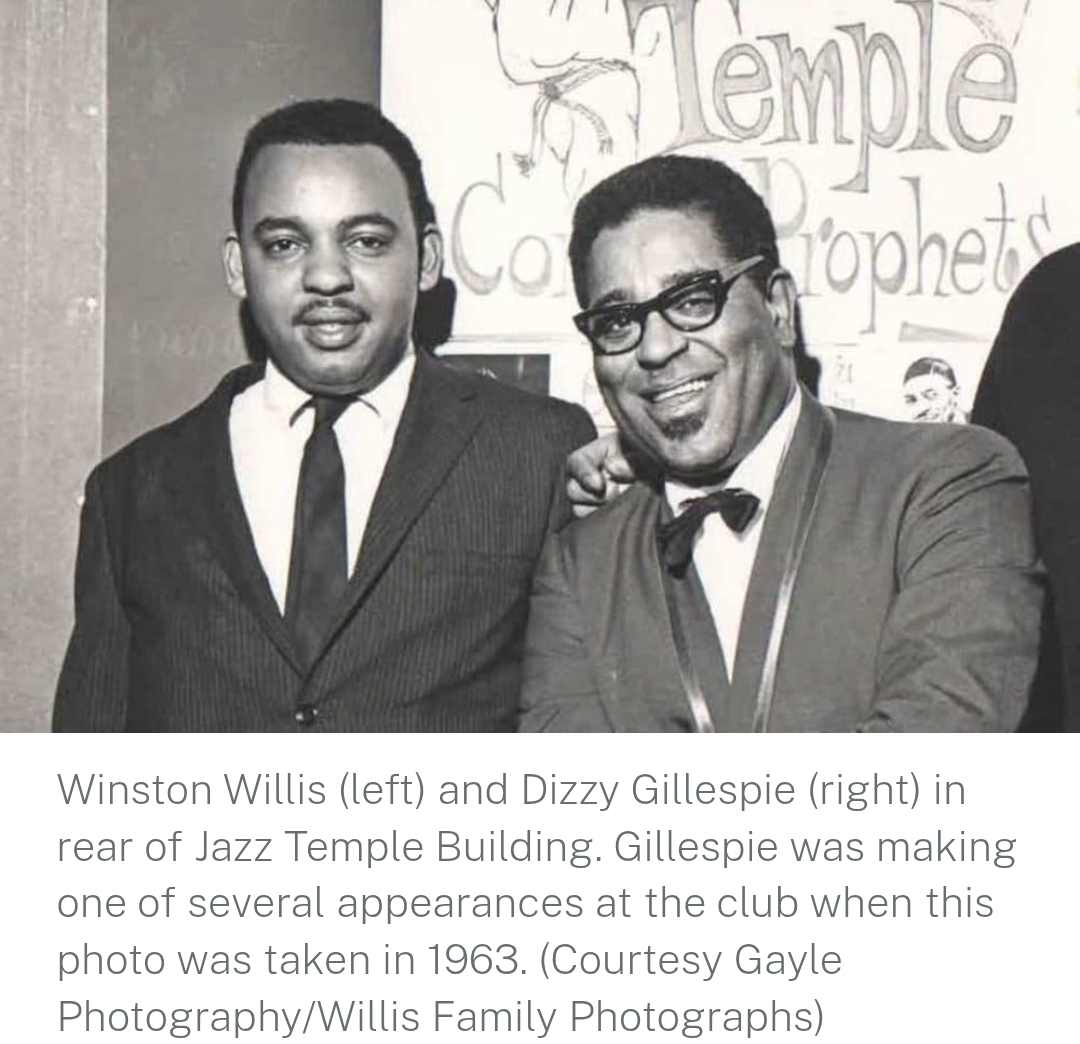
Winston and Charlene, the dynamic duo, at The Jazz Temple in 1963. (Courtesy Gayle Photography/Willis Family Photographs)
Winston and Charlene, the dynamic duo, at The Jazz Temple in 1963. (Courtesy Gayle Photography/Willis Family Photographs)
Ajah Hales: I'm Ajah Hales and I'm a writer and race educator from East Cleveland, Ohio.
Nora: Give me a little window into your work as a race educator. What do you spend your time doing?
Ajah: Well I give churches, nonprofits and corporations the tools to have productive conversations about race. Which basically means I create a lot of lesson plans and curriculum and do a ton of research.
So I’m not a reporter. But I worked really hard to report out this story with WBUR Podcasts so it could be told and heard in its entirety for the first time.
Nora: Right, and it has to do with one very busy - and very famous - intersection on Cleveland’s East Side. So tell us about this intersection - what’s there today?
Ajah: It’s called 105 and Euclid, and it’s kind of where Cleveland started. But right now, it’s home to a building owned by the Cleveland Clinic, you know, the number two hospital in the nation. It’s just two nondescript brick buildings called the W.O Walker Center, which is a physical therapy and rehab center.
Nora: About 40 years ago, though, this corner looked totally different, right?
Support WBUR
Ajah: Yeah, I mean back in the 70s and 80s, this corner was a toehold for Black-owned businesses in a city that didn’t want them there. And that’s in large part thanks to Winston Willis, and his miracle on 105.
Nora: I’ve never heard of Winston Willis.
Ajah: Well, I'd love to tell you the story of a young Black man who came to Cleveland, gambled his way to the top and built a multi-million dollar empire that people once called ‘inner-city Disneyland.’ You know, a man who became the largest employer of Black Americans in the Midwest. But that's not the full story. The full story ends in a very different way.
[Voice 1: To me, 105th and Euclid is a crime scene…
Voice 2: Broader context of Black dispossession…
Voice 3: If America wasn’t America, my uncle could have been Bill Gates...]
Ajah: This is the story of a Black man who was punished for daring to live the American dream.
Nora: Punished by whom?
Ajah: It's not that simple. You can't put it down to just one person or one entity. This was a conglomeration of forces coming together. And here’s the thing. These forces don't have to prove they weren’t involved with what happened to Winston Willis. They just have to make it really hard for you to prove they were.
Support WBUR
Nora: Welcome to Last Seen - a show about people, places and things that have gone missing, and whether or not they can, or even should, be found. From WBUR - Boston’s NPR station. I’m Nora Saks.
Today, for the final chapter in our Season 2 anthology, we hear a story that comes from a clear point of view. Race educator Ajah Hales is on a search for proof of the missing legacy of Black business mogul Winston Willis - while he’s still alive. This is Episode 10: “Searching for a Miracle”.
[DOCUMENTARY CLIP:
Winston Willis: I think that Cleveland has to be, absolutely the most racist part of all of America.]
Ajah: That’s Winston Willis four years ago, speaking for a documentary that was never made. He’s talking about Cleveland in the 60s, but honestly? Not much has changed since then. By the time I was born in 1985, Cleveland had earned the label ‘hypersegregated.’ Today, Cleveland still ranks in the top ten most segregated cities in America. That’s why it surprised me to learn that a Black millionaire once owned prime real estate on Euclid avenue with 28 businesses where Black Clevelanders could shop, work and thrive. A place they called ‘inner-city Disneyland.’
I’m getting ahead of myself. Let’s go back to the very beginning.
[MUSIC]
Winston Willis grew up in Detroit, Michigan. And he was always a bit of a rebel. A rebel who would go from being a hustler to becoming a serial entrepreneur and real estate developer. At 19, Winston left Detroit without his parent’s permission and set out for Hollywood. He wanted to make movies.
Aundra Willis Carrasco: And he felt guilty, because he knew our mother was going to be so upset. So he stopped at a payphone to call Mother, and she was just hysterically crying and saying well at least go to your cousin's house and get a hot meal.
Support WBUR
Ajah: That’s the voice of Aundra Willis Carrasco, Winston’s sister. She has spent the majority of her life trying to salvage her brother’s legacy and tell his story. Now that Winston’s health has declined to the point where he no longer speaks to the public, his ‘baby’ sister fights for him. I’d tell you her age, but she knows where I live.
Since Black Americans could never ensure their welcome among their leucistic analogs, stopping at the house of a family member, or friend, for a home-cooked meal (and generous to-go plate) was the safest option for Black American travelers well into the ‘70s. In 1959, Winston stopped at his cousin’s house in Cleveland to eat, and shoot some pool.
Aundra: In that pool hall, one of the first people he met was a guy named Carl Stokes, who later became mayor.
Ajah: The first Black mayor of any major U.S. City. Winston started that night by making friends in high places and ended it $35,000 richer than he came in. Ultimately, neither his money or his powerful relationships would save him from ‘the powers that be.’ More on that later.
Winston grew up managing his father’s tile shop. That’s where he met and befriended jazz legend Miles Davis - he was shopping there. So when Winston won $35,000 in a pool game, he used his winnings to start Detroit Carpet and Tile. The first of over two dozen businesses Winston would eventually own on Cleveland’s Eastside. Detroit Carpet and Tile was where Willis met his first love, a woman named Charlene.
Aundra: And with Charlene, Winston and Charlene created the Jazz Temple. And that was in 1961.
[JAZZ MUSIC PLAYS]
Ajah: The Jazz Temple sat across the street from Case Western, and a stone’s throw away from University Hospital. The building bordered an infamously anti-Black neighborhood called Little Italy. At 19, Winston was too young for a liquor license, but he knew he didn’t need to sell alcohol to turn a profit--top-notch performances at affordable prices would keep the music accessible and the chairs full.
He also knew that a young Black man opening an integrated club in a predominantly white ‘ed’s and med’s’ district, or educational and medical as it used to be called, was nothing short of a declaration of war. Nevertheless, he persisted.
Support WBUR
Using his relationships with Black entertainers like Miles Davis and John Coltrane, Winston created a venue that became a hot spot for Cleveland. A place to catch a real legend perform, or just the mere chance of spotting someone Black and famous.
Aundra: And the Jazz Temple was hugely successful.
Ajah: Aundra started working at Jazz Temple the night she got to Cleveland. If you were family, and you were in town, Winston was going to put you to work.
Aundra: We used to get bomb threats every single night! I used to answer the phone and hear the most god-awful racist threats.
Ajah: That was to be expected since Jazz Temple drew in college students from all over Northeast Ohio and was known as a ‘safe place’ for interracial couples.
[NPR CLIP:
Freddie Hubbard: For some reason, I don't think they wanted, the people in the neighborhood didn't want that club to be there. So they threatened to throw a bomb in the club that night.
Interviewer: What happened?
Freddie: Art Blakey said I don’t care what they do, we’re gonna play anyway.]
Support WBUR
Ajah: That’s Jazz legend Freddie Hubbard telling a local NPR affiliate about a night the Art Blakey band headlined at Jazz Temple. The musicians refused to be intimidated. They created a vaudevillian performance guaranteed to distract the crowd from the bomb threat.
[NPR CLIP:
Freddie Hubbard: And I’ll never forget, there was a guy, a friend of Art’s, who came in the club that night and danced on nails. So he, he came up on stage, and I'll never forget, we were playing Three Blind Mice and this guy laid down on some nails and walked on glass, right on stage.]
Ajah: Threats of racial violence did little to deter college students from going to see some of the hottest acts in the country. I’m looking at a poster from back then of Jazz Temple headliners that reads like a who’s who of 1960s Black entertainers. Miles, Coltrane, Dinah Washington, Redd Foxx, Herbie Hancock, Richard Pryor, Dick Gregory--even Malcolm X came to ‘worship at the temple’. But the Jazz Temple’s success would be short-lived.
Ajah: What happened to it?
Aundra: It was bombed (laughs).
Ajah: Just two weeks after Art Blakey’s friend danced on nails, someone put dynamite in an exhaust vent. It was the end of Jazz Temple. Cleveland Police failed to arrest any suspects. They called the bombing an ‘educational warning.’
It was the kind of “warning” many Black entertainment venues near white neighborhoods received, a form of what African American literature professor Koritha Mitchell calls ‘know your place aggression.’
[YOUTUBE CLIP
Support WBUR
Koritha Mitchell: Sometimes it wasn't that you were doing something wrong, it was that you were doing everything right, and thereby needed to be put in your so-called proper place.
Ajah: The Jazz Temple wasn’t the exception, it was the rule. I found example after example throughout the Midwest of Black people making incursions into white spaces, only to be met with racial violence. A few years earlier, a white-owned Jazz club that allowed ‘race mixing’ was bombed three times in one year. After the third bombing, they posted a sign that said: “Don’t bomb us. We quit.”
And it wasn’t just businesses. Mount Zion Congregational Church, one of the oldest churches in the country organized by and for Black Americans, was bombed when the congregation moved into University Circle. One local Black Pastor’s house was bombed twice. When racial covenants weren’t enough to keep Black Clevelanders in their place, hostility, threats, bombs, and violence often did the trick.
Like I mentioned, the Cleveland police called these kinds of incidents “educational warnings”. Feel free to disagree with me, but when white people destroy Black owned or frequented spaces to tell Black people we don’t belong somewhere, I call it racial terrorism - and that’s the term I’m going to keep using.
The crazy thing is, all of University Circle started off as land grants–a form of federal real estate subsidies that allowed white men to purchase huge parcels of land for pennies on the dollar. University Circle was built by and for white people, and racial violence was used to keep the area white. Black residents and business owners had no recourse against racial violence. They simply had to pick up the pieces and move on.
Which is exactly what Winston did.
In the years after racial terrorists destroyed the Jazz Temple, Winston opened up over two dozen more businesses throughout the midwest.
He invested in high liquidity businesses like after-hours restaurants, adult movie theaters, number’s stations - which are bodegas where you can gamble–businesses that didn’t ruffle any feathers and which allowed him to stack cash. Winston knew that when it came to real estate, the only color that really mattered was green.
Then, in 1968, Winston finally got the lucky break that would take him from being the new kid on the block to being able to buy the block. But we can’t talk about Winston’s success, or his ultimate downfall, without addressing the elephant in the room–urban renewal.
Support WBUR
Mark Souther: It's a period of convulsive change. I'm Mark Souther, I'm a professor of history at Cleveland State University in Cleveland Ohio. I teach courses on US History, 21st century urban history, and public history
Ajah: Mark helped me make sense of the University Circle Winston was trying to break into. The area had always been known as an ‘eds and meds’ district, home to Case Western Reserve University, University Hospitals, and what was at that time a small but promising teaching hospital called Cleveland Clinic.
Mark: The powers that be in Cleveland had eyed that area as an important node of future activity. It was a place that had been Cleveland’s second downtown. It had in their eyes fallen into blight and decline. And now they wanted to redevelop it and they envisioned a campus, again, towers in the park. If you can just look at the pictures. They wanted it to be less dense but with high rises, surrounded by greenspace.
Ajah: That idyllic image does little to describe the brutal reality of urban renewal.
Mark: I mean heck, the urban renewal program - it was not for nothing that some people called it negro removal.
Ajah: Urban renewal is a nexus of strategic disinvestment and displacement. After World War 2, the Federal Housing Act allowed the government to send states money to purchase and develop ‘blighted areas.’ States marked off neighborhoods for urban renewal, which allowed them to forcibly displace residents and businesses through a process called eminent domain
Most U.S. cities put some amount of land under urban renewal programs, but Cleveland went all in.
Mark: Cleveland really bit off more than it could chew. It got really excited about urban renewal, and it put six thousand sixty acres under urban renewal planning.
Ajah: The University-Euclid urban renewal project was one of the biggest in the city. New amendments to the Federal Housing Act allowed cities to count expenditures made by hospitals and schools as match money to leverage federal dollars–essentially letting cities redevelop for free.
Support WBUR
Mark: That would have been attractive...had it all come together.
Ajah: By 1961, the City of Cleveland had already used eminent domain to displace over 1,000 Black families, making room for the Clinic to expand. Phase two, which was spearheaded by Cleveland Clinic, would eventually displace upwards of 20,000 Clevelanders, most of them Black.
Black residents of University Circle were being forced into two nearby areas: Hough and Glenville.
Displacement, racial terrorism, and poverty created a perfect storm of discontent. By the mid-1960s, Cleveland’s Eastside was a powder keg ready to explode. And eventually, it did.
[BLACK PANTHER CHANTS: Pigs are gonna catch hell! No more brothers in jail!
Ajah: Martin Luther King Junior and Malcolm X both visited Cleveland in the mid-1960s. They spoke at Cory United Methodist, Cleveland’s largest Black Church.
[MONTAGE OF MLK AND MALCOLM X SPEECHE
Martin Luther King Jr.: And so every Black person in this country must rise up and say I am somebody...
Malcolm X: They attack all of us for the same reason. All of us catch hell from the same enemy...
Support WBUR
Martin Luther King Jr.: Freedom is never voluntarily given to the oppressed...
Ajah: Both wanted Black Clevelanders to stand up for their rights, but their messages, much like their methods, were very different.
[Martin Luther King Jr.: We’ve got to get smart. We’ve got to organize…
Malcolm X: Today is time to stop singing and start swinging...]
Ajah: Most Black Clevelanders, including my grandparents, said the police and FBI started the riots. Recently redacted documents from the FBI’s COINTELPRO project support that assertion. The year was 1968. Cleveland was burning. And Winston Willis was nowhere to be found.
During the riots he was sealed in the back of one of his restaurants, playing a high stakes game of craps. Although he didn’t know it, that weekend would forever be a defining moment in Winston’s life. His sister Aundra told me all about it.
Aundra: What they didn't know in those three days that they were literally sequestered in that back room was the Glenville shootout had broken out and there was martial law all over the city.
Ajah: Winston says he won half a million dollars in three days, showing up at his sister’s house later with industrial-sized garbage bags full of money. His friends wanted to keep the game going, but Winston had other plans.
Aundra: He said, “nope, I'll catch you all later. I'm going to buy me some real estate!” And those were his exact words to them, and that's what he did.
Support WBUR
Ajah: Winston used his winnings to found University Circle Properties Development. His goal was simple: to put Black people in charge of what urban redevelopment looked like. Winston built a $2 million dollar empire in two years, all centered around the needs of Black people, like Boon Docks Seafood restaurant, Paymaster money exchange, WinJam Studios, Mr. John’s Haberdashery, and the Scrumpy Dump theater. By 1970, he was the largest employer of Black Americans in the midwest.
Unfortunately, Winston’s vision for the community didn’t quite fit with the city’s idea of urban renewal. Professor Mark Souther explains.
Mark: I don't think they actually used the term 'skid row', but that was the type of term that was used in a lot of cities to describe businesses that catered to African Americans. And granted, some of these businesses were adult businesses.
Ajah: The Pussycat Cinex and Adult Bookstore was the only adult business Winston owned at that location. With 28 businesses on the corner of 105th and Euclid, Winston was in the way of the city’s urban renewal plan, and the city went out of their way to make sure that he knew it. He faced constant setbacks and sabotage, from direct threats on his life to bogus code violations and character assassination by media, who called Winston a pornographer, and a slumlord.
Ajah: Was Winston a slumlord?
Aundra: No. Do you want me to tell you how that came about?
Ajah: Yes.
Aundra: Okay. The city and the utility companies, like the Electric illuminating company, they would pull back the utilities in his beauty salon and claim that it was for non-payment, but the payments were made. But they did that on purpose to be able to portray him as a slumlord. He was not a slumlord. All of his buildings were very well maintained, and I have lived in some of his buildings. So none of this is true. No.
Ajah: As for the pornography accusation, in 1971, there were two black-owned newspapers and one white-owned paper in Cleveland, The Plain Dealer. And the white-owned paper reached out to Winston because they said they wanted to profile a successful business owner. He was skeptical. He worried it would be a hit job. But his mom talked him into it.
Last edited:


Similar threads


- Replies
- 35
- Views
- 661


- Replies
- 0
- Views
- 201
- Replies
- 14
- Views
- 462


