
You are using an out of date browser. It may not display this or other websites correctly.
You should upgrade or use an alternative browser.
You should upgrade or use an alternative browser.
Severe Weather/Climate Change Thread
- Thread starter easy_b
- Start date



Summer Is 30 Days Longer Than The 1960s, And Still Growing
Scientists Confirm Summer Is Expanding Faster Than Previously Thought
John Anderer
Research led by Ted J Scott (University of British Columbia)

 studyfinds.com
• Summers across the midlatitudes, including most of North America and Europe, now last roughly 30 days longer than they did in the 1960s.
• Since 1990, inland areas have been gaining more than six extra days of summer per decade, a rate up to 57 percent faster than earlier estimates.
• Total summer heat accumulation is growing more than three times faster than it did during the 1961–1990 baseline period.
• Summer is also arriving and ending more abruptly, leaving less time for ecosystems, infrastructure, and people to adjust.
Scientists Confirm Summer Is Expanding Faster Than Previously Thought
John Anderer
Research led by Ted J Scott (University of British Columbia)
Summer Is 30 Days Longer Than The 1960s, And Still Growing
Summer is arriving earlier, lasting longer, and getting hotter, and a new study says the pace of change is still accelerating.
studyfinds.com
• Summers across the midlatitudes, including most of North America and Europe, now last roughly 30 days longer than they did in the 1960s.
• Since 1990, inland areas have been gaining more than six extra days of summer per decade, a rate up to 57 percent faster than earlier estimates.
• Total summer heat accumulation is growing more than three times faster than it did during the 1961–1990 baseline period.
• Summer is also arriving and ending more abruptly, leaving less time for ecosystems, infrastructure, and people to adjust.

Yup and this past winter was quite short and not as coldSummer Is 30 Days Longer Than The 1960s, And Still Growing
Scientists Confirm Summer Is Expanding Faster Than Previously Thought
John Anderer
Research led by Ted J Scott (University of British Columbia)
Summer Is 30 Days Longer Than The 1960s, And Still Growing
Summer is arriving earlier, lasting longer, and getting hotter, and a new study says the pace of change is still accelerating.
• Summers across the midlatitudes, including most of North America and Europe, now last roughly 30 days longer than they did in the 1960s.
• Since 1990, inland areas have been gaining more than six extra days of summer per decade, a rate up to 57 percent faster than earlier estimates.
• Total summer heat accumulation is growing more than three times faster than it did during the 1961–1990 baseline period.
• Summer is also arriving and ending more abruptly, leaving less time for ecosystems, infrastructure, and people to adjust.
Scientists lose critical climate record as ocean observatory will go dark under Trump funding cuts
BY ANNIKA HAMMERSCHLAG
June 2, 2026
Scientists lose critical climate record as ocean observatory will go dark under Trump funding cuts
The Trump administration is dismantling a $386 million network of more than 900 ocean sensors funded by the National Science Foundation.
 apnews.com
A portion of one of the most ambitious ocean monitoring networks ever built will go dark this month when scientists board a research vessel and motor off the Oregon coast to pull a research buoy from deep out of the Pacific.
The buoy 80 meters (260 feet) below the water’s surface will be removed June 16 from the Ocean Observatories Initiative — a network of more than 900 ocean sensors built at a cost of $386 million that has continuously collected real-time data for more than a decade. But last month, the National Science Foundation announced it would dismantle most of the system, pulling instruments from waters off Oregon, Washington, Alaska, North Carolina and Greenland by 2027.
Funded by the foundation, the observatories have tracked everything from ocean circulation and marine ecosystems to climate change and extreme weather. Its data has been freely available and has informed more than 500 scientific publications. The project was slated to run for another 15 to 20 years...
Apocalypse when? ‘Earth’s Black Box’ to be installed in remote Tasmanian airfield
Rouser Lab says the steel structure will record ‘every step’ humanity takes towards climate catastrophe
Caitlin Cassidy
17 Jun 2026

 www.theguardian.com

It was designed to survive the apocalypse, as humanity’s last testament to its failure. But for a while it seemed the “Earth’s Black Box” hadn’t even survived its own planning process.
Now, five years after it was announced to much fanfare, followed by years of ominous silence, the box is back. Its creators say parts assembly is under way and, in December, the full monolith will be installed near Queenstown on the edge of a remote western Tasmanian airfield.
When it was first announced that an indestructible doomsday device would be built in a remote part of Tasmania to bear witness to the climate crisis, the news went viral around the world.
“Earth is getting a black box to record events that lead to downfall of civilization,” CNET declared, a headline that would later be quoted on The Late Show with Stephen Colbert. “We’re doomed,” he whispered to the camera.
According to the project’s website, the 16-metre long, four-metre high steel structure – to be topped with solar panels encased behind glass – will record “every step” humanity takes towards climate catastrophe.
“Hundreds of data sets, measurements and interactions relating to the health of our planet will be continuously collected and safely stored for future generations,” it says.
“How the story ends is completely up to us. Only one thing is certain, your actions, inactions, and interactions are now being recorded.”
The project’s inspiration is an aeroplane’s flight recorder, also known as a “black box” (despite usually being orange), which stores data within crash-proof casing to help investigators piece together the causes of accidents. That was also an Australian invention: the prototype was put together at a government research lab in Melbourne in 1954.
The Earth’s Black Box was announced to coincide with the UN’s 2021 Cop26 climate talks in Glasgow.
Digital hard drives were turned on to begin recording data from the talks, to be transferred later to the physical box...

Rouser Lab says the steel structure will record ‘every step’ humanity takes towards climate catastrophe
Caitlin Cassidy
17 Jun 2026
Apocalypse when? ‘Earth’s Black Box’ to be installed in remote Tasmanian airfield
Rouser Lab says the steel structure will record ‘every step’ humanity takes towards climate catastrophe
It was designed to survive the apocalypse, as humanity’s last testament to its failure. But for a while it seemed the “Earth’s Black Box” hadn’t even survived its own planning process.
Now, five years after it was announced to much fanfare, followed by years of ominous silence, the box is back. Its creators say parts assembly is under way and, in December, the full monolith will be installed near Queenstown on the edge of a remote western Tasmanian airfield.
When it was first announced that an indestructible doomsday device would be built in a remote part of Tasmania to bear witness to the climate crisis, the news went viral around the world.
“Earth is getting a black box to record events that lead to downfall of civilization,” CNET declared, a headline that would later be quoted on The Late Show with Stephen Colbert. “We’re doomed,” he whispered to the camera.
According to the project’s website, the 16-metre long, four-metre high steel structure – to be topped with solar panels encased behind glass – will record “every step” humanity takes towards climate catastrophe.
“Hundreds of data sets, measurements and interactions relating to the health of our planet will be continuously collected and safely stored for future generations,” it says.
“How the story ends is completely up to us. Only one thing is certain, your actions, inactions, and interactions are now being recorded.”
The project’s inspiration is an aeroplane’s flight recorder, also known as a “black box” (despite usually being orange), which stores data within crash-proof casing to help investigators piece together the causes of accidents. That was also an Australian invention: the prototype was put together at a government research lab in Melbourne in 1954.
The Earth’s Black Box was announced to coincide with the UN’s 2021 Cop26 climate talks in Glasgow.
Digital hard drives were turned on to begin recording data from the talks, to be transferred later to the physical box...
America’s Disaster Free Zone Has A Dark Secret
PBS Terra
June 16, 2026
When you look at Federally declared disasters across the U.S., there’s a surprising blank spot in the Southwest region.
What’s up with that? Is the Southwest really a safe haven from natural disasters? Or is there a more sinister explanation for this giant hole in the map?
On this episode of Weathered, we talk to the folks who made this map, and some of the world’s leading experts on climate risk to find out what’s really going on.
PBS Terra
June 16, 2026
When you look at Federally declared disasters across the U.S., there’s a surprising blank spot in the Southwest region.
What’s up with that? Is the Southwest really a safe haven from natural disasters? Or is there a more sinister explanation for this giant hole in the map?
On this episode of Weathered, we talk to the folks who made this map, and some of the world’s leading experts on climate risk to find out what’s really going on.

They are basically centralized around the Ring of Fire.
Good chance that a few Volcanoes have gotten shaken up and are ready to blow.
The U.S. has about 20+ active volcanoes in the Continental U.S, not including Alaska/Hawaii.
Prepare yourself…
NASA satellite captures wave of warm water hundreds of miles long that signals a devastatingly strong El Niño
This year's El Niño is on track to be among the strongest ever recorded.
BY SKYLER WARE
June 23, 2026
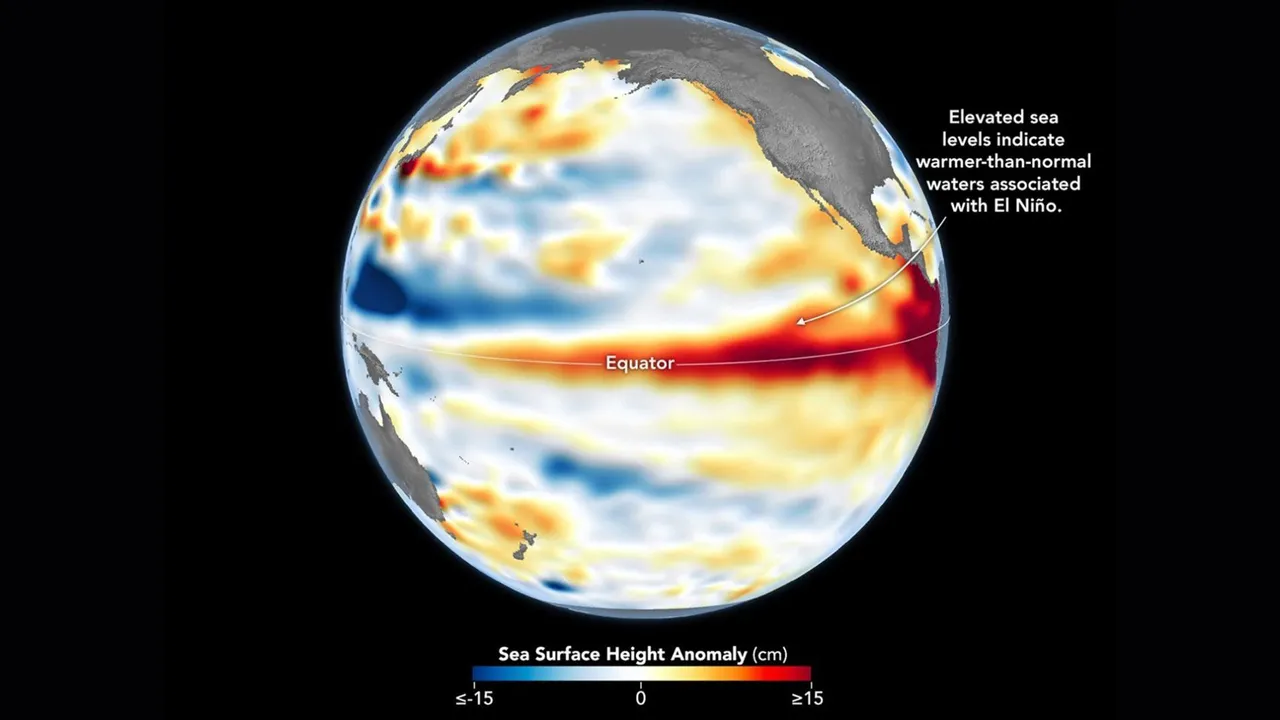
A wave of warm water and higher-than-usual sea surfaces (red) stretches across the Pacific, a few days before El Niño was declared.
(Image credit: Data for the map were acquired by the Sentinel-6 Michael Freilich satellite and processed by scientists at NASA’s Jet Propulsion Laboratory (JPL)
This year's El Niño is on track to be among the strongest ever recorded.
BY SKYLER WARE
June 23, 2026
A wave of warm water and higher-than-usual sea surfaces (red) stretches across the Pacific, a few days before El Niño was declared.
(Image credit: Data for the map were acquired by the Sentinel-6 Michael Freilich satellite and processed by scientists at NASA’s Jet Propulsion Laboratory (JPL)
The doom boys are coming

Similar threads

- Replies
- 8
- Views
- 663


- Replies
- 18
- Views
- 735
- Replies
- 4
- Views
- 102
- Replies
- 3
- Views
- 361

