
Russia Invades Georgia

QueEx

Rising Star
Super Moderator
<font size="6"><center>Russian tanks 'rolling into
Georgian breakaway'</font size></center>


art.jpg

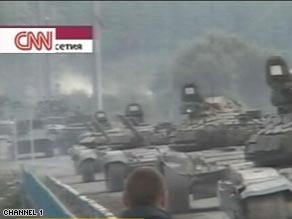
Russia's Channel 1 shows heavy tanks
purported to be on their way to South
Ossetia

CNN News
August 8, 2008

TBLISI, Georgia (CNN) -- Georgia's president said Friday that his country is under attack from Russian tanks and warplanes, and he accused Russia of targeting civilian populations as tensions over the breakway Georgian region of South Ossetia appeared to boil over into full-blown conflict.

"All day today they've been bombing Georgia from numerous warplanes and specifically targeting (the) civilian population, and we have scores of wounded and dead among (the) civilian population all around the country," Mikhail Saakashvili told CNN in an exclusive interview.

Saakashvili also said Georgian troops had shot down two Russian aircraft.

Asked whether Georgia and Russia were now at war, he said, "My country is in self-defense against Russian aggression. Russian troops invaded Georgia."

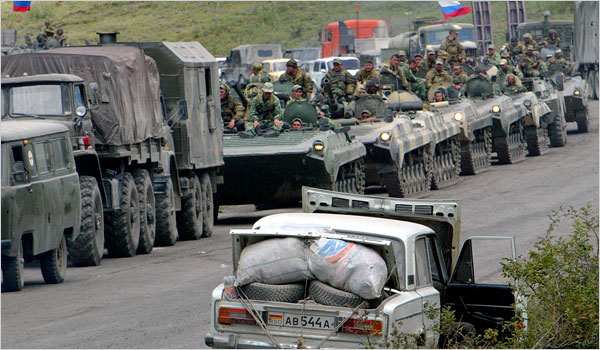
Russian television showed a convoy of Russian tanks and said they were heading into the breakaway Georgian region of South Ossetia as escalating tensions over the region threatened to boil into full blown conflict.

The move came after Russia denounced as "aggressive" a Georgian troops military offensive to regain control over the province, vowing to respond.

Russian authorities earlier said several of its peacekeepers died in a Georgian attack in South Ossetia, which borders Russia and has strong ties to its vast northern neighbor, and they vowed not to leave Russian citizens in the territory unprotected.

"The Georgian leadership has launched a dirty adventure," a statement from Russia's Defense Ministry said on Friday. "We will not leave our peacekeepers and Russian citizens unprotected."

Russian Prime Minister Vladimir Putin said Georgia started the fighting and warned that Russia would respond to their actions.

"Heavy weapons and artillery have been sent there, and tanks have been added. Deaths and injuries have been reported, including among Russian peacekeepers," Putin said in comments carried Friday by Russia's Interfax news agency.

"It's all very sad and alarming. And, of course, there will be a response."

Earlier Friday, Georgian President Mikhail Saakashvili said in a televised statement that Russian aircraft bombed several Georgian villages and other civilian facilities.

He added that there were injuries and damage to buildings. "A full-scale aggression has been launched against Georgia," he said.

A Georgian official reported that seven people were hurt in the attack, the Associated Press said.

Saakashvili urged Russia to immediately stop bombing Georgian territory. "Georgia will not yield its territory or renounce its freedom," he said.

He also called for the full-scale mobilization of Georgian reserve forces as fighting continued to rage in South Ossetia's capital.

Meanwhile, NATO Secretary-General Jaap de Hoop Scheffer issued a statement Friday saying he was seriously concerned about the recent events in the region, and called on "all sides to end armed clashes and begin direct talks."

The United States also urged all sides to bring an immediate end to the violence. "The U.S. has been in discussions for many months with all parties to find a peaceful resolution," White House spokesman Gordon Johndroe said.

"We urge all sides to refrain from violence and to begin direct talks."

Russian peacekeepers are in South Ossetia under a 1992 agreement by Russian, Georgian, and South Ossetian authorities to maintain what has been a fragile peace. The mixed peacekeeping force also includes Georgian and South Ossetian troops.

The latest events came just hours after the U.N. Security Council finished an emergency session to discuss a dramatic escalation of violence in Georgia and South Ossetia. The session ended Friday morning without a statement about the fighting.

Violence has been mounting in the region in recent days, with sporadic clashes between Georgian forces and South Ossetian separatists. South Ossetia declared its independence from Georgia in the early 1990s, but its independence is not internationally recognized.

Georgian troops launched new attacks in South Ossetia late Thursday after a top government official said a unilateral cease-fire offer was met with separatist artillery fire.

"The objective of the operation is to protect the civilian population, to ensure their security and then convince the separatists that there is not a military solution to this conflict," said Alexander Lomaia, the secretary of Georgia's National Security Council.

Lomaia said Georgian troops were responding proportionately to separatist mortar and artillery attacks on two villages -- attacks he said followed the cease-fire and call for negotiations by Saakashvili.

The official news agency of the South Ossetian government reported heavy shelling in the territory's capital, Tskhinvali, that left dozens of buildings ablaze.

About 2,000 Georgian troops attempted to storm Tskhinvali overnight and were regrouping south of the city, according to Russia's ITAR-TASS news agency.

Around 10 a.m. Friday, Georgia said Russian military aircraft violated Georgian airspace and dropped two bombs on Kareli, a part of Georgia that is about 50 miles northwest of the capital, Tblisi, and is not in the conflict zone, said Shota Utiashvili, spokesman for the Georgian Ministry of Interior.

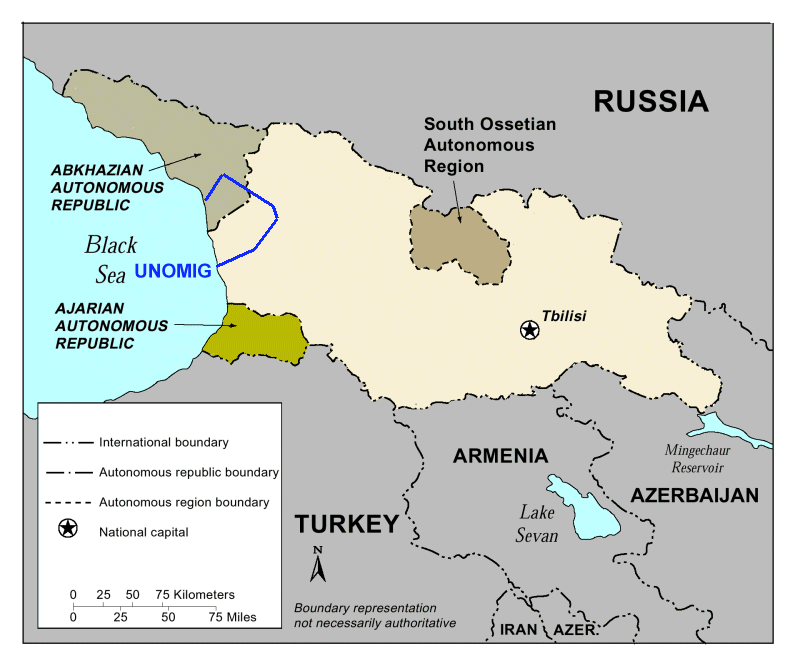
Georgia, located on the Black Sea coast between Russia and Turkey, has been split by Russian-backed separatist movements in South Ossetia and another region, Abkhazia.

Georgian and South Ossetian negotiators had been scheduled to meet Friday in Tskhinvali, Moscow's chief negotiator, Yuri Popov, told the Russian news agency Interfax.

Saakashvili announced Thursday night that he had ordered his troops to cease fire while the negotiators met, but Lomaia said the call was met with more attacks.

In addition, Lomaia said, hundreds of "mercenaries" -- or "volunteers," as the South Ossetians described them -- are pouring across the border from Russia to join the fight.


http://www.cnn.com/2008/WORLD/europe/08/08/georgia.ossetia/index.html
 
<IFRAME SRC="http://www.timesonline.co.uk/tol/news/world/europe/article4485527.ece" WIDTH=780 HEIGHT=1500>
<A HREF="http://www.timesonline.co.uk/tol/news/world/europe/article4485527.ece">link</A>

</IFRAME>
 
<font size="4">
John McCain on Russia and Georgia:</font size>

  • "Russia should immediately and unconditionally cease its military operations and withdraw all forces from sovereign Georgian territory,”

  • “The consequences of Euro Atlantic stability and security are grave,”

  • He also called for “a truly independent” international peacekeeping force for South Ossetia, and said the United States should work with the European Union and the OSCE to pressure Russia to halt its military efforts.

  • McCain has been a sharp critic of the policies of the Russian government headed by Vladimir Putin


<font size="4">
Barack Obama on Russia and Georgia:</font size>

  • Barack Obama called for an end to the violence, but stopped short of assigning blame, or making strong demands on Moscow. “I strongly condemn the outbreak of violence in Georgia, and urge an immediate end to armed conflict,"

  • "Now is the time for Georgia and Russia to show restraint, and to avoid an escalation to full scale war. Georgia’s territorial integrity must be respected. All sides should enter into direct talks on behalf of stability in Georgia, and the United States, the United Nations Security Council, and the international community should fully support a peaceful resolution to this crisis.”


http://politicalticker.blogs.cnn.com/2008/08/08/mccain-obama-decry-violence-in-georgia/
 
<font size="4">
The U.S. and the West's Interest in Georgia:</font size>


<font size="3"><u>Oil</font size></u>
  • Georgia has no significant oil or gas reserves of its own but it is a key transit point for oil from the Caspian and central Asia destined for Europe and the US.

  • The 1,100 mile long Baku-Tbilisi-Ceyhan pipeline, (the "BTC Pipeline), which entered service only last year, pumps up to 1 million barrels of oil per day from Baku in Azerbaijan to Yumurtalik, Turkey, where it is loaded on to supertankers for delivery to Europe and the US. Around 249km of the route passes through Georgia, with parts running only 55km from South Ossetia.

  • Georgia is the only practical route from this increasingly important producer region that avoids both Russia and Iran


<font size="3"><u>Terrorism</u></font size>
  • The first major attack on the pipeline took place only last week - not in Georgia but in Turkey where part of it was destroyed by PKK separatist rebels.

  • There is a very real threat of another attack on the pipeline by separatists in Georgia itself

  • Russia also backs the South Ossetian and Abkhazian separatists in Georgia

  • The U.S. has troops on the ground in Georgia training Georgian forces to fight the terrorists (separatist)

  • Georgian forces are on the ground in Afghanistan

  • Russia has condemned the U.S. for putting troops in Georgia - which is a former Soviet republic


http://www.timesonline.co.uk/tol/news/world/europe/article4484849.ece
http://news.bbc.co.uk/1/hi/world/europe/1844653.stm
 
Unfortunately, war is the only solution. Neither side is going to back down. The U.S. expanding its influence in the former USSR by admitting former soviet republics into NATO. We are also trying to place ballistic missles in Poland and the Czech Republic, under the guise of protecting Europe from Iranian nukes. We all know those missles are meant for Russia. Can you imagine our response to Russian missles in Cuba. :rolleyes: The lust for resources and global domination can only be satiated by warfare. What's your solution?
 
^ If Georgia was part of NATO, the US would be screwed = they'd have to come to the help of Georgia to fight it.

I think this will show NATO members that they don't want to get let Georgia into NATO for fear that they may have to fight Russia if future hostilites resume.
 
tit for tat?

Putin says Russia needs to go back to Cuba

Mon Aug 4, 9:03 AM ET

Russian Prime Minister Vladimir Putin on Monday said it was time for Russia to rebuild links with former Cold War ally Cuba, news agencies reported.

The Kremlin is angry at U.S. plans for a missile defence system in Eastern Europe, and last month a news report suggested Russia might use Cuba, a thorn in America's side for half a century, as a refueling stop for nuclear-capable bombers.

The Russian Defence Ministry denied the report and said it had no plans to open any military bases abroad, but a top U.S. general was drawn to say such a move would cross a "red line."

Moscow was the Caribbean island's key oil, arms and grain supplier for 30 years, until subsidies propping up the economy of Fidel Castro's revolutionary government fell to a trickle and then dried up entirely after the collapse of the Soviet Union.

"We need to reestablish positions on Cuba and in other countries," news agency Interfax quoted Putin as saying at the weekly presidium meeting of key government ministers.

Just 144 km (90 miles) from the coast of U.S. state of Florida, Cuba still has no formal diplomatic ties with Washington D.C.

At the height of the Cold War in 1962, a two-week crisis over Soviet missiles on the island nearly led to full-blown war.

Putin's remarks came after Russian Deputy Prime Minister Igor Sechin reported on a recent three-day visit to Cuba, where he discussed a raft of trade and investment issues and met with Raul Castro, Fidel's brother and now the island's leader.

"We agreed on a priority direction for cooperation, this being energy, the mining industry, agriculture, transport, health care and communications," news agency RIA quoted Sechin as saying.

(Reporting by Chris Baldwin, editing by Toby Reynolds)

http://news.yahoo.com/s/nm/20080804...1&printer=1;_ylt=AsXdjYb_suUIMui7Kyv27IYb.3QA
 
Like Pac said "There would never be peace, cause we all heading for doom, still consume by the beast" :smh:
 
what happens if russian forces kill US troops in Georgia?

Georgia isnt Chechnya they will fight back.......HARD.
 
what happens if russian forces kill US troops in Georgia?

Georgia isnt Chechnya they will fight back.......HARD.

this was expected especially after kosovo. then there is the new news about cuba. they want a complete role reversal. they plan on bleeding this country
 
Unfortunately, war is the only solution. Neither side is going to back down.
Perhaps. But is it all that simple ??? With respect to Russia and the U.S., maybe this is chess, and not checkers ??? I feel certain that you would say it would not be wise for the Russians to act or show weakness towards the U.S., lest it be taken advantage; do you think converse is true, as well ???


The U.S. expanding its influence in the former USSR by admitting former soviet republics into NATO.
I could see how the Russians would feel anxious about that; however, if they come willingly and you know that works to change the equation somewhat in your favor, do you refuse or deter their entry ???

We are also trying to place ballistic missles in Poland and the Czech Republic, under the guise of protecting Europe from Iranian nukes. We all know those missles are meant for Russia.
Maybe thats folly. Maybe thats going too far. While I have no idea who those missiles are actually "meant for" -- are they bargaining chips ??? - and what harm do they pose for the Russians ???

Can you imagine our response to Russian missles in Cuba. :rolleyes:
I know what our response has been and I know what it has not been; and some of that response might surprise you.

The lust for resources and global domination can only be satiated by warfare.
Now you're getting to the real issue. One question, is that lust one sided ??? Do other and powerful nations not have that lust ???

What's your solution?
Wish I knew a lot more about the situation than I do from this vantage point.

QueEx
 
Oil is the only bargaining chip here under the disguise of maintaining peace and influence in the region.
 
Georgia can't hang. They are bombing Georgia and Georgia isnt retalliating. I thought they had better arms. Russia has lost troops and fighter jets but they seem to be bombing with impunity. Maybe Georgia doesnt have tactical nukes or any nukes.
 
Georgia can't hang. They are bombing Georgia and Georgia isnt retalliating. I thought they had better arms. Russia has lost troops and fighter jets but they seem to be bombing with impunity. Maybe Georgia doesnt have tactical nukes or any nukes.
Are you saying, Georgia doesn't have nukes because a country would not invade another country that has nukes; or, are you saying, given the Russian's superiority, why has Georgia not used its nukes ???

QueEx
 
Well that didn't last long.

Georgia withdraws as Russia builds firepower

LHgeorgian-420x0.jpg


An injured Georgian woman calls for help in the town of Gori, 80 kilometres west of Tbilisi, after a Russian warplane bombed an apartment block yesterday. Photo: Reuters

Georgia withdrew from the separatist region of South Ossetia today after new clashes with Russian forces as Moscow amassed its military firepower to overwhelm its neighbour.

"We have left practically all of South Ossetia as an expression of goodwill and our willingness to stop military confrontation," Georgian National Security Council Secretary Alexander Lomaia told AFP.

Officials in South Ossetia, the separatist region at the heart of the fighting, said artillery fire was exchanged overnight and Georgia claimed Russian jets had bombed a military airfield near the Georgian capital Tbilisi.

Georgia also said Russia had brought 10,000 extra troops into South Ossetia and was assembling armoured vehicles close to the border. Reports said Russia was imposing a naval blockade after moving warships into range.

Mr Lomaia said Georgia had asked the United States to act as a mediator with Russia in the conflict, which broke out in the middle of last week and has left 2,000 dead according to Russian figures.

"We have asked United States Secretary of State Condoleezza Rice to mediate with the Russians, to transmit them our message," said Mr Lomaia, after announcing the withdrawal.

US President George Bush has led a chorus of international calls to end the hostilities which observers fear might spread to other parts of the volatile Caucasus region.

Russia backs the separatist government in South Ossetia and sent in tanks and troops on Friday in response to pro-Western Georgia's military offensive to take back the province which broke away in the early 1990s after a separatist war.

In a new move demonstrating Moscow's giant military advantage, Russian warships were reported by Interfax news agency to be setting up a sea blockade to prevent arms and other military supplies from reaching Georgia.

"This is definitely necessary for preventing arms shipments to Georgia by sea," Interfax quoted a naval source as saying. "A sea blockade of Georgia will also help avert an escalation of military activity in Abkhazia."

Overnight, Russian and Georgian forces exchanged artillery fire in the South Ossetian capital Tskhinvali, the South Ossetian authorities said in a statement. A South Ossetian spokeswoman said the overnight shelling killed 20 and wounded 150 people.

Russia also continued bombing raids on Georgian territory outside South Ossetia, hitting a runway of a military airfield near Tbilisi international airport early today, according to Mr Lomaia.

Yesterday Russian aircraft had staged raids on the Georgian port of Poti and the city of Gori, where inhabitants said scores of people were killed.

Mr Lomaia said Russia had concentrated a large number of armoured vehicles near the border with Georgia at a crossing not linked to South Ossetia.

Georgia's army of less than 25,000 men is confronting a Russian force which can count on more than one million troops - and experts say the conflict cannot last.

Diplomatic efforts to end the crisis were set to intensify, with a joint European-US mission heading for Georgia to try to help broker a ceasefire with Russia.

But a meeting of the UN Security Council yesterday failed to agree on a call for an immediate ceasefire.

France, which holds the EU presidency, announced that it would organise a meeting of European foreign ministers early next week and an emergency European Union (EU) summit could be held.

The EU "strongly states its commitment to the sovereignty and the territorial integrity of Georgia and its internationally recognised borders and urges Russia to respect them," said a statement released by France.

The EU "underscores that the military actions (against Georgia) could affect EU-Russian relations," it added.

French Foreign Minister Bernard Kouchner will visit the region today to present settlement proposals, France said.

Mr Bush cut into his engagements during a visit to Beijing to call for an end to Russian bombing.

"We have urged an immediate halt to the violence and a stand-down by all troops," he told reporters. "We call for an end to the Russian bombings."

As the fighting continued, the leaders of Russia and Georgia stepped up their war of words.

"What they are doing is nothing to do with conflict, it is about annihilation of a democracy on their borders," Georgian President Mikheil Saakashvili said in an interview with the BBC yesterday.

Mr Saakashvili declared a "state of war" in his country yesterday but also offered a ceasefire to Russia.

Russia's President Dmitry Medvedev said his country had launched its operation to "force the Georgian side into peace." He later said he would order an investigation into accusations by South Ossetian refugees of Georgian acts of genocide.

The conflict has also spread to Abkhazia, another breakaway region of Georgia, where the separatist government said its forces had launched attacks on Georgian troops. Georgia accused Russia of staging the attacks in the Kodori Gorge region, the only part of Abkhazia controlled by Georgia.

The conflict with Russia had claimed 150 Georgian lives, Georgian Foreign Minister Eka Tkeshelashvili said yesterday.

Russian officials have said at least 2000 people have been killed in South Ossetia.

South Ossetia broke from Georgia in the early 1990s. It has a population of 70,000, many of whom have been granted Russia passports.

Earlier, Russia's ambassador to the UN likened Georgia's deadly onslaught on South Ossetia to "genocide".

Pointing to the enclave's small population - estimated at 70,000 - Vitaly Churkin said he told the Security Council: "Two thousand killed, is it enough for you? Thirty thousand refugees, is that it enough for you?"

"How many people have to be killed for genocide? It's genocide to the South Ossetians," he told reporters after attending closed-door Security Council consultations that again failed to produce agreement on a call for a ceasefire in the bitter fighting between Russia and Georgia.

Mr Churkin said Russia viewed the Georgian offensive as "something that has elements of genocide and war crimes situation."

Russian Prime Minister Vladimir Putin earlier called for an investigation into alleged acts of genocide by Georgian forces during their offensive against the breakaway province of South Ossetia.

Incidents described by refugees "lie beyond the framework of understanding of military actions", Putin told President Dmitry Medvedev in comments broadcast on Russian television.

"In my opinion they are already elements of some kind of genocide of the Ossetian people. I think it would be correct if you instruct the military prosecutor to document all such incidents," he said.

Mr Putin was briefing Mr Medvedev on a visit to South Ossetian refugees in the Russian province of North Ossetia after flying back to Moscow early today, Russian news agencies reported.

Yesterday, Mr Saakashvili denounced as "a lie" Russian claims of more than 1,000 civilian deaths in South Ossetia's main city, saying "practically no civilians" were killed.

The claims are an "egregious lie. There were practically no civilians dead. But Tskhinvali is ruined as a result of Russian bombardments," he said during a televised meeting of his national security council.

He accused Moscow of carrying out a "truly Soviet-style disinformation campaign."


AFP

http://www.theage.com.au/world/georg...2.html?page=-1
 
<font size="4">
John McCain on Russia and Georgia:</font size>

  • "Russia should immediately and unconditionally cease its military operations and withdraw all forces from sovereign Georgian territory,”

  • “The consequences of Euro Atlantic stability and security are grave,”

  • He also called for “a truly independent” international peacekeeping force for South Ossetia, and said the United States should work with the European Union and the OSCE to pressure Russia to halt its military efforts.

  • McCain has been a sharp critic of the policies of the Russian government headed by Vladimir Putin

<font size="4">
John McCain on Russia and Georgia:</font size>

  • "Russia should immediately and unconditionally cease its military operations and withdraw all forces from sovereign Georgian territory,”

  • “The consequences of Euro Atlantic stability and security are grave,”

  • He also called for “a truly independent” international peacekeeping force for South Ossetia, and said the United States should work with the European Union and the OSCE to pressure Russia to halt its military efforts.

  • McCain has been a sharp critic of the policies of the Russian government headed by Vladimir Putin


<font size="4">
Barack Obama on Russia and Georgia:</font size>

  • Barack Obama called for an end to the violence, but stopped short of assigning blame, or making strong demands on Moscow. “I strongly condemn the outbreak of violence in Georgia, and urge an immediate end to armed conflict,"

  • "Now is the time for Georgia and Russia to show restraint, and to avoid an escalation to full scale war. Georgia’s territorial integrity must be respected. All sides should enter into direct talks on behalf of stability in Georgia, and the United States, the United Nations Security Council, and the international community should fully support a peaceful resolution to this crisis.”


http://politicalticker.blogs.cnn.com/2008/08/08/mccain-obama-decry-violence-in-georgia/


<font size="4">
Barack Obama on Russia and Georgia:</font size>

  • Barack Obama called for an end to the violence, but stopped short of assigning blame, or making strong demands on Moscow. “I strongly condemn the outbreak of violence in Georgia, and urge an immediate end to armed conflict,"

  • "Now is the time for Georgia and Russia to show restraint, and to avoid an escalation to full scale war. Georgia’s territorial integrity must be respected. All sides should enter into direct talks on behalf of stability in Georgia, and the United States, the United Nations Security Council, and the international community should fully support a peaceful resolution to this crisis.”


http://politicalticker.blogs.cnn.com/2008/08/08/mccain-obama-decry-violence-in-georgia/


<font size="5"><center>
Georgia crisis triggers war of words
on White House trail</font size></center>


Agence France-Presse
August 10, 2008

WASHINGTON (AFP) — Prominent supporters of White House runners John McCain and Barack Obama clashed Sunday over the crisis in Georgia with a McCain adviser under fire for his links to the government in Tbilisi.

As the Russian military seized control of the breakaway Georgian region of South Ossetia, the campaign of Democratic hopeful Obama defended its attacks on McCain foreign policy adviser Randy Scheunemann.

New Mexico Governor Bill Richardson said McCain's campaign "is run by lobbyists that represent Georgia and other countries."

"He takes huge amounts of money from oil companies that are profiting in the (former) Soviet Union and many parts of the world," the Democrat told ABC News, attempting to depict a conflict of interest for McCain.

Richardson, a former US ambassador to the United Nations, said the crisis vindicated Obama's pledge to rebuild US alliances in Europe that were strained under President George W. Bush.

"This has been one of the failures of the Bush administration, failing to build a strong relationship, a mutually beneficial relationship with Russia, so we'd have the kind of influence to persuade them to stop some of these very, very dangerous efforts within their territory," he said.

Virginia Governor Timothy Kaine, who is touted as a prospective running mate for Obama, denied that the crisis might drive US voters to the more experienced McCain.

"Experience is only positive insofar as it creates good judgment," he said on CBS News.

"And I think Senator Obama's strong case to the American people is that he will have the right judgment about how to balance America's military force with strong diplomacy to protect our interests abroad," Kaine said.

McCain and Obama both said Saturday they had spoken to Georgia's pro-Western President Mikheil Saakashvili, and called for an end to Russia's military campaign launched after Georgian forces had moved into South Ossetia.

The Obama campaign, attacking McCain as a creature of Washington because of his reliance on several former lobbyists high up in his operation, highlighted Scheunemann's work for the Georgian government.

"John McCain's top foreign policy adviser lobbied for and has a vested interest in the Republic of Georgia, and McCain has mirrored the position advocated by the government," Obama spokesman Hari Sevugan said Saturday.

There was outrage from the McCain campaign, which said the attacks on Scheunemann were "disgraceful" and showed Obama to be a stooge of Moscow indulging in "cheap and petty political attacks."

"Mr Scheunemann proudly represented a small democracy that is one of our closest allies in a very dangerous region," McCain spokesman Tucker Bounds said in a statement late Saturday.

"The reaction of the Obama campaign to this crisis, so at odds with our democratic allies and yet so bizarrely in sync with Moscow, doesn't merely raise questions about Senator Obama's judgment -- it answers them."

Louisiana Governor Bobby Jindal, one of the names mentioned as McCain's vice presidential pick, said on ABC that the Republican's warnings about Russian expansionism had been borne out by events in Georgia.

"They're an example of Senator McCain's push to spread democracy in that part of the world as a very important advance of America's interest, as well as being good for international stability," he said.

"So instead of trying to detract from the central issue, I wish Senator Obama had actually confronted the issue, not trying to detract our attention by focusing on a McCain adviser."

Richardson, however, said that McCain's frequent calls to expel Russia from the G8 club of powerful nations would prove disastrous if enacted.

"I believe what Senator McCain is proposing is totally, totally wrong," he said, stressing the United States needs Russia's help with Iran, with Middle East peace and in Iraq.


http://afp.google.com/article/ALeqM5j6ArHdzJxc4_Gz1_t1ixyB2OUQsw
 
<center>
logo_all.gif


<font size="5">

U.S. candidates diverge in response
to Russian-Georgian conflict</font size></center>


By Brian Knowlton and Elisabeth Bumiller
August 10, 2008


WASHINGTON: The fighting between Russia and Georgia has given the U.S. presidential candidates an unexpected chance to show voters how they would react to a major international crisis, providing a real-world test of Senator John McCain's hard approach to Russia and Senator Barack Obama's emphasis on diplomacy.

The crisis also provoked a rancorous eruption between the two presidential campaigns that had a McCain spokesman accusing Obama of being "bizarrely in sync with Moscow."


McCain on Friday "Hardened Approach"

McCain responded quickly and sharply Friday to the outbreak of fighting, after speaking by telephone with President Mikhail Saakashvili of Georgia, whom he has known since 1997.

Russia had crossed "an internationally recognized border into the sovereign territory of Georgia" and should "unconditionally cease its military operations and withdraw all forces," the presumptive Republican presidential nominee said in a statement.


McCain on Saturday "Softened Approach"

But Saturday, McCain said that he was pleased at U.S., European and NATO efforts to broker a cease-fire.


Obama on Friday "Softened Approach"

An initial statement from Obama, his Democratic rival, did not directly blame Russia. The Illinois senator instead offered a more measured response, which largely echoed the official comments of the European Union, NATO and President George W. Bush.

"Now is the time for Georgia and Russia to show restraint and to avoid an escalation to full-scale war," Obama said. He urged negotiations aimed at "stability."


Obama on Saturday "Hardened Approach"

Obama did harden his rhetoric later, shortly before flying to Hawaii on vacation. "What is clear is that Russia has invaded Georgia's sovereign - has encroached on Georgia's sovereignty, and it is very important for us to resolve this issue as quickly as possible," he said.

On Saturday, Obama's advisers said, he too spoke about the crisis with Saakashvili, and with Secretary of State Condoleezza Rice.


<u>The War Between the Political Camps</u>


The Obama Camp

But down in the political weeds, angry bickering erupted. The Obama campaign alerted reporters Friday that Randy Scheunemann, a top McCain foreign policy adviser, had lobbied for the Georgia government, creating the "appearance of a conflict of interest." Scheunemann, who has worked for McCain's campaign since early 2007, took a leave from his lobbying firm, Orion Strategies, five months ago.


The McCain Camp

The McCain camp called the criticism "disgraceful." Saying that the Scheunemann-Georgia lobbying link had been brought to reporters' attention by a public relations firm working for Russia, a McCain campaign e-mail said: "Today, many are dead and Georgia is in crisis, yet the Obama campaign has offered nothing more than cheap and petty political attacks that are echoed only by the Kremlin."

It called the Obama camp's reaction "bizarrely in sync with Moscow."


For the most part, the crisis brought bipartisan condemnations in Washington of Russia, but also debate on how best to deal with an increasingly authoritarian and aggressive Russia.

"We should be very firm that this response on the part of Russia is disproportionate," Senator Carl Levin of Michigan, chairman of the armed services committee, said on CNN. "It has to be condemned and the world needs to stand against it." Senator John Cornyn of Texas, a Republican on the committee, agreed with Levin and urged Russian restraint. But Levin, a Democrat, said that McCain's past calls to expel Russia from the Group of 8 were "reckless." Only a working relationship with Russia, he said, would give the United States leverage when crises erupted.

Governor Bill Richardson of New Mexico, an ally of Obama's, agreed. "I believe what Senator McCain is proposing is totally, totally wrong," he said on ABC, while endorsing Obama's preference for diplomacy.

But Bobby Jindal, the Louisiana governor who has been mentioned as a possible McCain running mate, said the crisis underscored the value of McCain's foreign policy and security credentials.

Elisabeth Bumiller reported from Las Vegas. Michael Falcone contributed from Honolulu.

http://www.iht.com/articles/2008/08/10/america/box.php
 
LOL, who the fuck are Bush and Cheney to condemn a invasion?

All the while US forces are bogged down with that bullshit in Iraq.
 
Russians Push Past Separatist Area to Assault Central Georgia; Bombs Capital


TBILISI, Georgia — Russia expanded its attacks on Georgia on Sunday, moving tanks and troops through the separatist enclave of South Ossetia and advancing toward the city of Gori in central Georgia, in its first direct assault on a Georgian city with ground forces during three days of heavy fighting, Georgian officials said.

The maneuver — along with bombing of the Georgian capital, Tbilisi — seemed to suggest that Russia’s aims in the conflict had gone beyond securing the pro-Russian enclaves of South Ossetia and Abkhazia to weakening the armed forces of Georgia, a former Soviet republic and an ally of the United States whose Western leanings have long irritated the Kremlin.

Russia’s moves, which came after Georgia offered a cease-fire and said it had pulled its troops out of South Ossetia, caused widespread international alarm and anger and set the stage for an intense diplomatic confrontation with the United States.

Two senior Western officials said that it was unclear whether Russia intended a full invasion of Georgia, but that its aims could go as far as destroying its armed forces or overthrowing Georgia’s pro-Western president, Mikheil Saakashvili.

“They seem to have gone beyond the logical stopping point,” one senior Western diplomat said, speaking anonymously under normal diplomatic protocol.

The escalation of fighting raised tensions between Russia and its former cold war foes to their highest level in decades. President Bush has promoted Georgia as a bastion of democracy, helped strengthen its military and urged that NATO admit the country to membership. Georgia serves as a major conduit for oil flowing from Russia and Central Asia to the West.

But Russia, emboldened by windfall profits from oil exports, is showing a resolve to reassert its dominance in a region it has always considered its “near abroad.”

The military action, which has involved air, naval and missile attacks, is the largest engagement by Russian forces outside its borders since the collapse of the Soviet Union.

Russia escalated its assault on Sunday despite strong diplomatic warnings from Mr. Bush and European leaders, underscoring the limits of Western influence over Russia at a time when the rest of Europe depends heavily on Russia for natural gas and the United States needs Moscow’s cooperation if it hopes to curtail what it believes is a nuclear weapons threat from Iran.

President Bush, in Beijing for the Olympics, strongly criticized the Russian attacks, especially those outside South Ossetia, and urged an immediate cease-fire.

In an interview on NBC on Monday morning, he said he had been “very firm” with both Russia’s prime minister, Vladimir V. Putin, and its president, Dmitri Medvedev.

Earlier, Vice President Dick Cheney expressed a strong warning for Russia. In a telephone conversation with the Georgian president, he said “that Russian aggression must not go unanswered, and that its continuation would have serious consequences for its relations with the United States, as well as the broader international community,” a spokeswoman, Lea Anne McBride, said in a statement released by the White House.

Russian officials say Georgia provoked the assault by attacking South Ossetia last week, causing heavy civilian casualties. But Western diplomats and military officials said they worried that Russia’s decision to extend the fighting and open a second front in Abkhazia indicated that it had sought to use a relatively low-level conflict in a conflict-prone part of the Caucasus region to extend its influence over a much broader area.

On Sunday, Russian artillery shells slammed the city of Gori, a major military installation and transportation hub in Georgia. In the separatist region of Abkhazia, Russian paratroopers and their Abkhaz allies battled Georgian special forces and tried to cross the boundary into undisputed Georgian territory, Georgian officials said.

Russia dropped a bomb on Tbilisi’s international airport shortly before Foreign Minister Bernard Kouchner of France, who was sent by the European Union to try to mediate, was due to land, Georgian officials said. It twice bombed an aviation factory on the outskirts of the capital. Russia’s Black Sea Fleet patrolled the coast of Abkhazia, and its Defense Ministry said Russian warships had sunk a Georgian gunboat that fired on them.

The Kremlin declined to say whether its troops had entered Georgia proper but said all its actions were intended to strike at Georgian military forces that had fired on its peacekeeping troops in South Ossetia.

A senior Russian defense official, Anatoly Nogovitsyn, said early Sunday that Russia did not intend to “break into” Georgian territory.

The Bush administration said it would seek a resolution from the United Nations Security Council condemning Russian military actions in Georgia.

In a heated exchange with his Russian counterpart at the United Nations, Ambassador Zalmay Khalilzad of the United States accused the Kremlin of seeking to oust President Saakashvili.

He charged that Russia’s foreign minister, Sergey Lavrov, had said as much Sunday morning in a telephone conversation with Secretary of State Condoleezza Rice, telling her “that the democratically elected president of Georgia ‘must go,’ ” Mr. Khalilzad said. Mr. Khalilzad said the comment was “completely unacceptable.”

In Washington, American officials said that Georgian troops had tried to disengage but that the Russians had not allowed them to.

“The Georgians told them, ‘We’re done. Let us withdraw,’ ” one American military official said. “But the Russians are not letting them withdraw. They are pursuing them, and people are seeing this.”

The official was not authorized to brief the press and spoke on condition of anonymity.

The official added: “This is not about military objectives. This is about a political objective: removing a thorn in their side.”

Tensions with Mr. Saakashvili escalated when he made a centerpiece of his presidency the reunification of Georgia with Abkhazia and South Ossetia, pro-Russian regions that won de facto autonomy in fighting in the early 1990s.

Russia has issued passports to many residents in the territories and has stationed peacekeeping troops in them. Heavy fighting broke out last week in South Ossetia when Georgian troops tried to take its capital in what seems to have been a major miscalculation.

Reports of the death toll varied widely, from the low hundreds to more than 2,000, but none could be independently verified.

Russian officials say more than 30,000 South Ossetians have fled into Russia.

Russia says it is acting to protect residents there and to punish Georgia for the assault, which Georgia says was to protect Georgian enclaves in the territory from attack and to push out illegally deployed Russian troops.

Russian officials told Russian news agencies late Sunday night that Georgian troops were attacking Tskhinvali.

There were no independent observers with either country’s forces, and verifying claims about military activity was not immediately possible.

Georgian officials expressed alarm on Sunday that Russia might be aiming to take Gori, about a 45-minute drive south from Tskhinvali. Gori, a major staging area for the Georgian military, sits in a valley that is the main route connecting the east and west halves of Georgia.

Shota Utiashvili, an official in the Georgian Interior Ministry, said the Russians had moved tanks and troops to within a few kilometers of Gori and were “trying to cut the country in half.”

Mr. Utiashvili said that if they tried to occupy Georgia, “there will probably be guerrilla warfare all over the country.”

He said: “We need large supplies of humanitarian aid, because we have thousands of wounded. And weapons. We need weapons.”

Sunday evening, artillery and tank fire could be heard from the outskirts of Gori. During a pause in the fighting, Georgian military personnel appeared to be flowing into the city. Georgian officials said they would defend it.

Ambulances with flashing red and blue lights roared back and forth on the highway between Gori and Tbilisi, along with troop transports. Families fled Gori in cars and donkey carts.

“The whole family is running away. There is nowhere for us to take shelter,” said Ketevan Sunabali, 40, who had left home in a pair of red Winnie the Pooh slippers. She said she had heard the bombs exploding and seen the smoke and just jumped in the car with her husband, without stopping to take any of their belongings.

“I had a home. I had a father,” said Gogita Kazahashvili, 29. “My father died today from the bombing. I’ve seen with my own eyes. My house was destroyed. I buried my father myself, by where the house was.”

A man who said he was fleeing from Kakhvi, which he described as a Georgian-controlled enclave squeezed between parts of South Ossetia along the winding border, said Russian soldiers had come to his house, and he had run away. Along the road, others who were displaced carried their possessions in wheelbarrows and plastic bags.

A reporter for The New York Times saw artillery being fired from Russian-controlled areas into Georgian territory near the villages of Eredvy and Prisi, about two miles from Tskhinvali. Grassy fields were burning in the villages and clouds of dust rose with the impact of the shells.

Even one close Russian ally, Maksim K. Gvindzhiya, expressed alarm about the possibility of Russian troops moving on Gori and clashing with Georgians on unchallenged Georgian territory.

“If it happened, then it’s a big mess, it’s a big problem, because it is direct confrontation,” said Mr. Gvindzhiya, deputy foreign affairs minister for the de facto government of Abkhazia. “It’s going out of the conflict zone.”

Fighting escalated in Abkhazia as well, Mr. Gvindzhiya and Georgian officials said.

Russia doubled the number of its troops in Abkhazia to about 6,000 early Sunday, landing paratroopers at an airport near the Black Sea. There was heavy fighting in the Kodori Gorge, the only area in Abkhazia that Georgia controls, with Russian paratroopers ferried in by helicopter.

In Washington, Secretary Rice worked through the night Saturday with other Bush administration officials on a Security Council resolution. American diplomats said that they did not want an actual Security Council vote on the resolution until Tuesday or so, the better to draw out the debate and publicly shame the Russian government. While the resolution will carry no punitive weight, and is almost sure to be vetoed by Russia, a permanent Council member, the hope is that it could create more pressure for a cease-fire, officials said.

Meanwhile, Georgian and Western diplomatic officials said Georgia had offered a cease-fire proposal to Russia, though Russian officials did not acknowledge receiving such an offer.
 
Re: Russians Push Past Separatist Area to Assault Central Georgia; Bombs Capital

I have a feeling that Russia's military objective is to create social & political unstability in Georigia to have the President step down and have Pro-Russian President replace him.

Like Clausewitz said, 'war is a continuation of politics with other means.'
 
Saakashvili says Moscow wants to oust him; Aim to Destroy Oil Pipeline

Saakashvili says Moscow wants to oust him

President Mikheil Saakashvili on Monday accused the Russian government of invading the undisputed territory of Georgia and of seeking to depose his government.

“They claim their purpose is to depose the democratically-elected government of the republic of Georgia,” he told a tele-conference before the line went down because of what the conference operators described as Russian aircraft “overflying” the president’s location.


Before he was interrupted, Mr Saakashvili said Russian aircraft were deliberately targeting civilians on the roads of Georgia and that tanks had advanced to within five km of the town of Gori and had then pulled back to 20km.

He said the tanks had been “firing extensively into the centre of Gori” and that 90 per cent of the casualties were civilian. “We should be crazy to want to continue this war,” the Georgian leader said. “But of course we are never going to give up our independence and freedom. We are going to fight to the end. There is no surrender.”

A Georgian interior ministry spokesman said Russian warplanes bombed Gori on Sunday night and Monday morning, and bombed a radar station at Tbilisi airport overnight.

Russia meanwhile on Monday denied it had invaded Georgian proper or bombed its territory as president Dmitry Medvedev said Russian military operations in South Ossetia were near conclusion. ”We are not crossing the (de facto) border, that’s our key principle,” Colonel-General Anatoly Nogovitsyn, deputy head of Russia’s general staff, told reporters in Moscow at a daily briefing. ”Russian peacekeeping troops have received no orders to invade Georgian territory,” he said.

“We have completed a significant part of the operations to force the Georgian side and the Georgian authorities into peace in South Ossetia,” Mr Medvedev said. He said the capital ”Tskhinvali has been taken under control by a strengthened Russian peacekeeping contingent”.

”We - I mean the Russian peacekeepers - will now do everything in our power to defend the lives... of Russian citizens,” he said during a meeting with defence minister, Anatoly Serdyukov.

A Russian military spokesman said Moscow was readying 9,000 troops to bolster its forces inside the separatist region of Abkhazia where it currently has a peacekeeping contingent. On Sunday the Georgian government said Moscow sent 4,000 soldiers into Abkhazia, and an additional 6,000 into South Ossetia.

The Kremlin’s ultimate goals in its Georgia campaign remain a mystery, but so far the stated objective has been only to secure control of the ethnic enclaves of South Ossetia and Abkhazia, and foil a Georgian offensive last Thursday to take South Ossetia. Moscow has not said whether it plans to launch ground operations outside of the enclaves, though it continues to pour in soldiers.

The US, which backs the Georgian government, has stepped up confrontational rhetoric in an effort to get Russia to back down. Vice President Dick Cheney telephoned Georgian President Mikheil Saakashvili to express US solidarity in the conflict with Russia and told him “Russian aggression must not go unanswered,” the vice president’s office said on Monday.

“The vice president expressed the United States’ solidarity with the Georgian people and their democratically elected government in the face of this threat to Georgia’s sovereignty and territorial integrity,” Mr Cheney’s office said in a statement.

The comments from the vice president appear to go further than those made by President George W. Bush. In a statement issued in Beijing, the White House said the “dangerous escalation” of conflict could have a “significant long-term impact on US-Russia relations”. Mr Bush, who is attending the Olympics, said: “The attacks are occurring in regions of Georgia far from the zone of conflict in South Ossetia. They mark a dangerous escalation in the crisis.”

Nicolas Sarkozy, French president and currently in the chair of the European Union, is expected to head to Moscow on Tuesday to ”try to finalise” a ceasefire with Georgia, French Foreign Minister Bernard Kouchner told French radio from Tbilisi.

f61f0e58-670b-11dd-808f-0000779fd18c.jpg


The four-day old war in the former Soviet republic, now a vital supply route for oil from the Caspian Sea and Central Asia to Europe, has brought angry criticism from both Washington and European Union leaders of Russia’s excessive use of force. Georgia claimed that Russia had targeted the Baku-Tbilisi-Ceyhan oil pipeline with at least 30 missiles, although none had hit it. This was also denied on Monday by Moscow while a major shareholder in the pipeline told Reuters a fire triggered by a technical error had been put out.

In New York, the United Nations Security Council met to tackle the mounting crisis and the US and other western states were expected to press for a formal UN resolution demanding a ceasefire in what envoys described as the most serious world crisis in years.

At least two thousand people, including soldiers and civilians, are estimated to have died on both sides.

Moscow has yet to respond to individual appeals from its Security Council partners to end the fighting after Georgia said it was pulling its troops out.

Vitaly Churkin, Russian ambassador to the UN, said the Georgian announcement had yet to be matched by developments on the ground. “If they want to pull out, they are welcome to do that,” he said.

The UN’s fourth emergency session in three days was marked by a stiff exchange between the Russian and US envoys, reminiscent of the Cold War.

Zalmay Khalilzad, US ambassador to the UN, said Russia was guilty of grave violations of Georgia’s territory and had shown intransigence in the face of international demands for a ceasefire.

Meanwhile, Irakli Alasania, Georgia’s ambassador to the UN, accused Russia of indiscriminate bombing of civilian populations that he said could not be defended in the face of Russia’s peacekeeping mission in the region.

In Washington, the crisis prompted a clash between the Republican and Democratic camps, with John McCain accusing Barack Obama’s campaign of “siding with the Kremlin”.

Mr McCain was responding to a statement by the Obama campaign that highlighted the role of a senior McCain adviser who previously lobbied for the government of Georgia.

In Abkhazia, separatist leaders deployed troops and heavy weapons along the ceasefire line, according to Edmond Mulet of the UN’s peacekeeping department. International observers had reported the bombardment of nearby Georgian villages.
 
Re: Russians Push Past Separatist Area to Assault Central Georgia; Bombs Capital

Some you have to check out the comments people leave at the NY Times page:

Russia is an aggressive bully who has continually attempted to subjugate Georgia for over 200 years. Russia needs to be shown in no uncertain terms that it cannot impose its (entirely self interested) will on neighboring states. Georgia has been a good friend of the United States and as a U.S. Citizen I would gladly go to war with Russia to protect its citizens from the vicious tyrants to the north. Sign me up.

— Thomas R.. Cardwell, Lincoln, NE

It's almost frustrating to track this conflict, for numerous reasons. As with all war-like situations, there are conflicting stories on each side. While one might originally find themselves siding with the Georgians at one moment, the next you hear that Georgia struck the first blow. It appears, in the end, that everybody involved is the "bad guy."

That being said, I have to wonder if the Bush Administration exists outside of the realm of irony. At this very moment, we are occupying a small, defenseless nation (notably petroleum rich) which we entered without consent of the United Nations. Not only without consent, but we were specifically told NOT to do it. And then? Russia pulls a similar move (albeit one, for the sake of appearances, seems to have slightly more merit. At least their justifications exist in reality) and our administration "calls for an end to the bombing." Admittedly, I wondered to myself whether he might actually be talking about Iraq.

— Austin, Chicago, Illinois
 
Re: Russians Push Past Separatist Area to Assault Central Georgia; Bombs Capital

Keysersoze, I see that you are staying on top of this... Good drop.

My question is: What unseen hand could make Saakashvili feel so self-assured in attacking South Ossetia? Militarily, it makes absolutely no sense knowing that Russia was bound to respond. I can only conclude there is an antagonistic influence at play here.

Beneath the surface, this is clearly a pseudo U.S. /Russian conflict. But how much deeper does the game go, and what other "underwater" players are involved?

What objective is being pursued by influencing Saakashvili to attack? Distraction? The condemnation of Russia? Or just plain antagonism? I sense it might be a mixture of the three with other unknown goals to boot.

To me, the most baffling statement Saakashvili said per your post is contained in this report:

... Before he was interrupted, Mr Saakashvili said Russian aircraft were deliberately targeting civilians on the roads of Georgia and that tanks had advanced to within five km of the town of Gori and had then pulled back to 20km.

He said the tanks had been “firing extensively into the centre of Gori” and that 90 per cent of the casualties were civilian. “We should be crazy to want to continue this war,” the Georgian leader said...


:confused:

WTF??

:smh: Don't start none, won't be none...


I'm now questioning if Russia actually crossed the border into Georgia at all. It could possibly be an attempt to make them look like aggressors (albeit retaliating aggressors). I guess for now I'll accept it as reported.


By the way, per your post, I didn't overlook the fact that Dick Cheney seems to really have a hard-on for this conflict to continue.

I also see that the claim Georgia made stating that "Russia had targeted the Baku-Tbilisi-Ceyhan oil pipeline with at least 30 missiles", is a clear indicator that someone is trying to alarm the British Petroleum (BP) stockholders since they have a high financial stake in it. Not to mention none of the missiles hit it.

I'll bet the pipline is essential for Israel's well-being. From east to west, it ends at the Ceyhan port in southern Turkey per your map:


f61f0e58-670b-11dd-808f-0000779fd18c.jpg


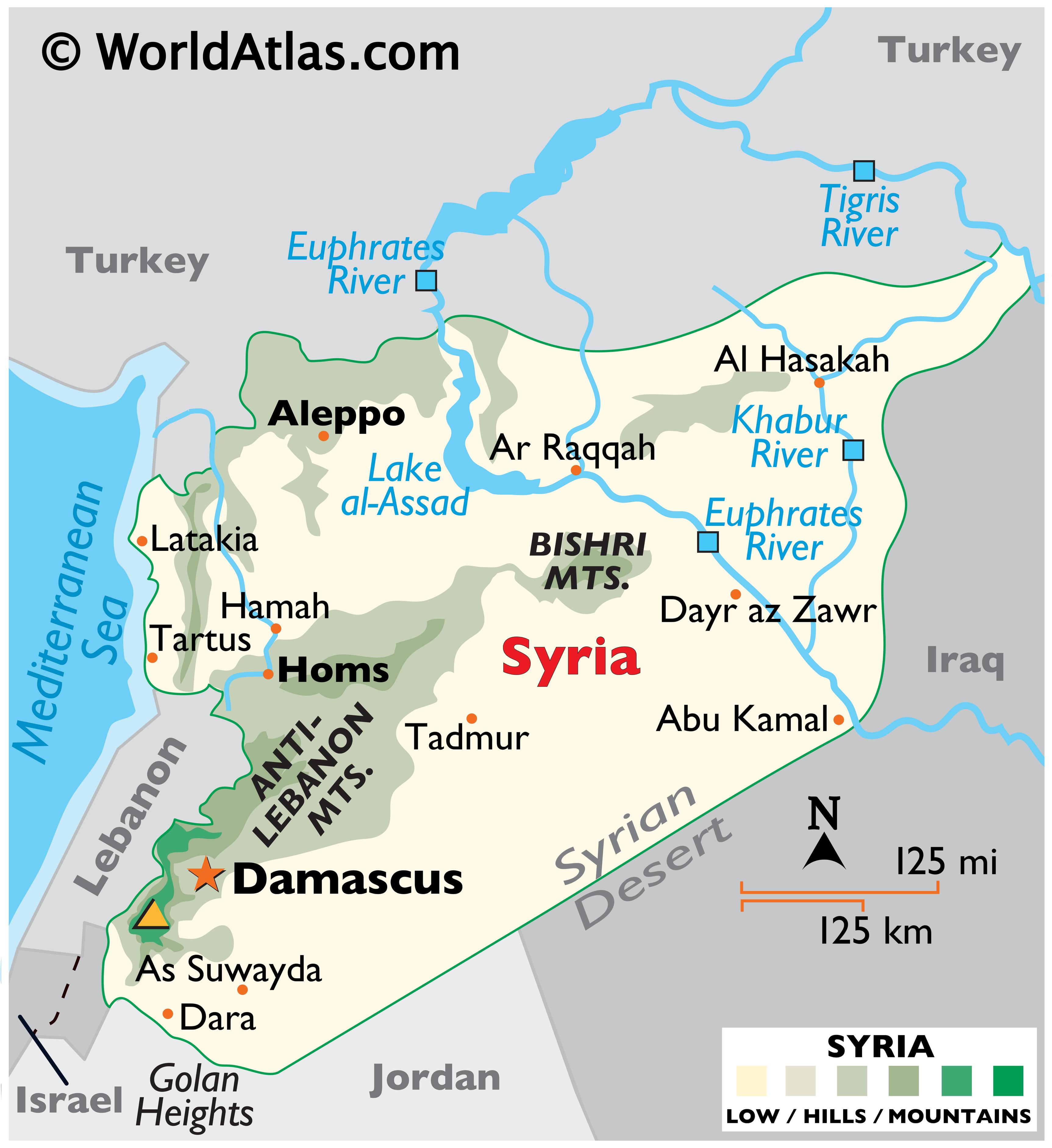
Which per this map, is a few "oar strokes" north of Israel via the Mediterannean Sea:


sycolor.gif


If that's the case, I'm sure all Israeli interests (in this country and elsewhere) are watching this situation closely too.

For some reason, I doubt that Russia actually targeted the pipeline itself. It may have just been a reminder to the heavily Israeli-influenced U.S. Congress and other U.S. government officials to stop playing games.

I'm pretty sure that if Russia really wanted to blow the pipeline after 30 missiles, at least one of them would have hit.


An interesting sidenote to this, is the reaction of McCain and Obama (which I also noted in your post). Hmm...
 
Yo these mofos talk night and day about Russia but won t say ish about Darfur.......hmmmmm..........I wonder why?
 
Re: Russians Push Past Separatist Area to Assault Central Georgia; Bombs Capital

<font size="4">Here's some other questions, to ponder:</font size>

Look at how well the Russian invasion was coordinanted; look how timely it has opened fronts; manuevered naval forces and is systematically degrading Georgian military assets.
  • How much "Planning" went into the Russians well coordinated military action ???

  • How much time was required to do the planning ???

  • How much time did it take to ready the forces (incorporate the planning into readiness) for the invasion ???

  • How long have the Russians been contemplating this move; and, were the Georgians somehow led or duped by the Russians into taking foolish actions - when the Russians were just waiting to pound ???


<font size="4">Some other ominous questions:</font size>

  • Positioning forces for invasions are not done in total silence (there are overt signs that tend to tip off that something . . . is afoot; I would doubt seriously if we haven't observed the little things (unusual radio coms, unusual radar intercepts, cancellation or alternation of leave, out-of-pattern movement of naval refueling ships and air tankers) that say either an exercise is underway or, something is imminent.

  • Its no secret that the U.S. and the Europeans (especially through NATO) closely share intelligence. How much did Europe know of the acts which threaten its energy supplies ???

  • Why have the Germans been so damn quiet ???

  • Were we caught flat-footed (lacking in naval and air power in-theatre to make the Russians think twice, before they acted) ???

  • If we weren't caught flat-footed, were the Europeans too chicken to act ???

  • Are the Russians actions in Georgia a signal that the Russians want to get off the porch and run with the big dogs AND -- show that it stands ready and capable of dictating the terms over a large share of the worlds oil/gas ???

  • Can you look at possibilities, OTHER THAN, just another George Bush/USA grand scheme conspiracy ???

QueEx
 
Thanks a bunch QueEx. Sounds like the good old days may be coming back.

For my money, and from the hip, I'd start cutting some deals to get Cuba into our sphere. No price too high. We've done enough damage to their side of the field for now, as Russia has indicated.

Note to others- if you are selling wolf tickets in southwest Asia, Russia is buying them. You need to know this.
 
Saakashvili miscalculated due to over confidence in the WEST and I think he lost like a dog with it's tail between it's legs if you ask me.
 
Back
Top