Russia Claims The North Pole+Oil, Gas, & Diamonds

Obadiah Plainman

Potential Star
Registered
Russian President Vladimir Putin has annexed a 460,000 square mile area he claims is apart of Russia's continital shelf. Funny how we haven't heard this story reported in American media.

Putin's Arctic invasion: Russia lays claim to the North Pole - and all its gas, oil, and diamonds

Last updated at 09:24am on 29th June 2007

Russian President Vladimir Putin is making an astonishing bid to grab a vast chunk of the Arctic - so he can tap its vast potential oil, gas and mineral wealth.

His scientists claim an underwater ridge near the North Pole is really part of Russia's continental shelf.

One newspaper printed a map of the "new addition", a triangle five times the size of Britain with twice as much oil as Saudi Arabia..............Full Article

5xdyyvq.jpg
 
What people also don't know is Russia owns oil refineries in SE Asia ( the ones America tried to get during the Vietnam War). Where do you think all these Russian billionaires are getting their wealth from? Whose going to fight Russia to stop them from taking this stretch of land?
 
LennyNero1972 said:
What people also don't know is Russia owns oil refineries in SE Asia ( the ones America tried to get during the Vietnam War). Where do you think all these Russian billionaires are getting their wealth from? Whose going to fight Russia to stop them from taking this stretch of land?


Why does it seem like Russia under Putin is re-entering the Iron Curtin, and our media and President are pretending its not happening? Every few days another story surfaces about Putin taking over this or threating that. Condie the Russian expert seems to be saying and doing nothing, President Bush acts like Putin is his Churchill. I don't get it, whats going on?

Bush_Puting_in_a_volga.JPG

putinbushmapbig.jpg
 
I think while we're focused on the incompetence of our own government officials and the threat posed by so many radicals across the globe Americans are failing to notice the re awakening of the Russian Empire under former KGB agent Vladimir Putin.

Russian sub plants flag under North Pole

6gmj71g.jpg


MOSCOW (Reuters) - Russian explorers dived deep below the North Pole in a submersible on Thursday and planted a national flag on the seabed to stake a symbolic claim to the energy riches of the Arctic.

A mechanical arm dropped a specially made rust-proof titanium flag onto the Arctic seabed at a depth of 4,261 meters (13,980 ft), Itar-Tass news agency quoted expedition officials as saying......................................Full Yahoo Article
 
QueEx said:

Funny thing. This thread is in almost direct contradiction to this thread:


Why is Bush trying to antagonize Russia? Is he about to start another cold war?
http://198.65.131.81/board/showthread.php?t=177136

Somebody got some splaining to do ...

QueEx


Truth is I saw the idea of Russia complaining and threatening a response about the American missile defense system in Europe as another example of Putins reach for power. I think the US media has stayed mum about the abuses of the Putin administration, primarily because Pres. Bush likes him (?). Plus we're busy -- America is fighting 2 wars and attempting to simultaniously stayve off home grown attackers. Thats why this is the perfect timing for Russia to regain some of its imperical status.

But I think Putin has played President Bush worse than Bush played Colin.

But I may be wrong.
 
I don't think you're wrong in saying that Putin has been agressive in attempting to re-assert Russia as a major world power. On the other hand, I don't know if I would go so far as to say the American media has ignored that fact - since I have seen articles on the topic in many online American outlets/websites, some of which, I have posted on this board.


I also agree with you that the Russians are using this period while we are dealing with Iraq and Afghanistan to make moves that they might not otherwise make. Bigger than that though, I think the Russians are taking full advantage of the scramble for oil sources by the U.S., the rest of the West and China to position itself (it already seems to have a leash on parts of the U.K. as its major supplier of natural gas).

QueEx
 
And the beat goes on........A few years back I remember reading that Russia turned of the gas lines to Georgia in the dead of winter. In effect they froze the entire nation. Now 'Democratic' Russia is bombing Georgian villages. What gives?

Russia Drops Bomb On Georgian Village
updated 2:26 a.m. EDT, Tue August 7, 2007


TSITELUBANI, Georgia (Reuters) -- Jets flown from Russia fired an air-to-surface missile at Georgian territory in an "act of aggression", Georgian Interior Minister Vano Merabishvili told Reuters on Tuesday.

Russia, which has a long history of tense relations with the former Soviet republic, denied that its airforce had flown missions in Georgian air space.

"Our radars show that these jets flew from Russia and then flew back in the same direction that they had come from ..." Merabishvili said.

"I assess this fact as an act of aggression carried out by planes flown from the territory of another state," he added.

Georgian officials say the ordnance hit the village of Tsitelubani, about 65 km (40 miles) west of the capital, Tbilisi, but did not explode...........................Full Article

Putin Plans New Nuclear Missile Production
http://www.breitbart.com/article.php?id=070805202109.f3tcjzxn&show_article=1
 
LOL. The Russians say Georgia "staged" the whole incident. It wasn't a few years back, I believe it was last year that the Ruskies and Georgia or the Ukraine had that gas row that caused ripples in parts of Europe.

What suprises me is how many people look upon the Russians as saints. No doubt, the U.S. has done some dirty deeds but a lot of people get real loud mouthed about that but are noticeably quiet about things like .... this

QueEx
 
P.S.

Watch closely the present Iranian Nuke controversy. Watch the Russians seemingly withholding nuclear fuel to run the nuclear reactor it built for the Iranians. They're saying they are withholding the fuel until Iran comes clean (for the West) on its past nuclear activities, i.e., development of nuclear bombs.

Sounds innocent enough; as if the Russians are finally coming on board to give the West a hand - - except, however, there is that little problem with Iran developing a pipe line that could pass gas to some of the same parts of Europe that the Russians have the ability to squeeze by turning off its gas by hook, crook or self-invented controversy with Georgia/Ukraine. If Iran gives up or alters those plans, I'll bet the farm a ship or train shows up pronto with the nuclear fuel.

QueEx
 
QueEx said:
P.S.

Watch closely the present Iranian Nuke controversy. Watch the Russians seemingly withholding nuclear fuel to run the nuclear reactor it built for the Iranians. They're saying they are withholding the fuel until Iran comes clean (for the West) on its past nuclear activities, i.e., development of nuclear bombs.

Sounds innocent enough; as if the Russians are finally coming on board to give the West a hand - - except, however, there is that little problem with Iran developing a pipe line that could pass gas to some of the same parts of Europe that the Russians have the ability to squeeze by turning off its gas by hook, crook or self-invented controversy with Georgia/Ukraine. If Iran gives up or alters those plans, I'll bet the farm a ship or train shows up pronto with the nuclear fuel.

QueEx

Interesting how the Russians seem to play for both teams. Aiding Iran in getting nuclear components and pretending to stand in solidarity with the UN. I would say based on these and other strategic moves made by the Putin administration over the past 5 years, the Cold War is back on.

I may be wrong though.
 
Ah....this gives alot of insight into why shrub is fucking with russia again all of a sudden.
 
Could these moves by Russia and the U.S. , lets not forget the Chinese,be the opening moves on the resource wars of the future that are being talked about in military related think tanks and capitals around the world? I believe Iran is claiming it is acquiring nuclear power to reduce it's reliance on it's oil resources. Gaining the knowledge on how to build THE BOMB is an...ahem... :rolleyes: unintended consequence :rolleyes:.
 
<font size="5"><center>Canada uses military might in Arctic scramble</font size><font size="4">
· Building programme is response to Russian move
· UN to decide on seabed claims to huge oil deposits </font size></center>

canada10d.jpg

Lancaster Sound, Nunavut, Canada. Global warming has made the
Arctic's oil and gas reserves more accessible Photograph: Louise
Murray/Science Photo Library

Ewen MacAskill in Washington
Saturday August 11, 2007
The Guardian


An international scramble for the Arctic's oil and gas resources accelerated yesterday when Canada responded to Russia's recent sovereignty claims with a plan to build two military bases in the region.

On a trip to the far north, the prime minister, Stephen Harper, said: "Canada's new government understands that the first principle of Arctic sovereignty is: use it or lose it. Today's announcements tell the world that Canada has a real, growing, long-term presence in the Arctic."

An army training centre for 100 troops is to be built in Resolute Bay, and a deep-water port will be built on Baffin Island, to bolster Canada's claim to ownership.
The move comes a week after a Russian sub planted a flag on the Arctic seabed. Moscow claims rights to half the Arctic. The US, Norway and Denmark also have claims.

A US state department official, speaking last week, signalled that Washington will not stand by in the face of what it sees as a Russian land-grab, though America's position is complicated by its failure so far to sign the treaty of the seas.

As Canada was making its move, Danish scientists were preparing to head for the Arctic tomorrow as part of their bid for a share of the region's wealth. A US coast guard icebreaker was heading to the Arctic to map the seafloor north of Alaska.

Although the US and Canada enjoy good relations, the American ambassador to Canada, David Wilkins, has expressed annoyance with the prime minister's claims in the past.

No country owns the Arctic Ocean and north pole, but there are international laws governing its use. Under one UN convention, each country with a coast has sole exploitation rights in a limited "exclusive economic zone", beyond which mineral resources are controlled by the International Seabed Authority. However, upon ratification of the UN convention, each country was given a 10-year period within which to make claims to extend its zone. Norway (ratified in 1996), Russia (1997), Canada (2003), and Denmark (2004) have all launched claims that certain Arctic sectors should belong to their territories.

The UN's ruling on these submissions will determine who gets the right to extract the Arctic's huge reserves of oil and gas, estimated at 10bn tonnes.

Arguments over the Arctic were until recently academic because of the depth of the ice, but global warming has seen some of it melt, making drilling feasible. The US geological survey estimates that 25% of the world's undiscovered oil and gas could be located under the polar cap.

Speaking in the shelter of a hut in Resolute Bay, Nunavut, Mr Harper said: "Protecting national sovereignty, the integrity of our borders, is the first and foremost responsibility of a national government, a responsibility which has too often been neglected."

Last month, he announced that six to eight navy patrol ships will be built to guard the Northwest Passage sea route in the Arctic, which the US insists does not belong to Canada.

Russian researchers claim the Lomonosov ridge, a 1,240-mile underwater mountain range. Denmark, which owns Greenland, is claiming the same landmass, saying the Lomonosov ridge is an extension of its territory.

"The preliminary investigations done so far are very promising," Helge Sander, Denmark's minister of science, technology and innovation, told Denmark's TV2 on Thursday. "There are things suggesting that Denmark could be given the north pole."

Christian Marcussen, of the Geological Survey of Denmark and Greenland, said: "We will be collecting data for a possible demand."

The US's position is complicated because the Senate has refused since the 1990s to ratify the 1982 UN convention on the law of the sea, mainly because Republican senators refused to recognise the right of the United Nations to broker it.

Under the convention, countries are entitled to control any waters above landmasses which extend from their continental shelf, the basis of the Russian and Danish claims to the Lomonosov ridge. If the US operated on the same principle, it would be able to claim half of the Arctic.

There is a sense of alarm in the US administration at the possibility of a missed opportunity, and President George Bush in May broke ranks with Republican senators in support of ratification. New hearings in the Senate foreign relations committee will be held in the autumn.

http://www.guardian.co.uk/oil/story/0,,2146728,00.html


 
QueEx said:
<font size="5"><center>Canada uses military might in Arctic scramble</font size><font size="4">
· Building programme is response to Russian move
· UN to decide on seabed claims to huge oil deposits </font size></center>

canada10d.jpg

Lancaster Sound, Nunavut, Canada. Global warming has made the
Arctic's oil and gas reserves more accessible Photograph: Louise
Murray/Science Photo Library

Ewen MacAskill in Washington
Saturday August 11, 2007
The Guardian


An international scramble for the Arctic's oil and gas resources accelerated yesterday when Canada responded to Russia's recent sovereignty claims with a plan to build two military bases in the region................


http://www.guardian.co.uk/oil/story/0,,2146728,00.html

Interesting turn of events. Canada saw Russia's recent moves as an authentic challenge and jumped in the frey, preparing to claim and defend their share of Santa's work shop. While the US sits back with the position that none of these symbolic claims can even be considered valid.

Is it possible that because of Bush inaction we could be left out of the Artic-ice-grab of 07'? And if so what could these events mean for Canadian-American relations in the future?
 
Putin Permanently Restores Communist Era Bomber Missions

Russia sends out 14 long-haul bombers: Putin
Fri Aug 17, 2007 9:59AM EDT

4ygw9he.jpg


CHEBARKUL, Russia (Reuters) - President Vladimir Putin said Russia sent 14 bomber aircraft on patrols far beyond its own territory on Friday, marking the permanent return to a Soviet-era practice.

Putin said the resumption of flights was a response to security threats posed by other military powers.

"We have decided to restore flights by Russian strategic aviation on a permanent basis," Putin told reporters at joint military exercises with China and four Central Asian states in Russia's Ural mountains.....................Full Reuters Article


Russia and China being War Games
 
t.gif


<font size="5"><center>Russia restores Soviet-era strategic bomber patrols</font size></center>


72128934.jpg


Russian News & Information Agency
August 17, 2007

CHEBARKUL (Urals), August 17 (RIA Novosti) - President Vladimir Putin said Russia permanently resumed Friday long-distance patrol flights of strategic bombers, which were suspended in 1992 after the collapse of the Soviet Union.

"I made a decision to restore flights of Russian strategic bombers on a permanent basis, and at 00:00 today, August 17, 14 strategic bombers, support aircraft and aerial tankers were deployed. Combat duty has begun, involving 20 aircraft."

The president, speaking on the final day of large-scale military exercises involving Russia, China, and four Central Asian countries in the south Urals, said that on the first day of patrol flights, bomber planes would spend about 20 hours in the air, with midair refueling, and would interact with naval forces.

"Air patrol areas will include zones of commercial shipping and economic activity. As of today, combat patrolling will be on a permanent basis. It has a strategic character," Putin said.

The president said that although the country stopped strategic flights to remote regions in 1992, "Unfortunately, not everyone followed our example." Other states' long-distance strategic patrol flights have created certain problems for national security, he said.

"We act on the assumption that our partners will treat with understanding the resumption of strategic air flights. Our pilots have been grounded for too long. There is strategic aviation, but there are no flights," Putin said.

Leaders of Shanghai Cooperation Organization (SCO) were in Russia's Chelyabinsk Region for the final day of Peace Mission 2007 counter-terrorism exercises, which began August 9. The drills involved about 6,000 servicemen from Russia and China, along with around 1,500 from the other four member states, Kazakhstan, Tajikistan, Kyrgyzstan, and Uzbekistan.

A former Russian Air Force chief said the resumption of patrols would strengthen Russia's defense capability. "It's a good thing that the old geopolitical setup has been revised. It used to be based on the principle, 'No one is going to attack us.' Practice testifies to the contrary," Army Gen. Pyotr Deinekin said.

He highlighted the new potential security threats Russia faces, saying NATO fighters were based in the Baltic States - formerly part of the Soviet Union and now EU members - while radar stations are being built around Russia's borders.

The general said that the early 1980s, in response to the U.S.'s deployment of cruise missiles in Europe, Soviet strategic aviation started patrolling areas as far afield as the U.S. coast. Patrols were discontinued following the collapse of the USSR and the Warsaw Pact, and due to severe economic difficulties, including an acute fuel shortage.

"Flights will be conducted on the same basis as they were in the past," Deinekin said.

Following Putin's announcement at Peace Mission 2007, exercises that were viewed by Western media as a display of Beijing and Moscow's renewed military might, Washington played down the significance of Russian strategic bomber flights.

"That's a decision for them to take," State Department spokesman Sean McCormack said. "It's interesting. We certainly are not in the kind of posture we were with what used to be the Soviet Union. It's a different era. If Russia feels as though they want to take some of these old aircraft out of mothballs and get them flying again, that's their decision."

http://en.rian.ru/russia/20070817/72189719.html
 
<font size="5"><center>Russian bombers could suppress U.S. missile shield</font size></center>


41180302.jpg


Ria Novosti
Russian News & Infromation Agency
13:05 | 05/ 03/ 2007


MOSCOW, March 5 (RIA Novosti) - Russia's strategic aviation has sufficient potential to suppress elements of a U.S. missile defense shield should it be deployed in Central Europe, the commander of the Strategic Air Force said Monday.

"Missile shield elements, which are located in silos, are very vulnerable and have weak defenses," Lieutenant-General Igor Khvorov said. "Therefore, all aircraft deployed by [Russian] strategic aviation can either apply electronic counter-measures against them or physically destroy them."

Russia, which has been anxious about NATO bases that have appeared in former Communist-bloc countries and ex-Soviet republics, has blasted U.S. plans to deploy anti-missile systems in Central Europe as a national security threat and a destabilizing factor for Europe.

Washington said the defenses would be designed to counter possible strikes from North Korea and Iran, which are involved in long-running disputes with the international community over their nuclear programs.

General Pyotr Deinekin, a former Commander-in-Chief of the Russian Air Force, said the deployment of U.S. missile shield elements in Eastern Europe "enables Americans to considerably expand their possibilities from the point of view of reconnaissance and the elimination of Russian missiles in the initial stage of their flight trajectory."

"We should now expect the deployment of their intermediate and short-range missiles in the former countries of the Warsaw Pact, including in the Baltic States," Deinekin said.

In that situation, Deinekin said, the Russian General Staff should calmly take adequate measures not only to contain, but to actively eliminate those facilities as well, including with the use of Strategic Air Force aviation assets.


http://en.rian.ru/world/20070305/61569829.html
 
<font size="5"><center>UK jets scrambled to intercept Russian aircraft</font size></center>

typhoon192.jpg


Mark Tran
Thursday September 6, 2007
Guardian Unlimited

British fighter jets were today scrambled to intercept eight Russian "Bear" reconnaissance aircraft in the second such incident in recent weeks.
Four Tornado F3 planes took off from Leeming, in north Yorkshire, and Waddington, in Lincolnshire, to head off the aircraft. The Ministry of Defence said the Russian planes had not entered British airspace but did not provide details on where the incident took place.

The Associated Press reported that Norwegian F16 fighters were scrambled twice to monitor the same eight Russian bombers that came close to its territory in the latest show of air power by the Kremlin.

Lieutenant Colonel John Inge Oegland, of the Norwegian joint headquarters, said the Russian bombers, all Tupolev-95s, neared but did not enter Norwegian air space in the far north.
"They followed a normal route in international airspace," he told AP. He said they flew near Norway's northern tip over the Barents Sea, then over the north Atlantic and back.

Lt Col Oegland said two Norwegian fighters were sent up both times the Russian aircraft approached Norway, in keeping with normal practice.

At the end of last month, two RAF Eurofighter Typhoon aircraft were scrambled for the first time to intercept a Tupolev Bear over the north Atlantic. At the time the MoD released photographs of the latest in a series of incidents over the past few months in which Russian planes flying close to British airspace have been intercepted by the RAF.

MoD officials at the time played down the incident last month as a "picture-led story" and an opportunity to show off the air defence role of the Typhoon, an expensive and long-delayed aircraft originally designed during the cold war to engage in dogfights with Soviet planes over northern Europe.

The Tupolev Bear was designed during the cold war as a long-range bomber. The first indications that Russia was flexing its muscles in this way came in May when Russian Bear aircraft flew towards British airspace during an exercise off Scotland, to spy on Royal Navy warships. Two Tornado F3 defence aircraft were scrambled to see the bombers off.

On three occasions in July, as the row over Russia's refusal to extradite Andrei Lugovoi over the murder of Alexander Litvinenko caused tit-for-tat expulsions, Tornados were scrambled to warn off Russian Bear aircraft.

Russia last month resumed its cold war practice of sending bombers on long-range flights.

President Vladimir Putin said the move to resume the flights permanently after a 15-year suspension was in response to what he described as security threats posed by other military powers.

The US plans to base parts of its controversial missile defence system in central Europe, close to the Russian border.


http://www.guardian.co.uk/military/story/0,,2163747,00.html
 
Putin Dissolves Government

67wzmon.jpg


Sep 12 01:19 PM US/Eastern
By MIKE ECKEL
Associated Press Writer


MOSCOW (AP) - President Vladimir Putin on Wednesday replaced his long-serving prime minister with an obscure Cabinet official—a surprise move that could put him in the running to succeed Putin in next year's presidential election.
The nomination of Viktor Zubkov, who currently oversees the government's fight against money laundering, appeared to have caught much of the Russian political elite off-guard.

Putin had been expected to announce in December whom he would back to run for president next year—and Russia's two first deputy prime ministers—former Defense Minister Sergei Ivanov and gas giant Gazprom board chairman Dmitry Medvedev—were widely considered to be the leading contenders.

"All expected successors had an awkward moment as Putin again showed that he's a master of disinformation," analyst Stanislav Belkovsky said on Ekho Moskvy radio.

Full AP Article
????
 
????

British Jets Intercept Russian Bombers

6cotjr5.jpg


Sep 14 07:14 AM US/Eastern

Norwegian and British fighter jets were scrambled to intercept Russian bombers over the north Atlantic, the latest in a series of such incidents, Norway's military command said Friday.
Two Russian Tupolev-160 bombers or "Blackjacks" were detected by the NATO allies flying along the Norwegian coast before passing by northern Scotland, a military spokesman told AFP.

"We dispatched two F-16s from Bodoe airbase (in the north of Norway) to identify them," Lieutenant-Colonel Jon Inge Oegland said, adding that Britain had also sent aircraft.

"It conforms with the declarations of (Russian) president (Vladmir) Putin and we are expecting more such flights in the future...............................Full AFP Article
 
GREAT INFO!!!

Maybe this is why the North American Union is being created...so we can use Canada to aid in this Arctic scramble...
 
Truth is I saw the idea of Russia complaining and threatening a response about the American missile defense system in Europe as another example of Putins reach for power. I think the US media has stayed mum about the abuses of the Putin administration, primarily because Pres. Bush likes him (?). Plus we're busy -- America is fighting 2 wars and attempting to simultaniously stayve off home grown attackers. Thats why this is the perfect timing for Russia to regain some of its imperical status.

But I think Putin has played President Bush worse than Bush played Colin.

But I may be wrong.

Always blame Bush. He will be gone soon. You will need someone else to blame or will you?
 
Why does it seem like Russia under Putin is re-entering the Iron Curtin, and our media and President are pretending its not happening? Every few days another story surfaces about Putin taking over this or threating that. Condie the Russian expert seems to be saying and doing nothing, President Bush acts like Putin is his Churchill. I don't get it, whats going on?

The primary investors of Russia's Energy Firms are that in the same of the United States. For Bush to battle back would be to shoot himself and his constituants in the foot.
 
Always blame Bush. He will be gone soon. You will need someone else to blame or will you?

If Putin continues his escalation, his return back to cold war era tactics, and President Bush continues to ignore it because he 'likes' (?) the guy. Then I'd say it would be fitting to lay the blame where its deservant, wouldn't you?
 
GREAT INFO!!!

Maybe this is why the North American Union is being created...so we can use Canada to aid in this Arctic scramble...

That sounds noble, but I suspect that the NAU if it is in the making will exist in an effort to create a stronger economical system for the region than is in place today, similar to the EU. Canada and the United States already have NORAD. But you never know.
 
<font size="5"><center>
U.S. scrambled jets as Russian bomber neared carrier</font size></center>


124-WORLD-NEWS-COLDWAR-2-FT.standalone.prod_affiliate.91.jpg

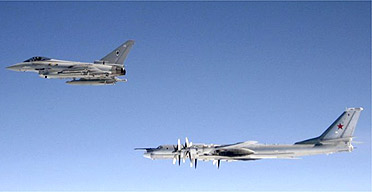
Russian Tupolev Tu-95 bomber is intercepted by a Royal Air Force
Typhoon fighter before approaching too close to British airspace in
August 2007.

McClatchy Newspapers
Kevin G. Hall
By Nancy A. Youssef and
Posted on Tuesday, February 12, 2008


WASHINGTON — A Russian bomber made a low-altitude pass over a U.S. carrier battle group that was conducting exercises in international waters near Japan last weekend, an incident reminiscent of the Cold War, U.S. military officials said Tuesday.

Pentagon officials said that the Tupolev 95 bomber — the world's only propeller-driven strategic bomber — flew within 2,000 feet of the USS Nimitz aircraft carrier. The Navy scrambled four F-18 fighters to escort the Russian aircraft away.

Adm. Gary Roughead, the chief of Naval Operations, said he didn't consider the incident "provocative," noting that the bomber made no effort to vary its path as it approached the carrier.

But he acknowledged that even during the Cold War, when the U.S. and the Soviet Union regularly attempted to rattle each other with such passes, Russian aircraft rarely flew so close to American warships.

Marine Corps Gen. James Cartwright, the vice chairman of the Joint Chiefs of Staff, said that the Pentagon was weighing "the implications of this return to a Cold War mind-set."

Roughead said the Russians were signaling that their once-inert military "is emerging" as a global force.

Over the weekend, Japan also scrambled fighter jets and accused Russia of violating its airspace around the Izu island chain, several hundred miles south of Tokyo.

There have been numerous incidents of Russian planes testing Japanese air defenses, but Russia's willingness to disrupt a U.S. training exercise was surprising, officials said.

Bush administration and Russian officials have been at odds over a number of issues in recent months, including Russia's sales of nuclear technology to Iran and U.S. plans to deploy a missile shield in Eastern Europe. Angered by the missile-shield plans, Russia announced last year that it would pull out of a treaty that long has governed the size and deployment of conventional forces in Europe.

Russia has been gradually rebuilding its military posture under President Vladimir Putin, who's expected to serve as prime minister when his handpicked successor takes office next month. With global oil and natural-gas prices at or near all-time highs, the Russian government has huge budget surpluses to spend on new military technology.

After a trip to Russia last fall, Secretary of Defense Robert Gates said he'd interpreted Putin's message to the United States as: "We are back."

"I think President Putin is coming back and saying, 'You know you have to take us into account on all these things.' In essence: 'We are back. We've got a lot of money. And we are a key player,' " Gates said then.

The Pentagon's first confirmation of the incident came at the end of a Senate Budget Committee hearing Tuesday on Pentagon funding requests. As the committee prepared to adjourn, Sen. Bill Nelson, D-Fla., asked whether news reports that a Russian bomber had buzzed the Nimitz on Saturday were true.

Cartwright, the vice chairman of the Joint Chiefs of Staff, said that they were.

"It's rather incredible what's happening," said Sen. Pete Domenici, R-N.M., who urged his colleagues to read recent classified CIA reports that document the changes in a nation that was the main rival of U.S. economic and foreign policy interests for much of the last century.

"They are particularly modern in what they are building," he said of Russia's military-spending and building spree.

McClatchy Newspapers 2008


http://www.mcclatchydc.com/100/story/27437.html
 
Medvedev sworn in as new Russian President, Putin quickly nominated as Prime Minister. Puppet government?

[FLASH]http://www.youtube.com/v/KPeBYzxR9t0&hl=en[/FLASH]​
 
Last edited:
More of the reimplementation of Soviet-era policies, by the new former non President-President. Mums the word from Condie and the coalition of the bringers of Democracy members.

Putin's opponents are made to vanish from TV
By Clifford J. Levy

Published: June 2, 2008

MOSCOW: On a talk show last autumn, a prominent political analyst named Mikhail Delyagin offered some tart words about Vladimir Putin. When the program was televised, Delyagin was not.

His remarks were cut and he was digitally erased from the show, like a disgraced comrade airbrushed from an old Soviet photo. (The technicians may have worked a bit hastily; they left his disembodied legs in one shot.)

Delyagin, it turned out, has for some time resided on the so-called stop list, a roster of political opponents and other critics of the government who have been barred from television news and political talk shows by the Kremlin................Full International Herald Triune article
 
Last edited:
Why does it seem like Russia under Putin is re-entering the Iron Curtin, and our media and President are pretending its not happening? Every few days another story surfaces about Putin taking over this or threating that. Condie the Russian expert seems to be saying and doing nothing, President Bush acts like Putin is his Churchill. I don't get it, whats going on?

In this particular case, the land is underwater. Nobody lives there. An iron curtain isn't necessary.

As to what's going on, in case you didn't notice, the US of B switched sides in Afghanistan after 9/11/1. Russia is our ally now. Rambo is rolling over in his residuals.
 
<font size="5"><center>Russian general fires Arctic warning</font size></center>

Canwest News Service
Randy Boswell
Tuesday, June 24, 2008


A tough-talking Russian general is reheating the rhetoric of Arctic politics ahead of a large-scale military training exercise in Siberia, commenting in the country's official army newspaper that "wars these days are won and lost well before they are launched."

Lt.-Gen. Vladimir Shamanov, head of the Russian military's combat training directorate, told the Krasnaya Zvezda (Red Star) that Russia moved to bolster its presence in the Arctic after a negative international response - which included criticism from Canada - to last summer's controversial Russian flag-planting on the North Pole sea floor.

"After the reaction of a certain number of heads of state to Russia's territorial claims to the continental plateau of the Arctic, the training division has immediately set out (training) plans for troops that could be engaged in Arctic combat missions," Shamanov was quoted saying in Tuesday's edition of the military daily.

In late May, ministers from the five nations with Arctic Ocean coasts - including Canadian Natural Resources Minister Gary Lunn and Russian foreign minister Sergei Lavrov - promised to tone down the rhetoric surrounding the countries' competing undersea territorial claims in the potentially oil-rich Arctic Ocean.

The five countries - Canada, Russia, Norway, Denmark (Greenland) and the U.S. (Alaska) - are each compiling data for possible extensions to their Arctic continental shelves under terms of the UN Convention on the Law of the Sea.

But just days after the five-nation Arctic summit in Greenland, Shamanov announced plans to increase the "operational radius" of Russia's northern submarine fleet and reinforce the Russian army's combat readiness along the Arctic coast.

Rob Huebert, a University of Calgary specialist in polar politics, said Shamanov isn't just "blowing smoke" and appears to be sending a message to Russia's northern neighbours about Moscow's determination to strengthen its military presence in the Arctic and secure its position as the region's prime power.

"This is, unfortunately, getting serious in a long-term scenario," Huebert told Canwest News Service.

"The Russians are making a really concerted effort to let us know they're reinvigorating their northern capabilities."

But Michael Byers, a University of British Columbia specialist in international law and Arctic politics, said Shamanov's choice of words doesn't appear to reflect Russia's recent co-operative approach to resolving Arctic issues through multilateral meetings and by "acting within the rules."

Shamanov, he said, is like those in Canada who seize "every opportunity to push for greater military spending without regard for the diplomatic or geopolitical consequences."

Huebert, though, rejects the widely held view that last year's North Pole dive by a Russian submersible was a mere scientific "stunt."

He says, in fact, that Russia was pointedly warning other Arctic states that their potential claims over seabed territory - likely to overlap in the central Arctic Ocean - should go no further than the North Pole.

"Those overlaps are potentially going to cause a degree of friction," said Huebert. "The million-dollar question is: What degree of friction?"

While Prime Minister Stephen Harper has announced several investments aimed at bolstering Canada's own capabilities in the Arctic - including a planned fleet of patrol vessels and a Resolute, Nunavut-based northern military training centre - Huebert said there's "no comparison" between Canada's modest defence presence in the Far North and Russia's superpower-scale Arctic military capacity.


http://www.canada.com/topics/news/story.html?id=ac0d24df-dc10-43da-89f3-b3c3c0928ae7
 
<font size="5"><center>Appetite for Arctic oil rises in line with crude prices</font size></center>

June 1, 2008

MADRID (AFP) — The appetite for Arctic oil has surged in line with rocketing crude prices but environmental concerns and a diplomatic stalemate stand in the way of exploration, experts say.

At a time when supplies are struggling to keep pace with surging demand from developing countries, the industry is increasingly looking to new frontiers in its search for new reserves, with the Arctic clearly in the sights.

"There is lots of oil under the North Pole," said geologist Donald Gautier of the US Geological Survey at the World Petroleum Congress this week. He estimated that the Arctic holds 100 billion barrels of oil.

But while extracting the oil from the harsh Arctic environment poses unprecedented technical challenges, the biggest barrier to exploration is the disputed ownership of the region which makes it difficult to get permission to drill, he added.

"Technology is critical on the one hand but the real issue in access to those continental shelves," said Gautier.

Five countries that border the Arctic Ocean -- Canada, Denmark, Norway, Russia and the United States -- dispute the sovereignty of the region's waters and they have become more vocal in their claims as interest in the region's resources rises.

Last year Canada announced it would build eight Arctic patrol vessels to reassert the country's northern sovereignty.

"Canada has a choice when it comes to defending our sovereignty in the Arctic; either we use it or we lose it. And make no mistake this government intends to use it," Canadian Prime Minister Stephen Harper said at the time.

Shortly after, Russian explorers placed a rust-proof titanium Russian flag on the seabed below the North Pole in what was seen as a bid to further Moscow's claims to the Arctic.

The North Pole is not currently regarded as part of any single country's territory and is therefore administered by the International Seabed Authority.

Environmental concerns also put the brakes on oil exploration in regions like the Arctic that are opening up to oil development thanks to technological developments, said David Boone, the president of Canada's Escavar Energy, an oil and gas producer.

"Even as space age technology opens up new areas, environmental concerns can shut them down just as quickly," he said.

The danger of oil spills in such a sensitive environment, where the cold means crude breaks down at especially slow speed, and the risk of disruption to local ecosystems figure as the two biggest concerns.

Industry leaders and analysts agree though that with oil prices at record highs, oil firms are not short on the cash that would be needed to open up new areas to oil exploration.

"Anyone who suggests that the oil industry does not have the money to invest with oil at 140 dollars a barrel is being facetious," said StatoilHydro vice president for business development Robert Skinner.

Earlier this month BP, ConocoPhillips and MGM Energy Corp were awarded exploration rights by the Canadian government for three offshore blocks in the petroleum-rich Arctic region in a lease sale.

The World Petroleum Congress, a gathering of executives from major oil companies and ministers from top oil producing nations held every three years, wraps up on Thursday. It is one of the industry's biggest events.

http://afp.google.com/article/ALeqM5jdEc_L98eicwjjkPveSKdGwg988Q
 
I guess, this didn't work out so well, for the U.S. :hmm:

'Son of Star Wars' is readied in Alaskan outpost
l By Giles Whittel

May 21, 2002

In the place where President Bush has chosen to draw a line in the sand against the ultimate terrorist threat, there is no sand and little sign of terrorists.

There was snow, at least there was until last week. There are moose, stalking over the open ground when the earthmovers allow, and even the odd grizzly bear.

Workers on contract to the US Army Corps of Engineers have been quietly clearing a large T-shaped swath of forest from the Fort Greely military reservation, 200 miles south of the Arctic Circle in the heart of Alaska, for nearly a year.

The site is invisible from civilian roads. The airspace above it is restricted. Visitors are vetted exhaustively and the perimeter is guarded by military police and a newly installed cordon of steel boxes 6ft high and filled with gravel.

Security is tight here and will get tighter. Starting on June 14, six months to the day after Mr Bush announced that the United States was withdrawing from the Anti-Ballistic Missile Treaty signed by Presidents Nixon and Brezhnev 30 years ago, excavators will gouge six yawning silos out of the Fort Greely earth.

By 2004 each of them will house a 65ft “exo-atmospheric kill vehicle” designed to intercept incoming nuclear missiles high over the Pacific Ocean.

Whether any of America’s enemies can or would launch a first nuclear strike of this kind is now beside the point. After two decades of debate the talking is over: Mr Bush believes that the threat is credible. Initial construction contracts worth $250 million (£171 million) were awarded last month.

Barring a humiliating U-turn for the White House, America is going to get some sort of missile defence shield, starting in Fort Greely.

It is bitterly cold here in winter, swarms with oversized mosquitoes by May and hauntingly remote, all of which is somehow apt. Few places could reflect more accurately the defiant unilateralism that Mr Bush brings this week to Europe, however artfully clothed in talk of co-operation with Russia.

His missile defence plans are part of a foreign policy based on crushing military superiority that Washington now wants to extend with technologies that none of its allies could conceive of building themselves and to which many of them remain strongly opposed.

The Pentagon insists that Fort Greely will be only a test site, at least at first. But, if the testing goes well, orders could come from Washington for 100 more silos and “kill vehicles” to fill them. There would be plenty of room.

“This is good for us and great for America,” said one local contractor who last week got the go-ahead to build a year-round work camp for 350 labourers on the edge of the reservation. Others in the Alaska Steakhouse in Delta Junction, the only source of liquor in the only civilian settlement within a two-hour drive, overwhelmingly agreed.

A year ago Fort Greely was virtually defunct. Its housing for 400 soldiers and their families stood empty and its pool tables were being sold for $25 each. Now being reborn as science fiction made fact, it is due for an injection of $400 million even if missile defence does not go beyond testing, and billions more if it does.

It is meant to operate as follows: alerted by military satellites over the north Pacific and enhanced early warning radar beacons in Alaska and California, Fort Greely would launch an interceptor roughly 20 minutes into the flight of any hostile ballistic missile heading for America.

Once airborne, the interceptor would be guided by a specially-built X-band radar station, probably installed on Shemya Island in the Aleutians and linked to a Battle Management Command and Control Centre at Fort Greely by 1,000 miles of fibre-optic cable. With three separate systems providing constant real-time telemetry the interceptor would be targeted to within a margin of error of a few feet and would be able to distinguish the incoming warhead from any decoys that it released. It would hit its target 150 miles above the Pacific at 15,000mph and the fruits of years of secret labour for a rogue state, international terrorist group or combination of the two would detonate harmlessly in outer space.

Whether missile defence will actually work is still a multibillion-dollar question. President Reagan’s plans for a space-based “Star Wars” shield were mothballed before they could be tested.

President Bush has enlisted every relevant technology, including giant lasers mounted on Boeing 747s, and is reserving judgment on which to use until the “north Pacific test bed” based at Fort Greely starts producing results.

Those obtained elsewhere are not encouraging. Two of America’s past five anti- missile tests failed when the interceptors missed their targets completely and none of the other three was fully realistic as the kill vehicles were fed their target data by the targets themselves.

Professor Theodore Postol, of the Massachusetts Institute of Technology, claimed last year that the tests had been rigged and that fundamental design flaws meant that the kill vehicles would never find their prey. He had singlehandedly disproved the US Army’s boast of a 96 per cent success rate against Iraqi Scud missiles with the Patriot system during the Gulf War (he says that not a single Scud was intercepted) and the Pentagon took his new intervention seriously enough to send two agents to his office in an apparent attempt to intimidate him. It also demanded that his correspondence be classified. Officials say that his latest claims relate to an interceptor that is no longer being used. Even so, no replacement has been chosen.

That the White House is pressing ahead with missile defence at all has stunned many of its critics into silence. Before the September 11 attacks, Russia, China, most European governments, many US Democrats and some Republicans agreed that any anti-missile shield would be technically fraught, prohibitively expensive, diplomatically risky and above all strategically wrong, since it countered a threat that went out with the Cold War. These critics seized on the September atrocities as tragic proof that America’s enemies would find alternatives to building their own missiles.

Mr Bush and his advisers declared that, on the contrary, if terrorists or states that sponsored them did have missiles, they would use them. Resistance crumbled. Congressional Democrats dropped their vetoes on spending and tests that violated the ABM treaty. The treaty was torn up and “Son of Star Wars” was born.
 
Back
Top