
You are using an out of date browser. It may not display this or other websites correctly.
You should upgrade or use an alternative browser.
You should upgrade or use an alternative browser.
Post anything that is considered, the unknown or unexplainable...on-going ...
- Thread starter (0_0)..l.. finger
- Start date



How can the government be broke, when they make their own money?
Here is how it works. The lowly householder can’t pay his mortgage, so the mortgage company takes the loss. The mortgage company goes broke so the banks take a loss. The bank takes a loss so another bank, the one that bought its derivative debt bomb, goes broke. And then, the feds step in and take the debt over. And then they add trillions more – claiming to protect everyone from everything…
…the guy who hasn’t saved for his retirement gets Social Security. The guy who hasn’t got health insurance gets Medicaid or Medicare or some sort of freeby medical help. The bankers get bailed out. GM gets bailed out. Farmers get subsidies. Poor people get food stamps. Lobbyists get contracts….
…and then the little government that is paying for all this can’t go on…so a bigger government bails it out…
…and then, investors buy the big government’s bonds…because they’re safer…even though they’re all in the same boat…
…and then the boat sinks!
you got it????


Today batteries can be found in any grocery, drug, convenience and department store you come across. Well, here's a battery that's 2,000 years old! Known as the Baghdad Battery, this curiosity was found in the ruins of a Parthian village believed to date back to between 248 B.C. and 226 A.D. The device consists of a 5-1/2-inch high clay vessel inside of which was a copper cylinder held in place by asphalt, and inside of that was an oxidized iron rod. Experts who examined it concluded that the device needed only to be filled with an acid or alkaline liquid to produce an electric charge. It is believed that this ancient battery might have been used for electroplating objects with gold. If so, how was this technology lost... and the battery not rediscovered for another 1,800 years?

While mineral hunting in the mountains of California near Olancha during the winter of 1961, Wallace Lane, Virginia Maxey and Mike Mikesell found a rock, among many others, that they thought was a geode - a good addition for their gem shop. Upon cutting it open, however, Mikesell found an object inside that seemed to be made of white porcelain. In the center was a shaft of shiny metal. Experts estimated that, if this was a geode, it should have taken about 500,000 years for this fossil-encrusted nodule to form, yet the object inside was obviously of sophisticated human manufacture. Further investigation revealed that the porcelain was surround by a hexagonal casing, and an x-ray revealed a tiny spring at one end, like a spark plug. There's a bit of controversy around this artifact, as you can imagine. Some contend that the artifact was not inside a geode at all, but encased in hardened clay. The artifact itself has been identified by experts as a 1920s-era Champion spark plug. Unfortunately, the Coso Artifact has gone missing and cannot be thoroughly examined. Is there a natural explanation for it? Or was it found, as the discoverer claimed, inside a geode? If so, how could a 1920s sparkplug get inside a 500,000-year-old rock?


There are artifacts belonging to ancient Egyptian and Central American cultures that look amazingly like modern-day aircraft. The Egyptian artifact, found in a tomb at Saqquara, Egypt in 1898, is a six-inch wooden object that strongly resembles a model airplane, with fuselage, wings and tail. Experts believe the object is so aerodynamic that it is actually able to glide. The small object discovered in Central America (shown at right), and estimated to be 1,000 years old, is made of gold and could easily be mistaken for a model of a delta-wing aircraft - or even the Space Shuttle. It even features what looks like a pilot's seat.
Could Ancient Man Fly?
Models of airplanes thousands of years old... vast works of art that can only be seen from the air... ancient texts that describe aerial battles. Are they proof that ancient civilizations mastered powered flight?
Flight has been the dream of humankind since they watched in awe as birds soared effortlessly through the sky. But, according to accepted history, it wasn't until the 1780s that two Frenchmen achieved lighter-than-air flight when they were lifted into the air in a hot air balloon near Paris. Then powered, heavier-than-air flight became the goal. And although it was theorized that heavier-than-air flight was possible as early as the 13th century, and in the 16th century Leonardo da Vinci designed winged aircraft and a crude kind of helicopter, it wasn't until the Wright brothers made their first successful flights at Kitty Hawk in 1903 that powered flight became a reality.
That's the widely accepted history. Some researchers and a few rogue scientists believe there's evidence to suggest that humans achieved flight earlier in history - much earlier... so early, they say, that the knowledge of this technology has been lost and ancient stories that recount adventures of human flight have been relegated only to myth.
Is it possible that humans developed the technology to fly in early civilizations - or in civilizations that are now lost to history? Let's take a look at what some call the evidence - intriguing artifacts, carvings, inscriptions and legends - that they say point to the true record human of flight.
The Egyptian Airplane

In 1898, a peculiar six-inch wooden object was found in a tomb at Saqquara, Egypt that dated back to about 200 BCE. The object had a body or fuselage, seven-inch wings that curved downward slightly, a fixed rudder and a tail. It looked very much like a modern airplane or glider. But since airplanes had not yet been invented in 1898 (never mind ancient Egypt), it was labeled as a model of bird and stored away in the basement of the Cairo museum.
The object was rediscovered many years later by Dr. Khalil Messiha, an authority on ancient models. According to Messiha and others who have studied the object, it has characteristics of very advanced aerodynamics, much like modern pusher-gliders that require very little power to stay aloft. The curved wings are today known as reversedihedral wings, which can attain great amounts of lift. A similar design is employed on the supersonic Concorde aircraft.
Was this just a child's toy? Or was it a scale model of an aircraft the Egyptians planned to build... or did build. If they did build a full-scale version of the aircraft, no evidence exists for it. No full-size airplanes have been found in any pharaoh's tomb to fly him to the land of the dead.
http://paranormal.about.com/library/weekly/aa032000a.htm

Fossils, as we learned in grade school, appear in rocks that were formed many thousands of years ago. Yet there are a number of fossils that just don't make geological or historical sense. A fossil of a human handprint, for example, was found in limestone estimated to be 110 million years old. What appears to be a fossilized human finger found in the Canadian Arctic also dates back 100 to 110 million years ago. And what appears to be the fossil of a human footprint, possibly wearing a sandal, was found near Delta, Utah in a shale deposit estimated to be 300 million to 600 million years old.
http://paranormal.about.com/od/anci...zling-Ancient-Artifact/Impossible-Fossils.htm

Humans were not even around 65 million years ago, never mind people who could work metal. So then how does science explain semi-ovoid metallic tubes dug out of 65-million-year-old Cretaceous chalk in France? In 1885, a block of coal was broken open to find a metal cube obviously worked by intelligent hands. In 1912, employees at an electric plant broke apart a large chunk of coal out of which fell an iron pot! A nail was found embedded in a sandstone block from the Mesozoic Era. And there are many, many more such anomalies.
What are we to make of these finds? There are several possibilities:
•Intelligent humans date back much, much further than we realize.
•Other intelligent beings and civilizations existed on earth far beyond our recorded history.
•Our dating methods are completely inaccurate, and that stone, coal and fossils form much more rapidly than we now estimate.
In any case, these examples - and there are many more - should prompt any curious and open-minded scientist to reexamine and rethink the true history of life on earth.
http://paranormal.about.com/od/anci...cient-Artifact/Out-of-Place-Metal-Objects.htm

10 Most Amazing Lost Cities
MACHU PICCHU (Peru): The Lost City of the Incas
Machu Picchu ("Old Peak") is a pre-Columbian Inca city located at 2,430 m (7,970 ft) altitude on a mountain ridge above the Urubamba Valley in Peru, near Cusco. Machu Picchu is probably the most familiar symbol of the Inca Empire. It is often referred to as "The Lost City of the Incas". The site was designated as a World Heritage Site in 1983 when it was described as "an absolute masterpiece of architecture and a unique testimony to the Inca civilization".


Machu Picchu was constructed around 1450, at the height of the Inca empire, and was abandoned less than 100 years later, as the empire collapsed under Spanish conquest. Although the citadel is located only about 50 miles from Cusco, the Inca capital, it was never found and destroyed by the Spanish, as were many other Inca sites. Over the centuries, the surrounding jungle grew to enshroud the site, and few knew of its existence. In 1911, Yale historian and explorer Hiram Bingham brought the "lost" city to the world's attention. Bingham and others hypothesized that the citadel was the traditional birthplace of the Inca people or the spiritual center of the "virgins of the sun," while curators of a recent exhibit have speculated that Machu Picchu was a royal retreat.
------------------------------------------------
ANGKOR (Cambodia): Contains the world's largest religious monument

Angkor served as the seat of the Khmer empire that flourished from approximately the 9th century to the 15th century A.D. More precisely, the Angkorian period may be defined as the period from 802 A.D., when the Khmer Hindu monarch Jayavarman II declared himself the "universal monarch" and "god-king" of Cambodia, until 1431 A.D., when Thai invaders sacked the Khmer capital, causing its population to migrate south to the area of Phnom Penh.
The ruins of Angkor are located amid forests and farmland to the north of the Great Lake (Tonle Sap) and south of the Kulen Hills, near modern day Siem Reap (13°24'N, 103°51'E), and are a UNESCO World Heritage Site. The temples of the Angkor area number over one thousand, ranging in scale from nondescript piles of brick rubble scattered through rice fields to the magnificent Angkor Wat, said to be the world's largest single religious monument. Many of the temples at Angkor have been restored, and together they comprise the most significant site of Khmer architecture. Visitor numbers approach one million annually.

In 2007 an international team of researchers using satellite photographs and other modern techniques concluded that Angkor had been the largest preindustrial city in the world with an urban sprawl of 1,150 square miles. The closest rival to Angkor, the Mayan city of Tikal in Guatemala, was roughly 50 square miles in total size
--------------------------------------------------
MEMPHIS (Egypt): ancient capital of Egypt
Memphis was the ancient capital of the first nome of Lower Egypt, and of the Old Kingdom of Egypt from its foundation until around 2200 BC and later for shorter periods during the New Kingdom, and an administrative centre throughout ancient history. Its Ancient Egyptian name was Ineb Hedj ("The White Walls"). The name "Memphis" is the Greek deformation of the Egyptian name of Pepi I's (6th dynasty) pyramid, Men-nefer, which became Menfe in Coptic. According to Herodotus, the city was founded around 3100 BC by Menes, who united the two kingdoms of Egypt
Estimates of population size differ widely. According to T. Chandlerm, Memphis had some 30,000 inhabitants and was by far the largest settlement worldwide from the time of its foundation until around 2250 BC and from 1557 to 1400 BC. Memphis reached a peak of prestige under the 6th Dynasty as a centre of the cult of Ptah. It declined briefly after the 18th Dynasty with the rise of Thebes and was revived under the Persian satraps before falling firmly into second place following the foundation of Alexandria. Under the Roman Empire, Alexandria remained the most important city and Memphis remained the second city of Egypt until the establishment of Fustat (or Fostat) in 641. It was then largely abandoned and became a source of stone for the surrounding settlements. It was still an imposing set of ruins in the 12th century but soon became little more than an expanse of low ruins and scattered stone. The remains of the temple of Ptah and of Apis have been uncovered at the site as well as a few statues, including two four-metre ones in alabaster of Ramesses II. The Saqqara necropolis is close to Memphis.
----------------------------------------
PETRA: stone structures carved into rocks

Petra ("Rock") lies on the slope of Mount Hor (Jordan) in a basin among the mountains which form the eastern flank of Arabah (Wadi Araba), the large valley running from the Dead Sea to the Gulf of Aqaba. It is famous for having many stone structures carved into the rock. The long-hidden site was revealed to the Western world by the Swiss explorer Johann Ludwig Burckhardt in 1812. It was famously described as "a rose-red city half as old as time" in a Newdigate prize-winning sonnet by John William Burgon. Burgon had not actually visited Petra, which remained accessible only to Europeans accompanied by local guides with armed escorts until after World War I. The site was designated as a UNESCO World Heritage Site in 1985 when it was described as "one of the most precious cultural properties of man's cultural heritage."
Enclosed by towering rocks and watered by a perennial stream, Petra not only possessed the advantages of a fortress but controlled the main commercial routes which passed through it to Gaza in the west, to Bosra and Damascus in the north, to Aqaba and Leuce Come on the Red Sea, and across the desert to the Persian Gulf. Petra's decline came rapidly under Roman rule, in large part due to the revision of sea-based trade routes. In 363 an earthquake destroyed buildings and crippled the vital water management system. The ruins of Petra were an object of curiosity in the Middle Ages and were visited by the Sultan Baibars of Egypt towards the close of the 13th century. The first European to describe them was Johann Ludwig Burckhardt in 1812.

----------------------------------------
PALMYRA (Syria): the Bride of the Desert

Palmyra was in the ancient times an important city of central Syria. It has long been a vital caravan city for travellers crossing the Syrian desert and was known as the Bride of the Desert. The earliest documented mention of the city by its pre-Semitic name Tadmor, Tadmur or Tudmur, is recorded in Babylonian tablets found in Mari. Though the ancient site fell into disuse after the 16th century, it is still known as Tadmor and there is a small newer settlement next to the ruins of the same name.

the mid-first century, Palmyra, a wealthy and elegant city located along the caravan routes linking Persia with the Mediterranean ports of Roman Syria and Phoenicia, came under Roman control. During the following period of great prosperity, the Arab citizens of Palmyra adopted customs and modes of dress from both the Iranian Parthian world to the east and the Graeco-Roman west. Tadmor is mentioned in the Hebrew Bible (Second Book of Chronicles 8:4) as a desert city built by the King Solomon of Judea, the son of David. Palmyra was made part of the Roman province of Syria during the reign of Tiberius (14–37). It steadily grew in importance as a trade route linking Persia, India, China, and the Roman empire. In 634 the first Muslims arrived in Palmyra. The city was taken by the Muslim Arabs under Khalid ibn Walid in 636. In the 6th century, Fakhreddine al Maany castle was built on top of a mountain overlooking the oasis. The castle was surrounded by a moat, with access only available through a drawbridge. The city of Palmyra was kept intact. After year 800, people started abandoning the city.
----------------------------------------------------
POMPEII (Italy): buried by the volcano

Along with Herculaneum, this Roman city near modern Naples was destroyed and completely buried during a catastrophic eruption of the volcano Mount Vesuvius spanning two days on 24 August year 79. The volcano collapsed higher roof-lines and buried Pompeii under many meters of ash and pumice, and it was lost for nearly 1700 years before its accidental rediscovery in 1748.

Since then, its excavation has provided an extraordinarily detailed insight into the life of a city at the height of the Roman Empire. Today, it is one of the most popular tourist attractions of Italy and a UNESCO World Heritage Site.
--------------------------------------------
PALENQUE (Mexico): one of Mayan's most exquisite cities

Palenque is an ancient Maya city near the Usumacinta River in the Mexican state of Chiapas. It contains some of the finest architecture, sculpture, roof comb and bas-relief carvings the Maya produced. The ancient Mayan city of Palenque, with its superb jungle setting and exquisite architecture and decoration, is one of the marvels of Mexico. First occupied around 100 BC, it flourished from about 600 to 700 AD, and what a glorious century that was. The city rose to prominence under Pakal, a club-footed king who reigned from 615 to 683 AD, represented by hieroglyphs of sun and shield, he is also referred to as Sun Shield or White Macaw. During Pakal's reign, many plazas and buildings, including the superlative Templo de las Inscripciones (his Mausoleum), were constructed in Palenque, characterized by very fine stucco bas-reliefs.

Pakal's son Chan-Bahlum II continued Palenque's political and economic expansion and the development of its art and architecture and presided over the construction of the Grupo de la Cruz temples, placing sizable narrative stone stelae within each. One can see the influence of Palenque's architecture in the Mayan city of Tikal. The rival Mayan city of Toniná's hostility was perhaps the major factor in Palenque's precipitous decline after Chan-Bahlum II's death in 702. Sources speak of a devastating Toniná attack on Palenque in 730. After the 10th century Palenque was largely abandoned. In an area that receives the heaviest rainfall in Mexico, the ruins lay undiscovered until the 18th century. Frans Blom, an early-to-mid-20th century investigator remarked: 'The first visit to Palenque is immensely impressive. When one has lived there for some time this ruined city becomes an obsession.'
-----------------------------------------------
VIJAYANAGAR (India): capital of one of the largest Hindu empires

Vijayanagar, the capital of one of the largest Hindu empires ever, was founded by Sangama dynasty princes Harihara and Bukka in 1336. Its power peaked under Krishnadevaraya (1509-29), when it controlled nearly the whole of the peninsula south of the Krishna and Tungabhadra rivers. Comparable to Delhi in the 14th century, the city, with an estimated population of half a million, covered 33 sq km and was surrounded by several concentric lines of fortification. Its wealth derived from the control of spice trade and the cotton industry. Its busy bazaars, described by travelers such as Portuguese Nunez and Paes, were centers of international commerce. The empire collapsed after the battle of Talikota in 1565 when the city was ransacked by the confederacy of Deccan sultans (Bidar, Bijapur, Golconda, Ahmednagar and Berar), thus opening up southern India for Muslim conquest.

The ruins are set in a strange and beautiful boulder strewn landscape with an almost magical quality. The undisputed highlight, the 16th century Vittala Temple, is a World Heritage Monument. Started by Krishnadevaraya, it was never finished or consecrated; its incredible sculptural work is the pinnacle of Vijayanagar art. The outer pillars are known as musical pillars as they reverberate when tapped. An ornate stone chariot in the temple courtyard containing an image of Garuda.
-----------------------------------------------------
EPHESUS (Turkey): one of the most important cities of early Christianity

Ephesus was an Ionian Greek city in ancient Anatolia, founded by colonists from Athens in the 10th century BC. The city was located in Ionia, where the Cayster River (Küçük Menderes) flows into the Aegean Sea, and was part of the Panionian League. Ephesus hosted one of the seven churches of Asia, addressed in the Book of Revelation (2:1–7). It is also the site of a large Gladiator graveyard

Ephesus was an important center for early Christianity. Paul used it as a base. He became embroiled in a dispute with artisans, whose livelihood depended on the Temple of Artemis there (Acts 19:23–41), and wrote 1 Corinthians from Ephesus. Later Paul wrote to the Christian community at Ephesus.
--------------------------------------------------
SANCHI (India): the best-preserved group of Buddhist monuments

A UNESCO world heritage site in central India near the Betwa River, Sanchi is on a flat-topped sandstone hill, 90m above the countryside, and stands the best-preserved group of Buddhist monuments in India. Most noteworthy is the Great Stupa, discovered in 1818. It was probably begun by the emperor Asoka in the mid-3rd century BCE and later enlarged. Solid throughout, it is enclosed by a massive stone railing pierced by four gateways on which are elaborate carvings depicting the life of the Buddha.

The stupa itself consists of a base bearing a hemispherical dome representing the dome of heaven enclosing the Earth; it is surmounted by a squared rail unit, the world mountain, from which rises a mast to symbolize the cosmic axis. The mast bears umbrellas that represent the various heavens. Other remains include several smaller stupas, an assembly hall (caitya), an Asokan pillar with inscription, and several monasteries (4th–11th cent. CE). Several relic baskets and more than 400 epigraphical records have also been discovered. ..................................
..........................................................
http://www.oddee.com/item_89087.aspx
MACHU PICCHU (Peru): The Lost City of the Incas
Machu Picchu ("Old Peak") is a pre-Columbian Inca city located at 2,430 m (7,970 ft) altitude on a mountain ridge above the Urubamba Valley in Peru, near Cusco. Machu Picchu is probably the most familiar symbol of the Inca Empire. It is often referred to as "The Lost City of the Incas". The site was designated as a World Heritage Site in 1983 when it was described as "an absolute masterpiece of architecture and a unique testimony to the Inca civilization".
Machu Picchu was constructed around 1450, at the height of the Inca empire, and was abandoned less than 100 years later, as the empire collapsed under Spanish conquest. Although the citadel is located only about 50 miles from Cusco, the Inca capital, it was never found and destroyed by the Spanish, as were many other Inca sites. Over the centuries, the surrounding jungle grew to enshroud the site, and few knew of its existence. In 1911, Yale historian and explorer Hiram Bingham brought the "lost" city to the world's attention. Bingham and others hypothesized that the citadel was the traditional birthplace of the Inca people or the spiritual center of the "virgins of the sun," while curators of a recent exhibit have speculated that Machu Picchu was a royal retreat.
------------------------------------------------
ANGKOR (Cambodia): Contains the world's largest religious monument
Angkor served as the seat of the Khmer empire that flourished from approximately the 9th century to the 15th century A.D. More precisely, the Angkorian period may be defined as the period from 802 A.D., when the Khmer Hindu monarch Jayavarman II declared himself the "universal monarch" and "god-king" of Cambodia, until 1431 A.D., when Thai invaders sacked the Khmer capital, causing its population to migrate south to the area of Phnom Penh.
The ruins of Angkor are located amid forests and farmland to the north of the Great Lake (Tonle Sap) and south of the Kulen Hills, near modern day Siem Reap (13°24'N, 103°51'E), and are a UNESCO World Heritage Site. The temples of the Angkor area number over one thousand, ranging in scale from nondescript piles of brick rubble scattered through rice fields to the magnificent Angkor Wat, said to be the world's largest single religious monument. Many of the temples at Angkor have been restored, and together they comprise the most significant site of Khmer architecture. Visitor numbers approach one million annually.
In 2007 an international team of researchers using satellite photographs and other modern techniques concluded that Angkor had been the largest preindustrial city in the world with an urban sprawl of 1,150 square miles. The closest rival to Angkor, the Mayan city of Tikal in Guatemala, was roughly 50 square miles in total size
--------------------------------------------------
MEMPHIS (Egypt): ancient capital of Egypt
Memphis was the ancient capital of the first nome of Lower Egypt, and of the Old Kingdom of Egypt from its foundation until around 2200 BC and later for shorter periods during the New Kingdom, and an administrative centre throughout ancient history. Its Ancient Egyptian name was Ineb Hedj ("The White Walls"). The name "Memphis" is the Greek deformation of the Egyptian name of Pepi I's (6th dynasty) pyramid, Men-nefer, which became Menfe in Coptic. According to Herodotus, the city was founded around 3100 BC by Menes, who united the two kingdoms of Egypt
Estimates of population size differ widely. According to T. Chandlerm, Memphis had some 30,000 inhabitants and was by far the largest settlement worldwide from the time of its foundation until around 2250 BC and from 1557 to 1400 BC. Memphis reached a peak of prestige under the 6th Dynasty as a centre of the cult of Ptah. It declined briefly after the 18th Dynasty with the rise of Thebes and was revived under the Persian satraps before falling firmly into second place following the foundation of Alexandria. Under the Roman Empire, Alexandria remained the most important city and Memphis remained the second city of Egypt until the establishment of Fustat (or Fostat) in 641. It was then largely abandoned and became a source of stone for the surrounding settlements. It was still an imposing set of ruins in the 12th century but soon became little more than an expanse of low ruins and scattered stone. The remains of the temple of Ptah and of Apis have been uncovered at the site as well as a few statues, including two four-metre ones in alabaster of Ramesses II. The Saqqara necropolis is close to Memphis.
----------------------------------------
PETRA: stone structures carved into rocks
Petra ("Rock") lies on the slope of Mount Hor (Jordan) in a basin among the mountains which form the eastern flank of Arabah (Wadi Araba), the large valley running from the Dead Sea to the Gulf of Aqaba. It is famous for having many stone structures carved into the rock. The long-hidden site was revealed to the Western world by the Swiss explorer Johann Ludwig Burckhardt in 1812. It was famously described as "a rose-red city half as old as time" in a Newdigate prize-winning sonnet by John William Burgon. Burgon had not actually visited Petra, which remained accessible only to Europeans accompanied by local guides with armed escorts until after World War I. The site was designated as a UNESCO World Heritage Site in 1985 when it was described as "one of the most precious cultural properties of man's cultural heritage."
Enclosed by towering rocks and watered by a perennial stream, Petra not only possessed the advantages of a fortress but controlled the main commercial routes which passed through it to Gaza in the west, to Bosra and Damascus in the north, to Aqaba and Leuce Come on the Red Sea, and across the desert to the Persian Gulf. Petra's decline came rapidly under Roman rule, in large part due to the revision of sea-based trade routes. In 363 an earthquake destroyed buildings and crippled the vital water management system. The ruins of Petra were an object of curiosity in the Middle Ages and were visited by the Sultan Baibars of Egypt towards the close of the 13th century. The first European to describe them was Johann Ludwig Burckhardt in 1812.
----------------------------------------
PALMYRA (Syria): the Bride of the Desert
Palmyra was in the ancient times an important city of central Syria. It has long been a vital caravan city for travellers crossing the Syrian desert and was known as the Bride of the Desert. The earliest documented mention of the city by its pre-Semitic name Tadmor, Tadmur or Tudmur, is recorded in Babylonian tablets found in Mari. Though the ancient site fell into disuse after the 16th century, it is still known as Tadmor and there is a small newer settlement next to the ruins of the same name.
the mid-first century, Palmyra, a wealthy and elegant city located along the caravan routes linking Persia with the Mediterranean ports of Roman Syria and Phoenicia, came under Roman control. During the following period of great prosperity, the Arab citizens of Palmyra adopted customs and modes of dress from both the Iranian Parthian world to the east and the Graeco-Roman west. Tadmor is mentioned in the Hebrew Bible (Second Book of Chronicles 8:4) as a desert city built by the King Solomon of Judea, the son of David. Palmyra was made part of the Roman province of Syria during the reign of Tiberius (14–37). It steadily grew in importance as a trade route linking Persia, India, China, and the Roman empire. In 634 the first Muslims arrived in Palmyra. The city was taken by the Muslim Arabs under Khalid ibn Walid in 636. In the 6th century, Fakhreddine al Maany castle was built on top of a mountain overlooking the oasis. The castle was surrounded by a moat, with access only available through a drawbridge. The city of Palmyra was kept intact. After year 800, people started abandoning the city.
----------------------------------------------------
POMPEII (Italy): buried by the volcano
Along with Herculaneum, this Roman city near modern Naples was destroyed and completely buried during a catastrophic eruption of the volcano Mount Vesuvius spanning two days on 24 August year 79. The volcano collapsed higher roof-lines and buried Pompeii under many meters of ash and pumice, and it was lost for nearly 1700 years before its accidental rediscovery in 1748.
Since then, its excavation has provided an extraordinarily detailed insight into the life of a city at the height of the Roman Empire. Today, it is one of the most popular tourist attractions of Italy and a UNESCO World Heritage Site.
--------------------------------------------
PALENQUE (Mexico): one of Mayan's most exquisite cities
Palenque is an ancient Maya city near the Usumacinta River in the Mexican state of Chiapas. It contains some of the finest architecture, sculpture, roof comb and bas-relief carvings the Maya produced. The ancient Mayan city of Palenque, with its superb jungle setting and exquisite architecture and decoration, is one of the marvels of Mexico. First occupied around 100 BC, it flourished from about 600 to 700 AD, and what a glorious century that was. The city rose to prominence under Pakal, a club-footed king who reigned from 615 to 683 AD, represented by hieroglyphs of sun and shield, he is also referred to as Sun Shield or White Macaw. During Pakal's reign, many plazas and buildings, including the superlative Templo de las Inscripciones (his Mausoleum), were constructed in Palenque, characterized by very fine stucco bas-reliefs.
Pakal's son Chan-Bahlum II continued Palenque's political and economic expansion and the development of its art and architecture and presided over the construction of the Grupo de la Cruz temples, placing sizable narrative stone stelae within each. One can see the influence of Palenque's architecture in the Mayan city of Tikal. The rival Mayan city of Toniná's hostility was perhaps the major factor in Palenque's precipitous decline after Chan-Bahlum II's death in 702. Sources speak of a devastating Toniná attack on Palenque in 730. After the 10th century Palenque was largely abandoned. In an area that receives the heaviest rainfall in Mexico, the ruins lay undiscovered until the 18th century. Frans Blom, an early-to-mid-20th century investigator remarked: 'The first visit to Palenque is immensely impressive. When one has lived there for some time this ruined city becomes an obsession.'
-----------------------------------------------
VIJAYANAGAR (India): capital of one of the largest Hindu empires
Vijayanagar, the capital of one of the largest Hindu empires ever, was founded by Sangama dynasty princes Harihara and Bukka in 1336. Its power peaked under Krishnadevaraya (1509-29), when it controlled nearly the whole of the peninsula south of the Krishna and Tungabhadra rivers. Comparable to Delhi in the 14th century, the city, with an estimated population of half a million, covered 33 sq km and was surrounded by several concentric lines of fortification. Its wealth derived from the control of spice trade and the cotton industry. Its busy bazaars, described by travelers such as Portuguese Nunez and Paes, were centers of international commerce. The empire collapsed after the battle of Talikota in 1565 when the city was ransacked by the confederacy of Deccan sultans (Bidar, Bijapur, Golconda, Ahmednagar and Berar), thus opening up southern India for Muslim conquest.
The ruins are set in a strange and beautiful boulder strewn landscape with an almost magical quality. The undisputed highlight, the 16th century Vittala Temple, is a World Heritage Monument. Started by Krishnadevaraya, it was never finished or consecrated; its incredible sculptural work is the pinnacle of Vijayanagar art. The outer pillars are known as musical pillars as they reverberate when tapped. An ornate stone chariot in the temple courtyard containing an image of Garuda.
-----------------------------------------------------
EPHESUS (Turkey): one of the most important cities of early Christianity
Ephesus was an Ionian Greek city in ancient Anatolia, founded by colonists from Athens in the 10th century BC. The city was located in Ionia, where the Cayster River (Küçük Menderes) flows into the Aegean Sea, and was part of the Panionian League. Ephesus hosted one of the seven churches of Asia, addressed in the Book of Revelation (2:1–7). It is also the site of a large Gladiator graveyard
Ephesus was an important center for early Christianity. Paul used it as a base. He became embroiled in a dispute with artisans, whose livelihood depended on the Temple of Artemis there (Acts 19:23–41), and wrote 1 Corinthians from Ephesus. Later Paul wrote to the Christian community at Ephesus.
--------------------------------------------------
SANCHI (India): the best-preserved group of Buddhist monuments
A UNESCO world heritage site in central India near the Betwa River, Sanchi is on a flat-topped sandstone hill, 90m above the countryside, and stands the best-preserved group of Buddhist monuments in India. Most noteworthy is the Great Stupa, discovered in 1818. It was probably begun by the emperor Asoka in the mid-3rd century BCE and later enlarged. Solid throughout, it is enclosed by a massive stone railing pierced by four gateways on which are elaborate carvings depicting the life of the Buddha.
The stupa itself consists of a base bearing a hemispherical dome representing the dome of heaven enclosing the Earth; it is surmounted by a squared rail unit, the world mountain, from which rises a mast to symbolize the cosmic axis. The mast bears umbrellas that represent the various heavens. Other remains include several smaller stupas, an assembly hall (caitya), an Asokan pillar with inscription, and several monasteries (4th–11th cent. CE). Several relic baskets and more than 400 epigraphical records have also been discovered. ..................................
..........................................................
http://www.oddee.com/item_89087.aspx

Green Grotto is 1,525 metres long and 12 metres deep and is characterised by numerous chambers and light holes and a subterranean lake - the Grotto Lake - occupies its bowels.
The cave is rich in history and can be identified with different groups of people. The first Jamaicans, the Arawak Indians (Tainos) found shelter in the caves initially. Proof of this is evident in the multiple fragments of pottery and adzes that are unearthed from time to time. During the period of take-over by the English, the caves were used as a hideout for the Spaniards who were being driven out of the country.
The caves can also be identified with that period between the two world wars where they were used by smugglers running arms to Cuba. In the latter years during the Second World War, the Government of Jamaica used the entrance of the cave as a storeroom for rum in barrels. In the 1960's Green Grotto Caves fell into the possession of the Kirkner family. Today, they are owned by the Urban Development Corporation and operated by the St Ann Development Company and the attraction is being developed to include a nature park and reserve.


They avoided or side stepped one other possibility time travel or dimensional warping. If objects were to materialize in another time the earth would not be in the same place causing materialization in a solid object at unpredictable depths.
Humans were not even around 65 million years ago, never mind people who could work metal. So then how does science explain semi-ovoid metallic tubes dug out of 65-million-year-old Cretaceous chalk in France? In 1885, a block of coal was broken open to find a metal cube obviously worked by intelligent hands. In 1912, employees at an electric plant broke apart a large chunk of coal out of which fell an iron pot! A nail was found embedded in a sandstone block from the Mesozoic Era. And there are many, many more such anomalies.
What are we to make of these finds? There are several possibilities:
•Intelligent humans date back much, much further than we realize.
•Other intelligent beings and civilizations existed on earth far beyond our recorded history.
•Our dating methods are completely inaccurate, and that stone, coal and fossils form much more rapidly than we now estimate.
In any case, these examples - and there are many more - should prompt any curious and open-minded scientist to reexamine and rethink the true history of life on earth.
http://paranormal.about.com/od/anci...cient-Artifact/Out-of-Place-Metal-Objects.htm

Dope thread Finger, this is my kinda stuff. I'll try to contribute if I come across something interesting, thanks.
 ...but, if you can't, don't worry, just sit back and enjoy
They avoided or side stepped one other possibility time travel or dimensional warping. If objects were to materialize in another time the earth would not be in the same place causing materialization in a solid object at unpredictable depths.
Theoretically, if time travel were possible we would only be able to go back to the time the Time Travel device was built, i.e. If it was built in 2000, and the current year was 2050, we'd be able to travel as far back as 2000, not exceeding past the date it was built.
But...
Personally I'm more inclined to believe in the possibility of 'dimension warping' of identical energy/objects somehow being transferred from one parallel universe to the next...


My kinda thread. Keep it goin'!!!! 


Coral Castle was built in the early 20th century by an eccentric Latvian recluse named Edward Leedskalnin who allegedly left Latvia when he was rejected by his 16 year old fiance. He would never marry and would spend 30 years of his life building a Coral Castle and its surrounding buildings, for his alleged 'Sweet Sixteen'. Leaving for America, he came down with terminal tuberculosis. He allegedly spontaneously healed, stating that magnets had some effect on his healing.
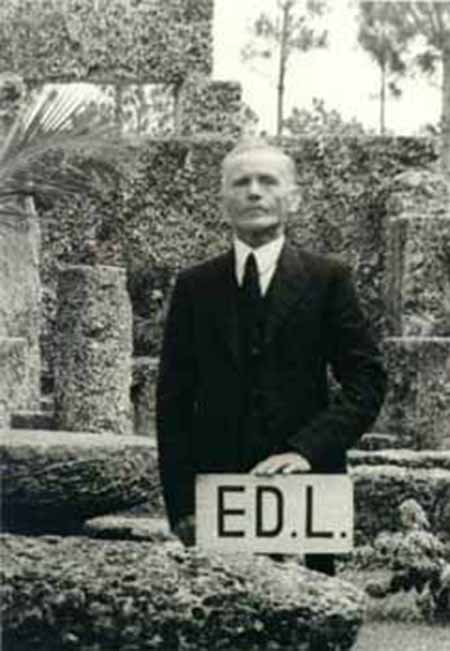
Leedskalnin was a 100 pound 5-foot tall man who wound up in Homestead, Florida on a ten-acre tract of land just south of Miami, Florida. Somehow he allegedly managed to single-handedly lift and maneuver blocks of megalithic stones, mostly coral, weighing up to 30 tons each, to create not only a castle but other things.
How Leedskalnin worked has never been discovered, though he labored for 30 years. The veracity of his doing this alone is impossible to prove because he worked at night, hidden from the eyes of observers. He seemed to know when he was being watched. On those occasions he wouldn't lifted the stones and stopped working.
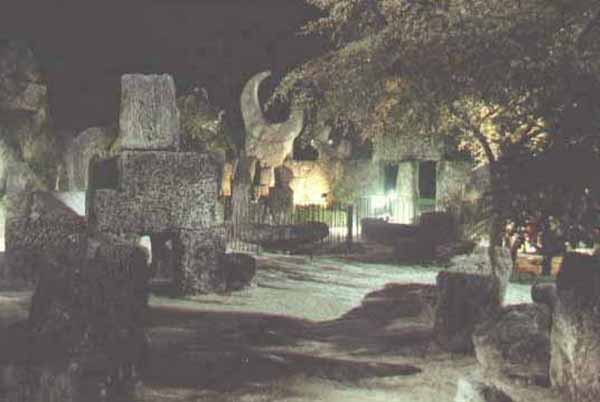
Some suggest that he used a form of antigravity device to build the castle. Numerous designs have been suggested for this device, some using "harmonic sound waves", some using magnetism, and numerous other proposals.
Leedskalnin himself claimed that he knew the "secret" of the ancient Egyptian pyramids, and some allege he used those secrets to assemble the structure. He was quoted as saying, "I have discovered the secrets of the pyramids, and have found out how the Egyptians and the ancient builders in Peru, Yucatan, and Asia, with only primitive tools, raised and set in place blocks of stone weighing many tons."


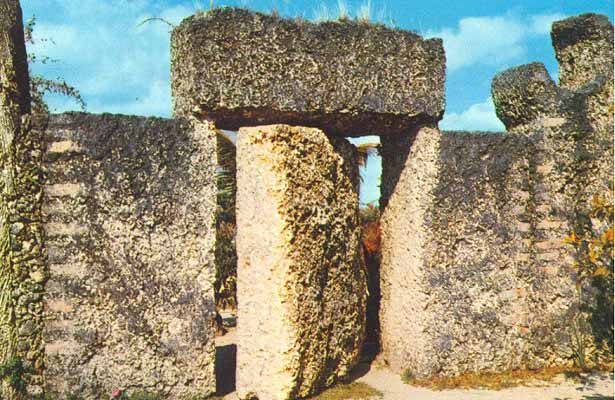
Entrance to Coral Castle is made through a gate fashioned from a single coral block weighing nine tons. This miraculous monolith is approximately 80 inches wide, 92 inches tall, and 21 inches thick. It fits within a quarter of an inch of the walls on either side and pivots through an iron rod resting on an automobile gear. The enormous block balances so perfectly on its center of gravity that a visitor can easily push it open with one finger. People who are sensitive to electromagnetic energies fields will sometimes report headaches while standing inside the archway of the nine-ton swinging gate - door - thought to be over a vortex - and a major grid point of the planet

An air of mystery surrounded his two story monolith, known as The Tower, which housed his workshop and living quarters which no one was permitted to enter. It is located just inside the courtyard, to the immediate right. Inside is a flight of stone steps ascending to a single doorway near the top. It leads to the highest point in the area and a small room. This chamber is occupied only by a leather hammock and a crude wooden table piled with primitive tools - chains, saws, many kinds of drills, wedges, hammers, chisels and crowbars. Tools also festoon the walls. This imposing tower was raised with approximately 243 tons of coral cut into cyclopean blocks weighing from four to nine tons each.
Theories
Edward Leedskalnin disputed contemporary science and believed all matter consisted of magnets which could produce measurable phenomena, and electricity. Ed would say he had rediscovered the laws of weight, measurement, and leverage" and that these concepts involved the relationship of the Earth to celestial alignments. He claimed to see beads of light which he believed to be the physical presence of nature's magnetism and life force, or what we term today, 'Chi'. Many people report that he used harmonics combined with grid energies and celestial alignments to do his work.
Harmonics are often thought to lift objects. Tibetan Monks combine their harmonics to elevate heavy objects.
'Tibetan Sound Levitation Of Large Stones Witnessed By Scientist'. In his work Diamagnetic Gravity Vortexes, found in the book Anti-Gravity and The World Grid David Hatcher Childress, postulates that the area of South Florida at Coral Castle (considered part of the Bermuda Triangle) is a powerful diamagnetic levitator. Leedskalnin demonstrated magnetism (EM energies), and the mechanism of levitation, by applying the natural Earth Grid principles of diamagnetism. Leedskalnin could levitate huge pieces of coral by using the center of mass for the needed slight, uplift, launching pressure.
Ed Leedskalnin showed every indication of being a natural geomancer - one who senses the unique telluric forces of the Earth. He was highly intuitive, and knew how to observe nature for signs of anomaly. This ultimately led him to the discovery of vortex energy, and the ability to harness the natural elements of magnetism.
He understood the critical nature of identifying the most energetic location to erect his massive Castle, and seemed to have known the secrets of anti-gravity, and its relation to cosmic events. Ed proceeded to develop a means of leverage power generated from the geomagnetic grid, and produced a system to generate anti-gravity waves.
Edward's notebooks are laden with schematics for magnetism, and electrical experiments. Although he possessed only a fourth-grade education, it seems he had discovered a means to reduce the gravitational pull of the earth. He wrote a series of pamphlets which included his theories on magnetism and cosmic force.
Researchers have speculated that Ed learned the secret of levitation, and one theory in particular caught the imagination of many. The planetary grid hypothesis postulates that the earth is covered by an invisible web of energy, which is concentrated at points of telluric power, the convergence of which create unusual phenomena.
These telluric grid dynamics played a vital role in the construction of the Castle, according to author Ray Stoner. In his book The Enigma of Coral Castle, Stoner speculates that the complex was originally moved from Florida City to Homestead, not because of privacy issues (as most historians suggest), but because Ed realized he had made a mathematical error in his original positioning, and moved the entire structure to take advantage of an area with greater telluric force.
In December of 1951 Ed Leedskalnin at age 64 became ill. He put a sign on the door saying 'Going to the Hospital'. He took a bus to Jackson Memorial Hospital in Miami. Three days later he died in his sleep of malnutrition and kidney failure, taking his secrets with him. After his death, $3,500 was found in the tower; his life savings, mostly from land sales.
Leedskalnin was a 100 pound 5-foot tall man who wound up in Homestead, Florida on a ten-acre tract of land just south of Miami, Florida. Somehow he allegedly managed to single-handedly lift and maneuver blocks of megalithic stones, mostly coral, weighing up to 30 tons each, to create not only a castle but other things.
How Leedskalnin worked has never been discovered, though he labored for 30 years. The veracity of his doing this alone is impossible to prove because he worked at night, hidden from the eyes of observers. He seemed to know when he was being watched. On those occasions he wouldn't lifted the stones and stopped working.
Some suggest that he used a form of antigravity device to build the castle. Numerous designs have been suggested for this device, some using "harmonic sound waves", some using magnetism, and numerous other proposals.
Leedskalnin himself claimed that he knew the "secret" of the ancient Egyptian pyramids, and some allege he used those secrets to assemble the structure. He was quoted as saying, "I have discovered the secrets of the pyramids, and have found out how the Egyptians and the ancient builders in Peru, Yucatan, and Asia, with only primitive tools, raised and set in place blocks of stone weighing many tons."
Entrance to Coral Castle is made through a gate fashioned from a single coral block weighing nine tons. This miraculous monolith is approximately 80 inches wide, 92 inches tall, and 21 inches thick. It fits within a quarter of an inch of the walls on either side and pivots through an iron rod resting on an automobile gear. The enormous block balances so perfectly on its center of gravity that a visitor can easily push it open with one finger. People who are sensitive to electromagnetic energies fields will sometimes report headaches while standing inside the archway of the nine-ton swinging gate - door - thought to be over a vortex - and a major grid point of the planet
An air of mystery surrounded his two story monolith, known as The Tower, which housed his workshop and living quarters which no one was permitted to enter. It is located just inside the courtyard, to the immediate right. Inside is a flight of stone steps ascending to a single doorway near the top. It leads to the highest point in the area and a small room. This chamber is occupied only by a leather hammock and a crude wooden table piled with primitive tools - chains, saws, many kinds of drills, wedges, hammers, chisels and crowbars. Tools also festoon the walls. This imposing tower was raised with approximately 243 tons of coral cut into cyclopean blocks weighing from four to nine tons each.
Theories
Edward Leedskalnin disputed contemporary science and believed all matter consisted of magnets which could produce measurable phenomena, and electricity. Ed would say he had rediscovered the laws of weight, measurement, and leverage" and that these concepts involved the relationship of the Earth to celestial alignments. He claimed to see beads of light which he believed to be the physical presence of nature's magnetism and life force, or what we term today, 'Chi'. Many people report that he used harmonics combined with grid energies and celestial alignments to do his work.
Harmonics are often thought to lift objects. Tibetan Monks combine their harmonics to elevate heavy objects.
'Tibetan Sound Levitation Of Large Stones Witnessed By Scientist'. In his work Diamagnetic Gravity Vortexes, found in the book Anti-Gravity and The World Grid David Hatcher Childress, postulates that the area of South Florida at Coral Castle (considered part of the Bermuda Triangle) is a powerful diamagnetic levitator. Leedskalnin demonstrated magnetism (EM energies), and the mechanism of levitation, by applying the natural Earth Grid principles of diamagnetism. Leedskalnin could levitate huge pieces of coral by using the center of mass for the needed slight, uplift, launching pressure.
Ed Leedskalnin showed every indication of being a natural geomancer - one who senses the unique telluric forces of the Earth. He was highly intuitive, and knew how to observe nature for signs of anomaly. This ultimately led him to the discovery of vortex energy, and the ability to harness the natural elements of magnetism.
He understood the critical nature of identifying the most energetic location to erect his massive Castle, and seemed to have known the secrets of anti-gravity, and its relation to cosmic events. Ed proceeded to develop a means of leverage power generated from the geomagnetic grid, and produced a system to generate anti-gravity waves.
Edward's notebooks are laden with schematics for magnetism, and electrical experiments. Although he possessed only a fourth-grade education, it seems he had discovered a means to reduce the gravitational pull of the earth. He wrote a series of pamphlets which included his theories on magnetism and cosmic force.
Researchers have speculated that Ed learned the secret of levitation, and one theory in particular caught the imagination of many. The planetary grid hypothesis postulates that the earth is covered by an invisible web of energy, which is concentrated at points of telluric power, the convergence of which create unusual phenomena.
These telluric grid dynamics played a vital role in the construction of the Castle, according to author Ray Stoner. In his book The Enigma of Coral Castle, Stoner speculates that the complex was originally moved from Florida City to Homestead, not because of privacy issues (as most historians suggest), but because Ed realized he had made a mathematical error in his original positioning, and moved the entire structure to take advantage of an area with greater telluric force.
In December of 1951 Ed Leedskalnin at age 64 became ill. He put a sign on the door saying 'Going to the Hospital'. He took a bus to Jackson Memorial Hospital in Miami. Three days later he died in his sleep of malnutrition and kidney failure, taking his secrets with him. After his death, $3,500 was found in the tower; his life savings, mostly from land sales.

this theory brings weird things into question. given the rotation of the earth and it's orbit around the sun as well as our system's movement through space AND our galaxies roatation and movement...why would anything 'rematerialize' even on the planet? i mean if the dimension being warped is time, and it was by the factors described...wouldn't the planet be in an entirely different point in space? should shit just be materializing in empty space? is there some sort of force that keeps the warping relative to our sphere?They avoided or side stepped one other possibility time travel or dimensional warping. If objects were to materialize in another time the earth would not be in the same place causing materialization in a solid object at unpredictable depths.
excellent thread
bump


face on Mars
The face on Mars is the image of some photographs of the Cydonia region of Mars taken in 1976 by the Viking Orbiter. The image is most likely of a natural formation but some people see a face or a building and are convinced that it was constructed by intelligent beings.
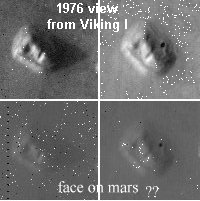
According to Gary Posner, the one most responsible for the view that the face on Mars is an alien construction is Richard C. Hoagland, author of The Monuments of Mars: A City on the Edge of Forever (1987).
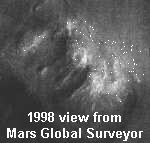
NASA claims that the photos are just a play of light and shadow. Some took this explanation as a sure sign of a cover-up. Some engineers and computer specialists digitally enhanced the NASA images. This soon gave birth to the claim that the face was a sculpture of a human being located next to a city whose temples and fortifications could also be seen. Some began to wonder: were these built by the same beings who built the ancient airports in Peru and who were now communicating to us through elaborate symbols carved in wheat crop circles? Others took the wonder to the level of belief, based on the flimsiest of evidence and the grandest of imagination. Carl Sagan's more down-to-earth explanation for the face on mars is that it is the result of erosion and winds and other natural forces (Sagan, 52-55). Such a view seems most reasonable under the circumstances.
NASA's Mars Odyssey orbiter sent back some more detailed pictures in July, 2002 that seems to slap the face into the ground with a group of other slapped faces. Much to the dismay of mystery mongers, NASA says that the Cydonia region is a "normal geologic feature with slopes and ridges carved by eons of wind and downslope motion due to gravity."* For the latest high resolution photos click here. http://www.esa.int/esaCP/SEM09F8LURE_index_1.html#subhead5

http://www.skepdic.com/faceonmars.html
Does anyone have any info on the guy that could fuse/weave trees together to make make them grow in diff shapes like baskets and such (while still planted). I know ur thinking "no big deal". But u gotta see it to believe it. I saw a special on it but havent been able to find any info. Not really sure what to search for cuz its so broad a subject.
He was the only person EVER that could manipulate trees this way!!
When he died it has never been done since. I think he was fusing fruits too (mixing oranges and lemons into one plant, and shit like that)!!
If anyone has any info on this guy it would be greatly appreciated.
I believe they have some of his trees on display at Disney Land/World or some place like that.
I searched images on google for twisted trees and there was one on the first page!! U'll know it when u see it.
400-Meter Asteroid May Hit Earth on 13 April, 2029


A recently rediscovered 400-meter Near-Earth Asteroid (NEA) is predicted to pass near the Earth on 13 April 2029. The flyby distance is uncertain and an Earth impact cannot yet be ruled out. The odds of impact, presently around 1 in 300, are unusual enough to merit special monitoring by astronomers, but should not be of public concern. These odds are likely to change on a day-to-day basis as new data are received. In all likelihood, the possibility of impact will eventually be eliminated as the asteroid continues to be tracked by astronomers around the world.
http://www.physorg.com/news2505.html
Does anyone have any info on the guy that could fuse/weave trees together to make make them grow in diff shapes like baskets and such (while still planted). I know ur thinking "no big deal". But u gotta see it to believe it. I saw a special on it but havent been able to find any info. Not really sure what to search for cuz its so broad a subject.
He was the only person EVER that could manipulate trees this way!!
When he died it has never been done since. I think he was fusing fruits too (mixing oranges and lemons into one plant, and shit like that)!!
If anyone has any info on this guy it would be greatly appreciated.
I believe they have some of his trees on display at Disney Land/World or some place like that.
I searched images on google for twisted trees and there was one on the first page!! U'll know it when u see it.
looking....

This nicca's hair


Seriously....
The Star Child Skull

This weird looking skull is the famous Starchild Skull that was found in 1930. The Starchild Skull was discovered in a mine tunnel about 100 miles southwest of Chihuahua, Mexico along with several other normal skeletons.
Both radio carbon dating and DNA test have been performed on this skull and the tests have determined that the Starchild lived around 900 years ago and was a male child around the age of 4.5 to 5 years old.
There are several abnormalities with the skull of the Starchild. For instance the orbital cavities are oval and shallow, with the optic nerve canal located at the bottom of the cavity instead of at the back. There also seams to be no frontal sinuses and the back of the skull is flattened, but apparently not by any artificial means. However the most bizarre abnormality of the StarChild Skull is that it has an interior volume of 1600 cubic centimeters, which is 200 cubic centimeters larger than the average adult’s brain.
Currently the Starchild Skull is in the possession of writer and lecturer Lloyd Pye who came into possession of the skull in 1999.


Second Star Child

This skeleton that has been called the second Star Child was discovered in Uberaba, Brazil and is currently kept in the Wilson Estanovic Museum of Natural History in Uberaba, Brazil.
Seriously....
The Star Child Skull
This weird looking skull is the famous Starchild Skull that was found in 1930. The Starchild Skull was discovered in a mine tunnel about 100 miles southwest of Chihuahua, Mexico along with several other normal skeletons.
Both radio carbon dating and DNA test have been performed on this skull and the tests have determined that the Starchild lived around 900 years ago and was a male child around the age of 4.5 to 5 years old.
There are several abnormalities with the skull of the Starchild. For instance the orbital cavities are oval and shallow, with the optic nerve canal located at the bottom of the cavity instead of at the back. There also seams to be no frontal sinuses and the back of the skull is flattened, but apparently not by any artificial means. However the most bizarre abnormality of the StarChild Skull is that it has an interior volume of 1600 cubic centimeters, which is 200 cubic centimeters larger than the average adult’s brain.
Currently the Starchild Skull is in the possession of writer and lecturer Lloyd Pye who came into possession of the skull in 1999.
Second Star Child
This skeleton that has been called the second Star Child was discovered in Uberaba, Brazil and is currently kept in the Wilson Estanovic Museum of Natural History in Uberaba, Brazil.
Last edited:

Cool ass thread
i may have a few things to add, let me go see.....
maybe sending something back to a time before the machine is made is harder and/or takes a bit more energy to do. th stuff we see stuck in rocks could've just been test to see if they could get something to earth, for all we know our whole solar system is littered with "test rocks" wit weird shit in em lol. Wasnt there a rock with a frog or turtle found in it?
i may have a few things to add, let me go see.....
Theoretically, if time travel were possible we would only be able to go back to the time the Time Travel device was built, i.e. If it was built in 2000, and the current year was 2050, we'd be able to travel as far back as 2000, not exceeding past the date it was built.
But...
Personally I'm more inclined to believe in the possibility of 'dimension warping' of identical energy/objects somehow being transferred from one parallel universe to the next...
sammyjax said:this theory brings weird things into question. given the rotation of the earth and it's orbit around the sun as well as our system's movement through space AND our galaxies roatation and movement...why would anything 'rematerialize' even on the planet? i mean if the dimension being warped is time, and it was by the factors described...wouldn't the planet be in an entirely different point in space? should shit just be materializing in empty space? is there some sort of force that keeps the warping relative to our sphere?
maybe sending something back to a time before the machine is made is harder and/or takes a bit more energy to do. th stuff we see stuck in rocks could've just been test to see if they could get something to earth, for all we know our whole solar system is littered with "test rocks" wit weird shit in em lol. Wasnt there a rock with a frog or turtle found in it?


Theoretically, if time travel were possible we would only be able to go back to the time the Time Travel device was built, i.e. If it was built in 2000, and the current year was 2050, we'd be able to travel as far back as 2000, not exceeding past the date it was built.
But...
Personally I'm more inclined to believe in the possibility of 'dimension warping' of identical energy/objects somehow being transferred from one parallel universe to the next...
There are many theories on time travel. Any-who,I agree that there are multiple plausible explanations. Inter dimensional travelers, alternate Earth space travelers, early super civilizations, the fact that we could just be doing all of this over and over again.Demons, Devils, or gods or any supernatural being playing practical jokes ( anything is possible).


BASED ON THE "ILLUSTRATIONS" I SAW ON THE Wikipedia LINK THERE IS NO WAY YOU CAN TELL WHAT THE BOOK IS ABOUT. IT WOULD BE OBVIOUS IF THEY HAD PICTURES OF SEX POSITIONS THAT THEY WOULD BE TALKING ABOUT SEX,BUT EVEN WITH ILLUSTRATIONS HOW WOULD YOU KNOW THEY ARE TALKING ABOUT HEALTH??? AND WHY WOULD ONE ASSUME THAT THIS OOK HOLDS THE SECRET TO LIFE?????????


This three-page foldout from the manuscript includes a chart that appears astronomical.
READ THE QUOTE ABOVE.
IT SAYS THAT IT "APPEARS" TO BE ASTRONOMICAL.
(EVEN wikimedia IS ASSUMING IT'S ASTRONOMICAL)
IF THEY HAD PICTURES OF A NAKED MAN AND WOMAN LYING DOWN OR IN SOME STRANGE POSITION TOGETHER, MOST PEOPLE WOULD ASSUME THAT THEY WERE HAVING SEX. BUT, BECAUSE YOU CAN'T READ SHIT ON THE PAGES, THE TWO NAKED PEOPLE COULD BE DANCING OR ME BE INVOLVED IN SOME WEIRD RELIGIOUS RITUAL. WHO KNOWS OTHER THAN THE ORIGINAL AUTHORS OF THESE WRITINGS???
SCHOOL ME MUTHATFUCKA
http://www.world-mysteries.com/sar_13.htm
When the manuscript was first shown to expert cryptologists, they thought that solving it would be easy as the text was composed of "words", some of which were more frequent and occurred in certain combinations (Kahn, 1967). This soon turned out to be a mistake; the text could not easily be converted into Latin, English, German or a host of other languages which might possible be at the base of this document.
A first "solution" was announced in 1919, by William Romaine Newbold (Newbold, 1921), who caused a sensation by claiming that the manuscript did indeed contain the work of Roger Bacon and that Bacon had known the use of the compound telescope and microscope, seeing the spiral structure of the Andromeda galaxy* (!) only visible with modern telescopes and cell structures unknown in the 13th Century.
What Newbold discovered in the text was absolutely astonishing— enough to gather a lot of attention from the scientific community. The biological drawings in the text were described asseminiferous tubes, the microscopic cells with nuclei, and even spermatozoa. Among the astronomical drawings were the descriptions of spiral nebulae, a coronary eclipse, and the comet of 1273. One of the more baffling things about this was that many of the drawings of plants, and of the galaxies appeared to have been invented. There was no doubt that if Bacon were the author of such a text, he must have had some way of obtaining the information.
For instance, Newbold's translation of the caption near the drawing of the nebula of Andromeda (which clearly shows its spiral characteristics), gave its location by the following:
Similar threads

- Replies
- 4
- Views
- 337

- Replies
- 26
- Views
- 2K


- Replies
- 42
- Views
- 1K

- Replies
- 68
- Views
- 4K


