Obama's Economic Recovery Plan

Bain316

Star
Registered
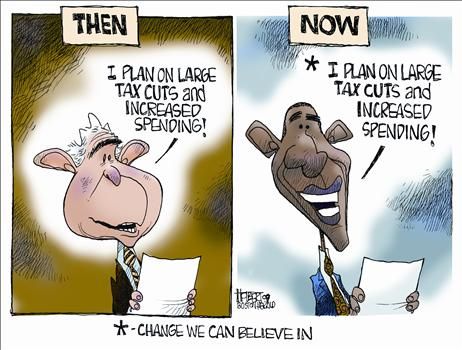
Obama Eyes $300 Billion Tax Cut

By JONATHAN WEISMAN and NAFTALI BENDAVID

WASHINGTON -- President-elect Barack Obama and congressional Democrats are crafting a plan to offer about $300 billion of tax cuts to individuals and businesses, a move aimed at attracting Republican support for an economic-stimulus package and prodding companies to create jobs.

The size of the proposed tax cuts -- which would account for about 40% of a stimulus package that could reach $775 billion over two years -- is greater than many on both sides of the aisle in Congress had anticipated. It may make it easier to win over Republicans who have stressed that any initiative should rely more heavily on tax cuts rather than spending.
[Obama Eyes $310 Billion Tax Cut] Getty Images

President-elect Barack Obama and congressional Democrats are crafting a plan to offer as much as $310 billion of tax cuts.

The Obama tax-cut proposals, if enacted, could pack more punch in two years than either of President George W. Bush's tax cuts did in their first two years. Mr. Bush's 10-year, $1.35 trillion tax cut of 2001, considered the largest in history, contained $174 billion of cuts during its first two full years, according to Congress's Joint Committee on Taxation. The second-largest tax cut -- the 10-year, $350 billion package engineered by Mr. Bush in 2003 -- contained $231 billion in 2004 and 2005.

Republicans and business leaders hadn't seen specifics of the proposals Sunday night, but welcomed the idea of basing a bigger proportion of the stimulus plan on tax cuts. Their response suggests the legislation could attract relatively broad support, and it highlighted the Obama team's determination to win backing from varied interests.

Some Republicans, including Senate Minority Leader Mitch McConnell (R., Ky.), have warned against a careless stimulus plan that enables unfettered spending.

The largest piece of tax relief in the new plan would involve cuts for people who pay income taxes or who claim the earned-income credit, a refund designed to lessen the impact of payroll taxes on low- and moderate-income workers. This component would serve as a down payment on the "Making Work Pay" proposal Mr. Obama outlined during his election campaign, giving a credit of $500 per individual or $1,000 per family.

On the campaign trail, Mr. Obama said he would phase out a similar tax-credit proposal at around $200,000 per household, but aides said they haven't settled on an income cap for the latest proposal. This part of the plan is similar to a bipartisan initiative launched in early 2008, which sent out checks worth $131 billion.

Economists of all political stripes widely agree the checks sent out last spring were ineffective in stemming the economic slide, partly because many strapped consumers paid bills or saved the cash rather than spend it. But Obama aides wanted a provision that could get money into consumers' hands fast, and hope they will be persuaded to spend money this time if the credit is made a permanent feature of the tax code.

As for the business tax package, a key provision would allow companies to write off huge losses incurred last year, as well as any losses from 2009, to retroactively reduce tax bills dating back five years. Obama aides note that businesses would have been able to claim most of the tax write-offs on future tax returns, and the proposal simply accelerates those write-offs to make them available in the current tax season, when a lack of available credit is leaving many companies short of cash.

A second provision would entice firms to plow that money back into new investment. The write-offs would be retroactive to expenditures made as of Jan. 1, 2009, to ensure that companies don't sit on their money until after Congress passes the measure.

Another element would offer a one-year tax credit for companies that make new hires or forgo layoffs, which could be worth $40 billion to $50 billion. And the Obama plan also would allow small businesses to write off a broad range expenditures worth up to $250,000 in 2009 and 2010. Currently, the limit is $175,000.

William Gale, a tax-policy analyst at the Brookings Institution think tank in Washington, said the scale of the whole package is larger than expected. He called the business offerings a true surprise, since most attention has been focused on the spending side of the equation, especially the hundreds of billions of dollars being discussed for infrastructure and aid to state and local governments.

"On the other hand, it was hard to figure out how they were going to spend all that money in intelligent ways, so it makes sense to do more on the tax side," Mr. Gale said. His biggest question about the latest proposal concerns the credits for hiring new workers or refraining from layoffs. Much of that money would likely go to companies that would have hired more people anyway, he said, adding that it is impossible to know what firms would have done without such a credit.

Business lobbyists are pushing hard for Congress to allow companies that haven't paid corporate income taxes to get a break, too. Start-up companies, alternative-energy firms and large corporations that have been swallowing losses for years -- such as automotive and steel companies and some airlines -- have already begun lobbying for such "refundability."

They argue that a provision to claim losses on back taxes will have little effect on the economy if firms that need it most -- struggling companies that weren't obligated to pay any taxes -- can't benefit from a tax break.

Mr. Obama, however, doesn't back payments to companies that haven't paid taxes, aides said. Instead, businesses that haven't been paying taxes would be able to get payments from tax credits they would have taken in 2008 and 2009 for incentives offered by Congress, such as the production tax credit offered to renewable-energy firms. These amounts would likely be relatively small.

"We're working with Congress to develop a tax-cut package based on a simple principle: What will have the biggest and most immediate impact on creating private-sector jobs and strengthening the middle class?" said transition-team spokeswoman Stephanie Cutter. "We're guided by what works, not by any ideology or special interests."

As these details are being worked out, Mr. Obama and his family left Chicago during the weekend for Washington. He will be on Capitol Hill Monday, first to meet with House Speaker Nancy Pelosi (D., Calif.) and Senate Majority Leader Harry Reid (D., Nev.), then with the broader bipartisan leadership of Congress. The stimulus package will be front-and-center in those discussions.

Democratic leaders and Obama aides acknowledge that congressional Democrats' initial goal of passing the recovery package before Mr. Obama's Jan. 20 inauguration is unrealistic. Now, they hope for passage before the Feb. 13 congressional recess.

Republicans are already criticizing parts of the stimulus package. Sen. McConnell, speaking Sunday on ABC's "This Week," questioned one of the biggest items, which would send as much as $200 billion to states largely to expand the federal share of Medicaid, the health program for the poor. He suggested structuring that aid as a loan, saying it would encourage states to "spend it more wisely."

An array of business tax cuts could help overcome such GOP opposition, enabling the Democrats to present their plan as a balanced mix of tax cuts and spending. It also would likely encourage business interests to lobby hard for its enactment.

Mr. Obama's team has spoken of wanting to attract significant Republican support, not simply picking up votes from a Republican moderate or two.

Obama aides have already enlisted business groups to rally behind spending for public-works projects. Norman R. Augustine, a former chairman and chief executive of Lockheed Martin Corp., will testify before the House Democrats' Steering and Policy Committee Wednesday in favor of an infusion of federal infrastructure spending. But the tax cuts may hold more sway with Republicans.
—Amy Chozick contributed to this article.

http://online.wsj.com/article/SB123111279694652423.html
 
Re: Obama Eyes $300 Billion Tax Cut

Obama will soon find out that compromise with the right wing republicans is futile. Their ideological bend is beyond compromise with the majority of the American electorate.

source: Huffington Post

Krugman: Obama Relying Too Much On Tax Cuts?

In a blog post, economist Paul Krugman worries that President-elect Barack Obama is relying too much on tax cuts in his stimulus plan in an effort to appease Republicans.

[T]here's a reasonable economic case for including a significant amount of tax cuts in the package, mainly in year one.

But the numbers being reported -- 40 percent of the whole, two-year plan -- sound high. And all the news reports say that the high tax-cut share is intended to assuage Republicans; what this presumably means is that this was the message the off-the-record Obamanauts were told to convey.


And that's bad news.


Politico reported Sunday night that 40 percent of the plan's cost will come from tax breaks.

"Obama strategists say he wants to get 80 or more votes in the 100-member Senate, and the emphasis on tax cuts is a way to defuse conservative criticism and enlist Republican support," Mike Allen relays.

The Wall Street Journal adds:

The Obama tax-cut proposals, if enacted, could pack more punch in two years than either of President George W. Bush's tax cuts did in their first two years. Mr. Bush's 10-year, $1.35 trillion tax cut of 2001, considered the largest in history, contained $174 billion of cuts during its first two full years, according to Congress's Joint Committee on Taxation. The second-largest tax cut -- the 10-year, $350 billion package engineered by Mr. Bush in 2003 -- contained $231 billion in 2004 and 2005.


The largest piece of tax relief in the new plan would involve cuts for people who pay income taxes or who claim the earned-income credit, a refund designed to lessen the impact of payroll taxes on low- and moderate-income workers. This component would serve as a down payment on the "Making Work Pay" proposal Mr. Obama outlined during his election campaign, giving a credit of $500 per individual or $1,000 per family.

Obama is expected to detail his economic vision in a meeting Monday with congressional leaders. While the president-elect was hoping to have a stimulus package on his desk by January 20, but now leaders on the Hill are saying it will take until at least mid-February. Obama spokesman Robert Gibbs calls a bill by inauguration "very, very unlikely."
 
Re: Obama Eyes $300 Billion Tax Cut

Obama will soon find out that compromise with the right wing republicans is futile. Their ideological bend is beyond compromise with the majority of the American electorate.
  • What happens when you cut off your nose, to spite your face ? ? ?

  • While you may have a majority in Congress, what happens when you're not fillibuster proof ? ? ?

  • If the oppressed are only doomed to become the oppressors, why the revolution ? ? ?

  • If you campaign on cooperation and refuse to try it, why lie ? ? ?

I could go on, but I think you see my point. On the other hand, I 'm sure you might have a few axioms to the contrary. If you don't agree with my point, let's hear them.

QueEx
 
Re: Obama Eyes $300 Billion Tax Cut

  • What happens when you cut off your nose, to spite your face ? ? ?

  • While you may have a majority in Congress, what happens when you're not fillibuster proof ? ? ?

  • If the oppressed are only doomed to become the oppressors, why the revolution ? ? ?

  • If you campaign on cooperation and refuse to try it, why lie ? ? ?

I could go on, but I think you see my point. On the other hand, I 'm sure you might have a few axioms to the contrary. If you don't agree with my point, let's hear them.

QueEx

Did cooperation work during the so called "Gang of 14" anti "nuclear option" 2005 senate? The republicans threaten to eliminate the traditional filibuster if they didn't get what they wanted. The democrats capitulated showing lack of backbone for the people that voted them in. The democrats are just one short of a filibuster proof senate and will most definitely have a filibuster majority in 2010 by a large number. Obama was elected by the largest plurality since Reagan. If Mitch McConnell wants to play obstructionist during the greatest economic crisis in 70 years, let him. That is what lead FDR to have his overwhelming democratic majority during the Great Depression, which lead to changes the republicans hated but could do nothing but sit back and loath!

source: New York Times

January 5, 2009, 7:48 am
Is Obama relying too much on tax cuts?

I don’t know yet. But news reports this morning certainly raise questions.

Let’s lay out the basics here. Other things equal, public investment is a much better way to provide economic stimulus than tax cuts, for two reasons. First, if the government spends money, that money is spent, helping support demand, whereas tax cuts may be largely saved. So public investment offers more bang for the buck. Second, public investment leaves something of value behind when the stimulus is over.

That said, there’s a problem with a public-investment-only stimulus plan, namely timing. We need stimulus fast, and there’s a limited supply of “shovel-ready” projects that can be started soon enough to deliver an economic boost any time soon. You can bulk up stimulus through other forms of spending, mainly aid to Americans in distress — unemployment benefits, food stamps, etc.. And you can also provide aid to state and local governments so that they don’t have to cut spending — avoiding anti-stimulus is a fast way to achieve net stimulus. But everything I’ve heard says that even with all these things it’s hard to come up with enough spending to provide all the aid the economy needs in 2009.

What this says is that there’s a reasonable economic case for including a significant amount of tax cuts in the package, mainly in year one.

But the numbers being reported — 40 percent of the whole, two-year plan — sound high. And all the news reports say that the high tax-cut share is intended to assuage Republicans; what this presumably means is that this was the message the off-the-record Obamanauts were told to convey.

And that’s bad news.

Look, Republicans are not going to come on board. Make 40% of the package tax cuts, they’ll demand 100%. Then they’ll start the thing about how you can’t cut taxes on people who don’t pay taxes (with only income taxes counting, of course) and demand that the plan focus on the affluent. Then they’ll demand cuts in corporate taxes. And Mitch McConnell is already saying that state and local governments should get loans, not aid — which would undermine that part of the plan, too.

OK, maybe this is just a head fake from the Obama people — they think they can win the PR battle by making bipartisan noises, then accusing the GOP of being obstructionist. But I’m really worried that they’re sending off signals of weakness right from the beginning, and that they’re just going to embolden the opposition.

Like Barney Frank, I’m feeling a bit of post-partisan depression.

Updates: A few more details are emerging: $140 billion for Obama’s tax break for workers, which gives most workers $500. But it sounds as if the rest is mainly, perhaps almost entirely, tax cuts for business. Not very New Dealish.

Meanwhile, Mitch McConnell, perhaps sensing weakness, is already moving the goalposts.
 
Last edited:
Re: Obama Eyes $300 Billion Tax Cut

holb090107_cmyk20090105084743.jpg


Something to think about.
 
Re: Obama Eyes $300 Billion Tax Cut

Okay this might not sound logical but if the government raises money by collecting taxes and the government is very short of money in extreme debt........how do you pay off off debt or raise money by cutting taxes to companies you are bailing out simultaneously.....You see the stipulations of this bailout should be to hire people....Not we will artificially fix both sides of the market....Thats ridiculous capitalism doesn't work that way....Hell that's communism in disguise...Furthermore it won't work...No real pressure has ever been exerted on companies to do what is expected of them
 
Re: Obama Eyes $300 Billion Tax Cut

Okay this might not sound logical but if the government raises money by collecting taxes and the government is very short of money in extreme debt........how do you pay off off debt or raise money by cutting taxes to companies you are bailing out simultaneously.....You see the stipulations of this bailout should be to hire people....Not we will artificially fix both sides of the market....Thats ridiculous capitalism doesn't work that way....Hell that's communism in disguise...Furthermore it won't work...No real pressure has ever been exerted on companies to do what is expected of them

First off, since when did anyone care about the deficit? When the republicans were in the presidency or had control of the congress and senate, did they care about the debt? Reagan created the first trillion dollar debt. When GW took office, Clinton left him a three trillion dollar deficit, being paid down for the first time since the Reagan administration. GW and the republicans gave the richest tax cuts and in it increased to it's current 10 trillion dollars and leaving the economy in shambles! Never in the history of the world has a war been carried out with out raising taxes or cutting spent or both. Cheney said "deficits don't mean anything".
This attempt the republicans are starting a talking point is just a lame attempt to try and shoot down any stimulus plan Obama wants to implement.

source: zfacts.com

National-Debt-GDP-L.gif

<!-- start zFacts Debt Gizmo -->
<table id="zDebtBox">
<tr><td><script type="text/javascript" src="http://www.zfacts.com/giz/G05/debt.js"></script></td></tr>
<tr><td><a href="http://zfacts.com/p/461.html" id='zF05' style="color:black;font-size:12px">The Gross National Debt</a></td></tr>
</table>
<!-- end gizmo -->​
 
Re: Obama Eyes $300 Billion Tax Cut

^^^Agreed. Its hilarious to me to hear Republicans bemoan the deficit. Seriously? :smh::smh:
 
Re: Obama Eyes $300 Billion Tax Cut

Why would anyone want to celebrate anything with this type of shit going on????? Fuck an inauguration show me the fucking money
 
Re: Obama Eyes $300 Billion Tax Cut

As Bush has proven: Tax cuts in a time of war is economic lunacy! The real question is Where does the money come from when the govt cannot pay it's debts?

What we need is more manufacturing and saving and less barrowing and consumption! End these wars and stop relying on imports!
 
As I understand it (currently), the plan is to take windfall profit taxes from oil companies and use them to offset certain expenses in domestic households via a stimulus package.

What the hell is wrong with this? Why are so many people opposed to this? It's paid for, right? Its not like we subjecting our economy to inflation by pumping more dollars into the system...

Thoughts appreciated.
 
`The main argument I hear ...we already have a Trillion dollar deficit - and his plan will add to that by close to a Trillion $$$

also Government cant spend their way out of a Recession
 
I guess there is nothing wrong with that. I'm of the opinion that oil companies pass their taxes on to the consumer so I'm not sure if that is viable.

How about getting out of NAFTA, its not the govts. role to negotiate trade agreements, plus that shit aint workin'

How about tax cuts for companies that don't outsource their workforce to foreigners?

How about creating an environment that encourages manufacturing and saving instead of borrowing and consumption?

How about ending these Wars? We're going broke ya'll

Any attempt at getting a handle on this requires a drastic cut in spending, I haven't heard from Mr. Obama what he intends to cut!
 
I agree what you stated I don't think it's actually been addressed and I doubt that it will be...Honestly I believe there is a literal class war going on against the middle class...And everything you stated supports that theory.....
 
Bailout 2.0

<font size="5"><center>
Tuesday marks a new day for
government's role in economy</font size></center>


992-9web-congressstimulus-major.major_story_img.prod_affiliate.91.jpg

Inside the marbled halls of Congress, the Senate
pondered, then voted to end the stimulus debate.


McClatchy Newspapers
By David Lightman
Monday, February 9, 2009


WASHINGTON — The Senate's vote on — and the likely approval of — an $838 billion economic-stimulus plan Tuesday will signal a decisive new expansion of the government's role in the economy.

The package will include tens of billions of dollars to help states pay for health-care, education and highways. It'll provide tax breaks for new car and home buyers. It will help to computerize health records and invest heavily in 21st-century renewable energy technology.

"Just think about Rosie the Riveter manufacturing solar panels and wind turbines," said Sen. Amy Klobuchar, D-Minn., describing the bill's long-term impact.

The measure's reach also is limited, however. It won't prove an immediate economic cure-all, and its passage is but a first step in a yearlong series of federal prescriptions for the ailing economy.

An hour before the Senate's vote at noon Tuesday, Treasury Secretary Timothy Geithner is scheduled to unveil his new financial-industry aid plan. The Federal Reserve's efforts to melt frozen credit markets also are expanding. Later this spring, Congress will consider how to spend the rest of this fiscal year's federal monies after President Barack Obama releases a detailed fiscal 2010 budget. The stimulus is thus but one part of a multi-front government counterattack on the recession.

The Senate stimulus plan cleared a key procedural hurdle Monday when members voted 61-36 to cut off debate. The vote Tuesday on the plan itself will come 13 days after the House of Representatives passed a similar version.

In the next step, top lawmakers from both houses will meet to reconcile the differences between the House and Senate bills. Once a compromise is reached, probably Thursday, each house will debate briefly and take final votes.

The negotiations promise to be tense but probably not hopeless, because the Democratic majorities in both houses will have voted to expand the government's role in a wide variety of social and educational programs. Compromise should be on Democratic terms, because Republicans don't have enough votes to impose their preference for less spending and bigger tax cuts.

"There certainly will be a change in direction compared to the previous administration," veteran Washington budget analyst Stan Collender said.

There are significant differences, however.

The Senate wants to give some consumers a break from the alternative minimum tax, at a cost of $70 billion over 10 years. The House didn't include the provision.

The House wants to spend $20 billion for school construction and create a $79 billion "State Fiscal Stabilization Fund" to help pay education expenses. The Senate cut the construction money and its stabilization fund is only about half the House's amount.

There are a series of smaller disagreements. The Senate includes tax breaks for new car buyers and homeowners that the House does not, and the Senate has a one-year 50 percent subsidy for health-care premiums for unemployed consumers, while the House has a 65 percent subsidy.

With Democrats from both houses in charge of the talks, however, and Obama pushing hard for a package, the two sides are expected to split the differences and emerge with a plan to pump about $800 billion into the economy through Sept. 30, 2010.

Democrats will praise the details, Republicans will criticize them and independent analysts will offer mostly hedged praise. The last obstacle will be whether three Republicans continue to break ranks with their party to put through the final conference version in the Senate. If they don't, it'll be back to the drawing board, but few analysts expect that.

"This should create a little bit of momentum," said Brian Bethune, chief U.S. financial economist at IHS Global Insight in Lexington, Mass. "Put enough warm coals into the fireplace and eventually you get flames."

The nonpartisan Congressional Budget Office, however, warned that stimulus packages contain no guarantees.

"The macroeconomic impacts of any economic stimulus program are very uncertain," CBO Director Douglas Elmendorf said in a letter last week to Sen. Judd Gregg, R-N.H., who's now the president's nominee to head the Commerce Department.

Even analysts who're concerned that lawmakers are ignoring the ballooning federal deficit — which the CBO estimates at $1.2 trillion this year even before the stimulus is factored in — concede that some kind of bill is necessary, however.

"There is no right answer as to what to do, and I don't know what the right size of the bill should be," said Maya MacGuineas, the president of the Committee for a Responsible Federal Budget, a watchdog group.

The House and Senate bills concur on most key provisions. Both have Obama's $139.8 billion "Making Work Pay" tax break, which gives effective $500 federal income-tax rebates to most taxpayers in 2009 and 2010.

Both provide significant money for rebuilding highways and bridges and repairing water and sewer systems; spend $27 billion on giving unemployed workers an extra 20 to 33 weeks of benefits; and give states $87 billion to help Medicaid, the joint state-federal program that provides health care for poor people and those with disabilities.

Most Republicans, as well as some Democrats, remain concerned that the bills have too much spending and not enough tax cuts.

Sen. Charles Grassley of Iowa, the top Republican on the Senate Finance Committee, called the tax relief "a pretty puny amount."

History has shown that massive government spending doesn't resuscitate ailing economies, contended Senate Republican Policy Committee Chairman John Ensign of Nevada.

"Even if you believe the New Deal was helpful," he said, "do we really want to take five, seven, 10 years to get out of the economic problems we have today? The New Deal never brought us out of the Depression."

Such arguments ignore contemporary reality, countered budget analyst Collender, who noted that most of the proposed stimulus spending doesn't create new agencies or programs but adds to those that already are running.

A big chunk aims to respond to anticipated future needs. Both bills have billions for renewable energy and energy-efficiency research and development. Each has about $4.5 billion to begin modernizing the electricity grid as well as billions to health providers to modernize their information technology systems. Money also would be provided to expand broadband access in remote areas of the country.

Such spending may not provide much immediate stimulus, but many analysts argue that it's still worth doing. Just don't expect miracles.

"The stimulus should provide some positive input," Collender said. "But you just don't get a single injection or operation and expect all the problems to be fixed."

http://www.mcclatchydc.com/227/story/61844.html
 
Re: Stimulus bill passes House

<font size="5"><center>Will Treasury's new bailout
be better than the first one?</font size>
</center>


McClatchy Newspapers
By Kevin G. Hall
Monday, February 9, 2009


WASHINGTON — Treasury Secretary Timothy Geithner rolls out the Obama administration's bank-rescue plan on Tuesday, hoping to restore vigor to the banking sector and create a wave of new lending to reverse the nation's deep economic slump.

The plan — along with parallel economic stimulus legislation moving through Congress — together amount to a trillion-dollar-plus roll of the dice. In addition, the Federal Reserve's muscular effort to thaw frozen credit markets is the third front of a multipart federal rescue effort. All must work in tandem to arrest the nation's economic contraction.

There's little room for Geithner to err, analysts think, because October's $700 billion Wall Street rescue hasn't worked with the first half spent. And taxpayers are furious that Washington demanded so little accounting for where the initial $350 billion went.

"Given how long we have gone, I think it's very important that these particular steps are seen as a major move forward from what has already been done," said Nigel Gault, chief U.S. economist for forecaster IHS Global Insight in Lexington, Mass.

The plan is billed as a comprehensive replacement for a piecemeal effort. The new approach is designed to fix errors and restore confidence by attacking a number of problems that are tying the economy in knots.

Geithner hopes to halt the soaring rate of home foreclosures, thaw the deep freeze in credit markets, corral bad assets that are poisoning bank ledger sheets and perhaps allow more bank failures to weed out failing institutions.

Here are some answers to questions about the new Treasury plan.

Q: How will Geithner help banks?

A: The Treasury secretary is expected to announce new, limited capital injections for banks. This continues an effort started last year, where the federal government takes an ownership stake in banks in exchange for preferred stock and warrants, which put the taxpayer at the front of the line for repayment should banks fail and liquidate their assets. Most economists agree that despite the $700 billion price tag on October's unpopular Wall Street rescue, more is needed.

Q:

A: Hard to say. The Obama administration is demanding a greater accounting of how the funds will be used and a justification if lending doesn't rise. With the economy deteriorating so fast, however, loans become riskier, and banks are loath to make more bad loans — after failing for several years to be sufficiently cautious.

Q: Are these injections a back-door nationalization of banks?

A: To a degree, but the government is wary of taking controlling stakes and directing how banks lend and to whom. As part of the price for new capital injections, however, the Obama administration will restrict executive pay and impose greater disclosure of how these funds are used.

Q: Will giving the banks more capital work?

A: Most economists think it's necessary, but that doesn't necessarily mean it will work. Simon Johnson, a former research director of the International Monetary Fund, said Monday on a blog called Baseline Scenario that capital injections "will be too small and the measures will help existing management stay in place. Large banks will remain 'too big to fail' . . . Lending will remain anemic." That's hardly an endorsement.

Q: Isn't it better to let banks fail?

A: In some cases, yes — and Geithner is expected to let more fail. However, the ones whose failure could cause systemwide risks are likely to keep getting capital injections from government to avoid that danger.

In addition, the Federal Deposit Insurance Corp. will get enhanced powers to aid or shut down failing financial institutions.

Q: How would Geithner's plan help housing?

A: Obama administration officials said it would include at least $50 billion to support mortgage modifications. FDIC Chairman Sheila Bair would get a bigger role in resolving the mortgage crisis. The Bush administration ignored her call to prevent foreclosures, which rose 81 percent nationwide last year and 110 percent in California, according to RealtyTrac of Irvine, Calif.

Bair favors restructuring distressed mortgages with lower monthly payments and stretching out the loan life, guaranteeing mortgage lenders some eventual profit. Lenders have balked at taking losses up front.

Congress also is expected to follow Geithner by expanding the Hope for Homeowners effort, where lenders are encouraged to take a loss on the original mortgage in exchange for handing it over to the government. While assuming the risk of default, the government would share in any profits when a homeowner eventually sells.

Do housing experts like this?

A: Some do. Rick Sharga, a senior vice president of RealtyTrac, whose foreclosure reports are widely followed, said lenders must forgive some portion of distressed mortgages, especially for those now priced above a home's market price.

"Why aren't we seeing some more creativity from the financial institutions that were pretty creative in coming up with (now-distressed) loan products?" he asked.

Q: Wasn't the original bailout supposed to clean up bad mortgage-backed assets?

A: Yes, but the Bush administration quickly focused instead on injecting capital into banks, on the theory that it would be quicker. It didn't work.

Now, Geithner is expected to announce a new public-private mechanism that would purchase from banks distressed assets such as mortgage bonds, which few investors want. Banks wanted the government to buy these assets at inflated prices, but Geithner's plan aims for government and private investors to share the risk.

Government would create incentives for private investors to buy the assets at below face-value, and to hold them in a "bad bank." The hope is that investors would snap them up at bargain prices, gambling that they'd become profitable as credit markets return to life.​

http://www.mcclatchydc.com/226/story/61850.html
 
Re: Bailout 2.0

This should nicely bring us above the 10 Trillion bailout-related dollar mark. Guess it can't be helped since we're in a perilous death spiraling catastrophe.
 
Re: Bailout 2.0

This should nicely bring us above the 10 Trillion bailout-related dollar mark. Guess it can't be helped since we're in a perilous death spiraling catastrophe.
Turns out it took us to the 12 trillion dollar mark instead.

"Hey kids, sorry I heaped $12 trillion of debt on you in just two years back in 2009, but daddy didn't want to go through a recession."
 
Re: Bailout 2.0

Turns out it took us to the 12 trillion dollar mark instead.

"Hey kids, sorry I heaped $12 trillion of debt on you in just two years back in 2009, but daddy didn't want to go through a recession."


This isnt to stop us from going through a recession - we're already in a recession

this is to stop the US Economy / World Economy from total collapse
 
Re: Bailout 2.0

[/B]


This isnt to stop us from going through a recession - we're already in a recession

this is to stop the US Economy / World Economy from total collapse
Yes, I heard. Death spiral. Castastrophe. Perilous moment.

Bailout = $30,000+ for every man, woman, and child currently in the United States.

Bailout = $1400+ for every man, woman, and child currently in the world.

Those numbers are the only castastrophe I see.
 
Geithner Plan Will Rob US Taxpayers......

By: Reuters | 24 Mar 2009 | 07:16 AM ET Text Size The U.S. government plan to rid banks of toxic assets will rob American taxpayers by exposing them to too much risk and is unlikely to work as long as the economy remains weak, Nobel Prize-winning economist Joseph Stiglitz said on Tuesday.

"The Geithner plan is very badly flawed," Stiglitz told Reuters in an interview during a Credit Suisse Asian Investment Conference in Hong Kong.


RELATED LINKS

Current DateTime: 11:55:31 24 Mar 2009
LinksList Documentid: 29848803
Recession to Stretch into 2010?
Toxic Assets Plan Unveiled
US States Measures for Financial Stability
Pros: Fed's Plans Will Make Crisis Worse
For Stocks, Treasury Plan 'May Be a Game-Changer'

U.S. Treasury Secretary Timothy Geithner's plan to wipe up to US$1 trillion in bad debt off banks' balance sheets, unveiled on Monday, offered "perverse incentives", Stiglitz said.

The U.S. government is basically using the taxpayer to guarantee against downside risk on the value of these assets, while giving the upside, or potential profits, to private investors, he said.

"Quite frankly, this amounts to robbery of the American people. I don't think it's going to work because I think there'll be a lot of anger about putting the losses so much on the shoulder of the American taxpayer."


Even if the plan clears banks of massive toxic debt, worries about the economic outlook mean banks could still be unwilling to make fresh loans, while the prospect of a higher tax burden to pay for various government stimulus plans could further undermine U.S. consumers, he said.

Some Republican lawmakers have also expressed concern over the incentives offered by the government, which could end up providing private investors with more than 90 percent of the funds to buy the troubled assets.

But President Barack Obama has said the plan was critical to a U.S. economic recovery, Stiglitz, a professor at New York's Columbia University and a former World Bank chief economist, also urged G20 leaders at their London summit next month to commit to providing greater resources to developing countries and said China should be given bigger voting rights in the International Monetary Fund.

"The voices of developing countries, and countries like China that will provide a lot of the money, are not heard."


China would be hard pushed to reach its targeted 8 percent economic growth this year, but the important thing was that at least the Chinese economy was still growing, he said.

Stiglitz welcomed China's proposal on Monday for an overhaul of the world monetary system in which Zhou Xiaochuan, governor of the People's Bank of China, said the IMF's Special Drawing Right has the potential to become a super-sovereign reserve currency.

Stiglitz has long called for the U.S. dollar to be replaced as the only reserve currency.

Basing a reserve system on a single currency whose strength depends on confidence its own economy is not a good basis for a global system, he says.

"We may be at the beginning of a loss of confidence (in the U.S. dollar reserve system)," he said. "I think there is support for some sort of global reserve system."


http://www.cnbc.com/id/29848741
 
Re: Geithner Plan Will Rob US Taxpayers......

Found this piece explaining Timmy G's plan, it explains the rise in financials the last couple of days!

<object width="425" height="344"><param name="movie" value="http://www.youtube.com/v/n-arbfLTCtI&hl=en&fs=1"></param><param name="allowFullScreen" value="true"></param><param name="allowscriptaccess" value="always"></param><embed src="http://www.youtube.com/v/n-arbfLTCtI&hl=en&fs=1" type="application/x-shockwave-flash" allowscriptaccess="always" allowfullscreen="true" width="425" height="344"></embed></object>
 
Back
Top