Obamacare Saves Consumers $2.1 Billion Since 2011

Ok Dave, I'll be your huckleberry. Using the base assumption that cost doesn't magically disappear because a politician decreed it to be, where does the cost go when someone pays a cheaper premium because of the law than they would have without the law?

I think this is a valid question unless you disagree with the base assumption that cost doesn't just magically disappear.

It's not valid because you presume the cost of health insurance is based on supply and demand and it's not.


More to come with a disproportionate weight given to the stories we agree with.

If that's how you feel, fine.
For me, I'm willing to wait to see how it pans out generally. Mr Younts may have premium increases but there isn't nearly enough information to know if the choices noted are or will be his only alternatives.
 
It's not valid because you presume the cost of health insurance is based on supply and demand and it's not.
Technically, you're right. Supply and demand determines the amount of insurance consumed. The cost has other determinants, but I'm sure that's not what you meant. Feel free to explain yourself.

If that's how you feel, fine.
For me, I'm willing to wait to see how it pans out generally. Mr Younts may have premium increases but there isn't nearly enough information to know if the choices noted are or will be his only alternatives.
You mean you'll wait until everything is firmly entrenched and extremely unlikely to change to determine the merits of this influential action taken by government? Got it. In the mean time, the obvious predictions derived from supply and demand and political incentives are manifesting themselves. Continue to conveniently ignore them. Like thoughtone said, "upheld."
 
Technically, you're right. Supply and demand determines the amount of insurance consumed. The cost has other determinants, but I'm sure that's not what you meant. Feel free to explain yourself.


You mean you'll wait until everything is firmly entrenched and extremely unlikely to change to determine the merits of this influential action taken by government? Got it. In the mean time, the obvious predictions derived from supply and demand and political incentives are manifesting themselves. Continue to conveniently ignore them. Like thoughtone said, "upheld."

Just like an ideologue. All types of preconceived notions.


What negative effects will the Tea Party shutdown cause?
 
You mean economic theory and followed by empirical evidence is preconceived notions?


Banks, bureaucrats, and lobbyist seem to be fine. What else does your government do?


yawning-puppy.jpg
 
Obamacare's Financial Unraveling: Predictable, and Predicted

Obamacare's Financial Unraveling: Predictable, and Predicted
By Charles Blahous
October 9, 2013

Advocates marketed the Affordable Care Act (ACA), known colloquially as "Obamacare," to the American public as a way to "bend the cost curve" of soaring health care costs downward. But despite its supporters' hopes, the 2010 legislation was fiscally reckless, markedly increasing the government's already-unsustainable health spending commitments at a time of record deficits. Three years later, the fiscal harm stemming from the ACA is as bad as-and even worse than-many experts predicted. The problem lies with the nature of the law itself, promising trillions in new government benefits while relying on dubious financing mechanisms. These problems were not only foreseeable, they were indeed widely foreseen.

Even before the president signed the ACA into law, non-partisan analysts demonstrated that the belief it would reduce federal deficits was based on a misunderstanding of government accounting. The ACA's projected savings from Medicare payment reductions were in effect being doubly committed: once to extend Medicare solvency and a second time to fund a massive coverage expansion. Both the Congressional Budget Office (CBO) and the Medicare Chief Actuary alerted Congress to the problem at the time. By counting projected savings only once, my own subsequent study demonstrated that the ACA would add roughly $340 billion to federal deficits in its first decade.

The reality was always likely to be worse than that estimate. The positive case for the ACA's financial integrity hung on two improbable outcomes: that all of its cost-savings provisions would work exactly as hoped, while none of its spending provisions would cost more than envisioned. Yet CBO warned at the time that many of the law's cost-saving provisions "might be difficult to sustain," while the Medicare Chief Actuary also warned that projected savings "may be unrealistic." My own conclusion after the law's passage was that, "the proceeds of such cost-savings cannot safely be spent until they have verifiably accrued."

No sooner was the ink dry on the ACA before these warnings began to prove correct. Many of the law's financing mechanisms started to unravel, while pressure mounted to expand its new spending programs. One of the first provisions to bite the dust was the CLASS long-term care program, suspended in 2011 due to its financial unsoundness. This wiped out a revenue source counted on to produce $70 billion during the first decade to help finance the ACA's coverage expansion.

The 2012 U.S. Supreme Court decision further complicated the law's financing. The original idea under the ACA was that states would expand Medicaid while more generous federal subsidies provide for others to buy health coverage from newly established exchanges. But the Court rendered Medicaid expansion optional for states, thus giving them an incentive to let the federal government shoulder the entire cost of subsidizing more generous insurance coverage for those above the poverty line. Many states are now taking advantage of this latitude, likely increasing federal costs for the exchanges.

Another of the ACA's important financing sources-supposedly delivering $140 billion in revenues over 10 years-was the requirement that employers offer affordable coverage to workers or pay a penalty. But earlier this year the Obama Administration announced it would not enforce this requirement during its statutory implementation year of 2014.

Labor leaders' recent appeal to expand ACA health exchange subsidies to multi-employer plans is but one example of a cost-escalating dynamic that many of us predicted. As I observed last year, "The ACA creates a horizontal inequity between two hypothetical low-income individuals; one who purchases insurance via an exchange receives a substantial direct federal subsidy, whereas one who receives employer-provided insurance (ESI) does not. This differential treatment could well lead either to the second individual's moving into the health exchanges (thus increasing participation rates) or to the federal government expanding low-income subsidies to those with ESI (increasing costs)."

The Obama White House correctly informed labor leaders that it lacked authority to provide them with these subsidies, but the political pressure to change the law will not end there. Indeed, we have already seen some subsidies expanding beyond the ACA's original construction, for members of Congress and their personal staffs.

The ACA's finances further depend on a new tax on medical device manufacturers, estimated to raise $29 billion from 2013-'22. Pressure is building against this tax, and the Senate already cast a nonbinding vote of 79-20 in favor of repeal. This issue was just resurrected during recent congressional debate over the continuing resolution (CR).

Also of uncertain fate is the ACA's "Independent Payment Advisory Board" (IPAB)-the unelected board charged with implementing policies to hold down Medicare costs with minimal congressional interference. Strong bipartisan opposition to IPAB persists, and as of this writing there is no sign of anyone even being nominated to serve on the board.

Finally, there are the ACA's most dubious financing sources. These include a new 3.8 percent "unearned income Medicare contribution" (UIMC) and a new tax on "Cadillac" health insurance plans. The income thresholds for the UIMC are not indexed for inflation, so under law most workers would eventually be subject to the tax-over 80 percent of workers within 75 years, according to the Medicare trustees. Past experience with legislation overriding other non-indexed taxes like the Alternative Minimum Tax (AMT) demonstrate why projections of escalating UIMC revenues should be taken with a hefty grain of salt. So, too, with the so-called "Cadillac plan tax," designed to hit more and more health insurance plans over time, an outcome that organized labor is determined to prevent.

The problematic nature of the ACA's finances is such that CBO's latest "long-term budget outlook" singled out its implementation as one of the biggest sources of future fiscal strains. Through 2038, CBO attributes 35 percent of the cost growth in federal health programs to population aging, 40 percent to general health inflation, and another 26 percent to the implementation of this single law. CBO now projects that merely delaying ACA implementation for one year would save $36 billion.

Partisans point fingers over the reasons for the ACA's financial unraveling, but the actors in this drama are too diverse to blame any one person or group. The task now facing both supporters and opponents is to take the steps necessary to prevent further fiscal damage, by scaling back the ACA's spending commitments before millions become dependent on benefits that the government is not in a position to pay.

Charles Blahous is a senior research fellow at the Mercatus Center at George Mason University, a public trustee for the Social Security and Medicare Programs, and formerly the deputy director of President Georg W. Bush's National Economic Council, serving as executive director of the bipartisan President's Commission to Strengthen Social Security.

http://www.realclearmarkets.com/art...aveling_predictable_and_predicted_100656.html
 
Technically, you're right.

I know.

Supply and demand determines the amount of insurance consumed. The cost has other determinants, but I'm sure that's not what you meant. Feel free to explain yourself.

:confused:
So there is a finite amount of insurance to be consumed?
What's th number, real or estimated?

You mean you'll wait until everything is firmly entrenched and extremely unlikely to change to determine the merits of this influential action taken by government? Got it. In the mean time, the obvious predictions derived from supply and demand and political incentives are manifesting themselves. Continue to conveniently ignore them. Like thoughtone said, "upheld."

If that's what I meant, I would have said so, so you "got" nothing.
If the ACA is a failure, it can be repealed, repaired, and/or replaced like any other law. But just as someone can point how a negative anecdote, someone else can find a positive one. Both are valid but neither should be used as evidence of success or failure this early in such a massive undertaking, an undertaking that many, many elected officials are intentionally trying to undermine as it's being implemented.
 
source: Huffington Post


Obamacare Struggles Even Worse In States That Resisted It

In Washington, D.C., (population 632,000), the drive to enroll the uninsured into health coverage under President Barack Obama's health care reform law is backed by the city government, federal funding and more than 200 local workers helping people apply for benefits.

In Prince William County, Va., (population 430,000), 30 miles south of the U.S. Capitol, there's pretty much just Frank Principi.

Principi is the executive director of the Greater Prince William Community Health Center in Woodbridge, a nonprofit clinic. The center is home to 14 doctors, nurses and dentists who care for 10,000 low- and middle-income patients a year, and it charges uninsured people on a sliding scale based on income. It's also the only place in the county where those who want to use the health insurance exchanges created by the Affordable Care Act can go for certified, in-person help with their applications.

"People are sick, and people are sick of having to pay large amounts of cash, or forgo paying a bill at all and going into bankruptcy," Principi, 52, said during an interview at the clinic on Wednesday. Principi estimates that about 100 people asked for information on Oct. 1 alone, the day the exchanges opened. Incoming phone calls are up more than 10 percent, he said.

The Obama administration aims to sign up 7 million people for private insurance via the exchanges. This enormous task, challenging under ideal circumstances, is made more difficult by the decisions of many states -- mostly Republican-led and including nearly the entire South -- to resist the law's implementation. As a result, the reach of Obamacare's enrollment drive is expected to vary widely. Fewer uninsured people are expected to get coverage in places like Virginia, which is doing next to nothing to help its residents sign up, than in places like the District of Columbia, which embraced the law's goals. And that's not even factoring in the faulty federal website impeding the project in more than 30 states.

There are about 44,000 uninsured people living in Prince William County, according to Centers for Medicare and Medicaid Services data compiled by Enroll America, a Washington-based organization promoting health insurance coverage. Open enrollment on the exchanges, also called marketplaces, runs until March 31. Principi hopes to sign up 2,500 people by then.

Back in the District of Columbia, more than 1,000 individuals or families applied for coverage on the city's health insurance exchange, DC Health Link, during the first week. The exchange already shifted from the educational phase to the enrollment phase due to intense demand, said Mila Kofman, the executive director of the D.C. Health Benefit Exchange Authority, which oversees DC Health Link.

"We learned that there's this pent-up demand for affordable, quality health coverage," Kofman, 43, said. About 64,000 District residents are uninsured, according to the Henry J. Kaiser Family Foundation.

Washington's 11 percent uninsured rate is lower than the national average. The rate is partially due to the fact that the city already offered coverage to low-income people through its DC Healthcare Alliance. It's also the result of the District's expansion of Medicaid to 200 percent of the federal poverty level, or about $23,000 for a single person. The Medicaid expansion is part of Obamacare, but some states chose not to do it.

The District of Columbia, which is strongly Democratic, opted to build its own health insurance exchange, and the entire apparatus of the District government is behind the project. Sixteen other states also built their own exchanges.

By contrast, Virginia is among the more than 30 states that declined to create their own health insurance marketplace, leaving it to the federal government. Virginia also is one of 25 states that have not expanded Medicaid to more poor residents under Obamacare -- though there's still a slim chance it will next year. The health care reform law calls for Medicaid to be opened to anyone earning up to 133 percent of poverty, which is about $15,300 for a single person this year. But the Supreme Court ruled last year that states may opt out, and about half have.

Currently, adults who don't have children or don't have a disability can't get Medicaid in Virginia, no matter how poor they are. Coverage for parents cuts off at 30 percent of poverty, or about $5,900 for a family of three, and for kids at 133 percent of poverty, or about $26,000 for a family of three.

The Obama administration and allies like Enroll America have targeted some states that aren't going along with Obamacare, like Texas and Florida, with enrollment efforts to boost the number of people covered.

Virginia isn't at the top of their lists, although organizations working as "navigators" -- like the Virginia Poverty Law Center in Richmond and community health centers in other areas -- are doing outreach. Fourteen percent of Virginians, or about 1.1 million, don't have health insurance. The figure is slightly below the 16 percent national rate.

"Political ideology at the state level and the federal level has put in place obstacles or roadblocks to successful and quick enrollment in the marketplace," Principi said.

Principi is immersed in the politics of Obamacare. He's serving his second term on the Prince William Board of County Supervisors and is one of two Democrats on the eight-member panel, which makes county government policy. Fellow Democratic supervisor John Jenkins and U.S. Rep. Gerry Connolly (D) have offices in the complex where the health center is located. The Prince William County Republican Committee is next door.

At the Greater Prince William Community Health Center, Principi employs four staff members to help sign people up for health insurance. He's hiring a fifth.

The health center is holding information sessions and running ads on local TV and radio. Automated telephone calls and text messages are going out to about 8,000 patients that the health center knows don't have insurance, Principi said.

Esthela Santos, 47, came to the health center to fill out an application for coverage Wednesday. She was armed with a pile of documents, and said she wanted to try to sign up even though she knows HealthCare.gov still has technical problems. Santos wants health insurance for herself, her husband and her 21-year-old daughter. Her son, 13, is covered by Medicaid.

"We're just starting with the application. The hard part will be to choose," Santos said.

But that will have to wait until HealthCare.gov is working properly and they can see the actual insurance products and prices. "Right now, all we're doing is filling out the paper applications," said health center employee Neysha Casiano, 27. "Once the site is back up, we'll be manually entering all the data." The health center staff had taken down about 200 applications in the first eight days of enrollment, she said.

Principi believes his patients will brave the extra hassle. "The families that we're helping? They've never had health insurance in their lives," he said. "Getting affordable health insurance for them and their families is a huge, huge relief from the stress, the anxiety, the pressure of not knowing what's going to happen when your child gets sick. These folks are willing to wait."
 
If the ACA is a failure, it can be repealed, repaired, and/or replaced like any other law. But just as someone can point how a negative anecdote, someone else can find a positive one. Both are valid but neither should be used as evidence of success or failure this early in such a massive undertaking, an undertaking that many, many elected officials are intentionally trying to undermine as it's being implemented.

:yes: . . . they said from the beginning, HE must fail and THIS must not be allowed to come to past.

 
:yes: . . . they said from the beginning, HE must fail and THIS must not be allowed to come to past.


The people who worked so hard against it, on the state and federal levels, can't ever sit back and honestly talk about any failings.

I did think the last column Greed posted was interesting and a large part of it plays off things I already noticed and things playing out in the current shutdown.
A major concern is how to pay for the ACA and that's always been legitimate. The problem has turned out that everyone loves the benefits but no one likes any of the revenue streams needed to fund them. Even now with the shutdown, Republicans are asking for the elimination of the medical device tax as they go down swinging (limply). That's billions gone off top of the cost of so many states choosing to not expand Medicaid (because they hate Obama more than they hate poverty).
Instead of wanting to recklessly compare the US financial situation to Detroit, some folks should take another look at California. They voted for every entitlement but voted down every tax hike to pay for them.
Funny how the people of "no free lunch" and balanced budgets are the ones championing this way of thinking.
Not funny ha-ha but funny "You sonsabitches". They know what they're doing. It's another way to undermine the ACA.
 
But, who wants to talk about failings -- when talking might lead to fixes and fixes might help HIM -- when in the end, for some, its as much about HIM, as it is about IT -- everything else be damn.
 
But i doubt you know the reason why it's right. Based on past conversations, i'm sure you're using a political reasoning again to address an economic problem.

Either way since we both agree that cost isn't determined by supply and demand, we can now address, "Using the base assumption that cost doesn't magically disappear because a politician decreed it to be, where does the cost go when someone pays a cheaper premium because of the law than they would have without the law?"

:confused:
So there is a finite amount of insurance to be consumed?
What's th number, real or estimated?
Yes Dave, there is a finite amount of insurance to be consumed. Insurance is a consumer good that has to be provided by someone else at a cost. There are a finite number of insurance providers, brokers, agencies, doctors in network, facilities to treat people, possible procedures that exist in the world, and a finite number of ailments that could debilitate someone.

I don't know if anyone knows the exact number, but I'm sure it gravitates around 1/6 of the economy in the US.

If that's what I meant, I would have said so, so you "got" nothing.
If the ACA is a failure, it can be repealed, repaired, and/or replaced like any other law. But just as someone can point how a negative anecdote, someone else can find a positive one. Both are valid but neither should be used as evidence of success or failure this early in such a massive undertaking, an undertaking that many, many elected officials are intentionally trying to undermine as it's being implemented.
You seem to be working with a false assumption that bad laws are "repealed, repaired, and/or replaced." We have so many laws because they dump new laws on old laws and don't "repealed, repaired, and/or replaced." They add to the bureaucracy. They don't take bureaucracy neutral actions. How do you think $4 trillion dollar yearly budgets come into being? Because of measured and thoughtful approaches to spending?

Anyway, people like Bill Clinton and unions are pointing out how badly the law was written. You trust them right. These are subject matter experts on government labor policies and they are saying beforehand that it was written badly and will likely produce a bad result because bad results are not uncommon in regards to government policies. Trust your leaders.

I'm sure you're not oblivious, just like Democrats and Republicans, that once 40 million people are receiving a new type of government welfare, that welfare program isn't going away. Whether it's a farm subsidy or insurance subsidy, it becomes firmly entrenched after the first month of checks roll out.

The people who worked so hard against it, on the state and federal levels, can't ever sit back and honestly talk about any failings.

I did think the last column Greed posted was interesting and a large part of it plays off things I already noticed and things playing out in the current shutdown.
A major concern is how to pay for the ACA and that's always been legitimate. The problem has turned out that everyone loves the benefits but no one likes any of the revenue streams needed to fund them. Even now with the shutdown, Republicans are asking for the elimination of the medical device tax as they go down swinging (limply). That's billions gone off top of the cost of so many states choosing to not expand Medicaid (because they hate Obama more than they hate poverty).
Instead of wanting to recklessly compare the US financial situation to Detroit, some folks should take another look at California. They voted for every entitlement but voted down every tax hike to pay for them.
Funny how the people of "no free lunch" and balanced budgets are the ones championing this way of thinking.
Not funny ha-ha but funny "You sonsabitches". They know what they're doing. It's another way to undermine the ACA.
Once again, this isn't wholly about implementation. It's been know since passage how badly the law was written. They just figured they could change it later, which is an incredible assumption considering how they passed it in the first place.

It's not paid for, it restricts access to care, it shifts cost instead of reducing it, and it took a broke health care system and threw money at the problem. Which is typical.
 
Yes Dave, there is a finite amount of insurance to be consumed. Insurance is a consumer good that has to be provided by someone else at a cost. There are a finite number of insurance providers, brokers, agencies, doctors in network, facilities to treat people, possible procedures that exist in the world, and a finite number of ailments that could debilitate someone.

I don't know if anyone knows the exact number, but I'm sure it gravitates around 1/6 of the economy in the US.

Then it' a good thing there is a finite number of people who actually need health care at any given time instead of all of us at the same time.

You seem to be working with a false assumption that bad laws are "repealed, repaired, and/or replaced." We have so many laws because they dump new laws on old laws and don't "repealed, repaired, and/or replaced." They add to the bureaucracy. They don't take bureaucracy neutral actions. How do you think $4 trillion dollar yearly budgets come into being? Because of measured and thoughtful approaches to spending?

Nothing false about it. The history of ethnic minorities and women and the changes made to Medicare and Social Security shows that laws can and do get repealed or changed.

.

I'm sure you're not oblivious, just like Democrats and Republicans, that once 40 million people are receiving a new type of government welfare, that welfare program isn't going away. Whether it's a farm subsidy or insurance subsidy, it becomes firmly entrenched after the first month of checks roll out.

If you're paying for it, is that "welfare" still?
 
Then it' a good thing there is a finite number of people who actually need health care at any given time instead of all of us at the same time.
Ok.

Nothing false about it. The history of ethnic minorities and women and the changes made to Medicare and Social Security shows that laws can and do get repealed or changed.
That's one way of looking at it. Another way to look at it is they just pile layer upon layer onto laws and nothing is "repealed, repaired, and/or replaced." But if you want to extend it to "change," then yes laws change.
.
If you're paying for it, is that "welfare" still?
How are they paying for their own subsidy? Is that New Math?
 
http://finance.yahoo.com/news/push-against-obamacare-leaves-5-040100477.html


Push Against Obamacare Leaves 5 Million Without Coverage


About 5.2 million Americans will be left without health coverage because of the decision by 26 U.S. states to reject expanded Medicaid insurance programs for the poor with money provided under Obamacare.

Alabama, Louisiana, Mississippi and South Carolina will be particularly hard-hit, as those southern states will fail to provide coverage to at least one-third of uninsured adults, according to a report from the Kaiser Commission on Medicaid and the Uninsured. In Texas, more than 1 million people won't have access to insurance provided through the Patient Protection and Affordable Care Act of 2010, while 763,890 Floridians won't receive health coverage.

Expansion of Medicaid eligibility was intended to provide health insurance for the working poor, those with incomes just higher than the poverty line who would struggle to pay premiums. While the U.S. Supreme Court last year upheld the law known as Obamacare, it also allowed states not to expand Medicaid.

"In states that expand their Medicaid programs, millions of adults will gain Medicaid coverage under the law," according to the report issued yesterday by the commission affiliated with the Kaiser Family Foundation, a nonprofit health research group based in Menlo Park, California. "However, with many states opting not to implement the Medicaid expansion, millions of adults will remain outside the reach of the ACA and continue to have limited, if any, option for health coverage."

Coverage Gap

The issue has created a coverage gap. The law was designed to expand Medicaid for those making as much as 138 percent of the poverty line. Only about 30 percent of poor adults now qualify for the joint federal-state program. Low-income workers who earn more than 138 percent of poverty are eligible for tax credits to help pay for insurance through the health exchanges created under the law.

The federal government will pay all the costs for states that expand Medicaid through 2016 and 90 percent of the extra expense to 2020.

Once the court struck down the mandate to expand Medicaid, poor workers in states that elected not to broaden their programs had nowhere to turn, the commission said in its report. They don't earn enough to get the tax credits and they aren't poor enough to qualify for Medicaid under the current eligibility level, which is a median income of about $9,400 a year for a family of three. The ACA would have allowed Medicaid benefits for families of three with incomes of about $27,000 annually.

Workers who fall into the gap are unlikely to be able to afford the cost of buying a health plan on their own. The average premium for a 40-year-old buying insurance through a national exchange is about $224 per month for a bronze plan, roughly half the monthly income for those at the lower end of the range, according to the report.

Care Barriers

"People in the coverage gap are likely to face barriers to needed health services or, if they do require medical care, potentially serious financial consequences," the commission concluded in the report. "Further, the safety net of clinics and hospitals that has traditionally served the uninsured population will continue to be stretched in these states."

Mississippi leads the nation in the percentage of uninsured adults in the coverage gap with 37 percent, followed by Alabama with 36 percent, Louisiana at 34 percent and South Carolina at 33 percent.

With 1 million uninsured in Texas, the state has the largest number of people without access to health insurance, representing a fifth of U.S. citizens without coverage. Florida has the second highest.
 
How are they paying for their own subsidy? Is that New Math?

They're paying with money from their own pockets as well as using any subsidies they MAY qualify for.
That makes it less "welfare" and more like tax exemptions you get on your mortgage interest or by having a child and paying for it's care.
 
<s>FOX</s> FAKE News, 24/7 - 360° Total Propaganda

“If you tell a lie big enough and keep repeating it, people will eventually come to believe it
-Joseph Goebbels- Reich Minister of Propaganda in Nazi Germany
<img src="http://www.clker.com/cliparts/4/X/o/u/X/w/swastika-hi.png" width="50">


<table border="13" style="border-collapse: collapse" width="770" cellspacing="4" cellpadding="4" bordercolorlight="#FF0000" bordercolordark="#0000FF" bgcolor="#000000" height="500">
<tr>
<td><center><iframe src='http://player.theplatform.com/p/2E2eJC/EmbeddedOffSite?guid=n_hayes_3stern_131021' height='500' width='635' scrolling='no' border='no' ></iframe></center></td>
</tr>
</table>

62b8ca1a-6d5e-483f-8be0-799d2ea2cdfa.png
 
They're paying with money from their own pockets as well as using any subsidies they MAY qualify for.
That makes it less "welfare" and more like tax exemptions you get on your mortgage interest or by having a child and paying for it's care.
Is that how you justify welfare like mortgage interest deductions and child credits? A lot of food stamp recipients are working. Just because they pay for the first 30¢ of a can of corn doesn't mean the rest isn't welfare?

Even if you don't think the health insurance premium subsidies are welfare, you shouldn't compare them to things like interest deductions and child credits. In general, the programs you cited are paid for by the recipient first then refunded. There are some special programs that help throughout the year, but those are not for the majority of people.

And while we're at it, those middle class welfare programs represent the worse about the welfare state. It can be promoted that helping people not starve is a moral obligation, and we should extend help as humans. If all the government transfers revolved around helping people not starve or healing people, then there would be less negativity towards them.

But what is the moral justification for helping people with their mortgage interest other than people voted for it. These things exist to get votes and are unnecessary.
 
Is that how you justify welfare like mortgage interest deductions and child credits? A lot of food stamp recipients are working. Just because they pay for the first 30¢ of a can of corn doesn't mean the rest isn't welfare?

Even if you don't think the health insurance premium subsidies are welfare, you shouldn't compare them to things like interest deductions and child credits. In general, the programs you cited are paid for by the recipient first then refunded. There are some special programs that help throughout the year, but those are not for the majority of people.

And while we're at it, those middle class welfare programs represent the worse about the welfare state. It can be promoted that helping people not starve is a moral obligation, and we should extend help as humans. If all the government transfers revolved around helping people not starve or healing people, then there would be less negativity towards them.

But what is the moral justification for helping people with their mortgage interest other than people voted for it. These things exist to get votes and are unnecessary.

There is no moral justification but an economic one as people buying homes is good for the economy as a whole. Building and maintaining homes provides millions of jobs. Going too hard in that direction is how we got the housing bubble that wrecked the world economy.


If all the government transfers revolved around helping people not starve or healing people, then there would be less negativity towards them
.


I haven't seen any evidence of that. The programs to help feed people and keep them healthy are the ones targeted the most.
 
There is no moral justification but an economic one as people buying homes is good for the economy as a whole. Building and maintaining homes provides millions of jobs. Going too hard in that direction is how we got the housing bubble that wrecked the world economy.
And since there is no real-time gauge to indicate when you going too hard, then don't risk it at all, especially since the real motive is to just secure votes.

I haven't seen any evidence of that. The programs to help feed people and keep them healthy are the ones targeted the most.
It's targeted because the average recipient of that kind of welfare is known to vote the least. Homeowners vote, low income welfare moms don't. However, if all the welfare-for-votes programs weren't taking up so much money then the welfare state in general wouldn't be on so many people's radar.
 
Some health insurance gets pricier as Obamacare rolls out

Some health insurance gets pricier as Obamacare rolls out
Many middle-class Californians with individual health plans are surprised they need policies that cover more — and cost more.
By Chad Terhune
October 26, 2013, 7:42 p.m.

Thousands of Californians are discovering what Obamacare will cost them — and many don't like what they see.

These middle-class consumers are staring at hefty increases on their insurance bills as the overhaul remakes the healthcare market. Their rates are rising in large part to help offset the higher costs of covering sicker, poorer people who have been shut out of the system for years.

Although recent criticism of the healthcare law has focused on website glitches and early enrollment snags, experts say sharp price increases for individual policies have the greatest potential to erode public support for President Obama's signature legislation.

"This is when the actual sticker shock comes into play for people," said Gerald Kominski, director of the UCLA Center for Health Policy Research. "There are winners and losers under the Affordable Care Act."

Fullerton resident Jennifer Harris thought she had a great deal, paying $98 a month for an individual plan through Health Net Inc. She got a rude surprise this month when the company said it would cancel her policy at the end of this year. Her current plan does not conform with the new federal rules, which require more generous levels of coverage.

Now Harris, a self-employed lawyer, must shop for replacement insurance. The cheapest plan she has found will cost her $238 a month. She and her husband don't qualify for federal premium subsidies because they earn too much money, about $80,000 a year combined.

"It doesn't seem right to make the middle class pay so much more in order to give health insurance to everybody else," said Harris, who is three months pregnant. "This increase is simply not affordable."

On balance, many Americans will benefit from the healthcare expansion. They are guaranteed coverage regardless of their medical history. And lower-income families will gain access to comprehensive coverage at little or no cost.

The federal government picks up much of the tab through an expansion of Medicaid and subsidies to people earning up to four times the federal poverty level. That's up to $46,000 for an individual or $94,000 for a family of four.

But middle-income consumers face an estimated 30% rate increase, on average, in California due to several factors tied to the healthcare law.

Some may elect to go without coverage if they feel prices are too high. Penalties for opting out are very small initially. Defections could cause rates to skyrocket if a diverse mix of people don't sign up for health insurance.

Pam Kehaly, president of Anthem Blue Cross in California, said she received a recent letter from a young woman complaining about a 50% rate hike related to the healthcare law.

"She said, 'I was all for Obamacare until I found out I was paying for it,'" Kehaly said.

Nearly 2 million Californians have individual insurance, and several hundred thousand of them are losing their health plans in a matter of weeks.

Blue Shield of California sent termination letters to 119,000 customers last month whose plans don't meet the new federal requirements. About two-thirds of those people will experience a rate increase from switching to a new health plan, according to the company.

HMO giant Kaiser Permanente is canceling coverage for about half of its individual customers, or 160,000 people, and offering to automatically enroll them in the most comparable health plan available.

The 16 million Californians who get health insurance through their employers aren't affected. Neither are individuals who have "grandfathered" policies bought before March 2010, when the healthcare law was enacted. It's estimated that about half of policyholders in the individual market have those older plans.

All these cancellations were prompted by a requirement from Covered California, the state's new insurance exchange. The state didn't want to give insurance companies the opportunity to hold on to the healthiest patients for up to a year, keeping them out of the larger risk pool that will influence future rates.

Peter Lee, executive director of Covered California, said the state and insurers agreed that clearing the decks by Jan. 1 was best for consumers in the long run despite the initial disruption. Lee has heard the complaints — even from his sister-in-law, who recently groused about her 50% rate increase.

"People could have kept their cheaper, bad coverage, and those people wouldn't have been part of the common risk pool," Lee said. "We are better off all being in this together. We are transforming the individual market and making it better."

Lee said consumers need to consider all their options. They don't have to stick with their current company, and higher premiums are only part of the cost equation. Lee said some of these rate hikes will be partially offset by smaller deductibles and lower limits on out-of-pocket medical expenses in the new plans.

Still, many are frustrated at being forced to give up the plans they have now. They frequently cite assurances given by Obama that Americans could hold on to their health insurance despite the massive overhaul.

"All we've been hearing the last three years is if you like your policy you can keep it," said Deborah Cavallaro, a real estate agent in Westchester. "I'm infuriated because I was lied to."

Supporters of the healthcare law say Obama was referring to people who are insured through their employers or through government programs such as Medicare. Still, they acknowledge the confusion and anger from individual policyholders who are being forced to change.

Cavallaro received her cancellation notice from Anthem Blue Cross this month. The company said a comparable Bronze plan would cost her 65% more, or $484 a month. She doubts she'll qualify for much in premium subsidies, if any. Regardless, she resents losing the ability to pick and choose the benefits she wants to pay for.

"I just won't have health insurance because I can't pay this increase," she said.

Most Americans are required to have health coverage starting next year or pay a fine of $95 per adult or 1% of their income, whichever is greater. The fines increase over time.

A number of factors are driving up rates. In a report this year, consultants hired by the state said the influx of sicker patients as a result of guaranteed coverage was the biggest single reason for higher premiums. Bob Cosway, a principal and consulting actuary at Milliman Inc. in San Diego, estimated that the average individual premium in 2014 will rise 27% because of that difference alone.

Individual policies must also cover a higher percentage of overall medical costs and include 10 "essential health benefits," such as prescription drugs and mental health services. The aim is to fill gaps in coverage and provide consumers more peace of mind. But those expanded benefits have to be paid for with higher premiums.

The federal law also adjusts how rates are set by age, a change that gives older consumers a break and shifts more costs to younger people. Rates by age can vary by only 3 to 1 starting next year as opposed to 6 to 1 in some cases now in California. People in their 20s just starting their careers may earn so little they qualify for subsidies. But that might not be the case for consumers who are slightly older and earning more.

"It has the effect of benefiting people in their 50s and 60s and shifting costs to people in their 20s and 30s," said Patrick Johnston, president of the California Assn. of Health Plans. "Benefits are being increased for all, but it's not government subsidies for all. Some will pay more."

Rates would be going up regardless of changes from the healthcare expansion. The average individual premium will climb 9% next year because of rising healthcare costs and increases in medical provider reimbursement, according to Milliman's estimates.

Some consumer groups have questioned whether insurers are inflating their rates under the guise of the healthcare law changes.

"We believe the prices are higher than they should be," said Jamie Court, president of Consumer Watchdog, a Santa Monica advocacy group. "This is giving a bad name to the Affordable Care Act."

State regulators checked the insurance companies' math and underlying cost projections for next year, but they don't have the authority to deny increases. Under federal rules, insurers can be ordered to issue rebates if they don't spend a minimum amount of every premium dollar on customers' medical care.

"The rates aren't going up because insurance companies are pocketing more money," Lee said. "That is what it takes to pay the claims and deliver the healthcare."

Javier Lopez, 38 and a self-employed aerospace engineer in Huntington Beach, pays about $750 a month for an Anthem Blue Cross plan for his family of four. His premiums may rise nearly 20% next year for a new policy because his current plan is being phased out.

Lopez says he's willing to absorb that one-year jump if it means the government can rein in future rate hikes.

"I'm hoping with this reform," Lopez said, "we won't see big increases year after year."

http://www.latimes.com/business/la-...k-20131027,0,4888906,full.story#axzz2ixyP8qnA
 
Re: Some health insurance gets pricier as Obamacare rolls out


Obamacare sticker shock?

The All In panel breaks down truths versus fiction on Obamacare.​


<iframe src='http://player.theplatform.com/p/2E2eJC/EmbeddedOffSite?guid=n_hayes_6panel_131028' height='500' width='635' scrolling='no' border='no' ></iframe>
 
Report: Obama administration knew millions wouldn't be able to keep insurance

Report: Obama administration knew millions wouldn't be able to keep insurance
By Mike Krumboltz, Yahoo News | Yahoo News
13 hrs ago

Before the Affordable Care Act became law in 2010, President Obama promised Americans they could keep their healthcare plan if they liked it. But already hundreds of thousands of citizens are receiving notification that their plans are being cancelled because they don't comply with the new law, and, according to NBC News, the Obama administration has known for at least three years the cancellations were coming.

While campaigning for health care reform in 2009, Obama went out of his way to make one thing perfectly clear: if you like your current health care plan, you will be able to keep it.

On June 15, 2009, Obama said this: "We will keep this promise to the American people. If you like your doctor, you will be able to keep your doctor. Period. If you like your healthcare plan, you will be able to keep your healthcare plan. Period.”

In 2012, he echoed that sentiment, saying, "“If [you] already have health insurance, you will keep your health insurance.”

However, many are finding that not to be the case. More than 300,000 cancellation notices have been sent out in Florida, according to Kaiser Health News, and another 180,000 in California. In New Jersey, the number of cancellations tops 800,000, the Star-Ledger reports.

According to NBC News, approximately 50 to 75 percent of the 14 million Americans who buy their health insurance individually should expect to receive a cancellation letter over the next year "because their existing policies don’t meet the standards mandated by the new health care law."

This could result in millions of Americans being forced to purchase different policies, potentially at higher premiums.

So how did the Obama administration know the cancellations would be coming?

The Affordable Care Act states that people who had health insurance prior to March 23, 2010 – the day President Obama signed the bill into law – will be able to keep those policies even if they don't meet the requirements of the new law. However, the Department of Health and Human Services tightened that provision, so that "if any part of a policy was significantly changed since that date -- the deductible, co-pay, or benefits, for example -- the policy would not be grandfathered," NBC News reports.

Because the market for individual insurance experiences significant turnover, the insinuation is the Obama administration had to have known many policies "grandfathered" in would not qualify for the ACA. NBC News claims that the administration knew in 2010 that "more than 40 to 67 percent of those in the individual market would not be able to keep their plans, even if they liked them."

“This says that when they made the promise [that individuals could keep their plans], they knew half the people in this market outright couldn’t keep what they had and then they wrote the rules so that others couldn’t make it either,” Robert Laszewski of Health Policy and Strategy Associates told NBC News.

Monday, former Obama adviser David Axelrod said on MSNBC's Morning Joe that "most people are going to keep their own plan." When asked about Axelrod's admission of "most" as opposed to all, White House spokesman Jay Carney acknowledge that some individual's plans will be cancelled, but countered that the plans they switch to will be better and affordable.

"What the president said and what everybody said all along is that there are going to be changes brought about by the Affordable Care Act to create minimum standards of coverage," Carney said. "… So it's true that there are existing health-care plans on the individual market that don't meet those minimum standards and therefore do not qualify for the Affordable Care Act."

Actually, what the President said back in 2009 was "[the Affordable Care Act] is for people who aren’t happy with their current plan. If you like what you’re getting, keep it. Nobody is forcing you to shift."

Only now, some who like their plans are being forced, including Laszewski. According to NBC News, he has a so-called "Cadillac plan" – "the best health insurance policy you can buy," he said – but recently received notice in the mail that it was being cancelled.

http://news.yahoo.com/obama-adminis...able-to-keep-insurance--report-222249311.html
 
White House: Half of young adults can get coverage for $50

NEARLY 5 IN 10 UNINSURED SINGLE YOUNG ADULTS ELIGIBLE FOR THE HEALTH INSURANCE MARKETPLACE COULD PAY $50 OR LESS PER MONTH FOR COVERAGE IN 2014
Nearly 5 in 10 (46 percent, or 1.3 million) uninsured young adults in single-person households who may be eligible for the Health Insurance Marketplace may be able to purchase a bronze plan for $50 per month or less after tax credits, based on analysis of data in 34 states.
http://aspe.hhs.gov/health/reports/2013/UninsuredYoungAdults/rb_uninsuredyoungadults.pdf
 
Obamacare Deductibles 26% Higher Make Cheap Rates a Risk

Obamacare Deductibles 26% Higher Make Cheap Rates a Risk
By Alex Nussbaum
Nov 15, 2013 2:33 PM CT

Americans seeking cheap insurance on the Obamacare health exchanges may be in for sticker shock if they get sick next year, as consumers trade lower premiums for out-of-pocket costs that can top $6,000 a person.

Expenses for some policies can reach $6,350 for a single person and $12,700 per family, the most allowed by the health-care law, according to a survey by HealthPocket Inc. of seven states, including California and Ohio. That’s 26 percent higher than the average deductible in the seven states, and a scenario likely repeated across the country, said Kev Coleman, head of research and data at Sunnyvale, California-based HealthPocket.

Private employers have been raising deductibles and co-pays for years to help control costs on health coverage for their workers. Now insurers are using the tactic to lower premiums on the government-run exchanges. While that has allowed President Barack Obama to tout the affordability of plans, it poses a choice: Do consumers gamble they won’t face a major medical bill, or boost monthly premiums just in case?

“If you have to pay $5,000 upfront” when illness hits, “you might as well not have any insurance at all,” said Larry Saphire, 82, of West Orange, New Jersey, who shopped for coverage for his wife and two children, ages 16 and 21. “That’s not insurance.”

On California’s state-run exchange site, the standard low-premium “bronze” plan carries a $5,000 deductible per person, a $60 co-pay to see a doctor and a 30 percent fee, known as coinsurance, on hospital care. In Rhode Island, Blue Cross Blue Shield’s bronze plan has a $5,800 deductible while Missouri’s U.S.-run exchange offers plans by Anthem Blue Cross with the maximum-allowable $6,350 in out-of-pocket costs.

Cost Compensation

The higher deductibles are one way insurers are trying to compensate for added costs under the Patient Protection and Affordable Care Act of 2010.

The health law, known as Obamacare, forbids insurers from dropping coverage or raising rates based on a customer’s illness, adding security that doesn’t exist today for individual policyholders. It also requires insurers to cover “essential benefits” sometimes not provided now, including prescription drugs, wellness visits and hospitalization.

Still, high deductibles have the potential to become the next political land mine for an administration already struggling with website outages, customer confusion over eligibility and the cancellation of existing policies after Obama pledged that people who like their coverage could keep it. The president yesterday tried to minimize the damage of cancellations by saying insurers would be given the option of extending those policies through next year.

Better Coverage

Insurance plans purchased through the exchanges give people more choices and better coverage of essential services, said White House Press Secretary Jay Carney.

“Every individual who might apply for or enroll in insurance on the individual market has available to him subsidies and also a vast array of choices,” Carney said at a briefing last week. “The basic level of insurance might have a higher deductible; a higher level of insurance might have a lower deductible, as is true today.”

Ariel Climer, 28, of Los Angeles, said she was hoping to afford health insurance for the first time since she graduated from college. While she has found coverage options on California’s state exchange that fit her budget of $60 to $90 a month, the high annual deductibles have given her pause.

Juggling Jobs

Climer works part-time for the Los Angeles Unified School District, at a bicycle shop and as a freelance personal assistant. While she rarely goes to the doctor, she said she worries about how she’d afford her share of the bill if an accident landed her in the emergency room.

“It is a balance between picking something that is going to be cheaper and something that won’t have a huge deductible or cost too much down the road,” Climer said. Paying more to lower her deductible, “is just going to mean I have no money to save at the end of the month.”

Prior to Obamacare, $10,000 to $20,000 deductibles were common in the individual market, said Timothy Jost, a law professor at Washington and Lee University in Lexington, Virginia, who supports the act. Republicans now criticizing the law have long argued the health-care system would benefit from consumers having “more skin in the game,” he said.

“This is essentially Republican health policy, where you have higher cost sharing,” Jost said in an interview. “Now that it’s individuals who have actual bills they have to pay, it’s a problem.”

Online Markets

The insurance exchanges that opened Oct. 1 as part of the 2010 health law are run by the federal government in 36 U.S. states, with the 14 remaining states and Washington, D.C., operating their own marketplaces. They are open to people who don’t have coverage through work or a government program like Medicare or Medicaid.

The law subsidizes out-of-pocket costs for people with incomes below 250 percent of the U.S. poverty line who buy on an exchange. That’s about $29,000 per year for a single person or $59,000 for a family of four. A separate subsidy to pay for premiums is available to anyone making as much as $46,000 a person and $94,000 for a family of four.

“The sweet spot is the people that are low-income and the people that don’t have a lot of health conditions,” said Andrea Croley, a Springfield, Missouri, insurance broker, in a telephone interview. “They can get a pretty good deal.”

Consumers who make more than that or have high medical bills face a tougher situation, said Coleman, the author of HealthPocket’s survey.

‘Pay More’

“Somebody who’s above 250 percent of the federal poverty level and who uses medical services frequently -- just do the math, they are going to pay more,” Coleman said by telephone.

There are four levels of coverage on the exchanges -- bronze, silver, gold and platinum. Bronze plans, the cheapest and least generous, are designed to cover about 60 percent of medical costs and carry higher deductibles. Platinum plans, the most expensive, cover about 90 percent of costs, yet charge higher monthly premiums.

“In the current individual marketplace, consumers can face unlimited out-of-pocket expenses for plans with limited benefits and high deductibles, if they can even get coverage without being denied for a pre-existing condition,” Joanne Peters, a spokeswoman for the U.S. Department of Health and Human Services, said in an e-mail.

The HealthPocket analysis found deductibles in the seven states averaged $4,500.

Bronze Plans

The company compared high-deductible bronze plans with all policies on the existing market, including more generous ones. Coleman said that was a fair comparison because bronze plans, as the cheapest, are likely to be the most popular with consumers. The pre-Affordable Care Act average also includes some with very high expenses, such as a plan sold in Vermont with a $100,000 deductible, he said.

In addition to more expensive deductibles for bronze plans, the survey found that other costs not included in monthly premiums will be higher as well. Doctor co-pays average $41 per office visit, 46 percent more than today’s standard. Generic-drug co-pays are 73 percent higher.

Bronze policies also keep premiums low by restricting coverage to a narrow network of providers. That means a patient’s costs may be even higher if that person needs to visit an out-of-network specialist or hospital.

‘Getting Worse?’

“It’s a challenge we are seeing for some folks, how to afford that,” said Samuel Chu, the chairman of OneLA, a Los Angeles-based community group seeking to enroll people in California’s health exchange. “Their initial reaction is going to be, ‘How come my insurance coverage is getting worse?’”

Consumers should view the health-care overhaul as an unfinished project, he said.

“I’ve always thought of the Affordable Care Act as being a first step,” Chu said in a telephone interview. “It’s not going to finish the job. If the goal is we ultimately want everyone to have accessible and affordable coverage, then we need to somehow find another way of getting there.”

In the first month of operation, 106,185 people enrolled in private insurance plans through the new marketplaces, with 369,261 more qualifying for the state-federal Medicaid program for the poor, the administration said on Nov. 13. The early sign-ups were less than anticipated as about 7 million people are projected to buy insurance on the exchanges for 2014.

Response times when people navigate from page to page on the federal website have improved, falling to less than 1 second on average from as high as 8 seconds when healthcare.gov opened, Jeffrey Zients, a management consultant assigned by Obama to help repair the site, told reporters today on a conference call. Error rates have declined and a punchlist of hundreds of issues to correct has been reduced to 50 priority items, he said.

“The system is more stable and users are having a better user experience on the site,” Zients said.

http://www.bloomberg.com/news/2013-...tibles-26-higher-make-cheap-rates-a-risk.html

 
Insurers restricting choice of doctors and hospitals to keep costs down

Insurers restricting choice of doctors and hospitals to keep costs down
By Sandhya Somashekhar and Ariana Eunjung Cha,
Published: November 20

As Americans have begun shopping for health plans on the insurance exchanges, they are discovering that insurers are restricting their choice of doctors and hospitals in order to keep costs low, and that many of the plans exclude top-rated hospitals.

The Obama administration made it a priority to keep down the cost of insurance on the exchanges, the online marketplaces that are central to the Affordable Care Act. But one way that insurers have been able to offer lower rates is by creating networks that are far smaller than what most Americans are accustomed to.

http://www.washingtonpost.com/natio...c84e20-4bb4-11e3-ac54-aa84301ced81_story.html
 
source: Media Matters


How Print And Broadcast Media Are Hiding Obamacare's Success In Controlling Costs

After weeks of highlighting negative aspects of the Affordable Care Act (ACA), media outlets have largely underreported the law's success in helping slow the growth of health care costs.

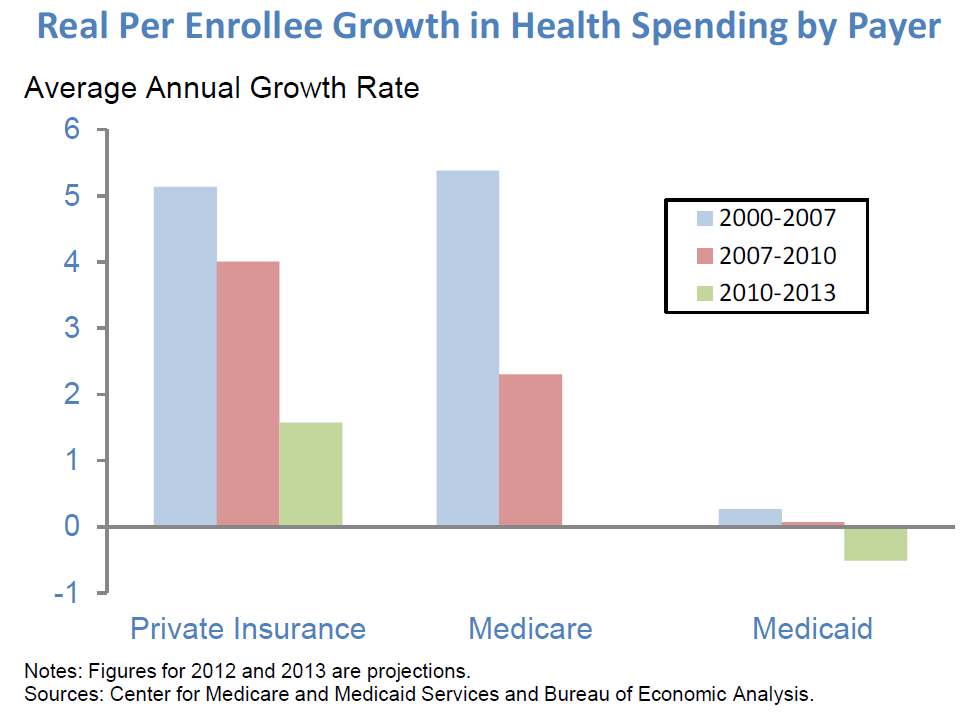
Council Of Economic Advisers Reveals Slower Growth In Health Care Cost After Implementation Of The Affordable Care Act

Jason Furman: "ACA Is Contributing To The Recent Slow Growth In Health Care Prices." In a November 20 report, economist Jason Furman, the chairman of the Council of Economic Advisors (CEA), highlighted several positive impacts of the Affordable Care Act (ACA). According to Furman, the ACA has already helped reduce waste and overpayment in Medicare that is "contributing to the recent slow growth in health care prices and spending." Furman argues that reduced spending in Medicare is having an effect across the health care sector:
Accounting for "spillover effects" of the ACA's reductions in Medicare overpayments suggests that the ACA has reduced health care price inflation by 0.5 percent per year since 2010, which represents a substantial fraction of the recent slowdown in health care price growth. [WhiteHouse.gov, 11/20/13]
Council Of Economic Advisors: ACA Is Contributing To Lower Spending, May Be Raising Employment. Citing trends since the first implementation of the ACA in 2010, the Council of Economic Advisers concluded that the law has had positive impacts on the economy in general, as well as the health care sector in particular:
The evidence is clear that recent trends in health care spending and price growth reflect, at least in part, ongoing structural changes in the health care sector. The slowdown may be raising employment today, and, if continued, will substantially raise living standards in the years ahead. The evidence also suggests that the ACA is already contributing to lower spending and price growth and that these effects will grow in the years ahead, bringing lower cost, higher quality care to Medicare and Medicaid beneficiaries and to the health system as a whole. [Executive Office of the President, Council of Economic Advisers, November 2013]
11.26_cea_costs.png


[Source: Executive Office of the President, Council of Economic Advisers, "Trends in Health Care Cost Growth and the Role of the Affordable Care Act", November 2013]

Economists Agree: ACA Is Partly Responsible For Slowing Of Health Care Cost Growth

David Cutler: "Slowing Down Medical Costs" A Success Story Of Obamacare. In a Washington Post op-ed, Harvard economist and former Obama health care adviser David Cutler explained how the law is already succeeding at controlling the rise of health care costs, stating "[t]he Affordable Care Act is a key to the underlying change":
Even as coverage efforts are sputtering, success on the cost front is becoming more noticeable. Since 2010, the average rate of health-care cost increases has been less than half the average in the prior 40 years. The first wave of the cost slowdown emerged just after the recession and was attributed to the economic hangover. Three years later, the economy is growing, and costs show no sign of rising. Something deeper is at work. [The Washington Post, 11/8/13]
Paul Krugman: "The Biggest Complaint Against Obamacare Was Completely Wrong." Writing for his New York Times blog, Nobel Prize-winning economist Paul Krugman noted that while the CEA was careful not to claim that the ACA was solely responsible for health care cost control, "there [is] pretty good evidence that the ACA has played an important role in the cost slowdown." [The New York Times,11/21/13]

Jonathan Gruber: Low Health Care Cost Growth Rates "Quite Striking." In an interview with USA Today, Massachusetts Institute of Technology economist Jonathan Gruber said that the continued low growth rate of health care costs was "quite striking." On the CEA's claim that the ACA is responsible for this cost containment, Gruber stated "obviously [the White House] has a point they want to push, but I think they've got it right." [USA Today, 11/20/13]

Dean Baker: The ACA "Probably Does Deserve Some Of The Credit." In an op-ed published by Truthout.org, economist Dean Baker of the Center for Economic and Policy Research noted that while the ACA is not the only factor contributing to lower costs, the health reform law "deserves some of the credit":
In short, by Washington standards Obama could easily take credit for the sharp slowdown in health care costs over the last five years. In reality, the ACA probably does deserve some of the credit, but regardless of the cause the slowdown is a really big deal. As a result, health care is much more affordable than would otherwise be the case. [Truthout.org, 11/25/13]
Print And Broadcast Media Largely Silent On Slowed Health Care Costs

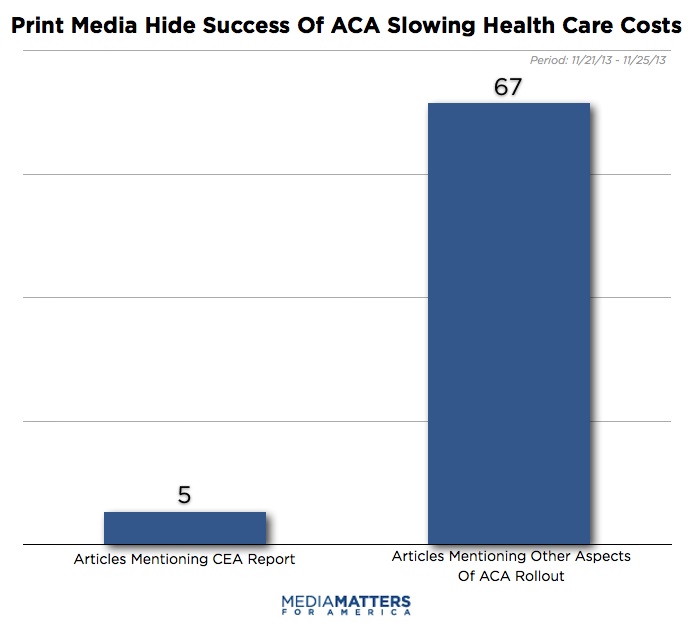
Print Media Devote Only Five Stories To ACA's Role In Slowed Costs. Since the release of the CEA report on November 20, the five top newspapers in the United States - The New York Times, The Washington Post, The Wall Street Journal, The Los Angeles Times, and USA Today - issued only five articles that mentioned the ACA's role in slowing the growth of health care costs. In the same time period, all print outlets combined issued 67 stories focusing on other aspects of the ACA rollout, including issues with the Healthcare.gov website and cancellations of individual policies. Only two outlets -- USA Today and The New York Times -- issued front page stories mentioning the CEA report.

11.26_print-media-ACA.jpg


Broadcast Media Silent On CEA Report. Between November 20 and November 25, broadcast morning, evening, and Sunday shows provided no airtime to the CEA report, instead dedicating over 20 minutes to other aspects of the ACA rollout.

Methodology

Media Matters conducted Nexis and Factiva searches of The New York Times, The Wall Street Journal, The Washington Post, USA Today, and The Los Angeles Times from November 21 (the day after the release of the CEA report) to November 25 using the following search terms: health care or health insurance or health reform or Affordable Care Act or ACA or Obamacare or Obama care.

We did not include online-only articles and letters to the editor.

Media Matters also reviewed evening news programs on ABC, CBS, and NBC from November 20 through November 25. We reviewed morning and Sunday show programs from November 21 through November 25. The programs analyzed were: CBS This Morning, Good Morning America, Today, CBS Evening News, Nightly News, World News, Face the Nation, and This Week. Meet the Press was not included because it did not air on November 24.

We defined articles and television segments that mention the role of ACA in slowing the growth of health care costs as those that directly mention the CEA report or comments from economists on the subject.
We defined articles and television segments that mention other aspects of the ACA rollout as those that mention any aspect of the ACA other than its role in slowing health care costs, including glitches in the Healthcare.gov website and individual policy cancellations.`
 
^^^^^^ ah, the "liberal media" lie exposed again.
Don't worry, they're still liberal. Why else would they treat a political report, out of the White House from the economic advisors of the President, as economic truth?

Luckily, you know, since you guys are so "Reality Based", you don't even have to leave this thread to see actual economic reports by the government you trust wholeheartedly. The CBO and Medicare actuaries have been very active in earning their pay.

But if you're really hardcore, you could actually look at the CEA report in the link thoughtone posted. CEA logic is we can't prove ACA is responsible for the downtrend that started in 2007, but what else could it be.

These are grown adults.
 
Don't worry, they're still liberal. Why else would they treat a political report, out of the White House from the economic advisors of the President, as economic truth?

Luckily, you know, since you guys are so "Reality Based", you don't even have to leave this thread to see actual economic reports by the government you trust wholeheartedly. The CBO and Medicare actuaries have been very active in earning their pay.

But if you're really hardcore, you could actually look at the CEA report in the link thoughtone posted. CEA logic is we can't prove ACA is responsible for the downtrend that started in 2007, but what else could it be.

These are grown adults.


CEA logic is we can't prove ACA is responsible for the downtrend that started in 2007, but what else could it be.


Can you site other factors?
 
Can you site other factors?
If you completely reject the CEA's logic, then I will link you to the Medicare actuaries' explicit reasoning on why they lowered their total health expenditures cost projections.

Say, "I rebuke Obama and I'm sorry for all I've believed."
 
If you completely reject the CEA's logic, then I will link you to the Medicare actuaries' explicit reasoning on why they lowered their total health expenditures cost projections.

Say, "I rebuke Obama and I'm sorry for all I've believed."

Is the Tea Bagger Kool Aid stronger than reality?


source: New York Times

Cost of Health Care Law Is Seen as Decreasing</NYT_HEADLINE>


The rollout of President Obama’s health care law may have deeply disappointed its supporters, but on at least one front, the Affordable Care Act is beating expectations: its cost.

Over the next few years, the government is expected to spend billions of dollars less than originally projected on the law, analysts said, with both the Medicaid expansion and the subsidies for private insurance plans ending up less expensive than anticipated.

Economists broadly agree that the sluggish economy remains the main reason that health spending has grown so slowly for the last half-decade. From 2007 to 2010, per-capita health care spending rose just 1.8 percent annually. Since then, the annual increase has slowed even further, to 1.3 percent. A decade ago, spending was growing at roughly 5 percent a year.

But even though the Affordable Care Act might be more a beneficiary of changes in health care spending than the primary driver of them, the law’s provisions to control costs could prove increasingly important as the economy improves, demand for health care increases and spending picks back up.

“It was a trend that was happening; we noticed that trend; we took advantage of that trend,” said Jason L. Furman, the chairman of the White House’s Council of Economic Advisers. “Some of it was the Affordable Care Act catching up with the private sector, and some of it was pushing the private sector forward.”

Administration officials have pointed to falling hospital readmission rates as one strong sign that cost-control provisions in the Affordable Care Act are working. Also, they noted that a growing number of insurers and health care providers are agreeing to contracts that pay for the quality of care, rather than the quantity, another indication that the law’s encouragement on that front is starting to pay dividends.

But those are responsible for only a tiny portion of the slowing rise of health care costs; other changes, like rising deductibles and copays that discourage some people from seeking extra services, play a bigger role, analysts say. Still, the Kaiser Family Foundation, a nonprofit research group, estimates that the weak economy accounts for as much as three-quarters of the slowdown in the growth of spending on health care.

But even if only about a quarter of the savings is because of noneconomic factors, said Larry Levitt, a top official at the Kaiser Family Foundation, “that’s real change in the health system.”

Critics, however, say they see little evidence that the law will lead to significant cost savings.

“These claims are just as groundless as the ones that misled so many Americans to believe they would be able to keep their previous coverage,” argued Charles Blahous, a former Bush administration official now at the Mercatus Center at George Mason University.

To be sure, the Affordable Care Act will lead to a drastic bump in health spending by the government starting next year, with an estimated nine million Americans signing up for Medicaid and perhaps as many as seven million buying a subsidized health plan through the government exchanges. But economists expect the underlying rate of spending growth to remain low.

And whatever the reasons for the slower growth, taxpayers appear set to reap some benefits.

Already, the Congressional Budget Office has quietly erased hundreds of billions of dollars from its projections. It now estimates that Medicare spending in 2020 will be $137 billion lower than it thought in 2010, a drop of 15 percent; Medicaid spending will be $85 billion, or 16 percent, lower; and private health insurance premiums are expected to be about 9 percent lower.

Some economists say they believe that the Congressional Budget Office might be underestimating the long-term effect of the slowdown, because it expects that spending growth will eventually return to its previous trend line. David M. Cutler, a Harvard economist and former Obama adviser, cautiously suggests that the slower growth might stick around, and if so the savings for the government might be a whopping $750 billion over 10 years, he says.

Whether such improvements will last depends on whether private firms — nudged along by Washington — create and retain incentives to keep spending low.

“In the past five decades, there are only two periods when we’ve been able to sustain low excess health care cost growth for an extended period,” Mr. Levitt, of the Kaiser foundation, said, referring to the current trend and a period in the 1990s, when the Clinton administration tried and failed at overhauling the health care system. “There was a sense in the system: ‘Something is coming, and we need to get ready for it.’ ”
 
So you don't reject the CEA's logic.

The Charles Blahous link you posted questioned why you can't use the same logic to say the 2005 Medicare expansion is responsible for the trend downturn. Sounds consistent to me.
 
My experience with government bureaucracy, is that it is used to discourage people from seeking benefits that they are entitled to, through denials and exhaustive administrative procedures. Ask veterans seeking assistance with PTSD from the VA which just recently relaxed the paperwork requirement that needs to be submitted.

Have you ever heard about website problems with the IRS, for the government to collect their money? The website response rate is under .1 seconds and can handle a capacity that far exceeds healthcare.gov.

Most of the people going to the website was people seeking assistance with Medicaid. I believe the government may have intentionally caused delays to frustrate these people, saving millions, or if not billions of dollars. Based on preliminary data, most of the initial enrollees were people that qualified under the expanded Medicaid program. The Republicans seized upon the opportunity to humiliate the ACA; having the website inaccessible is actually in-line with their goals of blocking ACA!!! I believe the government did not expect to have this kind of blowback from the media and was going to quietly frustrate enrollees.

The insurance companies also know that people with pre-existing conditions also flocked to the website, by having an inaccessible website, those people eventually gave up and became discouraged.
 
Last edited:
Back
Top