Obamacare Saves Consumers $2.1 Billion Since 2011

Health Care Law Raises Pressure on Public Unions

Health Care Law Raises Pressure on Public Unions
By KATE TAYLOR
Published: August 4, 2013

Cities and towns across the country are pushing municipal unions to accept cheaper health benefits in anticipation of a component of the Affordable Care Act that will tax expensive plans starting in 2018.

The so-called Cadillac tax was inserted into the Affordable Care Act at the advice of economists who argued that expensive health insurance with the employee bearing little cost made people insensitive to the cost of care. In public employment, though, where benefits are arrived at through bargaining with powerful unions, switching to cheaper plans will not be easy.

Cities including New York and Boston, and school districts from Westchester County, N.Y., to Orange County, Calif., are warning unions that if they cannot figure out how to rein in health care costs now, the price when the tax goes into effect will be steep, threatening raises and even jobs.

“Every municipality with a generous health care plan is doing the math on this,” said J. D. Piro, a health care lawyer at a human resources consultancy, Aon Hewitt.

But some prominent liberals express frustration at seeing the tax used against unions in negotiations.

“I think it was misguided all along,” Robert B. Reich, the former labor secretary, said in an e-mail. When the law was being written, he said, he worried that the tax was “a blunt instrument that could too easily become a bargaining chit for cutting back benefits of workers.”

“Apparently, that’s what it’s become,” Mr. Reich, who is a professor of public policy at the University of California, Berkeley, said.

Under the tax, plans that cost above a certain threshold in 2018 — $10,200 annually for individual plans and $27,500 for family plans, with slightly higher cutoffs for retirees and those in high-risk professions like law enforcement — will be taxed at 40 percent of their costs in excess of the limit. (The thresholds will rise with inflation after 2018.)

State and local governments across the country tend to offer more expensive health plans than private businesses do, and workers often accept smaller wage increases to retain their benefits. Because of this, state and local government employees are expected to be disproportionately represented among those whose plans will be subject to the tax.

New York City expects its two most popular employee health plans to reach taxable Cadillac levels by 2018 or shortly after. This year, the city projects that it will pay a total of $7,128 for individuals and $18,249 for families in its most popular plan, including the costs the city pays into union welfare funds to cover prescription drug benefits. That is above the national average for employer-sponsored health care coverage, which last year was $5,615 for single coverage and $15,745 for family coverage, according to a 2012 Kaiser Family Foundation survey.

The total health care cost for the city’s nearly 300,000 municipal employees, pre-Medicare-age retirees and their dependents is expected to approach $8 billion by 2018.

In a letter in April to the head of a labor coalition, Caswell F. Holloway IV, deputy mayor for operations, said the Cadillac tax would cost New York City $22 million in 2018, increasing to $549 million in 2022. (This year, the total city budget, excluding federal and state aid, is just over $50 billion.)

“We know that, on the current trajectory, we’re going to be hit with that tax and it would increase very steeply,” Mr. Holloway said.

So the administration of Mayor Michael R. Bloomberg, in its final months in office, is asking municipal unions to agree to seek new bids for the city’s health insurance business, hoping to lower premiums. It has already achieved one small victory, getting the city’s current primary insurer to freeze premiums for one year if it keeps the city’s business, the mayor said on Friday.

But lower-cost plans are likely to involve greater out-of-pocket costs and more limited networks of doctors, and so far, the response from labor has been cool.

Ninety-five percent of city employees and 93 percent of retirees are in the two largest plans, which require employees to pay nothing toward their premiums. According to the Kaiser Family Foundation survey, the average contribution by public employees throughout the country is 12 percent for individual plans and 23 percent for family plans.

Harry Nespoli, the chairman of the Municipal Labor Committee, the labor coalition that negotiates with the city on health care, said that he was concerned about the tax, but also that the burden of any cuts would fall largely on workers at the bottom of the pay scale.

Mr. Nespoli said his staff was looking over the request for proposals that the city had written, but he said he was skeptical that the process of seeking new health insurance could be completed before the next administration.

“We’re not going to turn around and do a $7 billion contract that affects our members for the next 10 years out without looking at it very carefully,” he said.

Most of Boston’s 20,000 employees are currently in plans that by 2018 would exceed the tax threshold. The city and its unions are preparing a request for proposals for new insurance coverage.

“The tax is going to be a hit, and, if you’re not expecting it, it’s going to be very shocking,” said Meredith Weenick, the chief financial officer for Boston.

Jim Finley, the executive director of the Connecticut Conference of Municipalities, said he thought it would be hard for Connecticut towns and cities to get their unions to agree to cheaper health care benefits to avoid the tax.

“In the end, it’s the taxpayer that’s going to bear that burden,” Mr. Finley said.

In Orange County, Calif., the Newport Mesa Unified School District warned employees during contract negotiations that if the district’s health care costs continued rising at the current rate, the district could face a $2.3 million burden from the tax in 2018.

The teachers’ union ultimately agreed to accept greater out-of-pocket costs to reduce the increase in its premium this year to 3 percent from 6 percent, but union leaders said they resented the district’s using the threat of the tax as a negotiating tactic.

Municipal unions opposed the inclusion of the tax in the health care law, and it was partly their efforts that succeeded in delaying its effective date until 2018.

Steven Kreisberg, the director of collective bargaining and health care policy at the American Federation of State, County, and Municipal Employees, said the term Cadillac tax was misleading, because it “connotes a certain aspect of luxury in these health plans that is just factually incorrect.”

The announcement last month that the Obama administration would delay by a year the mandate that larger employers offer coverage to their workers does not affect the timing of the excise tax, although it may provide encouragement to those who hope that the assessment will be delayed or scrapped altogether.

“Some skeptics, and I’m not one of them, say that that’s why the tax was put into effect in 2018 — that it’s far enough away that people can consider whether or not they really want it to go into effect,” Mr. Piro, the health care lawyer, said.

Jonathan Gruber, an economist at the Massachusetts Institute of Technology who was a paid consultant to the Obama administration on health care policy, said forcing state and local governments to rein in health care costs was exactly what the tax was intended to do.

“This is intended to shift compensation away from excessively generous health insurance toward wages,” he said.

In New York, if the Bloomberg administration does not succeed in getting new health insurance before the end of the year, the problem will fall in the lap of the next mayor.

Mr. Holloway said the Bloomberg administration, like many city governments, had long been concerned about the rising cost of health care and its impact on the budget.

But the 2018 tax “adds a sense of real urgency to getting a handle on this,” he said.

“We’ve got to start thinking about this now,” he continued. “Why is it that my plan is so expensive per person? What are the ways that we could get that under control?”

http://www.nytimes.com/2013/08/05/n...ons.html?ref=todayspaper&_r=1&&pagewanted=all
 
Dont put words in my mouth. One thing that is undesirable is some bureaucrat will control / oversee my healthcare. As if I can't do this myself.

Yeah, we fucked..............we have some who lack the ability to use critical thinking to understand this 21st century Tuskegee Experiment.

What, you think it cant happen again?

21st Century Tuskegee Experiment? Hyperbole much?

Sent from my SAMSUNG-SGH-I717 using Tapatalk 2
 
Studies take early look at health law's premiums

Studies take early look at health law's premiums
By RICARDO ALONSO-ZALDIVAR | Associated Press
6 hrs ago

WASHINGTON (AP) — Coverage under President Barack Obama's health care law won't be cheap, but cost-conscious consumers hunting for lower premiums will have plenty of options, according to two independent private studies.

A study released Thursday by the nonprofit Kaiser Family Foundation found that government tax credits would lower the sticker price on a benchmark "silver" policy to a little over $190 a month for single people making about $29,000, regardless of their age.

By pairing their tax credit with a stripped-down "bronze" policy, some younger consumers can bring their premiums down to the range of $100 to $140 a month, while older people can drive their monthly cost even lower — well below $100 — if they are willing to take a chance with higher deductibles and copays.

A separate study released Wednesday from Avalere Health, a private data analysis firm, took a wide-angle view, averaging the sticker prices of policies at different coverage levels.

Before tax credits that act like a discount, premiums for a 21-year-old buying a mid-range "silver" policy would be about $270 a month, the Avalere study found. List-price premiums for a 40-year-old buying a mid-range plan will average close to $330. For a 60-year-old, they were nearly double that at $615 a month.

Starting Oct. 1, those who don't have health care coverage on the job can go to new online insurance markets in their states to shop for a private plan and find out if they qualify for a tax credit. An estimated 4 out 5 consumers in the new markets will be eligible for some level of tax credit.

Come Jan. 1, virtually all Americans will be required to have coverage, or face fines. At the same time, insurance companies will no longer be able to turn away people in poor health.

The Obama administration, which is running the markets or taking the lead in 35 states, is not expected to release final premiums until close to the Oct. 1 launch date. But the two private studies provide an early look at the emerging market.

Caroline Pearson, lead author of the Avalere study, said it will be competitive, but there will be big price differences among age groups, states and even within states.

The bottom line is mixed: Many consumers will like their new options, particularly if they qualify for a tax credit. But others may have to stretch to afford coverage.

"We are seeing competitive offerings in every market if you buy toward the low end of what's available," said Pearson, a vice president of Avalere.

However, for uninsured people who are paying nothing today, "this is still a big cost that they're expected to fit into their budgets," Pearson added.

The Obama administration said consumers will have options that are cheaper than the averages presented in the Avalere study. "We're consistently seeing that premiums will be lower than expected," she said. "For the many people that qualify for a tax credit, the cost will be even lower."

The Kaiser study found that while premiums will vary significantly across the country, they are generally coming in lower than forecast by the government's own experts. It cautioned against comparing premiums under Obama's law to what individually insured people currently pay, because the new coverage is more robust.

Avalere crunched the numbers on premiums filed by insurers in 11 states and Washington, D.C. Kaiser analyzed 17 states and the District of Columbia. Both studies included a mix of states running their own insurance markets and ones in which the federal government will take charge.

The states analyzed by Avalere were California, Connecticut, Indiana, Maryland, New York, Ohio, Rhode Island, South Dakota, Vermont, Virginia and Washington.

In addition to those, Kaiser included Colorado, Maine, Montana, Nebraska, New Mexico and Oregon.

No data on premiums were publicly available for Texas and Florida — together they are home to more than 10 million of the nation's nearly 50 million uninsured people — and key to the law's success.

However, Pearson said she's confident the premiums in the Avalere study will be "quite representative" of other states, because clear pricing patterns emerged.

Four levels of plans will be available under Obama's law: bronze, silver, gold and platinum. Bronze plans will cover 60 percent of expected medical costs; silver plans will cover 70 percent; gold will cover 80 percent and platinum 90 percent.

All plans cover the same benefits, but bronze features the lowest premiums, paired with higher deductibles and copays. Platinum plans would have the lowest out-of-pocket costs and the highest premiums.

Mid-range silver plans are considered the benchmark, because the tax credits will be keyed to the cost of the second-lowest-cost silver plan in a local area.

And there's another important detail for consumers to be aware of: People with modest incomes may come out ahead by sticking with a silver plan instead of going for the lower premiums with bronze. Additional help with out-of-pocket costs like copays will only be available to people enrolling in a silver plan.

Although the sticker price for premiums rises dramatically above age 40, the tax credits are shaping up as a powerful equalizer for older consumers. That's because they work by limiting what you pay for premiums to a given percentage of your income.

For example, someone making $23,000 would pay no more than 6.3 percent of his or her annual income — $1,450 — for a benchmark silver plan. The amount you pay stays the same whether the total premium is $3,000 or $9,000.

However, those tax credits taper off rapidly for people with solid middle-class incomes, above $30,000 for an individual and $60,000 for a family of four.

The Avalere study also found some striking price differences within certain states, generally larger ones. In New York, with 16 insurers participating, the difference between the cheapest and priciest silver premium was $418.

http://news.yahoo.com/studies-early-look-health-laws-premiums-040631391.html
 
The premiums will drop even further, once uncompensated emergency care is reduced, and people starting getting care much sooner - before the disease reaches its full blown inefficient state.


We will still have the lingering effects of the old system still impacting the price rates.


The young consumer especially need health insurance - counter to what is being told, since they can get a women pregnant at any time, need access to birth control, and are higher risk of STD since many of them are unmarried.
 
Last edited:
GE to IBM Ending Retiree Health Plans in Historic Shift

GE to IBM Ending Retiree Health Plans in Historic Shift
By Alex Nussbaum
Sep 9, 2013 8:27 AM CT

America’s biggest employers, from GE to IBM, are increasingly moving retirees to insurance exchanges where they select their own health plans, an historic shift that could push more costs onto U.S. taxpayers.

Time Warner Inc. (TWX) yesterday said it would steer retired workers toward a privately run exchange, days after a similar announcement by International Business Machines Corp. General Electric Co. (GE) last year said it, too, would curb benefits in a move that may send some former employees to the public insurance exchanges created under the 2010 Affordable Care Act.

While retiree health benefits have been shrinking for years, the newest cutbacks may quickly become the norm. About 44 percent of companies plan to stop administering health plans for their former workers over the next two years, a survey last month by consultant Towers Watson & Co. (TW) found. Retirees are concerned their costs may rise, while analysts predict benefits will decline in some cases.
http://www.bloomberg.com/news/2013-...g-retiree-health-plans-in-historic-shift.html
 
Obamacare Unleashes Benefit Changes From Companies

Obamacare Unleashes Benefit Changes From Companies
By Alex Nussbaum
Sep 19, 2013 3:18 PM CT

Barack Obama wanted to change American health care as we know it. And he is, in ways that go far beyond the goals of the Affordable Care Act.

For weeks, headlines have cataloged the upheaval at private employers: UPS dropping coverage for employed spouses, IBM reworking retiree benefits. Yesterday came the biggest change: Walgreen Co. (WAG), the largest U.S. drugstore chain, told 160,000 workers they must buy insurance through a private exchange rather than having the company arrange their coverage.

None of the moves was dictated by the health-care law. All, though, have occurred in an environment shaped by Obamacare, which has pushed businesses and governments to reexamine their health-care role as costs soar and national priorities shift. The act now is giving businesses cover to loosen the decades-old link between jobs and health insurance, a shift that may further cloud the outlook for an already unpopular law.

“It’s going to be easy for conservatives who can’t beat up on this enough to point more fingers,” said Robert Laszewski, an insurance-industry consultant based in Arlington, Virginia. “If you pass the largest health-care reform bill in 50 years, then everything that happens in terms of people’s health insurance is your responsibility, fair or not.”

The decisions are an unintended consequence of the law that may drive up taxpayer costs, he said Laszewski. Stanford University researchers voiced similar concern in a study last week. Rising premiums could drive workers from employer plans to coverage under the health law, they wrote in a report, boosting costs for the government by as much as $6.7 billion.

Costs Moderate

Medical costs have moderated in the U.S. the past three years, offering relief to the public and private sector alike. Prices for medical care rose 1 percent in July compared with a year earlier, the lowest growth rate since the 1960s, according to U.S. Commerce Department data. Economists have credited the health-care law, a weak economy and less-generous health plans.

Home Depot Inc. (HD) said today that it would drop medical plans for about part-time workers and direct them to the government-sponsored insurance websites scheduled to open next year as part of the health law. About 20,000 employees would be affected, Stephen Holmes, a spokesman for the Atlanta-based retailer, said in a telephone interview.

With Congress engaged in a bitter feud over funding the 2010 law, worries over benefits offer Republicans yet another line of attack, said Stephen Hess, a presidential scholar at the Brookings Institution in Washington, in a telephone interview.

’Bad News’

“It has to be bad news for Obama,” Hess said. “Working out a successful health-care system has to be his legacy.”

The Obama administration says it’s confident the law will gain support as people, particularly the uninsured, see its benefits.

“One of the largest uninsured populations right now are the 55- to 65-year-old who may not have affordable coverage through their jobs,” said Kathleen Sebelius, the U.S. health secretary, at a stop last week in Newark, New Jersey. “The good news is that those people will finally have an affordable option.”

It’s not only business reassessing costs. Detroit and Chicago have proposed ending health plans for current or retired municipal workers, since they’ll be able to buy subsidized coverage through the health-care law. The Cleveland Clinic, one of the world’s foremost medical centers, announced yesterday it’s considering layoffs, partly to prepare for cuts in Medicare payments contained in the law.

’In the Mode’

“What the ACA has done is put all 300 million-plus Americans in the mode of thinking about health care,” said Jim Winkler, a chief innovation officer at Aon Plc. (AON) The London-based company runs the private exchange that will serve Walgreen’s employees.

“You’ve got CEOs reading articles and going to conferences, and that leads to a lot of discussions with Finance and HR about, ‘What are you going to do to solve our health-care cost problem?’” Winkler said by telephone.

The shift by big employers, which administer medical plans for 160 million Americans, could cause headaches for a law designed mainly to help the uninsured and small businesses.

Polls show support for Obamacare shrinking, even as the administration prepares for the Oct. 1 debut of the online insurance exchanges where Americans can buy subsidized coverage under the act. Fifty-seven percent of Americans opposed the health-care law in a poll this month by CNN/ORC, a turnaround from January when the survey found 51 percent in support.

What the changes mean for workers is harder to predict.

New Choices

IBM and Walgreen said employees will find more choice and, potentially, cheaper coverage by going through private exchanges, websites that will work similar to the new Obama markets, rather than taking a one-size-fits-all company plan.

That also puts the onus on workers to pick the right plan, an often complex choice now handled largely by human-resources professionals. Much also depends on whether employers continue to subsidize the plans and at what level, said Uwe Reinhardt, a health economist at Princeton University in New Jersey.

“The companies realized they cannot continue to be a social insurance system for the American people,” he said by e-mail. Businesses, he said, have been “woken up by the ACA.”

Aon jumped 5.6 percent in New York trading yesterday, after the Walgreen announcement. Insurers fell. Investors are worried their business may suffer in the transition away from traditional benefits, Matthew Borsch, a Goldman Sachs Group Inc. analyst, said in a note to clients.

Slide Continues

The slide continued today. UnitedHealth Group Inc. (UNH), the biggest U.S. health insurer, fell 3 percent to $70.84 at the close of trading. Cigna Corp. (CI) lost 4.3 percent.

Employers that announced changes in recent weeks said the health-care overhaul was one consideration among many. The law will raise costs for some businesses by imposing new taxes and requiring more generous benefits for existing workers.

United Parcel Service Inc. (UPS) said in August it would no longer provide benefits to employed spouses of 15,000 non-union workers, since they must be offered coverage by their own companies under the Affordable Care Act. Atlanta-based UPS also cited rising medical costs in general for their decision, particularly expenses for chronic conditions such as diabetes and heart disease.

International Business Machines Corp. (IBM) and Time Warner Inc. followed with word they would send retirees to the private exchanges, with company stipends to help pay for coverage.

IBM, based in Armonk, New York, said the move was made to help keep premiums low for the 110,000 Medicare-age workers affected by the switch.

’Moral Imperative’

Last week, Trader Joe’s Co., the closely held supermarket chain, said it would end health benefits next year for part-time workers. Employees will get a $500 payment and be sent to the public exchanges. With federal tax credits available there, most workers will get a better deal than the company could offer, Trader Joe’s said in a statement.

By offering other insurance options, “Obamacare has taken the moral imperative away for employers to continue offering coverage,” said Laszewski, the industry consultant. “The days of your father’s health insurance are over.”

Companies have been grappling with insurance costs since well before Obama signed the law, said Aon’s Winkler. Businesses have been curtailing spousal coverage and retiree benefits for more than a decade, he said.

“I cringe when I see headlines that suggest that the Affordable Care Act is driving all this,” Winkler said. “It’s certainly a factor that employers have to be looking at, but it is not the strategy in and of itself.”

http://www.bloomberg.com/news/2013-09-19/obamacare-unleashes-benefit-changes-from-companies.html
 
Lower Health Insurance Premiums to Come at Cost of Fewer Choices

Lower Health Insurance Premiums to Come at Cost of Fewer Choices
By ROBERT PEAR
Published: September 22, 2013

WASHINGTON — Federal officials often say that health insurance will cost consumers less than expected under President Obama’s health care law. But they rarely mention one big reason: many insurers are significantly limiting the choices of doctors and hospitals available to consumers.

From California to Illinois to New Hampshire, and in many states in between, insurers are driving down premiums by restricting the number of providers who will treat patients in their new health plans.

When insurance marketplaces open on Oct. 1, most of those shopping for coverage will be low- and moderate-income people for whom price is paramount. To hold down costs, insurers say, they have created smaller networks of doctors and hospitals than are typically found in commercial insurance. And those health care providers will, in many cases, be paid less than what they have been receiving from commercial insurers.

Some consumer advocates and health care providers are increasingly concerned. Decades of experience with Medicaid, the program for low-income people, show that having an insurance card does not guarantee access to specialists or other providers.

Consumers should be prepared for “much tighter, narrower networks” of doctors and hospitals, said Adam M. Linker, a health policy analyst at the North Carolina Justice Center, a statewide advocacy group.

“That can be positive for consumers if it holds down premiums and drives people to higher-quality providers,” Mr. Linker said. “But there is also a risk because, under some health plans, consumers can end up with astronomical costs if they go to providers outside the network.”

Insurers say that with a smaller array of doctors and hospitals, they can offer lower-cost policies and have more control over the quality of health care providers. They also say that having insurance with a limited network of providers is better than having no coverage at all.

Cigna illustrates the strategy of many insurers. It intends to participate next year in the insurance marketplaces, or exchanges, in Arizona, Colorado, Florida, Tennessee and Texas.

“The networks will be narrower than the networks typically offered to large groups of employees in the commercial market,” said Joseph Mondy, a spokesman for Cigna.

The current concerns echo some of the criticism that sank the Clinton administration’s plan for universal coverage in 1993-94. Republicans said the Clinton proposals threatened to limit patients’ options, their access to care and their choice of doctors.

At the same time, House Republicans are continuing to attack the new health law and are threatening to hold up a spending bill unless money is taken away from the health care program.

In a new study, the Health Research Institute of PricewaterhouseCoopers, the consulting company, says that “insurers passed over major medical centers” when selecting providers in California, Illinois, Indiana, Kentucky and Tennessee, among other states.

“Doing so enables health plans to offer lower premiums,” the study said. “But the use of narrow networks may also lead to higher out-of-pocket expenses, especially if a patient has a complex medical problem that’s being treated at a hospital that has been excluded from their health plan.”

In California, the statewide Blue Shield plan has developed a network specifically for consumers shopping in the insurance exchange.

Juan Carlos Davila, an executive vice president of Blue Shield of California, said the network for its exchange plans had 30,000 doctors, or 53 percent of the 57,000 doctors in its broadest commercial network, and 235 hospitals, or 78 percent of the 302 hospitals in its broadest network.

Mr. Davila said the new network did not include the five medical centers of the University of California or the Cedars-Sinai Medical Center near Beverly Hills.

“We expect to have the broadest and deepest network of any plan in California,” Mr. Davila said. “But not many folks who are uninsured or near the poverty line live in wealthy communities like Beverly Hills.”

Daniel R. Hawkins Jr., a senior vice president of the National Association of Community Health Centers, which represents 9,000 clinics around the country, said: “We serve the very population that will gain coverage — low-income, working class uninsured people. But insurers have shown little interest in including us in their provider networks.”

Dr. Bruce Siegel, the president of America’s Essential Hospitals, formerly known as the National Association of Public Hospitals and Health Systems, said insurers were telling his members: “We don’t want you in our network. We are worried about having your patients, who are sick and have complicated conditions.”

In some cases, Dr. Siegel said, “health plans will cover only selected services at our hospitals, like trauma care, or they offer rock-bottom payment rates.”

In New Hampshire, Anthem Blue Cross and Blue Shield, a unit of WellPoint, one of the nation’s largest insurers, has touched off a furor by excluding 10 of the state’s 26 hospitals from the health plans that it will sell through the insurance exchange.

Christopher R. Dugan, a spokesman for Anthem, said that premiums for this “select provider network” were about 25 percent lower than they would have been for a product using a broad network of doctors and hospitals.

Anthem is the only commercial carrier offering health plans in the New Hampshire exchange.

Peter L. Gosline, the chief executive of Monadnock Community Hospital in Peterborough, N.H., said his hospital had been excluded from the network without any discussions or negotiations.

“Many consumers will have to drive 30 minutes to an hour to reach other doctors and hospitals,” Mr. Gosline said. “It’s very inconvenient for patients, and at times it’s a hardship.”

State Senator Andy Sanborn, a Republican who is chairman of the Senate Commerce Committee, said, “The people of New Hampshire are really upset about this.”

Many physician groups in New Hampshire are owned by hospitals, so when an insurer excludes a hospital from its network, it often excludes the doctors as well.

David Sandor, a vice president of the Health Care Service Corporation, which offers Blue Cross and Blue Shield plans in Illinois, Montana, New Mexico, Oklahoma and Texas, said: “In the health insurance exchange, most individuals will be making choices based on costs. Our exchange products will have smaller provider networks that cost less than bigger plans with a larger selection of doctors and hospitals.”

Premiums will vary across the country, but federal officials said that consumers in many states would be able to buy insurance on the exchange for less than $300 a month — and less than $100 a month per person after taking account of federal subsidies.

“Competition and consumer choice are actually making insurance affordable,” Mr. Obama said recently.

Many insurers are cutting costs by slicing doctors’ fees.

Dr. Barbara L. McAneny, a cancer specialist in Albuquerque, said that insurers in the New Mexico exchange were generally paying doctors at Medicare levels, which she said were “often below our cost of doing business, and definitely below commercial rates.”

Outsiders might expect insurance companies to expand their networks to treat additional patients next year. But many insurers see advantages in narrow networks, saying they can steer patients to less expensive doctors and hospitals that provide high-quality care.

Even though insurers will be forbidden to discriminate against people with pre-existing conditions, they could subtly discourage the enrollment of sicker patients by limiting the size of their provider networks.

“If a health plan has a narrow network that excludes many doctors, that may shoo away patients with expensive pre-existing conditions who have established relationships with doctors,” said Mark E. Rust, the chairman of the national health care practice at Barnes & Thornburg, a law firm. “Some insurers do not want those patients who, for medical reasons, require a broad network of providers.”

http://www.nytimes.com/2013/09/23/h...st-of-fewer-choices.html?pagewanted=all&_r=2&
 
obamacare-passed-what-means-you.w654-620x350-450x254.jpg


health-insurance-waiting-room-calendar-october-2013.jpg
 
source: CNN Money

Obamacare premium rates lower than expected

130925092233-obamacare-premiums-exchanges-2-620xa.png


The Obamacare premiums will cost less than predicted, according to data released Wednesday by the Obama administration.


The release provided the first look into rates for consumers buying individual insuranceon the 36 federally run exchanges.

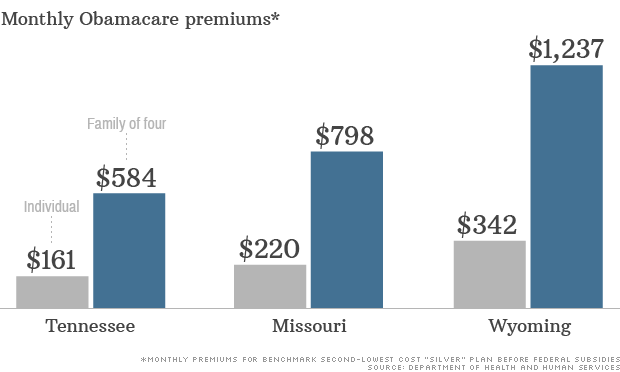
The national average premium for the benchmark plan will be $328 a month before subsidies, 16% less than projected by the Congressional Budget Office. The benchmark is the second-lowest cost "silver" policy for 48 states, upon which federal subsidies are based.

Related: See the Obamacare insurance rates

Subsidies will offer maximum caps for low- and moderate-income Americans in the benchmark plans. But for those who opt for other levels of coverage, or make too much to qualify for subsidies, prices vary widely based on one's age, income and state.

For instance, a 27-year-old living in Dallas making $25,000 could pay as little as $74 a month for the cheapest "bronze" plan after subsidies, according to the Department of Health and Human Services.

But a 60-year-old in Wyoming who makes more than $46,000 a year -- too much to get a tax credit -- could pay as much as $758 for a similar plan.

The majority of people uninsured today will be able to find a policy for $100 or less a month, taking into account subsidies and Medicaid eligibility, the administration said.

<SCRIPT src="http://i.cdn.turner.com/money/.element/script/6.0/players/embed.js?videoid=/video/news/2013/08/15/n-obamacare-rollout-delays-out-of-pocket-costs.cnnmoney"></SCRIPT>


Consumers will be able to start enrolling in the exchanges on Oct. 1, with coverage beginning in January. Starting in 2014, nearly everyone must have insurance -- either through their jobs, government programs or the individual market -- or face a penalty.

The rates released Wednesday do not apply to those who receive insurance through their employer.

Subsidies: What you'll actually pay for Obamacare

Most people who are expected to sign up for coverage in the exchange have incomes up 400% of poverty and will therefore be eligible for federal subsidies.

The lower your income and the more expensive the benchmark plan in your state, the larger your subsidy. For instance, those making $17,235 a year will pay no more than 4% of income, or $57 a month, for the benchmark plan. Those with incomes between $34,470 and $45,960 will pay a maximum of 9.5% of income, or $364 a month, for that benchmark plan. The federal government will cover the rest.

But these consumers can put their subsidy toward a cheaper plan than the benchmark policy and pay less per month. They can also choose a more expensive plan and pay more.

Anyone earning more than $45,960 would be responsible for the entire tab on the Obamacare health plan of his choice.

Additional information, including the names of insurers offering plans on the federal exchanges and the deductibles and co-pays associated with the policies, has yet to be unveiled. The department just said that the number of plans ranges from 6 to 169, depending on the area. Consumers will have a choice of as few as one insurer and as many as 13, based on where they live.

In states where there are only a handful of insurers, premiums are much higher, said Gary Claxton, vice president at the Kaiser Family Foundation. In the three most expensive states, Wyoming, Alaska and Mississippi, residents will only have a choice of two insurers.

Check out Kaiser's calculator to estimate your subsidy amount.

While the administration's report looks only at monthly premiums, a health care advisory firm issued a report Wednesday saying that consumers in the exchange will face high out-of-pocket costs in the bronze- and silver-level plans. These policies have lower deductibles than gold and platinum plans, but carry higher cost sharing burdens.

The average silver plan will carry a $2,550 deductible and $30 primary care co-pay, while the typical bronze plan will have a $5,150 deductible and $39 co-pay, according to Avelere Health. The firm looked at policies in six states that have released detailed data.
 
http://www.dailykos.com/story/2013/...g-About-Obamacare-VIDEO-diary?detail=facebook

Another Journalist Admits Republicans Lying About Obamacare (VIDEO)diary

Could it be that the excoriation received by Chuck Todd by a multitude of reputable online news sources is reframing the actions of some traditional journalists? Is it the fear that as Americans see the truth they will justifiably stop accepting the traditional media as one of their major sources of information? After-all, even the Dallas News is releasing new information showing a reduction of insurance rates in Texas. Yesterday the US Department of Health & Human Services released a report that says
Nearly all consumers (about 95%) will have a choice of 2 or more health insurance issuers (often many more) and nearly all consumers (about 95%) live in states with average premiums below earlier estimates. [Source]

Don Lemon raised the ire of many when he played into Fox News and Bill O’Reilly’s blanket attack on minorities. Some believed he may have been auditioning for a new Fox News gig and adopting their faux news methodology more closely. Don Lemon was no different than most other traditional media journalists. He like others have been rolled over by a well-organized and orchestrated Right Wing, Tea Party, Republican machine that have allowed the use of the national airwaves to misinform, lie to, and confuse their listeners.

This week Don Lemon began his process of atonement. He used his Tuesday’s Tom Joyner radio segment to come clean. What is interesting is that he referenced many fact checks he should have known and every legitimate journalist should have known when Republicans were spewing their venomous lies into the American psyche. Don Lemon, Chuck Todd, and most traditional journalists are responsible for being the conduits Republicans used to misinform.

Don Lemon now admits that Republicans are holding Americans hostage instead of telling them the truth. He said it is hard for them to tell the citizens the truth after not being above board (lying) to them for years. He said the three biggest whoppers (lies) are that it is a job killer, that it will raise insurance premiums, and that it would affect ones medical care. He fact checked them all and said they are lies. Now one would hope he will do the same on air when at CNN.

Listen to Don Lemon here:

 
<iframe width="560" height="315" src="http://www.nbc.com/assets/video/widget/widget.html?vid=n41321" frameborder="0"></iframe>
 
'Family glitch' in health law could be painful

'Family glitch' in health law could be painful
It could leave up to 500,000 children without coverage and cost some families thousands of dollars.
Kelly Kennedy, USA TODAY
11:55 p.m. EDT September 23, 2013

WASHINGTON — A "family glitch" in the 2010 health care law threatens to cost some families thousands of dollars in health insurance costs and leave up to 500,000 children without coverage, insurance and health care analysts say.

That's unless Congress fixes the problem, which seems unlikely given the House's latest move Friday to strip funding from the Affordable Care Act.

Congress defined "affordable" as 9.5% or less of an employee's household income, mostly to make sure people did not leave their workplace plans for subsidized coverage through the exchanges. But the "error" was that it only applies to the employee — and not his or her family. So, if an employer offers a woman affordable insurance, but doesn't provide it for her family, they cannot get subsidized help through the state health exchanges.

That can make a huge difference; the Kaiser Family Foundation said an average plan for an individual is about $5,600, but it goes up to $15,700 for families. Most employers help out with those costs, but not all.

"We saw this two-and-a-half years ago and thought, 'Has anyone else noticed this?'" said Kosali Simon, a professor of public affairs at Indiana University who specializes in health economics. "Everyone said, 'No, no. You must be wrong.' But we weren't, and that's going to leave a lot of people out."

The issue has recently received attention, especially after former president Bill Clinton highlighted it in a recent speech.

"The family glitch is definitely a drafting error that Congress made that needs to be fixed," said Joan Alker, executive director of the Georgetown University Center for Children and Families. "But that seems unlikely."

New rules state that those families will not be penalized for not purchasing coverage, but the point of the law was to make coverage affordable for families.

Other challenges for families remain as the Obama administration and the health care industry gear up for the Oct. 1 opening of the exchanges, websites for each state on which customers can shop for and buy health insurance. The law requires uninsured Americans to buy health insurance; many are eligible for government subsidies to help them for the policies. For example:

• Kids may not receive Medicaid or exchange coverage if their parents aren't eligible and, therefore, don't know to check.

• Undocumented immigrants may not learn their children are eligible for insurance.

The law has already helped children, Alker said, because it "stabilizes Medicaid and CHIP," the insurance program for children.

However, 70% of uninsured kids are eligible for Medicaid and CHIP, but they're not all enrolled, she said.

"There has to be a lot of outreach and education about the importance of getting health care," she said. "These kids could enroll today."

If congressional Republicans were to succeed in cutting funding for the law, the CHIP program would expire in October, said Bruce Lesley, president of First Focus, a bipartisan advocacy group for families.

The Children's Health Insurance Program provides insurance for kids whose family incomes are too high for Medicaid, but whose families still can't afford coverage. The Affordable Care Act extended it for two years, which means as many as 6 million children have health care.

Eliminating money for the law would force states to rethink their children's programs quickly, Alker said.

But even with the funding, not all kids are getting coverage. In fact, two-thirds of kids are eligible for Medicaid or CHIP but not enrolled. Advocates hope that adults signing up for insurance through the health exchanges will find out their kids are eligible, and have said as many as 4 million kids could sign up.

"In Massachusetts, the uninsured rate for kids is lower than 2%," Lesley said, explaining that when Massachusetts implemented "RomneyCare," children were enrolled for insurance in droves. The Massachusetts program became law in 2006 under then-Gov. Mitt Romney, last year's unsuccessful Republican nominee for president.

The Obama administration is working with the YMCA and other organizations to get the word out about children's eligibility, he said.

This can be a particularly big deal for immigrant families, where one parent might be a documented immigrant, a second could be undocumented, and the children could be U.S. citizens.

"Most of the kids are United States citizens," said Jenny Rejeske, a health policy analyst for the National Immigration Law Center. "We know already that many kids in mixed-status families don't have insurance."

Though she said the majority of immigrants are in the country legally, undocumented immigrants may be afraid to seek benefits for their children. Those children, she said, need immunizations and preventive care, in part to keep everybody else's kids healthy, too.

"I feel very confident saying it is safe for mixed-status families to sign up," she said. "The information they give will not be used for immigration enforcement."

The information will go only to the agencies that need to see it, and there are "protections" built in to the Affordable Care Act so families will go sign up their children, she said.

Others who might miss coverage options for kids include veterans receiving care through the VA but who don't have benefits for their families, as well as grandparents receiving Medicare. There is a child-only coverage option that would allow the child to receive subsidized insurance.

Alker said kids also benefit when their parents have coverage because the family is more likely to be financially secure. Medical bills are the leading cause of bankruptcy. She also cited examples, such as maternal depression or healthy pregnancy benefits that affect children as well as adults.

According to a Georgetown policy brief, 11.5 million parents and 6.3 million children were uninsured in 2010. Three-quarters of the parents' incomes fell below the poverty line, and 38% lived in deep poverty. About half of them are white, 29% are Hispanic, and 17% are African American.

Despite their concerns, the analysts said several promising things for families have happened through the law, including:

• Foster kids who have "aged out" of the system can continue to receive insurance through Medicaid until they are 26

• American children of immigrant parents -- even undocumented -- can get insurance subsidies through the new health insurance exchanges, and may be eligible for Medicaid.

• The children and spouses of disabled veterans, who receive their health care through Veterans Affairs, could be eligible for subsidized insurance through the exchange, even if the veteran is not. The same could apply to children who live with retired grandparents who receive care through Medicare.

http://www.usatoday.com/story/news/politics/2013/09/23/aca-family-glitch-issues/2804017/
 
Re: 'Family glitch' in health law could be painful

'Family glitch' in health law could be painful
It could leave up to 500,000 children without coverage and cost some families thousands of dollars.
Kelly Kennedy, USA TODAY
11:55 p.m. EDT September 23, 2013

WASHINGTON — A "family glitch" in the 2010 health care law threatens to cost some families thousands of dollars in health insurance costs and leave up to 500,000 children without coverage, insurance and health care analysts say.

That's unless Congress fixes the problem, which seems unlikely given the House's latest move Friday to strip funding from the Affordable Care Act.

Congress defined "affordable" as 9.5% or less of an employee's household income, mostly to make sure people did not leave their workplace plans for subsidized coverage through the exchanges. But the "error" was that it only applies to the employee — and not his or her family. So, if an employer offers a woman affordable insurance, but doesn't provide it for her family, they cannot get subsidized help through the state health exchanges.

That can make a huge difference; the Kaiser Family Foundation said an average plan for an individual is about $5,600, but it goes up to $15,700 for families. Most employers help out with those costs, but not all.

"We saw this two-and-a-half years ago and thought, 'Has anyone else noticed this?'" said Kosali Simon, a professor of public affairs at Indiana University who specializes in health economics. "Everyone said, 'No, no. You must be wrong.' But we weren't, and that's going to leave a lot of people out."

The issue has recently received attention, especially after former president Bill Clinton highlighted it in a recent speech.

"The family glitch is definitely a drafting error that Congress made that needs to be fixed," said Joan Alker, executive director of the Georgetown University Center for Children and Families. "But that seems unlikely."

New rules state that those families will not be penalized for not purchasing coverage, but the point of the law was to make coverage affordable for families.

Other challenges for families remain as the Obama administration and the health care industry gear up for the Oct. 1 opening of the exchanges, websites for each state on which customers can shop for and buy health insurance. The law requires uninsured Americans to buy health insurance; many are eligible for government subsidies to help them for the policies. For example:

• Kids may not receive Medicaid or exchange coverage if their parents aren't eligible and, therefore, don't know to check.

• Undocumented immigrants may not learn their children are eligible for insurance.

The law has already helped children, Alker said, because it "stabilizes Medicaid and CHIP," the insurance program for children.

However, 70% of uninsured kids are eligible for Medicaid and CHIP, but they're not all enrolled, she said.

"There has to be a lot of outreach and education about the importance of getting health care," she said. "These kids could enroll today."

If congressional Republicans were to succeed in cutting funding for the law, the CHIP program would expire in October, said Bruce Lesley, president of First Focus, a bipartisan advocacy group for families.

The Children's Health Insurance Program provides insurance for kids whose family incomes are too high for Medicaid, but whose families still can't afford coverage. The Affordable Care Act extended it for two years, which means as many as 6 million children have health care.

Eliminating money for the law would force states to rethink their children's programs quickly, Alker said.

But even with the funding, not all kids are getting coverage. In fact, two-thirds of kids are eligible for Medicaid or CHIP but not enrolled. Advocates hope that adults signing up for insurance through the health exchanges will find out their kids are eligible, and have said as many as 4 million kids could sign up.

"In Massachusetts, the uninsured rate for kids is lower than 2%," Lesley said, explaining that when Massachusetts implemented "RomneyCare," children were enrolled for insurance in droves. The Massachusetts program became law in 2006 under then-Gov. Mitt Romney, last year's unsuccessful Republican nominee for president.

The Obama administration is working with the YMCA and other organizations to get the word out about children's eligibility, he said.

This can be a particularly big deal for immigrant families, where one parent might be a documented immigrant, a second could be undocumented, and the children could be U.S. citizens.

"Most of the kids are United States citizens," said Jenny Rejeske, a health policy analyst for the National Immigration Law Center. "We know already that many kids in mixed-status families don't have insurance."

Though she said the majority of immigrants are in the country legally, undocumented immigrants may be afraid to seek benefits for their children. Those children, she said, need immunizations and preventive care, in part to keep everybody else's kids healthy, too.

"I feel very confident saying it is safe for mixed-status families to sign up," she said. "The information they give will not be used for immigration enforcement."

The information will go only to the agencies that need to see it, and there are "protections" built in to the Affordable Care Act so families will go sign up their children, she said.

Others who might miss coverage options for kids include veterans receiving care through the VA but who don't have benefits for their families, as well as grandparents receiving Medicare. There is a child-only coverage option that would allow the child to receive subsidized insurance.

Alker said kids also benefit when their parents have coverage because the family is more likely to be financially secure. Medical bills are the leading cause of bankruptcy. She also cited examples, such as maternal depression or healthy pregnancy benefits that affect children as well as adults.

According to a Georgetown policy brief, 11.5 million parents and 6.3 million children were uninsured in 2010. Three-quarters of the parents' incomes fell below the poverty line, and 38% lived in deep poverty. About half of them are white, 29% are Hispanic, and 17% are African American.

Despite their concerns, the analysts said several promising things for families have happened through the law, including:

• Foster kids who have "aged out" of the system can continue to receive insurance through Medicaid until they are 26

• American children of immigrant parents -- even undocumented -- can get insurance subsidies through the new health insurance exchanges, and may be eligible for Medicaid.

• The children and spouses of disabled veterans, who receive their health care through Veterans Affairs, could be eligible for subsidized insurance through the exchange, even if the veteran is not. The same could apply to children who live with retired grandparents who receive care through Medicare.

http://www.usatoday.com/story/news/politics/2013/09/23/aca-family-glitch-issues/2804017/


Great opinion piece.
 
Re: 'Family glitch' in health law could be painful

We know thoughtone. If it's not positive, then its not valid.

Apparently, it's not even reporting anymore.
 
Re: 'Family glitch' in health law could be painful

We know thoughtone. If it's not positive, then its not valid.

Apparently, it's not even reporting anymore.

You need to give up. You lost, Obama won. Go back to posting about the Fed.
 
Re: 'Family glitch' in health law could be painful

You need to give up. You lost, Obama won. Go back to posting about the Fed.
Which is exactly what it's all about. The only thing that matters is did you get what you want. Merits or "glitches" be damn.
 
Re: 'Family glitch' in health law could be painful

Which is exactly what it's all about. The only thing that matters is did you get what you want. Merits or "glitches" be damn.

The only thing that matters is that government is responsive to the people.
 
Re: 'Family glitch' in health law could be painful

Merits or "glitches" be damn.


<script height="720px" width="1280px" src="http://player.ooyala.com/iframe.js#pbid=b171980b65ae4996bffea4da902c7846&ec=NucXI5ZjpEvflOKbB-Tx-TgGdRXWxSOV"></script>
 
Beyond Obamacare glitches, some consumers face dramatically higher rates

Beyond Obamacare glitches, some consumers face dramatically higher rates
As Obamacare begins to roll out, some people who already buy insurance on the individual market are getting cancellation notices – and offers for coverage at double and triple their old rates.
By Linda Feldmann, Staff writer
October 7, 2013

Problems with the main Obamacare website, HealthCare.gov, have dominated headlines since the site opened for business on Oct. 1.

But another problem is surfacing: Some consumers who have been buying their own insurance are getting cancellation notices – and offers for insurance at dramatically higher rates.

There are multiple reasons this is happening. First, the Affordable Care Act (ACA) sets minimum standards for benefits, including mental-health and substance-abuse treatment, maternity care, prescription drugs, and rehabilitative care, which were not included in many of the old plans. Also, insurance companies are now required to take all comers, regardless of their health status, and so rates are rising to cover their costs as well.

In the debate before the ACA passed, there was plenty of focus on people who lacked insurance, either because they couldn’t afford it or had a preexisting condition. Now, newspapers around the country are chronicling the stories of the other category of consumer – people who make too much money to be eligible for federal subsidies and are being charged double and triple their old rates.

"The upper-middle class are the people who are essentially being asked to foot the bill, and that's true across the country,” Jonathan Wu, co-founder of ValuePenguin, a consumer finance website, tells the San Jose Mercury News.

Michael Yount of Charlotte, N.C., is one such unhappy customer. He and his wife, retired and in their late 50s, have been buying their own health insurance from Blue Cross and Blue Shield (BCBS) in North Carolina, paying about $380 a month with an $11,000 deductible. BCBS is offering them a new plan for three times the cost, $1,124.50 a month, still with an $11,000 deductible.

“We are an insurance company’s dream,” Mr. Yount tells the Monitor. “We pay our bills, we hardly ever get sick, no prescription drugs. And now this.”

Reluctantly, he says, they plan to drop out of formal health insurance, pay the penalty, and “self-insure.”

“No question, there’s risk there,” Yount says. “The question is, how much are you willing to pay someone else to mitigate that risk?”

He also understands that the law is meant to help those who have not been able to buy insurance because of preexisting conditions. But he objects to how it’s being done.

“If the only way to get it to them is forcibly taking it from everybody else, how is that any better?” Yount says. “I’m struggling with what is the greater evil and injustice. I don’t think it’s any more right to take it from one person forcibly. It’s coercion.”

Yount has been trying since Oct. 1 to get onto HealthCare.gov to see what his options are on the federal exchange, but with no success.

Indeed, after undergoing repairs over the weekend, HealthCare.gov is still experiencing significant difficulties. When the problems first became apparent, after open enrollment began on Oct. 1, administration officials blamed high traffic – a sign of the high demand from among the millions of Americans who have been unable to buy insurance until now.

Joanne Peters, spokeswoman for the Department of Health and Human Services (HHS), says the repair work is “beginning to show results.”

“Call center wait times are seconds, not minutes, and people have been enrolling over the phone 24/7,” Ms. Peters said Monday in an e-mailed statement. “Our work to expand the site’s capacity has led to more people successfully applying for and enrolling in affordable health coverage online, with wait times being shortened by approximately 50 percent since Friday. But we won’t stop until the doors to HealthCare.gov are wide open, and at the end of the six-month open enrollment, millions of Americans gain affordable coverage.”

But technical experts say the problems are about more than just capacity and that the site needs design changes.

“The website is troubled by coding problems and flaws in the architecture of the system,” The Wall Street Journal reported on Sunday, citing the conclusions of insurance-industry advisers, technical experts, and people close to the development of the marketplace.

Health-insurance consultants who have been tracking the rollout of the ACA say that if HealthCare.gov is not functioning smoothly by early November, the enrollment backlog will become critical. To be covered by Jan. 1, when the law’s mandate for individuals to carry insurance goes into effect, one must have signed up by Dec. 15.

HealthCare.gov services 36 states. The other 14 states plus the District of Columbia are running their own health-insurance exchanges, and while some have not had widespread problems – such as in Kentucky and Connecticut – others, like Maryland, have. The only way to be eligible for a federal subsidy is to buy insurance through one of the government exchanges.

A postscript from Michael Yount of Charlotte: He got back in touch to say that if he or his wife were to become ill, then they would buy health insurance – since the plans are now barred from turning anyone away.

One problem with that idea is that people can buy insurance on the government exchange only during the open enrollment period. In the first year, it goes from Oct 1, 2013, to March 31, 2014. Enrollment reopens on Oct. 7, 2014. So what happens if Yount or his wife get sick or have accident during the “blackout” period?

“As we discussed – there is risk,” Yount says in an e-mail. “But the odds are that the most likely scenario for a major medical problem is a car accident. That's covered with my auto insurance.”

And in the event of an expensive illness, he says, “we spin the wheel.”

http://www.csmonitor.com/USA/DC-Dec...onsumers-face-dramatically-higher-rates-video
 
Re: Beyond Obamacare glitches, some consumers face dramatically higher rates

Beyond Obamacare glitches, some consumers face dramatically higher rates
As Obamacare begins to roll out, some people who already buy insurance on the individual market are getting cancellation notices – and offers for coverage at double and triple their old rates.


Total-Failure-Thumb.jpg


tom-toles-obamacare.jpg
 
Re: Beyond Obamacare glitches, some consumers face dramatically higher rates

He also understands that the law is meant to help those who have not been able to buy insurance because of preexisting conditions. But he objects to how it’s being done.

“If the only way to get it to them is forcibly taking it from everybody else, how is that any better?” Yount says. “I’m struggling with what is the greater evil and injustice. I don’t think it’s any more right to take it from one person forcibly. It’s coercion.”
...
 
Re: Beyond Obamacare glitches, some consumers face dramatically higher rates

“If the only way to get it to them is forcibly taking it from everybody else, how is that any better?” Yount says. “I’m struggling with what is the greater evil and injustice. I don’t think it’s any more right to take it from one person forcibly. It’s coercion.”


...

In this argument, who is anything being taken from and who is being given anything?
 
I don't see anyone being given anything. There are now more people paying for insurance.

I don't discount Mr Yount's experience but I don't glean anything from it. His is one story out of millions with more to come.
 
I don't see anyone being given anything. There are now more people paying for insurance.
Ok Dave, I'll be your huckleberry. Using the base assumption that cost doesn't magically disappear because a politician decreed it to be, where does the cost go when someone pays a cheaper premium because of the law than they would have without the law?

I think this is a valid question unless you disagree with the base assumption that cost doesn't just magically disappear.

I don't discount Mr Yount's experience but I don't glean anything from it. His is one story out of millions with more to come.
More to come with a disproportionate weight given to the stories we agree with.
 
Back
Top