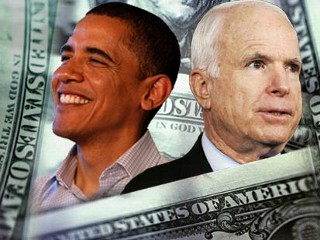
Obama Opts out of Public Funds Against McCain

AristotlesOwn

Star
Registered
Don't know if this has been posted yet or not. It seems McCain's camp isn't happy...only because they can't compete with Obama's money machine.

WASHINGTON (Reuters) - Democrat Barack Obama said on Thursday he would forego public financing of his general election campaign against Republican John McCain, reversing an earlier stance and positioning himself to outspend McCain in the White House race.

Obama said in a video message to supporters he would refuse $84 million in public funds available for the November general election. He is the first U.S. presidential candidate to bypass the system since it was created after the Watergate scandal in the mid-1970s.

His decision drew immediate condemnation from the McCain campaign, which has signaled so far he would participate in the system.

The move had been widely expected given Obama's record-smashing fundraising during the Democratic nominating battle. If Obama had taken the public funds, he would have been limited to spending just the $84 million in the two months between the Democratic convention and the November 4 election.

Obama's decision sets up what will be the most expensive presidential election in U.S. history. He had said earlier he would take public funds if his Republican opponent would as well.

"It's not an easy decision, and especially because I support a robust system of public financing of elections," Obama said in the video message.

"But the public financing of presidential elections as it exists today is broken and we face opponents who've become masters at gaming this broken system," he said.

McCain has not made a formal announcement on whether he will take the public funds, but the Arizona senator raised far less than Obama during the primary battle.

"Today, Barack Obama has revealed himself to be just another typical politician who will do and say whatever is most expedient for Barack Obama," McCain spokeswoman Jill Hazelbaker said in a statement.

"The true test of a candidate for president is whether he will stand on principle and keep his word to the American people. Barack Obama has failed that test today, and his reversal of his promise to participate in the public finance system undermines his call for a new type of politics," she said.

FUND-RAISING MACHINE

Obama built a formidable grass-roots financial machine during his primary battle against Sen. Hillary Clinton of New York, raising more than $265 million from more than 1.5 million donors, many of whom gave in small increments.

McCain raised $96 million so far during the primary season.

Obama said McCain's campaign and the Republican National Committee were fueled by contributions from Washington lobbyists and special interest groups that can make unlimited donations.

"From the very beginning of this campaign, I have asked my supporters to avoid that kind of unregulated activity and join us in building a new kind of politics -- and you have," he said in the video message.

"Instead of forcing us to rely on millions from Washington lobbyists and special interest (groups), you've fueled this campaign with donations of $5, $10, $20, whatever you can afford," he said.

"And because you did, we've built a grass-roots movement of over 1.5 million Americans."

The public funds are paid for by taxpayers who check off a box on their tax returns allowing a $3 contribution to the fund.

The decision by Obama, an Illinois senator, to forego the funds in the general election drew criticism from public interest groups as well as McCain.

"If he thinks the system is broken then he needs to be pledging to fix it," said David Arkush, a director at the public interest group Public Citizen, which champions publicly financed elections.

Obama and Clinton opted out of the public financing system during their primary battle, launching a money war that fueled new records and heavy spending during the campaign.

http://www.reuters.com/article/topNews/idUSN1828132020080619?pageNumber=3&virtualBrandChannel=10112
 
Thanks for posting A.O. Yeah, McCain's upset for the reason you stated.
I'm sure he's going to raise issues with Obama's promise that he wouldn't
go this route and how Obama is bailing out on his campaign reform positions
but I believe if the script was flipped (Obama unable to raise private funds
and McCain could) he would do the same thing.

QueEx
 
I saw this on the news this morning. It's a different ballgame when "the people" have a stake in the outcome...finally.

-VG
 
<font size="5"><center>Obama Poised for Huge Cash Edge</font size><font size="4">

Democrats Could Swamp McCain With
$500 Million in Final Two Months</font size></center>


campaign_money_080611_mn.jpg

The skies the limit in terms of campaign cash for
Sen. Barack Obama, who announced he is eschewing
public financing. Sen. John McCain, who is accepting
public financing, will be limited in his spending ability.
(ABC News Photo Illustration)

ABC News
By RICK KLEIN
June 19, 2008

Sen. Barack Obama's decision to forgo public financing for his presidential campaign clears the way for him to outspend Sen. John McCain by 3-to-1 or substantially more in the general election, a financial edge that dramatically rewrites the playbooks for both candidates.

With the possibility of spending perhaps $500 million just in the final two months of the campaign, Obama will be the first major-party candidate to enjoy a spending edge in the general election in more than 30 years. The comparison with the consistently cash-strapped McCain campaign could hardly be more stark.

"It'll be like George Steinbrenner's Yankees in the '90s — an All-Star at every position — against the '90s Kansas City Royals, barely able to meet their payroll," said Chris Lehane, a Democratic consultant who worked for Al Gore in 2000 and John Kerry in 2004.

Though Obama risks a short-term political backlash by seeming to go back on his word, Democratic and Republican strategists say most campaigns would take such a hit in exchange for the unprecedented cash advantage he'll derive.

McCain said Thursday he will accept public financing, meaning he'll be limited to spending only $84.1 million in the critical window between the Republican National Convention and Election Day. He'll be forced to lean more heavily on the Republican National Committee and outside groups that he cannot legally coordinate spending decisions with.

In that same time period, Obama will continue to be free to raise and spend unlimited amounts — with advertising specialists and party insiders projecting that he will bring in hundreds of millions of dollars, utilizing and expanding on the most efficient fundraising operation in American political history.

"He's going to be able to raise almost unimaginable amount of money," said Tad Devine, a Democratic strategist who was a top adviser in the Gore and Kerry campaigns. "This is an incredible advantage for him and his campaign. He'll be able to dictate the terms of this election."

Remainder of Article: http://abcnews.go.com/Politics/Vote2008/story?id=5207140&page=1
 
This makes more sense to me than anything else. I mean if you want real campaign finance reform it makes sense to only take money from the people who support you directly.

s4apld.jpg


You this old bastard is mad as hell, LOL!
 
I swear, people will make any excuse for Obama. He can do anything and be excused for it. This is just one example of going back on his word. All his previous talk about special interests etc ... he can now freely take as much money as can get from anyone; do you really not expect him to be beholden to them afterward?
 
I swear, people will make any excuse for Obama. He can do anything and be excused for it. This is just one example of going back on his word. All his previous talk about special interests etc ... he can now freely take as much money as can get from anyone; do you really not expect him to be beholden to them afterward?

<font size="3">Do you call the American People special interest ???

QueEx

</font size>
 
Straining to Reach Money Goal, Obama Presses Donors

September 9, 2008
Straining to Reach Money Goal, Obama Presses Donors
By MICHAEL LUO and JEFF ZELENY

After months of record-breaking fund-raising, a new sense of urgency in Senator Barack Obama’s fund-raising team is palpable as the full weight of the campaign’s decision to bypass public financing for the general election is suddenly upon it.

Pushing a fund-raiser later this month, a finance staff member sent a sharply worded note last week to Illinois members of its national finance committee, calling their recent efforts “extremely anemic.”

At a convention-week meeting in Denver of the campaign’s top fund-raisers, buttons with the image of a money tree were distributed to those who had already contributed the maximum $2,300 to the general election, a subtle reminder to those who had failed to ante up.

The signs of concern have become evident in recent weeks as early fund-raising totals have suggested that Mr. Obama’s decision to bypass public financing may not necessarily afford him the commanding financing advantage over Senator John McCain that many had originally predicted.

Presidential candidates in a general election have typically relied on two main sources of money: public financing, along with additional money their parties raise. In choosing to accept the public money, the McCain campaign now gets an $84 million cash infusion from the United States Treasury. Mr. McCain is barred from raising any more money for his own campaign coffers but can lean on money raised by the Republican National Committee, which has continued to exceed expectations.

Meanwhile, Obama campaign officials had calculated that with its vaunted fund-raising machine, driven by both small contributors over the Internet and a powerful high-dollar donor network, it made more sense to forgo public financing so they could raise and spend unlimited sums.

But the campaign is struggling to meet ambitious fund-raising goals it set for the campaign and the party. It collected in June and July far less from Senator Hillary Rodham Clinton’s donors than originally projected. Moreover, Mr. McCain, unlike Mr. Obama, will have the luxury of concentrating almost entirely on campaigning instead of raising money, as Mr. Obama must do.

The Obama campaign does not have to report its August fund-raising totals until next week, so it is difficult to tally what it has in the bank at this point. A spokesman said that August was its best fund-raising month yet and that the campaign’s fund-raising was on track. But the campaign finished July with slightly less cash on hand with the Democratic National Committee compared with Mr. McCain and the R.N.C. The Obama campaign has also been spending heavily, including several million more than the McCain campaign in advertising in August.

A California fund-raiser familiar with the party’s August performance estimated that it raised roughly $17 million last month, a drop-off from the previous month, and finished with just $13 million in the bank.

Still, the Obama campaign said last Thursday that it had raised $10 million over the Internet in the 24 hours after the speech by Mr. McCain’s running mate, Gov. Sarah Palin, at the Republican convention on Wednesday, a one-day record for the campaign.

David Plouffe, the Obama campaign manager, said the majority of the Obama campaign’s donors during the primary had yet to write checks for the general election. When they do, he said, it will be the equivalent of the large injection of cash the McCain campaign is receiving from the government — about $70 million or $80 million.

“We’re confident that we will meet our financial goals, but it’s hard work,” Mr. Plouffe said. “We have a long way to go in the next six weeks.”

Members of Mr. Obama’s national finance committee were briefed during the convention in Denver by Mr. Plouffe. Penny Pritzker, the Obama finance chairwoman, announced new state-by-state fund-raising goals. The decidedly business-oriented nature of the meeting reflected the burden on the Obama campaign in the coming weeks.

“I think McCain made the right call,” said Scott Reed, a Republican strategist who managed Bob Dole’s presidential campaign in 1996. “The Republican National Committee is strong. They have the resources to make this race almost financially on par.”

Democratic strategists disagree, pointing out that campaign finance rules impose serious restrictions on Mr. McCain’s ability to fully make use of his party’s bank account.

“It’s not just the limitation of dollars when you accept public financing, it’s the limitations that go with that spending,” said Tad Devine, a senior strategist for Senator John Kerry’s presidential campaign in 2004. Mr. Devine added that choosing to accept public financing was the Kerry campaign’s single biggest mistake because it limited the campaign’s resources.

The McCain campaign had by far its best fund-raising month ever in August, when it collected $47 million for its coffers and $22 million for the party, finishing the month with more than $100 million in the bank that will now be at the disposal of the R.N.C., according to several finance officials.

McCain fund-raisers said they also hope to raise an additional $100 million for the party in September and in October, taking advantage of the sizable contribution limits for the party. The party’s Internet fund-raising has also picked up significantly since the announcement that Ms. Palin would join the Republican ticket. Combined with the $84 million from public financing, that would leave the McCain campaign with about $300 million at its disposal.

A recent e-mail message to McCain fund-raisers unveiled new incentives to spur them in their final push. For the primary, anyone who raised $100,000 or more earned the title of Trailblazer, while those who raised $250,000 or more became Innovators. Now Trailblazers who raise another $100,000 for the party for the general election can become Super-Trailblazers, and Innovators who raise another $250,000 earn the title of Super-Innovators.

Officials have also sketched out plans for Ms. Palin to do some 35 fund-raisers over the next two months. Mr. McCain will be dispatched for only four major fund-raisers: one on Monday night in Chicago, in which the party raised about $4 million; another next week in Miami, then Los Angeles and New York in October, finance officials said.

But even if the McCain finance team, led by Lewis M. Eisenberg, a former Goldman Sachs executive, and Wayne L. Berman, a Washington lobbyist, meets its goals, the campaign will have complete control over only the $84 million from the federal government, as well as $19 million in party money that is permitted to be used in coordination with the campaign.

The Republican Party can spend unlimited amounts of its money independent of the McCain campaign. It can also split the costs of so-called hybrid advertisements with the campaign, commercials that must promote not only Mr. McCain but also other Republicans down the ticket, something media strategists said could be ineffective when trying to create a cohesive message. Nevertheless, McCain fund-raisers pointed out the pressure is now on the Obama campaign to raise far more than it ever has before.

The Obama campaign set a goal in mid-June of raising $300 million for the campaign and about $150 million for the Democratic Party over four-and-a-half months, fund-raisers said. As of the end of July, however, the Obama campaign was well short of the $100 million a month pace it had set, taking in about $77 million between the campaign and the party that month.

It is not yet clear whether the Obama campaign will be able to ratchet up its fund-raising enough in the final two months of the campaign to make up the difference.

Even Mr. Obama’s fund-raisers in Illinois were admonished in an e-mail message last Thursday to step up their efforts to “show the other regions that his home state still has it.” The donors, who were also reminded they had each promised to collect $300,000 for the campaign, were asked to raise $25,000 each for an event on Sept. 22 at a Chicago museum.

The new state-by-state goals unveiled by campaign officials in Denver stunned at least some in the room and included sizable increases for at least some states, according to interviews with several Obama fund-raisers.

The campaign has created a fund-raising committee, the Campaign for Change, which allows fund-raisers to harvest additional checks of more than $30,000 that will then be divvied up among state Democratic Parties in 18 battleground states, with Florida, Ohio, Pennsylvania and Michigan receiving the most.

In a campaign swing through South Florida over Labor Day weekend, Mr. Obama’s vice-presidential running mate, Senator Joseph R. Biden Jr., met with several small groups of major donors and sent out an e-mail appeal to supporters of his own unsuccessful presidential campaign, as well as to Jewish supporters. The effort brought in more than $1 million in four days.

Campaign officials expect their Internet fund-raising engine to ramp up as the election approaches. And they hope that much of the high-dollar fund-raising can be done without Mr. Obama. In the New York area alone, there are some 18 events planned in September, all with surrogates, including Mrs. Clinton, Caroline Kennedy and Gov. Bill Richardson of New Mexico.

But campaign officials conceded that Mr. Obama inevitably will have to make some appearances. On Friday night in New Jersey, Mr. Obama devoted five hours for two fund-raising events, including one at the home of the singer Jon Bon Jovi, in which the ticket was $30,800 a person. Mr. Obama is also scheduled to appear at back-to-back fund-raisers in Los Angeles on Sept. 16.

http://www.nytimes.com/2008/09/09/us/politics/09donate.html
 
Re: Straining to Reach Money Goal, Obama Presses Donors

September 9, 2008
Straining to Reach Money Goal, Obama Presses Donors
By MICHAEL LUO and JEFF ZELENY

After months of record-breaking fund-raising, a new sense of urgency in Senator Barack Obama’s fund-raising team is palpable as the full weight of the campaign’s decision to bypass public financing for the general election is suddenly upon it.

Pushing a fund-raiser later this month, a finance staff member sent a sharply worded note last week to Illinois members of its national finance committee, calling their recent efforts “extremely anemic.”

At a convention-week meeting in Denver of the campaign’s top fund-raisers, buttons with the image of a money tree were distributed to those who had already contributed the maximum $2,300 to the general election, a subtle reminder to those who had failed to ante up.

The signs of concern have become evident in recent weeks as early fund-raising totals have suggested that Mr. Obama’s decision to bypass public financing may not necessarily afford him the commanding financing advantage over Senator John McCain that many had originally predicted.

Presidential candidates in a general election have typically relied on two main sources of money: public financing, along with additional money their parties raise. In choosing to accept the public money, the McCain campaign now gets an $84 million cash infusion from the United States Treasury. Mr. McCain is barred from raising any more money for his own campaign coffers but can lean on money raised by the Republican National Committee, which has continued to exceed expectations.

Meanwhile, Obama campaign officials had calculated that with its vaunted fund-raising machine, driven by both small contributors over the Internet and a powerful high-dollar donor network, it made more sense to forgo public financing so they could raise and spend unlimited sums.

But the campaign is struggling to meet ambitious fund-raising goals it set for the campaign and the party. It collected in June and July far less from Senator Hillary Rodham Clinton’s donors than originally projected. Moreover, Mr. McCain, unlike Mr. Obama, will have the luxury of concentrating almost entirely on campaigning instead of raising money, as Mr. Obama must do.

The Obama campaign does not have to report its August fund-raising totals until next week, so it is difficult to tally what it has in the bank at this point. A spokesman said that August was its best fund-raising month yet and that the campaign’s fund-raising was on track. But the campaign finished July with slightly less cash on hand with the Democratic National Committee compared with Mr. McCain and the R.N.C. The Obama campaign has also been spending heavily, including several million more than the McCain campaign in advertising in August.

A California fund-raiser familiar with the party’s August performance estimated that it raised roughly $17 million last month, a drop-off from the previous month, and finished with just $13 million in the bank.

Still, the Obama campaign said last Thursday that it had raised $10 million over the Internet in the 24 hours after the speech by Mr. McCain’s running mate, Gov. Sarah Palin, at the Republican convention on Wednesday, a one-day record for the campaign.

David Plouffe, the Obama campaign manager, said the majority of the Obama campaign’s donors during the primary had yet to write checks for the general election. When they do, he said, it will be the equivalent of the large injection of cash the McCain campaign is receiving from the government — about $70 million or $80 million.

“We’re confident that we will meet our financial goals, but it’s hard work,” Mr. Plouffe said. “We have a long way to go in the next six weeks.”

Members of Mr. Obama’s national finance committee were briefed during the convention in Denver by Mr. Plouffe. Penny Pritzker, the Obama finance chairwoman, announced new state-by-state fund-raising goals. The decidedly business-oriented nature of the meeting reflected the burden on the Obama campaign in the coming weeks.

“I think McCain made the right call,” said Scott Reed, a Republican strategist who managed Bob Dole’s presidential campaign in 1996. “The Republican National Committee is strong. They have the resources to make this race almost financially on par.”

Democratic strategists disagree, pointing out that campaign finance rules impose serious restrictions on Mr. McCain’s ability to fully make use of his party’s bank account.

“It’s not just the limitation of dollars when you accept public financing, it’s the limitations that go with that spending,” said Tad Devine, a senior strategist for Senator John Kerry’s presidential campaign in 2004. Mr. Devine added that choosing to accept public financing was the Kerry campaign’s single biggest mistake because it limited the campaign’s resources.

The McCain campaign had by far its best fund-raising month ever in August, when it collected $47 million for its coffers and $22 million for the party, finishing the month with more than $100 million in the bank that will now be at the disposal of the R.N.C., according to several finance officials.

McCain fund-raisers said they also hope to raise an additional $100 million for the party in September and in October, taking advantage of the sizable contribution limits for the party. The party’s Internet fund-raising has also picked up significantly since the announcement that Ms. Palin would join the Republican ticket. Combined with the $84 million from public financing, that would leave the McCain campaign with about $300 million at its disposal.

A recent e-mail message to McCain fund-raisers unveiled new incentives to spur them in their final push. For the primary, anyone who raised $100,000 or more earned the title of Trailblazer, while those who raised $250,000 or more became Innovators. Now Trailblazers who raise another $100,000 for the party for the general election can become Super-Trailblazers, and Innovators who raise another $250,000 earn the title of Super-Innovators.

Officials have also sketched out plans for Ms. Palin to do some 35 fund-raisers over the next two months. Mr. McCain will be dispatched for only four major fund-raisers: one on Monday night in Chicago, in which the party raised about $4 million; another next week in Miami, then Los Angeles and New York in October, finance officials said.

But even if the McCain finance team, led by Lewis M. Eisenberg, a former Goldman Sachs executive, and Wayne L. Berman, a Washington lobbyist, meets its goals, the campaign will have complete control over only the $84 million from the federal government, as well as $19 million in party money that is permitted to be used in coordination with the campaign.

The Republican Party can spend unlimited amounts of its money independent of the McCain campaign. It can also split the costs of so-called hybrid advertisements with the campaign, commercials that must promote not only Mr. McCain but also other Republicans down the ticket, something media strategists said could be ineffective when trying to create a cohesive message. Nevertheless, McCain fund-raisers pointed out the pressure is now on the Obama campaign to raise far more than it ever has before.

The Obama campaign set a goal in mid-June of raising $300 million for the campaign and about $150 million for the Democratic Party over four-and-a-half months, fund-raisers said. As of the end of July, however, the Obama campaign was well short of the $100 million a month pace it had set, taking in about $77 million between the campaign and the party that month.

It is not yet clear whether the Obama campaign will be able to ratchet up its fund-raising enough in the final two months of the campaign to make up the difference.

Even Mr. Obama’s fund-raisers in Illinois were admonished in an e-mail message last Thursday to step up their efforts to “show the other regions that his home state still has it.” The donors, who were also reminded they had each promised to collect $300,000 for the campaign, were asked to raise $25,000 each for an event on Sept. 22 at a Chicago museum.

The new state-by-state goals unveiled by campaign officials in Denver stunned at least some in the room and included sizable increases for at least some states, according to interviews with several Obama fund-raisers.

The campaign has created a fund-raising committee, the Campaign for Change, which allows fund-raisers to harvest additional checks of more than $30,000 that will then be divvied up among state Democratic Parties in 18 battleground states, with Florida, Ohio, Pennsylvania and Michigan receiving the most.

In a campaign swing through South Florida over Labor Day weekend, Mr. Obama’s vice-presidential running mate, Senator Joseph R. Biden Jr., met with several small groups of major donors and sent out an e-mail appeal to supporters of his own unsuccessful presidential campaign, as well as to Jewish supporters. The effort brought in more than $1 million in four days.

Campaign officials expect their Internet fund-raising engine to ramp up as the election approaches. And they hope that much of the high-dollar fund-raising can be done without Mr. Obama. In the New York area alone, there are some 18 events planned in September, all with surrogates, including Mrs. Clinton, Caroline Kennedy and Gov. Bill Richardson of New Mexico.

But campaign officials conceded that Mr. Obama inevitably will have to make some appearances. On Friday night in New Jersey, Mr. Obama devoted five hours for two fund-raising events, including one at the home of the singer Jon Bon Jovi, in which the ticket was $30,800 a person. Mr. Obama is also scheduled to appear at back-to-back fund-raisers in Los Angeles on Sept. 16.

http://www.nytimes.com/2008/09/09/us/politics/09donate.html


You hope!
 
<font size="3">Do you call the American People special interest ???

QueEx

</font size>

that's basically what the republicans have been saying this whole election in there coded language. calling groups of americans like the teachers union special interest groups to try to equate them with big oil and all the washington lobbyists
 
source: International Herald Tribune

Obama sets money-raising record in August

By Jeff Zeleny and Michael Luo
Published: September 15, 2008

CHICAGO: Senator Barack Obama raised more money in August than any presidential candidate has ever recorded in a one-month period, with his campaign disclosing that it collected $66 million and drew 500,000 first-time donors to his candidacy.

The record-setting figures, particularly the new supporters who can contribute again before Election Day, were crucial for Obama as he headed into this month as the first major party candidate to forgo public financing for the general election. The campaign amassed its millions through an aggressive Internet drive by attracting some of Senator Hillary Rodham Clinton's donors and with concerns heightened over a tightening contest.

David Plouffe, the Obama campaign manager, said more than 2.5 million people had contributed since the race began. "The 500,000 new donors to the Obama campaign demonstrate just how strongly the American people are looking to kick the special interests out and change Washington," he said in an e-mail message on Sunday.

While the tally surpassed a previous record of $55 million set by Obama in February, the sum is actually in line with ambitious goals his campaign set in June when Obama decided to back away from his pledge to take public financing. He is hoping to repeat or even exceed the amount in September and October to compete with Senator John McCain and the Republican National Committee.

Even with its impressive August fund-raising, the Obama campaign and the Democratic National Committee appear to have started September with slightly less at their disposal for the general election sprint than McCain and the Republican National Committee have.

McCain hit a record of his own in August by raising $47 million. And Republicans started September with just more than $100 million, according to fund-raisers for McCain and party officials. That sum reflects money coming from the RNC, a balance left in McCain's primary account that has been transferred to the party and money held in a joint account for both entities, as well as several state parties.

Plouffe said Sunday that the Obama campaign began September with $77 million in its bank account. Democratic officials said the party raised about $17 million in August and finished with a similar amount in the bank. The combined total gave Democrats an estimated $94 million in available cash for the presidential race.

There is greater urgency, though, on behalf of Obama's campaign since he did not receive $84 million from the U.S. Treasury - as McCain did - when he accepted his party's nomination.

By this point in presidential campaigns, candidates usually step aside and let their party organizations raise money for advertising and get-out-the-vote efforts, but Obama's schedule is filled with fund-raising events. He will take time away from campaigning in battleground states and fly to California on Tuesday for a reception and a dinner in Beverly Hills. On Friday, he is set to raise money at two galas in Miami.

The Obama campaign is also getting outside help, including from Hillary Clinton, who appeared at a $1,000-per-plate dessert reception at a home in Wilmette, Illinois, on Sunday evening.

While McCain is scheduled to appear at only four fund-raisers in the next two months, others are raising money for him. Members of his fund-raising team said they hope to bring in another $100 million in September and October, which would give the campaign and the RNC roughly $300 million to spend.

A full analysis of how the campaigns are raising and spending their money will not be available until Sept. 20, when they file their reports with the Federal Election Commission. But judging from what both campaigns raised and had left in the bank at the end of the month, it appears that Obama only slightly outspent McCain in August, a stark contrast to the previous month. McCain appeared to have spent just over $50 million in August, up from the $32 million he spent in July, while Obama spent about $55 million, a similar amount to the prior month.

In the final two months of the campaign, Governor Sarah Palin of Alaska, McCain's running mate, has created new fund-raising opportunities for both parties. Obama's campaign said $10 million was raised in the day that Palin accepted the Republican vice presidential nomination, and she has continued to help energize Democratic donors.

At the same time, Republican officials said her presence in the race has rallied the party's large and small contributors, quadrupling online fund-raising.

While McCain and the Republican Party are expected to have similar resources, the Obama campaign will have more control over how it spends its money. And Obama will not face the spending limits imposed on McCain.

Jeff Zeleny reported from Chicago, and Michael Luo from New York.
 
Back
Top