
You are using an out of date browser. It may not display this or other websites correctly.
You should upgrade or use an alternative browser.
You should upgrade or use an alternative browser.
N. Korea Launches Missile
- Thread starter QueEx
- Start date


<font size="5"><center>North Korea tests short-range missile</font size>
<font size="4">Western concerns focused on preparation of long-range rocket</font size></center>

North Korea tested at least two missiles early
Wednesday, U.S. sources told CNN -- but has
not fired the long-range Taepodong-2 rocket
Western observers suspect has been readied
for launch. Both missiles were launched from
a site different to the one intelligence officials
have watched for weeks ahead of a possible
long-range missile test, a senior State
Department official said.
From Elise Labott and Justine Redman
CNN
Tuesday, July 4, 2006; Posted: 4:14 p.m. EDT (20:14 GMT)
WASHINGTON (CNN) -- North Korea tested a short-range missile early Wednesday but has not fired the long-range Taepodong-2 rocket Western observers suspect has been readied for launch, U.S. sources told CNN.
Two senior U.S. State Department officials said Tuesday that fuel trucks had departed the site where the long-range missile sits on a launching pad, indicating that a test might be near.
The removal of the fuel trucks and other auxiliary equipment meant the North Koreans may have finished fueling the missile, said the officials, who did not want to be named because of the sensitivity of the information.
Should the North Koreans have completed the fueling "all they would need to do now is press the button," one of the sources said.
But both officials said no hard evidence points to a launch coming soon.
"It's the Fourth of July, and they know we are watching and they like to play with us," said one official, who has followed the North Korean program for years. (Watch why North Korea is talking about annihilating the U.S. -- 2:04)
The United States, Japan and other countries are concerned about North Korea's reported preparations for a long-range missile test. The North Koreans fired a Taepodong-1 missile over Japan in 1998 but declared a moratorium on future tests in 1999.
President Bush has warned North Korea that it will face further isolation if it violates agreements by test launching a missile believed capable of reaching the continental United States. (Full story)
"The North Koreans have made agreements with us in the past, and we expect them to keep their agreements," Bush said last month at the end of a European Union summit.
"It should make people nervous when nontransparent regimes, that have announced that they've got nuclear warheads, fire missiles," Bush said. "This is not the way you conduct business in the world. This is not the way that peaceful nations conduct their affairs."
On Monday, Pyongyang's state-run media carried a report accusing the United States of harassing North Korea and vowing to respond to any pre-emptive attack "with a relentless annihilating strike and a nuclear war with a mighty nuclear deterrent."
The White House has dismissed that threat as "hypothetical." (Full story)
Meanwhile, the Pentagon is taking steps to be ready for a possible military response to a North Korean missile launch.
The U.S. Northern Command recently increased security measures at its Cheyenne Mountain Air Force Station in Colorado Springs, Colorado, a military official confirmed.
Some command and control operations there might be used if the United States launched an interceptor missile in an attempt to shoot down the North Korean missile.
In other planning measures instituted in the past several days, Northern Command, along with the Federal Aviation Administration, has put standby commercial flight restrictions into place over Vandenberg Air Force Base in California and Fort Greely, Alaska, where the U.S. interceptor missiles are based.
http://www.cnn.com/2006/WORLD/asiapcf/07/04/korea.missile/index.html
<font size="4">Western concerns focused on preparation of long-range rocket</font size></center>
North Korea tested at least two missiles early
Wednesday, U.S. sources told CNN -- but has
not fired the long-range Taepodong-2 rocket
Western observers suspect has been readied
for launch. Both missiles were launched from
a site different to the one intelligence officials
have watched for weeks ahead of a possible
long-range missile test, a senior State
Department official said.
From Elise Labott and Justine Redman
CNN
Tuesday, July 4, 2006; Posted: 4:14 p.m. EDT (20:14 GMT)
WASHINGTON (CNN) -- North Korea tested a short-range missile early Wednesday but has not fired the long-range Taepodong-2 rocket Western observers suspect has been readied for launch, U.S. sources told CNN.
Two senior U.S. State Department officials said Tuesday that fuel trucks had departed the site where the long-range missile sits on a launching pad, indicating that a test might be near.
The removal of the fuel trucks and other auxiliary equipment meant the North Koreans may have finished fueling the missile, said the officials, who did not want to be named because of the sensitivity of the information.
Should the North Koreans have completed the fueling "all they would need to do now is press the button," one of the sources said.
But both officials said no hard evidence points to a launch coming soon.
"It's the Fourth of July, and they know we are watching and they like to play with us," said one official, who has followed the North Korean program for years. (Watch why North Korea is talking about annihilating the U.S. -- 2:04)
The United States, Japan and other countries are concerned about North Korea's reported preparations for a long-range missile test. The North Koreans fired a Taepodong-1 missile over Japan in 1998 but declared a moratorium on future tests in 1999.
President Bush has warned North Korea that it will face further isolation if it violates agreements by test launching a missile believed capable of reaching the continental United States. (Full story)
"The North Koreans have made agreements with us in the past, and we expect them to keep their agreements," Bush said last month at the end of a European Union summit.
"It should make people nervous when nontransparent regimes, that have announced that they've got nuclear warheads, fire missiles," Bush said. "This is not the way you conduct business in the world. This is not the way that peaceful nations conduct their affairs."
On Monday, Pyongyang's state-run media carried a report accusing the United States of harassing North Korea and vowing to respond to any pre-emptive attack "with a relentless annihilating strike and a nuclear war with a mighty nuclear deterrent."
The White House has dismissed that threat as "hypothetical." (Full story)
Meanwhile, the Pentagon is taking steps to be ready for a possible military response to a North Korean missile launch.
The U.S. Northern Command recently increased security measures at its Cheyenne Mountain Air Force Station in Colorado Springs, Colorado, a military official confirmed.
Some command and control operations there might be used if the United States launched an interceptor missile in an attempt to shoot down the North Korean missile.
In other planning measures instituted in the past several days, Northern Command, along with the Federal Aviation Administration, has put standby commercial flight restrictions into place over Vandenberg Air Force Base in California and Fort Greely, Alaska, where the U.S. interceptor missiles are based.
http://www.cnn.com/2006/WORLD/asiapcf/07/04/korea.missile/index.html
Interesting fireworks on the 4th; even before the celebratory fireworks
across the U.S. are setoff. Reports indicate the 3rd missile (there are
some reports of a 4th missile) was the infamous taepodong-2, the long
range missile that the DPRK has developed that supposedly has the range
to hit the U.S. West Coasts. Those reports say that the Taepodong-2
failed in the first 2 or 2 minutes. The Taepodong-2 would have been in
range of U.S. anti-missile missiles at the 5-7 minute mark. Makes me
wonder:
- Did the North Koreans chicken out at the last minute and destroy the missile?
- Did the missile fail because their technology is just fucked?
- Did Kim Ill destroy the missle before it got in range of the U.S. anti-missile missiles
to avoid embarrassment?
- Did someone else in the North Korean government have the missile self-destruct because it was a dumb thing for Kim Ill to do in the first place?
- Was the missile launched by some rogue elements in the North Korean government/military and had to be destroyed before it provoked retribution against North Korea?
- North Korea was just celebrating the 4th of July and fuckin with Bush?
things to ponder,
QueEx
across the U.S. are setoff. Reports indicate the 3rd missile (there are
some reports of a 4th missile) was the infamous taepodong-2, the long
range missile that the DPRK has developed that supposedly has the range
to hit the U.S. West Coasts. Those reports say that the Taepodong-2
failed in the first 2 or 2 minutes. The Taepodong-2 would have been in
range of U.S. anti-missile missiles at the 5-7 minute mark. Makes me
wonder:
- Did the North Koreans chicken out at the last minute and destroy the missile?
- Did the missile fail because their technology is just fucked?
- Did Kim Ill destroy the missle before it got in range of the U.S. anti-missile missiles
to avoid embarrassment?
- Did someone else in the North Korean government have the missile self-destruct because it was a dumb thing for Kim Ill to do in the first place?
- Was the missile launched by some rogue elements in the North Korean government/military and had to be destroyed before it provoked retribution against North Korea?
- North Korea was just celebrating the 4th of July and fuckin with Bush?
things to ponder,
QueEx

Three missle launched by N.Korea.
Failed missle launch
Fox News story:
http://www.foxnews.com/story/0,2933,202060,00.html
yea the first two missle were two short rangel scud-type and landed near japan.
The last one was the long range Taepodong 2, but it was a dud and blew up 40 seconds into it's flight.


Failed missle launch
Fox News story:
http://www.foxnews.com/story/0,2933,202060,00.html
yea the first two missle were two short rangel scud-type and landed near japan.
The last one was the long range Taepodong 2, but it was a dud and blew up 40 seconds into it's flight.

U.S. to Japan....handle our light work
<font size="5"><center>Bush: Missile Firing a 'Provocation'</font size></center>
Jul 5, 3:08 AM (ET)
Associated Press
By DEB RIECHMANN
WASHINGTON (AP) - The White House is calculating its response to North Korea's defiant Fourth of July missile tests which raised the stakes in a nuclear standoff and pressured the United States and its partners to penalize Pyongyang.
The Bush administration strongly condemned North Korea's test-firing of six missiles, including a long-range one capable of reaching U.S. soil, but said they did not pose a danger to America.
For now, talking is the order of the day. Japan asked the U.N. Security Council to hold an emergency session Wednesday. Tokyo was expected to present a U.N. resolution protesting the missile tests, which sent U.S. officials scurrying to telephones for urgent, long-distance diplomacy.
The long-range missile, called the Taepondong-2, failed less than a minute after liftoff. It's unclear what North Korea learned from launching the shorter and medium-range ones, which fell into the Sea of Japan, but could be capable of striking its neighbors.
"Regardless of whether the series of launches occurred as North Korea planned, they nevertheless demonstrate North Korea's intent to intimidate other states by developing missiles of increasingly longer ranges," White House press secretary Tony Snow said in a statement released late Tuesday night. "We urge the North to refrain from further provocative acts, including further ballistic missile launches."
The White House said the United States would continue to take all necessary measures to protect itself and its allies, yet further diplomacy, not military action, appeared to be the preferred course of action.
Secretary of State Condoleezza Rice and Christopher Hill, assistant secretary of state, began talking Tuesday with their counterparts in Japan, China, Russia and South Korea. Hill was being dispatched to the region for new rounds of discussions.
National Security Adviser Stephen Hadley was meeting Wednesday with his South Korean counterpart, a meeting that now will be dominated by the tests, which could plunge global relations with the reclusive communist nation farther into a deep freeze.
"We do consider it provocative behavior," Hadley told reporters in a telephone briefing Tuesday.
President Bush, who was at the White House with family and friends gathered to celebrate the Fourth of July and his 60th birthday on Thursday, was notified of the test firings, and consulted with Rice and Defense Secretary Donald H. Rumsfeld.
"It wasn't that he (the president) was surprised because we've seen this coming for a while," Hadley said. "I think his instinct is that this just shows the defiance of the international community by North Korea."
The test-firings, however, present a weighty national security challenge for Bush. The president named North Korea, along with Iran and Iraq, in his "axis of evil," yet has focused most of his attention on the later two nations even though Pyongyang claims it already has nuclear weapons.
"The American officials have said that if the North Koreans proceed with a test, there are going to be consequences," said Robert Einhorn, former assistant secretary of state for nonproliferation in the Clinton administration and chief U.S. negotiator with North Korea from 1996 to 2000. "If there aren't consequences, the Bush administration is going to look like a paper tiger."
The challenge for Bush is to mobilize international support for penalizing the North Koreans. The United States and several of North Korea's neighbors had issued stern warnings, saying a missile test would mean further isolation and sanctions.
"It's open defiance of the Bush administration," Einhorn said. "The six launches probably had a military function, but it also has a political motivation. It was kind of 'In-your-face America."'
The White House stressed that the nuclear standoff with North Korea was not a battle between Washington and Pyongyang. The United States, Japan, Russia, China and South Korea have been involved in so-called six-party talks on the issue, but those negotiations have been stalled since North Korea boycotted them in September. "The appropriate thing is to pull together all the parties and figure out in a unified way the best way to proceed," Snow said.
News of the missile tests, which broke shortly before hundreds of guests began lining up at a White House gate to get to the South Lawn to watch fireworks, caused initial confusion in the West Wing. Officials first confirmed that North Korea had tested four missiles. A short time later, they confirmed a fifth and sixth. Minutes later they said they no longer were certain of the sixth. Hours later, however, they said a total of six were fired.
The president was keeping abreast of the situation while dining with guests in the East Room on fried chicken, Cajun shrimp and chocolate birthday cake topped with a replica of the White House. The provocation from halfway around the world didn't dampen the fireworks. After the light show, loud cheers and applause could be heard from the South Lawn.
About two weeks ago, in anticipation of the tests, the North American Aerospace Defense Command in Colorado was put on heightened alert, or "Bravo-Plus" - a status slightly higher than a medium threat level. NORAD and the U.S. Northern Command are responsible for defending U.S. territory.
However, the missile firings - launched within minutes of Tuesday's liftoff of the shuttle Discovery - were not viewed as an eminent threat against America.
"It's very difficult to know what the North Koreans think they are doing this for," Hadley said. "Obviously, it is a bit of an effort to get attention, perhaps because so much attention has been focused on the Iranians."
Michael Green, Bush's senior adviser on Asia until he stepped down in December to work for a think tank, said he's not surprised that the Taepondong-2 failed because it has not undergone comprehensive testing. He said it showed North Korea's President Kim Jong Il's diplomatic and technical ineptitude.
"This is not a good day for the dear leader," Green said.
http://apnews1.iwon.com//article/20060705/D8ILMB6O1.html?PG=home&SEC=news
Jul 5, 3:08 AM (ET)
Associated Press
By DEB RIECHMANN
WASHINGTON (AP) - The White House is calculating its response to North Korea's defiant Fourth of July missile tests which raised the stakes in a nuclear standoff and pressured the United States and its partners to penalize Pyongyang.
The Bush administration strongly condemned North Korea's test-firing of six missiles, including a long-range one capable of reaching U.S. soil, but said they did not pose a danger to America.
For now, talking is the order of the day. Japan asked the U.N. Security Council to hold an emergency session Wednesday. Tokyo was expected to present a U.N. resolution protesting the missile tests, which sent U.S. officials scurrying to telephones for urgent, long-distance diplomacy.
The long-range missile, called the Taepondong-2, failed less than a minute after liftoff. It's unclear what North Korea learned from launching the shorter and medium-range ones, which fell into the Sea of Japan, but could be capable of striking its neighbors.
"Regardless of whether the series of launches occurred as North Korea planned, they nevertheless demonstrate North Korea's intent to intimidate other states by developing missiles of increasingly longer ranges," White House press secretary Tony Snow said in a statement released late Tuesday night. "We urge the North to refrain from further provocative acts, including further ballistic missile launches."
The White House said the United States would continue to take all necessary measures to protect itself and its allies, yet further diplomacy, not military action, appeared to be the preferred course of action.
Secretary of State Condoleezza Rice and Christopher Hill, assistant secretary of state, began talking Tuesday with their counterparts in Japan, China, Russia and South Korea. Hill was being dispatched to the region for new rounds of discussions.
National Security Adviser Stephen Hadley was meeting Wednesday with his South Korean counterpart, a meeting that now will be dominated by the tests, which could plunge global relations with the reclusive communist nation farther into a deep freeze.
"We do consider it provocative behavior," Hadley told reporters in a telephone briefing Tuesday.
President Bush, who was at the White House with family and friends gathered to celebrate the Fourth of July and his 60th birthday on Thursday, was notified of the test firings, and consulted with Rice and Defense Secretary Donald H. Rumsfeld.
"It wasn't that he (the president) was surprised because we've seen this coming for a while," Hadley said. "I think his instinct is that this just shows the defiance of the international community by North Korea."
The test-firings, however, present a weighty national security challenge for Bush. The president named North Korea, along with Iran and Iraq, in his "axis of evil," yet has focused most of his attention on the later two nations even though Pyongyang claims it already has nuclear weapons.
"The American officials have said that if the North Koreans proceed with a test, there are going to be consequences," said Robert Einhorn, former assistant secretary of state for nonproliferation in the Clinton administration and chief U.S. negotiator with North Korea from 1996 to 2000. "If there aren't consequences, the Bush administration is going to look like a paper tiger."
The challenge for Bush is to mobilize international support for penalizing the North Koreans. The United States and several of North Korea's neighbors had issued stern warnings, saying a missile test would mean further isolation and sanctions.
"It's open defiance of the Bush administration," Einhorn said. "The six launches probably had a military function, but it also has a political motivation. It was kind of 'In-your-face America."'
The White House stressed that the nuclear standoff with North Korea was not a battle between Washington and Pyongyang. The United States, Japan, Russia, China and South Korea have been involved in so-called six-party talks on the issue, but those negotiations have been stalled since North Korea boycotted them in September. "The appropriate thing is to pull together all the parties and figure out in a unified way the best way to proceed," Snow said.
News of the missile tests, which broke shortly before hundreds of guests began lining up at a White House gate to get to the South Lawn to watch fireworks, caused initial confusion in the West Wing. Officials first confirmed that North Korea had tested four missiles. A short time later, they confirmed a fifth and sixth. Minutes later they said they no longer were certain of the sixth. Hours later, however, they said a total of six were fired.
The president was keeping abreast of the situation while dining with guests in the East Room on fried chicken, Cajun shrimp and chocolate birthday cake topped with a replica of the White House. The provocation from halfway around the world didn't dampen the fireworks. After the light show, loud cheers and applause could be heard from the South Lawn.
About two weeks ago, in anticipation of the tests, the North American Aerospace Defense Command in Colorado was put on heightened alert, or "Bravo-Plus" - a status slightly higher than a medium threat level. NORAD and the U.S. Northern Command are responsible for defending U.S. territory.
However, the missile firings - launched within minutes of Tuesday's liftoff of the shuttle Discovery - were not viewed as an eminent threat against America.
"It's very difficult to know what the North Koreans think they are doing this for," Hadley said. "Obviously, it is a bit of an effort to get attention, perhaps because so much attention has been focused on the Iranians."
Michael Green, Bush's senior adviser on Asia until he stepped down in December to work for a think tank, said he's not surprised that the Taepondong-2 failed because it has not undergone comprehensive testing. He said it showed North Korea's President Kim Jong Il's diplomatic and technical ineptitude.
"This is not a good day for the dear leader," Green said.
http://apnews1.iwon.com//article/20060705/D8ILMB6O1.html?PG=home&SEC=news
Has anyone given thought that North Korea could be testing the missles to be familiar with the range and to pass that information onto other countries such as Iran, even Venezuela....being that if Iran were to test missles themselves it would definetely provoke an immediate retalitory response from N.A.T.O., also...watch the timing of events from now till the mid August deadline with the Iranians...the stage is being set 
???J-BOOGIE said:We are on the verge of witnessing the most grandiose case of a suicide bombing in all of human history...
...
QueEx
Isn't eveyone in possession of the various variants of Scuds familiar with their range, drawbacks and vulnerabilities?GET YOU HOT said:Has anyone given thought that North Korea could be testing the missles to be familiar with the range and to pass that information onto other countries such as Iran, even Venezuela....being that if Iran were to test missles themselves it would definetely provoke an immediate retalitory response from N.A.T.O., also...watch the timing of events from now till the mid August deadline with the Iranians...the stage is being set

GET YOU HOT said:Has anyone given thought that North Korea could be testing the missles to be familiar with the range and to pass that information onto other countries such as Iran, even Venezuela....being that if Iran were to test missles themselves it would definetely provoke an immediate retalitory response from N.A.T.O., also...watch the timing of events from now till the mid August deadline with the Iranians...the stage is being set
Scuds Missiles ranges have been known for years.
Extracted from:
North Korea test-launches long-range missile despite international protests
July 5, 2006 - 9:19
By: JOSEPH COLEMAN
In Russia, Interfax quoted the army chief of staff, Gen. Yuri Baluyevsky, as saying the number of missiles fired by North Korea could be higher than the six cited by the U.S., Japan and South Korea.
"According to various data, 10 missiles were launched. Some say that these were missiles of various classes; however, some claim that <u>all</u> missiles were <u>intercontinental</u>," Baluyevsky was quoted as saying.
"According to various data, 10 missiles were launched. Some say that these were missiles of various classes; however, some claim that <u>all</u> missiles were <u>intercontinental</u>," Baluyevsky was quoted as saying.
http://www.680news.com/news/international/article.jsp?content=w070531A

QueEx said:???
QueEx
Just sarcasm...
But look at it in conjunction with the currnet global political climate, and all the thermonuclear warfare rheotric spewed by Mr Il. I, for one, don't take these assholes lightly at all. I think there are some untold truths going on here and the DPRK either has nothing to lose or some sort of trump card they are hoping to pull. But then again, their Dictatorial leader is just crazy. So what rational and reasonable deduction accounts for that?
One way or another? They are obviously dead serious about daring the United States and UN Allies to do something about them. This isn't just cat and mouse when they start blatatnly testing ICBM's in defiance of this country's warnings against doing so. On the Fourth of July too, of all times??? While the iranian issue is still hot? LOL @ "Axis of Evil"...
I repeat: I DO NOT take this shit lightly. They are calling all bluffs. "Microwaving" that country off of the face of the earth is an inevitable end, I'm afraid. Not that I am game for that kind of thing, not at all. But Kim Jong Il is playing a very deadly game. He seems willing to go out in a blaze of glory just to make an ass out of the US and the UN.
It's suicide, but they still pack the potential to deliver a very devestating death blow on the way out...
`NK Missile Warhead Found in Alaska’
By Ryu Jin
Staff Reporter
The warhead of a long-range missile test-fired by North Korea was found in the U.S. state of Alaska, a report to the National Assembly revealed yesterday.
``According to a U.S. document, the last piece of a missile warhead fired by North Korea was found in Alaska,’’ former Japanese foreign minister Taro Nakayama was quoted as saying in the report. ``Washington, as well as Tokyo, has so far underrated Pyongyang’s missile capabilities.’’
The report was the culmination of monthlong activities of the Assembly’s overseas delegation to five countries over the North Korean nuclear crisis. The Assembly dispatched groups of lawmakers to the United States, Japan, China, Russia and European Union last month to collect information and opinions on the international issue.
The team sent to Japan, headed by Rep. Kim Hak-won of the United Liberal Democrats, reported, ``Nakayama said Washington has come to put more emphasis on trilateral cooperation between South Korea, Japan and the United States since it recognized that the three countries are within the range of North Korean missiles.’’
According to the group dispatched to the U.S., American politicians had a wide range of opinions over the resolution of the nuclear issue, from ``a peaceful resolution’’ to ``military response.’’
Doves, such as Rep. Edward J. Markey, a Massachusetts Democrat and co-chairman of the Bipartisan Task Force on Nonproliferation, called for a peaceful settlement of the current confrontation, by offering food, energy and other humanitarian aid to the poverty-stricken country, while urging the North to give up its nuclear ambitions.
Rep. Markey also said the North should return to the nuclear Nonproliferation Treaty and the U.S. should make a nonaggression pact with the communist North.
Hardliners, however, warned that the North’s possession of nuclear weapons will instigate a nuclear race in the region, provoking Japan to also acquire nuclear weapons. Rep. Mark Steven Kirk, an Illinois Republican, said the U.S. might have to bomb the Yongbyon nuclear complex should the North try to export its nuclear material to other countries.
Over the controversy concerning the withdrawal of U.S. forces stationed here, most American legislators that the parliamentary delegation met said U.S. troops should stay on the peninsula as long as the Korean people want, the report said.
jinryu@koreatimes.co.kr
03-04-2003 17:27
http://times.hankooki.com/lpage/nation/200303/kt2003030417272311970.htm
By Ryu Jin
Staff Reporter
The warhead of a long-range missile test-fired by North Korea was found in the U.S. state of Alaska, a report to the National Assembly revealed yesterday.
``According to a U.S. document, the last piece of a missile warhead fired by North Korea was found in Alaska,’’ former Japanese foreign minister Taro Nakayama was quoted as saying in the report. ``Washington, as well as Tokyo, has so far underrated Pyongyang’s missile capabilities.’’
The report was the culmination of monthlong activities of the Assembly’s overseas delegation to five countries over the North Korean nuclear crisis. The Assembly dispatched groups of lawmakers to the United States, Japan, China, Russia and European Union last month to collect information and opinions on the international issue.
The team sent to Japan, headed by Rep. Kim Hak-won of the United Liberal Democrats, reported, ``Nakayama said Washington has come to put more emphasis on trilateral cooperation between South Korea, Japan and the United States since it recognized that the three countries are within the range of North Korean missiles.’’
According to the group dispatched to the U.S., American politicians had a wide range of opinions over the resolution of the nuclear issue, from ``a peaceful resolution’’ to ``military response.’’
Doves, such as Rep. Edward J. Markey, a Massachusetts Democrat and co-chairman of the Bipartisan Task Force on Nonproliferation, called for a peaceful settlement of the current confrontation, by offering food, energy and other humanitarian aid to the poverty-stricken country, while urging the North to give up its nuclear ambitions.
Rep. Markey also said the North should return to the nuclear Nonproliferation Treaty and the U.S. should make a nonaggression pact with the communist North.
Hardliners, however, warned that the North’s possession of nuclear weapons will instigate a nuclear race in the region, provoking Japan to also acquire nuclear weapons. Rep. Mark Steven Kirk, an Illinois Republican, said the U.S. might have to bomb the Yongbyon nuclear complex should the North try to export its nuclear material to other countries.
Over the controversy concerning the withdrawal of U.S. forces stationed here, most American legislators that the parliamentary delegation met said U.S. troops should stay on the peninsula as long as the Korean people want, the report said.
jinryu@koreatimes.co.kr
03-04-2003 17:27
http://times.hankooki.com/lpage/nation/200303/kt2003030417272311970.htm
QueEx said:Isn't eveyone in possession of the various variants of Scuds familiar with their range, drawbacks and vulnerabilities?
True Q and Rebel ...Meanwhile, reports are that more than scuds were launched. In Gulf War I the United States demonstrated the ability to knock out a good percentage of Scuds launched at a somewhat short range.
I am referring more specifically to the long range missles and their ability to reach the United States from various locations! Experts believe that they can travel up to some 9,000 miles, a test that failed ridicously...or so it may seem.

lmbao! You're gonna live, for now; unless, however, in the meantime, you get struck by a long range SUV on the Cali freeway, frustrated by the stagnant traffic. LOL.FUCKYOU said:yo queex, so just get to the point... are we safe or are we gonna die?? im in compton.. and no matter how gangsta i am. i cant stop a misile.. ya dig!
More seriously, you're probably safe, for now. It seems "Ill" has yet to develop a nuclear warhead for the Tay-Po-Dud2, even if he can make the missile work. Yesterday's failure may not mean a failure of technology as many insists, it might just mean "that" particular missile was fucked. In other words, it doesn't mean because it failed, that they won't be able to correct whatever that may have gone wrong -- <u>if something really went wrong</u>. Mr. "Ill" likes the drama but I don't think he's really crazy. He could have had the Tay-Po-Dud destroyed just after takeoff to keep from inciting a more serious furor -- that is, before he got over his head deep in shit. Mofo probably thinking Iran is getting a better deal (without nukes) than he has been offered (with nukes).
Whichever, we need to pay more attention to his attention tantrums.
QueEx
IN THE MEANTIME ...
<font size="5"><center>North Korea may fire more missiles</font size></center>
Thursday Jul 6 13:57 AEST
Pyongyang hailed its missile tests a success and said it was an act of self-defense amid claims that further tests are being planned.
North Korea's foreign ministry on Thursday called its missile launches "successful" and acts of self-defense, according to South Korea's Yonhap news agency, in Pyongyang's first formal reaction.
North Korea may launch more missiles, judging from its preparations, after test-firing seven in defiance of international appeals, South Korea's defence minister said Thursday.
"There is a possibility that North Korea may fire more missiles," Defence Minister Yoon Kwang-Ung told the country's National Assembly.
"Judging from evidence of preparations it had made over the past two months and equipment and personnel coming and going there, there still remains a possibility of further launches," he said.
Chosun Ilbo, Seoul's most widely read daily newspaper, cited unnamed government sources saying "three to four short- and medium-range missiles" were still at their launch sites in North Korea.
South Korea's Yonhap news agency quoted an unidentified military source as saying there was no movement in the North indicating the launch of a second Taepodong 2 long-range missile, which has the range to hit US soil.
"The fixed launching pad in Musudanri in (the northeastern province of) Hwadae is empty. The surrounding ground is also cleared," the source told Yonhap.
Experts here say it would take at least three weeks for North Korea to transport engines and parts to assemble a launching vehicle at the pad and fuel it before firing the rocket.
North Korea on Wednesday test-fired one long-range missile and six shorter-range ones, prompting widespread global condemnation and sparking a meeting of the UN Security Council, which was mulling a draft resolution.
The resolution, prepared by Japan and the United States with backing from Britain, would condemn the missile launches and call for punitive measures, but Russia and China signaled their opposition to the text.
Suh Choo-Suk, senior security policy advisor for President Roh Moo-Hyun, also said South Korea was closely monitoring activity in North Korea for evidence of further missile tests.
"It will be hard for inter-Korean ties to remain unaffected," Suh said. "Concrete steps to take in response will be decided in consideration of various situations."
He said the South was reviewing whether to go ahead with cabinet-level inter-Korean talks in the sourthern port of Busan next week, as critics demanded that the meeting be cancelled.
"We have yet to decide," Suh said. "There is an opinion within the government that it is desirable to maintain the (dialogue) framework and lodge a protest within the framework."
Unification Minister Lee Jong-Seok said Thursday that South Korea was considering the suspension of shipments of rice and other humanitarian aid to the impoverished communist state in response to the missile tests.
"The government will consider suspending additional (fertilizer and food) aid to the North," he told the National Assembly.
But he rejected demands from conservatives that Seoul also scrap tours to the North's Mount Kumgang resort and an industrial park in Kaesong, the two most important inter-Korean projects since a landmark summit in 2000.
"This demand is not appropriate as the two projects should be handled with a long-term approach," he said.
The South Korean military has been put on a higher alert since the missile launch.
http://news.ninemsn.com.au/article.aspx?id=111774
<font size="5"><center>North Korea may fire more missiles</font size></center>
Thursday Jul 6 13:57 AEST
Pyongyang hailed its missile tests a success and said it was an act of self-defense amid claims that further tests are being planned.
North Korea's foreign ministry on Thursday called its missile launches "successful" and acts of self-defense, according to South Korea's Yonhap news agency, in Pyongyang's first formal reaction.
North Korea may launch more missiles, judging from its preparations, after test-firing seven in defiance of international appeals, South Korea's defence minister said Thursday.
"There is a possibility that North Korea may fire more missiles," Defence Minister Yoon Kwang-Ung told the country's National Assembly.
"Judging from evidence of preparations it had made over the past two months and equipment and personnel coming and going there, there still remains a possibility of further launches," he said.
Chosun Ilbo, Seoul's most widely read daily newspaper, cited unnamed government sources saying "three to four short- and medium-range missiles" were still at their launch sites in North Korea.
South Korea's Yonhap news agency quoted an unidentified military source as saying there was no movement in the North indicating the launch of a second Taepodong 2 long-range missile, which has the range to hit US soil.
"The fixed launching pad in Musudanri in (the northeastern province of) Hwadae is empty. The surrounding ground is also cleared," the source told Yonhap.
Experts here say it would take at least three weeks for North Korea to transport engines and parts to assemble a launching vehicle at the pad and fuel it before firing the rocket.
North Korea on Wednesday test-fired one long-range missile and six shorter-range ones, prompting widespread global condemnation and sparking a meeting of the UN Security Council, which was mulling a draft resolution.
The resolution, prepared by Japan and the United States with backing from Britain, would condemn the missile launches and call for punitive measures, but Russia and China signaled their opposition to the text.
Suh Choo-Suk, senior security policy advisor for President Roh Moo-Hyun, also said South Korea was closely monitoring activity in North Korea for evidence of further missile tests.
"It will be hard for inter-Korean ties to remain unaffected," Suh said. "Concrete steps to take in response will be decided in consideration of various situations."
He said the South was reviewing whether to go ahead with cabinet-level inter-Korean talks in the sourthern port of Busan next week, as critics demanded that the meeting be cancelled.
"We have yet to decide," Suh said. "There is an opinion within the government that it is desirable to maintain the (dialogue) framework and lodge a protest within the framework."
Unification Minister Lee Jong-Seok said Thursday that South Korea was considering the suspension of shipments of rice and other humanitarian aid to the impoverished communist state in response to the missile tests.
"The government will consider suspending additional (fertilizer and food) aid to the North," he told the National Assembly.
But he rejected demands from conservatives that Seoul also scrap tours to the North's Mount Kumgang resort and an industrial park in Kaesong, the two most important inter-Korean projects since a landmark summit in 2000.
"This demand is not appropriate as the two projects should be handled with a long-term approach," he said.
The South Korean military has been put on a higher alert since the missile launch.
http://news.ninemsn.com.au/article.aspx?id=111774
Bruh,
Countries are free to test missiles; its part of their sovereign right. We do it, the Chinese do it, the Russians do it, the Israelis do it, Iran does it, and a whole lot of others, do it. One of the problems comes when a country doesn't declare its intentions, when it does it. In other words, if Kim Ill would announce his intentions when he tests missiles, there would be a lot less concern -- though with Ill's reputation, there would still be some concern.
When you state your intentions and are half-assed reliable, the "Big Boys" will send "observers" to the watch your party, but no one goes on alert, concerned that you might be trying to sneak one over them. The Big Boys all know that if they launch one, one can come back -- that tends to make everyone play by the rules -- thats called "Deterence" and mutually assured destruction. Ill doesn't behave (interesting word isn't it) like the Big Boys. Ill tends to act like he doesn't give a damn if you send one his way -- that is, deterence (I can hit you if you swing at me) might not mean much to Ill in making him play by the nuke rules.
Threatening mofo's with nukes and testing long range missiles acting like this might be "for real" is what they call, provocative. That is, an act that might make me provoked to send one your way or try to preemptively strike your capability to launch one.
QueEx
Countries are free to test missiles; its part of their sovereign right. We do it, the Chinese do it, the Russians do it, the Israelis do it, Iran does it, and a whole lot of others, do it. One of the problems comes when a country doesn't declare its intentions, when it does it. In other words, if Kim Ill would announce his intentions when he tests missiles, there would be a lot less concern -- though with Ill's reputation, there would still be some concern.
When you state your intentions and are half-assed reliable, the "Big Boys" will send "observers" to the watch your party, but no one goes on alert, concerned that you might be trying to sneak one over them. The Big Boys all know that if they launch one, one can come back -- that tends to make everyone play by the rules -- thats called "Deterence" and mutually assured destruction. Ill doesn't behave (interesting word isn't it) like the Big Boys. Ill tends to act like he doesn't give a damn if you send one his way -- that is, deterence (I can hit you if you swing at me) might not mean much to Ill in making him play by the nuke rules.
Threatening mofo's with nukes and testing long range missiles acting like this might be "for real" is what they call, provocative. That is, an act that might make me provoked to send one your way or try to preemptively strike your capability to launch one.
QueEx
FUCKYOU said:Why In The Fuck Is Bush Sitting Around While This Chink Muthafucka Launches Test Misiles?
<font size="5"><center>U.S. Sends Missile Destroyer To Japan</font size>
<font size="4">With More N. Korea Missile Tests Looming, U.S. Naval Warship Deployed</font size></center>
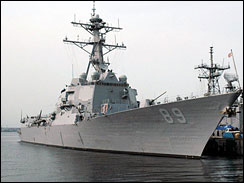
The USS Mustin, a U.S. Navy destroyer equipped
with the most advanced Aegis missile guidance
system, arrives at the Yokosuka base, near Tokyo
Saturday, July 8, 2006. (AP Photo)
CBS News
TOKYO, July 8, 2006
(CBS/AP) A new top-of-the-line U.S. guided missile destroyer with missile-tracking radar was deployed to Japan on Saturday, as tensions mounted over neighboring North Korea's recent missile tests.
The USS Mustin arrived Saturday at Yokosuka, homeport to the U.S. Navy's 7th Fleet, with its crew of 300 sailors for permanent assignment to the region, said 7th Fleet spokeswoman Hanako Tomizuka.
The move comes as the United States restructures its regional defenses amid growing concern about the nuclear ambitions of North Korea, which stunned northeastern Asia on Wednesday by test-firing seven missiles.
In August, Yokosuka will also welcome the USS Shiloh, which last month demonstrated its ability to shoot down missile warheads in a landmark test off the coast of Hawaii.
The Mustin, commissioned in 2003, is one of the most advanced in the fleet, but its deployment to Yokosuka was previously planned and not made in response to North Korea's latest missile shots, Tomizuka said.
Both the Mustin and the Shiloh are equipped with radar systems that employ so-called Aegis technology that is geared toward tracking and shooting down enemy missiles. The system was instrumental in identifying and assessing Wednesday's missile launchings, which all fell apparently harmlessly into the Sea of Japan.
The U.S. Navy now has eight Aegis-equipped vessels at Yokosuka, Kyodo News agency reported.
http://www.cbsnews.com/stories/2006/07/08/world/main1786400.shtml
U.S. Deploys Destroyer Against N. Korean Missiles
<font size="5"><center>U.S. Sends Missile Destroyer To Japan</font size>
<font size="4">With More N. Korea Missile Tests Looming, U.S. Naval Warship Deployed</font size></center>
The USS Mustin, a U.S. Navy destroyer equipped
with the most advanced Aegis missile guidance
system, arrives at the Yokosuka base, near Tokyo
Saturday, July 8, 2006. (AP Photo)
CBS News
TOKYO, July 8, 2006
(CBS/AP) A new top-of-the-line U.S. guided missile destroyer with missile-tracking radar was deployed to Japan on Saturday, as tensions mounted over neighboring North Korea's recent missile tests.
The USS Mustin arrived Saturday at Yokosuka, homeport to the U.S. Navy's 7th Fleet, with its crew of 300 sailors for permanent assignment to the region, said 7th Fleet spokeswoman Hanako Tomizuka.
The move comes as the United States restructures its regional defenses amid growing concern about the nuclear ambitions of North Korea, which stunned northeastern Asia on Wednesday by test-firing seven missiles.
In August, Yokosuka will also welcome the USS Shiloh, which last month demonstrated its ability to shoot down missile warheads in a landmark test off the coast of Hawaii.
The Mustin, commissioned in 2003, is one of the most advanced in the fleet, but its deployment to Yokosuka was previously planned and not made in response to North Korea's latest missile shots, Tomizuka said.
Both the Mustin and the Shiloh are equipped with radar systems that employ so-called Aegis technology that is geared toward tracking and shooting down enemy missiles. The system was instrumental in identifying and assessing Wednesday's missile launchings, which all fell apparently harmlessly into the Sea of Japan.
The U.S. Navy now has eight Aegis-equipped vessels at Yokosuka, Kyodo News agency reported.
http://www.cbsnews.com/stories/2006/07/08/world/main1786400.shtml
<font size="5"><center>U.S. Sends Missile Destroyer To Japan</font size>
<font size="4">With More N. Korea Missile Tests Looming, U.S. Naval Warship Deployed</font size></center>
The USS Mustin, a U.S. Navy destroyer equipped
with the most advanced Aegis missile guidance
system, arrives at the Yokosuka base, near Tokyo
Saturday, July 8, 2006. (AP Photo)
CBS News
TOKYO, July 8, 2006
(CBS/AP) A new top-of-the-line U.S. guided missile destroyer with missile-tracking radar was deployed to Japan on Saturday, as tensions mounted over neighboring North Korea's recent missile tests.
The USS Mustin arrived Saturday at Yokosuka, homeport to the U.S. Navy's 7th Fleet, with its crew of 300 sailors for permanent assignment to the region, said 7th Fleet spokeswoman Hanako Tomizuka.
The move comes as the United States restructures its regional defenses amid growing concern about the nuclear ambitions of North Korea, which stunned northeastern Asia on Wednesday by test-firing seven missiles.
In August, Yokosuka will also welcome the USS Shiloh, which last month demonstrated its ability to shoot down missile warheads in a landmark test off the coast of Hawaii.
The Mustin, commissioned in 2003, is one of the most advanced in the fleet, but its deployment to Yokosuka was previously planned and not made in response to North Korea's latest missile shots, Tomizuka said.
Both the Mustin and the Shiloh are equipped with radar systems that employ so-called Aegis technology that is geared toward tracking and shooting down enemy missiles. The system was instrumental in identifying and assessing Wednesday's missile launchings, which all fell apparently harmlessly into the Sea of Japan.
The U.S. Navy now has eight Aegis-equipped vessels at Yokosuka, Kyodo News agency reported.
http://www.cbsnews.com/stories/2006/07/08/world/main1786400.shtml
Re: U.S. Deploys Destroyer Against N. Korean Missiles
Bush isn't about to kiss that NK's ass like Clinton did. Secretary of State Madeline Albright under Clinton gave those ungrateful asses money to build a light water Nuclear reactor and sent tons of food and shit hoping that would make them happy. Nobody believed that shit would work but Madeline said it would. Didn't work. So might as well position some shit nearby to help Japan out because Japan is a trading partner with US interests. The US will protect it's money.
-VG
Bush isn't about to kiss that NK's ass like Clinton did. Secretary of State Madeline Albright under Clinton gave those ungrateful asses money to build a light water Nuclear reactor and sent tons of food and shit hoping that would make them happy. Nobody believed that shit would work but Madeline said it would. Didn't work. So might as well position some shit nearby to help Japan out because Japan is a trading partner with US interests. The US will protect it's money.
-VG
The biggest threat is N. Korea will pass portable nukes to terrorist out to destroy the U.S.. The fact that Russia and China are not getting involve in this means they want to see how this plays out meaning they want to see America fall. GB said last week on the anniversary of those bus bombing that they expect more, America should share that sentiment because it is coming here too and it will prolly be a wmd or something worst like a economic collapse.
QueEx said:ACCORDING TO CNN:
North Korea has launched a 3rd missile -- believe to be the long range missile
capable of reaching U.S. west coast. Mofo's on the West Coast -- take cover.
lol
QueEx
Although this article is somewhat dated, you have to wonder about the current status mentioned in the quoted statement.
U.S. Missile Defense Test Fails
Latest Setback in Pacific Fuels Doubts About System's Future
Bradley Graham/ Washington Post
December 16, 2004
The Bush administration's effort to build a system for defending the country against ballistic missile attack suffered an embarrassing setback yesterday when an interceptor missile failed to launch during the first flight test of the system in two years.
Pentagon officials could not immediately explain the reason for the failure. They said some kind of anomaly prompted the automatic shutdown of the launch sequence just 23 seconds before the interceptor was due to take off from the Marshall Islands in the Pacific. Plans had called for the interceptor to soar into space and knock down a mock warhead fired from Kodiak Island in Alaska about 16 minutes earlier.
The aborted test cast fresh doubt over when Defense Secretary Donald H. Rumsfeld would decide to put the new system on alert. That decision had been expected earlier this fall, after the installation of an initial set of six interceptors at a launch facility near Fairbanks, Alaska.
For weeks, Pentagon officials have described the facility as going through a "shakedown" phase and have insisted that the decision to declare it operational would be made independent of the outcome of the flight test. Lawrence Di Rita, the Pentagon's top spokesman, reiterated yesterday that "the test was not connected to any decisions about operational capability." He said Rumsfeld had been "given a very cursory description of the test and the results."
But until the root cause of the test failure is determined, the Pentagon cannot be sure of the reliability of the interceptors that have already been installed or what might be required to prevent a similar occurrence in the future.
http://www.pierretristam.com/Bobst/library/wf-242.htm
FUCKYOU said:Why In The Fuck Is Bush Sitting Around While This Chink Muthafucka Launches Test Misiles?
They have been expecting this for sometime...hence the accusations by the N Korean government of spying by the US....
If Necessary, Strike and Destroy
North Korea Cannot Be Allowed to Test This Missile
By Ashton B. Carter and William J. Perry
June 22, 2006
North Korean technicians are reportedly in the final stages of fueling a long-range ballistic missile that some experts estimate can deliver a deadly payload to the United States. The last time North Korea tested such a missile, in 1998, it sent a shock wave around the world, but especially to the United States and Japan, both of which North Korea regards as archenemies. They recognized immediately that a missile of this type makes no sense as a weapon unless it is intended for delivery of a nuclear warhead.
A year later North Korea agreed to a moratorium on further launches, which it upheld -- until now. But there is a critical difference between now and 1998. Today North Korea openly boasts of its nuclear deterrent, has obtained six to eight bombs' worth of plutonium since 2003 and is plunging ahead to make more in its Yongbyon reactor. The six-party talks aimed at containing North Korea's weapons of mass destruction have collapsed.
Should the United States allow a country openly hostile to it and armed with nuclear weapons to perfect an intercontinental ballistic missile capable of delivering nuclear weapons to U.S. soil? We believe not. The Bush administration has unwisely ballyhooed the doctrine of "preemption," which all previous presidents have sustained as an option rather than a dogma. It has applied the doctrine to Iraq, where the intelligence pointed to a threat from weapons of mass destruction that was much smaller than the risk North Korea poses. (The actual threat from Saddam Hussein was, we now know, even smaller than believed at the time of the invasion.) But intervening before mortal threats to U.S. security can develop is surely a prudent policy.
http://www.washingtonpost.com/wp-dyn/content/article/2006/06/21/AR2006062101518_pf.html
Commentary from CATO Institute Think Tank
[RM]http://www.cato.org/realaudio/logan-on-bbc-07-05-06.ram[/RM]
Iran
 N.Korea
[RM]http://www.cato.org/realaudio/logan-on-bbc-07-05-06.ram[/RM]
Iran
<font size="5"><center>U.N. Imposes Limited Sanctions on N. Korea </font size>
<font size="4">But North Korea Announced it "will go on with missile launch exercises
as part of its efforts to bolster deterrent for self-defense"</font size></center>

By EDITH M. LEDERER
07.15.2006, 06:23 PM
The U.N. Security Council voted unanimously Saturday to impose limited sanctions on North Korea for its recent missile tests, and demanded that the reclusive communist nation suspend its ballistic missile program. North Korea immediately rejected the resolution and vowed to continue missile launches.
U.S. Ambassador John Bolton said North Korea set "a world record" for a rejection - 45 minutes - and warned that Pyongyang's failure to comply could lead to further council action. He did not say what that might be.
The resolution bans all U.N. member states from selling material or technology for missiles or weapons of mass destruction to North Korea, and from receiving missiles, banned weapons or technology from Pyongyang.
It condemns North Korea's multiple missile launches on July 5 and demands that North Korea "suspend all activities related to its ballistic missile program" and re-establish a moratorium on missile launches. It strongly urges North Korea to return to six-party talks on its nuclear program, which have been stalled since last September.
North Korea's U.N. Ambassador Pak Gil Yon, who was in the Security Council chamber for the vote in a rare appearance, accused the council of trying to isolate his country, known officially as the Democratic People's Republic of Korea, or DPRK.
"The delegation of the Democratic People's Republic of Korea resolutely condemns the attempt of some countries to misuse the Security Council for the despicable political aim to isolate and put pressure on the DPRK, and totally rejects the resolution," he said.
The Korean People's Army "will go on with missile launch exercises as part of its efforts to bolster deterrent for self-defense in the future, too," he said.
Pak warned that North Korea will "take stronger physical actions of other forms should any other country ... take issue with the exercises and put pressure."
He immediately left the council chamber at the end of his speech in a move considered a breach of diplomatic protocol.
The resolution culminated 10 days of difficult negotiations and came after a last-minute compromise between Japan, the United States and Britain, who wanted a tough statement, and Russia and China, who favored weaker language.
The resolution adopted Saturday by a 15-0 vote states that the Security Council was "acting under its special responsibility for the maintenance of international peace and security."
Associated Press Writer Nick Wadhams contributed to this report
http://www.forbes.com/entrepreneurs/feeds/ap/2006/07/15/ap2881211.html
<font size="4">But North Korea Announced it "will go on with missile launch exercises
as part of its efforts to bolster deterrent for self-defense"</font size></center>
By EDITH M. LEDERER
07.15.2006, 06:23 PM
The U.N. Security Council voted unanimously Saturday to impose limited sanctions on North Korea for its recent missile tests, and demanded that the reclusive communist nation suspend its ballistic missile program. North Korea immediately rejected the resolution and vowed to continue missile launches.
U.S. Ambassador John Bolton said North Korea set "a world record" for a rejection - 45 minutes - and warned that Pyongyang's failure to comply could lead to further council action. He did not say what that might be.
The resolution bans all U.N. member states from selling material or technology for missiles or weapons of mass destruction to North Korea, and from receiving missiles, banned weapons or technology from Pyongyang.
It condemns North Korea's multiple missile launches on July 5 and demands that North Korea "suspend all activities related to its ballistic missile program" and re-establish a moratorium on missile launches. It strongly urges North Korea to return to six-party talks on its nuclear program, which have been stalled since last September.
North Korea's U.N. Ambassador Pak Gil Yon, who was in the Security Council chamber for the vote in a rare appearance, accused the council of trying to isolate his country, known officially as the Democratic People's Republic of Korea, or DPRK.
"The delegation of the Democratic People's Republic of Korea resolutely condemns the attempt of some countries to misuse the Security Council for the despicable political aim to isolate and put pressure on the DPRK, and totally rejects the resolution," he said.
The Korean People's Army "will go on with missile launch exercises as part of its efforts to bolster deterrent for self-defense in the future, too," he said.
Pak warned that North Korea will "take stronger physical actions of other forms should any other country ... take issue with the exercises and put pressure."
He immediately left the council chamber at the end of his speech in a move considered a breach of diplomatic protocol.
The resolution culminated 10 days of difficult negotiations and came after a last-minute compromise between Japan, the United States and Britain, who wanted a tough statement, and Russia and China, who favored weaker language.
The resolution adopted Saturday by a 15-0 vote states that the Security Council was "acting under its special responsibility for the maintenance of international peace and security."
Associated Press Writer Nick Wadhams contributed to this report
http://www.forbes.com/entrepreneurs/feeds/ap/2006/07/15/ap2881211.html
Similar threads

- Replies
- 0
- Views
- 266

- Replies
- 0
- Views
- 231
- Replies
- 1
- Views
- 208