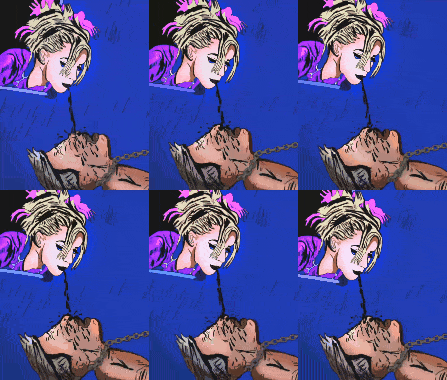
So a lot of people have been comparing Mistresstopia artstyle with Namio Harukawa’s art style. So here’s a breakdown somewhat
Harukawa's is a celebrated fine artist known for a "classic" fetish aesthetic, while Mistresstopia is rooted in a modern, digital comic book style.
1. Mistresstopia vs Namio Harukawa
• Namio Harukawa: Harukawa primarily worked with traditional media, specifically pencil and ink. His work is characterized by "hatching"—fine, meticulous lines used to create depth, shadow, and texture. It has a high-art, editorial quality that feels more like a portrait or a vintage illustration.
• Mistresstopia: This series utilizes digital art. The lines are cleaner and "slicker," typical of modern webcomics. It relies on digital gradients and flat colors rather than the complex cross-hatching found in Harukawa’s manual illustrations.
• Namio Harukawa: Harukawa is famous for the "gynoid" or hyper-voluptuous aesthetic. His women often have extremely exaggerated features—massive hips, thick legs, and large busts—paired with very small, often faceless or diminutive men. The anatomy is heavy and fleshy.
• Mistresstopia: The anatomy in the Unknown Nation series is more aligned with Western superhero comics. While the women are powerful and athletic, they generally follow "fit" or "Amazonian" proportions. The focus is more on muscularity and height rather than the specific soft-flesh exaggerations Harukawa specialized in.
• Namio Harukawa: Harukawa’s work is largely non-narrative. Most of his famous pieces are standalone illustrations that depict a single, intense moment of dominance. There is rarely a "story" beyond the immediate visual power dynamic.
• Mistresstopia: As part of the Unknown Nation universe, this is a narrative comic. It features dialogue, world-building (like the "Mistresses of Darkness" lore), and character arcs. The art is designed to move a story forward through panels rather than serving as a static piece of art.