Military Coup in Mali (W. Africa)

QueEx

Rising Star
Super Moderator

Military grabs power in Africa's Mali
as Libya fallout spreads


McClatchy Newspapers
Alan Boswell
Thursday, March 22, 2012


NAIROBI, Kenya — In the latest unforeseen consequence of the toppling of Moammar Gadhafi in Libya, a barracks mutiny turned into a full-fledged military power grab in the West African nation of Mali on Thursday, replacing an elderly, well-regarded statesman with a cadre of unknown junior officers.

On the face of it, Mali, which has been a democracy for 20 years, would not seem to be have been a prime candidate for Africa's latest coup, especially compared to its far more politically fluid neighbors in the impoverished region. President Amadou Toumani Toure was due to step down ahead of elections slated for April 29.

But events in the country took a sharp turn downhill after the conflict in Libya last year sent thousands of restless nomadic Tuareg tribesmen, whose Sahara Desert homeland stretches across the borders of five countries, spilling back into Mali's marginalized desert north, laden with weapons and military experience from having served in the Libyan army.

In a rebellion that began in January, the Tuareg from Libya quickly took ground against the Malian army. The Malian troops complained they did not have enough arms to counter the northern rebellion, and the young officers who took power seem to have tired of Toure's rhetoric of reconciliation, and his government's inability to impose control on the wild north.

In a televised statement, the military officers representing the country's new rulers said they were "putting an end to the incompetent regime of Amadou Toumani Toure."​

The U.S. and the pan-continental African Union immediately condemned the move, which robbed the West of a rare example of a democratic transfer of power in Africa. Toure, who is believed to be alive and in hiding, was finishing his second term as president. The constitution did not allow him to run for a third term, but unlike some of his peers, the Malian leader never attempted to rewrite the books to hang onto power.

The U.S. - stands "with the legitimately elected government," State Department spokeswoman Victoria Nuland said in a statement.

African Union - Jean Ping, the commission chair of the African Union, said the military takeover "constitutes a significant setback for Mali."


Kenya - Kenya's foreign minister, Moses Wetangula, who is stranded in Bamako until he can be evacuated, wrote on his Facebook page on Thursday: "We are still concerned and worried about our safety." Earlier in the day, he'd posted that the city was in turmoil. "Situation worsening. Curfew imposed. Airport closed. Heavier gunfire can be heard repeatedly."

The BBC reported that rebelling troops had looted the presidential palace.

Malian democracy is the biggest domino to come crashing down in the African Sahara's exposed underbelly — where jobs are scarce, governments weak, arms rampant and ethnic grievances rife — since last year's conflict in Libya shook the region.


Gadhafi's Influence

Gadhafi cast a wide shadow over his poorer neighbors to the south, flooding his friends with money and funding rebellions against his enemies. He also befriended the Tuareg and opened Libya's doors to streams of West African migrant laborers.

No people were more affected by Gadhafi's fall than the Tuareg, a tribe of desert nomads whose traditional homeland spreads across the borders of several countries. Thousands of Tuareg had moved to Libya to work, and many had joined Gadhafi's army.

When rebels overwhelmed Gadhafi's forces, the Tuareg fled south across the Sahara, returning to their homes in Niger, Mali, Burkina Faso and Algeria. Many carried with them the heavy weapons they'd held as Gadhafi soldiers. Those that had been truck drivers or oilfield laborers suddenly were without income as they fled south.

Shortly after Gadhafi's fall, experts predicted that the returning Tuareg could become a problem, with a population of 1.5 million to 3 million spread across a desert expanse that is largely outside the control of the region's governments.

To many Tuareg, Gadhafi was the closest thing they had to a friend in a region whose leaders are suspicious of the desert people's fiercely independent and sometimes violent ways. Tuareg representatives are a rarity in the capitals of any of the countries where they range, but Gadhafi visited Tuareg lands, tossed about his petrodollars, supported the rebels and mediated 2009 peace deals that ended Tuareg rebellions in Niger and Mali.​


Fighting broke out in northern Mali in early January as the Tuareg seized several towns. The Malian army retook the towns, but the Tuareg revolt continued, with the rebels advancing throughout northern Mali. Some reports suggest that about a third of the country is now under Tuareg control.


Experts also worried that the Tuareg would become easy partners with al Qaida's North Africa chapter, al Qaida in the Maghreb, a ghost-like band that has undertaken kidnappings of Westerners in Mali and Niger and attacked military bases in Algeria.

That concern propelled the United States to start training the Mali military in counterterrorism operations to fight AQIM — presumably some of the same units that now have seized control of the country.


(Boswell is a McClatchy special correspondent. His reporting is underwritten in part by a grant from Humanity United, a California-based foundation that focuses on human rights issues.)


http://www.mcclatchydc.com/2012/03/22/142834/military-grabs-power-in-africas.html


NDQ4b.Sm.91.jpg
 

Mali's Unfolding Coup


141701138.jpg


Stratfor
March 23, 2012


Summary

Capt. Amadou Haya Sanogo, leader of Mali's military junta, seized control of the capital of Bamako on March 21. The following day, he declared himself president of the National Committee for the Return of Democracy and the Restoration of the States (CNRDR). The coup appears to have started with what may have been an impromptu mutiny at the Kati barracks outside the city after a visit by Malian Defense Minister Gen. Sadio Gassama reportedly failed to address troops' grievances.

The discontent in the ranks takes place amid a renewed Tuareg insurgency in Mali's far north, and some Malian military forces fighting in the north have fallen back to the city of Gao in the aftermath of the coup. While it is not clear whether those forces' loyalties lie with Sanogo or Malian President Amadou Tomani, a significant amount of territory has already been ceded to Tuareg militants and may prove difficult for the Malian government to win back.


Analysis

Frustration with Toure and senior military officers appears to have been significant among the ranks for some time; in mid-February, less than a month after the most recent spate of clashes between the military and Tuareg rebels, deserters and their families began protesting in Bamako.

After the mutiny started, Sanogo appears to have led an effort to seize power. In addition to the presidential palace -- the physical seat of government power -- soldiers seized the state television and radio stations, shut down the airport and closed Mali's borders. These are critical targets in a coup because seizing them establishes control over key symbols of power and means of communications (and also denies the incumbent regime access to those resources).

The coup, led by officers in their 20s and 30s (notably backed by some more senior and older officers), was followed by a statement of grievances, the suspension of the constitution and the creation of the CNRDR, with Sanogo as president. These actions were couched in terms of returning the country to democracy, though Sanogo has already postponed elections scheduled for April -- a delay that could easily last into 2013. A curfew was imposed, but by March 23 people were encouraged to return to work during daylight hours (few did).

In a sense, Mali is two countries, with the demographic core in the south distinct and distant from the restive north. The intensifying Tuareg insurgency in the north that Mali has struggled to contain is thus separate from the coup in Bamako, located in the country's south. The two events are related, however: As the small Malian military moved more units northward to reinforce the intensifying counterinsurgency campaign, Bamako was left vulnerable in terms of the military forces located in and around the city. In other words, with so much of Mali's military engaged in the north, the number of units that must be co-opted, neutralized or isolated in and around the city for a successful coup was reduced.

The coup did face some challenges. While Malian Foreign Minister Soumeylou Boubaye Maiga and Territory Administrator Kafrougouna Kone appear to be in CNRDR custody, the president evaded capture and reportedly is in hiding, protected by members of the 33rd Parachute Regiment or "Red Berets," a loyalist unit of paratroopers in which the president once served. This is an important factor, since Toure can serve as a rallying point for loyalist forces and as a figure who foreign governments could support. Additionally, the coup occurred shortly after an African Union summit in Bamako and several prominent foreign diplomats are stuck in the capital, potentially attracting foreign attention counterproductive to the coup.

However, there is little immediate prospect of a meaningful counter-coup. While Burkina Faso to the southeast has intervened in coups in the region before, the popular support for the coup plotters (who appear to share some cultural and ethnic links to Burkina Faso) could hinder an overt intervention, which in any case would present serious logistical and operational obstacles. So while direct military intervention is unlikely, Burkina Faso could play a role as a mediator.

CNRDR is doing what it can to craft an image of broad support within the rank-and-file of the military, and the mutiny that occurred in the northern city of Gao prompted by news of the coup would suggest there is legitimacy to that claim. Furthermore, while elements of the loyalist 33rd Parachute Regiment may be protecting the president, much of that regiment is thought to be committed to the fight in the north, meaning it may not be in a position to intervene quickly.

It is not clear how unified the Malian military forces in the north are and where loyalties lie, as illustrated by the mutiny in Gao -- one of the two main northern cities being used as a key base of operations for Malian forces fighting the Tuareg. Malian military units are now falling back from operations farther north and rallying in Gao, though it is unclear whether the result will be more infighting or a unified force -- and to whom that force's loyalty will go. Meanwhile, Tuareg rebels claim to be advancing rapidly on Kidal, the other main base of Malian military operations in the north.

Basic military theory teaches that speed can be everything in a coup, and despite some important tactical failures such as Toure remaining at large, the junta appears to be in control of Bamako and could even have broad support among the population. The more time the coup plotters have to consolidate that control and support, the more difficult they will be to displace. The greatest threat to the junta at this point would be the return of Malian forces from the north to Bamako en masse -- though that would involve its own logistical and operational challenges, especially given the potentially broad discontent among the rank-and-file.

The junta claimed that the government's campaign against the Tuareg insurgency was ineffective in order to garner support, but it is far from clear that the coup leaders will be able to wage a different or more effective counterinsurgency campaign in the north. Mali's inability to marshal the resources necessary to pacify the region remains. But by returning hastily to Gao, Malian forces have ceded a great deal of territory to the Tuareg, changing the operational reality. Militants likely will be harder to remove if the Malian government mounts a new offensive to retake the ceded territory. For now, it appears the Tuareg rebellion is benefiting the most from the coup in Bamako.


Read more: Mali's Unfolding Coup | Stratfor


In Mali, rise of Islamic radicals poses new terrorism fears


1oXcKn.WiPh.91.jpg

Mali at war in March 2012. | Xinhua/Zuma Press/MCT


McClatchy Newspapers
By Matthew Schofield
Thursday, June 7, 2012


WASHINGTON — The government is in shambles. Rebels backed by money and weapons from terrorists have taken control of a large swath of the country. A shadow government is reportedly installing a radical Islamist agenda, with harsh Sharia law and anti-Christian attacks by roving armed bands.

This isn’t Afghanistan in the mid-1990s or Somalia in the last decade. It’s the northern half of Mali, an arid, Texas-sized chunk of northwest Africa.

Although details are sketchy, an unlikely alliance of Islamic radicals and moderate but long-marginalized Tuareg tribesmen seized northern Mali following a coup in the south two months ago. They proclaimed a new nation, Azawad, where Islamists have separated boys and girls in school, banned soccer and television and whipped people publicly for drinking alcohol.

The degree to which terrorist groups – including al Qaida of the Islamic Maghreb and Nigeria’s Boko Haram – have grabbed power is unclear, experts say. A U.S. official described the situation as “fluid.” But Maman Sidikou, the ambassador to Washington from Mali’s neighbor, Niger, says the world is looking at the formation of international terrorism’s next safe haven unless there is swift action to stop that from happening.

“The time to kill the snake is before it has babies. We don’t have the resources in the Sahel to deal with this problem,” he said, referring to the sparsely populated region of West Africa below the Sahara.

“The world is simply watching. Each day, radical Islam is consolidating its power and control in the area.”

U.S. officials in Washington say that while Mali isn’t at the top of their priority list, they are closely monitoring the situation.

“We are very concerned about developments in northern Mali,” said a U.S. official who requested anonymity because he was not authorized to speak publicly on the issue. “Extremists there are taking advantage of the security vacuum to spread their influence.”

Concern is more palpable in France, the former colonial power, where officials have described northern Mali as “a potential West African Afghanistan.” New French President Francois Hollande has said that Mali was at the “center of our discussions” about the region and that France’s priorities are “the restoration of constitutional order for Mali, territorial integrity and fighting terrorism.”

Seth Jones, a terror expert at the RAND Corporation, says the situation “isn’t helpful” to U.S. interests, but many questions remain: “What’s the goal? Who are they going to target? The threat right now appears to be to the region, and, if it escalates, to southern Europe.”

The U.S. sends Mali $140 million in aid annually, a combination of military and civilian assistance. In addition, the U.S. military has trained some members of Mali’s armed forces, including Capt. Amadou Sanago, who led the coup by junior officers two months ago. While the officers seized control of the south, the Tuaregs – a minority ethnic group whose power peaked centuries ago at the height of the African salt trade – remained in control of the north.

How did rebels outmuscle a national army long backed by U.S. dollars? Many blame the NATO-assisted collapse of Moammar Gadhafi’s regime for the rise of the terrorist enclave.

When Gadhafi’s regime fell, his weapons flooded from Libya through the Sahel. Many were carried by non-Malian Tuareg fighters looking for a new cause. Others were bought with money al Qaida in the Islamic Maghreb made from kidnapping and the drug trade.

The alliance of Tuareg nationalists and Islamic radicals also bolstered their power by seizing arms caches abandoned by the Malian army – some of it reportedly supplied by the United States – when its forces fled south.

The African Union, which sent a peacekeeping force to Somalia to battle the militant Islamist group al Shabab, has offered help, but the southern-based government remains too dysfunctional even to accept. After leading the coup, Sanago ceded control of the south to an interim government, but neither it nor the military retain any credibility. An interim president was beaten by a crowd of unhappy Malians and flown to France for unspecified medical treatment. Refugees have flooded south.

J. Peter Pham, director of the Atlantic Council’s Michael S. Ansari Africa Center, says that it will be “at least months before the government is able to function well enough to make decisions about the north, and perhaps a year before the military will again be capable of carrying out those policies.”

The Tuareg had launched previous rebellions against the southern-based government in Bamako. Their leader, Iyad Ag Ghali, now is at the helm of a radical Islamist group called Ansar Dine, which maintains deep respect among Tuareg nationalists. Experts say this likely explains what many see as an unnatural alliance between radical Islam and traditionally moderate, almost secular Tuaregs, but it’s unclear how long the alliance will last if the radicals overshadow the Tuaregs. For example, Ansar Dine and AQIM fighters reportedly are stationed at the most prestigious barracks, while Tuareg have accepted lesser lodgings.

“I think the Tuareg thought they were going to ride this very dangerous beast to victory, and instead they got bit, badly,” Pham said. “There is talk that the rebellion will collapse because the people in the region don’t back the harsh Sharia law being imposed, but the people with all the gold and guns will make the rules.”

Alexander Stroh, an expert at the German Institute of Global and Area Studies in Hamburg, said the north is far from being a functioning state, but that there is fear this rebellion could spread.

“It’s not clear, even, how many of the Tuareg fighters in the north have previous ties to Mali,” he said, adding that many Tuaregs have fled to the south as refugees.

While the Islamist coalition is hosted by Ansar Dine and largely funded by AQIM, it’s also thought to contain fighters from Nigeria’s Boko Haram and an AQIM offshoot called the Movement for Unity and Jihad in West Africa. Boko Haram has struck repeatedly in Nigeria, including a series of bombings of churches last December that killed 40 people, but this is believed to be its first foray abroad. There are also reports that foreign fighters from as far away as Pakistan are making their way into the world’s newest terror haven.

Sidikou, the ambassador from Niger, believes that the world’s inaction benefits the Islamists.

“The Tuareg are too weak to ever be in control of this coalition,” he said. “The world is giving dangerous radicals the time they need to sell their agenda to a very poor people. Starving people can be swayed by food. This is the type of land in which terrorism can thrive. And we have seen that when terrorism takes root even in very remote regions, it can quickly spread
to the rest of the world.”


Email: mschofield@mcclatchydc.com


SOURCE: http://www.mcclatchydc.com/2012/06/07/151543/in-mali-rise-of-islamic-radicals.html


XD6Gd.Sm.91.jpg


Islamists destroy Timbuktu religious treasures


3993838-3x4-340x453.jpg


ABC News
July 01, 2012


Hardline Islamists occupying northern Mali have gone on a rampage in Timbuktu, destroying ancient tombs of Muslim saints and threatening to wipe out every religious shrine in the fabled city.

The onslaught by armed militants from the fundamentalist Ansar Dine group was launched just two days after UNESCO named the city an endangered world heritage site because of the unrest in the vast desert north of Mali.

"They have raped Timbuktu today. It is a crime," said a source close to a local imam in the town known as the "City of 333 Saints".​

Witnesses said the Islamists had destroyed the ancient tomb of one revered Muslim figure after encircling a cemetery in the north of the Timbuktu, and were on the attack against another in the east on Saturday.

"This is tragic news for us all," Alissandra Cummins, chair of UNESCO's executive committee, said in a statement.

"I appeal to all those engaged in the conflict in Timbuktu to exercise their responsibility."

Ansar Dine, one of the hardline Islamist groups which seized control of the vast desert north of Mali in the chaotic aftermath of a March coup in Bamako, said no site would be safe in Timbuktu.

"Ansar Dine will today destroy every mausoleum in the city. All of them, without exception," spokesman Sanda Ould Boumama told AFP through an interpreter from the city.

The Ansar Dine spokesman suggested Saturday's action was in retaliation for the UNESCO decision to put the world heritage site, a cradle of Islamic learning founded in the fifth century, on its endangered list on Thursday.

"God is unique. All of this is haram (forbidden). We are all Muslims. UNESCO is what?" he said, declaring that Ansar Dine - which wants to impose sharia law in the region - was acting "in the name of God."

Witnesses in Timbuktu said the gangs had destroyed the mausoleum of a saint whose 15th century tomb was already desecrated in May by members of Al-Qaeda in the Islamic Magreb, another of the groups in control in the north.

"As I am speaking to you, Islamists from Ansar Dine have destroyed the mausoleum of saint Sidi Mahmoud," one witness said.

"They are now in the process of destroying the mausoleum [of Sidi Moctar]," added a local journalist. "They have said they will destroy everything."

UNESCO said its decision to place both the town and the nearby Tomb of Askia in Gao on its List of World Heritage in Danger "aims to raise cooperation and support for the sites threatened by the armed conflict in the region."

Mali has been gripped by chaos since disgruntled troops swarmed the capital Bamako in the south in March and ousted the elected president of what had been seen as one of Africa's model democracies.

Islamic and tribal Tuareg groups seized on the power vacuum to push government forces out of northern Mali, an area the size of France and Belgium, including Timbuktu and the cities of Gao and Kidal.

AFP


SOURCE: http://www.abc.net.au/news/2012-06-30/islamists-destroy-timbuktu-religious-treasures/4102688
 

Timbuktu world heritage site attacked by Islamists


Al-Qaida-linked Ansar Dine group destroys mausoleums
and tombs with pick-axes at centuries-old site in Mali


Timbuktu-008.jpg

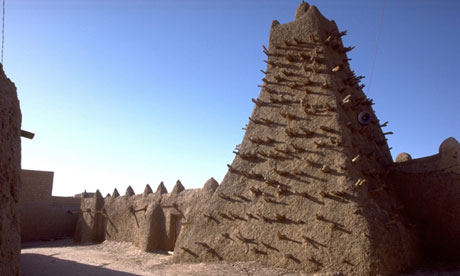
A minaret in Timbuktu, Mali. Photograph: UN photo/Evan Schneider/EPA


Islamists armed with Kalashnikovs and pick-axes have destroyed the centuries-old mausoleums of saints in the Unesco-listed city of Timbuktu in front of shocked locals, witnesses say.


The attack by the al-Qaida-linked Ansar Dine group came days after Unesco placed Timbuktu on its list of heritage sites in danger and will recall the 2001 dynamiting by the Taliban of two sixth-century statues of Buddha carved into a cliff in Bamiyan in central Afghanistan.

"They are armed and have surrounded the sites with pick-up trucks. The population is just looking on helplessly," said a local journalist, Yeya Tandina.

Tandina and other witnesses said Ansar Dine had already destroyed the mausoleums of three local saints – Sidi Mahmoud, Sidi el-Mokhtar and Alfa Moya – and at least seven tombs.

"The mausoleum doesn't exist any more and the cemetery is as bare as a soccer pitch," a local teacher, Abdoulaye Boulahi, said of the Mahmoud burial place.

"There's about 30 of them breaking everything up with pick-axes and hoes. They've put their Kalashnikovs down by their side. These are shocking scenes for the people in Timbuktu," said Boulahi.


Ansar Dine backs strict sharia law, and considers the shrines of the local Sufi version of Islam to be idolatrous. Sufi shrines have also been attacked by hardline Salafists in Egypt and Libya in the past year.

Locals said the attackers had threatened to destroy all of the 16 main mausoleum sites. The Unesco director general, Irina Bokova, called for an immediate halt. Late on Saturday, Tandina said Ansar Dine had halted the attacks. Attempts to contact members of the group were unsuccessful.

Ansar Dine has gained the upper hand over less-well-armed Tuareg-led separatists since the two joined forces to rout government troops and seize control in April of the northern two-thirds of the inland west African state.

The sites date from Timbuktu's golden age in the 16th century. Located on an old Saharan trading route along which salt from the Arab north was exchanged for gold and slaves from the south, Timbuktu blossomed as an Islamic seat of learning, home to priests, scribes and jurists.

Mali had in recent years sought to create a desert tourism industry around Timbuktu, but even before April's rebellion many tourists were being discouraged by a spate of kidnappings of westerners in the region claimed by al-Qaida-linked groups.

Unesco's world heritage committee said this week it had accepted the request of the Malian government to place Timbuktu on its list of endangered heritage sites.

"The committee … also asked Mali's neighbours to do all in their power to prevent the trafficking in cultural objects from these sites," it said.

The rebel seizure of the north came as the southern capital, Bamako, was struggling with the aftermath of a coup on 22 March.

Mali's neighbours are seeking UN backing for a military intervention to stabilise the country but security council members say they need more details on the mission being planned.

SOURCE: http://www.guardian.co.uk/world/2012/jul/01/timbuktu-world-heritage-site-attacked?newsfeed=true
 
628x471.jpg

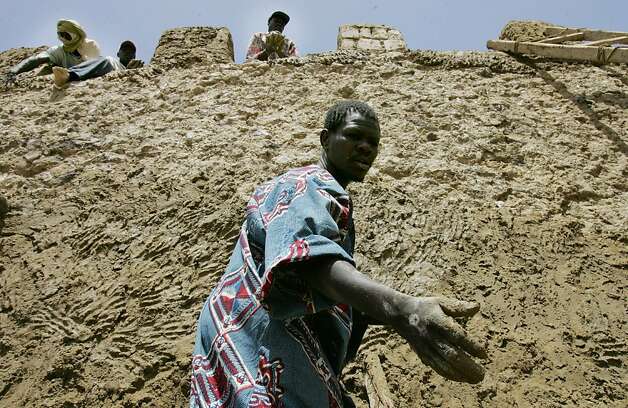
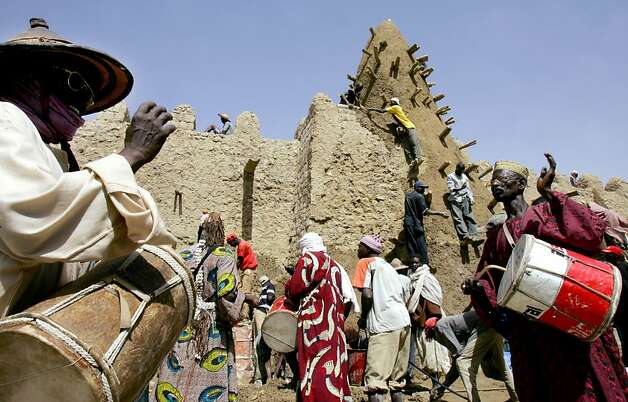
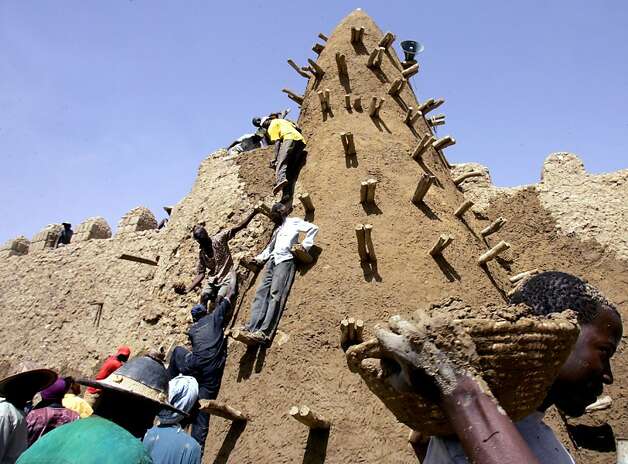
Residents of Timbuktu restore the City of 333 Saints' Great Mosque 10 April 2006 prior to the
Maouloud festival, marking the birth of the Muslim Prophet Mohammed. Ansar Dine, one of the
hardline Islamist groups controlling northern Mali, threatened on June 30, 2012 to destroy all
shrines of Muslim saints in the fabled city of Timbuktu, two days after the city was listed as
an endangered world heritage site by UNESCO. The Djingareyber Mosque was built by the Sultan
of Mali, Kankan Moussa, on his return from a pilgrimage to Mecca in 1325. AFP PHOTO ISSOUF
SANOGOISSOUF SANOGO/AFP/GettyImages Photo: Issouf Sanogo, AFP/Getty Images / SF


628x471.jpg


628x471.jpg

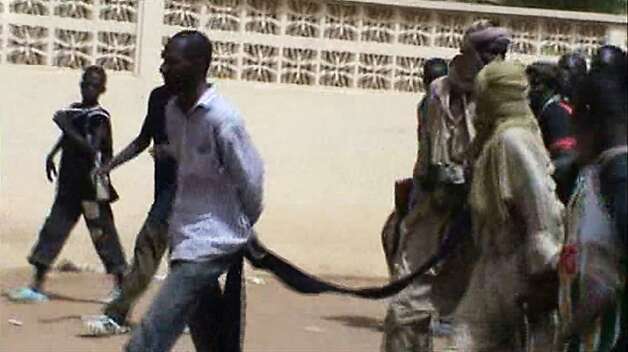
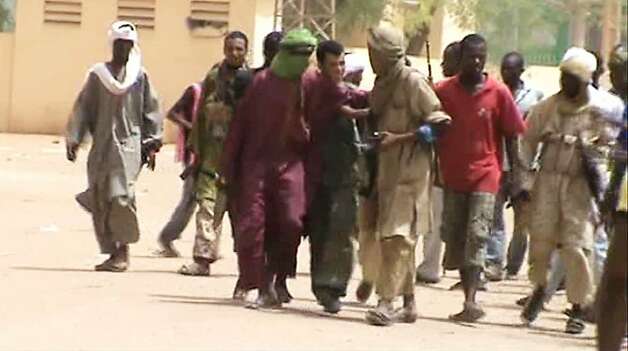
EXCLUSIVE IMAGES A still from a video shows a civilian man walking as he was captured by
fighters in the streets of Gao on June 27, 2012. Algerian jihadists arrived in Gao on June 29,
2012 to reinforce Islamist fighters in the northern Mali city after they chased Tuareg rebels from
the town they had jointly occupied for three months, sources said. The Islamist group which
drove out the Tuareg in fighting that caused 20 deaths, the Movement for Oneness and Jihad
in West Africa (MUJAO), along with AQIM and Ansar Dine (Defenders of Faith) have taken firm
control of Mali's vast north. Ansar Dine leader Iyad Ag Ghaly arrived in the town on June 28,
after the fighting a day earlier erupted between the Tuareg and Islamists resulted in the desert
nomads being dislodged from all key positions in the city. AFP PHOTO ATTENTION EDITORS:
THE PICTURE QUALITY IS POOR, HOWEVER, WE HAVE CHOSEN TO PROVIDE THESE IMAGES NEVER-
THELESS DUE TO THE DIFFICULTY OF ACCESS AND SCARCITY OF IMAGES FROM THE REGION.STR/
AFP/GettyImages Photo: Str, AFP/Getty Images / SF


628x471.jpg


628x471.jpg

EXCLUSIVE IMAGES A still from a video shows Islamist fighters walking in the streets of Gao
on June 27, 2012. Algerian jihadists arrived in Gao on June 29, 2012 to reinforce Islamist
fighters in the northern Mali city after they chased Tuareg rebels from the town they had
jointly occupied for three months, sources said. The Islamist group which drove out the
Tuareg in fighting that caused 20 deaths, the Movement for Oneness and Jihad in West
Africa (MUJAO), along with AQIM and Ansar Dine (Defenders of Faith) have taken firm control
of Mali's vast north. Ansar Dine leader Iyad Ag Ghaly arrived in the town on June 28, after the
fighting a day earlier erupted between the Tuareg and Islamists resulted in the desert nomads
being dislodged from all key positions in the city. AFP PHOTO ATTENTION EDITORS: THE
PICTURE QUALITY IS POOR, HOWEVER, WE HAVE CHOSEN TO PROVIDE THESE IMAGES NEVERTHE-
LESS DUE TO THE DIFFICULTY OF ACCESS AND SCARCITY OF IMAGES FROM THE REGION.STR/AFP/
GettyImages Photo: Str, AFP/Getty Images / SF


628x471.jpg

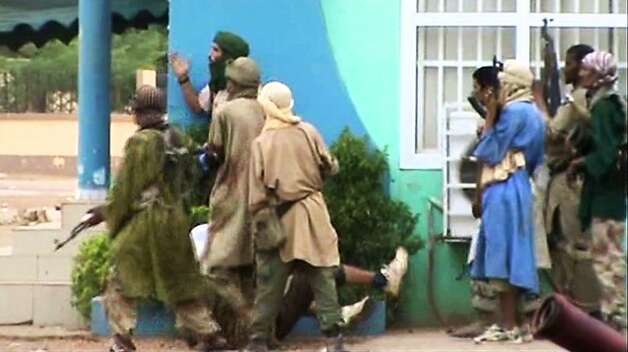
EXCLUSIVE IMAGES A still from a video shows armed Islamists patrolling in the streets of Gao on
June 27, 2012. Algerian jihadists arrived in Gao on June 29, 2012 to reinforce Islamist fighters in
the northern Mali city after they chased Tuareg rebels from the town they had jointly occupied
for three months, sources said. The Islamist group which drove out the Tuareg in fighting
that caused 20 deaths, the Movement for Oneness and Jihad in West Africa (MUJAO), along with
AQIM and Ansar Dine (Defenders of Faith) have taken firm control of Mali's vast north. Ansar Dine
leader Iyad Ag Ghaly arrived in the town on June 28, after the fighting a day earlier erupted between
the Tuareg and Islamists resulted in the desert nomads being dislodged from all key positions in the
city. AFP PHOTOSTR/AFP/GettyImages Photo: Str, AFP/Getty Images / SF


628x471.jpg

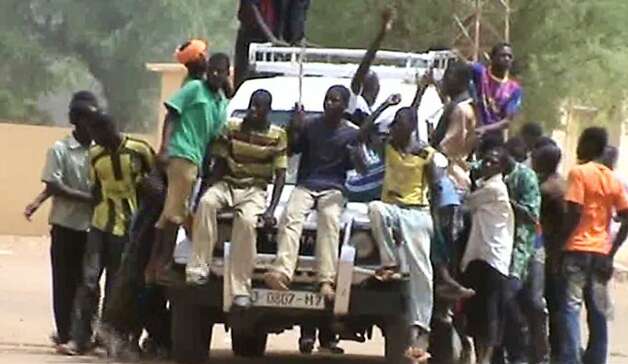
EXCLUSIVE IMAGES A still from a video shows civilians riding on a 4x4 car shouting "Allah Akhbar"
in the streets of Gao on June 27, 2012. Algerian jihadists arrived in Gao on June 29, 2012 to rein-
force Islamist fighters in the northern Mali city after they chased Tuareg rebels from the town
they had jointly occupied for three months, sources said. The Islamist group which drove out the
Tuareg in fighting that caused 20 deaths, the Movement for Oneness and Jihad in West Africa
(MUJAO), along with AQIM and Ansar Dine (Defenders of Faith) have taken firm control of Mali's
vast north. Ansar Dine leader Iyad Ag Ghaly arrived in the town on June 28, after the fighting a day
earlier erupted between the Tuareg and Islamists resulted in the desert nomads being dislodged
from all key positions in the city. AFP PHOTO ATTENTION EDITORS: THE PICTURE QUALITY IS
POOR, HOWEVER, WE HAVE CHOSEN TO PROVIDE THESE IMAGES NEVERTHELESS DUE TO
THE DIFFICULTY OF ACCESS AND SCARCITY OF IMAGES FROM THE REGION.STR/AFP/Getty
Images Photo: Str, AFP/Getty Images / SF

SOURCE: http://www.sfgate.com/world/slidesh...aints-tombs-destroyed-45315.php#photo-3141709


`
 

France launches airstrike in Mali


134409_mainimg.jpg

France's President Francois Hollande confirmed in Paris that French forces
were involved in repelling Al-Qaeda-linked radicals in Mali.


PARIS/BAMAKO: The French air force carried out an airstrike in Mali Friday in support of government forces trying to push back Islamist rebels, French Foreign Minister Laurent Fabius said, as Mali’s interim president declared a state of emergency.

The raid came as France launched a military intervention in the west African state to help the government resist a push south by rebel forces.

“President [Dioncounda] Traore has just decreed a state of emergency. The information will be transmitted on national television this evening,” the official told Reuters, asking not to be identified.

Britain backed France’s decision to give military support to the government in Mali to stem an advance by Islamist rebels, British Foreign Secretary William Hague said Friday.

“U.K. supports [the] French decision to provide assistance to [the] Government of Mali in the face of [the] rebel advance,” Hague tweeted.

Western powers fear the alliance of Al-Qaeda-linked militants that seized the northern two-thirds of Mali in April will seek to use the vast desert zone as a launchpad for international attacks.

“French forces brought their support this afternoon to Malian army units to fight against terrorist elements,” French President Francois Hollande told reporters. “This operation will last as long as is necessary.”

Hollande said U.N. Security Council resolutions meant France was acting in accordance with international laws.

Earlier, Hollande had made it clear that France would intervene to stop any further drive southward by Islamist rebels as Malian soldiers launched a counteroffensive to wrest back a town captured by militants this week.

The chairman of West African bloc ECOWAS authorized the immediate deployment of troops to Mali, a statement said Friday.

“The chairman, after consultations with his peers and conforming to Security Council Resolution 2085, is deciding to authorize the immediate sending of troops on the ground under the [African-led International Support Mission in Mali] to help the Malian army defend its territorial integrity,” said the statement signed by Ivory Coast President Alassane Ouattara, the current ECOWAS chairman.

The statement came after Mali’s army said troops from Nigeria, Senegal and France were deployed in support of government forces in their offensive against Islamists who have advanced to the center of the country.

Mali’s government appealed for urgent military aid from France Thursday after Islamist fighters encroached further south, seizing the town of Konna in the center of the country.

The rebel advance caused panic among residents in the nearby towns of Mopti and Sevare, home to a military base and airport.

“We are faced with blatant aggression that is threatening Mali’s very existence. France cannot accept this,” Hollande said in a speech to diplomats and journalists. “We will be ready to stop the terrorists’ offensive if it continues.”

The U.N. Security Council in December authorized the deployment of an African-led force supported by European states.

“The French believe that France, and Europe, face a real security threat from what is happening in the Sahel,” said Jakkie Cilliers, executive director of the Institute for Security Studies in South Africa.

More than two decades worth of peaceful elections had earned Mali a reputation as a bulwark of democracy in a part of Africa better known for turmoil – an image that unraveled in a matter of weeks after a coup last March that paved the way for the Islamist rebellion.

Residents had seen Western soldiers arriving late Thursday at an airport at Sevare, 60 km south of Konna.

Sevare residents also reported the arrival of military helicopters and army reinforcements, which took part in the counterattack to retake Konna Thursday night in a bid to roll back the militant’s southward drive.

“Helicopters have bombarded rebel positions. The operation will continue,” a senior military source in Bamako said.

A source at Sevare airport also said around a dozen war planes had arrived Friday. A spokesman for the Nigerian air force said planes had been deployed to Mali for a reconnaissance mission, not for combat.

A spokesman for one of the main groups in the Islamist rebel alliance said they remained in control of Konna.

Asked whether the rebels intended to press ahead to capture Sevare and Mopti, the Ansar Dine spokesman, Sanda Ould Boumama, said: “We will make that clear in the coming days.” He added that any intervention by France would be evidence of an anti-Islam bias.

The French Foreign Ministry stepped up its security alert on Mali and parts of neighboring Mauritania and Niger Friday, extending its red alert – the highest level – to include Bamako. France has eight nationals in Islamist hands in the Sahara after a string of kidnappings.

“Due to the serious deterioration in the security situation in Mali, the threat of attack or abduction is growing,” the ministry said in its latest travel alert.

Fabius said Islamist rebels in Mali want to take full control of the country and install a “terrorist state.”

French involvement in the conflict was aimed at preventing the rebels from making further gains and would last “as long as necessary,” he told a news conference.


http://www.dailystar.com.lb/News/In...201913-france-launches-airstrike-in-mali.ashx


Hollande: France will pursue operations to oust Islamist rebels in Mali

source: NBC News

130112-mali-hmed-130p.photoblog600.jpg

This picture released by the French Army Communications Audiovisual office shows French Mirage 2000 D aircraft flying to Mali overnight Thursday into Friday.

<!-- end16483124 -->

As French aircraft pounded rebel fighters in Mali for a second day Saturday, President Francois Hollande that France will pursue operations to oust Islamist rebels in the West Africa country.

The intervention, which Hollande said will be African-led, will step up anti-terrorist security measures. Neighboring West African states sped up their plans to deploy troops in the international campaign to prevent groups linked to al Qaida expanding their power base.

"We have already held back the progress of our adversaries and inflicted heavy losses on them. But our mission is not over yet," Hollande said.

French forces earlier launched airstrikes against Islamist rebels and sent troops to protect the capital city of Bamako in an operation involving several hundred soldiers, French Defense Minister Jean-Yves Le Drian said.

The operation has not started smoothly. A French pilot was killed during intense fighting on Friday when his helicopter was shot down during an attack -- a blow to the start of a campaign that represents the socialist leader's biggest foreign policy test since his May election.

More than 100 people including rebels and government soldiers were killed, according to military sources and witnesses. A resident in Gao, a stronghold of the rebel group, said fighters started arriving with their dead on Saturday.

In a separate incident in Somalia on Saturday, France also lost a commando and a secret agent held hostage since 2009, an operation Hollande said had been planned several days ago. His defense minister said the events in Mali and Somalia are unrelated.

Special forces dispatched

Defense Minister Le Drian said France had sent special forces into Mopti to prepare the ground.

France had additional Rafale fighter jets on standby to be deployed, he said.

French army chief Edouard Guillaud said Saturday that while its troops would help quash the rebel offensive, there were no current plans to extend operations to northern areas controlled by the Islamists.

Guillaud told reporters that extra military planes had been sent to Africa, after strikes had destroyed half a dozen pick-up trucks belonging to the rebels.

"We are in the buildup phase of operations ... As you know we have planes in Africa and have added more," he said. "The quicker the African mission is on the ground, the less we will need to help the Malian army."
 
Re: Hollande: France will pursue operations to oust Islamist rebels in Mali


A statement from the kidnappers said the assault
on the gas plant was launched in retaliation for
French intervention against Islamist groups
in neighbouring Mali.

<IFRAME SRC="http://www.bbc.co.uk/news/world-africa-21101092" WIDTH=760 HEIGHT=1500>
<A HREF="http://www.bbc.co.uk/news/world-africa-21101092">link</A>

</IFRAME>
 
This is all about Africom.Is it a coincidence that all this shit is happening as
tha US is planning to pull troops out of Afghanistan????Panetta basically spelled it out when he said they had to smoke out Muslim extremists no matter where they are and Clinton is currently talking up Africom and US boots in Africa for "An extended period of time" right now at her Libya hearing. :smh: :smh:
 
US Taxpayers Pick Up Tab For US Military Missions In Mali "Assisting" The French

As reported previously, not only are there currently US boots on the ground in the latest geopolitical "anti Al-Qaeda" snafu in Mali, but it turns out a US presence had been secretly in place for many months prior to the recent escalation in French-led hostilities against the western African nation. And while this would likely have opened up numerous media inquiries under any other administration, so far these has been zero interest as to just why the US is "assisting" the French in this latest military deployment of military forces outside of the US: after all, one of the biggest complaints about US spending is that so much of it goes for military purposes (ignoring that all the tax revenues can't even cover just the monthly entitlement spending of the nation).

Perhaps one reason is that, at least to date, the general consensus was that since the French operation in Mali is spearheaded and organized by the French, it is also funded by them. As it turns out that is not the case.

As Reuters reports, "The U.S. military has flown five C-17 cargo sorties into the Malian capital to help bring a French mechanized infantry unit into the fight against al Qaeda-affiliated militants in the north of the country, Pentagon officials said on Tuesday." But surely the French are paying for these sorties which are there only to help the French, right? Wrong. "Little said the United States had decided not to seek compensation or reimbursement from France for the flights." Luckily, the US is in such a healthy financial position it can afford to not only open one more front in the war against "Al Qaeda", but will sign for the French tab too. With Joe Sixpack's money of course.

More from Reuters:

A small group of U.S. military troops, including two communications personnel, have been on the ground at the airport at Bamako temporarily to help coordinate the logistics for the C-17 flights, a military official said.

Defence Secretary Leon Panetta said last week that while the United States supported France's decision to put troops into Mali to stop the advance of al Qaeda affiliated troops toward Bamako, the Pentagon had no plans to put U.S. combat troops on the ground there.

Pentagon spokesman George Little said the United States had been providing France with intelligence since the outset of the operation. He said the Pentagon had now begun providing airlift capacity and was still reviewing a request for aerial refuelling tankers.

"We stand by our French allies. At this point we are providing airlift support to the French and as of January 22 ... the United States Air Force has flown five C-17 sorties moving French personnel, supplies and equipment into the country," Little said. "We have carried more than 124 tons of equipment and supplies and more than 80 passengers."

Another spokesman said the U.S. flights were helping to carry a French mechanized infantry unit to Mali.

And the punchline:

The Wall Street Journal reported over the weekend that the issue of payment had caused friction between the two sides. "Compensation and reimbursement is always a point of discussion when it comes to these operations, with the French or other allies for that matter," Little told reporters on Tuesday. "In this instance we have made a decision at this time not to seek reimbursement or compensation," he said. "The focus right now is not on money but is on achieving our shared goal of thwarting militants in northern Mali."

At least they have not discovered Weapons of Mass Destruction. Yet.

Of course, who cares about what the costs of peace, and war, are when it is the Federal Reserve's monetization of the budget deficit, and countless future born and unborn US citizens, who are paying the price.

In other news, the US has a "not enough taxation" problem.
 
<IFRAME SRC="http://www.theatlantic.com/infocus/2013/01/the-conflict-in-mali/100446/" WIDTH=780 HEIGHT=1900>
<A HREF="http://www.theatlantic.com/infocus/2013/01/the-conflict-in-mali/100446/">link</A>

</IFRAME>
 
I keep saying, Muslims really don't care about Africa.


You really mean Islamic Fundamentalist don't you ??? That group tends to be opposed to our very existence. But, there are without question Muslims who do not seek our demise and there are most definitely places where people appear, to some degree peacefully or democratically, to have opted for their chief influence to be Muslim, and they appear to care about their people as much as any other religion or non-relgion does or would.


,
 
You really mean Islamic Fundamentalist don't you ??? That group tends to be opposed to our very existence. But, there are without question Muslims who do not seek our demise and there are most definitely places where people appear, to some degree peacefully or democratically, to have opted for their chief influence to be Muslim, and they appear to care about their people as much as any other religion or non-relgion does or would.


,

I would say this, the extremist see Africa as a good place to recruit manpower. I mean why not use them to do the dirty work like piracy, and scams. Funny how it seems like every race tries to find a way to scam our race.
 
You really mean Islamic Fundamentalist don't you ??? That group tends to be opposed to our very existence. But, there are without question Muslims who do not seek our demise and there are most definitely places where people appear, to some degree peacefully or democratically, to have opted for their chief influence to be Muslim, and they appear to care about their people as much as any other religion or non-relgion does or would.


,


Fundamentalists for sure, but Islam, like Christianity and Hebrew have no interests in exposing the greatness of Africa.

Do they "seek our demise"? By "our", do you mean the western Euro centric culture?... Because despite what many think, we of African descent, that have generations in the West are more Western in our thought than "African". No, I don't think "they" seek our demise".

But you cannot deny, "African" cultures over the centuries has been demeaned, bastardized, trivialized, reviled, made evil and called uncivilized.

Remember Africa, despite what has gone on there over the last 500 years, is the origin of humanity and culture.

Their must be somethings of that land and people that are redeeming and deserved to be honored, preserved and taught to the world.

As Malcolm X said, before we were Christians, we were Black!
 
You really mean Islamic Fundamentalist don't you ??? That group tends to be opposed to our very existence. But, there are without question Muslims who do not seek our demise and there are most definitely places where people appear, to some degree peacefully or democratically, to have opted for their chief influence to be Muslim, and they appear to care about their people as much as any other religion or non-relgion does or would.


,

<iframe width="560" height="315" src="http://www.youtube.com/embed/i-BD7P9I7Wg" frameborder="0" allowfullscreen></iframe>
 
Fundamentalists for sure, but Islam, like Christianity and Hebrew have no interests in exposing the greatness of Africa.

Do they "seek our demise"? By "our", do you mean the western Euro centric culture?... Because despite what many think, we of African descent, that have generations in the West are more Western in our thought than "African". No, I don't think "they" seek our demise".

But you cannot deny, "African" cultures over the centuries has been demeaned, bastardized, trivialized, reviled, made evil and called uncivilized.

Remember Africa, despite what has gone on there over the last 500 years, is the origin of humanity and culture.

Their must be somethings of that land and people that are redeeming and deserved to be honored, preserved and taught to the world.

As Malcolm X said, before we were Christians, we were Black!

Of course, I was speaking of demise vis a vis western culture. But, I think its safe to say that Islamic Fundamentalism, in many respects, seeks preeminence over all that is not of its particular brand of Islam, including quite possibly, Malcolm's theology and sociology, as well. No?


,
 
Of course, I was speaking of demise vis a vis western culture. But, I think its safe to say that Islamic Fundamentalism, in many respects, seeks preeminence over all that is not of its particular brand of Islam, including quite possibly, Malcolm's theology and sociology, as well. No?


,

Doesn't Christian fundamentalism seek to do the same?
 
Most religions have as their stated goals the propagation of their beliefs.
With regards to religious fundamentalist, the belief systems appear to be
less tolerant of things inconsistent with those beliefs. The more rigid the
adherence to those beliefs it appears the less tolerant the belief system.


,
 
<IFRAME SRC="http://www.bbc.co.uk/news/world-africa-21555898" WIDTH=760 HEIGHT=1500>
<A HREF="http://www.bbc.co.uk/news/world-africa-21555898">link</A>

</IFRAME>
 

The US military says it has deployed surveillance drones in Niger to gather information on the Islamist militants.

The intelligence collected by a 100-strong contingent of US personnel from across the border is being shared with French troops in Mali, who are assisting thousands of troops from African states.

US drones

Islamist rebels are believed to have retreated to the Ifoghas mountains - a desert area in the Kidal region near the border with Algeria - after being forced from northern population centres in recent weeks.


Obama alerts Congress
he's sent military personnel to Niger​


McClatchy Newspapers
by Lesley Clark
February 22, 2013


President Obama says about 100 U.S. military personnel have been deployed to the African nation of Niger.

In a letter to Congress, Obama says the forces will provide support for "intelligence collection" and "intelligence sharing” with French troops fighting militants in neighboring Mali.

He said 40 U.S. troops arrived Wednesday, with the consent of the government of Niger, bringing the troop total to 100. Obama said the forces are armed, "with weapons for the purpose of providing their own force protection and security."​


Read more here: http://blogs.mcclatchydc.com/washin...elp-french-efforts-in-mali.html#storylink=cpy


<IFRAME SRC="http://www.theatlantic.com/international/archive/2013/03/in-mali-a-star-singer-calls-for-war/274317/" WIDTH=760 HEIGHT=2100>
<A HREF="http://www.theatlantic.com/international/archive/2013/03/in-mali-a-star-singer-calls-for-war/274317/">link</A>

</IFRAME>
 
UN takes over from African troops in Mali

Analysis: Africa defense force never more needed but still a paper tiger
UN takes over from African troops in Mali
By BABA AHMED | Associated Press –
Mon, Jul 1, 2013

BAMAKO, Mali (AP) — An African force was formally transformed into a United Nations peacekeeping mission at a ceremony in Mali's capital on Monday, six months after French and African troops launched a military intervention to take back the country's north from al-Qaida-linked rebels.

The roughly 6,200 African troops, whose effectiveness in the field was hampered by major logistical lapses including units who were sent to Mali without weapons, will be folded into the Integrated United Nations Mission for the Stabilization of Mali, or MINUSMA. The force is expected to grow to more than 12,600 peacekeepers, though the timeline for the build-up is not clear.

"The composition of the MINUSMA is going to grow gradually in coming months," said Bert Koenders, a Dutch politician who is heading the mission.

In April, the U.N. Security Council authorized an 11,200-strong peacekeeping force and 1,440 international police to replace the 6,000-member African-led mission. The force is being led by military commander Maj. Gen. Jean Bosco Kazura, a Rwandan who was formerly head of the Rwandan Defense Forces Combat Training Center.

Before being integrated into the U.N. force, the African troops have long complained about the lack of supplies. A contingent in Burkina Faso based in the crucial northern city of Timbuktu, for example, said they could not fight the insurgents at night because they were missing night vision goggles. And the soldiers said they could not chase the extremists during the day because the rebels were using pickup trucks that ran on petrol, which drive faster than the gasoline-guzzling vehicles used by the military.

"This is a mission that has its own challenges, but we are here to say that we will find a solution to these obstacles," said Kazura. "Our goal is to accompany and support the peace process in Mali, and with everyone's help we will succeed."

Mali was plunged into near-anarchy last year when a junior military officer led a coup in the capital, toppling the nation's longtime leader. Insurgents in the north took advantage of the chaos to push into the main northern cities, succeeding in taking a France-sized territory. They ruled the area for 10 months until France launched a military intervention on Jan. 11.

The intervention was supposed to be a joint effort with African forces, but neighboring nations were slow to send troops and many came without crucial equipment and were left stranded in Bamako. The French swiftly moved north, and succeeded in liberating two of the three main towns in the north before the end of January.

With the exception of Chadian forces, who aggressively fought the insurgents in the Adrar des Ifoghas area of northern Mali, a foreboding landscape dubbed "Planet Mars" because of its red-colored and rocky terrain, the other African units largely played a support role. Many worry that with the drawdown of French forces, the insurgents will succeed in returning to Mali's deserted north and prove no match for the peacekeepers.

http://news.yahoo.com/un-takes-over-african-troops-mali-142941921.html;_ylt=A2KJ2Ui_JtVRgHoApFfQtDMD
 
Mali’s New President-Elect Faces a Long, Hard Road Ahead

Mali’s New President-Elect Faces a Long, Hard Road Ahead
By Aryn Baker @arynebaker
Aug. 13, 2013

Former Prime Minister Ibrahim Boubacar Keita will be Mali’s new president after his rival conceded the fight late Monday night, days before the official results of Sunday’s election were to be announced. Former finance minister and one-time ally Soumalia Cissé’s concession is a seemingly smooth conclusion to the tightly contested election. It clears the way for a new page in Mali after a tumultuous 18 months that saw a coup, the near division of the country, an al Qaeda-affiliated Islamist take over of the north, a French-led military intervention and the arrival of a U.N. peacekeeping force. Winning a race that started with 27 candidates and went to a second round on Sunday seems almost simple compared to what Keita faces as he attempts to mend the country’s wounds. If his past and his campaign promises to restore Mali’s honor—an oblique reference to efforts to quieten a disgruntled ethnic group that seeks autonomy for the country’s north—are any indication, he is unlikely to solve the problems that have undermined Mali for decades, setting the stage for more strife to come.

The immediate future, however, is more optimistic. The successful election will unlock some $4 billion in promised aid from international donors, who refused contributions until Mali could mark a successful return to democracy. In addition the United States, one of Mali’s most important military partners, will be able to resume military assistance to the country as it embarks on a new efforts to prevent Islamist militants from expanding their foothold in the region. Mali’s northern expanse, the size of France and Spain combined, is a largely lawless area that borders the Saharan stretches of Mauritania, Algeria, Libya and Niger. The Sahel, as the region is known, is home to drug smugglers, gunrunners, kidnap-for-ransom gangs, human traffickers and militant groups linked to al-Qaeda, including Al Qaeda in the Islamic Maghreb, or AQIM.

One of the world’s most aid-dependent countries, Mali’s sudden collapse, triggered by a coup on March 22, 2012, was a shock to most observers, who had long held the country up as a beacon of democracy in a region plagued by strongmen. But democracy in Mali was a façade stitched out of a social imperative to seek consensus and accommodation at the expense of accountability. As a result both government institutions and the military had been hollowed out by a decade of corruption and nepotism—a state of affairs made all the more clear when military efforts to calm a northern rebellion collapsed immediately following the coup. Soldiers in the northern garrisons fled at the first sign of the rebel advance, shedding their uniforms and refusing to protect a civilian population now at the mercy of ethnic Tuareg rebels allied with the Islamist groups based in the Sahel. In three days the alliance captured the capitals of the three northern regions, Kidal, Gao and Timbuktu. Once entrenched, the Islamists shunted the Tuareg-dominated National Movement for the Liberation of Azawad (MNLA) rebels aside and instituted their harsh interpretation of Islamic law on a terrified population.

Keita’s campaign promise to end corruption echoed that of coup leader Captain Amadou Sanogo, who justified overthrowing the government for the same reasons. “Mali was stolen from us,” Keita said in a recent campaign speech. “That government ate it up and sucked the bones dry. They humiliated us to the point that people started to ally with the Islamists. Malians, that will never happen again.” Yet Keita, as a member of parliament and a Prime Minister from 1994 to 2000, was a member of the same government. His detractors wonder how a product of such a system will ever be able to clean it up. Then again, voters had little choice: most candidates came from the same pool of political elite. Keita boasted he earned endorsements from at least 22 of the 25 candidates knocked out of the race.

Short on details, Keita, 68, also promised to restore Mali’s dignity and honor. He has been an outspoken critic of a 2006 peace deal with the Tuareg separatists that now make up the MNLA. The deal was never fully realized, causing dismay among the historically nomadic and light-skinned Tuaregs that live in the north and who say they are systematically excluded from benefiting by the nation’s wealth. The other ethnic groups of the area resent what they see as undue concessions to a group that makes up less than 10 percent of the population. The reality, say most observers, is that corruption among northern leaders deprived all sides their due.

No matter his thoughts on the prior peace deal, Keita will have to oversee the implementation of a far-reaching reconciliation program if he is to prevent further uprisings. That will prove difficult. The recent crisis has hardened attitudes, and northern residents largely blame Tuaregs—even the ones not affiliated with the uprising—for opening the doors to the Islamists and allowing them to unleash a 10-month reign of terror that only ended with a French military intervention. The MNLA, which still controls the northern city of Kidal, allowed a ceasefire for elections, though only a reported 12% of voters cast ballots there. And hostilities are likely to resume if negotiations don’t start up soon. The U.N. refugee agency says 527,000 Malians, mostly Tuaregs and light skinned Arabs, have decamped from the north for fear of reprisals. If they don’t return, the economy of the north, already weak, could collapse entirely.

The French forces, which once numbered 4,500, will draw down to a 1,000-strong counterterror force by year’s end. Meanwhile some 12,600 U.N. peacekeepers, mostly drawn from African Union states, will start deploying to Mali as part of an open-ended stabilization force. Mali welcomes the force, and its integrated police and military training program will be essential for strengthening the armed forces—as well as the population’s faith in their soldiers. But the influx of such high numbers can put additional strains on a country that are not be immediately apparent, from economic distortion to resentment stemming from cultural misunderstandings.

Cissé, after conceding in person to Keita, announced his decision on Twitter: “May God bless Mali,” he wrote. Mali will need those blessings. So too will Keita.

http://world.time.com/2013/08/13/in...nd-a-president-elect-faces-a-long-road-ahead/
 
Re: Mali’s New President-Elect Faces a Long, Hard Road Ahead

<iframe width="780" height="1525" src="http://www.bbc.com/news/world-africa-26909113" frameborder="0" allowfullscreen></iframe>
 
Back
Top