

Install the app
How to install the app on iOS
Follow along with the video below to see how to install our site as a web app on your home screen.
Note: This feature may not be available in some browsers.
You are using an out of date browser. It may not display this or other websites correctly.
You should upgrade or use an alternative browser.
You should upgrade or use an alternative browser.
Madoff left them Badoff
- Thread starter World B Free
- Start date



 good read..............
A False Sense of Security
from Townhall.com
A False Sense of Security
John Stossel
Wednesday, January 14, 2009
The $50-billion investment scam allegedly pulled off by Wall Street insider Bernard Madoff has ignited predictable calls for more regulation.
The "massive fraud ... was made possible in part because the regulators who were assigned to oversee Wall Street dropped the ball," said President-elect Obama.
"This scandal underscores the need for a 21st century regulatory approach," writes Arthur Levitt Jr., former chairman of the Securities and Exchange Commission (SEC), in The Wall Street Journal.
Notice the disconnect. Regulation failed, so we need more regulation. I see it differently. Regulation failed, so let's try free markets. That would be a change.
Regulation did indeed fail. "An executive in the securities industry, Harry Markopolos, contacted the SEC's Boston office in May 1999, urging regulators to investigate Mr. Madoff. Mr. Markopolos continued to pursue his accusations over the past nine years," The Wall Street Journal reported.
Of course, when a regulatory agency fails, the usual response is to make it bigger, not abolish it. Economist Robert Murphy notes, "In the private sector, when a firm fails, it ceases operations. The opposite happens in government. There is literally nothing a government agency could do that would make the talking heads on the Sunday shows ask, 'Should we just abolish this agency? Is it doing more harm than good?'"
Most people won't like the suggestion that we dump regulation for free markets. We can't let markets run themselves, they'll say. Someone has to protect the unsuspecting from conmen. The Madoff case shows why this view is wrong. We've always been told that regulation of financial markets protects the least knowledgeable investors. Sophisticated people know what they are doing and can fend for themselves.
But Madoff's alleged Ponzi scheme is fascinating precisely because it caught some very knowledgeable people. They knew Madoff. Everyone trusted him, including the regulators.
That's one reason those savvy investors gave him their money. But there is surely another reason. Since the 1930s, investors have been led to believe the regulatory system watches out for dishonest investment schemes. That creates a false sense of security -- and sets people up to be conned.
Advocates of regulation attribute almost magical powers to regulators, but clever cheats can get around any system. They always have. It's their chosen profession, and the regulators can't look everywhere. Regulation advocates also assume that bureaucrats are disinterested and incorruptible, but we know this is not always true. People who work in government are like anyone else. There will always be a percentage of individuals who can be tempted by corrupt opportunities. The logic of regulation would require that super bureaucrats be appointed to watch over the regulatory agencies.
But who will watch over them?
This is why regulation is counterproductive and a poor substitute for investor vigilance. The more rigorous the regulatory effort appears, the more risky it is.
Regulation by market discipline is better, but in our state-dominated culture few people realize this. Arthur Levitt says, "The complexity of today's products, markets and investment strategies calls for a laser-like focus [by the SEC] on risk assessment."
But the opposite is true. Savvy investors would do their own risk assessment if they didn't believe the government was doing it for them. And wouldn't they do a better job, considering it was their own money at risk? Regulators risk nothing.
Of course many of us investors are unqualified to assess risk for ourselves. But we could pay specialists for the service, generating a competitive market for risk assessment -- in contrast to the monopolistic SEC and other agencies.
That form of investor protection would be superior in every way to a system that gives a bureaucracy arbitrary power. After all, private risk assessors would have to justify their fees, which clients would pay voluntarily.
Current government regulation interferes with honest voluntary exchanges by imposing arbitrary terms and requiring tons of paperwork disclosing information no one wants anyway.
Fraud will always exist. Enforcement of anti-fraud laws is a useful deterrent, but in the end there's no substitute for investor vigilance. Government regulations provide a false sense of security -- and that's worth less than no sense of security at all.
Copyright © 2008 Salem Web Network. All Rights Reserved.
from Townhall.com
A False Sense of Security
John Stossel
Wednesday, January 14, 2009
The $50-billion investment scam allegedly pulled off by Wall Street insider Bernard Madoff has ignited predictable calls for more regulation.
The "massive fraud ... was made possible in part because the regulators who were assigned to oversee Wall Street dropped the ball," said President-elect Obama.
"This scandal underscores the need for a 21st century regulatory approach," writes Arthur Levitt Jr., former chairman of the Securities and Exchange Commission (SEC), in The Wall Street Journal.
Notice the disconnect. Regulation failed, so we need more regulation. I see it differently. Regulation failed, so let's try free markets. That would be a change.
Regulation did indeed fail. "An executive in the securities industry, Harry Markopolos, contacted the SEC's Boston office in May 1999, urging regulators to investigate Mr. Madoff. Mr. Markopolos continued to pursue his accusations over the past nine years," The Wall Street Journal reported.
Of course, when a regulatory agency fails, the usual response is to make it bigger, not abolish it. Economist Robert Murphy notes, "In the private sector, when a firm fails, it ceases operations. The opposite happens in government. There is literally nothing a government agency could do that would make the talking heads on the Sunday shows ask, 'Should we just abolish this agency? Is it doing more harm than good?'"
Most people won't like the suggestion that we dump regulation for free markets. We can't let markets run themselves, they'll say. Someone has to protect the unsuspecting from conmen. The Madoff case shows why this view is wrong. We've always been told that regulation of financial markets protects the least knowledgeable investors. Sophisticated people know what they are doing and can fend for themselves.
But Madoff's alleged Ponzi scheme is fascinating precisely because it caught some very knowledgeable people. They knew Madoff. Everyone trusted him, including the regulators.
That's one reason those savvy investors gave him their money. But there is surely another reason. Since the 1930s, investors have been led to believe the regulatory system watches out for dishonest investment schemes. That creates a false sense of security -- and sets people up to be conned.
Advocates of regulation attribute almost magical powers to regulators, but clever cheats can get around any system. They always have. It's their chosen profession, and the regulators can't look everywhere. Regulation advocates also assume that bureaucrats are disinterested and incorruptible, but we know this is not always true. People who work in government are like anyone else. There will always be a percentage of individuals who can be tempted by corrupt opportunities. The logic of regulation would require that super bureaucrats be appointed to watch over the regulatory agencies.
But who will watch over them?
This is why regulation is counterproductive and a poor substitute for investor vigilance. The more rigorous the regulatory effort appears, the more risky it is.
Regulation by market discipline is better, but in our state-dominated culture few people realize this. Arthur Levitt says, "The complexity of today's products, markets and investment strategies calls for a laser-like focus [by the SEC] on risk assessment."
But the opposite is true. Savvy investors would do their own risk assessment if they didn't believe the government was doing it for them. And wouldn't they do a better job, considering it was their own money at risk? Regulators risk nothing.
Of course many of us investors are unqualified to assess risk for ourselves. But we could pay specialists for the service, generating a competitive market for risk assessment -- in contrast to the monopolistic SEC and other agencies.
That form of investor protection would be superior in every way to a system that gives a bureaucracy arbitrary power. After all, private risk assessors would have to justify their fees, which clients would pay voluntarily.
Current government regulation interferes with honest voluntary exchanges by imposing arbitrary terms and requiring tons of paperwork disclosing information no one wants anyway.
Fraud will always exist. Enforcement of anti-fraud laws is a useful deterrent, but in the end there's no substitute for investor vigilance. Government regulations provide a false sense of security -- and that's worth less than no sense of security at all.
Copyright © 2008 Salem Web Network. All Rights Reserved.
Re: A False Sense of Security
I'd agree with this, we don't need more regulators, we need the govt. to enforce anti-fraud laws - plain and simple! Also, I just want to add this: Everyone is greedy but the lust for profit is always counter-balanced with the risk of loss! It is only when the govt gets involved in the free market that you see colossal missteps.
Hence capitalism should not be blamed: Market intervention by "you know who" is where the blame lies.
I'd agree with this, we don't need more regulators, we need the govt. to enforce anti-fraud laws - plain and simple! Also, I just want to add this: Everyone is greedy but the lust for profit is always counter-balanced with the risk of loss! It is only when the govt gets involved in the free market that you see colossal missteps.
Hence capitalism should not be blamed: Market intervention by "you know who" is where the blame lies.
Madoff and Company Spent Nearly $1 Million on Washington Influence
http://www.opensecrets.org/news/2008/12/madoff-and-company-spent-nearl.html Look at that list
The man behind a $50 billion Ponzi scheme that has roiled Wall Street and shaken up the nonprofit world was also a long-time contributor to Democrats, the nonpartisan Center for Responsive Politics has found. Bernard Madoff was arrested last Thursday and charged with operating a fraudulent money-management business with which he advised investors, hedge funds and institutions, including charitable foundations. Madoff made a fortune, and he played politics with some of that money. In total, he and his wife, Ruth, have given $238,200 to federal candidates, parties and committees since 1991, with Democrats getting 88 percent of that. Overall, Madoff and other individuals at his company, Bernard L. Madoff Investment Securities, gave $372,100 in campaign contributions since 1991, with 89 percent to Democrats. The firm spent $590,000 on lobbying in the last 11 years, all but $10,000 of it with the lobbying firm of Lent, Scrivner & Roth. A search for funds with "Madoff" in their title in lawmakers' personal investments did not find any members of Congress with their own funds invested with him.
See Madoff benefactors and read the article here!
http://www.opensecrets.org/news/2008/12/madoff-and-company-spent-nearl.html Look at that list
The man behind a $50 billion Ponzi scheme that has roiled Wall Street and shaken up the nonprofit world was also a long-time contributor to Democrats, the nonpartisan Center for Responsive Politics has found. Bernard Madoff was arrested last Thursday and charged with operating a fraudulent money-management business with which he advised investors, hedge funds and institutions, including charitable foundations. Madoff made a fortune, and he played politics with some of that money. In total, he and his wife, Ruth, have given $238,200 to federal candidates, parties and committees since 1991, with Democrats getting 88 percent of that. Overall, Madoff and other individuals at his company, Bernard L. Madoff Investment Securities, gave $372,100 in campaign contributions since 1991, with 89 percent to Democrats. The firm spent $590,000 on lobbying in the last 11 years, all but $10,000 of it with the lobbying firm of Lent, Scrivner & Roth. A search for funds with "Madoff" in their title in lawmakers' personal investments did not find any members of Congress with their own funds invested with him.
See Madoff benefactors and read the article here!
Re: Madoff and Company Spent Nearly $1 Million on Washington Influence
What's 1 million when you just stole 86 billion????

What's 1 million when you just stole 86 billion????

Re: Madoff and Company Spent Nearly $1 Million on Washington Influence
<font size="5">
U.S. Proposes 150 Years for Madoff</font size>
<font size="5">
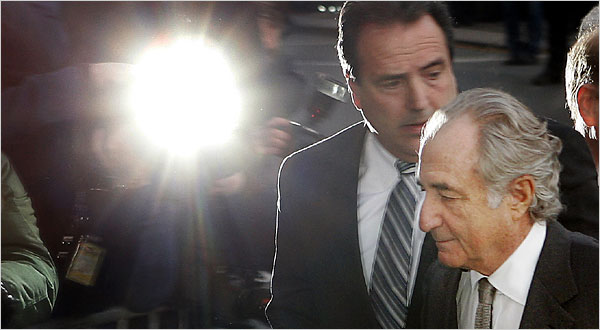
U.S. Proposes 150 Years for Madoff</font size>
Bernard L. Madoff pleaded guilty in March to the $65 billion Ponzi scheme and is expected
to be sentenced Monday. Federal prosecutors recommended on Friday that Bernard L.
Madoff be sentenced to 150 years in prison for conducting his enormous worldwide Ponzi
scheme.
In the meantime, U.S. District Judge Denny Chin entered a preliminary order requiring Madoff
to forfeit $170 billion in assets. According to earlier court documents, prosecutors reserved
the right to pursue more than $170 billion in criminal forfeiture. That represents the total
amount of money that could be connected to the fraud, not the amount stolen or lost.
to be sentenced Monday. Federal prosecutors recommended on Friday that Bernard L.
Madoff be sentenced to 150 years in prison for conducting his enormous worldwide Ponzi
scheme.
In the meantime, U.S. District Judge Denny Chin entered a preliminary order requiring Madoff
to forfeit $170 billion in assets. According to earlier court documents, prosecutors reserved
the right to pursue more than $170 billion in criminal forfeiture. That represents the total
amount of money that could be connected to the fraud, not the amount stolen or lost.
Re: Madoff and Company Spent Nearly $1 Million on Washington Influence
`
Bernard Madoff, standing with his hands clasped in front of him, showed no emotion as a judge ordered him to serve the rest of his life in a prison cell. Madoff was <SPAN style="BACKGROUND-COLOR: #ffff00">sentenced to 150 years to life </span>for defrauding investors of at least $13 billion.
`
`
Bernard Madoff, standing with his hands clasped in front of him, showed no emotion as a judge ordered him to serve the rest of his life in a prison cell. Madoff was <SPAN style="BACKGROUND-COLOR: #ffff00">sentenced to 150 years to life </span>for defrauding investors of at least $13 billion.
`