Japan: Nuclear Plant (Damage) with No Dome

GET YOU HOT

Superfly Moderator
BGOL Investor
http://www.latimes.com/news/nationworld/world/la-fg-japan-quake-main-20110313,0,738219.story

Japan evacuates 50,000 after nuclear power plant explosion
Japanese officials, trying to calm a stunned nation, say the explosion didn't damage the Fukushima Daiichi nuclear reactor itself but merely caused the collapse of a wall outside. Japanese television is reporting that at least three residents among 90 tested showed excess exposure to radiation.


Japanese Cabinet Secretary Yukio Edano

The explosion at the Fukushima Daiichi plant was caused by a buildup of hydrogen in the cooling system. He insisted that the explosion didn't cause any damage to the reactor itself but merely caused the collapse of a wall outside.

"We are evacuating people just as a precaution," Edano said at a news conference, even as television footage showed white smoke billowing from the reactor, followed by a black cloud. "There is no risk to inhabitants of the area."


<iframe title="YouTube video player" width="480" height="390" src="http://www.youtube.com/embed/pHHQXW7VSMw" frameborder="0" allowfullscreen></iframe>

Sea water is being pumped in to cool the reactors. There are some leaks, which have been detected and there have been evacuations in miles around the plant. This plant is far larger than Chernobyl.
 
Footage of tsunami approaching the coast viewed by a frantic announcer...:smh:

<iframe title="YouTube video player" width="480" height="390" src="http://www.youtube.com/embed/w3AdFjklR50" frameborder="0" allowfullscreen></iframe>
 
<font size="4">

Unfortunately, CNN is quoting Japanese news agencies which report that Meltdown may be underway. That is, a catastrophic failure of a nuclear reactor may be underway with an imminent risk of widespread radiation release.

But, there is conflicting information as to whether there is in fact a meltdown.

</font size>


[5:48 p.m. ET, 7:48 a.m. Tokyo] A meltdown may be under way at one of Fukushima Daiichi's nuclear power reactors, an official with Japan's nuclear and industrial safety agency told CNN Sunday.

A meltdown is a catastrophic failure of the reactor core, with a potential for widespread radiation release. However, Toshiro Bannai, director of the agency's international affairs office, expressed confidence that efforts to control the crisis would prove successful.


<font size="4">

Unfortunately, CNN is quoting Japanese news agencies which report that Meltdown may be underway. That is, a catastrophic failure of a nuclear reactor may be underway with an imminent risk of widespread radiation release.

But, there is conflicting information as to whether there is in fact a meltdown.

</font size>

I just read that, i'm way beyond CNN...

Official: 'We see the possibility of a meltdown'
By the CNN Wire Staff
March 12, 2011 6:06 p.m. EST
STORY HIGHLIGHTS
"At this point, we still have not confirmed that there is an actual meltdown, but there is a possibility"
Engineers not able to see the core, but base their conclusion on isotopes in the air
Tokyo (CNN) -- A meltdown may be under way at one of Fukushima Daiichi's nuclear power reactors in northern Japan, an official with Japan's Nuclear and Industrial Safety Agency told CNN Sunday.
"There is a possibility, we see the possibility of a meltdown," said Toshihiro Bannai, director of the agency's international affairs office, in a telephone interview from the agency's headquarters in Tokyo. "At this point, we have still not confirmed that there is an actual meltdown, but there is a possibility."
Though he said engineers have been unable to get close enough to the core to know what's going on, he based his conclusion on the fact that they measured radioactive cesium and radioactive iodine in the air Saturday night.
"What we have seen is only the slight indication from a monitoring post of cesium and iodine," he said. Since then, he said, plant officials have injected sea water and boron into the plant in an effort to cool its nuclear fuel.
We have some confidence, to some extent, to make the situation to be stable status," he said. "We actually have very good confidence that we will resolve this."
A state of emergency has been declared for it and two of the other five reactors at the same complex, he said. Three are in a safe, shut-down state, he said. "The other two still have some cooling systems, but not enough capacity."
From CNN's Tom Watkins


Live updating...
http://live.reuters.com/Event/Japan_earthquake2
 
Last edited:
<font size="4">

Unfortunately, CNN is quoting Japanese news agencies which report that Meltdown may be underway. That is, a catastrophic failure of a nuclear reactor may be underway with an imminent risk of widespread radiation release.

But, there is conflicting information as to whether there is in fact a meltdown.

</font size>

As they are cooling, they are relieving pressure, to stabilize the reactors...

by means of a controlled release of air and water vapour to the atmosphere. Because this water has been through the reactor core, this would inevitably mean a certain release of radiation. The IAEA said this would be filtered to retain radiation within the containment. Tepco has confirmed it was in the process of relieving pressure at unit 1 while preparing to do the same for units 2 and 3.


http://www.world-nuclear-news.org/RS_Battle_to_stabilise_earthquake_reactors_1203111.html
 
I am confused, the news is giving conflicting info.

The last official statement by IAEA Director General Yukiya

<iframe title="YouTube video player" width="480" height="390" src="http://www.youtube.com/embed/g82a36LWtcU" frameborder="0" allowfullscreen></iframe>
 
Press Release (Mar 13,2011)
Plant Status of Fukushima Daiichi Nuclear Power Station (as of 2am March 13th)


All 6 units of Fukushima Daiichi Nuclear Power Station have been shut down.

Unit 1(Shut down)
- Reactor has been shut down. However, the unit is under inspection due to
the explosive sound and white smoke that was confirmed after the big
quake occurred at 3:36PM.
- We have been injecting sea water and boric acid which absorbs neutron
into the reactor core.

Unit 2(Shut down)
- Reactor and Reactor Core Isolation Cooling System have been shut down.
Current reactor water level is lower than normal level, but the water
level is steady. After fully securing safety, we are preparing to
implement a measure to reduce the pressure of the reactor containment
vessels under the instruction of the national government.

Unit 3(Shut down)
- Reactor has been shut down and we continue injecting water by High
Pressure Core Injection System. After fully securing safety, we are
preparing to implement a measure to reduce the pressure of the reactor
containment vessels under the instruction of the national government.
- Currently, we do not believe there is any reactor coolant leakage
inside the reactor containment vessel.

Unit 4 (shut down due to regular inspection)
- Reactor has been shut down and sufficient level of reactor coolant to
ensure safety is maintained.
- Currently, we do not believe there is any reactor coolant leakage inside
the reactor containment vessel.

Unit 5 (outage due to regular inspection)
- Reactor has been shut down and sufficient level of reactor coolant to
ensure safety is maintained.
- Currently, we do not believe there is any reactor coolant leakage inside
the reactor containment vessel.

Unit 6 (outage due to regular inspection)
- Reactor has been shut down and sufficient level of reactor coolant to
ensure safety is maintained.
- Currently, we do not believe there is any reactor coolant leakage
inside the reactor containment vessel.

Casualty
- 2 workers of cooperative firm were injured at the occurrence of the
earthquake, and were transported to the hospital.
- 1 TEPCO employee who was not able to stand by his own with his hand
holding left chest was transported to the hospital by an ambulance.
- 1 subcontract worker at important earthquake-proof building was
unconscious and transported to the hospital by an ambulance.
- The radiation exposure of 1 TEPCO employee, who was working inside the
reactor building, exceeded 100mSv and was transported to the hospital.
- 4 workers were injured and transported to the hospital after explosive
sound and white smoke were confirmed around the Unit 1.
- Presence of 2 TEPCO employees at the site are not confirmed

Others
- We measured radioactive materials inside of the nuclear power station
area (outdoor) by monitoring car and confirmed that radioactive
materials level is higher than ordinary level. Also, the level at
monitoring post is higher than ordinary level. We will continue to
monitor in detail the possibility of radioactive material being
discharged from exhaust stack or discharge canal. The national
government has instructed evacuation for those local residents within
20km radius of the periphery because it's possible that radioactive
materials are discharged.

- We will continue to take all measures to restore the security of
the site and to monitor the environment of the site periphery.

http://www.tepco.co.jp/en/press/corp-com/release/11031301-e.html
 
Nuclear Safety Expert, attempts to explain the explosion, citing Japanese authorities are not forthcoming with information... "either there is not alot of information to give or more pessimistically they are hiding something..."

<iframe title="YouTube video player" width="640" height="390" src="http://www.youtube.com/embed/4-sPr16-Bf0" frameborder="0" allowfullscreen></iframe>


Australian expert from Nautalis Inst. with explanation of possibilities if a total meltdown insues due to power failures in attempt to cool down the core...

<iframe title="YouTube video player" width="640" height="390" src="http://www.youtube.com/embed/hhW-vMoyyIo" frameborder="0" allowfullscreen></iframe>
 
Last edited:
The first seconds of the clip, shows aerial view of an Oil refinery plant fire, in at least three massive areas....

<iframe title="YouTube video player" width="480" height="390" src="http://www.youtube.com/embed/BPEWBhYGYEY" frameborder="0" allowfullscreen></iframe>

Not to be confused with...

<iframe title="YouTube video player" width="640" height="390" src="http://www.youtube.com/embed/DHfR_wybvw0" frameborder="0" allowfullscreen></iframe>

<iframe title="YouTube video player" width="480" height="390" src="http://www.youtube.com/embed/e77DJkHUnew" frameborder="0" allowfullscreen></iframe>


Map of Nuclear Plant...

Fukushima-Daiichi-Nuclear-Power-Station2.jpg
 
Japan Earthquake Update (13 March 2011 13:35 CET)
Japanese authorities have informed the IAEA's Incident and Emergency Centre (IEC) that venting of the containment of reactor Unit 3 of the Fukushima Daiichi nuclear power plant started at 9:20 AM local Japan time of 13 March through a controlled release of vapour. The operation is intended to lower pressure inside the reactor containment.

Subsequently, following the failure of the high pressure injection system and other attempts of cooling the plant, injection of water first and sea water afterwards started. The authorities have informed the IAEA that accumulation of hydrogen is possible.

Japanese authorities have also informed the IAEA that the first (i.e., lowest) state of emergency at the Onagawa nuclear power plant has been reported by Tohoku Electric Power Company. The authorities have informed the IAEA that the three reactor units at the Onagawa nuclear power plant are under control.

As defined in Article 10 of Japan's Act on Special Measures Concerning Nuclear Emergency Preparedness, the alert was declared as a consequence of radioactivity readings exceeding allowed levels in the area surrounding the plant. Japanese authorities are investigating the source of radiation. The IAEA has offered its "Good Offices" to Japan to support the nation's response to the 11 March earthquake and tsunami. One IAEA capability intended to help member states during crises is the Response and Assistance Network (RANET). The network consists of nations that can offer specialized assistance after a radiation incident or emergency. Such assistance is coordinated by the IAEA within the framework of the Assistance Convention.

The IAEA continues to liaise with the Japanese authorities and is monitoring the situation as it evolves.


http://www.iaea.org/newscenter/news/tsunamiupdate01.html
 

Japanese Government Confirms Meltdown


09a9c4f549fedfb2ce0ad2de4d05c59812d8ec74.jpg


Strategic Forecasting - Stratfor.com
March 12, 2011 | 2148 GMT


Japan’s Nuclear and Industrial Safety Agency (NISA) said March 12 that the explosion at the Fukushima Daiichi No. 1 nuclear plant could only have been caused by a meltdown of the reactor core, Japanese daily Nikkei reported. This statement seemed somewhat at odds with Japanese Chief Cabinet Secretary Yukio Edano’s comments earlier March 12, in which he said “the walls of the building containing the reactor were destroyed, meaning that the metal container encasing the reactor did not explode.”

NISA’s statement is significant because it is the government agency that reports to the Agency for Natural Resources and Energy within the Ministry of Economy, Trade and Industry. NISA works in conjunction with the Atomic Energy Commission. Its role is to provide oversight to the industry and is responsible for signing off construction of new plants, among other things. It has been criticized for approving nuclear plants on geological fault lines and for an alleged conflict of interest in regulating the nuclear sector. It was NISA that issued the order for the opening of the valve to release pressure — and thus allegedly some radiation — from the Fukushima power plant.

NISA has also overseen the entire government response to the nuclear reactor problems following the Tohoku earthquake and tsunami. It is difficult to determine at this point whether the NISA statement is accurate, as the Nikkei report has not been corroborated by others. It is also not clear from the context whether NISA is stating the conclusions of an official assessment or simply making a statement. However, the Tokyo Electric Power Co. (TEPCO), the operator of the Fukushima nuclear plant, also said that although it had relieved pressure, nevertheless some nuclear fuel had melted and further action was necessary to contain the pressure.

If this report is accurate, it would not be the first time statements by NISA and Edano have diverged. When Edano earlier claimed that radiation levels had fallen at the site after the depressurization efforts, NISA claimed they had risen due to the release of radioactive vapors.


http://www.stratfor.com/


The Mechanics of a Partial Meltdown
The difference between a partial meltdown and a full meltdown at a nuclear plant is enormous, both in the degree of damage and in the potential release of radiation, experts in nuclear power said.


:smh:

<iframe title="YouTube video player" width="480" height="390" src="http://www.youtube.com/embed/u_l1Kx9ulkc" frameborder="0" allowfullscreen></iframe>

http://www.newsonjapan.com/
http://www.japantimes.co.jp/
http://www.reuters.com/
http://edition.cnn.com/
http://english.aljazeera.net/
 
Excerpt from
http://www.phyast.pitt.edu/~blc/book/chapter6.html
...

1. LOCA arising from a break in the reactor coolant system.

The cooling water system for transferring heat out of the reactor operates at very high temperature and pressure (600°F, and 2,200 pounds per square inch (psi) in a PWR, or 1,200 psi in a BWR). Therefore, if the system should break open, the water would come shooting out as steam in a process picturesquely called blowdown. Such a break could arise from a failure in the seal of the huge pump that brings the water into the reactor, or from a pressure relief valve opened by a brief pressure surge failing to close, but the most likely cause would be a pipe breaking off, especially at a welded joint.

A series of safety measures is designed to protect the system from breaking open.10 The first of these is very elaborate quality control on materials and workmanship, far superior to that in any other industry. No effort or expense is spared in choosing the highest quality materials and equipment, nor in requiring the most demanding specifications for safety-related parts of the system. The second measure is a highly elaborate inspection program, including X-ray inspection of every weld, and other inspections with magnetic particle and ultrasonic techniques during construction, followed by periodic ultrasonic and visual inspections after the reactor has gone into operation. The visual inspection program, for example, includes removal of insulation from pipes to search for imperfections or signs of cracking. One problem originally discovered by these inspections, "corrosion cracking," is discussed in the last section of this chapter. A third measure is a variety of leak detection systems: ordinarily a large break starts out as a small crack which allows some of the water and the radioactivity it contains to leak out. Leaking water becomes steam as it emerges (its temperature is close to 600°F), increasing the humidity; there are instruments installed to detect this increased humidity. Much of the radioactive material emerging with the leaking water attaches to airborne dust, and there are instruments in place for detecting increased radioactivity in this dust. These systems for detecting increased humidity and increased radioactivity in dust act as sensitive indicators for leaks, therefore serving as early warnings of possible cracks in the system.

If all of these measures should fail, a LOCA would occur. The remaining protection against a meltdown would then be the emergency core cooling system to be discussed below.

2. Loss of electric power (station blackout).

If there should be no electric power to operate the pumps, the water in the reactor would stay there and get hotter and hotter, building up the pressure until relief valves open allowing the water to escape. In addition, the pump seals require cooling water and would fail if it were not supplied due to station blackout, leading to a LOCA as described in (1).

To protect against station blackout, off-site power is normally brought into the plant from two different directions, and several diesel-driven generators are available, any one of which could provide the needed power. These engines are started at frequent intervals to assure their availability when needed, and statistics are kept on their failures to start. In addition, some safety system pumps are driven by steam from the reactor rather than by electric power; normally there would be plenty of this steam available. Control systems for operating pumps and valves are electrically operated, but batteries are available for this purpose.

In some plants, at least, being without electric power for more than about 20 minutes would usually lead to a meltdown.

3. Transients with failure of reactor protection systems.

While a reactor is operating, changes can and do occur which tend to increase the power level of a reactor. For example, the temperature or pressure of the water or its chemical content may change, causing it to absorb fewer neutrons, leaving more neutrons to strike uranium atoms and thus produce more energy. Reactors have "control rods," simple rods made of a material that strongly absorbs neutrons, which are moved in or out of the reactor core to control the power level. In the above example they would be moved in a short distance to absorb more neutrons and thus compensate for the fact that the water was absorbing fewer neutrons, restoring the power to its original level. An incident of this type is called a "transient." Small transients occur frequently in normal reactor operation, and control rods are frequently moved to adjust the power of the reactor.

Occasionally, perhaps once or twice a year, an abnormally large transient occurs which cannot be accommodated by the normal control rods. For example, if the electric power demand should suddenly drop drastically as in the case of a transformer or transmission line failure, the reactor is suddenly in a condition where it is producing far too much heat. For such transients, anticipated to occur many times in a reactor's "lifetime," safety systems automatically insert emergency control rods all the way into the reactor at high speed, absorbing so many neutrons that the chain reaction is completely stopped. This process is called scram.

It is possible that the scram system might fail when one of these anticipated large transients occur. This is called "anticipated transients without scram," or ATWS. An ATWS event would lead to rapid, intense overheating and loss of water — blown out through pressure relief valves. This loss of water would constitute a LOCA. It would also stop the chain reaction.

The protection against occurrence of an ATWS accident is in the use of high-quality materials and components, and in a good program of inspections and tests. If an ATWS does occur, the emergency core cooling system, to be discussed below, would normally prevent a meltdown.

4. Earthquakes and fires.

Earthquakes can cause any of the above failures and can cause failures in safety systems which would ordinarily mitigate the effects of these failures. Fires, especially in the switch gear, in the control room, or in cables, can lead to failure of various operating or protection systems. For these reasons, nuclear plants are constructed with several features, like bracing and special pipe supports, to minimize effects of earthquakes. In addition, great care is taken in siting plants to avoid proximity to potentially active geological faults. (Widely circulated stories about plants being built on faults are not true). Some of the best earthquake scientists in the nation are involved in this activity, and regulations and procedures are very elaborate.

Any system can be destroyed by a sufficiently powerful earthquake, but in an earthquake strong enough to cause a nuclear reactor meltdown, effects of the meltdown would be a relatively minor addition to the consequences of that earthquake.

All of these accident scenarios lead to loss of water. The chain reaction cannot go on without water, so it is shut down, but one must still worry about heat from radioactivity causing the fuel to melt. This can only be prevented if water cooling is very rapidly restored to the reactor core (where the fuel is located). Reactor designs provide this function through the "emergency core cooling system," ECCS. An ECCS consists of several independent systems for pumping water into the reactor, any one of which would provide sufficient water to save the reactor in most cases — in all cases two would do the job.11 More details are given on the ECCS in the Chapter 6 Appendix.

Without water cooling, reactor fuel heats up very rapidly, and it would require perhaps 30 seconds before water from the ECCS would flood the reactor vessel to a level at which the core is covered. During this time, the fuel would reach temperatures in the range 1,000-2,500°F.

When the water from the ECCS first reaches the hot fuel, it would flash into steam, and at one time there was some concern as to whether this might prevent further water from reaching and cooling the fuel. Some of the first tests of small mock-ups, performed in 1970-1971, indicated that this might be the case. The problem thus received very wide publicity.12 This was the situation that brought the opposition group, Union of Concerned Scientists (UCS), into prominence, as they asked for a halt to reactor licensing until the problem was resolved.13 The culmination was a series of hearings held in Washington extending over a year in 1972-1973.

As a result of the hearings, changes were introduced in reactor operation as a temporary measure to reduce the performance required of the ECCS if a LOCA should occur, and a crash research program costing hundreds of millions of dollars was instigated to settle the unresolved questions. As more sophisticated experimental tests and computer analyses were developed, it became increasingly clear in the 1975-1978 time period that the ECCS would work. There were over 50 tests, far more realistic and sophisticated than the 1971 tests, and all came out favorably. The question was finally resolved in 1978 when a test reactor specifically designed to test the ECCS (called LOFT, for loss of fluid test) came into operation at the Idaho Nuclear Engineering Laboratory and was put through various types of LOCAs. In all cases, the ECCS performed better than had been estimated.14 For example, in the first LOFT test, the best estimate from the computer analysis was a maximum temperature of 1,376°F, the conservative calculation used for the safety analysis gave 2,018°F, but the highest measured temperature was only 960°F. In the second LOFT test, carried out under rather different conditions, these temperatures were 1,360, 2,205, and 1,185°F, respectively. These examples also demonstrate how conservative estimates rather than "best estimates" are generally used in safety analyses. This is good engineering practice, but it is not usually recognized by those who use such estimates to frighten the public.

One type of LOCA in which the ECCS would not prevent a meltdown is a large crack in the bottom of the reactor vessel, since water injected by the ECCS would simply pour out through that crack. This would not occur with pipe breaks since all significant pipes enter the vessel near its top. This problem was intensively investigated by the British as part of their decision to convert from their own type to American-type reactors, and they concluded15 that, in view of the large thicknesses (see Fig. 2) and high quality of the materials used, the probability of a large crack in the reactor vessel is so small as to be negligible. There is also an elaborate inspection program to ensure that the high quality of the reactor vessel material is maintained. One potential problem in this regard, "pressurized thermal shock," has received widespread publicity. It is discussed later in this chapter.

While every effort is being made to block the roads to meltdown, there is always a possibility of a road being opened by successive failures in the various lines of defense we have described. Or perhaps there is some obscure road to meltdown that no one has ever thought of in spite of the many years of technical effort on this problem. If nuclear power becomes a flourishing industry, there probably will be meltdowns somewhere someday. But if and when they occur, there is still one final line of defense — the containment — which should protect the public from harm in most cases. Let's now consider the reliability of that line of defense.
 
<font size="6"><center>
Japan's nuclear crisis widens</font size></center>


20110313_Summary_QUAKE.small.prod_affiliate.91.jpg

View Larger Image


Los Angeles Times
via McClatchy Newspapers
By Mark Magnier,
Barbara Demick
and Laura King
March 14, 2011


SENDAI, Japan, and TOKYO — A fresh explosion rocked a crippled nuclear complex as rescuers from around the world converged on Japan's devastated earthquake zone, searching for survivors and ministering to the sick and hungry. With the death toll from the largest quake in Japan's recorded history expected to ultimately reach the tens of thousands, more than a half-million people have been displaced by growing radiation fears and the massive swath of destruction.

Japanese officials ordered people near the Fukushima complex — around which an evacuation zone had already been carved out — to stay indoors after a hydrogen blast Monday in the containment building of one of its six reactors, similar to one that occurred Saturday in a separate reactor.

Cabinet secretary Yukio Edano, speaking in a live TV broadcast, said it was believed that the reactor remained intact and "we think that the possibility of a massive radiation emission is low."

But the apparently intensifying nuclear crisis sent a wave of fear and anxiety through the quake-battered country, as powerful aftershocks from Friday's temblor continued to rattle cities and towns. Earlier, the government reported that radiation levels had again risen above legal limits outside the Fukushima complex, about 150 miles north of Tokyo, where authorities have been pumping seawater into two overheated reactors to try to cool them down.

Fuel rods at a third reactor were dangerously exposed Monday evening when a pump used to deliver seawater malfunctioned, Japan's Kyodo News Agency said. The reactor's cooling system had stopped earlier in the day.

The use of seawater was considered a drastic emergency measure — a "Hail Mary" improvisation, by the characterization of some experts — and it emerged that early Monday, even that had briefly failed. Japan's nuclear safety agency said at about 1 a.m., the seawater injection halted for about 2 1/2 hours because the tanks being used went dry, and that stoppage triggered rising pressure in the reactor container prior to the explosion.

A Tokyo Electric Power Co. official said six people were missing after the blast at the Fukushima nuclear plant. Several other nuclear installations were under close watch for potential problems.

The International Atomic Energy Agency said its lowest classification of emergency had been declared at a separate plant outside the northern town of Sendai. But Japan's nuclear safety agency said that although there had been a rise in radiation the reactor's cooling system was functioning adequately.

Across a wide swath of earthquake-hit territory, hundreds of thousands of shivering survivors roused themselves from a third cold night spent huddled in darkened emergency centers, cut off from rescuers, aid and electricity. At least 1.4 million households had gone without water since the quake struck and some 1.9 million households were without power. Rolling blackouts to conserve energy were scheduled across much of the country.

In Tokyo and other large cities outside the quake zone, the first full workday since Friday's temblor began with delays and disruptions. Many of the train lines that normally run between Tokyo and outlying suburbs and surrounding cities were either running far less frequently than normal or not running at all. Subway and train lines crisscrossing the capital were also curtailed.

With fears about how the world's third-largest economy would weather the ongoing fallout from the massive quake, Japan's main stock index, the Nikkei, plunged by 6 percent in early trading. The central bank said it would inject a record $182 billion into money markets to try to stabilize the financial system.

A full reckoning of deaths and damage could take weeks, but the picture grew grimmer with each passing hour. Kyodo reported the discovery of an additional 2,000 bodies at two separate locations in Miyagi prefecture. The official death toll — expected to be dwarfed by a final full count — stood at 1,598. The official rolls listed 1,720 people missing, but many thousands more are unaccounted for.

In Miyagi, with a population of 2.3 million, at least 10,000 residents were killed, police spokesman Go Sugawara told the Associated Press late Sunday.

An international rescue effort gathered force, with teams arriving from China, New Zealand, Germany and the United States, among other nations. Eighty-eight governments and six international institutions have offered assistance with recovery efforts, the Japanese Foreign Ministry announced. Even Bangladesh offered to help — an unaccustomed reversal for Japan, one of the world's biggest donors of foreign aid.

Among those arriving were a Los Angeles County Fire Department search-and-rescue team at Misawa Air Base about 400 miles north of Tokyo carrying 74 tons of equipment, including swift-water rescue gear and six search dogs, spokesman Don Kunitomi said.

With 100,000 Japanese troops taking part in the rescue effort, the Defense Ministry said it was considering the formation of a volunteer rescue brigade, consisting of thousands of additional helpers who could be dispatched within days.

There were some dramatic rescues of tsunami survivors Sunday, including that of a 60-year-old man who had been waiting for help since he was swept out to sea Friday. Hiromitsu Shinkawa was spotted by rescuers at 12:40 p.m., nine miles off shore by the crew of a Japanese Maritime Self-Defense Force destroyer, according to Jiji Press.

Shinkawa, from the devastated city of Minamisoma, was conscious and in "good condition" after the rescue, Japanese officials said.

"I ran away after learning that the tsunami was coming," Shinkawa told rescuers, according to Jiji Press. "But I turned back to pick up something at home, when I was washed away. I was rescued while I was hanging (on) to the roof from my house."

Japan's Yomiuri newspaper on Monday reported the discovery of an elderly quake survivor, a man in his 70s, in a collapsed building — a rare development amid the constant discovery of more bodies.

In a part of Iwanuma city, near Sendai airport, waves about 30 feet high carried entire homes across a pretty canal, a four-lane road and into an industrial area. One yellow house was plunked down nearly intact, Wizard of Oz style, on top of a gas station.

The once affluent beachfront neighborhood with its tiled houses and topiary-pruned pines has been reduced to a swamp. In the mud were the trappings of the comfortable life that once was — a large flat-screen TV, a harpsichord, lacquer teacups.

A volunteer fire brigade had gone house-to-house only a mile from the beach warning people to leave, but many weren't quick enough. Three firefighters stayed until the last minute and were swallowed up by the wave.

Compounding a general sense of chaos, aftershocks continued to rumble through much of the country. Many people are bracing for the worst in the wake of the prediction by Japan's Meteorological Agency that there was a 70 percent probability of a magnitude 7 quake in the next two days.

After a magnitude 6.2 tremor on Monday morning, centered near Tokyo, there were reports of a new tsunami, but they proved false.

Officials from Tokyo Electric Power Co. began rationing power Monday to the 45 million people they serve to prevent Tokyo and nearby prefectures from experiencing massive blackouts, Kyodo reported. Government officials said that the region-specific outages would affect a broad range of things used in everyday life such as traffic signals, medical institutions and train operations, and possibly result in water supply disruptions.

The power rationing is expected to last until the end of April, officials said.

Japanese Prime Minister Naoto Kan told reporters Sunday that his country was facing its most difficult challenge since World War II and called on his people to unite in the face of a devastating earthquake and tsunami and potential nuclear crisis.

"This is the toughest crisis in Japan's 65 years of postwar history," Kan said during a televised news conference. "I'm convinced that we can overcome the crisis."

In the quake zone, makeshift cities of survivors sprang up. At a high school in Sendai's Natori City, now a makeshift emergency evacuation center, 110 people including 30 children bedded down for the night on the floor of the school gymnasium, sleeping on wrestling mats and blankets. Children sat quietly or passed their time with the stuffed toys, sketchbooks and wood shogi set, or Japanese chess.

Tomohide Takahashi, an English teacher helping staff the center, said the school still can't account for five students of its 450.

"We're short on food and water," Takahashi said. "We need a generator. Some people stay for a while then go home, new ones come. A few people get sick, but we haven't had many injured. In general, people are afraid."

At a makeshift disaster center, long lines stretched from a bank of eight phones. There was no cell coverage, so many held their mobile phones as they spoke on the landlines, looking up stored numbers. In the lobby of the building, one of the few with electricity in the prefecture because it's got a generator, dozens of cellphones snaked from chargers off the few available outlets, a sign of people's hopes service would be resumed.

Just beside the entrance, a crowd of residents gathered around a flat-screen TV watching the news, which included repeated video footage of the tsunami they so recently lived through.

The area withstood the earthquake relatively well with most of the devastation resulting from the tsunami, which residents say struck about 30 minutes later. So while the neighborhoods close to the water were flattened, a few blocks inland there are all the trappings of normality, from car dealerships and strip malls to convenience stores and pachinko parlors, although business remains closed because of the lack of power and water.


http://www.mcclatchydc.com/2011/03/14/110394/japans-nuclear-crisis-widens.html
 
A third blast...

A third explosion has been heard at a quake-stricken Japanese nuclear power plant, the country's nuclear safety agency confirmed.
http://news.sky.com/skynews/Home/Wo...t-Nuclear-Plant/Article/201103215951706?f=rss
0012: Radiation is feared to have leaked after the container vessel was damaged at Fukushima's reactor 2, the Kyodo news agency is quoting Tokyo Electric Power Company as saying.

http://www.bbc.co.uk/news/world-middle-east-12307698

http://www.ctv.ca/CTVNews/TopStories/20110313/japan-nuclear-reactors-monday-110314/#commentSection
 
I think the situation is still very, very grim - we are by far not over the worst

Olli Heinonen, former deputy director general of the International Atomic Energy Agency
 
It is now snowing in Japan, empeding rescue efforts and the crisis is increasing, with the greater population surrounding the Fukushima Daiichi evacuated and 150thousand more within proximity, of the evacuated zone, being told to stay indoors and seal windows and doors. Expert teams from significant nuclear hosts have now joined efforts to keep contamination at bay. Risk level had now been graded to 6, on a scale of 1-7, up from Saturdays rating of 4, when cooling efforts began. As you know, there have been 3 explosions and several fires. Radiation levels are extremely high in the plant area and workers have been told to leave. Additional efforts to cool reactors, will be to drop seawater and fire retardant onto the damaged plants' reactors.

snowy.jpg


One source went on record saying...
BCCJ Members Update on Japan’s Nuclear Power station situation
March 15, 2011
Telephone briefing from Sir John Beddington, the UK’s chief scientific adviser, and Hilary Walker, deputy director for emergency preparedness at the Department of Health.

“Unequivocally, Tokyo will not be affected by the radiation fallout of explosions that have occurred or may occur at the Fukushima nuclear power stations.”

The danger area is limited to within the 30 kilometer evacuation zone and no one will be allowed to enter this area other than those directly involved in the emergency procedures currently being undertaken at both Fukushima 1 & 2.

Status of quake-stricken reactors at Fukushima nuclear power plants
Wednesday 16th March, 03:00 PM JST

TOKYO —
The following is the known status as of Wednesday afternoon of each of the six reactors at the Fukushima No. 1 nuclear power plant and the four reactors at the Fukushima No. 2 plant, both in Fukushima Prefecture, which were crippled by Friday’s magnitude 9.0 earthquake and the ensuing tsunami.

Fukushima No. 1 plant

—Reactor No. 1 - Cooling failure, partial melting of core, vapor vented, building damaged Saturday by hydrogen explosion, seawater being pumped in.

—Reactor No. 2 - Cooling failure, seawater being pumped in, fuel rods fully exposed temporarily, vapor vented, building damaged Monday by blast at Reactor No. 3, damage to containment vessel on Tuesday, potential meltdown feared.

—Reactor No. 3 - Cooling failure, partial melting of core feared, vapor vented, seawater being pumped in, building damaged Monday by hydrogen explosion, high-level radiation measured nearby on Tuesday, plume of smoke observed Wednesday, damage to containment vessel likely.

—Reactor No. 4 - Under maintenance when quake struck, fire Tuesday possibly caused by hydrogen explosion at pool holding spent fuel rods, pool water level not observed, fire observed Wednesday at building housing reactor, no water poured in to cool pool.

—Reactor No. 5, No. 6 - Under maintenance when quake struck, temperature slightly rising in spent fuel pool.

Fukushima No. 2 plant

—Reactor No. 1, No. 2, No. 4 - Cooling failure, then cold shutdown.

—Reactor No. 3 - Cold shutdown.
 
Workers briefly abandon Japan nuclear plant as crisis worsens

(Reuters) - Japan's nuclear crisis appeared to be spinning out of control on Wednesday after workers withdrew briefly from a stricken power plant because of surging radiation levels and a helicopter failed to drop water on the most troubled reactor.


<object type='application/x-shockwave-flash' data='http://www.reuters.com/resources_v2/flash/video_embed.swf?videoId=196072493' id='rcomVideo_196072493' width='460' height='259'> <param name='movie' value='http://www.reuters.com/resources_v2/flash/video_embed.swf?videoId=196072493'></param> <param name='allowFullScreen' value='true'></param> <param name='allowScriptAccess' value='always'></param> <param name='wmode' value='transparent'> <embed src='http://www.reuters.com/resources_v2/flash/video_embed.swf?videoId=196072493' type='application/x-shockwave-flash' allowfullscreen='true' allowScriptAccess='always' width='460' height='259' wmode='transparent'></embed> </object>


http://www.reuters.com/article/2011...E72A0SS20110316?feedType=RSS&feedName=topNews

Footage from Japan
<object type='application/x-shockwave-flash' data='http://www.reuters.com/resources_v2/flash/video_embed.swf?videoId=196385476' id='rcomVideo_196385476' width='460' height='259'> <param name='movie' value='http://www.reuters.com/resources_v2/flash/video_embed.swf?videoId=196385476'></param> <param name='allowFullScreen' value='true'></param> <param name='allowScriptAccess' value='always'></param> <param name='wmode' value='transparent'> <embed src='http://www.reuters.com/resources_v2/flash/video_embed.swf?videoId=196385476' type='application/x-shockwave-flash' allowfullscreen='true' allowScriptAccess='always' width='460' height='259' wmode='transparent'></embed> </object>
 
Last edited:

Reports: Lax oversight, 'greed'
preceded Japan nuclear crisis​


Reports suggest that greed within the worldwide nuclear industry,
combined with an insufficient UN watchdog and lax oversight of
Japan's nuclear plants, contributed to the Japan nuclear crisis.


0316-OCUTCORNER-japan-nuclear-crisis_full_380.jpg

This photo shows the Tokyo Electric Power Co. Fukushima
Daiichi nuclear power plant reactor no. 4 (c.) and no. 3 (l.)
in northern Japan on March 15. Tokyo Electric Power Co./
Reuters


Christian Science Monitor
By Stephen Kurczy, Staff writer
March 16, 2011


As Japan races to control a nuclear crisis in the wake of Friday's devastating earthquake and tsunami, the country's sterling image as one of the nations most prepared to prevent and manage a disaster of this magnitude is being tarnished.

Reports are emerging that both the United Nations' nuclear watchdog agency and the Japanese government failed to properly ensure the safety of country's nuclear power industry.

The reports are challenging the recent refrain that the world's No. 3 economy couldn't have done better and once again highlighting how poor government oversight of an industry that allegedly cut corners to turn higher profits can spawn an environmental disaster.

Just as the BP oil spill one year ago heaped scrutiny on the United State's Minerals Management Service, harshly criticized for lax drilling oversight and cozy ties with the oil industry, the nuclear crisis in Japan is shining a light on that nation's safety practices.


Design flaws in nuclear reactor containment vessels?

Four out of six reactors at the Fukushima Daiichi nuclear power plant (also known as Fukushima I) have now suffered explosions or fires since a March 11 earthquake and tsunami devastated the region and knocked out electricity at the plant, which caused cooling systems to fail and reactors to suffer at least partial meltdowns.

Two of those reactor containment vessels may now have cracked and appear to be releasing radioactive steam. Their designer, General Electric, is now feeling heat for marketing the reactor despite safety concerns dating back three decades. Indeed, just as the BP oil spill drew scrutiny on several multinational companies, the crisis in Japan is underscoring a "flat world" where responsibility – along with environmental and economic fallout – spreads across oceans.

Russian nuclear accident specialist Iouli Andreev, who as director of the Soviet Spetsatom clean-up agency helped in the efforts 25 years ago to clean up Chernobyl, has lashed out against the UN's International Atomic Energy Agency (IAEA) and private corporations for failing to heed lessons from that 1986 nuclear catastrophe in Ukraine.

"After Chernobyl all the force of the nuclear industry was directed to hide this event, for not creating damage to their reputation. The Chernobyl experience was not studied properly because who has money for studying? Only industry," he told Reuters in an interview published Tuesday.


Reports that plant operator TEPCO cut corners

Dr. Andreev said the sequence of events at Japan's Fukushima I suggested that the plant's owner, Tokyo Electric Power Company (TEPCO), may have put profit before safety. The fire that broke out Tuesday in reactor No. 4's fuel storage pond may have been caused by a desire to conserve space and money, he suggested.

"The Japanese were very greedy and they used every square inch of the space. But when you have a dense placing of spent fuel in the basin you have a high possibility of fire if the water is removed from the basin," Andreev told Reuters.

TEPCO has come under fire in the past for falsifying safety records at the Fukushima Daiichi plant. In 2002, according to The Wall Street Journal, TEPCO admitted to the Nuclear and Industrial Safety Agency that it had falsified the results of safety tests on the No. 1 reactor.

This was only one in a string of scandals and coverups to mar the Asia's biggest utility company. In 2007, the company initially said there was no release of radiation after an earthquake damaged its Kashiwazaki-Kariwa plant, but later admitted that radioactive water spilled into the Sea of Japan.

And less than a year ago, on June 17, a reactor at Fukushima I lost electricity and saw a dangerous drop in cooling water, Bloomberg reported. TEPCO's president failed to adequately investigate to prevent the current crisis, said Iwaki City council member Kazuyoshi Sato.

“Tokyo Electric and the government’s Nuclear and Industrial Safety Agency had too much faith and confidence in the safety of the plant and were lax in their response,” Mr. Sato told Bloomberg News.


Cozy relations within industry

But if the plant was lax in its response, where was the government agency whose job is to enforce safety regulations? Indeed, seemingly cozy relations within the nuclear industry between regulators and operators are now also under the spotlight.

TEPCO and the Japanese government have partnered in the past to market nuclear power. In August, TEPCO's chairman joined the head of Japan's Ministry of Economy, Trade, and Industry on a trip to Vietnam to promote the sale of Japanese nuclear power plants. (Vietnam later chose TEPCO.)

Andreev, the Russian scientist, has also accused the IAEA of being too close with corporations. "This is only a fake organization because every organization which depends on the nuclear industry – and the IAEA depends on the nuclear industry – cannot perform properly."

IAEA officials defended the agency, saying this characterization showed a misunderstanding of their mandate. "The agency can facilitate the creation of a standard but cannot enforce that standard," one anonymous official told The Guardian. The IAEA is dependent on member states for voluntary compliance and control of information.


Two Japanese members of the IAEA have specifically been targeted.

Yukiya Amano, a Japanese diplomat named deputy director general for the IAEA's Department of Nuclear Safety and Security in 2009, has been lambasted for apparent delays in issuing crisis updates. Mr. Amano's predecessor, Tomihiro Taniguchi, was criticized by the US more than two years ago for being "weak" on safety practices.

"[Tomihiro] Taniguchi has been a weak manager and advocate, particularly with respect to confronting Japan's own safety practices, and he is a particular disappointment to the United States for his unloved-step-child treatment of the Office of Nuclear Security," the US State Department said in a secret cable that was released to The Guardian by the secret-spilling website WikiLeaks.


Reexamining GE's reactor design

American company General Electric (GE) has also come under fire for its design of the damaged nuclear reactors at Fukushima I.

As early as 1972, American regulators considered discontinuing GE's Mark 1 system, according to The New York Times. "Among the concerns cited was the smaller containment design, which was more susceptible to explosion and rupture from a buildup in hydrogen – a situation that may have unfolded at the Fukushima Daiichi plant," according to the article.

The ban idea was nixed because of the industry's preference for the design. Today in the US, 23 reactors at 16 locations still use the Mark 1 design, according to the antinuclear power Nuclear Information and Resource Service (pdf). The nonprofit has released documents dating back to 1972 on its website.

"The concern has been there all along that this containment building was not strong enough and the pressure containment system was not robust enough to prevent an explosion," Director Michael Mariotte said in a statement.

While the world's biggest nuclear-equipment supplier has maintained that its containment vessels are reliable, three GE employees quit in 1975 in protest over safety concerns around GE's so-called Mark 1 reactor containment vessel. Resigned employee Dale Bridenbaugh told ABC News that the rapid loss of cooling water in a reactor, as has happened now in Japan, "could tear the containment apart and create an uncontrolled release."


http://www.csmonitor.com/World/Asia...oversight-greed-preceded-Japan-nuclear-crisis


Reports suggest that greed within the worldwide nuclear industry,
combined with an insufficient UN watchdog and lax oversight of
Japan's nuclear plants, contributed to the Japan nuclear crisis.
<font size="3">
An Omen to us all ? ? ?

QueEx

</font size>
 
At its epicenter, the earthquake exceeded Fukushima Daiichi’s design strength. Most plants operate safely and never undergo natural disasters as plant destruction.

greed within the world
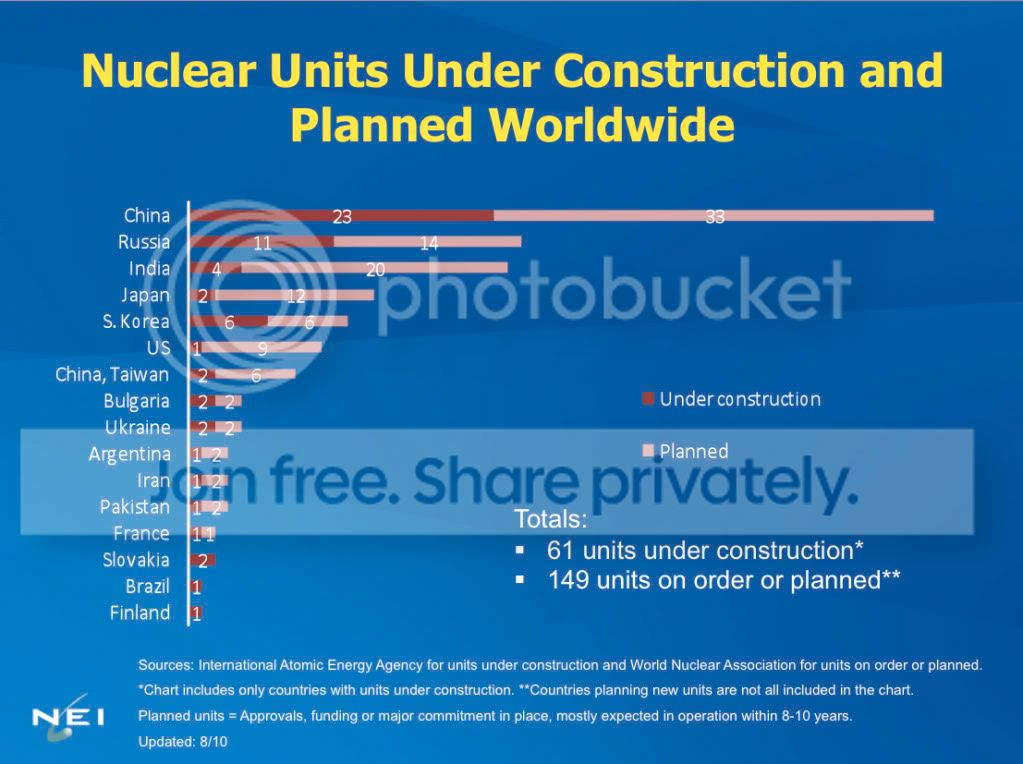
NuclearUnitsUnderConstructionandPlannedWorldwide.jpg


<font size="3">
An Omen to us all ? ? ?

QueEx

</font size>
 
IAEA director admits to not knowing the extent of damage and is planning to travel to Japan...

<iframe title="YouTube video player" width="640" height="390" src="http://www.youtube.com/embed/AR19cbbQgQk" frameborder="0" allowfullscreen></iframe>


Water dropping operation fails

<iframe title="YouTube video player" width="640" height="390" src="http://www.youtube.com/embed/cEYB1_uJCOY" frameborder="0" allowfullscreen></iframe>


...

<iframe title="YouTube video player" width="640" height="390" src="http://www.youtube.com/embed/lUNwDu0qGls" frameborder="0" allowfullscreen></iframe>
 
Last edited:
Back
Top