Israel rehearses strike on Iran

QueEx

Rising Star
Super Moderator
<font size="5"><center>
Israel rehearses strike on Iran nuclear sites</font size>
<font size="4">
Israel has carried out a full rehearsal of a massive air assault
on Iran's nuclear sites involving scores of aircraft</font size></center>


israel404_680822c.jpg


The Telegraph (UK)
By Tim Butcher in Jerusalem
June 20, 2008


While Israeli officials remained silent on the matter today, sources in Washington at the Pentagon and other US government agencies confirmed that the exercise was staged two weeks ago over the eastern Mediterranean.

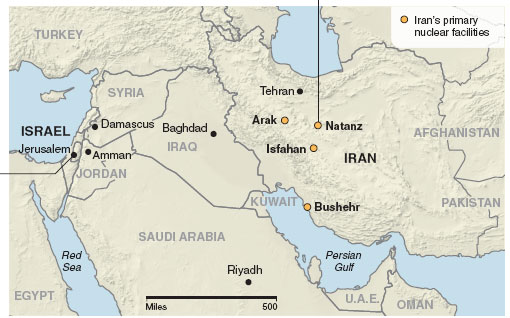
The target of the exercise was 900 miles from Israel, roughly the same distance as Iran's nuclear enrichment facility at Natanz.

A Pentagon official told the New York Times the exercise was deliberately designed by Israel to send a clear signal about the seriousness of its intentions towards Iran.

"They wanted us to know, they wanted the Europeans to know, and they wanted the Iranians to know," the official said.

"There's a lot of signalling going on at different levels."

As many as 100 F16 and F15 warplanes were involved in flying long-range missions supported by air refuelling tankers. They were alongside specially configured Israeli helicopters with long-range fuel tanks which practised rescuing downed combat aircrew.

The exercise, in the first week of June, came as President George W Bush and Ehud Olmert, Israeli prime minister, both used the same language in public to put pressure on Tehran, saying that a nuclear Iran was "unacceptable".

No Israeli attack mission would be possible without the tacit approval of Washington as it controls the airspace – over Iraq – through which Israeli planes would have to fly on a direct attack path.

Having created so much domestic political opposition with the US-led attack on Iraq, President Bush is unlikely to be able to cobble together in the last seven months of his presidency the necessary support at home for a US-led attack.

But an Israeli-led attack, tacitly allowed by US commanders responsible for Iraqi airspace, is something that would not need domestic American political support.

Israel has twice acted by itself to stop its regional enemies developing a nuclear capability, in Syria last year and Iraq in the 1980s.

Israel is the only nuclear power in the Middle East, a monopoly it wishes to maintain especially as its enemies in the Islamic world, most significantly Iran, regard the Jewish state as an anathema.

Asked to comment on reports of the rehearsal exercise, the Israeli military issued a statement saying only its air force "regularly trains for various missions in order to confront and meet the challenges posed by the threats facing Israel."

The Israeli government spokesman Mark Regev offered no comment beyond the military's statement.

The Israeli prime minister Ehud Olmert has said he prefers that Iran's nuclear ambitions be halted by diplomatic means, but has pointedly declined to rule out military action.

In an interview with the German magazine Der Spiegel published on Wednesday, Mr Olmert said the current international sanctions against Iran would probably not succeed alone, saying there were "many things that can be done economically, politically, diplomatically and militarily."

Asked if Israel was capable of taking military action against Iran, Mr Olmert said, "Israel always has to be in a position to defend itself against any adversary and against any threat of any kind."

The reaction in Iran to reports of the exercise was one of defiance.

"If enemies especially Israelis and their supporters in the United States would want to use a language of force, they should rest assured that they will receive a strong blow in the mouth," Ayatollah Ahmad Khatami, a senior cleric, said in his weekly prayers sermon held on Friday.

Ayatollah Khatami, whose speech was broadcast live on state radio, stressed that the Iranian nation's mentality was "to fight foreigners".

"Given this mentality, if you make a hostile look at the Islamic Iran, you will witness such a united roar by our nation that it will definitely make you regret any vicious move forever," the conservative cleric added.

http://www.telegraph.co.uk/news/wor...l-rehearses-strike-on-Iran-nuclear-sites.html
 
As many as 100 F16 and F15 warplanes were involved in flying long-range missions supported by air refuelling tankers. They were alongside specially configured Israeli helicopters with long-range fuel tanks which practised rescuing downed combat aircrew.

:smh:

That's not a message, that is a heads up that their about to take shit into their own hands.
 
DEBKAFile is an Israeli-based news/intelligence analysis outfit


<font size="5"><center>Israel rehearses possible air strike
against Iran over Greece</font size></center>


DEBKAFile
June 20, 2008,

US Pentagon sources report that more than 100 Air Force F-16 and F-15 fighters participated in the maneuver over the eastern Mediterranean and Greece in the first week of June. The maneuver included helicopters used for rescuing downed pilots and refueling tankers. They flew 1,440 km, roughly the distance between Israel and the Iranian uranium enrichment plant at Natanz.

Israel officials declined to comment on the exercise, the IDF saying only that the air force trains regularly for various missions in order to meet the challenges posed by the threats facing Israel. But the US sources said the scope of the Israeli exercise guaranteed it would be noticed by American and other foreign intelligence agencies, primarily to send a signal to the US, Europe and Iran that Israel was prepared and able to act militarily if diplomatic efforts failed to stop Iran’s nuclear weapons advances.

One Pentagon official said: “They rehearse it, rehearse it and rehearse it, so that if they actually have to do it, they’re ready. They’re not taking any options off the table.”

DEBKAfile’s military sources add that only on Tuesday, June 17, the chief of staff, Lt. Gen. Gaby Ashkenazy commented to the Knesset foreign affairs and security committee: "Beside the actions and sanctions against Iran, it is important we remain ready for any options."

Those sources interpreted the Ashkenazy’s typically understated remark as a hint that Israel must be ready for a possible war with Iran in the near future. This conflict could erupt on three additional fronts, Syria, Hizballah and Hamas. Those sources suggest that the scenario he hinted at would silence the many domestic critics of the ceasefire with Hamas and the Israeli military’s passivity in the face of Hizballah’s massive rocket buildup and Hamas’ escalating aggression.


<font size="4">What Was Motive Behind U.S. Leak of the Rehearsal?</font size>

<font size="3">Of interest too is the probable motive behind the US defense department’s leak to the world media of the Israel Air Force maneuver and its presentation as an exercise to simulate an attack on Iran.
According to DEBKAfile’s informants, US defense secretary Robert Gates is adamantly opposed to American military action against Iran’s nuclear facilities and even more so to Israel going it alone, which this publicity was intended to pre-empt.​
</font size>

http://www.debka.com/headline.php?hid=5362
 
<font size="5"><center>
Obama Discusses Rehearsal</font size>
<font size="4">
Barack Obama defends Israel’s concern about Iran's "extraordinary threat" </font size></center>


s_5364.jpg


DEBKAFile
June 21, 2008

The US Democratic presidential contender made this comment about the reported Israeli air rehearsal for a possible attack on Iran: “Without access to the actual detailed intelligence, I want to be careful about characterizing what was done and whether it was appropriate or not." But, said Senator Barack Obama, the Jewish state was right to be concerned about the anti-Israel comments of the Iranian president Mahmoud Ahmadinejad and about Tehran’s support for Hizballah and Hamas. “And so there is no doubt that Iran poses an extraordinary threat to Israel and Israel is always justified in making decisions that will provide for its security.”

http://www.debka.com/index1.php
 
<font size="5"><center>
Obama Discusses Rehearsal</font size>
<font size="4">
Barack Obama defends Israel’s concern about Iran's "extraordinary threat" </font size></center>


s_5364.jpg


DEBKAFile
June 21, 2008

The US Democratic presidential contender made this comment about the reported Israeli air rehearsal for a possible attack on Iran: “Without access to the actual detailed intelligence, I want to be careful about characterizing what was done and whether it was appropriate or not." But, said Senator Barack Obama, the Jewish state was right to be concerned about the anti-Israel comments of the Iranian president Mahmoud Ahmadinejad and about Tehran’s support for Hizballah and Hamas. “And so there is no doubt that Iran poses an extraordinary threat to Israel and Israel is always justified in making decisions that will provide for its security.”

http://www.debka.com/index1.php
this dude is really starting to worry me - A LOT.:hmm:...:smh:
 
Exclusive:

<font size="5"><center>Israel’s air maneuver did not simulate
possible Iran strike strategy</font size></center>


DEBKAFile
June 21, 2008

DEBKAfile’s Western military sources do not believe that if Israel does attack Iran’s nuclear facilities, it will resort to the old-fashioned aerial blitz tactic employed in 1981 for bombing Iraq’s Osirak reactor. They therefore challenge the US officials’ conclusion that Israel’s aerial exercise in conjunction with the Greek Air Force over Crete in early June was in fact a rehearsal for Iran.

What was demonstrated was the Israeli Air Force’s capability for deploying a large aerial force of more than 100 warplanes and helicopters for long-distance operations. The distance from Israel to Crete was indeed roughly equal to the distance to Iran’s uranium enrichment plant at Natanz.

Israel has already displayed its ability to strike a nuclear site by the attack on the Syrian-North Korean plutonium reactor in northern Syria on September 6, 2007.

But these military sources argue it would be sheer recklessness for Israel to send so large a part of its air fleet for a repeat of the Israeli attack on Iraq without first demolishing Iran’s air defenses.

In the attack on Syria, Israel was able to disarm by electronic means the Russian-made air defense batteries guarding its reactor. The same systems protect Iran’s nuclear sites. It must be assumed, however, that Iran and the Russian manufacturers learned a lesson or two from the way Israel silenced the batteries in Syria, although Israel too will have added new gadgetry.

Those Western military sources also deduced from the Israeli aerial exercise eastern Mediterranean that its war planners must have taken stock of the punishing fallout a war operation against Iran would trigger.

Therefore, rather than consigning a large air fleet to Iranians skies, Israel’s war planners are likely to first use large numbers of missiles to demolish Iran’s nuclear facilities and air defense batteries. Some may be delivered by air from a distance outside the range of Iranian fighter craft (most of which are outdated and in bad shape), others from Dolphin submarines.

The Air Force would go into action at a later stage.

They calculate that the moment Iran is attacked, not only will it retaliate, but all hell will break loose on Israeli borders. Iran’s terrorist stooges, Hizballah will let loose from Lebanon, Hamas from the Gaza Strip and the Syrian air and missile forces go into action from the north. The Israeli Air Force will be vitally needed to protect the population and sufficient aircraft must therefore be kept back for the home front.

Given Tehran’s multiple reprisal capability and the limits to which the Israeli Air Force can be stretched operationally at one time, the IDF may well decide to deal with the Hizballah and Hamas short-range rocket infrastructure as well as the Syrian Air Force before going into action against Iran..

In this sense, DEBKAfile’s military experts note, the decision to strike Iran’s nuclear sites is tightly bound up with preventive action against the menaces closer to home, Hamas at the very least.

MK Tzahi Hanegbi, chairman of the Knesset foreign affairs and security committee said in an interview Saturday, June 21, on Day Three of the Gaza truce, that a major operation to demolish Hamas’ war machine will be unavoidable at some point. He urged the formation of a national unity government to enlist the country's best brains and resources He urged the formation of a national unity government to enlist the country's best brains and resources for the tough decisions ahead.


http://www.debka.com/headline.php?hid=5367
 
Okay, enough of the b/s. The U.S. and the Israeli's are sending signals; some appearing to be conflicting and many not; are they: (a) just saber rattling to add/keep pressure on Iraq on the sanctions front; (b) a genuine warning to Iran that an attack may be imminent; or (c) both countries attempting to demonstrate that Obama is wrong if he thinks you can talk to the Iranians ???

QueEx
 
Israeli War Games 'Rehearsal' for Iran Attack

<object width="450" height="370"><param name="movie" value="http://www.liveleak.com/e/a72_1214248618"></param><param name="wmode" value="transparent"></param><embed src="http://www.liveleak.com/e/a72_1214248618" type="application/x-shockwave-flash" wmode="transparent" width="450" height="370"></embed></object>
:hmm:
 
Re: Israeli War Games 'Rehearsal' for Iran Attack

The timing of all of these world events are quite interesting. Things are getting harder, Isreal's forces are gearing up. We are already engaged on two extensive fronts, indebted to the middle eastern oil giants. Sound dooms dayish to me.
 
<font size="5"><center>
Iran’s Revolutionary Guards chief threatens
to hit US, Israel, block Persian Gulf if attacked</font size></center>


s_5383.jpg

IRGC chief
Mohammad Ali Jafari


DEBKAFile
June 28, 2008

DEBKAfile reports: The Guards commander, Mohammad Ali Jafari issued Tehran’s toughest and most explicit threats yet in response to recent reports of Israeli preparations to strike Iran’s nuclear installations.

This week the Chairman of the US Joint Chiefs of Staff Adm. Michael Mullent and Chief Naval Operations chief, Adm. Gary Roughead were in Israel to discuss coordination on the Iran front.


Hinting at an American attack, Jafari said: “If there is a confrontation between us and the enemy from outside the region , definitely the scope will reach the oil issue,” said the IRGC commander to the Iranian Jam-e Jam newspaper.

After this action (of imposing controls on the Gulf waterway), the oil price will rise very considerably,” he said. The Iranian general’s words may push rocketing oil prices even past the current $143 record per barrel, energy experts calculate.

Jafari clearly differentiated between Iran’s responses to possible American and Israeli attacks. The oil weapon would be applied against the former (American) – “and this is among the factors deterring enemies,” he said.

“Israelis know if they take military action against Iran… the abilities of the Islamic and Shiite world, especially in the region, will deliver fatal blows.” He noted that Israel was in range of Iranian missiles.

He said Iran’s “allies in the region” could also retaliate, referring to those living in “Lebanon’s heartland of South Lebanon,” without naming Hizballah.

US forces were “more vulnerable than the Israelis” because of their troops in the region. “Iran can in different ways harm American interests, even far away.”

Jafari warned Iran’s neighbors not to let their territory be used.

“If the attack takes place from the soil of another country ... the country attacked has the right to respond to the enemy's military action from where the operation started," he said.

http://www.debka.com/headline.php?hid=5383
 
^^^ He never said he'd counter the US if they attacked Iran - just "If the attack takes place from the soil of another country ... the country attacked has the right to respond to the enemy's military action from where the operation started."
That's an internationally recognized principle of self defense conditioned upon them being attacked first by the other state.​

Que, I wouldn't expect you to post something from DEBKAfile

Debka has been criticized as a fringe outfit catering to conspiracy theorists. Yediot Achronot's investigative reporter Ronen Bergman claims that the site relies on information from sources with an agenda, such as the rightist elements of the American Republican Party, and that Israeli intelligence officials do not consider even 10 percent of the site's content to be reliable.
http://en.wikipedia.org/wiki/Debka.com
 
^^^ He never said he'd counter the US if they attacked Iran - just "If the attack takes place from the soil of another country ... the country attacked has the right to respond to the enemy's military action from where the operation started."
That's an internationally recognized principle of self defense conditioned upon them being attacked first by the other state.​
I didn't post the article for the truth of the matters asserted. That is, I didn't post it as proof of Iran's or anyone else's intent. However, when you quote one part, don't forget to quote the other. Before that part you quoted, the article quotes Jafari saying:
Hinting at an American attack, Jafari said: “If there is a confrontation between us and the enemy from outside the region , definitely the scope will reach the oil issue,” said the IRGC commander to the Iranian Jam-e Jam newspaper.​
Maybe Jafari was talking about the Russians, ya think ??? And, maybe he wasn't referring to shutting down the straits/oil to the west, ya think ???

Hell, I wouldn't blame him one bit for making that position known. If you want to avoid an attack, one way to do it is to put something on the mind of your opponent -- that is -- that it could suffer bad consequences if it takes certain action. Of course, the U.S. has been saying/doing similar. Our huge exercise several months ago in the Persian Gulf was to demonstrate (a) that we could hit Iran in the ass and (b) keep the Persian Gulf and Strait of Hormuz open to shipping at the same time. That, was sending a message to Iran the same as Iran was apparently sending a message back.

All of this is sabre rattling; on both sides -- and both sides jockying to be seen as in a defensive posture.


keysersoze said:
Que, I wouldn't expect you to post something from DEBKAfile
You should expect me to post anything from any source. Thats what you should expect. I also expect (or at least hope) that people will READ critically whats posted. I don't necessarily believe the things that are written from any source I post. Every source should be analyzed and critiqued. There is usually a bit of truth, distortion, half-truth and untruth in EVERY article.

Our job is to try to identify each -- and not to accept the opinion of anyone or any source, as purveyors of the truth, without critical examination.


QueEx
 
I didn't post the article for the truth of the matters asserted. That is, I didn't post it as proof of Iran's or anyone else's intent. However, when you quote one part, don't forget to quote the other. Before that part you quoted, the article quotes Jafari saying:
Hinting at an American attack, Jafari said: “If there is a confrontation between us and the enemy from outside the region , definitely the scope will reach the oil issue,” said the IRGC commander to the Iranian Jam-e Jam newspaper.​
Maybe Jafari was talking about the Russians, ya think ??? And, maybe he wasn't referring to shutting down the straits/oil to the west, ya think ???

Hell, I wouldn't blame him one bit for making that position known. If you want to avoid an attack, one way to do it is to put something on the mind of your opponent -- that is -- that it could suffer bad consequences if it takes certain action. Of course, the U.S. has been saying/doing similar. Our huge exercise several months ago in the Persian Gulf was to demonstrate (a) that we could hit Iran in the ass and (b) keep the Persian Gulf and Strait of Hormuz open to shipping at the same time. That, was sending a message to Iran the same as Iran was apparently sending a message back.

All of this is sabre rattling; on both sides -- and both sides jockying to be seen as in a defensive posture.


You should expect me to post anything from any source. Thats what you should expect. I also expect (or at least hope) that people will READ critically whats posted. I don't necessarily believe the things that are written from any source I post. Every source should be analyzed and critiqued. There is usually a bit of truth, distortion, half-truth and untruth in EVERY article.

Our job is to try to identify each -- and not to accept the opinion of anyone or any source, as purveyors of the truth, without critical examination.


QueEx

Not for the truth of the matter asserted, huh? :lol: You trying to pull a hearsay exception on me? :lol: Maybe your just trying to show its an admission by party opponent. :lol:

Its fine that you posted it but the heading is very misleading and coupled with the fact that its from a biased and Usually UNRELIABLE source (isn't that one of things that negate admission of hearsay exceptions :lol:)

Peace & thanks for the hearsay lesson review :lol:.
 
It was to tell you what I said; I posted it because it was one (1) Israeli view point, though not necessarily the only one. Obviously you thought different, hence your reply.

QueEx
 
Israel Asked U.S. For Bomb to Strike Iran

<font size="5"><Center>
U.S. Rejected Aid for Israeli Raid
on Iranian Nuclear Site </font size>
<font size="4">
Israel Requested Specialized Bunker-Busting Bombs</font size></center>


11iran-graf01.jpg

11iran_1_lg.jpg

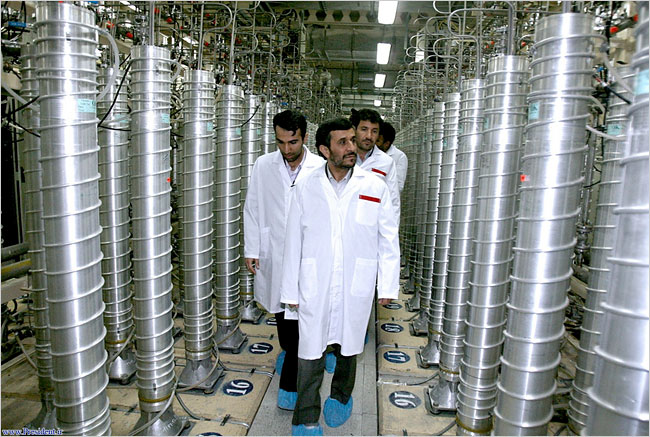
President Mahmoud Ahmadinejad tours the centrifuges at Iran’s underground complex at Natanz, a
target of an expanded American covert program.


The New York Times
By DAVID E. SANGER
Published: January 10, 2009


WASHINGTON — President Bush deflected a secret request by Israel last year for specialized bunker-busting bombs it wanted for an attack on Iran’s main nuclear complex and told the Israelis that he had authorized new covert action intended to sabotage Iran’s suspected effort to develop nuclear weapons, according to senior American and foreign officials.

White House officials never conclusively determined whether Israel had decided to go ahead with the strike before the United States protested, or whether Prime Minister Ehud Olmert of Israel was trying to goad the White House into more decisive action before Mr. Bush left office. But the Bush administration was particularly alarmed by an Israeli request to fly over Iraq to reach Iran’s major nuclear complex at Natanz, where the country’s only known uranium enrichment plant is located.

The White House denied that request outright, American officials said, and the Israelis backed off their plans, at least temporarily. But the tense exchanges also prompted the White House to step up intelligence-sharing with Israel and brief Israeli officials on new American efforts to subtly sabotage Iran’s nuclear infrastructure, a major covert program that Mr. Bush is about to hand off to President-elect Barack Obama.

This account of the expanded American covert program and the Bush administration’s efforts to dissuade Israel from an aerial attack on Iran emerged in interviews over the past 15 months with current and former American officials, outside experts, international nuclear inspectors and European and Israeli officials. None would speak on the record because of the great secrecy surrounding the intelligence developed on Iran.

Several details of the covert effort have been omitted from this account, at the request of senior United States intelligence and administration officials, to avoid harming continuing operations.

The interviews also suggest that while Mr. Bush was extensively briefed on options for an overt American attack on Iran’s facilities, he never instructed the Pentagon to move beyond contingency planning, even during the final year of his presidency, contrary to what some critics have suggested.

The interviews also indicate that Mr. Bush was convinced by top administration officials, led by Defense Secretary Robert M. Gates, that any overt attack on Iran would probably prove ineffective, lead to the expulsion of international inspectors and drive Iran’s nuclear effort further out of view. Mr. Bush and his aides also discussed the possibility that an airstrike could ignite a broad Middle East war in which America’s 140,000 troops in Iraq would inevitably become involved.

Instead, Mr. Bush embraced more intensive covert operations actions aimed at Iran, the interviews show, having concluded that the sanctions imposed by the United States and its allies were failing to slow the uranium enrichment efforts. Those covert operations, and the question of whether Israel will settle for something less than a conventional attack on Iran, pose immediate and wrenching decisions for Mr. Obama.

The covert American program, started in early 2008, includes renewed American efforts to penetrate Iran’s nuclear supply chain abroad, along with new efforts, some of them experimental, to undermine electrical systems, computer systems and other networks on which Iran relies. It is aimed at delaying the day that Iran can produce the weapons-grade fuel and designs it needs to produce a workable nuclear weapon.

Knowledge of the program has been closely held, yet inside the Bush administration some officials are skeptical about its chances of success, arguing that past efforts to undermine Iran’s nuclear program have been detected by the Iranians and have only delayed, not derailed, their drive to unlock the secrets of uranium enrichment.

Late last year, international inspectors estimated that Iran had 3,800 centrifuges spinning, but American intelligence officials now estimate that the figure is 4,000 to 5,000, enough to produce about one weapon’s worth of uranium every eight months or so.

While declining to be specific, one American official dismissed the latest covert operations against Iran as “science experiments.” One senior intelligence official argued that as Mr. Bush prepared to leave office, the Iranians were already so close to achieving a weapons capacity that they were unlikely to be stopped.

Others disagreed, making the point that the Israelis would not have been dissuaded from conducting an attack if they believed that the American effort was unlikely to prove effective.

Since his election on Nov. 4, Mr. Obama has been extensively briefed on the American actions in Iran, though his transition aides have refused to comment on the issue.

Early in his presidency, Mr. Obama must decide whether the covert actions begun by Mr. Bush are worth the risks of disrupting what he has pledged will be a more active diplomatic effort to engage with Iran.

Either course could carry risks for Mr. Obama. An inherited intelligence or military mission that went wrong could backfire, as happened to President Kennedy with the Bay of Pigs operation in Cuba. But a decision to pull back on operations aimed at Iran could leave Mr. Obama vulnerable to charges that he is allowing Iran to speed ahead toward a nuclear capacity, one that could change the contours of power in the Middle East.

<font size="4">An Intelligence Conflict</font size>

Israel’s effort to obtain the weapons, refueling capacity and permission to fly over Iraq for an attack on Iran grew out of its disbelief and anger at an American intelligence assessment completed in late 2007 that concluded that Iran had effectively suspended its development of nuclear weapons four years earlier.

That conclusion also stunned Mr. Bush’s national security team — and Mr. Bush himself, who was deeply suspicious of the conclusion, according to officials who discussed it with him.

The assessment, a National Intelligence Estimate, was based on a trove of Iranian reports obtained by penetrating Iran’s computer networks.

Those reports indicated that Iranian engineers had been ordered to halt development of a nuclear warhead in 2003, even while they continued to speed ahead in enriching uranium, the most difficult obstacle to building a weapon.

The “key judgments” of the National Intelligence Estimate, which were publicly released, emphasized the suspension of the weapons work.

The public version made only glancing reference to evidence described at great length in the 140-page classified version of the assessment: the suspicion that Iran had 10 or 15 other nuclear-related facilities, never opened to international inspectors, where enrichment activity, weapons work or the manufacturing of centrifuges might be taking place.

The Israelis responded angrily and rebutted the American report, providing American intelligence officials and Adm. Mike Mullen, the chairman of the Joint Chiefs of Staff, with evidence that they said indicated that the Iranians were still working on a weapon.

While the Americans were not convinced that the Iranian weapons development was continuing, the Israelis were not the only ones highly critical of the United States report. Secretary Gates, a former director of the Central Intelligence Agency, said the report had presented the evidence poorly, underemphasizing the importance of Iran’s enrichment activity and overemphasizing the suspension of a weapons-design effort that could easily be turned back on.

In an interview, Mr. Gates said that in his whole career he had never seen “an N.I.E. that had such an impact on U.S. diplomacy,” because “people figured, well, the military option is now off the table.”

Prime Minister Olmert came to the same conclusion. He had previously expected, according to several Americans and Israeli officials, that Mr. Bush would deal with Iran’s nuclear program before he left office. “Now,” said one American official who bore the brunt of Israel’s reaction, “they didn’t believe he would.”


http://www.nytimes.com/2009/01/11/washington/11iran.html?hp
 
Re: Israel Asked U.S. For Bomb to Strike Iran

<font size="4">
U.S. Rejected Aid for Israeli
Raid on Iranian Nuclear Site
Part Two

</font size>


11iran04-650.jpg

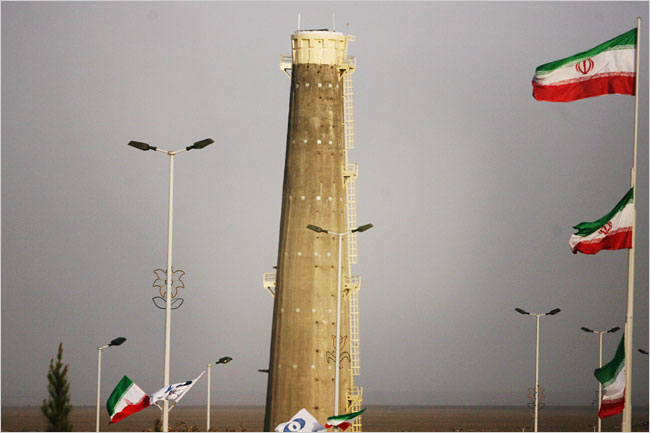
The Iranian nuclear enrichment plant at Natanz, the target of a planned Israeli airstrike last year. Majid Saeedi/Getty Images


<font size="4">
Attack Planning</font size>

Early in 2008, the Israeli government signaled that it might be preparing to take matters into its own hands. In a series of meetings, Israeli officials asked Washington for a new generation of powerful bunker-busters, far more capable of blowing up a deep underground plant than anything in Israel’s arsenal of conventional weapons. They asked for refueling equipment that would allow their aircraft to reach Iran and return to Israel. And they asked for the right to fly over Iraq.

Mr. Bush deflected the first two requests, pushing the issue off, but “we said ‘hell no’ to the overflights,” one of his top aides said. At the White House and the Pentagon, there was widespread concern that a political uproar in Iraq about the use of its American-controlled airspace could result in the expulsion of American forces from the country.

The Israeli ambassador to the United States, Sallai Meridor, declined several requests over the past four weeks to be interviewed about Israel’s efforts to obtain the weapons from Washington, saying through aides that he was too busy.

Last June, the Israelis conducted an exercise over the Mediterranean Sea that appeared to be a dry run for an attack on the enrichment plant at Natanz. When the exercise was analyzed at the Pentagon, officials concluded that the distances flown almost exactly equaled the distance between Israel and the Iranian nuclear site.

“This really spooked a lot of people,” one White House official said. White House officials discussed the possibility that the Israelis would fly over Iraq without American permission. In that case, would the American military be ordered to shoot them down? If the United States did not interfere to stop an Israeli attack, would the Bush administration be accused of being complicit in it?

Admiral Mullen, traveling to Israel in early July on a previously scheduled trip, questioned Israeli officials about their intentions. His Israeli counterpart, Lt. Gen. Gabi Ashkenazi, argued that an aerial attack could set Iran’s program back by two or three years, according to officials familiar with the exchange. The American estimates at the time were far more conservative.

Yet by the time Admiral Mullen made his visit, Israeli officials appear to have concluded that without American help, they were not yet capable of hitting the site effectively enough to strike a decisive blow against the Iranian program.

The United States did give Israel one item on its shopping list: high-powered radar, called the X-Band, to detect any Iranian missile launchings. It was the only element in the Israeli request that could be used solely for defense, not offense.

Mr. Gates’s spokesman, Geoff Morrell, said last week that Mr. Gates — whom Mr. Obama is retaining as defense secretary — believed that “a potential strike on the Iranian facilities is not something that we or anyone else should be pursuing at this time.”


<font size="4">A New Covert Push</font size>

Throughout 2008, the Bush administration insisted that it had a plan to deal with the Iranians: applying overwhelming financial pressure that would persuade Tehran to abandon its nuclear program, as foreign enterprises like the French company Total pulled out of Iranian oil projects, European banks cut financing, and trade credits were squeezed.

But the Iranians were making uranium faster than the sanctions were making progress. As Mr. Bush realized that the sanctions he had pressed for were inadequate and his military options untenable, he turned to the C.I.A. His hope, several people involved in the program said, was to create some leverage against the Iranians, by setting back their nuclear program while sanctions continued and, more recently, oil prices dropped precipitously.

There were two specific objectives: to slow progress at Natanz and other known and suspected nuclear facilities, and keep the pressure on a little-known Iranian professor named Mohsen Fakrizadeh, a scientist described in classified portions of American intelligence reports as deeply involved in an effort to design a nuclear warhead for Iran.

Past American-led efforts aimed at Natanz had yielded little result. Several years ago, foreign intelligence services tinkered with individual power units that Iran bought in Turkey to drive its centrifuges, the floor-to-ceiling silvery tubes that spin at the speed of sound, enriching uranium for use in power stations or, with additional enrichment, nuclear weapons.

A number of centrifuges blew up, prompting public declarations of sabotage by Iranian officials. An engineer in Switzerland, who worked with the Pakistani nuclear black-marketeer Abdul Qadeer Khan, had been “turned” by American intelligence officials and helped them slip faulty technology into parts bought by the Iranians.

What Mr. Bush authorized, and informed a narrow group of Congressional leaders about, was a far broader effort, aimed at the entire industrial infrastructure that supports the Iranian nuclear program. Some of the efforts focused on ways to destabilize the centrifuges. The details are closely held, for obvious reasons, by American officials. One official, however, said, “It was not until the last year that they got really imaginative about what one could do to screw up the system.”

Then, he cautioned, “none of these are game-changers,” meaning that the efforts would not necessarily cripple the Iranian program. Others in the administration strongly disagree.

In the end, success or failure may come down to how much pressure can be brought to bear on Mr. Fakrizadeh, whom the 2007 National Intelligence Estimate identifies, in its classified sections, as the manager of Project 110 and Project 111. According to a presentation by the chief inspector of the International Atomic Energy Agency, those were the names for two Iranian efforts that appeared to be dedicated to designing a warhead and making it work with an Iranian missile. Iranian officials say the projects are a fiction, made up by the United States.

While the international agency readily concedes that the evidence about the two projects remains murky, one of the documents it briefly displayed at a meeting of the agency’s member countries in Vienna last year, from Mr. Fakrizadeh’s projects, showed the chronology of a missile launching, ending with a warhead exploding about 650 yards above ground — approximately the altitude from which the bomb dropped on Hiroshima was detonated.

The exact status of Mr. Fakrizadeh’s projects today is unclear. While the National Intelligence Estimate reported that activity on Projects 110 and 111 had been halted, the fear among intelligence agencies is that if the weapons design projects are turned back on, will they know?


David E. Sanger is the chief Washington correspondent for The New York Times. Reporting for this article was developed in the course of research for “The Inheritance: The World Obama Confronts and the Challenges to American Power,” to be published Tuesday by Harmony Books.


Back
Top