Israel lobby & US foreign policy!

neo_cacos

Potential Star
Registered
The article: http://www.lrb.co.uk/v28/n06/mear01_.html
The debate: http://www.scribemedia.org/2006/10/11/israel-lobby/
The Israel Lobby
John Mearsheimer and Stephen Walt

For the past several decades, and especially since the Six-Day War in 1967, the centrepiece of US Middle Eastern policy has been its relationship with Israel. The combination of unwavering support for Israel and the related effort to spread ‘democracy’ throughout the region has inflamed Arab and Islamic opinion and jeopardised not only US security but that of much of the rest of the world. This situation has no equal in American political history. Why has the US been willing to set aside its own security and that of many of its allies in order to advance the interests of another state? One might assume that the bond between the two countries was based on shared strategic interests or compelling moral imperatives, but neither explanation can account for the remarkable level of material and diplomatic support that the US provides.

Instead, the thrust of US policy in the region derives almost entirely from domestic politics, and especially the activities of the ‘Israel Lobby’. Other special-interest groups have managed to skew foreign policy, but no lobby has managed to divert it as far from what the national interest would suggest, while simultaneously convincing Americans that US interests and those of the other country – in this case, Israel – are essentially identical.

Since the October War in 1973, Washington has provided Israel with a level of support dwarfing that given to any other state. It has been the largest annual recipient of direct economic and military assistance since 1976, and is the largest recipient in total since World War Two, to the tune of well over $140 billion (in 2004 dollars). Israel receives about $3 billion in direct assistance each year, roughly one-fifth of the foreign aid budget, and worth about $500 a year for every Israeli. This largesse is especially striking since Israel is now a wealthy industrial state with a per capita income roughly equal to that of South Korea or Spain.

Other recipients get their money in quarterly installments, but Israel receives its entire appropriation at the beginning of each fiscal year and can thus earn interest on it. Most recipients of aid given for military purposes are required to spend all of it in the US, but Israel is allowed to use roughly 25 per cent of its allocation to subsidise its own defence industry. It is the only recipient that does not have to account for how the aid is spent, which makes it virtually impossible to prevent the money from being used for purposes the US opposes, such as building settlements on the West Bank. Moreover, the US has provided Israel with nearly $3 billion to develop weapons systems, and given it access to such top-drawer weaponry as Blackhawk helicopters and F-16 jets. Finally, the US gives Israel access to intelligence it denies to its Nato allies and has turned a blind eye to Israel’s acquisition of nuclear weapons.

Washington also provides Israel with consistent diplomatic support. Since 1982, the US has vetoed 32 Security Council resolutions critical of Israel, more than the total number of vetoes cast by all the other Security Council members. It blocks the efforts of Arab states to put Israel’s nuclear arsenal on the IAEA’s agenda. The US comes to the rescue in wartime and takes Israel’s side when negotiating peace. The Nixon administration protected it from the threat of Soviet intervention and resupplied it during the October War. Washington was deeply involved in the negotiations that ended that war, as well as in the lengthy ‘step-by-step’ process that followed, just as it played a key role in the negotiations that preceded and followed the 1993 Oslo Accords. In each case there was occasional friction between US and Israeli officials, but the US consistently supported the Israeli position. One American participant at Camp David in 2000 later said: ‘Far too often, we functioned . . . as Israel’s lawyer.’ Finally, the Bush administration’s ambition to transform the Middle East is at least partly aimed at improving Israel’s strategic situation.

This extraordinary generosity might be .....
http://www.lrb.co.uk/v28/n06/mear01_.html
 
<font face="times new roman" size="4" color="#d90000"><b>
Informative Video about Israels preposterous stranglehold on US foreign-policy and military policy which negatively affects the entire American population. </b></font>

<hr noshade color="#ff0000" size="8"></hr><p>

<object width="425" height="350"><param name="movie" value="http://www.youtube.com/v/CVBIzu4YvnE"></param><param name="wmode" value="transparent"></param><embed src="http://www.youtube.com/v/CVBIzu4YvnE" type="application/x-shockwave-flash" wmode="transparent" width="425" height="350"></embed></object>

<hr noshade color="#ff0000" size="8"></hr>
<font size="3" color="#000000">
The details of Israel's ridiculous domination of US international relations & foreign policy are meticulously detailed in the report - THE-ISRAEL-LOBBY-AND-U.S.-FOREIGN-POLICY by

John-J.-Mearsheimer-
Department-of-Political-Science-
University-of-Chicago-
-
--and --
-
Stephen-M.-Walt-
John-F.-Kennedy-School-of-Government-
Harvard-University-

This report was attacked by the "faith based" & "facts-don't-matter" Israeli zionist who don't want the world to know the details of their ridiculous control of US international relations & foreign policy........but among the "reality based" community their is NO denial of the facts this report lays out. As the report it self says on page 3

.....Some readers will find this analysis disturbing, but the facts recounted here are not in serious dispute among scholars. Indeed, our account relies heavily on the work of Israeli scholars and journalists, who deserve great credit for shedding light on these issues. We also rely on evidence provided by respected Israeli and international human rights organizations. Similarly, our claims about the Lobby’s impact rely on testimony from the Lobby’s own members, as well as testimony from politicians who have worked with them. Readers may reject our conclusions, of course, but the evidence on which they rest is not controversial...

Here is the report link below.

<u><font face="arial black" color="#ff0000">THE-ISRAEL-LOBBY-AND-U.S.-FOREIGN-POLICY</u></font> </font><p>&nbsp;</p>
<p>&nbsp;</p>

<img src="http://mywebpage.netscape.com/camarilla10025/LebanonCollateralDamage1.jpg">

<p><hr noshade color="#0000FF" size="8"></hr><p> </font>
 
Israel had plans to off Bush Sr.

Right after Desert Storm, Bush nearly got killed by the Israelis. He always gave Israel about 99% of what it wanted, including 10 billion dollars in "loan guarantees" for allowing America to wipe out its Iraqi enemy in 1991.

But when Bush and Baker told Israel to back off on the "settlements," and threatened to delay the loan guarantees, the Mossad decided to assassinate Bush, according to Victor Ostrovsky, who wrote about the plot in his second book, "The Other Side of Deception."

Ostrovsky himself warned the Secret Service that Bush would be killed in Spain at the G-8 conference. They believed him, since Ostrovsky was a career Mossad officer. The loan guarantees, obviously, were given to Israel after that.

Bush was a conflicted guy whose voice was a combination of John Wayne and Liberace. Russbacher told me that the bisexual Bush started out after Yale as an assassin for the CIA, and liked to use an icepick on his victims.

Russbacher was also an assassin for the ONI and CIA and the son of a founder of CIA, and was thus in a position to know his colleagues and their resumes.

Bush came from the Yale sex and power club known as the Brotherhood of Death, or Skull & Bones. His penchant for killing became apparent to us all in 1991, less than a year after he bragged on television about the New World Order (on September 11, 1990). His version of it began with the illegal invasion of Iraq and the subsequent mass murders of over a million souls on behalf of the Zionist entity and his own powerbase, Big Oil. Bush was himself a one-third partner in Pennzoil and as that an owner of Getty Oil and Texaco.

As I wrote in Jewish Rule, our criminal invasion and occupation of Iraq is for the purpose of keeping Iraqi oil in the ground, and out of the gas tanks of consumers, where it would lower the price of fuel due to its fabulous abundance. Proven Iraqi reserves place it in the Top Five, along with Saudi Arabia, Iran, Venezuela and Gulf States.

That's the admitted Top Five. There are other Top Fives that are kept secret and include the Beaufort Sea, Colorado, MacKenzie River and the Falkland Islands. Fact is, there's just too much oil and something has to be done to keep it in the ground.

The first place to do that is Iraq. To add to Big Oil's problems, a Florida man has recently patented a device that alters water molecules slightly for use as a clean and virtually free replacement for gasoline as fuel. He has prudently withdrawn his brilliant invention from the market for a few years.


http://www.conspiracyplanet.com/channel.cfm?channelid=39&contentid=3848&page=2
 
GET YOU HOT said:
one and the same...

^^Agree

Here's a summary of the U.S mideast policy:

1. to ESTABLISHED Isreal as the DOMINANT force in the mideast.

2. to PRESERVE and maintained U.S. influence in the region by putting pressure on China AND Russia via our military presence.

3. to ensured NO arab country will CHALLENGE the jewish state(thus the free weapons and ammunition Isreal receives yearly from us, PLUS $2 BILLION IN AID AND LOANS).

4. to keep the palestians or pro arab RESISTANCE in check.

5. to establish a "democracy" THAT WILL favor the U.S. government and preserve our nat'l interest; i.e. OIL..!
 
The Israeli Lobby Power

US storm over book on Israel lobby

The power of America's "Jewish lobby" is said to be legendary

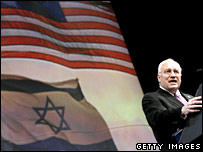
_44250766_cheneyaipac_getty_203.jpg

The Bush administration - like its
predecessors - has stood by Israel

BBC News
By Henri Astier
Thursday, 22 November 2007


Commentators the world over refer to it, as though it were a well-established fact that US Jews wield far more influence than their numbers (2% of the population) would suggest.

But this presumed influence is also a delicate issue in the US, and is rarely analysed.

How does the lobby work? Is its power truly legendary, or just a legend?

Two US academics, John Mearsheimer of the University of Chicago and Stephen Walt of Harvard, have set out to answer those questions, and triggered a firestorm of controversy as a result.

Their book The Israel Lobby and US Foreign Policy, which builds on a 2006 article in the London Review of Books, says the reasons for US support for Israel need to be explained.

America spends $3bn a year in largely military assistance - one-sixth of its direct aid budget - to help a prosperous, nuclear-armed country, and strongly backs Israel in negotiations on Middle East peace.

But according to Mearsheimer and Walt, the US gets remarkably little in return.

They reject the argument that Israel is a key ally in America's "war on terror".

On the contrary, they contend, US patronage of Israel fuels militant anger - as well as fostering resentment in Arab countries that control vital oil supplies.

One-sided

The authors also reject the common view of Israel as a democratic outpost that needs protection from deadly enemies.

It is indeed a vibrant democracy, they say, but also a regional giant ready to use its considerable firepower against civilians.

_44241703_helicopter_afp203b.jpg

Whose interests do US soldiers
in Iraq defend?

If both these arguments are weak, they say, the real reason behind US support for Israel is domestic - the activities of the American Israel Political Action Committee (Aipac), the Anti-Defamation League (ADL), and like-minded groups and think tanks.

Mearsheimer and Walt do not talk of a "Jewish lobby", as these groups do not speak for all US Jews and include many non-Jews, but of an "Israel lobby", whose main aim, they say, is to convince America that its interests are aligned with those of the Israeli state.

The book analyses the lobby's sources of influence - notably its financial muscle and the reluctance of critics to speak out.

Pro-Israeli contributions to US campaigns dwarf those of Arab-Americans or Muslim groups.

Like other interest groups, the Israel lobby also influences debate by rounding on politicians and commentators who take positions it does not like - but it does it particularly effectively, according to Mearsheimer and Walt.

Those who might think of questioning US support for Israel know they are in for a fight, making it more trouble than it is worth.

The resulting lack of discussion, the book says, has skewed US policies across the Middle East.

Most controversially, it argues that the lobby played an important role in the Iraq war.

No conspiracy

Perhaps not surprisingly, Mearsheimer and Walt have unleashed a torrent of criticism - though not from Aipac, which has made no comment.

"Their conclusions are classic anti-Semitic canards - such as control of foreign policy against the interest of the US, the Jews controlling the media and getting America into war," ADL director Abraham Foxman told the BBC News website.

After reading the original article, Mr Foxman wrote a book-length rebuttal entitled The Deadliest Lies: The Israel Lobby and The Myth of Jewish Control.

Many attacks have been highly personal.

In a fierce critique of their scholarship, Israeli historian Benny Morris wrote in the New Republic of the original article: "Were 'The Israel Lobby and US Foreign Policy' an actual person, I would have to say that he did not have a single honest bone in his body."

Virtually all reviews of the book in the mainstream US press have been negative.

"They have often misrepresented our arguments badly or tried to smear us by either saying or hinting that we are anti-Semitic," Mr Walt told the BBC News website.

He and Mr Mearsheimer deny recycling old fantasies of Jewish conspiracies ? their book repeatedly states that pro-Israeli lobbying is not secretive, but conforms to the open rules of America's democratic system.

The authors regard their excoriation in the US press as a sign of the lobby's effectiveness, and point out that reviews abroad have been much more favourable.

"This in some way confirms our basic argument that it's much easier to talk about this subject outside the United States than we do inside the US," he says.

Cause and effect

However some of Mearsheimer and Walt's US critics have been less vitriolic and harder to dismiss as angry polemic."

Robert Lieberman, a Columbia University political scientist, argues that they overstate the lobby's financial power.

Mearsheimer and Walt cite cases of members of Congress losing their seats after running afoul of pro-Israeli groups which then bankrolled their opponents.

But Mr Lieberman says the contributions involved are unlikely to make a difference and the book fails to establish a clear link between lobby money and victory.

Senate Minority leader Tom Daschle lost his seat in 2004 despite the fact that he got more pro-Israel funding than any candidate that year.

"For any anecdote they come up with, you can come up with an anecdote that demonstrates the opposite," Mr Lieberman says.

Perhaps the most contentious argument in the book is the direct causal link it tries to establish between lobby activity and US Middle East policies.

But political preferences can be influenced by any number of factors, such as popular pressure, party politics or heartfelt conviction.

Although Mearsheimer and Walt do their best to discard those alternative explanations for the US pro-Israeli stance, many are unconvinced.

"Is this the manipulation of a tiny group, or is this politicians not wanting to take a stand that is unpopular with the broader public?" Walter Russell Mead, of the Council on Foreign Relations, told the BBC News website.

Mr Mead - who wrote a lengthy critique of the book in the journal Foreign Affairs - also says Mearsheimer and Walt give too vague a definition of the lobby to make any credible conclusion about its impact.

Opening up

The fact that the book invites criticism, however, is also a strength. Its scholarly, dispassionate tone is meant to encourage a debate.

"Reasonable people can disagree and one of the reasons we want to have a discussion is to get issues out in the open so people can talk about them," Mr Walt says.

Tony Judt - a prominent historian and critic of Israel - does not accept every point made by Mearsheimer and Walt, but he credits them with lifting a taboo.

The main effect of the lobby, he says, has been self-censorship. "There are people out there who are anti-Semitic obviously, and you don't want to find yourself in their company, so you end up saying nothing," he says.

Mr Judt himself is not afraid to speak out, but he has to tread more carefully when he criticises Israeli policies in the US than he does in Israel itself.

"I have written articles in Haaretz that no American newspapers would touch," he says.

In this context, he adds, Mearsheimer and Walt's book is an "enormous act of intellectual courage".

"They gained nothing from it, but the community has really gained something because with each little step like that, the conversation opens up a bit more."

http://news.bbc.co.uk/1/hi/world/americas/7104030.stm
 
Re: The Israeli Lobby Power

American Jews Turn Away From Israel​


Foreign Policy Magazine


In the first week of September, Stephen Walt and John Mearsheimer's controversial book, The Israel Lobby, hit bookstores. In it, the authors argue that Israel supporters have excessive influence on U.S. foreign policy and consistently skew U.S. policies in favor of Israel. Coincidentally, in the same week, a little-noticed study found that young American Jews are less likely to support Israel than ever before. "Feelings of attachment may well be changing, as warmth gives way to indifference, and indifference may even give way to downright alienation," the study's coauthors, Steven Cohen of Hebrew Union College and Ari Y. Kelman of the University of California, Davis, wrote in their introduction.

Survey
Based on a written survey of 1,704 non-Orthodox American Jews,
  • just 48 percent of respondents under the age of 35 would consider the destruction of Israel a "personal tragedy," as opposed to 77 percent of those 65 and older.
  • Only 54 percent of the younger group said they were even "comfortable with the idea of a Jewish State," compared to 81 percent of the elderly respondents.

Political ideology has nothing to do with the lack of concern, according to the authors; intermarriage among faiths and the decline of a "collective view of being Jewish" explain the shift. For those who believe that U.S. foreign policy suffers for its pro-Israel positions, a wave of apathy may be on the way.

http://www.foreignpolicy.com/top10-2007/index9.html
 
Inside the Israeli PR machine in the US

Inside the Israeli PR machine in the US:hmm:
<object width="450" height="370"><param name="movie" value="http://www.liveleak.com/e/f51_1286652778"></param><param name="wmode" value="transparent"></param><param name="allowscriptaccess" value="always"></param><embed src="http://www.liveleak.com/e/f51_1286652778" type="application/x-shockwave-flash" wmode="transparent" allowscriptaccess="always" width="450" height="370"></embed></object>
 
Back
Top