Israel launches air strikes on Gaza

Ruff Ryder

Robotix
Registered
By IBRAHIM BARZAK, Associated Press Writer.

GAZA CITY, Gaza Strip – Israeli warplanes destroyed dozens of security compounds across Hamas-ruled Gaza on Saturday in unprecedented waves of air strikes, killing at least 145 people and wounding more than 310 in the single deadliest day in Gaza fighting in recent memory, Palestinian medical officials said.

The strikes came in response to renewed rocket fire from Gaza on Israeli border towns. Israeli Defense Minister Ehud Barak said "the operation will last as long as necessary" but it was not clear if it would include a ground offensive.

Asked if Hamas political leaders might be targeted next, military spokeswoman Maj. Avital Leibovitch said "Any Hamas target is a target."

Gaza militants fired several Grad-type Katyusha rockets at southern Israel in response to the strikes, the military said. One hit in the border community of Netivot, killing a woman and wounding four people, Israel's rescue service reported.

The strikes caused widespread panic and confusion as black clouds of smoke rose above Gaza. Some of the missiles struck in densely populated areas as children were leaving school and women rushed into the streets frantically looking for their children.

In Gaza City's main security compound, the bodies of more than a dozen uniformed security officers lay on the ground. One survivor raised his index finger in a show of Muslim faith, uttering a prayer. The Gaza police chief was among those killed.

It wasn't immediately clear how many civilian casualties there were.

Said Masri sat in the middle of a Gaza City street, close to a security compound, alternately slapping his face and covering his head with dust from the bombed-out building. "My son is gone, my son is gone," wailed Masri, 57.

The shopkeeper said he sent his son out to purchase cigarettes minutes before the airstrikes began and now could not find him. "May I burn like the cigarettes, may Israel burn," Masri moaned.

Hamas leaders threatened revenge attacks and Israel told its civilians near Gaza to take cover as militants began retaliating with rockets. Palestinian President Mahmoud Abbas, who has governed from the West Bank since Hamas seized control of Gaza last year, called for restraint and Egypt opened its border with Gaza to allow ambulances to drive out some of the wounded.

Hamas officials said all of Gaza's security compounds were destroyed. Israel Army Radio said at least 40 targets were hit.

Barak said the coming period "won't be easy and won't be short for the communities in the south" of Israel.

Israel declared a state of emergency in Israeli communities within a 12-mile range of Gaza, putting the area on a war footing.

Hamas said it would take revenge not just with rocket attacks but by sending suicide bombers into Israel. "Hamas will continue the resistance until the last drop of blood," said spokesman Fawzi Barhoum, speaking on a Gaza radio station.

The first round of air strikes came just before noon, and several more waves followed.

Civilians rushed to the targeted areas, trying to move the wounded in their cars to hospitals.

Television footage showed Gaza City hospitals crowded with people, including civilians rushing in wounded people in cars, vans and ambulances.

"We are treating people on the floor, in the corridors. We have no more space. We don't know who is here and what the priority is to treat," said one doctor who hung up the phone before identifying himself at Shifa Hospital, Gaza's main treatment center.

Moawiya Hassanain, a Gaza Health Ministry official, said at least 145 people were killed and more than 310 wounded.

Frantic civilians drove wounded people to hospitals in their cars.

In the West Bank, Hamas' rival Abbas condemned "this aggression" and called for restraint, according to an aide, Nabil Abu Rdeneh. Abbas, who has ruled only the West Bank since Islamic Hamas militants seized power in Gaza in June 2007, was in contact with Arab leaders and his West Bank Cabinet convened an emergency session.

Israel has targeted Gaza in the past but the number of simultaneous attacks was unprecedented.

Israel left Gaza in 2005 after a 38-year occupation but the withdrawal did not lead to better relations with Palestinians in the territory as Israeli officials had hoped. Instead, the evacuation was followed by a sharp rise in militant attacks on Israeli border communities that on several occasions provoked harsh Israeli military reprisals.

The last, in late February and early March of this year, spurred both sides to agree to a truce that was to have lasted six months but began unraveling in early November.

With 200 mortars and rockets raining down on Israel since the truce expired a week ago, and 3,000 since the beginning of the year, pressure had been mounting in Israel for the military to crush militants.

Israeli leaders have been voicing strong threats in recent days and consider Hamas to be primarily responsible for the situation.

http://news.yahoo.com/s/ap/20081227/ap_on_re_mi_ea/ml_israel_palestinians
 
<font size="5"><center>Israel air strikes continue in S. Gaza after
205 killed in earlier raids of Hamas sites</font size></center>


s_5797.jpg

Israeli air force
hits back at Hamas
in Gaza


DEBKAfile Special Report
December 27, 2008


Israeli bombers hit a vehicle in the southern Gazan town of Khan Younis Saturday night, Dec. 27, after massive air raids destroyed Hamas compounds across the enclave leaving 205 killed, 330 injured and thousands of shock victims. The operation followed a week in which Hamas fired 200 missiles at Israeli civilian targets.

The Israeli Air Force planes struck Hamas security headquarters in Gaza City and compounds, police stations and ports. Several Hamas commanders were killed in the bombardment of a Hamas military passing-out ceremony. Among them was Hamas police chief Tawfiq Jabber.

The Israeli military spokesman said the Gaza operation is "just beginning" and would be expanded and intensified as necessary.

Hamas and other Palestinian factions ordered its "fighters to avenge Israeli attacks." A Israeli was killed in Netivot in its first reprisal.

Egypt has condemned Israel for its military attack, but held Hamas responsible for refusing to heed warnings and failing to protect the Palestinian people. It has mobilized its rescue and medical services in Sinai, including hospitals for aid to casualties for the Israeli air bombardment of Gaza. Egyptian ambulances stood by at the Rafah crossing to transport wounded Hamas operatives.

The Israeli air attack launching some 40 missiles began 11.30 a.m. local time Saturday, eight days after Hamas terminated the informal Gaza ceasefire by showering missiles and mortar rounds on 250,000 Israeli civilians day after day.

Last week, the Israeli cabinet gave the Israeli military the green light for reprisals as Palestinian missile attacks escalated, 13 mortar rounds fired Friday, when Israel allowed 90 trucks of food and medicines to cross into the Gaza Strip.

Since Israel evacuated the Gaza Strip in 2005, the Palestinians have fired 5,000 missiles.

http://www.debka.com/headline.php?hid=5797
 
<font size="5"><center>Israel air strikes continue in S. Gaza after
205 killed in earlier raids of Hamas sites</font size></center>


s_5797.jpg

Israeli air force
hits back at Hamas
in Gaza


DEBKAfile Special Report
December 27, 2008


Israeli bombers hit a vehicle in the southern Gazan town of Khan Younis Saturday night, Dec. 27, after massive air raids destroyed Hamas compounds across the enclave leaving 205 killed, 330 injured and thousands of shock victims. The operation followed a week in which Hamas fired 200 missiles at Israeli civilian targets.

The Israeli Air Force planes struck Hamas security headquarters in Gaza City and compounds, police stations and ports. Several Hamas commanders were killed in the bombardment of a Hamas military passing-out ceremony. Among them was Hamas police chief Tawfiq Jabber.

The Israeli military spokesman said the Gaza operation is "just beginning" and would be expanded and intensified as necessary.

Hamas and other Palestinian factions ordered its "fighters to avenge Israeli attacks." A Israeli was killed in Netivot in its first reprisal.

Egypt has condemned Israel for its military attack, but held Hamas responsible for refusing to heed warnings and failing to protect the Palestinian people. It has mobilized its rescue and medical services in Sinai, including hospitals for aid to casualties for the Israeli air bombardment of Gaza. Egyptian ambulances stood by at the Rafah crossing to transport wounded Hamas operatives.

The Israeli air attack launching some 40 missiles began 11.30 a.m. local time Saturday, eight days after Hamas terminated the informal Gaza ceasefire by showering missiles and mortar rounds on 250,000 Israeli civilians day after day.

Last week, the Israeli cabinet gave the Israeli military the green light for reprisals as Palestinian missile attacks escalated, 13 mortar rounds fired Friday, when Israel allowed 90 trucks of food and medicines to cross into the Gaza Strip.

Since Israel evacuated the Gaza Strip in 2005, the Palestinians have fired 5,000 missiles.

http://www.debka.com/headline.php?hid=5797

I HATE THOSE JEWS
 
I hate to read this. Seems as if there is always this over reaching and overlly agressive/violent response to anything Palestinians do. This response seems overkill. Not much has changed from soldiers firing bullets at kids throwing rocks. Peace is possible, but improbable when the mandate coming from Israel is about nation building and land grabbing.
 
Warplanes pound Gaza for third day

Israeli air strikes continued to batter the Gaza strip for a third day today with government buildings coming under fire for the first time.


Air force jets bombed the Hamas-run interior ministry as part of Israel's attempts to stop Gaza's ruling body from launching rocket attacks.


Nearly 300 people are now said to have been killed since the bombing started on the highly populated territory on Saturday, with around 1,000 more including civilians and children caught up in the carnage wounded.


The continuing campaign comes despite Foreign Secretary David Miliband joining other international calls for an immediate halt to the violence.


Israel also looks poised to launch a ground assault on the Gaza strip after the country's leaders approved a call-up of 6,500 reserve soldiers. The country has also doubled the number of troops on the Gaza border in the past two days, and deployed an artillery battery.


Israel has said it is responding to Hamas-led rocket attacks on the southern part of the country, which have recently surged in numbers since a six-month ceasefire agreement expired last week.


Yesterday jets targeted smuggling tunnels in Gaza, a central prison and Gaza's Islamic University - a noted cultural symbol for Hamas.


Mr Miliband said an "urgent ceasefire" was needed to stop "massive loss of life" in the territory.


He insisted that Tel Aviv must abide by its "humanitarian obligations" and Prime Minister Gordon Brown shared his "grave concern" over the situation.


"The Prime Minister and I are following developments in Gaza with grave concern," he said.


"The rise in rocket attacks on Israel since December 19, and yesterday's massive loss of life, make this a dangerous moment which should be of concern to the whole of the international community.


"The UK supports an urgent ceasefire and immediate halt to all violence."


Israel has insisted it will keep up the assault until militants stop launching rockets, with defence minister Ehud Barack warning ominously that "the time has come to fight" and signalling willingness to put "boots on the ground".


After four hours of emergency talks yesterday, the United Nations Security Council upped the pressure on Tel Aviv by delivering a plea for the bloodshed to stop.


A statement made no direct reference to actions by either side, but said: "The members of the security council expressed serious concern at the escalation of the situation in Gaza and called for an immediate halt to all violence.


"The members called on the parties to stop immediately all military activities."


But US ambassador Zalmay Khalilzad stressed that Hamas held the key to restoring calm.


"We believe the way forward from here is for rocket attacks against Israel to stop, for all violence to end," he said.


Palestinian Authority president Mahmoud Abbas - whose Fatah faction is a bitter rival of Hamas - also blamed the group for failing to renew the ceasefire. He said if its leaders had heeded his advice "we could have avoided what happened".


Tel Aviv said at least 110 rockets had been fired into the country from Gaza since yesterday, with one person killed in the town of Netivot.

http://www.independent.co.uk/news/world/middle-east/warplanes-pound-gaza-for-third-day-1215323.html
 
Here are a few sound bites gathered from an article this morning posted on Yahoo from AP sources. I tried to arrange them in a way that displays the comparative damages/ fatalities of the trigger/ response of Hamas/ Isral respectively:

Arangement of Article said:
Israeli defense minister Ehud Barak told Israel's parliament in a special session that Israel was not fighting the residents of Gaza "but we have a war to the bitter end against Hamas and its branches."

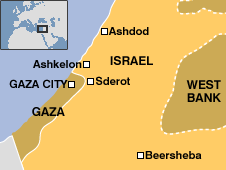
Six people have been killed in Israel in rocket attacks from Gaza since the beginning of the year, according to Israel's Foreign Ministry. On Sunday, Hamas missiles struck for the first time near the city of Ashdod, twice as far from Gaza as Ashkelon and only 25 miles from Israel's heart in Tel Aviv.

The three-day death toll (Palestinean) rose to 315, including seven children under the age of 15 who were killed in two separate strikes late Sunday and Monday, medics said. Gaza's nine hospitals were overwhelmed. Hassanain, who keeps a record for the Gaza Health Ministry, said more than 1,400 were wounded over two days of fighting and casualties were now being taken to private clinics and even homes. A Hamas police spokesman, Ehab Ghussein, said 180 members of the Hamas security forces were among the dead. The United Nations agency in charge of Palestinian refugees said at least 51 of the dead were civilians. A rise in civilian casualties could intensify international pressure on Israel to abort the offensive. An attack ravaged a compound controlled by Preventive Security, one of the group's chief security arms, and a third destroyed a house next to the residence of Ismail Haniyeh, the Hamas prime minister.

Like other Hamas leaders, Haniyeh is in hiding. Late on Sunday, Israeli aircraft attacked a building in the Jebaliya refugee camp next to Gaza City, killing a woman, a toddler and three young teenage girls, Gaza Health Ministry official Dr. Moaiya Hassanain said.

In the southern town of Rafah, a toddler and his two teenage brothers were killed in an airstrike aimed at a Hamas commander, Hassanain said. In Gaza City, another attack killed a man and his wife.

Now...

I thought this was supposed to be a "fight to the bitter end with hamas"? They are barely even TOUCHING Hamas. All they seem to be doing is DESTROYING Palestinean people's lives. That is only and most likely (and ironically) providing the survivors of these families killed in these ham-fisted attacks an incentive to HELP Hamas and giving credence to the Hamas agenda.

I am convinced that Israel is feeling justified in destroying the Palestineans altogether and eliminating their "problem" with them once and foor all. I can't go as far as to say genocide, no. But some sort of idea that is parallel to the extremist outcry for the Jewish State to be destroyed and taken out of existance. A parallel to an idea dting back to the very beginning of the Arab Israeli conflict.

Which is more than enough to justify those ideas and refresh them in the 21st century. I am bitterly annoyed by the entire Middle East as a whole at this juncture. They won't stop the bullshit and it seems to drag the rest of the world into it one way or another.

That entire region and it's cultural/ religious politics is nothing more than a massive sickness and a source of contention and tension the world over. I am convinced and tired of it too. If the gtound beneath The Middle Eastern Region were to give way and the entire group of nations upon it disappeared, leaving nothing but a humongous ocen-wide lake of that beloved crude (which is the MAIN reason why anyone gives two shits about them anyway) in the residual crater? I would jump for joy, because I think we all would be much better off without them...

how much many and how many of our Nation's resources have been wasted there over the decades now??? FUCK ISRAEL most importantly moreso than anything!!!
 
<IFRAME SRC="http://news.bbc.co.uk/1/hi/world/middle_east/7805558.stm" WIDTH=780 HEIGHT=1500>
<A HREF="http://news.bbc.co.uk/1/hi/world/middle_east/7805558.stm">link</A>

</IFRAME>
 
Hamas leader killed in air strike

A senior Hamas leader has been killed by an Israeli air strike on his home in the Gaza Strip, Hamas officials say.

_45339246_rayyan_afp226.jpg


Nizar Rayyan, the most senior Hamas figure to be killed since 2004, had urged suicide attacks against Israel.

News of the strike came on the sixth day of Israeli strikes on Hamas targets in the Gaza Strip.

Palestinian medical sources say 391 people have been killed. Israel says it is trying to prevent militants from firing rockets into southern Israel.

Mr Rayyan is the most senior Hamas leader to be killed since the death of Abdel Aziz al-Rantissi in April 2004.

Long reach of Israel

Since its bombing campaign began last Saturday, Israel has attacked Hamas fighters and commanders.

Sites linked to Hamas have also been hit, including smuggling tunnels under the border to Egypt, government buildings and security compounds.

_45337354_gaza_isreal1.gif


Hamas considered Mr Rayyan to be a political leader, but he often wore a military uniform and was close to the group's armed wing.

Until now, political leaders have not been killed.

The BBC's Mike Sergeant, in Jerusalem, says this may further strengthen the determination of Hamas to resist the Israeli air assault.

But it will also be seen as an indication that the Israeli military can target key members of the Hamas leadership - the people Israel says are responsible for the rockets being fired towards Israeli towns, our correspondent adds.

Four Israelis have been killed by Palestinian rockets fired into Israel since Saturday.

Humanitarian warning

On Wednesday, Mr Rayyan had promised that Hamas would hit Israel "even deeper" than it has so far.

On the Hamas-run al-Aqsa television channel, he said Hamas militants were preparing for any Israeli ground incursion, saying "we will kill the enemy and take hostages".

At least four other people, some said to be family members, were also killed in the air raid on Mr Rayyan's home in the Jabaliya refugee camp in the north of the Gaza Strip.

The deaths come as the main UN agency operating in Gaza, Unwra, has resumed food deliveries, but warned of a dire humanitarian situation in the territory.

Israel is refusing entry to Gaza for international journalists and has declared the area around it a "closed military zone", leading to speculation a ground offensive into the tiny coastal strip could be imminent.

Israeli President Shimon Peres said it was not his country's aim to return to the Gaza Strip.

"The aim is to stop terror. Our aim, if you ask me, is a positive one - to make peace," he told the BBC.

He said it was up to Hamas to end the conflict.

"It depends upon them. Today, after all the death and all the blood, they fired 17 rockets today. What for? If they really care about their people, stop it."

http://news.bbc.co.uk/1/hi/world/middle_east/7807124.stm
 
I feel you on this one, I just keep thinking how we are being pulled into this mess under the guise of it being the prophecy of the Bible, that Israel would rise out of this conflict when it seems they are the one's trying to start the next World War and lead us all into destruction.


Here are a few sound bites gathered from an article this morning posted on Yahoo from AP sources. I tried to arrange them in a way that displays the comparative damages/ fatalities of the trigger/ response of Hamas/ Isral respectively:


Now...

I thought this was supposed to be a "fight to the bitter end with hamas"? They are barely even TOUCHING Hamas. All they seem to be doing is DESTROYING Palestinean people's lives. That is only and most likely (and ironically) providing the survivors of these families killed in these ham-fisted attacks an incentive to HELP Hamas and giving credence to the Hamas agenda.

I am convinced that Israel is feeling justified in destroying the Palestineans altogether and eliminating their "problem" with them once and foor all. I can't go as far as to say genocide, no. But some sort of idea that is parallel to the extremist outcry for the Jewish State to be destroyed and taken out of existance. A parallel to an idea dting back to the very beginning of the Arab Israeli conflict.

Which is more than enough to justify those ideas and refresh them in the 21st century. I am bitterly annoyed by the entire Middle East as a whole at this juncture. They won't stop the bullshit and it seems to drag the rest of the world into it one way or another.

That entire region and it's cultural/ religious politics is nothing more than a massive sickness and a source of contention and tension the world over. I am convinced and tired of it too. If the gtound beneath The Middle Eastern Region were to give way and the entire group of nations upon it disappeared, leaving nothing but a humongous ocen-wide lake of that beloved crude (which is the MAIN reason why anyone gives two shits about them anyway) in the residual crater? I would jump for joy, because I think we all would be much better off without them...

how much many and how many of our Nation's resources have been wasted there over the decades now??? FUCK ISRAEL most importantly moreso than anything!!!
 
I agree, fuck Israel. We don't need to be bullied or be left feeling the rivets of primitive, maggot-minded groups who believe in invisible people that gave them land and now want to kill each other over it and can't seem to ever get along. Why can't the U.S. just stop Israel? Their stranglehold on U.S. foreign policy can't possibly be invulnerable to the notion of no longer giving a fuck about them and wanting to reduce the violence in the world by ending Israel's occupation.

I blame this entirely on religion and stupidity.
 
I agree, fuck Israel. We don't need to be bullied or be left feeling the rivets of primitive, maggot-minded groups who believe in invisible people that gave them land and now want to kill each other over it and can't seem to ever get along. Why can't the U.S. just stop Israel? Their stranglehold on U.S. foreign policy can't possibly be invulnerable to the notion of no longer giving a fuck about them and wanting to reduce the violence in the world by ending Israel's occupation.

I blame this entirely on religion and stupidity.

I also say Fuck Isreael. They've killed over $00+ people and I hate the USA's position of "Israel needs to protect themselves against terrorism"

The only Terrorists in this conflict are the Israelis
 
It's amazing, the numbers of justifiable "colateral damage" they expect to be acceptable when they launch these attacks. All that justification is allegedly validated by the: "Well, he started it!" concept.

Israelis are completely fucked up and America looks like a total Ass-Clown of Nation for supporting them without any kind of accountability being made for the shit they do to the lives of Palestinean and Arab civilians. Just to think: Amongst the battery of bullshit excuses given for invading Iraq? One of them was Iraq's support of Palestinean Terrorists/ Suicide Bombers...

Kind of sends a message to would be Palestinean helpers, eh?
 
<font size="5"><center>

Israeli ground forces enter Gaza in
escalation of conflict

</font size></center>


<IFRAME SRC="http://www.washingtonpost.com/wp-dyn/content/article/2009/01/03/AR2009010301031.html?hpid=topnews" WIDTH=780 HEIGHT=1500>
<A HREF="http://www.washingtonpost.com/wp-dyn/content/article/2009/01/03/AR2009010301031.html?hpid=topnews">link</A>

</IFRAME>
 
^^^^:smh::smh::smh::smh:

Ground troops are used for occupation. How quickly they've gotten to that point. Not good at all. But not surprising either.
 
Last edited:
Not necessarily.

But what do you mean by 'occupation' ? ? ?

995-WEBgaza.major_story_img.prod_affiliate.91.jpg

I mean precisely that..ground forces occupying territory that is not theirs, intent on controlling it, and its citizens during war. The article makes it pretty clear ground troops will be there for a long period of time and frankly its a small piece of land. Were it only about stopping "strikes" on Israel one would think the air strikes would be sufficient. They still haven't really let in any international journalists and we don't really have anything but Israel's word that this was started by strikes from Hamas first.

Given how virulently and violently Israeli settlers protested having to leave Gaza in the first place.....its not a surprise to see ground troops and would not be a surprise to see that area taken back.
 
I mean precisely that..ground forces occupying territory that is not theirs, intent on controlling it, and its citizens during war. The article makes it pretty clear ground troops will be there for a long period of time and frankly its a small piece of land.
I didn't get "long period of time" from the article, perhaps, I missed that.


Were it only about stopping "strikes" on Israel one would think the air strikes would be sufficient.
Well, did the air strikes stop Hamas from lobbing rockets into Israel ? ? ?

So far, has the ground incursion stopped Hamas from lobbing rockets into Israel ? ? ?

Can Israel stop Hamas from lobbing rockets into Israel ? ? ?

Perhaps, the answers tell us why this conflict demands a diplomatic solution. But, do the parties: Hamas, the Palestinians, Isrealis, etc., really want peaceful co-existence ? ? ?


They still haven't really let in any international journalists and we don't really have anything but Israel's word that this was started by strikes from Hamas first.
Get real. No country wants reporters on or near the battlefield or where fighting is occurring. As far as who started it, I'm not arguing here in support of Israel but Hamas isn't exactly denying shit either. LOL. Who cares who started it; what is the long term solution ? ? ?


Given how virulently and violently Israeli settlers protested having to leave Gaza in the first place.....its not a surprise to see ground troops and would not be a surprise to see that area taken back.
Just my opinion but, I just don't see 'occupation' being an issue. Occupation is expensive both in terms of money to fund it; diplomatically in terms of the rest of the world constantly attacking your motives and playing havoc with your trade ($$$); and, there is that little thing with the loss of Israeli soldiers that will occur in an occupation. But, what do I know.

QueEx
 
<font size="5"><Center>
Hamas and the Arab States</font size></center>


104168


Strategic Forecasting, Inc. (STRATFOR)
By Kamran Bokhari
and Reva Bhalla
January 7, 2009


Israel is now in the 12th day of carrying out Operation Cast Lead against the Palestinian Islamist movement Hamas in the Gaza Strip, where Hamas has been the de facto ruler ever since it seized control of the territory in a June 2007 coup. The Israeli campaign, whose primary military aim is to neutralize Hamas’ ability to carry out rocket attacks against Israel, has led to the reported deaths of more than 560 Palestinians; the number of wounded is approaching the 3,000 mark.


<font size="3">The Arab Reaction</font size>

The reaction from the Arab world has been mixed. On the one hand, a look at the so-called Arab street will reveal an angry scene of chanting protesters, burning flags and embassy attacks in protest of Israel’s actions. The principal Arab regimes, however, have either kept quiet or publicly condemned Hamas for the crisis — while privately often expressing their support for Israel’s bid to weaken the radical Palestinian group.

Despite the much-hyped Arab nationalist solidarity often cited in the name of Palestine, most Arab regimes actually have little love for the Palestinians. While these countries like keeping the Palestinian issue alive for domestic consumption and as a tool to pressure Israel and the West when the need arises, in actuality, they tend to view Palestinian refugees — and more Palestinian radical groups like Hamas — as a threat to the stability of their regimes.

<font size="3">Saudi Arabia</font size>​
One such Arab country is Saudi Arabia. Given its financial power and its shared religious underpinnings with Hamas, Riyadh traditionally has backed the radical Palestinian group. The kingdom backed a variety of Islamist political forces during the 1960s and 1970s in a bid to undercut secular Nasserite Arab nationalist forces, which threatened Saudi Arabia’s regional status. But 9/11, which stemmed in part from Saudi support for the Taliban and al Qaeda in Afghanistan, opened Riyadh’s eyes to the danger of supporting militant Islamism.

Thus, while Saudi Arabia continued to support many of the same Palestinian groups, it also started whistling a more moderate tune in its domestic and foreign policies. As part of this moderate drive, in 2002 King Abdullah offered Israel a comprehensive peace treaty whereby Arab states would normalize ties with the Jewish state in exchange for an Israeli withdrawal to its 1967 borders. Though Israel rejected the offer, the proposal itself clearly conflicted with Hamas’ manifesto, which calls for Israel’s destruction. The post-9/11 world also created new problems for one of Hamas’ sources of regular funding — wealthy Gulf Arabs — who grew increasingly wary of turning up on the radars of Western security and intelligence agencies as fund transfers from the Gulf came under closer scrutiny.

<font size="3">Egypt</font size>​
Meanwhile, Egypt, which regularly mediates Hamas-Israel and Hamas-Fatah matters, thus far has been the most vocal in its opposition to Hamas during the latest Israeli military offensive. Cairo has even gone as far as blaming Hamas for provoking the conflict. Though Egypt’s stance has earned it a number of attacks on its embassies in the Arab world and condemnations in major Arab editorial pages, Cairo has a core strategic interest in ensuring that Hamas remains boxed in. The secular government of Egyptian President Hosni Mubarak is already preparing for a shaky leadership transition, which is bound to be exploited by the country’s largest opposition movement, the Muslim Brotherhood (MB).

<font size="3">The Muslim Brotherhood - "MB"</font size>​
The MB, from which Hamas emerged, maintains links with the Hamas leadership. Egypt’s powerful security apparatus has kept the MB in check, but the Egyptian group has steadily built up support among Egypt’s lower and middle classes, which have grown disillusioned with the soaring rate of unemployment and lack of economic prospects in Egypt. The sight of Muslim Brotherhood activists leading protests in Egypt in the name of Hamas is thus quite disconcerting for the Mubarak regime. The Egyptians also are fearful that Gaza could become a haven for Salafist jihadist groups that could collaborate with Egypt’s own jihadist node the longer Gaza remains in disarray under Hamas rule.

<font size="3">Jordan</font size>​
Of the Arab states, Jordan has the most to lose from a group like Hamas. More than three-fourths of the Hashemite monarchy’s people claim Palestinian origins. The kingdom itself is a weak, poor state that historically has relied on the United Kingdom, Israel and the United States for its survival. Among all Arab governments, Amman has had the longest and closest relationship with Israel — even before it concluded a formal peace treaty with Israel in 1994. In 1970, Jordan waged war against Fatah when the group posed a threat to the kingdom’s security; it also threw out Hamas in 1999 after fears that the group posed a similar threat to the stability of the kingdom. Like Egypt, Jordan also has a vibrant MB, which has closer ties to Hamas than its Egyptian counterpart. As far as Amman is concerned, therefore, the harder Israel hits Hamas, the better.

<font size="3">Syria</font size>​
Finally, Syria is in a more complex position than these other four Arab states. The Alawite-Baathist regime in Syria has long been a pariah in the Arab world because of its support for Shiite Iran and for their mutual militant proxy in Lebanon, Hezbollah. But ever since the 2006 war between Israel and Hezbollah, the Syrians have been charting a different course, looking for ways to break free from diplomatic isolation and to reach some sort of understanding with the Israelis.

For the Syrians, support for Hamas, Palestinian Islamic Jihad and several other radical Palestinian outfits provides tools of leverage to use in negotiating a settlement with Israel. Any deal between the Syrians and the Israelis would thus involve Damascus sacrificing militant proxies such as Hezbollah and Hamas in return for key concessions in Lebanon — where Syria’s core geopolitical interests lie — and in the disputed Golan Heights. While the Israeli-Syrian peace talks remain in flux, Syria’s lukewarm reaction to the Israeli offensive and restraint (thus far) from criticizing the more moderate Arab regimes’ lack of response suggests Damascus may be looking to exploit the Gaza offensive to improve its relations in the Arab world and reinvigorate its talks with Israel. And the more damage Israel does to Hamas now, the easier it will be for Damascus to crack down on Hamas should the need arise.


<font size="3">Hamas' Shift Towards Iran</font size>

With Saudi Arabia, Egypt, Jordan and Syria taking into account their own interests when dealing with the Palestinians, ironically, the most reliable patron Sunni Hamas has had in recent years is Iran, the Sunni Arab world’s principal Shiite rival. Several key developments have made Hamas’ gradual shift toward Iran possible:


  1. Saudi Arabia’s post-9/11 move into the moderate camp — previously dominated by Egypt and Jordan, two states that have diplomatic relations with Israel.

  2. The collapse of Baathist Iraq and the resulting rise of Shiite power in the region.

  3. The 2004 Iranian parliamentary elections that put Iran’s ultraconservatives in power and the 2005 election of President Mahmoud Ahmadinejad, whose public anti-Israeli views resonated with Hamas at a time when other Arab states had grown more moderate.

  4. The 2006 Palestinian elections, in which Hamas defeated its secular rival, Fatah, by a landslide. When endowed with the responsibility of running an unrecognized government, Hamas floundered between its goals of dominating the Palestinian political landscape and continuing to call for the destruction of Israel and the creation of an Islamist state. The Arab states, particularly Saudi Arabia and Egypt, had hoped that the electoral victory would lead Hamas to moderate its stance, but Iran encouraged Hamas to adhere to its radical agenda. As the West increasingly isolated the Hamas-led government, the group shifted more toward the Iranian position, which more closely meshed with its original mandate.

  5. The 2006 summer military confrontation between Hezbollah and Israel, in which Iranian-backed Hezbollah symbolically defeated the Jewish state. Hezbollah’s ability to withstand the Israeli military onslaught gave confidence to Hamas that it could emulate the Lebanese Shiite movement — which, like Hamas, was both a political party and an armed paramilitary organization. Similar to their reaction to the current Gaza offensive, the principal Arab states condemned Hezbollah for provoking Israel and grew terrified at the outpouring of support for the Shiite militant group from their own populations. Hezbollah-Hamas collaboration in training, arms-procurement and funding intensified, and almost certainly has played a decisive role in equipping Hamas with 122mm BM-21 Grad artillery rockets and larger Iranian-made 240mm Fajr-3 rockets — and potentially even a modest anti-armor capability.

  6. The June 2007 Hamas coup against Fatah in the Gaza Strip, which caused a serious strain in relations between Egypt and Hamas. The resulting blockade on Gaza put Egypt in an extremely uncomfortable position, in which it had to crack down on the Gaza border, thus giving the MB an excuse to rally opposition against Cairo. Egypt was already uncomfortable with Hamas’ electoral victory, but it could not tolerate the group’s emergence as the unchallenged power in Gaza.

  7. Syria’s decision to go public with peace talks with Israel. As soon as it became clear that Syria was getting serious about such negotiations, alarm bells went off within groups like Hamas and Hezbollah, which now had to deal with the fear that Damascus could sell them out at any time as part of a deal with the Israelis.

Hamas’ relations with the Arab states already were souring; its warming relationship with Iran has proved the coup de grace. Mubarak said it best when he recently remarked that the situation in the Gaza Strip “has led to Egypt, in practice, having a border with Iran.” In other words, Hamas has allowed Iranian influence to come far too close for the Arab states’ comfort.

<font size="3">The Schism Between Hamas and Arab Regimes</font size>

In many ways, the falling-out between Hamas and the Arab regimes is not surprising. The decline of Nasserism in the late 1960s essentially meant the death of Arab nationalism. Even before then, the Arab states put their respective national interests ahead of any devotion to pan-Arab nationalism that would have translated into support for the Palestinian cause. As Islamism gradually came to replace Arab nationalism as a political force throughout the region, the Arab regimes became even more concerned about stability at home, given the very real threat of a religious challenge to their rule. While these states worked to suppress radical Islamist elements that had taken root in their countries, the Arab governments caught wind of Tehran’s attempts to adopt the region’s radical Islamist trend to create a geopolitical space for Iran in the Arab Middle East. As a result, the Arab-Persian struggle became one of the key drivers that has turned the Arab states against Hamas.

<font size="3">The Problem for Arab States</font size>

For each of these Arab states, Hamas represents a force that could stir the social pot at home — either by creating a backlash against the regimes for their ties to Israel and their perceived failure to aid the Palestinians, or by emboldening democratic Islamist movements in the region that could threaten the stability of both republican regimes and monarchies. With somewhat limited options to contain Iranian expansion in the region, the Arab states ironically are looking to Israel to ensure that Hamas remains boxed in. So, on the surface it may seem that the entire Arab world is convulsing with anger at Israel’s offensive against Hamas, a closer look reveals that the view from the Arab palace is quite different from the view on the Arab street.


Tell Stratfor What You Think

www.stratfor.com


`
 
Not going to happen but its time to end all world religions, they're just an excuse to rob, kill, rape and oppress people.
 
I don't believe shit the media says about this conflict.
Isreal has access to the U.S. servellence satellites.
Why can't they find where these missile launchers are??
And, why isn't any pictures of Isreal, where these alleged missiles fired by the Hammas, shown??
I suspect there's some untapped oil fields in the Gaza strip.


Isreal has access to the U.S. servellence satellites.
Why can't they find where these missile launchers are??

<font size="3">Because many of them are nothing more than this:


islamic_savage.jpg


which can be like finding needles in a hay stack, you think ? ? ?

And there are "allegations" that Hamas Leaves Weapons & Anti Aircraft Missile Launcher In Gaza Mosques. (video)</font size>


And, why isn't any pictures of Isreal, where these alleged missiles fired by the Hammas, shown??

<font size="3">Like these: Qassam missile attacks in Israel ? ? ?


I suspect there's some untapped oil fields in the Gaza strip.

<font size="3">You could be right; but do you have anything more than idle speculation ? ? ?


_____________________

P.S.

And, you probably think this is a pro-Israeli post.


QueEx
</font size>
 
<font size="5"><Center>
Israel declares Gaza cease-fire
but Hamas may not</font size></center>


McClatchy Newspapers
By Dion Nissenbaum
Saturday, January 17, 2009


JERUSALEM — Israel declared a unilateral halt Sunday to its three-week-old military campaign in the Gaza Strip, but prospects for renewed calm were cast in doubt by Hamas leaders who vowed to keep fighting.

After 22 days of strikes that have killed more than 1,200 Palestinians, a third of them children, Israeli Prime Minister Ehud Olmert declared that the Hamas rulers in the Gaza Strip had been dealt a decisive blow.

Bolstered by international support to prevent Gaza militants from rebuilding their arms smuggling tunnels to Egypt, Olmert announced that the Israeli military would halt its attacks at 2 a.m. Sunday, Jerusalem time. However, Olmert gave no timeline for withdrawing the soldiers and said that they'd remain in Gaza until the situation stabilized.

"If our enemies decide that the blows they have already suffered are not enough and they wish to continue fighting, Israel will be ready for that scenario and will feel free to continue responding with force," Olmert said during a late-night news conference at Israel's military headquarters in Tel Aviv.

"If Hamas decides to continue its wild terrorist attacks, it may find itself surprised again by the State of Israel's determination," Olmert warned. "I do not suggest that it — or any other terrorist organization — test us."

Israeli leaders decided to declare a unilateral truce after concluding that the Hamas leadership was too fractured to negotiate over a cease-fire deal being brokered by Egypt, according to diplomats.

Without any Egyptian-backed assurances from Hamas, Israel is gambling that the Islamist group's Gaza leaders will be so afraid of a resumption of the Israeli attacks that they'll order a complete halt to rocket fire aimed at southern Israel and attacks on the soldiers in Gaza.

"Hamas has been begging for Israel to let up," said one Israeli briefed on the cease-fire discussions.

Gaza militants kept up their rocket strikes on Israel in the hours leading up to the announcement. Palestinians fired more than two dozen rockets into Israel, but no one was seriously injured.

Since Israel launched the military campaign on Dec. 27, four Israelis have been killed by Palestinian rocket fire and nine Israeli soldiers have died fighting in Gaza.

While Hamas has been dealt a severe blow in Gaza, its leaders are publicly vowing to keep fighting.

Hamas leader Osama Hamdan in Beirut said that the group was under no obligation to defer to Israel's demands and bring Gaza attacks to an end.

"If there are no real arrangements discussed between sides, no one has to ask anyone to do anything," Hamdan told Al Jazeera English television before Olmert announced the unilateral truce. "They have finally to understand they have to talk to the resistance."

Israel refuses to talk to Hamas until the militant group renounces its pledge to destroy Israel.

The Israeli Security Cabinet decision to declare a halt to the strikes came hours after its military hit another United Nations compound in Gaza where hundreds of Palestinians were seeking refuge. The early-morning strike killed two boys, aged 5 and 7, as the U.N. staff was working to evacuate 1,800 Palestinians that had taken shelter in a U.N. elementary school in the northern Gaza Strip town of Beit Lahiya, said Chris Gunness, spokesman for the U.N. refugee agency.

Saturday's attack sparked the strongest criticism yet from John Ging, the head of the U.N. refugee agency, who joined with international human rights groups that have called for Israel to be investigated for war crimes.

U.N. Secretary-General Ban Ki-moon called the strike "outrageous" and noted that Israeli leaders had assured him during his recent visit that U.N. posts in Gaza would be protected.

Ban called for an investigation and demanded punishment for those responsible for the "appalling acts."

The Israeli military said it is still looking into the incident, the latest in a string of attacks on U.N. facilities.

In a statement about attacks on U.N. compounds, a high-rise that houses international media offices and a major Gaza City hospital, the Israeli military said "in all the above-mentioned incidents, Israeli forces were fired on from inside or adjacent to these locations, and that the IDF was responding to these attacks."

Ging has consistently denied Israeli military allegations that militants used U.N. property to launch attacks. Gunness also noted that Israeli officials had given contradictory versions of what prompted Israeli strikes on U.N. facilities.

"Their credibility on these allegations is hanging in rags," Gunness said.

In a sign of the continued international concern over the conflict, leaders from around the world accepted invitations from Egyptian President Hosni Mubarak to attend an emergency summit on Sunday in Sharm el-Sheikh.

Among those planning to attend are Ban, French President Nicolas Sarkozy and British Prime Minister Gordon Brown.

Britain, Germany and France all have pledged to offer naval support to help Israel patrol the Mediterranean coast to ensure that no weapons are smuggled into Gaza.

As Israeli leaders were preparing to consider the cease-fire, Mubarak called on Israel to declare an immediate truce and pull its forces out of Gaza.

In a speech to his nation, Mubarak firmly rejected an idea floated by Israeli leaders to dispatch an international force to crack down on arms smuggling under Egypt's border with Gaza.

"I say that this is a red line, and I will not allow it," Mubarak said.

Israel has made cracking down on Hamas arms smuggling a central goal of its military campaign in Gaza. The Israeli military has repeatedly hit the Gaza side of the border and estimated that it's destroyed 80 percent of the estimated 250 tunnels.

http://www.mcclatchydc.com/251/story/59939.html
 
<IFRAME SRC="http://news.bbc.co.uk/2/hi/middle_east/7892496.stm" WIDTH=780 HEIGHT=1500>
<A HREF="http://news.bbc.co.uk/2/hi/middle_east/7892496.stm">link</A>

</IFRAME>
 
<font size="5"><center>
Israeli soldiers say army rabbis
framed Gaza as religious war</font size></center>


McClatchy Newspapers
By Cliff Churgin
March 20, 2009


<font size="4">JERUSALEM_ Rabbis affiliated with the Israeli army urged troops heading into Gaza to reclaim what they said was God-given land and "get rid of the gentiles" — effectively turning the 22-day Israeli intervention into a religious war, according to the testimony of a soldier who fought in Gaza. </font size>

Literature passed out to soldiers by the army's rabbinate "had a clear message — we are the people of Israel, we came by a miracle to the land of Israel, God returned us to the land, now we need to struggle to get rid of the gentiles that are interfering with our conquest of the land," the soldier told a forum of Gaza veterans in mid-February, just weeks after the conflict ended.

A transcript of the testimony given at an Israeli military academy at the Oranim college on Feb. 13 was obtained on Friday by McClatchy and also published in Haaretz, one of Israel's leading dailies. The soldier, identified as "Ram," a pseudonym to protect his identity, gave a scathing description of the atmosphere as the Israeli army went to war.

"The general atmosphere among people I spoke to was . . . the lives of Palestinians are . . . let's say far, far less important from the lives of our soldiers," Ram said. The religious literature gave "the feeling of almost a religious mission," he said.

Jonathan Peled, the Israeli Embassy spokesman in Washington, said that Israel "absolutely" had no intention of expelling Palestinians from Gaza and has no territorial or other claims there. While he hadn't seen the religious literature mentioned by the soldier, he said the Israeli army "is a secular army and is not run by any religious institution but by army commanders answering to the democratically elected government of the State of Israel."


War Crimes Investigation

Brig. Gen. Avichai Mendelblit, the Israeli army's chief prosecutor, on Thursday announced the first criminal investigation into the killing of Palestinian civilians during Israel's military incursion. He issued the order after the Haaretz and Maariv newspapers published an account from the Oranim forum of how an Israeli sharpshooter killed a Palestinian woman and her two children when they inadvertently took a wrong turn after being released from detention in their own home.

There are growing questions about the Israeli Defense Force's commitment to prosecute war crimes and burgeoning criticism of the operation itself. According to Haaretz, the army first learned on Feb. 23 of the Oranim forum allegations and obtained a full transcript on March 5. The army told McClatchy on Thursday it had received the transcript that day, but on Friday a representative said it had received the document "a few days ago."

The Israeli Embassy in Washington said the army "holds itself to the highest moral and ethical standards, and as such is investigating the claims with the diligence one would expect in order to determine their accuracy, should further action be required."

Some 1,400 Palestinians were killed during the operation, more than half of them civilians, according to Palestinian human rights groups.


Some Soldiers Troubled by Shoot Orders

Danny Zamir, the head of the Yitzhak Rabin military academy, which organized the soldiers' the forum, said the Gaza operation was "an unusual military action in the IDF's history which established new, unknown, norm in the IDF's ethical code."

The testimonies indicated that the army, despite repeated claims that it was protecting civilian lives, was not instructing its troops to that effect.

One soldier, identified only as "Aviv," said he was bothered by open fire orders given to his unit for an operation that was later canceled.

"We were supposed to go in with an armored vehicle called an Ahzarit, break into the door and start to shoot inside and simply go up floor by floor. . . . I call this murder . . . to go up floor by floor and every person that we see we were to shoot," he said. "Aviv" served as a squad leader with the Givati unit in the Gaza neighborhood of Zeitoun.

"At first I said to myself how is this logical? Higher authorities said this was permissible because everyone left in the area and in the city of Gaza is condemned, is a terrorist, because they didn't run away."

When the orders were changed, Aviv said that another soldier protested: "Everyone in there is a terrorist, that's known." His comrades joined in, "We need to kill every person found there; everyone in Gaza is a terrorist."

Another soldier, indentified as "Gilad," said his battalion commander made clear that the army was going to use its overwhelming firepower as its protection in entering densely populated Gaza City.

"He made clear to everyone that one of the most important lessons and one of the big differences with the Second Lebanon War (in 2006) is the way in which we, the army . . . went in with a lot of fire. The surprise wouldn't be the time, or the way or the place, nothing but a lot of firepower. The goal actually was to protect solders' lives with firepower."

McClatchy reported that scores of Palestinians were treated at Gaza hospitals for burns that may have come from shells containing white phosphorus, which is illegal to use in heavily populated areas. The issue came up only briefly at the Oranim conference, when a sergeant in the paratroops, identified as Yossi, said, "There was a lot of use of white phosphorous."

Sarit Michaeli of the Israeli human rights group B'Tselem thinks that the public release of the testimony helped spur the investigation. "There have been many cases where we have asked the advocate general to look into cases, and they drag their feet until it gets into the media."

Michaeli said the testimonies showed the need for an independent investigation into Israel's action in Gaza, "The army and (State Attorney Menahem) Mazuz has claimed all along that the internal investigations and debriefings are the correct way. This clearly demonstrates that the soldiers didn't reveal what they did or that they didn't consider it a problem," Michaeli told McClatchy.

(Churgin is a McClatchy special correspondent.)

http://www.mcclatchydc.com/227/story/64518.html
 
Below is the transcript of the testimony given at an Israeli
military academy at the Oranim college on February 13th
as published in Haaretz, one of Israel's leading dailies. The
soldier, identified as "Ram," a pseudonym to protect his
identity, gave a scathing description of the atmosphere
as the Israeli army went to war.


<font size="6"><center>'Shooting and crying' </font size></center>

Haaretz
By Amos Harel
March 20, 2009


Less than a month after the end of Operation Cast Lead in the Gaza Strip, dozens of graduates of the Yitzhak Rabin pre-military preparatory program convened at Oranim Academic College in Kiryat Tivon. Since 1998 the program has prepared participants for what is considered meaningful military service. Many assume command positions in combat and other elite units of the Israel Defense Forces. The program's founder, Danny Zamir, still heads it today and also serves as deputy battalion commander in a reserve unit.

The previous Friday, February 13, Zamir had invited combat soldiers and officers who graduated the program for a lengthy discussion of their experiences in Gaza. They spoke openly, but also with considerable frustration.

Following are extensive excerpts from the transcript of the meeting, as it appears in the program's bulletin, Briza, which was published on Wednesday. The names of the soldiers have been changed to preserve their anonymity. The editors have also left out some of the details concerning the identity of the units that operated in a problematic way in Gaza.

Danny Zamir: "I don't intend for us to evaluate the achievements and the diplomatic-political significance of Operation Cast Lead this evening, nor need we deal with the systemic military aspect [of it]. However, discussion is necessary because this was, all told, an exceptional war action in terms of the history of the IDF, which has set new limits for the army's ethical code and that of the State of Israel as a whole.

"This is an action that sowed massive destruction among civilians. It is not certain that it was possible do have done it differently, but ultimately we have emerged from this operation and are not facing real paralysis from the Qassams. It is very possible that we will repeat such an operation on a larger scale in the years to come, because the problem in the Gaza Strip is not simple and it is not at all certain that it has been solved. What we want this evening is to hear from the fighters."

Aviv: "I am squad commander of a company that is still in training, from the Givati Brigade. We went into a neighborhood in the southern part of Gaza City. Altogether, this is a special experience. In the course of the training, you wait for the day you will go into Gaza, and in the end it isn't really like they say it is. It's more like, you come, you take over a house, you kick the tenants out and you move in. We stayed in a house for something like a week.

"Toward the end of the operation there was a plan to go into a very densely populated area inside Gaza City itself. In the briefings they started to talk to us about orders for opening fire inside the city, because as you know they used a huge amount of firepower and killed a huge number of people along the way, so that we wouldn't get hurt and they wouldn't fire on us.

"At first the specified action was to go into a house. We were supposed to go in with an armored personnel carrier called an Achzarit [literally, Cruel] to burst through the lower door, to start shooting inside and then ... I call this murder ... in effect, we were supposed to go up floor by floor, and any person we identified - we were supposed to shoot. I initially asked myself: Where is the logic in this?

"From above they said it was permissible, because anyone who remained in the sector and inside Gaza City was in effect condemned, a terrorist, because they hadn't fled. I didn't really understand: On the one hand they don't really have anywhere to flee to, but on the other hand they're telling us they hadn't fled so it's their fault ... This also scared me a bit. I tried to exert some influence, insofar as is possible from within my subordinate position, to change this. In the end the specification involved going into a house, operating megaphones and telling [the tenants]: 'Come on, everyone get out, you have five minutes, leave the house, anyone who doesn't get out gets killed.'

"I went to our soldiers and said, 'The order has changed. We go into the house, they have five minutes to escape, we check each person who goes out individually to see that he has no weapons, and then we start going into the house floor by floor to clean it out ... This means going into the house, opening fire at everything that moves , throwing a grenade, all those things. And then there was a very annoying moment. One of my soldiers came to me and asked, 'Why?' I said, 'What isn't clear? We don't want to kill innocent civilians.' He goes, 'Yeah? Anyone who's in there is a terrorist, that's a known fact.' I said, 'Do you think the people there will really run away? No one will run away.' He says, 'That's clear,' and then his buddies join in: 'We need to murder any person who's in there. Yeah, any person who's in Gaza is a terrorist,' and all the other things that they stuff our heads with, in the media.

"And then I try to explain to the guy that not everyone who is in there is a terrorist, and that after he kills, say, three children and four mothers, we'll go upstairs and kill another 20 or so people. And in the end it turns out that [there are] eight floors times five apartments on a floor - something like a minimum of 40 or 50 families that you murder. I tried to explain why we had to let them leave, and only then go into the houses. It didn't really help. This is really frustrating, to see that they understand that inside Gaza you are allowed to do anything you want, to break down doors of houses for no reason other than it's cool.

"You do not get the impression from the officers that there is any logic to it, but they won't say anything. To write 'death to the Arabs' on the walls, to take family pictures and spit on them, just because you can. I think this is the main thing in understanding how much the IDF has fallen in the realm of ethics, really. It's what I'll remember the most."

"One of our officers, a company commander, saw someone coming on some road, a woman, an old woman. She was walking along pretty far away, but close enough so you could take out someone you saw there. If she were suspicious, not suspicious - I don't know. In the end, he sent people up to the roof, to take her out with their weapons. From the description of this story, I simply felt it was murder in cold blood."

Zamir: "I don't understand. Why did he shoot her?"

Aviv: "That's what is so nice, supposedly, about Gaza: You see a person on a road, walking along a path. He doesn't have to be with a weapon, you don't have to identify him with anything and you can just shoot him. With us it was an old woman, on whom I didn't see any weapon. The order was to take the person out, that woman, the moment you see her."

Zvi: "Aviv's descriptions are accurate, but it's possible to understand where this is coming from. And that woman, you don't know whether she's ... She wasn't supposed to be there, because there were announcements and there were bombings. Logic says she shouldn't be there. The way you describe it, as murder in cold blood, that isn't right. It's known that they have lookouts and that sort of thing."

Gilad: "Even before we went in, the battalion commander made it clear to everyone that a very important lesson from the Second Lebanon War was the way the IDF goes in - with a lot of fire. The intention was to protect soldiers' lives by means of firepower. In the operation the IDF's losses really were light and the price was that a lot of Palestinians got killed."

Ram: "I serve in an operations company in the Givati Brigade. After we'd gone into the first houses, there was a house with a family inside. Entry was relatively calm. We didn't open fire, we just yelled at everyone to come down. We put them in a room and then left the house and entered it from a different lot. A few days after we went in, there was an order to release the family. They had set up positions upstairs. There was a sharpshooters' position on the roof. The platoon commander let the family go and told them to go to the right. One mother and her two children didn't understand and went to the left, but they forgot to tell the sharpshooter on the roof they had let them go, and it was was okay and he should hold his fire and he ... he did what he was supposed to, like he was following his orders."

Question from the audience: "At what range was this?"

Ram: "Between 100 and 200 meters, something like that. They had also came out of the house that he was on the roof of, they had advanced a bit and suddenly he saw then, people moving around in an area where they were forbidden to move around. I don't think he felt too bad about it, because after all, as far as he was concerned, he did his job according to the orders he was given. And the atmosphere in general, from what I understood from most of my men who I talked to ... I don't know how to describe it .... The lives of Palestinians, let's say, is something very, very less important than the lives of our soldiers. So as far as they are concerned they can justify it that way."

Yuval Friedman (chief instructor at the Rabin program): "Wasn't there a standing order to request permission to open fire?"

Ram: "No. It exists, beyond a certain line. The idea is that you are afraid that they are going to escape from you. If a terrorist is approaching and he is too close, he could blow up the house or something like that."

Zamir: "After a killing like that, by mistake, do they do some sort of investigation in the IDF? Do they look into how they could have corrected it?"

Ram: "They haven't come from the Military Police's investigative unit yet. There hasn't been any ... For all incidents, there are individual investigations and general examinations, of all of the conduct of the war. But they haven't focused on this specifically."

Moshe: "The attitude is very simple: It isn't pleasant to say so, but no one cares at all. We aren't investigating this. This is what happens during fighting and this is what happens during routine security."

Ram: "What I do remember in particular at the beginning is the feeling of almost a religious mission. My sergeant is a student at a hesder yeshiva [a program that combines religious study and military service]. Before we went in, he assembled the whole platoon and led the prayer for those going into battle. A brigade rabbi was there, who afterward came into Gaza and went around patting us on the shoulder and encouraging us, and praying with people. And also when we were inside they sent in those booklets, full of Psalms, a ton of Psalms. I think that at least in the house I was in for a week, we could have filled a room with the Psalms they sent us, and other booklets like that.

"There was a huge gap between what the Education Corps sent out and what the IDF rabbinate sent out. The Education Corps published a pamphlet for commanders - something about the history of Israel's fighting in Gaza from 1948 to the present. The rabbinate brought in a lot of booklets and articles, and ... their message was very clear: We are the Jewish people, we came to this land by a miracle, God brought us back to this land and now we need to fight to expel the gentiles who are interfering with our conquest of this holy land. This was the main message, and the whole sense many soldiers had in this operation was of a religious war. From my position as a commander and 'explainer,' I attempted to talk about the politics - the streams in Palestinian society, about how not everyone who is in Gaza is Hamas, and not every inhabitant wants to vanquish us. I wanted to explain to the soldiers that this war is not a war for the sanctification of the holy name, but rather one to stop the Qassams."

Zamir: "I would like to ask the pilots who are here, Gideon and Yonatan, to tell us a little about their perspective. As an infantryman, this has always interested me. How does it feel when you bomb a city like that?"

Gideon: "First of all, about what you have said concerning the crazy amounts of firepower: Right in the first foray in the fighting, the quantities were very impressive, very large, and this is mainly what sent all the Hamasniks into hiding in the deepest shelters and kept them from showing their faces until some two weeks after the fighting.

"In general the way that it works for us, just so you will understand the differences a bit, is that at night I would come to the squadron, do one foray in Gaza and go home to sleep. I go home to sleep in Tel Aviv, in my warm bed. I'm not stuck in a bed in the home of a Palestinian family, so life is a little better.

"When I'm with the squadron, I don't see a terrorist who is launching a Qassam and then decide to fly out to get him. There is a whole system that supports us, that serves as eyes, ears and intelligence for every plane that takes off, and creates more and more targets in real-time, of one level of legitimacy or another. In any case, I try to believe that these are targets [determined according to] the highest possible level of legitimacy.

"They dropped leaflets over Gaza and would sometimes fire a missile from a helicopter into the corner of some house, just to shake up the house a bit so everyone inside would flee. These things worked. The families came out, and really people [i.e., soldiers] did enter houses that were pretty empty, at least of innocent civilians. From this perspective it works.

"In any case, I arrive at the squadron, I get a target with a description and coordinates, and basically just make sure it isn't within the line of our forces. I look at the picture of the house I am suppose to attack, I see that it matches reality, I take off, I push the button and the bomb takes itself exactly to within one meter of the target itself."

Zamir: "Among the pilots, is there also talk or thoughts of remorse? For example, I was terribly surprised by the enthusiasm surrounding the killing of the Gaza traffic police on the first day of the operation: They took out 180 traffic cops. As a pilot, I would have questioned that."

Gideon: "There are two parts to this. Tactically speaking, you call them 'police.' In any case, they are armed and belong to Hamas ... During better times, they take Fatah people and throw them off the roofs and see what happens.

"With regard to the thoughts, you sit with the squadron and there are lots of discussions about the value-related significance of the fighting, about what we are doing; there is a lot to talk about. From the moment you start the plane's engine until the moment you turn it off, all of your thoughts, all of your concentration and all of your attention are on the mission you have to carry out. If you have an unjustified doubt, you're liable to cause a far greater screw-up and knock down a school with 40 children. If the building I hit isn't the one I am supposed to hit, but rather a house with our guys inside - the price of the mistake is very, very high."

Question from the audience: "Was there anyone in the squadron who didn't push the button, who thought twice?"

Gideon: "That question should be addressed to those involved in the helicopter operation, or to the guys who see what they do. With the weapons I used, my ability to make a decision that contradicts what they told me up to that point is zero. I dispatch the bomb from a range within which I can see the entire Gaza Strip. I also see Haifa, I also see Sinai, but it's more or less the same. It's from really far away."

Yossi: "I am a platoon sergeant in an operations company of the Paratroops Brigade. We were in a house and discovered a family inside that wasn't supposed to be there. We assembled them all in the basement, posted two guards at all times and made sure they didn't make any trouble. Gradually, the emotional distance between us broke down - we had cigarettes with them, we drank coffee with them, we talked about the meaning of life and the fighting in Gaza. After very many conversations the owner of the house, a man of 70-plus, was saying it's good we are in Gaza and it's good that the IDF is doing what it is doing.

"The next day we sent the owner of the house and his son, a man of 40 or 50, for questioning. The day after that, we received an answer: We found out that both are political activists in Hamas. That was a little annoying - that they tell you how fine it is that you're here and good for you and blah-blah-blah, and then you find out that they were lying to your face the whole time.

"What annoyed me was that in the end, after we understood that the members of this family weren't exactly our good friends and they pretty much deserved to be forcibly ejected from there, my platoon commander suggested that when we left the house, we should clean up all the stuff, pick up and collect all the garbage in bags, sweep and wash the floor, fold up the blankets we used, make a pile of the mattresses and put them back on the beds."

Zamir: "What do you mean? Didn't every IDF unit that left a house do that?"

Yossi: "No. Not at all. On the contrary: In most of the houses graffiti was left behind and things like that."

Zamir: "That's simply behaving like animals."

Yossi: "You aren't supposed to be concentrating on folding blankets when you're being shot at."

Zamir: "I haven't heard all that much about you being shot at. It's not that I'm complaining, but if you've spent a week in a home, clean up your filth."

Aviv: "We got an order one day: All of the equipment, all of the furniture - just clean out the whole house. We threw everything, everything, out of the windows to make room. The entire contents of the house went flying out the windows."

Yossi: "There was one day when a Katyusha, a Grad, landed in Be'er Sheva and a mother and her baby were moderately to seriously injured. They were neighbors of one of my soldiers. We heard the whole story on the radio, and he didn't take it lightly - that his neighbors were seriously hurt. So the guy was a bit antsy, and you can understand him. To tell a person like that, 'Come on, let's wash the floor of the house of a political activist in Hamas, who has just fired a Katyusha at your neighbors that has amputated one of their legs' - this isn't easy to do, especially if you don't agree with it at all. When my platoon commander said, 'Okay, tell everyone to fold up blankets and pile up mattresses,' it wasn't easy for me to take. There was lot of shouting. In the end I was convinced and realized it really was the right thing to do. Today I appreciate and even admire him, the platoon commander, for what happened there. In the end I don't think that any army, the Syrian army, the Afghani army, would wash the floor of its enemy's houses, and it certainly wouldn't fold blankets and put them back in the closets."

Zamir: "I think it would be important for parents to sit here and hear this discussion. I think it would be an instructive discussion, and also very dismaying and depressing. You are describing an army with very low value norms, that's the truth ... I am not judging you and I am not complaining about you. I'm just reflecting what I'm feeling after hearing your stories. I wasn't in Gaza, and I assume that among reserve soldiers the level of restraint and control is higher, but I think that all in all, you are reflecting and describing the kind of situation we were in.

"After the Six-Day War, when people came back from the fighting, they sat in circles and described what they had been through. For many years the people who did this were said to be 'shooting and crying.' In 1983, when we came back from the Lebanon War, the same things were said about us. We need to think about the events we have been through. We need to grapple with them also, in terms of establishing a standard or different norms.

"It is quite possible that Hamas and the Syrian army would behave differently from me. The point is that we aren't Hamas and we aren't the Syrian army or the Egyptian army, and if clerics are anointing us with oil and sticking holy books in our hands, and if the soldiers in these units aren't representative of the whole spectrum in the Jewish people, but rather of certain segments of the population - what are we expecting? To whom are we complaining?

"As reservists we don't take relate seriously to the orders of the regional brigades. We let the old people go through and we let families go through. Why kill people when it's clear to you that they are civilians? Which aspect of Israel's security will be harmed, who will be harmed? Exercise judgment, be human."​

http://www.haaretz.com/hasen/spages/1072475.html

 
<font size="5"><center>
Offensive backfired, leaving Israel
far less able to make peace</font size></center>


McClatchy-Tribune News Service
By Joel Brinkley
Friday, March 27, 2009


Palestinian militants in Gaza fired another missile into Israel on Tuesday. In recent weeks, Israel has responded to these attacks by assaulting Hamas fighters in Gaza and the West Bank.

Sound familiar? It should. This has been the status quo since Hamas seized control of Gaza in 2005.

Yes, but what about that war Israel fought in Gaza last December and January, the bloody conflict that took more than 1,200 lives and was intended to end the rocket attacks – forever? In hindsight, we can now see that it was a failure, a waste of time, resources and lives. Israel is worse off now than before it fought that war.

I'm not talking about the calls for war-crimes investigations, the new allegations of wanton killing of civilians in Gaza, or the diplomatic crises the nation faces as numerous nations turn away in anger. No, my point is that the offensive backfired. And one consequence is that Israel is far less able to make peace.

Think about it. After 22 days of attacks and bombardments intended to pacify Hamas and remove its ability to terrorize Israel with missiles, nothing has changed. The missiles continue, to this day. The army has shown itself impotent to stop them. But the situation is even darker than that.

Israel is about to inaugurate Benjamin Netanyahu, a right-wing prime minister who has no real interest in pursuing peace - if it involves an independent Palestinian state. After the Gaza fiasco, should anyone be surprised?

What happens if Israel does remove its West Bank settlements, withdraw its forces and grant the Palestinians an independent state, as the United States and the rest of the international community is demanding? What would keep Palestinians in this new state from firing missiles into Israel from the West Bank, just as they are now doing from Gaza?

If they did, wouldn't Israel be just as powerless to stop those attacks as they are now in Gaza?

I am not offering this as a defense of Israel. I have spent more than five years working in that region, and in my view both sides have much to answer for. Neither is blameless. I, for one, would like to see Israel and the Palestinians separate themselves into two independent states. But the logic of this moment says that simply cannot happen.

The minute Washington begins pressuring the new Israeli government to begin peace talks, I can positively predict what Netanyahu will say. From Gaza, he will note, Hamas has fired missiles able to strike the outskirts of Ashkelon, a small town about 15 miles away. Fired from the West Bank, those very same missiles would be able to strike Israel's international airport.

Years ago, I stood with Ariel Sharon on a West Bank bluff that overlooks the airport. He was making a similar point. "See how close," he said, pointing to the runways just below us, so close it almost seemed you could reach out and touch them. As Netanyahu appoints his new ambassador to Washington, I imagine he is also hiring a contractor to build a multi-level viewing platform on this same bluff.

Over several weeks, Israel's outgoing centrist government has been unable to make peace with Hamas. Talks, mediated by Egypt, collapsed last week. A cease-fire foundered over the failure to agree on a prisoner exchange to allow the release of Gilad Shalit, an Israeli soldier Hamas has held since 2006. Meantime, Hamas has said quite publicly that it does not want Gazans to fire any missiles.

"They are being fired at the wrong time," Hamas averred earlier this month. And yet, nearly 200 of them have hit since the offensive ended. So, Hamas is either dishonest or impotent - probably a bit of both. But from this, Israeli right wingers can continue to make the argument that peace agreements with Palestinians are worthless. Palestinians do not keep their word.

Most new presidents do not make grandiose promises to settle the Middle East conflict during the early days. But as Secretary of State Hillary Clinton said this month, "we will vigorously pursue a two-state solution to the Israeli-Palestinian conflict." Just rhetoric, perhaps. But at the same time, she appointed former senator George Mitchell as Middle East envoy. Asked about this Tuesday night, President Obama added, "we're going to be serious from day one."

Mitchell is in Jerusalem, where he is furnishing a permanent office. My suggestion: Set up a satellite office on that bluff overlooking the airport. You're going to spend a lot of time there.

ABOUT THE WRITER

Joel Brinkley is a former Pulitzer Prize-winning foreign correspondent for The New York Times and now a professor of journalism at Stanford University. Readers may send him e-mail at: brinkley@foreign-matters.com

© 2009, McClatchy-Tribune Information Services.

http://www.mcclatchydc.com/homepage/story/64929.html
 
<font size="5"><center>
Israeli soldiers in Gaza describe
a 'moral Twilight Zone'</font size>
<font size="4">

<SPAN style="BACKGROUND-COLOR: #ffff00">Israeli combat soldiers have acknowledged that they
forced Palestinian civilians to serve as human shields,
needlessly killed unarmed Gazans and improperly used
white phosphorus shells to burn down buildings as part
of Israel's three-week military offensive</span> </font size></center>


McClatchy Newspapers
By Dion Nissenbaum
Tuesday, July 14, 2009


JERUSALEM — Israeli combat soldiers have acknowledged that they forced Palestinian civilians to serve as human shields, needlessly killed unarmed Gazans and improperly used white phosphorus shells to burn down buildings as part of Israel's three-week military offensive in the Gaza Strip last winter.

In filmed testimony and written statements released Wednesday, more than two dozen soldiers told an Israeli army veterans' group that military commanders led the fighters into what one described as a "moral Twilight Zone" where almost every Palestinian was seen as a threat.

  • Soldiers described incidents in which Israeli forces killed an unarmed Palestinian carrying a white cloth, an elderly woman carrying a sack, a Gazan riding a motorcycle, and an elderly man with a flashlight, said Breaking the Silence, a group formed by army reservists in 2004.

  • Any Palestinian spotted near Israeli troops was considered suspect. A man talking on a cell phone on the roof of his building was viewed as a legitimate target because he could've been telling militants where to find Israeli forces, the group quoted soldiers as saying.

  • "In urban warfare, everyone is your enemy," said one soldier. "No innocents."

The 110-pages of testimony — along with 16 video clips — of interviews with 26 unnamed Israeli soldiers offers the most comprehensive look inside a military campaign that's become the subject of an unfolding United Nations war crimes investigation.

The Israel Defense Forces dismissed the report.

IDF spokeswoman Avital Leibovich said Tuesday that the IDF now is conducting dozens of investigations into troop conduct during the Gaza operation and that more than a dozen cases led to police investigations.

In April, the IDF announced it had concluded five high-level investigations, including one into the use of phosphorus to burn down buildings, and cleared itself.

Yehuda Shaul, a co-founder of Breaking the Silence, said the report didn't identify the soldiers by name because at least half the men quoted were young conscripts who could be jailed for speaking to the media. He agreed, however, to name the units and where they were operating in several instances.

Two soldiers from the Givati brigade who served in Zeitoun told the story of shooting an unarmed civilian without warning him.

The elderly man was walking with a flashlight toward a building where Israeli forces were taking cover.

The Israeli officer in the house repeatedly ignored requests from other soldiers to fire warning shots as the man approached, the soldiers said. Instead, when he got within 20 yards of the soldiers, the commander ordered snipers to kill the man.

The soldiers later confirmed that the man was unarmed.

When they complained to their commander about the incident, the soldiers were rebuffed and told that anyone walking at night was immediately suspect.

Michael Sfard, an Israeli human rights attorney who reviewed the testimony, said the stories reflected a "dramatic change in the ethos" of the Israeli military that portrays itself as the most moral army in the world.

"What we are seeing now is a deterioration of our moral values and red lines," Sfard said. "This is a dramatic change in heart and values."

Israel launched the 22-day military offensive on Dec. 27 in a bid to destabilize the Hamas-led government and deter Palestinian militants who've fired thousands of crude rockets and mortars at southern Israel that have killed 12 people in the past four years.

Nine Israeli soldiers were killed in Gaza during the fighting, four of them by friendly fire.

By contrast, Palestinian human rights groups and Gaza medical officials said that 1,400 Palestinians, more than half of them civilians, were killed by Israeli forces. The Israeli military has questioned that figure, but hasn't made its own analysis available for review.

Breaking the Silence identified other specific instances in which Israeli forces carried out highly questionable practices.

According to the soldiers, the Israeli military fired white phosphorus mortars and artillery shells to set suspicious buildings ablaze and destroyed scores of Palestinian homes for questionable reasons. The white phosphorus supplied by the U.S. is supposed to be used to illuminate targets or provide smoke cover for advancing troops.

"Phosphorus was used as an igniter, simply make it all go up in flames," one soldier said.

A second soldier — said by the reservists' group to have been in a tank brigade stationed in the Atatra neighborhood — told Breaking the Silence that at least one officer fired unauthorized white phosphorus mortars because it was "cool."

The use of white phosphorus to destroy buildings was part of a larger campaign to demolish parts of Gaza to make it more difficult for Palestinian militants to fire rockets at Israel, the soldiers said.

One soldier, who served in an infantry reserve unit of the Negev Brigade near Netzarim, said they were repeatedly told by officers to raze buildings as part of a campaign to prepare for "the day after."

"In practical terms, this meant taking a house that is not implicated in any way, that its single sin is the fact that it is situated on top of a hill in the Gaza Strip," said one soldier.

"In a personal talk with my battalion commander he mentioned this and said in a sort of sad half-smile, I think, that this is something that will eventually be added to 'my war crimes," he added.

In the Ezbt Abd Rabbo neighborhood, Israeli combatants said they forced Palestinians to search homes for militants and enter buildings ahead of soldiers in direct violation of an Israeli Supreme Court ruling that bars fighters from using civilians as human shields.

"Sometimes a force would enter while placing rifle barrels on a civilian's shoulder, advancing into a house and using him as a human shield," said one Israeli soldier with the Golani Brigade. "Commanders said these were the instructions, and we had to do it."

Each Palestinian forced to work with the Israeli military was given the same nickname: Johnnie.

The story was confirmed by four other Israeli soldiers who seized control of the Gaza neighborhood, but declined to speak on the record, Shaul said.

The testimony matches with that of nine Palestinian men who told McClatchy last winter that Israeli soldiers forced them into battle zones during the offensive in their northern Gaza Strip neighborhood.

One Palestinian, Castro Abed Rabbo, said Israeli soldiers ordered him to enter buildings to search for militants and booby traps before they sent in a specially trained dog with high-tech detection gear.

Two other Palestinian men told McClatchy that Israeli soldiers used them as human shields by forcing them to kneel in a field during a firefight as they exchanged fire with Gaza fighters.

"I was down on my knees and they fanned out in a 'V' behind me," Sami Rashid Mohammed, a Fatah-leaning former Palestinian Authority police officer, said in an unpublished interview in February. "It wasn't more than 10 or 15 minutes of shooting, but it was so scary."

One of the Israeli soldiers interviewed described the offensive was necessary.

"We did what we had to do," he said. "The actual doing was a bit thoughtless. We were allowed to do anything we wanted. Who's to tell us not to?"

One Israeli reservist said a brigade commander gave them stark orders as they were preparing for combat.

"He said something along the line of 'Don't let morality become an issue; that will come later,'" the soldier said. "He had this strange language: 'Leave the nightmares and horrors that will come up for later — now just shoot."

"You felt like a child playing around with a magnifying glass, burning up ants," another Israeli soldier said. "A 20-year-old kid should not be doing such things to people. . . . the guys were running a 'Wild West' scene: draw, cock, kill."

(McClatchy special correspondent Cliff Churgin contributed to this article from Jerusalem.)


http://www.mcclatchydc.com/227/story/71837.html
 
Back
Top