Is China trying to Poison Us ?

QueEx

Rising Star
Super Moderator
<font size="4">
First it was pet food.</font size> We find out that China has been secretly spiking dog and cat food with a substance called melamine, a cheap additive that looks like protein in tests, even though it does not provide any nutritional benefits. In other words, if tests on the pet food show higher protein levels = Chinese sellers get a higher price.

No problem; feed the little bastards table scraps.

<font size="4">
Now, its Human food.</font size> SOMETHING was wrong with the babies. The villagers noticed their heads were growing abnormally large while the rest of their bodies were skin and bones. By the time Chinese authorities discovered the culprit — severe malnutrition from fake milk powder — 13 had died.

The US subjects only a small fraction of its food imports to close inspection, but each month rejects about 200 shipments from China, mostly because of concerns about pesticides, antibiotics and misleading labelling. In February 2007, inspectors blocked <u>peas</u> tainted by pesticides, dried <u>plums</u> containing banned additives, <u>pepper</u> contaminated with salmonella and <u>crayfish</u> that were filthy.
http://www.theage.com.au/news/world...oisoned-chalice/2007/04/27/1177459979107.html

Today - the Food and Drug Administration is enforcing a new import alert that greatly expands its curtailment of some food ingredients imported from China, authorizing border inspectors to detain ingredients used in everything from noodles to breakfast bars.


I can't understand half the shit on the label anyway, now I gotta check to see whether it was imported from China ?

`
 
This is a five star post!! This is good info being WE as americans eat there food at restraunts constantally. As I was watching the news a few weeks back, they were saying chinese food is actually BAD for you. I use to be a chinese food and buffett junkie. Since then I havent been eating at those joints. They buy this food and cook with it. Its cheaper and they believe in buying from there country to keep the dough flowing. Watch it. This can lead to something big. Great post!
 
You guys dont realize just how fucked up the resteraunts are. Well atleast some of them. If you get a bad feeling about one of these places I wouldnt eat there anymore. This coming from someone on the inside.
 
Nevsky said:
You guys dont realize just how fucked up the resteraunts are. Well atleast some of them. If you get a bad feeling about one of these places I wouldnt eat there anymore. This coming from someone on the inside.
Just gave me the O.K. Thats all I needed. Good looking!!!
 
American producers are just as bad. This is what you get when you piss off people making your food. Under the surface, China hates the US, so don’t be surprise.
 
JUju2005 said:
American producers are just as bad.
I don't think so. Of course, we have incidents of poor practices that have led to injuries and even death, noteworthy the recent spinach contamination. But from what I've read, and I read a lot before starting this thread, there are virtually NO CONTROLS over Chinese vegetable production. In fact, the government is struggling to keep it out of the media -- so as not to scare the world away from its untrustworthy production.

QueEx
 
QueEx said:
I don't think so. Of course, we have incidents of poor practices that have led to injuries and even death, noteworthy the recent spinach contamination. But from what I've read, and I read a lot before starting this thread, there are virtually NO CONTROLS over Chinese vegetable production. In fact, the government is struggling to keep it out of the media -- so as not to scare the world away from its untrustworthy production.

QueEx
And you think the small fragment of our food that actually undergoes domestic inspection is any safer? :smh:

In all fairness though, of all foods imported here from around the world China is probably the worst. I don't think you want people who'd paint kiddie toys with lead paint getting your produce together.
 
Makkonnen said:
And you think the small fragment of our food that actually undergoes domestic inspection is any safer? :smh:
Food isn't 100% safe, here or anywhere else. No one inspects 100% of the food chain, anywhere. Fairly good inspections do detect problems but the greater reward is deterrence. If a company is likely to get caught by an inspection, a company is more likely than not to do the right thing, when nobody is watching.

QueEx
 
Nevsky said:
You guys dont realize just how fucked up the resteraunts are. Well atleast some of them. If you get a bad feeling about one of these places I wouldnt eat there anymore. This coming from someone on the inside.

Are you a cook, what do you mean about the "inside", please elaborate...!
 
hanginbals said:
Hey thats all I had to hear!!! I didn't even ask for anymore info!

oK well, i still want to know, there is a code of ethics, seein' if he is the one responsible or just innocent bystander...
 
<font size="5"><center>Recent spate of food scares has China on edge</font size></center>

By Tim Johnson
McClatchy Newspapers
Apr. 29, 2007

ZHENGZHOU, China - A few days ago, an alarmed teacher at a day-care center in this city south of Beijing called emergency services when some of her charges began to vomit. Ambulances rushed to Xinxin Day Care, and doctors later treated some 50 youngsters.


The culprit was tainted soy milk, but it was nothing dire and the children were home by dusk. However, the way in which local authorities handled the case - by suppressing the news - added to the parents' anguish and the concerns about the safety of food processing in China.


That concern is spreading to North America, where in the past five weeks U.S. authorities have recalled about 100 brands of dog and cat food made with wheat gluten and rice protein ingredients from China that's thought to be tainted with melamine, a chemical used in plastics and fertilizers. Now U.S. poultry and pig farms are on alert for feed made from the discarded pet food.


China's Foreign Ministry on Thursday denied that melamine-tainted protein exports sold to the United States had caused the spate of pet deaths. President Hu Jintao urged China's farmers and food-processing industry last week to improve food safety, prompted by the quickening pace of scandals over adulterated and tainted food.


The food scare shows a country caught between old habits of covering up - or denying - outbreaks of food-related illness and a modern desire to address problems squarely as the nation becomes a link in the global food chain.


Chinese citizens themselves worry a great deal about the safety of their food. A survey by China's Food and Drug Administration, cited by the state Xinhua news agency, found that 65 percent of Chinese are concerned about the food supply.


Food poisoning made headlines repeatedly in the past three weeks alone. Watermelon tainted by pesticides sickened residents in Guangdong and Shaanxi provinces last week. In southern Fujian province, 34 students fell ill after eating mushrooms at a cafeteria April 17. A day earlier, 60 migrant workers grew sick in Shanghai from canteen food. Police are investigating how rat poison got in breakfast food at a hospital in Harbin on April 9, making 200 people ill and killing one person.


The tendency to cover up, or minimize, the cases is strong in China.


When the children fell ill Wednesday at the Xinxin Day Care in Zhengzhou, the capital of Henan province, the national news agency carried a brief item but local media carried nothing, despite the anguish of local parents.


Within moments of a foreign reporter's arrival at the day-care center, police hauled him to a local station for questioning. "There's no problem here," said Officer Li Gaofeng, adding: "If this is in the foreign media, it will damage China's reputation."


At the entrance to the day care, a guard initially said the report was false. But parents described the incident in detail.


"Six ambulances came to the school and took kids to the hospital," said Niu Huiying, guardian of 4-year-old Zhao Mengjin, who attends the day care.


Later, officials from the city's publicity and education bureaus arrived and provided a detailed accounting. "The soybean milk was not boiled adequately," said Ma Wanfeng, a spokesman for the city's Guancheng district.


Chinese have good reason to worry that heavy metals, pesticides and other contaminants are creeping into their food. China is the world's biggest producer and user of pesticides, and many farmers over-apply pesticides and fertilizers to get greater yields on limited arable land.


According to the State Environmental Protection Administration, heavy metals pollute about 12 million tons of crops each year, causing economic losses of $2.5 billion.


Unscrupulous food processors and pharmaceutical suppliers, taking advantage of lax oversight, have been caught in recent years diluting infant formula, watering down other products and selling bogus or ineffective medicines.

If there's a way to add bulk to food with an additive such as melamine, "God forbid, then they will do it, because they probably get away with it most of the time, and it increases their profit in a market where profit margins are microns thin," said Matthew Crabbe, the managing director of Access Asia, a Shanghai-based market research firm.


Crabbe said foreign firms that obtained food ingredients in China "would probably be safer to actually buy some farmland there and grow ... it themselves."


A specialist in food safety at China's Center for Disease Control and Prevention, Chen Junshi, said the nation's sprawling agricultural and food-processing sectors were difficult to monitor.


"China has more than 200 million farmers in food production, and they seriously lack knowledge about food safety. It is so difficult to effectively inspect such a huge number of food producers that I don't think any government in the world can do the job," Chen said.


He said factors such as media exaggeration, public ignorance and official negligence could compound the problems. "It easily creates panic among the public," he said.


McClatchy special correspondent Fan Linjun contributed to this report.

http://www.realcities.com/mld/krwashington/17151353.htm
 
<font size="5"><center>Did Your Nuggets, Strips or Roaster Taste Good?
Millions Of Chickens Fed Tainted Pet Food</font size>
<font size="4">
Risk to Consumers Minimal, FDA Says, however,
"they know little about how the toxin
interacts with other compounds in food"</font size></center>

</font size></center>

By Rick Weiss
Washington Post Staff Writer
Wednesday, May 2, 2007; Page A01

At least 2.5 million broiler chickens from an Indiana producer were fed pet food scraps contaminated with the chemical melamine and subsequently sold for human consumption, federal health officials reported yesterday.

Hundreds of other producers may have similarly sold an unknown amount of contaminated poultry in recent months, they added, painting a picture of much broader consumption of contaminated feed and food than had previously been acknowledged in the widening pet food scandal.

Officials emphasized that they do not believe the tainted chickens -- or the smaller number of contaminated pigs that were reported to have entered the human food supply -- pose risks to people who ate them.

"We do not believe there is any significant threat of human illness from this," said David Acheson, the Food and Drug Administration's chief medical officer. FDA Commissioner Andrew von Eschenbach named Acheson yesterday the agency's new "food czar" -- officially, assistant commissioner for food protection.

None of the farm animals is known to have become sick from the food, and very little of the contaminant is suspected of having accumulated in their tissue. Thus, no recall of any products that may still be on store shelves or in people's freezers is planned, officials said.

Nonetheless, 100,000 Indiana chickens that ate the melamine-laced food and are still alive have been quarantined and will be destroyed as a precautionary measure -- as will any other animals that turn up as the investigation continues to expand.

The revelations are the latest in a rapidly widening scandal that started out with reports of a few deaths of pets. It has mushroomed into a major debacle that, even if no human injuries emerge, has exposed significant gaps in the nation's food-safety system.

In the first volley of what Hill watchers expect to be a series of proposed fixes, Sen. Richard J. Durbin (D-Ill.) and Rep. Rosa DeLauro (D-Conn.) yesterday introduced legislation that would give the FDA the power to order mandatory recalls of adulterated foods, establish an early warning and notification system for tainted human or pet food, and allow fines for companies that do not promptly report contaminated products.

Meanwhile, the FDA expanded the number of plant-based protein products from China on its "do not import" list, pending the completion of further tests on various kinds of glutens, protein concentrates and other products.

At the center of the problem are pet foods spiked with melamine, a mildly toxic chemical that can make food appear to have more protein than it does. Most of the food went to pets, but scraps were sold in February to the Indiana poultry producer, officials said. The contaminated material may have made up about 5 percent of the chickens' total food supply.

That small fraction, and the fact that people, unlike pets, do not eat the same thing day after day, suggests that consumers who ate contaminated pork or chicken would probably have ingested extremely small doses of melamine, well below the threshold for causing health effects, officials said. Experts conceded, however, that they know little about how the toxin interacts with other compounds in food.

Investigators are tracking streams of the contaminated food through several states.

"Our sense is that the investigation will lead to additional farms where contaminated feed may have been fed to either animals or poultry," said Kenneth Petersen of the Agriculture Department Food Safety and Inspection Service.

Officials said the FDA has received 17,000 reports of pets that owners believe were sickened or killed by contaminated food. About 8,000 reports, roughly half of them involving animals that died, have been formally entered into the FDA's tracking system for further analysis.

U.S. investigators have arrived in China, officials said, but inspections of production facilities there have been hampered by the start yesterday of a week-long national vacation.

"Essentially, all the officials are on holiday," said Walter Batts, part of the FDA's China team, adding that one Chinese official had stayed behind to help.

http://www.washingtonpost.com/wp-dyn/content/article/2007/05/01/AR2007050102071.html?referrer=email
 
GET YOU HOT said:
Are you a cook, what do you mean about the "inside", please elaborate...!

I'm friends with an owner. He doesn't even recommend eating from his resteraunts. Actually told me "No you don't want to anything from here". He also knows several others that do the same things he does. So I dont doubt that it's not wide spread. Im sure most food places are probably just as bad though. If you have anymore questions I can just post pictures of the place.
 
<font size="5"><center>From China to Panama
a Trail of Poisoned Medicine </font size>
<font size="4">
Cough Syrup laced with Anti-Freeze</font size></center>

New York Times
By WALT BOGDANICH and JAKE HOOKER
Published: May 6, 2007


The kidneys fail first. Then the central nervous system begins to misfire. Paralysis spreads, making breathing difficult, then often impossible without assistance. In the end, most victims die.

Many of them are children, poisoned at the hands of their unsuspecting parents.

The syrupy poison, diethylene glycol, is an indispensable part of the modern world, an industrial solvent and prime ingredient in some antifreeze.

It is also a killer. And the deaths, if not intentional, are often no accident.

Over the years, the poison has been loaded into all varieties of medicine — cough syrup, fever medication, injectable drugs — a result of counterfeiters who profit by substituting the sweet-tasting solvent for a safe, more expensive syrup, usually glycerin, commonly used in drugs, food, toothpaste and other products.

Toxic syrup has figured in at least eight mass poisonings around the world in the past two decades. Researchers estimate that thousands have died. In many cases, the precise origin of the poison has never been determined. But records and interviews show that in three of the last four cases it was made in China, a major source of counterfeit drugs.

Panama is the most recent victim. Last year, government officials there unwittingly mixed diethylene glycol into 260,000 bottles of cold medicine — with devastating results. Families have reported 365 deaths from the poison, 100 of which have been confirmed so far. With the onset of the rainy season, investigators are racing to exhume as many potential victims as possible before bodies decompose even more.

Panama’s death toll leads directly to Chinese companies that made and exported the poison as 99.5 percent pure glycerin.

Forty-six barrels of the toxic syrup arrived via a poison pipeline stretching halfway around the world. Through shipping records and interviews with government officials, The New York Times traced this pipeline from the Panamanian port of Colón, back through trading companies in Barcelona, Spain, and Beijing, to its beginning near the Yangtze Delta in a place local people call “chemical country.”

The counterfeit glycerin passed through three trading companies on three continents, yet not one of them tested the syrup to confirm what was on the label. Along the way, a certificate falsely attesting to the purity of the shipment was repeatedly altered, eliminating the name of the manufacturer and previous owner. As a result, traders bought the syrup without knowing where it came from, or who made it. With this information, the traders might have discovered — as The Times did — that the manufacturer was not certified to make pharmaceutical ingredients.

An examination of the two poisoning cases last year — in Panama and earlier in China — shows how China’s safety regulations have lagged behind its growing role as low-cost supplier to the world. It also demonstrates how a poorly policed chain of traders in country after country allows counterfeit medicine to contaminate the global market.

Last week, the United States Food and Drug Administration warned drug makers and suppliers in the United States “to be especially vigilant” in watching for diethylene glycol. The warning did not specifically mention China, and it said there was “no reason to believe” that glycerin in this country was tainted. Even so, the agency asked that all glycerin shipments be tested for diethylene glycol, and said it was “exploring how supplies of glycerin become contaminated.”

China is already being accused by United States authorities of exporting wheat gluten containing an industrial chemical, melamine, that ended up in pet food and livestock feed. The F.D.A. recently banned imports of Chinese-made wheat gluten after it was linked to pet deaths in the United States.

Beyond Panama and China, toxic syrup has caused mass poisonings in Haiti, Bangladesh, Argentina, Nigeria and twice in India.

In Bangladesh, investigators found poison in seven brands of fever medication in 1992, but only after countless children died. A Massachusetts laboratory detected the contamination after Dr. Michael L. Bennish, a pediatrician who works in developing countries, smuggled samples of the tainted syrup out of the country in a suitcase. Dr. Bennish, who investigated the Bangladesh epidemic and helped write a 1995 article about it for BMJ, formerly known as the British Medical Journal, said that given the amount of medication distributed, deaths “must be in the thousands or tens of thousands.”

“It’s vastly underreported,” Dr. Bennish said of diethylene glycol poisoning. Doctors might not suspect toxic medicine, particularly in poor countries with limited resources and a generally unhealthy population, he said, adding, “Most people who die don’t come to a medical facility.”

The makers of counterfeit glycerin, which superficially looks and acts like the real thing but generally costs considerably less, are rarely identified, much less prosecuted, given the difficulty of tracing shipments across borders. “This is really a global problem, and it needs to be handled in a global way,” said Dr. Henk Bekedam, the World Health Organization’s top representative in Beijing.

Seventy years ago, medicine laced with diethylene glycol killed more than 100 people in the United States, leading to the passage of the toughest drug regulations of that era and the creation of the modern Food and Drug Administration.

The F.D.A. has tried to help in poisoning cases around the world, but there is only so much it can do.

When at least 88 children died in Haiti a decade ago, F.D.A. investigators traced the poison to the Manchurian city of Dalian, but their attempts to visit the suspected manufacturer were repeatedly blocked by Chinese officials, according to internal State Department records. Permission was granted more than a year later, but by then the plant had moved and its records had been destroyed.

“Chinese officials we contacted on this matter were all reluctant to become involved,” the American Embassy in Beijing wrote in a confidential cable. “We cannot be optimistic about our chances for success in tracking down the other possible glycerine shipments.”

In fact, The Times found records showing that the same Chinese company implicated in the Haiti poisoning also shipped about 50 tons of counterfeit glycerin to the United States in 1995. Some of it was later resold to another American customer, Avatar Corporation, before the deception was discovered.

“Thank God we caught it when we did,” said Phil Ternes, chief operating officer of Avatar, a Chicago-area supplier of bulk pharmaceuticals and nonmedicinal products. The F.D.A. said it was unaware of the shipment.

In China, the government is vowing to clean up its pharmaceutical industry, in part because of criticism over counterfeit drugs flooding the world markets. In December, two top drug regulators were arrested on charges of taking bribes to approve drugs. In addition, 440 counterfeiting operations were closed down last year, the World Health Organization said.

But when Chinese officials investigated the role of Chinese companies in the Panama deaths, they found that no laws had been broken, according to an official of the nation’s drug enforcement agency. China’s drug regulation is “a black hole,” said one trader who has done business through CNSC Fortune Way, the Beijing-based broker that investigators say was a crucial conduit for the Panama poison.

In this environment, Wang Guiping, a tailor with a ninth-grade education and access to a chemistry book, found it easy to enter the pharmaceutical supply business as a middleman. He quickly discovered what others had before him: that counterfeiting was a simple way to increase profits.

And then people in China began to die.

Cheating the System

Mr. Wang spent years as a tailor in the manufacturing towns of the Yangtze Delta, in eastern China. But he did not want to remain a common craftsman, villagers say. He set his sights on trading chemicals, a business rooted in the many small chemical plants that have sprouted in the region.

“He didn’t know what he was doing,” Mr. Wang’s older brother, Wang Guoping, said in an interview. “He didn’t understand chemicals.”

But he did understand how to cheat the system.

Wang Guiping, 41, realized he could earn extra money by substituting cheaper, industrial-grade syrup — not approved for human consumption — for pharmaceutical grade syrup. To trick pharmaceutical buyers, he forged his licenses and laboratory analysis reports, records show.

Mr. Wang later told investigators that he figured no harm would come from the substitution, because he initially tested a small quantity. He did it with the expertise of a former tailor.

He swallowed some of it. When nothing happened, he shipped it.

One company that used the syrup beginning in early 2005 was Qiqihar No. 2 Pharmaceutical, about 1,000 miles away in Heilongjiang Province in the northeast. A buyer for the factory had seen a posting for Mr. Wang’s syrup on an industry Web site.

After a while, Mr. Wang set out to find an even cheaper substitute syrup so he could increase his profit even more, according to a Chinese investigator. In a chemical book he found what he was looking for: another odorless syrup — diethylene glycol. At the time, it sold for 6,000 to 7,000 yuan a ton, or about $725 to $845, while pharmaceutical-grade syrup cost 15,000 yuan, or about $1,815, according to the investigator.

Mr. Wang did not taste-test this second batch of syrup before shipping it to Qiqihar Pharmaceutical, the government investigator said, adding, “He knew it was dangerous, but he didn’t know that it could kill.”

The manufacturer used the toxic syrup in five drug products: ampules of Amillarisin A for gall bladder problems; a special enema fluid for children; an injection for blood vessel diseases; an intravenous pain reliever; and an arthritis treatment.

In April 2006, one of southern China’s finest hospitals, in Guangzhou, Guangdong Province, began administering Amillarisin A. Within a month or so, at least 18 people had died after taking the medicine, though some had already been quite sick.

Zhou Jianhong, 33, said his father took his first dose of Amillarisin A on April 19. A week later he was in critical condition. “If you are going to die, you want to die at home,” Mr. Zhou said. “So we checked him out of the hospital.” He died the next day.

“Everybody wants to invest in the pharmaceutical industry and it is growing, but the regulators can’t keep up,” Mr. Zhou said. “We need a system to assure our safety.”

The final death count is unclear, since some people who took the medicine may have died in less populated areas.

In a small town in Sichuan Province, a man named Zhou Lianghui said the authorities would not acknowledge that his wife had died from taking tainted Amillarisin A. But Mr. Zhou, 38, said he matched the identification number on the batch of medicine his wife received with a warning circular distributed by drug officials.

“You probably cannot understand a small town if you are in Beijing,” Zhou Lianghui said in a telephone interview. “The sky is high, and the emperor is far away. There are a lot of problems here that the law cannot speak to.”

The failure of the government to stop poison from contaminating the drug supply caused one of the bigger domestic scandals of the year. Last May, China’s premier, Wen Jiabao, ordered an investigation of the deaths, declaring, “The pharmaceutical market is in disorder.”

At about the same time, 9,000 miles away in Panama, the long rainy season had begun. Anticipating colds and coughs, the government health program began manufacturing cough and antihistamine syrup. The cough medicine was sugarless so that even diabetics could use it.

The medicine was mixed with a pale yellow, almost translucent syrup that had arrived in 46 barrels from Barcelona on the container ship Tobias Maersk. Shipping records showed the contents to be 99.5 percent pure glycerin.

It would be months and many deaths later before that certification was discovered to be pure fiction.

A Mysterious Illness

Early last September, doctors at Panama City’s big public hospital began to notice patients exhibiting unusual symptoms.

They initially appeared to have Guillain-Barré syndrome, a relatively rare neurological disorder that first shows up as a weakness or tingling sensation in the legs. That weakness often intensifies, spreading upward to the arms and chest, sometimes causing total paralysis and an inability to breathe.

The new patients had paralysis, but it did not spread upward. They also quickly lost their ability to urinate, a condition not associated with Guillain-Barré. Even more unusual was the number of cases. In a full year, doctors might see eight cases of Guillain-Barré, yet they saw that many in just two weeks.

Doctors sought help from an infectious disease specialist, Néstor Sosa, an intense, driven doctor who competes in triathlons and high-level chess.

Dr. Sosa’s medical specialty had a long, rich history in Panama, once known as one of the world’s unhealthiest places. In one year in the late 1800s, a lethal mix of yellow fever and malaria killed nearly 1 in every 10 residents of Panama City. Only after the United States managed to overcome those mosquito-borne diseases was it able to build the Panama Canal without the devastation that undermined an earlier attempt by the French.

The suspected Guillain-Barré cases worried Dr. Sosa. “It was something really extraordinary, something that was obviously reaching epidemic dimensions in our hospital,” he said.

With the death rate from the mystery illness near 50 percent, Dr. Sosa alerted the hospital management, which asked him to set up and run a task force to handle the situation. The assignment, a daunting around-the-clock dash to catch a killer, was one he eagerly embraced.

Several years earlier, Dr. Sosa had watched as other doctors identified the cause of another epidemic, later identified as hantavirus, a pathogen spread by infected rodents.

“I took care of patients but I somehow felt I did not do enough,” he said. The next time, he vowed, would be different.

Dr. Sosa set up a 24-hour “war room” in the hospital, where doctors could compare notes and theories as they scoured medical records for clues.

http://www.nytimes.com/2007/05/06/world/americas/06poison.html?pagewanted=1&_r=1


 
<font size="4">- CONTINUED -

</font size>

As a precaution, the patients with the mystery illness were segregated and placed in a large empty room awaiting renovation. Health care workers wore masks, heightening fears in the hospital and the community.

That spread a lot of panic,” said Dr. Jorge Motta, a cardiologist who runs the Gorgas Memorial Institute, a widely respected medical research center in Panama. “That is always a terrifying thought, that you will be the epicenter of a new infectious disease, and especially a new infectious disease that kills with a high rate of death, like this.”

Meanwhile, patients kept coming, and hospital personnel could barely keep up.

“I ended up giving C.P.R.,” Dr. Sosa said. “I haven’t given C.P.R. since I was a resident, but there were so many crises going on.”

Frightened hospital patients had to watch others around them die for reasons no one understood, fearing that they might be next.

As reports of strange Guillain-Barré symptoms started coming in from other parts of the country, doctors realized they were not just dealing with a localized outbreak.

Pascuala Pérez de González, 67, sought treatment for a cold at a clinic in Coclé Province, about a three-hour drive from Panama City. In late September she was treated and sent home. Within days, she could no longer eat; she stopped urinating and went into convulsions.

A decision was made to take her to the public hospital in Panama City, but on the way she stopped breathing and had to be resuscitated. She arrived at the hospital in a deep coma and later died.

Medical records contained clues but also plenty of false leads. Early victims tended to be males older than 60 and diabetic with high blood pressure. About half had been given Lisinopril, a blood pressure medicine distributed by the public health system.

But many who did not receive Lisinopril still got sick. On the chance that those patients might have forgotten that they had taken the drug, doctors pulled Lisinopril from pharmacy shelves — only to return it after tests found nothing wrong.

Investigators would later discover that Lisinopril did play an important, if indirect role in the epidemic, but not in the way they had imagined.

A Major Clue

One patient of particular interest to Dr. Sosa came into the hospital with a heart attack, but no Guillain-Barré-type symptoms. While undergoing treatment, the patient received several drugs, including Lisinopril. After a while, he began to exhibit the same neurological distress that was the hallmark of the mystery illness.

“This patient is a major clue,” Dr. Sosa recalled saying. “This is not something environmental, this is not a folk medicine that’s been taken by the patients at home. This patient developed the disease in the hospital, in front of us.”

Soon after, another patient told Dr. Sosa that he, too, developed symptoms after taking Lisinopril, but because the medicine made him cough, he also took cough syrup — the same syrup, it turned out, that had been given to the heart patient.

“I said this has got to be it,” Dr. Sosa recalled. “We need to investigate this cough syrup.”

The cough medicine had not initially aroused much suspicion because many victims did not remember taking it. “Twenty-five percent of those people affected denied that they had taken cough syrup, because it’s a nonevent in their lives,” Dr. Motta said.

Investigators from the United States Centers for Disease Control and Prevention, who were in Panama helping out, quickly put the bottles on a government jet and flew them to the United States for testing. The next day, Oct. 11, as Panamanian health officials were attending a news conference, a Blackberry in the room went off.

The tests, the C.D.C. was reporting, had turned up diethylene glycol in the cough syrup.

The mystery had been solved. The barrels labeled glycerin turned out to contain poison.

Dr. Sosa’s exhilaration at learning the cause did not last long. “It’s our medication that is killing these people,” he said he thought. “It’s not a virus, it’s not something that they got outside, but it was something we actually manufactured.”

A nationwide campaign was quickly begun to stop people from using the cough syrup. Neighborhoods were searched, but thousands of bottles either had been discarded or could not be found.

As the search wound down, two major tasks remained: count the dead and assign blame. Neither has been easy.

A precise accounting is all but impossible because, medical authorities say, victims were buried before the cause was known, and poor patients might not have seen doctors.

Another problem is that finding traces of diethylene glycol in decomposing bodies is difficult at best, medical experts say. Nonetheless, an Argentine pathologist who has studied diethylene glycol poisonings helped develop a test for the poison in exhumed bodies. Seven of the first nine bodies tested showed traces of the poison, Panamanian authorities said.

With the rainy season returning, though, the exhumations are about to end. Dr. José Vicente Pachar, director of Panama’s Institute of Legal Medicine and Forensic Sciences, said that as a scientist he would like a final count of the dead. But he added, “I should accept the reality that in the case of Panama we are not going to know the exact number.”

Local prosecutors have made some arrests and are investigating others connected to the case, including officials of the import company and the government agency that mixed and distributed the cold medicine. “Our responsibilities are to establish or discover the truth,” said Dimas Guevara, the homicide investigator guiding the inquiry.

But prosecutors have yet to charge anyone with actually making the counterfeit glycerin. And if the Panama investigation unfolds as other inquiries have, it is highly unlikely that they ever will.

A Suspect Factory

Panamanians wanting to see where their toxic nightmare began could look up the Web site of the company in Hengxiang, China, that investigators in four countries have identified as having made the syrup — the Taixing Glycerine Factory. There, under the words “About Us,” they would see a picture of a modern white building nearly a dozen stories tall, adorned by three arches at the entrance. The factory, the Web site boasts, “can strictly obey the contract and keep its word.”

But like the factory’s syrup, all is not as it seems.

There are no tall buildings in Hengxiang, a country town with one main road. The factory is not certified to sell any medical ingredients, Chinese officials say. And it looks nothing like the picture on the Internet. In reality, its chemicals are mixed in a plain, one-story brick building.

The factory is in a walled compound, surrounded by small shops and farms. In the spring, nearby fields of rape paint the countryside yellow. Near the front gate, a sign over the road warns, “Beware of counterfeits.” But it was posted by a nearby noodle machine factory that appears to be worried about competition.

The Taixing Glycerine Factory bought its diethylene glycol from the same manufacturer as Mr. Wang, the former tailor, the government investigator said. From this spot in China’s chemical country, the 46 barrels of toxic syrup began their journey, passing from company to company, port to port and country to country, apparently without anyone testing their contents.

Traders should be thoroughly familiar with their suppliers, United States health officials say. “One simply does not assume that what is labeled is indeed what it is,” said Dr. Murray Lumpkin, deputy commissioner for international and special programs for the Food and Drug Administration.

In the Panama case, names of suppliers were removed from shipping documents as they passed from one entity to the next, according to records and investigators. That is a practice some traders use to prevent customers from bypassing them on future purchases, but it also hides the provenance of the product.

The first distributor was the Beijing trading company, CNSC Fortune Way, a unit of a state-owned business that began by supplying goods and services to Chinese personnel and business officials overseas.

As China’s market reach expanded, Fortune Way focused its business on pharmaceutical ingredients, and in 2003, it brokered the sale of the suspect syrup made by the Taixing Glycerine Factory. The manufacturer’s certificate of analysis showed the batch to be 99.5 percent pure.

Whether the Taixing Glycerine Factory actually performed the test has not been publicly disclosed.

Original certificates of analysis should be passed on to each new buyer, said Kevin J. McGlue, a board member of the International Pharmaceutical Excipients Council. In this case, that was not done.

Fortune Way translated the certificate into English, putting its name — not the Taixing Glycerine Factory’s — at the top of the document, before shipping the barrels to a second trading company, this one in Barcelona.

Li Can, managing director at Fortune Way, said he did not remember the transaction and could not comment, adding, “There is a high volume of trade.”

Upon receiving the barrels in September 2003, the Spanish company, Rasfer International, did not test the contents, either. It copied the chemical analysis provided by Fortune Way, then put its logo on it. Ascensión Criado, Rasfer’s manager, said in an e-mail response to written questions that when Fortune Way shipped the syrup, it did not say who made it.

Several weeks later, Rasfer shipped the drums to a Panamanian broker, the Medicom Business Group. “Medicom never asked us for the name of the manufacturer,” Ms. Criado said.

A lawyer for Medicom, Valentín Jaén, said his client was a victim, too. “They were tricked by somebody,” Mr. Jaén said. “They operated in good faith.”

In Panama, the barrels sat unused for more than two years, and officials said Medicom improperly changed the expiration date on the syrup.

During that time, the company never tested the product. And the Panamanian government, which bought the 46 barrels and used them to make cold medicine, also failed to detect the poison, officials said.

The toxic pipeline ultimately emptied into the bloodstream of people like Ernesto Osorio, a former high school teacher in Panama City. He spent two months in the hospital after ingesting poison cough syrup last September.

Just before Christmas, after a kidney dialysis treatment, Mr. Osorio stood outside the city’s big public hospital in a tear-splattered shirt, describing what his life had become.

“I’m not an eighth of what I used to be,” Mr. Osorio said, his partly paralyzed face hanging like a slab of meat. “I have trouble walking. Look at my face, look at my tears.” The tears, he said apologetically, were not from emotion, but from nerve damage.

And yet, Mr. Osorio knows he is one of the lucky victims.

“They didn’t know how to keep the killer out of the medicine,” he said simply.

While the suffering in Panama was great, the potential profit — at least for the Spanish trading company, Rasfer — was surprisingly small. For the 46 barrels of glycerin, Rasfer paid Fortune Way $9,900, then sold them to Medicom for $11,322, according to records.

Chinese authorities have not disclosed how much Fortune Way and the Taixing Glycerine Factory made on their end, or how much they knew about what was in the barrels.

“The fault has to be traced back to areas of production,” said Dr. Motta, the cardiologist in Panama who helped uncover the source of the epidemic. “This was my plea — please, this thing is happening to us, make sure whoever did this down the line is not doing it to Peru or Sierra Leone or some other place.”

A Counterfeiter’s Confession

The power to prosecute the counterfeiters is now in the hands of the Chinese.

Last spring, the government moved quickly against Mr. Wang, the former tailor who poisoned Chinese residents.

The authorities caught up with him at a roadblock in Taizhou, a city just north of Taixing, in chemical country. He was weak and sick, and he had not eaten in two days. Inside his white sedan was a bankbook and cash. He had fled without his wife and teenage son.

Chinese patients were dead, a political scandal was brewing and the authorities wanted answers. Mr. Wang was taken to a hospital. Then, in long sessions with investigators, he gave them what they wanted, explaining his scheme, how he tested industrial syrup by drinking it, how he decided to use diethylene glycol and how he conned pharmaceutical companies into buying his syrup, according to a government official who was present for his interrogation.

“He made a fortune, but none of it went to his family,” said Wang Xiaodong, a former village official who knows Mr. Wang and his siblings. “He liked to gamble.”

Mr. Wang remains in custody as the authorities decide whether he should be put to death. The Qiqihar drug plant that made the poisonous medicine has been closed, and five employees are now being prosecuted for causing “a serious accident.”

In contrast to the Wang Guiping investigation, Chinese authorities have been tentative in acknowledging China’s link to the Panama tragedy, which involved a state-owned trading company. No one in China has been charged with committing the fraud that ended up killing so many in Panama.

Sun Jing, the pharmaceutical program officer for the World Health Organization in Beijing, said the health agency sent a fax “to remind the Chinese government that China should not be selling poisonous products overseas.” Ms. Sun said the agency did not receive an official reply.

Last fall, at the request of the United States — Panama has no diplomatic relations with China — the State Food and Drug Administration of China investigated the Taixing Glycerine Factory and Fortune Way.

The agency tested one batch of glycerin from the factory, and found no glycerin, only diethylene glycol and two other substances, a drug official said.

Since then, the Chinese drug administration has concluded that it has no jurisdiction in the case because the factory is not certified to make medicine.

The agency reached a similar conclusion about Fortune Way, saying that as an exporter it was not engaged in the pharmaceutical business.

“We did not find any evidence that either of these companies had broken the law,” said Yan Jiangying, a spokeswoman for the drug administration. “So a criminal investigation was never opened.”

A drug official said the investigation was subsequently handed off to an agency that tests and certifies commercial products — the General Administration of Quality Supervision, Inspection and Quarantine.

But the agency acted surprised to learn that it was now in charge. “What investigation?” asked Wang Jian, director of its Taixing branch. “I’m not aware of any investigation involving a glycerin factory.”

Besides, Huang Tong, an investigator in that office, said, “We rarely get involved in products that are sold for export.”

Wan Qigang, the legal representative for the Taixing Glycerine Factory, said in an interview late last year that the authorities had not questioned him about the Panama poisoning, and that his company made only industrial-grade glycerin.

“I can tell you for certain that we have no connection with Panama or Spain,” Mr. Wan said.

But in recent months, the Glycerine Factory has advertised 99.5 percent pure glycerin on the Internet.

Mr. Wan recently declined to answer any more questions. “If you come here as a guest, I will welcome you,” Mr. Wan said. “But if you come again wanting to talk about this matter, I will make a telephone call.”

A local government official said Mr. Wan was told not to grant interviews.

A five-minute walk away, another manufacturer, the Taixing White Oil Factory, also advertises medical glycerin on the Internet, yet it, too, has no authorization to make it. The company’s Web site says its products “have been exported to America, Australia and Italy.”

Ding Xiang, who represents the White Oil Factory, denied that his company made pharmaceutical-grade glycerin, but he said chemical trading companies in Beijing often called, asking for it.

“They want us to mark the barrels glycerin,” Mr. Ding said in late December. “I tell them we cannot do that.”

Mr. Ding said he stopped answering calls from Beijing. “If this stuff is taken overseas and improperly used. ...” He did not complete the thought.

In chemical country, product names are not always what they seem.

“The only two factories in Taixing that make glycerin don’t even make glycerin,” said Jiang Peng, who oversees inspections and investigations in the Taixing branch of the State Food and Drug Administration. “It is a different product.”

All in a Name

One lingering mystery involves the name of the product made by the Taixing Glycerine Factory. The factory had called its syrup “TD” glycerin. The letters TD were in virtually all the shipping documents. What did TD mean?

Spanish medical authorities concluded that it stood for a manufacturing process. Chinese inspectors thought it was the manufacturer’s secret formula.

But Yuan Kailin, a former salesman for the factory , said he knew what the TD meant because a friend and former manager of the factory, Ding Yuming, had once told him. TD stood for the Chinese word “tidai” (pronounced tee-die), said Mr. Yuan, who left his job in 1998 and still lives about a mile from the factory.

In Chinese, tidai means substitute. A clue that might have revealed the poison, the counterfeit product, was hiding in plain sight.

It was in the product name.

`
 
<font face="helvetica, verdana" size="3" color="#000000">
Peeps, the reason for the vastly diminished safety of the US food supply, domestically produced and imported is a no brainer.

“The Bush Crime Family” has castrated the US food inspection agencies and the number of food safety inspectors by 75%.

<b>Repeat 75%!!!</b>

You can read all the sordid details about how the bush RepubliKlans have atrophied the US food saftey inspection systems in the story links below.

<b>Some highlights are :
<font color="#0000FF">
• Safety tests for U.S.-produced food and imported food products & additives have dropped nearly 77 percent, under the Bush administration since 2002, according to US federal agency's own statistics.

• Dr. David A. Kessler, FDA commissioner under former Presidents George H. W. Bush and Bill Clinton, called the current food safety system under President George W. Bush is "broken" </b></font>
<font size="2">
http://www.chicagotribune.com/business/chi-070428food-story,0,1880972.story
http://www.cbsnews.com/stories/2007/02/26/health/main2518201.shtml
http://setup1.wsj.com/article/SB117807110178489056.html?mod=politics_primary_hs
http://www.msnbc.msn.com/id/17349427/
http://www.ombwatch.org/article/blogs/entry/2926/7

</font>

The RepubliKlan party as run by “The Bush Crime Family” don’t believe in government.

We all saw how “The Bush Crime Family” destroyed FEMA prior to Katrina,and the deadly results that ensued.

Drug safety agencies have also been decapitated by “The Bush Crime Family” . Under heavy pressure $$$$ from the pharmaceutical industry “The Bush Crime Family” allows drugs to be rushed into the marketplace without proper trials and testing.

We have also seen how “The Bush Crime Family” decimated the Veterans Administration; this was exposed during the recent Walter Reed scandal.

The “The Bush Crime Family” does not believe in government. As one of their chief ideologues <b><font color="#FF0000">Grover Norquist</font></b> has repeatedly stated "My goal is to cut government in half in twenty-five years, to get it down to the size where we can drown it in the bathtub."

The empirical evidence is clear. Even with most of the corporate media continuing to deceive the American people about true intentions of “The Bush Crime Family” , most Americans have begun to wake up. <font size="2" color="#0000FF"><b>-click link below-</b></font>

<font color="#FF0000"><b>The last polling shows bush at 72% DISAPPROVAL and the last polling shows that Obama, or Clinton or Edwards would beat ANY RepubliKlan candidate.</b></font>


</font>
 
<font size="5"><center>FDA Bans Toothpaste From China</font size></center>

Forbes
06.01.07, 12:00 AM ET

FRIDAY, June 1 (HealthDay News) -- U.S. health officials warned consumers Friday not to use toothpaste made in China because it may be contaminated with a poisonous chemical used in antifreeze and as a solvent.
"The U.S. Food and Drug Administration (FDA) has placed an import ban on all toothpaste from China," Deborah M. Autor, director of the FDA's Office of Compliance, Center for Drug Evaluation and Research, told reporters at an afternoon briefing.

"The companies will have to prove that their products don't contain harmful levels of DEG (diethylene glycol) before it is allowed into the United States," she added.

There have been no reports of poisoning from DEG in toothpaste, Autor said. "However, the agency is concerned about chronic exposure to DEG and exposure in children and individuals with kidney or liver disease," she added.

The agency began its investigation after it discovered DEG-contaminated toothpaste from China had been sold in Panama. In addition, DEG in cold medicine reportedly killed at least 100 people in Panama last year.

"DEG is used in antifreeze and as a solvent and it is used as a low substitute for glycerin and as a thickener," Autor said. "It does not belong in toothpaste even in a small concentration."

Autor said consumers should throw out any toothpaste they have that is made in China. But, she added, "no major toothpaste brands are involved in this matter."

Chinese toothpaste makes up about $3.3 million of the $2 billion U.S. toothpaste market, she said.

The FDA identified the following brands of toothpaste from China that contain DEG and are included in the import alert: Cooldent Fluoride; Cooldent Spearmint; Cooldent ICE; Dr. Cool, Everfresh Toothpaste; Superdent Toothpaste; Clean Rite Toothpaste; Oralmax Extreme; Oral Bright Fresh Spearmint Flavor; Bright Max Peppermint Flavor; and ShiR Fresh Mint Fluoride Paste.

The manufacturers of these products are Goldcredit International Enterprises Limited; Goldcredit International Trading Company Limited; and Suzhou City Jinmao Daily Chemicals Company Limited, DentaPro, DentaKleen and DentaKleen Junior, Autor said.

These brands are usually sold in discount stores, Autor said.

The FDA has seized tainted toothpaste at a DollarPlus store in Miami, Fla., and from a Todo, a store in Puerto Rico.

"In addition, FDA inspectors identified and detained one shipment of toothpaste at the U.S. border that contained about 3 percent DEG and FDA inspectors also found product at a distribution center," Autor said.

"FDA continues to investigate this problem," Autor said. "If FDA identifies other brands of toothpaste products containing DEG, FDA will take appropriate actions, including adding products and their manufacturers to the import alert to prevent them from entering the United States."

MORE FROM THE FDA: http://www.fda.gov/bbs/topics/NEWS/2007/NEW01646.html

http://www.forbes.com/forbeslife/health/feeds/hscout/2007/06/01/hscout605194.html
 
<font size="5"><center>N.J. Importer Warns About Chinese Tires</font size></center>

Associated Press
Monday June 25, 6:34 PM EDT

NEWARK, N.J. (AP) — A New Jersey tire importer has notified federal highway safety officials that a recall may be needed of up to 450,000 tires it sold from a Chinese manufacturer.

Foreign Tire Sales Inc. of Union said an unknown number of the light truck radials it imported since 2002 from Hangzhou Zhongce Rubber Co. Ltd., of Hangzhou, could suffer tread separation, a problem that led to the nation's largest tire recall in 2000.

FTS said an unknown number of the tires it sold were made without a safety feature, called a gum strip, that helps bind the belts of a tire to each other, the company said in a June 11 filing to the National Highway Traffic Safety Administration. Some of the tires had a gum strip about half the width of the 0.6 millimeter gum strip FTS expected, it said.

FTS said it believes other importers also sold such tires made by Hangzhou. The Chinese company has failed to provide information that would allow FTS to determine exactly how many tires, and which batches, have the problem, FTS lawyer Lawrence N. Lavigne said Monday.

Lavigne said that the tires appear to meet federal standards, but could still pose a risk to motorists.

"FTS, at great expense, investigated this," Lavigne said. The company, which has about a half-dozen employees, cannot fund a recall, he said.

According to the filing, the Hangzhou tires at issue were sold under at least four brand names, Westlake, Compass, Telluride and YKS, in these sizes: LT235/75R-15; LT225/75R-16; LT235/85R-16; LT245/75R-16; LT265/75R-16; and LT3X10.5-15.

FTS on May 31 sued Hangzhou in U.S. District Court in Newark, charging that its tests found that the tires may fail earlier than those originally provided by Hangzhou, and that a recall would put FTS out of business. The lawsuit seeks unspecified monetary damages and an injunction that would bar Hangzhou products from being imported.

The lawsuit was reported Monday by The Wall Street Journal.

The Associated Press was not immediately able to contact the company. A Hangzhou official reached by the Journal said, "We are aware of this matter, and we are now in the process of responding to the lawsuit. Production and sales at our company remain normal."

FTS said it became concerned about Hangzhou tires in October 2005 amid an increase in warranty claims and began talks with the Chinese company, and then commissioned its own tests.

FTS was sued in Philadelphia on May 4 by the families of two men killed when a van they were riding in crashed on the Northeast Extension of the Pennsylvania Turnpike on Aug. 12, 2006. Also suing was the driver and passenger in the van, which the suits claim had Hangzhou tires.

The nation's largest recall involved 14.7 million Firestone tires in 2000, said Sean Kane, president of Safety Research & Strategies, a consumer group. "I wouldn't expect this to rise to that number," he said.

FTS does not have a warehouse. It has tires shipped directly to distributors, who in turn send them to retail outlets, Lavigne said.

FTS, in its filing, said it sold Hangzhou tires to these distributors: Tireco, Compton, Calif.; Strategic Import Supply, Wayzata, Minn.; Omni United USA Inc., Jacksonville, Fla.; Orteck International Inc. of Gaithersburg, Md.; K&D Tire Wholesalers LLC, Carlsbad, Calif.; and Robinson Tire in Laurel, Miss.

———

On the Net:

National Highway Traffic Safety Administration: http://www.nhtsa.dot.gov/


http://money.iwon.com/jsp/nw/nwdt_rt_top.jsp?news_id=ap-d8q046fg1&.html
 
<font size="5"><center>Tainted seafood risks China's stake in U.S.</font size></center>

Chicago Tribune
By Evan Osnos and David Greising
Tribune correspondents
Published July 1, 2007


TAOYU, China -- This tiny village near the Great Wall is crowded with 20 household trout farms, which have cropped up in less then a decade to join China's booming seafood trade.

Yet, in a tale mirrored across the industry, the local water supply could not keep pace and fish began dying from contamination, said fish farmer Liu Yanyan. She turned to traditional Chinese medicine to save her trout, she said, while some neighbors resorted to antibiotics and other chemicals.

In trying to protect their business, China's fish farmers may have fueled a far larger problem: China's seafood industry, the world's largest source of farmed fish, is the latest casualty in a wave of scrutiny that threatens to undermine the nation's reputation as the superstore to the world. The case highlights a vulnerability in China's economy: the government's challenge to keep pace with growth to ensure that exporters meet health and safety standards in markets around the globe.

The U.S. Food and Drug Administration on Thursday moved to block the sale of five types of Chinese farm-raised seafood found to be contaminated by unapproved drugs and additives. The announcement came after a string of reports in recent months about Chinese exports failing to meet safety standards on pet food additives, toothpaste, toy trains and tires.

But the seafood crackdown could be particularly troublesome for China, experts say. Not only is China the largest foreign source of U.S. seafood—contributing more than a fifth of imports—but seafood is a particularly vivid new reason for U.S. consumers to take notice.

"There will be significant damage in terms of American consumers' willingness to experiment with Chinese products," predicted Tom Doctoroff, chief executive of greater China for advertising agency JWT.

"If people are starting to ask, 'I don't know how they make products in China. I'm concerned about what goes into them,' that could be a big blow," Doctoroff said.

The drumbeat of import actions has become a problem larger than it seemed in April, when U.S. regulators first suspected that two Chinese companies intentionally mixed an industrial chemical, melamine, with wheat flour in order to boost protein readings in a pet food additive.

Less than 90 days later, an economy that ships more than $30 billion a year in food and drugs to Asia, North America and Europe is facing a potential crisis of confidence that could stretch beyond consumable products and begin to hit the few branded goods that China offers, whether appliances from Haier or personal computers from Lenovo.

"China's climb up the branded-products ladder is not going to be smooth," Doctoroff said. "They've just been brought down one rung."


Public relations offensive
China is working to restore confidence. The Chinese Embassy in Washington last week released a flood of statistics designed to convey that, despite the latest incidents, "99 percent of Chinese food exports meet applicable standards" in more than 200 countries. Moreover, in noticeable contrast to its longtime practice of shrugging off foreign criticism, China has sought to demonstrate the scale of its response.

The head of the Chinese food and drug regulator has been sentenced to death for accepting bribes and failing to curb fake and unsafe medicines. And state media revealed last week that authorities have closed 180 foodmakers found to be mixing additives such as mineral oils, paraffin wax, industrial dyes, formaldehyde and the cancer-causing agent malachite green into the production of biscuits, melon seeds, bean curd, seafood, flour, candy and pickles, according to a report in the state-run China Daily newspaper.

In the latest move, authorities banned the sale of drugs that overstate their effectiveness. Beijing targeted producers of 10 types of medicine, charging that they exaggerated their products' effect on high blood pressure, diabetes and skin conditions, a Beijing newspaper reported Friday.

Thursday's import alert affecting Chinese catfish, shrimp, dace, eel and a catfish-related fish called basa comes after investigators and U.S. lobbyists raised questions about Chinese seafood. The FDA began scrutinizing Chinese imports soon after European and Chinese regulators in 2002 found residues of the antibiotic chloramphenicol in shrimp exports. Since then the FDA and Canadian authorities have raised occasional alarms about banned substances in Chinese seafood.

In repeated tests over the past seven months, the FDA found residues of unapproved drugs and food additives in Chinese seafood exports. Thursday's order was issued, the FDA said, because the agency found that the problem "is endemic throughout a country."

The levels of contaminants—including malachite green, fluoroquinolones, nitrofurans and gentian violet, which are used to inhibit parasite or fungus growth—are below levels that could cause immediate harm to consumers, the FDA said, but long-term exposure could cause cancer. Fluoroquinolones in food animals also can increase antibiotic resistance, the agency said.

The seafood ban has been long sought after by the U.S. shrimp and catfish industries. Both groups have complained bitterly about the rising shipments of cheaper shrimp and catfish from China and other Asian countries, such as Thailand and Vietnam.


Imports up sharply
Seafood consumption has jumped dramatically in the U.S., rising from about 3.5 billion pounds in 1995 to more than 4.5 billion pounds in 2006. Imported seafood makes up about 80 percent of the U.S. supply, and most of that comes from Asia.

Shrimp is the most popular seafood in America, with imports in 2006 reaching 1.3 billion pounds.

Despite obvious food safety concerns, it is difficult to ignore the protectionist nature of the FDA seafood ban. The shrimp industry, in particular, has been hard hit by cheaper imports.

The U.S. shrimp industry has begun an advertising campaign that promotes the wild shrimp captured in southern U.S. waters, hoping to cast it in a favorable light against the pond-raised shrimp from Asia.

Eddie Gordon, executive director of the Wild American Shrimp campaign, said while sales are a primary concern, his group's members also are worried that an illness from foreign shrimp will leave consumers leery of all shrimp, domestic or imported.

"It's going to protect not only our consumers' health, which is primary, but also it's protecting our seafood industry," Gordon said of the FDA move. "If people get sick from eating shrimp, it's going to cascade across the product line."

The catfish industry, which is centered in Mississippi and Alabama, had turned to its state governments for help. Agriculture officials in both states have launched aggressive campaigns to test frozen catfish from China.

Tests were stepped up in March, after pet food ingredients from China were found tainted with melamine, an ingredient that is used to make plastic. Those catfish tests found the presence of banned antibiotics, and the states issued a stop-sale order to local grocery stores.

There is no evidence that the potential for food-borne illness was behind the FDA's decision. Instead, agency officials said tests showed that a quarter of the shrimp imported from China contained antibiotics not allowed in U.S. food production.

"We're taking this strong step because of current and continuing evidence that certain Chinese aquaculture products imported into the United States contain illegal substances that are not permitted in seafood sold in the United States," said Dr. David Acheson, the FDA's assistant commissioner for food protection.

The FDA's order, which is effective immediately, allows companies importing seafood to conduct tests to show the FDA that its seafood is clean of the banned substances.

Wenonah Hauter, executive director of Food & Water Watch, said that aspect of the FDA's ban is troublesome, as tests could be conducted in China. The agency's food safety standards, she said, are well behind those of the European Union, which inspects more imported seafood.

"The EU has very strict regulations," Hauter said. "They inspect 20 to 50 percent of seafood, depending on the species. ... The FDA is very far behind."

Currently, the FDA inspects about 1 percent of all imported food as it arrives.


Peril of furious growth
The addition of seafood to the list of affected products has exacerbated the perception that China's fast-growing economy is outpacing regulators and safe ingredients. And like any brand, China will have to repair public confidence.

"These issues are endemic of the fast growth of China," said Scott Kronick, president of Ogilvy PR China. "Things are getting through the system that normally they would have control over."

In the mountains outside Beijing, the rapid rise of aquaculture is unmistakable. The first tiny fish farms, each composed of a dozen or so cascading concrete pools, appeared in 2001, fed by the pure waters of what locals call Pearl Spring.

But by today, so many households had joined the business that water was being diverted into pipes and canals, warming in the sun and making the area's rainbow and brook trout more vulnerable to infection. Producers in that area do not yet have licenses to export to the United States, so the fish is sold on domestic markets.

Liu, the 52-year-old owner of owner of Zhongjia Brook Trout Breeding Ground, has urged authorities to help small-scale fish farmers finance filter systems that would prevent further contamination without using drugs.

"Individual fisherman don't have enough money for facilities such as water treatment," she said. The farm, which she operates with her brother Liu Jianping, has been chosen to host a filtering pilot project this fall. In the meantime, they say they use only traditional herbal remedies, though they routinely see other operators beef up fish feed with agents such ciprofloxacin, fluoroquinolones and malachite green.

"The government has banned some drugs, but there are no good drugs," said Liu Jianping. "So the farmers have no choice. They can't just watch the fish die."

eosnos@tribune.com

dgreising@tribune.com

http://www.chicagotribune.com/business/chi-seafood_bd_1jul01,1,7107928.story?coll=chi-news-hed
 
If China is trying to poison us its going to hurt their food export industry across the world based on reputation. It could be just poor standards and they're going to have to upgrade it.
 
I do business in China mostly importing and I'm looking at doing some outsourcing. I get a very bad vibe from there. I don't know how to explain it but it bothers me. I sense a thinly vieled resentment for the West. I believe some time in the near future China will show it's true colors. They seem to hate not being number 1 in the world and they have a nationalism you don't see anywhere else.
 
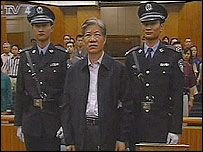
<font size="5"><center>China food safety head executed </font size></center>

_42981513_zheng203.jpg

Zheng Xiaoyu was accused of
accepting some $850,000 in bribes

BBC NEWS
Tuesday, 10 July 2007

The former head of China's State Food and Drug Administration, Zheng Xiaoyu, has been executed for corruption, the state-run Xinhua news agency reports.

He was convicted of taking 6.5m yuan ($850,000; £425,400) in bribes and of dereliction of duty at a trial in May.

The bribes were linked to sub-standard medicines, blamed for several deaths.

China has been criticised over a number of recent cases involving tainted goods, and correspondents say Zheng had become a symbol of the crisis.

Zheng had appealed against his sentence, arguing that it was "too severe" and saying he had confessed his crimes and co-operated with police.

But his appeal, heard in mid-June, was rejected shortly afterwards.

Toxic chemicals

Following Zheng's sacking in 2005, the Chinese government announced an urgent review of about 170,000 medical licences that were awarded during his tenure at the agency.

At a news conference in Beijing on Tuesday the State Food and Drug agency said that its supervision of safety was unsatisfactory, and it vowed to improve matters.

A senior official said Zheng Xiaoyu had "brought shame" on the department, adding that anyone abusing their power would be punished.

Chinese officials have already acknowledged that the country could face social unrest and a further tarnished image abroad unless improvements are made.

Dozens of people have died in China because of poor quality or fake food and drugs, sparking widespread international fears about the safety of Chinese exports.

Thirteen babies died of malnutrition in 2005 after being fed powdered milk that had no nutritional value.

US inspectors have blamed exported Chinese pet food ingredients, contaminated with melamine, for the deaths of cats and dogs in North America.

And they recently halted shipments of toothpaste from China to investigate reports that they may be contaminated with toxic chemicals.

The BBC's Daniel Griffiths in Beijing says the government is hoping that this execution will show it is getting to grips with the crisis.

But food and drug safety standards vary widely across this vast country and reform is going to be a major challenge, he says.

http://news.bbc.co.uk/2/hi/asia-pacific/6286698.stm
 
I hope they grilled him before they excecuted him, because, we may not know who he was working with or what may have been tainted beyond what has been found, thusfar... :hmm:
 
<font size="5"><center>Wine may not be what it seems in China</font size></center>

By Tim Johnson
McClatchy Newspapers
Posted on Wednesday, August 22, 2007

BEIJING — Poisoned pet food and lead-tainted children’s toys have created jitters worldwide about the safety of Chinese exports, but lost in the media storm is this fact: Consumers in China face an even more daunting challenge from misleading labels and unscrupulous manufacturers.

Take, for example, wine. Chinese vineyards can fib about the vintage on labels. They also can mislead consumers about where the wine comes from.

Some inexpensive “wines” may not even be wine at all. The state broadcaster, China Radio International, said investigators earlier this year found that “many wines consist of little more than water, pigment and alcohol, with trace amounts of grape juice.”

False wine labels don't fall into the category of bogus antibiotics, which killed seven people in China last year. No one has perished from sipping a mock merlot.

But the same toxic toothpastes and anti-freeze-tainted cough syrups that killed dozens of people in Panama and Haiti were on store shelves in China until last month. Other items recalled overseas — including seafood tainted with antibiotics, flammable baby clothes, unsafe extension cords and exploding batteries — generally remain in stores in China.

Senior officials have gone on the offensive against the foreign recalls, claiming they have less to do with safety and more to do with trade protectionism.

“I'm here to tell you, have faith in ‘Made in China,’” Li Changjiang, director of the General Administration of Quality Supervision, Inspection and Quarantine, said on a television show Monday night aimed at boosting consumer confidence.

Authorities say they investigated 68,000 cases of counterfeit and substandard food products last year and destroyed 5,900 kitchens and laboratories “used to produce and sell shoddy food products.”

Mislabeling of wine and other consumable products remains a major problem and points to broader issues in China, where factory owners and local government officials work together to promote economic growth, often ignoring severe pollution or health concerns.

Authorities haven't allowed major independent consumer protection groups to emerge, and when problems arise, redress can come late.

The anything-goes atmosphere in the alcoholic beverage sector is a case in point. At a recent workshop on the wine market in China, Ma Huiqin, an expert at China Agricultural University, decried the false vintages that China’s vintners use on some labels.

“They try to promote fake vintages, ’92, ’93 and even ’80-somethings. It’s cheating,” Ma said. “Nobody has stopped them.”

An industry spokesman acknowledged that the mislabeling has hurt wine’s image.

“In recent years, various problems … in the wine industry have caused (a) negative effect among consumers, such as fake vintage and bad quality,” Qi Wang, head of the China Alcoholic Drinks Industry Association, said in a written synopsis handed out at the conference.

Several Chinese vineyards also claim their wines come from well-known wine-growing areas overseas, leaving foreign vintners fuming.

A trade group of winemakers in Napa Valley, the Northern California region celebrated for its high-end wines, said it has found wine labeled “Valley Napa” in China.

“Additionally, we have learned of other Chinese brands using Napa place names in labeling,” said Terry Hall, a spokesman for Napa Valley Vintners. “Our vintners . . . have built a rock-solid reputation for high-quality wines second to none in the world. For others to be trading on that is wrong.”

Most wineries around the world follow strict labeling and content rules. China has been slow to adopt such regulations.

“The labeling issue is a big problem,” said Larry Lockshin, a professor of wine marketing at the University of South Australia in Adelaide, who attended the workshop.

Qi, the industry spokesman, said rules coming into effect in January will require that 80 percent of a wine must come from the vintage year indicated on the bottle label, and 75 percent of the wine must be from the grape variety indicated, such as merlot or chardonnay.

Still to be resolved is whether local winemakers can mix bulk wine imported from countries such as Spain, Chile, Australia and Argentina with their own wines without telling the consumer. Such bulk wine can sell for as little as 40 cents a liter.

Bulk wine imports to China climbed 121 percent last year, hitting nearly five times the volume of imported bottled wine. Industry experts say most of the bulk wine goes into the bottled wine of China’s three big vintners — Great Wall, Dynasty and Changyu which label their wines as products of China.

A purchasing executive with a foreign supermarket chain operating in China, who spoke on condition of anonymity because he doesn’t want to antagonize local vineyards, said of China’s homegrown wines: “I believe nothing on the label.”

Sipping wine still trails sipping tea as a Chinese pastime, although local wineries are growing quickly. Average Chinese drink only two cups a year, compared with a little over nine 750 ml bottles per person in the United States and 73 such bottles per capita in France. Still, China will climb to become the world’s 10th largest wine-consuming nation by 2010, says International Wine and Spirit Record, a data-tracking group in London.

A prominent blogger about wine in China, Wu Shuxian, was among the first to publicly accuse a major Chinese vintner of lying on labels.

In July 2006, Wu wrote on her blog that a Great Wall wine was bogus.

“The label of the wine is false. It claims to be a 1999 vintage, but I could taste that it wasn’t older than 2004,” Wu wrote. Great Wall, which grows grapes in Shandong province but is headquartered in Beijing, didn't respond to e-mail requests for comment on its labeling practices. Upon hearing the topic of an interview request, a woman in the public relations department said, “We are quite busy these days and cannot answer such specific questions.”

Ma, the wine professor, said many Chinese consumers remain unaware of the labeling problems and loyal to Chinese-labeled wine. The big national brands “do a lot of promotion on television, and the advertising is not about taste. It’s about brand.”

Moreover, labels of foreign brands, with their esoteric references to bouquets and “fruity” finishes, often baffle Chinese consumers.

“If you mention ‘raspberry notes’ on the label to a Chinese consumer, it means nothing. They’ve never tasted raspberry,” she said.

http://www.mcclatchydc.com/226/story/19122.html
 
dumb ------ not seeing this is only being talked about to ruin china's rep.

It's all bullshit, American is going down.
 
Last edited by a moderator:
Poison? If they choose to, they are taking over, the future is f%*#@`!g CHINA...

20060507_manufacturingoutputft_1.gif


Sunday, May 07, 2006
Chinese producers are moving up the value chain
Wages and production costs are rising rapidly in China. Tom Mitchell tells us, in a long piece in Monday's Financial Times, how China is handling cost rises by boosting value:

After crossing the Sharp Knife Gate waterway, the highway running west out of the Zhuhai special economic zone enters a predominantly agricultural landscape of banana fields and irrigation channels.

cont'd
http://neweconomist.blogs.com/new_economist/2006/05/china_costs.html
 
This is the cost of lower manufacturing costs, exporting of jobs and Globalization. When you don’t have standards for worker, environmental and product safety, you will invariably have lower manufacturing costs and a cheaper product. But short term savings mean long term repercussions.
 
<font size="5"><center>China threatens to retaliate over recalls</font size></center>

By Tim Johnson
McClatchy Newspapers
Posted on Thursday, August 23, 2007

BEIJING — Stung by a spate of safety recalls of its products, China hinted Thursday that it might take retaliatory action against U.S. products exported to China.

Earlier this week, China rejected a batch of U.S.-made pacemakers and asserted that U.S. soybean farmers sent shipments tainted with pesticide and weeds.

On Thursday, the State Council, China's Cabinet, released a statement saying China's government would return or destroy all improperly imported meat, fruit and recycled waste by the end of the year and would improve the monitoring of other imports.

Gao Hucheng, a vice minister of commerce, pointedly reminded a news conference that China is poised to overtake Japan as the United States' third-largest export market. A Commerce Ministry handout, though, cited "discordant notes" in bilateral trade ties, citing media coverage of safety issues as among the problems.

Gao accused American news organizations of grossly exaggerating problems with China's exports. "The Chinese government thinks certain media . . . sensationalize the quality problems of Chinese products," Gao said. "Deliberate sensationalism and overstatement will not be accepted by China."

Retaliation by China against U.S. products would be especially costly for American agricultural exporters. U.S. soybean shipments to China are valued at $3 billion annually, and grain shippers were waiting to learn whether China would take action after it announced Wednesday that it had detected "numerous quality problems" with U.S. soybeans arriving earlier in the year.

A U.S. soybean industry representative in Beijing dismissed China's complaints.

"It's all nonsense," said Phillip Laney, China country director from the U.S. Soybean Export Council. "It's a public relations ploy to divert attention from themselves and say, 'Everyone's got problems.'"

For the past six months, China has been roiled by charges that unscrupulous exporters sent tainted toothpaste and pet food, faulty tires, dangerous toys and other unsafe products to markets around the globe. The recalls have generated a backlash among some consumers against Chinese products as a whole.

Assistant Minister of Commerce Wang Chao acknowledged that backlash at the news conference, saying safety concerns have "affected sales of some 'Made in China' goods." But he noted that the nation's exports continued to increase.

Earlier this month, Mattel Inc., the world's largest toymaker, recalled 18 million Chinese-made toys worldwide, saying they may contain paint with lead or small magnets that can come loose. Mattel's Fisher-Price unit later recalled 1.5 million more toys.

In the wake of earlier recalls, China seized some U.S. shipments of orange pulp and dried apricots that it said contained excessive bacteria, mildew and sulfur dioxide.

On Monday, China announced that it had rejected part of a shipment of pacemakers. The country's standards watchdog agency said units in a batch of 272 pacemakers that arrived in Shanghai in April from St. Jude Medical of St. Paul, Minn., contained labels that didn't accurately reflect the voltage settings of the devices.

"As a result, they could create major hidden dangers in the lives of sick people," said a statement by the General Administration of Quality Supervision, Inspection and Quarantine, the nation's standards agency.

McClatchy Newspapers 2007

http://www.mcclatchydc.com/homepage/story/19153.html
 
Back
Top