Iranian Election Crisis

QueEx

Rising Star
Super Moderator
<font size="5"><Center>
Red Alert: Iran's Election Results</font size></center>


two_column

Iranian presidential candidate Mir Hossein Mousavi at a press
briefing in Tehran after the June 12 vote


Strategic Forecasting, Inc. (STRATFOR)
ALERT
June 12, 2009


The Iranian election is currently in turmoil. Both Iranian President Mahmoud Ahmadinejad and challenger Mir Hossein Mousavi are claiming to be ahead in the vote. Preliminary results from the presidential vote show Ahmadinejad leading; Iranian Election Commission chief Kamran Danesho held a press conference at 11:45 p.m. local time and announced that with some 20 percent of the votes counted, the president was leading with 3,462,548 votes (69.04 percent), while his main challenger, Mousavi, had 1, 425,678 (28.42 percent). Sources tell STRATFOR that these preliminary numbers pertain to the votes from the smaller towns and villages, where the president has considerable influence, as he has distributed a lot of cash to the poor.

However, Iran’s state-run Press TV is saying that only 10 million of 24 million votes, or around 42 percent of the vote, have been counted. At the same time, they are also claiming that 69 percent of the vote has been counted. Obviously the numbers are not adding up, and the agencies themselves appear to be in chaos.

Prior to the announcement of the results, Mousavi held a press conference in which he said he was the winner of the election. The opposition camp is greatly concerned about fraud, and STRATFOR has been told that Mousavi has vowed to resist any fraud, even if it entails taking to the streets. This means there is considerable risk of unrest should Ahmadinejad emerge as the winner. But so far there is no evidence that the government is mobilizing security forces to deal with any such eventuality.

The situation is being monitored carefully, as it is potentially explosive.


http://www.stratfor.com/analysis/20...e=RedAlert&utm_campaign=none&utm_medium=email
 
Re: Iranian Election Upset ?

<font size="5"><center>Iran Election In Dispute
as 2 Candidates Claim Victory</font size>
<font size="4">
Ahmadinejad Official Leader, But Mousavi Alleges Fraud</center></font size>


PH2009061201903.jpg

Iranians Show Their Support at the Polls. Iranians vote
for the country's next president on Friday, June 12, after
a hotly contested election campaign pitting President
Mahmoud Ahmadinejad against leading challenger and
revolutionary-era prime minister Mir Hossein Mousavi.


By Thomas Erdbrink
Washington Post Foreign Service
Saturday, June 13, 2009

TEHRAN, June 13 -- A pivotal presidential election in Iran ended in confusion and confrontation early Saturday as both sides claimed victory and plainclothes officers fired tear gas to disperse a cheering crowd outside the campaign headquarters of opposition candidate Mir Hossein Mousavi.

With votes still being counted in many cities, President Mahmoud Ahmadinejad was leading by a 2-1 ratio in early returns, according to Iranian Interior Ministry officials. But Mousavi's supporters dismissed those numbers, saying the ministry was effectively under Ahmadinejad's control.

"I am the winner of these elections," Mousavi declared late Friday, after heavy turnout resulted in a two-hour extension of voting across the Islamic republic. "The people have voted for me."

When Mousavi's youthful supporters gathered after midnight outside his Tehran headquarters to celebrate his claim to victory, officers quickly dispersed them with tear gas, said Milad Afsarzadeh, a Mousavi campaign official inside the building.

He and other witnesses to the brief melee said it was unclear whether the officers were police or members of the baseej, a paramilitary force of volunteers organized by the Revolutionary Guard Corps and greatly feared by student demonstrators. The witnesses said it was also unclear whether the plainclothes officers were taking sides in the election or enforcing rules against street demonstrations to try to prevent clashes between impassioned backers of Mousavi and Ahmadinejad. No serious violence was reported.

The election has stirred deep political passions among Iran's 46 million eligible voters, pitting Ahmadinejad, a populist who promised to help the poor and to make Iran a world power, against three challengers. If none wins a clear majority, a runoff will be held between the two top vote-getters.

Though the final say over Iran's foreign and domestic policies rests with its unelected supreme leader, Ayatollah Ali Khamenei, Mousavi portrayed himself as the candidate for change, pledging to take a less confrontational tone in relations with the West and to provide more technocratic management of the economy. His campaign produced an outpouring of enthusiasm from youth, intellectuals and an older generation of Iranian leaders, while Ahmadinejad drew his core support from rural and working-class voters, plus elements of the military and conservative Islamic clergy.

Ahmadinejad, who has been president since 2005, did not make a statement immediately after the polls closed, but his supporters pointed to the Interior Ministry's official tally to claim victory. With results in from about 35 percent of the country's 45,000 polling stations, the ministry said, Ahmadinejad had 10.2 million votes to Mousavi's 4.6 million.

Mousavi's supporters charged that officials were trying to steal the election and cut off alternative sources of information. For several hours during the balloting Friday, they said, international telephone lines to Tehran were down and text messaging -- which Mousavi's supporters had used to organize street rallies -- was blocked. Members of the baseej reportedly seized a building in North Tehran that housed several Web sites supporting Mousavi, which were shut down.

A senior aide to another opposition candidate, Mehdi Karroubi, charged that the Interior Ministry was distorting the early vote count by providing results from the countryside and not Iran's cities. "We believe these results are void and not acceptable," said the aide, Morteza Alviri.

Mousavi, meanwhile, issued a written statement thanking the "dear people of Iran" for his victory.

"I would like to inform you that in spite of wide-ranging fraud and problem-making, according to the documents and reports we have received, the majority of your votes have been cast in favor of your servant," the statement said. It concluded with a veiled suggestion of a possible confrontation, calling his supporters into the streets to celebrate his victory Saturday night and warning that if the votes are not fairly counted, "I will use all legal facilities and methods to restore the rights of the Iranian people."

The Interior Ministry, which is overseeing the election and counting the votes, is headed by Sadegh Mahsouli, a staunch supporter of Ahmadinejad. But its results must be confirmed by the Guardian Council, a panel of senior Islamic clergymen led by Khamenei, the supreme leader. Khamenei and Mousavi, who was prime minister from 1981 to 1989, are members of an older generation of Iranian revolutionaries who overthrew the shah 30 years ago.


Mousavi's statement and late-night news conference claiming victory capped a day of long lines at polling places across the capital, from the affluent neighborhoods in the north of the city to the working-class areas in the south.

"We haven't voted in 10 years time," said Giti Ghioshfar, who was waiting with her husband to cast ballots for Mousavi near Tehran's Fatemi Square. "We are here because we want more freedom," she said.

In Shahr-e Rey, south of Tehran, voter Ali Badiri said that young women without head scarves had been dancing in the streets over Mousavi's candidacy. "I'll vote for Ahmadinejad, because if Mousavi wins, they will be dancing naked next week," he said.

"We don't want to change Iran," said Abdollah Khalili, another Ahmadinejad voter. "We want this system to remain the way it is."

Researcher Kay Armin Serjoie contributed to this report.


http://www.washingtonpost.com/wp-dy..._2.html?wpisrc=newsletter&sid=ST2009061104183
 
Re: Iranian Election Upset ?

<font size="5"><center>
After Iran election,
what is Obama's next move?</font size>
<font size="4">

Obama has made an effort to reach out to Iran. But charges of vote
fraud and a crackdown on protesters there this weekend make
it harder for the president to maintain that course</font size></center>


The Christian Science Monitor
By Mark Sappenfield
Staff writer
June 14, 2009 edition


Iran's presidential election, widely suspected of being rife with fraud, presents President Obama and the West with both challenges and opportunities in their efforts to engage and moderate America's longtime enemy.


<font size="3">Obama Cautious with Criticism</font size>

Senior Obama administration officials have been conspicuously cautious in their criticism of the election results, suggesting that, for the time being, the US remains committed to reaching out to Iran, no matter who is president. But the past few days could complicate matters.

The US will not want to look too eager to essentially endorse a regime that might have significantly tampered with votes, and then sent riot squads onto the streets to cow the protesters who dared question the results. Opposition leaders have been arrested and the opposition's newspaper shuttered – events that reelected President Mahmoud Ahmadinejad deemed "not important."

Administration officials registered their concern about the legitimacy of the tally. Noting the way that the regime has suppressed free speech after the results were announced, Vice President Joe Biden said Sunday on NBC's Meet the Press that there was "some real doubt."

But he spoke in measured words. Secretary of State Hillary Rodham Clinton did the same Saturday, saying: "The United States has refrained from commenting on the election in Iran. We obviously hope that the outcome reflects the genuine will and desire of the Iranian people."


<font size="3">Tougher Statements May Come</font size>

Any potentially harsher statements would only come after an attempt to verify the claims of fraud – a difficult task, given that Iran does not allow international election monitors, Mr. Biden said. But international journalists have noted with suspicion that, according to early results, Mr. Ahmadinejad led in polls across the country – even in the cities, which are generally more liberal.

Still, this weekend is not likely to change Mr. Obama's diplomatic calculus – yet.

US "talks with Iran are not a reward for good behavior," Biden said. Instead, they are what is "in the best interests of the US," he added, noting that US goals in Iran are the same now as they were before the election: preventing Iran from developing a nuclear-weapons program and ending its support for terrorists.


<font size="3">Young Iranians the Target</font size>

The White House was heartened by Iranians' interest in the election. Spokesman Robert Gibbs said Saturday that the administration was "impressed by the vigorous debate and enthusiasm that this election generated, particularly among young Iranians."

The administration hopes that many of these Iranians were motivated by Obama's recent speech in Cairo, in which he sought to reach out to the Muslim world.

Indeed, having denounced the Bush-era doctrine of regime change, young Iranians continue to be Obama's greatest hope for reform within Iran. Their full-blooded support for Mir Hossein Mousavi – a less anti-Western candidate than Ahmadinejad – could be a building block for future Iran policy. That support suggests that Obama might be able to woo Iran's youth as allies against Ahmadinejad's conservative forces.


http://www.csmonitor.com/2009/0614/p02s01-usfp.html
 
Re: Iranian Election Upset ?

<font size="5"><center>
Iran's top cleric denounces election
results as rivals hold rallies</font size>


<font size="4">"No one in their right mind can believe" the official results
from Friday's contest, Grand Ayatollah Hossein Ali
Montazeri said of the landslide victory
Ahmadinejad claims for himself.</font size></center>


McClatchy Newspapers
By Warren P. Strobel
and Jonathan S. Landay
Tuesday, June 16, 2009


TEHRAN, Iran — Supporters of Iranian President Mahmoud Ahmadinejad and his main rival in the disputed presidential election, Mir Hossein Mousavi, staged competing rallies Tuesday as the country's most senior Islamic cleric threw his weight behind opposition charges that Ahmadinejad's re-election was rigged.

"No one in their right mind can believe" the official results from Friday's contest, Grand Ayatollah Hossein Ali Montazeri said of the landslide victory Ahmadinejad claims for himself. Montazeri accused the regime of handling Mousavi's charges of fraud and the massive protests staged by his supporters "in the worst way possible."

"A government not respecting people's vote has no religious or political legitimacy," he declared in comments on his official Web site. "I ask the police and army personals (personnel) not to 'sell their religion,' and beware that receiving orders will not excuse them before God."

Montazeri's pointed and public comments provided fresh evidence that a serious rift has opened at the top of Iran's powerful religious hierarchy over Supreme Leader Ali Khamenei's endorsement of the official election results and the regime's crackdown on opposition demonstrations.

A leader of the 1979 Islamic revolution who's often feuded with Khamenei and once vied with him for the supreme leader's position, Montazeri accused the government of attacking "the children of the people with astonishing violence" and "attempting a purge, arresting intellectuals, political opponents and Scientifics."

"He is questioning the legitimacy of the election and also questioning the legitimacy of (Khamenei's) leadership, and this is the heart of the political battle in Iran," said Mehdi Noorbaksh, an associate professor of international affairs at Harrisburg University of Science and Technology in Pennsylvania.

In an apparent attempt to defuse the crisis, the 12-member Guardian Council, part of the ruling theocracy, announced that it would conduct a partial recount of the balloting, which the government said Ahmadinejad won with more than 24 million votes, to 13 million for Mousavi.

The announcement, however, seemed to do little if anything to appease Mousavi, reform presidential candidate Mahdi Karroubi and their supporters, tens of thousands of whom filled the streets of Tehran for a fourth day to demand that the results be annulled.

"We are ready to recount those boxes that some presidential candidates claim to have been cheated," council spokesman Abbas Ali Kadkhodaei told Iranian journalists. Despite a lapsed deadline for complaints, "the body is ready to receive complaints and probe into the issue and build more confidence," he said.

It wasn't clear how many ballot boxes — or which ones — would be recounted. Mousavi has demanded an annulment of the vote.

President Barack Obama said he had "deep concerns about the election," but added that "it's not productive, given the history of U.S.-Iranian relations, to be seen as meddling."

The government, meanwhile, moved to extinguish international news coverage of the crisis after European leaders denounced security forces' violence against protesters.

At least eight demonstrators were shot dead and 28 others wounded by members of the Basij, a hard-line Islamic militia loyal to Ahmadinejad, according to workers at Tehran's Rasoul Akram Hospital, where a video posted on YouTube showed hundreds of doctors and nurses protesting the election results Tuesday.

The Ministry of Culture and Islamic Guidance banned foreign journalists from continuing to cover rallies in Tehran, revoked the credentials of those with temporary visas and ordered them to leave the country as soon as possible. Cell phone service was cut in the city.

The ministry also prohibited news agencies and foreign broadcasters from sending out video and pictures in what could presage a more violent government attempt to crack down.

The ban, however, failed to prevent details of the Ahmadinejad and Mousavi rallies from reaching the outside world via the Internet, where official news sites posted reports and videos and ordinary Iranians used Twitter, YouTube and other online networks.

Video that demonstrators shot on cell phones showed comrades carrying away a severely injured man in Vanak Square, the site of nightly clashes. Another video clip showed large fires in the traffic circle around the square.

(Landay reported from Washington.)


http://www.mcclatchydc.com/227/story/70155.html
 
Re: Iranian Election Upset ?

Yes this whole thing reeks of tuna.
Did anyone see Jon Stewart where they were poking jabs at this?
Then again,there were some uppercuts and hooks thrown too.
:lol:
 
Re: Iranian Election Upset ?

Props to them.
Some even died for their cause.
I love it.

I wish the American people had conviction and balls like them.
But...we dont
 
Re: Iranian Election Upset ?

838-06162009Siers.slideshow_main.prod_affiliate.91.jpg

Kevin Siers / The Charlotte Observer (June 16, 2009)​
 
Re: Iranian Election Upset ?

Props to them.
Some even died for their cause.
I love it.

I wish the American people had conviction and balls like them.
But...we dont

Today is June 17th, despite the very real possibility of being beaten or even killed, hundreds of thousands of Iranians took to the streets today.
LOOK at the video below.
With a total population of about 71 million, the size and scope of these demonstrations are huge. Add the fact that they live in a country where the media is virtually entirely controlled by mafia-style Theocratic -1000 A.D. clerics, this display is truly amazing. It just reinforces the sad reality that the majority of US citizens are clueless sheeple, brainwashed by <s>FOX</s> FAKE News & other "media of mass deception". The Iranians use the internet in a closed society to get the real information the 1000 A.D. clerics don't want them to know, In the US the internet is primarily used for entertainment...Porn, Online Vid-Games, Sports, silly YouTube vids, etc.
The late Marshall McLuhan was right about the US media & its affect on US viewers, he said:
<i>In this electronic age we see ourselves being translated more and more into the form of information, moving toward the technological extension of consciousness.</i>
-Marshall McLuhan-

Compared to the Iran demonstrators, our American consciousness for most US citizens is like a frog in a pot of water where the water is slowly brought to a boil and the frog is boiled to death never realizing the increasing water temperature.


[flash]http://www.youtube.com/v/CLo_6Qp1eTk&hl=en&fs=1&[/flash]

263j9ub.jpg


6a00d83451c45669e20115702b8e10970c-800wi
 
Last edited:
Re: Iranian Election Upset ?

The real question is this, what's Obama going to do about this situation?
 
Re: Iranian Election Upset ?

The real question is this, what's Obama going to do about this situation?

Philip Zelikow, an adviser to former Secretary of State Condoleezza Rice and history professor at the University of Virginia, said because of the election results, <SPAN style="BACKGROUND-COLOR: #ffff00">the United States needs to be careful with how it approaches Iran</span> and shouldn't be seen as taking the side of the Ahmadinejad's opponents.

<SPAN style="BACKGROUND-COLOR: #ffff00">"The forces supporting Ahmadinejad will want to accuse their opponents of being foreign puppets,"</span> Zelikow said. "So <SPAN style="BACKGROUND-COLOR: #ffff00">our behavior needs to inoculate against that accusation</span>.​
 
Was Ahmadinejad's Win Rigged?

By SIMON ROBINSON

Iran's Interior Ministry announced Saturday that incumbent President Mahmoud Ahmadinejad had won 63.29% of the vote in the country's presidential election — a landslide. But Iran's opposition leader Mir-Hossein Mousavi says he won and that the result had been rigged; Mousavi supporters have taken to the streets in Tehran and other cities to protest the official outcome.

Ahmadinejad, for his part, insists that he won fairly, while Iran's Supreme Leader, Ayatullah Ali Khamenei, initially congratulated Iranians for proving their "great worth." The result, Khamenei said, was a "divine assessment." On Monday, though, Khamenei ordered the powerful Guardian Council to investigate the fraud allegations.

So far, Washington has taken a cautious approach to commenting on the election, though a senior U.S. official called the results "not credible" and Vice President Joe Biden told Meet the Press that "there's some real doubt" whether Ahmadinejad actually won. "There's an awful lot of questions about how this election was run," he said. Here are five key questions being raised about the legitimacy of the results.

Was the Voting Properly Supervised?
As always in Iran, this election was run by the Interior Ministry. In each ward, ministry and local government officials and respected local leaders form committees to oversee the election process. Iran's powerful Guardian Council appoints thousands of officials to supervise actual voting at polling stations. Candidates can also send an observer to each polling station to watch the voting and ballot count. However, there are no independent election observers in Iran.

Did the Voting Go Smoothly?
Not everywhere. On Friday, the polling day, there were reports that opposition observers were barred from entering some voting stations. Mousavi campaign officials also said that a number of stations in the northwest and south ran out of ballots.

The huge numbers of people voting — the government says turnout was more than 80%, one of the highest rates since the Revolution in 1979 — meant that some stations were kept open until late Friday night. Many Iranians, especially those in Tehran, have reported that just before voting ended, text-messaging and pro-Mousavi websites were blocked.

Was the Government's Fast Announcement of Results Normal?
No. The Interior Ministry announced the first results within an hour of the polls closing and the official result less than a day later. The ministry is supposed to wait three days after voting before it certifies the result, to allow time for disputes to be examined. Friday's announcement, which was based on a very small count, came just minutes after Mousavi declared himself to be "definitely the winner." According to a Mousavi official in Paris, the opposition leader was initially informed by the Interior Ministry that he had won. But ministry officials shortly thereafter publicly called it for Ahmadinejad.

Gary Sick, a Columbia University professor and Iranian-affairs adviser for three U.S. Administrations, said that given the apparent record turnout, it would have been impossible to announce a definitive result so soon after the polls closed, because Iran does not use voting machines. The country uses paper ballots that must be counted by hand — a time-consuming process, Sick said in an interview posted on the Council on Foreign Relations website. (See why the White House views Iran's election as a diplomatic coup.)

A fast announcement is not necessarily proof of rigging, says John Stremlau, vice president for peace programs at the Carter Center, which has monitored 75 elections over the past two decades. But for people to have confidence in those announcements, a country needs an independent electoral commission that acts fairly and transparently. "You have none of that in the case of Iran," says Stremlau.

Are Any of the Vote Totals Suspicious?
Yes. Support for Ahmadinejad was strangely consistent across the country, a real change from previous elections, when candidates drew different levels of support in different regions.

There were several other puzzlers in the results:

• According to official figures, Ahmadinejad handily beat Mousavi in Mousavi's hometown of Tabriz — a shocking result, given the candidate's popularity in his own region.

• Ahmadinejad beat Mousavi in the big cities, even though Iran's very limited polling and anecdotal evidence indicate that Mousavi is far more popular than the President in cities.

• The official figures put support for the other main reformist candidate, Mehdi Karoubi, at below 1%. That is far less than what was expected, and a drastic departure from the pattern in previous elections.

How Popular Is Ahmadinejad in Iran?
It's possible that the President is simply far more popular than people outside Iran want to believe. There's no doubt that he has won the support of many voters by focusing on Iran's nuclear ambitions and by playing up the perceived threats from Washington and Israel.

At the same time, Iran's economy is a mess, and people are unhappy about a raft of everyday issues, from the price of food to joblessness.

The result is also surprising in light of Iran's demographic trends. There is a lot of evidence that as the country grows younger, it is also growing more moderate. A reform candidate won Iran's presidency with 70% of the vote in 1997 and increased his share to 78% four years later. In 2005, the reform movement had fallen on lean times and many young voters stayed at home; Ahmadinejad squeaked into the presidency in a second round of voting widely seen as having been tampered with. If the results this time are legitimate, it means that two-thirds of Iran's voters have become more conservative over the past four years.

It's also worth noting that big turnouts are often a sign that voters want change and tend to favor the challenger. This time around, by contrast, the incumbent President won two-thirds of the votes cast, according to the government.


http://www.time.com/time/specials/packages/0,28757,1904645,00.html
 
Re: Iranian Election Upset ?

Philip Zelikow, an adviser to former Secretary of State Condoleezza Rice and history professor at the University of Virginia, said because of the election results, <SPAN style="BACKGROUND-COLOR: #ffff00">the United States needs to be careful with how it approaches Iran</span> and shouldn't be seen as taking the side of the Ahmadinejad's opponents.

<SPAN style="BACKGROUND-COLOR: #ffff00">"The forces supporting Ahmadinejad will want to accuse their opponents of being foreign puppets,"</span> Zelikow said. "So <SPAN style="BACKGROUND-COLOR: #ffff00">our behavior needs to inoculate against that accusation</span>.​

Yeah QueEx:

Even RepubliKlan, Racist, Retrograde, “angry white man” ,
"American Blacks should be thankful for slavery"
Patrick J. Buchanan
“Gets It” - regarding President Obama’s current Iran strategy

2_smallpersonimage_93.gif

READ: Outlasting the Ayatollahs by Patrick J. Buchanan

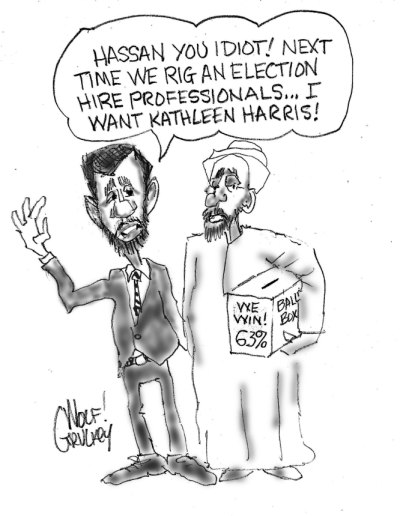
wolf-harris.jpg
 
Re: Iranian Election Upset ?

House condemns Tehran crackdown on protesters

In the strongest message yet from the U.S. government, the House voted 405-1 Friday to condemn Tehran's crackdown on demonstrators and the government's interference with Internet and cell phone communications.

The resolution was initiated by Republicans as a veiled criticism of President Barack Obama, who has been reluctant to criticize Tehran's handling of disputed elections that left hard-liner President Mahmoud Ahmadinejad in power.


Full Story
 
Re: Iranian Election Upset ?

The real question is this, what's Obama going to do about this situation?

<font size="6">
<SPAN style="BACKGROUND-COLOR: #ffff00">QBlog</span></font size>

June 22, 2009

<font size="3">In a move not likely to please actinanass or those on the Republican side of the aisle who are doing their best to use the Iranian Election Crisis as an issue to cut down the President -- Mr. Obama makes another Right Call:
The U.S. Department of Defense is "on edge" over the turmoil in Iran, and has directed U.S. naval assets in the Persian Gulf to be, in layman's terms, in "non-incident mode," military officials told FOX News Monday.

Meanwhile, the former crown prince of Iran contended that members of Iran's Revolutionary Guard are showing "discontent" and some are "contemplating the contingency" of defying the regime in the wake of the Islamic Republic's disputed presidential election.

U.S. military commanders are said to have been instructed to be alert to any possibility of a clash with Iranian naval assets, and to position themselves in such a way as to diminish the ability of Iran to stage an incident, however small, that could be used to rally the support of the Iranian people to the regime and President Mahmoud Ahmadinejad, whose backers are accused of voter fraud in the national election 10 days ago.

A Defense Department official told FOX News that U.S. Central Command has sent a message to all Navy service members in the Persian Gulf region that they are "expected to conduct themselves in a professional manner and to avoid any unnecessary escalation or confrontation" with Iranian ships or other military assets.

"Given the heightened sensitivities in Tehran we don't want to feed into what is already a very tense situation on their side," the official said.

Currently the aircraft carrier USS Eisenhower in in the Northern Arabian Sea supporting Operation Enduring Freedom F-18 flight missions along with its battle group, which consists of multiple support ships. Roughly half a dozen Navy ships, including destroyers, are located in the Persian Gulf.

President Obama said in an interview broadcast Monday that he wants the U.S. to stand back so that it doesn't become "a foil for those forces inside Iran who would love nothing better than to make this an argument about the United States.

"There should be no distractions from the fact that the Iranian people are seeking to let their voices be heard," he told CBS' "Early Show."

http://www.foxnews.com/politics/200...-mount-defecting-iranian-revolutionary-guard/

QueEx

</font size>
 
Re: Iranian Election Upset ?

`

What are the Russians saying ???
Russia said on Monday <SPAN style="BACKGROUND-COLOR: #ffff00">it views all issues</span> linked to Iran's presidential election <SPAN style="BACKGROUND-COLOR: #ffff00">as the Islamic Republic's internal affair</span>.

"According to the officially announced results of <SPAN style="BACKGROUND-COLOR: #ffff00">Iran's presidential election</span>, it <SPAN style="BACKGROUND-COLOR: #ffff00">was won by current President Mahmoud Ahmadinejad</span>," Russia's Foreign Ministry said in a statement.

"We consider all issues linked to Iran's election as this country's exclusively internal affair. We believe the discords that emerged after the election must be settled in strict conformity with the Islamic Republic's constitution and laws."

What else would the Russians have said ??? After all, Russia is building the Iranian nuclear power plant.

QueEx
 
Allow this clip from ABC News to shed some light on US intervention! peace

<object width="425" height="344"><param name="movie" value="http://www.youtube.com/v/GRwUZ-u6KFo&hl=en&fs=1&"></param><param name="allowFullScreen" value="true"></param><param name="allowscriptaccess" value="always"></param><embed src="http://www.youtube.com/v/GRwUZ-u6KFo&hl=en&fs=1&" type="application/x-shockwave-flash" allowscriptaccess="always" allowfullscreen="true" width="425" height="344"></embed></object>
 
Allow this clip from ABC News [:smh: :smh: :smh:] to shed some light on US intervention! peace
<font size="3">
I don't know which is worse: those in government who deceive - or - those who make and/or post deceiving videos about government.

QueEx

</font size>
 
<font size="3">
I don't know which is worse: those in government who deceive - or - those who make and/or post deceiving videos about government.

QueEx

</font size>

2 sides to every story boss. I haven't formed an opinion, one way or the other, but I try to seek the truth. Above all, let the Iranians solve their own problems!
 
My comments were not about you or anyone else having formed an opinion.

My comments ARE about your representation that the clip was an ABC News video.
Obviously. Obviously, that was not true. Are you saying, you didn't know that ???

QueEx
 
my bad, the ABC News logo throughout the vid kinda threw me off.

Really? Threw you off?

What about the constant switching back and forth and the inuendo between
and the 2007 ABC clip - - and - - the totally unrelated images from 2009 ???

Did that impress you ???

Or, did you think it would impress us ???

QueEx
 
Re: Iranian Election Upset ?

California budget stalled as deadline passes


SAN FRANCISCO (AFP) — A deadline to fix California's budget crisis passed with no deal in sight Tuesday as the White House warned that the recession-ravaged state must solve its fiscal problems alone.

California Governor Arnold Schwarzenegger warned last week lawmakers must come up with a plan to plug a 24-billion-dollar budget deficit by midnight Monday in order to prevent the state running out of cash next month.

However, after meetings in Sacramento, the deadline came and went with no budget in place, edging California closer to the brink of a financial meltdown.

California's deficit has spiraled as soaring unemployment and one of the worst home foreclosure crises in the United States have sent state revenues plummeting to levels not seen since the 1990s.

State officials say California needed to set a budget by Monday for loans to ensure liquidity over the first half of the fiscal year from July to December. California receives most of its revenues in the second half of the year.

In recent weeks, Schwarzenegger has repeatedly warned that California faces a financial meltdown if no budget is put in place.

"I don't have to shut down state government, because when (legislators) don't produce a budget on time, we will run out of cash and therefore our government will shut down by itself," he said Friday.


The U.S. is in no position to criticize anybody. California is about to go belly up. Not to mention about 40-45 other states. Iran could be lending us money in a few months.
 
Middle East
Jun 23, 2009

http://www.atimes.com/atimes/Middle_East/KF23Ak02.html

'Color' revolution fizzles in Iran
By M K Bhadrakumar

Israelis are realists par excellence. This is why it is always gainful to buttonhole an Israeli counterpart over a single-malt on the diplomatic circuit. He will invariably weave into the tapestry of the plain tale a nylon thread until then obscure to the naked eye.

Thus, the first warning that the adventurous project to mount a "Twitter revolution" in Iran was doomed to fail had to come from the Israelis. It meshes well with the indications that Supreme Leader Ali Khamenei's capacity to command the seemingly explosive political situation was never really been in doubt, no matter the hype in the Western media that Tehran was on the 'knife's edge".

If any doubt lingers, that also is dispelled by the fury in the state-controlled Saudi Arabian media's unprecedented, vicious personal attack on both Khamenei and President Mahmud Ahmadinejad - of a kind alien to the culture of ta'arof (politesse) or even taqiyah (dissimulation) in that part of the world. Riyadh's fond hopes of witnessing the Iranian regime debilitated by a protracted crisis have been dashed. Its principal interlocutor, former Iranian president Akbar Hashemi Rafsanjani, has vanished from the chessboard. Riyadh seems bracing for Tehran's wrath.

Israel's faultless prognosis
In an extraordinary media leak at the weekend, just as Khamenei's historic speech at the Friday prayer meeting in Tehran ended, Meir Dagan, head of Israel's Mossad, let it be known that a win by Iranian opposition candidate Mir Hossein Mousavi in the presidential election on June 12 would have spelled "big problems" for Israel.

Israelis have a way of saying things. It was a subtle acknowledgement of political realities in Tehran. Speaking to the Foreign Affairs and Defense Committee of the Knesset (parliament) last Tuesday, Israel's spymaster could foresee that the protests in Iran would run out of steam. According to Ha'aretz newspaper, Dagan said: "Election fraud in Iran is no different than what happens in liberal states during elections. The struggle over the election results in Iran is internal and is unconnected to its strategic aspirations, including its nuclear program."

He explained: "The world, and we, already know Ahmadinejad. If the reformist candidate Mousavi had won, Israel would have had a more serious problem, because it would need to explain to the world the danger of the Iranian threat, since Mousavi is perceived in the international arena as a moderate element. It is important to remember that he is the one who began Iran's nuclear program when he was prime minister."

The assessment is faultless, perfect. By a masterstroke in "back-channel" diplomacy, Israel signaled to Tehran it had nothing to do with any "color" revolution. It was a timely signal. Indeed, divisions have come to surface that have existed for years within the Iranian regime. But it is very obvious that there is no scope for a "color" revolution in today's Iran. Even a trenchant, relentless critic of the regime like veteran author Amir Taheri admits:
The regime's base has benefited from Ahmadinejad's largesse, and the rest of Iranian society is not sure anyone could do better. Ahmadinejad's principal weakness is his failure to bring the rich and corrupt mullahs to justice, as he had promised. His supporters say that would be the priority in his second term. ... Today, he is the authentic leader of the Khomeinist movement in a way that Mousavi, or [former President Mohammad] Khatami, or any of the other half-way-house Khomeinists could never be.


Mousavi's limitations
Nonetheless, Mousavi kindled hopes in the West - notably London, Paris and Berlin - and some "pro-West" Arab capitals. But then, that was because he was a known factor as foreign minister and then prime minister during 1981-89. The issue was never that he was a modernist or reformer. To quote Taheri, the well-informed chronicler of the Middle East, Mousavi when he was in power, "developed a wide network of contacts in the US, Europe and the Arab countries".

Taheri, who rubs shoulders with the Arab and Western political elites with elan, offers insights into the Mousavi camp. He recalls that the man who led the lengthy Algiers talks, which resulted in the release of the American hostages in 1981, Behzad Nabvi, is still assisting Mousavi. So is Abbas Kangarioo who held secret negotiations with the Ronald Reagan administration in what came to be known as the Iran-Contra deal. Kangarioo, a key advisor and friend of Mousavi, also has the distinction of having "developed a network of contacts in intelligence and diplomatic circles in Europe and the US".

Unsurprisingly, Taheri estimates that while Mousavi's fame might have spread far and wide in the Western intelligence circles, his principal appeal at home is confined to the urban middle classes who wish the "Khomeinist revolution would just fade away ... People like Mousavi and former presidents Mohammad Khatami and Hashemi Rafsanjani have long ceased to be regarded as genuine revolutionaries".

From another direction, Taheri came to virtually the same definitive conclusion as the Israeli intelligence chief reached. Namely, that a weak interlocutor without a "Khomeinist base" like Mousavi could never make concessions that the US, the Europeans and the Arabs demanded, whereas Ahmadinejad can afford a softening of position as it will only seem a clever maneuver. Paradoxically, negotiating with Ahmadinejad might prove easier for the West, as he has a genuine constituency.

Looking back at the past four years, the fact remains that Ahmadinejad restored the connectivity of the regime with the radical populist discourse. "Four years ago", Taheri writes, "the image of the regime was one of a clique of mid-ranking mullahs and their business associates running the country as a private company in their own interest. The regime's 'downtrodden' base saw itself as the victim of a great historic swindle. Under Ahmadinejad, a new generation of revolutionaries has come to the fore, projecting an image of piety and probity, reassuring the 'downtrodden' that all is not lost."

Ahmadinejad's populism is a double-edged sword. If carried too far, it may undermine the legitimacy of the regime, which included corrupt sections of the clerical establishment. But Ahmadinejad is a clever politician. He has certainly grown while on the job these past four years. Although he self-portrayed with gusto as a locomotive that charges ahead without brakes or reverse gear, he knew where to stop and when to glance over his shoulder. Thus, he hit at many corrupt practices and threatened to bring key figures to justice, but stopped short of landing the big catch. The big question is whether Ahmadinejad will cast his net wide in his second term.

Rafsanjani outmaneuvered
However, Khamenei remains the ultimate arbiter. Ahmadinejad publicly acknowledged the locus of power by expressing in a formal letter "his gratitude" to Khamenei for his "helpful remarks" at the Friday prayers. Last week's power-play showed that Khamenei effectively thwarted Rafsanjani's attempt to rally the clerical establishment in Qom. The turning point was reached on Thursday when the majority of the 86 members of the powerful Assembly of Experts (which Rafsanjani headed) openly rallied behind Khamenei.

The Assembly of Experts is the most powerful organ of the regime, invested with the authority to elect and dismiss the supreme leader and to supervise his functioning. Around 50 members of the Assembly of Experts said in a statement that "enemies of Iran" were masterminding the "unrest and riots" over the presidential vote through its "hired elements". Rafsanjani conclusively lost the war when the majority of the members of the Assembly of Experts expressed confidence that with the "sagacious directions of the [Supreme] Leader", the machinations of Iran's enemies will be defeated.

Armed with this decisive support, Khamenei came to deliver his historic Friday prayer speech where he ruled out any rethink about the election result. Rafsanjani failed to show up at the prayer meeting, even as Khamenei made clear his support for Ahmadinejad, stressing how closely their viewpoints coincided.

Significantly, Khamenei referred to Rafsanjani by name even in his absence. The message was loud and clear: Khamenei's supremacy is unchallengeable. Most ominously, while Khamenei graciously absolved Rafsanjani of any personal corruption, he left open the possibility of legal proceedings being initiated against his family members. Rafsanjani will now need to weigh his options very carefully. He cannot but factor in the Sword of Damocles hanging over his family members who have allegedly amassed huge wealth through corrupt practices.


Also, Khamenei made no effort to specifically contradict the grave charge leveled by Ahmadinejad during the election campaign that Rafsanjani conspired with the Saudi regime to overthrow his government - an allegation that the president couldn't have made without input from Iranian intelligence, which comes under the supervision of the supreme leader.

On Saturday, the Assembly of Experts went a step further by expressing its "strong support" for Khamenei's speech. It called on the nation to obey Khamenei's guidelines. Also on Saturday, the Iranian armed forces headquarters and the Qom Seminary Teachers Society and several influential voices in the regime publicly rallied behind Khamenei. The so-called reformist clergy aligned with Khatami changed their mind and called off their planned demonstration on Saturday.

The hard reality, therefore, is that Khamenei's awesome powers are in no way under challenge. He can afford to let demonstrations by Mousavi's middle-class followers continue to let off steam, as he has the authority to command the situation in a holistic way. That is to say, even if protests may continue for a while - which seems improbable as Mousavi finds himself in a tight spot - that does not erode state power.

As Taheri put it, "So-called 'Iran experts' did not realize that Mousavi was a balloon that a section of the Iranian middle class inflated to show its anger not only at Ahmadinejad but also at the entire Khomeinist regime. Otherwise, there is nothing in Mousavi's record ... to make him more attractive than Ahmadinejad."

At the end of it all, the international community can only heave a sigh of relief that while this complex and extremely confusing political drama unfolded, George W Bush was no more in the White House in Washington. United States President Barack Obama could grasp the subtleties of the situation and adopted a well-thought-out, measured policy and broadly stuck to it despite apparent pressure from conservatives.

His remarks have not even remotely called into question Ahmadinejad's locus standii, let alone Khamenei's, to lead the country. Nor has Obama identified himself with Mousavi's call for a new poll. If anything, he ostentatiously distanced himself from Mousavi. Certainly, not once did Obama threaten to go back on his offer to directly engage Iran in the near future.

Meanwhile, Obama has just done some thoughtful fine-tuning in the lineup of the Iran hands in his administration, as the countdown begins for the commencement of direct talks. He shifted Dennis Ross to the National Security Council as special advisor for the Persian Gulf and Southwest Asia instead of appointing him as the special envoy to Iran on the lines of George Mitchell's portfolio covering the Palestinians and Israel. Tehran will no doubt welcome the shift, given Ross' hawkish views. Now, it will be the right thing to do if Obama asks Richard Holbrooke, special representative for Afghanistan and Pakistan, to hold additional charge of Iran.

Clearly, the Iranians took note that Obama's statements remained carefully modulated, although Voice of America might have meddled in the turmoil, as Tehran alleges. Foreign Minister Manouchehr Mottaki's broadside on Saturday in Tehran singled out Britain, France and Germany, but omitted any reference to the US (or Israel). Among European countries, Tehran trained its guns on Britain.

Mottaki said British forces in Iraq trained saboteurs and infiltrated them into Iran. But even then, it is a measure of Tehran's self-confidence that he elected to mock, saying it's time London forgot the adage that the "sun never sets on the British Empire".

Ambassador M K Bhadrakumar was a career diplomat in the Indian Foreign Service. His assignments included the Soviet Union, South Korea, Sri Lanka, Germany, Afghanistan, Pakistan, Uzbekistan, Kuwait and Turkey.
 
Interesting analysis. Thanks for that.

Reaffirms my thinking that it was unwise, contrary to to the thinking of
those looking to create and embarassment for the President, for the U.S.
to involve itself in this internal matter because it seemed rather clear that
those who are really in charge in Iran were hardly losing control, as many
may have hoped.

Hence, the President is no worse position, even if not in any better position,
to conduct dialogue with the Iranians - - though it is unlikely in any case that
Iran will change directions from its nuclear future.

QueEx
 
No problem

I was looking for a level headed assessment at the situation in Iran.

Two thumbs up for the way Obama's admin has handled this so far.

BigUnc
 
No problem

I was looking for a level headed assessment at the situation in Iran.

Two thumbs up for the way Obama's admin has handled this so far.

BigUnc

<font size="3">Keep your eye on this <u>unusual</u>:

</font size>

<font size="5"><center>Tehran takes note of Israel's non-interference
in its domestic turmoil</font size></center>


DEBKAfile Exclusive Report
June 22, 2009


Ruling circles in Tehran have interpreted a remark by Israel's Mossad director Meir Dagan as signifying Jerusalem's non-interference in the domestic turmoil besetting the regime over the disputed presidential election, DEBKAfile's Iranian sources report. They see Israel lining up with mainstream Arab governments such as Egypt and Saudi Arabia, which have quietly watched Iranian unrest for ten days with hardly a word.

Last week, Dagan surprised Tehran when he remarked in a briefing to the Knesset foreign affairs and security committee that the scale of vote-rigging in Iran was not unusual compared with most democracies. The spy chief went on to say that the protests in Tehran would fade after a few days.

These comments, say our sources, persuaded Iranian officials to change their habit and go easy on "the Zionists" when accusing foreign elements of meddling in their internal affairs. They vented their ire this time on Britain and to a lesser degree on the US.

Regime sources in Tehran also noted that the Mossad director said one thing and prime minister Binyamin Netanyahu another. In an interview with the US broadcaster NBC Sunday, June 21, Netanyahu called the Islamic regime one "whose real nature has been unmasked, and it's been unmasked by incredible acts of courage by Iran's citizens." But he saw no reason why the Israeli and Iranian peoples should not live in peace.

According to DEBKAfile's sources, Tehran speculated that Netanyahu had adapted his remarks to a US audience which, like Israelis, sympathizes with the protest movement, while Dagan's remarks were meant for Iran's ears.


http://www.debka.com/headline.php?hid=6146
 
Unusual indeed.

Numerous questions are swirling in my head, Such as:

Is the Israeli military option now on the back burner in favor of diplomacy?

Is the Obama/Clinton pressure on Israel working?

Why are diplomatic communiques usually sent through back channels being done in press releases?

Do Iran and Israel have back door channels to each other or was the United states the intermediary? If so, has the US cut that avenue off and trying to force the 2 sides to speak to each other directly?

guess that's enough for now.I have more but it's time for a pot of coffee and some contemplation.
 
What about the constant switching back and forth and the inuendo between and the 2007 ABC clip - - and - - the totally unrelated images from 2009 ???

QueEx

huh? you too smart not to use commas bruh

Seriously, I'm just watchin' and waiting to see how this pans out. I'm glad Obama hasn't said anything about Iran, they can solve their own problems! What I can't grasp is why no one has cited past policies against Iran? Just last year, Dubya allocated 400 million towards destabilizing the country.

U.S. Is Said to Expand Covert Operations in Iran
 
<font size="5"><center>
The Iranian Election
and the Revolution Test</font size></center>


104168


Strategic Forecasting, Inc. (STRATFOR)
Geopolitical Intelligence Report
By: By George Friedman
June 22, 2009


Successful revolutions have three phases. First, a strategically located single or limited segment of society begins vocally to express resentment, asserting itself in the streets of a major city, usually the capital. This segment is joined by other segments in the city and by segments elsewhere as the demonstration spreads to other cities and becomes more assertive, disruptive and potentially violent. As resistance to the regime spreads, the regime deploys its military and security forces. These forces, drawn from resisting social segments and isolated from the rest of society, turn on the regime, and stop following the regime’s orders. This is what happened to the Shah of Iran in 1979; it is also what happened in Russia in 1917 or in Romania in 1989.

Revolutions fail when no one joins the initial segment, meaning the initial demonstrators are the ones who find themselves socially isolated. When the demonstrations do not spread to other cities, the demonstrations either peter out or the regime brings in the security and military forces — who remain loyal to the regime and frequently personally hostile to the demonstrators — and use force to suppress the rising to the extent necessary. This is what happened in Tiananmen Square in China: The students who rose up were not joined by others. Military forces who were not only loyal to the regime but hostile to the students were brought in, and the students were crushed.


<font size="4">A Question of Support</font size>

This is also what happened in Iran this week. The global media, obsessively focused on the initial demonstrators — who were supporters of Iranian President Mahmoud Ahmadinejad’s opponents — failed to notice that while large, the demonstrations primarily consisted of the same type of people demonstrating. Amid the breathless reporting on the demonstrations, reporters failed to notice that the uprising was not spreading to other classes and to other areas. In constantly interviewing English-speaking demonstrators, they failed to note just how many of the demonstrators spoke English and had smartphones. The media thus did not recognize these as the signs of a failing revolution.

Later, when Ayatollah Ali Khamenei spoke Friday and called out the Islamic Revolutionary Guard Corps, they failed to understand that the troops — definitely not drawn from what we might call the “Twittering classes,” would remain loyal to the regime for ideological and social reasons. The troops had about as much sympathy for the demonstrators as a small-town boy from Alabama might have for a Harvard postdoc. Failing to understand the social tensions in Iran, the reporters deluded themselves into thinking they were witnessing a general uprising. But this was not St. Petersburg in 1917 or Bucharest in 1989 — it was Tiananmen Square.

In the global discussion last week outside Iran, there was a great deal of confusion about basic facts. For example, it is said that the urban-rural distinction in Iran is not critical any longer because according to the United Nations, 68 percent of Iranians are urbanized. This is an important point because it implies Iran is homogeneous and the demonstrators representative of the country. The problem is the Iranian definition of urban — and this is quite common around the world — includes very small communities (some with only a few thousand people) as “urban.” But the social difference between someone living in a town with 10,000 people and someone living in Tehran is the difference between someone living in Bastrop, Texas and someone living in New York. We can assure you that that difference is not only vast, but that most of the good people of Bastrop and the fine people of New York would probably not see the world the same way. The failure to understand the dramatic diversity of Iranian society led observers to assume that students at Iran’s elite university somehow spoke for the rest of the country.

Tehran proper has about 8 million inhabitants; its suburbs bring it to about 13 million people out of Iran’s total population of 70.5 million. Tehran accounts for about 20 percent of Iran, but as we know, the cab driver and the construction worker are not socially linked to students at elite universities. There are six cities with populations between 1 million and 2.4 million people and 11 with populations of about 500,000. Including Tehran proper, 15.5 million people live in cities with more than 1 million and 19.7 million in cities greater than 500,000. Iran has 80 cities with more than 100,000. But given that Waco, Texas, has more than 100,000 people, inferences of social similarities between cities with 100,000 and 5 million are tenuous. And with metro Oklahoma City having more than a million people, it becomes plain that urbanization has many faces.


<font size="4">Winning the Election With or Without Fraud</font size>

We continue to believe two things: that vote fraud occurred, and that Ahmadinejad likely would have won without it. Very little direct evidence has emerged to establish vote fraud, but several things seem suspect.

For example, the speed of the vote count has been taken as a sign of fraud, as it should have been impossible to count votes that fast. The polls originally were to have closed at 7 p.m. local time, but voting hours were extended until 10 p.m. because of the number of voters in line. By 11:45 p.m. about 20 percent of the vote had been counted. By 5:20 a.m. the next day, with almost all votes counted, the election commission declared Ahmadinejad the winner. The vote count thus took about seven hours. (Remember there were no senators, congressmen, city council members or school board members being counted — just the presidential race.) Intriguingly, this is about the same time in took in 2005, though reformists that claimed fraud back then did not stress the counting time in their allegations.

The counting mechanism is simple: Iran has 47,000 voting stations, plus 14,000 roaming stations that travel from tiny village to tiny village, staying there for a short time before moving on. That creates 61,000 ballot boxes designed to receive roughly the same number of votes. That would mean that each station would have been counting about 500 ballots, or about 70 votes per hour. With counting beginning at 10 p.m., concluding seven hours later does not necessarily indicate fraud or anything else. The Iranian presidential election system is designed for simplicity: one race to count in one time zone, and all counting beginning at the same time in all regions, we would expect the numbers to come in a somewhat linear fashion as rural and urban voting patterns would balance each other out — explaining why voting percentages didn’t change much during the night.

It has been pointed out that some of the candidates didn’t even carry their own provinces or districts. We remember that Al Gore didn’t carry Tennessee in 2000. We also remember Ralph Nader, who also didn’t carry his home precinct in part because people didn’t want to spend their vote on someone unlikely to win — an effect probably felt by the two smaller candidates in the Iranian election.

That Mousavi didn’t carry his own province is more interesting. Flynt Leverett and Hillary Mann Leverett writing in Politico make some interesting points on this. As an ethnic Azeri, it was assumed that Mousavi would carry his Azeri-named and -dominated home province. But they also point out that Ahmadinejad also speaks Azeri, and made multiple campaign appearances in the district. They also point out that Khamenei is Azeri. In sum, winning that district was by no means certain for Mousavi, so losing it does not automatically signal fraud. It raised suspicions, but by no means was a smoking gun.

We do not doubt that fraud occurred during Iranian election. For example, 99.4 percent of potential voters voted in Mazandaran province, a mostly secular area home to the shah’s family. Ahmadinejad carried the province by a 2.2 to 1 ratio. That is one heck of a turnout and level of support for a province that lost everything when the mullahs took over 30 years ago. But even if you take all of the suspect cases and added them together, it would not have changed the outcome. The fact is that Ahmadinejad’s vote in 2009 was extremely close to his victory percentage in 2005. And while the Western media portrayed Ahmadinejad’s performance in the presidential debates ahead of the election as dismal, embarrassing and indicative of an imminent electoral defeat, many Iranians who viewed those debates — including some of the most hardcore Mousavi supporters — acknowledge that Ahmadinejad outperformed his opponents by a landslide.

Mousavi persuasively detailed his fraud claims Sunday, and they have yet to be rebutted. But if his claims of the extent of fraud were true, the protests should have spread rapidly by social segment and geography to the millions of people who even the central government asserts voted for him. Certainly, Mousavi supporters believed they would win the election based in part on highly flawed polls, and when they didn’t, they assumed they were robbed and took to the streets.

But critically, the protesters were not joined by any of the millions whose votes the protesters alleged were stolen. In a complete hijacking of the election by some 13 million votes by an extremely unpopular candidate, we would have expected to see the core of Mousavi’s supporters joined by others who had been disenfranchised. On last Monday, Tuesday and Wednesday, when the demonstrations were at their height, the millions of Mousavi voters should have made their appearance. They didn’t. We might assume that the security apparatus intimidated some, but surely more than just the Tehran professional and student classes posses civic courage. While appearing large, the demonstrations actually comprised a small fraction of society.


<font size="4">Tensions Among the Political Elite</font size>

All of this not to say there are not tremendous tensions within the Iranian political elite. That no revolution broke out does not mean there isn’t a crisis in the political elite, particularly among the clerics. But that crisis does not cut the way Western common sense would have it. Many of Iran’s religious leaders see Ahmadinejad as hostile to their interests, as threatening their financial prerogatives, and as taking international risks they don’t want to take. Ahmadinejad’s political popularity in fact rests on his populist hostility to what he sees as the corruption of the clerics and their families and his strong stand on Iranian national security issues.

The clerics are divided among themselves, but many wanted to see Ahmadinejad lose to protect their own interests. Khamenei, the supreme leader, faced a difficult choice last Friday. He could demand a major recount or even new elections, or he could validate what happened. Khamenei speaks for a sizable chunk of the ruling elite, but also has had to rule by consensus among both clerical and non-clerical forces. Many powerful clerics like Ali Akbar Hashemi Rafsanjani wanted Khamenei to reverse the election, and we suspect Khamenei wished he could have found a way to do it. But as the defender of the regime, he was afraid to. Mousavi supporters’ demonstrations would have been nothing compared to the firestorm among Ahmadinejad supporters — both voters and the security forces — had their candidate been denied. Khamenei wasn’t going to flirt with disaster, so he endorsed the outcome.

The Western media misunderstood this because they didn’t understand that Ahmadinejad does not speak for the clerics but against them, that many of the clerics were working for his defeat, and that Ahmadinejad has enormous pull in the country’s security apparatus. The reason Western media missed this is because they bought into the concept of the stolen election, therefore failing to see Ahmadinejad’s support and the widespread dissatisfaction with the old clerical elite. The Western media simply didn’t understand that the most traditional and pious segments of Iranian society support Ahmadinejad because he opposes the old ruling elite. Instead, they assumed this was like Prague or Budapest in 1989, with a broad-based uprising in favor of liberalism against an unpopular regime.

Tehran in 2009, however, was a struggle between two main factions, both of which supported the Islamic republic as it was. There were the clerics, who have dominated the regime since 1979 and had grown wealthy in the process. And there was Ahmadinejad, who felt the ruling clerical elite had betrayed the revolution with their personal excesses. And there also was the small faction the BBC and CNN kept focusing on — the demonstrators in the streets who want to dramatically liberalize the Islamic republic. This faction never stood a chance of taking power, whether by election or revolution. The two main factions used the third smaller faction in various ways, however. Ahmadinejad used it to make his case that the clerics who supported them, like Rafsanjani, would risk the revolution and play into the hands of the Americans and British to protect their own wealth. Meanwhile, Rafsanjani argued behind the scenes that the unrest was the tip of the iceberg, and that Ahmadinejad had to be replaced. Khamenei, an astute politician, examined the data and supported Ahmadinejad.

Now, as we saw after Tiananmen Square, we will see a reshuffling among the elite. Those who backed Mousavi will be on the defensive. By contrast, those who supported Ahmadinejad are in a powerful position. There is a massive crisis in the elite, but this crisis has nothing to do with liberalization: It has to do with power and prerogatives among the elite. Having been forced by the election and Khamenei to live with Ahmadinejad, some will make deals while some will fight — but Ahmadinejad is well-positioned to win this battle.


Tell STRATFOR what you think.

http://www.stratfor.com/weekly/20090622_iranian_election_and_revolution_test

Stratfor.com


 
Re: Iranian Election Upset ?

<IFRAME SRC="http://news.bbc.co.uk/2/hi/middle_east/8118783.stm" WIDTH=780 HEIGHT=1500>
<A HREF="http://news.bbc.co.uk/2/hi/middle_east/8118783.stm">link</A>

</IFRAME>
 
Re: Iranian Election Upset ?

<font size="5"><center>

Top Iran figure calls for protesters' release

</font size></center>


<IFRAME SRC="http://news.bbc.co.uk/2/hi/middle_east/8155203.stm" WIDTH=780 HEIGHT=1500>
<A HREF="http://news.bbc.co.uk/2/hi/middle_east/8155203.stm">link</A>

</IFRAME>
 
Back
Top