In First for Africa, Woman Wins Election as President of Liberia

VegasGuy

Star
OG Investor
By LYDIA POLGREEN
Published: November 12, 2005

DAKAR, Senegal, Nov. 11 - Ellen Johnson-Sirleaf, a Harvard-educated economist and former World Bank official who waged a fierce presidential campaign against the soccer star George Weah, emerged victorious on Friday in her quest to lead war-torn Liberia and become the first woman elected head of state in modern African history.

"Everything is on our side," said Morris Dukuly, a spokesman for Ms. Johnson-Sirleaf. "The voters have chosen a new and brighter future."

With 97 percent of the runoff vote counted on Friday, Ms. Johnson- Sirleaf achieved an insurmountable lead with 59 percent, compared with Mr. Weah's 41 percent, in a nation where women make up more than half the electorate.

Ms. Johnson-Sirleaf's victory propels her into an old boys' club unlike any other. From the Cape to Cairo, from Dar es Salaam to Dakar, men have dominated African politics from the earliest days of the anticolonial struggle.

"There are so many capable women," said Yassine Fall, a Senegalese economist and feminist working on women's rights in Africa. "But they just don't get the chance to lead."

Indeed, when supporters of Ms. Johnson-Sirleaf, 66, a onetime United Nations official and Liberian finance minister, marched through the broken streets of Monrovia in the final, frantic days of the campaign for Liberia's presidency, they shouted and waved signs that read, "Ellen - she's our man."

**link**

-VG
 
[frame]http://www.frontpageafrica.com/RunScript.asp?page=&Article_ID=1008&NWS=NWS&ap=NewsDetail.asp&p=ASP\~Pg0.asp[/frame]
 
<IFRAME SRC="http://news.bbc.co.uk/1/hi/world/africa/4673778.stm" WIDTH=780 HEIGHT=1500>
<A HREF="http://news.bbc.co.uk/1/hi/world/africa/4673778.stm">link</A>

</IFRAME>
 
Last edited:
<font size="5"><center>
Liberia's ex-leader 'stole $1m'</font size></center>


_42472235_bryant203b.jpg

Gyude Bryant led Liberia through
a two-year peace process

BBC News
Last Updated: Wednesday, 28 February 2007, 11:39 GMT


Liberia's ex-President Gyude Bryant has been charged with embezzling more than $1m while in office.

Mr Bryant headed the country during a transitional phase after the end of the 14-year civil war in 2003.

His government is accused by regional body the Economic Community Of West African States, which oversaw the peace process, of stealing state funds.

President Ellen Johnson-Sirleaf came to power just over a year ago promising to crack down on corruption.

"The government of Liberia has formally charged the former chairman of the transition with theft," Information Minister Lawrence Bropleh said in a statement.

Mr Bryant was questioned by police over the corruption allegations twice last month.

At the time, Liberia's solicitor general said everyone named in the Ecowas report would be investigated as "million and millions of dollars" had gone missing.

Mr Bryant is a businessman and was appointed by regional peace brokers to lead Liberia's transitional administration when Charles Taylor went into exile in 2003.

After his initial appearance before the investigation board, he said he was disappointed by the process and did not expect his executive decisions to be probed.

http://news.bbc.co.uk/2/hi/africa/6403923.stm
 
Liberia government may offer model for Africa​

Continent’s first female elected leader bringing democracy, stability, peace


071216-sirleaf-hmed-1p.hmedium.jpg

President Bush, left, presents a Presidential Medal of
Freedom to Liberian President Ellen Johnson-Sirleaf
during a Nov. 5 ceremony at the White House in
Washington.


APTRANS.gif

Sun., Dec. 16, 2007


A yearlong exploration by The Associated Press suggests that despite immense challenges, progress is gaining a foothold in pockets of Africa, in spheres ranging from democracy to education. After minimal results from five decades of Western advice and aid, the progress is led by Africans themselves.

MONROVIA, Liberia - Rarely in Africa has the human cost of war and greed been clearer than in this dingy, broken, sweltering corner of hell. Yet nowhere has the expectation of change created so much hope.

After 14 years of darkness, street lights shine amid the shattered buildings. And the new president — the first woman elected to head an African country — stands under an umbrella in the driving rain to launch repairs to a street that seems to have more holes than pavement.

Liberia last year began a grand experiment to overcome its past through a sea change in how it is run. The new leaders are elected. Parliament is controlled by the opposition, for the first time in its history. And President Ellen Johnson-Sirleaf promises a new deal funded by donors and investors lured by peace and good governance.

"This country will never be what it was before," said Augustine Toe, a lawyer who directs the Roman Catholic Peace and Justice Commission. "People are starting to hold the government accountable more than ever before in our history. For the first time we are beginning to have a semblance of checks and balances."

Two-thirds of African countries now hold elections that are considered democratic, but democracy is a loaded word in Africa. In Zimbabwe, for example, President Robert Mugabe claims he is democratic despite elections widely viewed as fraudulent, and last year's election in Sudan did nothing to curb conflict there.

Polls by the Pew Global Attitudes Project and the Afrobarometer research group find enthusiasm for democracy in Africa is still high but fading, as Africans discover it is a lot messier in practice than on paper.

Liberia is trying to do something Africa has little experience with — forge a system that can survive one leader and contain the excesses of a ruling class. The attempt goes against a history of leaders in Africa who cling to power long after their expiry date.

War-torn nation votes for change
Liberia — its name comes from liberty — was founded by slaves freed by the United States more than a century and a half ago. But despite the mantle of freedom, the leaders of this West African country of 3.2 million people often came to power by force rather than a ballot box. The loser was sometimes tortured and killed under the dispassionate gaze of the winner.

Even on a continent long plagued with violence, the civil war in Liberia stood out for its luridness and for the naked greed that drove it without any cloak of tribal or ideological concerns.

071216-liberia-hmed-1p.standard.jpg

A Liberians United for Reconciliation and Demo-
cracy rebel observes a ceasfire in August 2003.
Even on a continent long plagued with violence,
the civil war in Liberia stood out for its luridness
and for the naked greed that drove it without any
cloak of tribal or ideological concerns.


Soldiers for toppled President Charles Taylor, now facing trial for war crimes in the Hague, Netherlands, ate the hearts of slain enemies and decorated checkpoints with human entrails. They sliced open pregnant women and bet on the sex of the unborn child.

Johnson-Sirleaf, 69, was jailed twice under previous leaders and fled into exile. The Harvard-trained economist, who has worked for Citibank and the World Bank, won election in 2005. No public building was in good enough shape to host the inauguration ceremony, so guests sat on white plastic chairs on the grounds of the Capital Building and cheered, "Queen of Africa!"

"We know that your vote was a vote for change, a vote for peace, security," said Johnson-Sirleaf, a mother of four who is known as both Ma Ellen and the Iron Lady. "We have heard you loudly."

Changes start to take hold
Early results are promising. Liberia's economy grew about 8 percent last year, after a freefall of more than 90 percent the preceding two decades. Inflation is in single digits, and growth this year could reach 11 percent.

But one look at Monrovia shows how far there is to go. Dozens of buildings are no longer habitable, and many others are covered in grime and a dull black mold. Electrical power goes up and down like a bucket from a well. Tropical downpours create pools of mud and stagnant water that stink in the heat.

Almost 90 percent of Liberians are unemployed. From early morning until late at night, the streets are clogged with legions of ragged people who seem to drift aimlessly in search of a way to make enough money to buy food.

The government and the United Nations have created 21,000 jobs through projects to repair roads, remove garbage, clean drains and carry out other basic tasks. Foreign investment promises to create thousands more. A billion-dollar payment by steel giant Arcelor-Mittal for an iron ore concession could create 3,500 jobs by itself.

Memory sticks replace rifles
Momolu Norman, a former child soldier, enrolled in a computer school under a U.N. program to retrain combatants. He now teaches at the school in the mornings and studies criminal justice and administration at the university in the afternoons. Instead of a Kalashnikov, he carries a computer memory stick tied to a lanyard looped around the button-down collar of his pink and white checked shirt.

Seven years ago, when Norman was 15, he was selling used clothes on the street when a truck came to round up boys for the army.

"I gave my clothes to someone I knew and tried to run," says Norman, now 22. "But they caught me and put me on the truck. My family didn't even know then what had happened to me."

Five years of terror followed, during which Norman saw friends lose their arms, legs and lives.

"I had to kill people — I had no choice," he says. "I never wanted to be a soldier. When the U.N. intervened to end the war, I could finally do something for myself."

Barrier to trust
More than a half million Liberians have returned to their homes, according to the United Nations. And in November, Johnson-Sirleaf persuaded the International Monetary Fund to begin relief on Liberia's debt of $3.5 billion.

The new openness at the top is obvious just from switching on the radio. Government officials are guests on talk shows almost daily, explaining policies, taking suggestions and fielding angry complaints. The justice minister tells a caller frankly that some police are corrupt. Every new initiative is presented for public comment.

At the Information Ministry, deputy Gabriel Williams is constantly interrupted by telephone calls and passers-by who open his office door to ask directions. He apologizes as he answers the phone for the fourth or fifth time in a few minutes, explaining that government must be accessible.

As he speaks, the lights flicker and die. The generator is turned off for the night.

"We only budget for so much fuel a day," says Williams. He pauses briefly, then picks up his train of thought. "We inherited a system where there was no public trust in government. ... We are trying to change that."

One barrier to that trust is corruption, which costs Africa about $148 billion a year, according to African Union estimates. Four years of corruption is enough to eat up all the foreign aid sent to Africa in the last 60 years.

Liberia used to be among the worst offenders. Money for government workers went instead to buy SUVs for politicians. There were secret no-bid contracts for mining rights. The families of many schoolchildren paid tuition at the central bank because successive school administrators fled the country with hundreds of thousands of dollars.

Liberia has now canceled concession contracts for rubber and timber, given with dubious transparency. And it insists new contracts follow international business practices and give the country a cut for its exports.

"Firestone has been here for 97 years but we don't produce enough rubber locally to make a condom," says Sandra Howard-Kendor, deputy chairwoman of the Governance Commission established to direct reform.

Role of opposition
The government is also decentralizing power to get rid of the old system of patronage. Every major government transaction is examined by both a Liberian manager and an international expert. Experts from Europe, the U.S. and elsewhere in Africa help with financial management and train Liberian staff.

The business community in general is responding. Tony Hage, leader of the economically powerful Lebanese community, for example, says governance is improving. But the Liberian Business Association complains that foreign businesses are gaining more than locals, and it wants more and faster change.

Perhaps the clearest sign of change is the role of the opposition. Former soccer star George Weah, Johnson-Sirleaf's opponent in the runoff election, sat in the front row at her inauguration.

Even opposition politicians concede the government is bent on reform, and grumble mostly about the pace or the manner of change. One former presidential candidate complains that Johnson-Sirleaf is too tied to foreign investors. Another, lawyer Winston Tubman, says he would pursue the same good governance goals but reunite the country first.

"They are serious about what they are doing, but they are on the wrong track," says Tubman, the nephew of one-time president William Tubman and a lawyer who quit as the U.N. special envoy for Somalia to run for the presidency.

High praise for female leader
Overseas, Johnson-Sirleaf wins high praise and awards from the United Nations, the United States and the European Union. At home, she draws guarded hope. Many Liberians are somewhat wary of her close ties with the World Bank and her early support for warlord Taylor, whom she later rejected, but still believe she is their best chance for a better life.

Norman, the reluctant one-time boy soldier, pushes his sunglasses up on top of his head and briefly surveys the chaos on the broken streets of Monrovia. Now that the country is at peace, people can work, go to school and dream again about a future, he says.

"The changes in Liberia are taking place a little slow," he adds. "But we expect this government to do something. We have faith it is doing its best to improve our lives."

"The difference," says Norman, leaning forward and speaking softly to emphasize his point, "is that we put this government into power."


http://www.msnbc.msn.com/id/22285777/


 
Weah would have been a good candidate also as he is an icon but this woman has some very good credentials...Women have always been leaders in Africa just do history...I admit there are some customs which are can seem demeaning to women in Africa but as far as leadership Africa is quite progressive...The same thing is occuring in Rwanda...Which I why I think things will progress...Africa should form an alliance with China and Japan and cut off Europeans and Middle East exploiters
 

Nobel Peace For Women's Rights Activists


a_liberia_0928.jpg

Liberian President Ellen Johnson Sirleaf,
who is running for re-election, speaks at the U.
S. Institute of Peace in Washington on June 24,
2011 Jim Watson / AFP / Getty Images


logo-time-horiz-white.png

By AP / Karl Ritter
and Bjoern H. Amland
Friday, Oct. 07, 2011


(OSLO, Norway) — Africa's first democratically elected female president, a Liberian campaigner against rape and a woman who stood up to Yemen's autocratic regime won the Nobel Peace Prize on Friday in recognition of the importance of women's rights in the spread of global peace.

The 10 million kronor ($1.5 million) award was split three ways between Liberian President Ellen Johnson Sirleaf, women's rights actvist Leyma Gbowee from the same African country and democracy activist Tawakkul Karman of Yemen — the first Arab woman to win the prize.

The chairman of the Norwegian Nobel Committee told The Associated Press that Karman's award should be seen as a signal that both women and Islam have important roles to play in the uprisings known as the Arab Spring, which have challenged authoritarian regimes across the Mideast.

Thorbjoern Jagland told the AP the prize was "a signal that the Arab Spring cannot be successful without including the women in it."

He said Karman belongs to a Muslim movement with links to the Muslim Brotherhood, the Islamist group "which in the West is perceived as a threat to democracy." He added that "I don't believe that. There are many signals that that kind of movement can be an important part of the solution."

Yemen is an extremely conservative society but a feature of the uprising there has been a prominent role for women who turned out for protests in large numbers. The uprising there has, however, been one of the least successful, failing to unseat President Ali Abdullah Saleh as the country descends into failed state status and armed groups take increasingly central roles. In Libya's and Syria's uprisings, women have been largely absent. And while there were many women protesters in Egypt's revolution, few had key leadership positions.

No woman had won the prize since 2004, when the committee honored Wangari Maathai of Kenya, who died last month at 71. 2004 was also the last year the prize went to an African.

Karman is a 32-year-old mother of three who heads the human rights group Women Journalists without Chains. She has been a leading figure in organizing protests against President Ali Abdullah Saleh that kicked off in late January as part of a wave of anti-authoritarian revolts that have convulsed the Arab world.

"I am very very happy about this prize," Karman told The Associated Press. "I give the prize to the youth of revolution in Yemen and the Yemeni people."

Citing the Arab Spring alone could have been problematic for the committee. Libya descended into civil war that led to NATO military intervention. Egypt and Tunisia are still in turmoil. Hardliners are holding onto power in Yemen and Syria and a Saudi-led force crushed the uprising in Bahrain, leaving an uncertain record for the Arab protest movement.

Jagland said it was difficult to find a leader of the Arab Spring revolts, especially among the many bloggers who played a role in energizing the protests, and noted that Kamran's work started before the Arab uprisings.

"Many years before the revolutions started she stood up against one of the most authoritarian and autocratic regimes in the world," he told reporters.

Liberia was ravaged by civil wars for years until 2003. The drawn-out conflict that began in 1989 left about 200,000 people dead and displaced half the country's population of 3 million. The country — created to settle freed American slaves in 1847 — is still struggling to maintain a fragile peace with the help of U.N. peacekeepers.

Sirleaf, 72, has a master's degree in public administration from Harvard University and has held top regional jobs at the World Bank, the United Nations and within the Liberian government.

In elections in 1997, she ran second to warlord-turned-president Charles Taylor, who many claimed was voted into power by a fearful electorate. Though she lost by a landslide, she rose to national prominence and earned the nickname, "Iron Lady." She went on to became Africa's first democratically elected female leader in 2005.

Sirleaf was seen as a reformer and peacemaker in Liberia when she took office. She is running for re-election this month and opponents in the presidential campaign have accused her of buying votes and using government funds to campaign. Her camp denies the charges. The election is Tuesday.

"This gives me a stronger commitment to work for reconciliation," Sirleaf said Friday from her home in Monrovia. "Liberians should be proud."

In a 2005 interview with The Associated Press, Sirleaf said she hoped young girls would see her as a role model and be inspired.

"I certainly hope more and more of them will be better off, women in Liberia, women in Africa, I hope even women in the world."

"If you're competing with men as a professional, you have to be better than they are ... and make sure you get their respect as an equal," Sirleaf said. "It's been hard. Even when you gain their acceptance, it's in a male-dominated away. They say, 'Oh, now she's one of the boys."

Buttons from her presidential campaign say it all: "Ellen — She's Our Man."

The committee cited Sirleaf's efforts to secure peace in her country, promote economic and social development and strengthen the position of women.

Jagland said the committee didn't consider the upcoming election in Liberia when it made its decision.

"We cannot look to that domestic consideration," he said. "We have to look at Alfred Nobel's will, which says that the prize should go to the person that has done the most for peace in the world."

Gbowee, who organized a group of Christian and Muslim women to challenge Liberia's warlords, was honored for mobilizing women "across ethnic and religious dividing lines to bring an end to the long war in Liberia, and to ensure women's participation in elections."

Gbowee has long campaigned for the rights of women and against rape. In 2003, she led hundreds of female protesters through Monrovia to demand swift disarmament of fighters who preyed on women throughout Liberia during 14 years of near-constant civil war.

Gbowee works in Ghana's capital as the director of Women Peace and Security Network Africa. The group's website says she is a mother of five.

"I know Leymah to be a warrior daring to enter where others would not dare," said Gbowee's assistant, Bertha Amanor. "So fair and straight, and a very nice person."

Karman is from Taiz, a city in southern Yemen that is a hotbed of resistance against Saleh's regime, and now lives in the capital, Sanaa. She is a journalist and member of Islah, an Islamic party. Her father is a former legal affairs minister under Saleh.

Long an advocate for human rights and freedom of expression in Yemen, she has been campaigning for Saleh's ouster since 2006 and mounted an initiative to organize Yemeni youth groups and opposition into a national council.

On Jan. 23, Karman was arrested at her home. After widespread protests against her detention — it is rare for Yemen women to be taken to jail — she was released early the next day.

Karman has been dubbed "Iron Woman, "The Mother of Revolution" and "The Spirit of the Yemeni Revolution" by fellow protesters.

During a February rally in Sanaa, she told the AP: "We will retain the dignity of the people and their rights by bringing down the regime."

The peace prize was in line with Norway's development aid strategy, which is often focused on women's rights. Norwegian Prime Minister Jens Stoltenberg called the award "important and worthy."

In his 1895 will, award creator Alfred Nobel gave only vague guidelines for the peace prize, saying it should honor "work for fraternity between nations, for the abolition or reduction of standing armies and for the holding and promotion of peace congresses."

The peace prize is the only Nobel handed out in Oslo, Norway. The other five awards — in medicine, physics, chemistry, literature and economics — are presented in Stockholm.

Last year's peace prize went to imprisoned Chinese dissident Liu Xiaobo.

Krista Larson in Johannesburg, Robert Reid and Sarah El-Deeb in Cairo, Jonathan Paye-Layleh in Monrovia, Liberia and Ahmed Al-Haj in Sanaa, Yemen, contributed.


http://www.time.com/time/world/article/0,8599,2096442,00.html


After the Award,
Re-Election Fight for Liberia's Chief


WO-AH304_Nobel3_G_20111007160421.jpg

Ellen Johnson Sirleaf at her house in Monrovia, Liberia.


Four days after being named co-winner of the 2011 Nobel Peace Prize, Liberia's
President Ellen Johnson Sirleaf will face what may be an even tougher contest:
re-election.

Abroad, Africa's first female president remains a heroine for solidifying peace and
reviving growth in her strife-torn country. But high youth unemployment and
official corruption have eroded her popularity at home. On Tuesday, Liberia holds
just its second presidential vote since the close of its 14-year civil war, and Ms.
Johnson Sirleaf could fall short of re-election—at least in the first round.

"It's in the streets," said Director George Wah Williams of Monrovia-based Liberia
Democracy Watch. "Liberians are generally very disappointed."

FULL STORY


Violence, boycott cast gloom over Liberia's run-off


r

Nigerian United Nations peacekeepers try to disarm a Liberian riot policeman
who fired live rounds while storming the compound of the opposition Congress
for Democratic Change headquarters in the capital Monrovia, November 7, 2011


r

Opposition supporters stand around the body of a man killed after Liberian
riot police fired live rounds into the compound of the opposition Congress
for Democratic Change (CDC) headquarters in the capital Monrovia,
November 7, 2011. REUTERS/Finbarr O'Reilly


r

Nigerian United Nations peacekeepers (R) confront Liberian riot police who
stormed the compound of the opposition Congress for Democratic Change
headquarters in the capital Monrovia, November 7, 2011. REUTERS/Finbarr
O'Reilly


r

Opposition supporters carry a man wounded after Liberian riot police stormed
the compound of the opposition Congress for Democratic Change (CDC)
headquarters firing tear gas and live rounds, in the capital Monrovia,
November 7, 2011.


Reuters
By Richard Valdmanis
and Alphonso Toweh

MONROVIA | Tue Nov 8, 2011 1:04am EST


MONROVIA (Reuters) - Tension, a planned opposition boycott and fresh memories of a day of deadly clashes hang over Liberia's presidential election run-off on Tuesday, which incumbent leader Ellen Johnson-Sirleaf is poised to win.

Johnson-Sirleaf is set to secure a second term in the poll, the West African state's first locally organized presidential contest since a civil war, after her rival Winston Tubman withdrew in protest against alleged fraud in the first round.

At least one person was shot dead after Tubman supporters clashed with Liberian and United Nations security forces in the capital Monrovia on Monday. A Liberian police officer was detained by U.N. peacekeepers after he admitted to firing live rounds during the clash, Liberia's police inspector said.

"We don't want any trouble. But monkey and baboon not getting along," said a Monrovia resident who called himself Tarr. Liberians have nicknamed Johnson-Sirleaf 'monkey' and Tubman 'baboon' and frequently used stuffed animal mascots during campaigning.

Human rights watchdog Amnesty International called for a thorough investigation of the killing and urged restraint through the rest of the election process.

"All political candidates must ensure their supporters respect the law and make clear to their supporters that those responsible for ordering or carrying out human rights abuses will be held accountable," said Lucy Freeman, a West Africa researcher for the group.

Tubman, a Harvard-educated former U.N. ambassador, seized on the clashes to criticize Johnson-Sirleaf.

"It shows to you why the Liberian people are determined to get rid of this leader. She is somebody who will use violence against peaceful people," he said.

The government called the rally an illegal provocation and urged voters not to be intimidated on election day.

On Tuesday U.S. President Barack Obama called on Liberian security forces to show restraint and allow peaceful protest, and he warned against any voting violations.

"Those gains (to consolidate democracy) must not be set back by individuals who seek to disrupt the political process," he said. "The international community will hold accountable those who choose to obstruct the democratic process."

The vote is due to gauge the West African state's progress since civil war ended in 2003 and pave the way for new investment, but fears are rising it could instead kick off open-ended political turmoil.

Liberia is one of the world's poorest countries, with over half of its people surviving on less than 50 U.S. cents a day. Fourteen years of intermittent fighting killed nearly a quarter of a million people and has left its infrastructure in ruins.

Johnson-Sirleaf took nearly 44 percent of the first round vote on October 11 and has since won the backing of the third-place finisher, former warlord Prince Johnson.

Tubman -- who won roughly 33 percent in the first round -- said last week he would withdraw from the race and called for a boycott because of evidence of fraud. He said he would only be willing to participate in a second-round if it were delayed by two to four weeks and counting procedures were amended.

International election observers called the October 11 vote mostly free and fair, and the United States, the United Nations, regional bloc ECOWAS and the African Union have all criticized Tubman's decision.

Many of his supporters are unemployed former fighters.

Johnson-Sirleaf became Africa's first freely elected female head of state in 2005, and has been internationally praised for reducing the country's debt and maintaining peace. But she faces criticism within for the slow pace of development.

Analysts had anticipated that a smooth election would trigger a surge in foreign investment in resources such as iron ore and oil, which have already attracted major firms including ArcelorMittal, BHP Billiton and Anadarko Petroleum.

____________________

Liberia faces many challenges: up to 80% of Liberians are unemployed and a majority live without basic necessities such as water and electricity


http://www.reuters.com/article/2011/11/08/us-liberia-election-idUSTRE7A642R20111108


To the newer people wondering why this thread exist, back in the days this used to be a black board and we used to maintain threads on various African countries as well as discuss issues pertaining to African-Americans. The recent coup in Central African Republic had me wondering how Liberia was doing.

I'm going to try to find some of those threads and bump them with relevant info instead of just a "^^^^^^^^^^^^."

Just saying.


Liberia: No to April 12 Demonstration - Liberia Not Ready for Redux of Ugly Past
24 MARCH 2013
EDITORIAL

TWO SIGNIFICANT events in the last century changed the face of Africa's oldest republic for good and continue to affect Liberia's current political, social and economic development. It is no coincident that both events taking place in the month of April, are only two days apart, literally: April 14, 1979 and April 12, 1980.

THE "RICE RIOTS" APRIL 14, 1979 was triggered by a proposed increase in the price of imported rice, suggested in order to stimulate local growth. The effort resulted in riots which lead to many deaths and enormous infrastructural damage to the capital city of Monrovia. Ironically, the leaders of the demonstration were student leaders whom Tolbert had invited home to Liberia some months before.

ONE YEAR LATER, THE COUP of April 12, 1980 saw Samuel K. Doe, a master sergeant of Krahn descent in the Liberian army, overthrowing the government in a bloody coup. President Tolbert was assassinated, 13 Cabinet ministers executed, and dozens of other government officials imprisoned.

OVER THE PAST few weeks murmurs have been filtering in the air regarding plans by a number of groups to use the month of April to stage yet another demonstration in a post-war nation still fragile and eerily recovering from a civil war which left hundreds dead, scores fleeing into exile and hundreds maimed, caught in the middle of yet another attempt by a group of people claiming a quest to liberate Liberia from nepotism, corruption

THE END RESULT in most of these demonstrations, riots and grass root protests have led to innocent loss of lives, unnecessary hardship for those languishing at the bottom of the economic ladder.

WHAT IS EVEN more troubling is that many of the so-called leaders of previous demonstrations, protests and wars are today enjoying big, fat government jobs, riding luxury cars and engaging in corruption far worse than what they claimed they were advocating against during their so-called struggle.

IRONICALLY, MANY of those used in those struggles have are now six-feet below, still living before the poverty line or still struggling to make ends meet.

IN RECENT DAYS, a group under the banner of the Grass roots Leadership Network, labeling itself as the Bastion for Change thru Democratic Resistance, is seriously advocating for thousands of Liberians to prepare for Martyrdom on April 12th, 2013 looking to encourage International Pressure for the resignation of President Ellen Johnson-Sirleaf. "While we couldn't stop the President's seven-year perception of the masses as fools celebrated every April; we've now grown indignant to the height of irate consciousness and look to making April, not the fool's month, but the month of sworn revolutionaries cast in an irreversible struggle to end corruption, or die trying in the thousands," the group declared in a statement last week.

THE GRASS ROOTS network claims to have a composite of over thirty-five civil society organizations and is undertaking the initiative to respond to the people's outcry and tears for an end to endemic corruption destroying the bedrock of our deteriorating economy.

WHILE WE in no way are seeking to discourage any Liberian, group or organization from exercising their rights to freely expressed their views and vent their frustrations, we feel strongly that the anger should be redirected at the ballot box.

PRESSURE groups must now begin the process of organizing political blocs that will put itself in the best position to win state power in 2017 and the Mid Term elections in 2014.

LIBERIANS HAVE only themselves to blame for what is unfolding now. We have allowed politicians to sweeten our minds during campaign season with rhetoric and lies and when things do not go their way, tend to want to force matters into their own hands.

THE REALITY IS too many people have lost their lives in the struggle and too many have been disenfranchised in the process of change. We cannot afford to turn back the clock to yesterday's bloodshed, suffering and chaos.

NOW IS THE time to preserve the democracy for which so many have died, for which so much have been lost and for which endless resources have been wasted.

NOW IS THE TIME for all Liberians to strive to preserve the peace, tranquility and post-war serenity. Staging yet another April demonstration will do nothing to steer Liberia forward but everything to steer us backward.

LIBERIANS MUST reject any attempt by any group using words like martyrdom, resistance and violence. This is not help Liberia, Liberians and the republic for which we stand.

RETURNING to chaos, violence and resistance is not the answer to our current predicament. The answer lies in the hidden power we have all refused to use when it matters most: Voting right and putting power in the hands of the wrong people.

THE YEAR 2017 MAY seem far away but it is only right around the corner. This is where our anger should be directed and where those seeking resistance and martyrdom should be focusing their attention. Failure to do this is likely to result in yet another dark period, much worse than the road many have traveled and died and buried in mass graves.

EVERY LIBERIAN who mean well for this nation should shun any talk of martyrdom and any lingering flirtation with violence. The looming threat of any demonstration on April 12, 2013 is bad for Liberia and the difficult but fragile peace we now enjoy.

http://allafrica.com/stories/201303251646.html?viewall=1
 
Liberia: Women Seek Better Future Under Constitution

Liberia: Women Seek Better Future Under Constitution
BY ABDULLAH DUKULY, 10 APRIL 2013

Liberian women are seizing the opportunity of the on-going constitutional reform process to secure their future by coming together to build an inclusive and caring society whose foundations are established by the Constitution.

At the start of a two-day national consultative meeting yesterday, dozens of women representatives from across the country gathered at a local hotel in Monrovia to champion their cause under the theme: Seizing the Moment to Ensure Gender-sensitive Constitutional Reform.

During the opening ceremonies, the main objectives of the forum were left to conjecture pending their subsequent unveiling at a special session of women's only with key male experts by Ms Frances Greaves, Chairperson of Women's NGO Secretariat.

But an insider confided in our reporter that even though the Constitution is the articulation of values and principles, the women are seeking not to constrict themselves anymore to the old fashioned, conflicts politics of the past.

"The dawn of a new era is upon us. After decades of a search for our rights under the law, the moment is now ripe upon us. We must seize this opportunity with courage, she said conceding, though, that she knew some people were concerned about the pace of implementation of the new constitution to come. But she is convinced that the implementation of the new constitution would be nothing to worry about. "The people and the government would be totally committed to the implementation of the new constitution," said our source.

Indeed the women's expectations are huge, said Madam Karin Kandgren, Special Rep of the Secretary General, in a short speech for her boss. There are sticky issues of gender equality, political participation, and equitable distribution of resources, fundamental rights and freedoms to be enjoyed by the women.

After saying that UN was committed to supporting the women's forum, the UN official welcomed President Ellen Johnson Sirleaf's decision to extend the timeline of the Constitutional Review Committee - a referendum that was expected to take place earlier will now kick off later after a thorough review of the constitution.

She said the process of rewriting a constitutional proposal was vitally important. "This is a historic process. Expectations are high," she pointed out assuring the women that UNMIL (the United Nations Mission in Liberia) would work with them in rewriting their constitution and rebuilding the country.

For her part, Ms Marpu Speare of the NGO secretariat stressed the need for the women to understand the Constitution before they venture into amending it.

She mentioned a simplified version of the document that could help them to understand what they will be doing.

"We must keep in mind that the Constitution is concerned about us in three ways: our lives, our welfare and our protection," she told the women, asking them to use the Constitution meticulously for posterity. "We need not take back what we take from it to put it under our beds."

A representative of political parties assured the women that political parties were committed to doing everything in the interest of the people. He admonished them not to revert to a situation in 1986 when coup leaders arm-twisted the drafters of the Constitution to undo what the drafters did.

Rep Josephine Frances of the Women's Legislative Caucus, said rewriting the Constitution will enable the women have a space to participate in the unfolding political process.

A proxy for the President, Pro Tempore, believes that the constitution will lift the women to a greater height. But they must be mindful of what they are doing, she cautioned. Whatever they will do will live with them. "If you do it for the wrong reasons, you will definitely get the wrong result," she warned.

A member of the 1986 Constitutional Drafting Committee, Counsellor Pearl Brown Bull said in 1981, the military junta led by Gen. Samuel Doe set up a 25-man constitutional review commission headed by Amos Sawyer to produce a new organic law of the country. "The members were elected by political subdivisions of the country. They were not handpicked. They represented the people of Liberia, and not PRC. They spent 57 days at Cutting University. There were experts like Philip Banks and they reviewed over 200 documents," she told the gathering

Gender and Development Minister Julia Duncan Cassell challenged the women to seize the opportunity to rewrite the constitution. "The moment is ripe for many reasons: it is an essential part for our peace process; it will address the rights of women and advance the agenda for national reconciliation." She challenged the women to take the bold step to rewrite the constitution that will address their national identity and national development path.

http://allafrica.com/stories/201304101092.html?viewall=1
 
Liberia's Johnson-Sirleaf sacks auditor-general for graft

Liberia's Johnson-Sirleaf sacks auditor-general for graft
Reuters
8 hrs ago

DAKAR (Reuters) - President Ellen Johnson-Sirleaf dismissed Liberia's auditor-general and the head of the public procurement agency (GSA) on Monday in a crackdown on public sector corruption.

Johnson-Sirleaf, a Nobel peace laureate, has pledged to fight graft as the West African country strives to recover from a sporadic 14-year civil conflict that ended in 2003 and left its once-prosperous economy in tatters.

A presidency statement said Auditor-General Robert Kilby, who took office last year, was being dismissed for a clear conflict of interest due to his private business dealings.

Pearine Davis-Parkinson, director-general of the General Services Agency (GSA), was dismissed for approving contracts involving Kilby in violation of Liberian law.
Davis-Parkinson told a parliamentary committee last week the GSA had employed an accounting firm owned by Kilby to set up an asset tracking system for the government.

"Join me in our continued fight against corruption," Johnson-Sirleaf said in a statement announcing the dismissals.

Johnson-Sirleaf, who took office as Africa's first elected female head of state in 2006, has come under pressure for failing to root out corruption.

A recent audit of resource contracts by the accounting firm Moore Stephens showed that almost all the $8 billion worth of resource contracts signed since 2009 violated Liberia's laws and showed irregularities.

Johnson-Sirleaf told Reuters that the audit had been designed to highlight problems so that they could be addressed, and her government was taking action to do so.

She has forecast that economic growth, which has averaged 6.5 percent over the past four years, will hit double digits within two years as foreign investment starts to have an impact.

http://news.yahoo.com/liberias-johnson-sirleaf-sacks-auditor-general-graft-184356510.html
 
Liberia marks anniversary of Taylor's departure

Liberia marks anniversary of Taylor's departure
By JONATHAN PAYE-LAYLEH | Associated Press
21 hrs ago

MONROVIA, Liberia (AP) — The ex-wife of former Liberian President Charles Taylor said the convicted war criminal made "the ultimate sacrifice" by exiting the country 10 years ago Sunday, an event that effectively ended a brutal 14-year civil war that claimed 250,000 lives.

In an interview with The Associated Press marking the 10th anniversary of her ex-husband's departure, Jewel Taylor, now a powerful senator representing the former president's stronghold of Bong County, said the war may have been a "necessary" chapter in Liberia's history.

"Every country has gone through some crisis," she said. "I believe if you talk to historians as to where we were when the crisis began, there might be some who say the war was necessary."

The senator's comments underscore Liberia's complicated relationship with Taylor 10 years on from war. The former president retains a vocal following despite well-documented abuses committed by his fighters — many of them children — and his plundering of the state's resources after he came to power in 1997.

On Aug. 11, 2003, Jewel and Charles Taylor flew to Nigeria amid intense international pressure and persistent rebel attempts to capture Monrovia. Three years later, not long after Liberia completed its first postwar election, Taylor was arrested and transferred to The Hague, where he faced trial at a United Nations-backed tribunal over crimes committed during Sierra Leone's 11-year civil war.

Last year, Taylor was found guilty of war crimes and crimes against humanity and sentenced to 50 years in prison.

Ten years after the end of the civil war, Liberia's current government, headed by 2011 Nobel Peace Prize winner Ellen Johnson Sirleaf, still has several challenges to improve the lives of Liberia's 4 million people. Sirleaf's government will mark the 10-year anniversary of the Liberian war's conclusion on Aug. 18, the day a comprehensive peace deal was signed in Accra, Ghana.

At a press briefing last week discussing the plans, cabinet minister Conmany Wesseh encouraged Liberians to use the anniversary "to carry out creative actions to thank themselves and others and renew their dedication to building a peaceful, prosperous and happy Liberia."

Sirleaf's government has made "immeasurable gains" in consolidating peace and promoting reconciliation and development, Wesseh said.

But critics accuse Sirleaf of not going far enough to root out corruption in her administration. And they question how much her government's development projects have improved the lives of ordinary Liberians, taking particular issue with large-scale agricultural and forestry concessions that have dispossessed the rural poor.

Vice President Joseph Boakai acknowledged that large swaths of the population believe they have not benefited from the government's accomplishments. He said there is still a need "to try to touch the lives of people so that they feel the benefits and dividends of peace."

http://news.yahoo.com/liberia-marks-anniversary-taylors-departure-151405272.html
 
Re: Liberia marks anniversary of Taylor's departure


Women on the Rise in African Politics


2CE2112C-9726-49CA-825C-B1CE29E24A5C_w640_r1_s_cx0_cy3_cw0.jpg

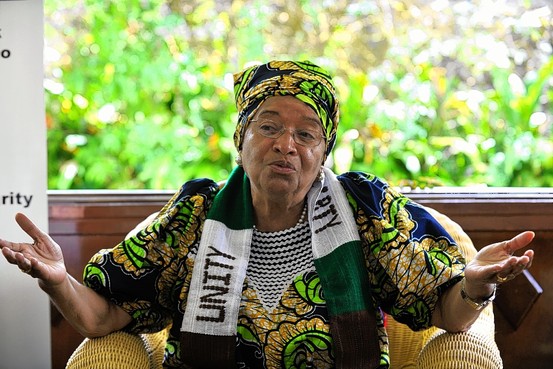
President of Liberia Ellen Johnson Sirleaf


C10D0F4F-73CC-4734-9769-8AE135F46B16_w640_s.jpg

Malawi President Joyce Banda speaks during funeral service
for Nelson Mandela, Qunu, South Africa, Dec. 15, 2013.


9149799C-C7BD-499D-B2D2-5E5C412F99DD_w640_s.jpg

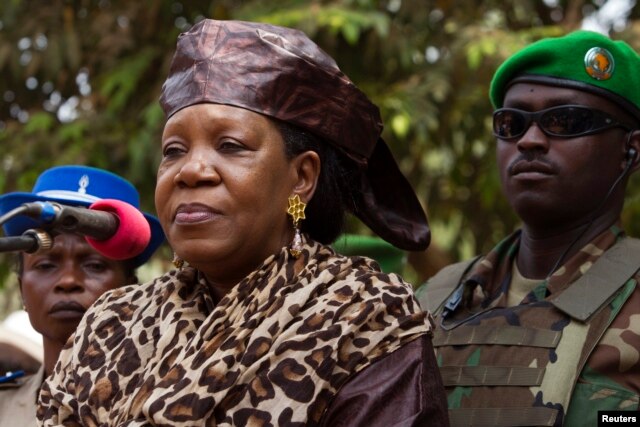
Interim President of the Central African Republic Catherine
Samba-Panza gives a speech in Bangui, Feb. 1, 2014.


Anne Look
February 08, 2014


DAKAR — Africa now has three female heads of state, after Catherine Samba-Panza of the Central African Republic took office in January. Though women leaders remain the exception in African politics, activists say things are looking up.

Women are breaking into the "boys club" of the African presidency.

Liberian President Ellen Johnson Sirleaf, or "Ma Ellen," was the first in 2005 as the country emerged from 13 years of brutal civil war.

Joyce Banda stepped up in Malawi in 2012 after the sudden death of the president. She had been the vice president.

And now there's President Catherine Samba-Panza in the Central African Republic, a country torn apart by rebellion and sectarian violence.

Each of these women has taken office amid crisis and transition. Countries like Mali have seen their first female presidential candidates. Bad times are finally prying the doors open.

"There's a joke I read the other day - when everything gets messed up, the women are asked to come in and clean up," says Executive Director for the NGO Women Africa Solidarity, Oley Dibba-Wadda,

She says girls and young women are getting much-needed role models.

"To say it is possible, I can actually be a president being a woman…These trailblazers have just opened the flood doors and it's just going to happen. There is no thinking of going back. We can't go back," she said.

As African women break political "glass ceilings" at all levels of government, some are criticized for not doing enough for other women.

Samba-Panza made it clear from day one that she would be different. About a third of her Cabinet is female.

"I intend to respect parity because until now, the previous governments didn't give us a lot of seats," she said. "There were only two or three women. But I won't choose women no matter what. I need to have women of worth, who are able to accompany my actions."

Women hold just one-fifth of parliamentary seats and ministerial positions in sub-Saharan Africa.

Discrimination remains, but the pool of qualified women is growing as more girls get to stay in school.

At least 16 African countries have passed parity laws. Countries like Rwanda reserve a percentage of parliamentary seats for women, while others like Senegal have set quotas for women on candidate lists.

The percentage of women in Senegal's legislature doubled in 2012 thanks to the law.

But prominent Senegalese politician and presidential adviser Penda Mbow says true equality requires societal change.

"Parity laws may be one tool but they are not enough. We also need to fix what goes on inside political parties and let capable, promising women emerge naturally so that when they are promoted, no one can say they got special treatment," said Penda Mbow.

Africa now has three formidable female presidents tackling everything from security to corruption. Half a century after independence, women's time may have come.


http://www.voanews.com/content/women-on-the-rise-in-african-politics/1847360.html


Re: Liberia marks anniversary of Taylor's departure


<iframe width="780" height="1500" src="http://www.bbc.com/news/world-28684561" frameborder="0" allowfullscreen></iframe>

 
Liberia Senate Elections Held Despite Ebola Threat

Liberia Senate Elections Held Despite Ebola Threat
20 December 2014

Voters who turned out for senate elections in Liberia were met with health workers at the door of polling stations to check for Ebola. The elections had been delayed twice due to the outbreak.

The vote for 15 of the 30 seats in the upper house of parliament had been postponed twice since October because of the Ebola outbreak. More than 3,340 people have now died from Ebola in Liberia, making it the country with the highest number of fatalities in the current outbreak, followed by Sierra Leone and Guinea.

Assistant Health Minister Tolbert Nyenswah had warned that anyone running a temperature higher than 98.6 degrees Fahrenheit (37 Celsius) could be removed from the line, asked to cast their ballots in a separate area, and then sent for screening. A sudden fever is one of the signs of the highly contagious Ebola infection.

A spokesman for the national election commission said that all voters had to wash their hands before entering polling stations and maintain at least a meter's distance from each other.

"What bothers me is the low turnout, but I am not surprised," said Jerome Korkoya, chairman of the National Elections Commission. "That's what you find in most of the world now in a political process."

UN Secretary General Ban Ki-moon was on a two-day visit to the region to review the international effort to tackle the Ebola outbreak. He began his tour in Liberia.

"This election will give Liberia and its people an opportunity to show the world how far it has come," Ban said.

Polling challenge

The 1.9 million registered voters chose between 139 candidates. Polling stations opened in the early morning and began closing early evening. Some stations opened late in the seaside capital Monrovia and in several locations in the interior of the country. There were also reports that some of the 4,700 thermometers and 10,000 bottles of sanitizer intended for the health workers to use at the polling stations did not arrive in time.

Among the candidates for the senate were former footballer George Weah, who stood against the son of the current president, Robert Sirleaf, in Monrovia's Montserrado County. The 48-year-old Weah, a former African footballer of the year, had previously stood against current President Ellen Johnson Sirleaf in the 2005 presidential election.

"I am more than confident that I will win" Weah said. "My victory was stolen from me in previous presidential elections. This time I will not allow it."

Provisional results were expected on Sunday.

http://allafrica.com/stories/201412210002.html
 
Back
Top