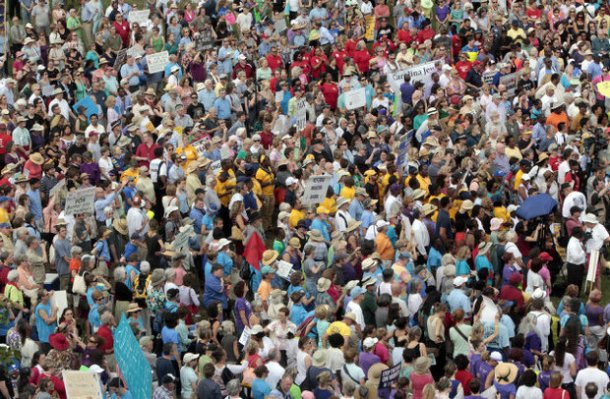
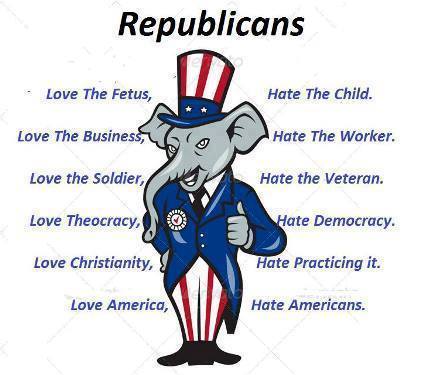
I live in NC and this barely got any news coverage

Upgrade Dave

Rising Star
Registered
Liberal media my ass.


North Carolina’s Moral Monday Movement Kicks Off 2014 With a Massive Rally in Raleigh


On February 1, 1960, four black students at North Carolina A&T kicked off the 1960s civil rights movement by trying to eat at a segregated lunch counter at Woolworth’s in downtown Greensboro. Two months later, young activists founded the Student Nonviolent Coordinating Committee at Shaw University in Raleigh, which would transform the South through sit-ins, Freedom Rides and voter registration drives.

So it was fitting that North Carolina’s Moral Monday movement held a massive “Moral March” in Raleigh today which began at Shaw University, exactly fifty-four years after North Carolina’s trailblazing role in the civil rights movement. Tens of thousands of activists—from all backgrounds, races and causes—marched from Shaw to the North Carolina State Capitol, where they held an exuberant rally protesting the right-wing policies of the North Carolina government and commemorating the eighth anniversary of the HKonJ coalition (the acronym stands for Historic Thousands on Jones Street, where the NC legislature sits).

The day began cold and cloudy, a fitting metaphor for politics in North Carolina last year. Since taking over the legislature in 2010 and the governor’s mansion in 2012, controlling state government for the first time in over a century, North Carolina Republicans eliminated the earned-income tax credit for 900,000 North Carolinians; refused Medicaid coverage for 500,000; ended federal unemployment benefits for 170,000; cut pre-K for 30,000 kids while shifting $90 million from public education to voucher schools; slashed taxes for the top 5 percent while raising taxes on the bottom 95 percent; axed public financing of judicial races; prohibited death row inmates from challenging racially discriminatory verdicts; passed one of the country’s most draconian anti-choice laws; and enacted the country’s worst voter suppression law, which mandates strict voter ID, cuts early voting and eliminates same-day registration, among other things.

The fierce reaction against these policies led to the Moral Monday movement, when nearly 1,000 activists were arrested for nonviolent civil disobedience inside the North Carolina General Assembly. Rallies were held in more than thirty cities across the state and the approval ratings of North Carolina Republicans fell into the toilet. Sample signs at today’s rally: “OMG, GOP, WTF. It’s 2014, not 1954!!!” “Welcome to North Carolina. Turn Your Watch Back 50 Years!” (See my Twitter feed for photos of the rally.)

The Moral Monday protests transformed North Carolina politics in 2013, building a multiracial, multi-issue movement centered around social justice such as the South hadn’t seen since the 1960s. “We have come to say to the extremists, who ignore the common good and have chosen the low road, your actions have worked in reverse,” said Reverend William Barber II, president of the North Carolina NAACP and the leader of the Moral Monday movement, in his boisterous keynote speech. “You may have thought you were going to discourage us, but instead you have encouraged us. The more you push us back, the more we will fight to go forward. The more you try to oppress us, the more you will inspire us.”

If today’s rally was any indication, the Moral Monday movement will be bigger and broader in 2014. An estimated 15,000 activists attended the HKonJ rally last year, bringing thirty buses; this year, the NC NAACP estimated that 80,000 to 100,000 people rallied in Raleigh, with 100 buses converging from all over the state and country. It was the largest civil rights rally in the South since tens of thousands of voting rights activists marched from Selma to Montgomery in support of the Voting Rights Act.

“This Moral March inaugurates a fresh year of grassroots empowerment, voter education, litigation and non-violent direct action,” Barber said. There will be a new wave of direct action protests when the North Carolina legislature returns in the spring, a new wave of activists doing voter mobilization and registration during the “Freedom Summer 2014,” and litigation challenging North Carolina’s voter suppression bill. The movement will be active in the streets, in the courtroom and at the ballot box. They will be focused not just on changing minds, but on changing outcomes.

To that end, the HKonJ coalition called for five demands:


• Secure pro-labor, anti-poverty policies that insure economic sustainability;

• Provide well-funded, quality public education for all;

• Stand up for the health of every North Carolinian by promoting health care access and environmental justice across all the state's communities;

• Address the continuing inequalities in the criminal justice system and ensure equality under the law for every person, regardless of race, class, creed, documentation or sexual preference;

• Protect and expand voting rights for people of color, women, immigrants, the elderly and students to safeguard fair democratic representation.


Barber has frequently called North Carolina “a state fight with national implications,” and that message has started to break through nationally. Moral Monday spinoffs have begun in Georgia and South Carolina, and national progressive leaders like Randi Weingarten of the American Federation of Teachers traveled to Raleigh to lend their support today. “This is a movement, not a moment” is a frequent refrain among Moral Monday activists. “This was just the beginning,” Barber said after the rally. “We did not come all this way just to go home.” Barber just wrapped up a sixteen-city tour of the state last week. He’ll hit the road again next week.

By the end of the rally, the sun had finally come out. “Even the universe is blessing us,” Barber said.
 
We need a website like this:

theintercept.org

That is funded independently of corporations and sponsors to get unbiased news and coverage of events like this. If you are looking at corporate news, they will block information or not report on stories that are relevant.

<iframe width="640" height="360" src="//www.youtube.com/embed/A8J54Ph_sG0" frameborder="0" allowfullscreen></iframe>
 
Last edited:
source: Atlanta Journal Constitution


23 Moral Monday protesters arrested over gun control bill


The Atlanta Journal-Constitution

Police arrested nearly two dozen protesters Monday who refused to leave a state senator’s office over his handling of a gun control bill.

Twenty-three people faced criminal trespassing charges, and more may be pending. The protesters were taken to Fulton County Jail.

The arrests represent the second time this year protesters affiliated with a new group called Moral Monday Georgia have been cuffed at the Capitol since the first day of the legislative session Jan. 13.

Monday’s target, Senate Judiciary Non-Civil Committee Chairman Jesse Stone, R-Waynesboro, has declined to act on a Democratic effort to repeal the state’s “stand your ground” law. The group asked Stone to meet with them en masse. Stone said he would meet with two of them with no cameras present. The group did not agree to his conditions.

Afterward, the senator said the protesters had hurt their case to move Senate Bill 280 forward. “If this is the kind of circus we’re going to have to contend with, we might not be able to do it,” Stone said. “I’m very sympathetic to their concerns, but I can’t reach a good decision just based on the number of people crowding into my office.”

State Sen. Vincent Fort, D-Atlanta, filed SB 280 last month, although it’s not likely to go anywhere under the Republican-led Legislature.

The law, passed in 2006, states a person has no duty to retreat and can use deadly force if they have reason to believe their lives or property is endangered. The law most recently came under scrutiny in November when a Georgia homeowner shot and killed a 72-year-old Alzheimer’s patient he thought was an intruder.

Moral Monday Georgia has modeled its political protests after weekly demonstrations that rocked North Carolina last year and led to hundreds of arrests each week. Georgia organizers count support from a number of different groups, and they advocate progressive policies at sharp odds with the state’s conservative Republican leadership.

Police arrested 10 Moral Monday protesters Jan. 27 over Gov. Nathan Deal’s refusal to expand Medicaid in Georgia. The group also has pledged to take on House Bill 875, a sweeping gun bill that would widely expand access to guns in Georgia.
 
crowd-shot-of-mountain-moral-monday-660x405.jpg

moral-mondays.jpeg%3Fw%3D610%26h%3D399

Moral-Monday-NC-2-e1391967387814.jpg


A 80,000+ multi-racial, multicultural crowd of American citizens gather together in Raleigh, the capital of the former confederate state of North Carolina, a state who as late as 2002 was represented in the U.S. Senate by the proud white supremacist Jesse Helms, — a crowd protesting the State’s severe retrograde annulment of 40 years of hard fought progressive policies — and the lurch back to 1950’s style barbarism — engineered by a carcass of North Carolina RepubliKlan politicos, against the expressed majority opinion of the people of North Carolina.

The corporate “media-of-mass-distraction” controlled by six white men decides that that largest demonstration in a Southern state for civil rights & economic justice since the 1960’s is not news and refuses to cover and show the rally on the nations televisions. A deliberate decision?? Absolutely! — another nail in the coffin that contains the myth of “the liberal media”.

If you had a tea bagger scrum of even 100 people marching against “Obamacare” the corporate media would of broadcast the event live. We saw this phenomenon during the RepubliKlan instigated “government shutdown” last year when the corporate media’s television cameras followed a tea bagger crowd of less than 200 people around Washington D.C. all the way to the gates of the White House where they unfurled a confederate flag. This was deemed major news by the ‘suits’ that control what is seen on corporate media television screens. The obfuscation and outright suppression of television media coverage of any & all major public rallies advocating progressive public policies or demonstration against corrupt activity is beyond obvious in this 21st century.

It started with the coup d'état&nbsp; that the Bush v. Gore &nbsp;5-to-4 Supreme Court ruling certified on December 12, 2000. The Florida vote recount was stopped by 5 justices of SCOTUS because they said ”irreparable harm would come to Bush by counting the votes” — in other words Gore would win. This SCOTUS sanctioned theft and negation of the millions of ballots cast by Americans believing in —“one-person-one vote”— was the beginning of America’s government institutions descending into it’s current pornocracy, with slave-bitches posing as legislators, who have engorged on $400,000,000 ($400 Million) from just the Koch brothers alone.


<object id="flashObj" width="480" height="270"><param name="movie" value="http://c.brightcove.com/services/viewer/federated_f9?isVid=1&isUI=1" /><param name="bgcolor" value="#FFFFFF" /><param name="flashVars" value="omnitureAccountID=gpaper108,gntbcstglobal&pageContentCategory=NEWS&pageContentSubcategory=NEWS01&marketName=Asheville:citizen-times&revSciSeg=&revSciZip=&revSciAge=&revSciGender=&division=newspaper&SSTSCode=&videoId=3171750865001&playerID=1654994576001&playerKey=AQ~~,AAAACNNiCeE~,k3ki2w-GA3IfgiMMaN2pwDISwkrGbsPm&domain=embed&dynamicStreaming=true" /><param name="base" value="http://admin.brightcove.com" /><param name="seamlesstabbing" value="false" /><param name="allowFullScreen" value="true" /><param name="swLiveConnect" value="true" /><param name="allowScriptAccess" value="always" /><embed src="http://c.brightcove.com/services/viewer/federated_f9?isVid=1&isUI=1" bgcolor="#FFFFFF" flashVars="omnitureAccountID=gpaper108,gntbcstglobal&pageContentCategory=NEWS&pageContentSubcategory=NEWS01&marketName=Asheville:citizen-times&revSciSeg=&revSciZip=&revSciAge=&revSciGender=&division=newspaper&SSTSCode=&videoId=3171750865001&playerID=1654994576001&playerKey=AQ~~,AAAACNNiCeE~,k3ki2w-GA3IfgiMMaN2pwDISwkrGbsPm&domain=embed&dynamicStreaming=true" base="http://admin.brightcove.com" name="flashObj" width="480" height="270" seamlesstabbing="false" type="application/x-shockwave-flash" allowFullScreen="true" allowScriptAccess="always" swLiveConnect="true"></embed></object>


You have to applaud these people for standing up!!! Having been lulled to sleep on the gains produced by the sacrifices of the Civil Rights Movement, it appears we're less motivated to protect those gains and/or fight off infringements threatening further advancement.

The fervor building in N.C., needs to catch fire and spread from Sea to Shining Sea.


Gotdam

we heard nothing of this..
in NYC

yea,

Gill Scott was right.

the revolution will NOT be televised!!

South starting to say, fuck the dumb shit.

when disenfranchised caucasions stop working

against their own interest, and fight the right

fight so we all win.....

Utopia would be right around the corner...


well not for the hardcore rockefellers and rothchilds and their minions...

but everyone else GOOD!


You have to applaud these people for standing up!!! Having been lulled to sleep on the gains produced by the sacrifices of the Civil Rights Movement, it appears we're less motivated to protect those gains and/or fight off infringements threatening further advancement.

The fervor building in N.C., needs to catch fire and spread from Sea to Shining Sea.


:yes:

Since you asked for it

https://www.commondreams.org/view/2014/01/12-4


Published on Sunday, January 12, 2014 by Facing South

Moral Monday Movement Spreads Through the South

by Sue Sturgis


After drawing thousands of protesters to the state legislature and inspiring the arrests of more than 900 people for nonviolent civil disobedience, North Carolina's Moral Monday movement challenging the extreme conservative agenda of the state's Republican-controlled legislature and administration is gearing up for more actions in 2014.
It's also spreading to other states in the South where Republicans hold overwhelming power -- and where legislators face re-election this year.

When the Georgia General Assembly convenes on Monday, Jan. 13, members will be met by progressive activists holding their state's first Moral Monday protest. Among the issues the protesters are focusing on are Georgia's refusal to expand Medicaid under the Affordable Care Act, efforts to restrict voting rights, and policies that divert education funds from public to private schools. The Georgia NAACP is leading the coalition organizing the protest.
Before gathering for a rally on the steps of the Georgia state capitol at 4 p.m., Moral Monday Georgia participants are invited to visit their representatives from 10 a.m. to noon, attend a "Hunger Lunch" focusing on food security issues, and participate in workshops led by the N.C. NAACP's Rev. Dr. William Barber, architect of North Carolina's Moral Monday movement.

"For too long, many elected officials in Georgia have ignored the moral implications of their actions and inactions with respect to the neediest among us," MMGA says in a statement on its website. "Our coalition stands against all forms of discrimination and amplifies the voices and ideas of folks in marginalized circumstances."

The South Carolina legislature convenes the following day, Tuesday, Jan 14, and progressive activists from across the state will gather at the State House in Columbia for what's being billed as "Truthful Tuesday." The action is being organized by the state chapter of the National Association of Social Workers, the S.C. AFL-CIO, S.C. Christian Action Council, S.C. NAACP, S.C. Progressive Network, S.C. Alliance for Retired Americans, and the S.C. Education Association.

Protesters are being asked to wear black as a symbol of mourning for the estimated 1,300 people who will likely die in South Carolina this year if the state continues to refuse Medicaid expansion. The organizers are also calling for better funding of education and the protection of voting rights.

“It's to really put lawmakers on notice regarding the need to expand Medicaid and protect voting rights and to fully fund public education,” George Hopkins, a College of Charleston history professor and Charleston chapter president of the S.C. Progressive Network, told the Charleston City Paper. “Hopefully on Wednesday the 15th the headlines across the state will read 'Citizens Descend on Columbia' to demand legislators take action on these issues."

Momentum builds in North Carolina

At the same time North Carolina's Moral Monday movement is inspiring progressive activists in other states, its leaders have announced plans to continue the fight at home.

At a press conference held this week, Rev. Barber announced plans for a Moral March on Raleigh to be held on Feb. 8. The action continues a tradition that began in February 2007 with the annual Historic Thousands on Jones Street marches named for the street where the legislature is located.

Organized by the N.C. NAACP and supported by a coalition that has grown to include 160 organizations, the mass marches are held near the start of each legislative session to promote a 14-point People's Agenda that includes adequate funding for public schools, livable wages, and health care for all. The marchers assemble at Raleigh's Shaw University, a historically black school where the Student Nonviolent Coordinating Committee was formed in 1960 and went on to help lead the fight for civil rights in the South.

"This crowd is a crowd of extremists," Barber said, referring to the legislature, "and we're calling on all people of good will to stand against these extremists who are attacking poor, and women, and labor, and unemployed people, and the sick, and, most horribly, what's fundamental to our democracy, which are our voting rights."

Starting next week, Barber will kick off a Moral March on Raleigh Statewide Tour to build support for the Feb. 8 event, with stops planned for Scotland County, Washington County, Goldsboro, Charlotte, Asheville, Brevard, Hickory, Winston-Salem, Greensboro, Burlington, Rocky Mount, Wilmington and Elizabeth City. The NAACP is also planning a weekend of religious services involving 50 churches, mosques, synagogues that will preach about the Moral March on Raleigh, and there will be an ecumenical service in Raleigh the night before the march.

In addition, Barber said the state NAACP and its allies would continue the fight against the legislature's actions through litigation. This week, the NAACP and other plaintiffs suing the state over its restrictive new voting law filed an amended lawsuit that claims the law discriminates not only against African Americans but also against Latinos and young people. The law imposes strict voter ID requirements, cuts early voting, and ends same-day registration and teen pre-registration.

"We are saying to our friends near and far, if you believe that an injustice anywhere is a threat to justice everywhere, join us for the Moral March on Raleigh," Barber said.
 
The Rev. Barber needs to be in consideration for some of these awards and honors that get handed out by Time Magazine and the Nobel people.
 
Moral Monday has hit Florida.

I find it interesting and troubling that a rally of 100-150 is treated as the equivalent to one of over 400 but that's the corporate media for you. They must force false dichotomies to appear "unbiased".

I would love to know what those 100 people were really protesting/supporting in their faux grassroots "counter protests".
Are you really against helping more people get health coverage? Are you really for


http://jacksonville.com/news/2014-03-03/story/moral-monday-brings-dueling-rallies-floridas-capital


By Brandon Larrabee & Margie Menzel/News Service of Florida


With the Legislature set to open on Tuesday, dueling rallies converged on the Capitol to pressure lawmakers to use the election-year session to advance each side’s priorities.


The twin protests started Monday morning, when about 400 Floridians rallied in the Capitol courtyard for what was billed as “Moral Monday.” The event included an array of left-leaning groups and individuals, from the NAACP to clergymen to organized labor.

Speakers at the morning rally called for lawmakers to expand Medicaid, stop the state’s voter purge and roll back the Stand Your Ground self-defense law.

None of that is likely to occur during the 60-day legislative session, given the GOP’s dominance in both chambers. But the protesters vowed to carry their concerns to the polls in the mid-term elections.

The “Moral Monday” idea comes from voting-rights protests in North Carolina last year. Similar protests have also spread to Georgia. Florida House Minority Leader Perry Thurston, D-Fort Lauderdale, told the rally that too many voters’ voices are going unheard.

On the other side of the Capitol and a few hours later, Americans for Prosperity’s Florida chapter held its own event to oppose expanding Medicaid and support overhauling the state’s pension system, slashing $500 million in taxes and fees and expanding programs that allow parents to choose where their children go to school.

Americans for Prosperity is one of a constellation of conservative groups that have helped fuel the tea party movement and pushed lawmakers in Florida and elsewhere to keep up a right-leaning agenda.

About 100 to 150 people attended the rally, cheering House Speaker Will Weatherford, R-Wesley Chapel, as he defended the Legislature’s decision to turn down billions of federal dollars for Medicaid expansion. He pointed to the rocky rollout of the Affordable Care Act, the health care law signed by President Barack Obama that contained the Medicaid provisions..

The event also featured some jabs at the Moral Monday event. Slade O’Brien, Americans for Prosperity’s state director for Florida, ripped into the earlier rally.

“In fact, if you were to listen to some of the speeches earlier today, I think you would have been shocked to hear so-called civic leaders actually pontificating and propagating a culture of dependency here in the state of Florida,” he said. “And we all know that that’s not the way to create success, that’s not the way to create jobs, that’s not the way to create opportunity.”
 
logo-main.gif


What’s Next for the Moral Monday Movement?


This multiracial, multi-issue progressive coalition is not only remobilizing in
North Carolina—its model of activism is now spreading all over the South

<font="arial Unicode ms, verdana" size="4" color="#000000">
by Ari Berman | March 17, 2014

http://www.thenation.com/article/178459/whats-next-moral-monday-movement

Raleigh, N.C.—On February 1, 1960, four black students at North Carolina A&T kicked off the decade’s civil rights movement by trying to eat at a segregated Woolworth’s lunch counter in downtown Greensboro. Two months later, young activists founded the Student Nonviolent Coordinating Committee (SNCC) at Shaw University in Raleigh, which would transform the South through sit-ins, Freedom Rides and voter registration drives.

So it was fitting that when North Carolina’s Moral Monday movement held a massive “Moral March” in Raleigh on February 8, it began at Shaw University, exactly fifty-four years after North Carolina’s trail-blazing role in the civil rights movement. Tens of thousands of activists from thirty-two states—representing all different backgrounds, races and causes—marched from Shaw to the State Capitol, protesting the right-wing policies of the government (sample sign: Welcome to North Carolina. Turn Your Watch Back 50 Years!) and rallying for economic fairness, equal justice, labor rights, voting rights, universal healthcare and public education.

The North Carolina NAACP estimated that upward of 80,000 people attended; the police said they’d granted a permit for up to 30,000. Either way, it was the largest civil rights rally in the South since the legendary Selma-to-Montgomery march in support of the Voting Rights Act in 1965.

The weekly Moral Monday protests at the North Carolina Statehouse transformed state politics in 2013, capturing the hearts and minds of progressive activists across the nation. “This Moral March inaugurates a fresh year of grassroots empowerment, voter education, litigation and nonviolent direct action,” said the Rev. William Barber II, president of the North Carolina NAACP and leader of the Moral Monday movement, in his keynote speech. If the February 8 rally was any indication, the movement will be bigger and broader in 2014. “If you thought we fought hard in 2013,” Barber wrote in January, “you ain’t seen nothing yet.”

<span style="background-color:yellow;"><b>Since taking over the Legislature in 2010 and the governor’s mansion in 2012—controlling state government for the first time since 1896—North Carolina Republicans have transformed a state long regarded as one of the most progressive in the South into Alabama virtually overnight. They eliminated the state earned-income tax credit for 900,000 people; refused Medicaid coverage for 500,000; ended federal unemployment benefits for 170,000; cut $200 million to public education; slashed taxes for the top 5 percent while raising taxes on the bottom 80 percent; passed one of the country’s most draconian anti-choice laws; and enacted the country’s harshest voting restrictions, which mandate strict voter ID, cut early voting, eliminate same-day registration and ax public financing of judicial races, among other things. </b></span>

Last April 29, after the new voting restrictions were introduced, Barber and sixteen other ministers and civil rights veterans were arrested inside the State Legislature for trespassing and failure to disperse. Barber called it a peaceful “pray-in.” The next week, thirty more people were arrested. The numbers grew quickly. By the end of July, when the Legislature adjourned for the year, thirteen protests had been held at the General Assembly and nearly 1,000 people had been arrested, most for the first time in their lives.

Barber took the show on the road when the Legislature left town, holding twenty-five rallies across the state, in progressive strongholds like Asheville and in heavily Republican mountain and river towns. It was tough to find a week when there wasn’t a Moral Monday event going on.

Though it lost practically every policy fight with the GOP, the Moral Monday movement accumulated a number of victories in 2013. It mobilized more than 50,000 opponents of the GOP’s policies, including some Republicans, turning outrage into action. It changed the political conversation in the state, moving it away from Democrat versus Republican and toward right versus wrong, using real people’s stories rather than statistics, and highlighting those hurt by the policies instead of the politicians. When protesters denounced the new voting restrictions, for example, a featured speaker was 92-year-old Rosanell Eaton, who had to ride a mule-drawn wagon to the county courthouse and recite the preamble to the Constitution in 1939 just to register to vote. A clip of Eaton chanting “Fed up, fired up!” outside the General Assembly quickly went viral. Over the summer, polls showed that the Moral Monday protesters were twice as popular as the GOP legislature. “It was the rare protest movement that actually had popular support,” says Tom Jensen, director of the Raleigh-based Public Policy Polling.

The movement’s most important accomplishment has been to build a multi-issue, multiracial, statewide progressive coalition, one that North Carolina—or the South, for that matter—has never seen. “In a Southern state, an African-American is leading a multiracial movement that I believe represents the majority of the people of the state,” says Penda Hair, co-director of the Advancement Project, a national civil rights group that is advising the North Carolina NAACP. “It’s a huge breakthrough in terms of racial barriers in the South.”

On August 4, nine days after the Legislature adjourned, Barber traveled to a Moral Monday event four hours west of Raleigh in Mitchell County, deep in the Blue Ridge Mountains on the Tennessee border, which voted 75 percent for Mitt Romney and is 97 percent white. In 1923, after a black man allegedly raped a white woman, every black person in Mitchell County was put on a train and not allowed to return. Despite the county’s history and Republicanism, every week Moral Monday activists had been rallying at the Food Lion parking lot and riding buses to Raleigh to join the protests. Barber spoke to the faithful at the packed Trinity Episcopal Church in the tiny town of Spruce Pine. “It is something to behold for the president of the NAACP to be here in Mitchell County,” he said to cheers. (The next day, a Moral Monday rally in Asheville drew 10,000.)

Western North Carolina, which is heavily white, is the home of five new NAACP chapters—including places like Mitchell County, where no one ever dreamed of starting one before. “We saw the NAACP as the most organized and most aggressive group taking action against the Legislature,” said Joy Boothe, a local Moral Monday leader in the mountain town of Burnsville, who helped start the Yancey/Mitchell County NAACP. It now has 126 dues-paying members, nearly all of them white. In fact, the five new chapters are the first majority-white NAACP affiliates in the state.

The Moral Monday movement, though modeled after the 1960s civil rights movement, is more iconoclastic: it’s a majority-white social movement led by a black preacher who belongs to a predominantly white denomination (the Protestant Disciples of Christ). It’s the type of coalition through which the NAACP can be reborn in Appalachia. “We’re all colored people now,” Barber likes to joke.

In 2014, the Moral Monday movement will be active in the streets, in the courtroom and at the ballot box. It will be focused not just on changing minds, but on changing outcomes. Protests will continue across the state—the most recent one was in Fayetteville on February 17—and will return to Raleigh when the Legislature resumes work in May. NAACP lawyers are taking part in challenges to the state’s voting restrictions, along with the Justice Department and other civil rights groups; the NAACP is also considering lawsuits against Governor Pat McCrory’s education cuts and his refusal to expand Medicaid.

The biggest question for the movement will be the impact it has at the polls. The momentum created by the protests last summer for Democratic candidates has been erased by the rocky rollout of Obamacare, says pollster Jensen. Over the summer, Democratic candidates enjoyed a nine-point advantage over Republicans; now it’s even. And because the Republicans ruthlessly gerrymandered state legislative districts following the 2010 elections, Democrats need to win the statewide vote by fourteen points in order to take back the Legislature. “The big things the Moral Monday movement can do is help increase turnout and interest in the midterms from people who usually drop off,” Jensen notes, “and then just generally keep in the news the things that the Republican Legislature has done over the past few years that are so unpopular.”

Moral Monday organizers plan to target forty swing counties for voter registration and mobilization and will deploy fifty young organizers in the field for twelve weeks this year in what they’re calling Moral Freedom Summer 2014. (They’re also planning to field sixty full-time organizers across the South for a much longer period.) “What we don’t know is what happens in an off-year election with this kind of intensity, because we’ve never seen it before,” Barber says. Yet he’s quick to stress that electoral politics will not define the movement. Moral Monday is most frequently compared to Occupy Wall Street and the 2011 Wisconsin protests, though neither one really captures what’s happening in North Carolina. Moral Monday is far more diverse, disciplined, broad-based and leadership-driven than Occupy was; nor is it focused on a single issue, like the protests in Wisconsin, which centered around labor rights and were closely connected to the state Democratic Party. Moral Monday inhabits a place on the spectrum somewhere between Occupy and Wisconsin—not disconnected from electoral politics but not defined by it, either, which gives it a better chance at longevity.

“Most folks understand this cannot just be about 2014,” Barber says. “This is about a fundamental change in consciousness, and building a new type of movement and electorate that will have long-lasting consequences…. When Dr. King went to Selma, he didn’t change who was elected. He changed the climate in which elected officials had to operate in.”

On December 9, Moral Monday organizers held a strategy session in Raleigh for more than 100 activists from over a dozen states, from Mississippi to Massachusetts, who wanted to replicate the movement in their own backyard. “Everybody in the South has been paying attention to Moral Mondays and eyeing it as a Southern strategy,” said attendee Tim Franzen, a program director for the American Friends Service Committee in Atlanta, who was a leader with the local Occupy movement. “It was really inspiring for me to see the NAACP leading this civil disobedience movement. In my mind, as a young activist, I had categorized the NAACP as an organization with a great history, but not something that is going to lead a cutting-edge, really popping and impactful movement that is going to challenge power in big way.”

On January 13, Barber came to Atlanta for the launch of Moral Monday Georgia. Five hundred people gathered on a rainy afternoon at the State Capitol, placing religious symbols on the steps to represent the people who would die because GOP Governor Nathan Deal has refused to cover 600,000 Georgians under Medicaid. Two weeks later, ten activists, including State Senator Vincent Fort from Atlanta, were arrested after staging a sit-in at Deal’s office. They became known as the “Medicaid Ten.” On February 10, twenty-three more activists—from veteran pastors like the Rev. Timothy McDonald III of the African American Ministers Leadership Council to students at Morehouse College—were arrested after holding another sit-in protesting the state’s “stand your ground” law. Future demonstrations are planned on issues like public education, labor rights and women’s rights.

A day after the first Georgia protest, South Carolina launched its own weekly demonstration, called Truthful Tuesday, when 1,000 rallied at the Statehouse in Columbia for Medicaid expansion, public education and voting rights. “There’s a sense of enthusiasm,” said Brett Bursey, executive director of the South Carolina Progressive Network. “The opportunity is pushing people to move beyond the traditional hurdles that impede us.” The Alabama NAACP has started Truth and Justice Tuesdays, and the Florida NAACP will launch the newest Moral Monday spin-off in March. Meanwhile, Arizona is holding its own Moral March on March 29.

It won’t be easy to replicate what’s happening in North Carolina. There’s no Reverend Barber in other Southern states, and far less progressive capacity than in North Carolina. Organic, indigenous political movements cannot be built overnight. The seeds of the Moral Monday movement were planted back in 2006, after Barber became president of the state NAACP. “It took North Carolina seven to eight years to build this,” says Franzen. “And that’s what it’s going to take in Georgia and other states. It’s up to us to build something that doesn’t exist right now.”


</font>


<hr noshade color="#ff0000" size="8"></hr>

gop-loves-the__.jpg
25275901-e0b.jpg


You have to applaud these people for standing up!!! Having been lulled to sleep on the gains produced by the sacrifices of the Civil Rights Movement, it appears we're less motivated to protect those gains and/or fight off infringements threatening further advancement.

The fervor building in N.C., needs to catch fire and spread from Sea to Shining Sea.


Gotdam

we heard nothing of this..
in NYC

yea,

Gill Scott was right.

the revolution will NOT be televised!!

South starting to say, fuck the dumb shit.

when disenfranchised caucasions stop working

against their own interest, and fight the right

fight so we all win.....

Utopia would be right around the corner...


well not for the hardcore rockefellers and rothchilds and their minions...

but everyone else GOOD!

These^^

Sent from my GT-N5110 using Tapatalk
 
Back
Top