How Republicans would overhaul the health care system

QueEx

Rising Star
Super Moderator
<font size="5"><center>
How Republicans would overhaul
the health care system</font size></center>


Kaiser Health News
By Julie Appleby
September 17, 2009


WASHINGTON — While Republican leaders don't have a unified health care restructuring plan, the rank and file have produced a number of bills and ideas, including several overhaul proposals that would reshape the system.

At least three comprehensive Republican bills have been introduced: one by Sens. Tom Coburn of Oklahoma and Richard Burr of North Carolina and Rep. Paul Ryan of Wisconsin, another by Rep. Tom Price of Georgia and a third by Rep. John Shadegg of Arizona.

All three bills have a few themes in common with the Democratic proposals. For example, they'd create health insurance exchanges to make it easier for the uninsured and small businesses to find affordable insurance, although the exchanges have less regulatory authority than the proposals outlined by the Democrats do.

In addition, they'd provide subsidies to help some people buy coverage and would impose new regulations on insurers. The Republican plans also differ sharply from the Democratic approaches, however. They don't, for example, require individuals to buy insurance or impose sanctions on employers who don't offer it.

While the main Republican proposals have no chance of passage, they could influence the debate. They would:

  • Change the tax treatment of health benefits. The Coburn-Burr-Ryan bill would end the tax break for workers with employer-provided health insurance and replace it with a tax credit of $2,290 for individuals and $5,710 for families. Additional subsidies ranging from $2,000 to more than $5,000 would be available for families who have at least one child and who earn below 200 percent of the poverty level, or about $44,100 a year for a family of four.

    The Price bill, which wouldn't eliminate the tax break for job-based coverage, would allow people who buy their own insurance to deduct the cost of premiums from their income taxes. Tax credits ranging from $2,000 to $5,000 would go to people below 200 percent of the poverty level to help them buy coverage. People who earn up to 300 percent of the poverty level, or about $66,150 for a family of four, would get smaller credits.

    Possible impact: While changing the tax code would "level the playing field" between those who buy their own insurance and those who get it through their jobs, some question whether the sizes of the tax credits offered in any of the proposals would be enough for individuals and families to purchase their own coverage.​


  • Change Medicaid. Under the Coburn-Burr-Ryan bill, most low-income families no longer would be in Medicaid, the state-federal program for the poor, but instead would get tax credits and other subsidies to buy insurance on the private market. States would get block grants to help pay for long-term care; the grants could be used for care in nursing homes or non-institutional settings. People with disabilities, children in foster care and women with breast or cervical cancer would remain in Medicaid. The Price bill would allow individuals to opt out of Medicaid or other federal or employer health plans and use tax credits instead to buy their own coverage.

    Possible impact: Proponents say creating a voucher program for Medicaid would give recipients more choices of insurance and providers, but it's not clear whether the credits and subsidies would be enough for individuals to buy comparable private insurance.​


  • Limit medical malpractice awards and consider court alternatives. States would get grants to set up alternatives to malpractice lawsuits in the Coburn-Burr-Ryan bill. The alternatives could be review panels or health care tribunals composed of medical experts and lawyers, who'd determine liability. Those who are unhappy with the decisions could reject the recommendations and file in state court. The Price bill would cap non-economic damages at $250,000.

    Possible impact: Proponents say special courts would provide an additional avenue for plaintiffs and may reduce costs related to so-called "defensive medicine," in which doctors order more tests and procedures to avoid lawsuits. It's hard to quantify what percentage of health care spending is defensive, however, and how much is tied to payment systems that reward doctors and hospitals for doing additional procedures. A 2004 Congressional Budget Office report that looked at capping malpractice damage awards said, "Savings from reducing defensive medicine would be very small."​


  • Allow individuals and small businesses to band together to buy insurance. Approaches differ among the bills. The Price and Shadegg bills would allow individuals and groups or associations of employers to come together to buy insurance. Such policies would be exempt from state rules on what insurance must cover. Under the Price bill, individuals could buy policies from insurers in other states so long as premiums in the individuals' home states cost 10 percent more than the national average. The Coburn-Burr-Ryan bill gives states the option of creating health insurance exchanges, in which individuals could purchase policies. The proposal also gives states the ability to form multi-state arrangements.

    Possible impact: Proponents say this proposal would allow individuals and small businesses to get lower premium rates for coverage by bypassing some state mandates and joining into larger pools. Critics say it would remove too much state control and leave policyholders with skimpy coverage.​


  • Create options for people with pre-existing conditions. All the Republican proposals stop short of an outright ban on the widespread practice of insurers' rejecting applicants with health problems. The Coburn-Burr-Ryan plan prohibits insurers that participate in state-based exchanges from rejecting applicants with medical conditions, but it allows them to offer policies outside exchanges that wouldn't be subject to the ban. The Price bill gives states financial incentives to create high-risk pools or other methods of covering people with pre-existing conditions.

    Possible impact: If exchanges are big enough to attract large numbers of applicants, insurers may be more willing to take on the risk of people with medical conditions. Because participation by insurers and individuals is voluntary, however, it isn't clear whether insurers will be attracted enough to take on the risk. High-risk pools already operate in more than 30 states, but premiums can be expensive. Some require waiting periods before covering policyholders' medical conditions.​


  • Change Medicare. The Coburn-Burr-Ryan bill would reduce payments to the Medicare Advantage program, which is the private-plan alternative to traditional Medicare, by requiring insurers to bid competitively for the business. It also would charge seniors who have annual incomes of more than $85,000 as individuals or $170,000 as couples more for Medicare coverage for physician care and prescription drugs.

    Possible impact: Proponents say compelling private insurers to submit competitive bids to Medicare would help lower costs. Critics say more money could be saved by simply lowering payments to the private plans to the same amount that's spent on patients in traditional Medicare.​

(Kaiser Health News, an editorially independent news service, is a program of the Kaiser Family Foundation, a nonpartisan health care policy research organization that's not affiliated with Kaiser Permanente.)


http://www.mcclatchydc.com/washington/story/75628.html?storylink=MI_emailed
 
I think most of the ideas presented are good, sound, ideas to take in consideration. One thing I'm with Obama on is the ban on not accepting people with pre-existing conditions.

I say make the marketplace friendly to accept such conditions, and just to make sure, put the ban on top of it.
 
Giving tax credits to make insurance plans affordable would add to the deficit, How would they pay for the shortfall?

I like the aspect of giving tax deduction for getting your health insurance plan on your own. If people had to pay for their health insurance, the price inflation would be limited. I don't like having employers being the only option for coverage.
 
Giving tax credits to make insurance plans affordable would add to the deficit, How would they pay for the shortfall?

I like the aspect of giving tax deduction for getting your health insurance plan on your own. If people had to pay for their health insurance, the price inflation would be limited. I don't like having employers being the only option for coverage.

You do know that spending for a public plan adds to the deficit too.

Do you think if more people are paying taxes, you will get MORE taxes coming in?

Think about it like this. If wal-mart *that dreaded name again* had the same prices as your mom and pops store. Would Wal-mart become the juggernaut it is today? My point is this, less the taxes are, the more tax payers are created. The more jobs are created, the more taxes you will gain from your citizenry.
 
The public option would not add to the deficit. The public option is almost like a non-profit insurance company with 4% Administrative costs versus the 16-26 percent that private insurance companies.

The one trillion they are talking about is giving subsidies to make insurance affordable for low income households over 10 years.

Republican:
The tax credits to make insurance affordable without getting rid of medicare advantage or raising taxes will add to the deficit. This is the main reason we have 9 trillion deficit now.
 
The public option would not add to the deficit. The public option is almost like a non-profit insurance company with 4% Administrative costs versus the 16-26 percent that private insurance companies.

The one trillion they are talking about is giving subsidies to make insurance affordable for low income households over 10 years.

Republican:
The tax credits to make insurance affordable without getting rid of medicare advantage or raising taxes will add to the deficit. This is the main reason we have 9 trillion deficit now.


Whaaa!!!!

Would it be possible to see some numbers to back this up
 
My point is this, less the taxes are, the more tax payers are created. The more jobs are created, the more taxes you will gain from your citizenry.

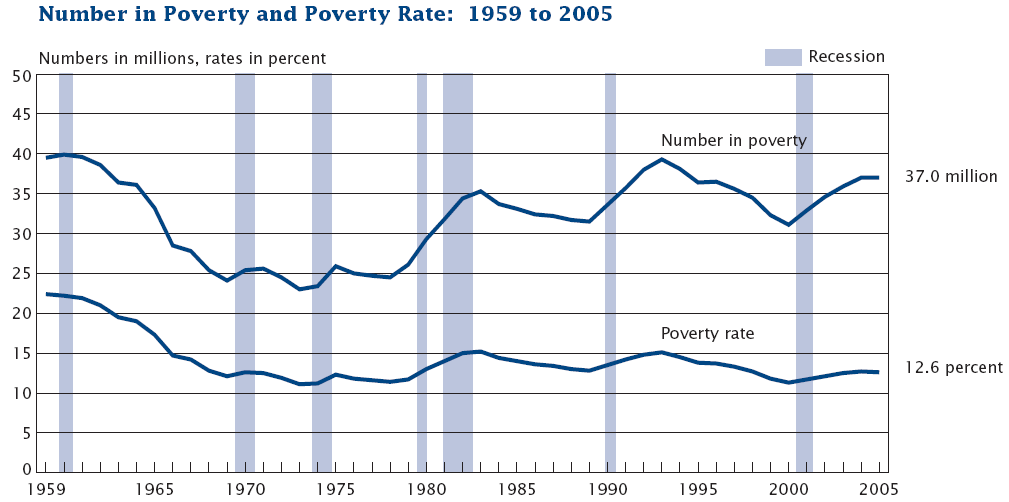
Thats republican mumbo jumbo. Fact is when Reagan / G.W. Bush lowered taxes our deficit skyrocketed and the number of those in poverty increased.
 
Thats republican mumbo jumbo. Fact is when Reagan / G.W. Bush lowered taxes our deficit skyrocketed and the number of those in poverty increased.

The reason the deficit skyrocketed during both the Bush and Reagan years is they lowered taxes but increased the defense/military budget. Reagan has the Cold War and Bush had the current two. Not really sure if the poverty rate increased for Reagan, I would def. need to see some numbers on that.
 
Thats republican mumbo jumbo. Fact is when Reagan / G.W. Bush lowered taxes our deficit skyrocketed and the number of those in poverty increased.

I will need to see the numbers on the poverty claim.

BTW, I know a lot of people who got rich during Reagan, and I got my job under Bush.
 
I'm not feelin the whole tax cut idea for health insurance. If it means an individual will have to shoehorn $X into their already tight budget, and wait until tax time (which could be the following year), to get some relief.

Overall, I just dont think the Republicans are going far enough to put the power in the hands of the insured, or at least keep the insurance companies in check.

:smh:
 
I'm not feelin the whole tax cut idea for health insurance. If it means an individual will have to shoehorn $X into their already tight budget, and wait until tax time (which could be the following year), to get some relief.

Overall, I just dont think the Republicans are going far enough to put the power in the hands of the insured, or at least keep the insurance companies in check.

:smh:

dude, you are not understanding the premise. If businesses are able to hire more people, that means more people will have insurance on the most part. The real question is this, are we talking about making people insured while helping the economy, or we are talking about government insuring people without a job?

I would think Obama would want to kill two birds with one stone. However, the style he is taking *with the help of this shitty congress*, it doesn't seem like he wants to do anything to help this economy. No one can deny that.
 
dude, you are not understanding the premise. If businesses are able to hire more people, that means more people will have insurance on the most part. The real question is this, are we talking about making people insured while helping the economy, or we are talking about government insuring people without a job?

I would think Obama would want to kill two birds with one stone. However, the style he is taking *with the help of this shitty congress*, it doesn't seem like he wants to do anything to help this economy. No one can deny that.

Thats just it though. There are a ton of employers out there who dont offer health insurance (way more than I think you are taking into consideration). Or in some cases they hire people as contractors so they dont have to provide benefits, etc. etc.. A tax cut doesnt work on people the same way it does on businesses. Especially if that family/individual is already struggling to make ends meet. What about medical expenses, prescriptions, treatments, etc? The republicans arent doing anything to address that. And if you lose your job, then what? Increasing jobs is not going to solve health care, otherwise it would of been solved years ago. Better health care is going to solve health care.

As far as Obama, you gotta look beyond the tunnel your peeking through man (less taxes /= more jobs). Businesses do not just simply hire more people because they have less expenses or less taxes to pay. There has to be a need out there for their services to justify expanding their workforce. If nobody is buying, businesses will continue to cut costs in hopes of turning a profit, or ship their workforce overseas, etc.. But that in itself is just a small part of multitude of issues. Theres no way he's going to fix this economy by just focusing on 1 thing. Because for that 1 thing to happen (and remain sustainable), several other things need to happen prior to it.
 
Last edited:
<font size="5"><center>
GOP Set to Propose Its Own Health Bill </font size></center>


Wall Street Journal
By GREG HITT
November 2, 2009


<font size="3">WASHINGTON -- Republicans are preparing an alternative health-care bill to Democratic legislation, House Republican Leader John Boehner said, marking a shift in strategy as the full House is set to begin debate on the issue this week.</font size>

Mr. Boehner said Sunday the Republican bill would extend health-insurance coverage to "millions" of Americans but wouldn't try to match the scope of the House Democratic bill unveiled last week. The Democratic legislation, if passed, is estimated to expand coverage to more than 30 million Americans now without insurance. Its estimated gross cost is $1.055 trillion over 10 years.

"What we do is we try to make the current system work better," Mr. Boehner, of Ohio, said on CNN's "State of the Nation." The GOP plan would likely be less costly to taxpayers and involve less government intrusion into the private sector. Mr. Boehner said the bill would take "a step-by-step approach" to expanding coverage.

It would, among other things,

  • propose new limits on medical malpractice lawsuits;

  • make it easier for individuals and small businesses to pool resources to purchase insurance;

  • propose grants for states that use "innovative" solutions to expand coverage.

Boehner pointed to states that have created special "high-risk pools" to provide insurance to individuals with pre-existing conditions.

He said the bill wouldn't raise taxes, nor mandate that individuals and businesses purchase insurance, as the Democratic legislation does.


For months, Republicans have attacked the Democratic health plan, hammering at pieces of the bill -- such as a proposed government-run health plan -- and helping to stir public doubt over the initiative.

By unveiling their own legislation, Republicans will be able to coalesce around a concrete plan. But they also open themselves to potential criticism of their proposals.

Republicans have talked about a variety of alternatives to Democratic efforts on health care, but decided to put out their own bill after seeing details of the legislation unveiled by Democrats last Thursday. GOP leaders hope to offer the measure as an alternative during debate on the Democratic bill, and a spokesman for House Speaker Nancy Pelosi (D., Calif.) said Republicans would be allowed to do so.

In the Senate, where Democratic leaders are pushing a proposal to create a new government-run insurance plan, Sen. Joseph Lieberman, the Connecticut independent, made clear again Sunday that he opposed the idea. The senator said he wouldn't try to block debate on the bill, but signaled he would support any Republican efforts to block a vote on it.

Write to Greg Hitt at greg.hitt@wsj.com

Printed in The Wall Street Journal, page A3


http://online.wsj.com/article/SB125711811707721639.html?mod=rss_Today's_Most_Popular
 
<IFRAME SRC="http://www.gop.gov/solutions/healthcare" WIDTH=780 HEIGHT=1500>
<A HREF="http://www.gop.gov/solutions/healthcare">link</A>

</IFRAME>
 
Those currently paying the additional 30 + percent surcharge on their premiums won't pay that under the public option. (The government won't need to make a profit.) The people get to keep that money and spend it on what they want to spend it on. Seems republicans would be in favor of people keeping and spending their own money.

I guess that was bullshit too. :smh:

-VG
 
I will need to see the numbers on the poverty claim.

BTW, I know a lot of people who got rich during Reagan, and I got my job under Bush.

BTW, I know a lot of people who got rich during Reagan, and I got my job under Bush.

I know a lot more who got poor.

source: dol

Series Id: LNS14000000Seasonal AdjustedSeries title: (Seas) Unemployment RateLabor force status: Unemployment rateType of data: PercentAge: 16 years and over

LNS14000000_199841_1257283544078.gif


source: wiki

Poverty_59_to_05.png
 
Back
Top