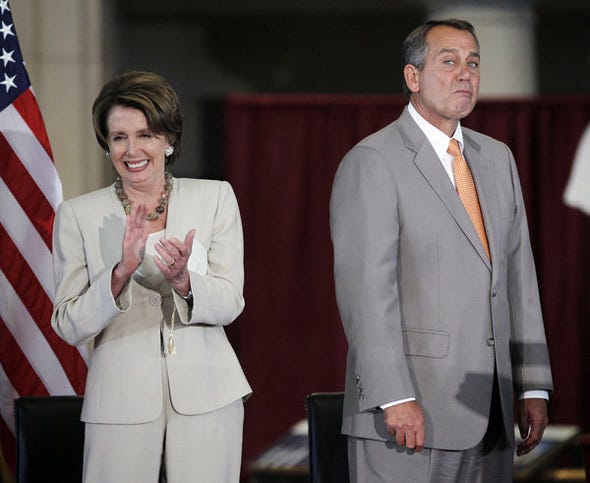
House Republicans Vote (Again) To Repeal Obamacare. LOL!

QueEx

Rising Star
Super Moderator
Re: McDonalds May Drop Health Coverage Due to Obamacare

<font size="5"><Center>
McDonald's Denies WSJ Report
That It Will Drop Health Care Plan</font size></center>


ABC News
By DANIEL ARNALL
and HUMA KHAN
Sept. 30, 2010


<font size="3">McDonald's and the Obama administration are firing back at a report that the fast food giant is considering dropping its "mini-med" health insurance for hourly workers, even as the National Association of Insurance Commissioners said it won't ask for an exemption for such plans. </font size>


"Mini-med" plans, which provide limited coverage at minimal employee cost, came into the spotlight after the Wall Street Journal reported today that McDonald's is planning to drop them because of the new health care law.

The Journal reviewed a memo by McDonald's asking federal officials to determine if their most basic health insurance plans can be exempted from the medical loss ratio (MLR) requirements of the new health care law.

The law requires that 80-85 percent of the premiums received go directly to patient care, not to other expenses like overhead, executive salaries or dividends for shareholders.


McDonald's said the company has no plans to drop the "mini-med" plan.

<font size="3"><center>"Media reports stating that we plan to drop health care coverage
for our employees are completely false,"
said Steve Russell, a senior
vice president and head of human resources for McDonald's, in a
written response to the article. "These reports are purely
speculative and misleading."
</font size></center>

That sentiment was echoed by Health and Human Services Secretary Kathleen Sebelius today.

"The McDonald's story is flat-out wrong, and I am sorry that they were not more accurate in their reporting," Sebelius said at a reporters' breakfast organized by the Christian Science Monitor. "The medical loss ratio issue is one that isn't even settled. ... We have assured the folks at McDonald's and others that as soon as we have a regulation that has a process in it, we will begin those discussions."

<param name="movie" value="http://abcnews.go.com/assets/player/walt2.6/flash/SFP_Walt.swf" /><param name="quality" value="high" /><param name="allowScriptAccess" value="always" /><param name="allowNetworking" value="all" /><param name="flashvars" value="configUrl=http://abcnews.go.com/video/sfp/embedPlayerConfig&configId=406732&clipId=11768744&showId=11764596&gig_lt=1285934558878&gig_pt=1285934562607&gig_g=2" /><param name="allowfullscreen" value="true" /><embed src="http://abcnews.go.com/assets/player/walt2.6/flash/SFP_Walt.swf" quality="high" allowScriptAccess="always" allowNetworking="all" allowfullscreen="true" pluginspage="http://www.adobe.com/shockwave/download/download.cgi?P1_Prod_Version=ShockwaveFlash" type="application/x-shockwave-flash" width="344" height="278" flashvars="configUrl=http://abcnews.go.com/video/sfp/embedPlayerConfig&configId=406732&clipId=11768744&showId=11764596&gig_lt=1285934558878&gig_pt=1285934562607&gig_g=2" name="ABCESNWID"></embed></object>


Nearly 30,000 McDonald's employees currently participate in the plan, which provides a maximum of $2,000 to $10,000 a year in basic medical coverage at a cost of $14 to $32 a week, according to the company. Home Depot, Disney, Blockbuster, Staples and other big retail chains with large populations of hourly employees offer similar plans.

The McDonald's plan, according to the report, has higher overhead costs because it provides insurance to a highly transient population of hourly workers in its restaurants and would not likely meet the minimum ratio requirements of the new law.

HHS guidelines on the medical loss ratio will be based on a report issued by the NAIC, due at the end of the year. Today, the NAIC said that "mini-med" plans will be subject to new medical loss ratio regulations and the group has no plans to ask for an exemption for those.

"Mini-med plans that are sold as stand-alone coverage -- and are not supplemental to a comprehensive plan -- will be subject to the MLR requirement, and we have no plans to ask HHS for a specific exemption on their behalf. If they are sold as comprehensive coverage, we expect them to meet the same MLR standards as other health plans," Kansas Insurance Commissioner and chair of the NAIC Health Insurance Committee Sandy Praeger said in a statement to ABC News.

Speaker of the House Nancy Pelosi's office also came to the defense of the new law, saying in a statement that, "Under the law, workers and businesses will have access to affordable health coverage choices and we are moving toward a system where more of the premiums will go to provide benefits instead of paying for insurance companies' administrative costs."

Medical loss ratio guidelines -- the ratio of medical expenses to administrative spending -- have not been issued yet but the new law sets new stricter guidelines that raise the percentage of the premium dollar that should go to medical care rather than administrative costs and profits. Some "mini-med" plans are eligible for waivers.

The new limits are due to go into effect in January.

Republicans today painted the report as another support for their argument that the health care law should be repealed.

Speaking at the American Enterprise Institute, House Minority Leader John Boehner, R-Ohio, promised to repeal what he called the monstrosity of a health care bill if Republicans gain majority of the House after the mid-term elections.

"If you believe, as I do, that Obamacare will ruin the best health care delivery system in the world, and, as I do, believe it will bankrupt our country, we've made it clear we want a repeal of Obamacare and to replace it with common sense reforms that will bring down the cost of health insurance," Boehner said. "When I say we're going to do everything to make sure that this law does not go into effect, I mean that we will do everything. Is that clear?"


ABC News' Devin Dwyer, Ben Krolowitz and Brian Hartman contributed to this report.

http://abcnews.go.com/Politics/Heal...eport-drop-health-care-plan/story?id=11764596
 
Re: McDonalds May Drop Health Coverage Due to Obamacare

<font size="3">
I'll help him out: </font size>


Republicans today painted the report as another support for their argument that the health care law should be repealed.

Speaking at the American Enterprise Institute, House Minority Leader John Boehner, R-Ohio, promised to repeal what he called the monstrosity of a health care bill if Republicans gain majority of the House after the mid-term elections.

"If you believe, as I do, that Obamacare will ruin the best health care delivery system in the world, and, as I do, believe it will bankrupt our country, we've made it clear we want a repeal of Obamacare and to replace it with common sense reforms that will bring down the cost of health insurance," Boehner said. <SPAN style="BACKGROUND-COLOR: #ffff00">"When I say we're going to do everything to make sure that this law does not go into effect, I mean that we will do everything. Is that clear?"</span>
 
Re: ObamaCare - UPHELD

nancy-pelosi-john-boehner.jpg


:lol::lol::lol:
 
source: The New Republic


cannon.jpg

Can one very determined libertarian and one very distorted version of history keep millions of people from getting health insurance? We’re about to find out.

The determined libertarian is Michael Cannon of the Cato Institute. He was among the most vocal opponents of the Affordable Care Act, going back to the time when it was still a glint in the eyes of Ted Kennedy. The idea of universal coverage is so antithetical to Cannon’s principles that he actually started an "Anti-Universal Coverage Club." Once the law passed and took on the moniker "Obamacare," Cannon became a leading advocate for its repeal. And since he understood the law might survive both the courts and the 2012 elections, as it eventually did, he also made the case that states should avoid complicity in its implementation—and, if possible, actively thwart it. He made that case in his writing and speeches, sometimes directly to the officials with responsibility for implementing the law.

One of the arguments he’s made is a legal one, the result of a collaboration with Jonathan Adler, a widely cited libertarian law professor at Case Western University. The state of Oklahoma has filed a lawsuit in federal court, making the same essential case. (I haven’t been able to establish to what extent, if any, Oklahoma officials relied on the Adler-Cannon brief, but the arguments are very close. And no single individual has done more to make the case for state resistance to Obamacare than Cannon.) Note that the lawsuit doesn't have to succeed to cause trouble: Merely by emboldening state officials hostile to the law, it could make implementation, already a challenge, even more difficult.

The legal argument focuses on Obamacare’s insurance exchanges—the new marketplaces where people without access to insurance will be able to buy private coverage on their own, regardless of pre-existing medical conditions and with the help of federal subsidies. The law calls upon states to create and operate exchanges, so that coverage is available starting on January 1, 2014. Anytime a state fails to do so, the law says, the federal government should create and run that state’s exchange instead.


About these facts, there is no dispute. The question is whether, when running an exchange in lieu of a state, the federal government can operate it in the same way—in particular, whether the federal government has authority to offer those subsidies. These tax credits, available to people on a sliding scale depending on income, will be worth as much as several thousand dollars a year in some cases. They will enable millions of Americans to get comprehensive health insurance, the kind they cannot now because the coverage is too expensive or simply unavailable. Without the subsidies, these people couldn’t get coverage and, quite possibly, the exchanges as a whole would cease to function because they could not maintain a good actuarial balance.

Cannon and Adler, along with the state of Oklahoma and others embracing this cause, argue that the federal government lacks authority to offer those subsidies. Roughly speaking, their reasoning goes like this: The section of the law describing subsidies specifies that Washington may offer them in state-run exchanges, but has no parallel language specifying that Washington may offer them in federally run substitutes. And this omission, Cannon and Adler insist, was no accident. The Senate wanted the states, not Washington, to run the exchanges. And since the federal government can’t order states to do something—that’s called “commandeering”—it had to offer financial incentives. Withholding subsidies unless states ran the exchanges, Cannon and Adler say, was one of those incentives:
The language, structure, legislative history, and congressional debate over the PPACA demonstrate that its authors preferred state-run Exchanges to federal Exchanges. From the outset, the Act directs states to establish Exchanges and many PPACA’s supporters presumed that all states would create exchanges of their own. While the Act authorizes the federal government to establish Exchanges for states that fail to comply with the PPACA’s direction, these exchanges are intended to serve as a fallback, and were not intended to replace state-run exchanges.
The emphasis is mine, because this is really the heart of the case. According to Cannon and Adler, the Senate wanted a system in which states that failed to create exchanges could deprive their citizens of subsidies.

Not too many legal experts seem to think the lawsuit has merit. (Then again, the legal establishment said the same thing about the original lawsuits challenging the constitutionality of the whole law had merit, and those suits came within one very narrow vote of winning at the Supreme Court.) Among the skeptics is Samuel Bagenstos, a professor at the University of Michgan and a widely respected expert on constitutional law. In a recently posted series of blog posts, Bagenstos says Cannon and Adler are reading the statute in an unusually pinched way. The law may not specify that the federal government may offer subsidies when it operates exchanges, Bagenstos says, but elsewhere it talks about the federal government running exchanges in lieu of recalcitrant states. Clearly, Bagenstos says, the Senate bill’s architects wanted these substitute exchanges to be fully functional, complete with subsidies. The whole point was to have the feds do what the states would not. "It is implausible to think that Congress would have intended to create a statute that was so at war with itself,” Bagenstos concludes, “and that rendered largely useless its crucial backup provision for federally-operated exchanges.”

This is the same point that Timothy Jost, a law professor at Washington University, has been making ever since Cannon first raised this argument. Jost may know more about the fine print of the Affordable Care Act than any person on the planet. Here’s his recollection of the legislative history, as related in a blog post for the policy journal Health Affairs:
Throughout the debate, Senators assumed that tax credits would be available in all 50 states. Thus Senator Bingaman stated on December 4, 2009, that the ACA “includes creation of a new health insurance exchange in each State which will provide Americans a centralized source of meaningful private insurance as well as refundable premium tax credits to ensure that coverage is affordable.” Senator Johnson stated on December 17, “The legislation will also form health insurance exchanges in every State,” which will “provide tax credits to significantly reduce the cost of purchasing that [insurance] coverage.”
If Congress had meant to limit premium subsidies to state-established exchanges, as an incentive to States, one would have expected the Finance Committee report … to have mentioned this, and for at least one Senator to have pointed this out during the debate in November and December 2009.
Most importantly, the Congressional Budget Office (together with the Joint Committee on Taxation) provided Congress on November 30, 2009, an analysis of the impact of the legislation on premiums that assumed that premium tax credits would be available in all states, making no distinction between federal and state exchanges. Over the next few days, this analysis was discussed by Republican Senators Grassley, Enzi, and Coburn. None raised what Cannon and Adler see as an obvious point, that the CBO analysis was flawed because it failed to recognize that premium tax credits would not be available though federally facilitated exchanges.
In responses to Jost and Bagenstos, Cannon has suggested that they cannot back up their inferences about intent. I think they have, but I can add some material, as well.

I covered the debate on health care reform from first stirrings of activity in early 2008 to the day President Obama signed legislation at the White House. The debate over whether to have federal or state exchanges was contentious alright. In fact, it was one of the key divisions between the Senate and the House. But everybody always assumed that, if states chose not to create exchanges, the federal government would step in and do the job completely. The idea that a state could deny its citizens insurance subsidies by choosing not to build an exchange is simply not an option the law’s architects ever contemplated.

And you don’t have to take my word for it. From 2008 through 2010, John McDonough was a senior member of the HELP Committee staff; Kennedy had recruited him from Massachusetts, where he’d worked on that state’s reforms, to help craft the final legislation. McDonough has since returned to Boston, where he’s a professor at the Harvard School of Public Health. And he has written a book, Inside Health Reform, that is among the most thorough guides to the law and its crafting. Yes, McDonough says, the HELP Committee decided to withhold feeral subsidies from states that didn’t set up qualifying exchanges. But the reason, he says, was to prevent states from creating shoddy exchanges that didn’t live up to the law’s standards. And in those cases, McDonough says via e-mail, “the subsidy power would then switch to the feds—just as it does in the ACA.”

Another reliable source on the issue is Liz Fowler, who was Baucus’ senior health care adviser on the Finance Committee. While it was President Obama and Democratic congressional leaders who made the big decisions on health care reform, it was a tiny handful of administration officials and senior congressional staff who actually wrote the bills that became final legislation. Fowler was one of them. In fact, she is probably the single most authoritative judge of what her boss and his committee colleagues intended the law to say.

Fowler, who went on to work at the White House and recently left that position, doesn’t speak to the press much. But she agreed to speak about this. “Of course Congress did not intend to deny anyone in any state access to tax credits to which they are entitled,” she says. “That is not how the law is drafted and that is not how it was scored by the CBO.”

The fate of the case won't rest simply on the debate over congressional intent. Among the other issues is standing—specifically, whether Oklahoma can even bring this lawsuit. (The federal government just filed a brief challenging that.) But it's Cannon's congressional intent argument that I find most baffling. I’ve known Michael for a long time. He is smart and congenial, his belief in libertarian principles utterly sincere. Maybe he simply sees things differently. Or maybe he has convinced himself of this reality, because he wants to believe it, as people have been known to do. I honestly don't know.

Whatever the explanation, he's a private citizen and entitled to his opinion. The public officials who have signed onto this crusade are another story. I can’t read their minds, but I'm skeptical that all, or even most, of them honestly believe the Senate intended to give them this sort of discretion. More likely, they see this as an opportunity to thwart a law they oppose—and, perhaps, curry favor with conservative voters or funders. Either motive would violate the basic oath most of them take, pledging to execute the laws in good faith.

If these officials don't like Obamacare, they can criticize it and campaign for representatives in Washington who would repeal it. But as long as Obamacare remains on the books, these officials also have to implement it—just as surely as they implement the minimum wage, environmental regulations, and any other liberal measures they similarly detest. Their first obligation isn't to their ideology, philosophy, or party. It's to the country and that means to enforce its duly passed laws.
 
:roflmao::roflmao::roflmao::dance:

source: NPR


Thursday's vote was the 37th time that House lawmakers have voted to try to curtail Obamacare in some manner, but the third vote on repealing the law outright.

The 37th time is unlikely to be the charm for House Republicans who voted on Thursday yet again to derail Obamacare.

In a largely partisan vote that has become almost routine, the measure to reeal the law passed the Republican-controlled House — this time by a vote of 229-195.

To Democrats, it's a waste of timethey control the Senate, which will simply ignore the House vote. Besides, the president would never sign it.

As The Associated Press points out, Democrats note that the Affordable Care Act "has been upheld by the Supreme Court, and millions are already receiving some benefits, from young adults able to stay on a parent's insurance until age 26, to seniors on Medicare whose high prescription drug bills have been reduced."

Republicans, however, "see a political advantage to keeping the pressure up as the administration tries to get all the moving parts of the law finally working," the news agency says.

And, as The Washington Post reports:
"This slew of three-dozen repeal votes have changed both how the Affordable Care Act works and how the public perceives it.

"Last month, the Kaiser Family Foundation polled Americans on whether the Affordable Care Act is still law. Twelve percent of Americans — that's about one in eight people — think that Congress repealed the Affordable Care Act. Another 23 percent aren't sure or refused to answer the question."


House votes to defund health care
law in bill to finance government


4OFKZ.WiPh2.91.jpg


McClatchy Washington Bureau
By William Douglas
Friday, September 20, 2013


WASHINGTON — The House of Representatives approved a contentious
$986 billion short-term measure Friday to keep the federal government
running through mid-December and defund the Affordable Care Act, President
Barack Obama’s legacy accomplishment.

A victory for conservative House Republicans against some party elders, the
230-189 vote on a continuing resolution to fund the government temporarily
also stripped funding for the health care law and retained the automatic
domestic and military budget cuts known as sequestration. It was the first
move in a complicated political chess match that could lead to lead to a
government shutdown Oct. 1.

“The House has listened to the American people,” House Speaker John Boehner
of Ohio said to the cheers of fellow Republicans. “Now it’s time for the United
States Senate to listen to them as well.”


Read more here: http://www.mcclatchydc.com/2013/09/20/202759/house-votes-to-defund-health-care.html#storylink=cpy


<iframe width="640" height="480" src="//www.youtube.com/embed/R7cRsfW0Jv8" frameborder="0" allowfullscreen></iframe>

More misinformation and smearing the ACA. The video provides no facts, just gives the impression of the government getting involved.

You always have the choice of getting your health plan outside the exchanges. The government only gets involved to provide subsidies for a private plan if your income falls below a certain level.

The only time the government would get involved, is if a person qualifies for Medicaid due to poverty.


I think some people want to give the impression of this being a government takeover, so that a single payer system would seem like Communism.
 
Last edited:


An enemies list is circulating on conservative sites. It doesn't contain Democratic names, as you might expect. Instead it's a list comprising over half of the Republicans in the Senate.

"The following 25 Republicans stood shoulder to shoulder with Senator Harry Reid and President Obama to fund ObamaCare," claims the Tea Party group Freedom Works, before providing a list of Republican senators.

The list contains the usual suspects - GOP senators who aren't Tea Partiers, many of whom have attracted the dreaded RINO label. It includes blue state Republicans like Kelly Ayotte (R-NH), Susan Collins (R-ME), and Mark Kirk (R-IL), and occasional bipartisans like John McCain and Lindsey Graham. It also includes the party's senate leader, Mitch McConnell.

The curious thing is that none of these senators actually voted "for" Obamacare. They voted for cloture, meaning that they voted to let the bill funding government to proceed to the next stage in the Senate, at which point Reid stripped out the "defund Obamacare" amendment. After that, all of the senators on the list voted against the bill - in other words, they voted against funding Obamacare.

Nonetheless, the list continues to circulate and has been shared on other conservative sites.


freedomworks2_logo.png


Establishment Republicans Surrender:
See Whether Your Senators Voted to Fund ObamaCare Here!


Last week, Republicans in the House of Representatives, under great pressure from their constituents, came together and passed a Continuing Resolution (CR) to fund the federal government, but which disallowed any funding for ObamaCare. This afternoon, Republicans the U.S. Senate betrayed their House colleagues and their constituents by voting to send the CR back the House with funding for ObamaCare.

The critical vote today was a procedural vote - on cloture - to end debate and proceed to votes on amendments and passage of the bill. Ending debate requires 60 votes, meaning that the 46 Republicans in the Senate have the numbers to put a stop to a bill if they so choose. After cloture, the remaining votes, including passage of the bill, require only 50 votes to pass, meaning that the Senate Democrats can pass what they wish without Republican input.

As Senators Mike Lee and Ted Cruz have been reminding their colleagues, a 'yes' on cloture is a vote to fund ObamaCare.

The following 25 Republicans stood shoulder to shoulder with Senator Harry Reid and President Obama to fund ObamaCare:

Alexander

Ayotte

Barrasso

Blunt

Boozman

Burr

Chambliss

Chiesa

Coats

Coburn

Cochran

Collins

Corker

Cornyn

Graham

Hoeven

Isakson

Johanns

Johnson (WI)

Kirk

McCain

McConnell

Murkowski

Thune

Wicker​


Meanwhile, the 19 heroes who stood with Senators Cruz and Lee to defund ObamaCare are:

Crapo

Cruz

Enzi

Fischer

Grassley

Heller

Inhofe

Lee

Moran

Paul

Portman

Risch

Roberts

Rubio

Scott

Sessions

Shelby

Toomey

Vitter​


Two Republican senators did not vote:

Flake

Hatch​

Because of the remarkable opportunity presented by the cloture vote today, and thus the magnitude of the failure of these Senate Republicans, FreedomWorks is double-weighting the score of this vote on our online Congressional Scorecard.


SOURCE: FreedomWorks


Reid: Senate will ‘reject’ House CR plan


130730_harry_reid_ap_328.jpg


Updated: 9/28/13 5:40 PM EDT


Senate Democrats will reject the House government funding bill
on the eve of a shutdown, seeking to pressure House Republicans
to approve their plan to keep government running past Tuesday.

The House vote on Saturday on a bill to fund the government
through Dec. 15, delay Obamacare’s individual mandate and
repeal the medical device tax is “pointless,” said Senate
Majority Leader Harry Reid, who added in a blistering statement
that “the American people will not be extorted by Tea Party
anarchists.”


“To be absolutely clear, the Senate will reject both the one-
year delay of the Affordable Care Act and the repeal of the
medical device tax.
After weeks of futile political games from
Republicans, we are still at square one: Republicans must
decide whether to pass the Senate’s clean CR, or force a
Republican government shutdown,”
Reid said in a statement.


Some Senate Republicans, too, are dubious of the House plan.
On Friday, Sen. John McCain (R-Ariz.) warned that the Senate
would not accept even a one-year delay of the individual
mandate.

“The only problem with that is [in] the United States Senate,
you’d have to have 60 Republican votes in the Senate, and you’d
have to have 67 Republican votes to override a veto,” McCain
said. “These are all good ideas, but elections have
consequences. … I campaigned for months [last year], repeal
and replace Obamacare — and it didn’t happen.”


Read more: http://www.politico.com/story/2013/...e-democrats-house-cr-97500.html#ixzz2gEDBJ1lr


<iframe width="560" height="315" src="http://www.nbc.com/assets/video/widget/widget.html?vid=n41321" frameborder="0"></iframe>
 
I would have liked an option that a person can sign some type of waiver to avoid the fines. If you show up in the Emergency Room wanting thousands of dollars in free medical care, the hospital can assess your ability to pay as a condition for treatment and deny you without liability.

I am not big fan of the ACA but it is better than nothing...
 
Last edited:

Is the Effort to Repeal Obamacare Finally Dead?

Or is it merely biding its time?


6ddad51e5.jpg


If the repeal-Obamacare movement is dead, as Salon's Brian Beutler argues today, no one told conservative columnist Erick Erickson, who writes today at RedState (emphasis added):


As we all get back to business today, we must remember the law itself is the problem — not the website. The website they can fix. <SPAN style="BACKGROUND-COLOR: #ffff00">We must deny them the opportunity to fix the law itself. Let the American people see big government in all its glory. THEN offer a repeal.</span>


One rarely sees so bald a statement of the strategic calculations involved.

And while House Republicans currently have no plans to revive repeal efforts during end-of-year budget negotiations, the Huffington Post's Sam Stein reports, the formal GOP position remains advocacy for repeal.


The question for the GOP is how long members can wait before trying again, if they are ever to do so. As of January 1, hundreds of thousands of people will be newly enrolled in public and private health plans thanks to Obamacare. At that point, repeal advocates will find themselves in the unenviable position of seeking to yank insurance from these newly insured without making any viable coverage alternative available to them.

The deeper we get into 2014, the higher the risks for the GOP in a new major repeal effort, because the more people will squeal if there's a threat to their new insurance.

And yet there's something to be said for playing the long game. There are many more parts of the federally run exchange package that have yet to come fully online—from the Spanish-language site to the back-end system for transferring subsidies to consumers—and whatever lift the program gets when it finally becomes more tangible could be undone if there are major new snafus.

The most likely outcome, given the fierce opposition to the law over the past three years, is that Obamacare merely gets added to the permanent Republican complaint list, where it will join Social Security and Medicare as something that's subject to periodic GOP efforts at radical transformation. Just because a program is decades old, successful, and well-loved by voters doesn't mean it can't or won't be opposed by Republican reformers. And right now Obamacare is not yet any of those three things.


A picture is coming into focus of just how many Americans have gained insurance since enrollment under the Affordable Care Act opened in October, as enrollment momentum lowers the projected costs of the program:
  • Four percent of Americans say they are newly insured this year, with 2.1 percent of Americans reporting their coverage comes from a federal or state health exchange created under the Affordable Care Act, according to a Gallup poll released Wednesday. The 4 percent are people who were previously uninsured.

The results, from a sampling of 20,000 adults in the United States conducted between March 4 and April 14, suggest that the law so far has been effective at insuring a significant number of young, presumably healthier people who are needed to offset the higher cost of covering older people with greater health-care needs.

  • The survey found that people between ages 18 and 29 made up 30 percent of the newly insured, although they represent 21 percent of the general population.

  • Blacks make up 15 percent of the uninsured population, with some 6.8 million of them eligible for coverage under Obamacare. From October to February, nearly 3 percent of previously uninsured blacks gained coverage, according to a separate Gallup poll.

  • The enrollment gains prompted <SPAN style="BACKGROUND-COLOR: #ffff00">the nonpartisan Congressional Budget Office to lower its cost estimate for the health care law by $5 billion in 2014 and $104 billion over the next decade. The CBO also found “no clear evidence” that premiums will significantly surge in 2015.</span>

The Take: Do you hear that sound? That's Republicans backpedaling on their crusade to repeal Obamacare.

The CBO report knocks the legs out from under the Republicans’ two most frequent lines of attack—premiums would skyrocket and lead to mass cancellations of plans; and a huge new bureaucracy would form, driving up government spending and wrecking the economy.

Now that the law is taking hold, it’s not a good look for Republicans to campaign on yanking the benefits from voters.

Gallup says the uninsured rate is dropping three times faster in states that opened health care exchanges and expanded Medicaid than it is in states that did not expand Medicaid and/or implement exchanges. Republicans governors in other states thought they had Obamacare licked by refusing to set up exchanges or expand Medicaid, but their efforts are failing in politically pivotal Florida, Michigan and North Carolina—all states where enrollment nonetheless has exceeded the national average.

From a backpedal to a pivot, Republicans are tweaking their message to swap out “repeal” for “replace.” When Congress returns from recess, House Republicans are expected to get to work on replacement legislation.

In North Carolina, the super PAC American Crossroads used both terms in its recent $1 million ad buy for a television spot supporting Republican state House Speaker Thom Tillis’ bid for the U.S. Senate. The ad touts Tillis as “a fiscal conservative with the guts to repeal and replace Obamacare.”


So far, the tough talk isn't doing wonders for the candidate.


http://www.theroot.com/blogs/the_ta...es_police_for_failed_jameis_winston_case.html


Back
Top